
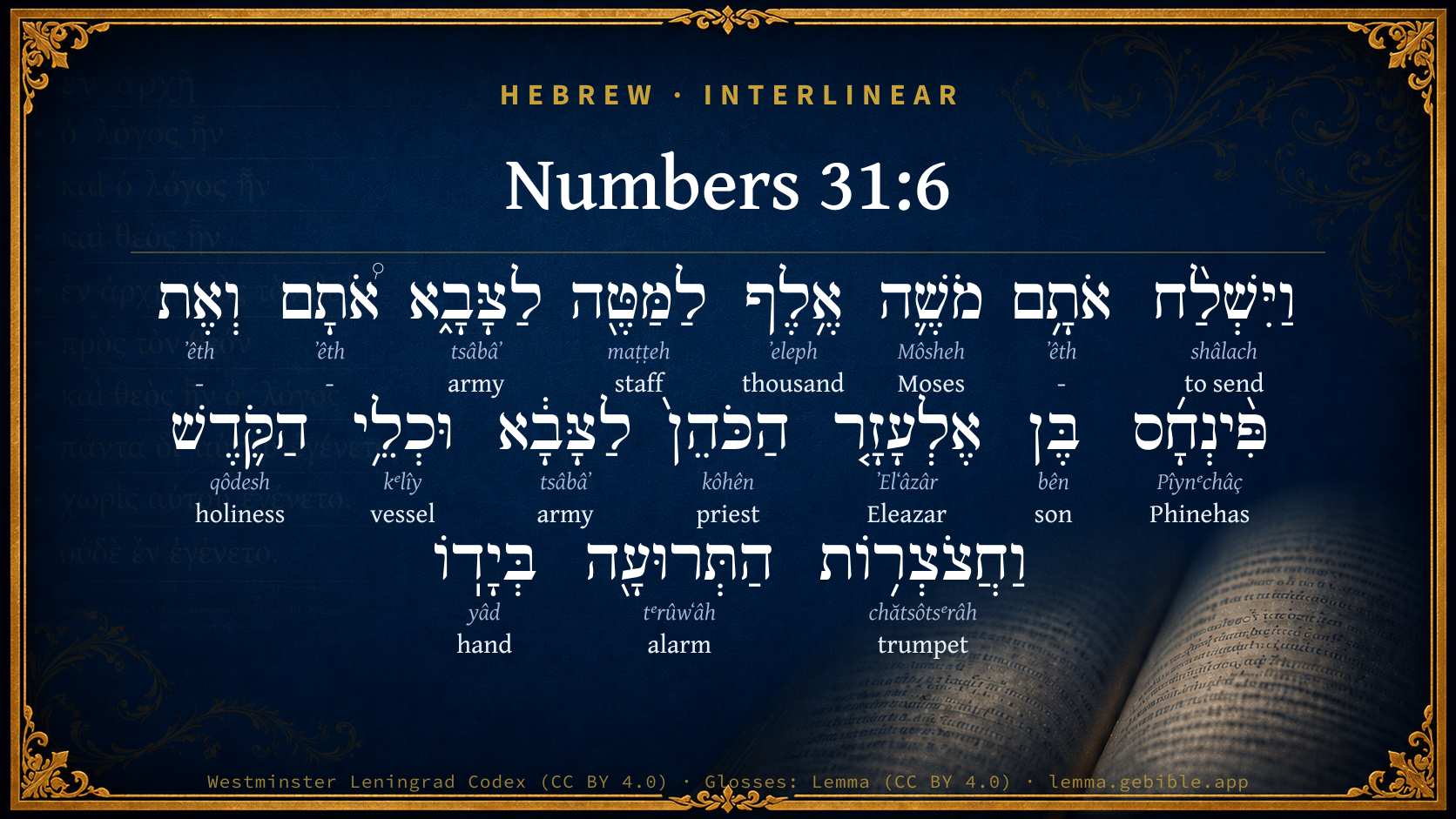
Numbers 31:6

Hebrew (Westminster Leningrad Codex) Numbers 31:6 appears in the Hebrew Old Testament. The text above is from the Westminster Leningrad Codex. Each word links to its Strong’s number, a concise gloss, and parsing drawn from the Open Scriptures Hebrew Bible morphology. Click any word for its full Brown-Driver-Briggs (BDB) entry.
Download image
Cite this verse

Numbers 31:6 (World English Bible). Public Domain. Lemma interlinear Bible study tool, https://lemma.gebible.app/v/numbers/31/6.

Show BibTeX & RIS
BibTeX
RIS
English Translation
Moses sent them, one thousand of every tribe, to the war, them and Phinehas the son of Eleazar the priest, to the war, with the vessels of the sanctuary and the trumpets for the alarm in his hand.
World English Bible · Public Domain
Download a study sheet

One document with this verse’s original text, its word-by-word gloss line, the meaning frame, cross-references with their text, attributed commentary, and full source and license credits — printable, and it pastes into notes with its structure intact.

This verse Autodidact and up

Study sheet (.html) Plain text (.txt)

A passage Seminary Student

Up to 50 verses in one chapter. A passage sheet keeps up to 6 commentary sources and 12 cross-references per verse, in the order this page ranks them, and says so on the sheet whenever that leaves anything out. Ask for a single verse and you get the Autodidact verse sheet above.

Everything on this page stays free to read, with no account — the sheet is a download of what is already on screen, not access to it.

Want to remove ads? Support Godless Engineer
Compare translations 3

The same verse in 3 English versions, stacked beneath the original-language interlinear above. Click any original word for its lexicon entry.

Each is an independent rendering of the whole verse — the interlinear is not word-aligned to these translations.

Highlighted words mark where these versions differ — a whole-verse word diff, not a word-by-word alignment.

  • World English Bible Public Domain
    Moses sent them, one thousand of every tribe, to the war, them and Phinehas the son of Eleazar the priest, to the war, with the vessels of the sanctuary and the trumpets for the alarm in his hand.
  • King James Version Public Domain
    And Moses sent them to the war, a thousand of every tribe, them and Phinehas the son of Eleazar the priest, to the war, with the holy instruments, and the trumpets to blow in his hand.
  • unfoldingWord Literal Text CC BY-SA 4.0
    And Moses sent them to the war, a thousand for a tribe, them and Phinehas the son of Eleazar the priest to the war. And the vessels of holiness and the blasting trumpets were in his hand.

unfoldingWord Literal Text — © unfoldingWord, licensed CC BY-SA 4.0. Word-aligned USFM3 via Door43 (git.door43.org/unfoldingWord/en_ult).

Versions to compare (up to 4)

3 of 4 selected

Show all 18 translations

Every available English version of this verse, each an independent rendering of the whole verse.

  • World English Bible Public Domain
    Moses sent them, one thousand of every tribe, to the war, them and Phinehas the son of Eleazar the priest, to the war, with the vessels of the sanctuary and the trumpets for the alarm in his hand.
  • Berean Standard Bible Public Domain
    And Moses sent the thousand from each tribe into battle, along with Phinehas son of Eleazar the priest, who took with him the vessels of the sanctuary and the trumpets for signaling.
  • Majority Standard Bible Public Domain
    And Moses sent the thousand from each tribe into battle, along with Phinehas son of Eleazar the priest, who took with him the vessels of the sanctuary and the trumpets for signaling.
  • King James Version Public Domain
    And Moses sent them to the war, a thousand of every tribe, them and Phinehas the son of Eleazar the priest, to the war, with the holy instruments, and the trumpets to blow in his hand.
  • American Standard Version (1901) Public Domain
    And Moses sent them, a thousand of every tribe, to the war, them and Phinehas the son of Eleazar the priest, to the war, with the vessels of the sanctuary and the trumpets for the alarm in his hand.
  • Revised Version (1885) Public Domain
    And Moses sent them, a thousand of every tribe, to the war, them and Phinehas the son of Eleazar the priest, to the war, with the vessels of the sanctuary and the trumpets for the alarm in his hand.
  • Geneva Bible (1599) Public Domain
    And Moses sent them to the warre, euen a thousand of euery tribe, and sent them with Phinehas the sonne of Eleazar the Priest to the warre: and the holy instruments, that is, the trumpets to blow were in his hand.
  • Douay-Rheims (1899) Public Domain
    And Moses sent them with Phinees the son of Eleazar the priest, and he delivered to him the holy vessels, and the trumpets to sound.
  • Young's Literal Translation Public Domain
    and Moses sendeth them, a thousand for a tribe, to the host, them and Phinehas son of Eleazar the priest, to the host; and the holy vessels, and the trumpets of the shouting, in his hand.
  • Literal Standard Version CC BY-SA 4.0
    and Moses sends them, one thousand for a tribe, to the war; [he sent] them and Phinehas son of Eleazar the priest to the war, with the holy vessels and the trumpets of shouting in his hand.
  • Unlocked Literal Bible CC BY-SA 4.0
    Then Moses sent them to battle, a thousand from every tribe, along with Phinehas son of Eleazar the priest, and with some articles from the holy place and the trumpets in his possession for sounding signals.
  • unfoldingWord Literal Text CC BY-SA 4.0
    And Moses sent them to the war, a thousand for a tribe, them and Phinehas the son of Eleazar the priest to the war. And the vessels of holiness and the blasting trumpets were in his hand.
  • Darby Bible Public Domain
    And Moses sent them to the war, a thousand by the tribe, them and Phinehas the son of Eleazar the priest, to the war, and the holy instruments, even the alarm-trumpets in his hand.
  • World Messianic Bible Public Domain
    Moses sent them, one thousand of every tribe, to the war with Phinehas the son of Eleazar the priest, to the war, with the vessels of the sanctuary and the shofars for the alarm in his hand.
  • Webster's Bible Public Domain
    And Moses sent them to the war, a thousand of every tribe, them and Phinehas the son of Eleazar the priest, to the war, with the holy instruments, and the trumpets to blow in his hand.
  • Free Bible Version CC BY-SA 4.0
    Moses sent them into battle, one thousand from each tribe, together with Phinehas, son of Eleazar the priest. He carried with him the holy objects from the sanctuary and the trumpets used for giving signals.
  • Bible in Basic English Public Domain
    And Moses sent them out to war, a thousand from every tribe, and with them Phinehas, the son of Eleazar the priest, taking in his hands the vessels of the holy place and the horns for sounding the note of war.
  • JPS Tanakh (1917) Public Domain
    And Moses sent them, a thousand of every tribe, to the war, them and Phinehas the son of Eleazar the priest, to the war, with the holy vessels and the trumpets for the alarm in his hand.

Literal Standard Version (2020), Covenant Press — licensed CC BY-SA 4.0. Text via the HelloAO Bible API (eBible.org). Unlocked Literal Bible (unfoldingWord) — licensed CC BY-SA 4.0. Text via the HelloAO Bible API (eBible.org). unfoldingWord Literal Text — © unfoldingWord, licensed CC BY-SA 4.0. Word-aligned USFM3 via Door43 (git.door43.org/unfoldingWord/en_ult). Free Bible Version, Dr. Jonathan Gallagher — licensed CC BY-SA 4.0. Text via the HelloAO Bible API (eBible.org).

Word by word

More ways to search: Search by grammar → Find every occurrence → Compare this word →

Practice this passage: Drill this verse → Learn its vocabulary →

פִּ֨ינְחָ֜ס
Pîynᵉchâç
H6372
“Phinehas”
Noun, Proper
Part of Speech
Noun
Type
Proper
Full BDB Definition

Origin: apparently from H6310 and a variation of H5175

TWOT: None

Phinehas = "mouth of brass" - son of Eleazar and grandson of Aaron; his zealousness for the Lord averted a plague on Israel and gained him the promise of the Lord of an everlasting priesthood in his family - a priest and the son of the priest Eli - the father of a helper of Ezra
  1. וַיִּשְׁלַ֨ח shâlach H7971 “and · to send” Conjunction + Verb, Qal, Sequential Imperfect, 3rd Person, Masculine, Singular
  2. אֹתָ֥ם ʼêth H853 “- · them” Particle, Direct Object + Suffix, Personal, 3rd Person, Masculine, Plural
  3. מֹשֶׁ֛ה Môsheh H4872 “Moses” Noun, Proper
  4. אֶ֥לֶף ʼeleph H505 “thousand” Adjective, Cardinal number, Both, Singular, Absolute
  5. לַמַּטֶּ֖ה maṭṭeh H4294 “to/for the · staff” Preposition, Determined + Noun, Common, Masculine, Singular, Absolute
  6. לַצָּבָ֑א tsâbâʼ H6635 “to/for the · army” Preposition, Determined + Noun, Common, Both, Singular, Absolute
  7. אֹ֠תָם ʼêth H853 “- · them” Particle, Direct Object + Suffix, Personal, 3rd Person, Masculine, Plural
  8. וְאֶת ʼêth H853 “and · -” Conjunction + Particle, Direct Object
  9. בֶּן bên H1121 “son of” Noun, Common, Masculine, Singular, Construct
  10. אֶלְעָזָ֤ר ʼElʻâzâr H499 “Eleazar” Noun, Proper
  11. הַכֹּהֵן֙ kôhên H3548 “the · priest” Particle, Definite Article + Noun, Common, Masculine, Singular, Absolute
  12. לַצָּבָ֔א tsâbâʼ H6635 “to/for the · army” Preposition, Determined + Noun, Common, Both, Singular, Absolute
  13. וּכְלֵ֥י kᵉlîy H3627 “and · vessels of” Conjunction + Noun, Common, Masculine, Plural, Construct
  14. הַקֹּ֛דֶשׁ qôdesh H6944 “the · holiness” Particle, Definite Article + Noun, Common, Masculine, Singular, Absolute
  15. וַחֲצֹצְר֥וֹת chătsôtsᵉrâh H2689 “and · trumpets of” Conjunction + Noun, Common, Feminine, Plural, Construct
  16. הַתְּרוּעָ֖ה tᵉrûwʻâh H8643 “the · alarm” Particle, Definite Article + Noun, Common, Feminine, Singular, Absolute
  17. בְּיָדֽוֹ yâd H3027 “in/at · hand · his” Preposition + Noun, Common, Both, Singular, Construct + Suffix, Personal, 3rd Person, Masculine, Singular

About this verse

These counts appear in no published source. They are computed here, from the morphology-tagged text and Lemma’s own curated glosses. What Lemma adds →

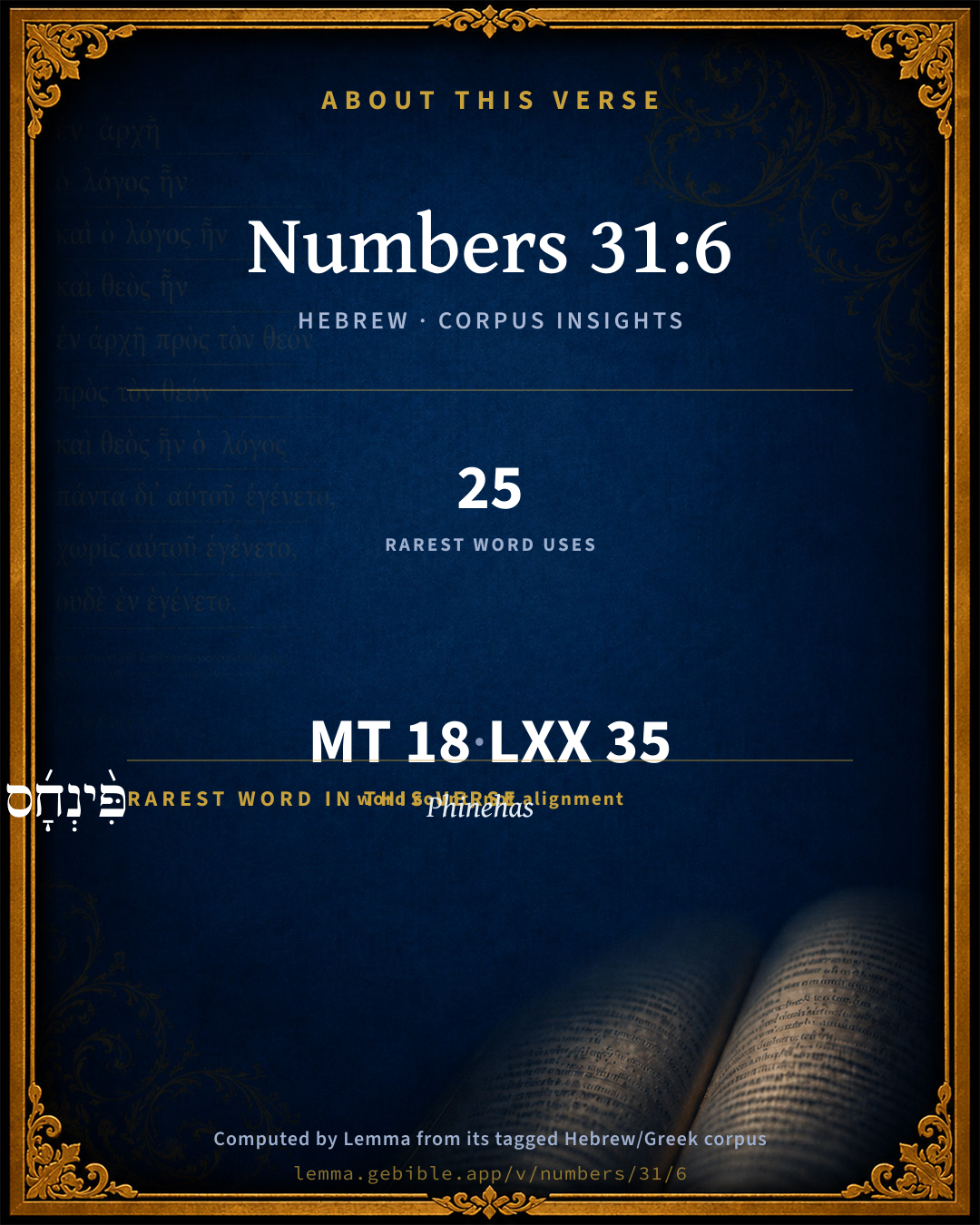
18
words
15
distinct lemmas
Pentateuch
section

Notable vocabulary

The rarest word here is פִּ֨ינְחָ֜ס Phinehas H6372 — appearing just 25 times in the whole Hebrew Bible.

Shared distinctive vocabulary

פִּ֨ינְחָ֜ס Phinehas H6372 occurs in 24 verses of the Hebrew Bible. Also found in:

Grammatical profile

  • 1 verb
  • 13 nouns
  • 1 adjective
  • 3 particles

Verb forms

  • וַיִּשְׁלַ֨ח Qal · Sequential Imperfect

Repetition

A word recurs within this verse — often emphatic in Hebrew:

  • לַצָּבָ֑א army H6635 ×2

Hebrew & Septuagint length

In English translation the verse runs 38 words from the Hebrew and 37 from the Septuagint (LXX English) — closely comparable.

A rough comparison of the two English renderings, which tokenize alike — not a word-level alignment.

Word counts can differ between the Hebrew and the Greek without any difference in meaning — e.g. the Hebrew direct-object marker אֵת has no separate Greek word, and Greek often adds the article ὁ.

In the original languages it is 18 Hebrew tokens and 35 Greek tokens — but the two are counted differently (Hebrew bundles its prefixes and suffixes into one token; the Greek is in lemma form), so that isn’t a like-for-like length.

Cross-references

13

Topical passages linked to Numbers 31:6 in the Treasury of Scripture Knowledge — connected by theme and wording, ordered by reader-vote popularity; previews shown in the World English Bible.

  • Numbers 14:44 But they presumed to go up to the top of the mountain: nevertheless the ark of the covenant of Yahweh, and Moses, didn't depart out of the camp.
  • Numbers 10:8–9 The sons of Aaron, the priests, shall blow the trumpets; and they shall be to you for a statute forever throughout your generations.
  • Exodus 25:9 According to all that I show you, the pattern of the tent, and the pattern of all of its furniture, even so you shall make it.
  • Numbers 25:7–13 When Phinehas, the son of Eleazar, the son of Aaron the priest, saw it, he rose up from the midst of the congregation, and took a spear in his hand;
  • Numbers 33:20–22 They traveled from Rimmon Perez, and encamped in Libnah.
  • Joshua 6:4–6 Seven priests shall bear seven trumpets of rams' horns before the ark: and the seventh day you shall compass the city seven times, and the priests shall blow the trumpets.
  • Joshua 6:13–15 The seven priests bearing the seven trumpets of rams' horns before the ark of Yahweh went on continually, and blew the trumpets: and the armed men went before them; and the rearward came after the ark of Yahweh, [the priests] blowing the trumpets as they went.
  • 1 Samuel 4:4–5 So the people sent to Shiloh; and they brought from there the ark of the covenant of Yahweh of Hosts, who sits [above] the cherubim: and the two sons of Eli, Hophni and Phinehas, were there with the ark of the covenant of God.
  • 1 Samuel 4:17 He who brought the news answered, Israel is fled before the Philistines, and there has been also a great slaughter among the people, and your two sons also, Hophni and Phinehas, are dead, and the ark of God is taken.
  • 1 Samuel 14:18 Saul said to Ahijah, Bring here the ark of God. For the ark of God was [there] at that time with the children of Israel.
  • 1 Samuel 23:9 David knew that Saul was devising mischief against him; and he said to Abiathar the priest, Bring here the ephod.
  • 2 Samuel 11:11 Uriah said to David, The ark, and Israel, and Judah, abide in booths; and my lord Joab, and the servants of my lord, are encamped in the open field; shall I then go into my house, to eat and to drink, and to lie with my wife? as you live, and as your soul lives, I will not do this thing.
  • 2 Chronicles 13:12–15 Behold, God is with us at our head, and his priests with the trumpets of alarm to sound an alarm against you. Children of Israel, don't you fight against Yahweh, the God of your fathers; for you shall not prosper.

Cross-references courtesy of OpenBible.info (CC BY 4.0).

Hebrew and Greek witnesses Masoretic Hebrew ↔ Greek Septuagint

The same verse in the two great witnesses to the Old Testament, shown verse-for-verse.

These are two independent witnesses, not word-aligned to each other, and the Septuagint is shown in lemma (dictionary) form.

Hebrew Numbers 31:6 Masoretic · Westminster Leningrad Codex

וַיִּשְׁלַ֨ח אֹתָ֥ם מֹשֶׁ֛ה אֶ֥לֶף לַמַּטֶּ֖ה לַצָּבָ֑א אֹ֠תָם וְאֶת פִּ֨ינְחָ֜ס בֶּן אֶלְעָזָ֤ר הַכֹּהֵן֙ לַצָּבָ֔א וּכְלֵ֥י הַקֹּ֛דֶשׁ וַחֲצֹצְר֥וֹת הַתְּרוּעָ֖ה בְּיָדֽוֹ

Moses sent them, one thousand of every tribe, to the war, them and Phinehas the son of Eleazar the priest, to the war, with the vessels of the sanctuary and the trumpets for the alarm in his hand.

World English Bible · Public Domain

Greek LXX Numbers 31:6 Septuagint · lemma form

καί ἀποστέλλω αὐτός μωυσῆς χίλιοι ἐκ φυλή χίλιοι ἐκ φυλή σύν δύναμις αὐτός καί φινεες υἱός ελεαζαρ υἱός ἀαρών ὁ ἱερεύς καί ὁ σκεῦος ὁ ἅγιος καί ὁ σάλπιγξ ὁ σημασία ἐν ὁ χείρ αὐτός

And Moses sent them away a thousand of every tribe with their forces, and Phinees the son of Eleazar the son of Aaron the priest: and the holy instruments, and the signal trumpets were in their hands.

LXX2012 (modern English Septuagint) · Public Domain

On this verse, The Pulpit Commentary discusses the Septuagint’s reading. Read the note in Commentary ↓

Hebrew: Westminster Leningrad Codex (CC BY 4.0). Greek: Septuagint (public domain); English from LXX2012 (modern English Septuagint) (Public Domain). How the Septuagint differs from the Hebrew →

Targum (Aramaic paraphrase)

2

The Targum is the ancient Jewish Aramaic paraphrase of the Hebrew Scriptures — an interpretive translation, not the Hebrew text itself. Onkelos (literal) and Pseudo-Jonathan (expansive) render the Torah, and Jonathan the Prophets. Coverage is partial: where no permissively-licensed English translation exists for a verse, only the Aramaic is shown. This is verse-level text, not a word-by-word alignment to the Hebrew.

  1. Targum Onkelos Torah (Genesis–Deuteronomy)
    וּשְׁלַח יָתְהוֹן משֶׁה אַלְפָא לְשִׁבְטָא לְחֵילָא יָתְהוֹן וְיָת פִּינְחָס בַּר אֶלְעָזָר כַּהֲנָא לְחֵילָא וּמָנֵי דְקוּדְשָׁא וַחֲצוֹצְרוֹת יַבֶּבְתָּא בִּידֵיהּ

    (no public-domain English translation for this verse)

    Targum Onkelos — Aramaic: “Onkelos Genesis” (public domain); “Onkelos Exodus” (public domain); “Onkelos Leviticus” (public domain); “Onkelos Numbers” (public domain); “Onkelos Deuteronomy” (public domain). English: “Sefaria Community Translation” (CC0 1.0 (public-domain dedication)); “J.W. Etheridge. The Targums of Onkelos and Jonathan Ben Uzziel on the Pentateuch. London: Longmans, Green, 1862” (public domain). Text via Sefaria.

  2. Targum Pseudo-Jonathan Torah (Genesis–Deuteronomy)
    וּשְׁדַר יַתְהוֹן משֶׁה אַלְפָא לְשִׁבְטָא לְחֵילָא יַתְהוֹן וְיַת פִּנְחָס בַּר אֶלְעָזָר כַּהֲנָא לְחֵילָא וְאוּרַיָא וְתֻמַיָא דְקוּדְשַׁיָא לִמְשַׁיְילָא בְּהוֹן וַחֲצוֹצְרוֹת יַבָּבָא בִּידֵיהּ לְמִכְנַשׁ וּלְמִשְׁרֵי וּלְמֵיטַל מַשְׁרִיתָא דְיִשְרָאֵל

    And Mosheh sent them, a thousand of each tribe to the war, them and Phinehas bar Elazar the priest unto the war, with the Uraia and Thummaia consecrated to inquire for them, and the Jubilee trumpets in his hand for assembling, encamping, and ordering forward the host of Israel.

    Targum Pseudo-Jonathan — Aramaic: “Targum Jonathan on Genesis” (public domain); “Targum Jonathan on Exodus” (public domain); “Targum Jonathan on Leviticus” (public domain); “Targum Jonathan on Numbers” (public domain); “Targum Jonathan on Deuteronomy” (public domain). English: “The Targum of Jonathan ben Uzziel, trans. J. W. Etheridge, London, 1862” (public domain). Text via Sefaria.

Commentary

Notes on Numbers 31:6 from classic Christian and Jewish commentators (each source and its license shown beneath its notes). The classic Christian expositions comment on the surrounding passage and are grouped to its opening verse, so a note may address several verses; the Jewish commentaries on the Tanakh (Rashi and others) are per-verse, so they appear only where the commentator wrote on this verse.

Lemma curates 59 commentaries, every one of them public domain or Creative Commons licensed, each selected and text-cleaned for this edition rather than reprinted as found. About our sources →

Trapp's Complete Commentary

John Trapp

Num 31:6 And Moses sent them to the war, a thousand of [every] tribe, them and Phinehas the son of Eleazar the priest, to the war, with the holy instruments, and the trumpets to blow in his hand.

Ver. 6. Them and Phinehas.] Not without Joshua, the general (though not here mentioned), the mighty conqueror of all Israel’s enemies that rose up and resisted them: famous is he for his faithfulness and fortitude, In cognoscendis rebus bellicis perspicax, in agendo solers: noverat optime insidias facere, proelium committere, victoria uti, &c., as Dio saith {a} of Decebalus, king of the Daci, in Domitian’s days: i.e., Well skilled in warlike businesses, and diligent in despatching them; He knew well how to lay an ambush, worst an enemy, use a victory, &c.

{a} Dio, in Domitiano.

John Trapp, A Commentary or Exposition upon All the Books of the Old and New Testament (1647–1656) — public domain. Text from a community e-Sword module.

Joseph Benson's Commentary

Num 31:6. Them and Phinehas — Who had the charge, not of the army, as general, (an office never committed to a priest in all the Old Testament,) but of the holy instruments, and was sent to encourage and quicken them in their enterprise. The holy instruments — The holy breast plate, wherein was the Urim and Thummim, which was easily carried, and was very useful in war, upon many emergent occasions.

Joseph Benson's Commentary on the Old and New Testaments (1811–1818) — public domain. Text from a community e-Sword module.

Tyndale Open Study Notes

Tyndale Open Resources

31:6 Phinehas son of Eleazar (the high priest) led this force of 12,000 into battle. His leadership helped to define this engagement as “holy war,” an act of revenge for the spiritual harm that Midian had inflicted on Israel (cp. 25:6-18; 31:15-16). His zeal in this situation (Num 25:11, 13) was equal to what he demonstrated in the case of Zimri and Cozbi (25:7-8). • Many believe that holy objects of the sanctuary meant the Ark, which the Hebrews sometimes carried into battle (e.g., 10:35-36; Josh 6:6; 1 Sam 4:3-11; cp. Num 14:44). Others suggest that they were a variety of sacred vessels associated with the Tabernacle rituals (3:31; 4:15; 18:3; cp. 1 Kgs 8:4; 1 Chr 9:29; 2 Chr 5:5). The Israelites probably took some or all of these holy objects as symbols of God’s participation in their holy war.

Tyndale Open Study Notes — © Tyndale Open Resources, licensed CC BY-SA 4.0. Text via the HelloAO Bible API.

Geneva Bible (1599)

Geneva Bible translators

For his great zeal that he bare to the Lord, Num. 25:13.

Geneva Bible (1599) marginal notes — public domain. Text via Bolls.life.

Jamieson, Fausset & Brown

Robert Jamieson, A. R. Fausset & David Brown

Moses sent . . . Eleazar the priest, to the war--Although it is not expressly mentioned, it is highly probable that Joshua was the general who conducted this war. The presence of the priest, who was always with the army (Deu 20:2), was necessary to preside over the Levites, who accompanied the expedition, and to inflame the courage of the combatants by his sacred services and counsels.

holy instruments--As neither the ark nor the Urim and Thummim were carried to the battlefield till a later period in the history of Israel, the "holy instruments" must mean the "trumpets" (Num 10:9). And this view is agreeable to the text, by simply changing "and" into "even," as the Hebrew particle is frequently rendered.

Jamieson, Fausset & Brown — Commentary Critical and Explanatory on the Whole Bible (1871) — public domain (CC PDM 1.0). Text via the HelloAO Bible API.

Adam Clarke's Commentary

Verse 6. A thousand of every tribe] Twelve thousand men in the whole. And Phinehas, the son of Eleazar; some think he was made general in this expedition, but this is not likely. The ark and its contents must proceed to this battle, because the battle was the Lord's, and he dwelt between the cherubim over the ark; and Phinehas, who had before got a grant in the eternal priesthood, was chosen to accompany the ark in place of his father Eleazar, who was probably now too far advanced in years to undergo the fatigue. Who then was general? Joshua, without doubt, though not here mentioned, because the battle being the Lord's, he alone is to have the supreme direction, and all the glory. Besides, it was an extraordinary war, and not conducted on the common principle, for we do not find that peace was offered to the Midianites, and that they refused it; see De 20:10, c. In such a case only hostilities could lawfully commence but they were sinners against GOD; the cup of their iniquity was full, and God thought proper to destroy them. Though a leader there certainly was, and Joshua was probably that leader, yet because God, for the above reason, was considered as commander-in-chief, therefore no one else is mentioned; for it is evident that the sole business of Phinehas was to take care of the holy instruments and to blow with the trumpet.

Adam Clarke's Commentary on the Bible (1810–1826) — public domain. Text from a community e-Sword/MySword module.

Ellicott's Commentary for English Readers

(6) With the holy instruments, and . . . —Or, with the holy instruments, even, &c. It does not appear whether the ark did or did not accompany the expedition. It has been inferred from Num_14:44 that the reference may be to the ark, but it does not appear probable that the ark would be so described. Moreover, Phinehas was not the high priest, and therefore would not have the ephod with the breastplate, which was worn at this time by-Eleazar. The reference may be only to the silver trumpets (see Num_10:9), or it may include other sacred instruments. This was emphatically a holy war; and we may learn, from the command given to the Israelites to take with them “the holy instruments,” that they who would engage in the war against sin and Satan must “take to them the whole armour of God” (Eph_6:13).

A Bible Commentary for English Readers, edited by Charles John Ellicott (1878–1897) — public domain. Text from a community e-Sword module.

The Cambridge Bible for Schools and Colleges

gen. ed. J. J. S. Perowne

6. The war being of a strictly religious character, the soldiers were apparently led not by Moses or Joshua but by Phinehas the priest, who had previously displayed his zeal against the Midianites (Num_25:6-8). Eleazar the chief priest is represented as staying behind in the camp, perhaps from fear of pollution by contact with the dead.

the vessels of the sanctuary] The word rendered ‘vessels’ is a general term which may denote any utensils or objects. It has been suggested that the writer had in mind the ephod containing the Urim and Tummim by which Phinehas could enquire of God concerning the conduct of the battle; but it is doubtful whether that right would be ascribed to any but the high priest (cf. Num_27:21).

The Cambridge Bible for Schools and Colleges (gen. ed. J. J. S. Perowne; Cambridge University Press, 1878–1918) — public domain. Text from a community e-Sword module.

John Gill's Exposition

And Moses sent them to the war,.... Being mustered and armed:

a thousand of every tribe, them and Phinehas the son of Eleazar the priest to the war; which looks as if Phinehas was the general of this army; for Moses went not to the war, and no mention is made of Joshua, nor might it be proper for him, he being the successor of Moses, who was quickly to die; but it seems rather that there was no one person that had the command of the whole, but every captain commanded his own company; since, when Moses met them, and was angry with them for sparing the women, he does not address anyone as the chief commander, but all the officers, Num 31:14, however, it was very proper and prudent to send Phinehas with them, both on account of his office as a priest, to encourage the people, and because of his extraordinary zeal against the Midianites for what they had done, as appears by his slaying a prince of Simeon and a Midianitish princess in their uncleanness:

and he went with the holy instruments, and the trumpets to blow in his hand; by "the holy instruments", Aben Ezra understands the ark with what appertained to it, which in later times used to be carried out when the Israelites went to war, Jos 6:4, and Jarchi interprets them of the ark and plate of gold (z) which was upon the forehead of the high priest; but what had Phinehas to do with this, who was but a common priest? though the Targum of Jonathan paraphrases it,"with the Urim and Thummim of holiness, to inquire by them;''and it appears, that sometimes a son of an high priest was intrusted with the ephod, to which the breastplate was fastened, which had the Urim and Thummim on it, and made use thereof to inquire by, as in the times of David, Sa1 23:6, but it is the opinion of some learned men, and they may be in the right, that these instruments are no other than the trumpets, and who suppose the "vau" is not copulative, but explanative, so Ben Gersom, and read the words thus, "with the holy instruments, even", or, "that is, the trumpets" (a), the silver trumpets ordered to be made, Num 10:2 one of which was far the journey of the camps, and also to blow an alarm for war, and which was done by the priests; and so the Targum of Jonathan adds here,"to cause the camp of Israel to rest, and to cause it to go;''that is, to direct it when it should stop, and when it should move.

(z) So the Rabbins in Abendana in Miclol Yophi in loc. (a) "erantque tubae", Tigurine version; "id est tubae", Vatablus; "nempe tubae", Piscator; so Ainsworth.

John Gill's Exposition of the Whole Bible (1746–1763) — public domain (CC PDM 1.0). Text via the HelloAO Bible API.

Albert Barnes' Notes on the Bible

Phinehas - He was marked out as the fitting director of the expedition by his conduct (compare Num 25:7-13) in the matter of Zimri and Cozbi.

With the holy instruments, and the trumpets - Or rather, “with the holy instruments, to wit, the trumpets,” for the trumpets themselves seem to be the instruments intended.

Albert Barnes' Notes on the Bible (1834–1885) — public domain. Text from a community e-Sword/MySword module.

Haydock's Catholic Bible Commentary

Trumpets. These are the holy vessels just specified, though some believe that he carried the ark, which was done in some wars, Josue vi. 1., and 1 Kings iv. 5. Priests always sounded the trumpet, Deuteronomy xx. 2. Phinees was appointed general of this expedition to reward him for his zeal against the fornicators. (Calmet) --- Or Josue headed the army, as he did on other occasions, though his name be not here specified. The tribe of Levi was not obliged to go to battle, and therefore only twelve tribes send each 1000. Josue had been elected general by God, so that it was not necessary to mention his name. (Salien)

George Leo Haydock (1774–1849), Haydock's Catholic Family Bible and Commentary, 1859 edition — public domain. Excludes Psalms (Douay-Rheims chapter numbering differs from Protestant) and Deuterocanonical books (Catholic canon only).

Matthew Poole's English Annotations

Phinehas had the charge not of the army, as general, (an office never committed to any priest in all the Old Testament,) but of

the holy instruments, & c. as is here expressed, and was also sent to encourage, and quicken, and confirm them in their good enterprise. It is not here mentioned who was the general, whether Joshua, as some think, because he is not named amongst those who went out to meet the returning host, though that might be for other reasons, or some other prince, nor is it worth while to determine. The holy instruments; either,

1. The ark, with the things belonging to it, which before the building of the temple they did sometimes carry into the war for the encouragement of their army. See Num 14:44; Jos 6:9; 1Sa 4:4; 14:18. But why then is it thus ambiguously expressed, seeing in all the other places it is called by its proper name? Nor is the ark ever so called in Scripture. Or,

2. The trumpets, as it here follows, the words being thus to be read, the holy instruments that is, the trumpets; for and is ofttimes put exegetically for that is, or to wit, as Gen 13:15; 1Ch 21:12, compared with 2Sa 24:13; Zec 1:4; 9:9, &c. Or rather,

3. The holy breastplate, wherein was the Urim and Thummim, which was easily carried and used, and very useful in war upon many emergent occasions. See 1Sa 23:9; 30:7.

And the trumpets, which were to be used in war as well as in the service of the tabernacle. See Num 10:9; 2Ch 13:12.

Matthew Poole's English Annotations on the Holy Bible (1683–1685) — public domain. Text from a community e-Sword/MySword module.

The Pulpit Commentary

And Phinehas the son of Eleazar. The high priest himself could not leave the camp and the sanctuary, because of his duties, and because of the risk of being defiled (see verse 19); but his son, who was already marked out as his successor, could act as his representative. (see on Num_16:37) In after times the Messiah Milchama ("Sacerdos unctus ad bellum," alluded to in Deu_20:2) who accompanied the army to the field was a recognized member of the Jewish hierarchy. Phinehas was of course specially marked out by his zeal for the present duty, but we may suppose that he would have gone in any case. With the holy instruments, and the trumpets. Septuagint, kai ta skeuh ta agia kai ai salpiggev . The word instruments (yleK) is the same more usually translated "vessel," as in Num_3:31, and is apparently to be understood of the sacred furniture of the tabernacle. It is difficult to understand what "holy vessels" could have accompanied an expedition of this sort, unless it were the ark itself. The Israelites were accustomed at all critical times to be preceded by the ark, (Num_10:33Jo Num_3:14 Num_6:8) and the narrative of 1Sa_4:3 sq. shows plainly that, long after the settlement at Shiloh, no scruples existed against bringing it forth against the foes of Israel and of God. Indeed there is a resemblance in the circumstances between that ease and this which is all the more striking because of the contrast in the result. Most modern commentators, unwilling to believe that the ark left the camp, (but cf. Num_14:44) identify the "holy instruments" with "the trumpets;" this, however, is plainly to do violence to the grammar, which is perfectly simple, and is contrary to the Septuagint and the Targums. The Targum of Palestine paraphrases "holy instruments" by Urim and Thummim; these, however, as far as we can gather, seem to have been in the exclusive possession of the high priest.

The Pulpit Commentary (1880–1919), ed. H.D.M. Spence-Jones & Joseph S. Exell — public domain. Text from a community e-Sword module.

John Wesley's Explanatory Notes

Them and Phinehas - Who had the charge not of the army, as general, (an office never committed to a priest in all the Old Testament) but of the holy instruments, and was sent to encourage, and quicken, them in their enterprize. The holy instruments - The holy breast-plate, wherein was the Urim and Thummim, which was easily carried, and very useful in war upon many emergent occasions.

John Wesley, Explanatory Notes Upon the Whole Bible (1754–1765) — public domain. Text via the GEBible commentary corpus.

unfoldingWord translationNotes

Door43 World Missions Community

Evi, Rekem, Zur, Hur, and Reba

These are names of kings of Midian. (See: How to Translate Names)

Balaam son of Beor

Beor was Balaam's father. See how you translated this in Numbers 22:5.

translationWords

Phinehas

Eleazar

priest

holy place

trumpet

possess

command

king

die

Balaam

sword

unfoldingWord translationNotes — © Distant Shores Media and the Door43 World Missions Community, licensed CC BY-SA 4.0. Source: git.door43.org/Door43/en_tn.

Rashi

Rabbi Shlomo Yitzchaki (Rashi)

אתם ואת פינחס [MOSES SENT THEM … TO THE WAR], THEM AND PHINEAS — The repetition of the word אתם, “them”, in association with Phineas’ name tells us that Phineas was regarded as equal to all of them together. — But why did Phineas go and Eleazar did not go? The Holy One, blessed be He, said, “He who made a beginning with this meritorious work, in that he slew Kozbi the daughter of Zur (who was a Midianitess), let him complete it”. — Another explanation why Phineas and not Eleazar went is that he went to take vengeance for Joseph, his mother’s ancestor, as it is said, (Genesis 37:36) “And the Midianites sold him [unto Egypt]”. And from where do we know that Phineas’ mother was of the family of Joseph? Because it is said, (Exodus 6:25) that she was “one of the daughters of Putiel” (see Rashi on that verse) — which is explained to mean that she was of the seed of Jethro who used to fatten (פטם) calves for idolatrous worship, and of the seed of Joseph who overcame (שפטפט, who talked or argued with) his passions (cf. Sifrei Bamidbar 157:4; Sotah 43a). — Another explanation: Phineas went because he was the high priest anointed for war purposes (cf. Deuteronomy 20:2 and Rashi thereon) (Sotah 43a).

וכלי הקדש AND THE VESSELS OF HOLINESS … [WERE WITH THEM] — these were the Ark and the Golden Plate (which are termed קדש, “holiness”, in Numbers 4:20 and Leviticus 8:9 respectively) (cf. Sifrei Bamidbar 157:4; Sotah 43a). — Because Balaam was with them (the Midianites) and through enchantment he made the kings of Midian float in the air and he himself floated with them, he (Phineas) showed them (held up to them) the Golden Plato upon which the Divine Name was engraved and they immediately fell to the ground. On this account it is said (v. 8) of the Kings of Midian that they were killed “upon those belonging to them who had been killed”, meaning that they fell from the air upon those who had already been killed; and similarly of Balaam it is written in the book of Joshua (13:22): “[And Balaam the son of Beor did the children of Israel slay] upon those who were slain by them” (Midrash Tanchuma, Matot 2; Talmud Yerushalmi Sanhedrin 10:2).

בידו means IN HIS POSSESSION (not actually “in his hand”, for it was impossible for him to hold these sacred objects in his hand), similar to (21:26) “And he took all his land from his possession (מידו)” (Sifrei Bamidbar 157:4).

Rashi on the Tanakh — English translations: “The Judaica Press complete Tanach with Rashi, translated by A. J. Rosenberg” (CC BY 4.0); “Pentateuch with Rashi's commentary by M. Rosenbaum and A.M. Silbermann, 1929-1934” (public domain); “The Metsudah Tanach series, Lakewood, N.J” (CC BY 4.0); and “The Book of Joshua, Metsudah Publications, 1997” (CC BY 4.0). Text via Sefaria.

Ramban (Nachmanides)

Rabbi Moshe ben Nachman (Ramban / Nachmanides)

AND MOSES SENT THEM, A THOUSAND OF EVERY TRIBE. He did not send all the members of the army there, although the Midianites were a large people, and their cities were fortified, and very large., 13:28. The reason for this is that those who had sinned with the Moabite women were many, and they were not fit to execute the vengeance of the Eternal; therefore they chose those men who were known amongst their tribes as righteous men. Now Moses did not command them what to do, but merely told them to execute the vengeance of the Eternal on Midian, and he thought that they would let none of them remain or escape, but [would execute the vengeance of the Eternal] like the vengeance [they were commanded] in connection with Amalek or the vengeance [they were commanded] in connection with the seven nations [of the land of Canaan]. And therefore when Moses saw that they had spared the women and children and the cattle, he was angry about [the fact that they had left alive] the women who had had sexual intercourse, because the officers of the army should have killed them as the very first thing, both as execution of the vengeance [which they were now commanded to do], and in performance of the general law of the Torah [that a living thing which causes a man to sin must be killed, as it is said], and ye shall slay the beast. And when he saw that the people wanted [to keep] the spoil, he remitted [and allowed them to keep] the female children and the spoil., Verse 20.It is also possible to explain that Moses was [only] commanded to Harass the Midianites, and Avenge the children of Israel of the Midianites, [but was not commanded to destroy them all like Amalek and the seven nations]. Therefore he sent only a small contingent [twelve thousand men] to strike at the unwalled towns and fell every good tree, and stop all fountains of water, and mar every good piece of land with stones as spoilers usually do, and he did not give them any specific commands except that they should execute whatever vengeance they were able to do — and G-d, blessed be He, Who controls [the course of all] battles, gave the Midianites and their [five] kings and cities into their hands. Therefore Moses was only angry about [their sparing] the women who had had sexual intercourse, and [he was] not angry about anything else, as a form of vengeance. Hence we understand why he was not angry about their sparing the children and spoil, but only about their sparing the grown-up women who had caused the sin. and his command [to kill] the male children was an [additional measure of] retributive punishment.Now Moses was wroth with the officers of the host but showed honor to Phinehas [by not criticizing him, too], because G-d had given unto him His covenant of peace. And in the Sifre we are taught: 157. “Phinehas said to Moses: As you have commanded us, so have we done.” But I do not know what this statement means, since according to the Scriptural verses [here] Moses did not command them anything specific, for had he commanded them something which [as Phinehas said] they fulfilled, how could he [Moses] have been angry with them? [We cannot say that he was angry because they did not do everything that he told them to,] because had he commanded them, Heaven forbid that [we say that] Phinehas would transgress his command! Saul lost his kingdom on account of such disobedience! But the [explanation of the matter] is as I have said, that Moses [merely] commanded them to execute the vengeance of the Eternal on Midian, and Phinehas told him: “We have executed great vengeance on them.” It is also possible to explain that Phinehas told Moses: “Just as you charged us with the law of the Torah given at Mount Sinai, namely, When thou shalt besiege a city etc.. It was this law which was Phinehas’ defense. so have we done to them.” And Moses was angry about [their sparing] the adult women, because, Behold, these caused the children of Israel etc., and he added [the command to kill] every male among the little ones in order to complete the retribution.

Ramban (Nachmanides) on the Tanakh — English translation: “Commentary on the Torah by Ramban (Nachmanides). Translated and annotated by Charles B. Chavel. New York, Shilo Pub. House, 1971-1976” (CC BY 4.0). Text via Sefaria.

Lesson kit

Teaching starters — assembled from the data on this page, not authored interpretation. Every prompt links to the verse data it draws on. Edit before teaching.

Numbers, in the Pentateuch, opens this verse with 18 words (15 distinct Hebrew lemmas). Its most distinctive word is Pîynᵉchâç (“Phinehas”). A historical commentator’s framing appears above. Read the whole chapter for the surrounding context.

Discussion questions

  1. What does “Phinehas” (Pîynᵉchâç) contribute to the verse as a whole?
  2. Exodus 6:25 shares the word «Phinehas» with this verse. How do the two illuminate each other?
  3. “army” occurs 2× in this one verse. What is the effect of the repetition?
  4. These translations render this verse differently; the difference is in the English rendering, not the original. What questions does that raise?
  5. The verb «וַיִּשְׁלַ֨ח» is Qal Sequential Imperfect. How does its form color the action?
  6. Reading how Trapp's Complete Commentary and Joseph Benson's Commentary read this verse, where do the two commentators agree and where do they part?

Things to notice

Reading settings

Reading text

Shown beneath each verse's original-language words.

Old Testament
Old Testament edition

Read the OT as the Masoretic Hebrew (MT) or the Greek Septuagint (LXX).

English shown for the Greek Septuagint (in the Hebrew ↔ Greek comparison).

Comparing translations? Open the Compare panel on any verse page to stack up to four side by side.