
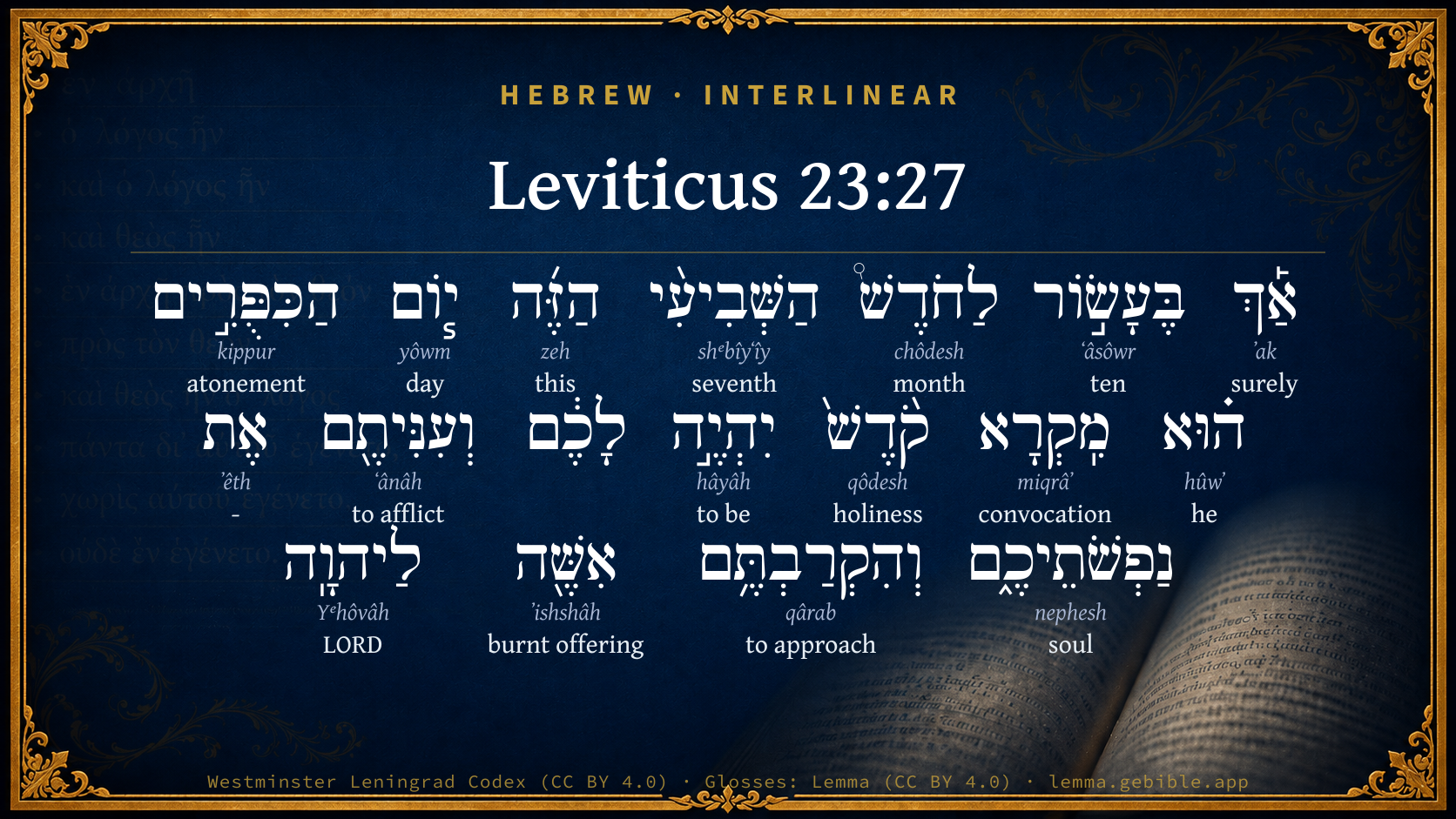
Leviticus 23:27

Hebrew (Westminster Leningrad Codex) Leviticus 23:27 appears in the Hebrew Old Testament. The text above is from the Westminster Leningrad Codex. Each word links to its Strong’s number, a concise gloss, and parsing drawn from the Open Scriptures Hebrew Bible morphology. Click any word for its full Brown-Driver-Briggs (BDB) entry.
Download image
Cite this verse

Leviticus 23:27 (World English Bible). Public Domain. Lemma interlinear Bible study tool, https://lemma.gebible.app/v/leviticus/23/27.

Show BibTeX & RIS
BibTeX
RIS
English Translation
"However on the tenth day of this seventh month is the day of atonement: it shall be a holy convocation to you, and you shall afflict yourselves; and you shall offer an offering made by fire to Yahweh.
World English Bible · Public Domain
Download a study sheet

One document with this verse’s original text, its word-by-word gloss line, the meaning frame, cross-references with their text, attributed commentary, and full source and license credits — printable, and it pastes into notes with its structure intact.

This verse Autodidact and up

Study sheet (.html) Plain text (.txt)

A passage Seminary Student

Up to 50 verses in one chapter. A passage sheet keeps up to 6 commentary sources and 12 cross-references per verse, in the order this page ranks them, and says so on the sheet whenever that leaves anything out. Ask for a single verse and you get the Autodidact verse sheet above.

Everything on this page stays free to read, with no account — the sheet is a download of what is already on screen, not access to it.

Want to remove ads? Support Godless Engineer
Compare translations 3

The same verse in 3 English versions, stacked beneath the original-language interlinear above. Click any original word for its lexicon entry.

Each is an independent rendering of the whole verse — the interlinear is not word-aligned to these translations.

Highlighted words mark where these versions differ — a whole-verse word diff, not a word-by-word alignment.

  • World English Bible Public Domain
    "However on the tenth day of this seventh month is the day of atonement: it shall be a holy convocation to you, and you shall afflict yourselves; and you shall offer an offering made by fire to Yahweh.
  • King James Version Public Domain
    Also on the tenth day of this seventh month there shall be a day of atonement: it shall be an holy convocation unto you; and ye shall afflict your souls, and offer an offering made by fire unto the LORD.
  • unfoldingWord Literal Text CC BY-SA 4.0
    “Surely on the tenth of this seventh month, it is the Day of Atonement. It shall be an assembly of holiness for you, and you shall humble your souls, and you shall present a gift to Yahweh.

unfoldingWord Literal Text — © unfoldingWord, licensed CC BY-SA 4.0. Word-aligned USFM3 via Door43 (git.door43.org/unfoldingWord/en_ult).

Versions to compare (up to 4)

3 of 4 selected

Show all 18 translations

Every available English version of this verse, each an independent rendering of the whole verse.

  • World English Bible Public Domain
    "However on the tenth day of this seventh month is the day of atonement: it shall be a holy convocation to you, and you shall afflict yourselves; and you shall offer an offering made by fire to Yahweh.
  • Berean Standard Bible Public Domain
    “The tenth day of this seventh month is the Day of Atonement. You shall hold a sacred assembly and humble yourselves, and present an offering made by fire to the LORD.
  • Majority Standard Bible Public Domain
    “The tenth day of this seventh month is the Day of Atonement. You shall hold a sacred assembly and humble yourselves, and present a food offering to the LORD.
  • King James Version Public Domain
    Also on the tenth day of this seventh month there shall be a day of atonement: it shall be an holy convocation unto you; and ye shall afflict your souls, and offer an offering made by fire unto the LORD.
  • American Standard Version (1901) Public Domain
    Howbeit on the tenth day of this seventh month is the day of atonement: it shall be a holy convocation unto you, and ye shall afflict your souls; and ye shall offer an offering made by fire unto Jehovah.
  • Revised Version (1885) Public Domain
    Howbeit on the tenth day of this seventh month is the day of atonement: it shall be an holy convocation unto you, and ye shall afflict your souls; and ye shall offer an offering made by fire unto the LORD.
  • Geneva Bible (1599) Public Domain
    The tenth also of this seuenth moneth shalbe a day of reconciliation: it shalbe an holie conuocation vnto you, and yee shall humble your soules, and offer sacrifice made by fire vnto the Lord.
  • Douay-Rheims (1899) Public Domain
    Upon the tenth day of this seventh month shall be the day of atonement, it shall be most solemn, and shall be called holy: and you shall afflict your souls on that day, and shall offer a holocaust to the Lord.
  • Young's Literal Translation Public Domain
    `Only -- on the tenth of this seventh month is a day of atonements; ye have a holy convocation, and ye have humbled yourselves, and have brought near a fire-offering to Jehovah;
  • Literal Standard Version CC BY-SA 4.0
    “Only—on the tenth of this seventh month is the Day of Atonements; you have a holy convocation, and you have humbled yourselves, and have brought a fire-offering near to YHWH;
  • Unlocked Literal Bible CC BY-SA 4.0
    “Now the tenth day of this seventh month is the Day of Atonement. It is to be a holy assembly, and you must humble yourselves and present to Yahweh an offering by fire.
  • unfoldingWord Literal Text CC BY-SA 4.0
    “Surely on the tenth of this seventh month, it is the Day of Atonement. It shall be an assembly of holiness for you, and you shall humble your souls, and you shall present a gift to Yahweh.
  • Darby Bible Public Domain
    Also on the tenth of this seventh month is the day of the atonement: a holy convocation shall it be unto you; and ye shall afflict your souls, and present an offering by fire to Jehovah.
  • World Messianic Bible Public Domain
    “However on the tenth day of this seventh month is Yom Kippur. It shall be a holy convocation to you. You shall afflict yourselves and you shall offer an offering made by fire to the LORD.
  • Webster's Bible Public Domain
    Also on the tenth day of this seventh month there shall be a day of atonement; it shall be a holy convocation to you, and ye shall afflict your souls, and offer an offering made by fire to the LORD.
  • Free Bible Version CC BY-SA 4.0
    “The Day of Atonement is on the tenth day of this seventh month. You are to have a holy meeting, deny yourselves, and present a food offering to the Lord
  • Bible in Basic English Public Domain
    The tenth day of this seventh month is the day for the taking away of sin; let it be a holy day of worship; you are to keep from pleasure, and give to the Lord an offering made by fire.
  • JPS Tanakh (1917) Public Domain
    Howbeit on the tenth day of this seventh month is the day of atonement; there shall be a holy convocation unto you, and ye shall afflict your souls; and ye shall bring an offering made by fire unto the LORD.

Literal Standard Version (2020), Covenant Press — licensed CC BY-SA 4.0. Text via the HelloAO Bible API (eBible.org). Unlocked Literal Bible (unfoldingWord) — licensed CC BY-SA 4.0. Text via the HelloAO Bible API (eBible.org). unfoldingWord Literal Text — © unfoldingWord, licensed CC BY-SA 4.0. Word-aligned USFM3 via Door43 (git.door43.org/unfoldingWord/en_ult). Free Bible Version, Dr. Jonathan Gallagher — licensed CC BY-SA 4.0. Text via the HelloAO Bible API (eBible.org).

Word by word

More ways to search: Search by grammar → Find every occurrence → Compare this word →

Practice this passage: Drill this verse → Learn its vocabulary →

הַכִּפֻּרִ֣ים
kippur
H3725
“the · atonement”
Particle, Definite Article + Noun, Common, Masculine, Plural, Absolute
Part of Speech
Particle + Noun
Type
Common
Gender
Masculine
Number
Plural
State
Absolute
Full BDB Definition

Origin: from H3722

TWOT: 1023b

atonement
  1. אַ֡ךְ ʼak H389 “surely” Particle, Accusative
  2. בֶּעָשׂ֣וֹר ʻâsôwr H6218 “in/at the · ten” Preposition, Determined + Noun, Common, Masculine, Singular, Absolute
  3. לַחֹדֶשׁ֩ chôdesh H2320 “to/for the · month” Preposition, Determined + Noun, Common, Masculine, Singular, Absolute
  4. הַשְּׁבִיעִ֨י shᵉbîyʻîy H7637 “the · seventh” Particle, Definite Article + Adjective, Ordinal number, Masculine, Singular, Absolute
  5. הַזֶּ֜ה zeh H2088 “the · this” Particle, Definite Article + Pronoun, Demonstrative, Masculine, Singular
  6. י֧וֹם yôwm H3117 “day of” Noun, Common, Masculine, Singular, Construct
  7. ה֗וּא hûwʼ H1931 “he” Pronoun, Personal, 3rd Person, Masculine, Singular
  8. מִֽקְרָא miqrâʼ H4744 “convocation of” Noun, Common, Masculine, Singular, Construct
  9. קֹ֨דֶשׁ֙ qôdesh H6944 “holiness” Noun, Common, Masculine, Singular, Absolute
  10. יִהְיֶ֣ה hâyâh H1961 “to be” Verb, Qal, Imperfect, 3rd Person, Masculine, Singular
  11. וְעִנִּיתֶ֖ם ʻânâh H6031 “and · to afflict” Conjunction + Verb, Piel, Sequential Perfect, 2nd Person, Masculine, Plural
  12. אֶת ʼêth H853 “-” Particle, Direct Object
  13. נַפְשֹׁתֵיכֶ֑ם nephesh H5315 “souls · your” Noun, Common, Both, Plural, Construct + Suffix, Personal, 2nd Person, Masculine, Plural
  14. וְהִקְרַבְתֶּ֥ם qârab H7126 “and · to approach” Conjunction + Verb, Hiphil, Sequential Perfect, 2nd Person, Masculine, Plural
  15. אִשֶּׁ֖ה ʼishshâh H801 “burnt offering” Noun, Common, Masculine, Singular, Absolute
  16. לַיהוָֽה Yᵉhôvâh H3068 “to/for · LORD” Preposition + Noun, Proper

About this verse

These counts appear in no published source. They are computed here, from the morphology-tagged text and Lemma’s own curated glosses. What Lemma adds →

18
words
17
distinct lemmas
Pentateuch
section

Notable vocabulary

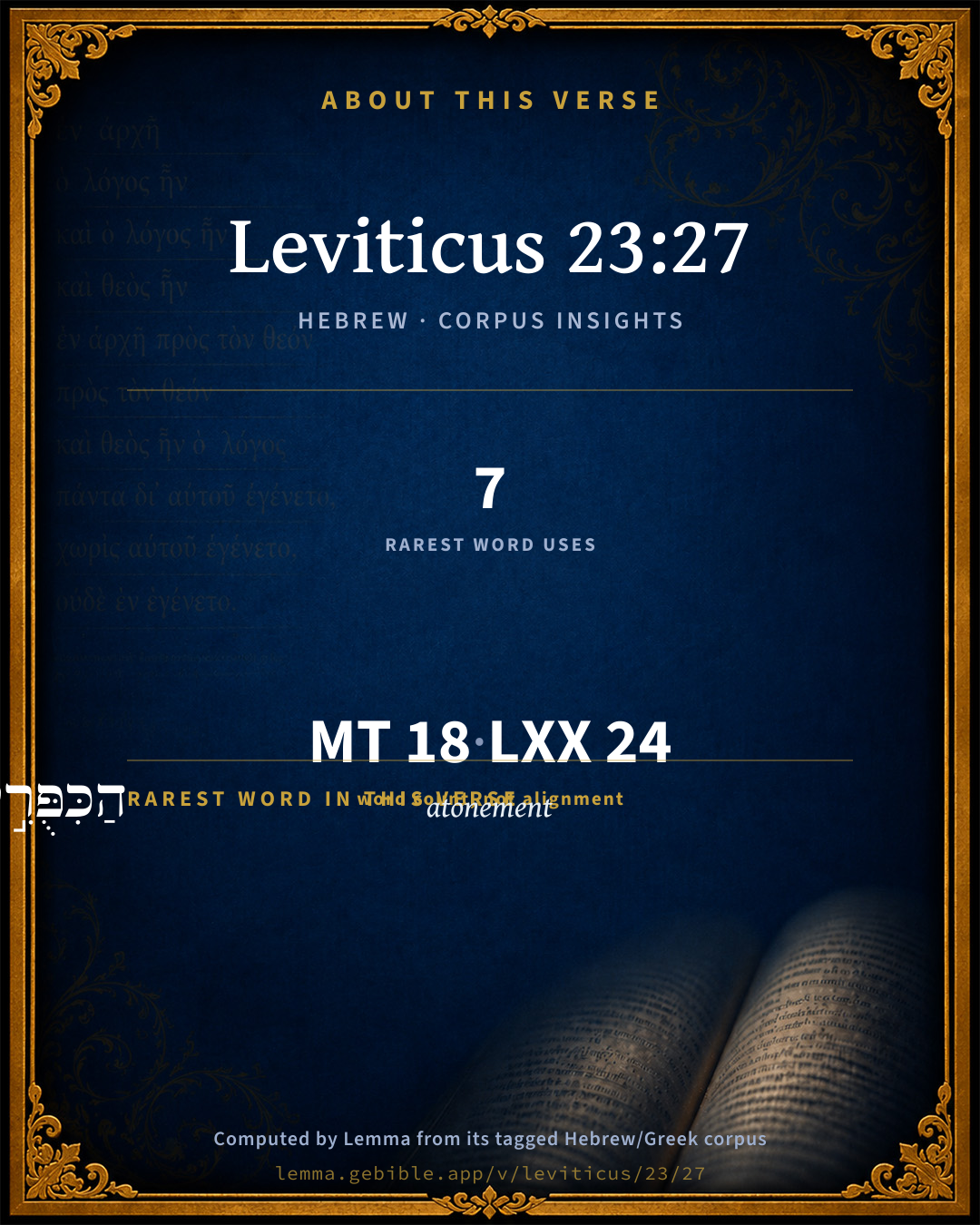
The rarest word here is הַכִּפֻּרִ֣ים atonement H3725 — appearing just 7 times in the whole Hebrew Bible.

Shared distinctive vocabulary

הַכִּפֻּרִ֣ים atonement H3725 occurs in 7 verses of the Hebrew Bible. Also found in:

Grammatical profile

  • 3 verbs
  • 9 nouns
  • 1 adjective
  • 2 pronouns
  • 1 preposition
  • 2 particles

Verb forms

  • יִהְיֶ֣ה Qal · Imperfect
  • וְעִנִּיתֶ֖ם Piel · Sequential Perfect
  • וְהִקְרַבְתֶּ֥ם Hiphil · Sequential Perfect

Hebrew & Septuagint length

In English translation the verse runs 38 words from the Hebrew and 37 from the Septuagint (LXX English) — closely comparable.

A rough comparison of the two English renderings, which tokenize alike — not a word-level alignment.

Word counts can differ between the Hebrew and the Greek without any difference in meaning — e.g. the Hebrew direct-object marker אֵת has no separate Greek word, and Greek often adds the article ὁ.

In the original languages it is 18 Hebrew tokens and 24 Greek tokens — but the two are counted differently (Hebrew bundles its prefixes and suffixes into one token; the Greek is in lemma form), so that isn’t a like-for-like length.

Cross-references

15

Topical passages linked to Leviticus 23:27 in the Treasury of Scripture Knowledge — connected by theme and wording, ordered by reader-vote popularity; previews shown in the World English Bible.

  • Leviticus 16:29–31 "It shall be a statute to you forever: in the seventh month, on the tenth day of the month, you shall afflict your souls, and shall do no manner of work, the native-born, or the stranger who lives as a foreigner among you:
  • Exodus 30:10 Aaron shall make atonement on its horns once in the year; with the blood of the sin offering of atonement once in the year he shall make atonement for it throughout your generations. It is most holy to Yahweh."
  • Leviticus 16:24 Then he shall bathe himself in water in a holy place, and put on his garments, and come out and offer his burnt offering and the burnt offering of the people, and make atonement for himself and for the people.
  • Leviticus 16:15 "Then he shall kill the goat of the sin offering, that is for the people, and bring his blood within the veil, and do with his blood as he did with the blood of the bull, and sprinkle it on the mercy seat, and before the mercy seat:
  • Numbers 29:7–11 On the tenth day of this seventh month you shall have a holy convocation; and you shall afflict your souls: you shall do no manner of work;
  • Isaiah 58:5 Is such the fast that I have chosen? the day for a man to afflict his soul? Is it to bow down his head as a rush, and to spread sackcloth and ashes under him? will you call this a fast, and an acceptable day to Yahweh?
  • Leviticus 16:11 "Aaron shall present the bull of the sin offering, which is for himself, and shall make atonement for himself and for his house, and shall kill the bull of the sin offering which is for himself.
  • Leviticus 25:9 Then you shall sound the loud trumpet on the tenth day of the seventh month. On the Day of Atonement you shall sound the trumpet throughout all your land.
  • Ezra 8:21 Then I proclaimed a fast there, at the river Ahava, that we might humble ourselves before our God, to seek of him a straight way for us, and for our little ones, and for all our substance.
  • Daniel 10:2–3 In those days I, Daniel, was mourning three whole weeks.
  • Zechariah 12:10 I will pour on the house of David, and on the inhabitants of Jerusalem, the spirit of grace and of supplication; and they will look to me whom they have pierced; and they shall mourn for him, as one mourns for his only son, and will grieve bitterly for him, as one grieves for his firstborn.
  • Acts 2:37–38 Now when they heard this, they were cut to the heart, and said to Peter and the rest of the apostles, "Brothers, what shall we do?"
  • 2 Corinthians 7:10–11 For godly sorrow works repentance to salvation, which brings no regret. But the sorrow of the world works death.
  • James 4:9 Lament, mourn, and weep. Let your laughter be turned to mourning, and your joy to gloom.
  • Psalms 35:13 But as for me, when they were sick, my clothing was sackcloth. I afflicted my soul with fasting. My prayer returned into my own bosom.

Cross-references courtesy of OpenBible.info (CC BY 4.0).

Hebrew and Greek witnesses Masoretic Hebrew ↔ Greek Septuagint

The same verse in the two great witnesses to the Old Testament, shown verse-for-verse.

These are two independent witnesses, not word-aligned to each other, and the Septuagint is shown in lemma (dictionary) form.

Hebrew Leviticus 23:27 Masoretic · Westminster Leningrad Codex

אַ֡ךְ בֶּעָשׂ֣וֹר לַחֹדֶשׁ֩ הַשְּׁבִיעִ֨י הַזֶּ֜ה י֧וֹם הַכִּפֻּרִ֣ים ה֗וּא מִֽקְרָא קֹ֨דֶשׁ֙ יִהְיֶ֣ה לָכֶ֔ם וְעִנִּיתֶ֖ם אֶת נַפְשֹׁתֵיכֶ֑ם וְהִקְרַבְתֶּ֥ם אִשֶּׁ֖ה לַיהוָֽה

"However on the tenth day of this seventh month is the day of atonement: it shall be a holy convocation to you, and you shall afflict yourselves; and you shall offer an offering made by fire to Yahweh.

World English Bible · Public Domain

Greek LXX Leviticus 23:27 Septuagint · lemma form

καί ὁ δέκατος ὁ μήν ὁ ἕβδομος οὗτος ἡμέρα ἐξιλασμός κλητός ἅγιος εἰμί σύ καί ταπεινόω ὁ ψυχή σύ καί προςἄγω ὁλοκαύτωμα ὁ κύριος

Also on the tenth day of this seventh month is a day of atonement: it shall be a holy convocation to you; and you⌃ shall humble your souls, and offer a whole burnt offering to the Lord.

LXX2012 (modern English Septuagint) · Public Domain

Hebrew: Westminster Leningrad Codex (CC BY 4.0). Greek: Septuagint (public domain); English from LXX2012 (modern English Septuagint) (Public Domain). How the Septuagint differs from the Hebrew →

Targum (Aramaic paraphrase)

2

The Targum is the ancient Jewish Aramaic paraphrase of the Hebrew Scriptures — an interpretive translation, not the Hebrew text itself. Onkelos (literal) and Pseudo-Jonathan (expansive) render the Torah, and Jonathan the Prophets. Coverage is partial: where no permissively-licensed English translation exists for a verse, only the Aramaic is shown. This is verse-level text, not a word-by-word alignment to the Hebrew.

  1. Targum Onkelos Torah (Genesis–Deuteronomy)
    בְּרַם בְּעַשְׂרָא לְיַרְחָא שְׁבִיעָאָה הָדֵין יוֹמָא דְכִפּוּרַיָא הוּא מְעָרַע קַדִישׁ יְהֵי לְכוֹן וּתְעַנוּן יָת נַפְשָׁתֵיכוֹן וּתְקָרְבוּן קֻרְבָּנָא קֳדָם יְיָ

    (no public-domain English translation for this verse)

    Targum Onkelos — Aramaic: “Onkelos Genesis” (public domain); “Onkelos Exodus” (public domain); “Onkelos Leviticus” (public domain); “Onkelos Numbers” (public domain); “Onkelos Deuteronomy” (public domain). English: “Sefaria Community Translation” (CC0 1.0 (public-domain dedication)); “J.W. Etheridge. The Targums of Onkelos and Jonathan Ben Uzziel on the Pentateuch. London: Longmans, Green, 1862” (public domain). Text via Sefaria.

  2. Targum Pseudo-Jonathan Torah (Genesis–Deuteronomy)
    בְּרַם בְּעַשְרָא יוֹמִין לְיַרְחָא שְׁבִיעָאָה הָדֵין יוֹמָא דְכִפּוּרַיָא הוּא מְאָרַע קַדִישׁ יְהֵי לְכוֹן וּתְעַנוּן יַת נַפְשָׁתֵיכוֹן מִמֵיכְלָא וּמִשְׁתַּיָא וְהַנְיַית בֵּי בָּנַי וְתַמְרוּקִין וְתַשְׁמִישׁ עַרְסָא וְסַנְדְלָא וּתְקַרְבוּן קָרְבָּנָא קֳדָם יְיָ

    But on the tenth day of this seventh month is the Day of Atonement; a holy convocation shall it be to you, and you shall humble your souls, (abstaining) from food, and from drink, and from the use of the bath, and from anointing, and the use of the bed, and from sandals; and you shall offer an oblation before the Lord,

    Targum Pseudo-Jonathan — Aramaic: “Targum Jonathan on Genesis” (public domain); “Targum Jonathan on Exodus” (public domain); “Targum Jonathan on Leviticus” (public domain); “Targum Jonathan on Numbers” (public domain); “Targum Jonathan on Deuteronomy” (public domain). English: “The Targum of Jonathan ben Uzziel, trans. J. W. Etheridge, London, 1862” (public domain). Text via Sefaria.

Commentary

Notes on Leviticus 23:27 from classic Christian and Jewish commentators (each source and its license shown beneath its notes). The classic Christian expositions comment on the surrounding passage and are grouped to its opening verse, so a note may address several verses; the Jewish commentaries on the Tanakh (Rashi and others) are per-verse, so they appear only where the commentator wrote on this verse.

Lemma curates 59 commentaries, every one of them public domain or Creative Commons licensed, each selected and text-cleaned for this edition rather than reprinted as found. About our sources →

Trapp's Complete Commentary

John Trapp

Lev 23:27 Also on the tenth [day] of this seventh month [there shall be] a day of atonement: it shall be an holy convocation unto you; and ye shall afflict your souls, and offer an offering made by fire unto the LORD.

Ver. 27. Also on the tenth day.] {See Trapp on "Lev 16:31"} Thus they were kept in sorrow five days, before they might keep their feast of joy. {Lev 23:34}

John Trapp, A Commentary or Exposition upon All the Books of the Old and New Testament (1647–1656) — public domain. Text from a community e-Sword module.

Joseph Benson's Commentary

Lev 23:27. Afflict your souls — With fasting and bitter repentance for all, and especially their national sins, among which, no doubt, God would have them remember their sin of the golden calf. For as God had threatened to remember it in after-times to punish them for it, so there was great reason why they should remember it to humble themselves for it.

Joseph Benson's Commentary on the Old and New Testaments (1811–1818) — public domain. Text from a community e-Sword module.

Tyndale Open Study Notes

Tyndale Open Resources

23:27 The Day of Atonement was the most solemn day in the Israelite calendar and the only day of fasting (ch 16). The high priest made atonement for the corporate sin of the people, laying the theological foundation for the atonement made by Jesus Christ (Heb 9:11-12).

Tyndale Open Study Notes — © Tyndale Open Resources, licensed CC BY-SA 4.0. Text via the HelloAO Bible API.

Geneva Bible (1599)

Geneva Bible translators

By fasting and prayer.

Geneva Bible (1599) marginal notes — public domain. Text via Bolls.life.

Jamieson, Fausset & Brown

Robert Jamieson, A. R. Fausset & David Brown

there shall be a day of atonement . . . and ye shall afflict your souls--an unusual festival, at which the sins of the whole year were expiated. (See Lev 16:29-34). It is here only stated that the severest penalty was incurred by the violation of this day.

Jamieson, Fausset & Brown — Commentary Critical and Explanatory on the Whole Bible (1871) — public domain (CC PDM 1.0). Text via the HelloAO Bible API.

Ellicott's Commentary for English Readers

(27) Also on the tenth.—See Lev_16:29.

And ye shall afflict your souls.—That is, fast. (See Lev_16:29.)

And offer an offering.—See Num_29:8-11.

A Bible Commentary for English Readers, edited by Charles John Ellicott (1878–1897) — public domain. Text from a community e-Sword module.

John Gill's Exposition

Also on the tenth day of this seventh month,.... Tisri, the same as before, answering to part of our September, and part of October:

there shall be a day of atonement; for all the sins of the year past; see Lev 16:29,

it shall be an holy convocation unto you: when they should be called together for the exercise of holy duties:

and ye shall afflict your souls; their souls, by repentance, contrition, and humiliation for sin, and their bodies by fasting; and, as the Targum of Jonathan paraphrases it,"by abstaining from eating and drinking, and the advantage of bathing and wiping, and the use of the bed and sandals;''hence called the fast, Act 27:9; See Gill on Lev 16:29,

and offer an offering made by fire unto the Lord; a burnt offering, of which see Num 29:8.

John Gill's Exposition of the Whole Bible (1746–1763) — public domain (CC PDM 1.0). Text via the HelloAO Bible API.

Albert Barnes' Notes on the Bible

Also - Surely. On the special rites of the day, the tenth of Tisri, that is from the evening of the ninth day of the month to that of the tenth Lev 23:32, see Lev. 16.

Albert Barnes' Notes on the Bible (1834–1885) — public domain. Text from a community e-Sword/MySword module.

Haydock's Catholic Bible Commentary

CHAPTER XXIII.

George Leo Haydock (1774–1849), Haydock's Catholic Family Bible and Commentary, 1859 edition — public domain. Excludes Psalms (Douay-Rheims chapter numbering differs from Protestant) and Deuterocanonical books (Catholic canon only).

Matthew Poole's English Annotations

Ye shall afflict your souls, with fasting, and bitter repentance for all, especially their national sins, among which no doubt God would have them remember their sin of the golden calf. For as God had threatened to remember it in after-times to punish them for it, Exo 32:34, so there was great reason why they should remember it to humble themselves for it.

Matthew Poole's English Annotations on the Holy Bible (1683–1685) — public domain. Text from a community e-Sword/MySword module.

John Wesley's Explanatory Notes

Afflict your souls - With fasting, and bitter repentance for all, especially their national sins, among which no doubt God would have them remember their sin of the golden calf. For as God had threatened to remember it in after times to punish them for it, so there was great reason why they should remember it to humble themselves for it.

John Wesley, Explanatory Notes Upon the Whole Bible (1754–1765) — public domain. Text via the GEBible commentary corpus.

Scofield Reference Notes

C. I. Scofield

atonement

The day of Atonement, Lev 23:26-32. The day is the same described in Leviticus 16, but here the stress is laid upon the sorrow and repentance of Israel. In other words, the prophetical feature is made prominent, and that looks forward to the repentance of Israel after her regathering under the Palestinian Covenant, Deu 30:1-10 preparatory to the second advent of Messiah and the establishment of the kingdom. See the connection between the "trumpet" in Joe 2:1 and the mourning which follows in verses Joe 2:11-15.

Also Zec 12:10-13 in connection with the atonement of Zec 13:1. Historically the "fountain" of Zec 13:1 was opened at the crucifixion, but rejected by the Jews of that and the succeeding centuries. After the regathering of Israel the fountain will be efficaciously "opened" to Israel.

atonement

(See Scofield "Exo 29:33").

The Scofield Reference Bible (1917 edition), notes by C. I. Scofield — public domain. Text from a community e-Sword module.

Rashi

Rabbi Shlomo Yitzchaki (Rashi)

אך — The words אך and רק wherever they occur in Scripture have a limitative force; here the word implies: it (Yom Kippur) makes expiation for those who repent, but it does not make expiation for those who do not repent (אך... יום הכפורים הוא — in a limitative sense it is Yom Kippur) (Shevuot 13a; cf. Rashi on Exodus 34:7).

Rashi on the Tanakh — English translations: “The Judaica Press complete Tanach with Rashi, translated by A. J. Rosenberg” (CC BY 4.0); “Pentateuch with Rashi's commentary by M. Rosenbaum and A.M. Silbermann, 1929-1934” (public domain); “The Metsudah Tanach series, Lakewood, N.J” (CC BY 4.0); and “The Book of Joshua, Metsudah Publications, 1997” (CC BY 4.0). Text via Sefaria.

Ramban (Nachmanides)

Rabbi Moshe ben Nachman (Ramban / Nachmanides)

ACH’ (BUT) ON THE TENTH DAY OF THIS SEVENTH MONTH IS THE DAY OF ATONEMENT. “All expressions in the Torah of ach (but) and rak (only) indicate limiting qualifications, [and here the word ach indicates that the Day of Atonement] effects atonement ‘only’ for those who repent, but it does not effect atonement for those who do not repent.” This is Rashi’s language on the basis of the words of our Rabbis. And if so, the explanation of the verse is that on the first day of this month [Tishri] there will be for all of you a day of memorial of ‘t’ruah [a blowing of the quavering sound which signifies judgment], for you will all be judged then before Him, but for some of you [i.e., those who repent] there will be on the tenth day of this month a day of atonement. Thus the meaning of the word ach is like that of bilvad (“only,” “alone”). Similarly, Now therefore forgive, I pray thee, my son ‘ach’ (only) this once. So also, ‘harak ach b’Moshe’ means “has He indeed spoken ‘only’ with Moses?” Likewise, ‘Ach’ on the fifteenth day of the seventh month means “only on the fifteenth day [of Tishri] ye shall keep the feast of the Eternal seven days, not consecutively,” for the Festival-offering [brought by the individual] does not override the Sabbath [and therefore it cannot mean seven days consecutively]. In the same way you are to explain [the word ach] in all the commandments, in accordance with the tradition of our Rabbis. Similarly, ‘ach’ he is torn in pieces means [that Jacob said] that nothing else [could have happened to Joseph] except that he was torn in pieces. So also, For the children of Israel and the children of Judah ‘ach’ have done that which was evil in My sight from their youth; for the children of Israel have ‘ach’ provoked Me, means that they have done nothing else.But by way of the plain meaning of Scripture the word ach means achein (“surely”), [a word which is used] to authenticate something, [as in the following expressions]: ‘achein’ (surely) the thing is known; ‘achein’ (surely) ye shall die like men. And here it means, “Surely on the tenth day of the seventh month is the day of atonement,” the expression constituting a [Divine] assurance on the authenticity of the matter, Scripture stating: “On the first day of the month is the day of judgment, but indeed on the tenth of the month is the day of atonement, therefore you shall afflict your souls, and you shall do no manner of work.” Similarly, ‘ach’ (surely) thou art my bone and my flesh; ‘ach’ (surely) it is the king of Israel; ‘ach’ (surely) G-d is good to Israel, even to such as are pure in heart. So also is the meaning of the verse, ‘ach’ ye shall keep My Sabbaths which declares: “Now I have commanded you concerning the work of the Tabernacle, but surely My Sabbaths you shall keep forever.” So also in all cases [where the word ach is mentioned] it may be explained to you in this way, if you will understand them.

Ramban (Nachmanides) on the Tanakh — English translation: “Commentary on the Torah by Ramban (Nachmanides). Translated and annotated by Charles B. Chavel. New York, Shilo Pub. House, 1971-1976” (CC BY 4.0). Text via Sefaria.

Sforno

Rabbi Ovadia Sforno

Indeed, on the tenth. On the rest of the holy assemblies it is fitting to rejoice and enjoy oneself with food and drink as well, as it says (Nechemiah 8:10): “Go, eat fat foods and drink sweet drinks and send portions to whoever has nothing prepared, for the day is holy to our Lord.” Nonetheless, the tenth of the month is the Day of Atonement to confess and regret our sins. It is not a day of rejoicing and enjoyment but rather a day of affliction, as it says, “And you shall afflict yourselves and you shall bring a fire-offering,” which is the Kohein Godol’s offerings and the congregation’s offerings that come for atonement.

Sforno on the Tanakh — English translation: “Yalkut, Sifsei Chachomim Chumash, Metsudah Publications, 2009” (CC BY 4.0). Text via Sefaria.

Lesson kit

Teaching starters — assembled from the data on this page, not authored interpretation. Every prompt links to the verse data it draws on. Edit before teaching.

Leviticus, in the Pentateuch, opens this verse with 18 words (17 distinct Hebrew lemmas). Its most distinctive word is kippur (“atonement”). A historical commentator’s framing appears above. Read the whole chapter for the surrounding context.

Discussion questions

  1. The word kippur carries the sense “atonement.” How does it shape the verse?
  2. Exodus 29:36 shares the word «atonement» with this verse. How do the two illuminate each other?
  3. These translations render this verse differently; the difference is in the English rendering, not the original. What questions does that raise?
  4. The verb «יִהְיֶ֣ה» is Qal Imperfect. How does its form color the action?
  5. Reading how Trapp's Complete Commentary and Joseph Benson's Commentary read this verse, where do the two commentators agree and where do they part?

Things to notice

Reading settings

Reading text

Shown beneath each verse's original-language words.

Old Testament
Old Testament edition

Read the OT as the Masoretic Hebrew (MT) or the Greek Septuagint (LXX).

English shown for the Greek Septuagint (in the Hebrew ↔ Greek comparison).

Comparing translations? Open the Compare panel on any verse page to stack up to four side by side.