
Numbers 18:16

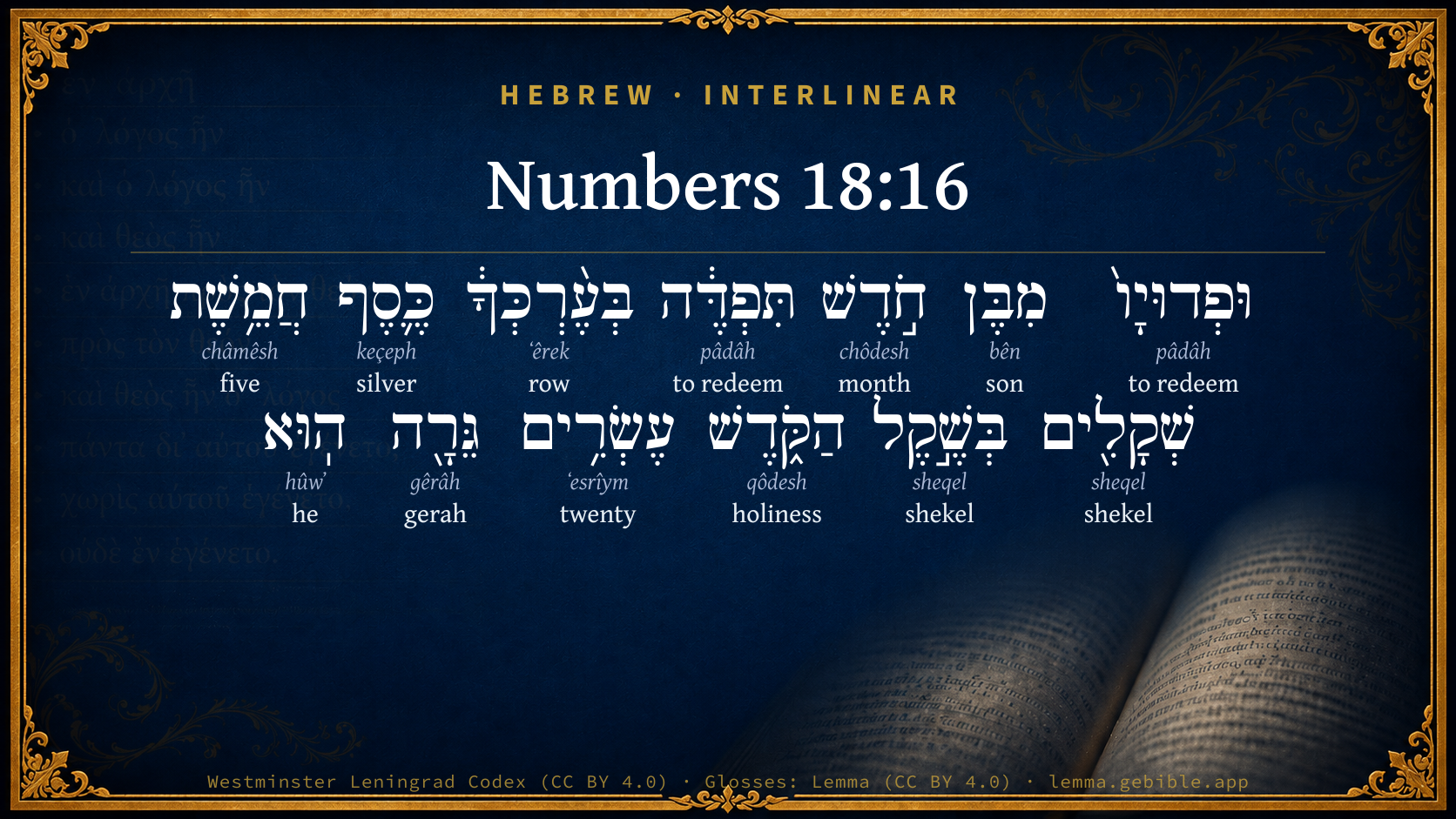
Hebrew (Westminster Leningrad Codex) Numbers 18:16 appears in the Hebrew Old Testament. The text above is from the Westminster Leningrad Codex. Each word links to its Strong’s number, a concise gloss, and parsing drawn from the Open Scriptures Hebrew Bible morphology. Click any word for its full Brown-Driver-Briggs (BDB) entry.
Download image
Cite this verse

Numbers 18:16 (World English Bible). Public Domain. Lemma interlinear Bible study tool, https://lemma.gebible.app/v/numbers/18/16.

Show BibTeX & RIS
BibTeX
RIS
English Translation
Those who are to be redeemed of them from a month old shall you redeem, according to your estimation, for the money of five shekels, after the shekel of the sanctuary (the same is twenty gerahs).
World English Bible · Public Domain
Download a study sheet

One document with this verse’s original text, its word-by-word gloss line, the meaning frame, cross-references with their text, attributed commentary, and full source and license credits — printable, and it pastes into notes with its structure intact.

This verse Autodidact and up

Study sheet (.html) Plain text (.txt)

A passage Seminary Student

Up to 50 verses in one chapter. A passage sheet keeps up to 6 commentary sources and 12 cross-references per verse, in the order this page ranks them, and says so on the sheet whenever that leaves anything out. Ask for a single verse and you get the Autodidact verse sheet above.

Everything on this page stays free to read, with no account — the sheet is a download of what is already on screen, not access to it.

Want to remove ads? Support Godless Engineer
Compare translations 3

The same verse in 3 English versions, stacked beneath the original-language interlinear above. Click any original word for its lexicon entry.

Each is an independent rendering of the whole verse — the interlinear is not word-aligned to these translations.

Highlighted words mark where these versions differ — a whole-verse word diff, not a word-by-word alignment.

  • World English Bible Public Domain
    Those who are to be redeemed of them from a month old shall you redeem, according to your estimation, for the money of five shekels, after the shekel of the sanctuary (the same is twenty gerahs).
  • King James Version Public Domain
    And those that are to be redeemed from a month old shalt thou redeem, according to thine estimation, for the money of five shekels, after the shekel of the sanctuary, which is twenty gerahs.
  • unfoldingWord Literal Text CC BY-SA 4.0
    And his redeemed ones from a son of a month you shall redeem by your valuation, silver of five shekels, by the shekel of the holy place (it 20 gerahs).

unfoldingWord Literal Text — © unfoldingWord, licensed CC BY-SA 4.0. Word-aligned USFM3 via Door43 (git.door43.org/unfoldingWord/en_ult).

Versions to compare (up to 4)

3 of 4 selected

Show all 18 translations

Every available English version of this verse, each an independent rendering of the whole verse.

  • World English Bible Public Domain
    Those who are to be redeemed of them from a month old shall you redeem, according to your estimation, for the money of five shekels, after the shekel of the sanctuary (the same is twenty gerahs).
  • Berean Standard Bible Public Domain
    You are to pay the redemption price for a month-old male according to your valuation: five shekels of silver, according to the sanctuary shekel, which is twenty gerahs.
  • Majority Standard Bible Public Domain
    You are to pay the redemption price for a month-old male according to your valuation: five shekels of silver, according to the sanctuary shekel, which is twenty gerahs.
  • King James Version Public Domain
    And those that are to be redeemed from a month old shalt thou redeem, according to thine estimation, for the money of five shekels, after the shekel of the sanctuary, which is twenty gerahs.
  • American Standard Version (1901) Public Domain
    And those that are to be redeemed of them from a month old shalt thou redeem, according to thine estimation, for the money of five shekels, after the shekel of the sanctuary (the same is twenty gerahs).
  • Revised Version (1885) Public Domain
    And those that are to be redeemed of them from a month old shalt thou redeem, according to thine estimation, for the money of five shekels, after the shekel of the sanctuary (the same is twenty gerahs).
  • Geneva Bible (1599) Public Domain
    And those that are to bee redeemed, shalt thou redeeme from the age of a moneth, according to thy estimation, for the money of fiue shekels, after the shekel of the Sanctuarie, which is twentie gerahs.
  • Douay-Rheims (1899) Public Domain
    And the redemption of it shall be after one month, for five sicles of silver, by the weight of the sanctuary. A sicle hath twenty obols.
  • Young's Literal Translation Public Domain
    `And their ransomed ones from a son of a month, thou dost ransom with thy valuation, of silver, five shekels, by the shekel of the sanctuary, twenty gerahs it `is'.
  • Literal Standard Version CC BY-SA 4.0
    And their ransomed ones from a son of a month, you ransom with your valuation [for] five shekels of silver, by the shekel of the holy place; it [is] twenty gerahs.
  • Unlocked Literal Bible CC BY-SA 4.0
    Those that are to be bought back by the people must be bought back after becoming one month old. Then the people may buy them back, for the price of five shekels, by the standard weight of the sanctuary shekel, which equals twenty gerahs.
  • unfoldingWord Literal Text CC BY-SA 4.0
    And his redeemed ones from a son of a month you shall redeem by your valuation, silver of five shekels, by the shekel of the holy place (it 20 gerahs).
  • Darby Bible Public Domain
    And those that are to be ransomed from a month old shalt thou ransom, according to thy valuation, for the money of five shekels, after the shekel of the sanctuary, which is twenty gerahs.
  • World Messianic Bible Public Domain
    You shall redeem those who are to be redeemed of them from a month old, according to your estimation, for five shekels of money, according to the shekel of the sanctuary, which weighs twenty gerahs.
  • Webster's Bible Public Domain
    And those that are to be redeemed from a month old shalt thou redeem, according to thy estimation, for the money of five shekels, after the shekel of the sanctuary, which is twenty gerahs.
  • Free Bible Version CC BY-SA 4.0
    When they are one month old you shall pay the redemption price of five shekels of silver (using the sanctuary shekel standard), equivalent to twenty gerahs.
  • Bible in Basic English Public Domain
    Payment is to be made for these when they are a month old, at the value fixed by you, a price of five shekels by the scale of the holy place, that is, twenty gerahs to the shekel.
  • JPS Tanakh (1917) Public Domain
    And their redemption-money — from a month old shalt thou redeem them — shall be, according to thy valuation, five shekels of silver, after the shekel of the sanctuary — the same is twenty gerahs.

Literal Standard Version (2020), Covenant Press — licensed CC BY-SA 4.0. Text via the HelloAO Bible API (eBible.org). Unlocked Literal Bible (unfoldingWord) — licensed CC BY-SA 4.0. Text via the HelloAO Bible API (eBible.org). unfoldingWord Literal Text — © unfoldingWord, licensed CC BY-SA 4.0. Word-aligned USFM3 via Door43 (git.door43.org/unfoldingWord/en_ult). Free Bible Version, Dr. Jonathan Gallagher — licensed CC BY-SA 4.0. Text via the HelloAO Bible API (eBible.org).

Word by word

More ways to search: Search by grammar → Find every occurrence → Compare this word →

Practice this passage: Drill this verse → Learn its vocabulary →

גֵּרָ֖ה
gêrâh
H1626
“gerah”
Noun, Common, Feminine, Singular, Absolute
Part of Speech
Noun
Type
Common
Gender
Feminine
Number
Singular
State
Absolute
Full BDB Definition

Origin: from H1641 (as in H1625 )

TWOT: 386b

gerah, a weight, a 20th part of a shekel, equal to the weight of 16 barley grains or 4 to 5 carob beans
  1. וּפְדוּיָו֙ pâdâh H6299 “and · redeemed · him” Conjunction + Verb, Qal, Participle Passive, Masculine, Singular, Construct + Suffix, Personal, 3rd Person, Masculine, Singular
  2. מִבֶּן bên H1121 “from · son of” Preposition + Noun, Common, Masculine, Singular, Construct
  3. חֹ֣דֶשׁ chôdesh H2320 “month” Noun, Common, Masculine, Singular, Absolute
  4. תִּפְדֶּ֔ה pâdâh H6299 “to redeem” Verb, Qal, Imperfect, 2nd Person, Masculine, Singular
  5. בְּעֶ֨רְכְּךָ֔ ʻêrek H6187 “in/at · row · your” Preposition + Noun, Common, Masculine, Singular, Construct + Suffix, Personal, 2nd Person, Masculine, Singular
  6. כֶּ֛סֶף keçeph H3701 “silver of” Noun, Common, Masculine, Singular, Construct
  7. חֲמֵ֥שֶׁת châmêsh H2568 “five” Adjective, Cardinal number, Masculine, Singular, Construct
  8. שְׁקָלִ֖ים sheqel H8255 “shekels” Noun, Common, Masculine, Plural, Absolute
  9. בְּשֶׁ֣קֶל sheqel H8255 “in/at · shekel of” Preposition + Noun, Common, Masculine, Singular, Construct
  10. הַקֹּ֑דֶשׁ qôdesh H6944 “the · holiness” Particle, Definite Article + Noun, Common, Masculine, Singular, Absolute
  11. עֶשְׂרִ֥ים ʻesrîym H6242 “twenty” Adjective, Cardinal number, Both, Plural, Absolute
  12. הֽוּא hûwʼ H1931 “he” Pronoun, Personal, 3rd Person, Masculine, Singular

About this verse

These counts appear in no published source. They are computed here, from the morphology-tagged text and Lemma’s own curated glosses. What Lemma adds →

13
words
11
distinct lemmas
Pentateuch
section

Notable vocabulary

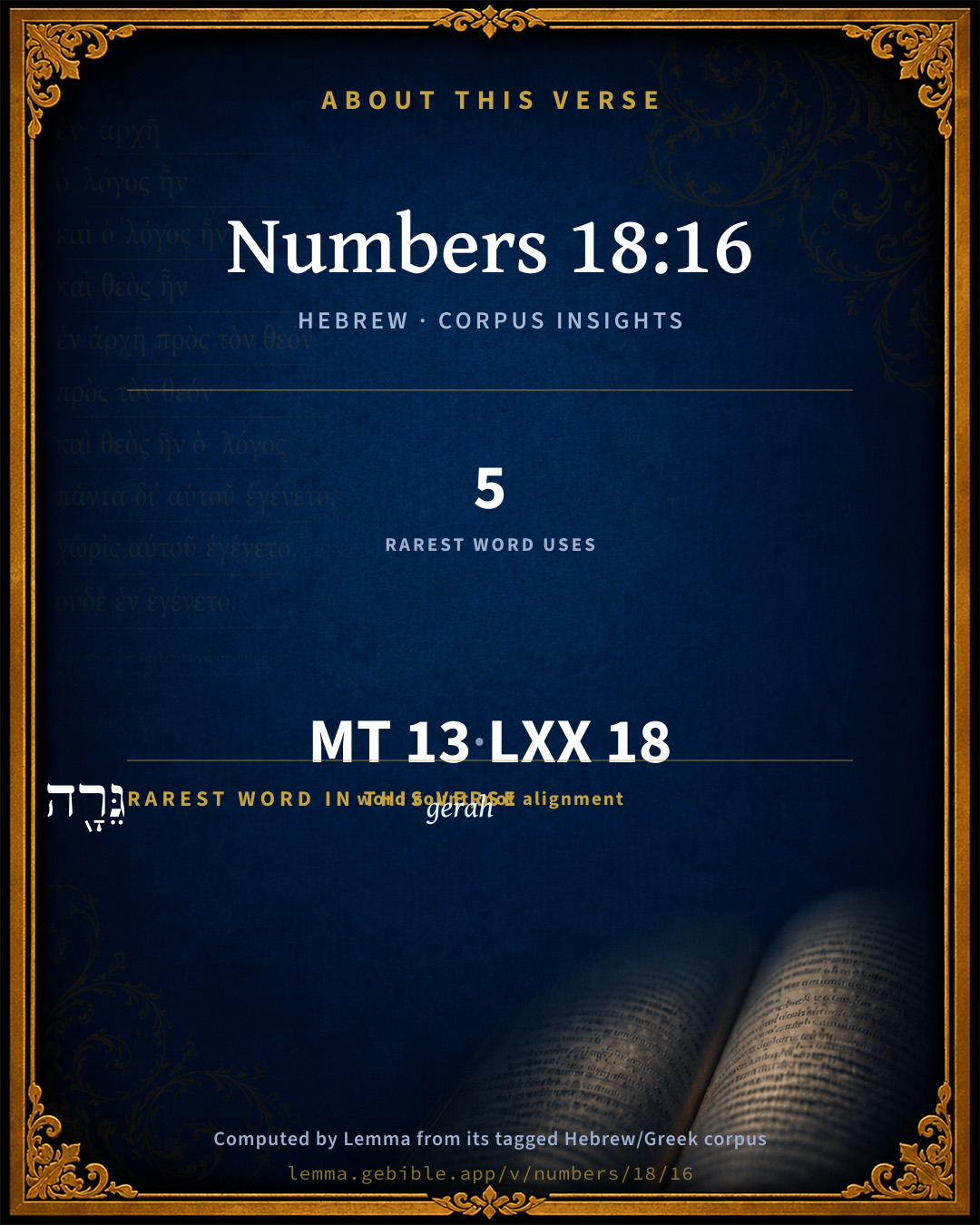
The rarest word here is גֵּרָ֖ה gerah H1626 — appearing just 5 times in the whole Hebrew Bible.

Shared distinctive vocabulary

גֵּרָ֖ה gerah H1626 occurs in 5 verses of the Hebrew Bible. Also found in:

Grammatical profile

  • 2 verbs
  • 8 nouns
  • 2 adjectives
  • 1 pronoun

Verb forms

  • וּפְדוּיָו֙ Qal · Participle Passive
  • תִּפְדֶּ֔ה Qal · Imperfect

Repetition

Words recur within this verse — often emphatic in Hebrew:

  • וּפְדוּיָו֙ to redeem H6299 ×2
  • שְׁקָלִ֖ים shekel H8255 ×2

Hebrew & Septuagint length

In English translation the verse runs 36 words from the Hebrew and 24 from the Septuagint (LXX English) — the Septuagint runs noticeably shorter here. See the side-by-side →

A rough comparison of the two English renderings, which tokenize alike — not a word-level alignment.

Word counts can differ between the Hebrew and the Greek without any difference in meaning — e.g. the Hebrew direct-object marker אֵת has no separate Greek word, and Greek often adds the article ὁ.

In the original languages it is 13 Hebrew tokens and 18 Greek tokens — but the two are counted differently (Hebrew bundles its prefixes and suffixes into one token; the Greek is in lemma form), so that isn’t a like-for-like length.

Cross-references

5

Topical passages linked to Numbers 18:16 in the Treasury of Scripture Knowledge — connected by theme and wording, ordered by reader-vote popularity; previews shown in the World English Bible.

  • Exodus 30:13 They shall give this, everyone who passes over to those who are numbered, half a shekel after the shekel of the sanctuary; (the shekel is twenty gerahs;) half a shekel for an offering to Yahweh.
  • Numbers 3:47 you shall take five shekels apiece for each one; after the shekel of the sanctuary you shall take them (the shekel is twenty gerahs):
  • Leviticus 27:2–7 "Speak to the children of Israel, and say to them, 'When a man makes a vow, the persons shall be for Yahweh by your valuation.
  • Leviticus 27:25 All your valuations shall be according to the shekel of the sanctuary: twenty gerahs to the shekel.
  • Ezekiel 45:12 The shekel shall be twenty gerahs. Twenty shekels plus twenty-five shekels plus fifteen shekels shall be your mina.

Cross-references courtesy of OpenBible.info (CC BY 4.0).

Hebrew and Greek witnesses Masoretic Hebrew ↔ Greek Septuagint

The same verse in the two great witnesses to the Old Testament, shown verse-for-verse.

Here the Septuagint runs noticeably shorter than the Hebrew — LXX2012 (modern English Septuagint) 24 words vs World English Bible 36. A rough length comparison of the two English translations, not a word-level alignment — read both below.

These are two independent witnesses, not word-aligned to each other, and the Septuagint is shown in lemma (dictionary) form.

Hebrew Numbers 18:16 Masoretic · Westminster Leningrad Codex

וּפְדוּיָו֙ מִבֶּן חֹ֣דֶשׁ תִּפְדֶּ֔ה בְּעֶ֨רְכְּךָ֔ כֶּ֛סֶף חֲמֵ֥שֶׁת שְׁקָלִ֖ים בְּשֶׁ֣קֶל הַקֹּ֑דֶשׁ עֶשְׂרִ֥ים גֵּרָ֖ה הֽוּא

Those who are to be redeemed of them from a month old shall you redeem, according to your estimation, for the money of five shekels, after the shekel of the sanctuary (the same is twenty gerahs).

World English Bible · Public Domain

Greek LXX Numbers 18:16 Septuagint · lemma form

καί ὁ λύτρωσις αὐτός ἀπό μηνιαῖος ὁ συντίμησις πέντε σίκλος κατά ὁ σίκλος ὁ ἅγιος εἴκοσι ὀβολός εἰμί

And the redemption of them shall be from a month old; their valuation of five shekels—it is twenty oboli according to the holy shekel.

LXX2012 (modern English Septuagint) · Public Domain

Hebrew: Westminster Leningrad Codex (CC BY 4.0). Greek: Septuagint (public domain); English from LXX2012 (modern English Septuagint) (Public Domain). How the Septuagint differs from the Hebrew →

Targum (Aramaic paraphrase)

2

The Targum is the ancient Jewish Aramaic paraphrase of the Hebrew Scriptures — an interpretive translation, not the Hebrew text itself. Onkelos (literal) and Pseudo-Jonathan (expansive) render the Torah, and Jonathan the Prophets. Coverage is partial: where no permissively-licensed English translation exists for a verse, only the Aramaic is shown. This is verse-level text, not a word-by-word alignment to the Hebrew.

  1. Targum Onkelos Torah (Genesis–Deuteronomy)
    וּפוּרְקָנֵיהּ מִבַּר יַרְחָא תִּפְרוֹק בְּפוּרְסָנֵיהּ כְּסַף חַמְשָׁא סִלְעִין בְּסִלְעֵי קוּדְשָׁא עַשְׂרִין מָעִין הוּא

    (no public-domain English translation for this verse)

    Targum Onkelos — Aramaic: “Onkelos Genesis” (public domain); “Onkelos Exodus” (public domain); “Onkelos Leviticus” (public domain); “Onkelos Numbers” (public domain); “Onkelos Deuteronomy” (public domain). English: “Sefaria Community Translation” (CC0 1.0 (public-domain dedication)); “J.W. Etheridge. The Targums of Onkelos and Jonathan Ben Uzziel on the Pentateuch. London: Longmans, Green, 1862” (public domain). Text via Sefaria.

  2. Targum Pseudo-Jonathan Torah (Genesis–Deuteronomy)
    וּפִרְקוּנֵיהּ דְבַר נַשׁ מִבַּר יַרְחָא תִּפְרוֹק בִּסְכוּם עִלוֹיָיךְ כְּסַף חָמֵשׁ סִלְעִין בְּסִלְעֵי בֵּית קוּדְשָׁא עַשְרִין מָעִין הוּא

    And the redemption of a man child of a month old thou shalt make, according to thy estimation of him, by five shekels of silver in the shekel of the sanctuary, which is twenty meahs.

    Targum Pseudo-Jonathan — Aramaic: “Targum Jonathan on Genesis” (public domain); “Targum Jonathan on Exodus” (public domain); “Targum Jonathan on Leviticus” (public domain); “Targum Jonathan on Numbers” (public domain); “Targum Jonathan on Deuteronomy” (public domain). English: “The Targum of Jonathan ben Uzziel, trans. J. W. Etheridge, London, 1862” (public domain). Text via Sefaria.

Commentary

Notes on Numbers 18:16 from classic Christian and Jewish commentators (each source and its license shown beneath its notes). The classic Christian expositions comment on the surrounding passage and are grouped to its opening verse, so a note may address several verses; the Jewish commentaries on the Tanakh (Rashi and others) are per-verse, so they appear only where the commentator wrote on this verse.

Lemma curates 59 commentaries, every one of them public domain or Creative Commons licensed, each selected and text-cleaned for this edition rather than reprinted as found. About our sources →

Adam Clarke's Commentary

Verse 16. Shalt thou redeem - for the money of five shekels] Redemption of the first-born is one of the rites which is still practised among the Jews. According to Leo of Modena, it is performed in the following manner: - When the child is thirty days old, the father sends for one of the descendants of Aaron: several persons being assembled on the occasion, the father brings a cup containing several pieces of gold and silver coin. The priest then takes the child into his arms, and addressing himself to the mother, says: Is this thy son?

MOTHER. Yes.

PRIEST. Hast thou never had another child, male or female, a miscarriage or untimely birth?

MOTHER. No.

PRIEST. This being the case, this child, as first-born, belongs to me.

Then, turning to the father, he says: If it be thy desire to have this child, thou must redeem it.

FATHER. I present thee with this gold and silver for this purpose.

PRIEST. Thou dost wish, therefore, to redeem the child?

FATHER. I do wish so to do.

The priest then, turning himself to the assembly, says: Very well; this child, as first-born, is mine, as it is written in Bemidbar, (Nu 18:16), Thou shalt redeem the first-born of a month old for five shekels, but I shall content myself with this in exchange. He then takes two gold crowns, or thereabouts, and returns the child to his parents.

Adam Clarke's Commentary on the Bible (1810–1826) — public domain. Text from a community e-Sword/MySword module.

Matthew Poole's English Annotations

Those that are to be redeemed, to wit, of men only, not of unclean beasts last mentioned, as is manifest from the time and price of redemption here mentioned, both which agree to men; the time, Num 18:16; the price, Num 3:46,47; but neither agree to unclean beasts, which were to be redeemed with a sheep, Exo 13:13, and that after it was eight days old.

According to thine estimation: this belongs either,

1. To the foregoing clause, to this purpose, that whereas women newly delivered of a child continued in their uncleanness either a longer or shorter time, according to the quality of the birth, as it was male or female, Lev 12:4,5, and the temper of the mother, the priest was to take that time when he judged the mother to be clean, that so the mother might be purified and the child redeemed at the same time. Or rather,

2. To the following clause, to wit, the price which was to be paid, as appears by comparing this place with Lev 27:2,3. And both there and here it is said to be done according to the priest’s estimation, though a certain rule be added to guide his estimation, and a certain price set, because the priest was to apply that general rule to each person, and to put that price upon him.

Matthew Poole's English Annotations on the Holy Bible (1683–1685) — public domain. Text from a community e-Sword/MySword module.

Joseph Benson's Commentary

Num 18:16. Those that are to be redeemed — Namely, of men only, not of unclean beasts, as is manifest from the time and price of redemption here mentioned, both which agree to men; the time, Num 18:16; the price, Num 3:46-47; but neither agree to unclean beasts, which were to be redeemed with a sheep, (Exo 13:13,) and that after it was eight days old.

Joseph Benson's Commentary on the Old and New Testaments (1811–1818) — public domain. Text from a community e-Sword module.

Ellicott's Commentary for English Readers

(16) According to thine estimation.—See Lev_18:3-7, and Notes.

A Bible Commentary for English Readers, edited by Charles John Ellicott (1878–1897) — public domain. Text from a community e-Sword module.

The Cambridge Bible for Schools and Colleges

gen. ed. J. J. S. Perowne

16. And as to his redemption money, from a month, &c.] The pronoun ‘his’ refers to the firstborn of men, who were redeemed from death by 5 shekels. The price for the firstborn of unclean animals varied according to the priests’ valuation (Lev_27:11 f., Lev_27:27).

from a month old] i.e. directly the age of a month has been reached, and so it practically means ‘at a month old.’

the shekel of the sanctuary] See on Num_3:47.

The Cambridge Bible for Schools and Colleges (gen. ed. J. J. S. Perowne; Cambridge University Press, 1878–1918) — public domain. Text from a community e-Sword module.

John Gill's Exposition

But the firstling of a cow, or the firstling of a sheep, or the firstling of a goat, thou shalt not redeem,.... That is, shalt not take the redemption price for them, but the creatures themselves; which they, the priests, were to take for their own use:

they are holy; separated to the Lord, and therefore not to be used in common by men, but were sacred to the Lord, or became the property of his priests; see Deu 15:19; how they were to be made use of follows:

thou shalt sprinkle their blood upon the altar; for they were to be sacrificed, and their blood used as in other sacrifices:

and shalt burn their fat for an offering made by fire; for a sweet savour unto the Lord; as the fat of other sacrifices was, and particularly of the peace offerings, which were wholly eaten otherwise, Lev 7:31.

John Gill's Exposition of the Whole Bible (1746–1763) — public domain (CC PDM 1.0). Text via the HelloAO Bible API.

Haydock's Catholic Bible Commentary

Of it; the first-born of man. The child might be redeemed sooner, and sometimes they waited till after the purification of the mother, or 40 days, as our blessed Lady did, Luke ii. 22. (Calmet) --- Five sicles of silver, or about 11s. 6d. English, were then to be paid, unless poverty obliged them to give only two turtles or pigeons. (Haydock) --- Beasts might be redeemed after they were eight days old, Exodus xiii. 12. Leo of Modena, (p. 1. c. 9,) informs us, that when a child is to be redeemed, at present, the father sends for a descendant of Aaron, who, after enquiring of the mother, if she have had no child before; and of the father, if he wish to redeem the infant, says aloud, "This child, being the first-born, belongs to me; as it is said, (Numbers xviii. 16,) Thou shalt redeem the child of a month old for five sicles. But I take this (about two crowns of gold) instead." (Calmet) --- But how can these priests prove their genealogy, since the distinction of the tribes has been so long lost? --- Of silver. Hebrew, "according to thy estimation, for the money of five sicles, by the sicle of the sanctuary, which hath 20 geras." (Haydock)

George Leo Haydock (1774–1849), Haydock's Catholic Family Bible and Commentary, 1859 edition — public domain. Excludes Psalms (Douay-Rheims chapter numbering differs from Protestant) and Deuterocanonical books (Catholic canon only).

Whedon's Commentary on the Bible

Daniel D. Whedon

16. According to thine estimation — That is, at the price which has been established for thee, namely, five shekels. See Num_3:47, note; Lev_27:2-7, notes.

Daniel D. Whedon (gen. ed.), Commentary on the Old and New Testaments (1874–1909) — public domain. Text from a community e-Sword module.

The Pulpit Commentary

From a month old. Literally, "from the monthly child," as soon as they reach the age of one month. According to thine estimation. See on Lev_5:15 Lev_27:2-7. It would seem that the priest was to make the valuation for the people, since each first-born or firstling was separately claimed by God, and had to be separately redeemed; but at the same time, to prevent extortion, the sum which the priest might assess was fixed by God. For the money of five shekels. About seventeen shillings of our money. (see Num_3:47) It is extremely drill cult to estimate the number of first-born, but it is evident that in any ease a large income must have accrued to the priests in this way. No value is here set upon the firstlings of unclean beasts; in the most usual ease, that of the ass, the rule had been laid down in Exo_13:13; and in other cases it was apparently left to the discretion of the priests, subject to the right of the owner, if he saw fit, to destroy the animal rather than pay for it. (see Lev_27:27)

The Pulpit Commentary (1880–1919), ed. H.D.M. Spence-Jones & Joseph S. Exell — public domain. Text from a community e-Sword module.

John Wesley's Explanatory Notes

Those that are to be redeemed - Namely, of men only, not of unclean beasts, as is manifest from the time and price of redemption here mentioned, both which agree to men; the time, ver. 16, the price, chap. iii, 46, 47, but neither agree to unclean beasts, which were to be redeemed with a sheep, Exod. xiii, 13, and that after it was eight days old.

John Wesley, Explanatory Notes Upon the Whole Bible (1754–1765) — public domain. Text via the GEBible commentary corpus.

Lesson kit

Teaching starters — assembled from the data on this page, not authored interpretation. Every prompt links to the verse data it draws on. Edit before teaching.

Numbers, in the Pentateuch, opens this verse with 13 words (11 distinct Hebrew lemmas). Its most distinctive word is gêrâh (“gerah”). The Greek Septuagint runs shorter here. A historical commentator’s framing appears above. Read the whole chapter for the surrounding context.

Discussion questions

  1. How does “gerah” (gêrâh) shape what this verse is saying?
  2. Exodus 30:13 shares the word «gerah» with this verse. How do the two illuminate each other?
  3. “to redeem” occurs 2× in this one verse. What is the effect of the repetition?
  4. Compared with the Hebrew, the Septuagint runs shorter here. What questions does that raise?
  5. These translations render this verse differently; the difference is in the English rendering, not the original. What questions does that raise?
  6. The verb «וּפְדוּיָו֙» is Qal Participle Passive. How does its form color the action?
  7. Reading how Adam Clarke's Commentary and Matthew Poole's English Annotations read this verse, where do the two commentators agree and where do they part?

Things to notice

Reading settings

Reading text

Shown beneath each verse's original-language words.

Old Testament
Old Testament edition

Read the OT as the Masoretic Hebrew (MT) or the Greek Septuagint (LXX).

English shown for the Greek Septuagint (in the Hebrew ↔ Greek comparison).

Comparing translations? Open the Compare panel on any verse page to stack up to four side by side.