Joshua 6:19

Hebrew (Westminster Leningrad Codex) Joshua 6:19 appears in the Hebrew Old Testament. The text above is from the Westminster Leningrad Codex. Each word links to its Strong’s number, a concise gloss, and parsing drawn from the Open Scriptures Hebrew Bible morphology. Click any word for its full Brown-Driver-Briggs (BDB) entry.
Download image
Cite this verse

Joshua 6:19 (World English Bible). Public Domain. Lemma interlinear Bible study tool, https://lemma.gebible.app/v/joshua/6/19.

Show BibTeX & RIS
BibTeX
RIS
English Translation
But all the silver, and gold, and vessels of brass and iron, are holy to Yahweh: they shall come into the treasury of Yahweh.
World English Bible · Public Domain
Download a study sheet

One document with this verse’s original text, its word-by-word gloss line, the meaning frame, cross-references with their text, attributed commentary, and full source and license credits — printable, and it pastes into notes with its structure intact.

This verse Autodidact and up

Study sheet (.html) Plain text (.txt)

A passage Seminary Student

Up to 50 verses in one chapter. A passage sheet keeps up to 6 commentary sources and 12 cross-references per verse, in the order this page ranks them, and says so on the sheet whenever that leaves anything out. Ask for a single verse and you get the Autodidact verse sheet above.

Everything on this page stays free to read, with no account — the sheet is a download of what is already on screen, not access to it.

Want to remove ads? Support Godless Engineer
Compare translations 3

The same verse in 3 English versions, stacked beneath the original-language interlinear above. Click any original word for its lexicon entry.

Each is an independent rendering of the whole verse — the interlinear is not word-aligned to these translations.

Highlighted words mark where these versions differ — a whole-verse word diff, not a word-by-word alignment.

  • World English Bible Public Domain
    But all the silver, and gold, and vessels of brass and iron, are holy to Yahweh: they shall come into the treasury of Yahweh.
  • King James Version Public Domain
    But all the silver, and gold, and vessels of brass and iron, are consecrated unto the LORD: they shall come into the treasury of the LORD.
  • unfoldingWord Literal Text CC BY-SA 4.0
    And all of the silver and gold and objects of bronze and iron, it is a holy thing for Yahweh. It shall enter the storehouse of Yahweh.”

unfoldingWord Literal Text — © unfoldingWord, licensed CC BY-SA 4.0. Word-aligned USFM3 via Door43 (git.door43.org/unfoldingWord/en_ult).

Versions to compare (up to 4)

3 of 4 selected

Show all 18 translations

Every available English version of this verse, each an independent rendering of the whole verse.

  • World English Bible Public Domain
    But all the silver, and gold, and vessels of brass and iron, are holy to Yahweh: they shall come into the treasury of Yahweh.
  • Berean Standard Bible Public Domain
    For all the silver and gold and all the articles of bronze and iron are holy to the LORD; they must go into His treasury.”
  • Majority Standard Bible Public Domain
    For all the silver and gold and all the articles of bronze and iron are holy to the LORD; they must go into His treasury.”
  • King James Version Public Domain
    But all the silver, and gold, and vessels of brass and iron, are consecrated unto the LORD: they shall come into the treasury of the LORD.
  • American Standard Version (1901) Public Domain
    But all the silver, and gold, and vessels of brass and iron, are holy unto Jehovah: they shall come into the treasury of Jehovah.
  • Revised Version (1885) Public Domain
    But all the silver, and gold, and vessels of brass and iron, are holy unto the LORD: they shall come into the treasury of the LORD.
  • Geneva Bible (1599) Public Domain
    But all siluer, and gold, and vessels of brasse, and yron shalbe consecrate vnto the Lord, and shall come into the Lordes treasury.
  • Douay-Rheims (1899) Public Domain
    But whatsoever gold or silver there shall be, or vessels of brass and iron, let it be consecrated to the Lord, laid up in his treasures.
  • Young's Literal Translation Public Domain
    and all the silver and gold, and vessels of brass and iron, holy they `are' to Jehovah; into the treasury of Jehovah they come.'
  • Literal Standard Version CC BY-SA 4.0
    and all the silver and gold, and vessels of bronze and iron—it [is] holy to YHWH; it comes into the treasury of YHWH.”
  • Unlocked Literal Bible CC BY-SA 4.0
    All the silver, gold, and the things made of bronze and iron are set apart to Yahweh. They must go into the treasury of Yahweh.”
  • unfoldingWord Literal Text CC BY-SA 4.0
    And all of the silver and gold and objects of bronze and iron, it is a holy thing for Yahweh. It shall enter the storehouse of Yahweh.”
  • Darby Bible Public Domain
    And all the silver, and gold, and vessels of copper and iron, shall be holy to Jehovah; they shall come into the treasury of Jehovah.
  • World Messianic Bible Public Domain
    But all the silver, gold, and vessels of bronze and iron are holy to the LORD. They shall come into the LORD’s treasury.”
  • Webster's Bible Public Domain
    But all the silver, and gold, and vessels of brass and iron, are consecrated to the LORD: they shall come into the treasury of the LORD.
  • Free Bible Version CC BY-SA 4.0
    All the silver and the gold, and everything made of bronze and iron, are holy to the Lord and they must be placed in the Lord's treasury.”
  • Bible in Basic English Public Domain
    But all the silver and gold and the vessels of brass and iron are holy to the Lord: they are to come into the store-house of the Lord.
  • JPS Tanakh (1917) Public Domain
    But all the silver, and gold, and vessels of brass and iron, are holy unto the LORD; they shall come into the treasury of the LORD.'

Literal Standard Version (2020), Covenant Press — licensed CC BY-SA 4.0. Text via the HelloAO Bible API (eBible.org). Unlocked Literal Bible (unfoldingWord) — licensed CC BY-SA 4.0. Text via the HelloAO Bible API (eBible.org). unfoldingWord Literal Text — © unfoldingWord, licensed CC BY-SA 4.0. Word-aligned USFM3 via Door43 (git.door43.org/unfoldingWord/en_ult). Free Bible Version, Dr. Jonathan Gallagher — licensed CC BY-SA 4.0. Text via the HelloAO Bible API (eBible.org).

Word by word

More ways to search: Search by grammar → Find every occurrence → Compare this word →

Practice this passage: Drill this verse → Learn its vocabulary →

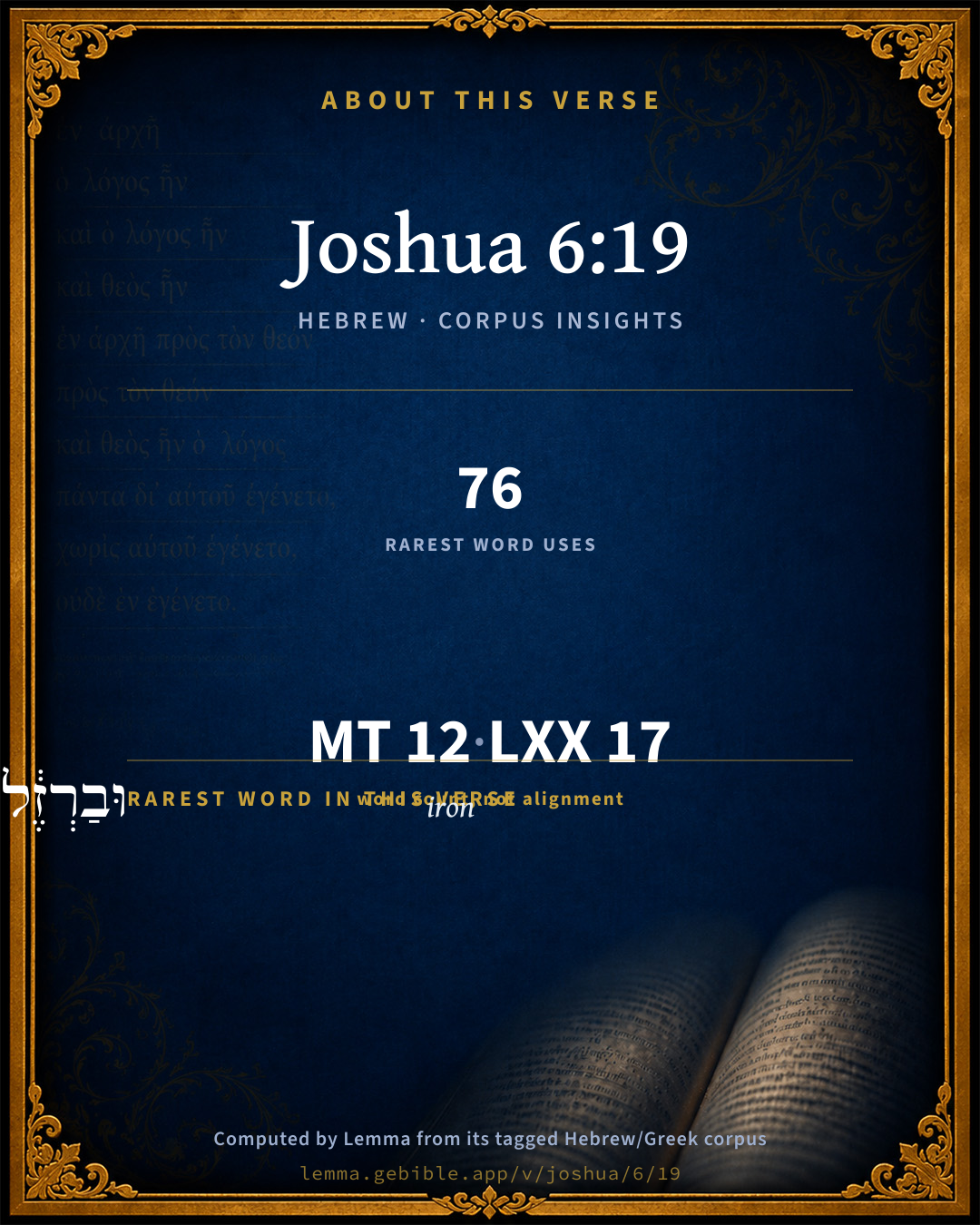
וּבַרְזֶ֔ל
barzel
H1270
“and · iron”
Conjunction + Noun, Common, Masculine, Singular, Absolute
Part of Speech
Conjunction + Noun
Type
Common
Gender
Masculine
Number
Singular
State
Absolute
Full BDB Definition

Origin: perhaps from the root of H1269

TWOT: 283a

iron - iron - iron ore - as material of furniture, utensils, implements - tool of iron - harshness, strength, oppression (figuratively)
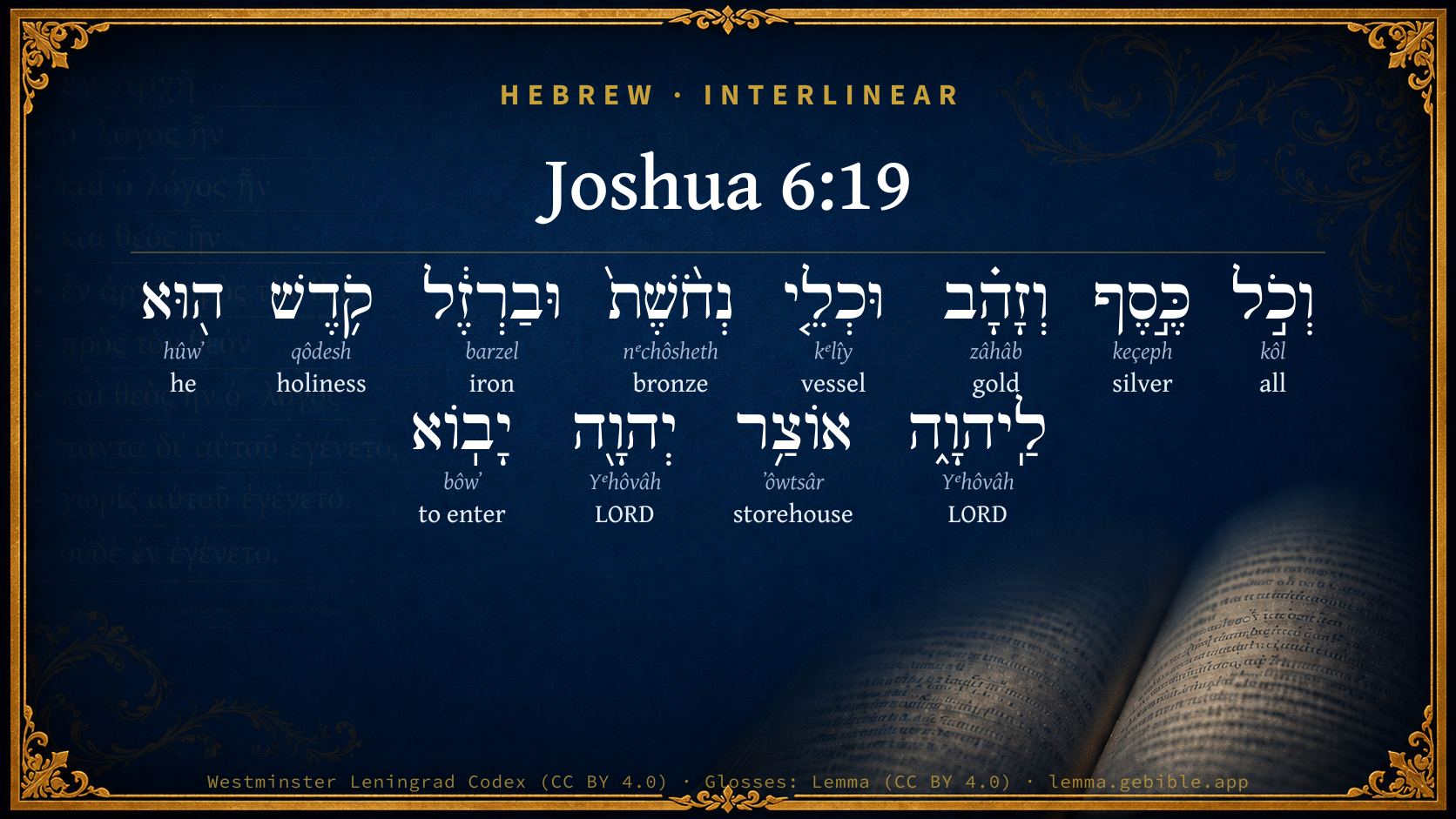
  1. וְכֹ֣ל kôl H3605 “and · all of” Conjunction + Noun, Common, Masculine, Singular, Construct
  2. כֶּ֣סֶף keçeph H3701 “silver” Noun, Common, Masculine, Singular, Absolute
  3. וְזָהָ֗ב zâhâb H2091 “and · gold” Conjunction + Noun, Common, Masculine, Singular, Absolute
  4. וּכְלֵ֤י kᵉlîy H3627 “and · vessels of” Conjunction + Noun, Common, Masculine, Plural, Construct
  5. נְחֹ֨שֶׁת֙ nᵉchôsheth H5178 “bronze” Noun, Common, Feminine, Singular, Absolute
  6. קֹ֥דֶשׁ qôdesh H6944 “holiness” Noun, Common, Masculine, Singular, Absolute
  7. ה֖וּא hûwʼ H1931 “he” Pronoun, Personal, 3rd Person, Masculine, Singular
  8. לַֽיהוָ֑ה Yᵉhôvâh H3068 “to/for · LORD” Preposition + Noun, Proper
  9. אוֹצַ֥ר ʼôwtsâr H214 “storehouse of” Noun, Common, Masculine, Singular, Construct
  10. יְהוָ֖ה Yᵉhôvâh H3068 “LORD” Noun, Proper
  11. יָבֽוֹא bôwʼ H935 “to enter” Verb, Qal, Imperfect, 3rd Person, Masculine, Singular

About this verse

These counts appear in no published source. They are computed here, from the morphology-tagged text and Lemma’s own curated glosses. What Lemma adds →

12
words
11
distinct lemmas
Historical
section

Grammatical profile

  • 1 verb
  • 10 nouns
  • 1 pronoun

Verb forms

  • יָבֽוֹא Qal · Imperfect

Repetition

A word recurs within this verse — often emphatic in Hebrew:

  • לַֽיהוָ֑ה LORD H3068 ×2

Hebrew & Septuagint length

In English translation the verse runs 24 words from the Hebrew and 26 from the Septuagint (LXX English) — closely comparable.

A rough comparison of the two English renderings, which tokenize alike — not a word-level alignment.

Word counts can differ between the Hebrew and the Greek without any difference in meaning — e.g. the Hebrew direct-object marker אֵת has no separate Greek word, and Greek often adds the article ὁ.

In the original languages it is 12 Hebrew tokens and 17 Greek tokens — but the two are counted differently (Hebrew bundles its prefixes and suffixes into one token; the Greek is in lemma form), so that isn’t a like-for-like length.

Cross-references

21

Topical passages linked to Joshua 6:19 in the Treasury of Scripture Knowledge — connected by theme and wording, ordered by reader-vote popularity; previews shown in the World English Bible.

  • 1 Chronicles 26:20 Of the Levites, Ahijah was over the treasures of the house of God, and over the treasures of the dedicated things.
  • Matthew 27:6 The chief priests took the pieces of silver, and said, "It's not lawful to put them into the treasury, since it is the price of blood."
  • Mark 12:41 Jesus sat down opposite the treasury, and saw how the multitude cast money into the treasury. Many who were rich cast in much.
  • 2 Samuel 8:11 These also did king David dedicate to Yahweh, with the silver and gold that he dedicated of all the nations which he subdued;
  • 1 Kings 7:51 Thus all the work that king Solomon worked in the house of Yahweh was finished. Solomon brought in the things which David his father had dedicated, [even] the silver, and the gold, and the vessels, and put them in the treasuries of the house of Yahweh.
  • 2 Kings 24:13 He carried out there all the treasures of the house of Yahweh, and the treasures of the king's house, and cut in pieces all the vessels of gold, which Solomon king of Israel had made in the temple of Yahweh, as Yahweh had said.
  • 1 Chronicles 18:11 These also did king David dedicate to Yahweh, with the silver and the gold that he carried away from all the nations; from Edom, and from Moab, and from the children of Ammon, and from the Philistines, and from Amalek.
  • Nehemiah 10:38 The priest the son of Aaron shall be with the Levites, when the Levites take tithes: and the Levites shall bring up the tithe of the tithes to the house of our God, to the chambers, into the treasure-house.
  • 1 Kings 14:26 and he took away the treasures of the house of Yahweh, and the treasures of the king's house; he even took away all: and he took away all the shields of gold which Solomon had made.
  • 1 Chronicles 26:26 This Shelomoth and his brothers were over all the treasures of the dedicated things, which David the king, and the heads of the fathers' [houses], the captains over thousands and hundreds, and the captains of the host, had dedicated.
  • 1 Chronicles 26:28 All that Samuel the seer, and Saul the son of Kish, and Abner the son of Ner, and Joab the son of Zeruiah, had dedicated, whoever had dedicated anything, it was under the hand of Shelomoth, and of his brothers.
  • 1 Chronicles 28:12 and the pattern of all that he had by the Spirit, for the courts of the house of Yahweh, and for all the surrounding rooms, for the treasuries of the house of God, and for the treasuries of the dedicated things;
  • 2 Chronicles 15:18 He brought into the house of God the things that his father had dedicated, and that he himself had dedicated, silver, and gold, and vessels.
  • 2 Chronicles 31:12 They brought in the offerings and the tithes and the dedicated things faithfully: and over them Conaniah the Levite was ruler, and Shimei his brother was second.
  • Nehemiah 7:70–71 Some from among the heads of fathers' [houses] gave to the work. The governor gave to the treasury one thousand darics of gold, fifty basins, and five hundred thirty priests' garments.
  • Micah 4:13 Arise and thresh, daughter of Zion; For I will make your horn iron, And I will make your hoofs brass; And you will beat in pieces many peoples: And I will devote their gain to Yahweh, And their substance to the Lord of the whole earth.
  • Leviticus 19:24 But in the fourth year all its fruit shall be holy, for giving praise to Yahweh.
  • Numbers 31:22 however the gold, and the silver, the brass, the iron, the tin, and the lead,
  • Isaiah 23:17–18 It shall happen after the end of seventy years, that Yahweh will visit Tyre, and she shall return to her hire, and shall play the prostitute with all the kingdoms of the world on the surface of the earth.
  • Jeremiah 38:11 So Ebedmelech took the men with him, and went into the house of the king under the treasury, and took there rags and worn-out garments, and let them down by cords into the dungeon to Jeremiah.
  • Zechariah 14:20–21 In that day there will be on the bells of the horses, "HOLY TO YAHWEH;" and the pots in Yahweh's house will be like the bowls before the altar.

Cross-references courtesy of OpenBible.info (CC BY 4.0).

Hebrew and Greek witnesses Masoretic Hebrew ↔ Greek Septuagint

The same verse in the two great witnesses to the Old Testament, shown verse-for-verse.

These are two independent witnesses, not word-aligned to each other, and the Septuagint is shown in lemma (dictionary) form.

Hebrew Joshua 6:19 Masoretic · Westminster Leningrad Codex

וְכֹ֣ל כֶּ֣סֶף וְזָהָ֗ב וּכְלֵ֤י נְחֹ֨שֶׁת֙ וּבַרְזֶ֔ל קֹ֥דֶשׁ ה֖וּא לַֽיהוָ֑ה אוֹצַ֥ר יְהוָ֖ה יָבֽוֹא

But all the silver, and gold, and vessels of brass and iron, are holy to Yahweh: they shall come into the treasury of Yahweh.

World English Bible · Public Domain

Greek LXX Joshua 6:19 Septuagint · lemma form

καί πᾶς ἀργύριον ἤ χρυσίον ἤ χαλκός ἤ σίδηρος ἅγιος εἰμί ὁ κύριος εἰς θησαυρός κύριος εἰςφέρω

And all the silver, or gold, or brass, or iron, shall be holy to the Lord; it shall be carried into the treasury of the Lord.

LXX2012 (modern English Septuagint) · Public Domain

Hebrew: Westminster Leningrad Codex (CC BY 4.0). Greek: Septuagint (public domain); English from LXX2012 (modern English Septuagint) (Public Domain). How the Septuagint differs from the Hebrew →

Targum (Aramaic paraphrase)

1

The Targum is the ancient Jewish Aramaic paraphrase of the Hebrew Scriptures — an interpretive translation, not the Hebrew text itself. Onkelos (literal) and Pseudo-Jonathan (expansive) render the Torah, and Jonathan the Prophets. Coverage is partial: where no permissively-licensed English translation exists for a verse, only the Aramaic is shown. This is verse-level text, not a word-by-word alignment to the Hebrew.

  1. Targum Jonathan Prophets (Joshua–Malachi)
    וְכָל כַּסְפָּא וְדַהֲבָא וּמָנֵי נְחָשָׁא וּבַרְזְלָא קוּדְשָׁא אִינוּן קֳדָם יְיָ לְאוֹצַר בֵּית מַקְדְשָׁא דַייָ יִתְעָלוּן:

    (no public-domain English translation for this verse)

    Targum Jonathan — Aramaic: “Mikraot Gedolot” (public domain). English: “Sefaria Community Translation” (CC0 1.0 (public-domain dedication)); “London "Chaldee Paraphrase," 1871” (public domain). Text via Sefaria.

Commentary

Notes on Joshua 6:19 from classic Christian and Jewish commentators (each source and its license shown beneath its notes). The classic Christian expositions comment on the surrounding passage and are grouped to its opening verse, so a note may address several verses; the Jewish commentaries on the Tanakh (Rashi and others) are per-verse, so they appear only where the commentator wrote on this verse.

Lemma curates 59 commentaries, every one of them public domain or Creative Commons licensed, each selected and text-cleaned for this edition rather than reprinted as found. About our sources →

Trapp's Complete Commentary

John Trapp

Jos 6:19 But all the silver, and gold, and vessels of brass and iron, [are] consecrated unto the LORD: they shall come into the treasury of the LORD.

Ver. 19. But all the silver and the gold.] Only their idols of silver and gold were to be utterly destroyed, {Deu 7:25 Exo 32:20} for detestation’s sake, and prevention of idolatry, that land desolating sin.

John Trapp, A Commentary or Exposition upon All the Books of the Old and New Testament (1647–1656) — public domain. Text from a community e-Sword module.

Joseph Benson's Commentary

Jos 6:19. Vessels of brass and iron — Except that of which images were made, which were utterly to be destroyed. Unto the Lord — Being first made to pass through the fire, Num 31:22-23. Treasury of the Lord — To be employed wholly for the uses of the tabernacle, not to be applied to the use of any private person or priest.

Joseph Benson's Commentary on the Old and New Testaments (1811–1818) — public domain. Text from a community e-Sword module.

Geneva Bible (1599)

Geneva Bible translators

And therefore cannot be put to any private use, but must be first molten, and then serve for the Tabernacle.

Geneva Bible (1599) marginal notes — public domain. Text via Bolls.life.

Adam Clarke's Commentary

Verse 19. But all the silver, and gold - shall come into the treasury] The Brahmins will receive from any caste, however degraded, gold, silver, &c.: but to receive from Shoodras food, garments, &c., would be considered a great degradation.-Ward.

Adam Clarke's Commentary on the Bible (1810–1826) — public domain. Text from a community e-Sword/MySword module.

Ellicott's Commentary for English Readers

(19) The silver, and gold, and vessels of brass and iron . . . into the treasury of the Lord.—See Num_31:22-23; Num_31:54, where something similar was done with the spoil of the Midianites.

A Bible Commentary for English Readers, edited by Charles John Ellicott (1878–1897) — public domain. Text from a community e-Sword module.

The Cambridge Bible for Schools and Colleges

gen. ed. J. J. S. Perowne

19. are consecrated] Or, as in the margin, are holiness unto the Lord: “to ye Lord be it halowid,” Wyclif.

into the treasury of the Lord] Comp. Num_31:22-23; Num_31:50-54. In the case of Jericho, the whole city, with all that it contained, was cherem or “devoted.”

The Cambridge Bible for Schools and Colleges (gen. ed. J. J. S. Perowne; Cambridge University Press, 1878–1918) — public domain. Text from a community e-Sword module.

John Gill's Exposition

But all the silver and gold, and vessels of brass and iron,

are consecrated to the Lord,.... Or rather, "for all the silver", &c. as the particle here used sometimes signifies, and is so rendered (d): each of these metals, and whatsoever were made of them, were set apart for the Lord, and dedicated to sacred uses, and might not be converted to any other, unless what were upon their idols, which were to be burnt with fire, Deu 7:25,

they shall come into the treasury of the Lord; be brought into the tabernacle, as Kimchi and Abarbinel interpret it, into some apartment there destined for such service, and which is clear from Jos 6:24; the same where the offering of the officers was brought after the battle with Midian, Num 31:54.

(d) "nam totum", Junius & Tremellius, Piscator.

John Gill's Exposition of the Whole Bible (1746–1763) — public domain (CC PDM 1.0). Text via the HelloAO Bible API.

Haydock's Catholic Bible Commentary

Treasures, probably in the tabernacle. See Numbers xxxi. 48. God claims the first-fruits of the booty, as an acknowledgment that he granted the victory, (Calmet) and all the riches of the country, to his people. (Haydock)

George Leo Haydock (1774–1849), Haydock's Catholic Family Bible and Commentary, 1859 edition — public domain. Excludes Psalms (Douay-Rheims chapter numbering differs from Protestant) and Deuterocanonical books (Catholic canon only).

Matthew Poole's English Annotations

Except that of which images were made, which were to be utterly destroyed, Exo 32:20; Deu 7:25. Consecrated unto the Lord; being first made to pass through the fire, Num 31:22,23.

They shall come into the treasury of the Lord, to be employed wholly for the service or uses of the tabernacle, not to be applied to the use of any private person or priest.

Matthew Poole's English Annotations on the Holy Bible (1683–1685) — public domain. Text from a community e-Sword/MySword module.

Whedon's Commentary on the Bible

Daniel D. Whedon

19. But all the silver, and gold — Because the precious metals and vessels of brass and iron were regarded as indestructible by fire, and were needed in the service of the tabernacle, they were put into the treasury of the tabernacle.

Consecrated unto the Lord — Literally this and the following sentence read: Holiness is it to Jehovah, a treasure of Jehovah shall it go. In Num_31:21-23, the method is prescribed of purifying metals by fire in order to consecrate them to the service of God.

Daniel D. Whedon (gen. ed.), Commentary on the Old and New Testaments (1874–1909) — public domain. Text from a community e-Sword module.

The Pulpit Commentary

Consecrated unto the Lord. Literally, as margin, holiness unto the Lord. (cf. Exo_28:36 Exo_39:30 Lev_27:14, 21 Jer_2:3) An expression used of anything specially devoted to God.

The Pulpit Commentary (1880–1919), ed. H.D.M. Spence-Jones & Joseph S. Exell — public domain. Text from a community e-Sword module.

John Wesley's Explanatory Notes

Vessels of brass and iron - Except that of which images were made, which were to be utterly destroyed. Unto the Lord - Being first made to pass through the fire, Num. xxxi, 22, 23. Treasury of the Lord - To be employed wholly for the uses of the tabernacle, not to be applied to the use of any private person or priest.

John Wesley, Explanatory Notes Upon the Whole Bible (1754–1765) — public domain. Text via the GEBible commentary corpus.

Lesson kit

Teaching starters — assembled from the data on this page, not authored interpretation. Every prompt links to the verse data it draws on. Edit before teaching.

Joshua, in the Historical, opens this verse with 12 words (11 distinct Hebrew lemmas). Its most distinctive word is barzel (“iron”). A historical commentator’s framing appears above. Read the whole chapter for the surrounding context.

Discussion questions

  1. How does “iron” (barzel) shape what this verse is saying?
  2. 1 Chronicles 26:20 shares this passage’s theme. How do the two illuminate each other?
  3. “LORD” occurs 2× in this one verse. What is the effect of the repetition?
  4. These translations render this verse differently. What is at stake in choosing one wording over another?
  5. The verb «יָבֽוֹא» is Qal Imperfect. How does its form color the action?
  6. Reading how Trapp's Complete Commentary and Joseph Benson's Commentary read this verse, where do the two commentators agree and where do they part?

Things to notice

Reading settings

Reading text

Shown beneath each verse's original-language words.

Old Testament
Old Testament edition

Read the OT as the Masoretic Hebrew (MT) or the Greek Septuagint (LXX).

English shown for the Greek Septuagint (in the Hebrew ↔ Greek comparison).

Comparing translations? Open the Compare panel on any verse page to stack up to four side by side.