Numbers 5:9

Hebrew (Westminster Leningrad Codex) Numbers 5:9 appears in the Hebrew Old Testament. The text above is from the Westminster Leningrad Codex. Each word links to its Strong’s number, a concise gloss, and parsing drawn from the Open Scriptures Hebrew Bible morphology. Click any word for its full Brown-Driver-Briggs (BDB) entry.
Download image
Cite this verse

Numbers 5:9 (World English Bible). Public Domain. Lemma interlinear Bible study tool, https://lemma.gebible.app/v/numbers/5/9.

Show BibTeX & RIS
BibTeX
RIS
English Translation
Every heave offering of all the holy things of the children of Israel, which they present to the priest, shall be his.
World English Bible · Public Domain
Download a study sheet

One document with this verse’s original text, its word-by-word gloss line, the meaning frame, cross-references with their text, attributed commentary, and full source and license credits — printable, and it pastes into notes with its structure intact.

This verse Autodidact and up

Study sheet (.html) Plain text (.txt)

A passage Seminary Student

Up to 50 verses in one chapter. A passage sheet keeps up to 6 commentary sources and 12 cross-references per verse, in the order this page ranks them, and says so on the sheet whenever that leaves anything out. Ask for a single verse and you get the Autodidact verse sheet above.

Everything on this page stays free to read, with no account — the sheet is a download of what is already on screen, not access to it.

Want to remove ads? Support Godless Engineer
Compare translations 3

The same verse in 3 English versions, stacked beneath the original-language interlinear above. Click any original word for its lexicon entry.

Each is an independent rendering of the whole verse — the interlinear is not word-aligned to these translations.

Highlighted words mark where these versions differ — a whole-verse word diff, not a word-by-word alignment.

  • World English Bible Public Domain
    Every heave offering of all the holy things of the children of Israel, which they present to the priest, shall be his.
  • King James Version Public Domain
    And every offering of all the holy things of the children of Israel, which they bring unto the priest, shall be his.
  • unfoldingWord Literal Text CC BY-SA 4.0
    And every contribution of all the holy things of the sons of Israel that they present to the priest, to him it shall be.

unfoldingWord Literal Text — © unfoldingWord, licensed CC BY-SA 4.0. Word-aligned USFM3 via Door43 (git.door43.org/unfoldingWord/en_ult).

Versions to compare (up to 4)

3 of 4 selected

Show all 18 translations

Every available English version of this verse, each an independent rendering of the whole verse.

  • World English Bible Public Domain
    Every heave offering of all the holy things of the children of Israel, which they present to the priest, shall be his.
  • Berean Standard Bible Public Domain
    Every sacred contribution the Israelites bring to the priest shall belong to him.
  • Majority Standard Bible Public Domain
    Every sacred contribution the Israelites bring to the priest shall belong to him.
  • King James Version Public Domain
    And every offering of all the holy things of the children of Israel, which they bring unto the priest, shall be his.
  • American Standard Version (1901) Public Domain
    And every heave-offering of all the holy things of the children of Israel, which they present unto the priest, shall be his.
  • Revised Version (1885) Public Domain
    And every heave offering of all the holy things of the children of Israel, which they present unto the priest, shall be his.
  • Geneva Bible (1599) Public Domain
    And euery offring of all the holy thinges of the children of Israel, which they bring vnto the Priest, shalbe his.
  • Douay-Rheims (1899) Public Domain
    an the firstfruits also, which the children of Israel offer, belong to the priest:
  • Young's Literal Translation Public Domain
    `And every heave-offering of all the holy things of the sons of Israel, which they bring near to the priest, becometh his;
  • Literal Standard Version CC BY-SA 4.0
    And every raised-offering of all the holy things of the sons of Israel, which they bring near to the priest, becomes his;
  • Unlocked Literal Bible CC BY-SA 4.0
    Every offering of the people of Israel, the things that are set aside and brought to the priest by the people of Israel, will belong to him.
  • unfoldingWord Literal Text CC BY-SA 4.0
    And every contribution of all the holy things of the sons of Israel that they present to the priest, to him it shall be.
  • Darby Bible Public Domain
    And every heave-offering of all the holy things of the children of Israel, which they present unto the priest, shall be his.
  • World Messianic Bible Public Domain
    Every heave offering of all the holy things of the children of Israel, which they present to the priest, shall be his.
  • Webster's Bible Public Domain
    And every offering of all the holy things of the children of Israel, which they bring to the priest, shall be his.
  • Free Bible Version CC BY-SA 4.0
    All holy offerings that the Israelites bring to the priest belong to him.
  • Bible in Basic English Public Domain
    And every offering lifted up of all the holy things which the children of Israel give to the priest, will be his.
  • JPS Tanakh (1917) Public Domain
    And every heave-offering of all the holy things of the children of Israel, which they present unto the priest, shall be his.

Literal Standard Version (2020), Covenant Press — licensed CC BY-SA 4.0. Text via the HelloAO Bible API (eBible.org). Unlocked Literal Bible (unfoldingWord) — licensed CC BY-SA 4.0. Text via the HelloAO Bible API (eBible.org). unfoldingWord Literal Text — © unfoldingWord, licensed CC BY-SA 4.0. Word-aligned USFM3 via Door43 (git.door43.org/unfoldingWord/en_ult). Free Bible Version, Dr. Jonathan Gallagher — licensed CC BY-SA 4.0. Text via the HelloAO Bible API (eBible.org).

Word by word

More ways to search: Search by grammar → Find every occurrence → Compare this word →

Practice this passage: Drill this verse → Learn its vocabulary →

תְּרוּמָ֞ה
tᵉrûwmâh
H8641
“offering”
Noun, Common, Feminine, Singular, Absolute
Part of Speech
Noun
Type
Common
Gender
Feminine
Number
Singular
State
Absolute
Full BDB Definition

Origin: from H7311

TWOT: 2133i

contribution, offering - a heave offering - any offering - an offering to God - an offering (of grain, money, etc) - contribution
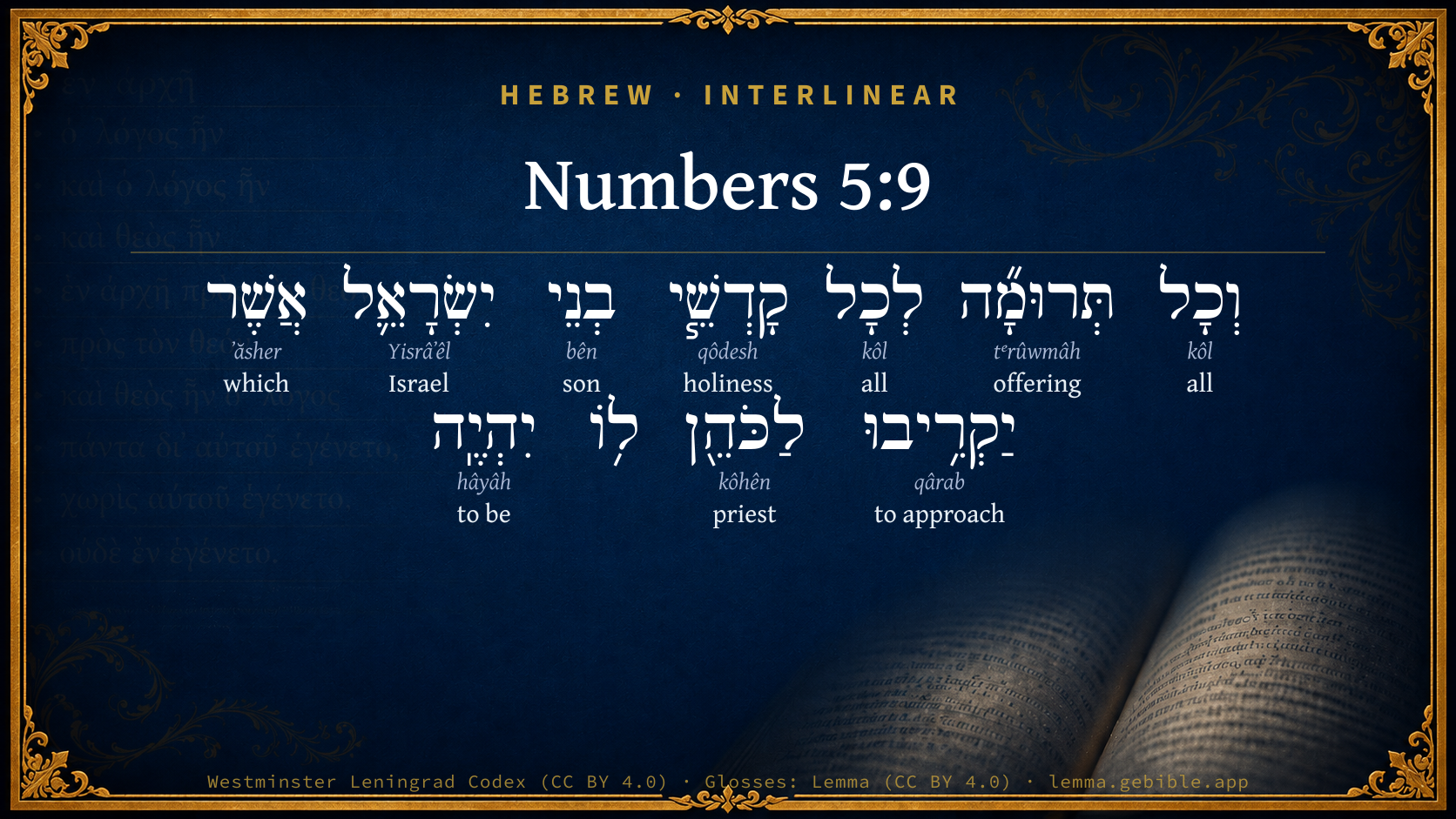
  1. וְכָל kôl H3605 “and · all of” Conjunction + Noun, Common, Masculine, Singular, Construct
  2. לְכָל kôl H3605 “to/for · all of” Preposition + Noun, Common, Masculine, Singular, Construct
  3. קָדְשֵׁ֧י qôdesh H6944 “holy things of” Noun, Common, Masculine, Plural, Construct
  4. בְנֵי bên H1121 “sons of” Noun, Common, Masculine, Plural, Construct
  5. יִשְׂרָאֵ֛ל Yisrâʼêl H3478 “Israel” Noun, Proper
  6. אֲשֶׁר ʼăsher H834 “which” Particle, Relative
  7. יַקְרִ֥יבוּ qârab H7126 “to approach” Verb, Hiphil, Imperfect, 3rd Person, Masculine, Plural
  8. לַכֹּהֵ֖ן kôhên H3548 “to/for the · priest” Preposition, Determined + Noun, Common, Masculine, Singular, Absolute
  9. יִהְיֶֽה hâyâh H1961 “to be” Verb, Qal, Imperfect, 3rd Person, Masculine, Singular

About this verse

These counts appear in no published source. They are computed here, from the morphology-tagged text and Lemma’s own curated glosses. What Lemma adds →

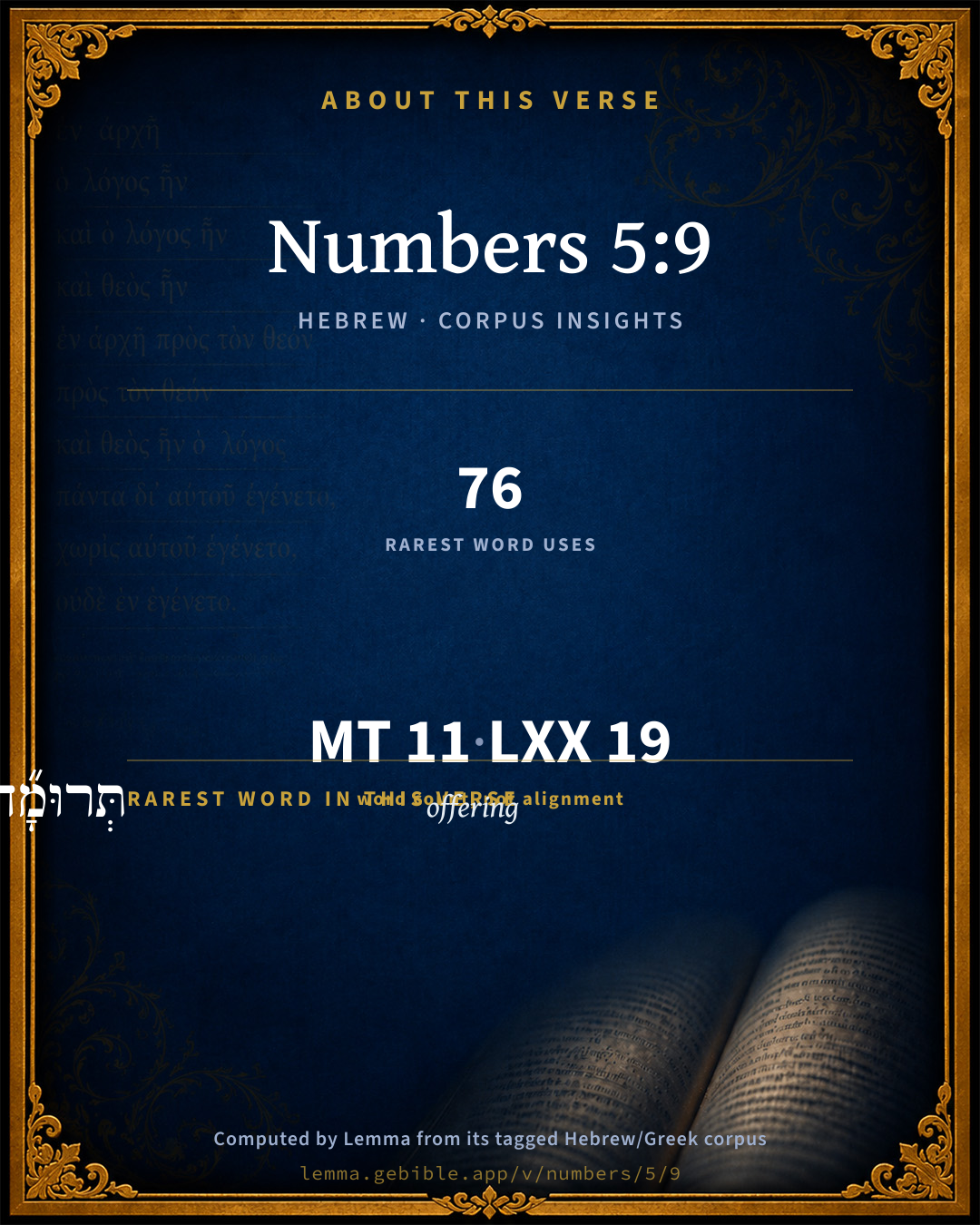
11
words
9
distinct lemmas
Pentateuch
section

Grammatical profile

  • 2 verbs
  • 7 nouns
  • 1 preposition
  • 1 particle

Verb forms

  • יַקְרִ֥יבוּ Hiphil · Imperfect
  • יִהְיֶֽה Qal · Imperfect

Repetition

A word recurs within this verse — often emphatic in Hebrew:

  • וְכָל all H3605 ×2

Hebrew & Septuagint length

In English translation the verse runs 22 words from the Hebrew and 27 from the Septuagint (LXX English) — closely comparable.

A rough comparison of the two English renderings, which tokenize alike — not a word-level alignment.

Word counts can differ between the Hebrew and the Greek without any difference in meaning — e.g. the Hebrew direct-object marker אֵת has no separate Greek word, and Greek often adds the article ὁ.

In the original languages it is 11 Hebrew tokens and 19 Greek tokens — but the two are counted differently (Hebrew bundles its prefixes and suffixes into one token; the Greek is in lemma form), so that isn’t a like-for-like length.

Cross-references

12

Topical passages linked to Numbers 5:9 in the Treasury of Scripture Knowledge — connected by theme and wording, ordered by reader-vote popularity; previews shown in the World English Bible.

  • Exodus 29:28 and it shall be for Aaron and his sons as their portion forever from the children of Israel; for it is a heave-offering: and it shall be a heave-offering from the children of Israel of the sacrifices of their peace-offerings, even their heave-offering to Yahweh.
  • Leviticus 6:17–18 It shall not be baked with yeast. I have given it as their portion of my offerings made by fire. It is most holy, as the sin offering, and as the trespass offering.
  • Leviticus 7:6–14 Every male among the priests may eat of it. It shall be eaten in a holy place. It is most holy.
  • Numbers 18:19 All the heave-offerings of the holy things, which the children of Israel offer to Yahweh, have I given you, and your sons and your daughters with you, as a portion forever: it is a covenant of salt forever before Yahweh to you and to your seed with you.
  • Deuteronomy 18:3–4 This shall be the priests' due from the people, from those who offer a sacrifice, whether it be ox or sheep, that they shall give to the priest the shoulder, and the two cheeks, and the maw.
  • Leviticus 6:26 The priest who offers it for sin shall eat it. It shall be eaten in a holy place, in the court of the Tent of Meeting.
  • Leviticus 10:13 and you shall eat it in a holy place, because it is your portion, and your sons' portion, of the offerings of Yahweh made by fire: for so I am commanded.
  • Leviticus 22:2–3 "Tell Aaron and his sons to separate themselves from the holy things of the children of Israel, which they make holy to me, and that they not profane my holy name. I am Yahweh.
  • Numbers 18:8–9 Yahweh spoke to Aaron, I, behold, I have given you the charge of my heave-offerings, even all the holy things of the children of Israel; to you have I given them by reason of the anointing, and to your sons, as a portion forever.
  • Ezekiel 44:29–30 They shall eat the meal-offering, and the sin-offering, and the trespass-offering; and every devoted thing in Israel shall be theirs.
  • Malachi 3:8–10 Will a man rob God? Yet you rob me! But you say, 'How have we robbed you?' In tithes and offerings.
  • 1 Corinthians 9:7–13 What soldier ever serves at his own expense? Who plants a vineyard, and doesn't eat of its fruit? Or who feeds a flock, and doesn't drink from the flock's milk?

Cross-references courtesy of OpenBible.info (CC BY 4.0).

Hebrew and Greek witnesses Masoretic Hebrew ↔ Greek Septuagint

The same verse in the two great witnesses to the Old Testament, shown verse-for-verse.

These are two independent witnesses, not word-aligned to each other, and the Septuagint is shown in lemma (dictionary) form.

Hebrew Numbers 5:9 Masoretic · Westminster Leningrad Codex

וְכָל תְּרוּמָ֞ה לְכָל קָדְשֵׁ֧י בְנֵי יִשְׂרָאֵ֛ל אֲשֶׁר יַקְרִ֥יבוּ לַכֹּהֵ֖ן ל֥וֹ יִהְיֶֽה

Every heave offering of all the holy things of the children of Israel, which they present to the priest, shall be his.

World English Bible · Public Domain

Greek LXX Numbers 5:9 Septuagint · lemma form

καί πᾶς ἀπαρχή κατά πᾶς ὁ ἁγιάζω ἐν υἱός ἰσραήλ ὅσος ἄν προςφέρω ὁ κύριος ὁ ἱερεύς αὐτός εἰμί

And every first fruits in all the sanctified things among the children of Israel, whatever they shall offer to the Lord, shall be for the priest himself.

LXX2012 (modern English Septuagint) · Public Domain

On this verse, The Cambridge Bible for Schools and Colleges discusses the Septuagint’s reading. Read the note in Commentary ↓

Hebrew: Westminster Leningrad Codex (CC BY 4.0). Greek: Septuagint (public domain); English from LXX2012 (modern English Septuagint) (Public Domain). How the Septuagint differs from the Hebrew →

Targum (Aramaic paraphrase)

2

The Targum is the ancient Jewish Aramaic paraphrase of the Hebrew Scriptures — an interpretive translation, not the Hebrew text itself. Onkelos (literal) and Pseudo-Jonathan (expansive) render the Torah, and Jonathan the Prophets. Coverage is partial: where no permissively-licensed English translation exists for a verse, only the Aramaic is shown. This is verse-level text, not a word-by-word alignment to the Hebrew.

  1. Targum Onkelos Torah (Genesis–Deuteronomy)
    וְכָל אַפְרָשׁוּתָא לְכָל קוּדְשַׁיָא דִבְנֵי יִשְׂרָאֵל דִי יְקָרְבוּן לְכַהֲנָא דִלֵהּ יְהֵא

    (no public-domain English translation for this verse)

    Targum Onkelos — Aramaic: “Onkelos Genesis” (public domain); “Onkelos Exodus” (public domain); “Onkelos Leviticus” (public domain); “Onkelos Numbers” (public domain); “Onkelos Deuteronomy” (public domain). English: “Sefaria Community Translation” (CC0 1.0 (public-domain dedication)); “J.W. Etheridge. The Targums of Onkelos and Jonathan Ben Uzziel on the Pentateuch. London: Longmans, Green, 1862” (public domain). Text via Sefaria.

  2. Targum Pseudo-Jonathan Torah (Genesis–Deuteronomy)
    וְכָל אַפְרָשׁוּתָא לְכָל קוּדְשַׁיָא דִבְנֵי יִשְרָאֵל דִיקַרְבוּן לְכַהֲנָא דִילֵיהּ יְהוֹן

    And every separation of all consecrated things of the children of Israel which they bring to the priest shall be his.

    Targum Pseudo-Jonathan — Aramaic: “Targum Jonathan on Genesis” (public domain); “Targum Jonathan on Exodus” (public domain); “Targum Jonathan on Leviticus” (public domain); “Targum Jonathan on Numbers” (public domain); “Targum Jonathan on Deuteronomy” (public domain). English: “The Targum of Jonathan ben Uzziel, trans. J. W. Etheridge, London, 1862” (public domain). Text via Sefaria.

Commentary

Notes on Numbers 5:9 from classic Christian and Jewish commentators (each source and its license shown beneath its notes). The classic Christian expositions comment on the surrounding passage and are grouped to its opening verse, so a note may address several verses; the Jewish commentaries on the Tanakh (Rashi and others) are per-verse, so they appear only where the commentator wrote on this verse.

Lemma curates 59 commentaries, every one of them public domain or Creative Commons licensed, each selected and text-cleaned for this edition rather than reprinted as found. About our sources →

Trapp's Complete Commentary

John Trapp

Num 5:9 And every offering of all the holy things of the children of Israel, which they bring unto the priest, shall be his.

Ver. 9. And every offering.] So liberally doth the Lord provide for his priests. {See Trapp on "Lev 27:30"} And is not the right of livelihood as equal and due to the ministers of the gospel, whose ministry is far more glorious, {2Co 3:8-9} even greater than that of John Baptist? {Mat 11:11}

John Trapp, A Commentary or Exposition upon All the Books of the Old and New Testament (1647–1656) — public domain. Text from a community e-Sword module.

Tyndale Open Study Notes

Tyndale Open Resources

5:9-10 Priests supported their families partly by receiving a share of the sacrifices. In some instances, surplus sacrifices could be sold to provide funds for the priesthood, for maintaining the sanctuary, and for other religious needs (cp. 1 Cor 8:4-13).

Tyndale Open Study Notes — © Tyndale Open Resources, licensed CC BY-SA 4.0. Text via the HelloAO Bible API.

Geneva Bible (1599)

Geneva Bible translators

Or, things offered to the Lord, as firstfruits, etc.

Geneva Bible (1599) marginal notes — public domain. Text via Bolls.life.

Jamieson, Fausset & Brown

Robert Jamieson, A. R. Fausset & David Brown

every offering . . . shall be his--Whatever was given in this way, or otherwise, as by freewill offerings, irrevocably belonged to the priest.

Jamieson, Fausset & Brown — Commentary Critical and Explanatory on the Whole Bible (1871) — public domain (CC PDM 1.0). Text via the HelloAO Bible API.

The Cambridge Bible for Schools and Colleges

gen. ed. J. J. S. Perowne

9. every heave-offering] every contribution. The Heb. terûmâh is derived from a root signifying ‘to lift up, or off,’ and denotes that which is lifted off from a larger mass, and separated or contributed for sacred purposes. LXX. in the Pentateuch renders it by ἀφαιρεμα. It is used of gifts taken from the produce of the earth (Num_15:19-21 (P ), Deu_12:6; Deu_12:11), of money, spoils, &c. dedicated to Jehovah (Num_31:19; Num_31:41; Num_31:52), of the Levites’ tithe (Num_18:24), of the priests’ share of the tithe (Num_18:26-29), of materials for the Tabernacle (Exo_25:2 f., Num_35:5; Num_35:21; Num_35:24) and for the second temple (Ezr_8:25), of the half shekel for defraying the expenses of the Tabernacle services (Exo_30:13 ff.), and even of land reserved for the priests and Levites (Eze_45:1; Eze_45:6, &c.). As applied to animal sacrifices, the term is employed only of the shoulder of the peace-offering (Num_6:20, Exo_29:27, Lev_7:34; Lev_10:14 f.). See Driver’s article ‘Offer’ in Hastings’ DB. iii. 588.

The Cambridge Bible for Schools and Colleges (gen. ed. J. J. S. Perowne; Cambridge University Press, 1878–1918) — public domain. Text from a community e-Sword module.

John Gill's Exposition

And every offering of all the holy things of the children of Israel,.... Of the holy sacrifices brought by them to be offered up; that part of them which is elevated, heaved, or waved, as the heave shoulder and wave breast:

which they bring unto the priest, shall be his; what they bring to him to offer for them shall be his who performs the service, even that part of them which is his due.

John Gill's Exposition of the Whole Bible (1746–1763) — public domain (CC PDM 1.0). Text via the HelloAO Bible API.

Haydock's Catholic Bible Commentary

First-fruits; (teruman,) a term which comprises also voluntary oblations of all sorts, and the parts of the victims which belong to the priests; unless the person offering expressed a different intention. (Calmet)

George Leo Haydock (1774–1849), Haydock's Catholic Family Bible and Commentary, 1859 edition — public domain. Excludes Psalms (Douay-Rheims chapter numbering differs from Protestant) and Deuterocanonical books (Catholic canon only).

Matthew Poole's English Annotations

Heb. every heave offering, the heave-offering being here taken largely, so as to comprehend also the wave-offering for both of these were Aaron’s portion. See Exo 29:26-28.

Unto the priest to wit, to offer unto the Lord by his hands.

Shall be his, i.e. the priest’s. See Lev 6:16.

Matthew Poole's English Annotations on the Holy Bible (1683–1685) — public domain. Text from a community e-Sword/MySword module.

Whedon's Commentary on the Bible

Daniel D. Whedon

9. And every offering — Terumah. The original, according to Furst, signifies “any oblation, that is, a gift taken from a whole which one brings to God or to the priest.” It is supposed to have special reference here to the heave shoulder and the wave breast, the perquisites of the priestly office. Lev_10:12-15. The Greek version has απαρχη, firstfruits. We group together all the sources of revenue to the priests before their settlement in Canaan. 1.) One per cent. of the produce of the soil, which was one tenth of the tithes paid to the Levites. Num_18:26 to Num_28:2.) A special tithe every third year. Deu_14:28; Deu_26:12. 3.) The five shekels for the redemption of each firstborn. Num_18:16. 4.) The redemption of persons or things especially vowed to Jehovah. Lev_27:5.) A five hundredth part of half the spoils of war.

Num_31:27; Num_28:6.) The show bread, the flesh of the sin offerings, peace offerings, trespass offerings, especially the heave shoulder and the wave breast. 7.) An undefined amount of the firstfruits of corn, wine, and oil.

Shall be his — That is, the priest’s who ministers at the time. Thus Keil renders the tenth verse, “With regard to every man’s holy gifts, to him (the priest) shall they be; what any man gives to the priest shall belong to him.” Professor Bush interprets to him to signify the man who brings the gifts.

Daniel D. Whedon (gen. ed.), Commentary on the Old and New Testaments (1874–1909) — public domain. Text from a community e-Sword module.

The Pulpit Commentary

Every offering. Hebrew, terumah, heave offering. (Exo_29:28) Septuagint, aparch . Those offerings, or portions of offerings, which were not consumed on the altar, but "presented" at the altar. Having been offered, they were the property of the Lord, and were given by him to the priests.

The Pulpit Commentary (1880–1919), ed. H.D.M. Spence-Jones & Joseph S. Exell — public domain. Text from a community e-Sword module.

John Wesley's Explanatory Notes

Unto the priest - To offer by his hands.

John Wesley, Explanatory Notes Upon the Whole Bible (1754–1765) — public domain. Text via the GEBible commentary corpus.

Rashi

Rabbi Shlomo Yitzchaki (Rashi)

וכל תרומה וגו׳ AND EVERY HEAVE OFFERING … WHICH THEY BRING UNTO THE PRIEST] — R. Ishmael asked, “Do they then have to bring the heave-offering to the priest; does he not have to go around the granaries begging for it? What, then, is the meaning of ‘which they bring unto the priest’? It refers to the first fruits of which it is said, (Exodus 23:19) ‘[The first of the first fruits of thy ground] thou shalt bring into the house of the Lord they God’, but I do not know what is to be done with them, (i.e., this is nowhere stated). Scripture therefore states here, ‘[and every heave-offering, …which they bring] unto the priest, shall be his’ — Scripture comes and teaches you with respect to the first fruits that they must be given to the priest” (Sifrei Bamidbar 5).

Rashi on the Tanakh — English translations: “The Judaica Press complete Tanach with Rashi, translated by A. J. Rosenberg” (CC BY 4.0); “Pentateuch with Rashi's commentary by M. Rosenbaum and A.M. Silbermann, 1929-1934” (public domain); “The Metsudah Tanach series, Lakewood, N.J” (CC BY 4.0); and “The Book of Joshua, Metsudah Publications, 1997” (CC BY 4.0). Text via Sefaria.

Ramban (Nachmanides)

Rabbi Moshe ben Nachman (Ramban / Nachmanides)

AND EVERY HEAVE-OFFERING OF ALL THE HOLY THINGS OF THE CHILDREN OF ISRAEL, WHICH THEY BRING UNTO THE PRIEST, SHALL BE HIS. Scripture is saying that the heave-offering which the children of Israel hallow, that is to say, which they set aside [of the produce] and declare holy, shall be the priest’s, for since there is no specific measure [required by law of the Torah when setting aside] the heave-offering, therefore Scripture said that however much they set aside of the produce [as the heave-offering] shall belong to the priest when the owners bring it and give it to him, but the priest may not take it by force. This is the plain meaning of the verse. And so the Rabbis have said in the Sifre: 5. The “Sifre” is the Tannaitic Midrash on the Books of Numbers and Deuteronomy. It is equivalent to the Mechilta on Exodus, and the Sifra or Torath Kohanim on Leviticus. “Rabbi Akiba says: ‘Scripture comes [here] to teach you that if the owner wishes to declare his whole granary heave-offering, he may do so, provided that he leaves over a small amount’ [as ordinary food].” We have furthermore been taught there in the Sifre: 5. The “Sifre” is the Tannaitic Midrash on the Books of Numbers and Deuteronomy. It is equivalent to the Mechilta on Exodus, and the Sifra or Torath Kohanim on Leviticus. “Which ‘yakrivu’ (they bring) unto the priest. Said Rabbi Yishmael: But do they bring the heave-offering to the priest? What then is the meaning of the expression, which ‘yakrivu’ (they bring) unto the priest, shall be his? [It is as follows:] Since He stated, The choicest first-fruits of thy land thou shalt bring unto the House of the Eternal thy G-d, but we have not been informed yet what shall be done with them, therefore Scripture states [here], which ‘yakrivu’ (they bring) unto the priest, shall be his — Scripture comes and teaches you that the first-fruits are to be given to the priest.” Now Rashi [in citing here this text of the Sifre] explained [the question] “But do they bring the heave-offering to the priest?” in the following way: “Does not the priest have to go around the granaries asking for it?” But this is not clear. (they ‘bring’) unto the priest, shall be his. The heave-offering, according to Rashi, is to be “brought” to the priest. In the opinion of Ramban, only the priest’s taking it by force is forbidden, while his going around for it, is not prohibited in this verse, [[illegible]]since the yakrivu as explained by Rabbi Yishmael in the Sifre is to be understood as denoting offering on the altar, and his question is as follows: “Were they [really] (yakrivu) ‘bringing’ the heave-offering on the altar? Certainly not. Therefore it must refer to the first-fruits.” In brief, Rashi’s interpretation of yakrivu as “bringing” the heave-offering to the priest is therefore “not clear” (as Ramban expresses it). But the [correct] explanation is that in the opinion of Rabbi Yishmael [in the above text of the Sifre] the root hakravah in the Torah [“bringing” — as in yakrivu mentioned here] refers only to things which are offered up on the altar. Therefore he interpreted the expression ‘asher yakrivu’ (which they bring) as referring to the first-fruits, which require waving and bringing to the altar, Scripture thus stating [here] that all first-fruits which the owners bring to G-d shall belong to the officiating priest. And when Rabbi Yishmael said [in the Sifre above], “Since it is stated, The choicest first-fruits of thy land thou shalt bring unto the House of the Eternal thy G-d, but I do not know what is to be done with them,” he means to say that we have not yet been taught at all that the first-fruits are amongst the gifts of the priests, and it is here that He taught us for the first time that they are to be given to the priest. But afterwards He taught it again in the section dealing with [the gifts of] the priests: The first ripe fruits of all that is in their Land, which they bring unto the Eternal, shall be thine, for there He also restated the [laws of the] heave-offering, Verse 12. and hallowed objects, Verses 9, 17-19. in order to include together all gifts given to the priests, and to make a covenant of salt, Verse 19. for all of them [indicating that just as salt never decays, so will His covenant with Aaron endure]. It also [repeats the laws] for the sake of some new things added in that section, such as, every one that is clean in thy house may eat thereof., Verse 13. The verse is speaking about first-fruits. We furthermore learn from the verse here [i.e., from the expression asher yakrivu which, as explained above, refers to some act of service in the Sanctuary] that the first-fruits are to be given to the men of the mishmar. to offer it up [i.e., to the priests who are then on duty in the Sanctuary], and that [the owner] may not give them to any priest he wants to, as is the law of the heave-offering.

Ramban (Nachmanides) on the Tanakh — English translation: “Commentary on the Torah by Ramban (Nachmanides). Translated and annotated by Charles B. Chavel. New York, Shilo Pub. House, 1971-1976” (CC BY 4.0). Text via Sefaria.

Lesson kit

Teaching starters — assembled from the data on this page, not authored interpretation. Every prompt links to the verse data it draws on. Edit before teaching.

Numbers, in the Pentateuch, opens this verse with 11 words (9 distinct Hebrew lemmas). Its most distinctive word is tᵉrûwmâh (“offering”). A historical commentator’s framing appears above. Read the whole chapter for the surrounding context.

Discussion questions

  1. How does “offering” (tᵉrûwmâh) shape what this verse is saying?
  2. Exodus 29:28 shares this passage’s theme. How do the two illuminate each other?
  3. “all” occurs 2× in this one verse. What is the effect of the repetition?
  4. The translations on this page render this verse differently — a whole-verse word diff, not a word-by-word alignment. What might account for the different wordings?
  5. The verb «יַקְרִ֥יבוּ» is Hiphil Imperfect. How does its form color the action?
  6. Reading how Trapp's Complete Commentary and Tyndale Open Study Notes read this verse, where do the two commentators agree and where do they part?

Things to notice

Reading settings

Reading text

Shown beneath each verse's original-language words.

Old Testament
Old Testament edition

Read the OT as the Masoretic Hebrew (MT) or the Greek Septuagint (LXX).

English shown for the Greek Septuagint (in the Hebrew ↔ Greek comparison).

Comparing translations? Open the Compare panel on any verse page to stack up to four side by side.