
2 Kings 12:18

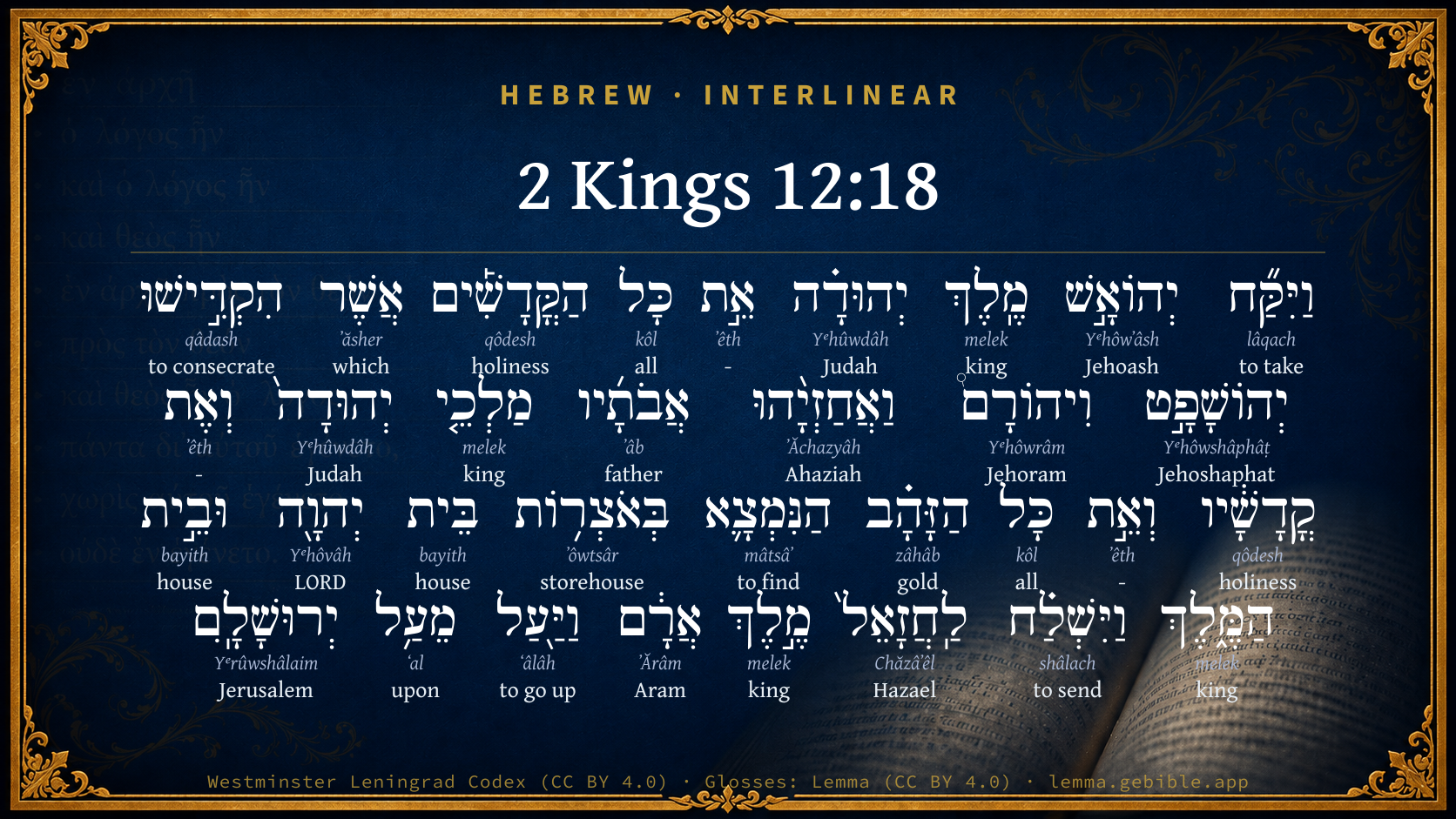
Hebrew (Westminster Leningrad Codex) 2 Kings 12:18 appears in the Hebrew Old Testament. The text above is from the Westminster Leningrad Codex. Each word links to its Strong’s number, a concise gloss, and parsing drawn from the Open Scriptures Hebrew Bible morphology. Click any word for its full Brown-Driver-Briggs (BDB) entry.
Download image
Cite this verse

2 Kings 12:18 (World English Bible). Public Domain. Lemma interlinear Bible study tool, https://lemma.gebible.app/v/2-kings/12/18.

Show BibTeX & RIS
BibTeX
RIS
English Translation
Jehoash king of Judah took all the holy things that Jehoshaphat and Jehoram and Ahaziah, his fathers, kings of Judah, had dedicated, and his own holy things, and all the gold that was found in the treasures of the house of Yahweh, and of the king's house, and sent it to Hazael king of Syria: and he went away from Jerusalem.
World English Bible · Public Domain
Download a study sheet

One document with this verse’s original text, its word-by-word gloss line, the meaning frame, cross-references with their text, attributed commentary, and full source and license credits — printable, and it pastes into notes with its structure intact.

This verse Autodidact and up

Study sheet (.html) Plain text (.txt)

A passage Seminary Student

Up to 50 verses in one chapter. A passage sheet keeps up to 6 commentary sources and 12 cross-references per verse, in the order this page ranks them, and says so on the sheet whenever that leaves anything out. Ask for a single verse and you get the Autodidact verse sheet above.

Everything on this page stays free to read, with no account — the sheet is a download of what is already on screen, not access to it.

Want to remove ads? Support Godless Engineer
Compare translations 3

The same verse in 3 English versions, stacked beneath the original-language interlinear above. Click any original word for its lexicon entry.

Each is an independent rendering of the whole verse — the interlinear is not word-aligned to these translations.

Highlighted words mark where these versions differ — a whole-verse word diff, not a word-by-word alignment.

  • World English Bible Public Domain
    Jehoash king of Judah took all the holy things that Jehoshaphat and Jehoram and Ahaziah, his fathers, kings of Judah, had dedicated, and his own holy things, and all the gold that was found in the treasures of the house of Yahweh, and of the king's house, and sent it to Hazael king of Syria: and he went away from Jerusalem.
  • King James Version Public Domain
    And Jehoash king of Judah took all the hallowed things that Jehoshaphat, and Jehoram, and Ahaziah, his fathers, kings of Judah, had dedicated, and his own hallowed things, and all the gold that was found in the treasures of the house of the LORD, and in the king's house, and sent it to Hazael king of Syria: and he went away from Jerusalem.
  • unfoldingWord Literal Text CC BY-SA 4.0
    And Joash, the king of Judah, took all of the holy things that Jehoshaphat and Jehoram and Ahaziah, his fathers, the kings of Judah, had consecrated and his holy things and all of the gold found in the treasuries of the house of Yahweh and the house of the king, and he sent to Hazael, the king of Aram, and he went up from upon Jerusalem.

unfoldingWord Literal Text — © unfoldingWord, licensed CC BY-SA 4.0. Word-aligned USFM3 via Door43 (git.door43.org/unfoldingWord/en_ult).

Versions to compare (up to 4)

3 of 4 selected

Show all 18 translations

Every available English version of this verse, each an independent rendering of the whole verse.

  • World English Bible Public Domain
    Jehoash king of Judah took all the holy things that Jehoshaphat and Jehoram and Ahaziah, his fathers, kings of Judah, had dedicated, and his own holy things, and all the gold that was found in the treasures of the house of Yahweh, and of the king's house, and sent it to Hazael king of Syria: and he went away from Jerusalem.
  • Berean Standard Bible Public Domain
    So King Joash of Judah took all the sacred objects dedicated by his fathers—Jehoshaphat, Jehoram, and Ahaziah, the kings of Judah—along with his own consecrated items and all the gold found in the treasuries of the house of the LORD and the royal palace, and he sent them to Hazael king of Aram. So Hazael withdrew from Jerusalem.
  • Majority Standard Bible Public Domain
    So King Joash of Judah took all the sacred objects dedicated by his fathers—Jehoshaphat, Jehoram, and Ahaziah, the kings of Judah—along with his own consecrated items and all the gold found in the treasuries of the house of the LORD and the royal palace, and he sent them to Hazael king of Aram. So Hazael withdrew from Jerusalem.
  • King James Version Public Domain
    And Jehoash king of Judah took all the hallowed things that Jehoshaphat, and Jehoram, and Ahaziah, his fathers, kings of Judah, had dedicated, and his own hallowed things, and all the gold that was found in the treasures of the house of the LORD, and in the king's house, and sent it to Hazael king of Syria: and he went away from Jerusalem.
  • American Standard Version (1901) Public Domain
    And Jehoash king of Judah took all the hallowed things that Jehoshaphat and Jehoram and Ahaziah, his fathers, kings of Judah, had dedicated, and his own hallowed things, and all the gold that was found in the treasures of the house of Jehovah, and of the king's house, and sent it to Hazael king of Syria: and he went away from Jerusalem.
  • Revised Version (1885) Public Domain
    And Jehoash king of Judah took all the hallowed things that Jehoshaphat, and Jehoram, and Ahaziah, his fathers, kings of Judah, had dedicated, and his own hallowed things, and all the gold that was found in the treasures of the house of the LORD; and of the king’s house, and sent it to Hazael king of Syria: and he went away from Jerusalem.
  • Geneva Bible (1599) Public Domain
    And Iehoash King of Iudah tooke all the halowed thinges that Iehoshaphat, and Iehoram, and Ahaziah his fathers Kings of Iudah had dedicated, and that he himselfe had dedicated, and all the golde that was found in the treasures of the house of the Lord and in the Kings house, and sent it to Hazael King of Aram, and he departed from Ierusalem.
  • Douay-Rheims (1899) Public Domain
    Wherefore Joas king of Juda took all the sanctified things, which Josaphat, and Joram, and Ochozias his fathers the kings of Juda had dedicated to holy uses, and which he himself had offered: and all the silver that could be found in the treasures of the temple of the Lord, and in the king's palace: and sent it to Hazael king of Syria, and he went off from Jerusalem.
  • Young's Literal Translation Public Domain
    and Jehoash king of Judah taketh all the sanctified things that Jehoshaphat, and Jehoram, and Ahaziah, his fathers, kings of Judah, had sanctified, and his own sanctified things, and all the gold that is found in the treasures of the house of Jehovah and of the house of the king, and sendeth to Hazael king of Aram, and he goeth up from off Jerusalem.
  • Literal Standard Version CC BY-SA 4.0
    and Jehoash king of Judah takes all the sanctified things that Jehoshaphat, and Jehoram, and Ahaziah, his fathers, kings of Judah, had sanctified, and his own sanctified things, and all the gold that is found in the treasures of the house of YHWH and of the house of the king, and sends [them] to Hazael king of Aram, and he goes up from off Jerusalem.
  • Unlocked Literal Bible CC BY-SA 4.0
    Joash king of Judah took all the things that Jehoshaphat and Jehoram and Ahaziah, his fathers, kings of Judah, had set apart, and what he had set apart, and all the gold that was found in the storerooms of the houses of Yahweh and of the king and he sent them to Hazael king of Aram. Then Hazael went away from Jerusalem.
  • unfoldingWord Literal Text CC BY-SA 4.0
    And Joash, the king of Judah, took all of the holy things that Jehoshaphat and Jehoram and Ahaziah, his fathers, the kings of Judah, had consecrated and his holy things and all of the gold found in the treasuries of the house of Yahweh and the house of the king, and he sent to Hazael, the king of Aram, and he went up from upon Jerusalem.
  • Darby Bible Public Domain
    And Jehoash king of Judah took all the hallowed things that Jehoshaphat and Jehoram and Ahaziah, his fathers, kings of Judah, had dedicated, and his own hallowed things, and all the gold found in the treasures of the house of Jehovah and in the king's house, and sent it to Hazael king of Syria; and he went away from Jerusalem.
  • World Messianic Bible Public Domain
    Jehoash king of Judah took all the holy things that Jehoshaphat and Jehoram and Ahaziah, his fathers, kings of Judah, had dedicated, and his own holy things, and all the gold that was found in the treasures of the LORD’s house, and of the king’s house, and sent it to Hazael king of Syria; and he went away from Jerusalem.
  • Webster's Bible Public Domain
    And Jehoash king of Judah took all the hallowed things that Jehoshaphat, and Jehoram, and Ahaziah, his fathers, kings of Judah, had dedicated, and his own hallowed things, and all the gold that was found in the treasures of the house of the LORD, and in the king's house, and sent it to Hazael king of Syria: and he went away from Jerusalem.
  • Free Bible Version CC BY-SA 4.0
    So King Joash of Judah took all the holy objects dedicated by his forefathers Jehoshaphat, Jehoram, and Ahaziah, the kings of Judah, along with all the items he had dedicated himself, and all the gold found in the treasuries of the Lord's Temple and the royal palace, and he sent everything to Hazael, king of Aram. So Hazael retreated from Jerusalem.
  • Bible in Basic English Public Domain
    Then Jehoash, king of Judah, took all the holy things which Jehoshaphat and Jehoram and Ahaziah his fathers, the kings of Judah, had given to the Lord, together with the things he himself had given, and all the gold in the Temple store and in the king's house, and sent it to Hazael, king of Aram; and he went away from Jerusalem.
  • JPS Tanakh (1917) Public Domain
    (12-19) And Jehoash king Judah took all the hallowed things that Jehoshaphat, and Jehoram, and Ahaziah, his fathers, kings of Judah, had dedicated, and his own hallowed things, and all the gold that was found in the treasures of the house of the LORD, and of the king's house, and sent it to Hazael king of Aram; and he went away from Jerusalem.

Literal Standard Version (2020), Covenant Press — licensed CC BY-SA 4.0. Text via the HelloAO Bible API (eBible.org). Unlocked Literal Bible (unfoldingWord) — licensed CC BY-SA 4.0. Text via the HelloAO Bible API (eBible.org). unfoldingWord Literal Text — © unfoldingWord, licensed CC BY-SA 4.0. Word-aligned USFM3 via Door43 (git.door43.org/unfoldingWord/en_ult). Free Bible Version, Dr. Jonathan Gallagher — licensed CC BY-SA 4.0. Text via the HelloAO Bible API (eBible.org).

Word by word

More ways to search: Search by grammar → Find every occurrence → Compare this word →

Practice this passage: Drill this verse → Learn its vocabulary →

יְהוֹאָ֣שׁ
Yᵉhôwʼâsh
H3060
“Jehoash”
Noun, Proper
Part of Speech
Noun
Type
Proper
Full BDB Definition

Origin: from H3068 and (perhaps) H784

TWOT: None

Jehoash = "given by the Lord" - son of king Ahaziah and the 8th king of Judah - son of king Jehoahaz and the 12th king of the northern kingdom of Israel
  1. וַיִּקַּ֞ח lâqach H3947 “and · to take” Conjunction + Verb, Qal, Sequential Imperfect, 3rd Person, Masculine, Singular
  2. מֶֽלֶךְ melek H4428 “king of” Noun, Common, Masculine, Singular, Construct
  3. יְהוּדָ֗ה Yᵉhûwdâh H3063 “Judah” Noun, Proper
  4. אֵ֣ת ʼêth H853 “-” Particle, Direct Object
  5. כָּל kôl H3605 “all of” Noun, Common, Masculine, Singular, Construct
  6. הַקֳּדָשִׁ֡ים qôdesh H6944 “the · holy things” Particle, Definite Article + Noun, Common, Masculine, Plural, Absolute
  7. אֲשֶׁר ʼăsher H834 “which” Particle, Relative
  8. הִקְדִּ֣ישׁוּ qâdash H6942 “to consecrate” Verb, Hiphil, Perfect, 3rd Person, Common, Plural
  9. יְהוֹשָׁפָ֣ט Yᵉhôwshâphâṭ H3092 “Jehoshaphat” Noun, Proper
  10. וִיהוֹרָם֩ Yᵉhôwrâm H3088 “and · Jehoram” Conjunction + Noun, Proper
  11. וַאֲחַזְיָ֨הוּ ʼĂchazyâh H274 “and · Ahaziah” Conjunction + Noun, Proper
  12. אֲבֹתָ֜יו ʼâb H1 “fathers · his” Noun, Common, Masculine, Plural, Construct + Suffix, Personal, 3rd Person, Masculine, Singular
  13. מַלְכֵ֤י melek H4428 “kings of” Noun, Common, Masculine, Plural, Construct
  14. יְהוּדָה֙ Yᵉhûwdâh H3063 “Judah” Noun, Proper
  15. וְאֶת ʼêth H853 “and · -” Conjunction + Particle, Direct Object
  16. קֳדָשָׁ֔יו qôdesh H6944 “holy things · his” Noun, Common, Masculine, Plural, Construct + Suffix, Personal, 3rd Person, Masculine, Singular
  17. וְאֵ֣ת ʼêth H853 “and · -” Conjunction + Particle, Direct Object
  18. כָּל kôl H3605 “all of” Noun, Common, Masculine, Singular, Construct
  19. הַזָּהָ֗ב zâhâb H2091 “the · gold” Particle, Definite Article + Noun, Common, Masculine, Singular, Absolute
  20. הַנִּמְצָ֛א mâtsâʼ H4672 “the · finding” Particle, Definite Article + Verb, Niphal, Participle Active, Masculine, Singular, Absolute
  21. בְּאֹצְר֥וֹת ʼôwtsâr H214 “in/at · storehouses of” Preposition + Noun, Common, Masculine, Plural, Construct
  22. בֵּית bayith H1004 “house of” Noun, Common, Masculine, Singular, Construct
  23. יְהוָ֖ה Yᵉhôvâh H3068 “LORD” Noun, Proper
  24. וּבֵ֣ית bayith H1004 “and · house of” Conjunction + Noun, Common, Masculine, Singular, Construct
  25. הַמֶּ֑לֶךְ melek H4428 “the · king” Particle, Definite Article + Noun, Common, Masculine, Singular, Absolute
  26. וַיִּשְׁלַ֗ח shâlach H7971 “and · to send” Conjunction + Verb, Qal, Sequential Imperfect, 3rd Person, Masculine, Singular
  27. לַֽחֲזָאֵל֙ Chăzâʼêl H2371 “to/for · Hazael” Preposition + Noun, Proper
  28. מֶ֣לֶךְ melek H4428 “king of” Noun, Common, Masculine, Singular, Construct
  29. אֲרָ֔ם ʼĂrâm H758 “Aram” Noun, Proper
  30. וַיַּ֖עַל ʻâlâh H5927 “and · to go up” Conjunction + Verb, Qal, Sequential Imperfect, 3rd Person, Masculine, Singular
  31. מֵעַ֥ל ʻal H5921 “from · upon” Preposition + Preposition
  32. יְרוּשָׁלִָֽם Yᵉrûwshâlaim H3389 “Jerusalem” Noun, Proper

About this verse

These counts appear in no published source. They are computed here, from the morphology-tagged text and Lemma’s own curated glosses. What Lemma adds →

33
words
24
distinct lemmas
Historical
section

Notable vocabulary

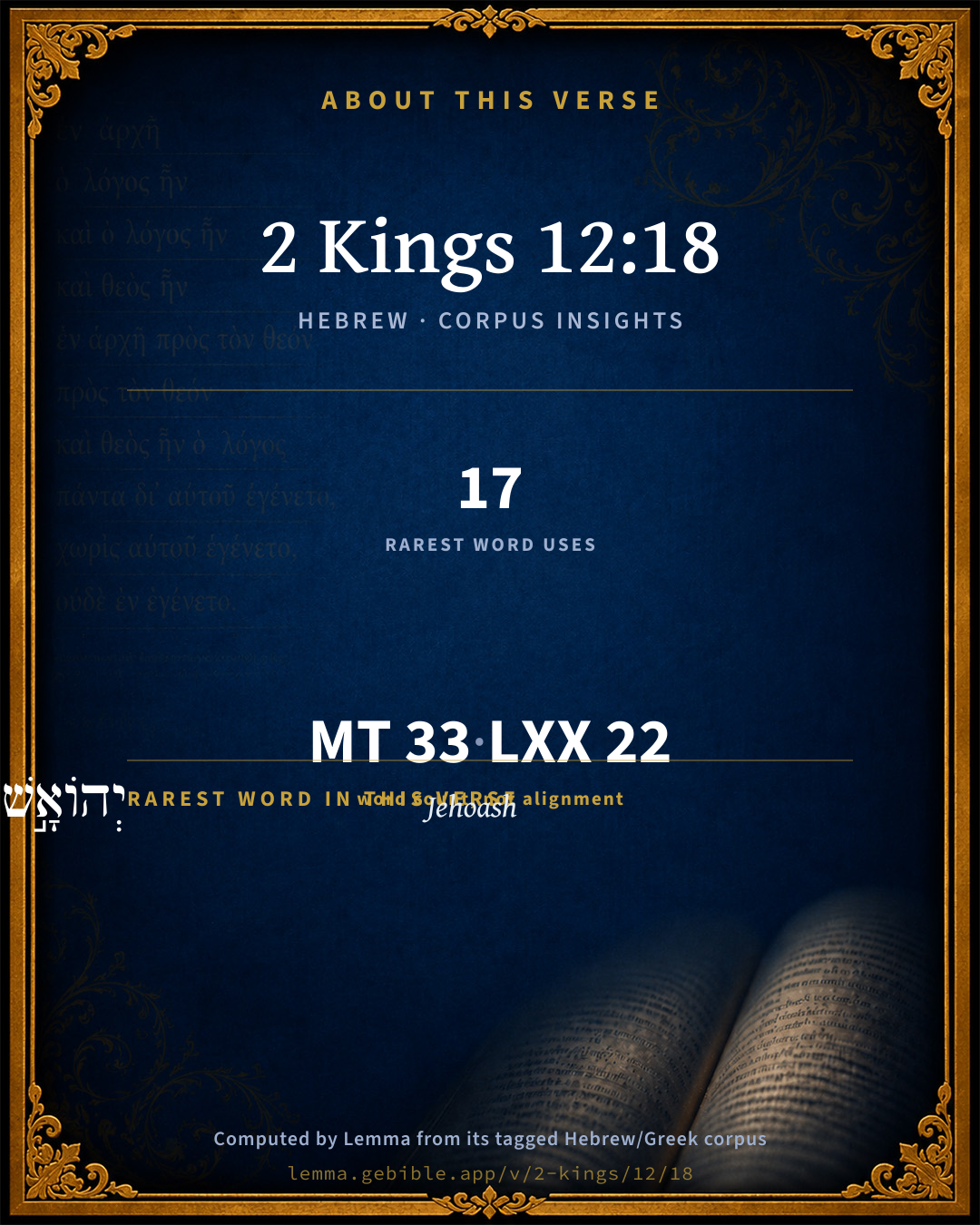
The rarest word here is יְהוֹאָ֣שׁ Jehoash H3060 — appearing just 17 times in the whole Hebrew Bible.

Shared distinctive vocabulary

יְהוֹאָ֣שׁ Jehoash H3060 occurs in 16 verses of the Hebrew Bible. Also found in:

Grammatical profile

  • 5 verbs
  • 23 nouns
  • 1 preposition
  • 4 particles

Verb forms

  • וַיִּקַּ֞ח Qal · Sequential Imperfect
  • הִקְדִּ֣ישׁוּ Hiphil · Perfect
  • הַנִּמְצָ֛א Niphal · Participle Active
  • וַיִּשְׁלַ֗ח Qal · Sequential Imperfect
  • וַיַּ֖עַל Qal · Sequential Imperfect

Repetition

Words recur within this verse — often emphatic in Hebrew:

  • מֶֽלֶךְ king H4428 ×4
  • יְהוּדָ֗ה Judah H3063 ×2
  • כָּל all H3605 ×2
  • הַקֳּדָשִׁ֡ים holiness H6944 ×2
  • בֵּית house H1004 ×2

Hebrew & Septuagint length

In English translation the verse runs 61 words from the Hebrew and 62 from the Septuagint (LXX English) — closely comparable.

A rough comparison of the two English renderings, which tokenize alike — not a word-level alignment.

Word counts can differ between the Hebrew and the Greek without any difference in meaning — e.g. the Hebrew direct-object marker אֵת has no separate Greek word, and Greek often adds the article ὁ.

In the original languages it is 33 Hebrew tokens and 22 Greek tokens — but the two are counted differently (Hebrew bundles its prefixes and suffixes into one token; the Greek is in lemma form), so that isn’t a like-for-like length.

Cross-references

6

Topical passages linked to 2 Kings 12:18 in the Treasury of Scripture Knowledge — connected by theme and wording, ordered by reader-vote popularity; previews shown in the World English Bible.

  • 1 Kings 15:18 Then Asa took all the silver and the gold that were left in the treasures of the house of Yahweh, and the treasures of the king's house, and delivered them into the hand of his servants; and king Asa sent them to Ben Hadad, the son of Tabrimmon, the son of Hezion, king of Syria, who lived at Damascus, saying,
  • 2 Kings 18:15–16 Hezekiah gave [him] all the silver that was found in the house of Yahweh, and in the treasures of the king's house.
  • 1 Kings 14:26 and he took away the treasures of the house of Yahweh, and the treasures of the king's house; he even took away all: and he took away all the shields of gold which Solomon had made.
  • 2 Kings 12:4 Jehoash said to the priests, All the money of the holy things that is brought into the house of Yahweh, in current money, the money of the persons for whom each man is rated, and all the money that it comes into any man's heart to bring into the house of Yahweh,
  • 2 Kings 16:8 Ahaz took the silver and gold that was found in the house of Yahweh, and in the treasures of the king's house, and sent it for a present to the king of Assyria.
  • 2 Chronicles 16:2 Then Asa brought out silver and gold out of the treasures of the house of Yahweh and of the king's house, and sent to Ben Hadad king of Syria, who lived at Damascus, saying,

Cross-references courtesy of OpenBible.info (CC BY 4.0).

Hebrew and Greek witnesses Masoretic Hebrew ↔ Greek Septuagint

The same verse in the two great witnesses to the Old Testament, shown verse-for-verse.

These are two independent witnesses, not word-aligned to each other, and the Septuagint is shown in lemma (dictionary) form.

Hebrew 2 Kings 12:18 Masoretic · Westminster Leningrad Codex

וַיִּקַּ֞ח יְהוֹאָ֣שׁ מֶֽלֶךְ יְהוּדָ֗ה אֵ֣ת כָּל הַקֳּדָשִׁ֡ים אֲשֶׁר הִקְדִּ֣ישׁוּ יְהוֹשָׁפָ֣ט וִיהוֹרָם֩ וַאֲחַזְיָ֨הוּ אֲבֹתָ֜יו מַלְכֵ֤י יְהוּדָה֙ וְאֶת קֳדָשָׁ֔יו וְאֵ֣ת כָּל הַזָּהָ֗ב הַנִּמְצָ֛א בְּאֹצְר֥וֹת בֵּית יְהוָ֖ה וּבֵ֣ית הַמֶּ֑לֶךְ וַיִּשְׁלַ֗ח לַֽחֲזָאֵל֙ מֶ֣לֶךְ אֲרָ֔ם וַיַּ֖עַל מֵעַ֥ל יְרוּשָׁלִָֽם

Jehoash king of Judah took all the holy things that Jehoshaphat and Jehoram and Ahaziah, his fathers, kings of Judah, had dedicated, and his own holy things, and all the gold that was found in the treasures of the house of Yahweh, and of the king's house, and sent it to Hazael king of Syria: and he went away from Jerusalem.

World English Bible · Public Domain

Greek LXX 2 Kings 12:18 Septuagint · lemma form

τότε ἀναβαίνω αζαηλ βασιλεύς συρία καί πολεμέω ἐπί γεθ καί προ καταλαμβάνω αὐτός καί τάσσω αζαηλ ὁ πρόσωπον αὐτός ἀναβαίνω ἐπί ἰερουσαλήμ

And Joas king of Juda took all the holy things which Josaphat, and Joram, Ochozias, his fathers, and kings of Juda had consecrated, and what he had himself dedicated, and all the gold that was found in the treasures of the Lord's house and the king's house, and he sent them to Azael king of Syria; and he went up from Jerusalem.

LXX2012 (modern English Septuagint) · Public Domain

Hebrew: Westminster Leningrad Codex (CC BY 4.0). Greek: Septuagint (public domain); English from LXX2012 (modern English Septuagint) (Public Domain). How the Septuagint differs from the Hebrew →

Targum (Aramaic paraphrase)

1

The Targum is the ancient Jewish Aramaic paraphrase of the Hebrew Scriptures — an interpretive translation, not the Hebrew text itself. Onkelos (literal) and Pseudo-Jonathan (expansive) render the Torah, and Jonathan the Prophets. Coverage is partial: where no permissively-licensed English translation exists for a verse, only the Aramaic is shown. This is verse-level text, not a word-by-word alignment to the Hebrew.

  1. Targum Jonathan Prophets (Joshua–Malachi)
    בְּכֵן סְלִיק חֲזָאֵל מַלְכָּא דַאֲרָם וְאַגִיחַ קְרָבָא עַל גַת וּכַבְשָׁהּ וְשַׁוִי חֲזָאֵל אַפּוֹהִי לְמִיסַק לִירוּשְׁלֵם:

    (no public-domain English translation for this verse)

    Targum Jonathan — Aramaic: “Mikraot Gedolot” (public domain). English: “Sefaria Community Translation” (CC0 1.0 (public-domain dedication)); “London "Chaldee Paraphrase," 1871” (public domain). Text via Sefaria.

Commentary

Notes on 2 Kings 12:18 from classic Christian and Jewish commentators (each source and its license shown beneath its notes). The classic Christian expositions comment on the surrounding passage and are grouped to its opening verse, so a note may address several verses; the Jewish commentaries on the Tanakh (Rashi and others) are per-verse, so they appear only where the commentator wrote on this verse.

Lemma curates 59 commentaries, every one of them public domain or Creative Commons licensed, each selected and text-cleaned for this edition rather than reprinted as found. About our sources →

Trapp's Complete Commentary

John Trapp

2Ki 12:18 And Jehoash king of Judah took all the hallowed things that Jehoshaphat, and Jehoram, and Ahaziah, his fathers, kings of Judah, had dedicated, and his own hallowed things, and all the gold [that was] found in the treasures of the house of the LORD, and in the king’s house, and sent [it] to Hazael king of Syria: and he went away from Jerusalem.

Ver. 18. He went away.] But the next year he returned again, spoiled Jerusalem, killed many, wounded Jehoash, after that he had put to death Zechariah the son of Jehoiada for his plain dealing. {2Ch 24:17, &c.}

John Trapp, A Commentary or Exposition upon All the Books of the Old and New Testament (1647–1656) — public domain. Text from a community e-Sword module.

Tyndale Open Study Notes

Tyndale Open Resources

12:18 Sacred objects . . . gold: Such treasures had been contributed to the Temple earlier by Solomon and Asa (1 Kgs 7:51; 15:15). • Hazael had already begun the attack against Jerusalem, and Joash was wounded during the battle (2 Chr 24:25). Paying tribute to Hazael may have prevented further destruction in the city.

Tyndale Open Study Notes — © Tyndale Open Resources, licensed CC BY-SA 4.0. Text via the HelloAO Bible API.

Geneva Bible (1599)

Geneva Bible translators

After the death of Jehoiada, Joash fell to idolatry: therefore God rejected him, and stirreth up his enemy against him, whom he pacified with the treasures of the Temple: for God would not be served with those gifts, seeing the king’s heart was wicked.

Geneva Bible (1599) marginal notes — public domain. Text via Bolls.life.

Adam Clarke's Commentary

Verse 18. Took all the hallowed things] He dearly bought a peace which was of short duration, for the next year Hazael returned, and Jehoash, having no more treasures, was obliged to hazard a battle, which he lost, with the principal part of his nobility, so that Judah was totally ruined, and Jehoash shortly after slain in his bed by his own servants; 2Ch 24:23.

Adam Clarke's Commentary on the Bible (1810–1826) — public domain. Text from a community e-Sword/MySword module.

Ellicott's Commentary for English Readers

(18) The hallowed things that . . . Jehoram, and Ahaziah . . . had dedicated—Although these kings had sought to naturalise the Baal-worship, they had not ventured to abolish that of Jehovah. On the contrary, as appears from this passage, they even tried to conciliate the powerful priesthood and numerous adherents of the national religion, by dedicating gifts to the sanctuary. The fact that there was so much treasure disposable is not to be wondered at, even after the narrative of the way in which funds were raised for repairing the Temple; because the treasure in question, especially that of the Temple, appears to have been regarded as a reserve, only to be touched in case of grave national emergency like the present.

And he went away from Jerusalem—i.e., withdrew his forces. Thenius asserts that the present expedition of Hazael is distinct from that recorded in 2Ch_24:23, seq., which he admits to be historical. But it is not said here that Hazael went in person against Jerusalem. (Comp, 2Ki_12:17, “set his face to go up,” i.e., prepared to march thither.) The serious defeat of the army of Jehoash, related in Chronicles, accounts very satisfactorily for the sacrifice of his treasures here specified’; while the withdrawal of the Syrians after their victory, as told in Chronicles, is explained by the bribe which Jehoash is here said to have paid them. The two narratives thus supplement each other.

A Bible Commentary for English Readers, edited by Charles John Ellicott (1878–1897) — public domain. Text from a community e-Sword module.

The Cambridge Bible for Schools and Colleges

gen. ed. J. J. S. Perowne

18. hallowed things] See above on verse 4.

kings of Judah had dedicate] No doubt there were occasions in almost every reign when the king was able to give from his conquests some gift as a thankoffering to God for success. Hence the sacred treasures would come to be of great value.

and he went away from Jerusalem] Since Hazael is not mentioned by the Chronicler as present in this expedition, and the spoils are described as being sent away to him, we may conclude that what he is here said to have done was done by the hosts of Syria which he sent forth. In Chronicles, though nothing is said there about the way in which Jehoash bribed the Syrians to depart, we learn that for some reason or other they did depart without prosecuting the siege of Jerusalem.

The Cambridge Bible for Schools and Colleges (gen. ed. J. J. S. Perowne; Cambridge University Press, 1878–1918) — public domain. Text from a community e-Sword module.

Haydock's Catholic Bible Commentary

Joram, &c. These are accused of plundering the temple, 2 Paralipomenon xxiv. 7. But they might make some presents, through ostentation. How many rob the poor, while they erect magnificent altars to the God of the poor! (Calmet)

George Leo Haydock (1774–1849), Haydock's Catholic Family Bible and Commentary, 1859 edition — public domain. Excludes Psalms (Douay-Rheims chapter numbering differs from Protestant) and Deuterocanonical books (Catholic canon only).

Matthew Poole's English Annotations

Took all the hallowed things: that necessity of saving his kingdom and people by this means, which otherwise might seem to excuse the fact, was brought upon himself by his apostacy from God. See Poole "1Ki 15:18".

Matthew Poole's English Annotations on the Holy Bible (1683–1685) — public domain. Text from a community e-Sword/MySword module.

Whedon's Commentary on the Bible

Daniel D. Whedon

18. Took all the hallowed things — This was a too expensive buying of an uncertain peace, and led to no permanent security. Asa before him, (1Ki_15:18,) and Ahaz and Hezekiah after him, (2Ki_16:8; 2Ki_18:15,) did the like foolish thing, to the great damage of the kingdom.

Daniel D. Whedon (gen. ed.), Commentary on the Old and New Testaments (1874–1909) — public domain. Text from a community e-Sword module.

The Pulpit Commentary

And Jehoash King of Judah took all the hallowed things. The writer of Chronicles tells us that, first of all, there was a battle. "The army of the Syrians came with a small company of men, and the Lord delivered a very great host into their hand". (2Ch_24:24) The loss was especially heavy among the nobles, who officered the Jewish army. Much plunder was taken by the visitors. (2Ch_24:23) Then, probably, the siege of the city was commenced, and Joash, like Rehoboam and Asa before him, (1Ki_14:26 1Ki_15:18) and Hezekiah subsequently, (2Ki_18:15, 2Ki_18:16) had recourse to the temple treasures, and with them bought off the invader. It is noticeable that Athaliah had not deprived the temple of them previously. That Jehoshaphat, and Jehoram, and Ahaziah, his fathers, kings of Judah, had dedicated.

Though Jehoram and Ahaziah apostatized so far as to maintain the Baal-worship in Jerusalem, and even to force attendance on it, (2Ch_21:11) yet they did not relinquish altogether the worship of Jehovah. That Jehoram called his son, Ahaziah, "possession of Jehovah," and Ahaziah one of his sons, Joash, "whom Jehovah supports," is indicative of this syncretism, which was common in ancient times, but against which pure Judaism made the strongest possible protest. And his own hallowed thingsi.e. , the gifts which he had himself made to the templeand all the gold that was found in the treasures of the house of the Lord. This was probably not much; but some "vessels of gold" had been made (2Ch_24:14) out of the residue of the money subscribed for the repairs. And in the king"s house. The royal palace had been plundered by the Arabs and Philistines combined in the reign of Jehoram; (2Ch_21:16, 2Ch_21:17) but in the thirty years that had since elapsed there had been time for fresh accumulations. And sent it to Hazael King of Syria: and he went away from Jerusalem. The personal presence of Hazael at the siege seems to be here implied, while 2Ch_24:23 rather implies his absence. Perhaps he was absent at first, but joined the besiegers after a while.

The Pulpit Commentary (1880–1919), ed. H.D.M. Spence-Jones & Joseph S. Exell — public domain. Text from a community e-Sword module.

Rashi

Rabbi Shlomo Yitzchaki (Rashi)

Then Chazoeil [the king of Arom] went up. After the death of Yehoyoda, Yoash made himself for a god.

Rashi on the Tanakh — English translations: “The Judaica Press complete Tanach with Rashi, translated by A. J. Rosenberg” (CC BY 4.0); “Pentateuch with Rashi's commentary by M. Rosenbaum and A.M. Silbermann, 1929-1934” (public domain); “The Metsudah Tanach series, Lakewood, N.J” (CC BY 4.0); and “The Book of Joshua, Metsudah Publications, 1997” (CC BY 4.0). Text via Sefaria.

Lesson kit

Teaching starters — assembled from the data on this page, not authored interpretation. Every prompt links to the verse data it draws on. Edit before teaching.

2 Kings, in the Historical, opens this verse with 33 words (24 distinct Hebrew lemmas). Its most distinctive word is Yᵉhôwʼâsh (“Jehoash”). A historical commentator’s framing appears above. Read the whole chapter for the surrounding context.

Discussion questions

  1. How does “Jehoash” (Yᵉhôwʼâsh) shape what this verse is saying?
  2. 2 Kings 11:21 shares the word «Jehoash» with this verse. How do the two illuminate each other?
  3. “king” occurs 4× in this one verse. What is the effect of the repetition?
  4. These translations render this verse differently; the difference is in the English rendering, not the original. What questions does that raise?
  5. The verb «וַיִּקַּ֞ח» is Qal Sequential Imperfect. How does its form color the action?
  6. Reading how Trapp's Complete Commentary and Tyndale Open Study Notes read this verse, where do the two commentators agree and where do they part?

Things to notice

Reading settings

Reading text

Shown beneath each verse's original-language words.

Old Testament
Old Testament edition

Read the OT as the Masoretic Hebrew (MT) or the Greek Septuagint (LXX).

English shown for the Greek Septuagint (in the Hebrew ↔ Greek comparison).

Comparing translations? Open the Compare panel on any verse page to stack up to four side by side.