
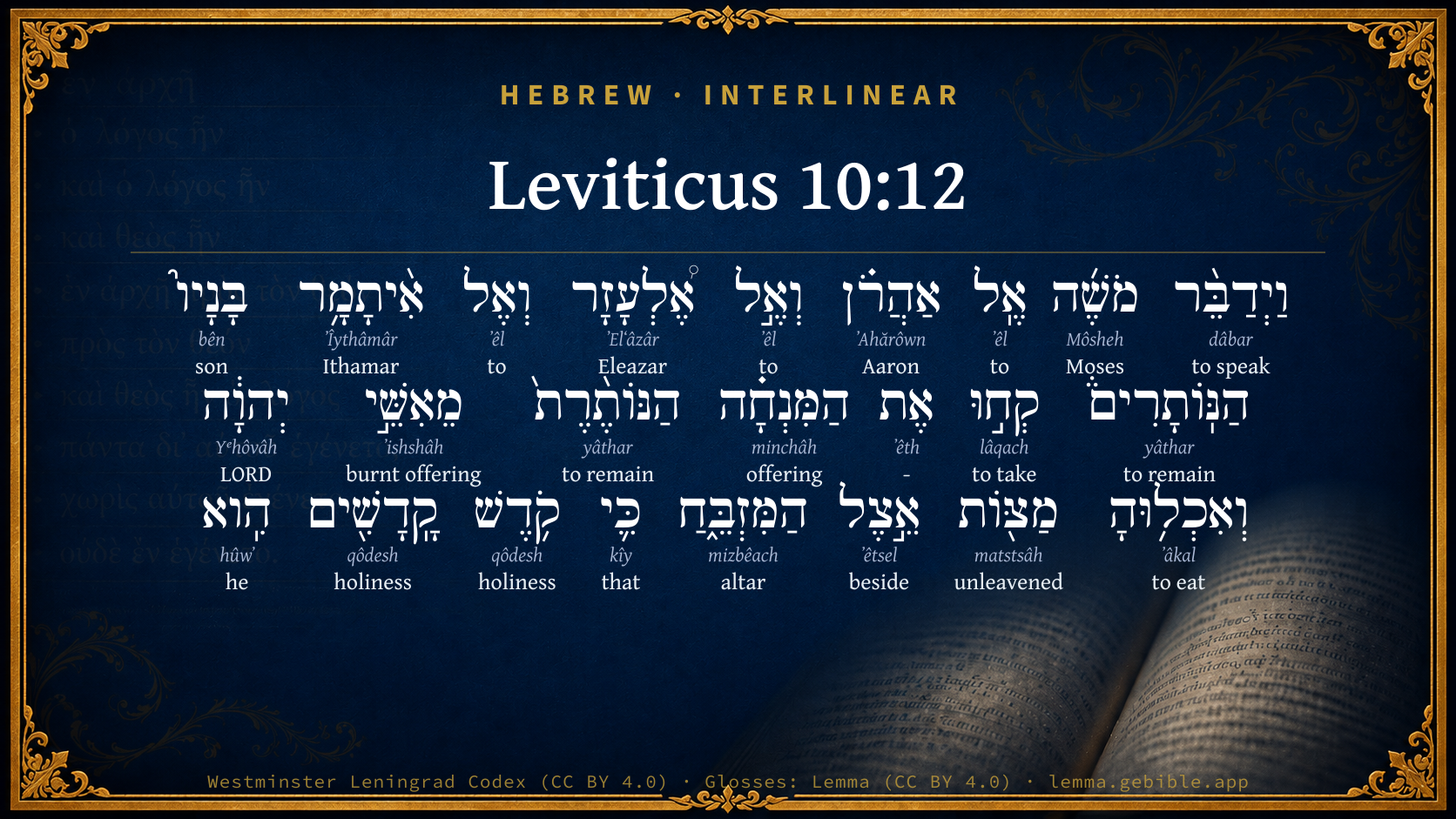
Leviticus 10:12

Hebrew (Westminster Leningrad Codex) Leviticus 10:12 appears in the Hebrew Old Testament. The text above is from the Westminster Leningrad Codex. Each word links to its Strong’s number, a concise gloss, and parsing drawn from the Open Scriptures Hebrew Bible morphology. Click any word for its full Brown-Driver-Briggs (BDB) entry.
Download image
Cite this verse

Leviticus 10:12 (World English Bible). Public Domain. Lemma interlinear Bible study tool, https://lemma.gebible.app/v/leviticus/10/12.

Show BibTeX & RIS
BibTeX
RIS
English Translation
Moses spoke to Aaron, and to Eleazar and to Ithamar, his sons who were left, "Take the meal offering that remains of the offerings of Yahweh made by fire, and eat it without yeast beside the altar; for it is most holy;
World English Bible · Public Domain
Download a study sheet

One document with this verse’s original text, its word-by-word gloss line, the meaning frame, cross-references with their text, attributed commentary, and full source and license credits — printable, and it pastes into notes with its structure intact.

This verse Autodidact and up

Study sheet (.html) Plain text (.txt)

A passage Seminary Student

Up to 50 verses in one chapter. A passage sheet keeps up to 6 commentary sources and 12 cross-references per verse, in the order this page ranks them, and says so on the sheet whenever that leaves anything out. Ask for a single verse and you get the Autodidact verse sheet above.

Everything on this page stays free to read, with no account — the sheet is a download of what is already on screen, not access to it.

Want to remove ads? Support Godless Engineer
Compare translations 3

The same verse in 3 English versions, stacked beneath the original-language interlinear above. Click any original word for its lexicon entry.

Each is an independent rendering of the whole verse — the interlinear is not word-aligned to these translations.

Highlighted words mark where these versions differ — a whole-verse word diff, not a word-by-word alignment.

  • World English Bible Public Domain
    Moses spoke to Aaron, and to Eleazar and to Ithamar, his sons who were left, "Take the meal offering that remains of the offerings of Yahweh made by fire, and eat it without yeast beside the altar; for it is most holy;
  • King James Version Public Domain
    And Moses spake unto Aaron, and unto Eleazar and unto Ithamar, his sons that were left, Take the meat offering that remaineth of the offerings of the LORD made by fire, and eat it without leaven beside the altar: for it is most holy:
  • unfoldingWord Literal Text CC BY-SA 4.0
    And Moses spoke to Aaron, and to Eleazar and to Ithamar, his remaining sons, “Take the grain offering, the remainder from the gifts of Yahweh, and eat it unleavened beside the altar, for it is a holy thing of the holy things.

unfoldingWord Literal Text — © unfoldingWord, licensed CC BY-SA 4.0. Word-aligned USFM3 via Door43 (git.door43.org/unfoldingWord/en_ult).

Versions to compare (up to 4)

3 of 4 selected

Show all 18 translations

Every available English version of this verse, each an independent rendering of the whole verse.

  • World English Bible Public Domain
    Moses spoke to Aaron, and to Eleazar and to Ithamar, his sons who were left, "Take the meal offering that remains of the offerings of Yahweh made by fire, and eat it without yeast beside the altar; for it is most holy;
  • Berean Standard Bible Public Domain
    And Moses said to Aaron and his remaining sons, Eleazar and Ithamar, “Take the grain offering that remains from the offerings made by fire to the LORD and eat it without leaven beside the altar, because it is most holy.
  • Majority Standard Bible Public Domain
    And Moses said to Aaron and his remaining sons, Eleazar and Ithamar, “Take the grain offering that remains from the food offerings to the LORD and eat it without leaven beside the altar, because it is most holy.
  • King James Version Public Domain
    And Moses spake unto Aaron, and unto Eleazar and unto Ithamar, his sons that were left, Take the meat offering that remaineth of the offerings of the LORD made by fire, and eat it without leaven beside the altar: for it is most holy:
  • American Standard Version (1901) Public Domain
    And Moses spake unto Aaron, and unto Eleazar and unto Ithamar, his sons that were left, Take the meal-offering that remaineth of the offerings of Jehovah made by fire, and eat it without leaven beside the altar; for it is most holy;
  • Revised Version (1885) Public Domain
    And Moses spake unto Aaron, and unto Eleazar and unto Ithamar, his sons that were left, Take the meal offering that remaineth of the offerings of the LORD made by fire, and eat it without leaven beside the altar: for it is most holy:
  • Geneva Bible (1599) Public Domain
    Then Moses saide vnto Aaron and vnto Eleazar and to Ithamar his sonnes that were left, Take the meate offring that remaineth of the offrings of the Lord, made by fire, and eate it without leauen beside ye altar: for it is most holy:
  • Douay-Rheims (1899) Public Domain
    And Moses spoke to Aaron, and to Eleazar and Ithamar, his sons that were left: Take the sacrifice that is remaining of the oblation of the Lord, and eat it without leaven beside the altar, because it is holy of holies.
  • Young's Literal Translation Public Domain
    And Moses speaketh unto Aaron, and unto Eleazar, and unto Ithamar his sons, who are left, `Take ye the present that is left from the fire-offerings of Jehovah, and eat it unleavened near the altar, for it `is' most holy,
  • Literal Standard Version CC BY-SA 4.0
    And Moses speaks to Aaron and his sons, to Eleazar and to Ithamar, who are left, “Take the present that is left from the fire-offerings of YHWH, and eat it unleavened near the altar, for it [is] most holy,
  • Unlocked Literal Bible CC BY-SA 4.0
    Moses spoke to Aaron and to Eleazar and to Ithamar, his remaining sons, “Take the grain offering that remains from the offerings to Yahweh made by fire, and eat it without yeast beside the altar, for it is most holy.
  • unfoldingWord Literal Text CC BY-SA 4.0
    And Moses spoke to Aaron, and to Eleazar and to Ithamar, his remaining sons, “Take the grain offering, the remainder from the gifts of Yahweh, and eat it unleavened beside the altar, for it is a holy thing of the holy things.
  • Darby Bible Public Domain
    And Moses spoke to Aaron, and to Eleazar and to Ithamar, his sons that were left, Take the oblation that is left of Jehovah's offerings by fire, and eat it with unleavened bread beside the altar; for it is most holy.
  • World Messianic Bible Public Domain
    Moses spoke to Aaron, and to Eleazar and to Ithamar, his sons who were left, “Take the meal offering that remains of the offerings of the LORD made by fire, and eat it without yeast beside the altar; for it is most holy;
  • Webster's Bible Public Domain
    And Moses spoke to Aaron, and to Eleazar and to Ithamar, his sons that were left, Take the meat-offering that remaineth of the offerings of the LORD made by fire, and eat it without leaven beside the altar: for it is most holy:
  • Free Bible Version CC BY-SA 4.0
    Moses told Aaron and his two sons who were left, Eleazar and Ithamar, “Take the grain offering that is left over from the food offerings given to the Lord and eat it without yeast beside the altar, because it is most holy.
  • Bible in Basic English Public Domain
    And Moses said to Aaron and to Eleazar and Ithamar, his sons who were still living, Take the rest of the meal offering from the offerings of the Lord made by fire, and take it for your food, without leaven, at the side of the altar, for it is most holy.
  • JPS Tanakh (1917) Public Domain
    And Moses spoke unto Aaron, and unto Eleazar and unto Ithamar, his sons that were left: 'Take the meal-offering that remaineth of the offerings of the LORD made by fire, and eat it without leaven beside the altar; for it is most holy.

Literal Standard Version (2020), Covenant Press — licensed CC BY-SA 4.0. Text via the HelloAO Bible API (eBible.org). Unlocked Literal Bible (unfoldingWord) — licensed CC BY-SA 4.0. Text via the HelloAO Bible API (eBible.org). unfoldingWord Literal Text — © unfoldingWord, licensed CC BY-SA 4.0. Word-aligned USFM3 via Door43 (git.door43.org/unfoldingWord/en_ult). Free Bible Version, Dr. Jonathan Gallagher — licensed CC BY-SA 4.0. Text via the HelloAO Bible API (eBible.org).

Word by word

More ways to search: Search by grammar → Find every occurrence → Compare this word →

Practice this passage: Drill this verse → Learn its vocabulary →

אִ֨יתָמָ֥ר
ʼÎythâmâr
H385
“Ithamar”
Noun, Proper
Part of Speech
Noun
Type
Proper
Full BDB Definition

Origin: from H339 and H8558

TWOT: None

Ithamar = "coast of palms" - fourth and youngest son of Aaron
  1. וַיְדַבֵּ֨ר dâbar H1696 “and · to speak” Conjunction + Verb, Piel, Sequential Imperfect, 3rd Person, Masculine, Singular
  2. מֹשֶׁ֜ה Môsheh H4872 “Moses” Noun, Proper
  3. אֶֽל ʼêl H413 “to” Preposition
  4. אַהֲרֹ֗ן ʼAhărôwn H175 “Aaron” Noun, Proper
  5. וְאֶ֣ל ʼêl H413 “and · to” Conjunction + Preposition
  6. אֶ֠לְעָזָר ʼElʻâzâr H499 “Eleazar” Noun, Proper
  7. וְאֶל ʼêl H413 “and · to” Conjunction + Preposition
  8. בָּנָיו֮ bên H1121 “sons · his” Noun, Common, Masculine, Plural, Construct + Suffix, Personal, 3rd Person, Masculine, Singular
  9. הַנּֽוֹתָרִים֒ yâthar H3498 “the · remaining” Particle, Definite Article + Verb, Niphal, Participle Active, Masculine, Plural, Absolute
  10. קְח֣וּ lâqach H3947 “take” Verb, Qal, Imperative, 2nd Person, Masculine, Plural
  11. אֶת ʼêth H853 “-” Particle, Direct Object
  12. הַמִּנְחָ֗ה minchâh H4503 “the · offering” Particle, Definite Article + Noun, Common, Feminine, Singular, Absolute
  13. הַנּוֹתֶ֨רֶת֙ yâthar H3498 “the · remaining” Particle, Definite Article + Verb, Niphal, Participle Active, Feminine, Singular, Absolute
  14. מֵאִשֵּׁ֣י ʼishshâh H801 “from · burnt offerings of” Preposition + Noun, Common, Masculine, Plural, Construct
  15. יְהוָ֔ה Yᵉhôvâh H3068 “LORD” Noun, Proper
  16. וְאִכְל֥וּהָ ʼâkal H398 “and · eat · her” Conjunction + Verb, Qal, Imperative, 2nd Person, Masculine, Plural + Suffix, Personal, 3rd Person, Feminine, Singular
  17. מַצּ֖וֹת matstsâh H4682 “unleavened bread” Noun, Common, Feminine, Plural, Absolute
  18. אֵ֣צֶל ʼêtsel H681 “beside” Preposition
  19. הַמִּזְבֵּ֑חַ mizbêach H4196 “the · altar” Particle, Definite Article + Noun, Common, Masculine, Singular, Absolute
  20. כִּ֛י kîy H3588 “that” Conjunction
  21. קֹ֥דֶשׁ qôdesh H6944 “holiness of” Noun, Common, Masculine, Singular, Construct
  22. קָֽדָשִׁ֖ים qôdesh H6944 “holy things” Noun, Common, Masculine, Plural, Absolute
  23. הִֽוא hûwʼ H1931 “he” Pronoun, Personal, 3rd Person, Feminine, Singular

About this verse

These counts appear in no published source. They are computed here, from the morphology-tagged text and Lemma’s own curated glosses. What Lemma adds →

24
words
20
distinct lemmas
Pentateuch
section

Notable vocabulary

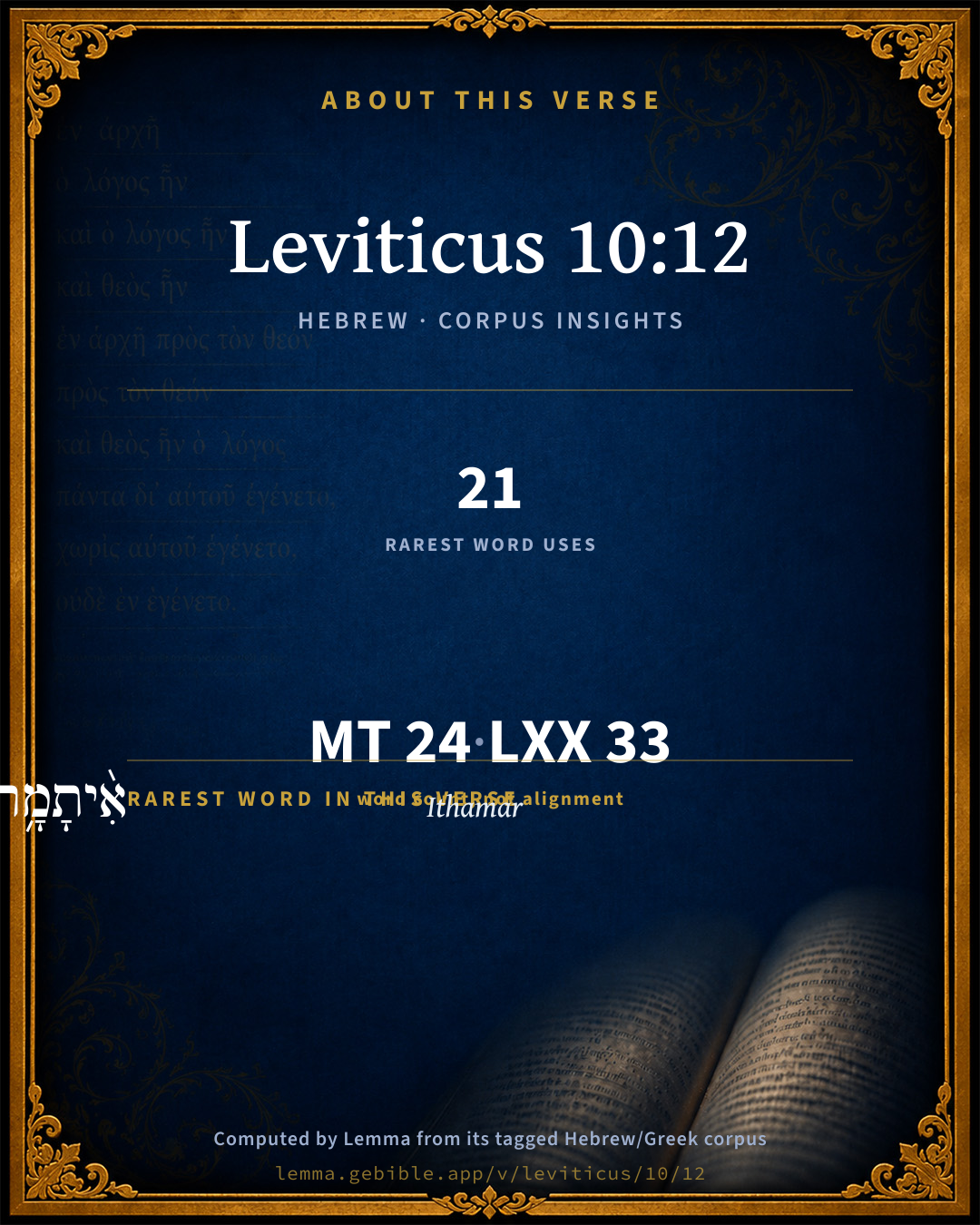
The rarest word here is אִ֨יתָמָ֥ר Ithamar H385 — appearing just 21 times in the whole Hebrew Bible.

Shared distinctive vocabulary

אִ֨יתָמָ֥ר Ithamar H385 occurs in 20 verses of the Hebrew Bible. Also found in:

Grammatical profile

  • 5 verbs
  • 12 nouns
  • 1 pronoun
  • 4 prepositions
  • 1 conjunction
  • 1 particle

Verb forms

  • וַיְדַבֵּ֨ר Piel · Sequential Imperfect
  • הַנּֽוֹתָרִים֒ Niphal · Participle Active
  • קְח֣וּ Qal · Imperative
  • הַנּוֹתֶ֨רֶת֙ Niphal · Participle Active
  • וְאִכְל֥וּהָ Qal · Imperative

Repetition

Words recur within this verse — often emphatic in Hebrew:

  • הַנּֽוֹתָרִים֒ to remain H3498 ×2
  • קֹ֥דֶשׁ holiness H6944 ×2
  • אֶֽל to H413 ×3

Hebrew & Septuagint length

In English translation the verse runs 42 words from the Hebrew and 42 from the Septuagint (LXX English) — the same length.

A rough comparison of the two English renderings, which tokenize alike — not a word-level alignment.

Word counts can differ between the Hebrew and the Greek without any difference in meaning — e.g. the Hebrew direct-object marker אֵת has no separate Greek word, and Greek often adds the article ὁ.

In the original languages it is 24 Hebrew tokens and 33 Greek tokens — but the two are counted differently (Hebrew bundles its prefixes and suffixes into one token; the Greek is in lemma form), so that isn’t a like-for-like length.

Cross-references

7

Topical passages linked to Leviticus 10:12 in the Treasury of Scripture Knowledge — connected by theme and wording, ordered by reader-vote popularity; previews shown in the World English Bible.

  • Leviticus 21:22 He shall eat the bread of his God, both of the most holy, and of the holy.
  • Numbers 18:9–10 This shall be your of the most holy things, [reserved] from the fire: every offering of theirs, even every meal-offering of theirs, and every sin-offering of theirs, and every trespass-offering of theirs, which they shall render to me, shall be most holy for you and for your sons.
  • Exodus 29:2 unleavened bread, unleavened cakes mixed with oil, and unleavened wafers anointed with oil: you shall make them of fine wheat flour.
  • Leviticus 2:1–16 "'When anyone offers an offering of a meal offering to Yahweh, his offering shall be of fine flour; and he shall pour oil on it, and put frankincense on it.
  • Leviticus 6:14–18 "'This is the law of the meal offering: the sons of Aaron shall offer it before Yahweh, before the altar.
  • Leviticus 7:9 Every meal offering that is baked in the oven, and all that is dressed in the frying pan, and on the baking pan, shall be the priest's who offers it.
  • Ezekiel 44:29 They shall eat the meal-offering, and the sin-offering, and the trespass-offering; and every devoted thing in Israel shall be theirs.

Cross-references courtesy of OpenBible.info (CC BY 4.0).

Hebrew and Greek witnesses Masoretic Hebrew ↔ Greek Septuagint

The same verse in the two great witnesses to the Old Testament, shown verse-for-verse.

These are two independent witnesses, not word-aligned to each other, and the Septuagint is shown in lemma (dictionary) form.

Hebrew Leviticus 10:12 Masoretic · Westminster Leningrad Codex

וַיְדַבֵּ֨ר מֹשֶׁ֜ה אֶֽל אַהֲרֹ֗ן וְאֶ֣ל אֶ֠לְעָזָר וְאֶל אִ֨יתָמָ֥ר בָּנָיו֮ הַנּֽוֹתָרִים֒ קְח֣וּ אֶת הַמִּנְחָ֗ה הַנּוֹתֶ֨רֶת֙ מֵאִשֵּׁ֣י יְהוָ֔ה וְאִכְל֥וּהָ מַצּ֖וֹת אֵ֣צֶל הַמִּזְבֵּ֑חַ כִּ֛י קֹ֥דֶשׁ קָֽדָשִׁ֖ים הִֽוא

Moses spoke to Aaron, and to Eleazar and to Ithamar, his sons who were left, "Take the meal offering that remains of the offerings of Yahweh made by fire, and eat it without yeast beside the altar; for it is most holy;

World English Bible · Public Domain

Greek LXX Leviticus 10:12 Septuagint · lemma form

καί εἶπον μωυσῆς πρός ἀαρών καί πρός ελεαζαρ καί ιθαμαρ ὁ υἱός ἀαρών ὁ καταλείπω λαμβάνω ὁ θυσία ὁ καταλείπω ἀπό ὁ κάρπωμα κύριος καί ἐσθίω ἄζυμος παρά ὁ θυσιαστήριον ἅγιος ἅγιος εἰμί

And Moses said to Aaron, and to Eleazar and Ithamar, the sons of Aaron who survived, Take the sacrifice that is left of the burnt offerings of the Lord, and you⌃ shall eat unleavened bread by the altar: it is most holy.

LXX2012 (modern English Septuagint) · Public Domain

Hebrew: Westminster Leningrad Codex (CC BY 4.0). Greek: Septuagint (public domain); English from LXX2012 (modern English Septuagint) (Public Domain). How the Septuagint differs from the Hebrew →

Targum (Aramaic paraphrase)

2

The Targum is the ancient Jewish Aramaic paraphrase of the Hebrew Scriptures — an interpretive translation, not the Hebrew text itself. Onkelos (literal) and Pseudo-Jonathan (expansive) render the Torah, and Jonathan the Prophets. Coverage is partial: where no permissively-licensed English translation exists for a verse, only the Aramaic is shown. This is verse-level text, not a word-by-word alignment to the Hebrew.

  1. Targum Onkelos Torah (Genesis–Deuteronomy)
    וּמַלִיל מֹשֶׁה עִם אַהֲרֹן וְעִם אֶלְעָזָר וְעִם אִיתָמָר בְּנוֹהִי דְאִשְׁתָּאֲרוּ סִבוּ יָת מִנְחָתָא דְאִשְׁתָּאָרָת מִקֻרְבָּנַיָא דַיְיָ וְאִכְלוּהָ פַטִיר בִּסְטַר מַדְבְּחָא אֲרֵי קֹדֶשׁ קוּדְשִׁין הִיא

    (no public-domain English translation for this verse)

    Targum Onkelos — Aramaic: “Onkelos Genesis” (public domain); “Onkelos Exodus” (public domain); “Onkelos Leviticus” (public domain); “Onkelos Numbers” (public domain); “Onkelos Deuteronomy” (public domain). English: “Sefaria Community Translation” (CC0 1.0 (public-domain dedication)); “J.W. Etheridge. The Targums of Onkelos and Jonathan Ben Uzziel on the Pentateuch. London: Longmans, Green, 1862” (public domain). Text via Sefaria.

  2. Targum Pseudo-Jonathan Torah (Genesis–Deuteronomy)
    וּמַלֵיל משֶׁה עִם אַהֲרן וְעִם אֶלְעָזָר וְעִם אִיתָמָר בְּנוֹי דְאִישְׁתַּיְירוּ מִן יַקִידְתָּא סִיבוּ יַת מִנְחָתָא דְאִשְׁתְּיָרַת מִקוּרְבָּנַיָא דַיְיָ וְאִכְלוּהָ פַּטִיר בִּסְטַר מַדְבְּחָא אֲרוּם קוֹדֶשׁ קוּדְשִׁין הִיא

    And Mosheh spake with Aharon, and Elasar and Ithamar, his sons, who were left from the burning: Take the mincha that remaineth of the Lord's oblations, and eat it unleavened at the side of the altar, because it is most sacred:

    Targum Pseudo-Jonathan — Aramaic: “Targum Jonathan on Genesis” (public domain); “Targum Jonathan on Exodus” (public domain); “Targum Jonathan on Leviticus” (public domain); “Targum Jonathan on Numbers” (public domain); “Targum Jonathan on Deuteronomy” (public domain). English: “The Targum of Jonathan ben Uzziel, trans. J. W. Etheridge, London, 1862” (public domain). Text via Sefaria.

Commentary

Notes on Leviticus 10:12 from classic Christian and Jewish commentators (each source and its license shown beneath its notes). The classic Christian expositions comment on the surrounding passage and are grouped to its opening verse, so a note may address several verses; the Jewish commentaries on the Tanakh (Rashi and others) are per-verse, so they appear only where the commentator wrote on this verse.

Lemma curates 59 commentaries, every one of them public domain or Creative Commons licensed, each selected and text-cleaned for this edition rather than reprinted as found. About our sources →

Matthew Henry's Commentary

Moses is here directing Aaron to go on with his service after this interruption. Afflictions should rather quicken us to our duty than take us off from it. Observe (Lev 10:12), He spoke unto Aaron and to his sons that were left. The notice taken of their survivorship intimates, 1. That Aaron should take comfort under the loss of two of his sons, from this consideration, that God had graciously spared him the other two, and that he had reason to be thankful for the remnant that was left, and all his sons were not dead, and, in token of his thankfulness to God, to go on cheerfully in his work. 2. That God's sparing them should be an engagement upon them to proceed in his service, and not to fly off from it. Here were four priests consecrated together, two were taken away, and two left; therefore the two that were left should endeavour to fill up the places of those that were gone, by double care and diligence in the services of the priesthood. Now,

I. Moses repeats the directions he had formerly given them about eating their share of the sacrifices, Lev 10:12-14, Lev 10:15. The priests must learn not only to put a difference between the holy and the unholy, as they had been taught (Lev 10:10), but also to distinguish between that which was most holy and that which was only holy of the things that were to eat. That part of the meat-offering which remained to the priest was most holy, and therefore must be eaten in the courts of the tabernacle, and by Aaron sons only (Lev 10:12, Lev 10:13); but the breast and shoulder of the peace-offerings might be eaten in any decent place out of the courts of the tabernacle, and by the daughters of their families. The meat-offerings, being annexed to the burnt-offerings, were intended only and wholly for the glory of God; but the peace-offerings were ordained for the furtherance of men's joy and comfort; the former therefore were the more sacred, and to be had more in veneration. This distinction the priests must carefully observe, and take heed of making any blunders. Moses does not pretend to give any reasons for this difference, but refers to his instructions: For so am I commanded, Lev 10:13. This was reason enough; he had received of the Lord all that he delivered unto them, Co1 11:23.

II. He enquires concerning one deviation from the appointment, which it seems had happened upon this occasion, which was this: - There was a goat to be sacrificed as a sin-offering or the people, Lev 9:15. Now the law of the sin-offerings was that if the blood of them was brought into the holy place, as that of the sin-offerings for the priest was, then the flesh was to be burnt without the camp; otherwise it was to be eaten by the priest in the holy place, Lev 6:30. The meaning of this is here explained (Lev 10:17), that the priests did hereby bear the iniquity of the congregation, that is, they were types of him who was to be made sin for us, and on whom God would lay the iniquity of us all. Now the blood of this goat was not brought into the holy place, and yet, it seems, it was burnt without the camp. Now observe here, 1. The gentle reproof Moses gives to Aaron and his sons for this irregularity. Here again Aaron sons are said to be those that were left alive (Lev 10:16), who therefore ought to have taken warning; and Moses was angry with them. Though he was the meekest man in the world, it seems he could be angry; and when he thought God was disobeyed and dishonoured, and the priesthood endangered, he would be angry. Yet observe how very mildly he deals with Aaron and his sons, considering their present affliction. He only tells them they should indeed have eaten it in the holy place, but is willing to hear what they have to say for themselves, being loth to speak to the grief of those whom God had wounded.

2. The plausible excuse which Aaron makes for this mistake. Moses charged the fault upon Eleazar and Ithamar (Lev 10:16), but it is probable that what they did was by Aaron direction, and therefore he apologized for it. He might have pleaded that this was a sin-offering for the congregation, and if it had been a bullock it must have been wholly burnt (Lev 4:21), and therefore why not now that it was a goat? But it seems it was otherwise ordered at this time, and therefore he makes his affliction his excuse, Lev 10:19. Observe, (1.) How he speaks of affliction: Such things have befallen me, such sad things, which could not but go near his heart, and make it very happy. He was a high priest taken from among men, and could not put off natural affection when he put on the holy garments. He held his peace (Lev 10:3), yet his sorrow was stirred, as David's, Psa 39:2. Note, There may be a deep sense of affliction even where there is a sincere resignation to the will of God in the affliction. "Such things as never befel me before, and as I little expected now. My spirits cannot but sink, when I see my family sinking; I must needs be heavy, when God is angry:" thus it is easy to say a great deal to aggravate an affliction, but it is better to say little. (2.) How he makes this an excuse for his varying from the appointment about the sin-offering. He could not have eaten it but in his mourning, and with a sorrowful spirit; and would this have been accepted? He does not plead that his heart was so full of grief that he had no appetite for it, but that he feared it would not be accepted. Note, [1.] Acceptance with God is the great thing we should desire and aim at in all our religious services, particularly in the Lord's supper, which is our eating of the sin-offering. [2.] The sorrow of the world is a very great hindrance to our acceptable performance of holy duties, both as it is discomposing to ourselves, takes off our chariot-wheels and makes us drive heavily (Sa1 1:7, Sa1 1:8), and as it is displeasing to God, whose will it is that we should serve him cheerfully, Deu 12:7. Mourner's bread was polluted, Hos 9:4. See Mal 3:14.

3. The acquiescence of Moses in this excuse: He was content, Lev 10:20. Perhaps he thought it justified what they had done. God had provided that what could not be eaten might be burnt. Our unfitness for duty, when it is natural and not sinful, will have great allowances made for it; and God will have mercy and not sacrifice. At least he thought it did very much extenuate the fault; the spirit indeed was willing, but the flesh was weak. God by Moses showed that he considered his frame. It appeared that Aaron sincerely aimed at God's acceptance; and those that do so with an upright heart shall find he is not extreme to mark what they do amiss. Nor must we be severe in our animadversions upon every mistake, considering ourselves, lest we also be tempted.

Matthew Henry's Commentary on the Whole Bible (1708–1710) — public domain (CC PDM 1.0). Text via the HelloAO Bible API.

Trapp's Complete Commentary

John Trapp

Lev 10:12 And Moses spake unto Aaron, and unto Eleazar and unto Ithamar, his sons that were left, Take the meat offering that remaineth of the offerings of the LORD made by fire, and eat it without leaven beside the altar: for it [is] most holy:

Ver. 12. Take the meat offerlng,] q.d., Think not that God hath cashiered you because he hath corrected you; neither refuse your meat out of a sullen sourness; but fall to your meat offering, and take better heed another time. Only "eat before the Lord." {Deu 12:18}

John Trapp, A Commentary or Exposition upon All the Books of the Old and New Testament (1647–1656) — public domain. Text from a community e-Sword module.

Albert Barnes' Notes on the Bible

The argument is, that as such meals were appointed in honor of Yahweh Himself, they ought to be conducted with due reverence and discretion.

Lev 10:12

Beside the altar - What is called “the holy place” in Lev 10:13, Lev 10:17 : it should be rather, a holy place, any part of the holy precinct, as distinguished from a merely “clean place” Lev 10:14, either within or without the court of the tabernacle.

Lev 10:14

Wave breast and heave shoulder - See Lev 7:30 note.

Albert Barnes' Notes on the Bible (1834–1885) — public domain. Text from a community e-Sword/MySword module.

Joseph Benson's Commentary

Lev 10:12-14. Moses spake unto Aaron — Moses, being apprehensive that Aaron, in the confusion of his grief for the loss of his two sons, might forget or omit some part of his duty, here puts him in mind of it, repeating to him the order about eating the remains of the meat or meal-offering, (Lev 6:16-17,) and about the shoulder and breast, Lev 7:31. The former of which the priests alone might eat, and that only in the holy place, or court of the tabernacle. The other might be eaten in any clean place, that is, in any of their dwellings, or in any place in the camp which was decent, and kept clean from all ceremonial defilement; and where the women as well as the men might come; for the daughters of the priests might eat these as well as their sons, if they were maids, or widows, or divorced, Lev 2:11-13.

Joseph Benson's Commentary on the Old and New Testaments (1811–1818) — public domain. Text from a community e-Sword module.

Whedon's Commentary on the Bible

Daniel D. Whedon

EATING THE MOST HOLY THINGS, Lev_10:12-20.

12. Take the meat offering — The appalling stroke of Jehovah’s wrath had disconcerted Aaron so that he had forgotten the prescribed order of the sacrifices. Moses reminds him that the meat offering follows the burnt offering consumed by celestial fire. Lev_9:24. See Introduction, (5.)

And eat it — The eating by the priest symbolizes the full acceptance of the oblation. See Lev_6:16, note, and Concluding Note (1) of the same chapter.

Beside the altar — This was the altar of incense in the priests’ apartment, called the holy place, within the first veil. See chap.

Lev_4:7.

Daniel D. Whedon (gen. ed.), Commentary on the Old and New Testaments (1874–1909) — public domain. Text from a community e-Sword module.

Keil & Delitzsch

C. F. Keil & F. Delitzsch

After the directions occasioned by this judgment of God, Moses reminded Aaron and his sons of the general laws concerning the consumption of the priests' portions of the sacrifices, and their relation to the existing circumstances: first of all (Lev 10:12, Lev 10:13), of the law relating to the eating of the meat-offering, which belonged to the priests after the azcarah had been lifted off (Lev 2:3; Lev 6:9-11), and then (Lev 10:14, Lev 10:15) of that relating to the wave-breast and heave-leg (Lev 7:32-34). By the minchah in Lev 10:12 we are to understand the meal and oil, which were offered with the burnt-offering of the nation (Lev 9:4 and Lev 9:7); and by the אשּׁים in Lev 10:12 and Lev 10:15, those portions of the burnt-offering, meat-offering, and peace-offering of the nation which were burned upon the altar (Lev 9:13, Lev 9:17, and Lev 9:20). He then looked for "the he-goat of the sin-offering," - i.e., the flesh of the goat which had been brought for a sin-offering (Lev 9:15), and which was to have been eaten by the priests in the holy place along with the sin-offerings, whose blood was not taken into the sanctuary (Lev 6:19, Lev 6:22); - "and, behold, it was burned" (שׂרף, 3 perf. Pual). Moses was angry at this, and reproved Eleazar and Ithamar, who had attended to the burning: "Wherefore have ye not eaten the sin-offering in a holy place?" he said; "for it is most holy, and He (Jehovah) hath given it you to bear the iniquity of the congregation, to make atonement for it before Jehovah," as its blood had not been brought into the holy place (הוּבא construed as a passive with an accusative, as in Gen 4:18, etc.). "To bear the iniquity" does not signify here, as in Lev 5:1, to bear and atone for the sin in its consequences, but, as in Exo 28:38, to take the sin of another upon one's self, for the purpose of cancelling it, to make expiation for it. As, according to Exo 28:38, the high priest was to appear before the Lord with the diadem upon his forehead, as the symbol of the holiness of his office, to cancel, as the mediator of the nation and by virtue of his official holiness, the sin which adhered to the holy gifts of the nation (see the note on this passage), so here it is stated with regard to the official eating of the most holy flesh of the sin-offering, which had been enjoined upon the priests, that they were thereby to bear the sin of the congregation, to make atonement for it. This effect or signification could only be ascribed to the eating, by its being regarded as an incorporation of the victim laden with sin, whereby the priests actually took away the sin by virtue of the holiness and sanctifying power belonging to their office, and not merely declared it removed, as Oehler explains the words (Herzog's Cycl. x. p. 649). Exo 28:38 is decisive in opposition to the declaratory view, which does not embrace the meaning of the words, and is not applicable to the passage at all. "Incorporabant quasi peccatum populique reatum in se recipiebant" (Deyling observv. ss. i. 45, 2).

(Note: C. a Lapide has given this correct interpretation of the passage: "ut scilicet cum hostiis populi pro peccato simul etiam populi peccata in vos quasi recipiatis, ut illa expietis." There is no foundation for the objection offered by Oehler, that the actual removal of guilt and the atonement itself were effected by the offering of the blood. For it by no means follows from Lev 17:11, that the blood, as the soul of the sacrificial animal, covered or expiated the soul of the sinner, and that the removal and extinction of the sin had already taken place with the covering of the soul before the holy God, which involved the forgiveness of the sin and the reception of the sinner to mercy.)

Keil & Delitzsch — Biblical Commentary on the Old Testament (1861–1891) — public domain (CC PDM 1.0). Text via the HelloAO Bible API. (Old Testament only.)

Tyndale Open Study Notes

Tyndale Open Resources

10:12 The grain offering was part of the ordination ceremony (see 8:26; Exod 29:2, 23). • no yeast, for it is most holy: Realizing that some time had passed, Moses wanted to be certain that no fermentation had occurred in the priest’s portion of the grain offering (Lev 6:14-18).

Tyndale Open Study Notes — © Tyndale Open Resources, licensed CC BY-SA 4.0. Text via the HelloAO Bible API.

Jamieson, Fausset & Brown

Robert Jamieson, A. R. Fausset & David Brown

Moses spake unto Aaron, &c.--This was a timely and considerate rehearsal of the laws that regulated the conduct of the priests. Amid the distractions of their family bereavement, Aaron and his surviving sons might have forgotten or overlooked some of their duties.

Jamieson, Fausset & Brown — Commentary Critical and Explanatory on the Whole Bible (1871) — public domain (CC PDM 1.0). Text via the HelloAO Bible API.

Ellicott's Commentary for English Readers

(12) And Moses spake unto Aaron.—This communication, which refers to the sacrifices offered on the eighth day, or the day after the consecration was finished, Moses made to Aaron and his two surviving sons immediately after the calamity that had befallen them. As Aaron lost his two eldest sons in consequence of their having violated the sacrificial regulations, Moses is most anxious to guard him and his two younger sons against transgressing any other part of the ritual connected with the same sacrifices, lest they also should incur a similar punishment.

Take the meat offering that remaineth of the offerings.—The meat offering which was offered by the nation the day after the consecration, when the calamity happened (see Lev_9:17), and which was not as yet eaten. With the exception of the handful which was burnt on the altar, all belonged to the priests. (See Lev_2:1-3; Lev_6:14-18.)

And eat it without leaven beside the altar.—That is, in the court of the tent of meeting, where the altar of burnt offering stood. (See Lev_6:16.)

For it is most holy.—Hence it could only be eaten by the male members of the families of the priests within the court of the sanctuary. (See Lev_6:18.)

A Bible Commentary for English Readers, edited by Charles John Ellicott (1878–1897) — public domain. Text from a community e-Sword module.

John Gill's Exposition

And ye shall eat it in the holy place,.... Not in that which was properly so called, but in the court of the tabernacle; at the door of the tabernacle of the congregation, as Aben Ezra, in some apartment there; for it was not to be carried out of the sanctuary, and eaten in their own houses or tents, as others might, after mentioned:

because it is thy due, and thy sons' due, of the offerings of the Lord made by fire; and not any others; neither his wife nor his daughters, nor any other related to him, or whom he might invite, as in other cases, might eat of it; this none but he and his sons might eat of, and nowhere else but in the sanctuary:

for so I am commanded; to make known and declare this as the will of God.

John Gill's Exposition of the Whole Bible (1746–1763) — public domain (CC PDM 1.0). Text via the HelloAO Bible API.

Haydock's Catholic Bible Commentary

Sacrifice, of flour or bread. A tent was undoubtedly erected, where the priests might take the necessary refreshments of meat and sleep, during the days of their service.

George Leo Haydock (1774–1849), Haydock's Catholic Family Bible and Commentary, 1859 edition — public domain. Excludes Psalms (Douay-Rheims chapter numbering differs from Protestant) and Deuterocanonical books (Catholic canon only).

Matthew Poole's English Annotations

Moses repeateth and re-enforceth the former command, partly lest their great loss and grief should cause them to forget or neglect their meat prescribed them by God, which abstinence would have been both a signification of their sorrow, which God had forbidden them, and a new transgression of a Divine precept; and partly to encourage them to go on in their holy services, and not to be dejected for the late severity, as if God would no more accept them or their sacrifices.

Matthew Poole's English Annotations on the Holy Bible (1683–1685) — public domain. Text from a community e-Sword/MySword module.

The Pulpit Commentary

Vers. 12-20. Moses takes care that the remaining part of the ritual of the day shall be carried out in spite of the terrible interruption that has occurred. Under his instructions, Aaron and Eleazar and Ithamar eat the remainder of the meat offering, (Lev_9:17) in the court of the tabernacle, and reserve the wave breast and heave shoulder to eat in a clean place, that is, not necessarily within the court; but he finds that the sin offerings, (Lev_9:15) which ought to be eaten by the priests, had been burnt. The rule was that, when the blood was presented in the tabernacle, the flesh was burned; when it was not, the flesh was eaten by the priests. In the present case, the blood had not been brought within the holy place, and yet the flesh had been burned instead of being eaten. Moses was angry with Eleazar and Ithamar, and demanded an explanation. Aaron"s plea of defense was twofold.

1. His sons had fulfilled aright the ritual of their own sin offering and burntoffering, that is, the offerings made for the priests, and it had been rather his duty than theirs to see that the ritual of the sin offering of the congregation had been properly carried out.

2. The state of distress in which he was, and the near escape that he hadhad from ceremonial defilement, and the sense of sin brought home to him by his children"s death, had made him unfit and unable to eat the sin offering of the people, as he should have done under other circumstances. With this plea Moses was content. It was true that the letter of the Law had been broken, but there was a sufficient cause for it. (see Hos_6:6 Mat_12:7) It appears from hence that the expiation wrought by the sin offering was not complete until the whole ceremony was accomplished, the last act of which was the eating of the flesh by the priests in one class of sin offering, and the burning the flesh outside the camp in the other. It has been questioned, what is the full meaning of the expression, God hath given it you the flesh of the sin offering to bear the iniquity of the congregation, to make atonement for them before the Lord. Archdeacon Freeman expresses the view of A Lapide, Keil, and many others when he says that, by eating the flesh of the offering, the priests "in a deep mystery neutralized, through the holiness vested in them by their consecration, the sin which the offerer had laid upon the victim and upon them" ("Principles of Divine Service," part 2). Oehler, on the other hand (Herzog"s "Cyclop.," 10), maintains that the priests did no more by this act than declare the removal of the sin already taken away; with which accords Philo"s explanation ("De Vict.," 13, quoted by Edersheim, "Temple Service," chapter 6.) that the object of the sacrificial meal was to carry assurance of acceptance to the offerer, "since God would never have allowed his servants to partake of it had there not been a complete removal and forgetting of the sin atoned for." Neither of these explanations seems to be altogether satisfactory. The former attributes more meaning to the expression bear the iniquity than it appears to have elsewhere; e.g. Exo_28:38 and Num_18:1, where Aaron is said to bear the iniquity of the holy things and of the sanctuary; and Eze_4:4-6, where the prophet is said to bear the iniquity of Israel and Judah. The latter interpretation appears too much to evacuate the meaning of the words. It is quite certain that the part of the ceremony by which the atonement was wrought (if it was wrought by any one part) was the offering of the blood for the covering of the offerer"s sins, but yet this action of the priests in eating the flesh of the victim was in some way also connected with the atonement, not only with the assurance of its having been wrought; but in what way this was effected we are not told, and cannot pronounce. The words bear the iniquity are equivalent to making atonement for by taking the sin in some sense upon themselves. (cf. Isa_53:11, "He shall bear their iniquities," and Joh_1:29, "Behold the Lamb of God, that taketh away or beareth the sin of the world Accordingly, Bishop Patrick comments: "The very eating of the people"s sin offering argued the sins of the people were, in some sort, laid upon the priests, to be taken away by them. From whence the sacrifice of Christ may be explained, who is said to bear our iniquity (as the priest is here said to do), all our sins being laid on him, who took upon him to make an expiation for them by the sacrifice of himself. For the priest, hereby eating of the sin offering, receiving the guilt upon himself, may well be thought to prefigure One who should be both Priest and Sacrifice for sin; which was accomplished in Christ". (on Lev_10:17)

Vers. 12-15. The eating of the holy things.

In the words of the last paragraph God speaks immediately to Aaron; here Moses resumes, addressing now "Aaron and his sons that were left, or who had escaped the terrible judgment in which Nadab and Abihu were involved. He repeats his instructions concerning

I THE MEAT OFFERING REMAINING OF THE OFFERINGS MADE BY FIRE.

1. This was accounted "most holy.

(1) This is equivalent to calling it the "bread of God". (Lev_21:6, Lev_21:22) It was therefore "most holy," as typifying Christ. (Joh_6:33) He is "most holy" in the mystery of his birth, as "coming down from heaven". (Luk_1:35) Also in his death, by which he was able to "give his life unto the world.

(2) It was the priests" due, or appointment, viz. from God. For it was first given to God, and now came from him. So Jesus, whom we bring to God as the Atoning Sacrifice for our sin, God gives to us for the nourishment of our souls. To the spiritual priesthood he is still the "Bread of God that cometh down from heaven.

2. It was to be eaten, viz.

(1) "Beside the altar." Jesus becomes the" food of his people after his passion. The bread of the Eucharist was "broken" before it was "given" to the disciples to eat. (Mat_26:26 Joh_12:24 1Co_11:23-26) The Lord"s table is furnished from the altar that was without the comp. (Heb_13:10-12)

(2) It was to be eaten "without leaven." There was neither "malice" nor "wickedness" in Jesus, nor should there be in those who seek his fellowship. (1Co_5:6-8) He is the Truth Truth itself Truth essential; fellowship with him, therefore, must be in "sincerity and truth.

(3) It was to be eaten "in the holy place." The joys of the Christian profession should be sought in the fellowship of the saints. Odd persons, who stand aloof from Church communion, are not serving God according to his order.

II THE WAVE BREAST AND HEAVE SHOULDER.

1. These were accounted "holy.

(1) They were so because they had been offered to God. Julius Bate construes the words rendered "wave breast and heave shoulder" (verse 14), "the breast that is presented, and the shoulder that is lifted up. This at least expresses the spirit of the original.

(2) The "holy" as well as "most holy" bread is the same as the bread of God, (see Lev_21:22) and equally points to Christ. Both were alike the priests" due or appointment. (Exo_29:24)

2. The holy things were to be eaten in a clean place.

(1) This marks the difference between the "holy" and the "most holy." The "most holy" must be eaten in the holy place, in the court of the priests, and therefore by the priests alone, but the "holy" may be eaten in the houses, and therefore by the daughters of the priests.

(2) The moral teaching is that while the "most holy" communion with Christ is by the altar-side in his Church, we may have "holy" communion with him in our families. The ordinary meals of godly persons will be received as from God with thanksgiving, and thereby become in a sense sacramental. (see 1Co_10:18-31)

(3) The one limitation is that the holy things of the peace offerings must be eaten "in a clean place." Viewed in the letter, this means that the house must not be polluted by the dead, or by a leper, or anything for which the purifications of the Law may be required. Viewed in the spirit, the teaching is that if we would have communion with Christ in our families, vicious dispositions and ungodly strangers must be excluded. "The friendship of the world is enmity against God" (see 2Co_6:14-18 Jam_4:4 1Jn_2:15) J.A.M.

Vers. 12-20. The spirit of obedience.

The words of Moses appear to have followed. closely upon the incidents described in the opening verses of the chapter. Thus viewed, they show

I THAT THE SIN OF SOME MUST NOT INTERFERE WITH THE SERVICE OF OTHERS. (Verse 12) Consternation or resentment might have led Aaron and "his sons that were left" to leave the remainder of their sacred duties undischarged. This must not be. The sin of the two sons must not interrupt the service of the Most High. His worship must not cease because two men have erred. Men often plead the inconsistencies and transgressions of others as an excuse for their own shortcoming. They decline to worship God, or to sit down to the table of the Lord, or to work in the vineyard of the Great Husbandman because of their resentment against the wren. doing of their fellows. This may satisfy themselves, but it will have no weight at all in the balances of the Divine Judge.

II THAT THE SIN OF SOME NEED NOT INTERFERE WITH THE PRIVILEGE OF OTHERS. (Verse 14) The whole congregation were to "bewail the burning which the Lord had kindled" (verse 6). But they were, nevertheless, to "eat in a clean place of the sacrifices of peace offerings." The saddest things need not interpose to prevent our enjoyment of the sacred privileges with which God has provided us.

III THAT RESPONSIBLE MEN MAY WELL BE VIGILANT IN ALL MATTERS PERTAINING TO THE SERVICE OF GOD. (Verses 16-18) Moses "diligently sought" the goat which should not have been burnt, but eaten, he showed a holy solicitude to conform to the exact requirements of "the Law of the Lord," and a commendable concern when he thought he discovered a slight departure therefrom. In Christ Jesus we are not bound by any minute commandments like those which regulated the temple service of the Jews. But there is room enough in the Church of Christ for holy vigilance on the part of those who are "over others in the Lord." They should watch keenly to observe and to correct the slightest departure from the spirit of the Master; from the spirit

(1) of reverence, or

(2) of earnestness, or

(3) of humility, or

(4) of charity.

IV THAT THE SPIRIT OF OBEDIENCE IS EVERYTHING IN THE SIGHT OF GOD. There is something profoundly touching in the excuse (verse 19) which Aaron urged. His sons who "were left" had, spite of their bereavement and their fraternal sorrow, "offered their sin offering and their burnt offering before the Lord;" they had laid great restraint upon their feelings; they had striven to render the service required of them. And when "such things had befallen him;" when Aaron "held his peace," indeed, but "his sorrow was stirred;" when his parental heart was bleeding, would the eating of the flesh of the goat in such a "day of desperate grief" have been an acceptable service in the sight of the Lord? Would an act in which there must have been so large a measure of constraint have been in accordance with the will of God? Moses was content with Aaron"s plea; he felt that it was sound. We may infer that he was right in accepting it. Had Aaron repined, or had he resented the retributive act of God, he would certainly have sinned. But this he did not. He summoned himself and his sons to continue in the service of the Lord, and only stopped at the point where overcoming sorrow laid its arresting hand upon him. God desires of us

(1) the will to serve him,

(2) the faith in him which uncomplainingly accepts his decisions when these are painful and perplexing, and

(3) the endeavour, to the height of our power, to continue at our post. When the spirit of obedience is thus in our hearts, he does not exact a strict measure of work to be accomplished by our hands. C.

That which is left to us.

"His sons that were left." Happily and mercifully, it is not often that we suffer such a breach in our life or in our home as that which Aaron was called upon this day to endure; but inroads arc made, suddenly or gradually, upon our sources of joy. Accident (as we call it), disease, treachery, misfortune, the band of time, these take away our treasures; they strip the goodly tree of its branches, as well as of its leaves. But "though much is taken, much abides." The good man has always consolation in that which is left to him. There is left to us

I SOME HUMAN AFFECTION. If not "sons that are left," or daughters, yet friends whose attachment has grown with the growing years.

II SOME HUMAN ESTEEM. There are those it may be many, at any rate a few who hold us in genuine regard; who honour us, and pour on our wounded spirit the precious ointment of their esteem.

III Solacing memories of faithful work.

IV The consciousness of our own integrity. (Psa_41:12)

V The abiding favour and friendship of the Lord. (Psa_125:2)

VI The hope of eternal life in the presence of God. C. (2Ti_4:6)

The Pulpit Commentary (1880–1919), ed. H.D.M. Spence-Jones & Joseph S. Exell — public domain. Text from a community e-Sword module.

John Wesley's Explanatory Notes

Eat it - Moses repeats the command, partly lest their grief should cause them to neglect their meat prescribed by God, (which abstinence would have been both a signification of their sorrow which God had forbidden them, and a new transgression of a divine precept;) and partly to encourage them to go on in their holy services, and not to be dejected, as if God would no more accept them or their sacrifices.

John Wesley, Explanatory Notes Upon the Whole Bible (1754–1765) — public domain. Text via the GEBible commentary corpus.

unfoldingWord translationNotes

Door43 World Missions Community

the offerings to Yahweh made by fire

This can be translated in active form. AT: "the burnt offerings to Yahweh" (See: Active or Passive)

for it is most holy

"for the grain offering is most holy"

this is what I have been commanded to tell you

This can be translated in active form. AT: "this is what Yahweh commanded me to tell you" (See: Active or Passive)

translationWords

grain offering

Yahweh

yeast

altar

holy

command

unfoldingWord translationNotes — © Distant Shores Media and the Door43 World Missions Community, licensed CC BY-SA 4.0. Source: git.door43.org/Door43/en_tn.

Rashi

Rabbi Shlomo Yitzchaki (Rashi)

הנותרים WHO WERE LEFT from death. This teaches us that upon them, also, death had been pronounced in punishment for the sin of the golden calf. This is what is meant by the words (Deuteronomy 9:20) “And with Aaron the Lord was very angry to destroy him”, for the expression “destruction” means the extirpation of offspring, as it is said (Amos 2:9) “And I destroyed its fruit above”. Moses’ prayer, however, made half the sentence of none effect, (so that only two of Aaron’s four sons died) as it is said (Deuteronomy 9:20) “And I prayed also on behalf of Aaron at that time” (cf. Rashi on that passage).

קחו את המנחה TAKE THE MEAL OFFERING, although ye are אוננים and the holy things are forbidden to an אונן (Zevachim 101a).

את המנחה THE MEAL-OFFERING — This was the meal-offering prescribed for the eighth day of the installation ceremony and the meal-offering of Nachshon (Numbers 7:13; cf. Sifra, Shemini, Chapter 1 3).

ואכלהו מצות AND EAT IT AS UNLEAVENED CAKES — Why is this stated at all, since this regulation regarding the meal-offering has been previously laid down (cf. Leviticus 6:9)? Since, however, this (the meal-offering prescribed for the installation ceremony) was a communal meal-offering (cf. Leviticus 9:3—4) and an occasional meal-offering and nothing similar to it had been commanded for future generations and it was therefore possible that the regulations relating to meal-offerings in general did not apply, it was necessary expressly to set forth in respect of it the law already laid down for other meal-offerings (Sifra, Shemini, Chapter 1 4).

Rashi on the Tanakh — English translations: “The Judaica Press complete Tanach with Rashi, translated by A. J. Rosenberg” (CC BY 4.0); “Pentateuch with Rashi's commentary by M. Rosenbaum and A.M. Silbermann, 1929-1934” (public domain); “The Metsudah Tanach series, Lakewood, N.J” (CC BY 4.0); and “The Book of Joshua, Metsudah Publications, 1997” (CC BY 4.0). Text via Sefaria.

Lesson kit

Teaching starters — assembled from the data on this page, not authored interpretation. Every prompt links to the verse data it draws on. Edit before teaching.

Leviticus, in the Pentateuch, opens this verse with 24 words (20 distinct Hebrew lemmas). Its most distinctive word is ʼÎythâmâr (“Ithamar”). A historical commentator’s framing appears above. Read the whole chapter for the surrounding context.

Discussion questions

  1. The word ʼÎythâmâr carries the sense “Ithamar.” How does it shape the verse?
  2. Exodus 6:23 shares the word «Ithamar» with this verse. How do the two illuminate each other?
  3. “to remain” occurs 2× in this one verse. What is the effect of the repetition?
  4. These translations render this verse differently. What is at stake in choosing one wording over another?
  5. The verb «וַיְדַבֵּ֨ר» is Piel Sequential Imperfect. How does its form color the action?
  6. Reading how Matthew Henry's Commentary and Trapp's Complete Commentary read this verse, where do the two commentators agree and where do they part?

Things to notice

Reading settings

Reading text

Shown beneath each verse's original-language words.

Old Testament
Old Testament edition

Read the OT as the Masoretic Hebrew (MT) or the Greek Septuagint (LXX).

English shown for the Greek Septuagint (in the Hebrew ↔ Greek comparison).

Comparing translations? Open the Compare panel on any verse page to stack up to four side by side.