Exodus 31:11

Hebrew (Westminster Leningrad Codex) Exodus 31:11 appears in the Hebrew Old Testament. The text above is from the Westminster Leningrad Codex. Each word links to its Strong’s number, a concise gloss, and parsing drawn from the Open Scriptures Hebrew Bible morphology. Click any word for its full Brown-Driver-Briggs (BDB) entry.
Download image
Cite this verse

Exodus 31:11 (World English Bible). Public Domain. Lemma interlinear Bible study tool, https://lemma.gebible.app/v/exodus/31/11.

Show BibTeX & RIS
BibTeX
RIS
English Translation
the anointing oil, and the incense of sweet spices for the holy place: according to all that I have commanded you they shall do."
World English Bible · Public Domain
Download a study sheet

One document with this verse’s original text, its word-by-word gloss line, the meaning frame, cross-references with their text, attributed commentary, and full source and license credits — printable, and it pastes into notes with its structure intact.

This verse Autodidact and up

Study sheet (.html) Plain text (.txt)

A passage Seminary Student

Up to 50 verses in one chapter. A passage sheet keeps up to 6 commentary sources and 12 cross-references per verse, in the order this page ranks them, and says so on the sheet whenever that leaves anything out. Ask for a single verse and you get the Autodidact verse sheet above.

Everything on this page stays free to read, with no account — the sheet is a download of what is already on screen, not access to it.

Want to remove ads? Support Godless Engineer
Compare translations 3

The same verse in 3 English versions, stacked beneath the original-language interlinear above. Click any original word for its lexicon entry.

Each is an independent rendering of the whole verse — the interlinear is not word-aligned to these translations.

Highlighted words mark where these versions differ — a whole-verse word diff, not a word-by-word alignment.

  • World English Bible Public Domain
    the anointing oil, and the incense of sweet spices for the holy place: according to all that I have commanded you they shall do."
  • King James Version Public Domain
    And the anointing oil, and sweet incense for the holy place: according to all that I have commanded thee shall they do.
  • unfoldingWord Literal Text CC BY-SA 4.0
    and the oil of anointing and the incense of fragrance for the sanctuary. They shall make according to all that I have commanded you.”

unfoldingWord Literal Text — © unfoldingWord, licensed CC BY-SA 4.0. Word-aligned USFM3 via Door43 (git.door43.org/unfoldingWord/en_ult).

Versions to compare (up to 4)

3 of 4 selected

Show all 18 translations

Every available English version of this verse, each an independent rendering of the whole verse.

  • World English Bible Public Domain
    the anointing oil, and the incense of sweet spices for the holy place: according to all that I have commanded you they shall do."
  • Berean Standard Bible Public Domain
    in addition to the anointing oil and fragrant incense for the Holy Place. They are to make them according to all that I have commanded you.”
  • Majority Standard Bible Public Domain
    in addition to the anointing oil and fragrant incense for the Holy Place. They are to make them according to all that I have commanded you.”
  • King James Version Public Domain
    And the anointing oil, and sweet incense for the holy place: according to all that I have commanded thee shall they do.
  • American Standard Version (1901) Public Domain
    and the anointing oil, and the incense of sweet spices for the holy place: according to all that I have commanded thee shall they do.
  • Revised Version (1885) Public Domain
    and the anointing oil, and the incense of sweet spices for the holy place: according to all that I have commanded thee shall they do.
  • Geneva Bible (1599) Public Domain
    And the anoynting oyle, and sweete perfume for the Sanctuarie: according to all that I haue commanded thee, shall they do.
  • Douay-Rheims (1899) Public Domain
    The oil of unction, and the incense of spices in the sanctuary, all things which I have commanded thee, shall they make.
  • Young's Literal Translation Public Domain
    and the anointing oil, and the perfume of the spices for the sanctuary; according to all that I have commanded thee -- they do.'
  • Literal Standard Version CC BY-SA 4.0
    and the anointing oil, and the incense of the spices for the holy place; according to all that I have commanded you—they do.”
  • Unlocked Literal Bible CC BY-SA 4.0
    This also includes the anointing oil and the sweet incense for the holy place. These craftsmen must make all these things just as I have commanded you.”
  • unfoldingWord Literal Text CC BY-SA 4.0
    and the oil of anointing and the incense of fragrance for the sanctuary. They shall make according to all that I have commanded you.”
  • Darby Bible Public Domain
    and the anointing oil, and the incense of fragrant drugs for the sanctuary: according to all that I have commanded thee shall they do.
  • World Messianic Bible Public Domain
    the anointing oil, and the incense of sweet spices for the holy place: according to all that I have commanded you they shall do.”
  • Webster's Bible Public Domain
    And the anointing oil, and sweet incense for the holy place: according to all that I have commanded thee, shall they do.
  • Free Bible Version CC BY-SA 4.0
    as well as anointing oil and fragrant incense for the Holy Place. They are to make them following all the instructions I have given you.”
  • Bible in Basic English Public Domain
    And the holy oil, and the perfume of sweet spices for the holy place; they will do whatever I have given you orders to have done.
  • JPS Tanakh (1917) Public Domain
    and the anointing oil, and the incense of sweet spices for the holy place; according to all that I have commanded thee shall they do.'

Literal Standard Version (2020), Covenant Press — licensed CC BY-SA 4.0. Text via the HelloAO Bible API (eBible.org). Unlocked Literal Bible (unfoldingWord) — licensed CC BY-SA 4.0. Text via the HelloAO Bible API (eBible.org). unfoldingWord Literal Text — © unfoldingWord, licensed CC BY-SA 4.0. Word-aligned USFM3 via Door43 (git.door43.org/unfoldingWord/en_ult). Free Bible Version, Dr. Jonathan Gallagher — licensed CC BY-SA 4.0. Text via the HelloAO Bible API (eBible.org).

Word by word

More ways to search: Search by grammar → Find every occurrence → Compare this word →

Practice this passage: Drill this verse → Learn its vocabulary →

הַסַּמִּ֖ים
çam
H5561
“the · spices”
Particle, Definite Article + Noun, Common, Masculine, Plural, Absolute
Part of Speech
Particle + Noun
Type
Common
Gender
Masculine
Number
Plural
State
Absolute
Full BDB Definition

Origin: from an unused root meaning to smell sweet

TWOT: 1516a

spice - a spice used in incense
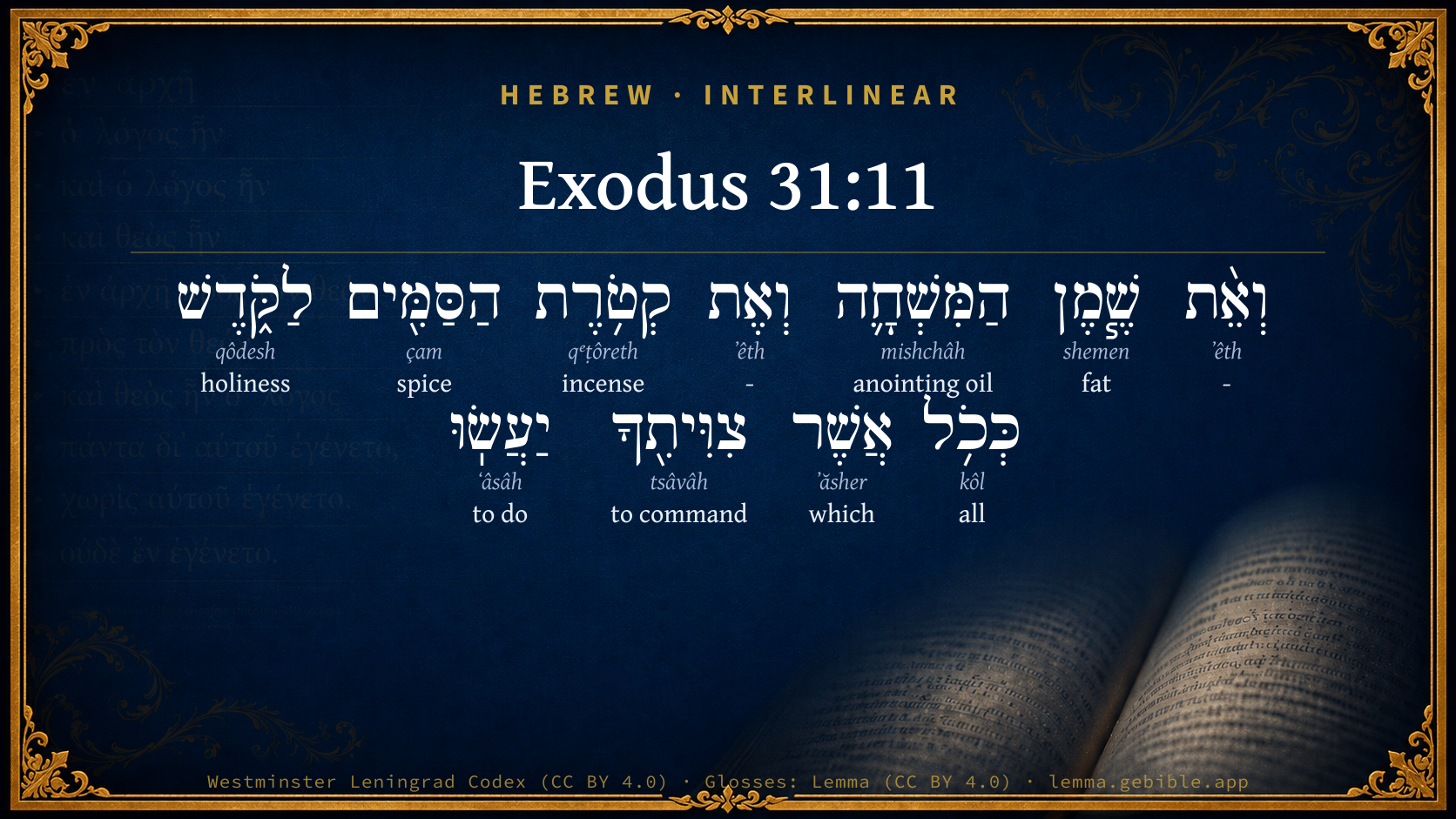
  1. וְאֵ֨ת ʼêth H853 “and · -” Conjunction + Particle, Direct Object
  2. שֶׁ֧מֶן shemen H8081 “fat of” Noun, Common, Masculine, Singular, Construct
  3. הַמִּשְׁחָ֛ה mishchâh H4888 “the · anointing oil” Particle, Definite Article + Noun, Common, Feminine, Singular, Absolute
  4. וְאֶת ʼêth H853 “and · -” Conjunction + Particle, Direct Object
  5. קְטֹ֥רֶת qᵉṭôreth H7004 “incense of” Noun, Common, Feminine, Singular, Construct
  6. לַקֹּ֑דֶשׁ qôdesh H6944 “to/for the · holiness” Preposition, Determined + Noun, Common, Masculine, Singular, Absolute
  7. כְּכֹ֥ל kôl H3605 “like/as · all” Preposition + Noun, Common, Masculine, Singular, Absolute
  8. אֲשֶׁר ʼăsher H834 “which” Particle, Relative
  9. צִוִּיתִ֖ךָ tsâvâh H6680 “to command · you” Verb, Piel, Perfect, 1st Person, Common, Singular + Suffix, Personal, 2nd Person, Masculine, Singular
  10. יַעֲשֽׂוּ ʻâsâh H6213 “to do” Verb, Qal, Imperfect, 3rd Person, Masculine, Plural

About this verse

These counts appear in no published source. They are computed here, from the morphology-tagged text and Lemma’s own curated glosses. What Lemma adds →

11
words
10
distinct lemmas
Pentateuch
section

Notable vocabulary

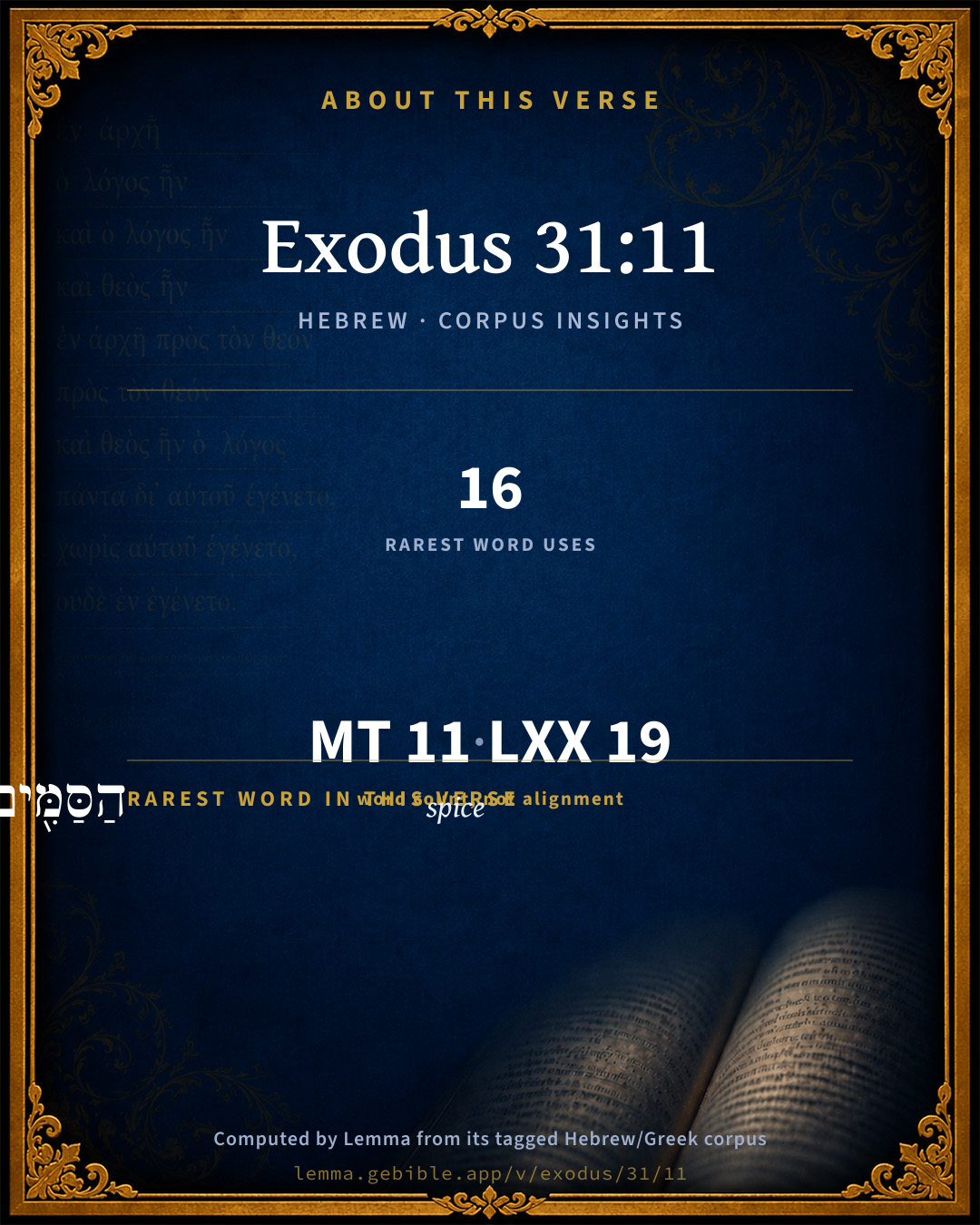
The rarest word here is הַסַּמִּ֖ים spice H5561 — appearing just 16 times in the whole Hebrew Bible.

Shared distinctive vocabulary

הַסַּמִּ֖ים spice H5561 occurs in 15 verses of the Hebrew Bible. Also found in:

Grammatical profile

  • 2 verbs
  • 6 nouns
  • 3 particles

Verb forms

  • צִוִּיתִ֖ךָ Piel · Perfect
  • יַעֲשֽׂוּ Qal · Imperfect

Hebrew & Septuagint length

In English translation the verse runs 24 words from the Hebrew and 23 from the Septuagint (LXX English) — closely comparable.

A rough comparison of the two English renderings, which tokenize alike — not a word-level alignment.

Word counts can differ between the Hebrew and the Greek without any difference in meaning — e.g. the Hebrew direct-object marker אֵת has no separate Greek word, and Greek often adds the article ὁ.

In the original languages it is 11 Hebrew tokens and 19 Greek tokens — but the two are counted differently (Hebrew bundles its prefixes and suffixes into one token; the Greek is in lemma form), so that isn’t a like-for-like length.

Cross-references

2

Topical passages linked to Exodus 31:11 in the Treasury of Scripture Knowledge — connected by theme and wording, ordered by reader-vote popularity; previews shown in the World English Bible.

  • Exodus 37:29 He made the holy anointing oil and the pure incense of sweet spices, after the art of the perfumer.
  • Exodus 30:23–38 "Also take fine spices: of liquid myrrh, five hundred shekels; and of fragrant cinnamon half as much, even two hundred and fifty; and of fragrant cane, two hundred and fifty;

Cross-references courtesy of OpenBible.info (CC BY 4.0).

Hebrew and Greek witnesses Masoretic Hebrew ↔ Greek Septuagint

The same verse in the two great witnesses to the Old Testament, shown verse-for-verse.

These are two independent witnesses, not word-aligned to each other, and the Septuagint is shown in lemma (dictionary) form.

Hebrew Exodus 31:11 Masoretic · Westminster Leningrad Codex

וְאֵ֨ת שֶׁ֧מֶן הַמִּשְׁחָ֛ה וְאֶת קְטֹ֥רֶת הַסַּמִּ֖ים לַקֹּ֑דֶשׁ כְּכֹ֥ל אֲשֶׁר צִוִּיתִ֖ךָ יַעֲשֽׂוּ

the anointing oil, and the incense of sweet spices for the holy place: according to all that I have commanded you they shall do."

World English Bible · Public Domain

Greek LXX Exodus 31:11 Septuagint · lemma form

καί ὁ ἔλαιον ὁ χρίσις καί ὁ θυμίαμα ὁ σύνθεσις ὁ ἅγιος κατά πᾶς ὅσος ἐγώ ἐντέλλομαι σύ ποιέω

and the anointing oil and the compound incense of the sanctuary; according to all that I have commanded you shall they make them.

LXX2012 (modern English Septuagint) · Public Domain

Hebrew: Westminster Leningrad Codex (CC BY 4.0). Greek: Septuagint (public domain); English from LXX2012 (modern English Septuagint) (Public Domain). How the Septuagint differs from the Hebrew →

Targum (Aramaic paraphrase)

2

The Targum is the ancient Jewish Aramaic paraphrase of the Hebrew Scriptures — an interpretive translation, not the Hebrew text itself. Onkelos (literal) and Pseudo-Jonathan (expansive) render the Torah, and Jonathan the Prophets. Coverage is partial: where no permissively-licensed English translation exists for a verse, only the Aramaic is shown. This is verse-level text, not a word-by-word alignment to the Hebrew.

  1. Targum Onkelos Torah (Genesis–Deuteronomy)
    וְיָת מִשְׁחָא דִרְבוּתָא וְיָת קְטוֹרֶת בּוּסְמַיָא לְקוּדְשָׁא כְּכֹל דִי פַקֵדִתָּךְ יַעְבְּדוּן:

    (no public-domain English translation for this verse)

    Targum Onkelos — Aramaic: “Onkelos Genesis” (public domain); “Onkelos Exodus” (public domain); “Onkelos Leviticus” (public domain); “Onkelos Numbers” (public domain); “Onkelos Deuteronomy” (public domain). English: “Sefaria Community Translation” (CC0 1.0 (public-domain dedication)); “J.W. Etheridge. The Targums of Onkelos and Jonathan Ben Uzziel on the Pentateuch. London: Longmans, Green, 1862” (public domain). Text via Sefaria.

  2. Targum Pseudo-Jonathan Torah (Genesis–Deuteronomy)
    וְיַת מְשַׁח רְבוּתָא וְיַת קְטוֹרֶת בּוּסְמַיָא לְקוּדְשָׁא הֵי כְּכָל מַה דְּפַקִידְתָּךְ יַעַבְדוּן

    and the oil of anointing; and the sweet incense for the sanctuary; even all whatever I have commanded thee, they shall make.

    Targum Pseudo-Jonathan — Aramaic: “Targum Jonathan on Genesis” (public domain); “Targum Jonathan on Exodus” (public domain); “Targum Jonathan on Leviticus” (public domain); “Targum Jonathan on Numbers” (public domain); “Targum Jonathan on Deuteronomy” (public domain). English: “The Targum of Jonathan ben Uzziel, trans. J. W. Etheridge, London, 1862” (public domain). Text via Sefaria.

Commentary

Notes on Exodus 31:11 from classic Christian and Jewish commentators (each source and its license shown beneath its notes). The classic Christian expositions comment on the surrounding passage and are grouped to its opening verse, so a note may address several verses; the Jewish commentaries on the Tanakh (Rashi and others) are per-verse, so they appear only where the commentator wrote on this verse.

Lemma curates 59 commentaries, every one of them public domain or Creative Commons licensed, each selected and text-cleaned for this edition rather than reprinted as found. About our sources →

Tyndale Open Study Notes

Tyndale Open Resources

31:11 The point throughout this entire section (25:1–40:38) is that God intends to meet his people’s need for some tangible representation of his presence, but it must be done in the way he has commanded. He, not we, determines the terms by which we come to him.

Tyndale Open Study Notes — © Tyndale Open Resources, licensed CC BY-SA 4.0. Text via the HelloAO Bible API.

Geneva Bible (1599)

Geneva Bible translators

Which only was to anoint the Priests and the instruments of the tabernacle, and not to burn.

Geneva Bible (1599) marginal notes — public domain. Text via Bolls.life.

Adam Clarke's Commentary

Verse 11. The anointing oil] See Clarke on Ex 30:23.

Sweet incense] See Clarke on Ex 30:23; and "Ex 30:24".

Adam Clarke's Commentary on the Bible (1810–1826) — public domain. Text from a community e-Sword/MySword module.

The Cambridge Bible for Schools and Colleges

gen. ed. J. J. S. Perowne

11. sweet spices] fragrant powders: see on Exo_30:34.

12–17 (cf. Exo_35:2-3). The observance of the sabbath inculcated. The section has in vv. 13, 14a (see the notes) strong affinities with the ‘Law of Holiness,’ or H (the older laws embedded in P, in Leviticus 17-26); and there is little doubt that some of H’s injunctions on the observance of the sabbath have here been excerpted by P or P2[216] and emphasized by him with the addition of vv. 14b–17: the whole thus forming a law inculcating the observance of the sabbath at a time when the execution of urgent sacred work might be taken as an excuse for disregarding it. The parts excerpted from H have also (like those in Leviticus 17-26 : see LOT. pp. 45 f., 138–141; ed. 6–8, pp. 49 f., 145–148) remarkable affinities with Ezekiel.

[216] Secondary strata of P (see p. xii top; pp. 328f., 378).

The Cambridge Bible for Schools and Colleges (gen. ed. J. J. S. Perowne; Cambridge University Press, 1878–1918) — public domain. Text from a community e-Sword module.

John Gill's Exposition

And the anointing oil, and sweet incense for the holy place,.... Of the composition of both which, see Exo 30:23.

according to all that I have commanded thee shall they do: not only make all the said things, but make them exactly according to the form and pattern given to Moses, communicated to Bezaleel and Aholiab, whose business it was to see that all things were done by the workmen agreeably to it.

John Gill's Exposition of the Whole Bible (1746–1763) — public domain (CC PDM 1.0). Text via the HelloAO Bible API.

Rashi

Rabbi Shlomo Yitzchaki (Rashi)

ואת קטרת הסמים לקדש AND INCENSE OF AROMATICS FOR THE SANCTUARY — i. e. for the purpose of letting it (the incense) rise in smoke in the היכל which is the “קדש” (that part of the Tabernacle or Temple in front of the קדש קדשים‎.

Rashi on the Tanakh — English translations: “The Judaica Press complete Tanach with Rashi, translated by A. J. Rosenberg” (CC BY 4.0); “Pentateuch with Rashi's commentary by M. Rosenbaum and A.M. Silbermann, 1929-1934” (public domain); “The Metsudah Tanach series, Lakewood, N.J” (CC BY 4.0); and “The Book of Joshua, Metsudah Publications, 1997” (CC BY 4.0). Text via Sefaria.

Lesson kit

Teaching starters — assembled from the data on this page, not authored interpretation. Every prompt links to the verse data it draws on. Edit before teaching.

Exodus, in the Pentateuch, opens this verse with 11 words (10 distinct Hebrew lemmas). Its most distinctive word is çam (“spice”). A historical commentator’s framing appears above. Read the whole chapter for the surrounding context.

Discussion questions

  1. What does “spice” (çam) contribute to the verse as a whole?
  2. Exodus 25:6 shares the word «spice» with this verse. How do the two illuminate each other?
  3. These translations render this verse differently; the difference is in the English rendering, not the original. What questions does that raise?
  4. The verb «צִוִּיתִ֖ךָ» is Piel Perfect. How does its form color the action?
  5. Reading how Tyndale Open Study Notes and Geneva Bible (1599) read this verse, where do the two commentators agree and where do they part?

Things to notice

Reading settings

Reading text

Shown beneath each verse's original-language words.

Old Testament
Old Testament edition

Read the OT as the Masoretic Hebrew (MT) or the Greek Septuagint (LXX).

English shown for the Greek Septuagint (in the Hebrew ↔ Greek comparison).

Comparing translations? Open the Compare panel on any verse page to stack up to four side by side.