
Leviticus 8:9

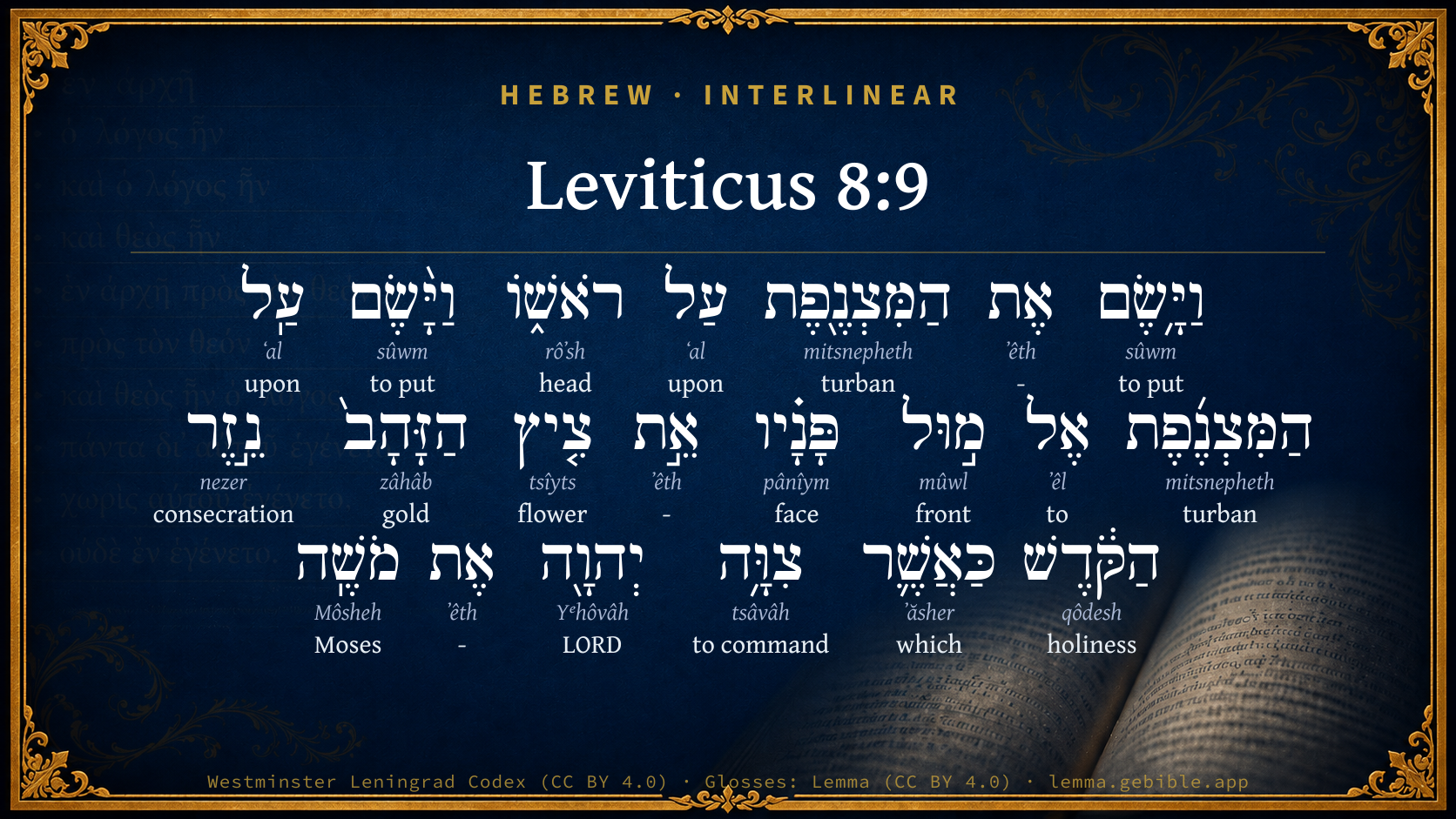
Hebrew (Westminster Leningrad Codex) Leviticus 8:9 appears in the Hebrew Old Testament. The text above is from the Westminster Leningrad Codex. Each word links to its Strong’s number, a concise gloss, and parsing drawn from the Open Scriptures Hebrew Bible morphology. Click any word for its full Brown-Driver-Briggs (BDB) entry.
Download image
Cite this verse

Leviticus 8:9 (World English Bible). Public Domain. Lemma interlinear Bible study tool, https://lemma.gebible.app/v/leviticus/8/9.

Show BibTeX & RIS
BibTeX
RIS
English Translation
He set the turban on his head; and on the turban, in front, he set the golden plate, the holy crown; as Yahweh commanded Moses.
World English Bible · Public Domain
Download a study sheet

One document with this verse’s original text, its word-by-word gloss line, the meaning frame, cross-references with their text, attributed commentary, and full source and license credits — printable, and it pastes into notes with its structure intact.

This verse Autodidact and up

Study sheet (.html) Plain text (.txt)

A passage Seminary Student

Up to 50 verses in one chapter. A passage sheet keeps up to 6 commentary sources and 12 cross-references per verse, in the order this page ranks them, and says so on the sheet whenever that leaves anything out. Ask for a single verse and you get the Autodidact verse sheet above.

Everything on this page stays free to read, with no account — the sheet is a download of what is already on screen, not access to it.

Want to remove ads? Support Godless Engineer
Compare translations 3

The same verse in 3 English versions, stacked beneath the original-language interlinear above. Click any original word for its lexicon entry.

Each is an independent rendering of the whole verse — the interlinear is not word-aligned to these translations.

Highlighted words mark where these versions differ — a whole-verse word diff, not a word-by-word alignment.

  • World English Bible Public Domain
    He set the turban on his head; and on the turban, in front, he set the golden plate, the holy crown; as Yahweh commanded Moses.
  • King James Version Public Domain
    And he put the mitre upon his head; also upon the mitre, even upon his forefront, did he put the golden plate, the holy crown; as the LORD commanded Moses.
  • unfoldingWord Literal Text CC BY-SA 4.0
    And he placed the turban on his head, and he placed on the turban—to the front of its face—the flower of gold, the crown of holiness, just as Yahweh commanded Moses.

unfoldingWord Literal Text — © unfoldingWord, licensed CC BY-SA 4.0. Word-aligned USFM3 via Door43 (git.door43.org/unfoldingWord/en_ult).

Versions to compare (up to 4)

3 of 4 selected

Show all 18 translations

Every available English version of this verse, each an independent rendering of the whole verse.

  • World English Bible Public Domain
    He set the turban on his head; and on the turban, in front, he set the golden plate, the holy crown; as Yahweh commanded Moses.
  • Berean Standard Bible Public Domain
    Moses also put the turban on Aaron’s head and set the gold plate, the holy diadem, on the front of the turban, as the LORD had commanded him.
  • Majority Standard Bible Public Domain
    Moses also put the turban on Aaron’s head and set the gold plate, the holy diadem, on the front of the turban, as the LORD had commanded him.
  • King James Version Public Domain
    And he put the mitre upon his head; also upon the mitre, even upon his forefront, did he put the golden plate, the holy crown; as the LORD commanded Moses.
  • American Standard Version (1901) Public Domain
    And he set the mitre upon his head; and upon the mitre, in front, did he set the golden plate, the holy crown; as Jehovah commanded Moses.
  • Revised Version (1885) Public Domain
    And he set the mitre upon his head; and upon the mitre, in front, did he set the golden plate, the holy crown; as the LORD commanded Moses.
  • Geneva Bible (1599) Public Domain
    Also he put the miter vpon his head, and put vpon the miter on the fore front the golden plate, and the holy crowne, as the Lord had commanded Moses.
  • Douay-Rheims (1899) Public Domain
    He put also the mitre upon his head: and upon the mitre over the forehead, he put the plate of gold, consecrated with sanctification, as the Lord had commanded him.
  • Young's Literal Translation Public Domain
    and doth put the mitre on his head, and doth put on the mitre, over-against its front, the golden flower of the holy crown, as Jehovah hath commanded Moses.
  • Literal Standard Version CC BY-SA 4.0
    and puts the turban on his head, and puts the golden flower of the holy crown on the turban, toward the front of its face, as YHWH has commanded Moses.
  • Unlocked Literal Bible CC BY-SA 4.0
    He set the turban on his head, and on the turban, in front, he set the golden plate, the holy crown, as Yahweh had commanded him.
  • unfoldingWord Literal Text CC BY-SA 4.0
    And he placed the turban on his head, and he placed on the turban—to the front of its face—the flower of gold, the crown of holiness, just as Yahweh commanded Moses.
  • Darby Bible Public Domain
    and he put the turban upon his head; and upon the turban, on the front of it, he put the golden plate, the holy diadem; as Jehovah had commanded Moses.
  • World Messianic Bible Public Domain
    He set the turban on his head. He set the golden plate, the holy crown, on the front of the turban, as the LORD commanded Moses.
  • Webster's Bible Public Domain
    And he put the miter upon his head; also upon the miter, even upon his front, did he put the golden plate, the holy crown; as the LORD commanded Moses.
  • Free Bible Version CC BY-SA 4.0
    He put the turban on Aaron's head and placed the gold plate, the holy crown, on the front of the turban, as the Lord had instructed him to do.
  • Bible in Basic English Public Domain
    And on his head he put the head-dress, and in front of the head-dress the plate of gold, the holy crown, as the Lord gave orders to Moses.
  • JPS Tanakh (1917) Public Domain
    And he set the mitre upon his head; and upon the mitre, in front, did he set the golden plate, the holy crown; as the LORD commanded Moses.

Literal Standard Version (2020), Covenant Press — licensed CC BY-SA 4.0. Text via the HelloAO Bible API (eBible.org). Unlocked Literal Bible (unfoldingWord) — licensed CC BY-SA 4.0. Text via the HelloAO Bible API (eBible.org). unfoldingWord Literal Text — © unfoldingWord, licensed CC BY-SA 4.0. Word-aligned USFM3 via Door43 (git.door43.org/unfoldingWord/en_ult). Free Bible Version, Dr. Jonathan Gallagher — licensed CC BY-SA 4.0. Text via the HelloAO Bible API (eBible.org).

Word by word

More ways to search: Search by grammar → Find every occurrence → Compare this word →

Practice this passage: Drill this verse → Learn its vocabulary →

הַמִּצְנֶ֖פֶת
mitsnepheth
H4701
“the · turban”
Particle, Definite Article + Noun, Common, Feminine, Singular, Absolute
Part of Speech
Particle + Noun
Type
Common
Gender
Feminine
Number
Singular
State
Absolute
Full BDB Definition

Origin: from H6801

TWOT: 1940c

turban (of the high priest)
  1. וַיָּ֥שֶׂם sûwm H7760 “and · to put” Conjunction + Verb, Qal, Sequential Imperfect, 3rd Person, Masculine, Singular
  2. אֶת ʼêth H853 “-” Particle, Direct Object
  3. עַל ʻal H5921 “upon” Preposition
  4. רֹאשׁ֑וֹ rôʼsh H7218 “head · his” Noun, Common, Masculine, Singular, Construct + Suffix, Personal, 3rd Person, Masculine, Singular
  5. וַיָּ֨שֶׂם sûwm H7760 “and · to put” Conjunction + Verb, Qal, Sequential Imperfect, 3rd Person, Masculine, Singular
  6. עַֽל ʻal H5921 “upon” Preposition
  7. הַמִּצְנֶ֜פֶת mitsnepheth H4701 “the · turban” Particle, Definite Article + Noun, Common, Feminine, Singular, Absolute
  8. אֶל ʼêl H413 “to” Preposition
  9. מ֣וּל mûwl H4136 “front” Preposition
  10. פָּנָ֗יו pânîym H6440 “face(s) · his” Noun, Common, Both, Plural, Construct + Suffix, Personal, 3rd Person, Masculine, Singular
  11. אֵ֣ת ʼêth H853 “-” Particle, Direct Object
  12. צִ֤יץ tsîyts H6731 “flower of” Noun, Common, Masculine, Singular, Construct
  13. הַזָּהָב֙ zâhâb H2091 “the · gold” Particle, Definite Article + Noun, Common, Masculine, Singular, Absolute
  14. נֵ֣זֶר nezer H5145 “consecration of” Noun, Common, Masculine, Singular, Construct
  15. הַקֹּ֔דֶשׁ qôdesh H6944 “the · holiness” Particle, Definite Article + Noun, Common, Masculine, Singular, Absolute
  16. כַּאֲשֶׁ֛ר ʼăsher H834 “like/as · which” Preposition + Particle, Relative
  17. צִוָּ֥ה tsâvâh H6680 “to command” Verb, Piel, Perfect, 3rd Person, Masculine, Singular
  18. יְהוָ֖ה Yᵉhôvâh H3068 “LORD” Noun, Proper
  19. אֶת ʼêth H853 “-” Particle, Direct Object
  20. מֹשֶֽׁה Môsheh H4872 “Moses” Noun, Proper

About this verse

These counts appear in no published source. They are computed here, from the morphology-tagged text and Lemma’s own curated glosses. What Lemma adds →

21
words
16
distinct lemmas
Pentateuch
section

Notable vocabulary

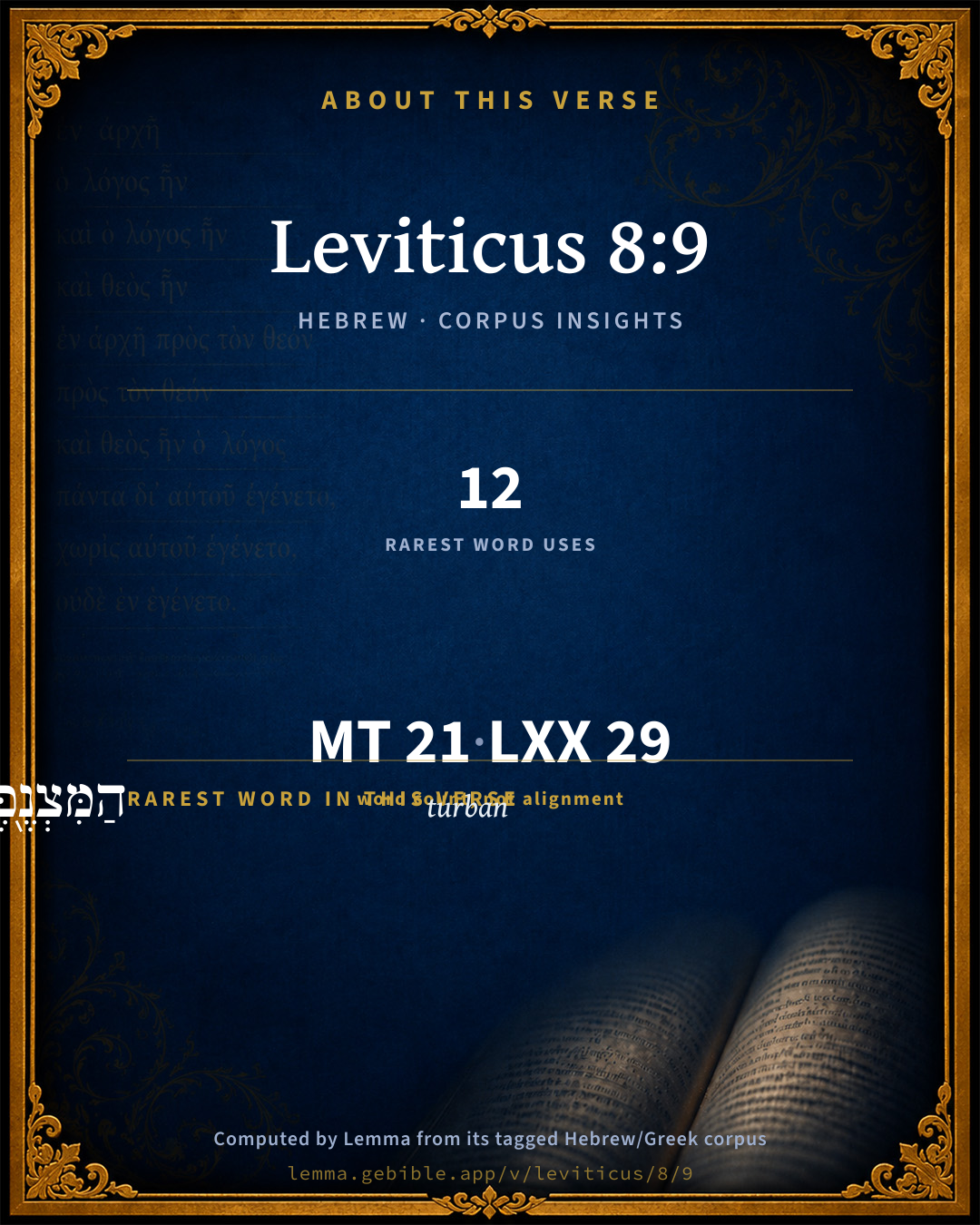
The rarest word here is הַמִּצְנֶ֖פֶת turban H4701 — appearing just 12 times in the whole Hebrew Bible.

Shared distinctive vocabulary

הַמִּצְנֶ֖פֶת turban H4701 occurs in 9 verses of the Hebrew Bible. Also found in:

Grammatical profile

  • 3 verbs
  • 10 nouns
  • 4 prepositions
  • 4 particles

Verb forms

  • וַיָּ֥שֶׂם Qal · Sequential Imperfect
  • וַיָּ֨שֶׂם Qal · Sequential Imperfect
  • צִוָּ֥ה Piel · Perfect

Repetition

Words recur within this verse — often emphatic in Hebrew:

  • וַיָּ֥שֶׂם to put H7760 ×2
  • הַמִּצְנֶ֖פֶת turban H4701 ×2
  • עַל upon H5921 ×2

Hebrew & Septuagint length

In English translation the verse runs 25 words from the Hebrew and 27 from the Septuagint (LXX English) — closely comparable.

A rough comparison of the two English renderings, which tokenize alike — not a word-level alignment.

Word counts can differ between the Hebrew and the Greek without any difference in meaning — e.g. the Hebrew direct-object marker אֵת has no separate Greek word, and Greek often adds the article ὁ.

In the original languages it is 21 Hebrew tokens and 29 Greek tokens — but the two are counted differently (Hebrew bundles its prefixes and suffixes into one token; the Greek is in lemma form), so that isn’t a like-for-like length.

Cross-references

7

Topical passages linked to Leviticus 8:9 in the Treasury of Scripture Knowledge — connected by theme and wording, ordered by reader-vote popularity; previews shown in the World English Bible.

  • Philippians 2:9–11 Therefore God also highly exalted him, and gave to him the name which is above every name;
  • Exodus 28:4 These are the garments which they shall make: a breastplate, and an ephod, and a robe, and a coat of checker work, a turban, and a sash: and they shall make holy garments for Aaron your brother, and his sons, that he may minister to me in the priest's office.
  • Exodus 28:36–38 "You shall make a plate of pure gold, and engrave on it, like the engravings of a signet, 'HOLY TO YAHWEH.'
  • Exodus 29:6 and you shall set the turban on his head, and put the holy crown on the turban.
  • Exodus 39:28–30 and the turban of fine linen, and the linen headbands of fine linen, and the linen breeches of fine twined linen,
  • Zechariah 3:5 I said, "Let them set a clean turban on his head." So they set a clean turban on his head, and clothed him; and the angel of Yahweh was standing by.
  • Zechariah 6:11–14 Yes, take silver and gold, and make crowns, and set them on the head of Joshua the son of Jehozadak, the high priest;

Cross-references courtesy of OpenBible.info (CC BY 4.0).

Hebrew and Greek witnesses Masoretic Hebrew ↔ Greek Septuagint

The same verse in the two great witnesses to the Old Testament, shown verse-for-verse.

These are two independent witnesses, not word-aligned to each other, and the Septuagint is shown in lemma (dictionary) form.

Hebrew Leviticus 8:9 Masoretic · Westminster Leningrad Codex

וַיָּ֥שֶׂם אֶת הַמִּצְנֶ֖פֶת עַל רֹאשׁ֑וֹ וַיָּ֨שֶׂם עַֽל הַמִּצְנֶ֜פֶת אֶל מ֣וּל פָּנָ֗יו אֵ֣ת צִ֤יץ הַזָּהָב֙ נֵ֣זֶר הַקֹּ֔דֶשׁ כַּאֲשֶׁ֛ר צִוָּ֥ה יְהוָ֖ה אֶת מֹשֶֽׁה

He set the turban on his head; and on the turban, in front, he set the golden plate, the holy crown; as Yahweh commanded Moses.

World English Bible · Public Domain

Greek LXX Leviticus 8:9 Septuagint · lemma form

καί ἐπιτίθημι ὁ μίτρα ἐπί ὁ κεφαλή αὐτός καί ἐπιτίθημι ἐπί ὁ μίτρα κατά πρόσωπον αὐτός ὁ πέταλον ὁ χρυσοῦς ὁ καταἁγιάζω ἅγιος ὅς τρόπος συντάσσω κύριος ὁ μωυσῆς

And he put the mitre on his head, and put upon the mitre in front the golden plate, the most holy thing, as the Lord commanded Moses.

LXX2012 (modern English Septuagint) · Public Domain

Hebrew: Westminster Leningrad Codex (CC BY 4.0). Greek: Septuagint (public domain); English from LXX2012 (modern English Septuagint) (Public Domain). How the Septuagint differs from the Hebrew →

Targum (Aramaic paraphrase)

2

The Targum is the ancient Jewish Aramaic paraphrase of the Hebrew Scriptures — an interpretive translation, not the Hebrew text itself. Onkelos (literal) and Pseudo-Jonathan (expansive) render the Torah, and Jonathan the Prophets. Coverage is partial: where no permissively-licensed English translation exists for a verse, only the Aramaic is shown. This is verse-level text, not a word-by-word alignment to the Hebrew.

  1. Targum Onkelos Torah (Genesis–Deuteronomy)
    וְשַׁוִי יָת מִצְנַפְתָּא עַל רֵישֵׁיהּ וְשַׁוִי עַל מִצְנֶפְתָּא לָקֳבֵיל אַפּוֹהִי יָת צִיצָא דְדַהֲבָא כְּלִילָא דְקוּדְשָׁא כְּמָא דִי פַקִיד יְיָ יָת מֹשֶׁה

    (no public-domain English translation for this verse)

    Targum Onkelos — Aramaic: “Onkelos Genesis” (public domain); “Onkelos Exodus” (public domain); “Onkelos Leviticus” (public domain); “Onkelos Numbers” (public domain); “Onkelos Deuteronomy” (public domain). English: “Sefaria Community Translation” (CC0 1.0 (public-domain dedication)); “J.W. Etheridge. The Targums of Onkelos and Jonathan Ben Uzziel on the Pentateuch. London: Longmans, Green, 1862” (public domain). Text via Sefaria.

  2. Targum Pseudo-Jonathan Torah (Genesis–Deuteronomy)
    וְשַׁוֵי יַת מִצְנַפְתָּא עַל רֵישֵׁיהּ וְשַׁוֵי עַל מִצְנַפְתָּא כָּל קְבֵיל אַנְפּוֹי יַת צִיצָא דְדַהֲבָא כְּלִילָא דְקוּדְשָׁא הֵיכְמָא דְפַקֵיד יְיָ יַת משֶׁה

    And, he put the mitre upon his head, and set upon the mitre over his forehead the plate of gold, the diadem of holiness, as the Lord commanded Mosheh.

    Targum Pseudo-Jonathan — Aramaic: “Targum Jonathan on Genesis” (public domain); “Targum Jonathan on Exodus” (public domain); “Targum Jonathan on Leviticus” (public domain); “Targum Jonathan on Numbers” (public domain); “Targum Jonathan on Deuteronomy” (public domain). English: “The Targum of Jonathan ben Uzziel, trans. J. W. Etheridge, London, 1862” (public domain). Text via Sefaria.

Commentary

Notes on Leviticus 8:9 from classic Christian and Jewish commentators (each source and its license shown beneath its notes). The classic Christian expositions comment on the surrounding passage and are grouped to its opening verse, so a note may address several verses; the Jewish commentaries on the Tanakh (Rashi and others) are per-verse, so they appear only where the commentator wrote on this verse.

Lemma curates 59 commentaries, every one of them public domain or Creative Commons licensed, each selected and text-cleaned for this edition rather than reprinted as found. About our sources →

Joseph Benson's Commentary

Lev 8:9. The holy crown — The crown signified the dignity of the high- priest, and its being termed holy, the sanctity of his person and office. Thus he was a type of Christ, crowned with glory and honour, perfectly holy, and consecrated for evermore.

Joseph Benson's Commentary on the Old and New Testaments (1811–1818) — public domain. Text from a community e-Sword module.

Tyndale Open Study Notes

Tyndale Open Resources

8:9 The turban worn by the high priest was made of linen and was distinct from the headdresses of the common priests (Exod 28:40). The gold medallion was suspended from the turban and bore an inscription that read, “Holy to the Lord” (Exod 28:36). With the names of the tribes on his shoulders and over his heart and the dedication to the Lord on his forehead, the high priest was clearly marked as the people’s representative to God and God’s representative to the people. In this mediating role, the high priest modeled the standard for all priests.

Tyndale Open Study Notes — © Tyndale Open Resources, licensed CC BY-SA 4.0. Text via the HelloAO Bible API.

Geneva Bible (1599)

Geneva Bible translators

So called, because this superscription, Holiness to the Lord, was graven in it.

Geneva Bible (1599) marginal notes — public domain. Text via Bolls.life.

Adam Clarke's Commentary

Verse 9. And he put the mitre] See Clarke on Ex 28:36.

Adam Clarke's Commentary on the Bible (1810–1826) — public domain. Text from a community e-Sword/MySword module.

Ellicott's Commentary for English Readers

(9) And he put the mitre.—See Exo_28:36-38.

A Bible Commentary for English Readers, edited by Charles John Ellicott (1878–1897) — public domain. Text from a community e-Sword module.

The Cambridge Bible for Schools and Colleges

gen. ed. J. J. S. Perowne

9. the mitre] turban as R.V. mg. Heb. miẓnépheth in Lev. here and Lev_16:4 (the linen mitre) only: in Exod. (in the cognate passages) Exo_28:4; Exo_28:37; Exo_28:39, Exo_29:6, Exo_39:28; Exo_39:31. It was made of fine linen; tradition describes it as 24 ft. long, so it was probably wound round the head like a turban. Besides the passages quoted, where it denotes the headdress of the high priest, it occurs only in Eze_21:26 (Heb. 31). (mitre R.V., diadem A.V.). Another word (ẓânîph) from the same root occurs Isa_62:3 (Ḳ’ri), translated ‘diadem,’ in parallelism with the common Heb. word for ‘crown’; and in Zec_3:5 with reference to the high priest Joshua. It is strange that ẓânîph should be used in the Zechariah passage to denote a mitre for the high priest, if miẓnépheth were already the technical term used for that portion of his attire.

Josephus (Ant. iii. 7. 6) says that the high priest’s mitre was like that of all the other priests, but another word is used (see Lev_8:13) for the head-dress of Aaron’s sons. He describes fully another mitre with a triple golden crown. This was probably an ornament added in later times. Alexander Balas sent a purple robe and a crown of gold to Jonathan which he wore at the Feast of Tabernacles b.c. 153 (1Ma_10:20). This may be the crown described by Josephus.

upon the mitre, in front] In A.V. ‘upon his forefront,’ ‘his’ refers to the mitre and in modern English would be ‘its.’

the golden plate, the holy crown] The golden plate is described Exo_28:36-37. The Heb. word (ẓîẓ), translated ‘plate,’ implies something bright and glittering, and is elsewhere used of a flower. The plate was fastened by its lace of blue to the turban (Exo_28:37, Exo_39:31) and would appear as an ornament or diadem in the headgear of the high priest. It is called ‘the holy crown’ in Exo_29:6, and here both names are given to it. The same combination occurs in Exo_39:30 where the English ‘the plate of the holy crown of pure gold’ conveys the impression that the ‘plate’ and the ‘crown’ are different instead of synonymous.

The Cambridge Bible for Schools and Colleges (gen. ed. J. J. S. Perowne; Cambridge University Press, 1878–1918) — public domain. Text from a community e-Sword module.

John Gill's Exposition

And he put the mitre upon his head,.... Which was made of fine linen, and was a wrap of that of a considerable length about his head, Exo 28:39.

also upon the mitre, even upon his forefront, did he put the golden plate; which was put upon the forehead of the high priest, reaching from ear to ear, and was fastened to the mitre with a blue lace, and had on it this inscription, "holiness to the Lord": Exo 28:36 and is here therefore called

the holy crown: denoting both the sanctity and the dignity of the high priest, and typical of Christ, who is holiness itself, and to his people, and is now crowned with glory and honour, being a priest upon the throne: hence the Jews (u) speak of the crown of the law, and of the crown of the kingdom, and of the crown of the priesthood: and this, as all the rest, was done

as the Lord commanded Moses; all these were made according to the divine order, and were put on in the manner and form he directed him; of the mystery of the mitre and the crown; see Gill on Exo 28:39, Exo 28:36, Exo 28:37.

(u) Pirke Abot, c. 4. sect. 13.

John Gill's Exposition of the Whole Bible (1746–1763) — public domain (CC PDM 1.0). Text via the HelloAO Bible API.

Haydock's Catholic Bible Commentary

Sanctification. Having these words engraven on it, Holiness to the Lord.

George Leo Haydock (1774–1849), Haydock's Catholic Family Bible and Commentary, 1859 edition — public domain. Excludes Psalms (Douay-Rheims chapter numbering differs from Protestant) and Deuterocanonical books (Catholic canon only).

Matthew Poole's English Annotations

This here added, either because Nadab and Abihu had been led to their error by drinking too much, which might easily fall out when they were feasting and full of joy for their entrance into so honourable and profitable an employment; or at least because others might thereby be drawn to commit the same miscarriages, which they might now commit from other causes. Drunkenness is so odious a sin in itself, especially a minister, and most of all in the time of his administration of sacred things, that God saw fit to prevent all occasions of it. And hence the devil, who is God’s ape in his prescriptions for his worship, required this abstinence from his priests in their idolatrous service.

Matthew Poole's English Annotations on the Holy Bible (1683–1685) — public domain. Text from a community e-Sword/MySword module.

Whedon's Commentary on the Bible

Daniel D. Whedon

9. The mitre — This was a turban, since its Hebrew name is from a verb signifying to wind about. This was a very splendid head-covering, worn only by pontiffs and kings, (Eze_21:26,) as an emblem of dignity, styled in Sir_45:12, “an ornament of honour, a costly work, the desire of the eyes.”

The holy crown — It was called holy because it had the tetragrammaton — the four-lettered Hebrew word for Jehovah — inscribed upon it. Exo_28:36. It was of fine linen, with a fillet of blue lace, symbolizing heaven, and over it a golden diadem, “on which,”

says Josephus, “blossomed a golden calyx like the flower of the henbane.” The engraved golden plate was a gold band, two fingers broad, tied behind with blue lace embroidered with flowers. It bore the inscription, HOLINESS TO THE LORD.

Daniel D. Whedon (gen. ed.), Commentary on the Old and New Testaments (1874–1909) — public domain. Text from a community e-Sword module.

Rashi

Rabbi Shlomo Yitzchaki (Rashi)

וישם על המצנפת UPON THE MITRE … DID HE PUT [THE GOLDEN PLATE] — Threads of blue purple that were: fastened on the Plate he put over the mitre, consequently the Plate hung from the mitre mid would be “against his face” (upon his forehead) as stated here (cf. Rashi on Exodus 28:37).

Rashi on the Tanakh — English translations: “The Judaica Press complete Tanach with Rashi, translated by A. J. Rosenberg” (CC BY 4.0); “Pentateuch with Rashi's commentary by M. Rosenbaum and A.M. Silbermann, 1929-1934” (public domain); “The Metsudah Tanach series, Lakewood, N.J” (CC BY 4.0); and “The Book of Joshua, Metsudah Publications, 1997” (CC BY 4.0). Text via Sefaria.

Lesson kit

Teaching starters — assembled from the data on this page, not authored interpretation. Every prompt links to the verse data it draws on. Edit before teaching.

Leviticus, in the Pentateuch, opens this verse with 21 words (16 distinct Hebrew lemmas). Its most distinctive word is mitsnepheth (“turban”). A historical commentator’s framing appears above. Read the whole chapter for the surrounding context.

Discussion questions

  1. The word mitsnepheth carries the sense “turban.” How does it shape the verse?
  2. How does Exodus 28:4, which shares the word «turban», read alongside this verse?
  3. What does the repetition of “to put” (2× in this one verse) do in this verse?
  4. These translations render this verse differently. What is at stake in choosing one wording over another?
  5. «וַיָּ֥שֶׂם» is a Qal Sequential Imperfect verb. How does that grammatical form shape the action described?
  6. Compare how Joseph Benson's Commentary and Tyndale Open Study Notes read this verse. Where do they agree or differ?

Things to notice

Reading settings

Reading text

Shown beneath each verse's original-language words.

Old Testament
Old Testament edition

Read the OT as the Masoretic Hebrew (MT) or the Greek Septuagint (LXX).

English shown for the Greek Septuagint (in the Hebrew ↔ Greek comparison).

Comparing translations? Open the Compare panel on any verse page to stack up to four side by side.