
Exodus 40:9

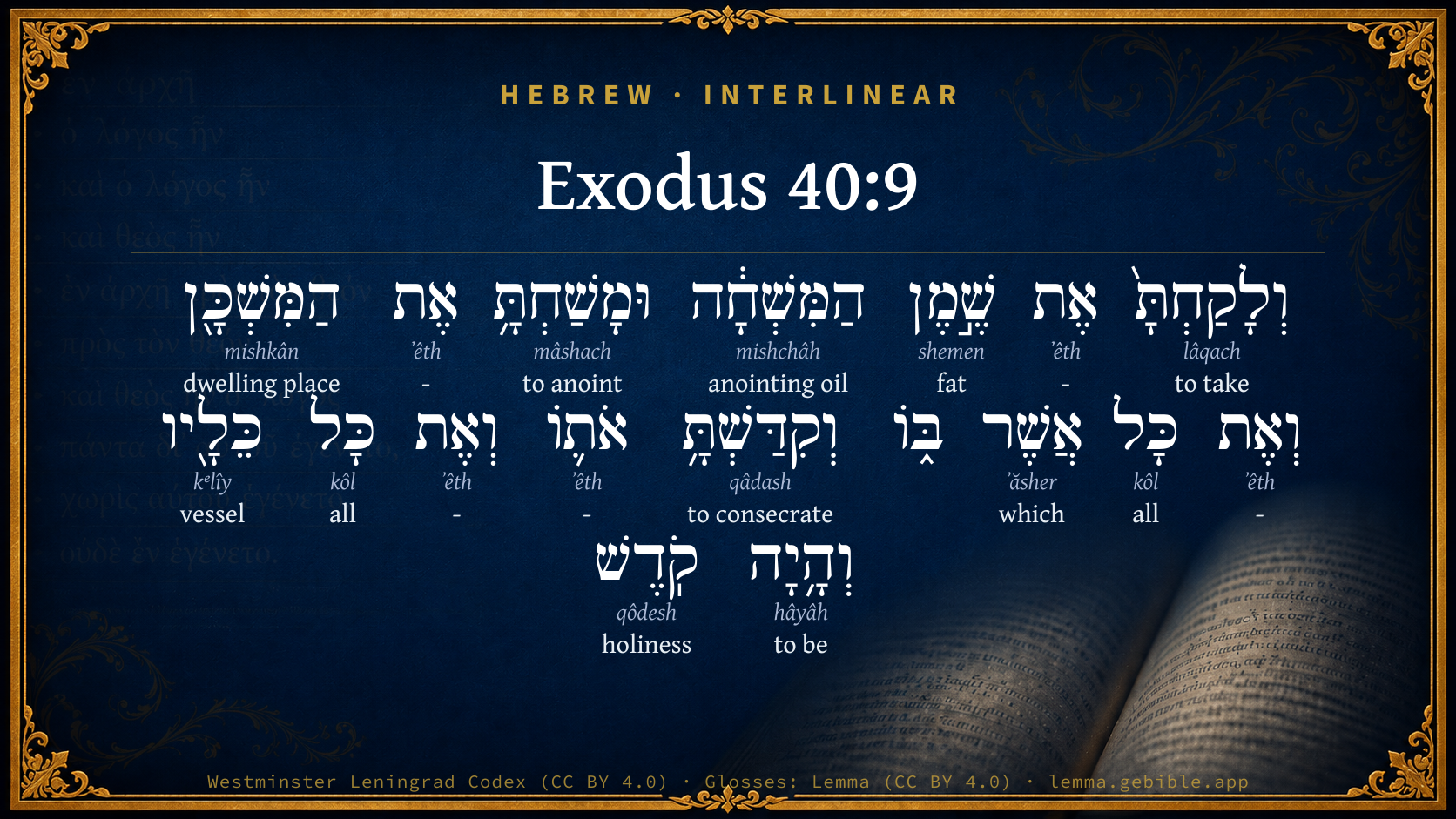
Hebrew (Westminster Leningrad Codex) Exodus 40:9 appears in the Hebrew Old Testament. The text above is from the Westminster Leningrad Codex. Each word links to its Strong’s number, a concise gloss, and parsing drawn from the Open Scriptures Hebrew Bible morphology. Click any word for its full Brown-Driver-Briggs (BDB) entry.
Download image
Cite this verse

Exodus 40:9 (World English Bible). Public Domain. Lemma interlinear Bible study tool, https://lemma.gebible.app/v/exodus/40/9.

Show BibTeX & RIS
BibTeX
RIS
English Translation
You shall take the anointing oil, and anoint the tent, and all that is in it, and shall make it holy, and all its furniture: and it will be holy.
World English Bible · Public Domain
Download a study sheet

One document with this verse’s original text, its word-by-word gloss line, the meaning frame, cross-references with their text, attributed commentary, and full source and license credits — printable, and it pastes into notes with its structure intact.

This verse Autodidact and up

Study sheet (.html) Plain text (.txt)

A passage Seminary Student

Up to 50 verses in one chapter. A passage sheet keeps up to 6 commentary sources and 12 cross-references per verse, in the order this page ranks them, and says so on the sheet whenever that leaves anything out. Ask for a single verse and you get the Autodidact verse sheet above.

Everything on this page stays free to read, with no account — the sheet is a download of what is already on screen, not access to it.

Want to remove ads? Support Godless Engineer
Compare translations 3

The same verse in 3 English versions, stacked beneath the original-language interlinear above. Click any original word for its lexicon entry.

Each is an independent rendering of the whole verse — the interlinear is not word-aligned to these translations.

Highlighted words mark where these versions differ — a whole-verse word diff, not a word-by-word alignment.

  • World English Bible Public Domain
    You shall take the anointing oil, and anoint the tent, and all that is in it, and shall make it holy, and all its furniture: and it will be holy.
  • King James Version Public Domain
    And thou shalt take the anointing oil, and anoint the tabernacle, and all that is therein, and shalt hallow it, and all the vessels thereof: and it shall be holy.
  • unfoldingWord Literal Text CC BY-SA 4.0
    And you shall take the oil of anointing and anoint the Dwelling and everything that is in it. And you shall set apart it and all its furnishings, and it will be holy.

unfoldingWord Literal Text — © unfoldingWord, licensed CC BY-SA 4.0. Word-aligned USFM3 via Door43 (git.door43.org/unfoldingWord/en_ult).

Versions to compare (up to 4)

3 of 4 selected

Show all 18 translations

Every available English version of this verse, each an independent rendering of the whole verse.

  • World English Bible Public Domain
    You shall take the anointing oil, and anoint the tent, and all that is in it, and shall make it holy, and all its furniture: and it will be holy.
  • Berean Standard Bible Public Domain
    Take the anointing oil and anoint the tabernacle and everything in it; consecrate it along with all its furnishings, and it shall be holy.
  • Majority Standard Bible Public Domain
    Take the anointing oil and anoint the tabernacle and everything in it; consecrate it along with all its furnishings, and it shall be holy.
  • King James Version Public Domain
    And thou shalt take the anointing oil, and anoint the tabernacle, and all that is therein, and shalt hallow it, and all the vessels thereof: and it shall be holy.
  • American Standard Version (1901) Public Domain
    And thou shalt take the anointing oil, and anoint the tabernacle, and all that is therein, and shalt hallow it, and all the furniture thereof: and it shall be holy.
  • Revised Version (1885) Public Domain
    And thou shalt take the anointing oil, and anoint the tabernacle, and all that is therein, and shalt hallow it, and all the furniture thereof: and it shall be holy.
  • Geneva Bible (1599) Public Domain
    After, thou shalt take the anoynting oyle, and anoynt the Tabernacle, and all that is therein, and halowe it with all the instruments thereof, that it may be holy.
  • Douay-Rheims (1899) Public Domain
    And thou shalt take the oil of unction and anoint the tabernacle with its vessels, that they may be sanctified:
  • Young's Literal Translation Public Domain
    and hast taken the anointing oil, and anointed the tabernacle, and all that `is' in it, and hallowed it, and all its vessels, and it hath been holy;
  • Literal Standard Version CC BY-SA 4.0
    and have taken the anointing oil, and anointed the Dwelling Place, and all that [is] in it, and hallowed it, and all its vessels, and it has been holy;
  • Unlocked Literal Bible CC BY-SA 4.0
    You must take the anointing oil and anoint the tabernacle and everything that is in it. You must set it apart and all its furnishings to me; then it will be holy.
  • unfoldingWord Literal Text CC BY-SA 4.0
    And you shall take the oil of anointing and anoint the Dwelling and everything that is in it. And you shall set apart it and all its furnishings, and it will be holy.
  • Darby Bible Public Domain
    And thou shalt take the anointing oil, and anoint the tabernacle, and all that is in it, and shalt hallow it, and all its utensils; and it shall be holy.
  • World Messianic Bible Public Domain
    “You shall take the anointing oil, and anoint the tabernacle and all that is in it, and shall make it holy, and all its furniture, and it will be holy.
  • Webster's Bible Public Domain
    And thou shalt take the anointing oil, and anoint the tabernacle, and all that is in it, and shalt hallow it, and all its vessels: and it shall be holy.
  • Free Bible Version CC BY-SA 4.0
    Use the anointing oil to anoint the Tabernacle and everything in it. Dedicate it and all its furniture to make it holy.
  • Bible in Basic English Public Domain
    And take the holy oil and put it on the House and everything in it, and make it and everything in it holy:
  • JPS Tanakh (1917) Public Domain
    And thou shalt take the anointing oil, and anoint the tabernacle, and all that is therein, and shalt hallow it, and all the furniture thereof; and it shall be holy.

Literal Standard Version (2020), Covenant Press — licensed CC BY-SA 4.0. Text via the HelloAO Bible API (eBible.org). Unlocked Literal Bible (unfoldingWord) — licensed CC BY-SA 4.0. Text via the HelloAO Bible API (eBible.org). unfoldingWord Literal Text — © unfoldingWord, licensed CC BY-SA 4.0. Word-aligned USFM3 via Door43 (git.door43.org/unfoldingWord/en_ult). Free Bible Version, Dr. Jonathan Gallagher — licensed CC BY-SA 4.0. Text via the HelloAO Bible API (eBible.org).

Word by word

More ways to search: Search by grammar → Find every occurrence → Compare this word →

Practice this passage: Drill this verse → Learn its vocabulary →

הַמִּשְׁחָ֔ה
mishchâh
H4888
“the · anointing oil”
Particle, Definite Article + Noun, Common, Feminine, Singular, Absolute
Part of Speech
Particle + Noun
Type
Common
Gender
Feminine
Number
Singular
State
Absolute
Full BDB Definition

Origin: from H4886

TWOT: 1255a , 1255b

consecrated portion, anointing oil, portion, ointment, anointing portion - ointment (used to consecrate by anointing) - anointing portion
  1. וְלָקַחְתָּ֙ lâqach H3947 “and · to take” Conjunction + Verb, Qal, Sequential Perfect, 2nd Person, Masculine, Singular
  2. אֶת ʼêth H853 “-” Particle, Direct Object
  3. שֶׁ֣מֶן shemen H8081 “fat of” Noun, Common, Masculine, Singular, Construct
  4. וּמָשַׁחְתָּ֥ mâshach H4886 “and · to anoint” Conjunction + Verb, Qal, Sequential Perfect, 2nd Person, Masculine, Singular
  5. אֶת ʼêth H853 “-” Particle, Direct Object
  6. הַמִּשְׁכָּ֖ן mishkân H4908 “the · dwelling place” Particle, Definite Article + Noun, Common, Masculine, Singular, Absolute
  7. וְאֶת ʼêth H853 “and · -” Conjunction + Particle, Direct Object
  8. כָּל kôl H3605 “all of” Noun, Common, Masculine, Singular, Construct
  9. אֲשֶׁר ʼăsher H834 “which” Particle, Relative
  10. וְקִדַּשְׁתָּ֥ qâdash H6942 “and · to consecrate” Conjunction + Verb, Piel, Sequential Perfect, 2nd Person, Masculine, Singular
  11. אֹת֛וֹ ʼêth H853 “- · him” Particle, Direct Object + Suffix, Personal, 3rd Person, Masculine, Singular
  12. וְאֶת ʼêth H853 “and · -” Conjunction + Particle, Direct Object
  13. כָּל kôl H3605 “all of” Noun, Common, Masculine, Singular, Construct
  14. כֵּלָ֖יו kᵉlîy H3627 “vessels · his” Noun, Common, Masculine, Plural, Construct + Suffix, Personal, 3rd Person, Masculine, Singular
  15. וְהָ֥יָה hâyâh H1961 “and · to be” Conjunction + Verb, Qal, Sequential Perfect, 3rd Person, Masculine, Singular
  16. קֹֽדֶשׁ qôdesh H6944 “holiness” Noun, Common, Masculine, Singular, Absolute

About this verse

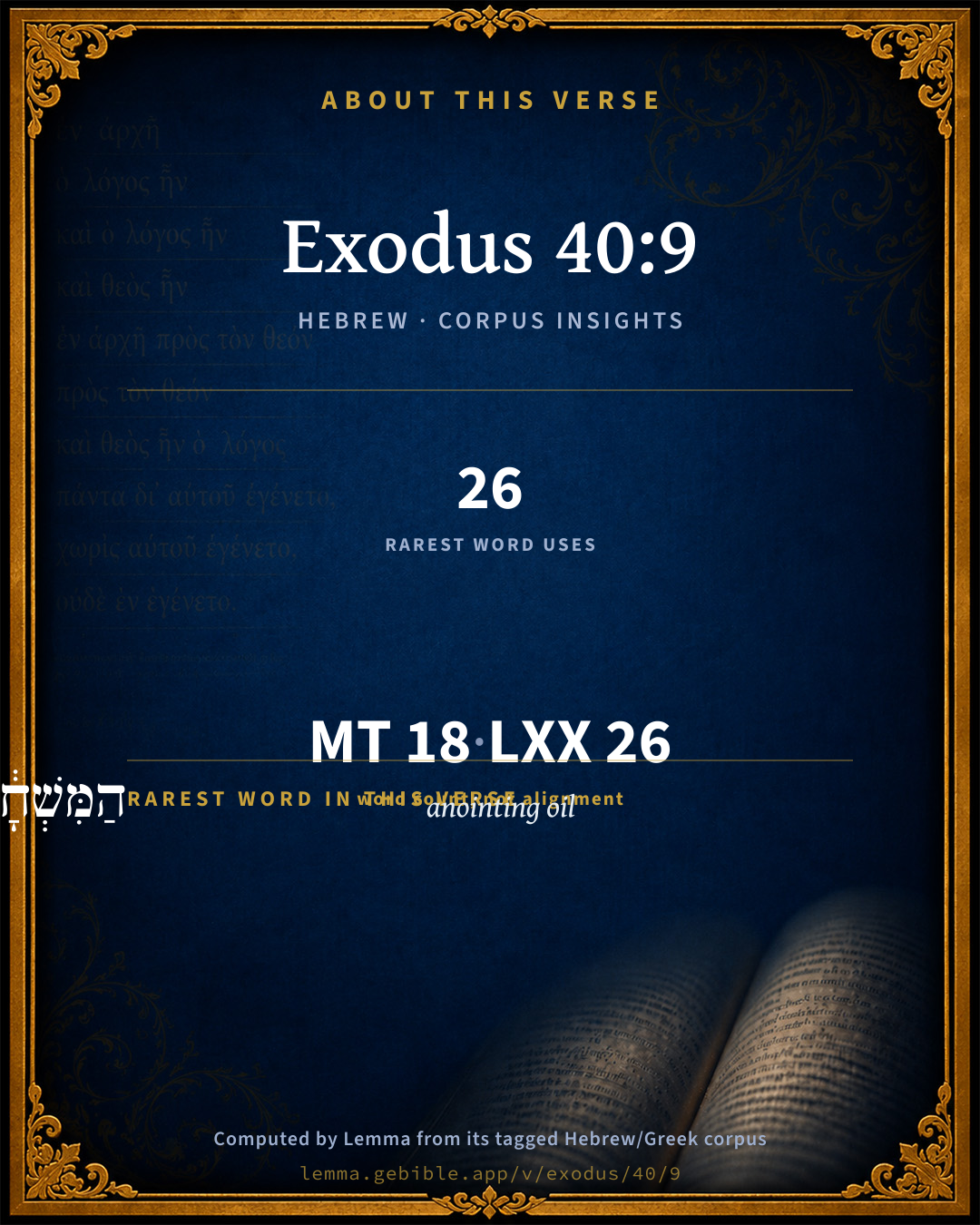
These counts appear in no published source. They are computed here, from the morphology-tagged text and Lemma’s own curated glosses. What Lemma adds →

18
words
12
distinct lemmas
Pentateuch
section

Shared distinctive vocabulary

הַמִּשְׁחָ֔ה anointing oil H4888 occurs in 24 verses of the Hebrew Bible. Also found in:

Grammatical profile

  • 4 verbs
  • 7 nouns
  • 1 preposition
  • 6 particles

Verb forms

  • וְלָקַחְתָּ֙ Qal · Sequential Perfect
  • וּמָשַׁחְתָּ֥ Qal · Sequential Perfect
  • וְקִדַּשְׁתָּ֥ Piel · Sequential Perfect
  • וְהָ֥יָה Qal · Sequential Perfect

Repetition

A word recurs within this verse — often emphatic in Hebrew:

Hebrew & Septuagint length

In English translation the verse runs 30 words from the Hebrew and 30 from the Septuagint (LXX English) — the same length.

A rough comparison of the two English renderings, which tokenize alike — not a word-level alignment.

Word counts can differ between the Hebrew and the Greek without any difference in meaning — e.g. the Hebrew direct-object marker אֵת has no separate Greek word, and Greek often adds the article ὁ.

In the original languages it is 18 Hebrew tokens and 26 Greek tokens — but the two are counted differently (Hebrew bundles its prefixes and suffixes into one token; the Greek is in lemma form), so that isn’t a like-for-like length.

Cross-references

13

Topical passages linked to Exodus 40:9 in the Treasury of Scripture Knowledge — connected by theme and wording, ordered by reader-vote popularity; previews shown in the World English Bible.

  • Leviticus 8:10 Moses took the anointing oil, and anointed the tabernacle and all that was in it, and sanctified them.
  • Numbers 7:1 It happened on the day that Moses had finished setting up the tabernacle, and had anointed it and sanctified it, with all its furniture, and the altar with all its vessels, and had anointed and sanctified them;
  • Exodus 30:23–33 "Also take fine spices: of liquid myrrh, five hundred shekels; and of fragrant cinnamon half as much, even two hundred and fifty; and of fragrant cane, two hundred and fifty;
  • Exodus 37:29 He made the holy anointing oil and the pure incense of sweet spices, after the art of the perfumer.
  • Exodus 39:39 the brazen altar, its grating of brass, its poles, all of its vessels, the basin and its base,
  • Psalms 45:7 You have loved righteousness, and hated wickedness. Therefore God, your God, has anointed you with the oil of gladness above your fellows.
  • Isaiah 11:2 The Spirit of Yahweh shall rest on him, the spirit of wisdom and understanding, the spirit of counsel and might, the spirit of knowledge and of the fear of Yahweh.
  • Isaiah 61:1 The Spirit of the Lord Yahweh is on me; because Yahweh has anointed me to preach good news to the humble; he has sent me to bind up the broken-hearted, to proclaim liberty to the captives, and the opening [of the prison] to those who are bound;
  • Matthew 3:16 Jesus, when he was baptized, went up directly from the water: and behold, the heavens were opened to him. He saw the Spirit of God descending as a dove, and coming on him.
  • John 3:34 For he whom God has sent speaks the words of God; for God gives the Spirit without measure.
  • 2 Corinthians 1:4 who comforts us in all our affliction, that we may be able to comfort those who are in any affliction, through the comfort with which we ourselves are comforted by God.
  • 2 Corinthians 1:22 who also sealed us, and gave us the down payment of the Spirit in our hearts.
  • 1 John 2:20 You have an anointing from the Holy One, and you know the truth.

Cross-references courtesy of OpenBible.info (CC BY 4.0).

Hebrew and Greek witnesses Masoretic Hebrew ↔ Greek Septuagint

The same verse in the two great witnesses to the Old Testament, shown verse-for-verse.

These are two independent witnesses, not word-aligned to each other, and the Septuagint is shown in lemma (dictionary) form.

Hebrew Exodus 40:9 Masoretic · Westminster Leningrad Codex

וְלָקַחְתָּ֙ אֶת שֶׁ֣מֶן הַמִּשְׁחָ֔ה וּמָשַׁחְתָּ֥ אֶת הַמִּשְׁכָּ֖ן וְאֶת כָּל אֲשֶׁר בּ֑וֹ וְקִדַּשְׁתָּ֥ אֹת֛וֹ וְאֶת כָּל כֵּלָ֖יו וְהָ֥יָה קֹֽדֶשׁ

You shall take the anointing oil, and anoint the tent, and all that is in it, and shall make it holy, and all its furniture: and it will be holy.

World English Bible · Public Domain

Greek LXX Exodus 40:9 Septuagint · lemma form

καί λαμβάνω ὁ ἔλαιον ὁ χρίσμα καί χρίω ὁ σκηνή καί πᾶς ὁ ἐν αὐτός καί ἁγιάζω αὐτός καί πᾶς ὁ σκεῦος αὐτός καί εἰμί ἅγιος

And you shall take the anointing oil, and shall anoint the tabernacle, and all things in it; and shall sanctify it, and all its furniture, and it shall be holy.

LXX2012 (modern English Septuagint) · Public Domain

Hebrew: Westminster Leningrad Codex (CC BY 4.0). Greek: Septuagint (public domain); English from LXX2012 (modern English Septuagint) (Public Domain). How the Septuagint differs from the Hebrew →

Targum (Aramaic paraphrase)

2

The Targum is the ancient Jewish Aramaic paraphrase of the Hebrew Scriptures — an interpretive translation, not the Hebrew text itself. Onkelos (literal) and Pseudo-Jonathan (expansive) render the Torah, and Jonathan the Prophets. Coverage is partial: where no permissively-licensed English translation exists for a verse, only the Aramaic is shown. This is verse-level text, not a word-by-word alignment to the Hebrew.

  1. Targum Onkelos Torah (Genesis–Deuteronomy)
    וְתִסַב יָת מִשְׁחָא דִרְבוּתָא וּתְרַבֵּי יָת מַשְׁכְּנָא וְיָת כָּל דִי בֵהּ וּתְקַדֵשׁ יָתֵהּ וְיָת כָּל מָנוֹהִי וִיהֵי קוּדְשָׁא:

    (no public-domain English translation for this verse)

    Targum Onkelos — Aramaic: “Onkelos Genesis” (public domain); “Onkelos Exodus” (public domain); “Onkelos Leviticus” (public domain); “Onkelos Numbers” (public domain); “Onkelos Deuteronomy” (public domain). English: “Sefaria Community Translation” (CC0 1.0 (public-domain dedication)); “J.W. Etheridge. The Targums of Onkelos and Jonathan Ben Uzziel on the Pentateuch. London: Longmans, Green, 1862” (public domain). Text via Sefaria.

  2. Targum Pseudo-Jonathan Torah (Genesis–Deuteronomy)
    וְתִסַּב יַת מִשְׁחָא דִרְבוּתָא וּתְרַבֵּי יַת מַשְׁכְּנָא וְיַת כָּל דְּבֵיהּ וּתְקַדֵּשׁ יָתֵיהּ מְטוּל כְּלִיל דְּמַלְכוּתָא דְבֵית יְהוּדָה וּמַלְכָּא מְשִׁיחָא דְעָתִיד לְמִפְרַק יַת יִשְרָאֵל בְּסוֹף יוֹמַיָא

    And thou shalt take the consecration-oil, and anoint the tabernacle, and all that is therein, and shalt sanctify it, on account of the crown of the kingdom of the house of Jehudah, and of the King Meshiha, who is to redeem Israel at the end of the days.

    Targum Pseudo-Jonathan — Aramaic: “Targum Jonathan on Genesis” (public domain); “Targum Jonathan on Exodus” (public domain); “Targum Jonathan on Leviticus” (public domain); “Targum Jonathan on Numbers” (public domain); “Targum Jonathan on Deuteronomy” (public domain). English: “The Targum of Jonathan ben Uzziel, trans. J. W. Etheridge, London, 1862” (public domain). Text via Sefaria.

Commentary

Notes on Exodus 40:9 from classic Christian and Jewish commentators (each source and its license shown beneath its notes). The classic Christian expositions comment on the surrounding passage and are grouped to its opening verse, so a note may address several verses; the Jewish commentaries on the Tanakh (Rashi and others) are per-verse, so they appear only where the commentator wrote on this verse.

Lemma curates 59 commentaries, every one of them public domain or Creative Commons licensed, each selected and text-cleaned for this edition rather than reprinted as found. About our sources →

Albert Barnes' Notes on the Bible

Most holy - In Exo 40:9 the tabernacle and its utensils are said to be rendered holy by the anointing; the altar and its utensils are in Exo 40:10 said to be “most holy”. The difference does not express a higher degree of holiness: it is only used as a caution. The position of the altar exposed it to the chance of being touched by the people when they assembled in the court, while they were not permitted to enter the tabernacle. The tabernacle itself, with all that belonged to it, is called most holy in Exo 30:29.

Albert Barnes' Notes on the Bible (1834–1885) — public domain. Text from a community e-Sword/MySword module.

Ellicott's Commentary for English Readers

(9) The anointing oil.—Directions for the composition of the oil had been already given (Exo_30:23-25); and at the same time it had been ordered that the Tabernacle, the ark, the table, the candlestick, the two altars, the laver, and the various vessels of the sanctuary, should be consecrated by anointing them (Exo_30:26-29).

THE INSTRUCTIONS FOR THE CONSECRATION OF THE TABERNACLE AND THE PRIESTS.

(9-15) Instructions for the consecration of the Tabernacle, its furniture and its vessels, by anointing, and for the consecration of Aaron and his sons by ablution, anointing, and investiture, were attached to those given concerning the setting up of the Tabernacle, and are here recorded, although their execution appears to have been delayed to a later date. (See Lev_8:1-13.) Moses perhaps found that there was not time for the completion of the ceremony on the day of the erection of the Tabernacle, and therefore deferred a part of it.

A Bible Commentary for English Readers, edited by Charles John Ellicott (1878–1897) — public domain. Text from a community e-Sword module.

The Cambridge Bible for Schools and Colleges

gen. ed. J. J. S. Perowne

9, 10. It is remarkable that, while in Exo_30:29 (see vv. 26–28), the Tent of Meeting with all the vessels belonging to it, are, by anointing, made ‘most holy’ (see for this term on Exo_29:37), here the altar only is ‘most holy,’ and the Tent of Meeting and all its contents are only ‘holy.’

9–11. The Dwelling, and everything belonging to it, to be anointed with the holy anointing oil: see Exo_30:26-29; and cf. Exo_29:36 f. (the altar alone).

The Cambridge Bible for Schools and Colleges (gen. ed. J. J. S. Perowne; Cambridge University Press, 1878–1918) — public domain. Text from a community e-Sword module.

John Gill's Exposition

And thou shall anoint them as thou didst anoint their father,.... For Aaron was first anointed, and then his sons:

that they may minister unto me in the priest's office; which they might not do before their anointing, though separated for it, and called unto it:

for their anointing shall surely be an everlasting priesthood throughout their generations; that is, this ceremony of anointing was to be used in all ages at the investiture of the high priest with his office, until the Messiah should come, who would put an end to the Aaronic priesthood; for not common priests, only the successors of the high priest, were anointed in later times; this present unction serving for all the priests that should follow in successive generations, so long as the priesthood continued.

John Gill's Exposition of the Whole Bible (1746–1763) — public domain (CC PDM 1.0). Text via the HelloAO Bible API.

The Pulpit Commentary

Vers. 9-16. The directions to anoint, etc.

It does not appear that these directions were carried out at this time. Probably, there would not have been time to go through all the ceremonies enjoined (Exo_29:1-34) on the same day with the erection of the sanctuary. They were consequently deferred, either till the next day, or possibly to a later date. (See Le 8) The anointing of the tabernacle is recorded in ver. 10; of the vessels in ver. 11; of the altar and laver in the same. The washing of Aaron and his sons in ver. 6; their investiture in vers. 7-9; the anointing of Aaron in ver. 12; and a further anointing of Aaron together with his sons in ver. 30.

The Pulpit Commentary (1880–1919), ed. H.D.M. Spence-Jones & Joseph S. Exell — public domain. Text from a community e-Sword module.

Lesson kit

Teaching starters — assembled from the data on this page, not authored interpretation. Every prompt links to the verse data it draws on. Edit before teaching.

Exodus, in the Pentateuch, opens this verse with 18 words (12 distinct Hebrew lemmas). Its most distinctive word is mishchâh (“anointing oil”). A historical commentator’s framing appears above. Read the whole chapter for the surrounding context.

Discussion questions

  1. How does “anointing oil” (mishchâh) shape what this verse is saying?
  2. How does Exodus 25:6, which shares the word «anointing oil», read alongside this verse?
  3. What does the repetition of “all” (2× in this one verse) do in this verse?
  4. The translations on this page render this verse differently — a whole-verse word diff, not a word-by-word alignment. What might account for the different wordings?
  5. «וְלָקַחְתָּ֙» is a Qal Sequential Perfect verb. How does that grammatical form shape the action described?
  6. Compare how Albert Barnes' Notes on the Bible and Ellicott's Commentary for English Readers read this verse. Where do they agree or differ?

Things to notice

Reading settings

Reading text

Shown beneath each verse's original-language words.

Old Testament
Old Testament edition

Read the OT as the Masoretic Hebrew (MT) or the Greek Septuagint (LXX).

English shown for the Greek Septuagint (in the Hebrew ↔ Greek comparison).

Comparing translations? Open the Compare panel on any verse page to stack up to four side by side.