
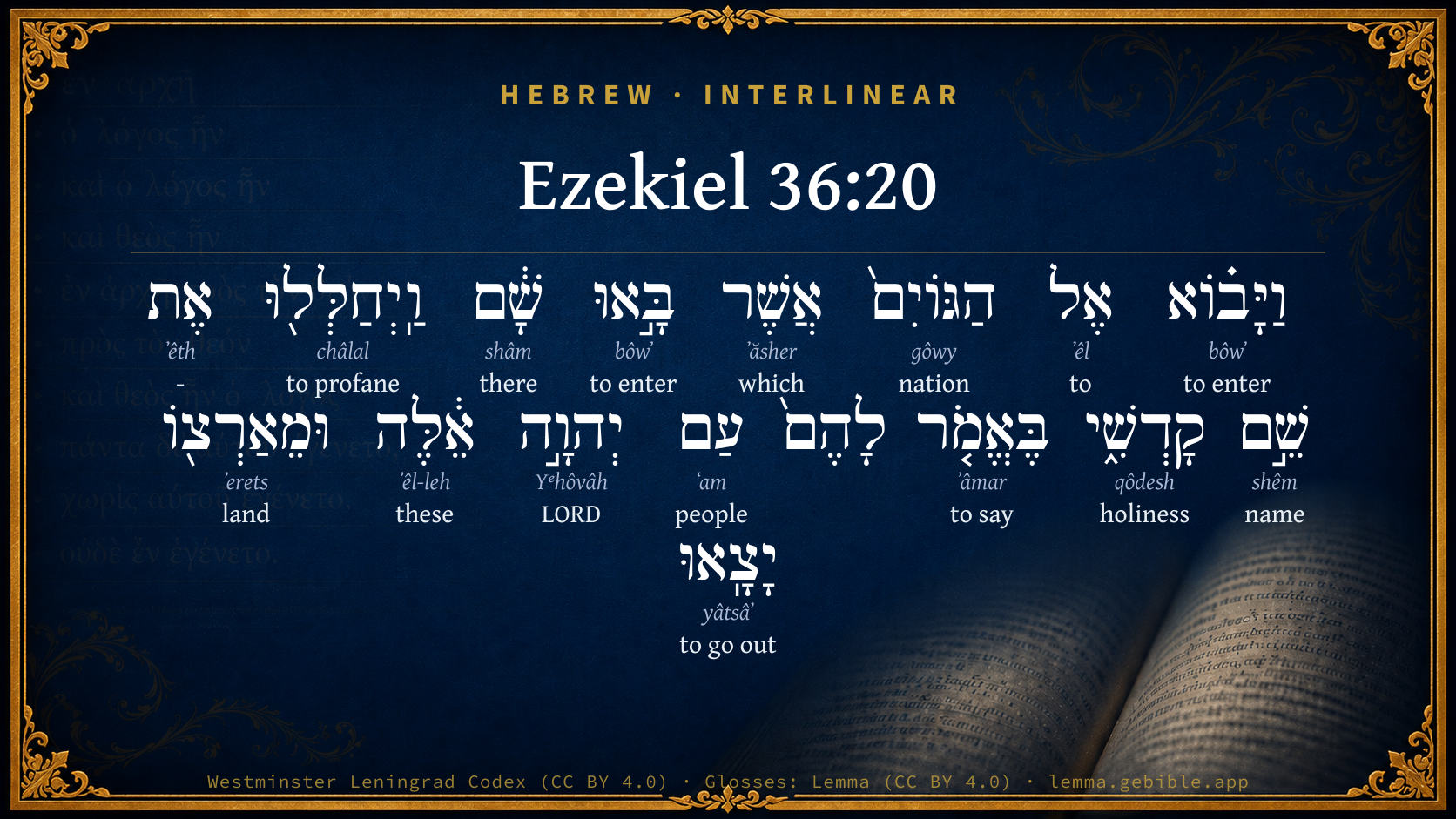
Ezekiel 36:20

Hebrew (Westminster Leningrad Codex) Ezekiel 36:20 appears in the Hebrew Old Testament. The text above is from the Westminster Leningrad Codex. Each word links to its Strong’s number, a concise gloss, and parsing drawn from the Open Scriptures Hebrew Bible morphology. Click any word for its full Brown-Driver-Briggs (BDB) entry.
Download image
Cite this verse

Ezekiel 36:20 (World English Bible). Public Domain. Lemma interlinear Bible study tool, https://lemma.gebible.app/v/ezekiel/36/20.

Show BibTeX & RIS
BibTeX
RIS
English Translation
When they came to the nations, where they went, they profaned my holy name; in that men said of them, These are the people of Yahweh, and are gone forth out of his land.
World English Bible · Public Domain
Download a study sheet

One document with this verse’s original text, its word-by-word gloss line, the meaning frame, cross-references with their text, attributed commentary, and full source and license credits — printable, and it pastes into notes with its structure intact.

This verse Autodidact and up

Study sheet (.html) Plain text (.txt)

A passage Seminary Student

Up to 50 verses in one chapter. A passage sheet keeps up to 6 commentary sources and 12 cross-references per verse, in the order this page ranks them, and says so on the sheet whenever that leaves anything out. Ask for a single verse and you get the Autodidact verse sheet above.

Everything on this page stays free to read, with no account — the sheet is a download of what is already on screen, not access to it.

Want to remove ads? Support Godless Engineer
Compare translations 3

The same verse in 3 English versions, stacked beneath the original-language interlinear above. Click any original word for its lexicon entry.

Each is an independent rendering of the whole verse — the interlinear is not word-aligned to these translations.

Highlighted words mark where these versions differ — a whole-verse word diff, not a word-by-word alignment.

  • World English Bible Public Domain
    When they came to the nations, where they went, they profaned my holy name; in that men said of them, These are the people of Yahweh, and are gone forth out of his land.
  • King James Version Public Domain
    And when they entered unto the heathen, whither they went, they profaned my holy name, when they said to them, These are the people of the LORD, and are gone forth out of his land.
  • unfoldingWord Literal Text CC BY-SA 4.0
    Then they went to the nations, and wherever they went, they profaned my holy name when people said of them, ‘Are these really the people of Yahweh? For they have been thrown out of his land.’

unfoldingWord Literal Text — © unfoldingWord, licensed CC BY-SA 4.0. Word-aligned USFM3 via Door43 (git.door43.org/unfoldingWord/en_ult).

Versions to compare (up to 4)

3 of 4 selected

Show all 18 translations

Every available English version of this verse, each an independent rendering of the whole verse.

  • World English Bible Public Domain
    When they came to the nations, where they went, they profaned my holy name; in that men said of them, These are the people of Yahweh, and are gone forth out of his land.
  • Berean Standard Bible Public Domain
    And wherever they went among the nations, they profaned My holy name, because it was said of them, ‘These are the people of the LORD, yet they had to leave His land.’
  • Majority Standard Bible Public Domain
    And wherever they went among the nations, they profaned My holy name, because it was said of them, ‘These are the people of the LORD, yet they had to leave His land.’
  • King James Version Public Domain
    And when they entered unto the heathen, whither they went, they profaned my holy name, when they said to them, These are the people of the LORD, and are gone forth out of his land.
  • American Standard Version (1901) Public Domain
    And when they came unto the nations, whither they went, they profaned my holy name; in that men said of them, These are the people of Jehovah, and are gone forth out of his land.
  • Revised Version (1885) Public Domain
    And when they came unto the nations, whither they went, they profaned my holy name; in that men said of them, These are the people of the LORD, and are gone forth out of his land.
  • Geneva Bible (1599) Public Domain
    And when they entred vnto the heathen, whither they went, they polluted mine holy Name, when they sayd of them, These are the people of the Lord, and are gone out of his land.
  • Douay-Rheims (1899) Public Domain
    And when they entered among the nations whither they went, they profaned my holy name, when it was said of them: This is the people of the Lord, and they are come forth out of his land.
  • Young's Literal Translation Public Domain
    And one goeth in unto the nations whither they have gone, And they pollute My holy name by saying to them, The people of Jehovah `are' these, And from His land they have gone forth.
  • Literal Standard Version CC BY-SA 4.0
    And one goes to the nations to where they have gone, || And they defile My holy Name by saying to them, || These [are] the people of YHWH, || And they have gone forth from His land.
  • Unlocked Literal Bible CC BY-SA 4.0
    Then they went to the nations, and wherever they went, they profaned my holy name when people said of them, 'Are these really the people of Yahweh? For they have been thrown out of his land.'
  • unfoldingWord Literal Text CC BY-SA 4.0
    Then they went to the nations, and wherever they went, they profaned my holy name when people said of them, ‘Are these really the people of Yahweh? For they have been thrown out of his land.’
  • Darby Bible Public Domain
    And when they came to the nations whither they went, they profaned my holy name, when it was said of them, These are the people of Jehovah, and they are gone forth out of his land.
  • World Messianic Bible Public Domain
    When they came to the nations where they went, they profaned my holy name, in that men said of them, ‘These are the LORD’s people, and have left his land.’
  • Webster's Bible Public Domain
    And when they entered among the heathen, whither they went, they profaned my holy name, when they said to them, These are the people of the LORD, and are gone forth out of his land.
  • Free Bible Version CC BY-SA 4.0
    But wherever they went among the nations, they ruined my reputation, because people said about them, ‘These are the Lord's people, but they had to leave his country.’
  • Bible in Basic English Public Domain
    And when they came among the nations, wherever they went, they made my holy name unclean, when it was said of them, These are the people of the Lord who have gone out from his land.
  • JPS Tanakh (1917) Public Domain
    And when they came unto the nations, whither they came, they profaned My holy name; in that men said of them: These are the people of the LORD, and are gone forth out of His land.

Literal Standard Version (2020), Covenant Press — licensed CC BY-SA 4.0. Text via the HelloAO Bible API (eBible.org). Unlocked Literal Bible (unfoldingWord) — licensed CC BY-SA 4.0. Text via the HelloAO Bible API (eBible.org). unfoldingWord Literal Text — © unfoldingWord, licensed CC BY-SA 4.0. Word-aligned USFM3 via Door43 (git.door43.org/unfoldingWord/en_ult). Free Bible Version, Dr. Jonathan Gallagher — licensed CC BY-SA 4.0. Text via the HelloAO Bible API (eBible.org).

Word by word

More ways to search: Search by grammar → Find every occurrence → Compare this word →

Practice this passage: Drill this verse → Learn its vocabulary →

וַֽיְחַלְּל֖וּ
châlal
H2490
“and · to profane”
Conjunction + Verb, Piel, Sequential Imperfect, 3rd Person, Masculine, Plural
Part of Speech
Conjunction + Verb
Stem
Piel
Form
Sequential Imperfect
Person
3rd Person
Gender
Masculine
Number
Plural
Full BDB Definition

Origin: a primitive root [compare H2470 ]

TWOT: 660 , 661

to profane, defile, pollute, desecrate, begin - (Niphal) - to profane oneself, defile oneself, pollute oneself - ritually - sexually - to be polluted, be defiled - (Piel) - to profane, make common, defile, pollute - to violate the honour of, dishonour - to violate (a covenant) - to treat as common - (Pual) to profane (name of God) - (Hiphil) - to let be profaned - to begin - (Hophal) to be begun - to wound (fatally), bore through, pierce, bore - (Qal) to pierce - (Pual) to be slain - (Poel) to wound, pierce - (Poal) to be wounded - (Piel) to play the flute or pipe
  1. וַיָּב֗וֹא bôwʼ H935 “and · to enter” Conjunction + Verb, Qal, Sequential Imperfect, 3rd Person, Masculine, Singular
  2. אֶל ʼêl H413 “to” Preposition
  3. הַגּוֹיִם֙ gôwy H1471 “the · nations” Particle, Definite Article + Noun, Common, Masculine, Plural, Absolute
  4. אֲשֶׁר ʼăsher H834 “which” Particle, Relative
  5. בָּ֣אוּ bôwʼ H935 “to enter” Verb, Qal, Perfect, 3rd Person, Common, Plural
  6. שָׁ֔ם shâm H8033 “there” Adverb
  7. אֶת ʼêth H853 “-” Particle, Direct Object
  8. שֵׁ֣ם shêm H8034 “name of” Noun, Common, Masculine, Singular, Construct
  9. קָדְשִׁ֑י qôdesh H6944 “holiness · my” Noun, Common, Masculine, Singular, Construct + Suffix, Personal, 1st Person, Common, Singular
  10. בֶּאֱמֹ֤ר ʼâmar H559 “in/at · to say” Preposition + Verb, Qal, Infinitive Construct
  11. עַם ʻam H5971 “people of” Noun, Common, Masculine, Singular, Construct
  12. יְהוָ֣ה Yᵉhôvâh H3068 “LORD” Noun, Proper
  13. אֵ֔לֶּה ʼêl-leh H428 “these” Pronoun, Demonstrative, Common, Plural
  14. וּמֵאַרְצ֖וֹ ʼerets H776 “and · from · land · his” Conjunction + Preposition + Noun, Common, Both, Singular, Construct + Suffix, Personal, 3rd Person, Masculine, Singular
  15. יָצָֽאוּ yâtsâʼ H3318 “to go out” Verb, Qal, Perfect, 3rd Person, Common, Plural

About this verse

These counts appear in no published source. They are computed here, from the morphology-tagged text and Lemma’s own curated glosses. What Lemma adds →

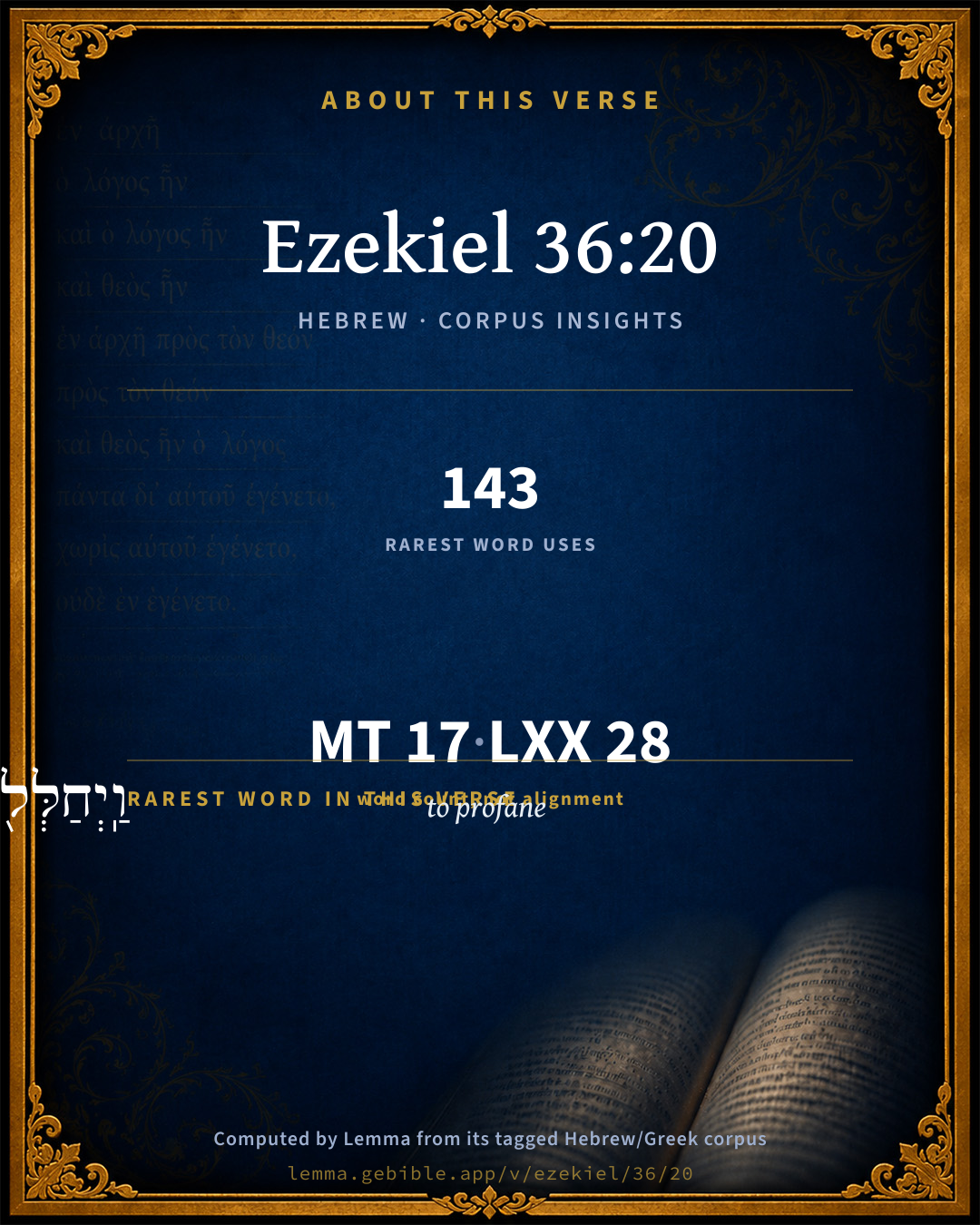
17
words
15
distinct lemmas
Prophets
section

Grammatical profile

  • 5 verbs
  • 6 nouns
  • 1 pronoun
  • 2 prepositions
  • 1 adverb
  • 2 particles

Verb forms

  • וַיָּב֗וֹא Qal · Sequential Imperfect
  • בָּ֣אוּ Qal · Perfect
  • וַֽיְחַלְּל֖וּ Piel · Sequential Imperfect
  • בֶּאֱמֹ֤ר Qal · Infinitive Construct
  • יָצָֽאוּ Qal · Perfect

Repetition

A word recurs within this verse — often emphatic in Hebrew:

  • וַיָּב֗וֹא to enter H935 ×2

Hebrew & Septuagint length

In English translation the verse runs 34 words from the Hebrew and 38 from the Septuagint (LXX English) — closely comparable.

A rough comparison of the two English renderings, which tokenize alike — not a word-level alignment.

Word counts can differ between the Hebrew and the Greek without any difference in meaning — e.g. the Hebrew direct-object marker אֵת has no separate Greek word, and Greek often adds the article ὁ.

In the original languages it is 17 Hebrew tokens and 28 Greek tokens — but the two are counted differently (Hebrew bundles its prefixes and suffixes into one token; the Greek is in lemma form), so that isn’t a like-for-like length.

Cross-references

11

Topical passages linked to Ezekiel 36:20 in the Treasury of Scripture Knowledge — connected by theme and wording, ordered by reader-vote popularity; previews shown in the World English Bible.

  • Isaiah 52:5 Now therefore, what do I here, says Yahweh, seeing that my people is taken away for nothing? those who rule over them do howl, says Yahweh, and my name continually all the day is blasphemed.
  • Romans 2:24 For "the name of God is blasphemed among the Gentiles because of you," just as it is written.
  • Jeremiah 33:24 Don't you consider what this people has spoken, saying, The two families which Yahweh did choose, he has cast them off? thus do they despise my people, that they should be no more a nation before them.
  • Exodus 32:11–13 Moses begged Yahweh his God, and said, "Yahweh, why does your wrath burn hot against your people, that you have brought forth out of the land of Egypt with great power and with a mighty hand?
  • Daniel 3:15 Now if you are ready whenever you hear the sound of the horn, flute, zither, lyre, harp, pipe, and all kinds of music to you fall down and worship the image which I have made, [well]: but if you don't worship, you shall be cast the same hour into the midst of a burning fiery furnace; and who is that god that shall deliver you out of my hands?
  • Numbers 14:15–16 Now if you shall kill this people as one man, then the nations which have heard the fame of you will speak, saying,
  • Joshua 7:9 For the Canaanites and all the inhabitants of the land will hear of it, and will compass us round, and cut off our name from the earth: and what will you do for your great name?
  • 2 Kings 18:30 neither let Hezekiah make you trust in Yahweh, saying, Yahweh will surely deliver us, and this city shall not be given into the hand of the king of Assyria.
  • 2 Kings 18:35 Who are they among all the gods of the countries, that have delivered their country out of my hand, that Yahweh should deliver Jerusalem out of my hand?
  • 2 Kings 19:10–12 Thus shall you speak to Hezekiah king of Judah, saying, Don't let your God in whom you trust deceive you, saying, Jerusalem shall not be given into the hand of the king of Assyria.
  • Ezekiel 12:16 But I will leave a few men of them from the sword, from the famine, and from the pestilence; that they may declare all their abominations among the nations where they come; and they shall know that I am Yahweh.

Cross-references courtesy of OpenBible.info (CC BY 4.0).

Hebrew and Greek witnesses Masoretic Hebrew ↔ Greek Septuagint

The same verse in the two great witnesses to the Old Testament, shown verse-for-verse.

These are two independent witnesses, not word-aligned to each other, and the Septuagint is shown in lemma (dictionary) form.

Hebrew Ezekiel 36:20 Masoretic · Westminster Leningrad Codex

וַיָּב֗וֹא אֶל הַגּוֹיִם֙ אֲשֶׁר בָּ֣אוּ שָׁ֔ם וַֽיְחַלְּל֖וּ אֶת שֵׁ֣ם קָדְשִׁ֑י בֶּאֱמֹ֤ר לָהֶם֙ עַם יְהוָ֣ה אֵ֔לֶּה וּמֵאַרְצ֖וֹ יָצָֽאוּ

When they came to the nations, where they went, they profaned my holy name; in that men said of them, These are the people of Yahweh, and are gone forth out of his land.

World English Bible · Public Domain

Greek LXX Ezekiel 36:20 Septuagint · lemma form

καί εἰςἔρχομαι εἰς ὁ ἔθνος ὅς εἰςἔρχομαι ἐκεῖ καί βεβηλόω ὁ ὄνομα ἐγώ ὁ ἅγιος ἐν ὁ λέγω αὐτός λαός κύριος οὗτος καί ἐκ ὁ γῆ αὐτός ἐκἔρχομαι

And they went in among the nations, among which they went, and they profaned my holy name, while it was said of them, These are the people of the Lord, and they came forth out of his land.

LXX2012 (modern English Septuagint) · Public Domain

Hebrew: Westminster Leningrad Codex (CC BY 4.0). Greek: Septuagint (public domain); English from LXX2012 (modern English Septuagint) (Public Domain). How the Septuagint differs from the Hebrew →

Targum (Aramaic paraphrase)

1

The Targum is the ancient Jewish Aramaic paraphrase of the Hebrew Scriptures — an interpretive translation, not the Hebrew text itself. Onkelos (literal) and Pseudo-Jonathan (expansive) render the Torah, and Jonathan the Prophets. Coverage is partial: where no permissively-licensed English translation exists for a verse, only the Aramaic is shown. This is verse-level text, not a word-by-word alignment to the Hebrew.

  1. Targum Jonathan Prophets (Joshua–Malachi)
    וַעֲלוּ לְבֵינֵי עַמְמַיָא דְאִתְגְלִיאוּ לְתַמָן עַל דַאֲחִילוּ יַת שְׁמָא דְקוּדְשִׁי בִּדְאָמְרִין לְהוֹן אִם עַמֵיהּ דַייָ אִלֵין וְאֵיכְדֵין מֵאַרְעָא בֵּית שְׁכִינְתֵּיהּ גְלוֹ:

    (no public-domain English translation for this verse)

    Targum Jonathan — Aramaic: “Mikraot Gedolot” (public domain). English: “Sefaria Community Translation” (CC0 1.0 (public-domain dedication)); “London "Chaldee Paraphrase," 1871” (public domain). Text via Sefaria.

Commentary

Notes on Ezekiel 36:20 from classic Christian and Jewish commentators (each source and its license shown beneath its notes). The classic Christian expositions comment on the surrounding passage and are grouped to its opening verse, so a note may address several verses; the Jewish commentaries on the Tanakh (Rashi and others) are per-verse, so they appear only where the commentator wrote on this verse.

Lemma curates 59 commentaries, every one of them public domain or Creative Commons licensed, each selected and text-cleaned for this edition rather than reprinted as found. About our sources →

Trapp's Complete Commentary

John Trapp

Eze 36:20 And when they entered unto the heathen, whither they went, they profaned my holy name, when they said to them, These [are] the people of the LORD, and are gone forth out of his land.

Ver. 20. These are the people of the Lord.] And these are the fruits of their religion. Are these the holy people? &c. Lactantius {a} complaineth of his times, that God’s truth was evil spoken of by the heathen, because Christians lived loosely and lewdly. Whereupon Erasmus {b} crieth out, O rem miseram! Oh, lamentable! Even in those purer times the piety of Christians was so much abated, that the gospel was therefore evil spoken of, for the evil lives of many that professed it. What marvel then, saith he, that Turks cry out upon us? that the banks of blasphemy are broken down in persons disaffected to the power of godliness?

{a} Lactant., de Opific. Dei; Proaem.

{b} Erasm. in Lactant.

John Trapp, A Commentary or Exposition upon All the Books of the Old and New Testament (1647–1656) — public domain. Text from a community e-Sword module.

The Biblical Illustrator

Joseph S. Exell

Eze_36:20

They profaned My holy name.

How Gods name is profaned

Men sanctify Jehovah when they recognise that which He is, or ascribe to Him His true nature. On the other hand, when the iniquities of His people constrain Him to act in such a way as to disguise any of His great attributes, such as His power, in the eyes of the nations, so that they misinterpret His being, His holy name is profaned, as, on the contrary, He is sanctified in the eyes of the nations by the restoration of His people, and their defence when restored and righteous. (A. B. Davidson, D. D.)

The nations conceptions of Jehovah regulated by His peoples conduct

These disasters which the people of Jehovah brought on themselves led to the desecration of His name among the heathen. The nations judged Him weak, and unable to protect His people. In the eyes of the nations, the interests of the god and his people were one; if a people were subdued by another, it was because its god was too feeble to protect it. Naturally, the idea of a god exercising a moral rule over his own people would not yet occur to them. That Jehovah so rules is the lesson which the history of Israel, its dispersion and restoration, is intended to read to the nations of the earth. (A. B. Davidson, D. D.)

The Biblical Illustrator, edited by Joseph S. Exell (c. 1880s–1900s) — public domain. Text from a community e-Sword module.

Joseph Benson's Commentary

Eze 36:20. When they entered unto the heathen, they profaned my holy name — 1st, By their evil practices they brought a scandal on God’s name, and gave occasion to the heathen to say, See what profligate wretches these are, who call themselves Jehovah’s peculiar people; judge what sort of a God he is who has such worshippers. The Jews were no credit to their profession wherever they went; but, on the contrary, a reproach to it, and the name of God and his holy religion was blasphemed through them, Rom 2:24. Observe, reader, when those that pretend to stand related to God, as his servants and children, and to be in covenant and communion with him, are nevertheless found corrupt in their morals, slaves to their appetites and passions, dishonest in their dealings, and false to their words, and the trusts reposed in them, the enemies of the Lord have thereby great cause given them to blaspheme both him and his religion. 2d, God’s name was profaned by the sufferings of Israel; for from them the enemies of God took occasion to reproach God, as unable to protect his own worshippers, and to make good his own grants. They said in scorn, These are the people of the Lord; these wicked people! you see he could not keep them in their obedience to his precepts; these miserable people! he could not keep them in the enjoyment of his favours. These are the people that came out of Jehovah’s land; they are the very scum of the nations!

Joseph Benson's Commentary on the Old and New Testaments (1811–1818) — public domain. Text from a community e-Sword module.

Tyndale Open Study Notes

Tyndale Open Resources

36:20 This scattering also brought shame on the Lord’s holy name. It was not so much the behavior of the exiles that robbed the Lord of his glory, but the very fact that they were in exile, insofar as it made the surrounding nations conclude that Israel’s God had been unable to keep them safe in his own land.

Tyndale Open Study Notes — © Tyndale Open Resources, licensed CC BY-SA 4.0. Text via the HelloAO Bible API.

Jamieson, Fausset & Brown

Robert Jamieson, A. R. Fausset & David Brown

profaned my holy name, when they--the heathen

said to them--the Israelites.

These, &c.--The Israelites gave a handle of reproach to the heathen against God, who would naturally say, These who take usury, oppress, commit adultery, &c., and who, in such an abject plight, are "gone forth" as exiles "out of His land," are specimens of what Jehovah can or will effect, for His people, and show what kind of a God this so-called holy, omnipotent, covenant-keeping God must be! (Isa 52:5; Rom 2:24).

Jamieson, Fausset & Brown — Commentary Critical and Explanatory on the Whole Bible (1871) — public domain (CC PDM 1.0). Text via the HelloAO Bible API.

Adam Clarke's Commentary

Verse 20. And when they entered unto the heathen] So bad were they, and so deeply fallen, that they profaned the Lord's name among the heathen; and, on their account, the true God was blasphemed. These, say they, are the people of Jehovah! O what an abominable people are these! and what a being must that God be who can have and own such for his people!

Adam Clarke's Commentary on the Bible (1810–1826) — public domain. Text from a community e-Sword/MySword module.

Ellicott's Commentary for English Readers

(20) When they said to them.—We are not here to understand that the Israelites profaned God’s name among the heathen in the way spoken of in Rom_2:24, though this also may have been done; but they profaned it by the very fact of their captivity, the consequence of their former sins. The heathen regarded Jehovah as merely the national God of the Israelites, and seeing them dispersed, in distress, and in captivity, concluded that He was unable to protect them. Hence, for the vindication of His name (Eze_36:21-24) God would restore His people to their land.

A Bible Commentary for English Readers, edited by Charles John Ellicott (1878–1897) — public domain. Text from a community e-Sword module.

The Cambridge Bible for Schools and Colleges

gen. ed. J. J. S. Perowne

20. These disasters which the people of Jehovah brought on themselves led to the desecration of his name among the heathen. The nations judged him weak and unable to protect his people. In the eyes of the nations the interests of the god and his people were one; if a people was subdued by another it was because its god was too feeble to protect it. Naturally the idea of a god exercising a moral rule over his own people would not yet occur to them. That Jehovah so rules is the lesson which the history of Israel, its dispersion and restoration, is intended to read to the nations of the earth. This lesson was one which Israel itself was slow to learn, and when Amos (Eze_3:2) read it to them, it was perhaps as strange to some as it might be to the heathen.

they profaned] i.e. Israel. Israel by bringing their dispersion upon themselves led to the desecration of Jehovah’s name by the nations, and hence they are said directly to have profaned his name (Eze_36:21).

when they said to them] when it was said of them, These are … and they are gone forth …, i.e. though the people of Jehovah, they have been driven into exile out of the land—he has not been able to protect them.

The Cambridge Bible for Schools and Colleges (gen. ed. J. J. S. Perowne; Cambridge University Press, 1878–1918) — public domain. Text from a community e-Sword module.

John Gill's Exposition

And when they entered unto the Heathen, whither they went,.... When the Jews went into the Heathen countries, whither they were carried captive, either by the Chaldeans, or by the Romans:

they profaned my holy name; by their irreligion and immorality; by their violation of both tables of the law; by their wicked lives and conversations, whereby they gave the enemy an occasion to reproach them, their religion, and their God, Rom 2:24,

when they said to them, these are the people of the Lord, and are gone forth out of his land; these are the men that boast they are the people of the Lord, whom he has chosen above all people, and see what a wicked people they are; for their sins they are driven out of the land, and become our captives: or though they were the Lord's people, as they pretend, and were under his care and protection; yet he was not able to keep them in their own land, and deliver them out of our hands, but they are carried captive by us; and thus the name of God, his being and perfections, were blasphemed, and his word, worship, and worshippers, were ridiculed by them. The Targum is,

"if these are the people of the Lord, how is it that they are gone out of the land of the house of his majesty?''

John Gill's Exposition of the Whole Bible (1746–1763) — public domain (CC PDM 1.0). Text via the HelloAO Bible API.

Haydock's Catholic Bible Commentary

Land. Yet their conduct was no better than that of infidels. Thus they throw the blame on the law, and upon God himself, Jeremias xlviii. 9., &c. (Calmet) --- The Jews had provoked God to punish them with captivity; and hence the nations took occasion to blaspheme, that he could not protect them. (Worthington)

George Leo Haydock (1774–1849), Haydock's Catholic Family Bible and Commentary, 1859 edition — public domain. Excludes Psalms (Douay-Rheims chapter numbering differs from Protestant) and Deuterocanonical books (Catholic canon only).

Matthew Poole's English Annotations

When they entered; when they were come into Babylon, and entered into familiarity with the inhabitants as neighbours.

Profaned my holy name; did profanely sin against those precepts of my law, which heathens did know, venerate, and observe better than the Jews; or it may include the misery their sins had brought them to, which misery reflected upon their God in the opinion of the heathen.

They said, their heathen neighbours, to them, the miserable and profane Jews,

These are the people of the Lord; with taunt and cutting reprimand. These, these captive slaves, that are most forlorn of men, will have it that their God is the Lord, the mighty and the good God, the true and faithful One, that gave them the land out of which they are driven. If he be good, as they boast, how comes it to pass his people are in such ill state? Or is he not able to better their state? Was he weak, and could not keep them in their own land? or doth he falsify his word? You miserable Jews, say what this meaneth. But by their impure life they opened the mouths of the heathen more to blaspheme, and call the holiness of God into question; when they saw his people so unholy, they concluded. As is the people so is their God; and this, as it was a great offence and scandal to the heathen, so it was a great dishonour to God.

Matthew Poole's English Annotations on the Holy Bible (1683–1685) — public domain. Text from a community e-Sword/MySword module.

The Pulpit Commentary

They profaned my holy Name; or, the name of my holiness. According to Kliefoth, the subject of the verb is "the heathen," but expositors generally regard it as "the house of Israel" of ver. 17. Plumptre thinks that "while grammatically the words may refer to either the heathen or the exiles of Israel, possibly the sentence was purposely left vague, so as to describe the fact in which both were sharers," and cites in support of this view similar constructions in Isa_55:5 and, Rom_2:24. What led to the profanation of Jehovah"s Name by the heathen was the arrival among them, not of the news of the calamity which had befallen Israel (Kliefoth, Hengstenberg) but of the house of Israel itself; and the actual profanation lay in this, that, having beheld the exiles, they said, These are the people of the Lord, and they are gone forth out of his land. As the heathen recognized only local divinities, they concluded Jehovah had either behaved capriciously towards his people and east them off, (comp. Jer_23:40 Jer_29:18 Jer_33:24) or had proved unequal to the task of protecting them so that they had been driven off. (comp. Eze_20:5, Num_14:16; Jer_14:9) In either case, the honor of Jehovah had been lessened in the minds and tarnished by the words of the heathen, and inasmuch as this result had been brought about by Israel"s sin, on Israel properly the blame lay.

Vers. 20-24Profanation and pity.

The conjunction is somewhat singular. Israel has profaned God"s Name. Upon this suggestion the Lord, pitying his own Name, resolves to sanctify it, and to this end, and not for Israel"s deserts, succors and restores his people. The several steps in this progress of thought should be attentively traced.

I THE ISRAELITES HAVE PROFANED GOD"S NAME AMONG THE HEATHEN. They are universally known as the people of Jehovah. When exiled from their land, they are the objects of derision and contempt to the heathen who behold them, and who, despising them, despise also the Name of Jehovah.

II THE LORD IS MOVED WITH PITY FOR HIS OWN NAME. The language, nay, the very thought, is remarkably bold. But especially as it is repeated, it must be taken as deliberate and intentional, and as corresponding with a wonderful and Divine, though but partially comprehensible, reality. His Name, his reputation, even among the heathen, is dear to him, and he deigns to be concerned when men speak lightly of his Name and blaspheme him openly. In human language, he is distressed at the evil things which are said of him among the enemies of his people.

III THE PURPOSES OF GOD"S MERCY ARE NOT PROMPTED BY ANY DESERTS OF ISRAEL. "I do not this for your sake, O house of Israel." This is a principle which should ever be borne in mind in interpreting Old Testament history. The Hebrew writers are faithful, candid, and outspoken in describing the national character, in relating the actions of their countrymen. They were a rebellious and stiff-necked people. They had their good qualities, but their many and grievous sins are not extenuated. If God chose them as his peculiar people, it was not for any special excellence or meritorious ness in themselves. And when he restored them from captivity, he let it be understood that he did this not from a regard to their deserts.

IV GOD"S PURPOSES OF MERCY TO ISRAEL ARE PROMPTED BY A REGARD TO HIS OWN NAME. He had made certain promises to the descendants of Abraham, Isaac, and Jacob; and those promises he must needs fulfill. He has intentions of mercy to mankind to be realized by means of the "children of promise," and he will not allow those intentions to be frustrated. He has his own faithfulness to vindicate, his own moral attributes to manifest. By his Name must be understood his character, especially as known among men; and, this being the case, it is not difficult to comprehend the meaning of "having pity on his holy Name.

V PITY BECOMES PRACTICAL IN THE RESTORATION OF ISRAEL TO THEIR OWN LAND, BY WHICH GOD"S NAME IS SANCTIFIED. There is dignity and even moral grandeur in the resolution which is expressed in this passage; it is felt to be worthy of him in whose lips it is placed by the prophet. When the great work of restoration is achieved, the nations who behold it see that the taunts and ridicule in which they have indulged are both foolish and blamable. Israel is proved to be the consecrated nation, preserved by God"s wisdom and goodness as the instrument in effecting his purposes. The Lord God is seen to be, not powerless like the so-called gods of the nations, but omnipotent and just. His promises are vindicated as faithful. "I will sanctify my great Name and the nations shall know that I am the Lord. T.

The Pulpit Commentary (1880–1919), ed. H.D.M. Spence-Jones & Joseph S. Exell — public domain. Text from a community e-Sword module.

John Wesley's Explanatory Notes

Entered - When they were come into Babylon. Profaned - They sinned. They - Their heathen neighbours. Them - The profane Jews. These - These profane slaves, call themselves the people of the Lord and say, he gave them the land out of which they are driven.

John Wesley, Explanatory Notes Upon the Whole Bible (1754–1765) — public domain. Text via the GEBible commentary corpus.

Rashi

Rabbi Shlomo Yitzchaki (Rashi)

And they entered [Heb. וַיָבוֹא, lit. and he entered.] Since he says, “the house of Israel” at the beginning of the segment, He refers to them in the singular throughout the segment. According to Midrash Aggadah: the Holy One, blessed be He, came with them in exile and bent His ear [to hear] what the captors were saying. “Behold these are God’s people, and He had no power to save them.” In Midrash Lamentations Rabbah (Proem 15).

and they profaned My Holy Name They lowered My honor. And what is the profanation? In that their enemies said of them, “These are the people of the Lord, and they have come out of His land, and He had no power to save His people and His land.”

Rashi on the Tanakh — English translations: “The Judaica Press complete Tanach with Rashi, translated by A. J. Rosenberg” (CC BY 4.0); “Pentateuch with Rashi's commentary by M. Rosenbaum and A.M. Silbermann, 1929-1934” (public domain); “The Metsudah Tanach series, Lakewood, N.J” (CC BY 4.0); and “The Book of Joshua, Metsudah Publications, 1997” (CC BY 4.0). Text via Sefaria.

Lesson kit

Teaching starters — assembled from the data on this page, not authored interpretation. Every prompt links to the verse data it draws on. Edit before teaching.

Ezekiel, in the Prophets, opens this verse with 17 words (15 distinct Hebrew lemmas). Its most distinctive word is châlal (“to profane”). A historical commentator’s framing appears above. Read the whole chapter for the surrounding context.

Discussion questions

  1. What does “to profane” (châlal) contribute to the verse as a whole?
  2. Isaiah 52:5 shares this passage’s theme. How do the two illuminate each other?
  3. “to enter” occurs 2× in this one verse. What is the effect of the repetition?
  4. These translations render this verse differently. What is at stake in choosing one wording over another?
  5. The verb «וַיָּב֗וֹא» is Qal Sequential Imperfect. How does its form color the action?
  6. Reading how Trapp's Complete Commentary and The Biblical Illustrator read this verse, where do the two commentators agree and where do they part?

Things to notice

Reading settings

Reading text

Shown beneath each verse's original-language words.

Old Testament
Old Testament edition

Read the OT as the Masoretic Hebrew (MT) or the Greek Septuagint (LXX).

English shown for the Greek Septuagint (in the Hebrew ↔ Greek comparison).

Comparing translations? Open the Compare panel on any verse page to stack up to four side by side.