Jeremiah 2:3

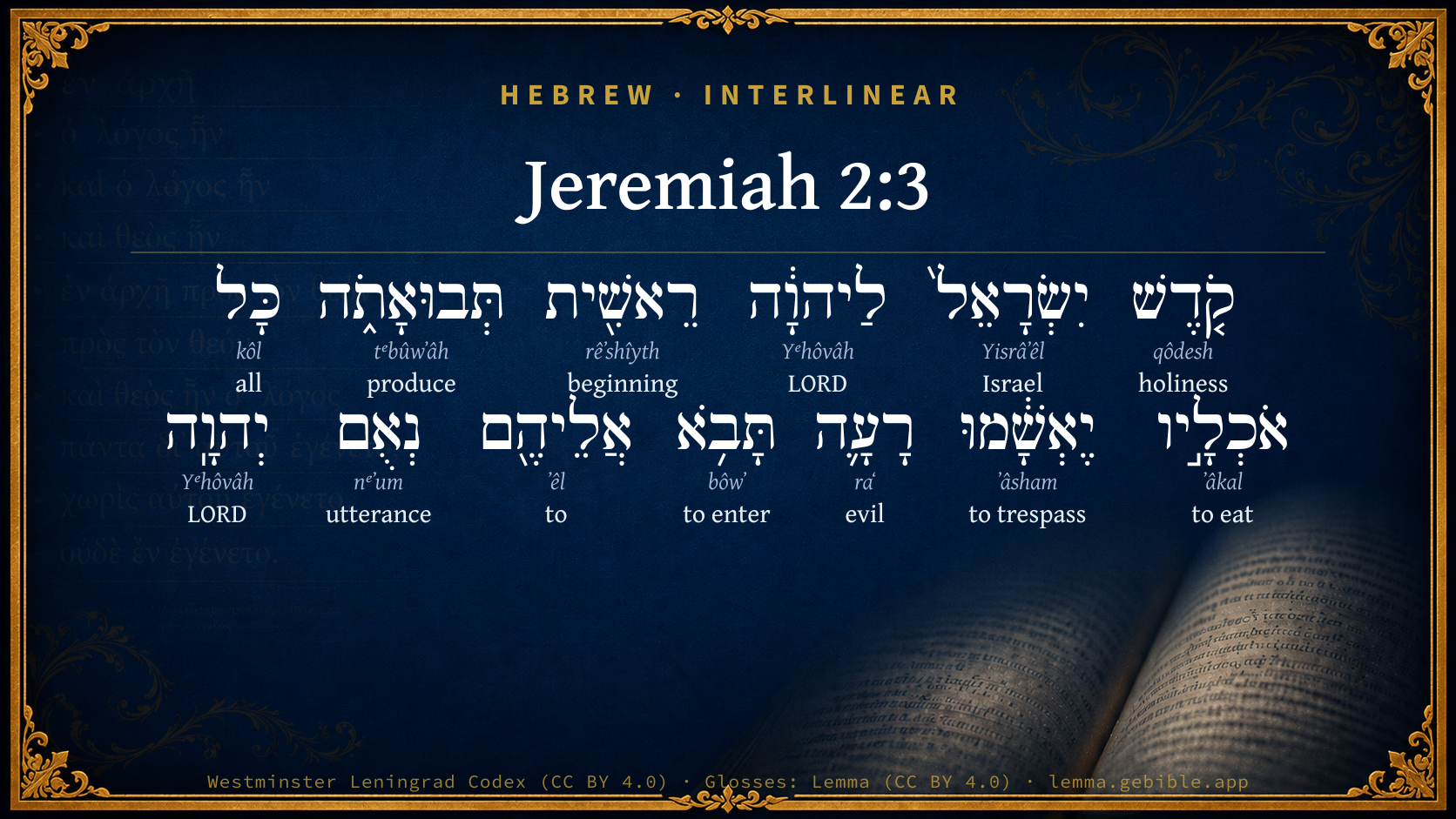
Hebrew (Westminster Leningrad Codex) Jeremiah 2:3 appears in the Hebrew Old Testament. The text above is from the Westminster Leningrad Codex. Each word links to its Strong’s number, a concise gloss, and parsing drawn from the Open Scriptures Hebrew Bible morphology. Click any word for its full Brown-Driver-Briggs (BDB) entry.
Download image
Cite this verse

Jeremiah 2:3 (World English Bible). Public Domain. Lemma interlinear Bible study tool, https://lemma.gebible.app/v/jeremiah/2/3.

Show BibTeX & RIS
BibTeX
RIS
English Translation
Israel [was] holiness to Yahweh, the first fruits of his increase: all who devour him shall be held guilty; evil shall come on them, says Yahweh.
World English Bible · Public Domain
Download a study sheet

One document with this verse’s original text, its word-by-word gloss line, the meaning frame, cross-references with their text, attributed commentary, and full source and license credits — printable, and it pastes into notes with its structure intact.

This verse Autodidact and up

Study sheet (.html) Plain text (.txt)

A passage Seminary Student

Up to 50 verses in one chapter. A passage sheet keeps up to 6 commentary sources and 12 cross-references per verse, in the order this page ranks them, and says so on the sheet whenever that leaves anything out. Ask for a single verse and you get the Autodidact verse sheet above.

Everything on this page stays free to read, with no account — the sheet is a download of what is already on screen, not access to it.

Want to remove ads? Support Godless Engineer
Compare translations 3

The same verse in 3 English versions, stacked beneath the original-language interlinear above. Click any original word for its lexicon entry.

Each is an independent rendering of the whole verse — the interlinear is not word-aligned to these translations.

Highlighted words mark where these versions differ — a whole-verse word diff, not a word-by-word alignment.

  • World English Bible Public Domain
    Israel [was] holiness to Yahweh, the first fruits of his increase: all who devour him shall be held guilty; evil shall come on them, says Yahweh.
  • King James Version Public Domain
    Israel was holiness unto the LORD, and the firstfruits of his increase: all that devour him shall offend; evil shall come upon them, saith the LORD.
  • unfoldingWord Literal Text CC BY-SA 4.0
    Israel holy to Yahweh, the first of his harvest! All those who ate it became guilty; disaster came upon them —the declaration of Yahweh.’” ts\*

unfoldingWord Literal Text — © unfoldingWord, licensed CC BY-SA 4.0. Word-aligned USFM3 via Door43 (git.door43.org/unfoldingWord/en_ult).

Versions to compare (up to 4)

3 of 4 selected

Show all 18 translations

Every available English version of this verse, each an independent rendering of the whole verse.

  • World English Bible Public Domain
    Israel [was] holiness to Yahweh, the first fruits of his increase: all who devour him shall be held guilty; evil shall come on them, says Yahweh.
  • Berean Standard Bible Public Domain
    Israel was holy to the LORD, the firstfruits of His harvest. All who devoured her found themselves guilty; disaster came upon them,’” declares the LORD.
  • Majority Standard Bible Public Domain
    Israel was holy to the LORD, the firstfruits of His harvest. All who devoured her were found guilty; disaster came upon them,’” declares the LORD.
  • King James Version Public Domain
    Israel was holiness unto the LORD, and the firstfruits of his increase: all that devour him shall offend; evil shall come upon them, saith the LORD.
  • American Standard Version (1901) Public Domain
    Israel `was' holiness unto Jehovah, the first-fruits of his increase: all that devour him shall be held guilty; evil shall come upon them, saith Jehovah.
  • Revised Version (1885) Public Domain
    Israel was holiness unto the LORD, the firstfruits of his increase: all that devour him shall be held guilty; evil shall come upon them, saith the LORD.
  • Geneva Bible (1599) Public Domain
    Israel was as a thing halowed vnto the Lord, and his first fruits: all they that eat it, shall offend: euil shall come vpon them, saith the Lord.
  • Douay-Rheims (1899) Public Domain
    Israel is holy to the Lord, the first fruits of his increase: all they that devour him offend: evils shall come upon them, saith the Lord.
  • Young's Literal Translation Public Domain
    Holy `is' Israel to Jehovah, The first-fruit of His increase, All consuming him are guilty, Evil cometh in unto them, an affirmation of Jehovah.
  • Literal Standard Version CC BY-SA 4.0
    Israel [is] holy to YHWH, || The first-fruit of His increase, || All consuming him are guilty, || Calamity comes to them,” || A declaration of YHWH.
  • Unlocked Literal Bible CC BY-SA 4.0
    Israel was set apart to Yahweh, the firstfruits of his harvest! All who ate from the firstfruits were held guilty; disaster came upon them—this is Yahweh's declaration.'”
  • unfoldingWord Literal Text CC BY-SA 4.0
    Israel holy to Yahweh, the first of his harvest! All those who ate it became guilty; disaster came upon them —the declaration of Yahweh.’” ts\*
  • Darby Bible Public Domain
    Israel was holiness unto Jehovah, the first-fruits of his increase: all that devour him are guilty; evil shall come upon them, saith Jehovah.
  • World Messianic Bible Public Domain
    Israel was holiness to the LORD, the first fruits of his increase. All who devour him will be held guilty. Evil will come on them,”’ says the LORD.”
  • Webster's Bible Public Domain
    Israel was holiness to the LORD, and the first-fruits of his increase: all that devour him shall offend; evil shall come upon them, saith the LORD.
  • Free Bible Version CC BY-SA 4.0
    Israel was holy to the Lord, the firstfruits of his harvest. Anyone who ate this harvest was guilty of sin, and they experienced the disastrous results, declares the Lord.
  • Bible in Basic English Public Domain
    Israel was holy to the Lord, the first-fruits of his increase: all who made attacks on him were judged as wrongdoers, evil came on them, says the Lord.
  • JPS Tanakh (1917) Public Domain
    Israel is the LORD'S hallowed portion, His first-fruits of the increase; all that devour him shall be held guilty, evil shall come upon them, saith the LORD.

Literal Standard Version (2020), Covenant Press — licensed CC BY-SA 4.0. Text via the HelloAO Bible API (eBible.org). Unlocked Literal Bible (unfoldingWord) — licensed CC BY-SA 4.0. Text via the HelloAO Bible API (eBible.org). unfoldingWord Literal Text — © unfoldingWord, licensed CC BY-SA 4.0. Word-aligned USFM3 via Door43 (git.door43.org/unfoldingWord/en_ult). Free Bible Version, Dr. Jonathan Gallagher — licensed CC BY-SA 4.0. Text via the HelloAO Bible API (eBible.org).

Word by word

More ways to search: Search by grammar → Find every occurrence → Compare this word →

Practice this passage: Drill this verse → Learn its vocabulary →

יֶאְשָׁ֔מוּ
ʼâsham
H816
“to trespass”
Verb, Qal, Imperfect, 3rd Person, Masculine, Plural
Part of Speech
Verb
Stem
Qal
Form
Imperfect
Person
3rd Person
Gender
Masculine
Number
Plural
Full BDB Definition

Origin: a primitive root

TWOT: 180

to offend, be guilty, trespass - (Qal) - to do wrong, offend, trespass, commit an offense, do injury - to be or become guilty - to be held guilty - to be incriminated - (Niphal) to suffer punishment - (Hiphil) to declare guilty - (TWOT) to be desolate, acknowledge offense
  1. קֹ֤דֶשׁ qôdesh H6944 “holiness” Noun, Common, Masculine, Singular, Absolute
  2. יִשְׂרָאֵל֙ Yisrâʼêl H3478 “Israel” Noun, Proper
  3. לַיהוָ֔ה Yᵉhôvâh H3068 “to/for · LORD” Preposition + Noun, Proper
  4. רֵאשִׁ֖ית rêʼshîyth H7225 “beginning of” Noun, Common, Feminine, Singular, Construct
  5. תְּבוּאָתֹ֑ה tᵉbûwʼâh H8393 “produce · his” Noun, Common, Feminine, Singular, Construct + Suffix, Personal, 3rd Person, Masculine, Singular
  6. כָּל kôl H3605 “all of” Noun, Common, Masculine, Singular, Construct
  7. אֹכְלָ֣יו ʼâkal H398 “eating · him” Verb, Qal, Participle Active, Masculine, Plural, Construct + Suffix, Personal, 3rd Person, Masculine, Singular
  8. רָעָ֛ה raʻ H7451 “evil” Noun, Common, Feminine, Singular, Absolute
  9. תָּבֹ֥א bôwʼ H935 “to enter” Verb, Qal, Imperfect, 3rd Person, Feminine, Singular
  10. אֲלֵיהֶ֖ם ʼêl H413 “to · them” Preposition + Suffix, Personal, 3rd Person, Masculine, Plural
  11. נְאֻם nᵉʼum H5002 “utterance of” Noun, Common, Masculine, Singular, Construct
  12. יְהוָֽה Yᵉhôvâh H3068 “LORD” Noun, Proper

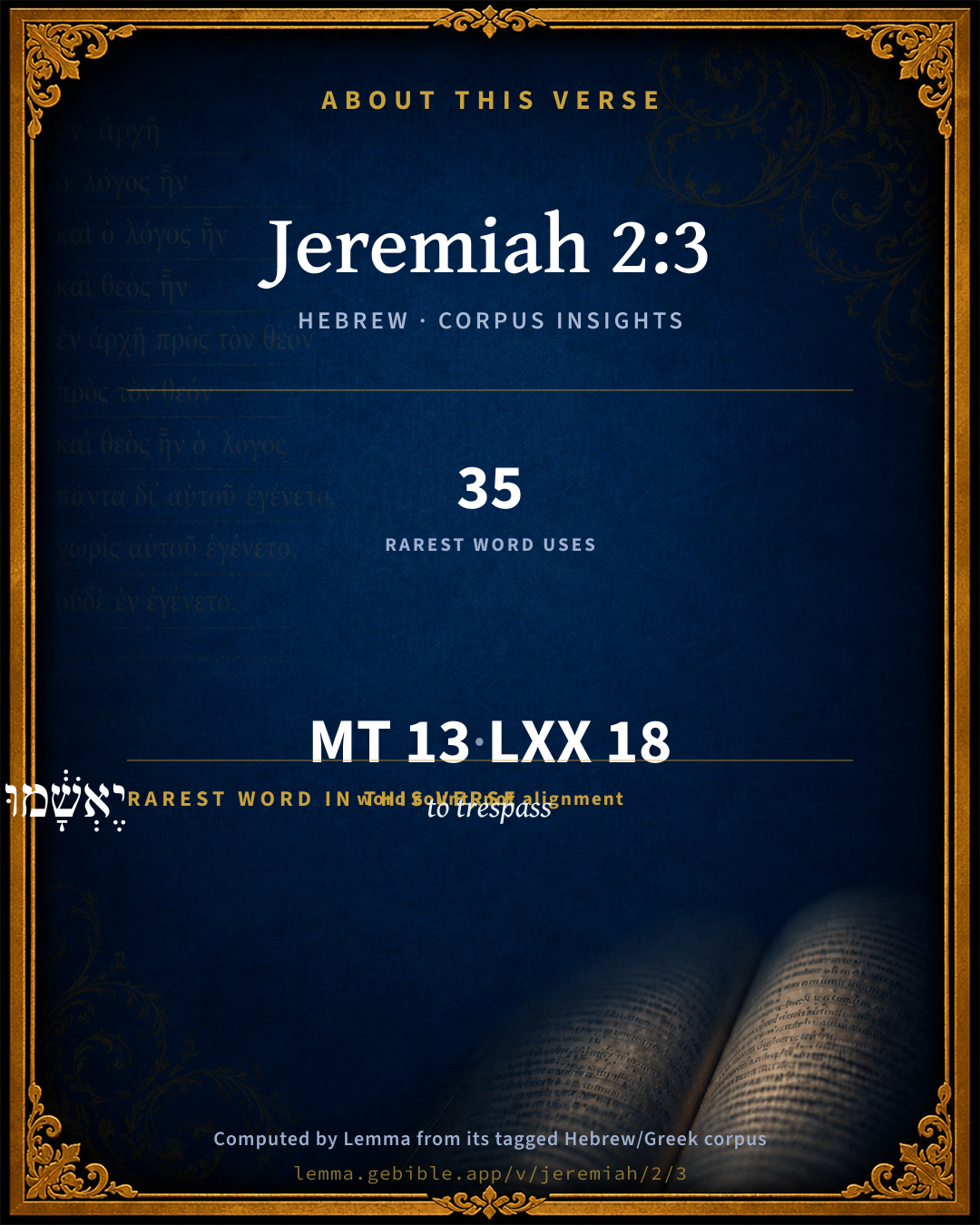
About this verse

These counts appear in no published source. They are computed here, from the morphology-tagged text and Lemma’s own curated glosses. What Lemma adds →

13
words
12
distinct lemmas
Prophets
section

Shared distinctive vocabulary

יֶאְשָׁ֔מוּ to trespass H816 occurs in 32 verses of the Hebrew Bible. Also found in:

Grammatical profile

  • 3 verbs
  • 9 nouns
  • 1 preposition

Verb forms

  • אֹכְלָ֣יו Qal · Participle Active
  • יֶאְשָׁ֔מוּ Qal · Imperfect
  • תָּבֹ֥א Qal · Imperfect

Repetition

A word recurs within this verse — often emphatic in Hebrew:

  • לַיהוָ֔ה LORD H3068 ×2

Hebrew & Septuagint length

In the original languages it is 13 Hebrew tokens and 18 Greek tokens — but the two are counted differently (Hebrew bundles its prefixes and suffixes into one token; the Greek is in lemma form), so that isn’t a like-for-like length.

Cross-references

30

Topical passages linked to Jeremiah 2:3 in the Treasury of Scripture Knowledge — connected by theme and wording, ordered by reader-vote popularity; previews shown in the World English Bible.

  • James 1:18 Of his own will he brought us forth by the word of truth, that we should be a kind of first fruits of his creatures.
  • Revelation 14:4 These are those who were not defiled with women, for they are virgins. These are those who follow the Lamb wherever he goes. These were redeemed by Jesus from among men, the first fruits to God and to the Lamb.
  • Exodus 4:22–23 You shall tell Pharaoh, 'Thus says Yahweh, Israel is my son, my firstborn,
  • Deuteronomy 7:6 For you are a holy people to Yahweh your God: Yahweh your God has chosen you to be a people for his own possession, above all peoples who are on the face of the earth.
  • Isaiah 41:11 Behold, all those who are incensed against you shall be disappointed and confounded: those who strive with you shall be as nothing, and shall perish.
  • Romans 11:16 If the first fruit is holy, so is the lump. If the root is holy, so are the branches.
  • Exodus 19:5–6 Now therefore, if you will indeed obey my voice, and keep my covenant, then you shall be my own possession from among all peoples; for all the earth is mine;
  • Deuteronomy 14:2 For you are a holy people to Yahweh your God, and Yahweh has chosen you to be a people for his own possession, above all peoples who are on the face of the earth.
  • Jeremiah 50:7 All who found them have devoured them; and their adversaries said, We are not guilty, because they have sinned against Yahweh, the habitation of righteousness, even Yahweh, the hope of their fathers.
  • Zechariah 2:8 For thus says Yahweh of hosts: 'For honor he has sent me to the nations which plundered you; for he who touches you touches the apple of his eye.
  • Ephesians 1:4 even as he chose us in him before the foundation of the world, that we would be holy and without blemish before him in love;
  • 1 Peter 2:9 But you are a chosen race, a royal priesthood, a holy nation, a people for God's own possession, that you may show forth the excellencies of him who called you out of darkness into his marvelous light:
  • Numbers 18:12 All the best of the oil, and all the best of the vintage, and of the grain, the first fruits of them which they give to Yahweh, to you have I given them.
  • Deuteronomy 26:19 and to make you high above all nations that he has made, in praise, and in name, and in honor; and that you may be a holy people to Yahweh your God, as he has spoken.
  • Jeremiah 12:14 Thus says Yahweh against all my evil neighbors, who touch the inheritance which I have caused my people Israel to inherit: behold, I will pluck them up from off their land, and will pluck up the house of Judah from among them.
  • Zechariah 14:20–21 In that day there will be on the bells of the horses, "HOLY TO YAHWEH;" and the pots in Yahweh's house will be like the bowls before the altar.
  • Exodus 22:29 "You shall not delay to offer from your harvest and from the outflow of your presses. "You shall give the firstborn of your sons to me.
  • Exodus 23:16 And the feast of harvest, the first fruits of your labors, which you sow in the field: and the feast of harvest, at the end of the year, when you gather in your labors out of the field.
  • Psalms 81:14–15 I would soon subdue their enemies, And turn my hand against their adversaries.
  • Psalms 105:14–15 He allowed no one to do them wrong. Yes, he reproved kings for their sakes,
  • Psalms 105:25–36 He turned their heart to hate his people, To conspire against his servants.
  • Isaiah 47:6 I was angry with my people, I profaned my inheritance, and gave them into your hand: you did show them no mercy; on the aged have you very heavily laid your yoke.
  • Jeremiah 30:16 Therefore all those who devour you shall be devoured; and all your adversaries, everyone of them, shall go into captivity; and those who despoil you shall be a spoil, and all who prey on you will I give for a prey.
  • Joel 1:3 Tell your children about it, And have your children tell their children, And their children, another generation.
  • Joel 1:7–8 He has laid my vine waste, And stripped my fig tree. He has stripped its bark, and thrown it away. Its branches are made white.
  • Zechariah 1:15 I am very angry with the nations that are at ease; for I was but a little displeased, but they added to the calamity."
  • Zechariah 12:2–4 "Behold, I will make Jerusalem a cup of reeling to all the surrounding peoples, and on Judah also will it be in the siege against Jerusalem.
  • Acts 9:4–5 He fell on the earth, and heard a voice saying to him, "Saul, Saul, why do you persecute me?"
  • Romans 16:5 Greet the assembly that is in their house. Greet Epaenetus, my beloved, who is the first fruits of Achaia to Christ.
  • Amos 6:1 Woe to those who are at ease in Zion, And to those who are secure on the mountain of Samaria, The notable men of the chief of the nations, To whom the house of Israel come!

Cross-references courtesy of OpenBible.info (CC BY 4.0).

Hebrew and Greek witnesses Masoretic Hebrew ↔ Greek Septuagint

The same verse in the two great witnesses to the Old Testament, shown verse-for-verse.

These are two independent witnesses, not word-aligned to each other, and the Septuagint is shown in lemma (dictionary) form.

Hebrew Jeremiah 2:3 Masoretic · Westminster Leningrad Codex

קֹ֤דֶשׁ יִשְׂרָאֵל֙ לַיהוָ֔ה רֵאשִׁ֖ית תְּבוּאָתֹ֑ה כָּל אֹכְלָ֣יו יֶאְשָׁ֔מוּ רָעָ֛ה תָּבֹ֥א אֲלֵיהֶ֖ם נְאֻם יְהוָֽה

Israel [was] holiness to Yahweh, the first fruits of his increase: all who devour him shall be held guilty; evil shall come on them, says Yahweh.

World English Bible · Public Domain

Greek LXX Structure differs

In the Septuagint, Jeremiah is about an eighth shorter than the Hebrew and arranges its material differently — the Oracles Against the Nations (Hebrew chapters 46–51) appear in the middle of the Greek book, after 25:13. Because the chapter and verse boundaries do not line up, a verse-for-verse comparison with the Hebrew is not shown.

A verse-for-verse comparison isn’t shown here because the chapters and verses don’t line up. Switch to the LXX edition with the MT / LXX toggle above to read the Greek directly.

Hebrew: Westminster Leningrad Codex (CC BY 4.0). Greek: Septuagint (public domain); English from a public-domain English Septuagint. How the Septuagint differs from the Hebrew →

Targum (Aramaic paraphrase)

1

The Targum is the ancient Jewish Aramaic paraphrase of the Hebrew Scriptures — an interpretive translation, not the Hebrew text itself. Onkelos (literal) and Pseudo-Jonathan (expansive) render the Torah, and Jonathan the Prophets. Coverage is partial: where no permissively-licensed English translation exists for a verse, only the Aramaic is shown. This is verse-level text, not a word-by-word alignment to the Hebrew.

  1. Targum Jonathan Prophets (Joshua–Malachi)
    קוּדְשַׁיָא אִינוּן בֵית יִשְׂרָאֵל קֳדָם יְיָ וְעַל בָּזְזֵיהוֹן כְּדִמְעָה אֲרָמוּת עַלְלָא דְמַן דָאָכַל מִנֵיהּ חַיָב לְמֵימַת וּכְשִׁירוּ חֲצַד עוֹמָר אֲרָמוּתָא דְעַד לָא מְקָרְבִין מִנֵיהּ כַּהֲנַיָא בְּנֵי אַהֲרֹן קוּרְבְּנַיָא עַל מַדְבְּחָא מַן דְּאָכִיל מִנֵיהּ מִתְחַיֵב אַף כֵּן כָּל בָּזְוֵיהוֹן דְבֵית יִשְׂרָאֵל יְחוֹבוּן בִּישְׁתָא תֵיתֵי עֲלֵיהוֹן אֲמַר יְיָ:

    (no public-domain English translation for this verse)

    Targum Jonathan — Aramaic: “Mikraot Gedolot” (public domain). English: “Sefaria Community Translation” (CC0 1.0 (public-domain dedication)); “London "Chaldee Paraphrase," 1871” (public domain). Text via Sefaria.

Commentary

Notes on Jeremiah 2:3 from classic Christian and Jewish commentators (each source and its license shown beneath its notes). The classic Christian expositions comment on the surrounding passage and are grouped to its opening verse, so a note may address several verses; the Jewish commentaries on the Tanakh (Rashi and others) are per-verse, so they appear only where the commentator wrote on this verse.

Lemma curates 59 commentaries, every one of them public domain or Creative Commons licensed, each selected and text-cleaned for this edition rather than reprinted as found. About our sources →

Trapp's Complete Commentary

John Trapp

Jer 2:3 Israel [was] holiness unto the LORD, [and] the firstfruits of his increase: all that devour him shall offend; evil shall come upon them, saith the LORD.

Ver. 3. Israel was holiness unto the Lord.] A people consecrated and set apart for his peculiar; {Exo 19:5 Psa 114:2} holy with a federal holiness at least.

And the firstfruits of his increase.] Yea, his "firstborn," and therefore, "higher than the kings of the earth." {Psa 89:27} All God’s people are so. {Heb 12:23 Jas 1:18}

All that devour them shall offend.] Rather thus: All that devoured them trespassed - evil befell them; witness the four latter books of Moses.

John Trapp, A Commentary or Exposition upon All the Books of the Old and New Testament (1647–1656) — public domain. Text from a community e-Sword module.

Tyndale Open Study Notes

Tyndale Open Resources

2:3 Israel was holy because the Lord had separated her from other nations to be his special people and reflect his character (Exod 19:5-6; Lev 19; 22:31-33). • first of his children: Literally the firstfruits of his harvest. Mosaic law required the people to offer the first portion of every harvest to the Lord (Exod 23:16, 19; 34:22, 26; Lev 2:12, 14; 23:10, 17, 20; Num 18:12; 28:26; Deut 18:4; 26:10; Zech 14:20). The people who made the covenant with God at Mount Sinai pledged their full commitment to the one true God. In return, the Lord protected them and punished their enemies during their journey to Canaan.

Tyndale Open Study Notes — © Tyndale Open Resources, licensed CC BY-SA 4.0. Text via the HelloAO Bible API.

Geneva Bible (1599)

Geneva Bible translators

Chosen above all others to serve the Lord only, and the first offered to the Lord of all other nations.

Whosoever did challenge this people, or else did annoy them, was punished.

Geneva Bible (1599) marginal notes — public domain. Text via Bolls.life.

Jamieson, Fausset & Brown

Robert Jamieson, A. R. Fausset & David Brown

holiness unto the Lord--that is, was consecrated to the service of Jehovah (Exo 19:5-6). They thus answered to the motto on their high priest's breastplate, "Holiness to the Lord" (Deu 7:6; Deu 14:2, Deu 14:21).

first-fruits of his increase--that is, of Jehovah's produce. As the first-fruits of the whole produce of the land were devoted to God (Exo 23:19; Num 18:12-13), so Israel was devoted to Him as the first-fruit and representative nation among all nations. So the spiritual Israel (Jam 1:18; Rev 14:4).

devour--carrying on the image of first-fruits which were eaten before the Lord by the priests as the Lord's representatives; all who ate (injured) Jehovah's first-fruits (Israel), contracted guilt: for example, Amalek, the Amorites, &c., were extirpated for their guilt towards Israel.

shall come--rather, "came."

Jamieson, Fausset & Brown — Commentary Critical and Explanatory on the Whole Bible (1871) — public domain (CC PDM 1.0). Text via the HelloAO Bible API.

Adam Clarke's Commentary

Verse 3. Israel was holiness unto the Lord] Fully consecrated to his service.

The first fruits of his increase] They were as wholly the Lord's, as the first fruits were the property of the priests according to the law, Nu 18:13. These the priests alone had a right to devote to their own use.

All that devour him shall offend] As they were betrothed to the Lord, they were considered his especial property; they therefore who injured them were considered as laying violent hands on the property of God. They who persecute God's children have a grievous burden to bear, an awful account to give.

Adam Clarke's Commentary on the Bible (1810–1826) — public domain. Text from a community e-Sword/MySword module.

John Calvin's Commentaries

God here more clearly reprobates the ingratitude of the people: and first he enumerates his favors by which he had bound the people for ever to himself; and secondly, he shews how malignantly the people responded to the many blessings which they had received.

In saying, then, that Israel was holy, he intends it not by way of honor. It was indeed in itself an illustrious testimony to their praise, that God had consecrated that people to himself, that he designed them to be the first — fruits of his increase: but we must remember that there is here an implied contrast between this great and incomparable favor of God, and the wickedness of the people, who afterwards fell away from that God who had been so liberal and gracious to them. According to this view, then, does Jeremiah say, that Israel was holiness to God; that is, that they were separated from all other nations, so that the glory of God shone only among them.

He then adds, that they were the first-fruits of his produce For though whatever produce the earth may bring forth ought to be consecrated to God, by whose power it grows, yet we know that the first — fruits were gathered and set on the altar as a sacred food. As, then, God had commanded, under the law, the first-fruits to be offered to him, and then given to the priests, he says here, in accordance with that rite, that Israel were the first — fruits of his produce. For the nations, who then everywhere dwelt, were not removed from under God’s government (as he is the creator of all, and shews himself to all as the Father and supporter); but he passed by other nations, and chose the race of Abraham, and for this end, — that he might protect them by his power and aid. Since, then, God had so bound the nation to himself, how great and how strong was the obligation under which that people was to him? Hence the more base and the more detestable was their perfidy, when the people despised the singular favors which God had conferred on them. We now see why the Prophet says that Israel was holy to God, and the first — fruits of his increase.

He also intimates that the time would come, when God would gather to himself other nations; for in the first-fruits the people dedicated and offered to God the whole produce of the year is included. So then Israel was like the first-fruits, because God afterwards took to himself other nations, which for many ages were deemed profane. But yet his special object was to shew that the guilt of the people was extreme, as they did not acknowledge the great favors which God had bestowed on them.

He then adds, Whosoever will devour him shall be punished Of this meaning I approve, because the explanation immediately follows, evil shall come on them God then means not that they should be only guilty of a crime, who should devour the first-fruits, but refers rather to punishment; as though he had said, “The profane shall not be unpunished who shall devour the first-fruits which has been dedicated to me.” For if any had stolen the first- fruits, God would have executed a vengeance such as sacrilege deserved. If, however, any one prefers the other explanation, — that it would be a crime to injure Israel, or to do him any harm, because he was under God’s protection, I shall not oppose him: but the wording of the sentence leads me to the other view, that is, that those who would injure Israel would not only be guilty, but would not be able to escape God’s vengeance, — and why? because evil will come upon them, saith Jehovah He afterwards explains more clearly the import of his doctrine —

John Calvin's Commentaries (1540-1563) — public domain. Text from the Calvin Translation Society English edition (1840s-50s) via the Christian Classics Ethereal Library (ccel.org). Calvin's coverage is partial (roughly two-thirds of the Bible); uncommented books and verses are honest gaps, never fabricated. The 19th-century editor's footnotes and remarks are omitted so the notes are faithfully Calvin's own voice.

Ellicott's Commentary for English Readers

(3) Holiness unto the Lord.—The thought was that expressed in the inscription on the gold plate worn on the high priest’s forehead (Exo_28:36), and in the term “holy thing” (Lev_22:10; Mat_7:6), applied to the consecrated gifts which were the portion of the priests. The prophet was taught that Israel, as a nation, had a priestly character, and was consecrated to the Lord as the “firstfruits” of the great harvest of the world. Compare the use of the same figure in Jas_1:18; Rom_11:16.

All that devour him shall offend.—The imagery of the firstfruits is continued. The Hebrew for the word “offend” is used for transgressions against the ceremonial law in Lev_5:5; Lev_5:19; Num_5:7. Here, however, it is probably better rendered, shall be condemned, or shall be made to suffer, as in Psa_34:21-22, where the Authorised version has “shall be desolate.” Those who devour Israel—the enemies and invaders, the tyrants and oppressors—are guilty as of a sacrilege that will not remain unpunished.

A Bible Commentary for English Readers, edited by Charles John Ellicott (1878–1897) — public domain. Text from a community e-Sword module.

The Cambridge Bible for Schools and Colleges

gen. ed. J. J. S. Perowne

3. Israel was holiness unto the Lord, the firstfruits of his increase] Cp. Exo_19:6; Deu_8:6; Deu_14:2; cp. Jer_26:18 and Amo_3:2. There is no moral significance attached to the word holiness here. It means simply setting apart from ordinary uses, dedication to God. Israel is as the most precious part of the harvest, that part which is consecrated as God’s portion. The notion was familiar through the yearly custom, prescribed Lev_23:10-14, that a measure of the firstfruits should be waved by the priest before the Lord, and that none of the harvest should be enjoyed till this rite had been fulfilled. Cp. Exo_23:19; Deu_26:2 ff.

all that devour him shall be held guilty] The priest and his family alone were to eat of the firstfruits. No stranger was allowed to partake. If any unhallowed person profaned the firstfruits by taking of them, he bore “the iniquity that bringeth guilt.” See Lev_22:16 (where the Heb. root is the same as here). Thus the sense is that if unconsecrated (i.e. heathen) nations assail Israel, their fate shall be that of such as eat the firstfruits unlawfully.

The Cambridge Bible for Schools and Colleges (gen. ed. J. J. S. Perowne; Cambridge University Press, 1878–1918) — public domain. Text from a community e-Sword module.

John Gill's Exposition

Israel was holiness unto the Lord,.... When first brought out of Egypt into the wilderness, by the Lord's choice and separation of them to be a holy people to him above all others; by covenant with him, and profession of him; and by his giving them holy laws, and placing a sanctuary among them; and by their high priest, who represented them in the most holy place; and had on the front of his mitre written,

holiness unto the Lord; so the spiritual Israel are chosen in Christ to be holy, and he is made sanctification to them; they are sanctified in him, and by his Spirit; they are called with a holy calling, and unto holiness; and, under the influence of grace, live holy lives and conversations, which the grace of God teaches, and young converts are remarkable for; their consciences being just awakened, and their hearts tender:

and the firstfruits of his increase; Israel was the first nation that God separated for himself; and this being the firstfruits, shows that he would separate others also, and take out of the Gentiles a people for his name, which he has since done; and the elect of God among the Israelites were the firstfruits of his chosen ones elsewhere; it were some of them that first believed in Christ, and received the firstfruits of the Spirit; and all converted ones are a kind of firstfruits of his creatures; the grace they receive at conversion is the firstfruits of a later increase of it, and even of eternal glory:

all that devour him shall offend; or, "all that eat him shall be guilty" (x); and be condemned and punished, who eat up the Lord's people, as they eat bread; see Psa 53:4, these shall not go unpunished; for his people are as the apple of his eye, and whoever touches and hurts them fall under the divine displeasure, and will be looked upon as criminals and offenders, and will be judged and condemned as such. The allusion is to the eating of the firstfruits, which only belonged to the priests; nor might any of the increase be eaten until the firstfruits were brought to them, Lev 23:10. This is expressed in the Chaldee paraphrase of the text,

"whosoever eats of them (the firstfruits) is guilty of death; for as the beginning of the harvest, the sheaf of oblation, whoever eats of it before the priests, the sons of Aaron, have offered of it upon the altar, shall be guilty or condemned; so all that spoil the house of Israel shall be guilty or condemned;''

so Jarchi and Kimchi:

evil shall come upon them, saith the Lord; that is, the evil of punishment, either in this world, or in that which is to come, or in both.

(x) "rcos fuisse", Junius & Tremellius; "rei peragebantur", Piscator; "rei fiunt", Cocceius.

John Gill's Exposition of the Whole Bible (1746–1763) — public domain (CC PDM 1.0). Text via the HelloAO Bible API.

Albert Barnes' Notes on the Bible

Render: “Israel” is an offering consecrated to Yahweh, His firstfruits of increase. The firstfruits were God’s consecrated property, His portion of the whole harvest. Pagan, i. e., unconsecrated, nations must not meddle with Israel, because it is the nation consecrated to God. If they do, they will bring such guilt upon themselves as those incur who eat the first-fruits Lev 22:10, Lev 22:16.

Albert Barnes' Notes on the Bible (1834–1885) — public domain. Text from a community e-Sword/MySword module.

Haydock's Catholic Bible Commentary

Increase; most desirable, Osee ix. 10. God punished those who attempted to injure his people: yet they abandoned his service.

George Leo Haydock (1774–1849), Haydock's Catholic Family Bible and Commentary, 1859 edition — public domain. Excludes Psalms (Douay-Rheims chapter numbering differs from Protestant) and Deuterocanonical books (Catholic canon only).

Matthew Poole's English Annotations

Israel was holiness, or

holy, the abstract for the concrete, i.e. a people dedicated to God; thus the word is used Lev 21:7; 27:14; set apart from other people for myself by peculiar laws and rites.

And the first-fruits of his increase: this supplement

and is better left out, it being not in the text, and rendering the sense more obscure; therefore better read, either, being the first-fruits, by apposition; or, as the first-fruits, i.e. as the first-fruits were holy to God, so was Israel.

All that devour; or rather, devoured; for it refers to the time past, not to the future, and so the following words; all that were injurious to him

shall offend; or, did offend, were obnoxious, and liable to punishment, as he that devoured that which is holy, Pro 20:25.

Shall come upon them; came upon them: some evil was inflicted on them from the Lord, that was always wont to stand up for the vindication of his people, as upon the Egyptians, Amalekites, Sihon, Og, the Midianites, Canaanites, and others, as the four last books of Moses do abundantly testify; and by these expressions is insinuated that now they are like to find it otherwise, Jer 1:7; this minding of them what God had done for them making way for the closer setting home the following reproofs.

Matthew Poole's English Annotations on the Holy Bible (1683–1685) — public domain. Text from a community e-Sword/MySword module.

Whedon's Commentary on the Bible

Daniel D. Whedon

3. Holiness unto the Lord — Their national motto, worn by the highpriest on his breastplate. Israel was the sanctuary of the nations; and those who should lay violent hands on her would bring upon themselves Jehovah’s curse as certainly as they who defile the sanctuary or seize the gift from the consecrated altar. “He that toucheth you toucheth the apple of his eye.”

Firstfruits — God’s portion of the harvest — a specimen and a pledge of the general ingathering. And so if Israel is the “firstfruits,” there is in this an implication that all the nations shall ultimately be the Lord’s. So are Christians the firstfruits of a redeemed universe. Rom_8:23.

Daniel D. Whedon (gen. ed.), Commentary on the Old and New Testaments (1874–1909) — public domain. Text from a community e-Sword module.

The Pulpit Commentary

Israel was holiness, etc. Israel was a consecrated people. (Exo_19:5, 6 Deu_7:6 Deu_14:2 Deu_26:19) Isaiah, fond as he is of the phrase "Israel"s Holy One," does not expressly enforce the correlative truth, as Jeremiah does here. The first-fruits of his increase; rather, his firstfruits of increase. Israel is compared to the firstfruits (reshith) of the land, which were devoted to the house of the Lord. (Exo_23:19 Num_18:12, Num_18:13) So in Amo_6:1, the title given him is "the chief margin, "firstfruits of the nations". (in Jer_31:7, a synonymous and cognate word, rosh, takes the place of reshith for "chief All that devour him shall offend; rather, all that ate him incurred guilt, or became guilty of a trespass. Foreigners were forbidden to eat of consecrated things; by breaking this law they became guilty of a "trespass," having invaded the rights of Jehovah. (Lev_22:10, Lev_22:15, Lev_22:16) The word for "trespass" is the same as that rendered "guilt.

Guilty instruments of Divine judgment.

A great problem in morals. Pharaoh"s "heart is hardened," and yet his guilt remains. Nations are raised up to punish Israel for unfaithfulness, yet they "offend" in doing this very thing.

I WHEREIN THE GUILT OF INSTRUMENTS OF DIVINE VENGEANCE MAY CONSIST. At least two explanations of this are to be found:

1. In the distinction between the formal and the material character of actions. The essential evil or good of an action is in the intention, the subjective conditions that originate and give character to it. It is subjective, not actualized; or its actualization in one of several forms or directions is indifferent. Towards any of these the Divine power may direct the impulse and tendency; or they may be shut up to them through the unconscious influence of providence, working in wider cycles.

2. In the overdoing or aggravation of the appointed task.

II WHAT IT IS THAT AGGRAVATES THE GUILT OF THE WICKED INSTRUMENT OF DIVINE WRATH. It is the character of God"s people, and the relation they boar to him. They have been "holiness unto the Lord." In so far as this character is interfered with or injured by the instruments of vengeance, the latter shall be the more guilty. In so far, too, as hatred for this character, either as past or present, in God"s people has actuated the vengeance inflicted, the avengers "shall offend." (Cf. for a similar sentiment, Mat_18:6) The Divine Being declares his personal attachment to those he has chosen, and his identification with them. To injure them is to injure him. They also represent, even in their apostasy, the stock from which salvation is to come, and the world"s spiritual future. M.

The Pulpit Commentary (1880–1919), ed. H.D.M. Spence-Jones & Joseph S. Exell — public domain. Text from a community e-Sword module.

John Wesley's Explanatory Notes

Holiness - A people dedicated to God. As - As the first fruits were holy to God, so was Israel. Devour - All that were injurious to him. Offend - Were liable to punishment. Evil - Evil was inflicted on them from the Lord, as upon the Egyptians, Amalekites, Midianites, Canaanites.

John Wesley, Explanatory Notes Upon the Whole Bible (1754–1765) — public domain. Text via the GEBible commentary corpus.

Rashi

Rabbi Shlomo Yitzchaki (Rashi)

Israel is holy like terumah.

the first of His grain Like the first of the harvest before the Omer, which it is forbidden to eat, and whoever eats it is liable, so will all those who eat him be guilty. So did Jonathan render it.

Rashi on the Tanakh — English translations: “The Judaica Press complete Tanach with Rashi, translated by A. J. Rosenberg” (CC BY 4.0); “Pentateuch with Rashi's commentary by M. Rosenbaum and A.M. Silbermann, 1929-1934” (public domain); “The Metsudah Tanach series, Lakewood, N.J” (CC BY 4.0); and “The Book of Joshua, Metsudah Publications, 1997” (CC BY 4.0). Text via Sefaria.

Lesson kit

Teaching starters — assembled from the data on this page, not authored interpretation. Every prompt links to the verse data it draws on. Edit before teaching.

Jeremiah, in the Prophets, opens this verse with 13 words (12 distinct Hebrew lemmas). Its most distinctive word is ʼâsham (“to trespass”). A historical commentator’s framing appears above. Read the whole chapter for the surrounding context.

Discussion questions

  1. How does “to trespass” (ʼâsham) shape what this verse is saying?
  2. Leviticus 4:13 shares the word «to trespass» with this verse. How do the two illuminate each other?
  3. “LORD” occurs 2× in this one verse. What is the effect of the repetition?
  4. These translations render this verse differently. What is at stake in choosing one wording over another?
  5. The verb «אֹכְלָ֣יו» is Qal Participle Active. How does its form color the action?
  6. Reading how Trapp's Complete Commentary and Tyndale Open Study Notes read this verse, where do the two commentators agree and where do they part?

Things to notice

Reading settings

Reading text

Shown beneath each verse's original-language words.

Old Testament
Old Testament edition

Read the OT as the Masoretic Hebrew (MT) or the Greek Septuagint (LXX).

English shown for the Greek Septuagint (in the Hebrew ↔ Greek comparison).

Comparing translations? Open the Compare panel on any verse page to stack up to four side by side.