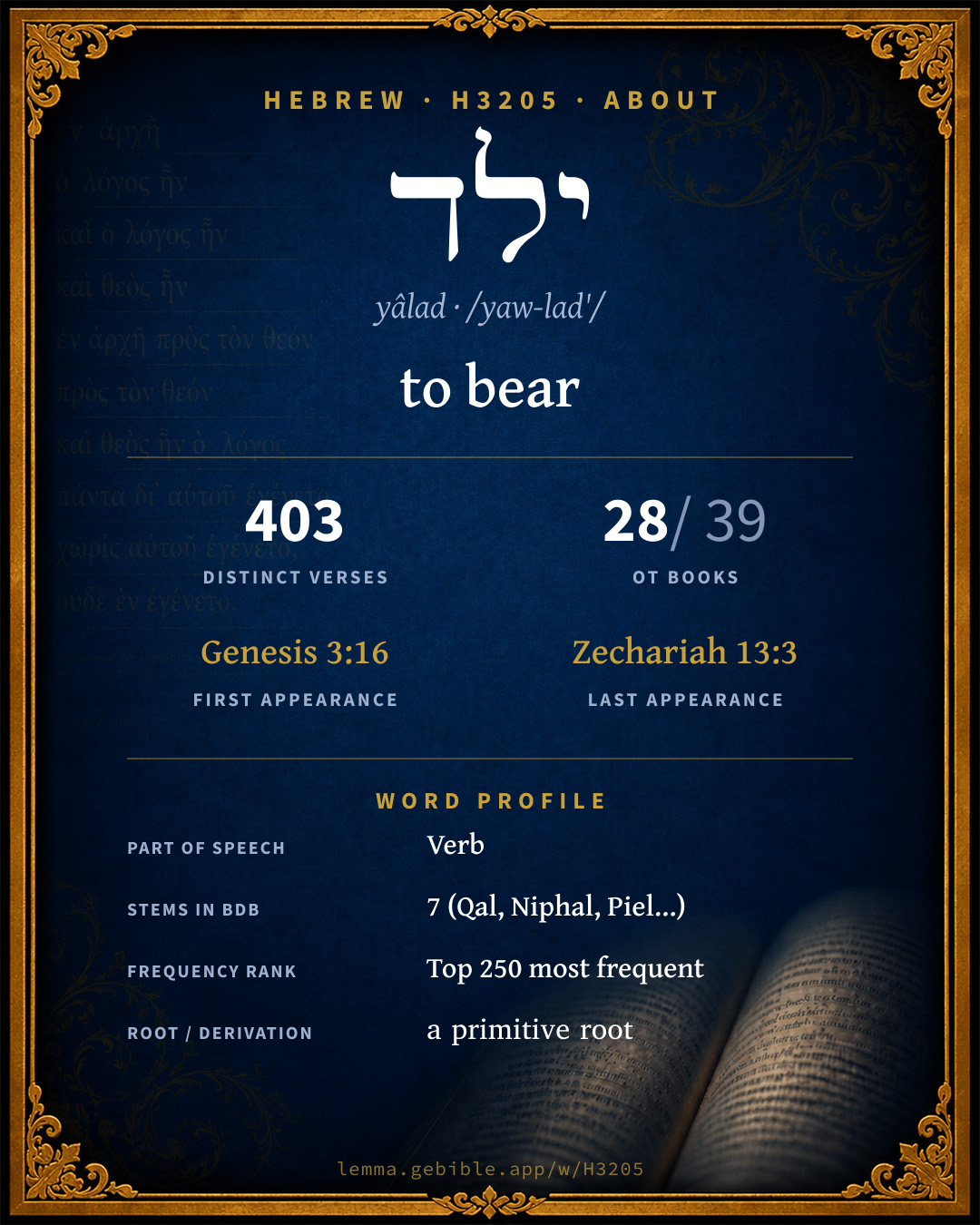
יָלַד
to bear
also: bring forth, beget, gender, travail fuller range ↓
Full lexicon entry — Brown-Driver-Briggs (BDB)
From Brown-Driver-Briggs (BDB)
Where this word appears
See every Qal verb in the Hebrew Bible →
Grammar key — what these labels mean
Part of speech
- Verb
- An action or state-of-being word.
- Noun
- A naming word — a person, place, thing, or idea.
Noun type
- Common
- A common noun — a general class of person, place, or thing (“king,” “city,” “water”), not a specific name.
Stem
- Hiphil
- The causative active stem (“he caused / brought about”). Here: ‘beget’
- Qal
- The basic, simple active stem — the plain form of the verb (“he wrote”). Here: ‘bear’
- Pual
- The passive counterpart of the Piel.
- Niphal
- Usually the simple passive or reflexive of the Qal (“he was written”).
- Piel
- An intensive or resultative active stem.
- Hophal
- The passive counterpart of the Hiphil (“he was caused to…”).
- Hithpael
- The reflexive or reciprocal stem (the subject acts on itself).
- Qal Passive
- An archaic passive of the Qal, preserved in a few forms.
Form
- Perfect
- A completed action or state — Hebrew marks aspect (completeness) more than strict tense (“he wrote”).
- Sequential Imperfect
- An imperfect with prefixed waw — the standard past-narrative form (waw-consecutive imperfect).
- Infinitive Construct
- A bound verbal noun, frequently with prepositions (“to write / in writing”).
- Participle Active
- A verbal adjective expressing ongoing or characteristic action (“writing / one who writes”).
- Imperfect
- An incomplete, ongoing, or future action (“he will / would write”).
- Participle Passive
- A verbal adjective expressing action received (“written”).
- Sequential Perfect
- A perfect with prefixed waw continuing a preceding imperfect or command (waw-consecutive perfect).
- Infinitive Absolute
- An unbound verbal noun, often intensifying or standing in for a finite verb.
- Imperative
- A direct command (“write!”).
- Jussive
- A third- or second-person volitional form expressing wish or command (“let him write”).
State
- Absolute
- The independent form of a noun, not bound to a following word.
- Construct
- A noun bound to a following noun in a possessive / “of” relationship (the construct chain).
Person
- 3rd Person
- The one spoken about (“he / she / it / they”).
- 1st Person
- The speaker (“I / we”).
- 2nd Person
- The one addressed (“you”).
Gender
- Masculine
- Grammatically masculine.
- Feminine
- Grammatically feminine.
- Common
- Either gender — not distinguished for this form.
Number
- Singular
- One.
- Plural
- More than one (in Hebrew, generally three or more).
Grammatical forms 73 distinct
- Verb, Hiphil, Perfect, 3rd Person, Masculine, Singular 97 times (19%)
- Verb, Qal, Sequential Imperfect, 3rd Person, Feminine, Singular 62 times (12%)
- Verb, Qal, Perfect, 3rd Person, Feminine, Singular 48 times (10%)
- Verb, Hiphil, Sequential Imperfect, 3rd Person, Masculine, Singular 45 times (9%)
- Verb, Qal, Perfect, 3rd Person, Masculine, Singular 23 times (5%)
- Verb, Qal, Infinitive Construct 19 times (4%)
- Verb, Qal, Participle Active, Feminine, Singular, Absolute 18 times (4%)
- Verb, Hiphil, Infinitive Construct 17 times (3%)
+65 more forms (171 occurrences)
Parsed forms decoded from the imported morphology (morphhb / Westminster Leningrad Codex — WLC text public domain, morphhb tagging CC BY 4.0), counted across 500 parsed occurrences — not distinct verses.
Page 1 of 3 — showing verses 1–200 of 403 distinct verses where H3205 appears, across 28 books. Click any verse to open its interlinear word-by-word view. Verse text shown in the World English Bible for context — . Each verse’s Hebrew form is shown with its reference; the English is not keyword-highlighted, since the data carries no word-level English alignment. Use “Compare translations” on any verse to read it across multiple English versions. This concordance covers the Hebrew Bible; Septuagint (Greek Old Testament) occurrences are not indexed here.
Genesis 133 verses
- Genesis 3:16 תֵּֽלְדִ֣י Qal impf 2fs To the woman he said, "I will greatly multiply your pain in childbirth. In pain you will bring forth children. Your desire will be for your husband, and he will rule over you."
- Genesis 4:1 וַ/תֵּ֣לֶד conj + Qal wimpf 3fs The man knew Eve his wife. She conceived, and gave birth to Cain, and said, "I have gotten a man with Yahweh's help."
- Genesis 4:2 לָ/לֶ֔דֶת prep + Qal inf.cs Again she gave birth, to Cain's brother Abel. Abel was a keeper of sheep, but Cain was a tiller of the ground.
- Genesis 4:17 וַ/תֵּ֣לֶד conj + Qal wimpf 3fs Cain knew his wife. She conceived, and gave birth to Enoch. He built a city, and called the name of the city, after the name of his son, Enoch.
- Genesis 4:18 וַ/יִּוָּלֵ֤ד יָלַ֖ד יָלַד֙ יָלַ֥ד conj + Niphal wimpf 3ms Qal pf 3ms Qal pf 3ms Qal pf 3ms To Enoch was born Irad. Irad became the father of Mehujael. Mehujael became the father of Methushael. Methushael became the father of Lamech.
- Genesis 4:20 וַ/תֵּ֥לֶד conj + Qal wimpf 3fs Adah gave birth to Jabal, who was the father of those who dwell in tents and have cattle.
- Genesis 4:22 יָֽלְדָה֙ Qal pf 3fs Zillah also gave birth to Tubal Cain, the forger of every cutting instrument of brass and iron. Tubal Cain's sister was Naamah.
- Genesis 4:25 וַ/תֵּ֣לֶד conj + Qal wimpf 3fs Adam knew his wife again. She gave birth to a son, and named him Seth. For, she said, "God has appointed me another child instead of Abel, for Cain killed him."
- Genesis 4:26 יֻלַּד Pual pf 3ms There was also born a son to Seth, and he named him Enosh. Then men began to call on Yahweh's name.
- Genesis 5:3 וַ/יּ֥וֹלֶד conj + Hiphil wimpf 3ms Adam lived one hundred thirty years, and became the father of a son in his own likeness, after his image, and named him Seth.
- Genesis 5:4 הוֹלִיד֣/וֹ וַ/יּ֥וֹלֶד Hiphil inf.cs + sfx pers 3ms conj + Hiphil wimpf 3ms The days of Adam after he became the father of Seth were eight hundred years, and he became the father of sons and daughters.
- Genesis 5:6 וַ/יּ֖וֹלֶד conj + Hiphil wimpf 3ms Seth lived one hundred five years, and became the father of Enosh.
- Genesis 5:7 הוֹלִיד֣/וֹ וַ/יּ֥וֹלֶד Hiphil inf.cs + sfx pers 3ms conj + Hiphil wimpf 3ms Seth lived after he became the father of Enosh eight hundred seven years, and became the father of sons and daughters.
- Genesis 5:9 וַ/יּ֖וֹלֶד conj + Hiphil wimpf 3ms Enosh lived ninety years, and became the father of Kenan.
- Genesis 5:10 הוֹלִיד֣/וֹ וַ/יּ֥וֹלֶד Hiphil inf.cs + sfx pers 3ms conj + Hiphil wimpf 3ms Enosh lived after he became the father of Kenan, eight hundred fifteen years, and became the father of sons and daughters.
- Genesis 5:12 וַ/יּ֖וֹלֶד conj + Hiphil wimpf 3ms Kenan lived seventy years, and became the father of Mahalalel.
- Genesis 5:13 הוֹלִיד֣/וֹ וַ/יּ֥וֹלֶד Hiphil inf.cs + sfx pers 3ms conj + Hiphil wimpf 3ms Kenan lived after he became the father of Mahalalel eight hundred forty years, and became the father of sons and daughters
- Genesis 5:15 וַ/יּ֖וֹלֶד conj + Hiphil wimpf 3ms Mahalalel lived sixty-five years, and became the father of Jared.
- Genesis 5:16 הוֹלִיד֣/וֹ וַ/יּ֥וֹלֶד Hiphil inf.cs + sfx pers 3ms conj + Hiphil wimpf 3ms Mahalalel lived after he became the father of Jared eight hundred thirty years, and became the father of sons and daughters.
- Genesis 5:18 וַ/יּ֖וֹלֶד conj + Hiphil wimpf 3ms Jared lived one hundred sixty-two years, and became the father of Enoch.
- Genesis 5:19 הוֹלִיד֣/וֹ וַ/יּ֥וֹלֶד Hiphil inf.cs + sfx pers 3ms conj + Hiphil wimpf 3ms Jared lived after he became the father of Enoch eight hundred years, and became the father of sons and daughters.
- Genesis 5:21 וַ/יּ֖וֹלֶד conj + Hiphil wimpf 3ms Enoch lived sixty-five years, and became the father of Methuselah.
- Genesis 5:22 הוֹלִיד֣/וֹ וַ/יּ֥וֹלֶד Hiphil inf.cs + sfx pers 3ms conj + Hiphil wimpf 3ms Enoch walked with God after he became the father of Methuselah three hundred years, and became the father of sons and daughters.
- Genesis 5:25 וַ/יּ֖וֹלֶד conj + Hiphil wimpf 3ms Methuselah lived one hundred eighty-seven years, and became the father of Lamech.
- Genesis 5:26 הוֹלִיד֣/וֹ וַ/יּ֥וֹלֶד Hiphil inf.cs + sfx pers 3ms conj + Hiphil wimpf 3ms Methuselah lived after he became the father of Lamech seven hundred eighty-two years, and became the father of sons and daughters.
- Genesis 5:28 וַ/יּ֖וֹלֶד conj + Hiphil wimpf 3ms Lamech lived one hundred eighty-two years, and became the father of a son,
- Genesis 5:30 הוֹלִיד֣/וֹ וַ/יּ֥וֹלֶד Hiphil inf.cs + sfx pers 3ms conj + Hiphil wimpf 3ms Lamech lived after he became the father of Noah five hundred ninety-five years, and became the father of sons and daughters.
- Genesis 5:32 וַ/יּ֣וֹלֶד conj + Hiphil wimpf 3ms Noah was five hundred years old, and Noah became the father of Shem, Ham, and Japheth.
- Genesis 6:1 יֻלְּד֥וּ Pual pf 3cp It happened, when men began to multiply on the surface of the ground, and daughters were born to them,
- Genesis 6:4 וְ/יָלְד֖וּ conj + Qal wpf 3cp The Nephilim were in the earth in those days, and also after that, when God's sons came to men's daughters. They bore children to them: the same were the mighty men who were of old, men of renown.
- Genesis 6:10 וַ/יּ֥וֹלֶד conj + Hiphil wimpf 3ms Noah became the father of three sons: Shem, Ham, and Japheth.
- Genesis 10:1 וַ/יִּוָּלְד֥וּ conj + Niphal wimpf 3mp Now this is the history of the generations of the sons of Noah and of Shem, Ham, and Japheth. Sons were born to them after the flood.
- Genesis 10:8 יָלַ֣ד Qal pf 3ms Cush became the father of Nimrod: he began to be a mighty one in the earth.
- Genesis 10:13 יָלַ֞ד Qal pf 3ms Mizraim became the father of Ludim, Anamim, Lehabim, Naphtuhim,
- Genesis 10:15 יָלַ֛ד Qal pf 3ms Canaan became the father of Sidon (his firstborn), Heth,
- Genesis 10:21 יֻלַּ֖ד Pual pf 3ms To Shem, the father of all the children of Eber, the elder brother of Japheth, to him also were children born.
- Genesis 10:24 יָלַ֣ד יָלַ֥ד Qal pf 3ms Qal pf 3ms Arpachshad became the father of Shelah. Shelah became the father of Eber.
- Genesis 10:25 יֻלַּ֖ד Pual pf 3ms To Eber were born two sons. The name of the one was Peleg, for in his days was the earth divided. His brother's name was Joktan.
- Genesis 10:26 יָלַ֔ד Qal pf 3ms Joktan became the father of Almodad, Sheleph, Hazarmaveth, Jerah,
- Genesis 11:10 וַ/יּ֖וֹלֶד conj + Hiphil wimpf 3ms This is the history of the generations of Shem. Shem was one hundred years old, and became the father of Arpachshad two years after the flood.
- Genesis 11:11 הוֹלִיד֣/וֹ וַ/יּ֥וֹלֶד Hiphil inf.cs + sfx pers 3ms conj + Hiphil wimpf 3ms Shem lived after he became the father of Arpachshad five hundred years, and became the father of sons and daughters.
- Genesis 11:12 וַ/יּ֖וֹלֶד conj + Hiphil wimpf 3ms Arpachshad lived thirty-five years, and became the father of Shelah.
- Genesis 11:13 הוֹלִיד֣/וֹ וַ/יּ֥וֹלֶד Hiphil inf.cs + sfx pers 3ms conj + Hiphil wimpf 3ms Arpachshad lived after he became the father of Shelah four hundred three years, and became the father of sons and daughters.
- Genesis 11:14 וַ/יּ֖וֹלֶד conj + Hiphil wimpf 3ms Shelah lived thirty years, and became the father of Eber:
- Genesis 11:15 הוֹלִיד֣/וֹ וַ/יּ֥וֹלֶד Hiphil inf.cs + sfx pers 3ms conj + Hiphil wimpf 3ms and Shelah lived after he became the father of Eber four hundred three years, and became the father of sons and daughters.
- Genesis 11:16 וַ/יּ֖וֹלֶד conj + Hiphil wimpf 3ms Eber lived thirty-four years, and became the father of Peleg.
- Genesis 11:17 הוֹלִיד֣/וֹ וַ/יּ֥וֹלֶד Hiphil inf.cs + sfx pers 3ms conj + Hiphil wimpf 3ms Eber lived after he became the father of Peleg four hundred thirty years, and became the father of sons and daughters.
- Genesis 11:18 וַ/יּ֖וֹלֶד conj + Hiphil wimpf 3ms Peleg lived thirty years, and became the father of Reu.
- Genesis 11:19 הוֹלִיד֣/וֹ וַ/יּ֥וֹלֶד Hiphil inf.cs + sfx pers 3ms conj + Hiphil wimpf 3ms Peleg lived after he became the father of Reu two hundred nine years, and became the father of sons and daughters.
- Genesis 11:20 וַ/יּ֖וֹלֶד conj + Hiphil wimpf 3ms Reu lived thirty-two years, and became the father of Serug.
- Genesis 11:21 הוֹלִיד֣/וֹ וַ/יּ֥וֹלֶד Hiphil inf.cs + sfx pers 3ms conj + Hiphil wimpf 3ms Reu lived after he became the father of Serug two hundred seven years, and became the father of sons and daughters.
- Genesis 11:22 וַ/יּ֖וֹלֶד conj + Hiphil wimpf 3ms Serug lived thirty years, and became the father of Nahor.
- Genesis 11:23 הוֹלִיד֥/וֹ וַ/יּ֥וֹלֶד Hiphil inf.cs + sfx pers 3ms conj + Hiphil wimpf 3ms Serug lived after he became the father of Nahor two hundred years, and became the father of sons and daughters.
- Genesis 11:24 וַ/יּ֖וֹלֶד conj + Hiphil wimpf 3ms Nahor lived twenty-nine years, and became the father of Terah.
- Genesis 11:25 הוֹלִיד֣/וֹ וַ/יּ֥וֹלֶד Hiphil inf.cs + sfx pers 3ms conj + Hiphil wimpf 3ms Nahor lived after he became the father of Terah one hundred nineteen years, and became the father of sons and daughters.
- Genesis 11:26 וַ/יּ֨וֹלֶד֙ conj + Hiphil wimpf 3ms Terah lived seventy years, and became the father of Abram, Nahor, and Haran.
- Genesis 11:27 הוֹלִ֣יד הוֹלִ֥יד Hiphil pf 3ms Hiphil pf 3ms Now this is the history of the generations of Terah. Terah became the father of Abram, Nahor, and Haran. Haran became the father of Lot.
- Genesis 16:1 יָלְדָ֖ה Qal pf 3fs Now Sarai, Abram's wife, bore him no children. She had a handmaid, an Egyptian, whose name was Hagar.
- Genesis 16:2 מִ/לֶּ֔דֶת prep + Qal inf.cs Sarai said to Abram," See now, Yahweh has restrained me from bearing. Please go in to my handmaid. It may be that I will obtain children by her." Abram listened to the voice of Sarai.
- Genesis 16:11 וְ/יֹלַ֣דְתְּ conj + Qal ptcp.act fs The angel of Yahweh said to her, "Behold, you are with child, and will bear a son. You shall call his name Ishmael, because Yahweh has heard your affliction.
- Genesis 16:15 וַ/תֵּ֧לֶד יָלְדָ֥ה conj + Qal wimpf 3fs Qal pf 3fs Hagar bore a son for Abram. Abram called the name of his son, whom Hagar bore, Ishmael.
- Genesis 16:16 בְּ/לֶֽדֶת prep + Qal inf.cs Abram was eighty-six years old, when Hagar bore Ishmael to Abram.
- Genesis 17:17 יִוָּלֵ֔ד תֵּלֵֽד Niphal impf 3ms Qal impf 3fs Then Abraham fell on his face, and laughed, and said in his heart, "Will a child be born to him who is one hundred years old? Will Sarah, who is ninety years old, give birth?"
- Genesis 17:19 יֹלֶ֤דֶת Qal ptcp.act fs God said, "No, but Sarah, your wife, will bear you a son. You shall call his name Isaac. I will establish my covenant with him for an everlasting covenant for his seed after him.
- Genesis 17:20 יוֹלִ֔יד Hiphil impf 3ms As for Ishmael, I have heard you. Behold, I have blessed him, and will make him fruitful, and will multiply him exceedingly. He will become the father of twelve princes, and I will make him a great nation.
- Genesis 17:21 תֵּלֵ֨ד Qal impf 3fs But my covenant I establish with Isaac, whom Sarah will bear to you at this set time in the next year."
- Genesis 18:13 אֵלֵ֖ד Qal impf 1cs Yahweh said to Abraham, "Why did Sarah laugh, saying, 'Will I really bear a child, yet I am old?'
- Genesis 19:37 וַ/תֵּ֤לֶד conj + Qal wimpf 3fs The firstborn bore a son, and named him Moab. The same is the father of the Moabites to this day.
- Genesis 19:38 יָ֣לְדָה Qal pf 3fs The younger also bore a son, and called his name Ben Ammi. The same is the father of the children of Ammon to this day.
- Genesis 20:17 וַ/יֵּלֵֽדוּ conj + Qal wimpf 3mp Abraham prayed to God. God healed Abimelech, and his wife, and his maid-servants, and they bore children.
- Genesis 21:2 וַ/תֵּ֨לֶד conj + Qal wimpf 3fs Sarah conceived, and bore Abraham a son in his old age, at the set time of which God had spoken to him.
- Genesis 21:3 הַ/נּֽוֹלַד יָלְדָה ptcl def.art + Niphal pf 3ms Qal pf 3fs Abraham called his son who was born to him, whom Sarah bare to him, Isaac.
- Genesis 21:5 בְּ/הִוָּ֣לֶד prep + Niphal inf.cs Abraham was one hundred years old when his son, Isaac, was born to him.
- Genesis 21:7 יָלַ֥דְתִּי Qal pf 1cs She said, "Who would have said to Abraham, that Sarah would nurse children? For I have borne him a son in his old age."
- Genesis 21:9 יָלְדָ֥ה Qal pf 3fs Sarah saw the son of Hagar the Egyptian, whom she had borne to Abraham, mocking.
- Genesis 22:20 יָלְדָ֨ה Qal pf 3fs It happened after these things, that it was told Abraham, saying, "Behold, Milcah, she also has borne children to your brother Nahor:
- Genesis 22:23 יָלַ֣ד יָלְדָ֣ה Qal pf 3ms Qal pf 3fs Bethuel became the father of Rebekah. These eight Milcah bore to Nahor, Abraham's brother.
- Genesis 22:24 וַ/תֵּ֤לֶד conj + Qal wimpf 3fs His concubine, whose name was Reumah, also bare Tebah, Gaham, Tahash, and Maacah.
- Genesis 24:15 יֻלְּדָה֙ Pual pf 3fs It happened, before he had done speaking, that behold, Rebekah came out, who was born to Bethuel the son of Milcah, the wife of Nahor, Abraham's brother, with her pitcher on her shoulder.
- Genesis 24:24 יָלְדָ֖ה Qal pf 3fs She said to him, "I am the daughter of Bethuel the son of Milcah, whom she bore to Nahor."
- Genesis 24:36 וַ/תֵּ֡לֶד conj + Qal wimpf 3fs Sarah, my master's wife, bore a son to my master when she was old. He has given all that he has to him.
- Genesis 24:47 יָֽלְדָה Qal pf 3fs I asked her, and said, 'Whose daughter are you?' She said, 'The daughter of Bethuel, Nahor's son, whom Milcah bare to him.' I put the ring on her nose, and the bracelets on her hands.
- Genesis 25:2 וַ/תֵּ֣לֶד conj + Qal wimpf 3fs She bore him Zimran, Jokshan, Medan, Midian, Ishbak, and Shuah.
- Genesis 25:3 יָלַ֔ד Qal pf 3ms Jokshan became the father of Sheba, and Dedan. The sons of Dedan were Asshurim, Letushim, and Leummim.
- Genesis 25:12 יָלְדָ֜ה Qal pf 3fs Now this is the history of the generations of Ishmael, Abraham's son, whom Hagar the Egyptian, Sarah's handmaid, bore to Abraham.
- Genesis 25:19 הוֹלִ֥יד Hiphil pf 3ms This is the history of the generations of Isaac, Abraham's son. Abraham became the father of Isaac.
- Genesis 25:24 לָ/לֶ֑דֶת prep + Qal inf.cs When her days to be delivered were fulfilled, behold, there were twins in her womb.
- Genesis 25:26 בְּ/לֶ֥דֶת prep + Qal inf.cs After that, his brother came out, and his hand had hold on Esau's heel. He was named Jacob. Isaac was sixty years old when she bore them.
- Genesis 29:32 וַ/תֵּ֣לֶד conj + Qal wimpf 3fs Leah conceived, and bore a son, and she named him Reuben. For she said, "Because Yahweh has looked at my affliction. For now my husband will love me."
- Genesis 29:33 וַ/תֵּ֣לֶד conj + Qal wimpf 3fs She conceived again, and bare a son, and said, "Because Yahweh has heard that I am hated, he has therefore given me this son also." She named him Simeon.
- Genesis 29:34 וַ/תֵּ֣לֶד יָלַ֥דְתִּי conj + Qal wimpf 3fs Qal pf 1cs She conceived again, and bare a son. Said, "Now this time will my husband be joined to me, because I have borne him three sons." Therefore was his name called Levi.
- Genesis 29:35 וַ/תֵּ֣לֶד מִ/לֶּֽדֶת conj + Qal wimpf 3fs prep + Qal inf.cs She conceived again, and bare a son. She said, "This time will I praise Yahweh." Therefore she named him Judah. Then she stopped bearing.
- Genesis 30:1 יָֽלְדָה֙ Qal pf 3fs When Rachel saw that she bore Jacob no children, Rachel envied her sister. She said to Jacob, "Give me children, or else I will die."
- Genesis 30:3 וְ/תֵלֵד֙ conj + Qal juss 3fs She said, "Behold, my maid Bilhah. Go in to her, that she may bear on my knees, and I also may obtain children by her."
- Genesis 30:5 וַ/תֵּ֥לֶד conj + Qal wimpf 3fs Bilhah conceived, and bore Jacob a son.
- Genesis 30:7 וַ/תֵּ֕לֶד conj + Qal wimpf 3fs Bilhah, Rachel's handmaid, conceived again, and bore Jacob a second son.
- Genesis 30:9 מִ/לֶּ֑דֶת prep + Qal inf.cs When Leah saw that she had finished bearing, she took Zilpah, her handmaid, and gave her to Jacob as a wife.
- Genesis 30:10 וַ/תֵּ֗לֶד conj + Qal wimpf 3fs Zilpah, Leah's handmaid, bore Jacob a son.
- Genesis 30:12 וַ/תֵּ֗לֶד conj + Qal wimpf 3fs Zilpah, Leah's handmaid, bore Jacob a second son.
- Genesis 30:17 וַ/תֵּ֥לֶד conj + Qal wimpf 3fs God listened to Leah, and she conceived, and bore Jacob a fifth son.
- Genesis 30:19 וַ/תֵּ֥לֶד conj + Qal wimpf 3fs Leah conceived again, and bore a sixth son to Jacob.
- Genesis 30:20 יָלַ֥דְתִּי Qal pf 1cs Leah said, "God has endowed me with a good dowry. Now my husband will live with me, because I have borne him six sons." She named him Zebulun.
- Genesis 30:21 יָ֣לְדָה Qal pf 3fs Afterwards, she bore a daughter, and named her Dinah.
- Genesis 30:23 וַ/תֵּ֣לֶד conj + Qal wimpf 3fs She conceived, bore a son, and said, "God has taken away my reproach."
- Genesis 30:25 יָלְדָ֥ה Qal pf 3fs It happened, when Rachel had borne Joseph, that Jacob said to Laban, "Send me away, that I may go to my own place, and to my country.
- Genesis 30:39 וַ/תֵּלַ֣דְןָ conj + Qal wimpf 3fp The flocks conceived before the rods, and the flocks brought forth streaked, speckled, and spotted.
- Genesis 31:8 וְ/יָלְד֥וּ וְ/יָלְד֥וּ conj + Qal pf 3cp conj + Qal pf 3cp If he said this, 'The speckled will be your wages,' then all the flock bore speckled. If he said this, 'The streaked will be your wages,' then all the flock bore streaked.
- Genesis 31:43 יָלָֽדוּ Qal pf 3cp Laban answered Jacob, "The daughters are my daughters, the children are my children, the flocks are my flocks, and all that you see is mine: and what can I do this day to these my daughters, or to their children whom they have borne?
- Genesis 34:1 יָלְדָ֖ה Qal pf 3fs Dinah, the daughter of Leah, whom she bore to Jacob, went out to see the daughters of the land.
- Genesis 35:16 וַ/תֵּ֥לֶד בְּ/לִדְתָּֽ/הּ conj + Qal wimpf 3fs prep + Qal inf.cs + sfx pers 3fs They traveled from Bethel. There was still some distance to come to Ephrath, and Rachel travailed. She had hard labor.
- Genesis 35:17 בְּ/לִדְתָּ֑/הּ הַ/מְיַלֶּ֨דֶת֙ prep + Qal inf.cs + sfx pers 3fs ptcl def.art + Piel ptcp.act fs It happened that, when she was in hard labor, that the midwife said to her, "Don't be afraid, for now you will have another son."
- Genesis 35:26 יֻלַּד Pual pf 3ms The sons of Zilpah (Leah's handmaid): Gad and Asher. These are the sons of Jacob, who were born to him in Paddan Aram.
- Genesis 36:4 וַ/תֵּ֧לֶד יָלְדָ֖ה conj + Qal wimpf 3fs Qal pf 3fs Adah bore to Esau Eliphaz. Basemath bore Reuel.
- Genesis 36:5 יָֽלְדָ֔ה יֻלְּדוּ Qal pf 3fs Pual pf 3cp Oholibamah bore Jeush, Jalam, and Korah. These are the sons of Esau, who were born to him in the land of Canaan.
- Genesis 36:12 וַ/תֵּ֥לֶד conj + Qal wimpf 3fs Timna was concubine to Eliphaz, Esau's son; and she bore to Eliphaz Amalek. These are the sons of Adah, Esau's wife.
- Genesis 36:14 וַ/תֵּ֣לֶד conj + Qal wimpf 3fs These were the sons of Oholibamah, the daughter of Anah, the daughter of Zibeon, Esau's wife: she bore to Esau Jeush, Jalam, and Korah.
- Genesis 38:3 וַ/תֵּ֣לֶד conj + Qal wimpf 3fs She conceived, and bore a son; and he named him Er.
- Genesis 38:4 וַ/תֵּ֣לֶד conj + Qal wimpf 3fs She conceived again, and bore a son; and she named him Onan.
- Genesis 38:5 וַ/תֵּ֣לֶד בְּ/לִדְתָּ֥/הּ conj + Qal wimpf 3fs prep + Qal inf.cs + sfx pers 3fs She yet again bore a son, and named him Shelah: and he was at Chezib, when she bore him.
- Genesis 38:27 לִדְתָּ֑/הּ Qal inf.cs + sfx pers 3fs It happened in the time of her travail, that behold, twins were in her womb.
- Genesis 38:28 בְ/לִדְתָּ֖/הּ הַ/מְיַלֶּ֗דֶת prep + Qal inf.cs + sfx pers 3fs ptcl def.art + Piel ptcp.act fs It happened, when she travailed, that one put out a hand: and the midwife took and tied a scarlet thread on his hand, saying, "This came out first."
- Genesis 40:20 הֻלֶּ֣דֶת Hophal inf.cs It happened the third day, which was Pharaoh's birthday, that he made a feast for all his servants, and he lifted up the head of the chief cupbearer and the head of the chief baker among his servants.
- Genesis 41:50 יֻלַּד֙ יָֽלְדָה Pual pf 3ms Qal pf 3fs To Joseph were born two sons before the year of famine came, whom Asenath, the daughter of Potiphera priest of On, bore to him.
- Genesis 44:27 יָֽלְדָה Qal pf 3fs Your servant, my father, said to us, 'You know that my wife bore me two sons:
- Genesis 46:15 יָֽלְדָ֤ה Qal pf 3fs These are the sons of Leah, whom she bore to Jacob in Paddan Aram, with his daughter Dinah. All the souls of his sons and his daughters were thirty-three.
- Genesis 46:18 וַ/תֵּ֤לֶד conj + Qal wimpf 3fs These are the sons of Zilpah, whom Laban gave to Leah, his daughter, and these she bore to Jacob, even sixteen souls.
- Genesis 46:20 וַ/יִּוָּלֵ֣ד יָֽלְדָה conj + Niphal wimpf 3ms Qal pf 3fs To Joseph in the land of Egypt were born Manasseh and Ephraim, whom Asenath, the daughter of Potiphera, priest of On, bore to him.
- Genesis 46:22 יֻלַּ֖ד Pual pf 3ms These are the sons of Rachel, who were born to Jacob: all the souls were fourteen.
- Genesis 46:25 וַ/תֵּ֧לֶד conj + Qal wimpf 3fs These are the sons of Bilhah, whom Laban gave to Rachel, his daughter, and these she bore to Jacob: all the souls were seven.
- Genesis 46:27 יֻלַּד Pual pf 3ms The sons of Joseph, who were born to him in Egypt, were two souls. All the souls of the house of Jacob, who came into Egypt, were seventy.
- Genesis 48:5 הַ/נּוֹלָדִ֨ים ptcl def.art + Niphal ptcp.act mp Now your two sons, who were born to you in the land of Egypt before I came to you into Egypt, are mine; Ephraim and Manasseh, even as Reuben and Simeon, will be mine.
- Genesis 48:6 הוֹלַ֥דְתָּ Hiphil pf 2ms Your issue, who you become the father of after them, will be yours. They will be called after the name of their brothers in their inheritance.
- Genesis 50:23 יֻלְּד֖וּ Pual pf 3cp Joseph saw Ephraim's children to the third generation. The children also of Machir, the son of Manasseh, were born on Joseph's knees.
Exodus 13 verses
- Exodus 1:15 לַֽ/מְיַלְּדֹ֖ת prep det + Piel ptcp.act fp The king of Egypt spoke to the Hebrew midwives, of whom the name of the one was Shiphrah, and the name of the other Puah,
- Exodus 1:16 בְּ/יַלֶּדְ/כֶן֙ prep + Piel inf.cs + sfx pers 2fp and he said, "When you perform the duty of a midwife to the Hebrew women, and see them on the birth stool; if it is a son, then you shall kill him; but if it is a daughter, then she shall live."
- Exodus 1:17 הַֽ/מְיַלְּדֹת֙ ptcl def.art + Piel ptcp.act fp But the midwives feared God, and didn't do what the king of Egypt commanded them, but saved the baby boys alive.
- Exodus 1:18 לַֽ/מְיַלְּדֹ֔ת prep det + Piel ptcp.act fp The king of Egypt called for the midwives, and said to them, "Why have you done this thing, and have saved the men-children alive?"
- Exodus 1:19 הַֽ/מְיַלְּדֹת֙ הַ/מְיַלֶּ֖דֶת וְ/יָלָֽדוּ ptcl def.art + Piel ptcp.act fp ptcl def.art + Piel ptcp.act fs conj + Qal pf 3cp The midwives said to Pharaoh, "Because the Hebrew women aren't like the Egyptian women; for they are vigorous, and give birth before the midwife comes to them."
- Exodus 1:20 לַֽ/מְיַלְּדֹ֑ת prep det + Piel ptcp.act fp God dealt well with the midwives, and the people multiplied, and grew very mighty.
- Exodus 1:21 הַֽ/מְיַלְּדֹ֖ת ptcl def.art + Piel ptcp.act fp It happened, because the midwives feared God, that he gave them families.
- Exodus 2:2 וַ/תֵּ֣לֶד conj + Qal wimpf 3fs The woman conceived, and bore a son. When she saw that he was a fine child, she hid him three months.
- Exodus 2:22 וַ/תֵּ֣לֶד conj + Qal wimpf 3fs She bore a son, and he named him Gershom, for he said, "I have lived as a foreigner in a foreign land."
- Exodus 6:20 וַ/תֵּ֣לֶד conj + Qal wimpf 3fs Amram took Jochebed his father's sister to himself as wife; and she bore him Aaron and Moses: and the years of the life of Amram were a hundred and thirty-seven years.
- Exodus 6:23 וַ/תֵּ֣לֶד conj + Qal wimpf 3fs Aaron took Elisheba, the daughter of Amminadab, the sister of Nahshon, as his wife; and she bore him Nadab and Abihu, Eleazar and Ithamar.
- Exodus 6:25 וַ/תֵּ֥לֶד conj + Qal wimpf 3fs Eleazar Aaron's son took one of the daughters of Putiel as his wife; and she bore him Phinehas. These are the heads of the fathers' houses of the Levites according to their families.
- Exodus 21:4 וְ/יָלְדָה conj + Qal wpf 3fs If his master gives him a wife and she bears him sons or daughters, the wife and her children shall be her master's, and he shall go out by himself.
Leviticus 5 verses
- Leviticus 12:2 וְ/יָלְדָ֖ה conj + Qal wpf 3fs "Speak to the children of Israel, saying, 'If a woman conceives, and bears a male child, then she shall be unclean seven days; as in the days of her monthly period she shall be unclean.
- Leviticus 12:5 תֵלֵ֔ד Qal impf 3fs But if she bears a female child, then she shall be unclean two weeks, as in her period; and she shall continue in the blood of purification sixty-six days.
- Leviticus 12:7 הַ/יֹּלֶ֔דֶת ptcl def.art + Qal ptcp.act fs and he shall offer it before Yahweh, and make atonement for her; and she shall be cleansed from the fountain of her blood. "'This is the law for her who bears, whether a male or a female.
- Leviticus 22:27 יִוָּלֵ֔ד Niphal impf 3ms "When a bull, or a sheep, or a goat, is born, then it shall remain seven days with its mother; and from the eighth day and thenceforth it shall be accepted for the offering of an offering made by fire to Yahweh.
- Leviticus 25:45 הוֹלִ֖ידוּ Hiphil pf 3cp Moreover of the children of the strangers who sojourn among you, of them you may buy, and of their families who are with you, which they have conceived in your land; and they will be your property.
Numbers 6 verses
- Numbers 1:18 וַ/יִּתְיַֽלְד֥וּ conj + Hithpael wimpf 3mp They assembled all the congregation together on the first day of the second month; and they declared their ancestry by their families, by their fathers' houses, according to the number of the names, from twenty years old and upward, one by one.
- Numbers 11:12 יְלִדְתִּ֑י/הוּ Qal pf 1cs + sfx pers 3ms Have I conceived all this people? have I brought them forth, that you should tell me, Carry them in your bosom, as a nursing-father carries the sucking child, to the land which you swore to their fathers?
- Numbers 26:29 הוֹלִ֣יד Hiphil pf 3ms The sons of Manasseh: of Machir, the family of the Machirites; and Machir became the father of Gilead; of Gilead, the family of the Gileadites.
- Numbers 26:58 הוֹלִ֥ד Hiphil pf 3ms These are the families of Levi: the family of the Libnites, the family of the Hebronites, the family of the Mahlites, the family of the Mushites, the family of the Korahites. Kohath became the father of Amram.
- Numbers 26:59 יָלְדָ֥ה וַ/תֵּ֣לֶד Qal pf 3fs conj + Qal wimpf 3fs The name of Amram's wife was Jochebed, the daughter of Levi, who was born to Levi in Egypt: and she bore to Amram Aaron and Moses, and Miriam their sister.
- Numbers 26:60 וַ/יִּוָּלֵ֣ד conj + Niphal wimpf 3ms To Aaron were born Nadab and Abihu, Eleazar and Ithamar.
Deuteronomy 8 verses
- Deuteronomy 4:25 תוֹלִ֤יד Hiphil impf 2ms When you shall father children, and children's children, and you shall have been long in the land, and shall corrupt yourselves, and make an engraved image in the form of anything, and shall do that which is evil in the sight of Yahweh your God, to provoke him to anger;
- Deuteronomy 15:19 יִוָּלֵ֨ד Niphal impf 3ms All the firstborn males that are born of your herd and of your flock you shall sanctify to Yahweh your God: you shall do no work with the firstborn of your herd, nor shear the firstborn of your flock.
- Deuteronomy 21:15 וְ/יָֽלְדוּ conj + Qal wpf 3cp If a man have two wives, the one beloved, and the other hated, and they have borne him children, both the beloved and the hated; and if the firstborn son be hers who was hated;
- Deuteronomy 23:8 יִוָּלְד֥וּ Niphal impf 3mp The children of the third generation who are born to them shall enter into the assembly of Yahweh.
- Deuteronomy 25:6 תֵּלֵ֔ד Qal impf 3fs It shall be, that the firstborn whom she bears shall succeed in the name of his brother who is dead, that his name not be blotted out of Israel.
- Deuteronomy 28:41 תּוֹלִ֑יד Hiphil impf 2ms You shall father sons and daughters, but they shall not be yours; for they shall go into captivity.
- Deuteronomy 28:57 תֵּלֵ֔ד Qal impf 3fs and toward her young one who comes out from between her feet, and toward her children whom she shall bear; for she shall eat them for want of all things secretly, in the siege and in the distress with which your enemy shall distress you in your gates.
- Deuteronomy 32:18 יְלָדְ/ךָ֖ Qal pf 3ms + sfx pers 2ms Of the Rock that became your father, you are unmindful, Have forgotten God who gave you birth.
Judges 10 verses
- Judges 8:31 יָֽלְדָה Qal pf 3fs His concubine who was in Shechem, she also bore him a son, and he named him Abimelech.
- Judges 11:1 וַ/יּ֥וֹלֶד conj + Hiphil wimpf 3ms Now Jephthah the Gileadite was a mighty man of valor, and he was the son of a prostitute: and Gilead became the father of Jephthah.
- Judges 11:2 וַ/תֵּ֧לֶד conj + Qal wimpf 3fs Gilead's wife bore him sons; and when his wife's sons grew up, they drove out Jephthah, and said to him, You shall not inherit in our father's house; for you are the son of another woman.
- Judges 13:2 יָלָֽדָה Qal pf 3fs There was a certain man of Zorah, of the family of the Danites, whose name was Manoah; and his wife was barren, and didn't bear.
- Judges 13:3 יָלַ֔דְתְּ וְ/יָלַ֥דְתְּ Qal pf 2fs conj + Qal pf 2fs The angel of Yahweh appeared to the woman, and said to her, See now, you are barren, and don't bear; but you shall conceive, and bear a son.
- Judges 13:5 וְ/יֹלַ֣דְתְּ conj + Qal wpf 2fs for, behold, you shall conceive, and bear a son; and no razor shall come on his head; for the child shall be a Nazirite to God from the womb: and he shall begin to save Israel out of the hand of the Philistines.
- Judges 13:7 וְ/יֹלַ֣דְתְּ conj + Qal wpf 2fs but he said to me, Behold, you shall conceive, and bear a son; and now drink no wine nor strong drink, and eat not any unclean thing; for the child shall be a Nazirite to God from the womb to the day of his death.
- Judges 13:8 הַ/יּוּלָּֽד prep det + Qal Passive ptcp.pass ms Then Manoah entreated Yahweh, and said, Oh, Lord, please let the man of God whom you did send come again to us, and teach us what we shall do to the child who shall be born.
- Judges 13:24 וַ/תֵּ֤לֶד conj + Qal wimpf 3fs The woman bore a son, and named him Samson: and the child grew, and Yahweh blessed him.
- Judges 18:29 יוּלַּ֖ד Pual impf 3ms They called the name of the city Dan, after the name of Dan their father, who was born to Israel: however the name of the city was Laish at the first.
Ruth 10 verses
- Ruth 1:12 יָלַ֥דְתִּי Qal pf 1cs Turn again, my daughters, go your way; for I am too old to have a husband. If I should say, I have hope, if I should even have a husband tonight, and should also bear sons;
- Ruth 4:12 יָלְדָ֥ה Qal pf 3fs and let your house be like the house of Perez, whom Tamar bore to Judah, of the seed which Yahweh shall give you of this young woman.
- Ruth 4:13 וַ/תֵּ֥לֶד conj + Qal wimpf 3fs So Boaz took Ruth, and she became his wife; and he went in to her, and Yahweh gave her conception, and she bore a son.
- Ruth 4:15 יְלָדַ֔תּ/וּ Qal pf 3fs + sfx pers 3ms He shall be to you a restorer of life, and sustain you in your old age, for your daughter-in-law, who loves you, who is better to you than seven sons, has borne him.
- Ruth 4:17 יֻלַּד Pual pf 3ms The women her neighbors gave it a name, saying, There is a son born to Naomi; and they named him Obed: he is the father of Jesse, the father of David.
- Ruth 4:18 הוֹלִ֥יד Hiphil pf 3ms Now this is the history of the generations of Perez: Perez became the father of Hezron,
- Ruth 4:19 הוֹלִ֣יד הוֹלִ֥יד Hiphil pf 3ms Hiphil pf 3ms and Hezron became the father of Ram, and Ram became the father of Amminadab,
- Ruth 4:20 הוֹלִ֣יד הוֹלִ֥יד Hiphil pf 3ms Hiphil pf 3ms and Amminadab became the father of Nahshon, and Nahshon became the father of Salmon,
- Ruth 4:21 הוֹלִ֣יד הוֹלִ֥יד Hiphil pf 3ms Hiphil pf 3ms and Salmon became the father of Boaz, and Boaz became the father of Obed,
- Ruth 4:22 הוֹלִ֣יד הוֹלִ֥יד Hiphil pf 3ms Hiphil pf 3ms and Obed became the father of Jesse, and Jesse became the father of David.
1 Samuel 5 verses
- 1 Samuel 1:20 וַ/תֵּ֣לֶד conj + Qal wimpf 3fs It happened, when the time was come about, that Hannah conceived, and bore a son; and she named him Samuel, [saying], Because I have asked him of Yahweh.
- 1 Samuel 2:5 יָלְדָ֣ה Qal pf 3fs Those who were full have hired out themselves for bread; Those who were hungry have ceased [to hunger]: Yes, the barren has borne seven; She who has many children languishes.
- 1 Samuel 2:21 וַ/תֵּ֥לֶד conj + Qal wimpf 3fs Yahweh visited Hannah, and she conceived, and bore three sons and two daughters. The child Samuel grew before Yahweh.
- 1 Samuel 4:19 לָ/לַת֒ וַ/תֵּ֔לֶד prep + Qal inf.cs conj + Qal wimpf 3fs His daughter-in-law, Phinehas' wife, was with child, near to be delivered: and when she heard the news that the ark of God was taken, and that her father-in-law and her husband were dead, she bowed herself and brought forth; for her pains came on her.
- 1 Samuel 4:20 יָלָ֑דְתְּ Qal pf 2fs About the time of her death the women who stood by her said to her, Don't be afraid; for you have brought forth a son. But she didn't answer, neither did she regard it.
2 Samuel 10 verses
- 2 Samuel 3:2 ו/ילדו וַ/יִּוָּלְד֧וּ conj + Qal wimpf 3mp conj + Niphal wimpf 3mp To David were sons born in Hebron: and his firstborn was Amnon, of Ahinoam the Jezreelitess;
- 2 Samuel 3:5 יֻלְּד֥וּ Pual pf 3cp and the sixth, Ithream, of Eglah, David's wife. These were born to David in Hebron.
- 2 Samuel 5:13 וַ/יִּוָּ֥לְדּוּ conj + Niphal wimpf 3mp David took him more concubines and wives out of Jerusalem, after he was come from Hebron; and there were yet sons and daughters born to David.
- 2 Samuel 11:27 וַ/תֵּ֥לֶד conj + Qal wimpf 3fs When the mourning was past, David sent and took her home to his house, and she became his wife, and bore him a son. But the thing that David had done displeased Yahweh.
- 2 Samuel 12:15 יָלְדָ֧ה Qal pf 3fs Nathan departed to his house. Yahweh struck the child that Uriah's wife bore to David, and it was very sick.
- 2 Samuel 12:24 וַ/תֵּ֣לֶד conj + Qal wimpf 3fs David comforted Bathsheba his wife, and went in to her, and lay with her: and she bore a son, and he called his name Solomon. Yahweh loved him;
- 2 Samuel 14:27 וַ/יִּֽוָּלְד֤וּ conj + Niphal wimpf 3mp To Absalom there were born three sons, and one daughter, whose name was Tamar: she was a woman of a beautiful face.
- 2 Samuel 21:8 יָלְדָ֣ה יָלְדָ֛ה Qal pf 3fs Qal pf 3fs But the king took the two sons of Rizpah the daughter of Aiah, whom she bore to Saul, Armoni and Mephibosheth; and the five sons of Michal the daughter of Saul, whom she bore to Adriel the son of Barzillai the Meholathite:
- 2 Samuel 21:20 יֻלַּ֥ד Pual pf 3ms There was again war at Gath, where was a man of great stature, who had on every hand six fingers, and on every foot six toes, four and twenty in number; and he also was born to the giant.
- 2 Samuel 21:22 יֻלְּד֥וּ Pual pf 3cp These four were born to the giant in Gath; and they fell by the hand of David, and by the hand of his servants.
About this entry
At a glance — auto-summarized from this page’s data, not written by a person. Every figure links to its source below. This summary describes the numbers; it doesn’t interpret them.
“to bear” is the headline sense of the Hebrew verb ילד (yâlad). Translators differ — “begat” in the King James Version, then “was the father of” (Berean Standard Bible) and “fathered” (unfoldingWord Literal Text), as the renderings breakdown shows. With 403 verses in 28 books, it is a common word in the Hebrew Bible. It concentrates in Genesis, which alone accounts for 33% of its uses. Read the stem: it spans 7 stems, including Qal and Niphal. See the sense tree, 403-verse concordance, and the renderings breakdown below.
Gloss history
Strong's 1890 vs modern scholarship
About this word
Strong's H3205 catalogs a Hebrew word from the Hebrew Old Testament.
These counts are not copied from any lexicon or concordance. They are computed here, from the morphology-tagged Hebrew Old Testament. What Lemma adds →
- 403
- distinct verses
- The word appears in 403 distinct verses.
- 28 / 39
- OT books
- The word appears in 28 of 39 Old Testament books.
- #101
- by frequency
- Top 250 most frequent Hebrew words (rank 101 of 8,640 Hebrew words by occurrence).
View all 403 occurrences in the concordance →
Most concentrated in
- Genesis 133 verses 33%
- 1 Chronicles 83 verses 21%
- Isaiah 22 verses 5%
By section of the Old Testament
By traditional corpus
Conventional, traditional groupings — biblical authorship is debated, so this is a traditional corpus grouping, not an authorship claim. Each share is this word’s portion of its verses in that division of the Hebrew canon. Each figure is a share of the word’s 403 distinct verses.
- Torah (Pentateuch) 165 verses · 41%
- Writings (Ketuvim) 140 verses · 35%
- Prophets (Nevi'im) 98 verses · 24%
How translations render this word
Counts come from each version’s own published word-to-Strong’s tagging or interlinear alignment — an approximate guide to how each version renders this word, not a word-level alignment the data otherwise carries. Because each total is that version’s own tagged count, the per-version totals vary from one another and need not match the appearance or distinct-verse counts above. These counts may also differ from a printed concordance because Lemma counts each distinctly tagged rendering and does not collapse phrase taggings into a single head-word total. This is a fixed set of word-tagged versions (KJV, ASV, BSB, ULT) and does not change with the reading translation you choose elsewhere. Each version’s license is shown beside its name below (and on Sources).
BDB lists this Strong’s number as 2 distinct words (homographs). Each count above pools all of them and is not split by sense — see the Senses section below. A low-frequency rendering may belong to a different one of those words, not the primary meaning.
- King James Version†: Begat 156×, Bare 64×, She bare 29×
- American Standard Version†: Begat 156×, Bare 54×, She bare 28×
- Berean Standard Bible†: Was the father of 104×, Bore 28×, Gave birth to 28×
- unfoldingWord Literal Text†: Fathered 114×, Bore 60×, He fathered 58×
King James Version Public Domain
Renders H3205 across 497† tagged occurrences — most commonly:
Plus other, less common renderings. Plus 86 renderings that appear only once — usually multi-word phrases or single function words the recovered tagging swept in, not distinct renderings. Not rendered by a distinct English word in 2 further occurrences.
American Standard Version Public Domain
Renders H3205 across 494† tagged occurrences — most commonly:
Plus other, less common renderings. Plus 109 renderings that appear only once — usually multi-word phrases or single function words the recovered tagging swept in, not distinct renderings.
Berean Standard Bible Public Domain
Renders H3205 across 483† tagged occurrences — most commonly:
Plus other, less common renderings. Plus 98 renderings that appear only once — usually multi-word phrases or single function words the recovered tagging swept in, not distinct renderings. Not rendered by a distinct English word in 13 further occurrences.
unfoldingWord Literal Text CC BY-SA 4.0
Renders H3205 across 555† tagged occurrences — most commonly:
Plus other, less common renderings. Plus 97 renderings that appear only once — usually multi-word phrases or single function words the recovered tagging swept in, not distinct renderings.
17 senses and sub-senses in the full BDB
Hebrew verbs can shift meaning by stem (binyan): Qal is the basic action, Niphal is often passive or reflexive, Piel often intensifies or makes it factitive, and Hiphil is typically causative. The senses below are grouped under the stem BDB assigns to each. This entry also uses Pual (the passive of Piel), Hophal (the passive of Hiphil), and Hithpael (reflexive or reciprocal).
What do BDB’s symbols mean?
BDB uses these scholarly abbreviations:
| Symbol | Meaning |
|---|---|
| 𝔊 | the Septuagint (the ancient Greek translation, LXX) |
| 𝔙 | the Vulgate (the Latin translation) |
| 𝔖 | the Syriac version (the Peshitta) |
| 𝔗 | the Targum (the Aramaic translation) |
| ψ | the Psalms |
| √ | root (the underlying root or stem) |
| ‖ | parallel passage (a synonymous or contrasted parallel) |
| † | the dagger: every passage where the word occurs is cited |
The 17 senses and sub-senses the full Brown-Driver-Briggs lexicon distinguishes for this word, in lexicon order (not ranked by frequency), with BDB’s own verbatim wording and sub-sense lettering. Shown in Hebrew script with BDB’s own scholarly abbreviations. The condensed entry is in the Lexicon Entry tab. See also the Forms in the corpus table below.
Qal
- Pf. יָלַד Gn 4:18(×3) + 16 times; יָלָ֑ד Je 17:11; וְיָלַד consec. ψ 7:15; sf. יְלָֽדְךָ Dt 32:18; 2 fs. sf. ילדתני Je 2:27 Kt; Qr יְלִדְתָּנוּ Köi. 410 Ges§ 69 s); 1 s. sf. יְלִדְתִּ֫יךָ ψ 2:7; יְלִדְתִּ֫יהוּ Nu 11:12, etc.; Impf. יֵלֶד(יֹום) Pr 27:1; 3 fs. תֵּלֵד Gn 17:17 + 6 times; וַתֵּ֫לֶד 4:1 + 61 times; 2 fs. תֵּלְדִי 3:16; אֵלֵד 18:13; וָאֵלֵד 1 K 3:17; יֵֽלְדוּ Is 65:23; 3 fpl. תֵּלַדְנָה Je 29:6; וַתֵּלַדְנָה Ez 23:4; וַתֵּלַדְןָ Gn 30:39, etc.; Inf. abs. יָלֹד Jb 15:35; cstr. לֵדָה Ho 9:11 + 3 times; לֶ֫דֶת Gn 4:2 Zp 2:2 (v. טֶרֶם) + 9 times; לָלַת 1 S 4:19 (Köi, 402, v. Dr); sf. לִדְתִּי 1 K 3:18, etc.; Pt. act. יֹלֵר Pr 17:21 Je 30:6, etc.; f. יוֹלֵדָה Ho 13:13 + 12 times; יֹלֶ֫דֶת Gn 17:19 + 4 times; יֹלַדְתְּ 16:11 + 2 times (Köi. 404 f.; perhaps יֹלֶדֶת intended by Kt, cf. Sta§ 213 b); sf. Pr 23:25; יוֹלַדְתּוֹ Pr 17:25, etc.; pl. יֹלְדוֹת Je 16:3; Pt. pass. יָלוּד 1 K 3:26, 27; cstr. יְלוּד Jb 14:1 + 2 times; pl. יְלוּדִים 1 Ch 14:4;— e.g. Genesis 4:18
- 1. bear, bring forth:
- a. (to mother a child,) so commonly, c. 208 times; sq. acc. Gn 3:16; 4:1 & constantly; acc. om. 6:4; 16:1 = be delivered of a child, 1 K 3:17, 18 2 K 19:3 = Is 37:3 (in proverb c. neg., i.e. human power exhausted); of animals Gn 30:39; 31:8(×2) Je 14:5; 17:11 (bird laying eggs, or hatching out young), Ez 31:6 Jb 39:1, 2; but also of whole process of labour (cf. חול) וַתְּקַשׁ בְּלִדְתָּהּ Gn 35:16 cf. v 17, 38:27, 28, cf. 1 S 14:19 Je 31:8 Mi 5:2 (of a man, as preposterous, Je 30:6, cf. Moses as mother of Israel Nu 11:12). e.g. Genesis 3:16
- b. hence in simile of distress Mi 4:9, 10 Is 13:8; 21:3; 42:14 Je 6:24; 13:21; 22:23; 30:6; 49:24; 50:43 ψ 48:7, cf. Ho 13:13; ילד על־ברכים (StaZAW 1886, 143 ff.) Gn 30:3; 50:23 (cf. Jb 3:12). e.g. Micah 4:9
- c. fig. of wicked וְהָרָה עָמָל וְיָלַד שָׁ֑קֶר ψ 7:15 cf. Jb 15:35 also Is 33:11; of Israelites, bringing forth wind (of vain efforts for deliverance) 26:18; כְּפֹר שָׁמַיִם מִי יְלָדוֹ Jb 38:29; of Tyre as mother of her inhabitants Is 23:4; of Jerus. Is 51:18; 54:1; 66:7, 8 Ez 16:20, Isr. bearing disloyal children Ho 5:7; Jerus. and Sam., as Oholibah and Oholah Ez 23:37; of Babylon Je 50:12; of a day, as producing events לֹא־תֵדַע מַה יֵּ֫לֶד יוֹם Pr 27:1; perhaps of God (fig. of rock צוּר), as mother of Isr. bringing forth with labour Dt 32:18 yet v. 2. e.g. Psalms 7:15
- 2. less often beget:
- a. lit., c. 22 times; always c. acc.; in Hex a mark of J; Gn 4:18(×3); 10:8, 13, 15, 24(×2), 26 = 1 Ch 1:10, 11, 13, 18(×2), 20, Gn 22:23; 25:3 (Dt 32:18 & Nu 11:12 E are dub.; P uses Hiph.), elsewhere Pr 17:21; 23:22, 24 Dn 11:6. e.g. Genesis 4:18
- b. beget, fig. ψ 2:7 of י׳’s formally installing king into theocratic rights. e.g. Psalms 2:7
- 3. Zc 13:3(×2), of both parents (lit.); Pt. pass. 3 times = child 1 K 3:26, 27 where mother is named, 1 Ch 14:4 where father named. e.g. Zechariah 13:3
Niphal
- Pf. נוֹלַד 1 Ch 2:3 + 6 times + הנּוֹלַד־ Gn 21:3 according to points, but read Pt. (v. Di); נוּ֯לְּדוּ 3:5; 20:8 (cf. Ol§ 263 b Ges§ 69, 5t); Impf. יִוָּלֵד Gn 17:17 + 4 times; יִוָּ֑לֶד Is 66:8; וַיִּוָּלֵד Gn 4:18 + 2 times, etc.; Inf. הִוָּ֑לֶד Gn 21:5; הִוָּֽלְדוֹ Ec 7:1; הִוָּֽלְדָהּ Ho 2:5; Pt. נוֹלָד 1 K 13:2 + 3 times (Gn 21:3 v. supr.); נוֹלָדִים 48:5 1 Ch 7:21;—be born: of human beings, sq. לְ (born to such and such a man), Gn 4:18; 10:1; 17:17; 21:3, 5; 46:20, 48:5 Nu 26:60 Dt 23:9 2 S 3:2 (Qr), 5:13; 14:27 1 Ch 2:3, 9; 3:1, 4, 5; 20:6, 8; 22:9; 26:6 Jb 1:2 cf. 1 K 13:2; without לְ, Jb 3:3; 38:21 ψ 78:6 1 Ch 7:21 Ec 7:1 (טוֹב שֵׁם מִשֶּׁמֶן טוֹב וְיוֹם הַמָּוֶת מִיּוֹם הִוָּֽלְֽדוֹ׃); metaph. of Israel (under fig. of unfaithful wife) Ho 2:5; of nation, גּוֹי, Is 66:8, people, עַם, ψ 22:32; of animals Lv 22:27 Dt 15:19; Pt. כָּל־נָשִׁים וְהַנּוֹלָד מֵהֶם Ezr 10:3; c. pred. or appos. on which emph. rests, נ׳ רָ֑שׁ Ec 4:14 he was born poor; אֹהֵב הָרֵ֑ע וְאָח לְצָרָה יִוָּלֵד Pr 17:17; עַיִר פרא אדם יִוָּלֵד Jb 11:12; 15:7. e.g. 1 Chronicles 2:3
Piel
- Inf. יַלֶּדְכֶן Ex 1:16; Pt. abs. מְיַלֶּדֶת Gn 35:17 + 2 times; pl. abs. מְיַלְּדוֹת Ex 1:15 + 5 times in Ex 1;—cause (or help) to bring forth, viz., assist or tend as midwife Ex 1:16 sq. acc.; elsewhere only Pt. f. as subst. = midwife; Gn 35:17 (E), 38:28 (J), Ex 1:15, 17, 18, 19(×2), 20, 21 (E). e.g. Exodus 1:16
Pual
- Pf. יֻלַּד Gn 4:26 + 13 times; יוּלַּד Ju 18:29; יֻלָּד֙ Gn 41:50; יוּלָּ֑ד Jb 5:7; יֻלְּדוּ Gn 6:1 + 4 times + 2 S 3:2 Kt (Qr וַיִּוָּֽלְדוּ); יֻלָּ֑דוּ ψ 90:2, etc.; Pt. (? cf. Köi. 433; Ges§ 52e, s) הַיּוּלָּד Ju 13:8 (Böii.p. 244 pass. Qal); i.q. Niph. be born, sq. לְ of father Gn 4:26; 6:1; 10:21, 25; 24:15 (all J), 41:50 (E), 35:26; 36:5; 46:22, 27 (all P), Ju 18:29; 2 S 3:2, 5; 21:20, 22; 1 Ch 1:19; Je 20:15; sq. לְ before grandmother’s name Ru 4:17 cf. לָ֫נוּ Is 9:5; sq. לְ of purpose, destiny, אדם לעמל יוּלָּ֑ד Jb 5:7; יֻלְּדוּ עַל־בִּרְכֵי יוֹסֵף Gn 50:23 (E; Sam. בִּימֵי יו׳, cit. Di) denoting recognition of children as his; no prep. Je 20:14; 22:26, cf. Ju 13:8 (v. supr.); fig. of foreigners incorporated in spiritual Zion ψ 87:4, 5, 6; of production of mountains ψ 90:2. e.g. Genesis 4:26
Hiphil
- Pf. הוֹלִיד Gn 11:27; +; הוֹלִד Nu 26:58; הֹלִיד 1 Ch 2:36 +; sf. וְהוֹלִידָהּ consec. Is 55:10; הוֹלַדְ֫תָּ Gn 48:6, etc.; Impf. יוֹלִיד Gn 17:20 Ec 6:3; וַיּ֫וֹלֶד Gn 5:3 +; 2 ms. תּוֹלִיד Dt 4:25 + 4 times; אוֹלִיד Is 66:9; Imv. הוֹלִי֫דוּ Je 29:6; Inf. abs. הוֹלֵיד Is 59:4; cstr. sf. הוֹלִידוֹ Gn 5:4 + 16 times; Pt. מוֹלִיד Is 66:9; מוֹלִדִים Je 16:3;— e.g. Genesis 11:27
- 1. beget (a father a child) Gn 5:3, 4(×2) + 56 times in Gn., Lv 25:45 Nu 26:29, 58 (all these P, v. sub Qal) + Dt 4:25; 28:41 (v. Di), 1 Ch 2:10(×2), 11(×2) + 84 times Chr.; Ru 4:18 + 8 times, Ju 11:1; 2 K 20:18 = Is 39:7, Je 29:6; Ez 18:10, 14; 47:22; Ec 5:13; 6:3, cf. Is 45:10; also Je 16:3 אֲבוֹתָם הַמּוֹלִדִים אוֹתָם, cf. freq. Assyrian abu bânûa, e.g. VR 1:8; fig. of producing dewdrops Jb 38:28; of causing the earth to bear grain Is 55:10; causing Zion to bring forth 66:9. e.g. Genesis 5:3
- 2. bear, only fig. 59:4 (‖ הָרוֹ), of wicked, bringing forth iniquity (this favoured by context; others, beget). e.g. Isaiah 59:4
Hophal
- Inf. הֻלֶּדֶת Gn 40:20; Ez 16:5; הוּלֶּ֫דֶת Ez 16:4 (Co as foregoing); only יוֹם ה׳ אֶת־ Gn 40:20 Ez 16:4, 5 day of one’s being born = birthday. e.g. Genesis 40:20
Hithpael
- Impf. וַיִּתְיַלְּדוּ Nu 1:18 denom. from תולדת declared their pedigree (v. Di). e.g. Numbers 1:18
Senses from the full Brown-Driver-Briggs lexicon (Brown, Driver, Briggs; Oxford 1906 — public domain), digitized via Sefaria, supplemented by the OpenScriptures HebrewLexicon (CC BY 4.0). Full attribution on Sources.
Word origin
vb. bear, bring forth, beget (NH id.; Aramaic יְלִיד, יְלֵיד, ܝܺܠܶܕ; Arabic وَلَدَ bear, bring forth, so Ethiopic ወለደ Assyrian alâdu, COTGloss)—
— Brown-Driver-Briggs (Oxford 1906, public domain), digitized via Sefaria, supplemented by the OpenScriptures HebrewLexicon (CC BY 4.0). See Sources.
Origin: a primitive root
Jastrow Dictionary
A second Hebrew/Aramaic lexicon for comparison, covering Aramaic and post-biblical (Talmudic, Targumic, Midrashic) usage that the biblical-Hebrew BDB does not. Matched by lemma rather than by Strong’s number, so a lemma may carry more than one Jastrow headword (shown separately below), and the entries cover usage well beyond the Bible.
יָלַד
- v. בָּלַט) to bear, bring forth; to beget, v. יוֹלֵד. Yeb. VII, 5 יָלְדָה הימנו בן she had a son from him. Ib. י׳ תאכל וכ׳ after she has given birth, she may eat (T’rumah). Snh. 52ᵃ ארור שזו י׳ cursed he who begot this woman. Yalk. Sam. 146 והיא ילדה מהם and she was with child from them (the male demons); והיו יוֹלְדוֹת ממנו and they (the female demons) were with child from him (Adam); Gen. R. s. 20 מולידות (corr. acc., or מוּלָדוֹת Hof.). Sot. 11ᵇ בשעה שכורעת לֵילֵד when she kneels down to give birth; a. v. fr.—Part. pass. יָלוּד born; יְלוּד אשה born of woman, human being. Sabb. 88ᵇ; a. fr.—V. יוֹלֵד, יוֹלֵדָה, יוֹלֶדֶת.
- to be born, to originate. Bets. I, 1 ביצה שנוֹלְדָה וכ׳ an egg which was laid on a Holy Day. Bekh. II, 3 נ׳ להם מום וכ׳ a permanent blemish appeared on them. Ib. V, 3 כשיִוָּלֵד לו וכ׳ when another blemish shall have appeared. Tosef. Keth. VII, 10 [read:] שדרכן לִיוָּלֵד which ordinarily appear; Y. ib. VII, end, 31ᵈ להִיוָּלֵד. Sabb. 137ᵃ יום הִוָּלְדוֹ his day of birth; a. v. fr.—Pesik. R. s. 15 כל חדש שלא נ׳, v. מוֹלָד.—Part. נוֹלָד forthcoming, future event, result. Ab. II, 9 הרואה את הנ׳ he who considers what may result (from his actions); Tam. 32ᵃ. Ned. III, 9 הנודר מן היִלּוֹדִים מותר בנוֹלָדִים if one foreswears enjoyment of the yillodim (those born), he is permitted to derive benefits from those born after his vow (v. Ib. ib. 30ᵇ).—Esp. a) (in festive ritual) nolad, an object which became available for use on a Holy Day. Bets. 2ᵃ אית ליה נ׳ holds to the opinion that nolad is forbidden to be used on the Holy Day, v. מוּקְצֶה. Sabb. 29ᵃ מעיקרא כלי … והוה ליה נ׳ ואסור before it was broken, it was a vessel (and not designated for fuel), and now it is a broken vessel and, therefore, is a nolad and must not be used as fuel. Erub. 46ᵃ top כ"ש דהוו להו נ׳ וכ׳ so much the more they must be considered as nolad &c.; a. fr.—b) (in votive law) nolad, a novel incident which changes the aspects of a vow and eventually nullifies it. Ned. IX, 2 פותחין בנ׳ the court in trying to absolve him may open the questions by pointing out a circumstance since occurred. Ib. 3 יש … שהן כנ׳ ואינן כנ׳ there are incidents which are and yet are not like nolad, i.e. incidents which may have been anticipated by the vowing person; a. fr.
- 1. to beget. Tosef. Yeb. X, 4 מפני שמוֹלִיד because he is capable of begetting children. Cant. R. beg. את מוצא צדיק מוליד וכ׳ you will find cases of a righteous man having a righteous son &c. Ex. R. s. 1 ולריק ישראל מוֹלִידִים shall Israelites beget in vain?; a. v. fr.—[Gen. R. s. 20 מולידות, v. supra. Keth. 72ᵇ מולידיו, v. יוֹלֵד.]
- 2. to bear living brood, opp. to laying eggs. Bekh. 7ᵇ, v. יָנַק.
- 1. to assist in birth, to deliver. Sabb. XVIII, 3 מְיַלְּדִין את האשה וכ׳ you may deliver a woman on the Sabbath; ib. 129ᵇ מְיַילְּדִים את החיה Ms. M. (ed. מיי׳ את הוולד you may take the child). Ab. Zar. II, 1 (26ᵃ) לא תְיַלֵּד וכ׳ must not deliver a gentile woman; a. fr.
- 2. to rear. Ib. מפני שמְיַלֶּדֶת וכ׳ because she rears a child for idolatry; a. e.
יְלֵד
- , to bear; to beget. Targ. Gen. IV, 1. Ib. 2 למֵילַד. Targ. Jer. XXXI, 7 יָלְדָן women giving birth (h. text יֹלֶדֶת). Targ. Prov. XXIII, 22 יַלְדָּךְ who begot thee. Targ. Gen. XVII, 19 תְּלִיד; usu. תֵּילַד, תֵּלַד. Targ. Ps. XXII, 32 למֵילַד to create; a. v. fr.—B. Bath. 91ᵃ (prov.) בחייך דיַלְדַּת שיתין למה לך דיַלְדַּת Ms. M. (v. Rabb. D. S. a. l. note) by thy life, the sixty (weaklings) thou begottest, what didst thou beget them for? איכפיל ואוֹלִיד וכ׳ (v. infra) marry again and beget one as strong as sixty; Yalk. Jud. 66. Macc. 17ᵇ דִּילִידָא אימיה כר"ש תֵּילוֹד whose mother soever is with child may she bear a son like R. S.; Yalk. Deut. כל דיַלְדָּה אימה כר"ש תְּלִיד; a. v. fr.
- 1. to beget, produce. Targ. Gen. IV, 18; a. fr.—Yeb. 76ᵃ בר אוֹלוּדֵי capable of begetting; ib. בני אולודי. Erub. 104ᵃ is it not because דקמוֹלִיד קלא וכל אולודי וכ׳ he produces a sound, and every production of sound is forbidden (on the Sabbath)?; a. fr.
- 2. as preced. Pi. Targ. Ex. I, 16.—Sot. 11ᵇ לאוֹלוּדָהּ to deliver her.
- 1. to act as midwife. Y. Keth. V, 30ᵃ bot. [read:] דמְיַלְּדָא, v. חֲכַם.
- 2. to give birth. Targ. Ps. CXLIV, 13.
- 1. to be born, to grow, to come forth. Targ. Ps. LXXVIII, 6. Targ. Gen. IV, 26; a. fr.—Sabb. 136ᵃ א׳ ליה וכ׳ a child was born to him. Bets. 2ᵇ כל ביצה דמִתְיַילְּדָא האידנא וכ׳ (some ed. דמִתְיְילִידָא) an egg laid to-day was fully developed yesterday. Ib. הנך דמִתְיְלִידָן וכ׳ those laid on the same day. Ḥull. 9ᵃ אִתְיְלִידָא בה ריעותא (not אתיליד) an accident occurred to it which made the case suspicious. Ned. 30ᵇ (ref. to נולדים, Mish. ib. III, 9, v. preced.) למימרא … דמִתְיַילְּדָן משמע does this mean to say that noladim means ‘things which will be forthcoming’?; אלא מעתה … ה"נ דמִתְיַילְּדִין הוא (v. marginal note) if this be so, does hannoladim in Gen. XLVIII, 5 also mean ‘those to be born’? ואלא מאי דִיְּילִידוּ משמע (= דְּאִיְּילִידוּ Ithpe. contr.) but what else? Does it (always) mean ‘those that have been born’? e.g. Genesis 48:5
- 2. to multiply, grow populous. Targ. O. Ex. I, 7 אִתְיַלָּדוּ ed. Berl. (Y. אִתְיְלִי׳). Targ. Gen. VIII, 17. Ib. IX, 7; a. e.
יֶלֶד
- preced.) child, young man. Nidd. 60ᵇ י׳ וזקן וכ׳ a young man and an old man travelling. Ex. R. s. 1; Sot. 12ᵇ הוא י׳ וקולו כנער he (Moses) was an infant, but his voice was that of a lad.—Y. Meg. III, 74ᵃ bot., v. אֶבְדּוֹקוֹס; a. fr.—Pl. יְלָדִים. Ex. R. l. c. קיימו את (החיו) הו׳ they spared the lives of the new-born. Kidd. 76ᵇ, a. e. ד׳ מאות י׳ וכ׳ David had four hundred young men in his suite; a. fr.—Fem. יַלְדָּה girl, young woman. B. Kam. 60ᵇ אחת י׳ ואחת זקינה one wife was young, the other old. Yeb. 101ᵇ; a. fr.—Pl. יְלָדוֹת. Sabb. 32ᵃ ר"א … מתות י׳ R. El. reports, ‘for three sins women die young’ (in place of יוֹלְדוֹת, v. יוֹלֶדֶת); Y. ib. II, 5ᵇ top.—Trnsf. יַלְּדָּה a young plant. Men. 69ᵇ; Sot. 43ᵇ, a. e. י׳ שסבכה בזקנה a young shoot (subject to the law of Orlah, v. עָרְלָה) which was grafted on an old tree. Ib. י׳ בי׳ a young shoot grafted on a young tree.
A Dictionary of the Targumim, the Talmud Babli and Yerushalmi, and the Midrashic Literature (Marcus Jastrow; London, Luzac, 1903) — Public Domain. Digitized via Sefaria. Digitized via Sefaria. Full attribution on Sources.
Forms in the corpus
The 241 distinct written forms H3205 takes in the Hebrew Bible, most frequent first — each parse links to that stem’s occurrences in the concordance. Hebrew forms include their vowel points and cantillation, so a single lemma takes many written forms.
The 60 most common forms are shown; 181 rarer forms follow in the full concordance.
Same root — word family
Other BDB entries built from the same root as H3205, grouped by Strong’s listed origin. These share a root / origin per the lexicon — not necessarily a shared meaning. Each links to that word’s own entry.
Derived from this word
- ילד yeled H3206 child
- ילוד yillôwd H3209 born
- יליד yâlîyd H3211 born
- מולדת môwledeth H4138 offspring
- תולדה tôwlᵉdâh H8435 generations
Proper names from this root
People and places named from this root — a name, not an additional meaning of the word.
Compare all same-root words → Showing 4 of 9 — not the complete family. 3 of the same-root words are proper names (people or places). They share a root, not necessarily a meaning.
Septuagint verse parallels
This word appears in 398 verses that also exist in the Greek Old Testament (Septuagint), out of the 403 Hebrew verses it occurs in. You can read those verses in Greek by switching the Old Testament edition to the Septuagint.
Read these verses in the Septuagint
- Genesis 3:16
- Exodus 1:15
- Leviticus 12:2
- Numbers 1:18
- Deuteronomy 4:25
- Judges 8:31
- Ruth 1:12
- 1 Samuel 1:20
- 2 Samuel 3:2
- 1 Kings 1:6
- 2 Kings 4:17
- 1 Chronicles 1:10
This is a verse-level parallel only — the same verses exist in both the Hebrew and Greek Old Testaments. No word-level Hebrew↔Greek correspondence is claimed: the data carries no such alignment, so no Greek word is shown as this Hebrew word’s translation. Coverage is not total — the Septuagint omits the deuterocanon and renumbers the Psalms, so some Hebrew verses have no direct Greek parallel.