
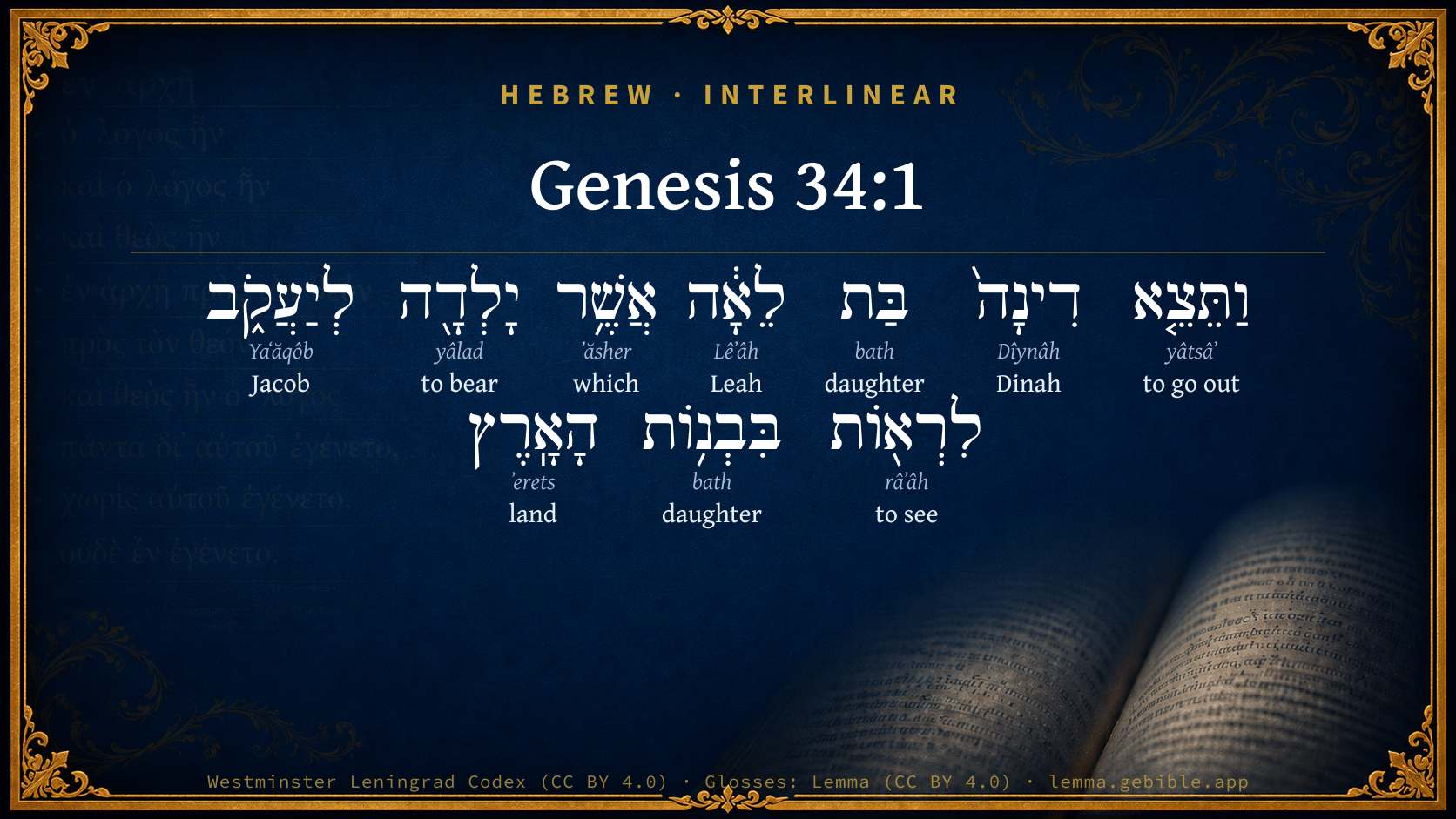
Genesis 34:1

Hebrew (Westminster Leningrad Codex) Genesis 34:1 appears in the Hebrew Old Testament. The text above is from the Westminster Leningrad Codex. Each word links to its Strong’s number, a concise gloss, and parsing drawn from the Open Scriptures Hebrew Bible morphology. Click any word for its full Brown-Driver-Briggs (BDB) entry.
Download image
Cite this verse

Genesis 34:1 (World English Bible). Public Domain. Lemma interlinear Bible study tool, https://lemma.gebible.app/v/genesis/34/1.

Show BibTeX & RIS
BibTeX
RIS
English Translation
Dinah, the daughter of Leah, whom she bore to Jacob, went out to see the daughters of the land.
World English Bible · Public Domain
Download a study sheet

One document with this verse’s original text, its word-by-word gloss line, the meaning frame, cross-references with their text, attributed commentary, and full source and license credits — printable, and it pastes into notes with its structure intact.

This verse Autodidact and up

Study sheet (.html) Plain text (.txt)

A passage Seminary Student

Up to 50 verses in one chapter. A passage sheet keeps up to 6 commentary sources and 12 cross-references per verse, in the order this page ranks them, and says so on the sheet whenever that leaves anything out. Ask for a single verse and you get the Autodidact verse sheet above.

Everything on this page stays free to read, with no account — the sheet is a download of what is already on screen, not access to it.

Want to remove ads? Support Godless Engineer
Compare translations 3

The same verse in 3 English versions, stacked beneath the original-language interlinear above. Click any original word for its lexicon entry.

Each is an independent rendering of the whole verse — the interlinear is not word-aligned to these translations.

Highlighted words mark where these versions differ — a whole-verse word diff, not a word-by-word alignment.

  • World English Bible Public Domain
    Dinah, the daughter of Leah, whom she bore to Jacob, went out to see the daughters of the land.
  • King James Version Public Domain
    And Dinah the daughter of Leah, which she bare unto Jacob, went out to see the daughters of the land.
  • unfoldingWord Literal Text CC BY-SA 4.0
    Then Dinah, the daughter of Leah, whom she had born for Jacob, went out to see the daughters of the land.

unfoldingWord Literal Text — © unfoldingWord, licensed CC BY-SA 4.0. Word-aligned USFM3 via Door43 (git.door43.org/unfoldingWord/en_ult).

Versions to compare (up to 4)

3 of 4 selected

Show all 18 translations

Every available English version of this verse, each an independent rendering of the whole verse.

  • World English Bible Public Domain
    Dinah, the daughter of Leah, whom she bore to Jacob, went out to see the daughters of the land.
  • Berean Standard Bible Public Domain
    Now Dinah, the daughter Leah had borne to Jacob, went out to visit the daughters of the land.
  • Majority Standard Bible Public Domain
    Now Dinah, the daughter Leah had borne to Jacob, went out to visit the daughters of the land.
  • King James Version Public Domain
    And Dinah the daughter of Leah, which she bare unto Jacob, went out to see the daughters of the land.
  • American Standard Version (1901) Public Domain
    And Dinah the daughter of Leah, whom she bare unto Jacob, went out to see the daughters of the land.
  • Revised Version (1885) Public Domain
    And Dinah the daughter of Leah, which she bare unto Jacob, went out to see the daughters of the land.
  • Geneva Bible (1599) Public Domain
    Then Dinah the daughter of Leah, which she bare vnto Iaakob, went out to see the daughters of that countrey.
  • Douay-Rheims (1899) Public Domain
    And Dina the daughter of Lia went out to see the women of that country.
  • Young's Literal Translation Public Domain
    And Dinah, daughter of Leah, whom she hath borne to Jacob, goeth out to look on the daughters of the land,
  • Literal Standard Version CC BY-SA 4.0
    And Dinah, daughter of Leah, whom she has borne to Jacob, goes out to look on the daughters of the land,
  • Unlocked Literal Bible CC BY-SA 4.0
    Now Dinah, Leah's daughter whom she bore to Jacob, went out to meet the young women of the land.
  • unfoldingWord Literal Text CC BY-SA 4.0
    Then Dinah, the daughter of Leah, whom she had born for Jacob, went out to see the daughters of the land.
  • Darby Bible Public Domain
    And Dinah the daughter of Leah, whom she had borne to Jacob, went out to see the daughters of the land.
  • World Messianic Bible Public Domain
    Dinah, the daughter of Leah, whom she bore to Jacob, went out to see the daughters of the land.
  • Webster's Bible Public Domain
    And Dinah the daughter of Leah, which she bore to Jacob, went out to see the daughters of the land.
  • Free Bible Version CC BY-SA 4.0
    Dinah, Jacob and Leah's daughter, went to visit some of the local women.
  • Bible in Basic English Public Domain
    Now Dinah, the daughter whom Leah had by Jacob, went out to see the women of that country.
  • JPS Tanakh (1917) Public Domain
    And Dinah the daughter of Leah, whom she had borne unto Jacob, went out to see the daughters of the land.

Literal Standard Version (2020), Covenant Press — licensed CC BY-SA 4.0. Text via the HelloAO Bible API (eBible.org). Unlocked Literal Bible (unfoldingWord) — licensed CC BY-SA 4.0. Text via the HelloAO Bible API (eBible.org). unfoldingWord Literal Text — © unfoldingWord, licensed CC BY-SA 4.0. Word-aligned USFM3 via Door43 (git.door43.org/unfoldingWord/en_ult). Free Bible Version, Dr. Jonathan Gallagher — licensed CC BY-SA 4.0. Text via the HelloAO Bible API (eBible.org).

Word by word

More ways to search: Search by grammar → Find every occurrence → Compare this word →

Practice this passage: Drill this verse → Learn its vocabulary →

About this verse

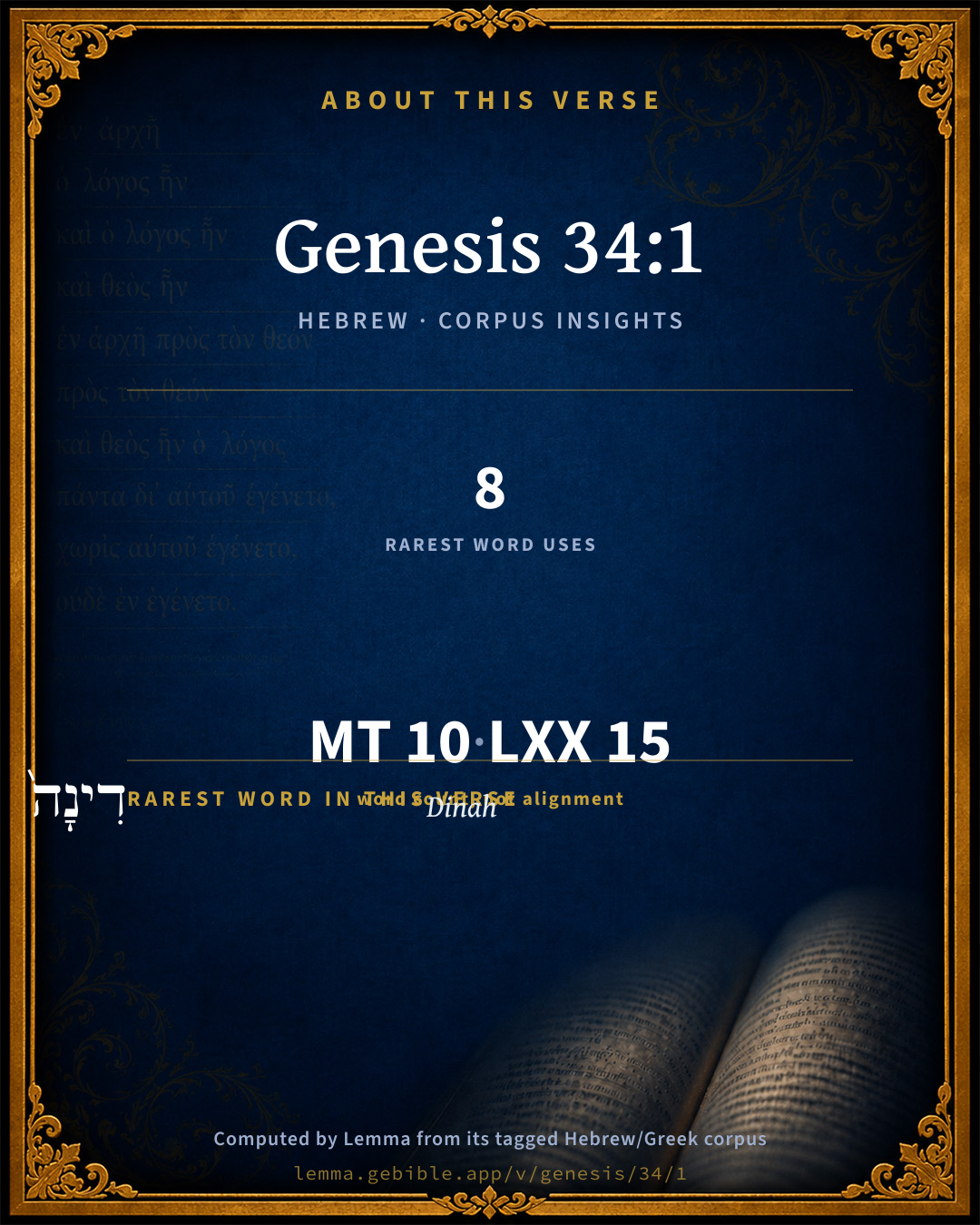
These counts appear in no published source. They are computed here, from the morphology-tagged text and Lemma’s own curated glosses. What Lemma adds →

10
words
9
distinct lemmas
Pentateuch
section

Notable vocabulary

The rarest word here is דִינָה֙ Dinah H1783 — appearing just 8 times in the whole Hebrew Bible.

Shared distinctive vocabulary

דִינָה֙ Dinah H1783 occurs in 8 verses of the Hebrew Bible. Also found in:

Grammatical profile

  • 3 verbs
  • 6 nouns
  • 1 particle

Verb forms

  • וַתֵּצֵ֤א Qal · Sequential Imperfect
  • יָלְדָ֖ה Qal · Perfect
  • לִרְא֖וֹת Qal · Infinitive Construct

Repetition

A word recurs within this verse — often emphatic in Hebrew:

  • בַּת daughter H1323 ×2

Hebrew & Septuagint length

In English translation the verse runs 19 words from the Hebrew and 20 from the Septuagint (LXX English) — closely comparable.

A rough comparison of the two English renderings, which tokenize alike — not a word-level alignment.

Word counts can differ between the Hebrew and the Greek without any difference in meaning — e.g. the Hebrew direct-object marker אֵת has no separate Greek word, and Greek often adds the article ὁ.

In the original languages it is 10 Hebrew tokens and 15 Greek tokens — but the two are counted differently (Hebrew bundles its prefixes and suffixes into one token; the Greek is in lemma form), so that isn’t a like-for-like length.

Cross-references

9

Topical passages linked to Genesis 34:1 in the Treasury of Scripture Knowledge — connected by theme and wording, ordered by reader-vote popularity; previews shown in the World English Bible.

  • Genesis 30:21 Afterwards, she bore a daughter, and named her Dinah.
  • Jeremiah 2:36 Why go you about so much to change your way? you shall be ashamed of Egypt also, as you were ashamed of Assyria.
  • Genesis 26:34 When Esau was forty years old, he took as wife Judith, the daughter of Beeri the Hittite, and Basemath, the daughter of Elon the Hittite.
  • Genesis 27:46 Rebekah said to Isaac, "I am weary of my life because of the daughters of Heth. If Jacob takes a wife of the daughters of Heth, such as these, of the daughters of the land, what good will my life do me?"
  • Genesis 28:6 Now Esau saw that Isaac had blessed Jacob and sent him away to Paddan Aram, to take him a wife from there, and that as he blessed him he gave him a charge, saying, "You shall not take a wife of the daughters of Canaan,"
  • Genesis 30:13 Leah said, "Happy am I, for the daughters will call me happy." She named him Asher.
  • Genesis 46:15 These are the sons of Leah, whom she bore to Jacob in Paddan Aram, with his daughter Dinah. All the souls of his sons and his daughters were thirty-three.
  • 1 Timothy 5:13 Besides, they also learn to be idle, going about from house to house. Not only idle, but also gossips and busybodies, saying things which they ought not.
  • Titus 2:5 to be sober-minded, chaste, workers at home, kind, being in subjection to their own husbands, that God's word may not be blasphemed.

Cross-references courtesy of OpenBible.info (CC BY 4.0).

Hebrew and Greek witnesses Masoretic Hebrew ↔ Greek Septuagint

The same verse in the two great witnesses to the Old Testament, shown verse-for-verse.

These are two independent witnesses, not word-aligned to each other, and the Septuagint is shown in lemma (dictionary) form.

Hebrew Genesis 34:1 Masoretic · Westminster Leningrad Codex

וַתֵּצֵ֤א דִינָה֙ בַּת לֵאָ֔ה אֲשֶׁ֥ר יָלְדָ֖ה לְיַעֲקֹ֑ב לִרְא֖וֹת בִּבְנ֥וֹת הָאָֽרֶץ

Dinah, the daughter of Leah, whom she bore to Jacob, went out to see the daughters of the land.

World English Bible · Public Domain

Greek LXX Genesis 34:1 Septuagint · lemma form

ἐκἔρχομαι δέ δινα ὁ θυγάτηρ λεια ὅς τίκτω ὁ ἰακώβ καταμανθάνω ὁ θυγάτηρ ὁ ἐγχώριος

And Dina, the daughter of Lea, whom she bore to Jacob, went forth to observe the daughters of the inhabitants.

LXX2012 (modern English Septuagint) · Public Domain

On this verse, John Gill's Exposition discusses the Septuagint’s reading. Read the note in Commentary ↓

Hebrew: Westminster Leningrad Codex (CC BY 4.0). Greek: Septuagint (public domain); English from LXX2012 (modern English Septuagint) (Public Domain). How the Septuagint differs from the Hebrew →

Targum (Aramaic paraphrase)

2

The Targum is the ancient Jewish Aramaic paraphrase of the Hebrew Scriptures — an interpretive translation, not the Hebrew text itself. Onkelos (literal) and Pseudo-Jonathan (expansive) render the Torah, and Jonathan the Prophets. Coverage is partial: where no permissively-licensed English translation exists for a verse, only the Aramaic is shown. This is verse-level text, not a word-by-word alignment to the Hebrew.

  1. Targum Onkelos Torah (Genesis–Deuteronomy)
    וּנְפָקַת דִּינָה בַּת לֵאָה דִּי יְלִידַת לְיַעֲקֹב לְמֶחֱזֵי בִּבְנַת אַרְעָא

    (no public-domain English translation for this verse)

    Targum Onkelos — Aramaic: “Onkelos Genesis” (public domain); “Onkelos Exodus” (public domain); “Onkelos Leviticus” (public domain); “Onkelos Numbers” (public domain); “Onkelos Deuteronomy” (public domain). English: “Sefaria Community Translation” (CC0 1.0 (public-domain dedication)); “J.W. Etheridge. The Targums of Onkelos and Jonathan Ben Uzziel on the Pentateuch. London: Longmans, Green, 1862” (public domain). Text via Sefaria.

  2. Targum Pseudo-Jonathan Torah (Genesis–Deuteronomy)
    וּנְפָקַת דִינָה בְּרַת לֵאָה דִי יְלִידַת לְיַעֲקב לְמֵיחְמֵי בְּנִימוּס בְּנַת עַמֵי אַרְעָא

    And Dinah the daughter of Leah whom she bare to Jakob, went forth to see the manners of the daughters of the people of the land.

    Targum Pseudo-Jonathan — Aramaic: “Targum Jonathan on Genesis” (public domain); “Targum Jonathan on Exodus” (public domain); “Targum Jonathan on Leviticus” (public domain); “Targum Jonathan on Numbers” (public domain); “Targum Jonathan on Deuteronomy” (public domain). English: “The Targum of Jonathan ben Uzziel, trans. J. W. Etheridge, London, 1862” (public domain). Text via Sefaria.

Commentary

Notes on Genesis 34:1 from classic Christian and Jewish commentators (each source and its license shown beneath its notes). The classic Christian expositions comment on the surrounding passage and are grouped to its opening verse, so a note may address several verses; the Jewish commentaries on the Tanakh (Rashi and others) are per-verse, so they appear only where the commentator wrote on this verse.

Lemma curates 59 commentaries, every one of them public domain or Creative Commons licensed, each selected and text-cleaned for this edition rather than reprinted as found. About our sources →

Matthew Henry's Commentary

Dinah was, for aught that appears, Jacob's only daughter, and we may suppose her therefore the mother's fondling and the darling of the family, and yet she proves neither a joy nor a credit to them; for those children seldom prove either the best or the happiest that are most indulged. She is reckoned now but fifteen or sixteen years of age when she here occasioned so much mischief. Observe, 1. Her vain curiosity, which exposed her. She went out, perhaps unknown to her father, but by the connivance of her mother, to see the daughters of the land (Gen 34:1); probably it was at a ball, or on some public day. Being an only daughter, she thought herself solitary at home, having none of her own age and sex to converse with; and therefore she must needs go abroad to divert herself, to keep off melancholy, and to accomplish herself by conversation better than she could in her father's tents. Note, It is a very good thing for children to love home; it is parents' wisdom to make it easy to them, and children's duty then to be easy in it. Her pretence was to see the daughters of the land, to see how they dressed, and how they danced, and what was fashionable among them. She went to see, yet that was not all, she went to be seen too; she went to see the daughters of the land, but, it may be, with some thoughts of the sons of the land too. I doubt she went to get an acquaintance with those Canaanites, and to learn their way. Note, The pride and vanity of young people betray them into many snares. 2. The loss of her honour by this means (Gen 34:2): Shechem, the prince of the country, but a slave to his own lusts, took her, and lay with her, it should seem, not so much by force as by surprise. Note, Great men think they may do any thing; and what more mischievous than untaught and ungoverned youth? See what came of Dinah's gadding: young women must learn to be chaste, keepers at home; these properties are put together, Tit 2:5, for those that are not keepers at home expose their chastity. Dinah went abroad to look about her; but, if she had looked about her as she ought, she would not have fallen into this snare. Note, The beginning of sin is as the letting forth of water. How great a matter does a little fire kindle! We should therefore carefully avoid all occasions of sin and approaches to it. 3. The court Shechem made to her, after he had defiled her. This was fair and commendable, and made the best of what was bad; he loved her (not as Amnon, Sa2 13:15), and he engaged his father to make a match for him with her, Gen 34:4. 4. The tidings brought to poor Jacob, Gen 34:5. As soon as his children grew up they began to be a grief to him. Let not godly parents, that are lamenting the miscarriages of their children, think their case singular or unprecedented. The good man held his peace, as one astonished, that knows not what to say: or he said nothing, for fear of saying amiss, as David (Psa 39:1, Psa 39:2); he smothered his resentments, lest, if he had suffered them to break out, they should have transported him into any decencies. Or, it should seem, he had left the management of his affairs very much (too much I doubt) to his sons, and he would do nothing without them: or, at least, he knew they would make him uneasy if he did, they having shown themselves, of late, upon all occasions, bold, forward, and assuming. Note, Things never go well when the authority of a parent runs low in a family. Let every man bear rule in his own house, and have his children in subjection with all gravity.

Matthew Henry's Commentary on the Whole Bible (1708–1710) — public domain (CC PDM 1.0). Text via the HelloAO Bible API.

Trapp's Complete Commentary

John Trapp

Gen 34:1 And Dinah the daughter of Leah, which she bare unto Jacob, went out to see the daughters of the land.

Ver. 1. Went out to see the daughters of the land.] Who went abroad at this time, with timbrels, to play, say the Hebrews; kept a solemn feast, saith Josephus. Hence Dinah’s desire to see them. But what saith St Bernard? Si tu otiose spectas, otiose non spectaris: tu curiose spectas, sed curiosius spectaris. Dinah’s wanton gadding, and gazing on others, gave occasion to the adulterer to look and lust after her. See the fruit of her needless getting abroad to see fashions and novelties. The name of a virgin, in the original tongues, {a} is derived from the house hiding; shadow; locked treasure; apple of the eye: to teach them to refrain ill company, and idle gadding. Young women are taught "to be keepers at home". {Tit 2:5} As when they come abroad among men, they must be, if not veiled, as at Venice, yet clothed, and in their right minds, as that demoniac in Luk 8:35. And this not only in winter, that they take no cold; but in the summer, that others take no heat from them, - which may rather burn them, than warm them, - as Shechem here did.

{a} בתולת; of בת a house; עלמה; of עלם to hide; טליתא; of טלל to shadow. Pαρθενος; of παραθειναι, to lay up. Kορη, a virgin, and the apple of thc eye.

John Trapp, A Commentary or Exposition upon All the Books of the Old and New Testament (1647–1656) — public domain. Text from a community e-Sword module.

Albert Barnes' Notes on the Bible

- Dinah’s Dishonor

This chapter records the rape of Dinah and the revenge of her brothers.

Gen 34:1-5

Dinah went out to see the daughters of the land. The Jewish doctors of a later period fix the marriageable age of a female at twelve years and a day. It is probable that Dinah was in her thirteenth year when she went out to visit the daughters of the land. Six or seven years, therefore, must have been spent by Jacob between Sukkoth, where he abode some time, and the neighborhood of Shekerm, where he had purchased a piece of ground. If we suppose Dinah to have been born in the same year with Joseph, who was in his seventeenth year at the time of his being sold as a bondslave Gen 37:2, the events of this chapter must have occurred in the interval between the completion of her twelfth and that of her sixteenth year. “Shekem.” This name is hereditary in the family, and had taken hold in the locality before the time of Abraham. The Hivite was a descendant of Kenaan. We find this tribe now occupying the district where the Kenaanite was in possession at a former period Gen 12:6. “Spake to the heart of the damsel.” After having robbed her of her honor, he promises to recognize her as his wife, provided he can gain the consent of her relatives. “Shekem spake unto his father Hamor.” He is in earnest about this matter. “Jacob held his peace.” He was a stranger in the land, and surrounded by a flourishing tribe, who were evidently unscrupulous in their conduct.

Gen 34:6-17

A conference takes place between the parties. Hamer and Jacob, the parents on both sides, are the principals in the negotiation. The sons of Jacob, being brothers of the injured damsel, are present, according to custom. “Wrought fully in Israel;” a standing phrase from this time forward for any deed that was contrary to the sanctity which ought to characterize God’s holy people. Israel is used here to designate the descendants of Israel, the special people. Hamer makes his proposal. “Shekem, my son.” These words are a nominative pendent, for which “his soul” is substituted. He proposes a political alliance or amalgamation of the two tribes, to be sealed and actually effected by intermarriage. He offers to make them joint-possessors of the soil, and of the rights of dwelling, trading, and acquiring property. Shekem now speaks with becoming deference and earnestness.

He offers any amount of dowry, or bridal presents, and of gift to the mother and brothers of the bride. It must be acknowledged that the father and the son were disposed to make whatever amends they could for the grievous offence that had been committed. The sons of Jacob answer with deceit. They are burning with resentment of the wrong that “ought not to have been done,” and that cannot now be fully repaired. Yet they are in presence of a superior force, and therefore, resort to deceit. “And spake.” This goes along with the previous verb “answered,” and is meant to have the same qualification “with deceit.” The last clause of the verse then assigns the cause of this deceitful dealing. Their speech, for the matter of it, is reasonable. They cannot intermarry with the uncircumcised. Only on condition that every male be circumcised will they consent. On these terms they promise to “become one people” with them. Otherwise they take their daughter, and depart. Our daughter. They here speak as a family or race, and therefore, call Dinah their daughter, though her brothers are the speakers.

Gen 34:18-24

Hamor and Shekem accept the terms, and immediately proceed to carry them into effect. It is testified of Shekem, that he delayed not to do the thing, and that he was more honorable than all his house. They bring the matter before their fellow-citizens, and urge them to adopt the rite of circumcision, on the ground that the men are peaceable, well-conducted, and they and their cattle and goods would be a valuable addition to the common wealth of their tribe. Hence, it appears that the population was still thin, that the neighboring territory was sufficient for a much larger number than its present occupants, and that a tribe found a real benefit in an accession to his numbers. The people were persuaded to comply with the terms proposed. There is nothing said here of the religious import of the rite, or of any diversity of worship that may have existed between the two parties. But it is not improbable that the Shekemites were prepared for mutual toleration, or even for the adoption of the religion of Israel in its external forms, though not perhaps to the exclusion of their own hereditary customs. It is also possible that the formal acknowledgment of the one true God was not yet extinct. Circumcision has been in use among the Egyptians, Colchians (Herodotus ii. 104), and other eastern nations; but when and how introduced we are not informed. The present narrative points out one way in which it may have spread from nation to nation.

Gen 34:25-31

Simon and Levi, at the head no doubt of all their father’s men, now fall upon the Shekemites, when feverish with the circumcision, and put them to the sword. Simon and Levi were the sons of Leah, and therefore, full brothers of Dinah. If Dinah was of the same year as Joseph, they would be respectively seven and six years older than she was. If she was in her thirteenth year, they would therefore, be respectively in their twentieth and nineteenth years, and therefore, suited by age and passion for such an enterprise. All the sons of Jacob joined in the sacking of the city. They seized all their cattle and goods, and made captives of their wives and little ones. Jacob is greatly distressed by this outrage, which is equally contrary to his policy and his humanity. He sets before his sons, in this expostulation, the danger attendant upon such a proceeding. The “Kenaanite and the Perizzite,” whom Abraham found in the land on his return from Egypt Gen 13:7. “I am a few men” - men of number that might easily be counted. I here denotes the family or tribe with all its dependents. When expanded, therefore, it is, “I and my house.” Simon and Levi have their reply. It justifies the retribution which has fallen on the Shekemites for this and all their other crimes. But it does not justify the executioners for taking the law into their own hands, or proceeding by fraud and indiscriminate slaughter. The employment of circumcision, too, which was the sign of the covenant of grace, as a means of deception, was a heinous aggravation of their offence.

Albert Barnes' Notes on the Bible (1834–1885) — public domain. Text from a community e-Sword/MySword module.

The Biblical Illustrator

Joseph S. Exell

Gen_34:1-5

Dinah the daughter of Leah . . . went out to see

Dinahs inglorious march

I.

SHE CAME.

II. SHE SAW.

III. SHE WAS CONQUERED. (J. Henry Burn, B. D.)

Dinahs dishonour

I. THAT THERE IS GREAT DANGER IN A VAIN CURIOSITY OF SEEING THE WORLD. Dinah was curious to know the ways and customs of the surrounding people. This led to a careless intimacy, which ended in accomplishing her ruin. She ought not to have wandered beyond parental control and supervision, nor disregarded the duty of separation from an idolatrous people, and their manners and habits. Evil communications corrupt good manners. The inhabitants of that country were to the family of Jacob what the present world is to the Christian. It is dangerous to the interests of the soul to indulge in the vain curiosity of knowing the evil ways of the world. What is called seeing life may prove, in many cases, to be but tasting death. Familiarity blunts the sense of things sinful, and increases the danger of temptation.

II. THAT SOME SENTIMENT OF VIRTUE MAY REMAIN IN THOSE ADDICTED TO THE WORST SOCIAL VICES. Shechem, we are told, loved the damsel, and spake kindly unto the damsel. He was willing to make honourable amends, as far as could be, by an offer of marriage. In this he was generous and noble, for lust commonly ends in loathing. Amnon abhors Tamar as before he loved her. But this man desires to cover his fault by marriage, and promises low and fidelity. He had many of the vices of the great and powerful, but was not without some remains of virtue. The conduct of this heathen man is a rebuke to many who dwell in Christian lands.

III. THAT INCREASING TROUBLES MAY FALL TO THE LOT OF GOOD MEN. Jacob now suffered one of the most dreadful calamities that can fall upon a household--the disgrace and ruin of his daughter. When he heard of it he held his peace, as if stunned by the blow (Gen_34:5). (T. H. Leale.)

Dinahs curiosity

As her mother Leah, so she hath a fault in her eyes, which was curiosity. She will needs see, and be seen; and whilst she doth vainly see, she is seen lustfully. It is not enough for us to look to our own thoughts, except we beware of the provocations of others. If we once wander out of the lists that God hath set us in our callings, there is nothing but danger. Her eyes were guilty of the temptation; only to see is an insufficient r arrant to draw us into places of spiritual hazard. If Shechem had seen her busy at home, his love had been free from outrage; now the lightness of her presence gave encouragement to his inordinate desires. Immodesty of behaviour makes way to lust, and gives life unto wicked hopes. (Bishop Hall.)

The eyes a source of danger

By those windows of the eyes and ears sin and death often enter. See to the cinque ports if ye would keep out the enemy. Shut up the five windows if ye would have the house, the heart, full of light, saith the Arabian proverb. (J. Trapp.)

Lessons

1. Sad occurrences may be ordered to saints while they sit by Gods altar. Worship is not without trial.

2. Religious care of God misplaced doth not exempt parents and children from sad temptations. Jacob worshipped by Shalem, not at Bethel.

3. Mothers sins Providence may hit in daughters miscarriages.

4. The children of saints, and specially daughters, may be occasion of great affliction to parents.

5. Wilfulness and wantonness urge on young souls to their own mischief, and grief of parents.

6. Unruly appetites to know the fashions and vain courses of others bring many souls into grievous snares.

7. Vain sights and spectacles in revels and wanton garbs may occasion loss of purity (Gen_34:1). (G. Hughes, B. D.)

Lessons

1. Great mens children are not usually the best; but vile and debauched. So Shechem the son of a prince.

2. Sons of great men are apt to think they may sin by authority; being not restrained.

3. It is a dangerous thing for an innocent damsel to come under the eye of lascivious men.

4. Lustful sight of beauty moveth hearts to take hold of opportunities to enjoy 2:5. Lust holds fast of its prey, will certainly close with it, humble, and afflict it (Gen_2:2).

6. Lust layeth out the very soul of man upon its prey desired.

7. Unclean love is the usual fruit of violent and injurious lust.

8. Lust will speak to the heart of any whom it may tempt unto unclean enjoyment (Gen_2:3).

9. Brutish lust cannot deny the parents right in ordering children unto marriage.

10. Lust itself will desire Gods ordinance of marriage for its own vile ends (Gen_2:4). (G. Hughes, B. D.)

Lessons

1. Sad tidings of childrens miscarriages and miseries may be brought to gracious parents.

2. Reports and hearing of evil, especially in dear children, strikes deep, through ears, to the hearts of parents.

3. Shechems violence upon Dinah, or of wicked me-, upon the daughters of the Church, is very sad.

4. Such evils may befall relations while they are honestly employed, and think not of it.

5. Silence in grieving, considering, and bearing such providences, becometh saints.

6. Silence of grieved spirits may well be broken off, when such are present whom they may consult for ease (Gen_34:5). (G. Hughes, B. D.)

Dinahs fall

It is a startling announcement; but it contains nothing more than might have been expected. Poor girl, a moth fluttering about a flame! A foolish fish nibbling at the bait! Was she lonely, being the only girl? Did she want to show off some piece of jewellery or dress? Did she long for more admiration, or fascinating society, than she could find at home? Was there a secret drawing to the young men of the place? She went along a path that seemed to her girlish fancy ever so much more attractive than the dull routine of home. She took no heed of the warnings that may have been addressed to her. And it all ended--as it has ended in thousands of cases since--in misery, ruin, and unutterable disgrace. She was kindly received. The world will always give a hearty welcome to those who bear a Christian name. Perhaps there is a sense of relief in feeling that it cannot be so bad after all, since Christians do not hesitate to take part with it. The welcome and well-done of worldly men should always put us on our guard. What evil thing have I done, said s shrewd observer, that yonder worldling speaks so well of me? She fascinated the young prince, and fell. It is the old, old story, which is ever new. On the one hand-rank, and wealth, and unbridled appetite; on the other--beauty, weakness, and dallying with temptation. But to whom was her fall due? To Shechem? Yes. To herself? Yes. But also to Jacob. He must for ever reproach himself for his daughters murdered innocence. But of what use were his reproaches, when the deed was done; and the honour of his house was gone; and his name stank among the inhabitants of the land?. Would that some Christian parents, reading these words, might take warning as to the end of a pathway:on which they are encouraging their children to tread! To stay now may save them tears of blood, and years of fruitless agony. (F. B.Meyer, B. A.)

Caution to young people

It is natural to suppose that the younger branches of the family, hearing everything that was going on among the youth of the place, would think it hard if they must not go amongst them. Whether the sons formed acquaintances among the Shechemites, we know not; but Dinah on a certain occasion must needs go out to see the daughters of the land. She wished no doubt to be acquainted with them, to see and be seen of them, and to do as they did. It might not be to a ball, nor a card party; but I presume it was to some merrymaking of this kind: and though the daughters of the land were her professed companions, yet the sons of the land must have assembled with them, else how came Shechem there? Young people, if you have any regard for your parents, or for yourselves, beware of such parties! The consequence was what might have been expected. Shechem was the son of the prince of the country, and men of rank and opulence are apt to think themselves entitled to do anything which their inclinations prompt them to. The young woman was inexperienced, and unused to company of this kind; she therefore fell an easy prey to the seducer. But could Dinah have gone without the consent or connivance of her parents, at least one of them? We should think she could not. I fear Leah was not clear in this matter. (A. Fuller.)

Caution to parents

If Jacob had not settled at Shechem, Dinah would not have been dishonoured, and the violence of his sons would not have been exhibited. We constantly see Christians getting into deep sorrow and trouble through their own unfaithfulness; and then, instead of judging themselves, they begin to look at circumstances, and to cast upon them the blame. Hew often do we see Christian parents, for instance, in keen anguish of soul about the wildness, unsubduedness, and worldliness of their children; and, all the while, they have mainly to blame themselves for not walking faithfully before God in reference to their family. Thus was it with Jacob. He was on low moral ground at Shechem; and, inasmuch as he lacked that refined sensibility which would have led him to detect the low ground, God, in very faithfulness, used his circumstances to chastise him. God is not mocked, for whatsoever a man soweth that shall he also reap. This is a principle flowing out of Gods moral government-a principle, from the application of which none can possibly escape; and it is a positive mercy to the children of God that they are obliged to reap the fruits of their errors. It is a mercy to be taught, in any way, the bitterness of departing from, or stopping short of, the living God. We must learn that this is not our rest; for, blessed be God, He would not give us a polluted rest. He would ever have us resting in and with Himself. (C. H. M.)

Dinah

Inferences hence are various.

1. The most pious and faithful families may have most fearful mischiefs befall them, as Jacobs had here and elsewhere, and Davids many afterwards. The worst miscarriages, through Satans malice, may happen in the best families.

2. The second inference is, such foul miscarriages fall not out in such godly families but usually there is some sin or other therein, which justly vindicates Gods righteousness in permitting such severe judgments to befall them. And it is apparent too in Jacobs case, when this first miscarriage in his house came upon him. It was now some seven or eight years since the Lord brought him back from Haran or Padanaram, yet had he not all this time thought of paying that vow which he made to God when he was going thither (Gen_28:20, &c.)

3. The third inference is, all needless gaddings abroad are of dangerous consequence to young people, who are unfit to be wholly at their own finding; especially the weaker sex, which may prove strong enough to provoke, but over-weak to resist a temptation.

4. The fourth inference is, if this mischievous miscarriage happened to Jacobs house through the indulgence of the mother in too much cockering her dear and only daughter, this sounds a loud alarm to all over-fond mothers, whose over-strong affections will probably bring over-strong afflictions. And where they do love too much, they may possibly grieve too much; as Leah here, who might read her sin writ upon her punishment. (C. Ness.)

Dinah

Not without reason had Dinah been mentioned previously among the children of Leah (Gen_30:21); she was intended to be the first cause of her fathers sorrow. An interval of six or eight years elapsed between the departure from Mesopotamia and the event here narrated; Dinah had become a blooming maiden; she had reached that age when Oriental virgins attain the full charm of their beauty. During that tong sojourn in Shechem, she formed friendships with the daughters of the natives, and had entered with them into social intercourse. Was this conduct culpable? Was it an offence deserving punishment? It almost appears that it was regarded as such; for she became both an object of violence and the cause of massacre; and, in Biblical history, there exists no misfortune without corresponding guilt. Dinah had preserved in her mind the vocation of her family; she did not comprehend that a perfect separation was indispensable from idolatrous tribes, whose moral reformation could not be expected, whose pernicious example could only infect the Hebrews, and whose doom was sealed on account of their iniquity. She paid the full penalty of her carelessness. She suffered the fate which Sarah and Rebekah encountered in the land of Pharaoh and of Abimelech; she was seen and taken by the son of the prince; but no angel guarded her innocence; no Divine vision shielded her from disgrace; and she fell a victim to Shechems passion. She did not require that immediate protection which her ancestors had enjoyed; she was a maiden, no wife; her father possessed a piece of land within which he was safe; and she belonged to a numerous family well capable of defending their rights. But Shechem was neither licentious nor frivolous; though he had been ensnared by passion, his heart was not debased, and he was ready to make the only reparation which the circumstances permitted; he loved Dinah; his soul clung to her, and he spoke to her heart; he endeavoured to secure her affection, and wished to make her his legitimate wife; he therefore asked his father to treat for him, and to solicit the consent of her family. (M. M.Kalisch, Ph. D.)

The Biblical Illustrator, edited by Joseph S. Exell (c. 1880s–1900s) — public domain. Text from a community e-Sword module.

Joseph Benson's Commentary

Gen 34:1. Dinah, the daughter of Leah, went out — From her father’s house into the city, out of curiosity, there being then, as Josephus asserts, (Ant., lib. 50. c. 20,) a great concourse of people to a feast. It does not appear that she asked, much less obtained, her father’s consent in this: but, to gratify her foolish fancy, put herself out of his protection, and exposed both herself and others to temptation, and that among persons who had no fear of God to restrain them from the most enormous crimes. “She went to see; yet that was not all,” says Henry, “she went to be seen too. She went to see the daughters of the land, but it may be, with some thoughts of the sons of the land too.” It is supposed that she was now only about fifteen or sixteen years of age.

Joseph Benson's Commentary on the Old and New Testaments (1811–1818) — public domain. Text from a community e-Sword module.

The Preacher's Complete Homiletical Commentary

Joseph S. Exell (gen. ed.)

CRITICAL NOTES.—

Gen_34:1. To see the daughters of the land.] To make their acquaintance—to pay them a friendly visit.

Gen_34:3. He loved the damsel, and spake kindly unto the damsel.] Heb. “He loved the damsel and spake to her heart.” The idea seems to be conveyed that he endeavoured to comfort her by promising marriage and fidelity.

MAIN HOMILETICS OF THE PARAGRAPH.—Gen_34:1-5

DINAH’S DISHONOUR

Illustrates the following truths—

I. That there is great danger in a vain curiosity of seeing the world. Dinah was curious to know the ways and customs of the surrounding people. This led to a careless intimacy, which ended in accomplishing her ruin. She ought not to have wandered beyond parental control and supervision, nor disregarded the duty of separation from an idolatrous people, and their manners and habits. “Evil communications corrupt good manners.” The inhabitants of that country were to the family of Jacob what the present world is to the Christian. It is dangerous to the interests of the soul to indulge in the vain curiosity of knowing the evil ways of the world. What is called “seeing life” may prove, in many cases, to be but tasting death. Familiarity blunts the sense of things sinful, and increases the danger of temptation.

II. That some sentiment of virtue may remain in those addicted to the worst social vices. Shechem, we are told, “loved the damsel, and spake kindly unto the damsel.” He was willing to make honourable amends, as far as could be, by an offer of marriage. In this he was generous and noble, for lust commonly ends in loathing. Ammon abhors Thamar as before he loved her. But this man desires to cover his fault by marriage, and promises love and fidelity. He had many of the vices of the great and powerful, but was not without some remains of virtue. The conduct of this heathen man is a rebuke to many who dwell in Christian lands.

III. That increasing troubles may fall to the lot of good men. Jacob now suffered one of the most dreadful calamities that can fall upon a household—the disgrace and ruin of his daughter. When he heard of it, he “held his peace,” as if stunned by the blow. (Gen_34:5). He was a man greatly favoured of God. He had seen the open vision of heaven. God had promised to be his God, and to be with him to the end of his days. He had made and performed his vows. He had erected his altar. Here was a man raised in spiritual priviliges above all men, and yet the gathering clouds of adversity surround him, and grow more dark and gloomy towards the close of his life. He had been delivered from foreign troubles, and now domestic troubles fall upon him. The honour of his family was laid in the dust. All sorts of complications of distress fell to the lot of this good man. As a son, servant, husband, father; in youth, manhood, and in old age, he is afflicted beyond the lot of most men. When one difficulty is surmounted, another, and a greater one, arises. No wonder the poor old man sums up his life, at the end, by saying, “All these things are against me.”

SUGGESTIVE COMMENTS ON THE VERSES

Gen_34:1-2. As her mother Leah, so she hath a fault in her eyes, which was curiosity. She will needs see, and be seen; and whilst she doth vainly see, she is seen lustfully. It is not enough for us to look to our own thoughts, except we beware of the provocations of others. If we once wander out of the lists that God hath set us in our callings, there is nothing but danger. Her eyes were guilty of the temptation; only to see is an insufficient warrant to draw us into places of spiritual hazard. If Shechem had seen her busy at home, his love had been free from outrage; now the lightness of her presence gave encouragement to his inordinate desires. Immodesty of behaviour makes way to lust, and gives life unto wicked hopes.—(Bishop Hall.)

By those windows of the eyes and ears sin and death often enter. See to the cinque ports if ye would keep out the enemy. Shut up the five windows if ye would have the house, the heart, full of light, saith the Arabian proverb.—(Trapp.)

It seemed an innocent action to go, out of mere curiosity, to see the daughters of the land. But in relalation to morals there are scarcely any actions that are trifling and insignificant.

Gen_34:3-4.—And now he goes about to entertain her with honest love, whom the rage of his lust had dishonestly abused. He will hide her dishonour with the name of an husband. Those actions which are ill begun can hardly be salved up with late satisfactions; whereas good entrances give strength unto the proceedings, and succcess to the end.—(Bp. Hall.)

The sequel shows that nothing could retrieve the mischief of the first false step. A willingness to make amends for sin will not avert its legitimate consequences.—(Bush.)

Gen_34:5. It is not meant that he was entirely silent, saying nothing about it in his family, which would have been inconceivable under the circumstances; but that he took no measures in respect to it, he forbore all action. He did not foresee the issue, or he would probably have taken the affairs into his own hands, and acted upon it at once. As it was, however, he did better in thus “ruling his spirit,” than did his sons who took the city. (Pro_16:32.)—(Bush.)

The Preacher's Complete Homiletical Commentary (gen. ed. Joseph S. Exell; Funk & Wagnalls, c. 1892) — public domain (pre-1929). A full-Bible homiletical/sermon-outline anthology covering 65 of 66 books (2 John is absent from the source module). Text from a community e-Sword module.

The Annotated Bible

Arno C. Gaebelein

CHAPTER 34 Defilement of Dinah

1. The defilement (Gen 34:1-3)

2. Hamor’s proposal (Gen 34:4-12)

3. The deceitful answer of Jacob’s sons (Gen 34:13-24)

4. The males of Shechem slain (Gen 34:25-29)

5. Jacob’s shame and grief (Gen 34:30-31)

If Jacob after the Peniel experience had gone to Bethel instead of building a house at Succoth and buying a parcel of a field, perhaps this sad event might never have occurred. God permitted it for the humiliation of His servant Jacob. Again he reaps what he had sown and the deceit of the father is reflected in the deceit of some of his sons.

Arno C. Gaebelein, The Annotated Bible (1913–1922) — public domain. Text from a community e-Sword module.

Tyndale Open Study Notes

Tyndale Open Resources

34:1-31 Once Jacob and his family settled in the land, the Canaanite presence became a threat. This account is a stern warning to the Israelites about the possibility of their being defiled by the Canaanites. The nation of Israel was later commanded not to intermarry or make treaties with them, for they were a corrupt and corrupting people. This chapter implicitly warns against becoming familiar with the way they lived (34:1-2). It also taught Israel that in dealing with the Canaanites, they were to keep their integrity and not use the holy things of the covenant for deception and slaughter (34:13); Israel’s reputation was at stake in the land (34:30). For their ruthless violence, Simeon and Levi were passed over in the birthright blessing (49:5-7).

34:1-2 As far as we know, Dinah was Jacob’s only daughter (30:21). • Shechem . . . seized her and raped her: Shechem violated and debased Dinah, so she had no chance for a proper marriage.

Tyndale Open Study Notes — © Tyndale Open Resources, licensed CC BY-SA 4.0. Text via the HelloAO Bible API.

Geneva Bible (1599)

Geneva Bible translators

This example teacheth us that too much liberty is not to be given to youth.

Geneva Bible (1599) marginal notes — public domain. Text via Bolls.life.

Adam Clarke's Commentary

CHAPTER XXXIV.

Dinah, the daughter of Jacob and Leah, going out to

see the daughters of the land, is ravished by Shechem,

the son of Hamor, 1, 2.

He entreats his father to get her for him to wife, 3.

Jacob and his sons hear of the indignity offered to Dinah, 5-7.

Hamor proposes the suit of Shechem to Jacob and his sons, and

offers them a variety of advantages, 8-10.

Shechem himself comes forward, begs to have Dinah to wife, and

offers dowry to any extent, 11, 12.

The sons of Jacob pretend scruples of conscience to give their

sister to one who was uncircumcised; and require, as a condition

of this marriage, and of intermarriages in general, that all the

Shechemites should be circumcised, 13-17.

Hamor and Shechem consent, 18, 19.

They lay the business before the elders of their city, dwell on

the advantages of a connection with Jacob and his family, and

propose to them the condition required by the sons of Jacob, 20-23.

The elders consent, and all the males are circumcised, 24.

While the Shechemites are incapable of defending themselves, on

the third day after their circumcision, Simeon and Levi, the

brothers of Dinah, came upon the city, slew all the males,

sacked the city, took the women and children captives, and

seized on all the cattle belonging to the Shechemites, 25-29.

Jacob is greatly displeased and alarmed at this treachery and

cruelty of his sons, and lays before them the probable

consequences, 30.

They endeavour to vindicate their conduct, 31.

NOTES ON CHAP. XXXIV

Verse 1. And Dinah - went out to see the daughters of the land.] It is supposed that Jacob had been now about seven or eight years in the land, and that Dinah, who was about seven years of age when Jacob came to Canaan, was now about fourteen or fifteen. Why or on what occasion she went out we know not, but the reason given by Josephus is very probable, viz., that it was on one of their festivals.

Adam Clarke's Commentary on the Bible (1810–1826) — public domain. Text from a community e-Sword/MySword module.

John Calvin's Commentaries

1. And Dinah... went out. This chapter records a severe contest, with which God again exercised his servant. How precious the chastity of his daughter would be to him, we may readily conjecture from the probity of his whole life. When therefore he heard that she was violated, this disgrace would inflict the deepest wound of grief upon his mind: yet soon his grief is trebled, when he hears that his sons, from the desire of revenge, have committed a most dreadful crime. But let us examine everything in order. Dinah is ravished, because, having left her father’s house, she wandered about more freely than was proper. She ought to have remained quietly at home, as both the Apostle teaches and nature itself dictates; for to girls the virtue is suitable, which the proverb applies to women, that they should be (οἰκουροὶ,) or keepers of the house. Therefore fathers of families are taught to keep their daughters under strict discipline, if they desire to preserve them free from all dishonor; for if a vain curiosity was so heavily punished in the daughter of holy Jacob, not less danger hangs over weak virgins at this day, if they go too boldly and eagerly into public assemblies, and excite the passions of youth towards themselves. For it is not to be doubted that Moses in part casts the blame of the offense upon Dinah herself, when he says, “she went out to see the daughters of the land;” whereas she ought to have remained under her mother’s eyes in the tent.

John Calvin's Commentaries (1540-1563) — public domain. Text from the Calvin Translation Society English edition (1840s-50s) via the Christian Classics Ethereal Library (ccel.org). Calvin's coverage is partial (roughly two-thirds of the Bible); uncommented books and verses are honest gaps, never fabricated. The 19th-century editor's footnotes and remarks are omitted so the notes are faithfully Calvin's own voice.

Ellicott's Commentary for English Readers

XXXIV.

(1) Dinah . . . went out to see the daughters of the land.—Those commentators who imagine that Jacob sojourned only twenty years at Haran are obliged to suppose that he remained two or more years at Succoth, and some eight years at Shechem, before this event happened, leaving only one more year for the interval between Dinah’s dishonour and the sale of Joseph to the Ishmaelites. But even so, if Dinah was now not more than fourteen, there would be left a period of only nine years, in which Leah has to bear six sons and a daughter, with a long interval of barrenness, during which Zilpah was given to Jacob and bears two sons. But besides this impossibility, Jacob evidently remained at Succoth only until he was shalem, sound and whole from his sprain, and Dinah’s visit was one of curiosity, for she went “to see the daughters of the land,” that is, she wanted, as Abravanel says, to see what the native women were like, and how they dressed themselves. Josephus says that she took the opportunity of a festival at Shechem; but as neither her father nor brothers knew of her going, but were with their cattle as usual, it is probable that with one or two women only she slipped away from her father’s camp and paid the penalty of her girlish curiosity. But she would feel no such curiosity after being a year or two at Shechem, so that it is probable that her dishonour took place within a few weeks after Jacob’s arrival there. So, too, Hamor’s words in Gen_34:21-22 plainly show that Jacob was a new comer; for he proposes that the people should “let them dwell in the land,” and therefore consent to the condition required by them that the Hivites should be circumcised. It would have been absurd thus to speak if Jacob had already dwelt there eight years with no apparent intention of going away.

A Bible Commentary for English Readers, edited by Charles John Ellicott (1878–1897) — public domain. Text from a community e-Sword module.

The Cambridge Bible for Schools and Colleges

gen. ed. J. J. S. Perowne

1. Dinah] See Gen_30:21, Gen_31:41, from which passages the age of Dinah at the time of Jacob’s flight from Haran may be computed. She was nearly the last of Jacob’s children born in Haran.

The Cambridge Bible for Schools and Colleges (gen. ed. J. J. S. Perowne; Cambridge University Press, 1878–1918) — public domain. Text from a community e-Sword module.

John Gill's Exposition

And Dinah the daughter of Leah, which she bare unto Jacob,....

Who is supposed to be at this time about fourteen or fifteen years of age: for that she was but about nine or ten years old is not to be credited, as some compute it (z): she is observed to be the daughter of Leah, partly that the following miscarriage might bring to mind her forwardness to intrude herself into Jacob's bed, and be a rebuke unto her; and partly to account for Simeon and Levi being so active in revenging her abuse, they being Leah's sons: of Dinah it is said, that she

went out to see the daughters of the land; of the land of Canaan, to visit them, and contract an acquaintance with them; and she having no sisters to converse with at home, it might be a temptation to her to go abroad. According to the Targum of Jonathan, she went to see the manners, customs, and fashions of the women of that country, to learn them, as the Septuagint version renders the word; or to see their habit and dress, and how they ornamented themselves, as Josephus (a) observes; and who also says it was a festival day at Shechem, and therefore very probably many of the young women of the country round about might come thither on that occasion; and who being dressed in their best clothes would give Dinah a good opportunity of seeing and observing their fashions; and which, with the diversions of the season, and shows to be seen, allured Dinah to go out of her mother's tent into the city, to gratify her curiosity. Aben Ezra's note is, that she went of herself, that is, without the leave of either of her parents: according to other Jewish writers (b) there was a snare laid for her by Shechem, who observing that Jacob's daughter dwelt in tents, and did not go abroad, he brought damsels out of the city dancing and playing on timbrels; and Dinah went forth to see them playing, and he took her, and lay with her, as follows.

(z) R. Ganz. Tzemach David, par. l. fol. 6. 2. (a) Antiqu. l. 1. c. 21. sect. 1. (b) Pirke Eliezer, c. 38. fol. 42. 2.

John Gill's Exposition of the Whole Bible (1746–1763) — public domain (CC PDM 1.0). Text via the HelloAO Bible API.

Haydock's Catholic Bible Commentary

Country, when a great festival was celebrated. (Josephus, Antiquities i. 18.) Dina was urged by curiosity to see and to be seen. Let others take example from her, and beware of associating with infidels, and of opening their hearts to pleasure at fairs and nocturnal meetings.

George Leo Haydock (1774–1849), Haydock's Catholic Family Bible and Commentary, 1859 edition — public domain. Excludes Psalms (Douay-Rheims chapter numbering differs from Protestant) and Deuterocanonical books (Catholic canon only).

Matthew Poole's English Annotations

From her father's house into the city, out of curiosity, there being then, as Josephus reports, a great concourse of people to a feast. Thus she put herself out of her father's protection, and merely out of a vain humour exposed both herself and others to temptation; which was the worse, because it was amongst them that had no fear of God to restrain them from the most enormous crimes. She was now fourteen or fifteen years old.

Matthew Poole's English Annotations on the Holy Bible (1683–1685) — public domain. Text from a community e-Sword/MySword module.

Dummelow's Commentary on the Holy Bible

J. R. Dummelow

The Dishonour done to Dinah, and the Crafty Revenge of Simeon and Levi

1. Went out to see the daughters of the land] According to Josephus there was a festival among the Canaanites at Shechem.

7. Folly] The term is frequently applied in the moral sense as equivalent to immorality: see Deu_22:21; Jdg_20:6; 2Sa_13:12, and frequently in Proverbs, as Pro_7:7. A world of argument lies in the scriptural identification of wickedness and folly. The moral man is the wise man. In Israel] The author anticipates the national name.

12. Dowry and gift] The former was the price paid to the relatives for the bride, the latter the gift to the bride.

13-17 Simeon and Levi professed to have scruples in giving their sister to one who was of an uncircumcised race, but they had another motive: by procuring the circumcision of the tribe they were able to carry out their revenge when the Shechemites were suffering from the effects of the rite.

25. Simeon, Levi, and Dinah were all children of Leah.

29. Little ones] rather, 'household,' servants, etc.

28-30. The murder of the Shechemites was a treacherous and cruel act. Jacob was deeply incensed at it, and on his deathbed (Genesis 49) denounced and cursed the murderers, though at the time he was chiefly concerned for the consequences of their conduct.

30. Make me to stink] i.e. to be in bad odour, as we say: cp. Exo_5:21.

J. R. Dummelow, A Commentary on the Holy Bible (Macmillan, 1909) — public domain. Text from a community e-Sword module.

Whedon's Commentary on the Bible

Daniel D. Whedon

1. Dinah — Now grown to be a blooming girl of twelve or fourteen years.

Went out to see the daughters of the land — Josephus says: “While the Shechemites were observing a feast, Dinah, the only daughter of Jacob, went into the city, looking at the fashion (κοσμον, order, or, perhaps here, ornamentation) of the women of the country.” There is no occasion, however, for the supposition that the abduction was occasioned by any such public meeting of Dinah and Shechem. Jacob’s family had now resided many years near the city, and probably Dinah had formed the habit of free intercourse and friendship with the young women of the place.

Daniel D. Whedon (gen. ed.), Commentary on the Old and New Testaments (1874–1909) — public domain. Text from a community e-Sword module.

The Pulpit Commentary

And Dinah the daughter of Leah, which she bare unto Jacob, if Dinah was born before Joseph (Gen_30:21) she was probably in her seventh year when Jacob reached Succoth; (Gen_33:17) but it does not follow that she was only six or seven years of age when the incident about to be described occurred (Tuch, Bohlen). If Jacob stayed two years at Succoth and eight in Shechem (Petavius), and if, as is probable, his residence in Shechem terminated with his daughter"s dishonor (Lange), and if, moreover, Joseph s sale into Egypt happened soon after (Hengstenberg), Dinah may at this time have been in her sixteenth or seventeenth year (Kurtz). Yet there is no reason why she should not have been younger, say between thirteen and fifteen (Keil, Lange, Kalisch, Murphy, et alii), since in the East females attain to puberty at the age of twelve, and sometimes earlier (Delitzsch)went out it is not implied that this was the first occasion on which Dinah left her mother"s tent to mingle with the city maidens in Shechem: the expression is equivalent to "once upon a time she went out" (Hengstenberg)to see the daughters of the land who were gathered at a festive entertainment (Josephus, "Ant.," 1:21, 1), a not improbable supposition (Kurtz), though the language rather indicates the paying of a friendly visit (Lange), or the habitual practice of associating with the Shechemite women (Bush), in their social entertainments, if not in their religious festivals.

HOMILETICS.

Vers. 1-31.

The tragedy at Shechem.

I DINAH AND SHECHEM.

1. A young girls indiscretion. "Dinah went out to see the daughters of the land." If Dinah"s object was to witness the manners of the people, she was guilty of objectionable curiosity; if to exhibit herself, of distressing vanity; if to mingle in their entertainments, of improper levity; and for all these reasons, considering the character of the family to which she belonged, and the wickedness of the people with whom she mingled, of exceedingly heinous sin.

2. A young princes wickedness. Shechem saw her, and took her, and lay with her, and defiled her. The sin of Shechem had many aggravations. It was done by a prince, whose very rank should have preserved him from such" degradation. Those whom God makes elevated in station should make themselves eminent in virtue. Goodness should always accompany greatness. Then it was done without the least excuse, since Shechem was at liberty by God"s law and man"s to have a wife whenever he desired. Again, it was done against a young and comparatively helpless girl whom circumstances had placed within his power. Further, it was done in violation of the laws of hospitality, which required him to protect, rather than to injure, a stranger"s good name. And, lastly, It was done to one belonging to a family whose members were invested with a high degree of sanctity. Still the crime of Shechem was not without its extenuations. First, he loved the maiden whom he had dishonored. Second, he offered the reparation of an honorable marriage. Third, he treated her with kindness while he detained her in his palace.

II JACOB AND HIS SONS.

1. The impression made on Jacob by Dinahs misfortune.

(1) He held his peace; in stupefaction, in sorrow, in meditation, in indecision.

(2) He sent for his sons, who, as recognized guardians of their sister, were entitled to be consulted in all that concerned her welfare.

2. The effect produced on Jacobs sons by their sisters shame.

(1) They were grieved for what had happened for Dinah"s, for their father"s, for their own sake.

(2) They were angry at its perpetrator; not so much, however, for the sin he had committed, as for the fact that he had committed it against Jacob"s daughter.

III JACOB"S SONS AND HAMOR"S SON.

1. The honorable proposal of Shechem. First through the medium of his father, and afterwards in his own person, he solicits Jacob and his sons to give him Dinah in marriage, and to enter in turn into matrimonial alliances with them, offering as an inducement unrestricted liberty to settle, trade, and acquire property in the land, and promising to pay whatever dowry or gift might be demanded for the damsel.

2. The deceitful reply of Jacobs sons. First they declared it impossible that Dinah should become the wife of one who was uncircumcised. Then they consented to the proposition on condition that Hamor, Shechem, and the Shechemites would submit to circumcision. And yet all the while it was only part of a deep-laid plot for exacting revenge.

IV HAMOR AND THE SHECHEMITES.

1. The condition prescribed by Jacobs sons explained. This was done by the ruling sovereign and the crown prince in a public assembly convened at the city gate.

2. The condition accepted by the Shechemites. Trusting to the good faith of the Hebrew strangers, they assented to the proposition that all the male inhabitants should be circumcised, and in good faith it was carried out by both prince and people.

V THE SONS OF JACOB AND THE SHECHEMITES.

1. The massacre of the inhabitants by Dinah"s brethren. Three days after, when, in consequence of the painful operation to which they had submitted, the male part of the population was unable to stir in their defense, Simeon and Levi, confident of success in their nefarious deed, fell upon the unsuspecting city, and slew all the males. It was a heartless, ruthless, treacherous, diabolic massacre, fit to rank with the St. Bartholomews and Glencoes of modern times.

2. The spoliation of the city by Jacob"s sons. If Simeon and Levi were alone responsible for the massacre, the sacking of the city was the work of all the brethren (Joseph and Benjamin doubtless excepted). Not only did they make captives of the wives and children, but they carried off every live thing they could find of any value; and not only did they ransack the houses, from the palace to the cottage, but they appear to have stripped even the very dead. The annals of uncivilized warfare scarcely record a more atrocious crime.

VI JACOB AND DINAH"S BRETHREN.

1. The feeble reproof of Jacob. He only complains that their cruel deed would cause his name to be abhorred in the land, and perhaps lead to their extermination as a people. For the different views that have been entertained of Jacob"s words the Exposition may be consulted.

2. The insufficient reply of Dinahs brethren. Shechem certainly had wronged Dinah, but he never meant to treat her as a harlot.

Learn

1. The danger of unrestrained social intercourse between the Church and the world in general, and in particular between the daughters of the pious and the sons of the ungodly exemplified in Dinah, who, going to see the daughters of the land, lost her fair fame, and brought trouble on her father"s house.

2. The misery of yielding to unholy passion illustrated in Shechem, whose unbridled lust bore bitter fruit to all concerned: to Dinah dishonor, to Jacob shame and sorrow, to Jacob"s sons the thirst for revenge, to Hamor and the Shechemites as well as to himself overwhelming retribution.

3. The wickedness of which good men when left to themselves may be guilty exhibited in the conduct of Jacob"s sons, who in this lamentable affair were chargeable with treachery, sacrilege, murder, spoliation, oppression.

4. The possibility of the innocent suffering with and for the guilty shown in the massacre of the Shechelnites for the sin of Shechem.

5. The certainty that a man"s worst foes are often those of his own household of which the case of Jacob was a melancholy instance, whose name was more dishonored by his sons" atrocities than by his daughter"s misfortune.

HOMILIES BY R.A. REDFORD

Gen_35:5) "the terror of God was upon the cities that were round about them. R.

The Pulpit Commentary (1880–1919), ed. H.D.M. Spence-Jones & Joseph S. Exell — public domain. Text from a community e-Sword module.

John Wesley's Explanatory Notes

In this chapter we have,

1. Dinah debauched, ver. 1, 2-5.

2. A treaty of marriage between her and Shechem who had defiled her, ver. 6-19.

3. The circumcision of the Shechemites, pursuant to that treaty, ver. 20-24.

4. The perfidious and bloody revenge which Simeon and Levi took upon them, ver. 25-31.

Dinah was then about fifteen or sixteen years of age when she went out to see the daughters of the land - Probably on some public day. She went to see; yet that was not all, she went to be seen too: she went to see the daughters of the land, but it may be with some thoughts of the sons of the land too.

John Wesley, Explanatory Notes Upon the Whole Bible (1754–1765) — public domain. Text via the GEBible commentary corpus.

Keil & Delitzsch

C. F. Keil & F. Delitzsch

During their stay at Shechem, Dinah, Jacob's daughter by Leah, went out one day to see, i.e., to make the acquaintance of the daughters of the land; when Shechem the Hivite, the son of the prince, took her with him and seduced her. Dinah was probably between 13 and 15 at the time, and had attained perfect maturity; for this is often the case in the East at the age of 12, and sometimes earlier. There is no ground for supposing her to have been younger. Even if she was born after Joseph, and not till the end of Jacob's 14 years' service with Laban, and therefore was only five years old when they left Mesopotamia, eight or ten years may have passed since then, as Jacob may easily have spent from eight to eleven years in Succoth, where he had built a house, and Shechem, where he had bought "a parcel of a field." But she cannot have been older; for, according to Gen 37:2, Joseph was sold by his brethren when he was 17 years old, i.e., in the 11th year after Jacob's return from Mesopotamia, as he was born in the 14th year of Jacob's service with Laban

(Note: This view is generally supported by the earlier writers, such as Demetrius, Petavius (Hengst. Diss.), etc.; only they reckon Dinah's age at 16, placing her birth in the 14th year of Jacob's service.)

(cf. Gen 30:24). In the interim between Dinah's seduction and the sale of Joseph there occurred nothing but Jacob's journey from Shechem to Bethel and thence to Ephratah, in the neighbourhood of which Benjamin was born and Rachel died, and his arrival in Hebron (Gen 35). This may all have taken place within a single year. Jacob was till at Hebron, when Joseph was sent to Shechem and sold by his brethren (Gen 37:14); and Isaac's death did not happen for 12 years afterwards, although it is mentioned in connection with the account of Jacob's arrival at Hebron (Gen 35:27.).

Keil & Delitzsch — Biblical Commentary on the Old Testament (1861–1891) — public domain (CC PDM 1.0). Text via the HelloAO Bible API. (Old Testament only.)

Mackintosh's Notes on the Pentateuch

C. H. Mackintosh

Genesis 33 - 34

We may here see how groundless were all Jacob’s fears, and how useless all his plans. Notwithstanding the wrestling, the touching the hollow of the thigh, and the halting, we find Jacob still planning. "And Jacob lifted up his eyes, and looked, and, behold, Esau came, and with him four hundred men. And he divided the children unto Leah, and unto Rachel, and unto the two handmaids. And he put the handmaids and their children foremost, and Leah and her children after, and Rachel and Joseph hindermost." This arrangement proved the continuance of his fears. He still anticipated vengeance from the hand of Esau, and he exposed those about whom he cared least, to the first stroke of that vengeance. How wondrous are the depths of the human heart? How slow it is to trust God! Had Jacob been really leaning upon God, he never could have anticipated destruction for himself and his family; but alas! the heart knows something of the difficulty of simply reposing, in calm confidence, upon an over present, all-powerful, and infinitely gracious God.

But mark, now, the thorough vanity of the heart’s anxiety. "and Esau ran to meet him, and embraced him, and fell on his neck and kissed him; and they wept." The present was quite unnecessary - the plan, useless. God "appeased" Esau, us He had already appeased Laban. Thus it is He ever delights to rebuke our poor, coward, unbelieving hearts, and put to flight all our fears. Instead of the dreaded sword of Esau, Jacob meets his embrace and kiss; instead of strife and conflict, they mingle their tears. Such are God’s ways. Who would not trust Him? Who would not honour Him with the heart’s fullest confidence? Why is it that, Notwithstanding all the sweet evidence of His faithfulness to those will put their trust in Him, we are so ready, on every fresh occasion, to doubt and hesitate? The answer is simple, we are not sufficiently acquainted with God. "acquaint now thyself with Him and be at peace." (Job 22: 21) This is true, whether in reference to the unconverted sinner, or to the child of God. The true knowledge of God, real acquaintance with Him, is life and pence. "This is, life eternal, that they might know thee, the only true God, and Jesus Christ whom thou hast sent." (John 17: 3) The more intimate our acquaintance with God, the more solid will be our peace, and the more will our souls be lifted above every creature dependence. "God is a Rock," and we only need to lean our whole weight upon Him, to know how ready and how able He is to sustain us.

After all this manifestation of God’s goodness, we find Jacob settling down in Succoth, and, contrary to the spirit and principles of a pilgrim life, building a house, as if it were his home. Now, Succoth was evidently not his divinely-appointed destination. The Lord had not said to him," I am the God of Succoth;" no; but "I am the God of Bethel." Bethel, therefore, and not Succoth, should have been Jacob’s grand object. But, alas! the heart is always prone to rest satisfied with a position and portion short of what God would graciously assign.

Jacob then moves on to Shechem, and purchases ground, still falling short of the divine mark, and the name by which he calls his altar is indicative of the moral condition of his soul. He calls it "El-elohe Israel," or "God, the God of Israel." This was taking a very contracted view of God. True, it is our privilege to know God as our God; but it is a higher thing to know Him as the God of His own house, and to view ourselves as part of that house. It is the believer’s privilege to know Christ as his Head; but it is a higher thing to know Him as the Head of His body the Church, and to know ourselves as members of that body.

We shall see, when we come to Gen. 35 that Jacob is led to take a higher and a wider view of God; but at Shechem he was manifestly on low ground, and he was made to smart for it, as is always the case when we stop short of God’s own ground. The two tribes and a half took up their position on this side of Jordan, and they were the first to fall into the enemy’s hand. So it was with Jacob. We see, in Gen. 34 the bitter fruits of his sojourn at Shechem. There is a blot cast upon his family, which Simeon and Levi attempt to wipe out, in the mere energy and violence of nature, which only led to still deeper sorrow; and that, too, which touched Jacob still more keenly than the insult offered to his daughter:" And Jacob said to Simeon and Levi, Ye have troubled me, to make me to stink among the inhabitants of the land, among the Canaanites and the Perizzites: and I being few in number, they shall gather themselves together against me, and slay me; and I shall be destroyed, I and my house." Thus, it was the consequences in reference to himself that affected Jacob most. He seems to have walked in constant apprehension of danger to himself or his family, and in the manifestation of an anxious, a cautious, timid, calculating spirit, utterly incompatible with a life of genuine faith in God.

It is not that Jacob was not, in the main, a man of faith; he assuredly was, and as such, gets a place amongst the "cloud of witnesses" in Heb. 11. But then he exhibited sad failure from not walking in the habitual exercise of that divine principle. Could faith have led him to say," I shall be destroyed, I and my house?" Surely not. God’s promise in Gen. 28: 14, 15, should have banished every fear from his poor timid spirit. "I will keep thee .....I will not leave thee. This should have tranquillised his heart. But the fact is, his mind was more occupied with his danger among the Shechemites than with his security in the hand of God. He ought to have known that "not a hair of his head could be touched, and therefore, instead of looking at Simeon and Levi, or the consequences of their rash acting, he should have judged himself for being in such a position at all. If he had not settled at Shechem, Dinah would not have been dishonoured, and the violence of his sons would not have been exhibited. We constantly see Christians getting into deep sorrow and trouble through their own unfaithfulness; and then, instead of judging themselves, they begin to look at circumstances, and to cast upon them the blame.

How often do we see Christian parents, for instance, in keen anguish of soul about the wildness, unsubduedness, and worldliness of their children; and, all the while, they have mainly to blame themselves for not walking faithfully before God in reference to their family. Thus was it with Jacob. He was on low moral ground at Shechem; and, inasmuch as he lacked that refined sensibility which would have led him to detect the low ground, God, in very faithfulness, used his circumstances to chastise him. "God is not mocked, for whatsoever a man soweth that shall he also reap." This is a principle flowing out of God’s moral government, a principle, from the application of which none can possibly escape; and it is a positive mercy to the children of God that they are obliged to reap the fruits of their errors. It is a mercy to be taught, in any way, the bitterness of departing from, or stopping short of, the living God. We must learn that this is not our rest; for, blessed be God, He would not give us a polluted rest. He would ever have us resting in, and with Himself. Such is His perfect grace; and when our hearts founder, or fall short, His word is, "If thou wilt return, return unto Me." False humility, which is simply the fruit of unbelief, would lead the wanderer or backslider to take lower ground, not knowing the principle or measure of God’s restoration. The prodigal would seek to be made a servant, not knowing that, so far as he was concerned, he had no more title to take place of a servant than to that of a son; and, moreover, that it would be utterly unworthy of the father’s character to put him in such a position. We must come to God on a principle and in a manner worthy of Himself, or not at all.

C. H. Mackintosh, Notes on the Pentateuch — public domain. Text from a community e-Sword module.

Scofield Reference Notes

C. I. Scofield

El-elohe-Israel

i.e. God, the God of Israel. Jacob’s act of faith, appropriating his new name, but also claiming Elohim in this new sense as the God through whom alone he could walk according to his new name. See Gen 14:18-23.

See note 2 of (See Scofield "Gen 14:18") for a similar appropriation by Abraham.

The Scofield Reference Bible (1917 edition), notes by C. I. Scofield — public domain. Text from a community e-Sword module.

Kretzmann's Popular Commentary

Paul E. Kretzmann

Dinah Defiled

v. 1. And Dinah, the daughter of Leah, which she bare unto Jacob, went out to see the daughters of the land. Dinah had probably been born in the fourteenth year of Jacob’s service in Mesopotamia. She was, like Simeon and Levi, who are so prominent in this story, a child of Jacob and Leah. About ten years had now elapsed since the family had come, first to Succoth and then to Shechem, and Dinah was a young woman, the girls in the Orient reaching maturity at an early age. Dissatisfied, perhaps, with the supposed curbing of her personal liberty in her father’s house, Dinah went out to make the acquaintance of the Canaanitish girls and to visit with them.

v. 2. And when Shechem, the son of Hamor, the Hivite, prince of the country, saw her, he took her, and lay with her, and defiled her, humbled her by robbing her of her virginity.

v. 3. And his soul clave unto Dinah, the daughter of Jacob, and he loved the damsel, and spake kindly unto the damsel. The fact that Shechem really loved Dinah and did not reject her after his sinful act places him in a somewhat better light, but it does not excuse him. To seek her love after deflowering her was not honorable.

v. 4. And Shechem spake unto his father Hamor, saying, Get me this damsel to wife. This attempt to atone for the sin by an honorable marriage was to the credit of Shechem, but it does not change the fact that he had seduced Dinah in the first place. Nor is Dinah wholly without fault. She knew that it was a dangerous thing for her to leave the protection of her father’s encampment and to seek the friendship of the heathen women; and we are not told that she offered a determined resistance when Shechem seduced her. Her example, therefore, is written as an earnest warning to all Christian young women, especially such as feel the lure of the world and are tempted to yield to the lust of the flesh.

v. 5. And Jacob heard that he had defiled Dinah, his daughter, for news of that kind usually travels quickly; now his sons were with his cattle in the field; and Jacob held his peace until they were come. Jacob did not act alone in this important matter, partly because the brothers of Dinah had a voice in all serious concerns relating to her, partly because he had to deal with the proud and insolent prince of the region, the old sheik’s successor. That is usually the first consequence of a sin of this kind, to bring grief and anguish to the hearts of the parents.

Paul E. Kretzmann, Popular Commentary of the Bible (1921–1924) — public domain. Text from a community e-Sword module.

unfoldingWord translationNotes

Door43 World Missions Community

Now

Here this word is used to mark a new part of the story.

Dinah

This is the name of Leah's daughter. See how you translated this name in Genesis 30:21. (See: How to Translate Names)

the Hivite

This is the name of a people group. See how you translated the similar word "Hivites" in Genesis 10:17. (See: How to Translate Names)

the prince of the land

This is referring to Hamor not Shechem. Also, "prince" here does not mean son of a king. It means Hamor was the leader of the people in that area.

assaulted her, and slept with her

Shechem raped Dinah. (See: Euphemism)

He was drawn to Dinah

"He was very attracted to her." This speaks about Shechem loving Dinah and wanting to be with her as if something were forcing him to come to Dinah. This can be stated in active form. AT: "He wanted very much to be with Dinah" (See: Metaphor and Active or Passive)

spoke tenderly to her

This means he spoke affectionately to convince her that he loved her and that he wanted her to love him also.

translationWords

Leah

Jacob

Shechem

Hamor

Hivite

prince

had relations with

unfoldingWord translationNotes — © Distant Shores Media and the Door43 World Missions Community, licensed CC BY-SA 4.0. Source: git.door43.org/Door43/en_tn.

Rashi

Rabbi Shlomo Yitzchaki (Rashi)

בת לאה THE DAUGHTER OF LEAH — so Scripture calls her. Why not the daughter of Jacob? But just because she “went out” she is called Leah’s daughter, since she, too, was fond “of going out” (Genesis Rabbah 80:1), as it is said (30:16) “and Leah went out to meet him”. With an allusion to her they formulated the proverb: “Like mother, like daughter”.

Rashi on the Tanakh — English translations: “The Judaica Press complete Tanach with Rashi, translated by A. J. Rosenberg” (CC BY 4.0); “Pentateuch with Rashi's commentary by M. Rosenbaum and A.M. Silbermann, 1929-1934” (public domain); “The Metsudah Tanach series, Lakewood, N.J” (CC BY 4.0); and “The Book of Joshua, Metsudah Publications, 1997” (CC BY 4.0). Text via Sefaria.

Ramban (Nachmanides)

Rabbi Moshe ben Nachman (Ramban / Nachmanides)

THE DAUGHTER OF LEAH, WHOM SHE HAD BORNE UNTO JACOB. The reason [Scripture specifies the daughter of Leah] is to state that she was the sister of Simeon and Levi, who were envious for her sake and avenged her cause. And Scripture mentions further, whom she had borne unto Jacob, in order to allude to the fact that all the brothers were envious for her.

Ramban (Nachmanides) on the Tanakh — English translation: “Commentary on the Torah by Ramban (Nachmanides). Translated and annotated by Charles B. Chavel. New York, Shilo Pub. House, 1971-1976” (CC BY 4.0). Text via Sefaria.

Radak

Rabbi David Kimhi (Radak)

ותצא דינה בת לאה, she went forth from her mother’s tent, her father also not being at home, and she came into the town to get acquainted with other girls in the town. The reason why the Torah underscored that she was the daughter of Leah, a fact we are all familiar with, was to remind us “like mother like daughter.” Her mother had been described in 30,16 by the words ותצא לאה לקראתו, “Leah went forth to meet her husband,” suggesting that she took an initiative which was not common for her. The reason the Torah added another fact that we knew already, i.e. אשר ילדה ליעקב, “whom she had born for Yaakov,” is to alert us to the fact that what happened to her was a punishment for her father (as we explained in 32,23).

Radak on the Tanakh — English translations: “Sefaria Community Translation” (CC0 1.0 (public-domain dedication)); “Eliyahu Munk, HaChut Hameshulash” (CC BY 4.0); “Rabbi Mike Feuer, Jerusalem Anthology” (CC BY 4.0); and “R. David Kimhi on the first book of Psalms, Translated by R.G. Finch, London, 1919” (public domain). Text via Sefaria.

Lesson kit

Teaching starters — assembled from the data on this page, not authored interpretation. Every prompt links to the verse data it draws on. Edit before teaching.

Genesis, in the Pentateuch, opens this verse with 10 words (9 distinct Hebrew lemmas). Its most distinctive word is Dîynâh (“Dinah”). A historical commentator’s framing appears above. Read the whole chapter for the surrounding context.

Discussion questions

  1. The word Dîynâh carries the sense “Dinah.” How does it shape the verse?
  2. Genesis 30:21 shares the word «Dinah» with this verse. How do the two illuminate each other?
  3. “daughter” occurs 2× in this one verse. What is the effect of the repetition?
  4. These translations render this verse differently. What is at stake in choosing one wording over another?
  5. The verb «וַתֵּצֵ֤א» is Qal Sequential Imperfect. How does its form color the action?
  6. Reading how Matthew Henry's Commentary and Trapp's Complete Commentary read this verse, where do the two commentators agree and where do they part?

Things to notice

Reading settings

Reading text

Shown beneath each verse's original-language words.

Old Testament
Old Testament edition

Read the OT as the Masoretic Hebrew (MT) or the Greek Septuagint (LXX).

English shown for the Greek Septuagint (in the Hebrew ↔ Greek comparison).

Comparing translations? Open the Compare panel on any verse page to stack up to four side by side.