Genesis 36:12

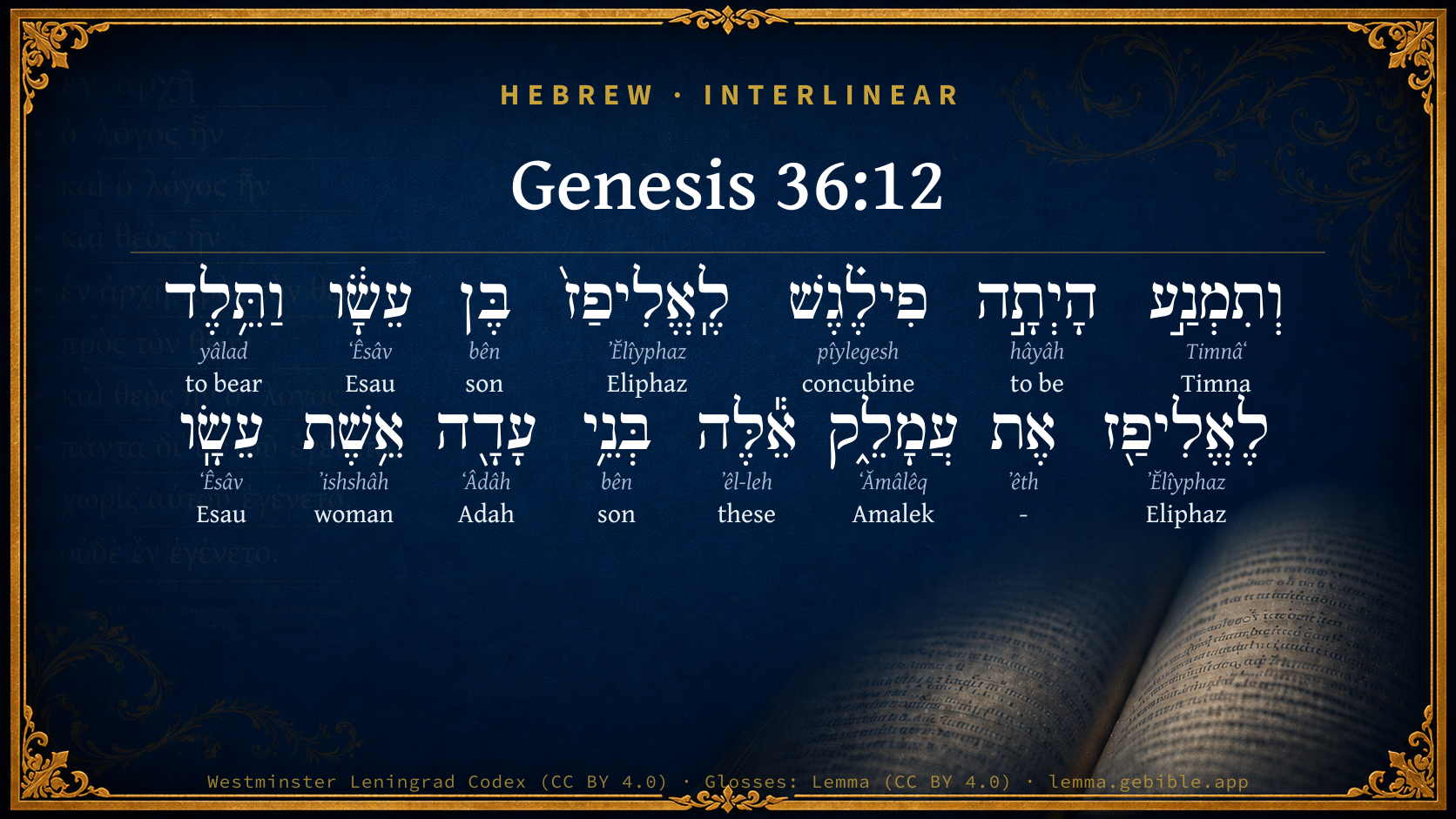
Hebrew (Westminster Leningrad Codex) Genesis 36:12 appears in the Hebrew Old Testament. The text above is from the Westminster Leningrad Codex. Each word links to its Strong’s number, a concise gloss, and parsing drawn from the Open Scriptures Hebrew Bible morphology. Click any word for its full Brown-Driver-Briggs (BDB) entry.
Download image
Cite this verse

Genesis 36:12 (World English Bible). Public Domain. Lemma interlinear Bible study tool, https://lemma.gebible.app/v/genesis/36/12.

Show BibTeX & RIS
BibTeX
RIS
English Translation
Timna was concubine to Eliphaz, Esau's son; and she bore to Eliphaz Amalek. These are the sons of Adah, Esau's wife.
World English Bible · Public Domain
Highlights
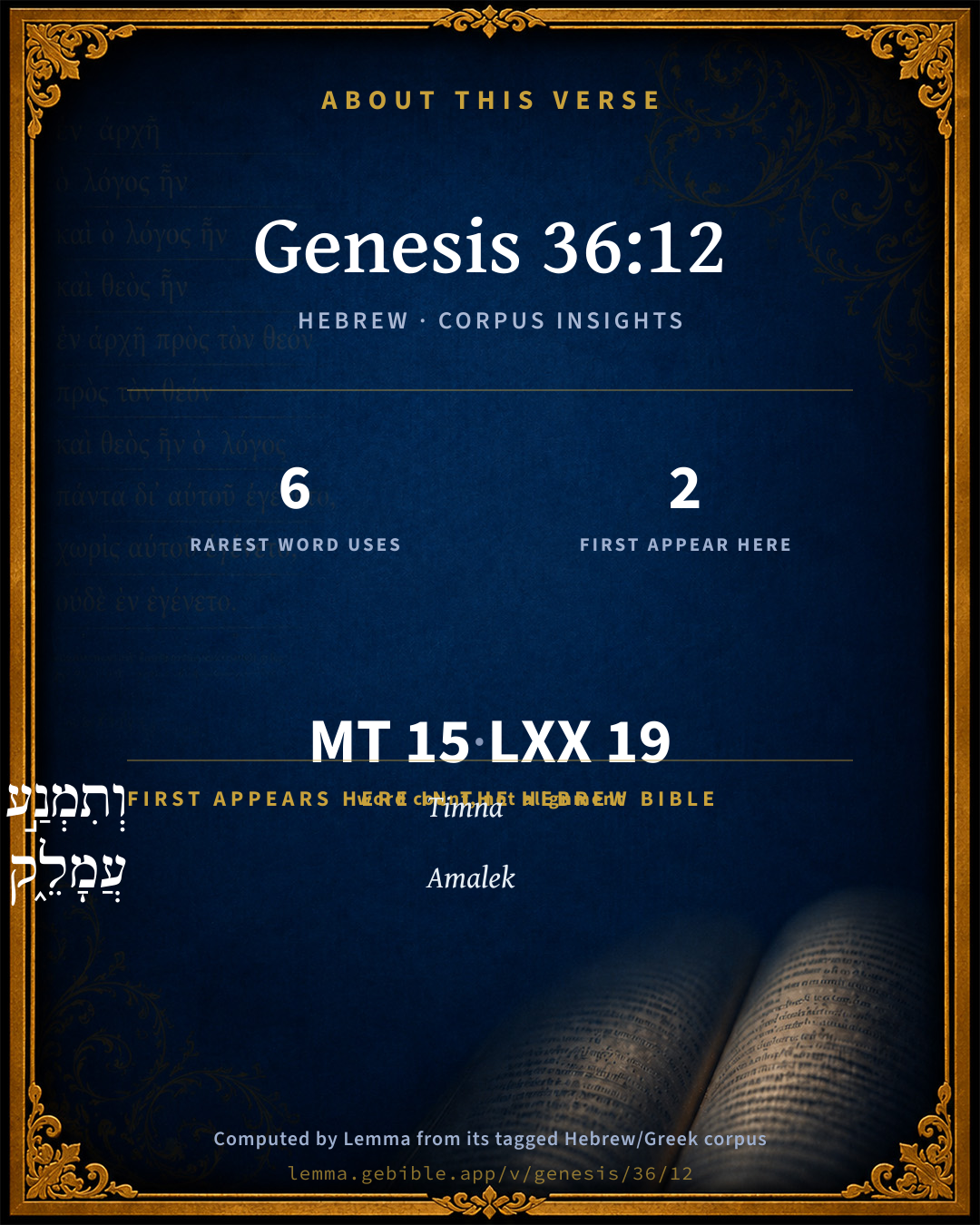
  • 2 first appearances in the Hebrew Bible
Full analysis ↓
Download a study sheet

One document with this verse’s original text, its word-by-word gloss line, the meaning frame, cross-references with their text, attributed commentary, and full source and license credits — printable, and it pastes into notes with its structure intact.

This verse Autodidact and up

Study sheet (.html) Plain text (.txt)

A passage Seminary Student

Up to 50 verses in one chapter. A passage sheet keeps up to 6 commentary sources and 12 cross-references per verse, in the order this page ranks them, and says so on the sheet whenever that leaves anything out. Ask for a single verse and you get the Autodidact verse sheet above.

Everything on this page stays free to read, with no account — the sheet is a download of what is already on screen, not access to it.

Want to remove ads? Support Godless Engineer
Compare translations 3

The same verse in 3 English versions, stacked beneath the original-language interlinear above. Click any original word for its lexicon entry.

Each is an independent rendering of the whole verse — the interlinear is not word-aligned to these translations.

Highlighted words mark where these versions differ — a whole-verse word diff, not a word-by-word alignment.

  • World English Bible Public Domain
    Timna was concubine to Eliphaz, Esau's son; and she bore to Eliphaz Amalek. These are the sons of Adah, Esau's wife.
  • King James Version Public Domain
    And Timna was concubine to Eliphaz Esau's son; and she bare to Eliphaz Amalek: these were the sons of Adah Esau's wife.
  • unfoldingWord Literal Text CC BY-SA 4.0
    And Timna was a concubine for Esau’s son Eliphaz, and she bore Amalek for Eliphaz. Those the grandsons of Adah, the wife of Esau.

unfoldingWord Literal Text — © unfoldingWord, licensed CC BY-SA 4.0. Word-aligned USFM3 via Door43 (git.door43.org/unfoldingWord/en_ult).

Versions to compare (up to 4)

3 of 4 selected

Show all 18 translations

Every available English version of this verse, each an independent rendering of the whole verse.

  • World English Bible Public Domain
    Timna was concubine to Eliphaz, Esau's son; and she bore to Eliphaz Amalek. These are the sons of Adah, Esau's wife.
  • Berean Standard Bible Public Domain
    Additionally, Timna, a concubine of Esau’s son Eliphaz, gave birth to Amalek. These are the grandsons of Esau’s wife Adah.
  • Majority Standard Bible Public Domain
    Additionally, Timna, a concubine of Esau’s son Eliphaz, gave birth to Amalek. These are the grandsons of Esau’s wife Adah.
  • King James Version Public Domain
    And Timna was concubine to Eliphaz Esau's son; and she bare to Eliphaz Amalek: these were the sons of Adah Esau's wife.
  • American Standard Version (1901) Public Domain
    And Timna was concubine to Eliphaz Esau's son; and she bare to Eliphaz Amalek: these are the sons of Adah, Esau's wife.
  • Revised Version (1885) Public Domain
    And Timna was concubine to Eliphaz Esau’s son; and she bare to Eliphaz Amalek: these are the sons of Adah Esau’s wife.
  • Geneva Bible (1599) Public Domain
    And Timna was concubine to Eliphaz Esaus sonne, and bare vnto Eliphaz, Amalek: these be the sonnes of Adah Esaus wife.
  • Douay-Rheims (1899) Public Domain
    And Thamna was the concubine of Eliphaz the son of Esau: and she bore him Amalech. These are the sons of Ada the wife of Esau.
  • Young's Literal Translation Public Domain
    and Timnath hath been concubine to Eliphaz son of Esau, and she beareth to Eliphaz, Amalek; these `are' sons of Adah wife of Esau.
  • Literal Standard Version CC BY-SA 4.0
    and Timnath has been concubine to Eliphaz son of Esau, and she bears to Eliphaz, Amalek; these [are] sons of Adah wife of Esau.
  • Unlocked Literal Bible CC BY-SA 4.0
    Timna, a concubine of Eliphaz, Esau's son, bore Amalek. These were the grandsons of Adah, Esau's wife.
  • unfoldingWord Literal Text CC BY-SA 4.0
    And Timna was a concubine for Esau’s son Eliphaz, and she bore Amalek for Eliphaz. Those the grandsons of Adah, the wife of Esau.
  • Darby Bible Public Domain
    And Timna was concubine to Eliphaz Esau's son, and she bore Amalek to Eliphaz. These are the sons of Adah Esau's wife.
  • World Messianic Bible Public Domain
    Timna was concubine to Eliphaz, Esau’s son; and she bore to Eliphaz Amalek. These are the descendants of Adah, Esau’s wife.
  • Webster's Bible Public Domain
    And Timna was concubine to Eliphaz Esau's son; and she bore to Eliphaz Amalek: these were the sons of Adah Esau's wife.
  • Free Bible Version CC BY-SA 4.0
    Timna, the concubine of Esau's son Eliphaz, had Amalek for Eliphaz. These were the descendants of Esau's wife Adah.
  • Bible in Basic English Public Domain
    And Eliphaz, the son of Esau, had connection with a woman named Timna, who gave birth to Amalek: all these were the children of Esau's wife Adah.
  • JPS Tanakh (1917) Public Domain
    And Timna was concubine to Eliphaz Esau's son; and she bore to Eliphaz Amalek. These are the sons of Adah Esau's wife.

Literal Standard Version (2020), Covenant Press — licensed CC BY-SA 4.0. Text via the HelloAO Bible API (eBible.org). Unlocked Literal Bible (unfoldingWord) — licensed CC BY-SA 4.0. Text via the HelloAO Bible API (eBible.org). unfoldingWord Literal Text — © unfoldingWord, licensed CC BY-SA 4.0. Word-aligned USFM3 via Door43 (git.door43.org/unfoldingWord/en_ult). Free Bible Version, Dr. Jonathan Gallagher — licensed CC BY-SA 4.0. Text via the HelloAO Bible API (eBible.org).

Word by word

More ways to search: Search by grammar → Find every occurrence → Compare this word →

Practice this passage: Drill this verse → Learn its vocabulary →

וְתִמְנַ֣ע
Timnâʻ
H8555
“and · Timna”
Conjunction + Noun, Proper
Part of Speech
Conjunction + Noun
Type
Proper
Full BDB Definition

Origin: from H4513

TWOT: None

Timna or Timnah = "restrained" - a chief or duke of Esau and of Edom (noun proper masculine) - the concubine of Eliphaz, the son of Esau (noun proper feminine) - daughter of Seir the Horite and sister of Lotan (noun proper feminine)
  1. הָיְתָ֣ה hâyâh H1961 “to be” Verb, Qal, Perfect, 3rd Person, Feminine, Singular
  2. פִילֶ֗גֶשׁ pîylegesh H6370 “concubine” Noun, Common, Feminine, Singular, Absolute
  3. לֶֽאֱלִיפַז֙ ʼĔlîyphaz H464 “to/for · Eliphaz” Preposition + Noun, Proper
  4. בֶּן bên H1121 “son of” Noun, Common, Masculine, Singular, Construct
  5. עֵשָׂ֔ו ʻÊsâv H6215 “Esau” Noun, Proper
  6. וַתֵּ֥לֶד yâlad H3205 “and · to bear” Conjunction + Verb, Qal, Sequential Imperfect, 3rd Person, Feminine, Singular
  7. לֶאֱלִיפַ֖ז ʼĔlîyphaz H464 “to/for · Eliphaz” Preposition + Noun, Proper
  8. אֶת ʼêth H853 “-” Particle, Direct Object
  9. עֲמָלֵ֑ק ʻĂmâlêq H6002 “Amalek” Noun, Proper
  10. אֵ֕לֶּה ʼêl-leh H428 “these” Pronoun, Demonstrative, Common, Plural
  11. בְּנֵ֥י bên H1121 “sons of” Noun, Common, Masculine, Plural, Construct
  12. עָדָ֖ה ʻÂdâh H5711 “Adah” Noun, Proper
  13. אֵ֥שֶׁת ʼishshâh H802 “woman of” Noun, Common, Feminine, Singular, Construct
  14. עֵשָֽׂו ʻÊsâv H6215 “Esau” Noun, Proper

About this verse

These counts appear in no published source. They are computed here, from the morphology-tagged text and Lemma’s own curated glosses. What Lemma adds →

15
words
12
distinct lemmas
Pentateuch
section

Notable vocabulary

The rarest word here is וְתִמְנַ֣ע Timna H8555 — appearing just 6 times in the whole Hebrew Bible.

First appearance in Scripture

These words make their first canonical appearance in the Hebrew Bible here:

  • וְתִמְנַ֣ע Timna H8555
  • עֲמָלֵ֑ק Amalek H6002

Shared distinctive vocabulary

וְתִמְנַ֣ע Timna H8555 occurs in 6 verses of the Hebrew Bible. Also found in:

Grammatical profile

  • 2 verbs
  • 11 nouns
  • 1 pronoun
  • 1 particle

Verb forms

  • הָיְתָ֣ה Qal · Perfect
  • וַתֵּ֥לֶד Qal · Sequential Imperfect

Repetition

Words recur within this verse — often emphatic in Hebrew:

  • לֶֽאֱלִיפַז֙ Eliphaz H464 ×2
  • בֶּן son H1121 ×2
  • עֵשָׂ֔ו Esau H6215 ×2

Hebrew & Septuagint length

In English translation the verse runs 21 words from the Hebrew and 27 from the Septuagint (LXX English) — closely comparable.

A rough comparison of the two English renderings, which tokenize alike — not a word-level alignment.

Word counts can differ between the Hebrew and the Greek without any difference in meaning — e.g. the Hebrew direct-object marker אֵת has no separate Greek word, and Greek often adds the article ὁ.

In the original languages it is 15 Hebrew tokens and 19 Greek tokens — but the two are counted differently (Hebrew bundles its prefixes and suffixes into one token; the Greek is in lemma form), so that isn’t a like-for-like length.

Cross-references

8

Topical passages linked to Genesis 36:12 in the Treasury of Scripture Knowledge — connected by theme and wording, ordered by reader-vote popularity; previews shown in the World English Bible.

  • Exodus 17:8–16 Then Amalek came and fought with Israel in Rephidim.
  • Deuteronomy 25:17–19 Remember what Amalek did to you by the way as you came forth out of Egypt;
  • Genesis 14:7 They returned, and came to En-mishpat (the same is Kadesh), and struck all the country of the Amalekites, and also the Amorites, that lived in Hazazon Tamar.
  • Genesis 36:22 The children of Lotan were Hori and Heman. Lotan's sister was Timna.
  • Numbers 24:18–20 Edom shall be a possession, Seir also shall be a possession, [who were] his enemies; While Israel does valiantly.
  • Deuteronomy 23:7 You shall not abhor an Edomite; for he is your brother: you shall not abhor an Egyptian, because you lived as a foreigner in his land.
  • 1 Samuel 15:2–9 Thus says Yahweh of Hosts, I have marked that which Amalek did to Israel, how he set himself against him in the way, when he came up out of Egypt.
  • 1 Chronicles 1:36 The sons of Eliphaz: Teman, and Omar, Zephi, and Gatam, Kenaz, and Timna, and Amalek.

Cross-references courtesy of OpenBible.info (CC BY 4.0).

Hebrew and Greek witnesses Masoretic Hebrew ↔ Greek Septuagint

The same verse in the two great witnesses to the Old Testament, shown verse-for-verse.

These are two independent witnesses, not word-aligned to each other, and the Septuagint is shown in lemma (dictionary) form.

Hebrew Genesis 36:12 Masoretic · Westminster Leningrad Codex

וְתִמְנַ֣ע הָיְתָ֣ה פִילֶ֗גֶשׁ לֶֽאֱלִיפַז֙ בֶּן עֵשָׂ֔ו וַתֵּ֥לֶד לֶאֱלִיפַ֖ז אֶת עֲמָלֵ֑ק אֵ֕לֶּה בְּנֵ֥י עָדָ֖ה אֵ֥שֶׁת עֵשָֽׂו

Timna was concubine to Eliphaz, Esau's son; and she bore to Eliphaz Amalek. These are the sons of Adah, Esau's wife.

World English Bible · Public Domain

Greek LXX Genesis 36:12 Septuagint · lemma form

θαμνα δέ εἰμί παλλακή ελιφας ὁ υἱός ησαυ καί τίκτω ὁ ελιφας ὁ αμαληκ οὗτος υἱός αδα γυνή ησαυ

And Thamna was a concubine of Eliphaz, the son of Esau; and she bore Amalec to Eliphas. These are the sons of Ada, the wife of Esau.

LXX2012 (modern English Septuagint) · Public Domain

Hebrew: Westminster Leningrad Codex (CC BY 4.0). Greek: Septuagint (public domain); English from LXX2012 (modern English Septuagint) (Public Domain). How the Septuagint differs from the Hebrew →

Targum (Aramaic paraphrase)

2

The Targum is the ancient Jewish Aramaic paraphrase of the Hebrew Scriptures — an interpretive translation, not the Hebrew text itself. Onkelos (literal) and Pseudo-Jonathan (expansive) render the Torah, and Jonathan the Prophets. Coverage is partial: where no permissively-licensed English translation exists for a verse, only the Aramaic is shown. This is verse-level text, not a word-by-word alignment to the Hebrew.

  1. Targum Onkelos Torah (Genesis–Deuteronomy)
    וְתִמְנַע הֲוַת לְחֵינָתָא לֶאֱלִיפַז בַּר עֵשָׂו וִילִידַת לֶאֱלִיפַז יָת עֲמָלֵק אִלֵּין בְּנֵי עָדָה אִתַּת עֵשָׂו

    (no public-domain English translation for this verse)

    Targum Onkelos — Aramaic: “Onkelos Genesis” (public domain); “Onkelos Exodus” (public domain); “Onkelos Leviticus” (public domain); “Onkelos Numbers” (public domain); “Onkelos Deuteronomy” (public domain). English: “Sefaria Community Translation” (CC0 1.0 (public-domain dedication)); “J.W. Etheridge. The Targums of Onkelos and Jonathan Ben Uzziel on the Pentateuch. London: Longmans, Green, 1862” (public domain). Text via Sefaria.

  2. Targum Pseudo-Jonathan Torah (Genesis–Deuteronomy)
    וְתִמְנַע הֲוָת פִּילַקְתָּא לֶאֱלִיפַז בַּר עֵשָו וִילֵידַת לֶאֱלִיפַז יַת עֲמָלֵק הוּא אֱלִיפַז חַבְרֵיהּ דְאִיוֹב אִלֵין בְּנֵי עָדָה אִיתַּת עֵשָו

    And Timna was the concubine of Eliphaz bar Esau, and she bare to Eliphaz Amalek. He is Eliphaz the companion of Job. These are the sons of Adah wife of Esau.

    Targum Pseudo-Jonathan — Aramaic: “Targum Jonathan on Genesis” (public domain); “Targum Jonathan on Exodus” (public domain); “Targum Jonathan on Leviticus” (public domain); “Targum Jonathan on Numbers” (public domain); “Targum Jonathan on Deuteronomy” (public domain). English: “The Targum of Jonathan ben Uzziel, trans. J. W. Etheridge, London, 1862” (public domain). Text via Sefaria.

Commentary

Notes on Genesis 36:12 from classic Christian and Jewish commentators (each source and its license shown beneath its notes). The classic Christian expositions comment on the surrounding passage and are grouped to its opening verse, so a note may address several verses; the Jewish commentaries on the Tanakh (Rashi and others) are per-verse, so they appear only where the commentator wrote on this verse.

Lemma curates 59 commentaries, every one of them public domain or Creative Commons licensed, each selected and text-cleaned for this edition rather than reprinted as found. About our sources →

Adam Clarke's Commentary

Verse 12. Timna was concubine to Eliphaz] As Timna was sister to Lotan the Horite, Ge 36:22, we see how the family of Esau and the Horites got intermixed. This might give the sons of Esau a pretext to seize the land, and expel the ancient inhabitants, as we find they did, De 2:12.

Amalek] The father of the Amalekites, afterwards bitter enemies to the Jews, and whom God commanded to be entirely exterminated, De 25:17; De 25:19.

Adam Clarke's Commentary on the Bible (1810–1826) — public domain. Text from a community e-Sword/MySword module.

Ellicott's Commentary for English Readers

(12) Amalek.—We have already read of the “field of the Amalekite” in Gen_14:7. As Balaam describes Amalek as “the beginning of nations” (so the Heb., Num_24:20), the race can scarcely have had so ignoble an origin as to have sprung from a concubine of Eliphaz; for we gather from Amo_6:1 that the phrase used by Balaam implied precedence and nobility. It was, moreover, one of the most widely spread races of antiquity, occupying the whole country from Shur, on the borders of Egypt, to Havilah, in Arabia Felix. But probably there was a fusion of some of the Horites with the Amalekites, just as the Kenezites, under Caleb, were fused into the tribe of Judah. For in 1Ch_4:42-43, we find the Simeonites invading Mount Seir, and smiting Amalekites there. Of these Amalekites in Seir, Amalek, the grandson of Esau, was probably the founder; for in Gen_36:16 he is called a duke, and therefore one district of the country would belong to his descendants, in the same manner as each son of Jacob had a territory called after his name. In this district the chiefs would be Semites of the race of Esau; the mass of the people a blended race of Horites. and Amalekites. There is no difficulty in the absence of their names from Genesis 10. Though Balaam magnified them, they were regarded by Israel, not as a nation, but as a hateful horde of plunderers.

A Bible Commentary for English Readers, edited by Charles John Ellicott (1878–1897) — public domain. Text from a community e-Sword module.

The Cambridge Bible for Schools and Colleges

gen. ed. J. J. S. Perowne

12. Amalek] Here a grandson of Esau; but, as the descendant from a concubine, he denotes a subordinate clan. Amalekites infested the Sinaitic Peninsula (Exo_17:8-15; Deu_25:17) and harried southern Palestine (1Sa_15:2).

The Cambridge Bible for Schools and Colleges (gen. ed. J. J. S. Perowne; Cambridge University Press, 1878–1918) — public domain. Text from a community e-Sword module.

John Gill's Exposition

And these are the sons of Reuel,.... Another son of Esau's; this man had four sons, as follow:

Nahath, and Zerah, Shammah and Mizzah: of whom we know no more than their names, unless Maps or Massa, which Ptolemy (z) places in Idumea, should have its name from Mizzah:

these were the sons of Bashemath, Esau's wife; her grandsons, as before.

(z) Geograph. l. 5. c. 16.

John Gill's Exposition of the Whole Bible (1746–1763) — public domain (CC PDM 1.0). Text via the HelloAO Bible API.

Scofield Reference Notes

C. I. Scofield

Amalek

(See Scofield "Exo 17:8").

The Scofield Reference Bible (1917 edition), notes by C. I. Scofield — public domain. Text from a community e-Sword module.

Rashi

Rabbi Shlomo Yitzchaki (Rashi)

ותמנע היתה פילגש AND TIMNA WAS CONCUBINE — This is stated to tell you in what importance Abraham was held — how eager people were to attach themselves to his descendants. This Timna was a descendant of chieftains, as it is said (v. 22) “And Lotan’s sister was Timna”, and Lotan was one of the chieftains inhabiting Seir — he was one of the Horites who had dwelt there from ancient times. She said to Eliphaz, “If I am unworthy to become your wife would that I might become your concubine!” In Chronicles (1 Chronicles 1:36) Scripture enumerates her amongst the children of Eliphaz, thus intimating that he took Seir’s wife and from the two of them Timna was born. When she grew up she became his concubine. This is why it is stated, “and Lotan’s sister was Timna”, and why Scripture does not enumerate her amongst Seir’s children, merely stating that she was sister to Lotan, Seir’s son, (see 5:20) because she was his sister from one mother and not from one father (Midrash Tanchuma, Vayeshev 1).

Rashi on the Tanakh — English translations: “The Judaica Press complete Tanach with Rashi, translated by A. J. Rosenberg” (CC BY 4.0); “Pentateuch with Rashi's commentary by M. Rosenbaum and A.M. Silbermann, 1929-1934” (public domain); “The Metsudah Tanach series, Lakewood, N.J” (CC BY 4.0); and “The Book of Joshua, Metsudah Publications, 1997” (CC BY 4.0). Text via Sefaria.

Ramban (Nachmanides)

Rabbi Moshe ben Nachman (Ramban / Nachmanides)

AND TIMNA WAS CONCUBINE TO ELIPHAZ ESAU’s SON. Because Scripture was not particular to tell us the names of the mothers of all the others, our Rabbis have interpreted that this was to tell us of the esteem in which Abraham our father was held, i.e., how eager people were to attach themselves to his descendants. This Timna was a descendant of chieftains, as it is said, And Lotan’s sister was Timna, [and Lotan was one of the chieftains of Se’ir]. She said to Eliphaz, “If I am unworthy to become your wife, would that I might become your concubine,” as Rashi has written.It is possible that the five sons of Eliphaz, mentioned in the preceding verse, were generally known as his children since he had begotten them from his wives. But Amalek, [born of Timna, the concubine of Eliphaz], was not known among his brothers, [who were the recognized children of Eliphaz], and he might have been included among Esau’s children because he was his descendant. Therefore, Scripture found it necessary to say that his mother so-and-so, to whom Amalek was known to have belonged, bore him to Eliphaz, but he is not listed among the descendants of Esau and did not dwell with them on mount Se’ir. Only the sons of the mistresses, and not the son of a concubine, are called Esau’s seed, since the son of the handmaid will not be heir with his sons, in keeping with the practice of his father’s father. Now concerning the descendants of Esau, we have been commanded not to abhor them or take their land., 2:5. This refers to all his known sons who dwell in Se’ir, as they are called Edomites by his name, but the son of the concubine is not part of the descendants of Esau, and he did not inherit together with them in their land, and in fact with respect to him we have been commanded to the contrary, i.e., to abhor him and blot out his name., 25:19.Now Rashi wrote further: “In the book of Chronicles Scripture enumerates Timna among the children of Eliphaz! This implies that he lived with Se’ir the Horite’s wife and from this union Timna was born. When she grew up she became his concubine. And this is why Scripture says, And Lotan’s sister was Timna, [since Lotan’s father was Se’ir the Horite]. And the reason why Scripture does not enumerate her among Se’ir’s children is that she was Lotan’s sister maternally but not paternally.”But I do not agree with this since in the book Chronicles, it should have said, “and Timna his daughter.” Why should Scripture enumerate the woman among the sons? Perhaps Scripture is not particular about this when a matter is known for so we find there in Chronicles: And the sons of Amram: Aaron and Moses, and Miriam. And the sons of Aaron: Nadab and Abihu, etc. [Scripture thus enumerates a woman among the sons.] If so, it is fitting that we say that this Timna was the daughter of Eliphaz, who had been born to him of the wife of Se’ir the Horite after the death of her husband, and she was thus Lotan’s sister from one mother. Eliphaz took her as a concubine, this being permissible to an idolater. Or we shall say, in accordance with the opinion of our Rabbis [that Timna was illegitimate, as explained above in the words of Rashi], that the Timna mentioned in Chronicles is identical with Timna the chieftain mentioned further on, for he is enumerated there in Chronicles among the sons of Eliphaz, just as Korah is enumerated there among the sons of Esau [while here in Verses 15-16 Korah is listed among the sons of Eliphaz. You must therefore conclude that he was illegitimate, as was Timna]. Furthermore, Korah is listed here in Verse 5 as the son of Oholibamah [and Esau, and further in Verse 16 he is enumerated among the sons of Eliphaz. You must therefore conclude] that both Korah and Timna were illegitimate, born of one father, and enumerated with the children of another, for it is far-fetched to say that the woman Timna was enumerated among the sons, as was suggested above.In line with the simple meaning of Scripture it is feasible to conjecture that Timna, the concubine of Eliphaz, after having given birth to Amalek [as stated in our present verse], gave birth to a son, and she had hard labor and died. As her soul was departing she called his name Timna so that her name be remembered, while his father Eliphaz called him Korah. Scripture, however, does not ascribe this son Timna to Timna his mother in order not to prolong the account for the intent is only to enumerate Amalek by himself. However, the sons of Eliphaz were seven, [as they are enumerated here in Verses 15-16, and Korah is among them]. Now Scripture enumerates there the chieftains who were the sons of Eliphaz in the order of their importance. Therefore, it gave Kenaz and Korah precedence over Gatam [although the order of their birth as stated in Verse 11 was: Zepho, and Gatam, and Kenaz].I have an additional opinion concerning this verse in connection with that which our Rabbis have said in the Midrash of “Thirty-two Rules by which Agadah is explained.” There they mentioned this rule: “There should have been one arrangement for [two verses, meaning that there are verses which should really be combined] but the prophets divided them for some reason! An example is the verse which says, For a multitude of the people, etc.”, (II Chronicles 30:18). And then in Verse 19 it continues: His whole heart he hath set to seek G-d, the Eternal, the G-d of his fathers, though not according to the purification that pertaineth to holy things. Now Verse 18 does not explain whom G-d should pardon, while Verse 19 does not explain “who set his heart, etc.” Combining the two verses makes the sense clear. Hezekiah prayed that the good Lord pardon every one who, though he had not cleansed himself according, etc., had set his whole heart to seek G-d. Those who pursue the plain meaning of Scripture apply this to other verses. And so too this verse says: (And) the sons of Eliphaz were Teman, Omar, Zepho, and Gatam and Kenaz, begins Verse 12. Ramban combines the two verses into one, with the result that Timna is also enumerated among the sons of Eliphaz. and Timna. Then Scripture returns to say, there was a concubine to Eliphaz Esau’s son, and she bore to Eliphaz Amalek, but Scripture does not mention the name of the concubine. But in truth she was Timna, as it is said, Lotan’s sister was Timna, and this is the reason that Scripture did not mention her name here since it did not want to say “and Timna” twice, once in reference to the male chieftain and once in reference to the female concubine. Thus Eliphaz had seven sons, [who are enumerated in Verses 11-12: Teman, Omar, Zepho, Gatam, Kenaz, Timna, and Amalek], and they are the same chieftains ascribed to Eliphaz in Verses 15-16, but they changed the name of this youngest son of Eliphaz — namely Timna — to Korah because his name was like that of the concubine and so that he should not be thought of as her son. He was named Korah upon his ascending to the position of chieftain.Now Rabbi Abraham ibn Ezra said that Korah the son of Esau’s wife Oholibamah is counted twice; [in Verse 5 he is mentioned as Oholibamah’s son while in Verse 16 he is listed as Adah’s son], because he was the youngest of Oholibamah’s sons, [as indicated in Verse 5 where he is mentioned last. Upon his mother’s death] Adah raised him, [which explains why he is mentioned among Adah’s children in Verse 16]. So also the verse, the five sons of Michal the daughter of Saul, as our Rabbis have said. According to this opinion [of Ibn Ezra, i.e., that because Adah raised Korah he is counted among her children], the explanation of Scripture in the book of Chronicles (I, 1:36), [where it mentions seven sons of Eliphaz, and among them, and Timna and Amalek, while here in Verses 11-12, it mentions only six sons of Eliphaz, is as follows: The expression in Chronicles, and Timna and Amalek, means] that Timna gave birth to Amalek, the sense of the verse thus being, “and to Timna, Amalek.” The letter lamed meaning “to” is missing just as in the verse: And there were two men that were captains of bands Saul’s son, which means “to Saul’s son.” [Thus it was Timna who was his mother, but because Adah raised him he is enumerated here in Verse 12 among the sons of Adah].The correct interpretation however is, as I have suggested, [that Timna, Lotan’s sister, bore Amalek to Eliphaz], and the verse stating, And these are the sons of Adah — [namely, Verse 16, which mentions Amalek among them], refers to the majority of the names mentioned there, for Amalek was not her son. Similarly the verse, These are the sons of Jacob, who were born to him in Padan-aram, does not apply to Benjamin, [who was born in the Land of Israel, although he is mentioned in the enumeration which follows].

Ramban (Nachmanides) on the Tanakh — English translation: “Commentary on the Torah by Ramban (Nachmanides). Translated and annotated by Charles B. Chavel. New York, Shilo Pub. House, 1971-1976” (CC BY 4.0). Text via Sefaria.

Radak

Rabbi David Kimhi (Radak)

ותמנע, it is possible that the Timna mentioned here was not a sister of Lotan as opined in the Midrash (Bereshit Rabbah 82,14) where we were told that this woman’s name and husband is mentioned in order to further illustrate the tremendous esteem in which Avraham had been held internationally at the time. This woman, who was the sister of an Aluf, i.e. a well known dignitary, a man of great prominence, said that seeing she did not have the good fortune to marry a direct descendant of Avraha, she was willing to settle for the lower rank of being a concubine to a son of Esau in order somehow to become a member of this outstanding family.

Radak on the Tanakh — English translations: “Sefaria Community Translation” (CC0 1.0 (public-domain dedication)); “Eliyahu Munk, HaChut Hameshulash” (CC BY 4.0); “Rabbi Mike Feuer, Jerusalem Anthology” (CC BY 4.0); and “R. David Kimhi on the first book of Psalms, Translated by R.G. Finch, London, 1919” (public domain). Text via Sefaria.

Lesson kit

Teaching starters — assembled from the data on this page, not authored interpretation. Every prompt links to the verse data it draws on. Edit before teaching.

Genesis, in the Pentateuch, opens this verse with 15 words (12 distinct Hebrew lemmas). Its most distinctive word is Timnâʻ (“Timna”). A historical commentator’s framing appears above. Read the whole chapter for the surrounding context.

Discussion questions

  1. How does “Timna” (Timnâʻ) shape what this verse is saying?
  2. 2 words here appear for the first time in Scripture. What is being introduced at this debut?
  3. Genesis 36:22 shares the word «Timna» with this verse. How do the two illuminate each other?
  4. “Eliphaz” occurs 2× in this one verse. What is the effect of the repetition?
  5. These translations render this verse differently; the difference is in the English rendering, not the original. What questions does that raise?
  6. The verb «הָיְתָ֣ה» is Qal Perfect. How does its form color the action?
  7. Reading how Adam Clarke's Commentary and Ellicott's Commentary for English Readers read this verse, where do the two commentators agree and where do they part?

Things to notice

Reading settings

Reading text

Shown beneath each verse's original-language words.

Old Testament
Old Testament edition

Read the OT as the Masoretic Hebrew (MT) or the Greek Septuagint (LXX).

English shown for the Greek Septuagint (in the Hebrew ↔ Greek comparison).

Comparing translations? Open the Compare panel on any verse page to stack up to four side by side.