
Exodus 6:23

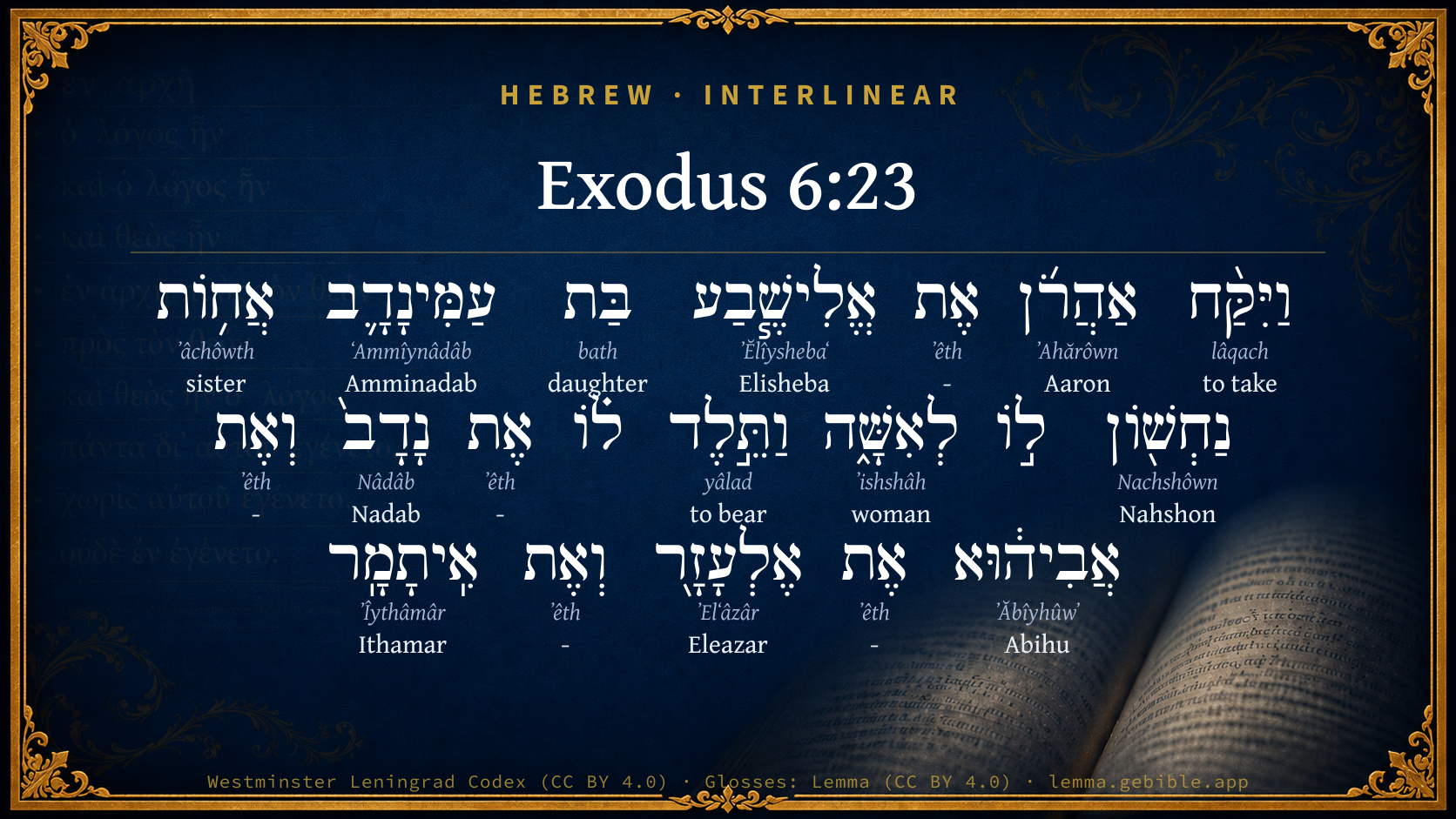
Hebrew (Westminster Leningrad Codex) Exodus 6:23 appears in the Hebrew Old Testament. The text above is from the Westminster Leningrad Codex. Each word links to its Strong’s number, a concise gloss, and parsing drawn from the Open Scriptures Hebrew Bible morphology. Click any word for its full Brown-Driver-Briggs (BDB) entry.
Download image
Cite this verse

Exodus 6:23 (World English Bible). Public Domain. Lemma interlinear Bible study tool, https://lemma.gebible.app/v/exodus/6/23.

Show BibTeX & RIS
BibTeX
RIS
English Translation
Aaron took Elisheba, the daughter of Amminadab, the sister of Nahshon, as his wife; and she bore him Nadab and Abihu, Eleazar and Ithamar.
World English Bible · Public Domain
Highlights
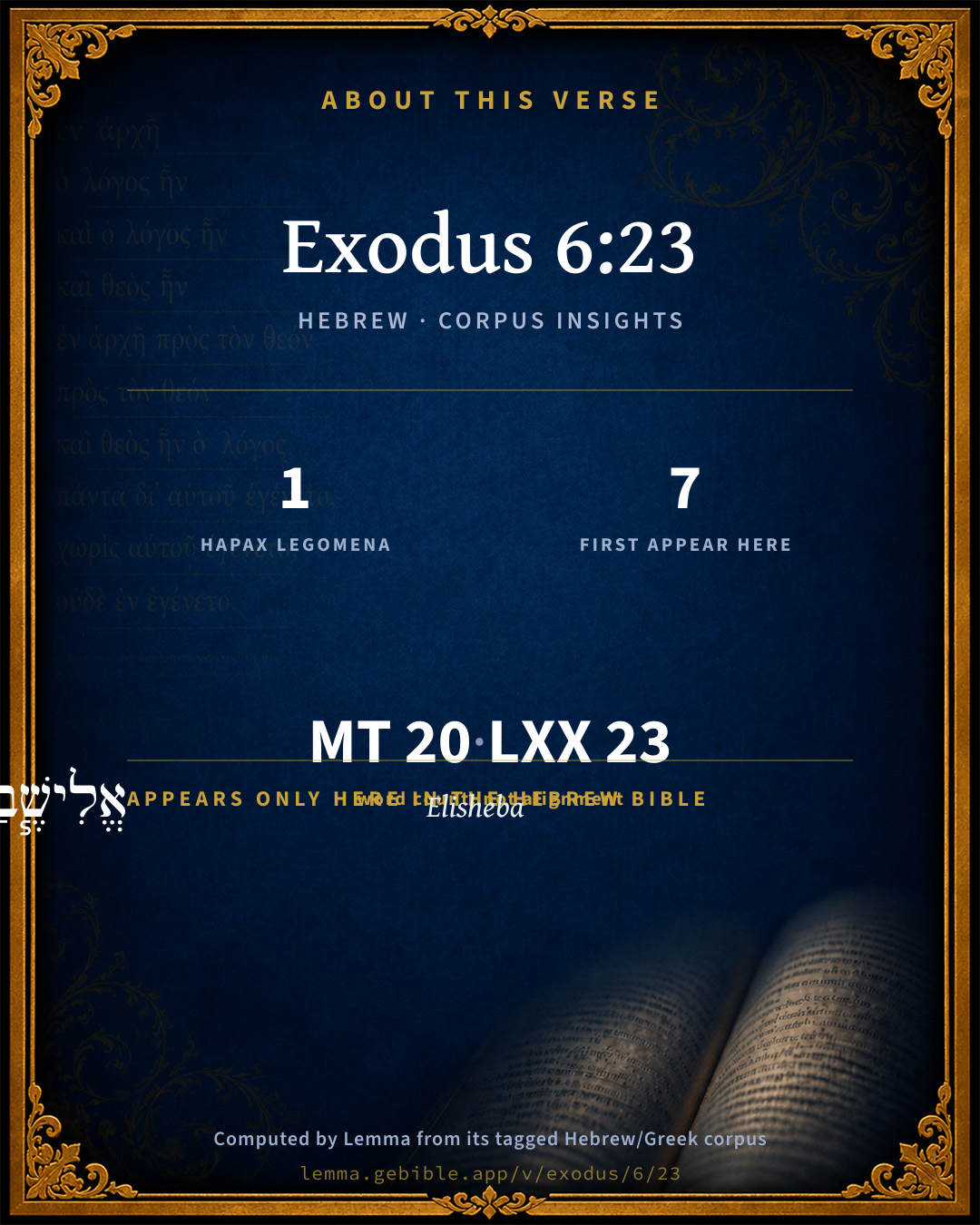
  • 1 hapax legomenon — only here in the Hebrew Bible
  • 7 first appearances in the Hebrew Bible
Full analysis ↓
Download a study sheet

One document with this verse’s original text, its word-by-word gloss line, the meaning frame, cross-references with their text, attributed commentary, and full source and license credits — printable, and it pastes into notes with its structure intact.

This verse Autodidact and up

Study sheet (.html) Plain text (.txt)

A passage Seminary Student

Up to 50 verses in one chapter. A passage sheet keeps up to 6 commentary sources and 12 cross-references per verse, in the order this page ranks them, and says so on the sheet whenever that leaves anything out. Ask for a single verse and you get the Autodidact verse sheet above.

Everything on this page stays free to read, with no account — the sheet is a download of what is already on screen, not access to it.

Want to remove ads? Support Godless Engineer
Compare translations 3

The same verse in 3 English versions, stacked beneath the original-language interlinear above. Click any original word for its lexicon entry.

Each is an independent rendering of the whole verse — the interlinear is not word-aligned to these translations.

Highlighted words mark where these versions differ — a whole-verse word diff, not a word-by-word alignment.

  • World English Bible Public Domain
    Aaron took Elisheba, the daughter of Amminadab, the sister of Nahshon, as his wife; and she bore him Nadab and Abihu, Eleazar and Ithamar.
  • King James Version Public Domain
    And Aaron took him Elisheba, daughter of Amminadab, sister of Naashon, to wife; and she bare him Nadab, and Abihu, Eleazar, and Ithamar.
  • unfoldingWord Literal Text CC BY-SA 4.0
    And Aaron took Elisheba, the daughter of Amminadab, the sister of Nahshon, as a wife for himself. And she bore him Nadab and Abihu, Eleazar and Ithamar.

unfoldingWord Literal Text — © unfoldingWord, licensed CC BY-SA 4.0. Word-aligned USFM3 via Door43 (git.door43.org/unfoldingWord/en_ult).

Versions to compare (up to 4)

3 of 4 selected

Show all 18 translations

Every available English version of this verse, each an independent rendering of the whole verse.

  • World English Bible Public Domain
    Aaron took Elisheba, the daughter of Amminadab, the sister of Nahshon, as his wife; and she bore him Nadab and Abihu, Eleazar and Ithamar.
  • Berean Standard Bible Public Domain
    And Aaron married Elisheba, the daughter of Amminadab and sister of Nahshon, and she bore him Nadab and Abihu, Eleazar and Ithamar.
  • Majority Standard Bible Public Domain
    And Aaron married Elisheba, the daughter of Amminadab and sister of Nahshon, and she bore him Nadab and Abihu, Eleazar and Ithamar.
  • King James Version Public Domain
    And Aaron took him Elisheba, daughter of Amminadab, sister of Naashon, to wife; and she bare him Nadab, and Abihu, Eleazar, and Ithamar.
  • American Standard Version (1901) Public Domain
    And Aaron took him Elisheba, the daughter of Amminadab, the sister of Nahshon, to wife; and she bare him Nadab and Abihu, Eleazar and Ithamar.
  • Revised Version (1885) Public Domain
    And Aaron took him Elisheba, the daughter of Amminadab, the sister of Nahshon, to wife; and she bare him Nadab and Abihu, Eleazar and Ithamar.
  • Geneva Bible (1599) Public Domain
    And Aaron tooke Elisheba daughter of Amminadab, sister of Nahashon to his wife, which bare him Nadab, and Abihu, Eleazar and Ithamar.
  • Douay-Rheims (1899) Public Domain
    And Aaron took to wife Elizabeth the daughter of Aminadab, sister of Nahason, who bore him Nadab, and Abiu, and Eleazar, and Ithamar.
  • Young's Literal Translation Public Domain
    And Aaron taketh Elisheba daughter of Amminadab, sister of Naashon, to himself for a wife, and she beareth to him Nadab, and Abihu, Eleazar, and Ithamar.
  • Literal Standard Version CC BY-SA 4.0
    And Aaron takes Elisheba daughter of Amminadab, sister of Naashon, to himself for a wife, and she bears to him Nadab, and Abihu, Eleazar, and Ithamar.
  • Unlocked Literal Bible CC BY-SA 4.0
    Aaron married Elisheba, daughter of Amminadab, sister of Nahshon. She bore him Nadab and Abihu, Eleazar and Ithamar.
  • unfoldingWord Literal Text CC BY-SA 4.0
    And Aaron took Elisheba, the daughter of Amminadab, the sister of Nahshon, as a wife for himself. And she bore him Nadab and Abihu, Eleazar and Ithamar.
  • Darby Bible Public Domain
    And Aaron took Elisheba, daughter of Amminadab, sister of Nahshon, as wife; and she bore him Nadab and Abihu, Eleazar and Ithamar.
  • World Messianic Bible Public Domain
    Aaron took Elisheba, the daughter of Amminadab, the sister of Nahshon, as his wife; and she bore him Nadab and Abihu, Eleazar and Ithamar.
  • Webster's Bible Public Domain
    And Aaron took him Elisheba daughter of Amminadab, sister of Naashon, for a wife; and she bore him Nadab and Abihu, Eleazar and Ithamar.
  • Free Bible Version CC BY-SA 4.0
    Aaron married Elisheba, daughter of Amminadab and sister of Nahshon. She had their sons Nadab and Abihu, Eleazar and Ithamar.
  • Bible in Basic English Public Domain
    And Aaron took as his wife Elisheba, the daughter of Amminadab, the sister of Nahshon; and she gave birth to Nadab and Abihu, Eleazar and Ithamar.
  • JPS Tanakh (1917) Public Domain
    And Aaron took him Elisheba, the daughter of Amminadab, the sister of Nahshon, to wife; and she bore him Nadab and Abihu, Eleazar and Ithamar.

Literal Standard Version (2020), Covenant Press — licensed CC BY-SA 4.0. Text via the HelloAO Bible API (eBible.org). Unlocked Literal Bible (unfoldingWord) — licensed CC BY-SA 4.0. Text via the HelloAO Bible API (eBible.org). unfoldingWord Literal Text — © unfoldingWord, licensed CC BY-SA 4.0. Word-aligned USFM3 via Door43 (git.door43.org/unfoldingWord/en_ult). Free Bible Version, Dr. Jonathan Gallagher — licensed CC BY-SA 4.0. Text via the HelloAO Bible API (eBible.org).

Word by word

More ways to search: Search by grammar → Find every occurrence → Compare this word →

Practice this passage: Drill this verse → Learn its vocabulary →

אֱלִישֶׁ֧בַע
ʼĔlîyshebaʻ
H472
“Elisheba”
Noun, Proper
Part of Speech
Noun
Type
Proper
Full BDB Definition

Origin: from H410 and H7651 (in the sense of H7650 )

TWOT: None

Elisheba = "my God has sworn" or " God is an oath" - Aaron's wife
  1. וַיִּקַּ֨ח lâqach H3947 “and · to take” Conjunction + Verb, Qal, Sequential Imperfect, 3rd Person, Masculine, Singular
  2. אַהֲרֹ֜ן ʼAhărôwn H175 “Aaron” Noun, Proper
  3. אֶת ʼêth H853 “-” Particle, Direct Object
  4. בַּת bath H1323 “daughter of” Noun, Common, Feminine, Singular, Construct
  5. עַמִּינָדָ֛ב ʻAmmîynâdâb H5992 “Amminadab” Noun, Proper
  6. אֲח֥וֹת ʼâchôwth H269 “sister of” Noun, Common, Feminine, Singular, Construct
  7. נַחְשׁ֖וֹן Nachshôwn H5177 “Nahshon” Noun, Proper
  8. לְאִשָּׁ֑ה ʼishshâh H802 “to/for · woman” Preposition + Noun, Common, Feminine, Singular, Absolute
  9. וַתֵּ֣לֶד yâlad H3205 “and · to bear” Conjunction + Verb, Qal, Sequential Imperfect, 3rd Person, Feminine, Singular
  10. אֶת ʼêth H853 “-” Particle, Direct Object
  11. נָדָב֙ Nâdâb H5070 “Nadab” Noun, Proper
  12. וְאֶת ʼêth H853 “and · -” Conjunction + Particle, Direct Object
  13. אֲבִיה֔וּא ʼĂbîyhûwʼ H30 “Abihu” Noun, Proper
  14. אֶת ʼêth H853 “-” Particle, Direct Object
  15. אֶלְעָזָ֖ר ʼElʻâzâr H499 “Eleazar” Noun, Proper
  16. וְאֶת ʼêth H853 “and · -” Conjunction + Particle, Direct Object
  17. אִֽיתָמָֽר ʼÎythâmâr H385 “Ithamar” Noun, Proper

About this verse

These counts appear in no published source. They are computed here, from the morphology-tagged text and Lemma’s own curated glosses. What Lemma adds →

20
words
14
distinct lemmas
Pentateuch
section

Notable vocabulary

1 hapax legomenon — a word that appears only here in the entire Hebrew Bible:

  • אֱלִישֶׁ֧בַע Elisheba H472

First appearance in Scripture

These words make their first canonical appearance in the Hebrew Bible here:

  • אֱלִישֶׁ֧בַע Elisheba H472
  • עַמִּינָדָ֛ב Amminadab H5992
  • נַחְשׁ֖וֹן Nahshon H5177
  • נָדָב֙ Nadab H5070
  • אֲבִיה֔וּא Abihu H30
  • אֶלְעָזָ֖ר Eleazar H499
  • אִֽיתָמָֽר Ithamar H385

Shared distinctive vocabulary

נַחְשׁ֖וֹן Nahshon H5177 occurs in 9 verses of the Hebrew Bible. Also found in:

Grammatical profile

  • 2 verbs
  • 11 nouns
  • 2 prepositions
  • 5 particles

Verb forms

  • וַיִּקַּ֨ח Qal · Sequential Imperfect
  • וַתֵּ֣לֶד Qal · Sequential Imperfect

Hebrew & Septuagint length

In English translation the verse runs 24 words from the Hebrew and 27 from the Septuagint (LXX English) — closely comparable.

A rough comparison of the two English renderings, which tokenize alike — not a word-level alignment.

Word counts can differ between the Hebrew and the Greek without any difference in meaning — e.g. the Hebrew direct-object marker אֵת has no separate Greek word, and Greek often adds the article ὁ.

In the original languages it is 20 Hebrew tokens and 23 Greek tokens — but the two are counted differently (Hebrew bundles its prefixes and suffixes into one token; the Greek is in lemma form), so that isn’t a like-for-like length.

Cross-references

14

Topical passages linked to Exodus 6:23 in the Treasury of Scripture Knowledge — connected by theme and wording, ordered by reader-vote popularity; previews shown in the World English Bible.

  • Ruth 4:19–20 and Hezron became the father of Ram, and Ram became the father of Amminadab,
  • Numbers 2:3 Those who encamp on the east side toward the sunrise shall be of the standard of the camp of Judah, according to their divisions: and the prince of the children of Judah shall be Nahshon the son of Amminadab.
  • Numbers 1:7 Of Judah: Nahshon the son of Amminadab.
  • 1 Chronicles 2:10 Ram became the father of Amminadab, and Amminadab became the father of Nahshon, prince of the children of Judah;
  • 1 Chronicles 6:3 The children of Amram: Aaron, and Moses, and Miriam. The sons of Aaron: Nadab, and Abihu, Eleazar, and Ithamar.
  • Matthew 1:4 Ram became the father of Amminadab. Amminadab became the father of Nahshon. Nahshon became the father of Salmon.
  • Exodus 24:1 He said to Moses, "Come up to Yahweh, you, and Aaron, Nadab, and Abihu, and seventy of the elders of Israel; and worship from a distance.
  • Exodus 24:9 Then Moses, Aaron, Nadab, Abihu, and seventy of the elders of Israel went up.
  • Leviticus 10:1–2 Nadab and Abihu, the sons of Aaron, each took his censer, and put fire in it, and laid incense on it, and offered strange fire before Yahweh, which he had not commanded them.
  • Numbers 3:2–4 These are the names of the sons of Aaron: Nadab the firstborn, and Abihu, Eleazar, and Ithamar.
  • Numbers 20:25 Take Aaron and Eleazar his son, and bring them up to Mount Hor;
  • Numbers 26:60–61 To Aaron were born Nadab and Abihu, Eleazar and Ithamar.
  • 1 Chronicles 24:1–2 Thes were the divisions of the sons of Aaron. The sons of Aaron: Nadab and Abihu, Eleazar and Ithamar.
  • Luke 1:5 There was in the days of Herod, the king of Judea, a certain priest named Zacharias, of the priestly division of Abijah. He had a wife of the daughters of Aaron, and her name was Elizabeth.

Cross-references courtesy of OpenBible.info (CC BY 4.0).

Hebrew and Greek witnesses Masoretic Hebrew ↔ Greek Septuagint

The same verse in the two great witnesses to the Old Testament, shown verse-for-verse.

These are two independent witnesses, not word-aligned to each other, and the Septuagint is shown in lemma (dictionary) form.

Hebrew Exodus 6:23 Masoretic · Westminster Leningrad Codex

וַיִּקַּ֨ח אַהֲרֹ֜ן אֶת אֱלִישֶׁ֧בַע בַּת עַמִּינָדָ֛ב אֲח֥וֹת נַחְשׁ֖וֹן ל֣וֹ לְאִשָּׁ֑ה וַתֵּ֣לֶד ל֗וֹ אֶת נָדָב֙ וְאֶת אֲבִיה֔וּא אֶת אֶלְעָזָ֖ר וְאֶת אִֽיתָמָֽר

Aaron took Elisheba, the daughter of Amminadab, the sister of Nahshon, as his wife; and she bore him Nadab and Abihu, Eleazar and Ithamar.

World English Bible · Public Domain

Greek LXX Exodus 6:23 Septuagint · lemma form

λαμβάνω δέ ααρων ὁ ελισαβεθ θυγάτηρ αμιναδαβ ἀδελφή ναασσων αὐτός γυνή καί τίκτω αὐτός ὁ τε ναδαβ καί αβιουδ καί ελεαζαρ καί ιθαμαρ

And Aaron took to himself to wife Elisabeth daughter of Aminadab sister of Naasson, and she bore to him both Nadab and Abiud, and Eleazar and Ithamar.

LXX2012 (modern English Septuagint) · Public Domain

On this verse, The Cambridge Bible for Schools and Colleges discusses the Septuagint’s reading. Read the note in Commentary ↓

Hebrew: Westminster Leningrad Codex (CC BY 4.0). Greek: Septuagint (public domain); English from LXX2012 (modern English Septuagint) (Public Domain). How the Septuagint differs from the Hebrew →

Targum (Aramaic paraphrase)

2

The Targum is the ancient Jewish Aramaic paraphrase of the Hebrew Scriptures — an interpretive translation, not the Hebrew text itself. Onkelos (literal) and Pseudo-Jonathan (expansive) render the Torah, and Jonathan the Prophets. Coverage is partial: where no permissively-licensed English translation exists for a verse, only the Aramaic is shown. This is verse-level text, not a word-by-word alignment to the Hebrew.

  1. Targum Onkelos Torah (Genesis–Deuteronomy)
    וּנְסִיב אַהֲרֹן יָת אֱלִישֶׁבַע בַּת עַמִינָדָב אַחָתֵהּ דְנַחְשׁוֹן לֵהּ לְאִנְתּוּ וִילִידַת לֵהּ יָת נָדָב וְיָת אֲבִיהוּא יָת אֶלְעָזָר וְיָת אִיתָמָר:

    (no public-domain English translation for this verse)

    Targum Onkelos — Aramaic: “Onkelos Genesis” (public domain); “Onkelos Exodus” (public domain); “Onkelos Leviticus” (public domain); “Onkelos Numbers” (public domain); “Onkelos Deuteronomy” (public domain). English: “Sefaria Community Translation” (CC0 1.0 (public-domain dedication)); “J.W. Etheridge. The Targums of Onkelos and Jonathan Ben Uzziel on the Pentateuch. London: Longmans, Green, 1862” (public domain). Text via Sefaria.

  2. Targum Pseudo-Jonathan Torah (Genesis–Deuteronomy)
    וּנְסֵיב אַהֲרן יַת אֱלִישֶׁבַע בְּרַת עַמִינָדָב אֲחָתֵיהּ דְנַחֲשׁוֹן לֵיהּ לְאִנְתּוּ וִילֵידַת לֵיהּ יַת נָדָב וְיַת אֲבִיהוּא יַת אֶלְעָזָר וְיַת אִיתָמָר

    And Aharon took Elisheba, daughter of Aminadab, sister of Nachshon, Unto him to wife, and she bare him Nadab and Abihu, Elasar and Ithamar.

    Targum Pseudo-Jonathan — Aramaic: “Targum Jonathan on Genesis” (public domain); “Targum Jonathan on Exodus” (public domain); “Targum Jonathan on Leviticus” (public domain); “Targum Jonathan on Numbers” (public domain); “Targum Jonathan on Deuteronomy” (public domain). English: “The Targum of Jonathan ben Uzziel, trans. J. W. Etheridge, London, 1862” (public domain). Text via Sefaria.

Commentary

Notes on Exodus 6:23 from classic Christian and Jewish commentators (each source and its license shown beneath its notes). The classic Christian expositions comment on the surrounding passage and are grouped to its opening verse, so a note may address several verses; the Jewish commentaries on the Tanakh (Rashi and others) are per-verse, so they appear only where the commentator wrote on this verse.

Lemma curates 59 commentaries, every one of them public domain or Creative Commons licensed, each selected and text-cleaned for this edition rather than reprinted as found. About our sources →

Trapp's Complete Commentary

John Trapp

Exo 6:23 And Aaron took him Elisheba, daughter of Amminadab, sister of Naashon, to wife; and she bare him Nadab, and Abihu, Eleazar, and Ithamar.

Ver. 23. Elisheba.] Or, Elizabeth, a prince’s sister. {Num 2:3} Our English Elizabeth was by a French duchess said to be the most glorious and most happy woman that ever swayed sceptre.

John Trapp, A Commentary or Exposition upon All the Books of the Old and New Testament (1647–1656) — public domain. Text from a community e-Sword module.

Geneva Bible (1599)

Geneva Bible translators

Who was a prince of Judah, Num. 1:7.

Geneva Bible (1599) marginal notes — public domain. Text via Bolls.life.

Jamieson, Fausset & Brown

Robert Jamieson, A. R. Fausset & David Brown

Elisheba--that is, Elizabethan. These minute particulars recorded of the family of Aaron, while he has passed over his own, indicate the real modesty of Moses. An ambitious man or an impostor would have acted in a different manner.

Next: Exodus Chapter 7

Jamieson, Fausset & Brown — Commentary Critical and Explanatory on the Whole Bible (1871) — public domain (CC PDM 1.0). Text via the HelloAO Bible API.

Adam Clarke's Commentary

Verse 23. Elisheba] The oath of the Lord. It is the same name as Elizabeth, so very common among Christians. She was of the royal tribe of Judah, and was sister to Nahshon, one of the princes; see Nu 2:3.

Eleazar] He succeeded to the high priesthood on the death of his father Aaron, Nu 20:25, &c.

Adam Clarke's Commentary on the Bible (1810–1826) — public domain. Text from a community e-Sword/MySword module.

Ellicott's Commentary for English Readers

(23) Elisheba, daughter of Amminadab, sister of Naashon.—Amminadab and Naashon were among the ancestors of David (Rth_4:19-20; 1Ch_2:10-15), and their names are consequently found in the genealogies of our Lord (Mat_1:4; Luk_3:32-33). Naashon was “prince of Judah” at the time of the Exodus (Num_1:7; Num_1:16).

A Bible Commentary for English Readers, edited by Charles John Ellicott (1878–1897) — public domain. Text from a community e-Sword module.

The Cambridge Bible for Schools and Colleges

gen. ed. J. J. S. Perowne

23. Aaron’s family. Aaron marries a wife of the tribe of Judah, viz. the daughter of Amminadab, and sister of Naḥshon, a descendant in the fifth generation from Judah (1Ch_2:4-5; 1Ch_2:9-10; Mat_1:3-4), who according to P was leader of the tribe of Judah in the wilderness (Num_1:7; Num_2:3; Num_7:11). Elisheba (LXX. Ἐλισαβεθ) is not mentioned elsewhere.

Nadab and Abihu] See Exo_24:1; Exo_24:9, in J: mentioned in P as priests (with their two brethren), Exo_28:1; and as being killed for offering ‘strange’ fire, Lev_10:1 f. (cf. Num_3:4; Num_26:61), and leaving no issue (Num_3:4).

Eleazar and Ithamar] Exo_28:1, Lev_10:6; Lev_10:12; Lev_10:16; Eleazar afterwards succeeded Aaron as chief priest (Deu_10:6; and in P, Num_20:26), and is often mentioned by P in the latter part of Numbers (e.g. Exo_26:1, Exo_31:6) and in Joshua (as Jos_14:1, Jos_19:51). For Ithamar, see Exo_38:21, Num_4:28; Num_4:33; 1Ch_6:3; 1Ch_24:1-6, Ezr_8:2.

23–25. Of two of Kohath’s grandchildren, Aaron and Koraḥ, some further descendants are enumerated,—no doubt, on account of their later prominence in the history.

The Cambridge Bible for Schools and Colleges (gen. ed. J. J. S. Perowne; Cambridge University Press, 1878–1918) — public domain. Text from a community e-Sword module.

John Gill's Exposition

These are that Aaron and Moses,.... Aaron is set before Moses, because he was the eldest, and because he prophesied in Egypt before Moses, as Aben Ezra observes; though Moses was greater in dignity than he, and therefore the true reason may be the modesty of Moses; though in a following verse Moses is set before Aaron, to show that they were equal, as Jarchi thinks; and perhaps the thing was quite an indifference to the historian, and done without any care and intention, however these words are emphatically expressed, on purpose to point out the persons to future ages:

to whom the Lord said, bring out the children of Israel from the land of Egypt: which is the charge he gave them both, Exo 6:13, and the account of which is returned to again, after an interruption by the genealogy before recorded: Israel were to be brought out:

according to their armies; denoting their numbers, and the order in which they were to march out of Egypt, as they did, not by flight, nor in confusion, but in a formidable manner, and in great composure and order, with these two men, Moses and Aaron, as their generals at the head of them.

John Gill's Exposition of the Whole Bible (1746–1763) — public domain (CC PDM 1.0). Text via the HelloAO Bible API.

Haydock's Catholic Bible Commentary

Nahason, prince of the tribe of Juda, Numbers i. 7. Observe the modesty of Moses, who passes over his own family almost in silence. (Menochius)

George Leo Haydock (1774–1849), Haydock's Catholic Family Bible and Commentary, 1859 edition — public domain. Excludes Psalms (Douay-Rheims chapter numbering differs from Protestant) and Deuterocanonical books (Catholic canon only).

Matthew Poole's English Annotations

Amminadab a prince of the tribe of Judah, Num 1:7; 2:3. Marriages were not yet confined to their own tribes; and when they were, the Levites seem to have had this privilege, that they might marry a daughter of any other tribe, because indeed the reason of that law did not concern them, there being no danger of confusion or loss of inheritance on their part. And especially there were many marriages made between the tribes of Judah and Levi, to signify that both were united in Christ, who was to be both king and priest. It is observable, that Moses is here silent in his own progeny, but gives a particular account of his brother’s, not only from his great humility and modesty, which shines forth in many other passages, but because it was of more concernment; and the honour of priesthood given to Aaron was to be hereditary, and peculiar to his seed, and therefore it was necessary they should be exactly known; whereas Moses’s honour and government was only personal, and did not pass to his children.

Matthew Poole's English Annotations on the Holy Bible (1683–1685) — public domain. Text from a community e-Sword/MySword module.

Whedon's Commentary on the Bible

Daniel D. Whedon

23-25. Elisheba, (Elisabeth,) which means, God is her oath, that is, She owns and worships God. The family connexions of Aaron and his wife Elisabeth are detailed with far more fulness than these of Moses, since the lineage of the high priests was a matter of the highest importance in Israel. The sons of Moses had no special prominence in the national history, and their names are hardly mentioned. It is recorded here that Aaron’s wife was the sister of Naashon, a well known prince of Judah.

It will be noticed that the priestly succession here stops at Phinehas, the grandson of Aaron, who, as a youth, entered Canaan, and was the last of the line that Moses could have seen. This incidental evidence of Mosaic authorship is worthy of attention.

Daniel D. Whedon (gen. ed.), Commentary on the Old and New Testaments (1874–1909) — public domain. Text from a community e-Sword module.

The Pulpit Commentary

Elisheba, daughter of Amminadab. Amminadah had not been previously mentioned. He was a descendant of Judah, through Pharez and Hezron, and held a place in the line of our Lord"s ancestry. (see 1Ch_2:3-10; Mat_1:5) Naashon was at this time "prince of the tribe of Judah". (Num_2:3) Nadab and Abihu. On their fate, see Lev_10:1, Lev_10:2. Eleazar became high-priest upon the death of Aaron. (Num_20:23-28) His death is related in Jos_24:33.

The Pulpit Commentary (1880–1919), ed. H.D.M. Spence-Jones & Joseph S. Exell — public domain. Text from a community e-Sword module.

John Wesley's Explanatory Notes

Aminadab - A prince of the tribe of Judah. The Levites might marry into any tribe, there being no danger of confusion or loss of inheritance thereby.

John Wesley, Explanatory Notes Upon the Whole Bible (1754–1765) — public domain. Text via the GEBible commentary corpus.

unfoldingWord translationNotes

Door43 World Missions Community

Nadab ... Ithamar

These are the names of men. (See: How to Translate Names)

Phinehas

This is the name of a man. (See: How to Translate Names)

These were the heads of the fathers' houses

The word "heads" here represents family leaders. AT: "These were the leaders of the families" (See: Metonymy)

unfoldingWord translationNotes — © Distant Shores Media and the Door43 World Missions Community, licensed CC BY-SA 4.0. Source: git.door43.org/Door43/en_tn.

Rashi

Rabbi Shlomo Yitzchaki (Rashi)

אחות נחשון THE SISTER OF NAASHON — Hence they (the Rabbis) learned (i.e. from the fact that Scripture states who her brother was when it mentions her marriage to Aaron) that he who is about to take a wife should strictly investigate who her brothers are (Bava Batra 110a).

Rashi on the Tanakh — English translations: “The Judaica Press complete Tanach with Rashi, translated by A. J. Rosenberg” (CC BY 4.0); “Pentateuch with Rashi's commentary by M. Rosenbaum and A.M. Silbermann, 1929-1934” (public domain); “The Metsudah Tanach series, Lakewood, N.J” (CC BY 4.0); and “The Book of Joshua, Metsudah Publications, 1997” (CC BY 4.0). Text via Sefaria.

Ramban (Nachmanides)

Rabbi Moshe ben Nachman (Ramban / Nachmanides)

AND AARON TOOK HIMSELF ELISHEBA, THE DAUGHTER OF AMMINADAB, THE SISTER OF NACHSHON TO WIFE. Just as Scripture mentioned the mother of the prophets, [namely, Jochebed], in their honor, saying that she was the daughter of Levi, a righteous man, and alluding to the fact that a miracle occurred to her, it also mentioned the mother of priesthood, i.e., that she was related to the seed of royalty, being the sister of the great prince [Nachshon of the tribe of Judah].Scripture mentioned the mother of Phinehas,. for he too was a priest, a reward which he earned himself. Now if this name Putiel — [Phinehas’ maternal grandfather] — is a proper name, it is not clear why Scripture [suddenly] mentions the name of a person whose identity we do not know. It is for this reason that our Rabbis have said that Phinehas was of the family of Joseph, who conquered his passion, (conquered) is suggested by the name Putiel. and of the family of Jethro, who fattened (fattened) is also suggested by the name Putiel. Phinehas was thus descended on his mother’s side not only from Joseph but from Jethro also. calves for idolatrous sacrifice, and he is mentioned for praise [here together with Aaron and his sons], who for their righteousness were worthy to be endowed with everlasting priesthood.In line with the plain meaning of Scripture, we will say [that the mothers of Moses and Aaron, of Aaron’s sons, and of Phinehas are mentioned here because] in the case of kings, it is the customary way of Scripture to mention the names of their mothers: And his mother’s name was Maacah the daughter of Abishalom; And his mother’s name was Azubah the daughter of Shilhi; and so in all cases. It may be that [Scripture does not relate more about Putiel because] he was an honorable and known person in his generation, and it [sufficed just to] mention him in praise.Scripture says, of the daughters of Putiel,. and not “the daughter of Putiel,” because Putiel had many daughters and Eleazar chose one of them. It may be that she was not his daughter but his daughter’s daughter who related herself to him on account of his distinction, and therefore Scripture did not mention her name.

Ramban (Nachmanides) on the Tanakh — English translation: “Commentary on the Torah by Ramban (Nachmanides). Translated and annotated by Charles B. Chavel. New York, Shilo Pub. House, 1971-1976” (CC BY 4.0). Text via Sefaria.

Lesson kit

Teaching starters — assembled from the data on this page, not authored interpretation. Every prompt links to the verse data it draws on. Edit before teaching.

Exodus, in the Pentateuch, opens this verse with 20 words (14 distinct Hebrew lemmas). Its most distinctive word is ʼĔlîyshebaʻ (“Elisheba”). A historical commentator’s framing appears above. Read the whole chapter for the surrounding context.

Discussion questions

  1. How does “Elisheba” (ʼĔlîyshebaʻ) shape what this verse is saying?
  2. 1 word here appears nowhere else in the Hebrew Bible. Why might the author reach for such rare wording?
  3. 7 words make their first appearance in Scripture here. What does this debut establish?
  4. How does Numbers 1:7, which shares the word «Nahshon», read alongside this verse?
  5. These translations render this verse differently; the difference is in the English rendering, not the original. What questions does that raise?
  6. «וַיִּקַּ֨ח» is a Qal Sequential Imperfect verb. How does that grammatical form shape the action described?
  7. Compare how Trapp's Complete Commentary and Geneva Bible (1599) read this verse. Where do they agree or differ?

Things to notice

Reading settings

Reading text

Shown beneath each verse's original-language words.

Old Testament
Old Testament edition

Read the OT as the Masoretic Hebrew (MT) or the Greek Septuagint (LXX).

English shown for the Greek Septuagint (in the Hebrew ↔ Greek comparison).

Comparing translations? Open the Compare panel on any verse page to stack up to four side by side.