
Zechariah 13:3

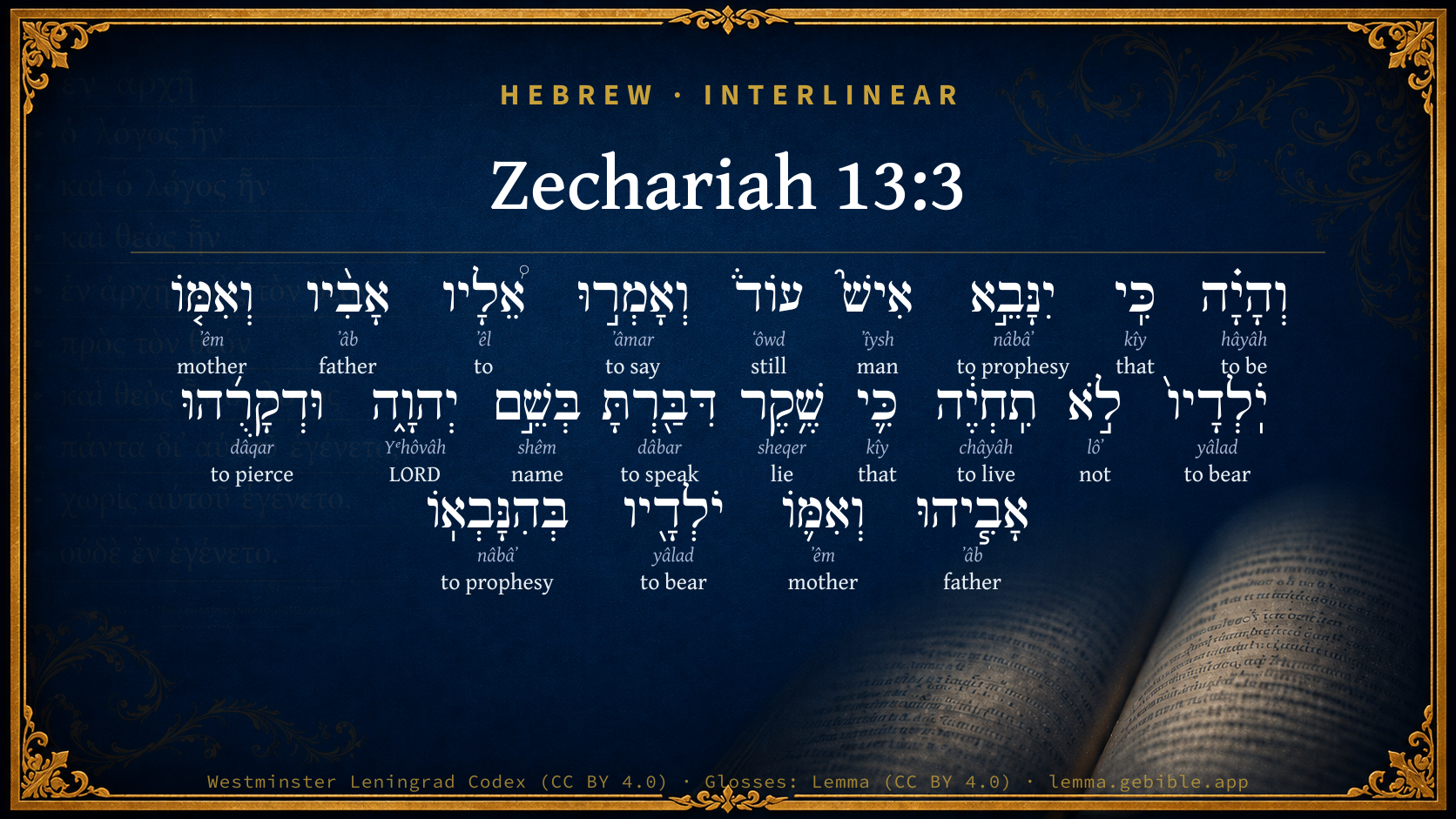
Hebrew (Westminster Leningrad Codex) Zechariah 13:3 appears in the Hebrew Old Testament. The text above is from the Westminster Leningrad Codex. Each word links to its Strong’s number, a concise gloss, and parsing drawn from the Open Scriptures Hebrew Bible morphology. Click any word for its full Brown-Driver-Briggs (BDB) entry.
Download image
Cite this verse

Zechariah 13:3 (World English Bible). Public Domain. Lemma interlinear Bible study tool, https://lemma.gebible.app/v/zechariah/13/3.

Show BibTeX & RIS
BibTeX
RIS
English Translation
It will happen that, when anyone still prophesies, then his father and his mother who bore him will tell him, 'You must die, because you speak lies in the name of Yahweh;' and his father and his mother who bore him will stab him when he prophesies.
World English Bible · Public Domain
Download a study sheet

One document with this verse’s original text, its word-by-word gloss line, the meaning frame, cross-references with their text, attributed commentary, and full source and license credits — printable, and it pastes into notes with its structure intact.

This verse Autodidact and up

Study sheet (.html) Plain text (.txt)

A passage Seminary Student

Up to 50 verses in one chapter. A passage sheet keeps up to 6 commentary sources and 12 cross-references per verse, in the order this page ranks them, and says so on the sheet whenever that leaves anything out. Ask for a single verse and you get the Autodidact verse sheet above.

Everything on this page stays free to read, with no account — the sheet is a download of what is already on screen, not access to it.

Want to remove ads? Support Godless Engineer
Compare translations 3

The same verse in 3 English versions, stacked beneath the original-language interlinear above. Click any original word for its lexicon entry.

Each is an independent rendering of the whole verse — the interlinear is not word-aligned to these translations.

Highlighted words mark where these versions differ — a whole-verse word diff, not a word-by-word alignment.

  • World English Bible Public Domain
    It will happen that, when anyone still prophesies, then his father and his mother who bore him will tell him, 'You must die, because you speak lies in the name of Yahweh;' and his father and his mother who bore him will stab him when he prophesies.
  • King James Version Public Domain
    And it shall come to pass, that when any shall yet prophesy, then his father and his mother that begat him shall say unto him, Thou shalt not live; for thou speakest lies in the name of the LORD: and his father and his mother that begat him shall thrust him through when he prophesieth.
  • unfoldingWord Literal Text CC BY-SA 4.0
    And it will be, if a man still prophesies, then his father and his mother, the ones who bore him, will say to him, ‘You will not live, for you have spoken falsehood in the name of Yahweh.’ And his father and his mother, the ones who bore him, will pierce him when he prophesies.

unfoldingWord Literal Text — © unfoldingWord, licensed CC BY-SA 4.0. Word-aligned USFM3 via Door43 (git.door43.org/unfoldingWord/en_ult).

Versions to compare (up to 4)

3 of 4 selected

Show all 18 translations

Every available English version of this verse, each an independent rendering of the whole verse.

  • World English Bible Public Domain
    It will happen that, when anyone still prophesies, then his father and his mother who bore him will tell him, 'You must die, because you speak lies in the name of Yahweh;' and his father and his mother who bore him will stab him when he prophesies.
  • Berean Standard Bible Public Domain
    And if anyone still prophesies, his father and mother who bore him will say to him, ‘You shall not remain alive, because you have spoken falsely in the name of the LORD.’ When he prophesies, his father and mother who bore him will pierce him through.
  • Majority Standard Bible Public Domain
    And if anyone still prophesies, his father and mother who bore him will say to him, ‘You shall not remain alive, because you have spoken falsely in the name of the LORD.’ When he prophesies, his father and mother who bore him will pierce him through.
  • King James Version Public Domain
    And it shall come to pass, that when any shall yet prophesy, then his father and his mother that begat him shall say unto him, Thou shalt not live; for thou speakest lies in the name of the LORD: and his father and his mother that begat him shall thrust him through when he prophesieth.
  • American Standard Version (1901) Public Domain
    And it shall come to pass that, when any shall yet prophesy, then his father and his mother that begat him shall say unto him, Thou shalt not live; for thou speakest lies in the name of Jehovah; and his father and his mother that begat him shall thrust him through when he prophesieth.
  • Revised Version (1885) Public Domain
    And it shall come to pass that, when any shall yet prophesy, then his father and his mother that begat him shall say unto him, Thou shall not live; for thou speakest lies in the name of the LORD: and his father and his mother that begat him shall thrust him through when he prophesieth.
  • Geneva Bible (1599) Public Domain
    And when any shall yet prophesie, his father and his mother that begate him, shall say vnto him, Thou shalt not liue: for thou speakest lies in the name of the Lord: and his father and his mother that begat him, shall thrust him through, when he prophesieth.
  • Douay-Rheims (1899) Public Domain
    And it shall come to pass, that when any man shall prophesy any more, his father and his mother that brought him into the world, shall say to him: Thou shalt not live: because thou best spoken a lie in the name of the Lord. And his father, and his mother, his parents, shall thrust him through, when he shall prophesy.
  • Young's Literal Translation Public Domain
    And it hath been, when one prophesieth again, That said unto him have his father and his mother, his parents, `Thou dost not live, For falsehood thou hast spoken in the name of Jehovah,' And pierced him through have his father and his mother, his parents, in his prophesying.
  • Literal Standard Version CC BY-SA 4.0
    And it has been, when one prophesies again, || That his parents, his father and his mother, || Have said to him, You do not live, || For you have spoken falsehood in the Name of YHWH, || And his father and his mother, his parents, || Have pierced him through in his prophesying.
  • Unlocked Literal Bible CC BY-SA 4.0
    If any man continues to prophesy, his father and mother who bore him will tell him, 'You will not live, for you speak lies in the name of Yahweh!' Then the father and mother who bore him will pierce him when he prophesies.
  • unfoldingWord Literal Text CC BY-SA 4.0
    And it will be, if a man still prophesies, then his father and his mother, the ones who bore him, will say to him, ‘You will not live, for you have spoken falsehood in the name of Yahweh.’ And his father and his mother, the ones who bore him, will pierce him when he prophesies.
  • Darby Bible Public Domain
    And it shall come to pass, if any shall yet prophesy, that his father and his mother that begat him shall say unto him, Thou shalt not live; for thou speakest lies in the name of Jehovah; and his father and his mother that begat him shall thrust him through when he prophesieth.
  • World Messianic Bible Public Domain
    It will happen that when anyone still prophesies, then his father and his mother who bore him will tell him, ‘You must die, because you speak lies in the LORD’s name;’ and his father and his mother who bore him will stab him when he prophesies.
  • Webster's Bible Public Domain
    And it shall come to pass, that when any shall yet prophesy, then his father and his mother that begat him shall say to him, Thou shalt not live; for thou speakest lies in the name of the LORD: and his father and his mother that begat him shall thrust him through when he prophesieth.
  • Free Bible Version CC BY-SA 4.0
    If anyone continues to prophesy, his father and mother to whom he was born will tell him, “You shall not live, because you have told lies in the Lord's name.” Then his parents shall kill him because he has prophesied.
  • Bible in Basic English Public Domain
    And if anyone goes on acting as a prophet, then his father and his mother who gave him life will say to him, You may not go on living, for you are saying what is false in the name of the Lord; and his father and his mother will put a sword through him when he does so.
  • JPS Tanakh (1917) Public Domain
    And it shall come to pass that, when any shall yet prophesy, then his father and his mother that begot him shall say unto him: 'Thou shalt not live, for thou speakest lies in the name of the LORD'; and his father and his mother that begot him shall thrust him through when he prophesieth.

Literal Standard Version (2020), Covenant Press — licensed CC BY-SA 4.0. Text via the HelloAO Bible API (eBible.org). Unlocked Literal Bible (unfoldingWord) — licensed CC BY-SA 4.0. Text via the HelloAO Bible API (eBible.org). unfoldingWord Literal Text — © unfoldingWord, licensed CC BY-SA 4.0. Word-aligned USFM3 via Door43 (git.door43.org/unfoldingWord/en_ult). Free Bible Version, Dr. Jonathan Gallagher — licensed CC BY-SA 4.0. Text via the HelloAO Bible API (eBible.org).

Word by word

More ways to search: Search by grammar → Find every occurrence → Compare this word →

Practice this passage: Drill this verse → Learn its vocabulary →

וּדְקָרֻ֜הוּ
dâqar
H1856
“and · to pierce · him”
Conjunction + Verb, Qal, Sequential Perfect, 3rd Person, Common, Plural + Suffix, Personal, 3rd Person, Masculine, Singular
Part of Speech
Conjunction + Verb
Stem
Qal
Form
Sequential Perfect
Person
3rd Person
Gender
Common
Number
Plural
Full BDB Definition

Origin: a primitive root

TWOT: 449

to pierce, thrust through, pierce through - (Qal) to pierce, run through - (Niphal) to be pierced through - (Pual) pierced, riddled (participle)
  1. וְהָיָ֗ה hâyâh H1961 “and · to be” Conjunction + Verb, Qal, Sequential Perfect, 3rd Person, Masculine, Singular
  2. כִּֽי kîy H3588 “that” Conjunction
  3. יִנָּבֵ֣א nâbâʼ H5012 “to prophesy” Verb, Niphal, Imperfect, 3rd Person, Masculine, Singular
  4. אִישׁ֮ ʼîysh H376 “man” Noun, Common, Masculine, Singular, Absolute
  5. עוֹד֒ ʻôwd H5750 “still” Adverb
  6. וְאָמְר֣וּ ʼâmar H559 “and · to say” Conjunction + Verb, Qal, Sequential Perfect, 3rd Person, Common, Plural
  7. אֵ֠לָיו ʼêl H413 “to · him” Preposition + Suffix, Personal, 3rd Person, Masculine, Singular
  8. אָבִ֨יו ʼâb H1 “father · his” Noun, Common, Masculine, Singular, Construct + Suffix, Personal, 3rd Person, Masculine, Singular
  9. וְאִמּ֤וֹ ʼêm H517 “and · mother · his” Conjunction + Noun, Common, Feminine, Singular, Construct + Suffix, Personal, 3rd Person, Masculine, Singular
  10. יֹֽלְדָיו֙ yâlad H3205 “bearing · him” Verb, Qal, Participle Active, Masculine, Plural, Construct + Suffix, Personal, 3rd Person, Masculine, Singular
  11. לֹ֣א lôʼ H3808 “not” Particle, Negative
  12. תִֽחְיֶ֔ה châyâh H2421 “to live” Verb, Qal, Imperfect, 2nd Person, Masculine, Singular
  13. כִּ֛י kîy H3588 “that” Conjunction
  14. שֶׁ֥קֶר sheqer H8267 “lie” Noun, Common, Masculine, Singular, Absolute
  15. דִּבַּ֖רְתָּ dâbar H1696 “to speak” Verb, Piel, Perfect, 2nd Person, Masculine, Singular
  16. בְּשֵׁ֣ם shêm H8034 “in/at · name of” Preposition + Noun, Common, Masculine, Singular, Construct
  17. יְהוָ֑ה Yᵉhôvâh H3068 “LORD” Noun, Proper
  18. אָבִ֧יהוּ ʼâb H1 “father · his” Noun, Common, Masculine, Singular, Construct + Suffix, Personal, 3rd Person, Masculine, Singular
  19. וְאִמּ֛וֹ ʼêm H517 “and · mother · his” Conjunction + Noun, Common, Feminine, Singular, Construct + Suffix, Personal, 3rd Person, Masculine, Singular
  20. יֹלְדָ֖יו yâlad H3205 “bearing · him” Verb, Qal, Participle Active, Masculine, Plural, Construct + Suffix, Personal, 3rd Person, Masculine, Singular
  21. בְּהִנָּבְאֽוֹ nâbâʼ H5012 “in/at · to prophesy · him” Preposition + Verb, Niphal, Infinitive Construct + Suffix, Personal, 3rd Person, Masculine, Singular

About this verse

These counts appear in no published source. They are computed here, from the morphology-tagged text and Lemma’s own curated glosses. What Lemma adds →

22
words
17
distinct lemmas
Prophets
section

Notable vocabulary

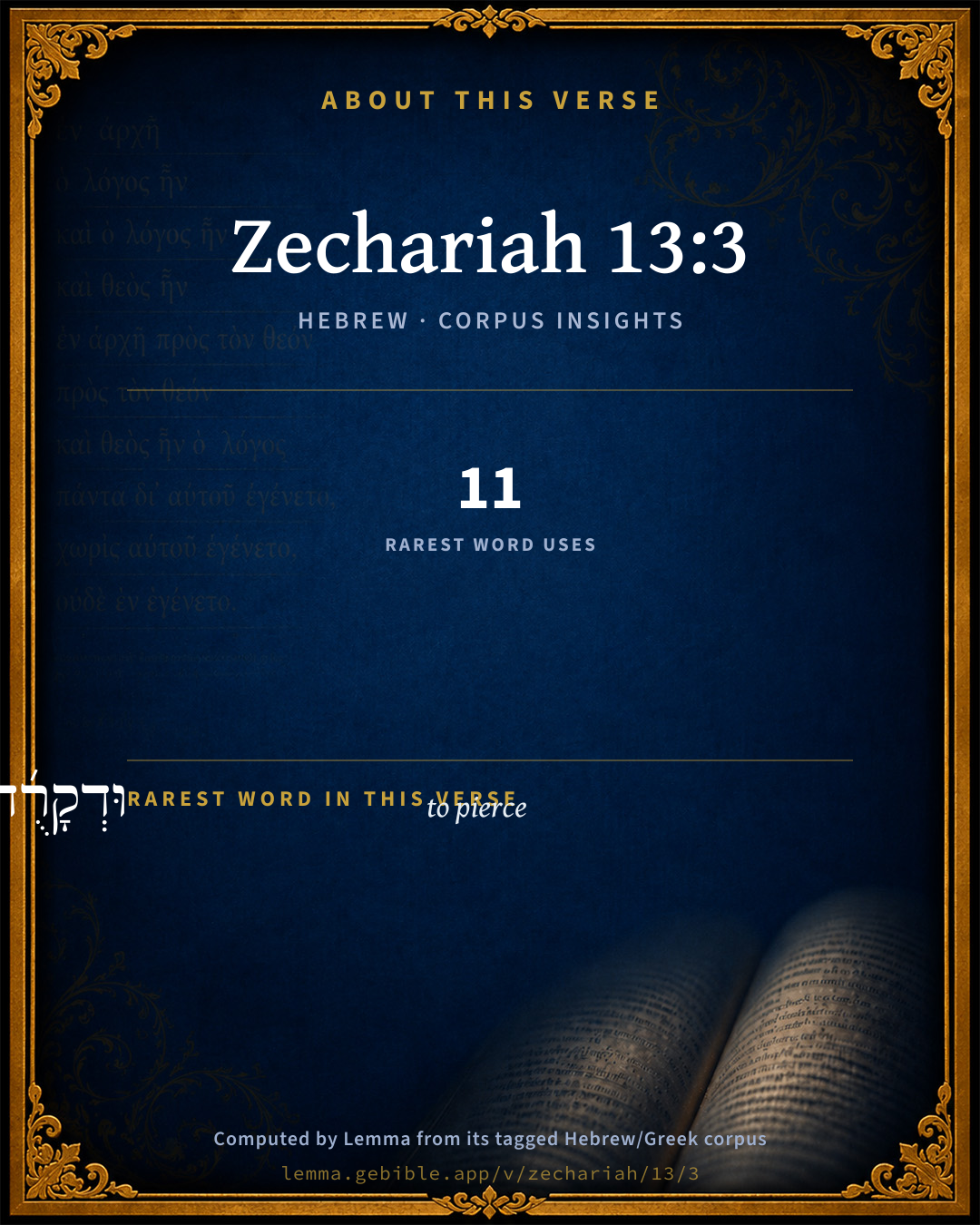
The rarest word here is וּדְקָרֻ֜הוּ to pierce H1856 — appearing just 11 times in the whole Hebrew Bible.

Shared distinctive vocabulary

וּדְקָרֻ֜הוּ to pierce H1856 occurs in 10 verses of the Hebrew Bible. Also found in:

Grammatical profile

  • 9 verbs
  • 8 nouns
  • 1 preposition
  • 2 conjunctions
  • 1 adverb
  • 1 particle

Verb forms

  • וְהָיָ֗ה Qal · Sequential Perfect
  • יִנָּבֵ֣א Niphal · Imperfect
  • וְאָמְר֣וּ Qal · Sequential Perfect
  • יֹֽלְדָיו֙ Qal · Participle Active
  • תִֽחְיֶ֔ה Qal · Imperfect
  • דִּבַּ֖רְתָּ Piel · Perfect
  • וּדְקָרֻ֜הוּ Qal · Sequential Perfect
  • יֹלְדָ֖יו Qal · Participle Active
  • בְּהִנָּבְאֽוֹ Niphal · Infinitive Construct

Repetition

Words recur within this verse — often emphatic in Hebrew:

  • יִנָּבֵ֣א to prophesy H5012 ×2
  • אָבִ֨יו father H1 ×2
  • וְאִמּ֤וֹ mother H517 ×2
  • יֹֽלְדָיו֙ to bear H3205 ×2
  • כִּֽי that H3588 ×2

Hebrew & Septuagint length

In English translation the verse runs 47 words from the Hebrew and 59 from the Septuagint (LXX English) — closely comparable.

A rough comparison of the two English renderings, which tokenize alike — not a word-level alignment.

Word counts can differ between the Hebrew and the Greek without any difference in meaning — e.g. the Hebrew direct-object marker אֵת has no separate Greek word, and Greek often adds the article ὁ.

Cross-references

9

Topical passages linked to Zechariah 13:3 in the Treasury of Scripture Knowledge — connected by theme and wording, ordered by reader-vote popularity; previews shown in the World English Bible.

  • Deuteronomy 13:6–11 If your brother, the son of your mother, or your son, or your daughter, or the wife of your bosom, or your friend, who is as your own soul, entice you secretly, saying, Let us go and serve other gods, which you have not known, you, nor your fathers;
  • Deuteronomy 18:20 But the prophet, who shall speak a word presumptuously in my name, which I have not commanded him to speak, or who shall speak in the name of other gods, that same prophet shall die.
  • Jeremiah 23:34 As for the prophet, and the priest, and the people, who shall say, The burden of Yahweh, I will even punish that man and his house.
  • Ezekiel 14:9 If the prophet be deceived and speak a word, I, Yahweh, have deceived that prophet, and I will stretch out my hand on him, and will destroy him from the midst of my people Israel.
  • Exodus 32:27–28 He said to them, "Thus says Yahweh, the God of Israel, 'Every man put his sword on his thigh, and go back and forth from gate to gate throughout the camp, and every man kill his brother, and every man his companion, and every man his neighbor."
  • Matthew 10:37 He who loves father or mother more than me is not worthy of me; and he who loves son or daughter more than me isn't worthy of me.
  • 2 Corinthians 5:16 Therefore we know no one after the flesh from now on. Even though we have known Christ after the flesh, yet now we know him so no more.
  • Deuteronomy 33:9 Who said of his father, and of his mother, I have not seen him; Neither did he acknowledge his brothers, Nor knew he his own children: For they have observed your word, Keep your covenant.
  • Luke 14:26 "If anyone comes to me, and doesn't hate his own father, mother, wife, children, brothers, and sisters, yes, and his own life also, he can't be my disciple.

Cross-references courtesy of OpenBible.info (CC BY 4.0).

Hebrew and Greek witnesses Masoretic Hebrew ↔ Greek Septuagint

The same verse in the two great witnesses to the Old Testament, shown verse-for-verse.

These are two independent witnesses, not word-aligned to each other, and the Septuagint is shown in lemma (dictionary) form.

Hebrew Zechariah 13:3 Masoretic · Westminster Leningrad Codex

וְהָיָ֗ה כִּֽי יִנָּבֵ֣א אִישׁ֮ עוֹד֒ וְאָמְר֣וּ אֵ֠לָיו אָבִ֨יו וְאִמּ֤וֹ יֹֽלְדָיו֙ לֹ֣א תִֽחְיֶ֔ה כִּ֛י שֶׁ֥קֶר דִּבַּ֖רְתָּ בְּשֵׁ֣ם יְהוָ֑ה וּדְקָרֻ֜הוּ אָבִ֧יהוּ וְאִמּ֛וֹ יֹלְדָ֖יו בְּהִנָּבְאֽוֹ

It will happen that, when anyone still prophesies, then his father and his mother who bore him will tell him, 'You must die, because you speak lies in the name of Yahweh;' and his father and his mother who bore him will stab him when he prophesies.

World English Bible · Public Domain

Greek LXX Zechariah 13:3 Septuagint · lemma form

καί εἰμί ἐάν προφητεύω ἄνθρωπος ἔτι καί εἶπον πρός αὐτός ὁ πατήρ αὐτός καί ὁ μήτηρ αὐτός ὁ γεννάω αὐτός οὐ ζάω ὅτι ψευδής λαλέω ἐπί ὄνομα κύριος καί συνποδίζω αὐτός ὁ πατήρ αὐτός καί ὁ μήτηρ αὐτός ὁ γεννάω αὐτός ἐν ὁ προφητεύω αὐτός

And it shall come to pass, if a man will yet prophesy, that his father and his mother which gave birth to him shall say to him, You shall not live; for you have spoken lies in the name of the Lord: and his father and his mother who gave him birth shall bind him as he is prophesying.

LXX2012 (modern English Septuagint) · Public Domain

On this verse, Haydock's Catholic Bible Commentary discusses the Septuagint’s reading. Read the note in Commentary ↓

Hebrew: Westminster Leningrad Codex (CC BY 4.0). Greek: Septuagint (public domain); English from LXX2012 (modern English Septuagint) (Public Domain). How the Septuagint differs from the Hebrew →

Targum (Aramaic paraphrase)

1

The Targum is the ancient Jewish Aramaic paraphrase of the Hebrew Scriptures — an interpretive translation, not the Hebrew text itself. Onkelos (literal) and Pseudo-Jonathan (expansive) render the Torah, and Jonathan the Prophets. Coverage is partial: where no permissively-licensed English translation exists for a verse, only the Aramaic is shown. This is verse-level text, not a word-by-word alignment to the Hebrew.

  1. Targum Jonathan Prophets (Joshua–Malachi)
    וִיהֵי אֲרֵי אִתְנַבֵּי גְבַר עוֹד וְיֵימְרוּן לֵיהּ אֲבוּהִי וְאִמֵיהּ יַלְדוֹהִי לָא תִתְקַיֵם אֲרֵי שִׁקְרָא אִתְנַבֵּיתָא בִּשְׁמָא דַייָ וְיֶחְדוּן בֵּיהּ אֲבוּהִי וְאִמֵיהּ יַלְדוֹהִי בְּאִתְנַבָּיוּתֵיהּ:

    (no public-domain English translation for this verse)

    Targum Jonathan — Aramaic: “Mikraot Gedolot” (public domain). English: “Sefaria Community Translation” (CC0 1.0 (public-domain dedication)); “London "Chaldee Paraphrase," 1871” (public domain). Text via Sefaria.

Commentary

Notes on Zechariah 13:3 from classic Christian and Jewish commentators (each source and its license shown beneath its notes). The classic Christian expositions comment on the surrounding passage and are grouped to its opening verse, so a note may address several verses; the Jewish commentaries on the Tanakh (Rashi and others) are per-verse, so they appear only where the commentator wrote on this verse.

Lemma curates 59 commentaries, every one of them public domain or Creative Commons licensed, each selected and text-cleaned for this edition rather than reprinted as found. About our sources →

Ellicott's Commentary for English Readers

(3) The reaction from superstition would be scepticism. The people would no longer believe in prophecy at all, and the very parents of a prophet would slay him as an impostor, even though not legally convicted of falsehood (Deu_18:19-22).

But God would have pity of their “zeal not according to knowledge,” and “pour out . . . the Spirit . . . so that they should look on Him whom they pierced,” &c. The word “pierced” is the same as is better rendered in Zec_13:3 by “thrust through” The Hebrew has “shall look upon me,” but by the addition of the small letter, it would mean “upon him,” which suits better the succeeding clauses, and has the support of Aquila, Theodotion, and Symmachus, and is defended by Kennicott, Ewald. Geiger, Bunsen, &c. (and is so quoted in Joh_19:37). We, accordingly, adopt this rendering. If our conjecture concerning the original position of Zec_12:10 in the text be correct, the whole passage will run as follows (Zec_13:1): “In that day shall be a fountain opened, for the house of David and for the inhabitants of Jerusalem, for [removal of] sin and of uncleanness.—(2) And it shall be in that day (‘tis the utterance of Jehovah of Hosts) I will cut off the names of the idols from the land, and they shall not be remembered any more; and the [false] prophets and the unclean spirit will I cause to pass away from the land. (3) And it shall be, when a man shall prophesy, then they shall say to him, his father and his mother, they that bare him, “Thou shalt not live, because thou hast Spoken lies in the name of Jehovah;” and they shall thrust him through, his father and his mother, they that bare him, on account of his prophesying. (Zec_12:10) Then will I pour out upon the house of David, and upon the inhabitants of Jerusalem, the spirit of grace and supplication, and they shall look on him, even him whom they thrust through, and they shall mourn over him, as the mourning for an only son, and they shall make bitter mourning over him, as one mourneth bitterly for a firstborn. In that day . . . (14) . . . and their wives apart.”

When scepticism should have reached such a pitch that parents would without hesitation slay their son if he should pretend to prophetic powers, then God would smite the people with prickings of the heart, and they would look on such a case with the utmost remorse, and make great lamentation for the victim. As with Zec_11:12 (see Notes), so this prophecy must not be regarded as being fulfilled in one single event only. But, certainly, in the case of Christ it received its most signal fulfilment. There was One, professing more than prophetic powers, rejected by His people, and especially by His own relatives—slain, thrust through, and then deeply lamented (Luk_23:48; Act_2:37-41).

A Bible Commentary for English Readers, edited by Charles John Ellicott (1878–1897) — public domain. Text from a community e-Sword module.

Trapp's Complete Commentary

John Trapp

Zec 13:3 And it shall come to pass, [that] when any shall yet prophesy, then his father and his mother that begat him shall say unto him, Thou shalt not live; for thou speakest lies in the name of the LORD: and his father and his mother that begat him shall thrust him through when he prophesieth.

Ver. 3. And it shall come to pass, that when any shall yet prophesy] Here the prophet showeth how God will effect the former promise. He will first give unto his people a spirit of judgment, and then a spirit of burning, as Isa 4:4, so that they shall be able to discern both good and evil, and not be led away with the error of the wicked, to fall from their own steadfastness, Heb 5:14 2Pe 2:17. They shall also be adeo perciti zelo, so carried on by zeal of God’s glory, and so blessedly blown up, as I may so say, in his cause, that they shall fall upon their dearest relations in this case, and labour to bring their own children to condign punishment, according to the law of God in that behalf provided, Deu 13:8-9. Neither let any object here, that this is Old Testament: we find no such thing in the gospel, for the prophet here speaketh of the times of the gospel {Zec 12:10} and of the kingdom of Christ. Sequitur ergo, saith Mr Calvin here well and worthily, non mode legem illam fuisse Iudaeis positam, quemadmodum nugantur fanatici homines, qui vellent hodie sibi permitti orbis, turbandi licentiam; sed extenditur ad nos etiam eadem lex. It followeth, therefore, that that law, Deu 13:9, was not made for the Jews only (as some brain sick people conceit it, who would fain get leave to trouble the world with their fopperies), but the same law extendeth itself even to us; for if at this day thieves, and witches, and adulterers, &c., are held worthy of punishment, how much more are heretics, seducers, blasphemers, who poison men’s souls, rob God of his glory, confound the whole order of the Church, &c. See Rom 13:4 1Pe 2:13-14, and hold to that old rule, Non distinguendum, ubi scriptura non distinguit, Men must not distinguish where the Scripture doth not.

That his father] In whose heart there is naturally an ocean of love to his own child, as we see in David toward Absalom, in old Andronicus, the Greek emperor, in our William the Conqueror, and Maud, his wife, toward their unnatural son, Robert Curtuoise, whom she maintained out of her own coffers in his quarrel for Normandy; which the king her husband knew, and took as a cause rather of displeasure than of hatred, as proceeding from motherly indulgence for advancing their son.

That begat him] This is twice here repeated, for honour’s sake, to these zealots, who had forgotten all natural and carnal respects for the vindication of God’s glory and his sincere service. See Mat 10:37. {See Trapp on "Mat 10:37"}

Thou shalt not live] sc. To do more mischief, and to draw more souls to the devil. Non Catilinae te genui sed partita, said Aulus Fulvius, when he slew his own son taken in Catiline’s conspiracy; I begat thee not for Catiline, but for thy country. More to be commended a great deal than Philip II, that bloody King of Spain, who said openly, that he had rather have no subjects than Lutheran subjects; that he would not leave a Lutheran in his dominions; that if he thought his shirt smelt of that heresy, he would tear it from his own back; and out of a blind zeal he suffered his oldest son, Charles, to be murdered by the cruel Inquisition, because he seemed to favour our profession. For which noble exploit that mouth of blasphemy, the Pope, gave him this commendation, Non pepercit filio suo, sed dedit pro nobis: He spared not his own son, but gave him up for us. Oh horrible!

For thou speakest lies in the name of the Lord] Lies in hypocrisy, 1Ti 4:12 Rev 2:24, doctrines of devils, depths of Satan, that artificer of lies, and father of them, Joh 8:44, which yet he would fain father and fasten upon the God of Amen, or of truth, as he is called, Psa 31:5; like as varletesses {a} beget bastards, and lay them at honest men’s doors to be kept: "Thou speakest lies in the name of the Lord." This is to substitute the devil in the place of God, or to transform God, so as that he should nothing differ from the devil. No wonder, therefore, though he that break the least commandment, and teach men so, be called least in the kingdom of heaven, Mat 5:19, especially if he pretend God’s authority for it, as the false prophets of old, and the Swenckfeldian heretics slate entitle themselves, The confessors of the glory of Christ; for this is the highest indignity, or rather contumely, that can be put upon God; it is a more detestable evil than to kill an innocent man; yea, to commit parricide, or treason. Imo quaecunque poterunt numerate scelera non pervenient ad hoc crimen, saith Calvin upon the text. Let sectaries and seducers look to it, those harmless, hornless creatures, as they would be accounted.

Shall thrust him through when he prophesieth] As Phineas did that stinking couple in the flagrancy of their lust, Num 25:8, and as Levi, in like case, consecrated himself to the Lord, even every man upon his son and upon his brother, Exo 32:29. He said unto his father and mother (when God’s glory required it), I have not seen him, neither did he acknowledge his brethren nor know his own children, Deu 33:9. All natural relations and self-respects should be drowned in the glory of God and the good of our own and other men’s souls. They should be even swallowed up thereby, as the fuel is by the fire, and as the sorcerer’s serpents were by Moses’ serpent, or the fat kine by the lean.

{a} A person of a low, mean, or knavish disposition; a knave, rogue, rascal. ŒD

John Trapp, A Commentary or Exposition upon All the Books of the Old and New Testament (1647–1656) — public domain. Text from a community e-Sword module.

Joseph Benson's Commentary

Zec 13:3. And when any shall yet prophesy — Namely, falsely; then his father and his mother shall say unto him — His dearest friends shall discourse with him, and inform him what the law of Moses directs in this case; Thou shalt not live — This probably is not to be considered as the condemnatory sentence; for, being private persons, they had no right to pronounce such a sentence; but it is a repetition of the law, which saith, that a false prophet ought not to be suffered to live, Deu 13:6-8. For thou speakest lies in the name of the Lord — Thou fallest under the sentence of the law. And his father and his mother shall thrust him through — Even the parents of such a person shall be forward to put in execution against him the penalties inflicted by the law upon false prophets and seducers. “They shall treat such a one in the same manner as their fathers did the true prophet, the Messiah; they shall pierce or thrust him through.” — Lowth. The purport of this passage seems to be, that very vigorous and decisive measures shall then be taken against every kind and degree of idolatry.

Joseph Benson's Commentary on the Old and New Testaments (1811–1818) — public domain. Text from a community e-Sword module.

Tyndale Open Study Notes

Tyndale Open Resources

13:3 You must die: According to God’s law, a false prophet must be executed (Deut 13:5, 10; 18:20). The Israelites had tolerated false prophets and killed the Lord’s true prophets. In the future, the situation would be reversed.

Tyndale Open Study Notes — © Tyndale Open Resources, licensed CC BY-SA 4.0. Text via the HelloAO Bible API.

Geneva Bible (1599)

Geneva Bible translators

He showeth what zeal the godly shall have under the kingdom of Christ, Deut. 13:6, 9.

That is, when they shall prophesy lies, and make God, who is the author of truth, a cloak thereunto.

Geneva Bible (1599) marginal notes — public domain. Text via Bolls.life.

Jamieson, Fausset & Brown

Robert Jamieson, A. R. Fausset & David Brown

The form of phraseology here is drawn from Deu 13:6-10; Deu 18:20. The substantial truth expressed is that false prophecy shall be utterly abolished. If it were possible for it again to start up, the very parents of the false prophet would not let parental affection interfere, but would be the first to thrust him through. Love to Christ must be paramount to the tenderest of natural ties (Mat 10:37). Much as the godly love their children, they love God and His honor more.

Jamieson, Fausset & Brown — Commentary Critical and Explanatory on the Whole Bible (1871) — public domain (CC PDM 1.0). Text via the HelloAO Bible API.

Adam Clarke's Commentary

Verse 3. When any shall yet prophesy] Falsely; such shall be the horror of such an evil, that there shall be no toleration of it. Itself, and they who practise it, shall be everywhere destroyed.

Adam Clarke's Commentary on the Bible (1810–1826) — public domain. Text from a community e-Sword/MySword module.

John Calvin's Commentaries

The same concession is made in this verse, where Zechariah speaks of the office of prophesying: he indeed confines what he says altogether to false teachers, for he takes it as granted that there was then no attention given to God’s servants, inasmuch as false spirits had conspired together, so that nothing pure or sound remained in the Church. As then a false and diabolical faction had then prevailed, Zechariah calls them Prophets as though they were all such, for they were heard as the Lord’s servants during that disorder of which mention is made. But he proceeds farther in this verse than before, and says, that there would be so much zeal in God’s children when renewed by his Spirit, that they would not spare even their own children, but slay them with their own hands, when they saw them perverting the truth of God.

Zechariah no doubt alludes to the 13th chapter of Deuteronomy 13:1 where God requires such a rigorous severity in defending pure doctrine, that a father was to rise up against the son whom he had begotten, that a husband was to lead his wife to death rather than to indulge his love and to pardon impiety, in case the wife solicited him or others to forsake God. The Lord then would have all the godly to burn with so much zeal in the defense of lawful worship and true religion, that no connection, no relationship, nor any other consideration, connected with the flesh, should avail to prevent them from bringing to punishment their neighbors, when they see that God’s worship is profaned, and that sound doctrine is corrupted. This was the rule prescribed by the law. Now after religion had been for a time neglected, and even trodden almost under foot, Zechariah says, that the faithful, when they shall have repented, would be endued with so much zeal for true religion, as that neither father nor mother would tolerate an ungodly error in their own son, but would lead him to punishment; for they would prefer the glory of God to flesh and blood, they would prefer to all earthly attachments that worship which ought to be more precious to us than life itself.

But it must at the same time be observed, that this zeal under the reign of Christ is approved by God; for Zechariah does not here confine what he teaches to the time of the law, but shows what would take place when Christ came, even that this zeal, which had become nearly extinct, would again burn in the hearts of all the godly. It then follows, that this law was not only given to the Jews, as some fanatics verily imagine, who would have for themselves at this day a liberty to disturb the whole world, but the same law also belongs to us: for if at this day thieves and robbers and sorcerers are justly punished, doubtless those who as far as they can destroy souls, who by their poison corrupt pure doctrine, which is spiritual food, who take away from God his own honor, who confound the whole order of the Church, doubtless such men ought not to escape unpunished. It would be indeed better to grant license to thieves and sorcerers and adulterers, than to suffer the blasphemies which the ungodly utter against God, to prevail without any punishment and without any restraint. And this is evident enough from the words of our Prophet.

And little consideration do they also show, who immediately fret from a regard to their own relatives. When faithful ministers and pastors are constrained to warn their people to beware of the artifices of Satan, they seek to bury every recollection of this, because it is invidious, because it leads to reproach. What if their children were to be drawn forth to punishment? How could they bear this, though they might remain at home; for they cannot attend to a free warning from their own pastor, when they find that impious errors are reproved, which we see prevailing, I say not in our neighborhood only, but also in our own bosom and in the Church. Let them then acknowledge their own folly, that they may learn to put on new courage, so that they may make more account of the glory of God, and of the pure doctrine of religion, than of their own carnal attachments, by which they are too fast held. And this is also the reason why the Prophet says, who have begotten him, and he repeats it twice: nor was it in vain that God had those words expressly added,

“The husband shall not suffer the wife who sleeps in his bosom to go unpunished; nor shall the father pardon his son whom he has begotten, nor the mother her own offspring, whom she has nourished, whom she has carried in her womb.” (Deuteronomy 13:6, 9.)

All these things are said, that we may learn to forget whatever belongs to the world and to the flesh, when God’s glory and purity of doctrine are to be vindicated by us.

Now the Prophet shows clearly that all this is to be understood of false teachers, for he adds, For falsehood hast thou spoken in the name of Jehovah. And at the same time the atrocity of their sin is here pointed out; for if we rightly consider what it is to speak falsehood in the name of Jehovah, it will certainly appear to us to be more detestable than either to kill an innocent man, or to destroy a guest with poison, or to lay violent hands on one’s own father, or to plunder a stranger. Whatever crimes then can be thought of, they do not come up to this, that is, when God himself is involved in such a dishonor, as to be made an abettor of falsehood. What indeed can more peculiarly belong to God than his own truth? and it is his will also to be worshipped by us according to this distinction: God is truth. Now to corrupt pure doctrine — is it not the same thing, as though one substituted the devil in the place of God? or sought to transform God, so that there should be no difference between him and the devil? Hence the greatest of all crimes, as I have already said, does not come up to this horrible and monstrous wickedness. For how much does the salvations of souls exceed all the riches of the world? and then, how much more excellent is the worship of God than the fame and honors of mortals? Besides, does not religion itself, the pledge of eternal life, swallow up in a manner every thing that is sought in the world? But most sacred to us ought to be the name of God, the sanctifying of which we daily pray for. When therefore what is false is brought forward in the name of God, is not he, according to what I have already said, as it were violently forced to undertake the office of the devil, to renounce himself, and to deny that he is God?

We hence see the design of the Prophet, when he shows that there is no place for pardon, when the ungodly thus wantonly rise up to pervert pure doctrine, and so to confound all things as wholly to destroy true religion.

He adds, Pierce him shall his father and his mother who have begotten him. It is much harder to kill their son by their own hands than to bring him to the Judge, and to leave him to his fate. But the Prophet has taken this from the law — that so much zeal is required from the faithful, that, if it be necessary, they are to exterminate from the world such pests as deprive God of his own honor, and attempt to extinguish the light of true and genuine religion. It follows —

John Calvin's Commentaries (1540-1563) — public domain. Text from the Calvin Translation Society English edition (1840s-50s) via the Christian Classics Ethereal Library (ccel.org). Calvin's coverage is partial (roughly two-thirds of the Bible); uncommented books and verses are honest gaps, never fabricated. The 19th-century editor's footnotes and remarks are omitted so the notes are faithfully Calvin's own voice.

The Cambridge Bible for Schools and Colleges

gen. ed. J. J. S. Perowne

3. his father and his mother] In holy zeal they would carry out the law, “thine hand shall be first upon him to put him to death.” Deu_13:6; Deu_13:9.

The Cambridge Bible for Schools and Colleges (gen. ed. J. J. S. Perowne; Cambridge University Press, 1878–1918) — public domain. Text from a community e-Sword module.

John Gill's Exposition

And it shall come to pass, that when any shall yet prophesy,.... Or attempt to prophesy, or propagate their idolatrous religion and principles after this time, when they shall be abundantly detected and exposed:

then his father and his mother that begat him; of whom he is born, and who, as his parents, must be supposed to have the most tender regard unto him, even to these the imposture will be so flagrant, that they will not encourage him, but, on the contrary,

shall say unto him, Thou shall not live; but die, according to the law against the false prophet in Deu 18:20,

for thou speakest lies in the name of the Lord; which is the very character of the followers of the man of sin, who speak lies in hypocrisy, pretending that they are of God, and carrying a show of truth; religion, and holiness, Ti1 4:1,

and his father and his mother that begat him shall thrust him through when he prophesieth; so great will be their love to God, and to his truth, that, notwithstanding the nearness of blood, their hands will be upon him first, and either beat him, or put him to death; a son, according to the law, not being to be spared in such a case, Deu 13:6.

John Gill's Exposition of the Whole Bible (1746–1763) — public domain (CC PDM 1.0). Text via the HelloAO Bible API.

Albert Barnes' Notes on the Bible

His father and mother that begat him shall say unto him, Thou shalt not live - The prophet describes the zeal against false prophecy, with reference to the law against those who seduced to apostasy from God. Deu 13:6-10 : “the nearest relations were themselves to denounce any who had secretly tried to seduce them, and themselves, as the accusers, to cast the first stone at them. Cyril: “Such shall in those times be the reverence to Godward, so careful shall they be of perfect probity and laudable life, that parents themselves shall be stimulated against their children, if they should speak falsely anything from their own heart, as though God spoke by them - How true that word is, and how accredited the prophecy! This indicates clearly a great advance toward godliness, God transforming things or the better. What aforetime was held in great esteem, is now hated and accursed and held intolerable.”

Albert Barnes' Notes on the Bible (1834–1885) — public domain. Text from a community e-Sword/MySword module.

Haydock's Catholic Bible Commentary

Not live. The law condemned those prophets to death, who attempted to lead the people into idolatry, Deuteronomy xiii. 1. People shall be so zealous for God’s honour, that the parents of the seducer shall themselves (Calmet) bring him to judgment. (Haydock) --- Through, or make some mark upon him, as fugitive slaves, &c., were stigmatized. (Calmet) --- Septuagint, "shall shackle." (Haydock) --- These before interpreted dakar, danced, or insulted. The others have in both places, "pierced." (St. Jerome) --- The person was not slain, ver. 6.

George Leo Haydock (1774–1849), Haydock's Catholic Family Bible and Commentary, 1859 edition — public domain. Excludes Psalms (Douay-Rheims chapter numbering differs from Protestant) and Deuterocanonical books (Catholic canon only).

Matthew Poole's English Annotations

When any shall yet prophesy; whosoever he be that shall pretend hereafter to prophesy through the instigation of that unclean spirit, for it can be from no other, when the Lord shall have fully revealed his mind to us.

His father and his mother that begat him; his dearest friends, they who are by nature/nearest to him, who begat him.

Shall say unto him; shall discourse to him, and inform him what the law of Moses directeth in this case.

Thou shalt not live; which I take to be not the sentence condemnatory, for, being private persons, they could not condemn him; but it is a repetition of the law which saith such shall not live, and then it amounts to this: A false prophet ought not to live, Deu 13:6,8; what then dost thou do to break this law, and endanger thy life? Their oughtest to die for this by the law. The father and mother thus should admonish and show the matter of law and danger, but not judicially pass sentence, and determine what shall be done.

Thou speakest lies in the name of the Lord; thou fallest under that law, Deu 13:6.

Shall thrust him through; or, wound, chastise with stripes that may leave their marks behind them; or rather, shall sharply reprove him, and with cutting words terrify him from the like practice. You read of words that are piercing words, Pro 12:18, words that run through as a sword; and the Chaldee paraphrast on this of our prophet allows the father and mother to deal sharply with their son, they shall rebuke cuttingly. Besides, if it were to be understood of killing, the law directs to stone such a one, Deu 13:10, not to run him through with lance or sword.

Matthew Poole's English Annotations on the Holy Bible (1683–1685) — public domain. Text from a community e-Sword/MySword module.

The Pulpit Commentary

When any shall yet prophesy; i.e. if any man shall pretend to have predictive powers conferred on him by God. There is here no intimation that true prophecy should cease, as Keil and Kohler suppose; the man is punished, not because he prophesies, but because "he speaketh lies." His father and his mother. The passage is grounded on the enactments in Deu_13:6-10 and Deu_18:20, which commanded the death of a false prophet or of one who enticed others to Idolatry. Here the holy zeal of the parents should put the law in force. This was quite a different state of things from that which obtained in former times. The earlier prophets continually complain of the favour shown to these deceivers; (comp. Isa_9:15 Jer_5:31 Mic_2:11) and we never read of the legal punishment being inflicted after due investigation, the test being the non-fulfilment of the prediction. (Deu_18:22) In the new theocracy, so great is the recoil from such pretenders, that their nearest relations shall at once punish them with death without any previous legal process. Shall thrust him through. Stab, pierce him, put him to death, as in Zec_12:10. The gospel deals more tenderly with heretics. (Luk_9:55) "Defendenda religio non est occidendo," says Laetant. ("Div. Inst.," 5:20), "sed moriendo; religio cogi non potest" (Wordsworth, in loc. ).

The Pulpit Commentary (1880–1919), ed. H.D.M. Spence-Jones & Joseph S. Exell — public domain. Text from a community e-Sword module.

John Wesley's Explanatory Notes

Prophesy - Falsely. His father - His dearest friends. Shall thrust him through - That is, shall wound, shall chastise him with stripes that may leave their marks behind.

John Wesley, Explanatory Notes Upon the Whole Bible (1754–1765) — public domain. Text via the GEBible commentary corpus.

unfoldingWord translationNotes

Door43 World Missions Community

to prophesy

It is implied that these are false prophecies. AT: "to prophesy falsely" (See: Assumed Knowledge and Implicit Information)

his father and mother who bore him

The phrase "who bore him" describes "his father and mother" in order to express surprise that someone's own parents would treat him in this way. AT: "his own father and mother" (See: Distinguishing versus Informing or Reminding)

You will not live

This can be stated in positive form. AT: "You must die"

you speak lies in the name of Yahweh

Speaking in the name of someone means speaking with his power and authority, or as his representative. AT: "you claim to speak for Yahweh but you speak lies" (See: Metonymy)

will pierce

"will stab and kill him"

translationWords

prophet

name

Yahweh

unfoldingWord translationNotes — © Distant Shores Media and the Door43 World Missions Community, licensed CC BY-SA 4.0. Source: git.door43.org/Door43/en_tn.

Lesson kit

Teaching starters — assembled from the data on this page, not authored interpretation. Every prompt links to the verse data it draws on. Edit before teaching.

Zechariah, in the Prophets, opens this verse with 22 words (17 distinct Hebrew lemmas). Its most distinctive word is dâqar (“to pierce”). A historical commentator’s framing appears above. Read the whole chapter for the surrounding context.

Discussion questions

  1. How does “to pierce” (dâqar) shape what this verse is saying?
  2. Numbers 25:8 shares the word «to pierce» with this verse. How do the two illuminate each other?
  3. “to prophesy” occurs 2× in this one verse. What is the effect of the repetition?
  4. The translations on this page render this verse differently — a whole-verse word diff, not a word-by-word alignment. What might account for the different wordings?
  5. The verb «וְהָיָ֗ה» is Qal Sequential Perfect. How does its form color the action?
  6. Reading how Ellicott's Commentary for English Readers and Trapp's Complete Commentary read this verse, where do the two commentators agree and where do they part?

Things to notice

Reading settings

Reading text

Shown beneath each verse's original-language words.

Old Testament
Old Testament edition

Read the OT as the Masoretic Hebrew (MT) or the Greek Septuagint (LXX).

English shown for the Greek Septuagint (in the Hebrew ↔ Greek comparison).

Comparing translations? Open the Compare panel on any verse page to stack up to four side by side.