
1 Samuel 4:19

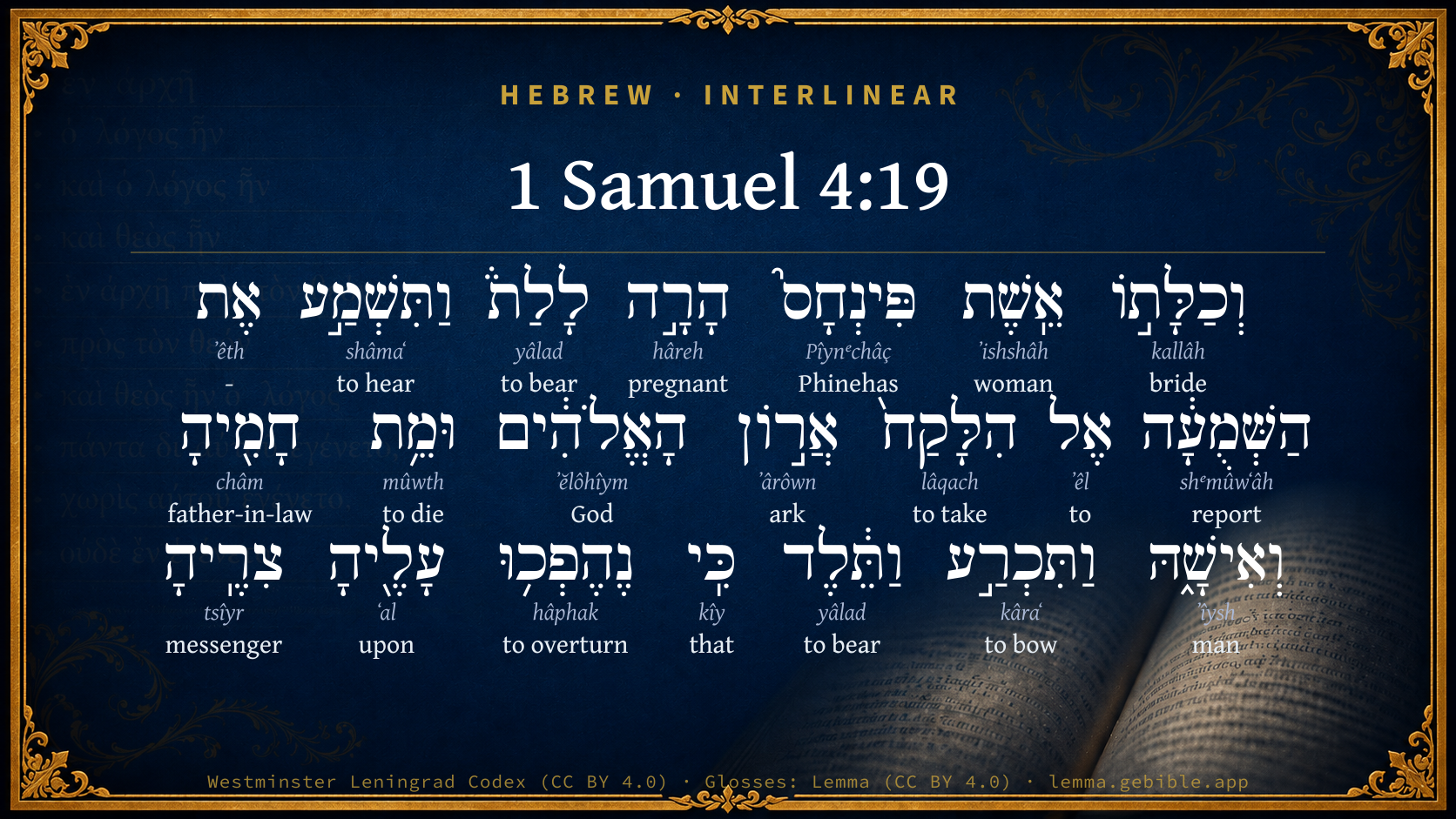
Hebrew (Westminster Leningrad Codex) 1 Samuel 4:19 appears in the Hebrew Old Testament. The text above is from the Westminster Leningrad Codex. Each word links to its Strong’s number, a concise gloss, and parsing drawn from the Open Scriptures Hebrew Bible morphology. Click any word for its full Brown-Driver-Briggs (BDB) entry.
Download image
Cite this verse

1 Samuel 4:19 (World English Bible). Public Domain. Lemma interlinear Bible study tool, https://lemma.gebible.app/v/1-samuel/4/19.

Show BibTeX & RIS
BibTeX
RIS
English Translation
His daughter-in-law, Phinehas' wife, was with child, near to be delivered: and when she heard the news that the ark of God was taken, and that her father-in-law and her husband were dead, she bowed herself and brought forth; for her pains came on her.
World English Bible · Public Domain
Highlights
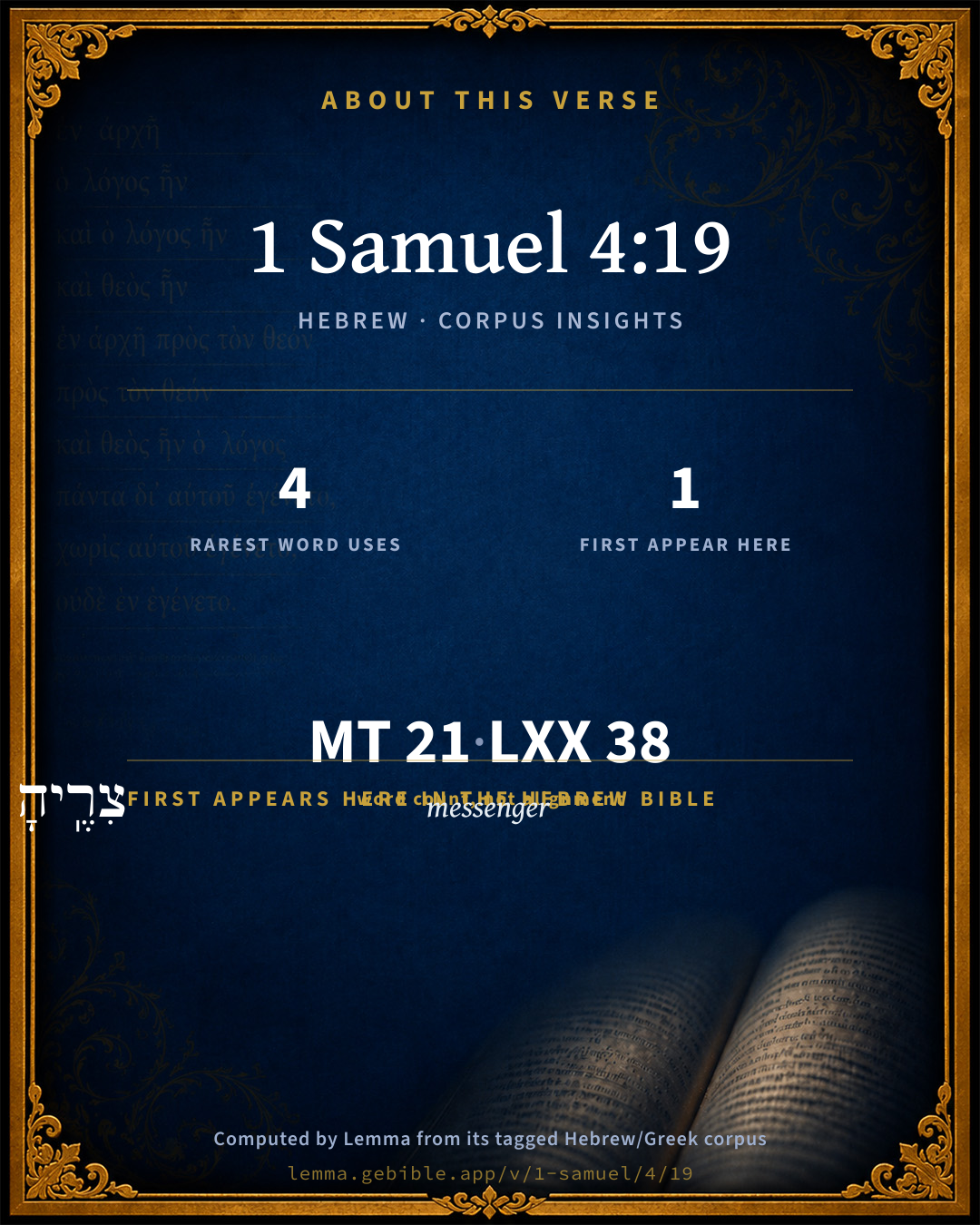
  • 1 first appearance in the Hebrew Bible
Full analysis ↓
Download a study sheet

One document with this verse’s original text, its word-by-word gloss line, the meaning frame, cross-references with their text, attributed commentary, and full source and license credits — printable, and it pastes into notes with its structure intact.

This verse Autodidact and up

Study sheet (.html) Plain text (.txt)

A passage Seminary Student

Up to 50 verses in one chapter. A passage sheet keeps up to 6 commentary sources and 12 cross-references per verse, in the order this page ranks them, and says so on the sheet whenever that leaves anything out. Ask for a single verse and you get the Autodidact verse sheet above.

Everything on this page stays free to read, with no account — the sheet is a download of what is already on screen, not access to it.

Want to remove ads? Support Godless Engineer
Compare translations 3

The same verse in 3 English versions, stacked beneath the original-language interlinear above. Click any original word for its lexicon entry.

Each is an independent rendering of the whole verse — the interlinear is not word-aligned to these translations.

Highlighted words mark where these versions differ — a whole-verse word diff, not a word-by-word alignment.

  • World English Bible Public Domain
    His daughter-in-law, Phinehas' wife, was with child, near to be delivered: and when she heard the news that the ark of God was taken, and that her father-in-law and her husband were dead, she bowed herself and brought forth; for her pains came on her.
  • King James Version Public Domain
    And his daughter in law, Phinehas' wife, was with child, near to be delivered: and when she heard the tidings that the ark of God was taken, and that her father in law and her husband were dead, she bowed herself and travailed; for her pains came upon her.
  • unfoldingWord Literal Text CC BY-SA 4.0
    Now his daughter-in-law, the wife of Phinehas, pregnant, to give birth. And she heard the report about the Box of God being taken and her father-in-law had died and her husband. And she knelt down and gave birth, for her pangs turned themselves upon her.

unfoldingWord Literal Text — © unfoldingWord, licensed CC BY-SA 4.0. Word-aligned USFM3 via Door43 (git.door43.org/unfoldingWord/en_ult).

Versions to compare (up to 4)

3 of 4 selected

Show all 18 translations

Every available English version of this verse, each an independent rendering of the whole verse.

  • World English Bible Public Domain
    His daughter-in-law, Phinehas' wife, was with child, near to be delivered: and when she heard the news that the ark of God was taken, and that her father-in-law and her husband were dead, she bowed herself and brought forth; for her pains came on her.
  • Berean Standard Bible Public Domain
    Now Eli’s daughter-in-law, the wife of Phinehas, was pregnant and about to give birth. When she heard the news of the capture of God’s ark and the deaths of her father-in-law and her husband, she collapsed and gave birth, for her labor pains overtook her.
  • Majority Standard Bible Public Domain
    Now Eli’s daughter-in-law, the wife of Phinehas, was pregnant and about to give birth. When she heard the news of the capture of God’s ark and the deaths of her father-in-law and her husband, she collapsed and gave birth, for her labor pains overtook her.
  • King James Version Public Domain
    And his daughter in law, Phinehas' wife, was with child, near to be delivered: and when she heard the tidings that the ark of God was taken, and that her father in law and her husband were dead, she bowed herself and travailed; for her pains came upon her.
  • American Standard Version (1901) Public Domain
    And his daughter-in-law, Phinehas' wife, was with child, near to be delivered: and when she heard the tidings that the ark of God was taken, and that her father-in-law and her husband were dead, she bowed herself and brought forth; for her pains came upon her.
  • Revised Version (1885) Public Domain
    And his daughter in law, Phinehas’ wife, was with child, near to be delivered: and when she heard the tidings that the ark of God was taken, and that her father in law and her husband were dead, she bowed herself and brought forth; for her pains came upon her.
  • Geneva Bible (1599) Public Domain
    And his daughter in lawe Phinehas wife was with childe neere her trauell: and when she heard the report that the Arke of God was taken, and that her father in lawe and her husband were dead, she bowed her selfe, and trauailed: for her paines came vpon her.
  • Douay-Rheims (1899) Public Domain
    And his daughter in law the wife of Phinees, was big with child, and near her time: and hearing the news that the ark of God was taken, and her father in law, and her husband, were dead, she bowed herself and fell in labour: for her pains came upon her on a sudden.
  • Young's Literal Translation Public Domain
    And his daughter-in-law, wife of Phinehas, `is' pregnant, about to bear, and she heareth the report of the taking of the ark of God, that her father-in-law and her husband have died, and she boweth, and beareth, for her pains have turned upon her.
  • Literal Standard Version CC BY-SA 4.0
    And his daughter-in-law, wife of Phinehas, [is] pregnant, about to bear, and she hears the report of the taking of the Ark of God, that her father-in-law and her husband have died, and she bows, and bears, for her pains have turned on her.
  • Unlocked Literal Bible CC BY-SA 4.0
    Now his daughter-in-law, Phinehas' wife, was pregnant and about to give birth. When she heard the news that the ark of God was captured and that her father-in-law and her husband were dead, she knelt down and gave birth, but her labor pains overwhelmed her.
  • unfoldingWord Literal Text CC BY-SA 4.0
    Now his daughter-in-law, the wife of Phinehas, pregnant, to give birth. And she heard the report about the Box of God being taken and her father-in-law had died and her husband. And she knelt down and gave birth, for her pangs turned themselves upon her.
  • Darby Bible Public Domain
    And his daughter-in-law, Phinehas' wife, was with child, near to be delivered; and when she heard the tidings that the ark of God was taken, and that her father-in-law and her husband were dead, she bowed herself and travailed; for her pains came upon her.
  • World Messianic Bible Public Domain
    His daughter-in-law, Phinehas’ wife, was with child, near to giving birth. When she heard the news that God’s ark was taken and that her father-in-law and her husband were dead, she bowed herself and gave birth; for her pains came on her.
  • Webster's Bible Public Domain
    And his daughter-in-law, the wife of Phinehas, was with child near to be delivered: and when she heard the tidings that the ark of God was taken, and that her father-in-law, and her husband were dead, she bowed herself, and travailed; for her pains came upon her.
  • Free Bible Version CC BY-SA 4.0
    His daughter-in-law, Phinehas' wife, was pregnant and about to give birth. When she heard the news that the Ark of God had been captured, and that her father-in-law and her husband were dead, she went into labor and gave birth, but her labor pains were too strong.
  • Bible in Basic English Public Domain
    And his daughter-in-law, the wife of Phinehas, was with child and near the time when she would give birth; and when she had the news that the ark of God had been taken and that her father-in-law and her husband were dead, her pains came on her suddenly and she gave birth.
  • JPS Tanakh (1917) Public Domain
    And his daughter-in-law, Phinehas' wife, was with child, near to be delivered; and when she heard the tidings that the ark of God was taken, and that her father-in-law and her husband were dead, she bowed herself and brought forth; for her pains came suddenly upon her.

Literal Standard Version (2020), Covenant Press — licensed CC BY-SA 4.0. Text via the HelloAO Bible API (eBible.org). Unlocked Literal Bible (unfoldingWord) — licensed CC BY-SA 4.0. Text via the HelloAO Bible API (eBible.org). unfoldingWord Literal Text — © unfoldingWord, licensed CC BY-SA 4.0. Word-aligned USFM3 via Door43 (git.door43.org/unfoldingWord/en_ult). Free Bible Version, Dr. Jonathan Gallagher — licensed CC BY-SA 4.0. Text via the HelloAO Bible API (eBible.org).

Word by word

More ways to search: Search by grammar → Find every occurrence → Compare this word →

Practice this passage: Drill this verse → Learn its vocabulary →

חָמִ֖יהָ
châm
H2524
“father-in-law · her”
Noun, Common, Masculine, Singular, Construct + Suffix, Personal, 3rd Person, Feminine, Singular
Part of Speech
Noun
Type
Common
Gender
Masculine
Number
Singular
State
Construct
Full BDB Definition

Origin: from the same as H2346

TWOT: 674a

father-in-law, husband's father
  1. וְכַלָּת֣וֹ kallâh H3618 “and · bride · his” Conjunction + Noun, Common, Feminine, Singular, Construct + Suffix, Personal, 3rd Person, Masculine, Singular
  2. אֵֽשֶׁת ʼishshâh H802 “woman of” Noun, Common, Feminine, Singular, Construct
  3. פִּינְחָס֮ Pîynᵉchâç H6372 “Phinehas” Noun, Proper
  4. הָרָ֣ה hâreh H2030 “pregnant” Adjective, Adjective, Feminine, Singular, Absolute
  5. לָלַת֒ yâlad H3205 “to bear” Preposition + Verb, Qal, Infinitive Construct
  6. וַתִּשְׁמַ֣ע shâmaʻ H8085 “and · to hear” Conjunction + Verb, Qal, Sequential Imperfect, 3rd Person, Feminine, Singular
  7. אֶת ʼêth H853 “-” Particle, Direct Object
  8. הַשְּׁמֻעָ֔ה shᵉmûwʻâh H8052 “the · report” Particle, Definite Article + Noun, Common, Feminine, Singular, Absolute
  9. אֶל ʼêl H413 “to” Preposition
  10. הִלָּקַח֙ lâqach H3947 “to take” Verb, Niphal, Infinitive Construct
  11. אֲר֣וֹן ʼârôwn H727 “ark of” Noun, Common, Both, Singular, Construct
  12. הָאֱלֹהִ֔ים ʼĕlôhîym H430 “the · God(s)” Particle, Definite Article + Noun, Common, Masculine, Plural, Absolute
  13. וּמֵ֥ת mûwth H4191 “and · to die” Conjunction + Verb, Qal, Perfect, 3rd Person, Masculine, Singular
  14. וְאִישָׁ֑הּ ʼîysh H376 “and · man · her” Conjunction + Noun, Common, Masculine, Singular, Construct + Suffix, Personal, 3rd Person, Feminine, Singular
  15. וַתִּכְרַ֣ע kâraʻ H3766 “and · to bow” Conjunction + Verb, Qal, Sequential Imperfect, 3rd Person, Feminine, Singular
  16. וַתֵּ֔לֶד yâlad H3205 “and · to bear” Conjunction + Verb, Qal, Sequential Imperfect, 3rd Person, Feminine, Singular
  17. כִּֽי kîy H3588 “that” Conjunction
  18. נֶהֶפְכ֥וּ hâphak H2015 “to overturn” Verb, Niphal, Perfect, 3rd Person, Common, Plural
  19. עָלֶ֖יהָ ʻal H5921 “upon · her” Preposition + Suffix, Personal, 3rd Person, Feminine, Singular
  20. צִרֶֽיהָ tsîyr H6735 “messengers · her” Noun, Common, Masculine, Plural, Construct + Suffix, Personal, 3rd Person, Feminine, Singular

About this verse

These counts appear in no published source. They are computed here, from the morphology-tagged text and Lemma’s own curated glosses. What Lemma adds →

21
words
20
distinct lemmas
Historical
section

Notable vocabulary

The rarest word here is חָמִ֖יהָ father-in-law H2524 — appearing just 4 times in the whole Hebrew Bible.

First appearance in Scripture

This word makes its first canonical appearance in the Hebrew Bible here:

  • צִרֶֽיהָ messenger H6735

Shared distinctive vocabulary

חָמִ֖יהָ father-in-law H2524 occurs in 4 verses of the Hebrew Bible. Also found in:

Grammatical profile

  • 7 verbs
  • 9 nouns
  • 1 adjective
  • 2 prepositions
  • 1 conjunction
  • 1 particle

Verb forms

  • לָלַת֒ Qal · Infinitive Construct
  • וַתִּשְׁמַ֣ע Qal · Sequential Imperfect
  • הִלָּקַח֙ Niphal · Infinitive Construct
  • וּמֵ֥ת Qal · Perfect
  • וַתִּכְרַ֣ע Qal · Sequential Imperfect
  • וַתֵּ֔לֶד Qal · Sequential Imperfect
  • נֶהֶפְכ֥וּ Niphal · Perfect

Repetition

A word recurs within this verse — often emphatic in Hebrew:

  • לָלַת֒ to bear H3205 ×2

Hebrew & Septuagint length

In English translation the verse runs 45 words from the Hebrew and 47 from the Septuagint (LXX English) — closely comparable.

A rough comparison of the two English renderings, which tokenize alike — not a word-level alignment.

Word counts can differ between the Hebrew and the Greek without any difference in meaning — e.g. the Hebrew direct-object marker אֵת has no separate Greek word, and Greek often adds the article ὁ.

In the original languages it is 21 Hebrew tokens and 38 Greek tokens — but the two are counted differently (Hebrew bundles its prefixes and suffixes into one token; the Greek is in lemma form), so that isn’t a like-for-like length.

Hebrew and Greek witnesses Masoretic Hebrew ↔ Greek Septuagint

The same verse in the two great witnesses to the Old Testament, shown verse-for-verse.

These are two independent witnesses, not word-aligned to each other, and the Septuagint is shown in lemma (dictionary) form.

Hebrew 1 Samuel 4:19 Masoretic · Westminster Leningrad Codex

וְכַלָּת֣וֹ אֵֽשֶׁת פִּינְחָס֮ הָרָ֣ה לָלַת֒ וַתִּשְׁמַ֣ע אֶת הַשְּׁמֻעָ֔ה אֶל הִלָּקַח֙ אֲר֣וֹן הָאֱלֹהִ֔ים וּמֵ֥ת חָמִ֖יהָ וְאִישָׁ֑הּ וַתִּכְרַ֣ע וַתֵּ֔לֶד כִּֽי נֶהֶפְכ֥וּ עָלֶ֖יהָ צִרֶֽיהָ

His daughter-in-law, Phinehas' wife, was with child, near to be delivered: and when she heard the news that the ark of God was taken, and that her father-in-law and her husband were dead, she bowed herself and brought forth; for her pains came on her.

World English Bible · Public Domain

Greek LXX 1 Samuel 4:19 Septuagint · lemma form

καί νύμφη αὐτός γυνή φινεες συνλαμβάνω ὁ τίκτω καί ἀκούω ὁ ἀγγελία ὅτι λαμβάνω ὁ κιβωτός ὁ θεός καί ὅτι θνήσκω ὁ πενθερός αὐτός καί ὁ ἀνήρ αὐτός καί ὀκλάζω καί τίκτω ὅτι ἐπιστρέφω ἐπί αὐτός ὠδίν αὐτός

And his daughter-in-law the wife of Phinees was with child, about to bring forth; and she heard the tidings, that the ark of God was taken, and that her father-in-law and her husband were dead; and she wept and was delivered, for her pains came upon her.

LXX2012 (modern English Septuagint) · Public Domain

Hebrew: Westminster Leningrad Codex (CC BY 4.0). Greek: Septuagint (public domain); English from LXX2012 (modern English Septuagint) (Public Domain). How the Septuagint differs from the Hebrew →

Targum (Aramaic paraphrase)

1

The Targum is the ancient Jewish Aramaic paraphrase of the Hebrew Scriptures — an interpretive translation, not the Hebrew text itself. Onkelos (literal) and Pseudo-Jonathan (expansive) render the Torah, and Jonathan the Prophets. Coverage is partial: where no permissively-licensed English translation exists for a verse, only the Aramaic is shown. This is verse-level text, not a word-by-word alignment to the Hebrew.

  1. Targum Jonathan Prophets (Joshua–Malachi)
    וְכַלָתֵיהּ אִתַּת פִּינְחָס מְעַדְיָא לְמֵילַד וּשְׁמָעַת יַת שְׁמוּעֲתָא דְאִשְׁתְּבִי אֲרוֹנָא דַייָ וּדְמִית חָמוּהָא וּדְאִתְקְטֵיל בַּעֲלָהּ וּכְרָעַת וִילֵידַת אֲרֵי בִעַתוּהָא חֶבְלָהָא:

    (no public-domain English translation for this verse)

    Targum Jonathan — Aramaic: “Mikraot Gedolot” (public domain). English: “Sefaria Community Translation” (CC0 1.0 (public-domain dedication)); “London "Chaldee Paraphrase," 1871” (public domain). Text via Sefaria.

Commentary

Notes on 1 Samuel 4:19 from classic Christian and Jewish commentators (each source and its license shown beneath its notes). The classic Christian expositions comment on the surrounding passage and are grouped to its opening verse, so a note may address several verses; the Jewish commentaries on the Tanakh (Rashi and others) are per-verse, so they appear only where the commentator wrote on this verse.

Lemma curates 59 commentaries, every one of them public domain or Creative Commons licensed, each selected and text-cleaned for this edition rather than reprinted as found. About our sources →

Matthew Henry's Commentary

We have here another melancholy story, that carries on the desolations of Eli's house, and the sorrowful feeling which the tidings of the ark's captivity excited. It is concerning the wife of Phinehas, one of those ungracious sons of Eli that had brought all this mischief on Israel. It cost her her life, though young, as well as that of her father-in-law, that was old; for many a green head, as well as many a hoary head, has been brought by sorrow to the grave: it worketh death. By what is here related of her it appears,

I. That she was a woman of a very tender spirit. Providence so ordered it that, just at this time, she was near her time; and our Saviour hath said, Woe to those that are with child, or give suck, in such days as these, Mat 24:19. So little joy will there then be in the birth, even of a man-child, that it will be said, Blessed are the wombs that bear not, Luk 23:29. The amazing news coming at this unhappy juncture, it put her into labour, as great frights or other strong passions sometimes do. When she heard of the death of her father-in-law whom she reverenced, and her husband whom, bad as he was, she loved, but especially of the loss of the ark, she travailed, for her pains came thickly upon her (Sa1 4:19), and the tidings so seized her spirits, at a time when they needed all possible supports, that, though she had strength to bear the child, she, soon after, fainted and died away, being very willing to let life go when she had lost the greatest comforts of her life. Those who are drawing near to that trying hour have need to treasure up for themselves comforts from the covenant of grace, to balance, not only the usual sorrows, but any thing extraordinary that may add to the grief which they do not foresee. Faith, at such a time, will keep from fainting, Psa 27:13.

II. That she was a woman of a very gracious spirit though matched to a wicked husband. Her concern for the death of her husband and father-in-law was an evidence of her natural affection; but her much greater concern for the loss of the ark was an evidence of her pious and devout affection to God and sacred things. The former helped to hasten her travail, but it appears by her dying words that the latter lay nearer her heart (Sa1 4:22): She said, The glory has departed from Israel, not lamenting so much the sinking of that particular family to which she was related as the general calamity of Israel in the captivity of the ark. This, this was it that was her grief, that was her death.

1. This made her regardless of her child. The women that attended her, who it is likely were some of the first rank in the city, encouraged her, and, thinking that he concern was mostly about the issue of her pains, when the child was born, said unto her, Fear not, now the worst is past, for thou has borne a son (and perhaps it was her first-born), but she answered not, neither did she regard it. The sorrows of her travail, if she had no other, would have been forgotten, for joy that a man-child was born into the world. Joh 16:21. But what is that joy, (1.) To one that feels herself dying? No joy but that which is spiritual and divine will stand us in any stead then. Death is too serious a thing to admit the relish of any earthly joy; it is all flat and sapless then. (2.) What is it to one that is lamenting the loss of the ark? Small comfort could she have of a child born in Israel, in Shiloh, when the ark is lost, and is a prisoner in the land of the Philistines. What pleasure can we take in our creature-comforts and enjoyments if we want God's word and ordinances, especially if we want the comfort of his gracious presence and the light of his countenance? As vinegar upon nitre, so is he that sings songs so such heavy hearts.

2. This made her give her child a name which should perpetuate the remembrance of the calamity and her sense of it. She has nothing to say to the child, only it being her province, now that her husband was dead, to name the child, she orders them to call it I-chabod, that is, Where is the glory? Or, Alas for the glory! or, There is no glory (Sa1 4:21), which she thus explains with her dying lips (Sa1 4:22): "The glory has departed from Israel; for the ark of God is taken. Call the child inglorious, for so he is; the beauty of Israel is lost, and there appears no hope of ever retrieving it; never let the name of an Israelite, must less a priest, carry glory in it any more, now that the ark is taken." Note, (1.) The purity and plenty of God's ordinances, and the tokens of his presence in them, are the glory of any people, much more so than their wealth, and trade, and interest, among the nations. 2. Nothing is more cutting, more killing, to a faithful Israelite, than the want and loss of these. If God go, the glory goes, and all good goes. Woe unto us if he depart!

Matthew Henry's Commentary on the Whole Bible (1708–1710) — public domain (CC PDM 1.0). Text via the HelloAO Bible API.

Trapp's Complete Commentary

John Trapp

1Sa 4:19 And his daughter in law, Phinehas’ wife, was with child, [near] to be delivered: and when she heard the tidings that the ark of God was taken, and that her father in law and her husband were dead, she bowed herself and travailed; for her pains came upon her.

Ver. 19. That the ark af God was taken.] Here likewise lay the pinch of this good woman’s grief. The miseries of the Church made Melancthon almost neglect the death of his most beloved children: they cost Oecolampadius his life.

John Trapp, A Commentary or Exposition upon All the Books of the Old and New Testament (1647–1656) — public domain. Text from a community e-Sword module.

Geneva Bible (1599)

Geneva Bible translators

And settled her body toward her travail.

Or, to cry out.

Geneva Bible (1599) marginal notes — public domain. Text via Bolls.life.

Adam Clarke's Commentary

Verse 19. And his daughter-in-law] This is another very affecting story; the defeat of Israel, the capture of the ark, the death of her father-in-law, and the slaughter of her husband, were more than a woman in her circumstances, near the time of her delivery could bear. She bowed, travailed, was delivered of a son, gave the child a name indicative of the ruined state of Israel, and expired!

Adam Clarke's Commentary on the Bible (1810–1826) — public domain. Text from a community e-Sword/MySword module.

The Cambridge Bible for Schools and Colleges

gen. ed. J. J. S. Perowne

19–22. Death of Eli’s Daughter in Law

19. his daughter in law] Her death is recorded (a) as being a further fulfilment of the doom of Eli’s house: (b) for the sake of her pathetic dying words about the Ark.

The Cambridge Bible for Schools and Colleges (gen. ed. J. J. S. Perowne; Cambridge University Press, 1878–1918) — public domain. Text from a community e-Sword module.

John Gill's Exposition

And his daughter in law, Phinehas's wife, was with child, near to be delivered,.... Was near her time, as it is commonly expressed. Ben Gersom derives the word from a root which signifies to complete and finish (k); denoting that her time to bring forth was completed and filled up; though Josephus (l) says that it was a seven months' birth, so that she came two months before her time; the margin of our Bibles is, "to cry out" (m); and so Moses Kimchi, as his brother relates, derives the word from a root which signifies to howl and lament, and so is expressive of a woman's crying out when her pains come upon her:

and when she heard the tidings that the ark of God was taken: which is mentioned first, as being the most distressing to her:

and that her father in law and her husband were dead; her father-in-law Eli is put first, being the high priest of God, and so his death gave her the greatest concern, as the death of an high priest was always matter of grief to the Israelites; and next the death of her husband, who should have succeeded him in the priesthood; for though he was a bad man, yet not so bad as Hophni, as Ben Gersom observes; and therefore the priesthood was continued in his line unto the reign of Solomon; and no notice is taken by her of the death of her brother-in-law:

she bowed herself, and travailed; put herself in a posture for travailing; perceiving she was coming to it, she fell upon her knees, as the word used signifies; and we are told (n), that the Ethiopian women, when they bring forth, fall upon their knees, and bear their young, rarely making use of a midwife, and so it seems it was the way of the Hebrew women:

for her pains came upon her; sooner it is very probable than otherwise they would, which is sometimes the case, when frights seize a person in such circumstances: or were "turned upon her" (o); they ceased, so that she could not make the necessary evacuations after the birth, which issued in her death; some render it, "her doors were turned" (p), or changed; the doors of her womb, as in Job 3:10, though these had been opened for the bringing forth of her child, yet were reversed, changed, and altered, so as to prevent the after birth coming away, which caused her death, as follows.

(k) "absolvere, consummare, perficere", Buxtorf. (l) Ut supra, (Antiqu. l. 5. c. 3.) sect. 4. (m) "ad ululandum", Montanus; so some in Munster; "ad ejulandum", as some in Vatablus. (n) Ludolph. Hist. Aethiop. l. 1. c. 14. (o) "versae erant", Pagninus, Montanus. (p) "Quoniam inversi sunt super eam eardines ejus", Munster; so Jarchi; Vid. T. Bab. Becorot, fol. 45. 1.

John Gill's Exposition of the Whole Bible (1746–1763) — public domain (CC PDM 1.0). Text via the HelloAO Bible API.

Haydock's Catholic Bible Commentary

Sudden, through extreme affliction. (Menochius) --- Josephus says the child was only in his seventh month, but alive. Abulensis thinks he did not long survive his mother.

George Leo Haydock (1774–1849), Haydock's Catholic Family Bible and Commentary, 1859 edition — public domain. Excludes Psalms (Douay-Rheims chapter numbering differs from Protestant) and Deuterocanonical books (Catholic canon only).

Matthew Poole's English Annotations

To wit, before her time, which is oft the effect of great terrors, both in women and in other creatures, Psa 29:9.

Matthew Poole's English Annotations on the Holy Bible (1683–1685) — public domain. Text from a community e-Sword/MySword module.

The Pulpit Commentary

Vers. 19-21. His daughter-in-law. The death of Eli"s daughter-in-law is equally tragic with his own. The news of the terrible calamity that had befallen the ark of God brought on a premature delivery; but when she had given birth to a son, the attendant women naturally hoped that the good tidings would cheer the mother"s heart. They haste, therefore, to tell her; but she answered not, neither did she regard it. This does not mean that she was already dead; if so, the women would not have told her. It means that no private joy could compensate her for the loss of the outward sign and proof that the covenant of Jehovah was with her and her people. The loss of the ark seemed to her to signify the overthrow of her national religion. But she heard, for immediately There is she named the child Ichabod. There is some doubt as to the exact meaning of the word. It may mean Alas! the glory; but more probably it signifies No glory the glory of Israel is no more. In the reason given by the narrator for her sorrow, as summed up in the name given to her child, the deaths of Eli and of Phinehas are included, but her own words refer only to the ark. Literally they are, "The glory is gone into captivity from Israel." There is possibly a reference to this in Psa_78:64, where, speaking of the fall of Shiloh, the Psalmist says, "Their priests fell by the sword, and their widows made no lamentation." Others, it may be, like the wife of Phinehas, felt that there was no room for private grief at a time of so great national distress and humiliation.

Vers. 19-22.

Ichabod.

The facts given are

1. The wife of Phinehas, hearing the sad tidings of Israel"s disaster and of the death of her husband and of Eli, suffers premature labour.

2. The loss of the ark of God contributes more to her anguish of spirit thandoes the sudden death of her nearest relatives.

3. She deliberately refuses the most natural of all consolations.

4. When dying she gives a name to her child that shall express her sense ofthe calamity fallen on Israel.

The record furnishes us with three typical references to persons greatly affected by the tidings brought from the field of battle.

1. The superstitious populace of the city, who utter a cry of consternationand despair.

2. The public functionary, good but blameworthy, who sees in the event ajust judgment, and, being sensible of his personal offence, pays dying homage to the sacred cause with which his life had been identified.

3. A very spiritually minded individual in private life, whose dying wordsmanifest her extraordinary piety. In the brief reference to the wife of Phinehas we see

I The NATURE OF SUPREME CALAMITY. Opinions of men differ with respect to what it is that constitutes the greatest calamity that can fall to the lot of nations, Churches, and individuals. The dying experience of the pious Hebrew mother throws useful light on this question. The ark of God was gone; and also, as its moral cause, the righteousness of the people. Hence, as a people"s "glory" lies in the enjoyment of the highest distinction God confers, and the happiness resulting therefrom, it follows that the greatest calamity falls on a people when that distinction and consequent happiness are taken away. The nature of the supreme distinction enjoyed depends on the capacities and vocations of those concerned.

1. Israel. The supreme distinction of Israel was the enjoyment of all that was suggested by the presence of the ark of God. By virtue of its structure,

2. its contents, and uses, the ark was the outward sign of an inestimable good. It meant that Israel was chosen above all people for a holy and far reaching purpose, in which all nations should be blessed, and that great covenanted blessings were theirs. To them the ark was favour, noble destiny, protection and enrichment, knowledge, holy influence, fellowship with the Eternal. And, in so far as its continued presence was connected with their possession of a character conformable in some degree to its purpose and their own destiny, its abode among them would suggest that they had not become utterly corrupt and unfit for the end for which they were chosen. When, then, the ark of God was allowed to be taken away, there happened, so far as the outward sign was still a correct index to its original and ordinary intent, the direst calamity conceivable. The evidence of being the people of Jehovah was gone! The tables of covenant were lost! The mercy seat was inaccessible by the appointed means! And, also, the righteousness of life appropriate to the continuance of such blessings and honours was lacking! Marvel not that a wail of woe arose from at least one true heart Loss of men, of commerce, of political influence, of home, of health, of all, was not to be compared with this. For what is Israel worth, what Israel"s function in the world, without Divine favour and blessing?

3. Nations. Taking nations generally in their relation to God and one another, their crowning distinction lies in righteousness of spirit and conduct. Population, trade, armies, fleets, science, art, have no permanence, no real value, apart from a healthy national conscience and right doing. If by any means this righteousness disappears, then the greatest calamity has come; and it is only a question of time with respect to the passing away of greatness. God never allows an unrighteous people to attain to the best a nation is capable of.

1. Churches. The Christian Church is the body of Christ. It exists as a body to exhibit the spirit and do the work of Christ, the Head. Its highest honour is in doing what Christ would have done in the world. But if a Church, professing to be part of the One Body, so far loses love for Christ and true holiness of life as to fail to answer the practical ends for which it exists, then it suffers a calamity far more serious than depletion of numbers, loss of social status, the pains of poverty, and the fiercest persecution. "Ichabod" was once appropriate to Laodicea. (Rev_3:15-18)

1. Individuals. The highest distinction and bliss of a human being is to be conformed in nature to the holy nature of Christ. This is the permanent crown of life. It could be shown that a soul so blessed wilt find the most

2. perfect development. This is that for which Christ came, lived, died, and rose again. And it is obvious that not thus to be saved is to suffer the greatest loss ever possible to a human being. "What shall it profit a man if he gain the whole world and lose his own soul?" Then, indeed, "Ichabod" is fearfully true.

3. The ministry of the gospel. A true ministry must embrace all the teaching requisite for the "perfecting of the saints." A full and perfect gospel means all that Christ and his apostles have left us. An examination of the apostolic ministry will show that the great theme on which the inspired preachers chiefly dwelt was the cross of Christ. This is the peculiar distinction of the New Testament teaching, and it is a truth which enters directly or indirectly into everything pertaining to Christian life. A ministry is good in proportion as it gives due place to this dominating truth. An aversion to the cross as the apostles preached it is an unhappy sign, as, also, is a mere parade of the term or the symbol. History proves that a Christless ministry is always a failure. "Ichabod" may be affirmed of it. Generally, then, "Ichabod" is true whenever the crowning characteristic has departed; in that lies a supreme calamity.

II HOW A JUST APPRECIATION OF A SUPREME CALAMITY REVEALS ITSELF. The wife of Phinehas was a study to her attendants. They, in common with the mass of Israel, felt that a sad disaster had befallen them, but her extreme anguish and singular conduct were perplexing. The fact was, she formed a just appreciation of what had occurred, and her feelings, words, and conduct were the natural expression of it. The appreciation appears in

1. All absorbing concern. A more striking instance of this is perhaps not to be found in the entire range of sacred history. This unnamed person was passing through the most momentous personal crisis possible to woman; the anguish of nature was enough to absorb every thought and power. Birth of a son was a new demand on attention and care, and the death of a husband was, at such a season, a special occasion of sorrow. Yet all these most important and pressing matters were entirely test sight of in her soul"s utter absorption in the interests of that Divine kingdom which lay so near to her heart. We have read of widows dying under the shock caused by a husband"s death, and with his name on the tongue as the last sign of affection and interest; but here the one word is "Ichabod." The cause of God was the one thought. In like manner will a just appreciation of calamity show itself when nations have lost the righteousness which exalts,

2. when Churches have failed in their holy design and have become a reproach, when souls cared and watched for are lost, when a ministry professedly of the gospel leaves out the cross. The whole soul will be filled with anguish and care.

3. Refusal to accept any substitute. The highest and most welcome comfort nature can afford to a sorrowing widowed mother is to give her a son. In the love of offspring the heart finds some healing and solace. But, marvel of devotion to the Spiritual and Eternal, this mother refuses to derive compensation from the new-born child! "She answered not, neither did she regard it." The mother"s conduct was right and natural; for the cause of God is first and highest. Nature sanctified will not accept a lower transitory good in the place of the higher eternal good. Jerusalem is to be preferred above our" chief joy." No wealth and fame will comfort the statesman who mourns the departure of national righteousness. Eloquence, logic, and elevation of taste are as nothing to one who glories in preaching Christ crucified, if he be not preached.

1. Tremendous effort to awaken regard for the spiritual. The dying woman made a great effort to think and speak. She loved the dear child, but loved the holy kingdom more; and therefore, to do the utmost in her power to arouse regard for what was too little regarded, she even imposed on her child a name associated with sorrow, shame, and trouble. Thus by this dying exertion did she

(1) impress her attendants with her sense of what calamity is, and what should be sought first and chief;

(2) direct her countrymen, through her son, to the great need of a radical reformation; and

(3) leave him a reminder of what was dearest to his mother"s heart. Noble woman! "She hath done what she could." Love of God stronger than love of husband, child, national fame, and even of personal comfort. In times of spiritual calamity the faithful, in proportion to faithfulness, put forth extraordinary efforts. Moses could wish himself blotted out of the book of. (Exo_32:32)

General lessons.

1. In darkest times God has in reserve a "holy remnant" (cf. 1Ki_19:10, 1Ki_19:18; Joh_10:14)

2. The deepest piety may exist where least expected. The wife of the vilestof men (cf. Mat_8:10)

3. Adverse circumstances, when met with a determined spirit, may evenconduce to exalted piety. The vile husband became the occasion of a more entire and constant trust in God (cf. Psa_9:9, 10 27:10)

4. How truly the requirements of Christ to love him and his cause above allfinds response in the most devoted souls (cf. Mat_10:37; Php_3:8)

5. The piety must be very profound, and wide in its spiritual vision, thatcan bring all the claims of nature into subordination to the kingdom of God, and feel assured of the essentially rational character of the subordination.

6. The Saviour is a unique instance of absorption in the spiritual, and exertion to realise it; and the experience of his people is a fellowship with his sufferings (cf. Mat_4:9 Mat_16:21, 22 20:28 23:37 26:38, 39; Luk_24:21-26; Joh_4:32 Joh 6:15 Joh_10:11; Php_3:10) "The zeal of thine house hath eaten me up.

Vers. 19-22. (SHILO.)

Ichabod.

"The glory is departed" (ver. 22). Ichabod =

(1) Where is thy glory? (It is departed);

(2) The Inglorious; or,

(3) Alas! the glory. The last words of the wife of Phinehas. Her piety was

1. Genuine. She called the ark "the glory," and, doubtless, had regard not merely to the symbol, but also and chiefly to the Divine presence which it represented.

2. Peculiar. Living in corrupt times, the wife of an ungodly man, yet truly devout; a pearl among pebbles, a rose among thorns, a grain of wheat in a heap of chaff.

3. Eminent. Her grief at the loss of the ark surpassed her sorrow at the death of her husband and her father-in-law, and swallowed up her joy at the birth of a son.

4. Early perfected by death amidst the righteous judgments of Heaven. From her dying utterance learn that

I THE PRESENCE OF GOD IS THE TRUE GLORY OF A PEOPLE. It is the source of

1. Their real dignity.

2. Their internal prosperity.

3. Their external influence.

In vain do we look elsewhere for these things. "Thy God" (shall be) "thy glory". (Isa_60:19 Isa_62:2)

II THE TRUE GLORY OF A PEOPLE MAY DEPART. This takes place when the presence (i.e. the favour and protection) of God is withdrawn.

1. It is caused by human sin of various kinds. He is not desirous of leaving men, but they are unwilling to fulfil the conditions according to which alone he can dwell among them.

2. It is often held out as a warning.

3. It has actually occurred. (Eze_10:18) "Moreover, at that feast which we call Pentecost, as the priests were going by night into the inner temple, as their custom was, to perform their sacred ministrations, they said that in the first place they felt a quaking and heard a great noise, and after that they heard a sound as of a great multitude, saying, "Let us depart hence. (Joseph., "Wars," 6:5, 3). The warnings given to the seven Churches of Asia (Rev 2:, Rev_2:3) were neglected, and the evils predicted came to pass. The candlestick was removed out of its place, (Rev_2:5) and darkness and desolation succeeded. "But though particular Churches may fall, our Lord"s promise will never fail the Catholic Church: "Lo, I am with you alway, even to the end of the world ("Sp. Com.").

Conclusion:

1. The presence of God should be accounted by us the greatest blessing, and his departure dreaded as the greatest calamity.

2. Whatever contributes to his departure must be zealously renounced orcorrected. (Lam_3:40)

3. No condition is altogether hopeless. "If from thence thou shalt seek the Lord thy God, thou shalt find him," etc.. (Deu_4:29) The glory of Israel, which, it was thought, had gone forever, was restored; and out of the night of sorrow a new day was born. D.

The Pulpit Commentary (1880–1919), ed. H.D.M. Spence-Jones & Joseph S. Exell — public domain. Text from a community e-Sword module.

Keil & Delitzsch

C. F. Keil & F. Delitzsch

The judgment which fell upon Eli through this stroke extended still further. His daughter-in-law, the wife of Phinehas, was with child (near) to be delivered. ללת, contracted from ללדת (from ילד: see Ges. 69, 3, note 1; Ewald, 238, c.). When she heard the tidings of the capture (אל־הלּקח, "with regard to the being taken away") of the ark of God, and the death of her father-in-law and husband, she fell upon her knees and was delivered, for her pains had fallen upon her (lit. had turned against her), and died in consequence. Her death, however, was but a subordinate matter to the historian. He simply refers to it casually in the words, "and about the time of her death," for the purpose of giving her last words, in which she gave utterance to her grief at the loss of the ark, as a matter of greater importance in relation to his object. As she lay dying, the women who stood round sought to comfort her, by telling her that she had brought forth a son; but "she did not answer, and took no notice (לב שׁוּת = לב שׂוּם, animum advertere; cf. Psa 62:11), but called to the boy (i.e., named him), Ichabod (כבוד אי, no glory), saying, The glory of Israel is departed," referring to the capture of the ark of God, and also to her father-in-law and husband. She then said again, "Gone (גּלה, wandered away, carried off) is the glory of Israel, for the ark of God is taken." The repetition of these words shows how deeply the wife of the godless Phinehas had taken to heart the carrying off of the ark, and how in her estimation the glory of Israel had departed with it. Israel could not be brought lower. With the surrender of the earthly throne of His glory, the Lord appeared to have abolished His covenant of grace with Israel; for the ark, with the tables of the law and the capporeth, was the visible pledge of the covenant of grace which Jehovah had made with Israel.

Keil & Delitzsch — Biblical Commentary on the Old Testament (1861–1891) — public domain (CC PDM 1.0). Text via the HelloAO Bible API. (Old Testament only.)

unfoldingWord translationNotes

Door43 World Missions Community

his daughter-in-law

Eli's daughter-in-law

the ark of God was captured

This can be stated in active form. AT: "the Philistines had captured the ark of God" (See: Active or Passive)

take what they said to heart

"pay any attention to what they said" or "allow herself to feel better"

translationWords

ark of the covenant

labor pains

unfoldingWord translationNotes — © Distant Shores Media and the Door43 World Missions Community, licensed CC BY-SA 4.0. Source: git.door43.org/Door43/en_tn.

Rashi

Rabbi Shlomo Yitzchaki (Rashi)

To give birth. Obviously [this word] means 'to give birth.' There is no similar form [in Scriptures]. However, Menachem placed this verb in the section dealing with the word יְלָלָה 'wailing,' because her birth pangs came upon her with wailing. The root of 'יְלָלָה' is the 'ל' alone.

Came suddenly. Differed from what normally occurs, therefore she died.

Her labor pains. [צִרֶיהָ=hinges], i.e., 'the hinges of the doors of her womb'; chardonel in O. F.

Rashi on the Tanakh — English translations: “The Judaica Press complete Tanach with Rashi, translated by A. J. Rosenberg” (CC BY 4.0); “Pentateuch with Rashi's commentary by M. Rosenbaum and A.M. Silbermann, 1929-1934” (public domain); “The Metsudah Tanach series, Lakewood, N.J” (CC BY 4.0); and “The Book of Joshua, Metsudah Publications, 1997” (CC BY 4.0). Text via Sefaria.

Lesson kit

Teaching starters — assembled from the data on this page, not authored interpretation. Every prompt links to the verse data it draws on. Edit before teaching.

1 Samuel, in the Historical, opens this verse with 21 words (20 distinct Hebrew lemmas). Its most distinctive word is châm (“father-in-law”). A historical commentator’s framing appears above. Read the whole chapter for the surrounding context.

Discussion questions

  1. The word châm carries the sense “father-in-law.” How does it shape the verse?
  2. The word “messenger” first appears here in Scripture. What is being introduced at this debut?
  3. Genesis 38:13 shares the word «father-in-law» with this verse. How do the two illuminate each other?
  4. “to bear” occurs 2× in this one verse. What is the effect of the repetition?
  5. These translations render this verse differently; the difference is in the English rendering, not the original. What questions does that raise?
  6. The verb «לָלַת֒» is Qal Infinitive Construct. How does its form color the action?
  7. Reading how Matthew Henry's Commentary and Trapp's Complete Commentary read this verse, where do the two commentators agree and where do they part?

Things to notice

Reading settings

Reading text

Shown beneath each verse's original-language words.

Old Testament
Old Testament edition

Read the OT as the Masoretic Hebrew (MT) or the Greek Septuagint (LXX).

English shown for the Greek Septuagint (in the Hebrew ↔ Greek comparison).

Comparing translations? Open the Compare panel on any verse page to stack up to four side by side.