Isaiah 59:4

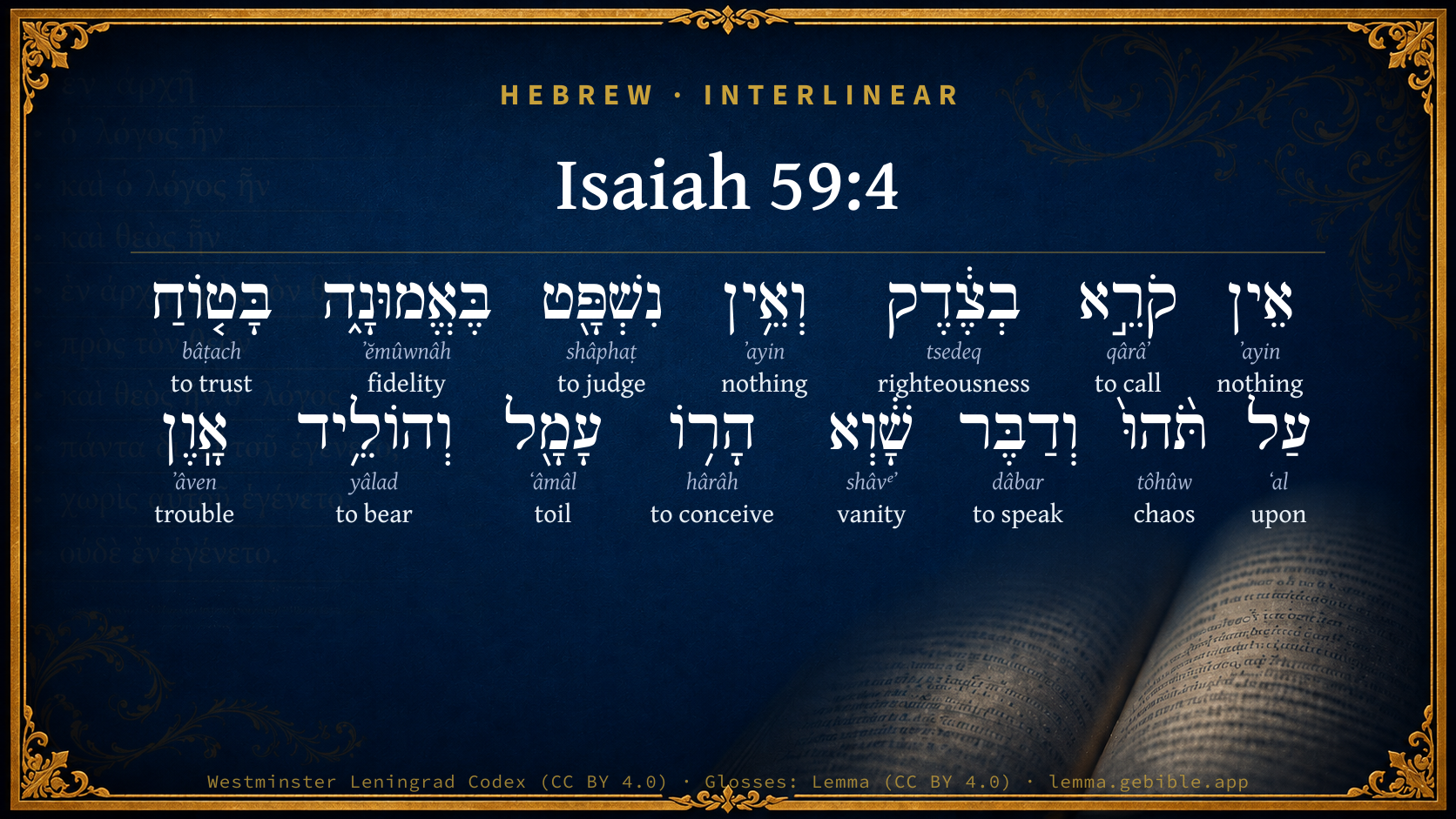
Hebrew (Westminster Leningrad Codex) Isaiah 59:4 appears in the Hebrew Old Testament. The text above is from the Westminster Leningrad Codex. Each word links to its Strong’s number, a concise gloss, and parsing drawn from the Open Scriptures Hebrew Bible morphology. Click any word for its full Brown-Driver-Briggs (BDB) entry.
Download image
Cite this verse

Isaiah 59:4 (World English Bible). Public Domain. Lemma interlinear Bible study tool, https://lemma.gebible.app/v/isaiah/59/4.

Show BibTeX & RIS
BibTeX
RIS
English Translation
None sues in righteousness, and none pleads in truth: they trust in vanity, and speak lies; they conceive mischief, and bring forth iniquity.
World English Bible · Public Domain
Download a study sheet

One document with this verse’s original text, its word-by-word gloss line, the meaning frame, cross-references with their text, attributed commentary, and full source and license credits — printable, and it pastes into notes with its structure intact.

This verse Autodidact and up

Study sheet (.html) Plain text (.txt)

A passage Seminary Student

Up to 50 verses in one chapter. A passage sheet keeps up to 6 commentary sources and 12 cross-references per verse, in the order this page ranks them, and says so on the sheet whenever that leaves anything out. Ask for a single verse and you get the Autodidact verse sheet above.

Everything on this page stays free to read, with no account — the sheet is a download of what is already on screen, not access to it.

Want to remove ads? Support Godless Engineer
Compare translations 3

The same verse in 3 English versions, stacked beneath the original-language interlinear above. Click any original word for its lexicon entry.

Each is an independent rendering of the whole verse — the interlinear is not word-aligned to these translations.

Highlighted words mark where these versions differ — a whole-verse word diff, not a word-by-word alignment.

  • World English Bible Public Domain
    None sues in righteousness, and none pleads in truth: they trust in vanity, and speak lies; they conceive mischief, and bring forth iniquity.
  • King James Version Public Domain
    None calleth for justice, nor any pleadeth for truth: they trust in vanity, and speak lies; they conceive mischief, and bring forth iniquity.
  • unfoldingWord Literal Text CC BY-SA 4.0
    None is calling in righteousness, and none is judging with another in faithfulness, trusting in emptiness and speaking falsehood, conceiving trouble and birthing iniquity.

unfoldingWord Literal Text — © unfoldingWord, licensed CC BY-SA 4.0. Word-aligned USFM3 via Door43 (git.door43.org/unfoldingWord/en_ult).

Versions to compare (up to 4)

3 of 4 selected

Show all 18 translations

Every available English version of this verse, each an independent rendering of the whole verse.

  • World English Bible Public Domain
    None sues in righteousness, and none pleads in truth: they trust in vanity, and speak lies; they conceive mischief, and bring forth iniquity.
  • Berean Standard Bible Public Domain
    No one calls for justice; no one pleads his case honestly. They rely on empty pleas; they tell lies; they conceive mischief and give birth to iniquity.
  • Majority Standard Bible Public Domain
    No one calls for justice; no one pleads his case honestly. They rely on empty pleas; they tell lies; they conceive mischief and give birth to iniquity.
  • King James Version Public Domain
    None calleth for justice, nor any pleadeth for truth: they trust in vanity, and speak lies; they conceive mischief, and bring forth iniquity.
  • American Standard Version (1901) Public Domain
    None sueth in righteousness, and none pleadeth in truth: they trust in vanity, and speak lies; they conceive mischief, and bring forth iniquity.
  • Revised Version (1885) Public Domain
    None sueth in righteousness, and none pleadeth in truth: they trust in vanity, and speak lies; they conceive mischief, and bring forth iniquity.
  • Geneva Bible (1599) Public Domain
    No man calleth for iustice: no man contendeth for trueth: they trust in vanitie, and speake vaine things: they conceiue mischiefe, and bring foorth iniquitie.
  • Douay-Rheims (1899) Public Domain
    There is none that calleth upon justice, neither is there any one that judgeth truly: but they trust in a mere nothing, and speak vanities: they have conceived labour, and brought forth iniquity.
  • Young's Literal Translation Public Domain
    There is none calling in righteousness, And there is none pleading in faithfulness, Trusting on emptiness, and speaking falsehood, Conceiving perverseness, and bearing iniquity.
  • Literal Standard Version CC BY-SA 4.0
    There is none calling in righteousness, || And there is none pleading in faithfulness, || Trusting on emptiness, and speaking falsehood, || Conceiving perverseness, and bearing iniquity.
  • Unlocked Literal Bible CC BY-SA 4.0
    No one calls in righteousness, and none pleads his case in truth. They trust in empty words, and tell lies; they conceive trouble and give birth to sin.
  • unfoldingWord Literal Text CC BY-SA 4.0
    None is calling in righteousness, and none is judging with another in faithfulness, trusting in emptiness and speaking falsehood, conceiving trouble and birthing iniquity.
  • Darby Bible Public Domain
    none calleth for justice, none pleadeth in truthfulness. They trust in vanity, and speak falsehood; they conceive mischief, and bring forth iniquity.
  • World Messianic Bible Public Domain
    No one sues in righteousness, and no one pleads in truth. They trust in vanity and speak lies. They conceive mischief and give birth to iniquity.
  • Webster's Bible Public Domain
    None calleth for justice, nor any pleadeth for truth: they trust in vanity, and speak lies; they conceive mischief, and bring forth iniquity.
  • Free Bible Version CC BY-SA 4.0
    Nobody wants justice, nobody pleads their case with honesty. They rely on false testimony, and tell lies. They conceive evil plans, and give birth to trouble.
  • Bible in Basic English Public Domain
    No one puts forward an upright cause, or gives a true decision: their hope is in deceit, and their words are false; they are with child with sin, and give birth to evil.
  • JPS Tanakh (1917) Public Domain
    None sueth in righteousness, and none pleadeth in truth; they trust in vanity, and speak lies, they conceive mischief, and bring forth iniquity.

Literal Standard Version (2020), Covenant Press — licensed CC BY-SA 4.0. Text via the HelloAO Bible API (eBible.org). Unlocked Literal Bible (unfoldingWord) — licensed CC BY-SA 4.0. Text via the HelloAO Bible API (eBible.org). unfoldingWord Literal Text — © unfoldingWord, licensed CC BY-SA 4.0. Word-aligned USFM3 via Door43 (git.door43.org/unfoldingWord/en_ult). Free Bible Version, Dr. Jonathan Gallagher — licensed CC BY-SA 4.0. Text via the HelloAO Bible API (eBible.org).

Word by word

More ways to search: Search by grammar → Find every occurrence → Compare this word →

Practice this passage: Drill this verse → Learn its vocabulary →

תֹּ֨הוּ֙
tôhûw
H8414
“chaos”
Noun, Common, Masculine, Singular, Absolute
Part of Speech
Noun
Type
Common
Gender
Masculine
Number
Singular
State
Absolute
Full BDB Definition

Origin: from an unused root meaning to lie waste

TWOT: 2494a

formlessness, confusion, unreality, emptiness - formlessness (of primeval earth) - nothingness, empty space - that which is empty or unreal (of idols) (figuratively) - wasteland, wilderness (of solitary places) - place of chaos - vanity
  1. אֵין ʼayin H369 “nothing” Particle, Negative
  2. קֹרֵ֣א qârâʼ H7121 “calling” Verb, Qal, Participle Active, Masculine, Singular, Absolute
  3. בְצֶ֔דֶק tsedeq H6664 “in/at · righteousness” Preposition + Noun, Common, Masculine, Singular, Absolute
  4. וְאֵ֥ין ʼayin H369 “and · nothing” Conjunction + Particle, Negative
  5. נִשְׁפָּ֖ט shâphaṭ H8199 “judging” Verb, Niphal, Participle Active, Masculine, Singular, Absolute
  6. בֶּאֱמוּנָ֑ה ʼĕmûwnâh H530 “in/at · fidelity” Preposition + Noun, Common, Feminine, Singular, Absolute
  7. בָּט֤וֹחַ bâṭach H982 “to trust” Verb, Qal, Infinitive Absolute
  8. עַל ʻal H5921 “upon” Preposition
  9. וְדַבֶּר dâbar H1696 “and · to speak” Conjunction + Verb, Piel, Infinitive Absolute
  10. שָׁ֔וְא shâvᵉʼ H7723 “vanity” Noun, Common, Masculine, Singular, Absolute
  11. הָר֥וֹ hârâh H2029 “to conceive” Verb, Qal, Infinitive Absolute
  12. עָמָ֖ל ʻâmâl H5999 “toil” Noun, Common, Both, Singular, Absolute
  13. וְהוֹלֵ֥יד yâlad H3205 “and · to bear” Conjunction + Verb, Hiphil, Infinitive Absolute
  14. אָֽוֶן ʼâven H205 “trouble” Noun, Common, Masculine, Singular, Absolute

About this verse

These counts appear in no published source. They are computed here, from the morphology-tagged text and Lemma’s own curated glosses. What Lemma adds →

15
words
14
distinct lemmas
Prophets
section

Notable vocabulary

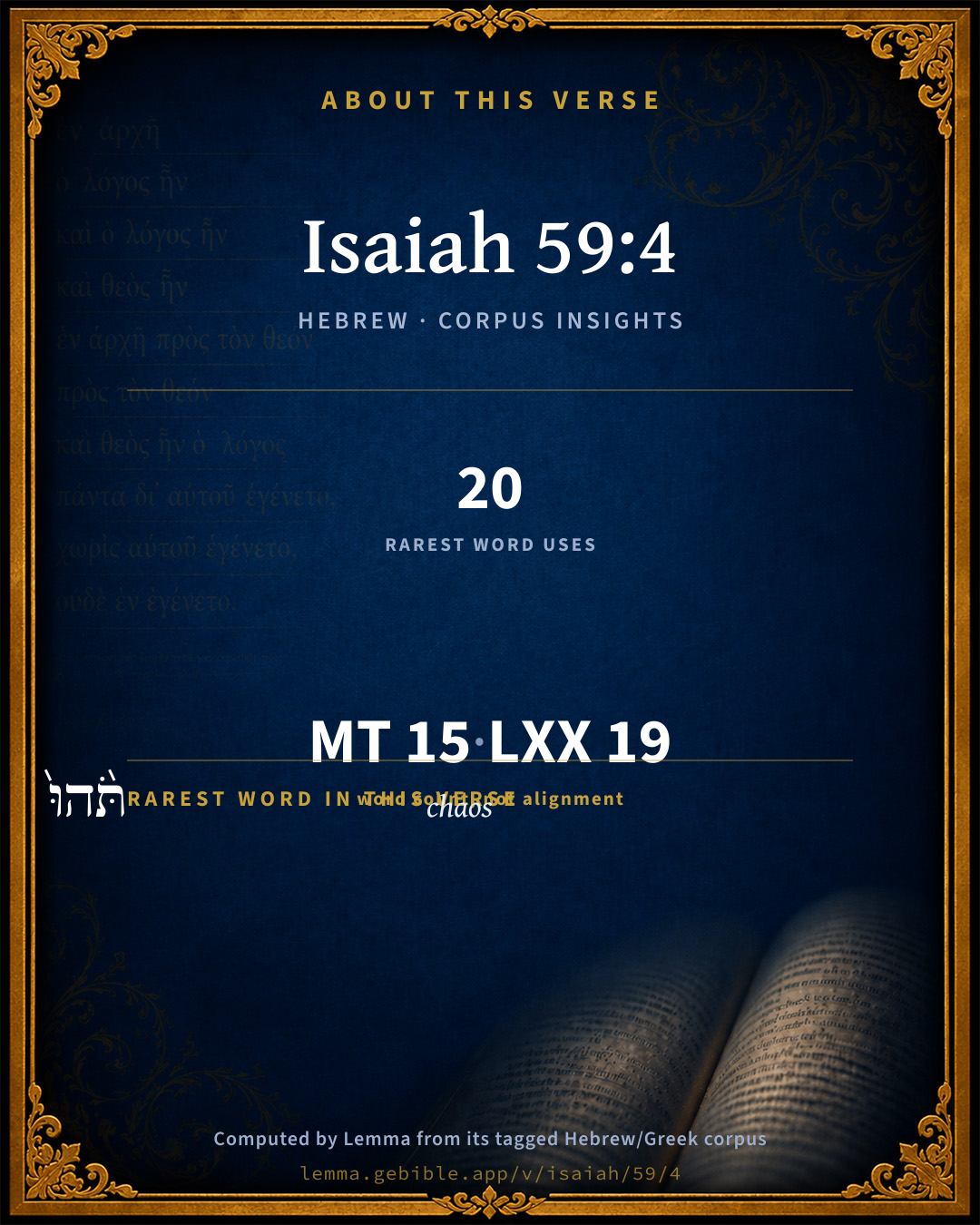
The rarest word here is תֹּ֨הוּ֙ chaos H8414 — appearing just 20 times in the whole Hebrew Bible.

Shared distinctive vocabulary

תֹּ֨הוּ֙ chaos H8414 occurs in 19 verses of the Hebrew Bible. Also found in:

Grammatical profile

  • 6 verbs
  • 6 nouns
  • 1 preposition
  • 2 particles

Verb forms

  • קֹרֵ֣א Qal · Participle Active
  • נִשְׁפָּ֖ט Niphal · Participle Active
  • בָּט֤וֹחַ Qal · Infinitive Absolute
  • וְדַבֶּר Piel · Infinitive Absolute
  • הָר֥וֹ Qal · Infinitive Absolute
  • וְהוֹלֵ֥יד Hiphil · Infinitive Absolute

Repetition

A word recurs within this verse — often emphatic in Hebrew:

  • אֵין nothing H369 ×2

Hebrew & Septuagint length

In English translation the verse runs 23 words from the Hebrew and 24 from the Septuagint (LXX English) — closely comparable.

A rough comparison of the two English renderings, which tokenize alike — not a word-level alignment.

Word counts can differ between the Hebrew and the Greek without any difference in meaning — e.g. the Hebrew direct-object marker אֵת has no separate Greek word, and Greek often adds the article ὁ.

In the original languages it is 15 Hebrew tokens and 19 Greek tokens — but the two are counted differently (Hebrew bundles its prefixes and suffixes into one token; the Greek is in lemma form), so that isn’t a like-for-like length.

Cross-references

18

Topical passages linked to Isaiah 59:4 in the Treasury of Scripture Knowledge — connected by theme and wording, ordered by reader-vote popularity; previews shown in the World English Bible.

  • Job 15:35 They conceive mischief, and bring forth iniquity. Their heart prepares deceit."
  • Micah 7:2–5 The godly man has perished out of the earth, And there is no one upright among men. They all lie in wait for blood; Every man hunts his brother with a net.
  • James 1:15 Then the lust, when it has conceived, bears sin; and the sin, when it is full grown, brings forth death.
  • Jeremiah 7:4 Don't you trust in lying words, saying, The temple of Yahweh, the temple of Yahweh, the temple of Yahweh, are these.
  • Jeremiah 7:8 Behold, you trust in lying words, that can't profit.
  • Proverbs 4:16 For they don't sleep, unless they do evil. Their sleep is taken away, unless they make someone fall.
  • Isaiah 30:12 Therefore thus says the Holy One of Israel, "Because you despise this word, and trust in oppression and perverseness, and rely thereon;
  • Isaiah 59:16 He saw that there was no man, and wondered that there was no intercessor: therefore his own arm brought salvation to him; and his righteousness, it upheld him.
  • Micah 2:1 Woe to those who devise iniquity And work evil on their beds! When the morning is light, they practice it, Because it is in the power of their hand.
  • Psalms 7:13–14 He has also prepared for himself the instruments of death. He makes ready his flaming arrows.
  • Psalms 62:10 Don't trust in oppression. Don't become vain in robbery. If riches increase, Don't set your heart on them.
  • Isaiah 59:3 For your hands are defiled with blood, and your fingers with iniquity; your lips have spoken lies, your tongue mutters wickedness.
  • Isaiah 59:13–14 transgressing and denying Yahweh, and turning away from following our God, speaking oppression and revolt, conceiving and uttering from the heart words of falsehood.
  • Jeremiah 5:4–5 Then I said, Surely these are poor; they are foolish; for they don't know the way of Yahweh, nor the law of their God:
  • Ezekiel 22:29–31 The people of the land have used oppression, and exercised robbery; yes, they have vexed the poor and needy, and have oppressed the foreigner wrongfully.
  • Psalms 62:4 They fully intend to throw him down from his lofty place. They delight in lies. They bless with their mouth, but they curse inwardly. Selah.
  • Jeremiah 5:1 Run you back and forth through the streets of Jerusalem, and see now, and know, and seek in the broad places of it, if you can find a man, if there are any who does justly, who seeks truth; and I will pardon her.
  • Job 15:31 Let him not trust in emptiness, deceiving himself; For emptiness shall be his reward.

Cross-references courtesy of OpenBible.info (CC BY 4.0).

Hebrew and Greek witnesses Masoretic Hebrew ↔ Greek Septuagint

The same verse in the two great witnesses to the Old Testament, shown verse-for-verse.

These are two independent witnesses, not word-aligned to each other, and the Septuagint is shown in lemma (dictionary) form.

Hebrew Isaiah 59:4 Masoretic · Westminster Leningrad Codex

אֵין קֹרֵ֣א בְצֶ֔דֶק וְאֵ֥ין נִשְׁפָּ֖ט בֶּאֱמוּנָ֑ה בָּט֤וֹחַ עַל תֹּ֨הוּ֙ וְדַבֶּר שָׁ֔וְא הָר֥וֹ עָמָ֖ל וְהוֹלֵ֥יד אָֽוֶן

None sues in righteousness, and none pleads in truth: they trust in vanity, and speak lies; they conceive mischief, and bring forth iniquity.

World English Bible · Public Domain

Greek LXX Isaiah 59:4 Septuagint · lemma form

οὐδείς λαλέω δίκαιος οὐδέ εἰμί κρίσις ἀληθινός πείθω ἐπί μάταιος καί λαλέω κενός ὅτι κύω πόνος καί τίκτω ἀνομία

None speaks justly, neither is there true judgment: they trust in vanities, and speak empty words; for they conceive trouble, and bring forth iniquity.

LXX2012 (modern English Septuagint) · Public Domain

On this verse, Keil & Delitzsch discusses the Septuagint’s reading. Read the note in Commentary ↓

Hebrew: Westminster Leningrad Codex (CC BY 4.0). Greek: Septuagint (public domain); English from LXX2012 (modern English Septuagint) (Public Domain). How the Septuagint differs from the Hebrew →

Targum (Aramaic paraphrase)

1

The Targum is the ancient Jewish Aramaic paraphrase of the Hebrew Scriptures — an interpretive translation, not the Hebrew text itself. Onkelos (literal) and Pseudo-Jonathan (expansive) render the Torah, and Jonathan the Prophets. Coverage is partial: where no permissively-licensed English translation exists for a verse, only the Aramaic is shown. This is verse-level text, not a word-by-word alignment to the Hebrew.

  1. Targum Jonathan Prophets (Joshua–Malachi)
    לֵית דִמְצַלֵי בִקְשׁוֹט וְלֵית דְמִתְדַן בְּהֵימְנוּתָא מִתְרַחֲצִין עַל לְמָא וּמְמַלְלִין שְׁקַר מוֹחָן וּמַפְקִין מִלִבְּהוֹן מִלִין דְאוֹנָס:

    There is none that truly prayeth, nor any that pleadeth for faithfulness: they trust in vanity, and speak lies; they hasten, and bring forth words of violence out of their heart.

    Targum Jonathan — Aramaic: “Mikraot Gedolot” (public domain). English: “Sefaria Community Translation” (CC0 1.0 (public-domain dedication)); “London "Chaldee Paraphrase," 1871” (public domain). Text via Sefaria.

Commentary

Notes on Isaiah 59:4 from classic Christian and Jewish commentators (each source and its license shown beneath its notes). The classic Christian expositions comment on the surrounding passage and are grouped to its opening verse, so a note may address several verses; the Jewish commentaries on the Tanakh (Rashi and others) are per-verse, so they appear only where the commentator wrote on this verse.

Lemma curates 59 commentaries, every one of them public domain or Creative Commons licensed, each selected and text-cleaned for this edition rather than reprinted as found. About our sources →

Trapp's Complete Commentary

John Trapp

Isa 59:4 None calleth for justice, nor [any] pleadeth for truth: they trust in vanity, and speak lies; they conceive mischief, and bring forth iniquity.

Ver. 4. None calleth for justice.] Mindeth the judges of their duty, but rather connive, collogue, partake, &c. The Chaldee hath it, ‘There is none that delivereth the poor and needy.’

They trust in vanity.] As those did; {Jer 7:4} making a bridge of their own shadows, they fall into the brook.

They conceive mischief, &c.] This is taken out of Psa 7:14 Job 15:35; {See Trapp on "Psa 7:14"} {See Trapp on "Job 15:35"} Heb., Going great with grievance, and bringing forth vexation.

John Trapp, A Commentary or Exposition upon All the Books of the Old and New Testament (1647–1656) — public domain. Text from a community e-Sword module.

Joseph Benson's Commentary

Isa 59:4. None calleth for justice — None seek to redress these wrongs and violences; they commit all rapines and frauds with impunity; they trust in vanity — In vain and empty words, void of all consistency; or, in vain things, such as their idols were, often called vanity and nothing, 1Co 8:4; or in their own power, craft, and policy, whereby, laying aside justice, they oppressed others. And speak lies — This may refer to the judges, lawyers, and false prophets, who told them they should not go into captivity; as if he had said, They speak that which they know to be false. They conceive mischief and bring forth, &c. — These two words, conceiving and bringing forth, denote the whole contriving and perfecting of their wickedness.

Joseph Benson's Commentary on the Old and New Testaments (1811–1818) — public domain. Text from a community e-Sword module.

Keil & Delitzsch

C. F. Keil & F. Delitzsch

The description now passes over to the social and judicial life. Lying and oppression universally prevail. "No one speaks with justice, and no one pleads with faithfulness; men trust in vanity, and speak with deception; they conceive trouble, and bring forth ruin. They hatch basilisks' eggs, and weave spiders' webs. He that eateth of their eggs must die; and if one is trodden upon, it splits into an adder. Their webs do not suffice for clothing, and men cannot cover themselves with their works: their works are works of ruin, and the practice of injustice is in their hands." As קרא is generally used in these prophetic addresses in the sense of κηρύσσειν, and the judicial meaning, citare, in just vocare, litem intendere, cannot be sustained, we must adopt this explanation, "no one gives public evidence with justice" (lxx οὐδεὶς λαλεῖ δίκαια). צדק is firm adherence to the rule of right and truth; אמוּנה a conscientious reliance which awakens trust; משׁפּט (in a reciprocal sense, as in Isa 43:26; Isa 66:16) signifies the commencement and pursuit of a law-suit with any one. The abstract infinitives which follow in Isa 59:4 express the general characteristics of the social life of that time, after the manner of the historical infinitive in Latin (cf., Isa 21:5; Ges. 131, 4, b). Men trust in tōhū, that which is perfectly destitute of truth, and speak שׁוא, what is morally corrupt and worthless. The double figure און והוליד עמל הרו is taken from Job 15:35 (cf., Psa 7:15). הרו (compare the poel in Isa 59:13) is only another form for הרה (Ges. 131, 4, b); and הוליד (the western or Palestinian reading here), or הולד (the oriental or Babylonian reading), is the usual form of the inf. abs. hiph. (Ges. 53, Anm. 2). What they carry about with them and set in operation is compared in Isa 59:5 to basilisks' eggs (צפעוני, serpens regulus, as in Isa 11:8) and spiders' webs (עכּבישׁ, as in Job 8:14, from עכּב, possibly in the sense of squatter, sitter still, with the substantive ending ı̄sh). They hatch basilisks' eggs (בּקּע like בּקע, Isa 34:15, a perfect, denoting that which has hitherto always taken place and therefore is a customary thing); and they spin spiders' webs (ארג possibly related to ἀράχ-νη;

(Note: Neither καῖρος nor ἀράχνη has hitherto been traced to an Indian root in any admissible way. Benfey deduces the former from the root dhvir (to twist); but this root has to perform an immense number of services. M. Mller deduces the latter from rak; but this means to make, not to spin.)

the future denoting that which goes on occurring). The point of comparison in the first figure is the injurious nature of all they do, whether men rely upon it, in which case "he that eateth of their eggs dieth," or whether they are bold or imprudent enough to try and frustrate their plans and performances, when that (the egg) which is crushed or trodden upon splits into an adder, i.e., sends out an adder, which snaps at the heel of the disturber of its rest. זוּר as in Job 39:15, here the part. pass. fem. like סוּרה (Isa 49:21), with a - instead of ā - like לנה, the original ă of the feminine (zūrăth) having returned from its lengthening into ā to the weaker lengthening into ĕ. The point of comparison in the second figure is the worthlessness and deceptive character of their works. What they spin and make does not serve for a covering to any man (יתכּסּוּ with the most general subject: Ges. 137, 3), but has simply the appearance of usefulness; their works are מעשׂי־און (with metheg, not munach, under the Mem), evil works, and their acts are all directed to the injury of their neighbour, in his right and his possession.

Keil & Delitzsch — Biblical Commentary on the Old Testament (1861–1891) — public domain (CC PDM 1.0). Text via the HelloAO Bible API. (Old Testament only.)

Tyndale Open Study Notes

Tyndale Open Resources

59:4 being fair and honest: Israel did not practice these qualities that are part of God’s nature and that he expects from people (1:21; see 25:1).

Tyndale Open Study Notes — © Tyndale Open Resources, licensed CC BY-SA 4.0. Text via the HelloAO Bible API.

Geneva Bible (1599)

Geneva Bible translators

According to their wicked devices, they hurt their neighbors.

All men wink at the injuries and oppressions, and none go about to remedy them.

Geneva Bible (1599) marginal notes — public domain. Text via Bolls.life.

Jamieson, Fausset & Brown

Robert Jamieson, A. R. Fausset & David Brown

Rather, "No one calleth an adversary into court with justice," that is, None bringeth a just suit: "No one pleadeth with truth."

they trust . . . iniquity--(So Job 15:35; Psa 7:14).

Jamieson, Fausset & Brown — Commentary Critical and Explanatory on the Whole Bible (1871) — public domain (CC PDM 1.0). Text via the HelloAO Bible API.

Adam Clarke's Commentary

Verse 4. They conceive mischief, and bring forth iniquity.] There is a curious propriety in this mode of expression; a thought or purpose is compared to conception; a word or act, which is the consequence of it, to the birth of a child. From the third to the fifteenth verse inclusive may be considered a true statement of the then moral state of the Jewish people; and that they were, in the most proper sense of the word, guilty of the iniquities with which they are charged.

Adam Clarke's Commentary on the Bible (1810–1826) — public domain. Text from a community e-Sword/MySword module.

Ellicott's Commentary for English Readers

(4) None calleth for justice.—Better, none preferreth his suit with truthfulness. The words point chiefly to the guilt of unrighteous prosecutions, but may include that of false witness also.

They trust in vanity.—Literally, in chaos—the characteristic tohu of both parts of Isaiah (Isa_24:10; Isa_29:21; Isa_40:17; Isa_40:23).

A Bible Commentary for English Readers, edited by Charles John Ellicott (1878–1897) — public domain. Text from a community e-Sword module.

The Cambridge Bible for Schools and Colleges

gen. ed. J. J. S. Perowne

4. The first half of the verse should be rendered as R.V.

None sueth in righteousness,

And none pleadeth in truth.

The reference is to the abuse of legal procedure: lawsuits instituted and conducted with absolute disregard of righteousness and truth. Cf. ch. Isa_29:21.

calleth] with the sense of “summon” (in jus vocare), as in Job_9:16; Job_13:22.

pleadeth] i.e. “pleadeth a cause”, litigates; the same word as in Isa_43:26.

The rest of the verse probably continues the same subject, describing the sophistical and mischievous arguments employed by the litigants to make the worse appear the better reason, and subvert the ends of justice. The verbs are infinitives (as in Isa_59:13 and Hos_4:2) and should be translated thus:

Trusting in emptiness (lit. “chaos” as Isa_40:17) and speaking vanity!

Conceiving mischief and bringing forth evil!

The last line occurs almost verbatim in Job_15:35.

The Cambridge Bible for Schools and Colleges (gen. ed. J. J. S. Perowne; Cambridge University Press, 1878–1918) — public domain. Text from a community e-Sword module.

John Gill's Exposition

None calleth for justice,.... Or, "righteousness"; not for civil justice in courts of judicature, as if there were no advocates for it there; or that put those in mind of it, to whom the administration of it belongs; or that see to put the laws against sin in execution, and to relieve those that are oppressed; though of this there may be just cause of complaint in some places: but there are none or few that call for evangelical righteousness, either that preach it, proclaim and publish it to others; even the righteousness of Christ, the grand doctrine of the Gospel, which is therein revealed from faith to faith; so the Syriac version, "there is none that preacheth righteously"; or "in", or "of righteousness" (t); and the Septuagint version, "no one speaks righteous things"; the words and doctrines of righteousness and truth: or, "no one calls for righteousness"; desires to hear this doctrine, and have it preached to him; hungers and thirsts after it; but chooses the doctrine of justification by works. The Targum refers it to prayer, paraphrasing it thus,

"there is none that prays in truth;''

in sincerity and uprightness, in faith and with fervour; but in a cold, formal, and hypocritical way:

nor any pleadeth for truth: for the truth of the Gospel, particularly for the principal one, the justification of a sinner by the righteousness of Christ alone; few or none contend earnestly for the faith once delivered to the saints; they are not valiant for the truth, nor stand fast in it, but drop or conceal it, or deny it: or, "none is judged by", or "according to truth" (u); by the Scriptures of truth, but by carnal reason; or by forms and rules of man's devising, and so are condemned; as Gospel ministers and professors of it are:

they trust in vanity; in nothing, as the Vulgate Latin; that is worth nothing; in their own strength, wisdom, riches, righteousness, especially the latter:

and speak lies; or "vanity"; vain things, false doctrines, as before:

they conceive mischief, and bring forth iniquity; they "conceive" and contrive "mischief" in their minds against those that differ in doctrine and practice from them: "and bring forth iniquity": do that which is criminal and sinful, by words and actions, by calumnies and reproaches, by violence and persecution. The Targum is,

"they hasten and bring out of their hearts words of violence.''

(t) "in justitia", Montanus, Tigurine version; "sive de justitia". (u) "nemo judicatur scundum veritatem", Munster; "non judicatur in veritate", Montanus.

John Gill's Exposition of the Whole Bible (1746–1763) — public domain (CC PDM 1.0). Text via the HelloAO Bible API.

Albert Barnes' Notes on the Bible

None calleth for justice - Or rather, there is no one who brings a suit with justice; no one who goes into court for the purpose of obtaining justice. There is a love of litigation; a desire to take all the advantage which the law can give; a desire to appeal to the law, not for the sake of having strict justice done, but for the sake of doing injury to others, and to take some undue advantage.

Nor any pleadeth for truth - Or, no one pleadeth with truth. He does not state the cause as it is. He makes use of cunning and falsehood to gain his cause.

They trust in vanity - They confide in quirks and evasions rather than in the justice of their cause.

They conceive mischief - They form plans of evil, and they execute them when they are fully ripe. Compare Job 15:35, where the same phrase occurs. The sense is, that they form plans to injure others, and that they expect to execute them by fraud and deceit.

Albert Barnes' Notes on the Bible (1834–1885) — public domain. Text from a community e-Sword/MySword module.

Haydock's Catholic Bible Commentary

Justice. They arraign unjustly. None call upon the just God, but trust in idols. --- Iniquity. They kill themselves, while they strive to injure others, Psalm vii. 15., and Micheas ii. 1.

George Leo Haydock (1774–1849), Haydock's Catholic Family Bible and Commentary, 1859 edition — public domain. Excludes Psalms (Douay-Rheims chapter numbering differs from Protestant) and Deuterocanonical books (Catholic canon only).

Matthew Poole's English Annotations

None calleth for justice, i.e. none seek to redress these wrongs and violences; they commit all rapines and frauds under impunity; either,

1. Because the judges are corrupt. Or,

2. Because none will warn the judges of their duty. Or,

3. Because none seek to bring offenders to justice. Or,

4. Because none will plead a righteous cause, or plead it righteously, or countenance goodness; and this the next expression favours; and so justice suffers, which the Hebrew word mispat, being in the passive voice, seems to intimate: the sense is the same, and whereas it is said none, it is as much as to say very few, as we say few or none; the like Psa 14:3.

Quest. How could this be charged upon them, when in the time of their captivity they had no courts?

Answ. It is probable they had courts among themselves, to judge between one another, by leave of the Babylonish kings.

They trust in vanity; either,

1. Relating to their lies, which are words empty and void of all consistency; and so it is the same with the next expression,

and speak lies. Or,

2. In their idols, which are stocks and stones, and so oft called vanity and nothing, 1Co 8:4. For even in Babylon they worshipped idols, as appears by Jer 16:11,12,18. Or rather,

3. In their power, and craft, and policy, whereby, laying aside justice, they can oppress others; and so he calls it vanity by a metonymy of the adjunct, because it would prove all vain in the end, and either,

1. Frustrate their ends. Or,

2. Not justify them against God’s proceedings with them. Or,

3. Bring all into emptiness and confusion: the word is tohu, whereby the confusion and mingling of all things is expressed, before the world was brought into order and form, Gen 1:2.

Speak lies: it may refer both to the judges, and to the lawyers and false prophets, that tell them they shall not go into captivity; they speak that which they know to be false.

They conceive mischief, and bring forth iniquity: these two words of conceiving and bringing forth note their whole contrivance, and perfecting their wickedness; the former notes their plotting, the latter their execution of mischief; whatever is in the mind, only out of sight, warmed and formed there by cogitating and meditation, is called conception, which being ripe, and produced to view, is called a birth; intimating that the wicked sin not occasionally and accidentally, but premeditatingly and professedly; they grow big with it. The expression is allegorical, and in the two next verses compared to the cockatrice’ eggs for the wickedness of it, and to a spider’s web for the vanity of it.

Matthew Poole's English Annotations on the Holy Bible (1683–1685) — public domain. Text from a community e-Sword/MySword module.

The Pulpit Commentary

None calleth for justice; rather, none preferreth his suit in justice (so Lowth, Gesenius, Ewald, Knobel, and Mr. Cheyne). "No one," that is, "who engaged in a suit, limited himself to just pleas and honest courses in his prosecution of it." Nor any pleadeth for truth; rather, none pleadeth in truthfulness. They trust in vanity; literally, in chaos; i.e. "in a mass of false and vain statements." The whole basis of the dealings between man and man was unsound, corrupt, chaotic. Where truth and plain dealing are set aside, all shortly becomes ruin and confusion. They conceive mischief, etc. (comp. Psa_7:14)

The Pulpit Commentary (1880–1919), ed. H.D.M. Spence-Jones & Joseph S. Exell — public domain. Text from a community e-Sword module.

John Wesley's Explanatory Notes

None - None seek to redress these wrongs, and violences; they commit all rapines, and frauds with impunity. Bring forth - These two words of conceiving, and bringing forth, denote their whole contrivance, and perfecting their wickedness.

John Wesley, Explanatory Notes Upon the Whole Bible (1754–1765) — public domain. Text via the GEBible commentary corpus.

J. A. Alexander on Isaiah

Joseph Addison Alexander

“There is none calling with (or for) justice, and there is none contending with truth; they trust in vanity and speak falsehood, condemn mischief and bring forth iniquity.” Some understand the first clause as meaning that none demand justice because they have no hope of obtaining it. Others make calling parallel to contending, and with justice to with truth. ‘No one pleads fairly or sues honestly.’

Joseph Addison Alexander, The Prophecies of Isaiah (1846–1847; New York: Scribner, 1870–1878) — public domain. Text from a community e-Sword module.

Scofield Reference Notes

C. I. Scofield

trust

(See Scofield "Psa 2:12").

The Scofield Reference Bible (1917 edition), notes by C. I. Scofield — public domain. Text from a community e-Sword module.

Ibn Ezra

Rabbi Abraham ibn Ezra

None calleth for justice. Nobody reproves you.

נשפט Judged. It is participle Niphal.

They trust in vanity, etc. They promise each other what they never fulfil.

They conceive mischief in their minds.

And bring forth iniquity in words.

Ibn Ezra on the Tanakh — English translations: “Sefaria Community Translation” (CC0 1.0 (public-domain dedication)); “Yalkut, Sifsei Chachomim Chumash, Metsudah Publications, 2009” (CC BY 4.0); and “Commentary of Ibn Ezra on Isaiah - trans. by M. Friedlander, 1873” (public domain). Text via Sefaria.

Lesson kit

Teaching starters — assembled from the data on this page, not authored interpretation. Every prompt links to the verse data it draws on. Edit before teaching.

Isaiah, in the Prophets, opens this verse with 15 words (14 distinct Hebrew lemmas). Its most distinctive word is tôhûw (“chaos”). A historical commentator’s framing appears above. Read the whole chapter for the surrounding context.

Discussion questions

  1. How does “chaos” (tôhûw) shape what this verse is saying?
  2. How does Genesis 1:2, which shares the word «chaos», read alongside this verse?
  3. What does the repetition of “nothing” (2× in this one verse) do in this verse?
  4. These translations render this verse differently; the difference is in the English rendering, not the original. What questions does that raise?
  5. «קֹרֵ֣א» is a Qal Participle Active verb. How does that grammatical form shape the action described?
  6. Compare how Trapp's Complete Commentary and Joseph Benson's Commentary read this verse. Where do they agree or differ?

Things to notice

Reading settings

Reading text

Shown beneath each verse's original-language words.

Old Testament
Old Testament edition

Read the OT as the Masoretic Hebrew (MT) or the Greek Septuagint (LXX).

English shown for the Greek Septuagint (in the Hebrew ↔ Greek comparison).

Comparing translations? Open the Compare panel on any verse page to stack up to four side by side.