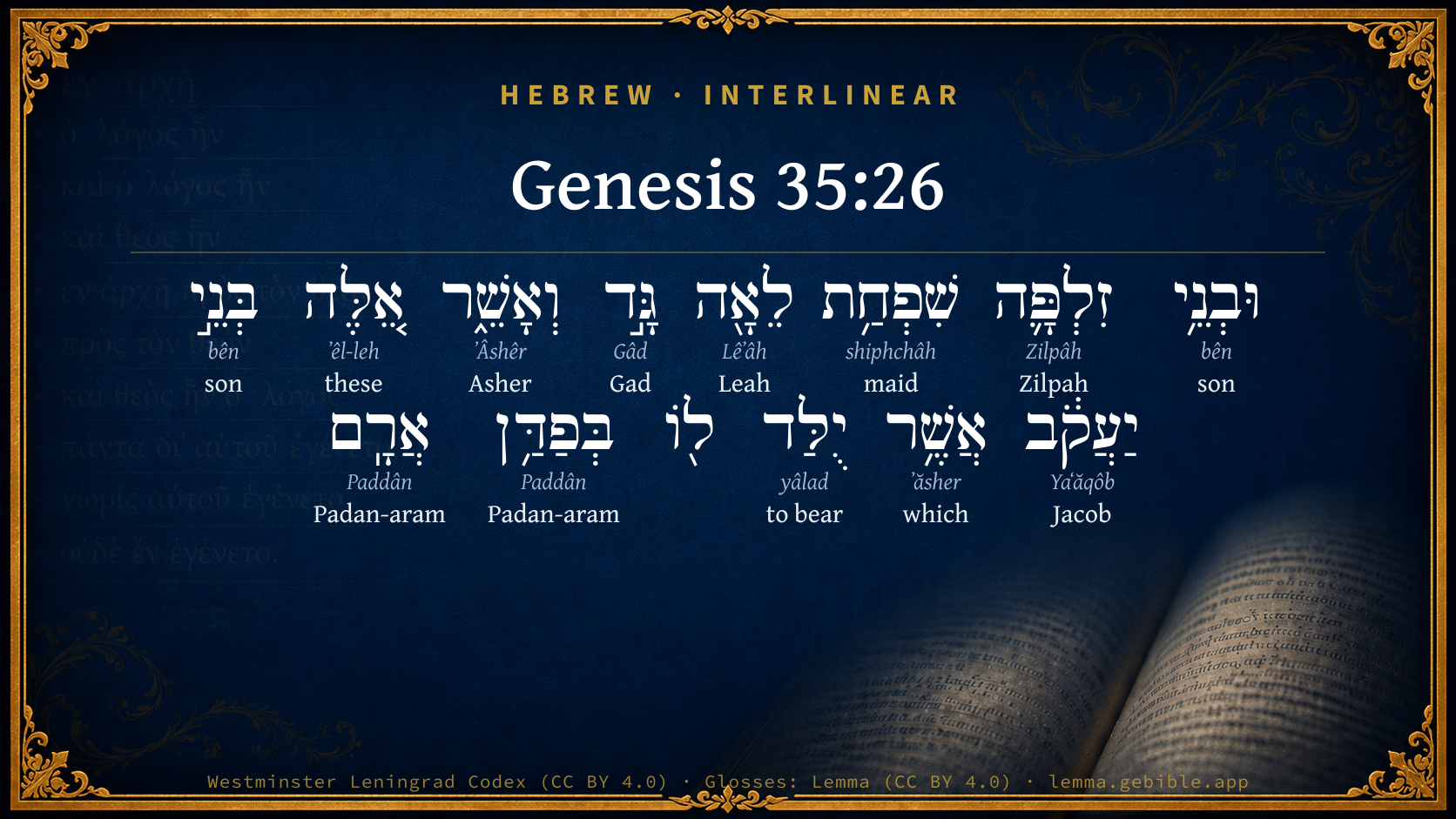
Genesis 35:26

Hebrew (Westminster Leningrad Codex) Genesis 35:26 appears in the Hebrew Old Testament. The text above is from the Westminster Leningrad Codex. Each word links to its Strong’s number, a concise gloss, and parsing drawn from the Open Scriptures Hebrew Bible morphology. Click any word for its full Brown-Driver-Briggs (BDB) entry.
Download image
Cite this verse

Genesis 35:26 (World English Bible). Public Domain. Lemma interlinear Bible study tool, https://lemma.gebible.app/v/genesis/35/26.

Show BibTeX & RIS
BibTeX
RIS
English Translation
The sons of Zilpah (Leah's handmaid): Gad and Asher. These are the sons of Jacob, who were born to him in Paddan Aram.
World English Bible · Public Domain
Download a study sheet

One document with this verse’s original text, its word-by-word gloss line, the meaning frame, cross-references with their text, attributed commentary, and full source and license credits — printable, and it pastes into notes with its structure intact.

This verse Autodidact and up

Study sheet (.html) Plain text (.txt)

A passage Seminary Student

Up to 50 verses in one chapter. A passage sheet keeps up to 6 commentary sources and 12 cross-references per verse, in the order this page ranks them, and says so on the sheet whenever that leaves anything out. Ask for a single verse and you get the Autodidact verse sheet above.

Everything on this page stays free to read, with no account — the sheet is a download of what is already on screen, not access to it.

Want to remove ads? Support Godless Engineer
Compare translations 3

The same verse in 3 English versions, stacked beneath the original-language interlinear above. Click any original word for its lexicon entry.

Each is an independent rendering of the whole verse — the interlinear is not word-aligned to these translations.

Highlighted words mark where these versions differ — a whole-verse word diff, not a word-by-word alignment.

  • World English Bible Public Domain
    The sons of Zilpah (Leah's handmaid): Gad and Asher. These are the sons of Jacob, who were born to him in Paddan Aram.
  • King James Version Public Domain
    And the sons of Zilpah, Leah's handmaid: Gad, and Asher: these are the sons of Jacob, which were born to him in Padanaram.
  • unfoldingWord Literal Text CC BY-SA 4.0
    And the sons of Zilpah, the maidservant of Leah, Gad and Asher. Those the sons of Jacob who were born to him in Paddan Aram. Isaac’s Death 35:27-29

unfoldingWord Literal Text — © unfoldingWord, licensed CC BY-SA 4.0. Word-aligned USFM3 via Door43 (git.door43.org/unfoldingWord/en_ult).

Versions to compare (up to 4)

3 of 4 selected

Show all 18 translations

Every available English version of this verse, each an independent rendering of the whole verse.

  • World English Bible Public Domain
    The sons of Zilpah (Leah's handmaid): Gad and Asher. These are the sons of Jacob, who were born to him in Paddan Aram.
  • Berean Standard Bible Public Domain
    And the sons of Leah’s maidservant Zilpah were Gad and Asher. These are the sons of Jacob, who were born to him in Paddan-aram.
  • Majority Standard Bible Public Domain
    And the sons of Leah’s maidservant Zilpah were Gad and Asher. These are the sons of Jacob, who were born to him in Paddan-aram.
  • King James Version Public Domain
    And the sons of Zilpah, Leah's handmaid: Gad, and Asher: these are the sons of Jacob, which were born to him in Padanaram.
  • American Standard Version (1901) Public Domain
    and the sons of Zilpah, Leah's handmaid: Gad and Asher: these are the sons of Jacob, that were born to him in Paddan-aram.
  • Revised Version (1885) Public Domain
    and the sons of Zilpah, Leah’s handmaid; Gad and Asher: these are the sons of Jacob, which were born to him in Paddan-aram.
  • Geneva Bible (1599) Public Domain
    And the sonnes of Zilpah Leahs maide: Gad and Asher. These are the sonnes of Iaakob, which were borne him in Padan Aram.
  • Douay-Rheims (1899) Public Domain
    The sons of Zelpha, Lia's handmaid: Gad and Aser: these are the sons of Jacob, that were born to him in Mesopotamia of Syria.
  • Young's Literal Translation Public Domain
    And sons of Zilpah, Leah's maid-servant: Gad and Asher. These `are' sons of Jacob, who have been born to him in Padan-Aram.
  • Literal Standard Version CC BY-SA 4.0
    And sons of Zilpah, Leah’s maidservant: Gad and Asher. These [are] sons of Jacob, who have been born to him in Padan-Aram.
  • Unlocked Literal Bible CC BY-SA 4.0
    The sons of Zilpah, Leah's female servant, were Gad and Asher. All these were the sons of Jacob who were born to him in Paddan Aram.
  • unfoldingWord Literal Text CC BY-SA 4.0
    And the sons of Zilpah, the maidservant of Leah, Gad and Asher. Those the sons of Jacob who were born to him in Paddan Aram. Isaac’s Death 35:27-29
  • Darby Bible Public Domain
    And the sons of Zilpah, Leah's maidservant: Gad and Asher. These are the sons of Jacob that were born to him in Padan-Aram.
  • World Messianic Bible Public Domain
    The sons of Zilpah (Leah’s servant): Gad and Asher. These are the sons of Jacob, who were born to him in Paddan Aram.
  • Webster's Bible Public Domain
    And the sons of Zilpah, Leah's handmaid; Gad, and Asher. These are the sons of Jacob, who were born to him in Padan-aram.
  • Free Bible Version CC BY-SA 4.0
    The sons of Leah's personal maid Zilpah: Gad and Asher. These were the sons of Jacob, who were born to him while in Paddan-aram.
  • Bible in Basic English Public Domain
    The sons of Zilpah, Leah's servant: Gad and Asher; these are the sons whom Jacob had in Paddan-aram.
  • JPS Tanakh (1917) Public Domain
    and the sons of Zilpah, Leah's handmaid: Gad and Asher. These are the sons of Jacob, that were born to him in Paddan-aram.

Literal Standard Version (2020), Covenant Press — licensed CC BY-SA 4.0. Text via the HelloAO Bible API (eBible.org). Unlocked Literal Bible (unfoldingWord) — licensed CC BY-SA 4.0. Text via the HelloAO Bible API (eBible.org). unfoldingWord Literal Text — © unfoldingWord, licensed CC BY-SA 4.0. Word-aligned USFM3 via Door43 (git.door43.org/unfoldingWord/en_ult). Free Bible Version, Dr. Jonathan Gallagher — licensed CC BY-SA 4.0. Text via the HelloAO Bible API (eBible.org).

Word by word

More ways to search: Search by grammar → Find every occurrence → Compare this word →

Practice this passage: Drill this verse → Learn its vocabulary →

זִלְפָּ֛ה
Zilpâh
H2153
“Zilpah”
Noun, Proper
Part of Speech
Noun
Type
Proper
Full BDB Definition

Origin: from an unused root apparently mean to trickle, as myrrh

TWOT: None

Zilpah = "a trickling" - the Syrian given by Laban to Leah as a handmaid, a concubine of Jacob, mother of Asher and Gad
  1. וּבְנֵ֥י bên H1121 “and · sons of” Conjunction + Noun, Common, Masculine, Plural, Construct
  2. שִׁפְחַ֥ת shiphchâh H8198 “maid of” Noun, Common, Feminine, Singular, Construct
  3. לֵאָ֖ה Lêʼâh H3812 “Leah” Noun, Proper
  4. גָּ֣ד Gâd H1410 “Gad” Noun, Proper
  5. וְאָשֵׁ֑ר ʼÂshêr H836 “and · Asher” Conjunction + Noun, Proper
  6. אֵ֚לֶּה ʼêl-leh H428 “these” Pronoun, Demonstrative, Common, Plural
  7. בְּנֵ֣י bên H1121 “sons of” Noun, Common, Masculine, Plural, Construct
  8. יַעֲקֹ֔ב Yaʻăqôb H3290 “Jacob” Noun, Proper
  9. אֲשֶׁ֥ר ʼăsher H834 “which” Particle, Relative
  10. יֻלַּד yâlad H3205 “to bear” Verb, Pual, Perfect, 3rd Person, Masculine, Singular
  11. בְּפַדַּ֥ן Paddân H6307 “in/at · Padan-aram” Preposition + Noun, Proper
  12. אֲרָֽם Paddân H6307 “Padan-aram” Noun, Proper

About this verse

These counts appear in no published source. They are computed here, from the morphology-tagged text and Lemma’s own curated glosses. What Lemma adds →

14
words
11
distinct lemmas
Pentateuch
section

Notable vocabulary

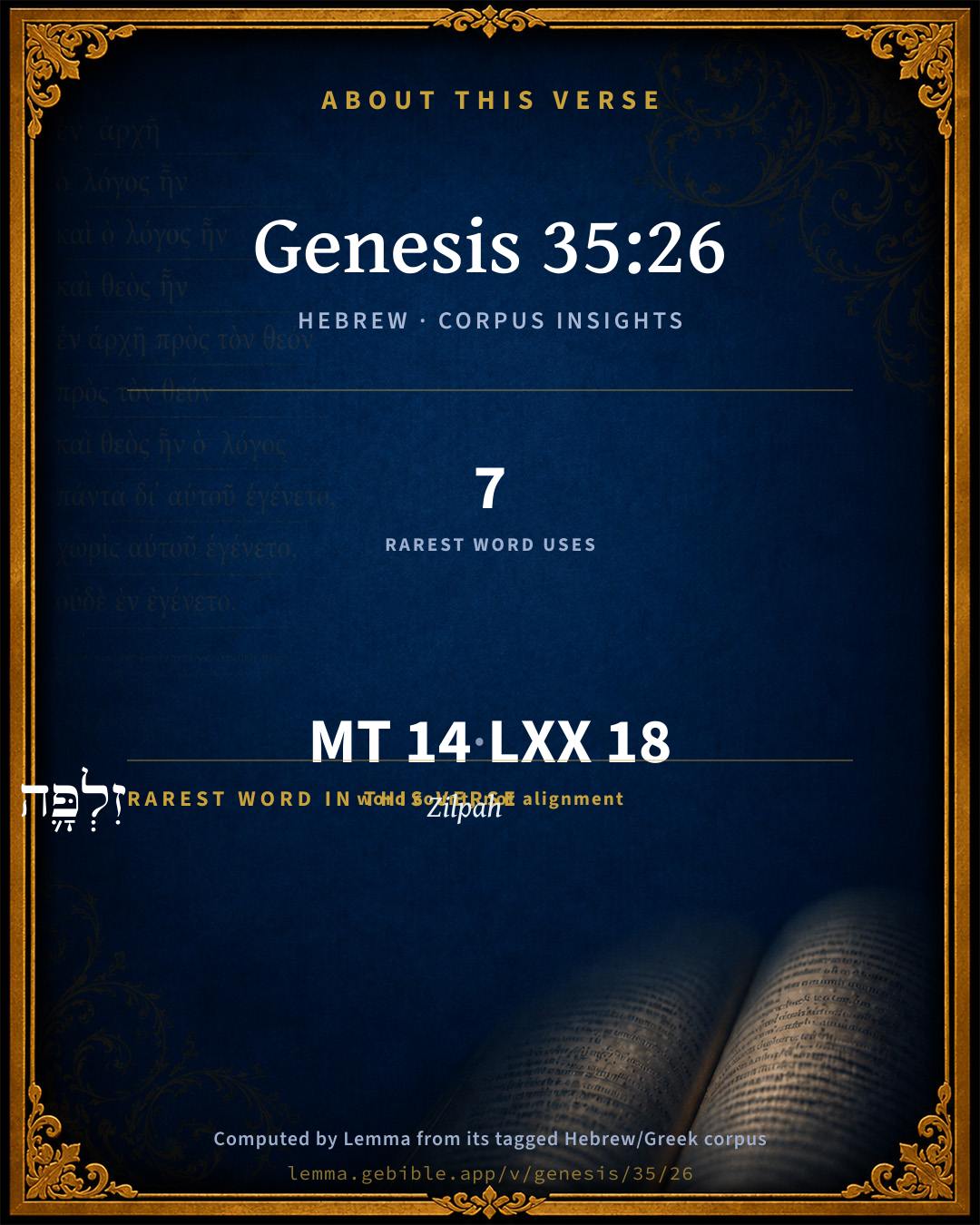
The rarest word here is זִלְפָּ֛ה Zilpah H2153 — appearing just 7 times in the whole Hebrew Bible.

Shared distinctive vocabulary

זִלְפָּ֛ה Zilpah H2153 occurs in 7 verses of the Hebrew Bible. Also found in:

Grammatical profile

  • 1 verb
  • 10 nouns
  • 1 pronoun
  • 1 preposition
  • 1 particle

Verb forms

  • יֻלַּד Pual · Perfect

Repetition

Words recur within this verse — often emphatic in Hebrew:

  • וּבְנֵ֥י son H1121 ×2
  • בְּפַדַּ֥ן Padan-aram H6307 ×2

Hebrew & Septuagint length

In English translation the verse runs 23 words from the Hebrew and 27 from the Septuagint (LXX English) — closely comparable.

A rough comparison of the two English renderings, which tokenize alike — not a word-level alignment.

Word counts can differ between the Hebrew and the Greek without any difference in meaning — e.g. the Hebrew direct-object marker אֵת has no separate Greek word, and Greek often adds the article ὁ.

In the original languages it is 14 Hebrew tokens and 18 Greek tokens — but the two are counted differently (Hebrew bundles its prefixes and suffixes into one token; the Greek is in lemma form), so that isn’t a like-for-like length.

Cross-references

6

Topical passages linked to Genesis 35:26 in the Treasury of Scripture Knowledge — connected by theme and wording, ordered by reader-vote popularity; previews shown in the World English Bible.

  • Genesis 25:20 Isaac was forty years old when he took Rebekah, the daughter of Bethuel the Syrian of Paddan Aram, the sister of Laban the Syrian, to be his wife.
  • Genesis 30:9–13 When Leah saw that she had finished bearing, she took Zilpah, her handmaid, and gave her to Jacob as a wife.
  • Genesis 31:18 and he carried away all his cattle, and all his substance which he had gathered, the cattle of his getting, which he had gathered in Paddan Aram, to go to Isaac his father to the land of Canaan.
  • Genesis 35:18 It happened, as her soul was departing (for she died), that she named him Ben-oni, but his father named him Benjamin.
  • Genesis 46:16–18 The sons of Gad: Ziphion, Haggi, Shuni, Ezbon, Eri, Arodi, and Areli.
  • Genesis 28:2 Arise, go to Paddan Aram, to the house of Bethuel your mother's father. Take a wife from there from the daughters of Laban, your mother's brother.

Cross-references courtesy of OpenBible.info (CC BY 4.0).

Hebrew and Greek witnesses Masoretic Hebrew ↔ Greek Septuagint

The same verse in the two great witnesses to the Old Testament, shown verse-for-verse.

These are two independent witnesses, not word-aligned to each other, and the Septuagint is shown in lemma (dictionary) form.

Hebrew Genesis 35:26 Masoretic · Westminster Leningrad Codex

וּבְנֵ֥י זִלְפָּ֛ה שִׁפְחַ֥ת לֵאָ֖ה גָּ֣ד וְאָשֵׁ֑ר אֵ֚לֶּה בְּנֵ֣י יַעֲקֹ֔ב אֲשֶׁ֥ר יֻלַּד ל֖וֹ בְּפַדַּ֥ן אֲרָֽם

The sons of Zilpah (Leah's handmaid): Gad and Asher. These are the sons of Jacob, who were born to him in Paddan Aram.

World English Bible · Public Domain

Greek LXX Genesis 35:26 Septuagint · lemma form

υἱός δέ ζελφα παιδίσκη λεια γαδ καί ασηρ οὗτος υἱός ἰακώβ ὅς γίγνομαι αὐτός ἐν μεσοποταμία ὁ συρία

And the sons of Zelpha, the handmaid of Lea; Gad and Aser. These are the sons of Jacob, which were born to him in Mesopotamia of Syria.

LXX2012 (modern English Septuagint) · Public Domain

On this verse, Adam Clarke's Commentary discusses the Septuagint’s reading. Read the note in Commentary ↓

Hebrew: Westminster Leningrad Codex (CC BY 4.0). Greek: Septuagint (public domain); English from LXX2012 (modern English Septuagint) (Public Domain). How the Septuagint differs from the Hebrew →

Targum (Aramaic paraphrase)

2

The Targum is the ancient Jewish Aramaic paraphrase of the Hebrew Scriptures — an interpretive translation, not the Hebrew text itself. Onkelos (literal) and Pseudo-Jonathan (expansive) render the Torah, and Jonathan the Prophets. Coverage is partial: where no permissively-licensed English translation exists for a verse, only the Aramaic is shown. This is verse-level text, not a word-by-word alignment to the Hebrew.

  1. Targum Onkelos Torah (Genesis–Deuteronomy)
    וּבְנֵי זִלְפָּה אַמְתָא דְלֵאָה גָּד וְאָשֵׁר אִלֵּין בְּנֵי יַעֲקֹב דִּי אִתְיְלִידוּ לֵהּ בְּפַדַן אֲרָם

    (no public-domain English translation for this verse)

    Targum Onkelos — Aramaic: “Onkelos Genesis” (public domain); “Onkelos Exodus” (public domain); “Onkelos Leviticus” (public domain); “Onkelos Numbers” (public domain); “Onkelos Deuteronomy” (public domain). English: “Sefaria Community Translation” (CC0 1.0 (public-domain dedication)); “J.W. Etheridge. The Targums of Onkelos and Jonathan Ben Uzziel on the Pentateuch. London: Longmans, Green, 1862” (public domain). Text via Sefaria.

  2. Targum Pseudo-Jonathan Torah (Genesis–Deuteronomy)
    וּבְנֵי זִלְפָּה אַמְתָא דְלֵאָה גָד וְאָשֵׁר אִלֵין בְּנֵי יַעֲקב דְאִתְיְלִידוּ לֵיהּ בְּפַדַן אֲרָם

    and the sons of Zilpha, the handmaid of Leah, Gad and Asher. These are the sons of Jakob who were born to him in Padan Aram.

    Targum Pseudo-Jonathan — Aramaic: “Targum Jonathan on Genesis” (public domain); “Targum Jonathan on Exodus” (public domain); “Targum Jonathan on Leviticus” (public domain); “Targum Jonathan on Numbers” (public domain); “Targum Jonathan on Deuteronomy” (public domain). English: “The Targum of Jonathan ben Uzziel, trans. J. W. Etheridge, London, 1862” (public domain). Text via Sefaria.

Commentary

Notes on Genesis 35:26 from classic Christian and Jewish commentators (each source and its license shown beneath its notes). The classic Christian expositions comment on the surrounding passage and are grouped to its opening verse, so a note may address several verses; the Jewish commentaries on the Tanakh (Rashi and others) are per-verse, so they appear only where the commentator wrote on this verse.

Lemma curates 59 commentaries, every one of them public domain or Creative Commons licensed, each selected and text-cleaned for this edition rather than reprinted as found. About our sources →

Jamieson, Fausset & Brown

Robert Jamieson, A. R. Fausset & David Brown

Sons of Jacob . . . born to him in Padan-aram--It is a common practice of the sacred historian to say of a company or body of men that which, though true of the majority, may not be applicable to every individual. (See Mat 19:28; Joh 20:24; Heb 11:13). Here is an example, for Benjamin was born in Canaan [Gen 35:16-18].

Jamieson, Fausset & Brown — Commentary Critical and Explanatory on the Whole Bible (1871) — public domain (CC PDM 1.0). Text via the HelloAO Bible API.

Adam Clarke's Commentary

Verse 26. Born to him in Padan-aram.] i.e., all but Benjamin was born in Canaan, Gen 35:16; Gen 35:17.

It is well known that Padan-aram is the same as Mesopotamia, and hence the Septuagint translate Μεσοποταμια της Συριας, Mesopotamia of Syria. The word signifies between the two rivers, from μεσος the midst, and ποταμος, a river. It is situated between the Euphrates and Tigris, having Assyria on the east, Arabia Deserta, with Babylonia, on the south, Syria on the west, and Armenia on the north. It is now the province of Diarbek, in Asiatic Turkey, and is sometimes called Maverannahar, the country beyond the river; and Aram Naharaim, Aram or Syria of the two rivers.

Adam Clarke's Commentary on the Bible (1810–1826) — public domain. Text from a community e-Sword/MySword module.

Ellicott's Commentary for English Readers

(26) In Padan-aram.—The words are to be taken only generally, as Benjamin was born in Canaan.

A Bible Commentary for English Readers, edited by Charles John Ellicott (1878–1897) — public domain. Text from a community e-Sword module.

Haydock's Catholic Bible Commentary

Syria, all except Benjamin. (Calmet) --- All frequently means the greatest part. (Haydock)

George Leo Haydock (1774–1849), Haydock's Catholic Family Bible and Commentary, 1859 edition — public domain. Excludes Psalms (Douay-Rheims chapter numbering differs from Protestant) and Deuterocanonical books (Catholic canon only).

Matthew Poole's English Annotations

All but Benjamin, who must in all reason be supposed to be excepted here, because he is said to be born elsewhere, above, Gen 35:16. But it is a usual synecdoche, whereby that is ascribed to all in gross which belongs to the greatest part. See Gen 15:13; 46:15; Exo 12:40; Jdg 20:46; Joh 20:24; 1Co 15:5.

Matthew Poole's English Annotations on the Holy Bible (1683–1685) — public domain. Text from a community e-Sword/MySword module.

unfoldingWord translationNotes

Door43 World Missions Community

Zilpah

This is the name of Leah's female servant. See how you translated this name in Genesis 29:24. (See: How to Translate Names)

who were born to him in Paddan Aram

It is implied that this does not include Benjamin who was born in the land of Canaan near Bethlehem. It only mentions Paddan Aram since that is where most of them were born. The full meaning of this can be made explicit. AT: "who were born to him in Paddan Aram, except Benjamin who was born in the land of Canaan" (See: Assumed Knowledge and Implicit Information)

Jacob came to Isaac

Here "came" can be stated as "went." (See: Go and Come)

Mamre

This was another name for the city of Hebron. It may have been named after Mamre, the friend of Abraham who lived there. See how you translated this in Genesis 13:18. (See: How to Translate Names)

Kiriath Arba

This is the name of a city. See how you translated this in Genesis 23:02. (See: How to Translate Names)

translationWords

Leah

servant

Gad

Asher

Jacob

Paddan Aram

Isaac

Hebron

Abraham

unfoldingWord translationNotes — © Distant Shores Media and the Door43 World Missions Community, licensed CC BY-SA 4.0. Source: git.door43.org/Door43/en_tn.

Radak

Rabbi David Kimhi (Radak)

אשר ילד לו בפדן ארם, the word yulad (instead of yuldu) occurs generally in the singular mode though applying to a number of births. The Torah speaks of all of these children having been born in Padan Aram although we know that Binyamin was born in the land of Israel, quite close to Bethlehem. The reason is that the Torah was concerned with where most of the children had been born.

Radak on the Tanakh — English translations: “Sefaria Community Translation” (CC0 1.0 (public-domain dedication)); “Eliyahu Munk, HaChut Hameshulash” (CC BY 4.0); “Rabbi Mike Feuer, Jerusalem Anthology” (CC BY 4.0); and “R. David Kimhi on the first book of Psalms, Translated by R.G. Finch, London, 1919” (public domain). Text via Sefaria.

Lesson kit

Teaching starters — assembled from the data on this page, not authored interpretation. Every prompt links to the verse data it draws on. Edit before teaching.

Genesis, in the Pentateuch, opens this verse with 14 words (11 distinct Hebrew lemmas). Its most distinctive word is Zilpâh (“Zilpah”). A historical commentator’s framing appears above. Read the whole chapter for the surrounding context.

Discussion questions

  1. The word Zilpâh carries the sense “Zilpah.” How does it shape the verse?
  2. Genesis 29:24 shares the word «Zilpah» with this verse. How do the two illuminate each other?
  3. “son” occurs 2× in this one verse. What is the effect of the repetition?
  4. These translations render this verse differently; the difference is in the English rendering, not the original. What questions does that raise?
  5. The verb «יֻלַּד» is Pual Perfect. How does its form color the action?
  6. Reading how Jamieson, Fausset & Brown and Adam Clarke's Commentary read this verse, where do the two commentators agree and where do they part?

Things to notice

Reading settings

Reading text

Shown beneath each verse's original-language words.

Old Testament
Old Testament edition

Read the OT as the Masoretic Hebrew (MT) or the Greek Septuagint (LXX).

English shown for the Greek Septuagint (in the Hebrew ↔ Greek comparison).

Comparing translations? Open the Compare panel on any verse page to stack up to four side by side.