
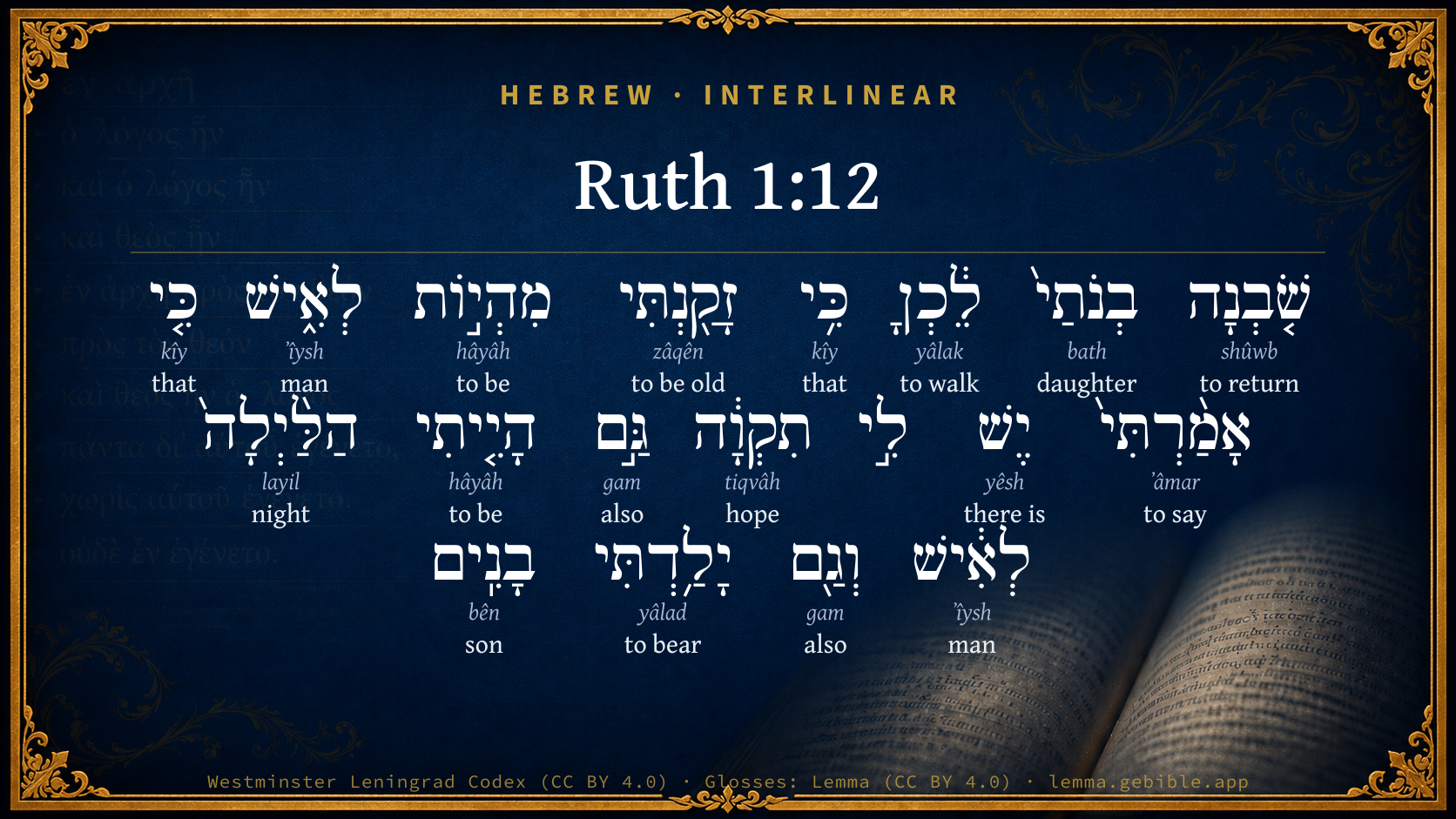
Ruth 1:12

Hebrew (Westminster Leningrad Codex) Ruth 1:12 appears in the Hebrew Old Testament. The text above is from the Westminster Leningrad Codex. Each word links to its Strong’s number, a concise gloss, and parsing drawn from the Open Scriptures Hebrew Bible morphology. Click any word for its full Brown-Driver-Briggs (BDB) entry.
Download image
Cite this verse

Ruth 1:12 (World English Bible). Public Domain. Lemma interlinear Bible study tool, https://lemma.gebible.app/v/ruth/1/12.

Show BibTeX & RIS
BibTeX
RIS
English Translation
Turn again, my daughters, go your way; for I am too old to have a husband. If I should say, I have hope, if I should even have a husband tonight, and should also bear sons;
World English Bible · Public Domain
Download a study sheet

One document with this verse’s original text, its word-by-word gloss line, the meaning frame, cross-references with their text, attributed commentary, and full source and license credits — printable, and it pastes into notes with its structure intact.

This verse Autodidact and up

Study sheet (.html) Plain text (.txt)

A passage Seminary Student

Up to 50 verses in one chapter. A passage sheet keeps up to 6 commentary sources and 12 cross-references per verse, in the order this page ranks them, and says so on the sheet whenever that leaves anything out. Ask for a single verse and you get the Autodidact verse sheet above.

Everything on this page stays free to read, with no account — the sheet is a download of what is already on screen, not access to it.

Want to remove ads? Support Godless Engineer
Compare translations 3

The same verse in 3 English versions, stacked beneath the original-language interlinear above. Click any original word for its lexicon entry.

Each is an independent rendering of the whole verse — the interlinear is not word-aligned to these translations.

Highlighted words mark where these versions differ — a whole-verse word diff, not a word-by-word alignment.

  • World English Bible Public Domain
    Turn again, my daughters, go your way; for I am too old to have a husband. If I should say, I have hope, if I should even have a husband tonight, and should also bear sons;
  • King James Version Public Domain
    Turn again, my daughters, go your way; for I am too old to have an husband. If I should say, I have hope, if I should have an husband also to night, and should also bear sons;
  • unfoldingWord Literal Text CC BY-SA 4.0
    Turn back, my daughters, go! For I am too old to belong to a husband. If I said I have hope, and if I belonged to a husband even tonight, and even if I would give birth to sons,

unfoldingWord Literal Text — © unfoldingWord, licensed CC BY-SA 4.0. Word-aligned USFM3 via Door43 (git.door43.org/unfoldingWord/en_ult).

Versions to compare (up to 4)

3 of 4 selected

Show all 18 translations

Every available English version of this verse, each an independent rendering of the whole verse.

  • World English Bible Public Domain
    Turn again, my daughters, go your way; for I am too old to have a husband. If I should say, I have hope, if I should even have a husband tonight, and should also bear sons;
  • Berean Standard Bible Public Domain
    Return home, my daughters. Go on, for I am too old to have another husband. Even if I thought there was hope for me to have a husband tonight and to bear sons,
  • Majority Standard Bible Public Domain
    Return home, my daughters. Go on, for I am too old to have another husband. Even if I thought there was hope for me to have a husband tonight and to bear sons,
  • King James Version Public Domain
    Turn again, my daughters, go your way; for I am too old to have an husband. If I should say, I have hope, if I should have an husband also to night, and should also bear sons;
  • American Standard Version (1901) Public Domain
    Turn again, my daughters, go your way; for I am too old to have a husband. If I should say, I have hope, if I should even have a husband to-night, and should also bear sons;
  • Revised Version (1885) Public Domain
    Turn again, my daughters, go your way; for I am too old to have an husband. If I should say, I have hope, if I should even have an husband to-night, and should also bear sons;
  • Geneva Bible (1599) Public Domain
    Turne againe, my daughters: go your way: for I am too olde to haue an husband. If I should say, I haue hope, and if I had an husband this night: yea, if I had borne sonnes,
  • Douay-Rheims (1899) Public Domain
    Return again, my daughters, and go your ways: for I am now spent with age, and not fit for wedlock. Although I might conceive this night, and bear children,
  • Young's Literal Translation Public Domain
    Turn back, my daughters, go, for I am too aged to be to a husband; though I had said, There is for me hope, also, I have been to-night to a husband, and also I have borne sons:
  • Literal Standard Version CC BY-SA 4.0
    Turn back, my daughters, go, for I am too aged to be to a husband; though I had said, There is for me hope, also, I have been tonight to a husband, and also I have borne sons:
  • Unlocked Literal Bible CC BY-SA 4.0
    Turn back, my daughters, go your own way, for I am too old to have a husband. If I said, 'I hope I get a husband tonight,' and then give birth to sons,
  • unfoldingWord Literal Text CC BY-SA 4.0
    Turn back, my daughters, go! For I am too old to belong to a husband. If I said I have hope, and if I belonged to a husband even tonight, and even if I would give birth to sons,
  • Darby Bible Public Domain
    Return, my daughters, go; for I am too old to have a husband. If I should say, I have hope, should I even have a husband to-night, and should I also bear sons,
  • World Messianic Bible Public Domain
    Go back, my daughters, go your way; for I am too old to have a husband. If I should say, ‘I have hope,’ if I should even have a husband tonight, and should also bear sons,
  • Webster's Bible Public Domain
    Turn again, my daughters, go your way; for I am too old to have a husband. If I should say, I have hope, if I should have a husband also to-night, and should also bear sons;
  • Free Bible Version CC BY-SA 4.0
    Go back home, my daughters, because I'm too old to marry again. Even if I were to sleep with a new husband tonight and had sons,
  • Bible in Basic English Public Domain
    Go back, my daughters, and go on your way; I am so old now that I may not have another husband. If I said, I have hopes, if I had a husband tonight, and might have sons,
  • JPS Tanakh (1917) Public Domain
    Turn back, my daughters, go your way; for I am too old to have a husband. If I should say: I have hope, should I even have an husband to-night, and also bear sons;

Literal Standard Version (2020), Covenant Press — licensed CC BY-SA 4.0. Text via the HelloAO Bible API (eBible.org). Unlocked Literal Bible (unfoldingWord) — licensed CC BY-SA 4.0. Text via the HelloAO Bible API (eBible.org). unfoldingWord Literal Text — © unfoldingWord, licensed CC BY-SA 4.0. Word-aligned USFM3 via Door43 (git.door43.org/unfoldingWord/en_ult). Free Bible Version, Dr. Jonathan Gallagher — licensed CC BY-SA 4.0. Text via the HelloAO Bible API (eBible.org).

Word by word

More ways to search: Search by grammar → Find every occurrence → Compare this word →

Practice this passage: Drill this verse → Learn its vocabulary →

זָקַ֖נְתִּי
zâqên
H2204
“to be old”
Verb, Qal, Perfect, 1st Person, Common, Singular
Part of Speech
Verb
Stem
Qal
Form
Perfect
Person
1st Person
Gender
Common
Number
Singular
Full BDB Definition

Origin: a primitive root

TWOT: 574

to be old, become old - (Qal) to be old, become old - (Hiphil) to grow old, show age
  1. שֹׁ֤בְנָה shûwb H7725 “return” Verb, Qal, Imperative, 2nd Person, Feminine, Plural
  2. בְנֹתַי֙ bath H1323 “daughters · my” Noun, Common, Feminine, Plural, Construct + Suffix, Personal, 1st Person, Common, Singular
  3. לֵ֔כְןָ yâlak H3212 “walk” Verb, Qal, Imperative, 2nd Person, Feminine, Plural
  4. כִּ֥י kîy H3588 “that” Conjunction
  5. מִהְי֣וֹת hâyâh H1961 “from · to be” Preposition + Verb, Qal, Infinitive Construct
  6. לְאִ֑ישׁ ʼîysh H376 “to/for · man” Preposition + Noun, Common, Masculine, Singular, Absolute
  7. כִּ֤י kîy H3588 “that” Conjunction
  8. אָמַ֨רְתִּי֙ ʼâmar H559 “to say” Verb, Qal, Perfect, 1st Person, Common, Singular
  9. יֶשׁ yêsh H3426 “there is” Particle, Demonstrative
  10. תִקְוָ֔ה tiqvâh H8615 “hope” Noun, Common, Feminine, Singular, Absolute
  11. גַּ֣ם gam H1571 “also” Particle, Accusative
  12. הָיִ֤יתִי hâyâh H1961 “to be” Verb, Qal, Perfect, 1st Person, Common, Singular
  13. הַלַּ֨יְלָה֙ layil H3915 “the · night” Particle, Definite Article + Noun, Common, Masculine, Singular, Absolute
  14. לְאִ֔ישׁ ʼîysh H376 “to/for · man” Preposition + Noun, Common, Masculine, Singular, Absolute
  15. וְגַ֖ם gam H1571 “and · also” Conjunction + Particle, Accusative
  16. יָלַ֥דְתִּי yâlad H3205 “to bear” Verb, Qal, Perfect, 1st Person, Common, Singular
  17. בָנִֽים bên H1121 “sons” Noun, Common, Masculine, Plural, Absolute

About this verse

These counts appear in no published source. They are computed here, from the morphology-tagged text and Lemma’s own curated glosses. What Lemma adds →

19
words
14
distinct lemmas
Historical
section

Shared distinctive vocabulary

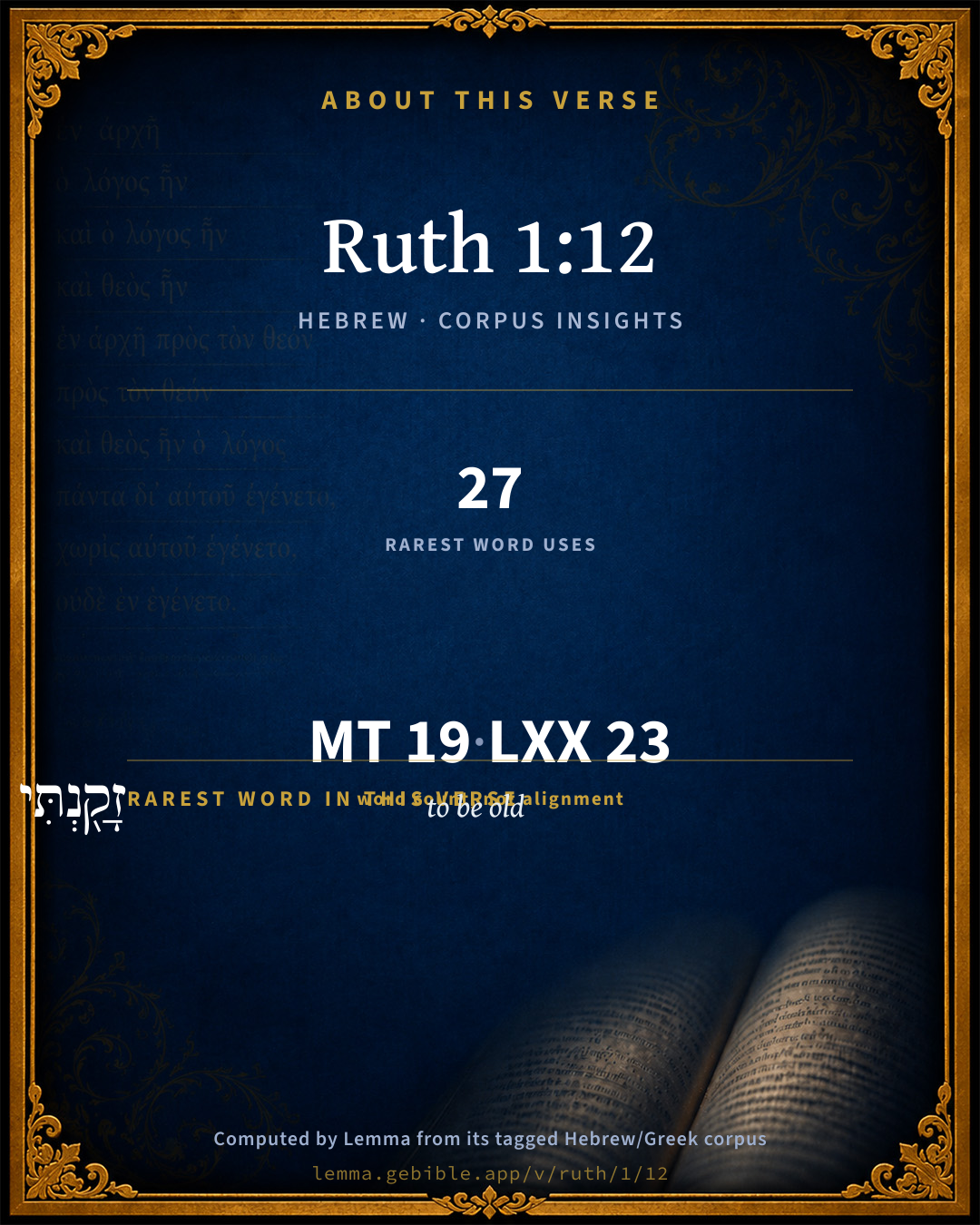
זָקַ֖נְתִּי to be old H2204 occurs in 26 verses of the Hebrew Bible. Also found in:

Grammatical profile

  • 7 verbs
  • 6 nouns
  • 1 preposition
  • 2 conjunctions
  • 3 particles

Verb forms

  • שֹׁ֤בְנָה Qal · Imperative
  • לֵ֔כְןָ Qal · Imperative
  • זָקַ֖נְתִּי Qal · Perfect
  • מִהְי֣וֹת Qal · Infinitive Construct
  • אָמַ֨רְתִּי֙ Qal · Perfect
  • הָיִ֤יתִי Qal · Perfect
  • יָלַ֥דְתִּי Qal · Perfect

Repetition

Words recur within this verse — often emphatic in Hebrew:

  • מִהְי֣וֹת to be H1961 ×2
  • לְאִ֑ישׁ man H376 ×2
  • גַּ֣ם also H1571 ×2
  • כִּ֥י that H3588 ×2

Hebrew & Septuagint length

In English translation the verse runs 36 words from the Hebrew and 23 from the Septuagint (LXX English) — the Septuagint runs noticeably shorter here. See the side-by-side →

A rough comparison of the two English renderings, which tokenize alike — not a word-level alignment.

Word counts can differ between the Hebrew and the Greek without any difference in meaning — e.g. the Hebrew direct-object marker אֵת has no separate Greek word, and Greek often adds the article ὁ.

In the original languages it is 19 Hebrew tokens and 23 Greek tokens — but the two are counted differently (Hebrew bundles its prefixes and suffixes into one token; the Greek is in lemma form), so that isn’t a like-for-like length.

Cross-references

2

Topical passages linked to Ruth 1:12 in the Treasury of Scripture Knowledge — connected by theme and wording, ordered by reader-vote popularity; previews shown in the World English Bible.

  • Genesis 17:17 Then Abraham fell on his face, and laughed, and said in his heart, "Will a child be born to him who is one hundred years old? Will Sarah, who is ninety years old, give birth?"
  • 1 Timothy 5:9 Let no one be enrolled as a widow under sixty years old, having been the wife of one man,

Cross-references courtesy of OpenBible.info (CC BY 4.0).

Hebrew and Greek witnesses Masoretic Hebrew ↔ Greek Septuagint

The same verse in the two great witnesses to the Old Testament, shown verse-for-verse.

Here the Septuagint runs noticeably shorter than the Hebrew — LXX2012 (modern English Septuagint) 23 words vs World English Bible 36. A rough length comparison of the two English translations, not a word-level alignment — read both below.

These are two independent witnesses, not word-aligned to each other, and the Septuagint is shown in lemma (dictionary) form.

Hebrew Ruth 1:12 Masoretic · Westminster Leningrad Codex

שֹׁ֤בְנָה בְנֹתַי֙ לֵ֔כְןָ כִּ֥י זָקַ֖נְתִּי מִהְי֣וֹת לְאִ֑ישׁ כִּ֤י אָמַ֨רְתִּי֙ יֶשׁ לִ֣י תִקְוָ֔ה גַּ֣ם הָיִ֤יתִי הַלַּ֨יְלָה֙ לְאִ֔ישׁ וְגַ֖ם יָלַ֥דְתִּי בָנִֽים

Turn again, my daughters, go your way; for I am too old to have a husband. If I should say, I have hope, if I should even have a husband tonight, and should also bear sons;

World English Bible · Public Domain

Greek LXX Ruth 1:12 Septuagint · lemma form

ἐπιστρέφω δή θυγάτηρ ἐγώ διότι γηράσκω ὁ μή εἰμί ἀνήρ ὅτι εἶπον ὅτι εἰμί ἐγώ ὑπόστασις ὁ γίγνομαι ἐγώ ἀνήρ καί τίκτω υἱός

Turn now, my daughters, for I am too old to be married: for I said, Suppose I were married, and should bear sons;

LXX2012 (modern English Septuagint) · Public Domain

On this verse, The Pulpit Commentary discusses the Septuagint’s reading. Read the note in Commentary ↓

Hebrew: Westminster Leningrad Codex (CC BY 4.0). Greek: Septuagint (public domain); English from LXX2012 (modern English Septuagint) (Public Domain). How the Septuagint differs from the Hebrew →

Commentary

Notes on Ruth 1:12 from classic Christian and Jewish commentators (each source and its license shown beneath its notes). The classic Christian expositions comment on the surrounding passage and are grouped to its opening verse, so a note may address several verses; the Jewish commentaries on the Tanakh (Rashi and others) are per-verse, so they appear only where the commentator wrote on this verse.

Lemma curates 59 commentaries, every one of them public domain or Creative Commons licensed, each selected and text-cleaned for this edition rather than reprinted as found. About our sources →

Trapp's Complete Commentary

John Trapp

Rth 1:12 Turn again, my daughters, go [your way]; for I am too old to have an husband. If I should say, I have hope, [if] I should have an husband also to night, and should also bear sons;

Ver. 12. Turn again, my daughters.] A probational persuasion, as Rth 1:8, that she might sound them to the bottom.

For I am too old to have an husband.] Second marriages are not unlawful: but thought of death is enough to forbid the bans of such marriage. Cogita te quotidie moriturum et nunquam de secundis nuptiis cogitabis, saith Jerome.

If I should have an husband also tonight, and should also bear sons.] Without having a husband, she doth not once think of having children, as many wantons and light-skirts do; making themselves whores, and their children bastards, and all for satisfying the rage of present lust, though after they repent with grief and shame. {a}

{a} Bernard.

John Trapp, A Commentary or Exposition upon All the Books of the Old and New Testament (1647–1656) — public domain. Text from a community e-Sword module.

Jamieson, Fausset & Brown

Robert Jamieson, A. R. Fausset & David Brown

Turn again, my daughters, go your way--That Naomi should dissuade her daughters-in-law so strongly from accompanying her to the land of Israel may appear strange. But it was the wisest and most prudent course for her to adopt: first, because they might be influenced by hopes which could not be realized; second, because they might be led, under temporary excitement, to take a step they might afterwards regret; and, third, because the sincerity and strength of their conversion to the true religion, which she had taught them, would be thoroughly tested.

Jamieson, Fausset & Brown — Commentary Critical and Explanatory on the Whole Bible (1871) — public domain (CC PDM 1.0). Text via the HelloAO Bible API.

The Cambridge Bible for Schools and Colleges

gen. ed. J. J. S. Perowne

12. I am too old to have an husband] Naomi does not seriously contemplate any application of the custom alluded to: not only has she no surviving sons, but she never can have any.

If I should say etc.] Strictly, ‘that I should have said, I have hope’ (scil. of children). For the grammar cf. Gen_40:15 (‘that they should have put me’), 1Sa_17:26 b.

The Cambridge Bible for Schools and Colleges (gen. ed. J. J. S. Perowne; Cambridge University Press, 1878–1918) — public domain. Text from a community e-Sword module.

John Gill's Exposition

Turn again, my daughters, go your way,.... This she repeated still to try their affections to her, and especially whether there was any real love to the God of Israel, his people, and worship, but still proceeds upon the same topic:

for I am too old to have an husband; and can never think of marrying again on account of age, nor can you surely ever think I should, at these years I am now arrived to:

if I should say I have hope; of marrying, and bearing children; suppose that:

if I should have a husband also tonight; be married to a man directly, suppose that:

and should also bear sons; conceive and bear, not female but male children, allow that; all which are mere suppositions, and, could they be admitted, would not furnish out any reason why you should be desirous of going with me.

John Gill's Exposition of the Whole Bible (1746–1763) — public domain (CC PDM 1.0). Text via the HelloAO Bible API.

Matthew Poole's English Annotations

Go your way.

Quest. Why doth she dissuade them from this journey, and not rather persuade them to go with her, and to embrace the Jewish religion?

Answ. 1. Possibly she thought such dissuasion might be the best way to persuade them, as it oft happens; especially in that sex.

2. She would not have them rashly and inconsiderately to embrace the Jewish religion, in hopes of some advantage from it, which she justly thought they would be disappointed of; and withal, exposed to many straits and troubles, and on that occasion revolt from the true religion, which would be far worse than never to have embraced it. And therefore she doth justly, and wisely, and piously in representing to them the truth of the business, and the outward inconveniences which would accompany the change of their place and religion; as also our blessed Lord Christ did, Mat 8:20.

Matthew Poole's English Annotations on the Holy Bible (1683–1685) — public domain. Text from a community e-Sword/MySword module.

Whedon's Commentary on the Bible

Daniel D. Whedon

12. I am too old to have a husband — She urges, in addition, the utter improbability of her having another husband or other sons, and hence the propriety of their return to their mothers’ homes, where, as young widows, they might be happily married again.

Daniel D. Whedon (gen. ed.), Commentary on the Old and New Testaments (1874–1909) — public domain. Text from a community e-Sword module.

The Pulpit Commentary

Turn back, my daughters, go; for I am too old to have a husband. But even if I could say, I have hope; yea, even if I had a husband this very night; yea, even if I had already given birth to sons; (ver. 13) would ye therefore wait till they grew up? would ye therefore shut yourselves up so as not to have husbands? nay, my daughters; for my lot is exceedingly bitter, more than even yours, for the hand of Yahveh has gone out against me. Most pathetic pleading, and not easily reproduced on lines of literal rendering. "Go, for I am too old to have a husband." An euphemistic rendering; but the original is euphemistic too, though under another phraseological phase. "But even if I could say, I have hope." The poverty of the Hebrew verb, in respect of provision to express "moods", is conspicuous: that," i.e. suppose that I said, I have hope." Mark the climactic representation. Firstly, Naomi makes, for argument"s sake, the supposition that she might yet have sons; then, secondly, she carries her supposition much higher, namely, that she might that very night have a husband; and then, thirdly, she carries the supposition a great deal higher still, namely, that even already her sons were brought forth: "Would you therefore wait?" Note the therefore. Ibn Ezra, the Septuagint, the Vulgate, and King James"s version assume that hel means for them. The feminine pronoun, however, as applied to Naomi"s sons, is, on that supposition, all but inexplicable. It is much better to assume, with the majority of modern critics, that it is equivalent to kel, whether we call it a Chaldaism or not. Certainly it was current in Chaldee. (see Dan_2:6, Dan_2:9) But it may have floated in circles of Semitic society that were never included within Chaldaea proper. Indeed, there were no precise limits bounding off the Chaldee language from the kindred dialects, just as there are no such limits in English or in German, or in any member of a linguistic group. Idioms often overlap. In the two interrogative clauses, "Would ye for that purpose wait till they grew up. Would ye for that purpose seclude, yourselves, so as not to have husbands? there is a parallelism; only, in the second clause, the representation rises. "For my lot is exceedingly bitter, more than even yours;" literally, "for it is bitter to me exceedingly, beyond you." The verb is used impersonally. Naomi means that her case was even more lamentable than theirs, so that she could not encourage them to hang their dependence on her help, or to hope for a retrieval of their circumstances in becoming partakers of her fortunes. The translation of King James"s version, "for your sakes," though decidedly supported by the Septuagint, is unnatural. Pagnin and Drusius both give the correct rendering, "more than you." So do Michaelis and Wright, But Bertheau and Gesenius agree with King James s version. The Syriac Peshito, strange to say, gives both translations, "I feel very bitterly for you, and to me it is more bitter than to you."

The Pulpit Commentary (1880–1919), ed. H.D.M. Spence-Jones & Joseph S. Exell — public domain. Text from a community e-Sword module.

Rashi

Rabbi Shlomo Yitzchaki (Rashi)

for I have become too old to marry that I should marry someone and bear sons, that you should marry them, for they are not forbidden to you and you are not forbidden to them as far as the prohibition against marrying the wife of a brother who is deceased, for she does not require a levirate marriage because Mahlon and Chilion were not halachically married to them because they were gentiles, and had not converted, and now they were coming to convert, as it is stated (verse 10): “[No], but we will return with you to your people.” From now on, we will become one people.

that I should say that I have hope for even if my heart told me that I have hope to marry again and to bear sons.

Even if I had a husband tonight and more than this, even if I conceived male offspring tonight.

and even if I had borne sons or even if I had already borne sons.

Rashi on the Tanakh — English translations: “The Judaica Press complete Tanach with Rashi, translated by A. J. Rosenberg” (CC BY 4.0); “Pentateuch with Rashi's commentary by M. Rosenbaum and A.M. Silbermann, 1929-1934” (public domain); “The Metsudah Tanach series, Lakewood, N.J” (CC BY 4.0); and “The Book of Joshua, Metsudah Publications, 1997” (CC BY 4.0). Text via Sefaria.

Lesson kit

Teaching starters — assembled from the data on this page, not authored interpretation. Every prompt links to the verse data it draws on. Edit before teaching.

Ruth, in the Historical, opens this verse with 19 words (14 distinct Hebrew lemmas). Its most distinctive word is zâqên (“to be old”). The Greek Septuagint runs shorter here. A historical commentator’s framing appears above. Read the whole chapter for the surrounding context.

Discussion questions

  1. How does “to be old” (zâqên) shape what this verse is saying?
  2. How does Genesis 18:12, which shares the word «to be old», read alongside this verse?
  3. What does the repetition of “to be” (2× in this one verse) do in this verse?
  4. The Septuagint runs shorter here than the Hebrew. What might account for the difference?
  5. These translations render this verse differently. What is at stake in choosing one wording over another?
  6. «שֹׁ֤בְנָה» is a Qal Imperative verb. How does that grammatical form shape the action described?
  7. Compare how Trapp's Complete Commentary and Jamieson, Fausset & Brown read this verse. Where do they agree or differ?

Things to notice

Reading settings

Reading text

Shown beneath each verse's original-language words.

Old Testament
Old Testament edition

Read the OT as the Masoretic Hebrew (MT) or the Greek Septuagint (LXX).

English shown for the Greek Septuagint (in the Hebrew ↔ Greek comparison).

Comparing translations? Open the Compare panel on any verse page to stack up to four side by side.