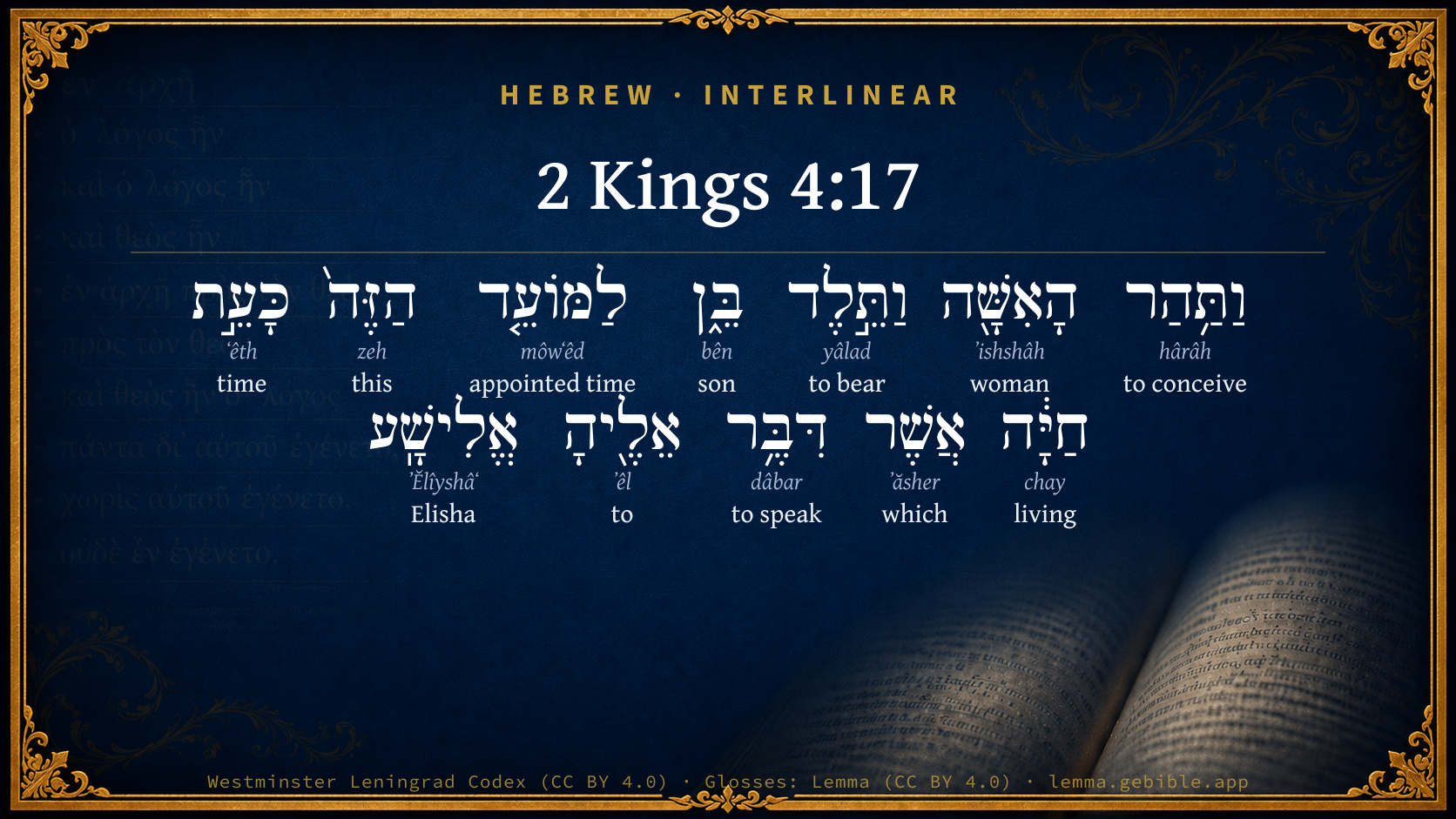
2 Kings 4:17

Hebrew (Westminster Leningrad Codex) 2 Kings 4:17 appears in the Hebrew Old Testament. The text above is from the Westminster Leningrad Codex. Each word links to its Strong’s number, a concise gloss, and parsing drawn from the Open Scriptures Hebrew Bible morphology. Click any word for its full Brown-Driver-Briggs (BDB) entry.
Download image
Cite this verse

2 Kings 4:17 (World English Bible). Public Domain. Lemma interlinear Bible study tool, https://lemma.gebible.app/v/2-kings/4/17.

Show BibTeX & RIS
BibTeX
RIS
English Translation
The woman conceived, and bore a son at that season, when the time came round, as Elisha had said to her.
World English Bible · Public Domain
Download a study sheet

One document with this verse’s original text, its word-by-word gloss line, the meaning frame, cross-references with their text, attributed commentary, and full source and license credits — printable, and it pastes into notes with its structure intact.

This verse Autodidact and up

Study sheet (.html) Plain text (.txt)

A passage Seminary Student

Up to 50 verses in one chapter. A passage sheet keeps up to 6 commentary sources and 12 cross-references per verse, in the order this page ranks them, and says so on the sheet whenever that leaves anything out. Ask for a single verse and you get the Autodidact verse sheet above.

Everything on this page stays free to read, with no account — the sheet is a download of what is already on screen, not access to it.

Want to remove ads? Support Godless Engineer
Compare translations 3

The same verse in 3 English versions, stacked beneath the original-language interlinear above. Click any original word for its lexicon entry.

Each is an independent rendering of the whole verse — the interlinear is not word-aligned to these translations.

Highlighted words mark where these versions differ — a whole-verse word diff, not a word-by-word alignment.

  • World English Bible Public Domain
    The woman conceived, and bore a son at that season, when the time came round, as Elisha had said to her.
  • King James Version Public Domain
    And the woman conceived, and bare a son at that season that Elisha had said unto her, according to the time of life.
  • unfoldingWord Literal Text CC BY-SA 4.0
    And the woman conceived, and she bore a son in that season, according to the time of reviving, as Elisha had spoken to her.

unfoldingWord Literal Text — © unfoldingWord, licensed CC BY-SA 4.0. Word-aligned USFM3 via Door43 (git.door43.org/unfoldingWord/en_ult).

Versions to compare (up to 4)

3 of 4 selected

Show all 18 translations

Every available English version of this verse, each an independent rendering of the whole verse.

  • World English Bible Public Domain
    The woman conceived, and bore a son at that season, when the time came round, as Elisha had said to her.
  • Berean Standard Bible Public Domain
    But the woman did conceive, and at that time the next year she gave birth to a son, just as Elisha had told her.
  • Majority Standard Bible Public Domain
    But the woman did conceive, and at that time the next year she gave birth to a son, just as Elisha had told her.
  • King James Version Public Domain
    And the woman conceived, and bare a son at that season that Elisha had said unto her, according to the time of life.
  • American Standard Version (1901) Public Domain
    And the woman conceived, and bare a son at that season, when the time came round, as Elisha had said unto her.
  • Revised Version (1885) Public Domain
    And the woman conceived, and bare a son at that season, when the time came round, as Elisha had said unto her.
  • Geneva Bible (1599) Public Domain
    So the woman conceiued, and bare a sonne at that same season, according to the time of life, that Elisha had sayd vnto her.
  • Douay-Rheims (1899) Public Domain
    And the woman conceived, and brought forth a son in the time, and at the same hour, that Eliseus had said.
  • Young's Literal Translation Public Domain
    And the woman conceiveth and beareth a son, at this season, according to the time of life, that Elisha spake of unto her.
  • Literal Standard Version CC BY-SA 4.0
    And the woman conceives and bears a son, at this season, according to the time of life that Elisha spoke of to her.
  • Unlocked Literal Bible CC BY-SA 4.0
    But the woman conceived and gave birth to a son at the same time in the following year, as Elisha had said to her.
  • unfoldingWord Literal Text CC BY-SA 4.0
    And the woman conceived, and she bore a son in that season, according to the time of reviving, as Elisha had spoken to her.
  • Darby Bible Public Domain
    And the woman conceived, and bore a son at that appointed time in the next year as Elisha had said to her.
  • World Messianic Bible Public Domain
    The woman conceived, and bore a son at that season when the time came around, as Elisha had said to her.
  • Webster's Bible Public Domain
    And the woman conceived, and bore a son at that season that Elisha had said to her, according to the time of life.
  • Free Bible Version CC BY-SA 4.0
    But the woman did indeed become pregnant, and the next year around that same time she gave birth to a son, just as Elisha had promised her.
  • Bible in Basic English Public Domain
    Then the woman became with child and gave birth to a son at the time named, in the year after, as Elisha had said to her.
  • JPS Tanakh (1917) Public Domain
    And the woman conceived, and bore a son at that season, when the time came round, as Elisha had said unto her.

Literal Standard Version (2020), Covenant Press — licensed CC BY-SA 4.0. Text via the HelloAO Bible API (eBible.org). Unlocked Literal Bible (unfoldingWord) — licensed CC BY-SA 4.0. Text via the HelloAO Bible API (eBible.org). unfoldingWord Literal Text — © unfoldingWord, licensed CC BY-SA 4.0. Word-aligned USFM3 via Door43 (git.door43.org/unfoldingWord/en_ult). Free Bible Version, Dr. Jonathan Gallagher — licensed CC BY-SA 4.0. Text via the HelloAO Bible API (eBible.org).

Word by word

More ways to search: Search by grammar → Find every occurrence → Compare this word →

Practice this passage: Drill this verse → Learn its vocabulary →

וַתַּ֥הַר
hârâh
H2029
“and · to conceive”
Conjunction + Verb, Qal, Sequential Imperfect, 3rd Person, Feminine, Singular
Part of Speech
Conjunction + Verb
Stem
Qal
Form
Sequential Imperfect
Person
3rd Person
Gender
Feminine
Number
Singular
Full BDB Definition

Origin: a primitive root

TWOT: 515

to conceive, become pregnant, bear, be with child, be conceived, progenitor - (Qal) to conceive, become pregnant - (Pual) to be conceived - (Poel) to conceive, contrive, devise
  1. הָאִשָּׁ֖ה ʼishshâh H802 “the · woman” Particle, Definite Article + Noun, Common, Feminine, Singular, Absolute
  2. וַתֵּ֣לֶד yâlad H3205 “and · to bear” Conjunction + Verb, Qal, Sequential Imperfect, 3rd Person, Feminine, Singular
  3. בֵּ֑ן bên H1121 “son” Noun, Common, Masculine, Singular, Absolute
  4. לַמּוֹעֵ֤ד môwʻêd H4150 “to/for the · appointed time” Preposition, Determined + Noun, Common, Masculine, Singular, Absolute
  5. הַזֶּה֙ zeh H2088 “the · this” Particle, Definite Article + Pronoun, Demonstrative, Masculine, Singular
  6. כָּעֵ֣ת ʻêth H6256 “like/as the · time” Preposition, Determined + Noun, Common, Both, Singular, Absolute
  7. חַיָּ֔ה chay H2416 “living” Adjective, Adjective, Feminine, Singular, Absolute
  8. אֲשֶׁר ʼăsher H834 “which” Particle, Relative
  9. דִּבֶּ֥ר dâbar H1696 “to speak” Verb, Piel, Perfect, 3rd Person, Masculine, Singular
  10. אֵלֶ֖יהָ ʼêl H413 “to · her” Preposition + Suffix, Personal, 3rd Person, Feminine, Singular
  11. אֱלִישָֽׁע ʼĔlîyshâʻ H477 “Elisha” Noun, Proper

About this verse

These counts appear in no published source. They are computed here, from the morphology-tagged text and Lemma’s own curated glosses. What Lemma adds →

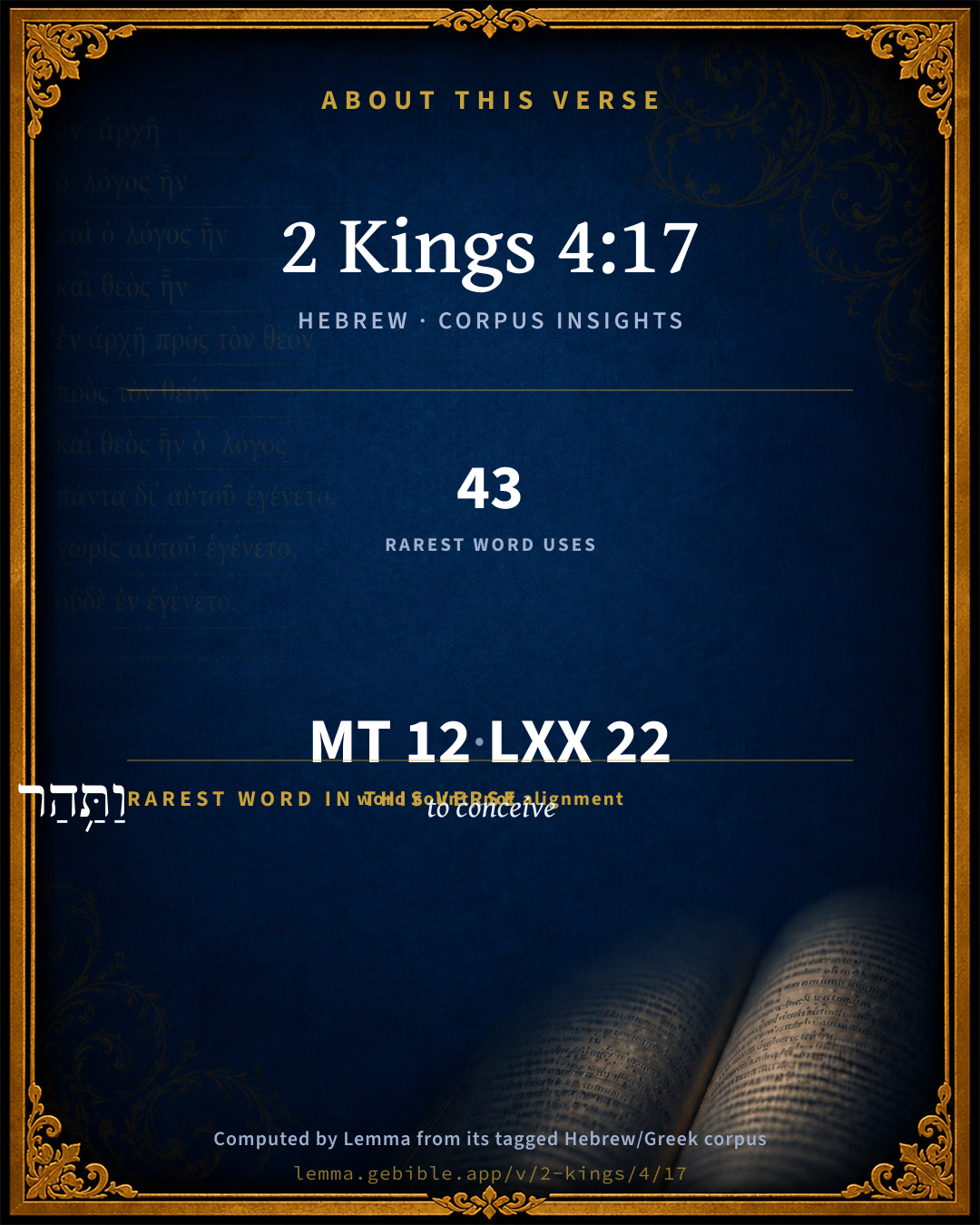
12
words
12
distinct lemmas
Historical
section

Shared distinctive vocabulary

וַתַּ֥הַר to conceive H2029 occurs in 42 verses of the Hebrew Bible. Also found in:

Grammatical profile

  • 3 verbs
  • 5 nouns
  • 1 adjective
  • 1 pronoun
  • 1 preposition
  • 1 particle

Verb forms

  • וַתַּ֥הַר Qal · Sequential Imperfect
  • וַתֵּ֣לֶד Qal · Sequential Imperfect
  • דִּבֶּ֥ר Piel · Perfect

Hebrew & Septuagint length

In English translation the verse runs 21 words from the Hebrew and 23 from the Septuagint (LXX English) — closely comparable.

A rough comparison of the two English renderings, which tokenize alike — not a word-level alignment.

Word counts can differ between the Hebrew and the Greek without any difference in meaning — e.g. the Hebrew direct-object marker אֵת has no separate Greek word, and Greek often adds the article ὁ.

In the original languages it is 12 Hebrew tokens and 22 Greek tokens — but the two are counted differently (Hebrew bundles its prefixes and suffixes into one token; the Greek is in lemma form), so that isn’t a like-for-like length.

Cross-references

6

Topical passages linked to 2 Kings 4:17 in the Treasury of Scripture Knowledge — connected by theme and wording, ordered by reader-vote popularity; previews shown in the World English Bible.

  • Genesis 21:1 Yahweh visited Sarah as he had said, and Yahweh did to Sarah as he had spoken.
  • Psalms 113:9 He settles the barren woman in her home, As a joyful mother of children. Praise Yah!
  • Luke 1:36 Behold, Elizabeth, your relative, also has conceived a son in her old age; and this is the sixth month with her who was called barren.
  • Hebrews 11:11 By faith, even Sarah herself received power to conceive, and she bore a child when she was past age, since she counted him faithful who had promised.
  • 1 Samuel 1:19–20 They rose up in the morning early, and worshiped before Yahweh, and returned, and came to their house to Ramah: and Elkanah knew Hannah his wife; and Yahweh remembered her.
  • Luke 1:24–25 After these days Elizabeth, his wife, conceived, and she hid herself five months, saying,

Cross-references courtesy of OpenBible.info (CC BY 4.0).

Hebrew and Greek witnesses Masoretic Hebrew ↔ Greek Septuagint

The same verse in the two great witnesses to the Old Testament, shown verse-for-verse.

These are two independent witnesses, not word-aligned to each other, and the Septuagint is shown in lemma (dictionary) form.

Hebrew 2 Kings 4:17 Masoretic · Westminster Leningrad Codex

וַתַּ֥הַר הָאִשָּׁ֖ה וַתֵּ֣לֶד בֵּ֑ן לַמּוֹעֵ֤ד הַזֶּה֙ כָּעֵ֣ת חַיָּ֔ה אֲשֶׁר דִּבֶּ֥ר אֵלֶ֖יהָ אֱלִישָֽׁע

The woman conceived, and bore a son at that season, when the time came round, as Elisha had said to her.

World English Bible · Public Domain

Greek LXX 2 Kings 4:17 Septuagint · lemma form

καί ἐν γαστήρ λαμβάνω ὁ γυνή καί τίκτω υἱός εἰς ὁ καιρός οὗτος ὡς ὁ ὥρα ζάω ὡς λαλέω πρός αὐτός ελισαιε

And the woman conceived, and bore a son at the very time, as the season was, being alive, as Elisaie said to her.

LXX2012 (modern English Septuagint) · Public Domain

Hebrew: Westminster Leningrad Codex (CC BY 4.0). Greek: Septuagint (public domain); English from LXX2012 (modern English Septuagint) (Public Domain). How the Septuagint differs from the Hebrew →

Targum (Aramaic paraphrase)

1

The Targum is the ancient Jewish Aramaic paraphrase of the Hebrew Scriptures — an interpretive translation, not the Hebrew text itself. Onkelos (literal) and Pseudo-Jonathan (expansive) render the Torah, and Jonathan the Prophets. Coverage is partial: where no permissively-licensed English translation exists for a verse, only the Aramaic is shown. This is verse-level text, not a word-by-word alignment to the Hebrew.

  1. Targum Jonathan Prophets (Joshua–Malachi)
    וְעַדִיאַת אִתְּתָא וִילֵידַת בָּר לְזִמְנָא הָדֵין כְּעִדַן דְהִיא קַיָמָא דִי מַלֵיל עִמָהּ אֱלִישָׁע:

    (no public-domain English translation for this verse)

    Targum Jonathan — Aramaic: “Mikraot Gedolot” (public domain). English: “Sefaria Community Translation” (CC0 1.0 (public-domain dedication)); “London "Chaldee Paraphrase," 1871” (public domain). Text via Sefaria.

Commentary

Notes on 2 Kings 4:17 from classic Christian and Jewish commentators (each source and its license shown beneath its notes). The classic Christian expositions comment on the surrounding passage and are grouped to its opening verse, so a note may address several verses; the Jewish commentaries on the Tanakh (Rashi and others) are per-verse, so they appear only where the commentator wrote on this verse.

Lemma curates 59 commentaries, every one of them public domain or Creative Commons licensed, each selected and text-cleaned for this edition rather than reprinted as found. About our sources →

Trapp's Complete Commentary

John Trapp

2Ki 4:17 And the woman conceived, and bare a son at that season that Elisha had said unto her, according to the time of life.

Ver. 17. And the woman conceived.] The like whereunto fell out in the last age: for Dr Sandys departing the land for fear of Queen Mary, and taking leave of his hostess, who was childless, and had been married eight years, he gave her a fine handkerchief and an old royal of gold in it, thanking her much, and said, Be of good comfort; ere that one whole year be past, God shall give you a child, a boy. And it came to pass that day twelve months lacking one day, God gave her a fair son. {a}

{a} Act. and Mon., 1894.

John Trapp, A Commentary or Exposition upon All the Books of the Old and New Testament (1647–1656) — public domain. Text from a community e-Sword module.

Ellicott's Commentary for English Readers

(17) And the woman conceived.—Comp. with this verse Gen_21:2.

Said.—Promised.

According to the time of life.—See Note on 2Ki_4:16.

A Bible Commentary for English Readers, edited by Charles John Ellicott (1878–1897) — public domain. Text from a community e-Sword module.

The Cambridge Bible for Schools and Colleges

gen. ed. J. J. S. Perowne

17. Here by rendering as in the previous verse the R.V. involves a change of order in the English but conforms thereby more nearly to the Hebrew order. ‘And the woman conceived, and bare a son at that season, when the time came round, as Elisha had said unto her’.

The Cambridge Bible for Schools and Colleges (gen. ed. J. J. S. Perowne; Cambridge University Press, 1878–1918) — public domain. Text from a community e-Sword module.

John Gill's Exposition

And the woman conceived, and bare a son at the season that Elisha said unto her,.... Quickly after this she conceived, and became pregnant, and by that time the year came round, she was brought to bed of a son:

according to the time of life: when she had gone her full time to have a son born alive, and live.

John Gill's Exposition of the Whole Bible (1746–1763) — public domain (CC PDM 1.0). Text via the HelloAO Bible API.

The Pulpit Commentary

And the woman conceived, and bare a son at that season that Elisha had said unto her, according to the time of life; rather, as the Revised Version gives the passage, the woman conceived, and bare a son at that season , when the time came round, as Elisha had said unto her. The event was exactly as predicted; the child was born at the same season of the ensuing year.

The Pulpit Commentary (1880–1919), ed. H.D.M. Spence-Jones & Joseph S. Exell — public domain. Text from a community e-Sword module.

John Wesley's Explanatory Notes

Time of life - See note on Gen. xviii, 10.

John Wesley, Explanatory Notes Upon the Whole Bible (1754–1765) — public domain. Text via the GEBible commentary corpus.

unfoldingWord translationNotes

Door43 World Missions Community

at the same time in the following year

"during the same season the next year"

When the child had grown

"When the child was older"

My head, my head.

The child said this because his head hurt. The meaning of this can be made clear. AT: "My head hurts! My head hurts!" (See: Assumed Knowledge and Implicit Information)

the child sat on her knees until noon and then died

Here the woman's knees refer to her lap. She held her son in her lap until he died. AT: "she held him on her lap until noon and then he died" (See: Synecdoche)

translationWords

harvest

die

unfoldingWord translationNotes — © Distant Shores Media and the Door43 World Missions Community, licensed CC BY-SA 4.0. Source: git.door43.org/Door43/en_tn.

Rashi

Rabbi Shlomo Yitzchaki (Rashi)

When the time was for her to give birth. Like this time when she was alive and well. Therefore, the word is voweled [to mean], like “this” time.

Rashi on the Tanakh — English translations: “The Judaica Press complete Tanach with Rashi, translated by A. J. Rosenberg” (CC BY 4.0); “Pentateuch with Rashi's commentary by M. Rosenbaum and A.M. Silbermann, 1929-1934” (public domain); “The Metsudah Tanach series, Lakewood, N.J” (CC BY 4.0); and “The Book of Joshua, Metsudah Publications, 1997” (CC BY 4.0). Text via Sefaria.

Lesson kit

Teaching starters — assembled from the data on this page, not authored interpretation. Every prompt links to the verse data it draws on. Edit before teaching.

2 Kings, in the Historical, opens this verse with 12 words (12 distinct Hebrew lemmas). Its most distinctive word is hârâh (“to conceive”). A historical commentator’s framing appears above. Read the whole chapter for the surrounding context.

Discussion questions

  1. How does “to conceive” (hârâh) shape what this verse is saying?
  2. Genesis 4:1 shares the word «to conceive» with this verse. How do the two illuminate each other?
  3. The translations on this page render this verse differently — a whole-verse word diff, not a word-by-word alignment. What might account for the different wordings?
  4. The verb «וַתַּ֥הַר» is Qal Sequential Imperfect. How does its form color the action?
  5. Reading how Trapp's Complete Commentary and Ellicott's Commentary for English Readers read this verse, where do the two commentators agree and where do they part?

Things to notice

Reading settings

Reading text

Shown beneath each verse's original-language words.

Old Testament
Old Testament edition

Read the OT as the Masoretic Hebrew (MT) or the Greek Septuagint (LXX).

English shown for the Greek Septuagint (in the Hebrew ↔ Greek comparison).

Comparing translations? Open the Compare panel on any verse page to stack up to four side by side.