Genesis 50:23

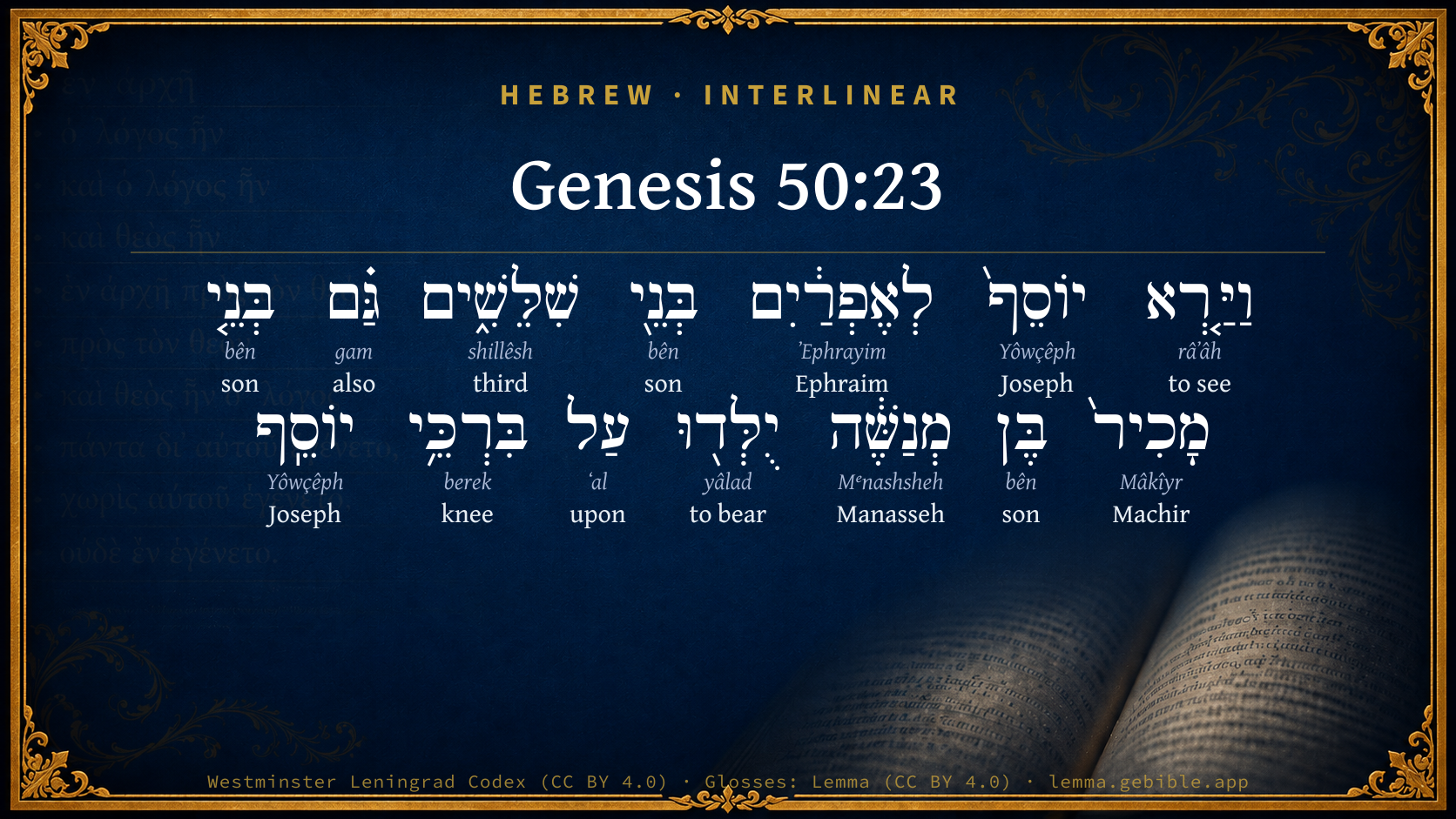
Hebrew (Westminster Leningrad Codex) Genesis 50:23 appears in the Hebrew Old Testament. The text above is from the Westminster Leningrad Codex. Each word links to its Strong’s number, a concise gloss, and parsing drawn from the Open Scriptures Hebrew Bible morphology. Click any word for its full Brown-Driver-Briggs (BDB) entry.
Download image
Cite this verse

Genesis 50:23 (World English Bible). Public Domain. Lemma interlinear Bible study tool, https://lemma.gebible.app/v/genesis/50/23.

Show BibTeX & RIS
BibTeX
RIS
English Translation
Joseph saw Ephraim's children to the third generation. The children also of Machir, the son of Manasseh, were born on Joseph's knees.
World English Bible · Public Domain
Highlights
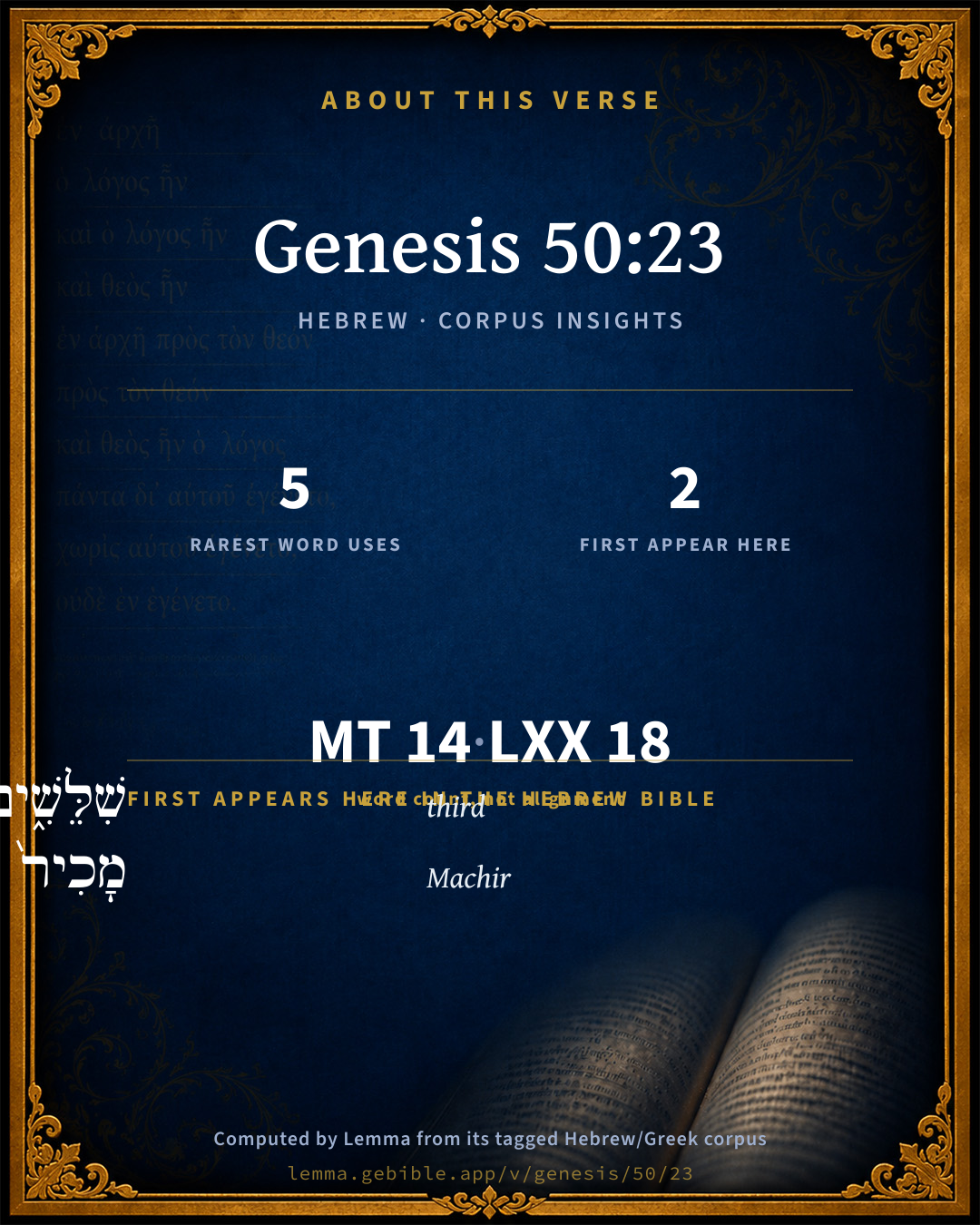
  • 2 first appearances in the Hebrew Bible
Full analysis ↓
Download a study sheet

One document with this verse’s original text, its word-by-word gloss line, the meaning frame, cross-references with their text, attributed commentary, and full source and license credits — printable, and it pastes into notes with its structure intact.

This verse Autodidact and up

Study sheet (.html) Plain text (.txt)

A passage Seminary Student

Up to 50 verses in one chapter. A passage sheet keeps up to 6 commentary sources and 12 cross-references per verse, in the order this page ranks them, and says so on the sheet whenever that leaves anything out. Ask for a single verse and you get the Autodidact verse sheet above.

Everything on this page stays free to read, with no account — the sheet is a download of what is already on screen, not access to it.

Want to remove ads? Support Godless Engineer
Compare translations 3

The same verse in 3 English versions, stacked beneath the original-language interlinear above. Click any original word for its lexicon entry.

Each is an independent rendering of the whole verse — the interlinear is not word-aligned to these translations.

Highlighted words mark where these versions differ — a whole-verse word diff, not a word-by-word alignment.

  • World English Bible Public Domain
    Joseph saw Ephraim's children to the third generation. The children also of Machir, the son of Manasseh, were born on Joseph's knees.
  • King James Version Public Domain
    And Joseph saw Ephraim's children of the third generation: the children also of Machir the son of Manasseh were brought up upon Joseph's knees.
  • unfoldingWord Literal Text CC BY-SA 4.0
    And Joseph saw Ephraim’s sons the third. Also, the sons of Machir, the son of Manasseh, were born on the knees of Joseph.

unfoldingWord Literal Text — © unfoldingWord, licensed CC BY-SA 4.0. Word-aligned USFM3 via Door43 (git.door43.org/unfoldingWord/en_ult).

Versions to compare (up to 4)

3 of 4 selected

Show all 18 translations

Every available English version of this verse, each an independent rendering of the whole verse.

  • World English Bible Public Domain
    Joseph saw Ephraim's children to the third generation. The children also of Machir, the son of Manasseh, were born on Joseph's knees.
  • Berean Standard Bible Public Domain
    He saw Ephraim’s sons to the third generation, and indeed the sons of Machir son of Manasseh were brought up on Joseph’s knees.
  • Majority Standard Bible Public Domain
    He saw Ephraim’s sons to the third generation, and indeed the sons of Machir son of Manasseh were brought up on Joseph’s knees.
  • King James Version Public Domain
    And Joseph saw Ephraim's children of the third generation: the children also of Machir the son of Manasseh were brought up upon Joseph's knees.
  • American Standard Version (1901) Public Domain
    And Joseph saw Ephraim's children of the third generation: the children also of Machir the son of Manasseh were born upon Joseph's knees.
  • Revised Version (1885) Public Domain
    And Joseph saw Ephraim’s children of the third generation: the children also of Machir the son of Manasseh were born upon Joseph’s knees.
  • Geneva Bible (1599) Public Domain
    And Ioseph saw Ephraims children, euen vnto the third generation: also the sonnes of Machir the sonne of Manasseh were brought vp on Iosephs knees.
  • Douay-Rheims (1899) Public Domain
    After which he told his brethren: God will visit you after my death, and will make you go up out of this land, to the land which he swore to Abraham, Isaac, and Jacob.
  • Young's Literal Translation Public Domain
    and Joseph looketh on Ephraim's sons of the third `generation'; sons also of Machir, son of Manasseh, have been born on the knees of Joseph.
  • Literal Standard Version CC BY-SA 4.0
    and Joseph looks on Ephraim’s sons of a third [generation]; sons also of Machir, son of Manasseh, have been born on the knees of Joseph.
  • Unlocked Literal Bible CC BY-SA 4.0
    Joseph saw Ephraim's children to the third generation. He also saw the children of Machir son of Manasseh, who were placed on the knees of Joseph.
  • unfoldingWord Literal Text CC BY-SA 4.0
    And Joseph saw Ephraim’s sons the third. Also, the sons of Machir, the son of Manasseh, were born on the knees of Joseph.
  • Darby Bible Public Domain
    And Joseph saw Ephraim's children of the third [generation]; the sons also of Machir the son of Manasseh were born on Joseph's knees.
  • World Messianic Bible Public Domain
    Joseph saw Ephraim’s children to the third generation. The children also of Machir, the son of Manasseh, were born on Joseph’s knees.
  • Webster's Bible Public Domain
    And Joseph saw Ephraim's children of the third generation: the children also of Machir, the son of Manasseh, were brought up upon Joseph's knees.
  • Free Bible Version CC BY-SA 4.0
    and saw three generations of his son Ephraim, and the sons of Makir, Manasseh's son, were placed in his lap when they were born.
  • Bible in Basic English Public Domain
    And Joseph saw Ephraim's children of the third generation: and the children of Machir, the son of Manasseh, came to birth on Joseph's knees.
  • JPS Tanakh (1917) Public Domain
    And Joseph saw Ephraim's children of the third generation; the children also of Machir the son of Manasseh were born upon Joseph's knees.

Literal Standard Version (2020), Covenant Press — licensed CC BY-SA 4.0. Text via the HelloAO Bible API (eBible.org). Unlocked Literal Bible (unfoldingWord) — licensed CC BY-SA 4.0. Text via the HelloAO Bible API (eBible.org). unfoldingWord Literal Text — © unfoldingWord, licensed CC BY-SA 4.0. Word-aligned USFM3 via Door43 (git.door43.org/unfoldingWord/en_ult). Free Bible Version, Dr. Jonathan Gallagher — licensed CC BY-SA 4.0. Text via the HelloAO Bible API (eBible.org).

Word by word

More ways to search: Search by grammar → Find every occurrence → Compare this word →

Practice this passage: Drill this verse → Learn its vocabulary →

שִׁלֵּשִׁ֑ים
shillêsh
H8029
“third generation”
Noun, Common, Masculine, Plural, Absolute
Part of Speech
Noun
Type
Common
Gender
Masculine
Number
Plural
State
Absolute
Full BDB Definition

Origin: from H8027

TWOT: 2403h

pertaining to the third, third (generation)
  1. וַיַּ֤רְא râʼâh H7200 “and · to see” Conjunction + Verb, Qal, Sequential Imperfect, 3rd Person, Masculine, Singular
  2. יוֹסֵף֙ Yôwçêph H3130 “Joseph” Noun, Proper
  3. לְאֶפְרַ֔יִם ʼEphrayim H669 “to/for · Ephraim” Preposition + Noun, Proper
  4. בְּנֵ֖י bên H1121 “sons of” Noun, Common, Masculine, Plural, Construct
  5. גַּ֗ם gam H1571 “also” Particle, Accusative
  6. בְּנֵ֤י bên H1121 “sons of” Noun, Common, Masculine, Plural, Construct
  7. מָכִיר֙ Mâkîyr H4353 “Machir” Noun, Proper
  8. בֶּן bên H1121 “son of” Noun, Common, Masculine, Singular, Construct
  9. מְנַשֶּׁ֔ה Mᵉnashsheh H4519 “Manasseh” Noun, Proper
  10. יֻלְּד֖וּ yâlad H3205 “to bear” Verb, Pual, Perfect, 3rd Person, Common, Plural
  11. עַל ʻal H5921 “upon” Preposition
  12. בִּרְכֵּ֥י berek H1290 “knees of” Noun, Common, Feminine, Dual, Construct
  13. יוֹסֵֽף Yôwçêph H3130 “Joseph” Noun, Proper

About this verse

These counts appear in no published source. They are computed here, from the morphology-tagged text and Lemma’s own curated glosses. What Lemma adds →

14
words
11
distinct lemmas
Pentateuch
section

Notable vocabulary

The rarest word here is שִׁלֵּשִׁ֑ים third H8029 — appearing just 5 times in the whole Hebrew Bible.

First appearance in Scripture

These words make their first canonical appearance in the Hebrew Bible here:

  • שִׁלֵּשִׁ֑ים third H8029
  • מָכִיר֙ Machir H4353

Shared distinctive vocabulary

שִׁלֵּשִׁ֑ים third H8029 occurs in 5 verses of the Hebrew Bible. Also found in:

Grammatical profile

  • 2 verbs
  • 10 nouns
  • 1 preposition
  • 1 particle

Verb forms

  • וַיַּ֤רְא Qal · Sequential Imperfect
  • יֻלְּד֖וּ Pual · Perfect

Repetition

Words recur within this verse — often emphatic in Hebrew:

  • בְּנֵ֖י son H1121 ×3
  • יוֹסֵף֙ Joseph H3130 ×2

Hebrew & Septuagint length

In English translation the verse runs 22 words from the Hebrew and 27 from the Septuagint (LXX English) — closely comparable.

A rough comparison of the two English renderings, which tokenize alike — not a word-level alignment.

Word counts can differ between the Hebrew and the Greek without any difference in meaning — e.g. the Hebrew direct-object marker אֵת has no separate Greek word, and Greek often adds the article ὁ.

In the original languages it is 14 Hebrew tokens and 18 Greek tokens — but the two are counted differently (Hebrew bundles its prefixes and suffixes into one token; the Greek is in lemma form), so that isn’t a like-for-like length.

Cross-references

8

Topical passages linked to Genesis 50:23 in the Treasury of Scripture Knowledge — connected by theme and wording, ordered by reader-vote popularity; previews shown in the World English Bible.

  • Numbers 32:39 The children of Machir the son of Manasseh went to Gilead, and took it, and dispossessed the Amorites who were therein.
  • Genesis 30:3 She said, "Behold, my maid Bilhah. Go in to her, that she may bear on my knees, and I also may obtain children by her."
  • Job 42:16 After this Job lived one hundred forty years, and saw his sons, and his sons' sons, to four generations.
  • Genesis 48:19 His father refused, and said, "I know, my son, I know. He also will become a people, and he also will be great. However, his younger brother will be greater than he, and his seed will become a multitude of nations."
  • Numbers 32:33 Moses gave to them, even to the children of Gad, and to the children of Reuben, and to the half-tribe of Manasseh the son of Joseph, the kingdom of Sihon king of the Amorites, and the kingdom of Og king of Bashan, the land, according to the cities of it with [their] borders, even the cities of the land round about.
  • Joshua 17:1 [This] was the lot for the tribe of Manasseh; for he was the firstborn of Joseph. As for Machir the firstborn of Manasseh, the father of Gilead, because he was a man of war, therefore he had Gilead and Bashan.
  • Psalms 128:6 Yes, may you see your children's children. Peace be upon Israel.
  • Genesis 49:12 His eyes will be red with wine, His teeth white with milk.

Cross-references courtesy of OpenBible.info (CC BY 4.0).

Hebrew and Greek witnesses Masoretic Hebrew ↔ Greek Septuagint

The same verse in the two great witnesses to the Old Testament, shown verse-for-verse.

These are two independent witnesses, not word-aligned to each other, and the Septuagint is shown in lemma (dictionary) form.

Hebrew Genesis 50:23 Masoretic · Westminster Leningrad Codex

וַיַּ֤רְא יוֹסֵף֙ לְאֶפְרַ֔יִם בְּנֵ֖י שִׁלֵּשִׁ֑ים גַּ֗ם בְּנֵ֤י מָכִיר֙ בֶּן מְנַשֶּׁ֔ה יֻלְּד֖וּ עַל בִּרְכֵּ֥י יוֹסֵֽף

Joseph saw Ephraim's children to the third generation. The children also of Machir, the son of Manasseh, were born on Joseph's knees.

World English Bible · Public Domain

Greek LXX Genesis 50:23 Septuagint · lemma form

καί ὁράω ιωσηφ ἐφράιμ παιδίον ἕως τρίτος γενεά καί υἱός μαχιρ ὁ υἱός μανασσή τίκτω ἐπί μηρός ιωσηφ

And Joseph saw the children of Ephraim to the third generation; and the sons of Machir the son of Manasse were borne on the sides of Joseph.

LXX2012 (modern English Septuagint) · Public Domain

Hebrew: Westminster Leningrad Codex (CC BY 4.0). Greek: Septuagint (public domain); English from LXX2012 (modern English Septuagint) (Public Domain). How the Septuagint differs from the Hebrew →

Targum (Aramaic paraphrase)

2

The Targum is the ancient Jewish Aramaic paraphrase of the Hebrew Scriptures — an interpretive translation, not the Hebrew text itself. Onkelos (literal) and Pseudo-Jonathan (expansive) render the Torah, and Jonathan the Prophets. Coverage is partial: where no permissively-licensed English translation exists for a verse, only the Aramaic is shown. This is verse-level text, not a word-by-word alignment to the Hebrew.

  1. Targum Onkelos Torah (Genesis–Deuteronomy)
    וַחֲזָא יוֹסֵף לְאֶפְרַיִם בְּנִין תְּלִיתָאִין אַף בְּנֵי מָכִיר בַּר מְנַשֶּׁה אִתְיְלִידוּ וְרַבִּי יוֹסֵף

    (no public-domain English translation for this verse)

    Targum Onkelos — Aramaic: “Onkelos Genesis” (public domain); “Onkelos Exodus” (public domain); “Onkelos Leviticus” (public domain); “Onkelos Numbers” (public domain); “Onkelos Deuteronomy” (public domain). English: “Sefaria Community Translation” (CC0 1.0 (public-domain dedication)); “J.W. Etheridge. The Targums of Onkelos and Jonathan Ben Uzziel on the Pentateuch. London: Longmans, Green, 1862” (public domain). Text via Sefaria.

  2. Targum Pseudo-Jonathan Torah (Genesis–Deuteronomy)
    וַחֲמָא יוֹסֵף לְאֶפְרַיִם בְּנִין דָרִין תְּלִיתָאִין אוּף בְּנֵי מָכִיר בַּר מְנַשֶׁה כַּד אִתְיְלִידוּ גְזִירִינוּן יוֹסֵף

    And Joseph saw Ephraim's children of the third generation; also the sons of Makir the son of Menasheh, when they were born, were circumcised by Joseph.

    Targum Pseudo-Jonathan — Aramaic: “Targum Jonathan on Genesis” (public domain); “Targum Jonathan on Exodus” (public domain); “Targum Jonathan on Leviticus” (public domain); “Targum Jonathan on Numbers” (public domain); “Targum Jonathan on Deuteronomy” (public domain). English: “The Targum of Jonathan ben Uzziel, trans. J. W. Etheridge, London, 1862” (public domain). Text via Sefaria.

Commentary

Notes on Genesis 50:23 from classic Christian and Jewish commentators (each source and its license shown beneath its notes). The classic Christian expositions comment on the surrounding passage and are grouped to its opening verse, so a note may address several verses; the Jewish commentaries on the Tanakh (Rashi and others) are per-verse, so they appear only where the commentator wrote on this verse.

Lemma curates 59 commentaries, every one of them public domain or Creative Commons licensed, each selected and text-cleaned for this edition rather than reprinted as found. About our sources →

Trapp's Complete Commentary

John Trapp

Gen 50:23 And Joseph saw Ephraim’s children of the third [generation]: the children also of Machir the son of Manasseh were brought up upon Joseph’s knees.

Ver. 23. Brought up upon Joseph’s knees.] Who with great joy danced and dandled them. So God is said to do his people, {Deu 33:3} as some understand it. {a}

{a} Pedibus suis inservit. Metaph. a parentibus qui filiolos suos quos charos habent, sic tractant. - Cartw., Hist. Christi. Sic Shindler. Buxtorf.

John Trapp, A Commentary or Exposition upon All the Books of the Old and New Testament (1647–1656) — public domain. Text from a community e-Sword module.

Tyndale Open Study Notes

Tyndale Open Resources

50:23 whom he claimed as his own (literally who were born on Joseph’s knees): Placing them on his knees at their birth was a symbolic act signifying that they came from him and belonged to him (cp. Job 3:12).

Tyndale Open Study Notes — © Tyndale Open Resources, licensed CC BY-SA 4.0. Text via the HelloAO Bible API.

Adam Clarke's Commentary

Verse 23. Were brought up upon Joseph's knees.] They were educated by him, or under his direction; his sons and their children continuing to acknowledge him as patriarch, or head of the family, as long as he lived.

Adam Clarke's Commentary on the Bible (1810–1826) — public domain. Text from a community e-Sword/MySword module.

Ellicott's Commentary for English Readers

(23) The third generation.—These would be Joseph’s great-grandchildren. Thus Eran, son of Shuthelah, son of Ephraim, was to be born in Joseph’s lifetime (Num_26:35-36).

Were brought up . . . —Heb., were born upon Joseph’s knees, that is, were adopted by him. (See Note on Gen_30:3.) They would not form tribes, as this prerogative was reserved for the sons of Jacob (Gen_48:5), but they would count as Joseph’s sons (Gen_48:6), and form “families.”

A Bible Commentary for English Readers, edited by Charles John Ellicott (1878–1897) — public domain. Text from a community e-Sword module.

The Cambridge Bible for Schools and Colleges

gen. ed. J. J. S. Perowne

23. of the third generation] Ephraim’s children “of the third generation” might mean his great-grandchildren; cf. Exo_34:7. But in Exo_20:5, Num_14:18, the third generation are the grandchildren, the grandparents being reckoned as the first. If this way of reckoning be here followed, Ephraim represents the first generation, and his grandchildren the third. This is also favoured by the next clause, which mentions Manasseh’s grand-children. Joseph, therefore, lived to see his great-grandchildren. On this token of blessing, see Psa_128:6; Pro_13:22; Pro_17:6.

Machir] The name of one of the leading branches of the tribe of Manasseh; cf. Num_32:39; Deu_3:15; Jos_13:31; Jos_17:1; 1Ch_7:14. From these passages it appears that the family of Machir occupied Gilead: while in Jdg_5:14 Machir takes rank with the tribes of Israel.

upon Joseph’s knees] A phrase denoting that Joseph, as head of the family, acknowledged and adopted the children. See note on Gen_30:3, and cf. Job_3:12, Isa_66:12, and Homer, Od. xix. 401.

The Cambridge Bible for Schools and Colleges (gen. ed. J. J. S. Perowne; Cambridge University Press, 1878–1918) — public domain. Text from a community e-Sword module.

John Gill's Exposition

And Joseph said unto his brethren, I die,.... Some time before his death he called them together, and observed to them, that he expected to die in a little time, as all must:

and God will surely visit you; not in a way of wrath and vindictive justice, as he sometimes does, but in a way of love, grace, and mercy:

and bring you out of this land; the land of Egypt, in which they then dwelt:

unto the land which he sware to Abraham, to Isaac, and to Jacob; meaning the land of Canaan, which he swore to those patriarchs that he would give to their posterity.

John Gill's Exposition of the Whole Bible (1746–1763) — public domain (CC PDM 1.0). Text via the HelloAO Bible API.

Matthew Poole's English Annotations

Of the third generation, reckoning from and after Ephraim, i.e., Ephraim’s grandchildren’s children. So early did Ephraim’s privilege above Manasseh appear, and Jacob’s blessing (Gen 48:19) take place.

The children of Machir, Heb. sons. For though he had but one son, viz. Gilead, by his first wife, yet he married a second wife, and by her had two other sons, 1Ch 7:16, which Joseph lived long enough to see. Or under the name of children his grandchildren also might be comprehended. So there is no need of that enallage of sons for one son which we meet with in other places.

Were brought up upon Joseph’s knees; laid upon Joseph’s lap or knees, where parents use ofttimes to take up and repose their infants, to express their love to them, and delight in them. And some observe, that it was an ancient custom in divers nations, that the infant, as soon as it was born, was laid upon the grandfather’s knees. So it is an ellipsis, whereby one word is put for two, or under one verb. See more of this phrase on Gen 30:3; 48:12.

Matthew Poole's English Annotations on the Holy Bible (1683–1685) — public domain. Text from a community e-Sword/MySword module.

Whedon's Commentary on the Bible

Daniel D. Whedon

23. Ephraim’s children of the third generation — That is, “his great great grandchildren (literally, the sons of the sons of the third generation, as Gesenius shows from Exo_20:5; Exo_34:7; but Furst and others understand the Hebrew to mean great grandchildren.) He took upon his knees also his great grandchildren in the line of Manasseh. It was a serene and trustful old age.” — Newhall.

Daniel D. Whedon (gen. ed.), Commentary on the Old and New Testaments (1874–1909) — public domain. Text from a community e-Sword module.

The Pulpit Commentary

And Joseph saw Ephraim"s children of the third generation: i.e. Ephraim"s great-grandchildren (Kalisch, Lange), or Ephraim s great-great-grandsons (Keil, Murphy), which perhaps was not impossible, since Ephraim must have been born before Joseph"s thirty-seventh year, thus allowing at least sixty-three years for four generations to intervene before the patriarch"s death, which might be, if marriage happened early, say not later than eighteenthe children also of Machir the son of Manasseh-by a concubine (1Ch_7:14) were brought up upon Joseph"s knees literally, were born upon Joseph"s knees, i.e. were adopted by him as soon as they were born (Kalisch, Wordsworth, "Speaker"s Commentary"), or were born so that he could take them also upon his knees, and show his love for them (Keil).

The Pulpit Commentary (1880–1919), ed. H.D.M. Spence-Jones & Joseph S. Exell — public domain. Text from a community e-Sword module.

Rashi

Rabbi Shlomo Yitzchaki (Rashi)

על ברכי יוסף [WERE BORN] ON JOSEPH’S KNEES — The meaning is as the Targum gives it: He brought them up upon his knees.

Rashi on the Tanakh — English translations: “The Judaica Press complete Tanach with Rashi, translated by A. J. Rosenberg” (CC BY 4.0); “Pentateuch with Rashi's commentary by M. Rosenbaum and A.M. Silbermann, 1929-1934” (public domain); “The Metsudah Tanach series, Lakewood, N.J” (CC BY 4.0); and “The Book of Joshua, Metsudah Publications, 1997” (CC BY 4.0). Text via Sefaria.

Lesson kit

Teaching starters — assembled from the data on this page, not authored interpretation. Every prompt links to the verse data it draws on. Edit before teaching.

Genesis, in the Pentateuch, opens this verse with 14 words (11 distinct Hebrew lemmas). Its most distinctive word is shillêsh (“third”). A historical commentator’s framing appears above. Read the whole chapter for the surrounding context.

Discussion questions

  1. What does “third” (shillêsh) contribute to the verse as a whole?
  2. 2 words here appear for the first time in Scripture. What is being introduced at this debut?
  3. Exodus 20:5 shares the word «third» with this verse. How do the two illuminate each other?
  4. “son” occurs 3× in this one verse. What is the effect of the repetition?
  5. These translations render this verse differently. What is at stake in choosing one wording over another?
  6. The verb «וַיַּ֤רְא» is Qal Sequential Imperfect. How does its form color the action?
  7. Reading how Trapp's Complete Commentary and Tyndale Open Study Notes read this verse, where do the two commentators agree and where do they part?

Things to notice

Reading settings

Reading text

Shown beneath each verse's original-language words.

Old Testament
Old Testament edition

Read the OT as the Masoretic Hebrew (MT) or the Greek Septuagint (LXX).

English shown for the Greek Septuagint (in the Hebrew ↔ Greek comparison).

Comparing translations? Open the Compare panel on any verse page to stack up to four side by side.