
Genesis 46:15

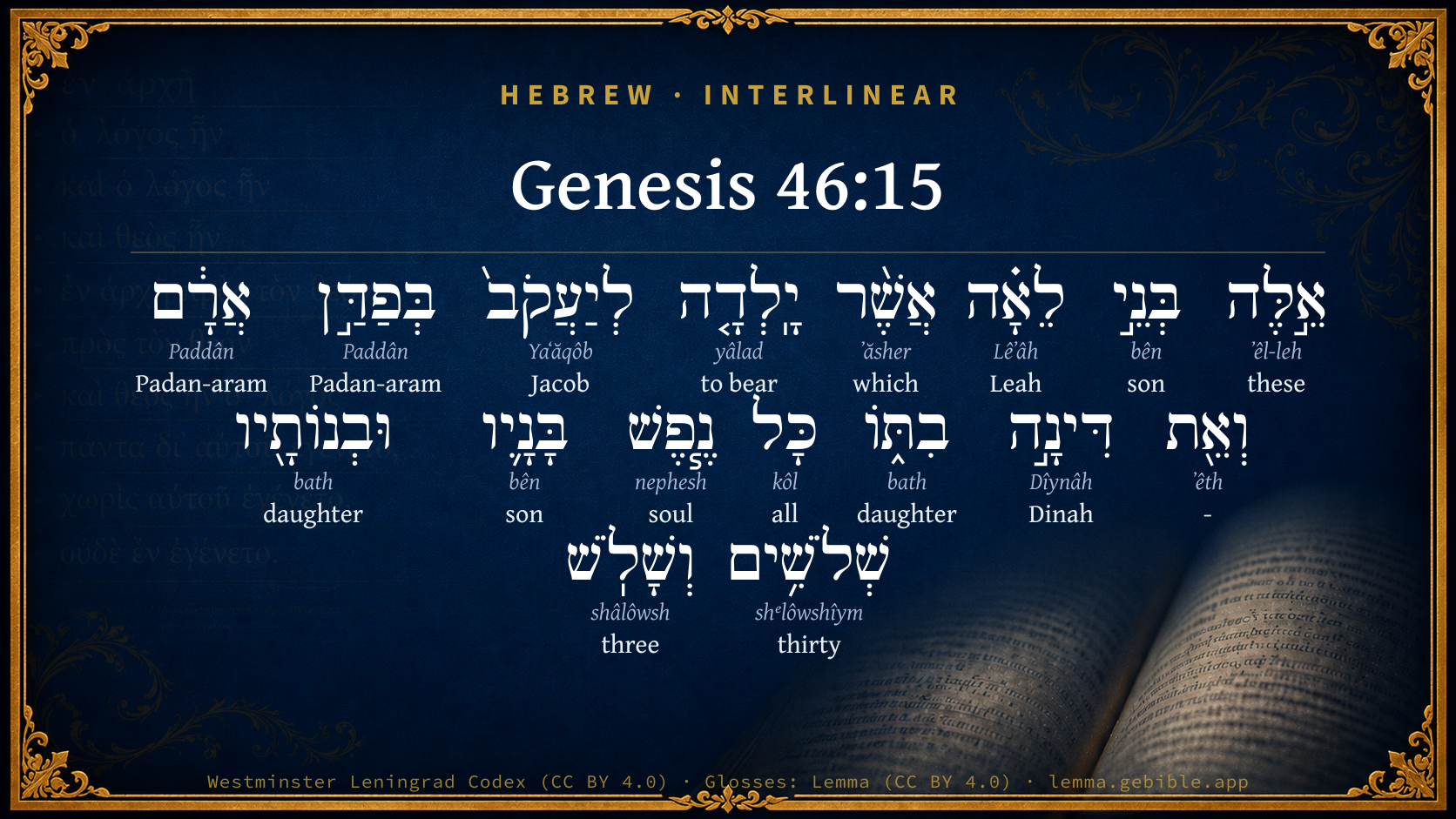
Hebrew (Westminster Leningrad Codex) Genesis 46:15 appears in the Hebrew Old Testament. The text above is from the Westminster Leningrad Codex. Each word links to its Strong’s number, a concise gloss, and parsing drawn from the Open Scriptures Hebrew Bible morphology. Click any word for its full Brown-Driver-Briggs (BDB) entry.
Download image
Cite this verse

Genesis 46:15 (World English Bible). Public Domain. Lemma interlinear Bible study tool, https://lemma.gebible.app/v/genesis/46/15.

Show BibTeX & RIS
BibTeX
RIS
English Translation
These are the sons of Leah, whom she bore to Jacob in Paddan Aram, with his daughter Dinah. All the souls of his sons and his daughters were thirty-three.
World English Bible · Public Domain
Download a study sheet

One document with this verse’s original text, its word-by-word gloss line, the meaning frame, cross-references with their text, attributed commentary, and full source and license credits — printable, and it pastes into notes with its structure intact.

This verse Autodidact and up

Study sheet (.html) Plain text (.txt)

A passage Seminary Student

Up to 50 verses in one chapter. A passage sheet keeps up to 6 commentary sources and 12 cross-references per verse, in the order this page ranks them, and says so on the sheet whenever that leaves anything out. Ask for a single verse and you get the Autodidact verse sheet above.

Everything on this page stays free to read, with no account — the sheet is a download of what is already on screen, not access to it.

Want to remove ads? Support Godless Engineer
Compare translations 3

The same verse in 3 English versions, stacked beneath the original-language interlinear above. Click any original word for its lexicon entry.

Each is an independent rendering of the whole verse — the interlinear is not word-aligned to these translations.

Highlighted words mark where these versions differ — a whole-verse word diff, not a word-by-word alignment.

  • World English Bible Public Domain
    These are the sons of Leah, whom she bore to Jacob in Paddan Aram, with his daughter Dinah. All the souls of his sons and his daughters were thirty-three.
  • King James Version Public Domain
    These be the sons of Leah, which she bare unto Jacob in Padanaram, with his daughter Dinah: all the souls of his sons and his daughters were thirty and three.
  • unfoldingWord Literal Text CC BY-SA 4.0
    Those the sons of Leah, whom she bore for Jacob in Paddan Aram, and Dinah his daughter. All the souls of his sons and his daughters thirty-three.

unfoldingWord Literal Text — © unfoldingWord, licensed CC BY-SA 4.0. Word-aligned USFM3 via Door43 (git.door43.org/unfoldingWord/en_ult).

Versions to compare (up to 4)

3 of 4 selected

Show all 18 translations

Every available English version of this verse, each an independent rendering of the whole verse.

  • World English Bible Public Domain
    These are the sons of Leah, whom she bore to Jacob in Paddan Aram, with his daughter Dinah. All the souls of his sons and his daughters were thirty-three.
  • Berean Standard Bible Public Domain
    These are the sons of Leah born to Jacob in Paddan-aram, in addition to his daughter Dinah. The total number of sons and daughters was thirty-three.
  • Majority Standard Bible Public Domain
    These are the sons of Leah born to Jacob in Paddan-aram, in addition to his daughter Dinah. The total number of sons and daughters was thirty-three.
  • King James Version Public Domain
    These be the sons of Leah, which she bare unto Jacob in Padanaram, with his daughter Dinah: all the souls of his sons and his daughters were thirty and three.
  • American Standard Version (1901) Public Domain
    These are the sons of Leah, whom she bare unto Jacob in Paddan-aram, with his daughter Dinah: all the souls of his sons and his daughters were thirty and three.
  • Revised Version (1885) Public Domain
    These are the sons of Leah, which she bare unto Jacob in Paddan-aram, with his daughter Dinah: all the souls of his sons and his daughters were thirty and three.
  • Geneva Bible (1599) Public Domain
    These bee the sonnes of Leah, which shee bare vnto Iaakob in Padan Aram, with his daughter Dinah. All the soules of his sonnes and his daughters were thirtie and three.
  • Douay-Rheims (1899) Public Domain
    These are the sons of Lia, whom she bore in Mesopotamia of Syria, with Dins his daughter. All the souls of her sons and daughters, thirty-three.
  • Young's Literal Translation Public Domain
    These `are' sons of Leah whom she bare to Jacob in Padan-Aram, and Dinah his daughter; all the persons of his sons and his daughters `are' thirty and three.
  • Literal Standard Version CC BY-SA 4.0
    These [are] sons of Leah whom she bore to Jacob in Padan-Aram, and his daughter Dinah; all the persons of his sons and his daughters [are] thirty-three.
  • Unlocked Literal Bible CC BY-SA 4.0
    These were the sons of Leah whom she bore to Jacob in Paddan Aram, along with his daughter Dinah. His sons and his daughters numbered thirty-three.
  • unfoldingWord Literal Text CC BY-SA 4.0
    Those the sons of Leah, whom she bore for Jacob in Paddan Aram, and Dinah his daughter. All the souls of his sons and his daughters thirty-three.
  • Darby Bible Public Domain
    -- These are the sons of Leah, whom she bore to Jacob in Padan-Aram; and his daughter, Dinah. All the souls of his sons and his daughters were thirty-three.
  • World Messianic Bible Public Domain
    These are the sons of Leah, whom she bore to Jacob in Paddan Aram, with his daughter Dinah. All the souls of his sons and his daughters were thirty-three.
  • Webster's Bible Public Domain
    These are the sons of Leah, which she bore to Jacob in Padan-aram, with his daughter Dinah: all the souls of his sons and his daughters were thirty and three.
  • Free Bible Version CC BY-SA 4.0
    These are the sons Leah had for Jacob in Paddan-aram, as well as his daughter Dinah. The total number of sons and daughters and grandchildren was thirty-three.
  • Bible in Basic English Public Domain
    All these, together with his daughter Dinah, were the children of Leah, whom Jacob had by her in Paddan-aram; they were thirty-three in number.
  • JPS Tanakh (1917) Public Domain
    These are the sons of Leah, whom she bore unto Jacob in Paddan-aram, with his daughter Dinah; all the souls of his sons and his daughters were thirty and three.

Literal Standard Version (2020), Covenant Press — licensed CC BY-SA 4.0. Text via the HelloAO Bible API (eBible.org). Unlocked Literal Bible (unfoldingWord) — licensed CC BY-SA 4.0. Text via the HelloAO Bible API (eBible.org). unfoldingWord Literal Text — © unfoldingWord, licensed CC BY-SA 4.0. Word-aligned USFM3 via Door43 (git.door43.org/unfoldingWord/en_ult). Free Bible Version, Dr. Jonathan Gallagher — licensed CC BY-SA 4.0. Text via the HelloAO Bible API (eBible.org).

Word by word

More ways to search: Search by grammar → Find every occurrence → Compare this word →

Practice this passage: Drill this verse → Learn its vocabulary →

דִּינָ֣ה
Dîynâh
H1783
“Dinah”
Noun, Proper
Part of Speech
Noun
Type
Proper
Full BDB Definition

Origin: from H1779

TWOT: None

Dinah = "judgment" - daughter of Jacob by Leah, full sister of Simeon and Levi
  1. אֵ֣לֶּה ʼêl-leh H428 “these” Pronoun, Demonstrative, Common, Plural
  2. בְּנֵ֣י bên H1121 “sons of” Noun, Common, Masculine, Plural, Construct
  3. לֵאָ֗ה Lêʼâh H3812 “Leah” Noun, Proper
  4. אֲשֶׁ֨ר ʼăsher H834 “which” Particle, Relative
  5. יָֽלְדָ֤ה yâlad H3205 “to bear” Verb, Qal, Perfect, 3rd Person, Feminine, Singular
  6. לְיַעֲקֹב֙ Yaʻăqôb H3290 “to/for · Jacob” Preposition + Noun, Proper
  7. בְּפַדַּ֣ן Paddân H6307 “in/at · Padan-aram” Preposition + Noun, Proper
  8. אֲרָ֔ם Paddân H6307 “Padan-aram” Noun, Proper
  9. וְאֵ֖ת ʼêth H853 “and · -” Conjunction + Particle, Direct Object
  10. בִתּ֑וֹ bath H1323 “daughter · his” Noun, Common, Feminine, Singular, Construct + Suffix, Personal, 3rd Person, Masculine, Singular
  11. כָּל kôl H3605 “all of” Noun, Common, Masculine, Singular, Construct
  12. נֶ֧פֶשׁ nephesh H5315 “soul of” Noun, Common, Both, Singular, Construct
  13. בָּנָ֛יו bên H1121 “sons · his” Noun, Common, Masculine, Plural, Construct + Suffix, Personal, 3rd Person, Masculine, Singular
  14. וּבְנוֹתָ֖יו bath H1323 “and · daughters · his” Conjunction + Noun, Common, Feminine, Plural, Construct + Suffix, Personal, 3rd Person, Masculine, Singular
  15. שְׁלֹשִׁ֥ים shᵉlôwshîym H7970 “thirty” Adjective, Cardinal number, Both, Plural, Absolute
  16. וְשָׁלֹֽשׁ shâlôwsh H7969 “and · three” Conjunction + Adjective, Cardinal number, Feminine, Singular, Absolute

About this verse

These counts appear in no published source. They are computed here, from the morphology-tagged text and Lemma’s own curated glosses. What Lemma adds →

17
words
14
distinct lemmas
Pentateuch
section

Notable vocabulary

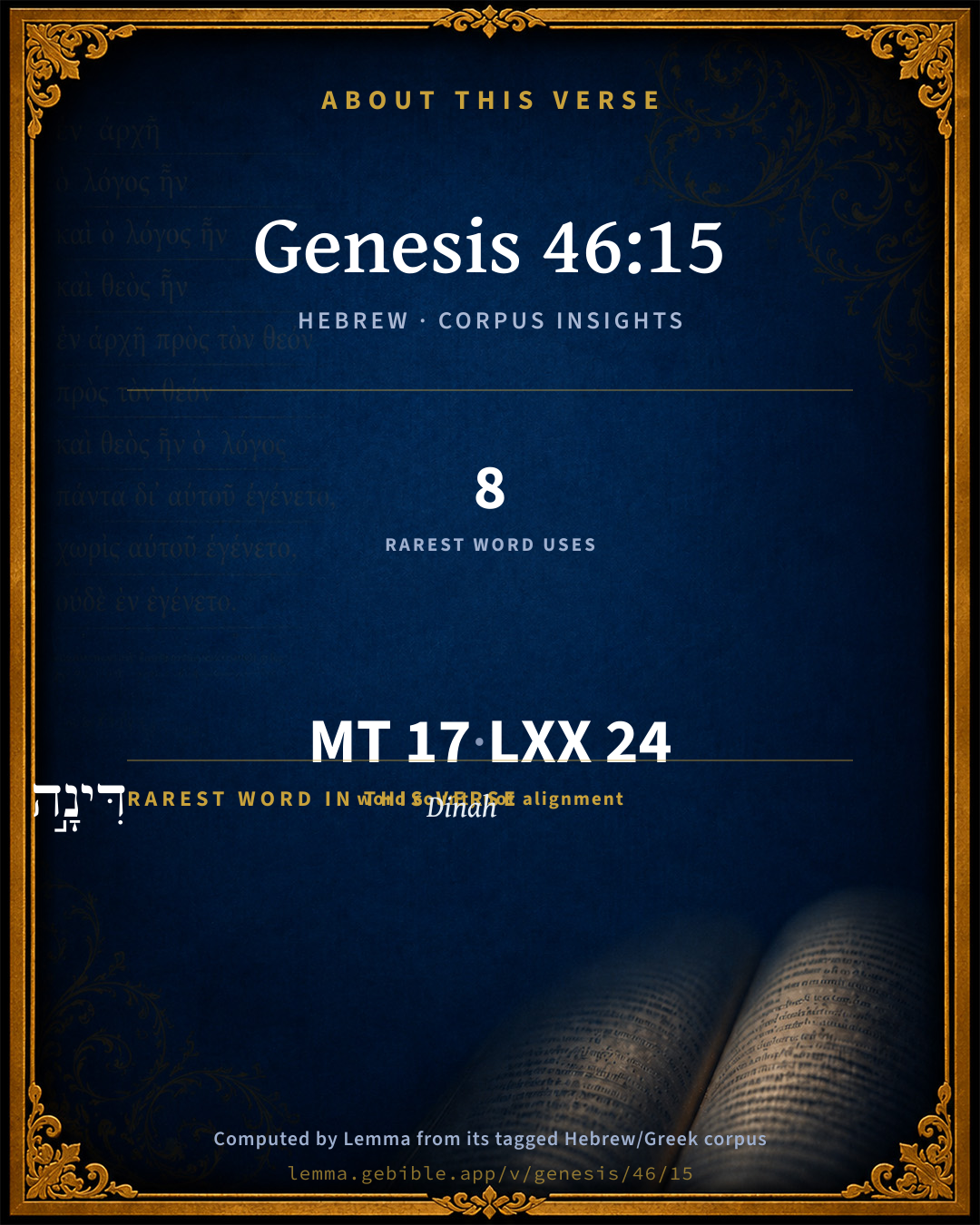
The rarest word here is דִּינָ֣ה Dinah H1783 — appearing just 8 times in the whole Hebrew Bible.

Shared distinctive vocabulary

דִּינָ֣ה Dinah H1783 occurs in 8 verses of the Hebrew Bible. Also found in:

Grammatical profile

  • 1 verb
  • 11 nouns
  • 2 adjectives
  • 1 pronoun
  • 2 particles

Verb forms

  • יָֽלְדָ֤ה Qal · Perfect

Repetition

Words recur within this verse — often emphatic in Hebrew:

  • בְּנֵ֣י son H1121 ×2
  • בְּפַדַּ֣ן Padan-aram H6307 ×2
  • בִתּ֑וֹ daughter H1323 ×2

Hebrew & Septuagint length

In English translation the verse runs 29 words from the Hebrew and 26 from the Septuagint (LXX English) — closely comparable.

A rough comparison of the two English renderings, which tokenize alike — not a word-level alignment.

Word counts can differ between the Hebrew and the Greek without any difference in meaning — e.g. the Hebrew direct-object marker אֵת has no separate Greek word, and Greek often adds the article ὁ.

In the original languages it is 17 Hebrew tokens and 24 Greek tokens — but the two are counted differently (Hebrew bundles its prefixes and suffixes into one token; the Greek is in lemma form), so that isn’t a like-for-like length.

Cross-references

11

Topical passages linked to Genesis 46:15 in the Treasury of Scripture Knowledge — connected by theme and wording, ordered by reader-vote popularity; previews shown in the World English Bible.

  • Genesis 29:32–35 Leah conceived, and bore a son, and she named him Reuben. For she said, "Because Yahweh has looked at my affliction. For now my husband will love me."
  • Genesis 30:17–21 God listened to Leah, and she conceived, and bore Jacob a fifth son.
  • Genesis 25:20 Isaac was forty years old when he took Rebekah, the daughter of Bethuel the Syrian of Paddan Aram, the sister of Laban the Syrian, to be his wife.
  • Genesis 34:1–31 Dinah, the daughter of Leah, whom she bore to Jacob, went out to see the daughters of the land.
  • Genesis 35:23 The sons of Leah: Reuben (Jacob's firstborn), Simeon, Levi, Judah, Issachar, and Zebulun.
  • Genesis 49:3–15 "Reuben, you are my firstborn, my might, and the beginning of my strength; The pre-eminence of dignity, and the pre-eminence of power.
  • Exodus 1:2–3 Reuben, Simeon, Levi, and Judah,
  • Numbers 1:1–54 Yahweh spoke to Moses in the wilderness of Sinai, in the Tent of Meeting, on the first day of the second month, in the second year after they had come out of the land of Egypt, saying,
  • Numbers 26:1–65 It happened after the plague, that Yahweh spoke to Moses and to Eleazar the son of Aaron the priest, saying,
  • 1 Chronicles 2:1 These are the sons of Israel: Reuben, Simeon, Levi, and Judah, Issachar, and Zebulun,
  • Numbers 10:1–36 Yahweh spoke to Moses, saying,

Cross-references courtesy of OpenBible.info (CC BY 4.0).

Hebrew and Greek witnesses Masoretic Hebrew ↔ Greek Septuagint

The same verse in the two great witnesses to the Old Testament, shown verse-for-verse.

These are two independent witnesses, not word-aligned to each other, and the Septuagint is shown in lemma (dictionary) form.

Hebrew Genesis 46:15 Masoretic · Westminster Leningrad Codex

אֵ֣לֶּה בְּנֵ֣י לֵאָ֗ה אֲשֶׁ֨ר יָֽלְדָ֤ה לְיַעֲקֹב֙ בְּפַדַּ֣ן אֲרָ֔ם וְאֵ֖ת דִּינָ֣ה בִתּ֑וֹ כָּל נֶ֧פֶשׁ בָּנָ֛יו וּבְנוֹתָ֖יו שְׁלֹשִׁ֥ים וְשָׁלֹֽשׁ

These are the sons of Leah, whom she bore to Jacob in Paddan Aram, with his daughter Dinah. All the souls of his sons and his daughters were thirty-three.

World English Bible · Public Domain

Greek LXX Genesis 46:15 Septuagint · lemma form

οὗτος υἱός λεια ὅς τίκτω ὁ ἰακώβ ἐν μεσοποταμία ὁ συρία καί δινα ὁ θυγάτηρ αὐτός πᾶς ὁ ψυχή υἱός καί θυγάτηρ τριάκοντα τρεῖς

These are the sons of Lea, which she bore to Jacob in Mesopotamia of Syria, and Dina his daughter; all the souls, sons and daughters, thirty-three.

LXX2012 (modern English Septuagint) · Public Domain

Hebrew: Westminster Leningrad Codex (CC BY 4.0). Greek: Septuagint (public domain); English from LXX2012 (modern English Septuagint) (Public Domain). How the Septuagint differs from the Hebrew →

Targum (Aramaic paraphrase)

2

The Targum is the ancient Jewish Aramaic paraphrase of the Hebrew Scriptures — an interpretive translation, not the Hebrew text itself. Onkelos (literal) and Pseudo-Jonathan (expansive) render the Torah, and Jonathan the Prophets. Coverage is partial: where no permissively-licensed English translation exists for a verse, only the Aramaic is shown. This is verse-level text, not a word-by-word alignment to the Hebrew.

  1. Targum Onkelos Torah (Genesis–Deuteronomy)
    אִלֵּין בְּנֵי לֵאָה דִּילִידַת לְיַעֲקֹב בְּפַדַּן אֲרָם וְיָת דִּינָה בְרַתֵּהּ כָּל נֶפֶשׁ בְּנוֹהִי וּבְנָתֵהּ תְּלָתִין וּתְלָת

    (no public-domain English translation for this verse)

    Targum Onkelos — Aramaic: “Onkelos Genesis” (public domain); “Onkelos Exodus” (public domain); “Onkelos Leviticus” (public domain); “Onkelos Numbers” (public domain); “Onkelos Deuteronomy” (public domain). English: “Sefaria Community Translation” (CC0 1.0 (public-domain dedication)); “J.W. Etheridge. The Targums of Onkelos and Jonathan Ben Uzziel on the Pentateuch. London: Longmans, Green, 1862” (public domain). Text via Sefaria.

  2. Targum Pseudo-Jonathan Torah (Genesis–Deuteronomy)
    אִלֵין בְּנֵי לֵאָה דִילֵידַת לְיַעֲקב בְּפַדַן דַאֲרַם וְיַת דִינָה בְרַתֵּיהּ כָּל נַפְשַׁת בְּנוֹי וּבְרַתֵּיהּ תְּלָתִין וּתְלַת

    These are the sons of Leah, whom she bare unto Jakob in. Padan Aram, with Dinah his daughter; all the souls of his sons and his daughter; thirty and three.

    Targum Pseudo-Jonathan — Aramaic: “Targum Jonathan on Genesis” (public domain); “Targum Jonathan on Exodus” (public domain); “Targum Jonathan on Leviticus” (public domain); “Targum Jonathan on Numbers” (public domain); “Targum Jonathan on Deuteronomy” (public domain). English: “The Targum of Jonathan ben Uzziel, trans. J. W. Etheridge, London, 1862” (public domain). Text via Sefaria.

Commentary

Notes on Genesis 46:15 from classic Christian and Jewish commentators (each source and its license shown beneath its notes). The classic Christian expositions comment on the surrounding passage and are grouped to its opening verse, so a note may address several verses; the Jewish commentaries on the Tanakh (Rashi and others) are per-verse, so they appear only where the commentator wrote on this verse.

Lemma curates 59 commentaries, every one of them public domain or Creative Commons licensed, each selected and text-cleaned for this edition rather than reprinted as found. About our sources →

Geneva Bible (1599)

Geneva Bible translators

Or, persons.

Geneva Bible (1599) marginal notes — public domain. Text via Bolls.life.

Ellicott's Commentary for English Readers

(15) All the souls . . . were thirty and three.—That is, six sons, twenty-three grandsons, two great grandsons, Dinah, and Jacob himself. The other daughters and granddaughters are omitted.

A Bible Commentary for English Readers, edited by Charles John Ellicott (1878–1897) — public domain. Text from a community e-Sword module.

The Cambridge Bible for Schools and Colleges

gen. ed. J. J. S. Perowne

15. in Paddan-aram] The statement that the foregoing were the names of those born in Paddan-aram (i.e. before Jacob’s return into Canaan) cannot be understood literally. It illustrates the artificial lines upon which the genealogies were drawn up in the P narrative.

his daughter Dinah] The mention of Dinah is very probably due to an interpolation.

thirty and three] The names of the male descendants in Gen_46:9-14 give a total of thirty-three, in which apparently Er and Onan were, at first, reckoned, but not Dinah. The mention of “his daughters” is therefore superfluous, and possibly a gloss. Later, however, Er and Onan were excluded, and the names of Jacob himself and Dinah added, in order to make up the figure.

The Cambridge Bible for Schools and Colleges (gen. ed. J. J. S. Perowne; Cambridge University Press, 1878–1918) — public domain. Text from a community e-Sword module.

John Gill's Exposition

These are the sons of Zilpah, whom Laban gave to Leah his daughter,.... To be her maid, when she was married to Jacob, by whom he had Gad and Asher:

and these she bare unto Jacob, even sixteen souls; not that Zilpah bare sixteen children to Jacob, for she bore but two; but the children and grandchildren of these two with them made sixteen.

John Gill's Exposition of the Whole Bible (1746–1763) — public domain (CC PDM 1.0). Text via the HelloAO Bible API.

Haydock's Catholic Bible Commentary

Syria. This must be restrained to her seven children. --- Thirty-three, comprising Lia, or Jacob; but without Her and Onan, who were dead. (Calmet)

George Leo Haydock (1774–1849), Haydock's Catholic Family Bible and Commentary, 1859 edition — public domain. Excludes Psalms (Douay-Rheims chapter numbering differs from Protestant) and Deuterocanonical books (Catholic canon only).

Matthew Poole's English Annotations

Which she bare unto Jacob in Padan-aram: this is true properly and immediately of the sons, who were indeed born there, but improperly and mediately of the grandchildren, which are as truly said to be born of Leah in Padan as to be born of her at all, because they were indeed born of them which were born of her, and that in Padan.

All the souls of his sons and his daughters, to wit, which came into Egypt as before; so that Er and Onan are excluded, as dying before this journey into Egypt, Gen 46:12.

Daughters is here put for daughter, as Gen 46:7, because Dinah was all the daughters which Jacob had. Heb. all the souls, sons and daughters being reckoned together with their father.

Matthew Poole's English Annotations on the Holy Bible (1683–1685) — public domain. Text from a community e-Sword/MySword module.

The Pulpit Commentary

These be the sons of Leah, which she bare unto Jacob in Parian-dram (i.e. the descendants of Leah"s sons which were born in Padan-aram), with his daughter Dinah (who probably had continued unmarried after her misfortune in Shechem, and is here mentioned as an independent member of Jacob"s family): all the souls of his sons and his daughters (reckoning him- self, and excluding Er and Onan) were thirty and three.

The Pulpit Commentary (1880–1919), ed. H.D.M. Spence-Jones & Joseph S. Exell — public domain. Text from a community e-Sword module.

Rashi

Rabbi Shlomo Yitzchaki (Rashi)

אלה בני לאה ואת דינה בתו THESE ARE THE SONS OF LEAH WITH HIS DAUGHTER DINAH. — Scripture associates the men with the name of Leah and the women with that of Jacob for the reason given the Talmud (Niddah 31a).

שלשים ושלש THIRTY THREE — But in the enumeration above you will find only thirty-two. The one whose name is omitted is Jochebed who was born “between the walls” just as they entered the border city, as it is said (Numbers 26:59) “Jochebed, the daughter of Levi, whom her mother bore to Levi in Egypt — she was born in Egypt, but she was not conceived in Egypt (Bava Batra 123).

Rashi on the Tanakh — English translations: “The Judaica Press complete Tanach with Rashi, translated by A. J. Rosenberg” (CC BY 4.0); “Pentateuch with Rashi's commentary by M. Rosenbaum and A.M. Silbermann, 1929-1934” (public domain); “The Metsudah Tanach series, Lakewood, N.J” (CC BY 4.0); and “The Book of Joshua, Metsudah Publications, 1997” (CC BY 4.0). Text via Sefaria.

Ramban (Nachmanides)

Rabbi Moshe ben Nachman (Ramban / Nachmanides)

THIRTY AND THREE. But in the above enumeration you will find only thirty-two. However, the one whose name is omitted is Jochebed who was born as they entered the border city, as it is said, Jochebed, the daughter of Levi, whom [her mother] bore to Levi in Egypt. She was born in Egypt, but she was not conceived in Egypt. This is the principle of our Rabbis. But Rabbi Abraham ibn Ezra replied, saying that “this is surprising. For if so, why did Scripture not mention the wonder that befell her, for she gave birth to Moses when she was one hundred and thirty years old? And why did it mention the case of Sarah who gave birth when she was ninety years old? This distress was not yet sufficient for us so that the poets came and composed liturgic poems for the day of Simchath Torah, wherein they state, ‘Jochebed, my mother, will be comforted after me,’ [implying that Jochebed survived her son], and thus she was two hundred and fifty years old at the death of Moses! Is the proof of the poets for this longevity of Jochebed because Ahijah the Shilonite lived a life of great duration? [If so, this is not a proof, for his longevity is but] an Agadic tradition or the opinion of a single authority.” These are the words of Rabbi Abraham ibn Ezra.Now lest he be wise in his own eyes in contradicting the words of our Rabbis, I must answer him and say that in any case, there is in the matter of Jochebed a great wonder of the hidden miracles which constitute the foundation of the Torah. Jochebed was Levi’s actual daughter, and not merely his offspring, as it is written, Jochebed, the daughter of Levi, whom [her mother] bore to Levi, and it is furthermore written, And Amram took himself Jochebed his father’s sister for a wife. [Thus Amram, Levi’s grandson, married Jochebed, Levi’s daughter.] Now if we would say that Levi begot Jochebed in his younger years, just as he begot all his sons, this would place her birth soon after his descent into Egypt, and she would have been very old at the time of Moses’ birth, at or near the age stated by our Rabbis. And if we would say that he begot her after he resided in Egypt for many years — say, for a period of fifty-seven years — then Levi would have been one hundred years old at Jochebed’s birth, for when he went down to Egypt he was forty-three years of age. In that case, there were two great wonders! [Levi, at the time he begot Jochebed], was as old as Abraham, concerning whom Scripture mentions, Shall a child be born to him who is a hundred years old? and it is further written, And my lord is old also, 18:12. while Jochebed would still have been an elderly woman of seventy-three when Moses was born! And should we further postpone Jochebed’s birth to the end of Levi’s days, the wonder of his begetting a child will be greater than that of Abraham!But I will tell you a true principle, clearly indicated in the Torah. Scripture mentions miracles performed through a prophet and which he previously prophesied, or performed by an angel who is revealed in the course of a Divine mission, but those effected naturally in order to help the righteous or destroy the wicked are not mentioned in the Torah or in the books of the prophets. May this be “hot gold poured into the mouth” of this wise man who refuted the words of our Rabbis in the matter of Phinehas and similar matters in many places. Why should Scripture mention hidden miracles when all the foundations of the Torah are hidden miracles. In the entire scope of the Torah there are only miracles, and no nature or custom. All assurances of the Torah are in the form of signs and wonders, as it is not natural that he who has connection with one of the forbidden degrees of marriage or he who eats forbidden fat suffers excision or death. Nor is it by nature that the heavens become as iron because we have sowed our fields in the Sabbatical year. Similarly, all the assurances of the Torah concerning those blessings [which will result from our observance of the law], and all the good fortune of the righteous ones because of their righteousness, as well as all the prayers of our king David [in the book of Psalms] and all our prayers, all are founded upon miracles and wonders, except that there is no heralded change in the nature of the world, as I have already mentioned, and I will yet explain it further, Verse 11. with the help of G-d.I will give you faithful testimony to that which I have said. We know that from the time Israel came into the Land until the birth of our lord David, about three hundred and seventy years elapsed. These years are to be divided among four generations: Salmon, Boaz, Obed, and Jesse [David’s father], each one being allotted ninety-three years. Thus when they begot children they were all approximately as old as Abraham was when he begot Isaac. Furthermore, each one begot his son in the year of his death, a most unusual thing, since in their era the general span of life was not a hundred years. And if one of them begot his son in his younger years, as is usual, the others would have had to be much older than Abraham, and thus the wonder concerning them would be exceedingly great since people in the generation of Abraham lived long, and in the days of David the average lifespan was reduced to a half. And perhaps these four generations lived longer than their contemporaries for it is possible that Salmon was already advanced in years when he entered the Land of Israel. It is for this reason that the masters of Tradition, who are the true Sages, have attributed longevity to Obed, this being a covert miracle which was done to the ancestor of the kingdom [of the house of David], the son of the righteous one [Ruth], who had come to take refuge under the wings of the Divine Presence. The Sages similarly mention longevity in connection with Obed’s mother, Ruth. Now I have already explained that the wonder in the case of Abraham was not as the above-mentioned Sage [Rabbi Abraham ibn Ezra] and other masters of the Scriptures have thought. Abraham begot Isaac seventy-five years before his death, prior to the completion of two-thirds of his lifespan, and in all generations, old age does not affect people until three quarters of their lives have passed, just as the doctors have considered the divisions of life to be: childhood, youth, manhood, and old age. In these generations, when the lifespan is about seventy years, doctors do not consider a person aged until after sixty. Moreover, Abraham begot many children forty years after the birth of Isaac, and the wonder is thus manifoldly miraculous! And should we say that G-d caused Abraham to revert to his youthful days, it may be asked why Scripture does not mention this great wonder when it was an open and known miracle which is contrary to nature. Moreover, it is known that in this present generation some men beget children until they are full seventy or eighty years old and more, depending upon the extent to which they retain their natural vitality. Women also have no specific time [for ceasing to conceive], as long as they have their period they can give birth. However, the wonder in the case of Abraham and Sarah, as I explained there, was due to the fact that they had not begotten children in their younger years, and now together they begot a child. In the case of Sarah there was an additional wonder, i.e., that the manner of women, 18:11. had ceased with her, and after this happens, women no longer give birth. Now if Jochebed lived as many years as her father Levi had, and if her vitality remained with her until near her old age, as is the way of women, it would be no wonder if she gave birth at the time set forth by our Rabbis, [namely, at one hundred and thirty years of age]. It is because G-d wanted to redeem Israel though the brothers [Moses and Aaron], and since the time of the redemption had not yet come, He delayed their birth many years until their mother was old. Nothing is too difficult for the Eternal. Rabbeinu Shlomo [Rashi] wrote: “According to the view that a twin-sister was born with each of Jacob’s sons, we must say that they died before Jacob and his sons went down to Egypt because they are not enumerated here.” There is no necessity for this conclusion, for the Rabbis have said: “Rabbi Yehudah says that Jacob’s sons married their sisters.” These twin-sisters were thus the wives of Jacob’s sons, concerning whom Scripture says, besides Jacob’s sons’ wives. In fact, Rabbi Yehudah arrived at this opinion on the basis of this verse, since if it refers to Canaanitish women what reason is there for Scripture to say, besides Jacob’s sons’ wives, after it had already said, that came out of his loins? It is only because his sons’ wives were also of those “that came out of his loins” that Scripture refers to them. It does not, however, divulge them here, just as it did not mention them explicitly when they were born together with Jacob’s sons. Furthermore, Scripture mentions here only those who begot children and increased in Egypt, in order to make known the great miracle which was performed in the mighty increase which they effected in Egypt, for at this juncture, they numbered seventy souls. Thus their wives were not counted because a man and his wife are one.

Ramban (Nachmanides) on the Tanakh — English translation: “Commentary on the Torah by Ramban (Nachmanides). Translated and annotated by Charles B. Chavel. New York, Shilo Pub. House, 1971-1976” (CC BY 4.0). Text via Sefaria.

Radak

Rabbi David Kimhi (Radak)

כל נפש בניו ובנותיו שלושים ושלוש. If we count the names mentioned we find only 32 names. This prompted the sages to say that Yocheved, daughter of Levi, was born on the way to Egypt when Levi’s wife had just arrived at the border so that on arrival the requisite number of Israelites entered Egypt. (Baba Batra 123) She could not have been enumerated at departure, not having born and named as yet. This is also why we find the word בנותיו, “his daughters, (pl.) “as an obscure reference to Yocheved [daughter and granddaughter being lumped together as “daughter.” Serach, being a daughter of Asher who was a son of Zilpah, is mentioned separately as a “sister” in verse 17. Ed.] Both Ibn Ezra and my father wrote that the number 33 is made up by the addition of Yaakov to the total [although he was not anyone’s descendant, so that it is difficult to see him as included in the words בני ישראל in verse 8. Ed.] According to the commentary of these two scholars the words ובנותיו would have to be understood as similar to “ובני דן,” and the sons of Dan, seeing that he is reported as having had only one son by the name of Chushim (verse 23)

Radak on the Tanakh — English translations: “Sefaria Community Translation” (CC0 1.0 (public-domain dedication)); “Eliyahu Munk, HaChut Hameshulash” (CC BY 4.0); “Rabbi Mike Feuer, Jerusalem Anthology” (CC BY 4.0); and “R. David Kimhi on the first book of Psalms, Translated by R.G. Finch, London, 1919” (public domain). Text via Sefaria.

Lesson kit

Teaching starters — assembled from the data on this page, not authored interpretation. Every prompt links to the verse data it draws on. Edit before teaching.

Genesis, in the Pentateuch, opens this verse with 17 words (14 distinct Hebrew lemmas). Its most distinctive word is Dîynâh (“Dinah”). A historical commentator’s framing appears above. Read the whole chapter for the surrounding context.

Discussion questions

  1. What does “Dinah” (Dîynâh) contribute to the verse as a whole?
  2. Genesis 30:21 shares the word «Dinah» with this verse. How do the two illuminate each other?
  3. “son” occurs 2× in this one verse. What is the effect of the repetition?
  4. These translations render this verse differently. What is at stake in choosing one wording over another?
  5. The verb «יָֽלְדָ֤ה» is Qal Perfect. How does its form color the action?
  6. Reading how Geneva Bible (1599) and Ellicott's Commentary for English Readers read this verse, where do the two commentators agree and where do they part?

Things to notice

Reading settings

Reading text

Shown beneath each verse's original-language words.

Old Testament
Old Testament edition

Read the OT as the Masoretic Hebrew (MT) or the Greek Septuagint (LXX).

English shown for the Greek Septuagint (in the Hebrew ↔ Greek comparison).

Comparing translations? Open the Compare panel on any verse page to stack up to four side by side.