Ezekiel 18:14

Hebrew (Westminster Leningrad Codex) Ezekiel 18:14 appears in the Hebrew Old Testament. The text above is from the Westminster Leningrad Codex. Each word links to its Strong’s number, a concise gloss, and parsing drawn from the Open Scriptures Hebrew Bible morphology. Click any word for its full Brown-Driver-Briggs (BDB) entry.
Download image
Cite this verse

Ezekiel 18:14 (World English Bible). Public Domain. Lemma interlinear Bible study tool, https://lemma.gebible.app/v/ezekiel/18/14.

Show BibTeX & RIS
BibTeX
RIS
English Translation
Now, behold, if he fathers a son, who sees all his father's sins, which he has done, and fears, and does not such like;
World English Bible · Public Domain
Download a study sheet

One document with this verse’s original text, its word-by-word gloss line, the meaning frame, cross-references with their text, attributed commentary, and full source and license credits — printable, and it pastes into notes with its structure intact.

This verse Autodidact and up

Study sheet (.html) Plain text (.txt)

A passage Seminary Student

Up to 50 verses in one chapter. A passage sheet keeps up to 6 commentary sources and 12 cross-references per verse, in the order this page ranks them, and says so on the sheet whenever that leaves anything out. Ask for a single verse and you get the Autodidact verse sheet above.

Everything on this page stays free to read, with no account — the sheet is a download of what is already on screen, not access to it.

Want to remove ads? Support Godless Engineer
Compare translations 3

The same verse in 3 English versions, stacked beneath the original-language interlinear above. Click any original word for its lexicon entry.

Each is an independent rendering of the whole verse — the interlinear is not word-aligned to these translations.

Highlighted words mark where these versions differ — a whole-verse word diff, not a word-by-word alignment.

  • World English Bible Public Domain
    Now, behold, if he fathers a son, who sees all his father's sins, which he has done, and fears, and does not such like;
  • King James Version Public Domain
    Now, lo, if he beget a son, that seeth all his father's sins which he hath done, and considereth, and doeth not such like,
  • unfoldingWord Literal Text CC BY-SA 4.0
    But behold! Suppose there is a man who bears a son, and his son sees all the sins that his father has committed, and though he sees them, he does not do those things.

unfoldingWord Literal Text — © unfoldingWord, licensed CC BY-SA 4.0. Word-aligned USFM3 via Door43 (git.door43.org/unfoldingWord/en_ult).

Versions to compare (up to 4)

3 of 4 selected

Show all 18 translations

Every available English version of this verse, each an independent rendering of the whole verse.

  • World English Bible Public Domain
    Now, behold, if he fathers a son, who sees all his father's sins, which he has done, and fears, and does not such like;
  • Berean Standard Bible Public Domain
    Now suppose this son has a son who sees all the sins his father has committed, considers them, and does not do likewise:
  • Majority Standard Bible Public Domain
    Now suppose this son has a son who sees all the sins his father has committed, considers them, and does not do likewise:
  • King James Version Public Domain
    Now, lo, if he beget a son, that seeth all his father's sins which he hath done, and considereth, and doeth not such like,
  • American Standard Version (1901) Public Domain
    Now, lo, if he beget a son, that seeth all his father's sins, which he hath done, and feareth, and doeth not such like;
  • Revised Version (1885) Public Domain
    Now, lo, if he beget a son, that seeth all his father’s sins, which he hath done, and feareth, and doth not such like,
  • Geneva Bible (1599) Public Domain
    But if he beget a sonne, that seeth all his fathers sinnes, which he hath done, and feareth, neither doeth such like,
  • Douay-Rheims (1899) Public Domain
    But if he beget a son, who, seeing all his father's sine, which he hath done, is afraid, and shall not do the like to them:
  • Young's Literal Translation Public Domain
    And -- lo, he hath begotten a son, And he seeth all the sins of his father, That he hath done, and he feareth, And doth not do like them,
  • Literal Standard Version CC BY-SA 4.0
    And—behold, he has begotten a son, || And he sees all the sins of his father, || That he has done, and he fears, || And does not do like them,
  • Unlocked Literal Bible CC BY-SA 4.0
    But behold! Suppose there is a man who bears a son, and his son sees all the sins that his father has committed, and though he sees them, he does not do those things.
  • unfoldingWord Literal Text CC BY-SA 4.0
    But behold! Suppose there is a man who bears a son, and his son sees all the sins that his father has committed, and though he sees them, he does not do those things.
  • Darby Bible Public Domain
    But lo, if he have begotten a son that seeth all his father's sins which he hath done, and considereth, and doeth not such like:
  • World Messianic Bible Public Domain
    “Now, behold, if he fathers a son who sees all his father’s sins which he has done, and fears, and doesn’t do likewise,
  • Webster's Bible Public Domain
    Now lo, if he begetteth a son, that seeth all his father's sins which he hath done, and considereth, and doeth not such like,
  • Free Bible Version CC BY-SA 4.0
    Now what if this man has a son who sees all the sins his father has committed. He sees them but doesn't do the same.
  • Bible in Basic English Public Domain
    Now if he has a son who sees all his father's sins which he has done, and in fear does not do the same:
  • JPS Tanakh (1917) Public Domain
    Now, lo, if he beget a son, that seeth all his father's sins, which he hath done, and considereth, and doeth not such like,

Literal Standard Version (2020), Covenant Press — licensed CC BY-SA 4.0. Text via the HelloAO Bible API (eBible.org). Unlocked Literal Bible (unfoldingWord) — licensed CC BY-SA 4.0. Text via the HelloAO Bible API (eBible.org). unfoldingWord Literal Text — © unfoldingWord, licensed CC BY-SA 4.0. Word-aligned USFM3 via Door43 (git.door43.org/unfoldingWord/en_ult). Free Bible Version, Dr. Jonathan Gallagher — licensed CC BY-SA 4.0. Text via the HelloAO Bible API (eBible.org).

Word by word

More ways to search: Search by grammar → Find every occurrence → Compare this word →

Practice this passage: Drill this verse → Learn its vocabulary →

כָּהֵֽן
hên
H2004
“like/as · them”
Preposition + Suffix, Personal, 3rd Person, Feminine, Plural
Part of Speech
Preposition
Full BDB Definition

Origin: from H1931

TWOT: 504

they, these, the same, who
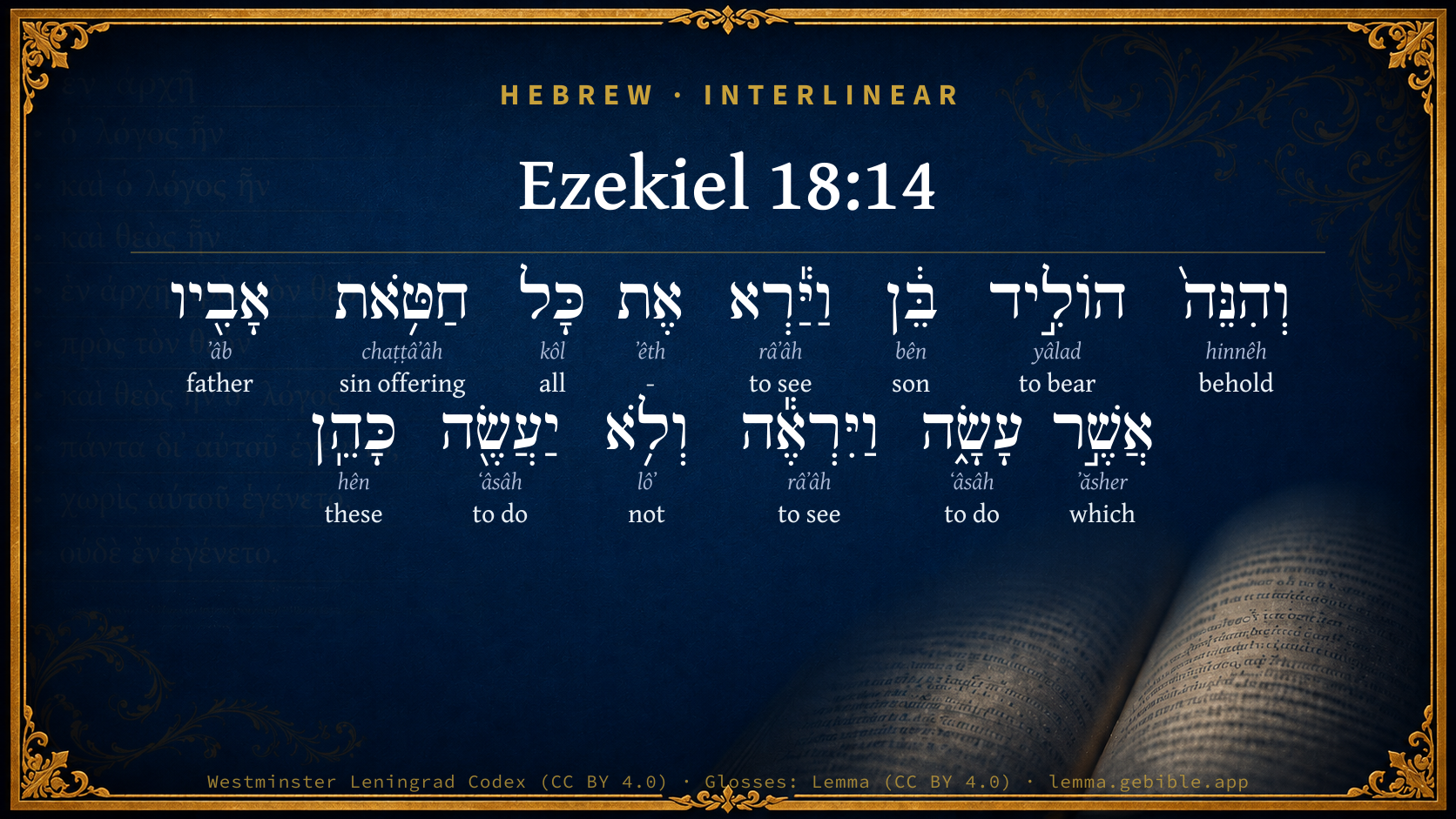
  1. וְהִנֵּה֙ hinnêh H2009 “and · behold” Conjunction + Particle, Demonstrative
  2. הוֹלִ֣יד yâlad H3205 “to bear” Verb, Hiphil, Perfect, 3rd Person, Masculine, Singular
  3. בֵּ֔ן bên H1121 “son” Noun, Common, Masculine, Singular, Absolute
  4. וַיַּ֕רְא râʼâh H7200 “and · to see” Conjunction + Verb, Qal, Sequential Imperfect, 3rd Person, Masculine, Singular
  5. אֶת ʼêth H853 “-” Particle, Direct Object
  6. כָּל kôl H3605 “all of” Noun, Common, Masculine, Singular, Construct
  7. חַטֹּ֥את chaṭṭâʼâh H2403 “sin offerings of” Noun, Common, Feminine, Plural, Construct
  8. אָבִ֖יו ʼâb H1 “father · his” Noun, Common, Masculine, Singular, Construct + Suffix, Personal, 3rd Person, Masculine, Singular
  9. אֲשֶׁ֣ר ʼăsher H834 “which” Particle, Relative
  10. עָשָׂ֑ה ʻâsâh H6213 “to do” Verb, Qal, Perfect, 3rd Person, Masculine, Singular
  11. וַיִּרְאֶ֕ה râʼâh H7200 “and · to see” Conjunction + Verb, Qal, Sequential Imperfect, 3rd Person, Masculine, Singular
  12. וְלֹ֥א lôʼ H3808 “and · not” Conjunction + Particle, Negative
  13. יַעֲשֶׂ֖ה ʻâsâh H6213 “to do” Verb, Qal, Imperfect, 3rd Person, Masculine, Singular

About this verse

These counts appear in no published source. They are computed here, from the morphology-tagged text and Lemma’s own curated glosses. What Lemma adds →

14
words
12
distinct lemmas
Prophets
section

Notable vocabulary

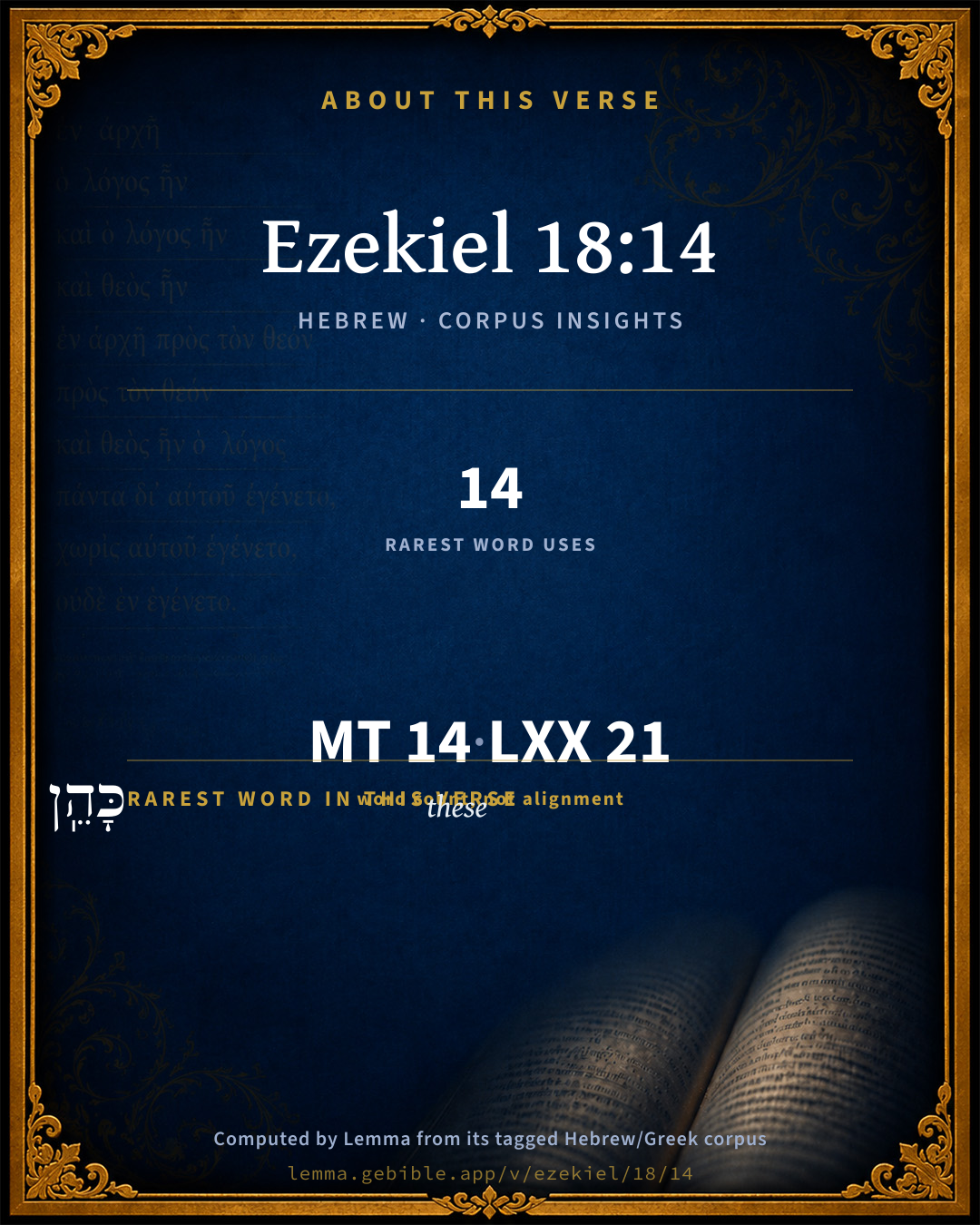
The rarest word here is כָּהֵֽן these H2004 — appearing just 14 times in the whole Hebrew Bible.

Shared distinctive vocabulary

כָּהֵֽן these H2004 occurs in 14 verses of the Hebrew Bible. Also found in:

Grammatical profile

  • 5 verbs
  • 4 nouns
  • 1 preposition
  • 4 particles

Verb forms

  • הוֹלִ֣יד Hiphil · Perfect
  • וַיַּ֕רְא Qal · Sequential Imperfect
  • עָשָׂ֑ה Qal · Perfect
  • וַיִּרְאֶ֕ה Qal · Sequential Imperfect
  • יַעֲשֶׂ֖ה Qal · Imperfect

Repetition

Words recur within this verse — often emphatic in Hebrew:

  • וַיַּ֕רְא to see H7200 ×2
  • עָשָׂ֑ה to do H6213 ×2

Hebrew & Septuagint length

In English translation the verse runs 24 words from the Hebrew and 26 from the Septuagint (LXX English) — closely comparable.

A rough comparison of the two English renderings, which tokenize alike — not a word-level alignment.

Word counts can differ between the Hebrew and the Greek without any difference in meaning — e.g. the Hebrew direct-object marker אֵת has no separate Greek word, and Greek often adds the article ὁ.

In the original languages it is 14 Hebrew tokens and 21 Greek tokens — but the two are counted differently (Hebrew bundles its prefixes and suffixes into one token; the Greek is in lemma form), so that isn’t a like-for-like length.

Cross-references

19

Topical passages linked to Ezekiel 18:14 in the Treasury of Scripture Knowledge — connected by theme and wording, ordered by reader-vote popularity; previews shown in the World English Bible.

  • 2 Chronicles 34:21 Go you, inquire of Yahweh for me, and for those who are left in Israel and in Judah, concerning the words of the book that is found; for great is the wrath of Yahweh that is poured out on us, because our fathers have not kept the word of Yahweh, to do according to all that is written in this book.
  • Proverbs 23:24 The father of the righteous has great joy. Whoever fathers a wise child delights in him.
  • 2 Chronicles 29:3–11 He in the first year of his reign, in the first month, opened the doors of the house of Yahweh, and repaired them.
  • Psalms 119:59–60 I considered my ways, And turned my steps to your statutes.
  • Proverbs 17:21 He who becomes the father of a fool grieves. The father of a fool has no joy.
  • Isaiah 44:19 None calls to mind, neither is there knowledge nor understanding to say, I have burned part of it in the fire; yes, also I have baked bread on the coals of it; I have roasted flesh and eaten it: and shall I make the residue of it an abomination? shall I fall down to the stock of a tree?
  • Jeremiah 8:6 I listened and heard, but they didn't speak aright: no man repents him of his wickedness, saying, What have I done? everyone turns to his course, as a horse that rushes headlong in the battle.
  • Jeremiah 9:14 but have walked after the stubbornness of their own heart, and after the Baals, which their fathers taught them;
  • Jeremiah 44:17 But we will certainly perform every word that is gone forth out of our mouth, to burn incense to the queen of the sky, and to pour out drink-offerings to her, as we have done, we and our fathers, our kings and our princes, in the cities of Judah, and in the streets of Jerusalem; for then had we plenty of food, and were well, and saw no evil.
  • Ezekiel 18:10 If he fathers a son who is a robber, a shedder of blood, and who does any one of these things,
  • Ezekiel 18:28 Because he considers, and turns away from all his transgressions that he has committed, he shall surely live, he shall not die.
  • Ezekiel 20:18 I said to their children in the wilderness, Don't you walk in the statutes of your fathers, neither observe their ordinances, nor defile yourselves with their idols.
  • Hosea 7:2 They don't consider in their hearts that I remember all their wickedness. Now their own deeds have engulfed them. They are before my face.
  • Haggai 1:5 Now therefore this is what Yahweh of Hosts says: Consider your ways.
  • Haggai 1:7 This is what Yahweh of Hosts says: "Consider your ways.
  • Haggai 2:18 'Consider, please, from this day and backward, from the twenty-fourth day of the ninth month, since the day that the foundation of Yahweh's temple was laid, consider it.
  • Matthew 23:32 Fill up, then, the measure of your fathers.
  • Luke 15:17–19 But when he came to himself he said, 'How many hired servants of my father's have bread enough to spare, and I'm dying with hunger!
  • 1 Peter 1:18 knowing that you were redeemed, not with corruptible things, with silver or gold, from the useless way of life handed down from your fathers,

Cross-references courtesy of OpenBible.info (CC BY 4.0).

Hebrew and Greek witnesses Masoretic Hebrew ↔ Greek Septuagint

The same verse in the two great witnesses to the Old Testament, shown verse-for-verse.

These are two independent witnesses, not word-aligned to each other, and the Septuagint is shown in lemma (dictionary) form.

Hebrew Ezekiel 18:14 Masoretic · Westminster Leningrad Codex

וְהִנֵּה֙ הוֹלִ֣יד בֵּ֔ן וַיַּ֕רְא אֶת כָּל חַטֹּ֥את אָבִ֖יו אֲשֶׁ֣ר עָשָׂ֑ה וַיִּרְאֶ֕ה וְלֹ֥א יַעֲשֶׂ֖ה כָּהֵֽן

Now, behold, if he fathers a son, who sees all his father's sins, which he has done, and fears, and does not such like;

World English Bible · Public Domain

Greek LXX Ezekiel 18:14 Septuagint · lemma form

ἐάν δέ γεννάω υἱός καί ὁράω πᾶς ὁ ἁμαρτία ὁ πατήρ αὐτός ὅς ποιέω καί φοβέω καί μή ποιέω κατά οὗτος

And if he beget a son, and the son see all his father's sins which he has wrought, and fear, and not do according to them,

LXX2012 (modern English Septuagint) · Public Domain

On this verse, Keil & Delitzsch discusses the Septuagint’s reading. Read the note in Commentary ↓

Hebrew: Westminster Leningrad Codex (CC BY 4.0). Greek: Septuagint (public domain); English from LXX2012 (modern English Septuagint) (Public Domain). How the Septuagint differs from the Hebrew →

Targum (Aramaic paraphrase)

1

The Targum is the ancient Jewish Aramaic paraphrase of the Hebrew Scriptures — an interpretive translation, not the Hebrew text itself. Onkelos (literal) and Pseudo-Jonathan (expansive) render the Torah, and Jonathan the Prophets. Coverage is partial: where no permissively-licensed English translation exists for a verse, only the Aramaic is shown. This is verse-level text, not a word-by-word alignment to the Hebrew.

  1. Targum Jonathan Prophets (Joshua–Malachi)
    וְהָא אוֹלִיד בַּר וַחֲזָא יַת כָּל חוֹבֵי אֲבוֹהִי דִעֲבָד וַחֲזָא וְלָא עָבַד כְּוַתְהוֹן:

    (no public-domain English translation for this verse)

    Targum Jonathan — Aramaic: “Mikraot Gedolot” (public domain). English: “Sefaria Community Translation” (CC0 1.0 (public-domain dedication)); “London "Chaldee Paraphrase," 1871” (public domain). Text via Sefaria.

Commentary

Notes on Ezekiel 18:14 from classic Christian and Jewish commentators (each source and its license shown beneath its notes). The classic Christian expositions comment on the surrounding passage and are grouped to its opening verse, so a note may address several verses; the Jewish commentaries on the Tanakh (Rashi and others) are per-verse, so they appear only where the commentator wrote on this verse.

Lemma curates 59 commentaries, every one of them public domain or Creative Commons licensed, each selected and text-cleaned for this edition rather than reprinted as found. About our sources →

Trapp's Complete Commentary

John Trapp

Eze 18:14 Now, lo, [if] he beget a son, that seeth all his father’s sins which he hath done, and considereth, and doeth not such like,

Ver. 14. Now, lo, if he beget a son that seeth.] And withal sigheth, his eye affecting his heart with grief and dislike.

And considereth,] viz., Of the ill consequence of those courses, et cavet et pavet. And consider and be frightened.

John Trapp, A Commentary or Exposition upon All the Books of the Old and New Testament (1647–1656) — public domain. Text from a community e-Sword module.

Whedon's Commentary on the Bible

Daniel D. Whedon

THE WICKED SON JUST DESCRIBED BECOMES THE FATHER OF A BOY WHO LIVES JUSTLY; SHALL HE BE PUNISHED FOR HIS FATHER’S SINS? NO; HE SHALL LIVE, BUT THE FATHER SHALL DIE, Eze_18:14-18.

14. And considereth — Literally, yea, seeth (see also Eze_18:28); or, with a very slight change, as R.V., “and feareth.”

Daniel D. Whedon (gen. ed.), Commentary on the Old and New Testaments (1874–1909) — public domain. Text from a community e-Sword module.

Keil & Delitzsch

C. F. Keil & F. Delitzsch

The son who avoids his father's sin will live; but the father will die for his own sins. - Eze 18:14. And behold, he begetteth a son, who seeth all his father's sins which he doeth; he seeth them, and doeth not such things. Eze 18:15. He eateth not upon the mountains, and lifteth not up his eyes to the idols of the house of Israel; he defileth not his neighbour's wife, Eze 18:16. And oppresseth no one; he doth not withhold a pledge, and committeth not robbery; giveth his bread to the hungry, and covereth the naked with clothes. Eze 18:17. He holdeth back his hand from the distressed one, taketh not usury and interest, doeth my rights, walketh in my statutes; he will not die for the sin of his father; he shall live. Eze 18:18. His father, because he hath practised oppression, committed robbery upon his brother, and hath done that which is not good in the midst of his people; behold, he shall die for his sin. Eze 18:19. And do ye say, Why doth the son not help to bear the father's sin? But the son hath done right and righteousness, hath kept all my statutes, and done them; he shall live. Eze 18:20. The soul that sinneth, it shall die. A son shall not help to bear the father's sin, and a father shall not help to bear the sin of the son. The righteousness of the righteous shall be upon him, and the wickedness of the wicked shall be upon him. - The case supposed in these verses forms the antithesis to the preceding one; the father is the transgressor in this instance, and the son a keeper of the law. The subject to הוליד in Eze 18:14 is not the righteous man described in Eze 18:15, but a man who is described immediately afterwards as a transgressor of the commandments of God. The Chetib וירא bite in the last clause of Eze 18:14 is not to be read ויּרא, καὶ φοβηθῇ, et timuerit, as it has been by the translators of the Septuagint and Vulgate; nor is it to be altered into ויּראה, as it has been by the Masoretes, to make it accord with Eze 18:28; but it is the apocopated form ויּרא, as in the preceding clause, and the object is to be repeated from what precedes, as in the similar case which we find in Exo 20:15, (18). Ewald and Hitzig propose to alter מעני in Eze 18:17 into מעול after Eze 18:8, but without the slightest necessity. The lxx are not to be taken as an authority for this, since the Chaldee and Syriac have both read and rendered עני; and Ezekiel, when repeating the same sentences, is accustomed to make variations in particular words. Holding back the hand from the distressed, is equivalent to abstaining from seizing upon him for the purpose of crushing him (compare Eze 18:12); בּתוך, in the midst of his countrymen = בּתוך עמּו, is adopted from the language of the Pentateuch. מת after הנּה is a participle. The question, "Why does the son not help to bear?" is not a direct objection on the part of the people, but is to be taken as a pretext, which the people might offer on the ground of the law, that God would visit the sin of the fathers upon the sons in justification of their proverb. Ezekiel cites this pretext for the purpose of meeting it by stating the reason why this does not occur. נשׂא ב, to carry, near or with, to join in carrying, or help to carry (cf. Num 11:17). This proved the proverb to be false, and confirmed the assertion made in Eze 18:4, to which the address therefore returns (Eze 18:20). The righteousness of the righteous man will come upon him, i.e., upon the righteous man, namely, in its consequences. The righteous man will receive the blessing of righteousness, but the unrighteous man the curse of his wickedness. There is no necessity for the article, which the Keri proposes to insert before רשׁע.

Keil & Delitzsch — Biblical Commentary on the Old Testament (1861–1891) — public domain (CC PDM 1.0). Text via the HelloAO Bible API. (Old Testament only.)

Tyndale Open Study Notes

Tyndale Open Resources

18:14-18 The righteous son of an evil man will surely live. God will judge each person individually.

Tyndale Open Study Notes — © Tyndale Open Resources, licensed CC BY-SA 4.0. Text via the HelloAO Bible API.

Jamieson, Fausset & Brown

Robert Jamieson, A. R. Fausset & David Brown

The third case: a son who walks not in the steps of an unrighteous father, but in the ways of God; for example, Josiah, the pious son of guilty Amon; Hezekiah, of Ahaz (2Ki. 16:1-20; 18:1-37; 21:1-22:20).

seeth . . . and considereth--The same Hebrew stands for both verbs, "seeth . . . yea, seeth." The repetition implies the attentive observation needed, in order that the son may not be led astray by his father's bad example; as sons generally are blind to parents sins, and even imitate them as if they were virtues.

Jamieson, Fausset & Brown — Commentary Critical and Explanatory on the Whole Bible (1871) — public domain (CC PDM 1.0). Text via the HelloAO Bible API.

Adam Clarke's Commentary

Verse 14. Now, lo, if he beget a son that seeth all his father's sins-and considereth] Lays to heart the evil of his father's life, and the dreadful consequences of a life of rebellion against God.

And doeth not such like] Is quite a different man in moral feeling and character; and acts up to the thirteen points already laid down.

Adam Clarke's Commentary on the Bible (1810–1826) — public domain. Text from a community e-Sword/MySword module.

John Calvin's Commentaries

In this third example Ezekiel announces, that if a man be born of a wicked father, he may nevertheless be pleasing to God, if he be unlike his father and thus he refutes the proverb that was so common in Israel — that the father ate the sour grapes, and the children’s teeth were set on edge. For if the sons were sufferers through the father’s eating the sour grapes, then the pious who drew their origin from wicked despisers of God would be freed from all their sins. Thus Ezekiel would have been punished instead of his father, Ahaz, and Josiah instead of Manasseh. But here the Prophet bears witness that the good, however they may have been born from wicked parents, should receive the reward of righteousness no less certainly and faithfully than if they had come down from heaven, and if their family had always been without the commission of any crime. Since, therefore, God does not punish them for their fathers’ crimes, it follows that the Israelites uttered this taunt not only foolishly, but impiously, saying that their own teeth were set on edge, because their fathers had eaten the sour grapes. Besides, as there is a difference in the phrase, I shall notice briefly what is worthy of remark: if he begat a son who saw all that his father had done, and was afraid. Here the Prophet teaches that it needed the greatest attention for the son to forsake the example of a bad father. For sons are blind to their fathers’ vices; and although, when duty is set before them, they carelessly despise it, yet they fancy themselves held so far by pious reverence, that they dare not condemn their fathers. Hence it happens that sons do not acknowledge their fathers’ crimes, and thus a wicked father corrupts his son willingly. Bad discipline, therefore, is added to this, so that it is not surprising if the offspring is worse than his ancestors. For this reason the Prophet says, if he has seen, that is, if a righteous child has observed his father’s sins, since sons shut their eyes as much as possible to all their fathers’ crimes; nay, they embrace their vices for the greatest virtues.

He then adds, if he has feared. It would not be sufficient to take notice of this without adding the fear of God. It is true, indeed, that many were unlike their parents, through being restrained by shame; for when they heard the reproaches of their parents, they were touched with ingenuous modesty, so as to be on their guard against such enormities. But all these followed the empty shadow of justice; and here the serious observance of the law is treated, which cannot flow from anything else but, the fear of God, and this, as Scripture says, is the beginning of wisdom. (Psalm 111:10; Proverbs 1:7.) A person thus may be blameless through his whole life, and yet not touch on any part of justice, since righteousness flows from only one principle — the fear of God. He afterwards adds, and has not done according to them. We see, therefore, that those who implicate themselves in others’ crimes are not otherwise deceived, unless they purposely stifle all difference between good and evil; for if they had attended to this, they would doubtless have been touched with some fear, and thus have governed their life according to God’s precepts: but scarcely one in a hundred thinks of this, and hence every one mingles freely with his neighbors, and so all perish together. He afterwards adds, he has not eaten upon the mountains, has not raised his eyes to the idols of the house of Israel: we have explained all these: and has not oppressed any one, and has not received a pledge. We said that this ought not to be explained of every pledge; for it was lawful for any one, on giving money, to receive a pledge for its return, but not from one who is destitute of either garments or the necessary implements of trade: so I pass this by. He has not received a prey, has distributed his bread to the hungry He adds, what he had not touched on previously, he has withdrawn his hand from the poor. This seems to differ from the opinion which we had in the sixteenth chapter, (Ezekiel 16:49.) Among the sins of Sodom, the Prophet there puts this also, that they withdrew their hand from the poor and needy; and surely, when we stretch forth the hand for the sake of help, it is a true proof of charity; but if we withdraw the hand, it is a proof of cruelty, since we do not deign to aid a brother who ought to obtain some favor from us. But we must bear in mind that there are two senses in which the hand is either extended or withdrawn. If I extend my hand to the poor to supply what is wanting, and to the weak to render him aid, this is the duty of charity. If, on the contrary, I withdraw my hand, I unjustly turn away from him who implores my confidence, and whose misery ought to win for him some favor. But we extend the hand when we seize on a neighbor’s goods, and violently deprive him of them, and despoil the innocent of their rights. On the contrary, he who withdraws his hand is humane in sparing his brethren, and not enriching himself at their expense, and profiting by their oppression. In this sense the Prophet now enumerates withdrawing the hand from the poor in the list of virtues, because the poor are subject to all kinds of injury. If, therefore, when we see booty already prepared for us, and yet we refrain from it, this is a proof of true charity. But again, we must remark upon what I treated but briefly yesterday, namely, that we must withdraw our hands from the poor, because nothing is more easy than to be enticed to make a gain of the poor; and wherever occasion and impunity offer themselves, avarice so seizes us, that we neither discern nor consider what is right and fair. Every one who wishes to preserve his self-restraint, and to subdue his affections, ought to attend to this with all his strength and with constant struggling: thus the Prophet says, we must withdraw the hand

John Calvin's Commentaries (1540-1563) — public domain. Text from the Calvin Translation Society English edition (1840s-50s) via the Christian Classics Ethereal Library (ccel.org). Calvin's coverage is partial (roughly two-thirds of the Bible); uncommented books and verses are honest gaps, never fabricated. The 19th-century editor's footnotes and remarks are omitted so the notes are faithfully Calvin's own voice.

Ellicott's Commentary for English Readers

(14) Doeth not such like.—This is the third case—that of the righteous son of a wicked father. The general principle is the same, that each man is to be judged according to his own individual character. The son of the righteous man has advantages, and the son of the wicked has hindrances in the way of righteousness which are not specified here, although elsewhere we are abundantly taught that responsibility is directly proportioned to privilege; but here the object is only to set forth in the clearest way, and apart from any other issues, the single fact of individual responsibility. In each case the particular examples of sin are somewhat varied, to show that they are mentioned only as examples, in order to set forth more clearly the general principle.

A Bible Commentary for English Readers, edited by Charles John Ellicott (1878–1897) — public domain. Text from a community e-Sword module.

The Cambridge Bible for Schools and Colleges

gen. ed. J. J. S. Perowne

14. and considereth] Lit. even seeth, so Eze_18:28. With a different punctuation the word would mean: and feareth, as R.V.

The Cambridge Bible for Schools and Colleges (gen. ed. J. J. S. Perowne; Cambridge University Press, 1878–1918) — public domain. Text from a community e-Sword module.

John Gill's Exposition

Now, lo, if he beget a son,.... That is, the wicked man before mentioned; if he begets a son who proves a good man, which sometimes is the case, as Hezekiah the son of Ahaz, and Josiah the son of Amon:

that seeth all his father's sins which he hath done; not every particular action, but the principal of them; however, the several sorts and kinds of sin he was addicted to, and which were done publicly enough, and obvious to view; and yet does not imitate them, as children are apt to do:

and considereth: the evil nature and tendency of them; how abominable to God; how contrary to his law; how scandalous and reproachful in themselves, and how pernicious and destructive in their effects and consequences. The Septuagint, Vulgate Latin, and Arabic versions, read, "and feareth":

and doeth not such like; he fears God; and because the fear of God is before his eyes, and on his heart, which was wanting in his father, therefore he cannot do the things he did; the fear of offending him, the fear of his goodness, and of his judgments, both have an influence to restrain from sin.

John Gill's Exposition of the Whole Bible (1746–1763) — public domain (CC PDM 1.0). Text via the HelloAO Bible API.

Matthew Poole's English Annotations

A third instance in a supposed son’s son to clear the case fully. The just father lives, his unjust son dieth; but the grandson of the just, seeing his father’s sins, and fleeing them, lives. It is rare that the children of debauched parents do think or discern evil in their parents’ courses, but blindly follow them, without putting difference between what is good and what is bad in that the latter doth; such suffer for their own sins more than for their fathers: but if it be so that the son of a wicked father act like a man, bring his father’s doings to the rule, and thereby discover the wickedness and danger of them, and do not the like, he shall not suffer for his father’s sins.

Seeth all his father’s sins; the kinds, or many of the several sorts, of his sins, for it is not possible the son should see all the particular acts of sin done by his father.

Considereth looks thoroughly into these things, and weighs the importance of them; considers God is our Sovereign, ought to be obeyed, will bless the obedient, will punish the disobedient; that his blessing is the life and welfare, his curse is the death and misery, of souls; that every man should look particularly to his own duty and happiness; that it is better to be happy with God, obeying him, than to perish with a father by imitating his vices; that God will be gracious to the obedient, according to his rich grace, though they be the children of irreligious idolaters and adulterers, &c.; on which or such-like considerations, if the son choose holiness, and walk in it, he shall live, his end shall not be, because his doings were not, like his father’s.

Matthew Poole's English Annotations on the Holy Bible (1683–1685) — public domain. Text from a community e-Sword/MySword module.

The Pulpit Commentary

Vers. 14-17. Now, lo! etc. The law of personal responsibility had been pressed on its darker side. It is now asserted in its brighter, and that with the special emphasis indicated in its opening words. The proverb of the "sour grapes" receives a direct contradiction. The son of the evil doer way take warning by his father"s example, and repent, as Ezekiel exhorted those among whom he lived to do. In that case he need fear no inherited or transmitted curse. He shall surely live; Hebrew, living he shall live. That truth came to Ezekiel as with the force of a new apocalypse, and it is obviously "exceeding broad," with far-reaching consequences both in ethics and theology.

The breach of heredity.

It is possible for the son of the sinner not to tread in his father"s evil footsteps. Here we have the door of escape from the odious proverb of the sour grapes (ver. 2).

I A FATHER"S SIN IS A SHAMEFUL SIGHT FOR HIS SON. The verse before us presents a distressing picture, though one with bright features in it. The father should be an example to his children, and they should be able to look up to him with reverence. Indeed, very little children naturally regard those who have charge of them as good. When first a child discovers that one who has directed his conduct is doing wrong, the revelation comes upon him with a painful shock of surprise. How sad that this should become a familiar sight! The very centre of authority in the home is then degraded. The child may still obey from a sense of fear, from a feeling of duty, or from mere force of habit. But all reverence is gone, and contempt is beginning to take its place. There must be something sadly wrong when a right-minded child is forced to despise his father or his mother. Surely such a prospect should be a warning to parents when personal considerations fail to influence them.

II A SON MAY BE SAVED FROM SHARING HIS FATHER"S SIN BY ITS VERY SHAMEFULNESS. There is an influence which is just the contrary of heredity in sin. Unconsciously, by force of physical constitution, and by the influence of example no doubt, a child is drawn towards his father"s sin. But when he reflects upon it and exercises his own judgment, he has miserable opportunities for witnessing its shamefulness which are not accorded to the happily guarded children of purer homes. The child of the drunkard knows the evil of strong drink only toe well. Thus if he "considereth" he has an ever present warning. Do we not see children who have turned with loathing from the habits of disgraceful parents, shunning the first approaches to the evil which has wrought such havoc in their homes, when other children who have not been to so painful a school toy with it in the confidence of ignorance?

III IT IS THE DUTY OF CHRISTIANS TO RESCUE THE CHILDREN OF WICKED PARENTS. The problem furnished by the wreck of broken down character among the degraded creatures who haunt the slums of great cities is well nigh insoluble, because so many of those hopeless beings refuse to be reclaimed. If they are removed to decent dwellings and supplied with the means of conducting respectable lives, they sink back to their old stats of degradation. Emigration alone will not cure this disease of dissoluteness. We could only burden America and our colonies with useless paupers by sending its victims across the sea. They have neither the moral nor the physical strength to begin s new life. It would seem that the best thing we could do for them would be to shut them up in a hospital for incurables, where at least they might be prevented from spreading moral contagion. They have reached moral imbecility. But we can save their children. It is with the children that the hope of recovery is most encouraging. Good work already done in rescuing the little waifs of the streets points to a much more extensive effort in that direction. For the price of an ironclad we might save the children of the slums of a whole city! It is here that the solution of our great social problem will begin.

The Pulpit Commentary (1880–1919), ed. H.D.M. Spence-Jones & Joseph S. Exell — public domain. Text from a community e-Sword module.

unfoldingWord translationNotes

Door43 World Missions Community

behold!

The word "behold" here adds emphasis to what follows.

That son does not eat upon the mountains

People often worshiped and offered sacrifices to pagan gods on the mountains. It is implied that this person has not participated in these kinds of pagan rituals. See how you translated a similar phrase in Ezekiel 18:6. AT: "That son does not eat meat sacrificed to idols upon the mountains" (See: Assumed Knowledge and Implicit Information)

he does not lift up his eyes to the idols

The idiom "lifted up his eyes" refers to looking toward something. With reference to idols, this gesture represents worshiping or praying to idols. See how you translated a similar phrase in Ezekiel 18:6. AT: "he does not worship the idols" or "he does not pray to the idols" (See: Symbolic Action)

the house of Israel

The word "house" is a metonym for the family that lives in the house, in this case the Israelites, the descendants of Jacob over many years. See how you translated this in Ezekiel 3:1. AT: "the Israelite people group" (See: Metonymy)

translationWords

sin

false god

defile

neighbor

unfoldingWord translationNotes — © Distant Shores Media and the Door43 World Missions Community, licensed CC BY-SA 4.0. Source: git.door43.org/Door43/en_tn.

Rashi

Rabbi Shlomo Yitzchaki (Rashi)

and sees and does not do likewise He sees with his heart that it is not good to do so, et il apercut in French, he realized.

Rashi on the Tanakh — English translations: “The Judaica Press complete Tanach with Rashi, translated by A. J. Rosenberg” (CC BY 4.0); “Pentateuch with Rashi's commentary by M. Rosenbaum and A.M. Silbermann, 1929-1934” (public domain); “The Metsudah Tanach series, Lakewood, N.J” (CC BY 4.0); and “The Book of Joshua, Metsudah Publications, 1997” (CC BY 4.0). Text via Sefaria.

Lesson kit

Teaching starters — assembled from the data on this page, not authored interpretation. Every prompt links to the verse data it draws on. Edit before teaching.

Ezekiel, in the Prophets, opens this verse with 14 words (12 distinct Hebrew lemmas). Its most distinctive word is hên (“these”). A historical commentator’s framing appears above. Read the whole chapter for the surrounding context.

Discussion questions

  1. The word hên carries the sense “these.” How does it shape the verse?
  2. How does Genesis 19:29, which shares the word «these», read alongside this verse?
  3. What does the repetition of “to see” (2× in this one verse) do in this verse?
  4. These translations render this verse differently; the difference is in the English rendering, not the original. What questions does that raise?
  5. «הוֹלִ֣יד» is a Hiphil Perfect verb. How does that grammatical form shape the action described?
  6. Compare how Trapp's Complete Commentary and Whedon's Commentary on the Bible read this verse. Where do they agree or differ?

Things to notice

Reading settings

Reading text

Shown beneath each verse's original-language words.

Old Testament
Old Testament edition

Read the OT as the Masoretic Hebrew (MT) or the Greek Septuagint (LXX).

English shown for the Greek Septuagint (in the Hebrew ↔ Greek comparison).

Comparing translations? Open the Compare panel on any verse page to stack up to four side by side.