Genesis 25:3

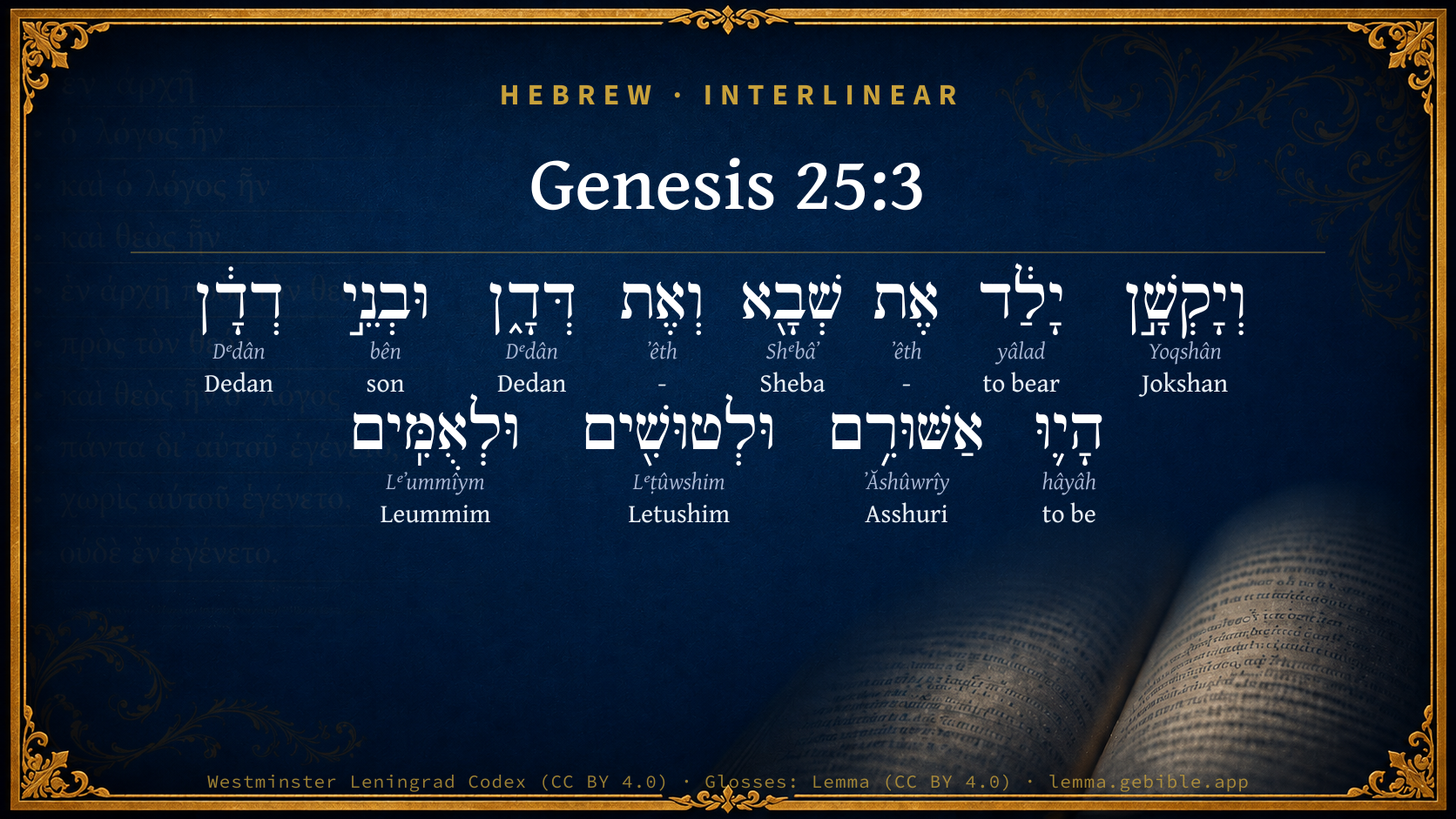
Hebrew (Westminster Leningrad Codex) Genesis 25:3 appears in the Hebrew Old Testament. The text above is from the Westminster Leningrad Codex. Each word links to its Strong’s number, a concise gloss, and parsing drawn from the Open Scriptures Hebrew Bible morphology. Click any word for its full Brown-Driver-Briggs (BDB) entry.
Download image
Cite this verse

Genesis 25:3 (World English Bible). Public Domain. Lemma interlinear Bible study tool, https://lemma.gebible.app/v/genesis/25/3.

Show BibTeX & RIS
BibTeX
RIS
English Translation
Jokshan became the father of Sheba, and Dedan. The sons of Dedan were Asshurim, Letushim, and Leummim.
World English Bible · Public Domain
Highlights
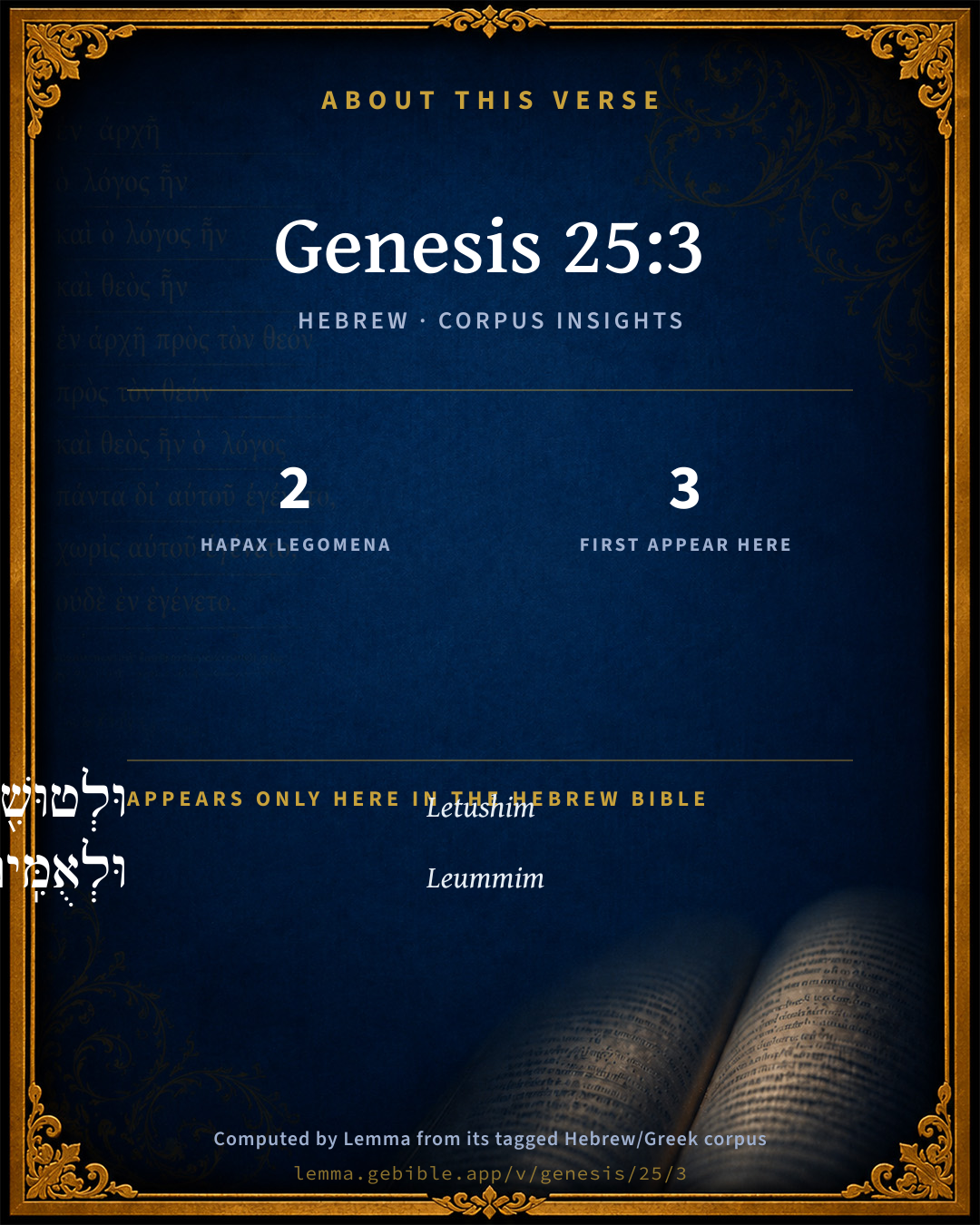
  • 2 hapax legomena — only here in the Hebrew Bible
  • 3 first appearances in the Hebrew Bible
Full analysis ↓
Download a study sheet

One document with this verse’s original text, its word-by-word gloss line, the meaning frame, cross-references with their text, attributed commentary, and full source and license credits — printable, and it pastes into notes with its structure intact.

This verse Autodidact and up

Study sheet (.html) Plain text (.txt)

A passage Seminary Student

Up to 50 verses in one chapter. A passage sheet keeps up to 6 commentary sources and 12 cross-references per verse, in the order this page ranks them, and says so on the sheet whenever that leaves anything out. Ask for a single verse and you get the Autodidact verse sheet above.

Everything on this page stays free to read, with no account — the sheet is a download of what is already on screen, not access to it.

Want to remove ads? Support Godless Engineer
Compare translations 3

The same verse in 3 English versions, stacked beneath the original-language interlinear above. Click any original word for its lexicon entry.

Each is an independent rendering of the whole verse — the interlinear is not word-aligned to these translations.

Highlighted words mark where these versions differ — a whole-verse word diff, not a word-by-word alignment.

  • World English Bible Public Domain
    Jokshan became the father of Sheba, and Dedan. The sons of Dedan were Asshurim, Letushim, and Leummim.
  • King James Version Public Domain
    And Jokshan begat Sheba, and Dedan. And the sons of Dedan were Asshurim, and Letushim, and Leummim.
  • unfoldingWord Literal Text CC BY-SA 4.0
    And Jokshan fathered Sheba and Dedan. And the descendants of Dedan were the Asshurites and the Letushites and the Leummites.

unfoldingWord Literal Text — © unfoldingWord, licensed CC BY-SA 4.0. Word-aligned USFM3 via Door43 (git.door43.org/unfoldingWord/en_ult).

Versions to compare (up to 4)

3 of 4 selected

Show all 18 translations

Every available English version of this verse, each an independent rendering of the whole verse.

  • World English Bible Public Domain
    Jokshan became the father of Sheba, and Dedan. The sons of Dedan were Asshurim, Letushim, and Leummim.
  • Berean Standard Bible Public Domain
    Jokshan was the father of Sheba and Dedan. And the sons of Dedan were the Asshurites, the Letushites, and the Leummites.
  • Majority Standard Bible Public Domain
    Jokshan was the father of Sheba and Dedan. And the sons of Dedan were the Asshurites, the Letushites, and the Leummites.
  • King James Version Public Domain
    And Jokshan begat Sheba, and Dedan. And the sons of Dedan were Asshurim, and Letushim, and Leummim.
  • American Standard Version (1901) Public Domain
    And Jokshan begat Sheba, and Dedan. And the sons of Dedan were Asshurim, and Letushim, and Leummim.
  • Revised Version (1885) Public Domain
    And Jokshan begat Sheba, and Dedan. And the sons of Dedan were Asshurim, and Letushim, and Leummim.
  • Geneva Bible (1599) Public Domain
    And Iokshan begate Sheba, and Dedan: And the sonnes of Dedan were Asshurim, and Letushim, and Leummim.
  • Douay-Rheims (1899) Public Domain
    Jecsan also begot Saba and Dadan. The children of Dadan were Assurim, and Latusim, and Loomin.
  • Young's Literal Translation Public Domain
    And Jokshan hath begotten Sheba and Dedan; and the sons of Dedan were Asshurim, and Letushim, and Leummim;
  • Literal Standard Version CC BY-SA 4.0
    And Jokshan has begotten Sheba and Dedan; and the sons of Dedan were Asshurim, and Letushim, and Leummim;
  • Unlocked Literal Bible CC BY-SA 4.0
    Jokshan became the father of Sheba and Dedan. The descendants of Dedan were the Assyrian people, the Letush people, and the Leum people.
  • unfoldingWord Literal Text CC BY-SA 4.0
    And Jokshan fathered Sheba and Dedan. And the descendants of Dedan were the Asshurites and the Letushites and the Leummites.
  • Darby Bible Public Domain
    And Jokshan begot Sheba and Dedan; and the sons of Dedan were the Asshurim, and the Letushim, and the Leummim.
  • World Messianic Bible Public Domain
    Jokshan became the father of Sheba, and Dedan. The sons of Dedan were Asshurim, Letushim, and Leummim.
  • Webster's Bible Public Domain
    And Jokshan begat Sheba, and Dedan. And the sons of Dedan were Asshurim, and Letushim and Leummim.
  • Free Bible Version CC BY-SA 4.0
    Jokshan was the father of Sheba and Dedan. The descendants of Dedan were the Asshurites, the Letushites, and the Leummites.
  • Bible in Basic English Public Domain
    And Jokshan became the father of Sheba and Dedan. And from Dedan came the Asshurim and Letushim and Leummim.
  • JPS Tanakh (1917) Public Domain
    And Jokshan begot Sheba, and Dedan. And the sons of Dedan were Asshurim, and Letushim, and Leummim.

Literal Standard Version (2020), Covenant Press — licensed CC BY-SA 4.0. Text via the HelloAO Bible API (eBible.org). Unlocked Literal Bible (unfoldingWord) — licensed CC BY-SA 4.0. Text via the HelloAO Bible API (eBible.org). unfoldingWord Literal Text — © unfoldingWord, licensed CC BY-SA 4.0. Word-aligned USFM3 via Door43 (git.door43.org/unfoldingWord/en_ult). Free Bible Version, Dr. Jonathan Gallagher — licensed CC BY-SA 4.0. Text via the HelloAO Bible API (eBible.org).

Word by word

More ways to search: Search by grammar → Find every occurrence → Compare this word →

Practice this passage: Drill this verse → Learn its vocabulary →

וּלְטוּשִׁ֖ים
Lᵉṭûwshim
H3912
“and · Letushim”
Conjunction + Noun, Proper
Part of Speech
Conjunction + Noun
Type
Proper
Full BDB Definition

Origin: masc. pl. of pass participle of H3913

TWOT: None

Letushim = "hammered" - the 2nd son of Dedan, grandson of Jokshan, great grandson of Abraham by Keturah
  1. וְיָקְשָׁ֣ן Yoqshân H3370 “and · Jokshan” Conjunction + Noun, Proper
  2. יָלַ֔ד yâlad H3205 “to bear” Verb, Qal, Perfect, 3rd Person, Masculine, Singular
  3. אֶת ʼêth H853 “-” Particle, Direct Object
  4. שְׁבָ֖א Shᵉbâʼ H7614 “Sheba” Noun, Proper
  5. וְאֶת ʼêth H853 “and · -” Conjunction + Particle, Direct Object
  6. דְּדָ֑ן Dᵉdân H1719 “Dedan” Noun, Proper
  7. וּבְנֵ֣י bên H1121 “and · sons of” Conjunction + Noun, Common, Masculine, Plural, Construct
  8. דְדָ֔ן Dᵉdân H1719 “Dedan” Noun, Proper
  9. הָי֛וּ hâyâh H1961 “to be” Verb, Qal, Perfect, 3rd Person, Common, Plural
  10. אַשּׁוּרִ֥ם ʼĂshûwrîy H805 “Asshuri” Noun, Proper
  11. וּלְאֻמִּֽים Lᵉʼummîym H3817 “and · Leummim” Conjunction + Noun, Proper

About this verse

These counts appear in no published source. They are computed here, from the morphology-tagged text and Lemma’s own curated glosses. What Lemma adds →

12
words
10
distinct lemmas
Pentateuch
section

Notable vocabulary

2 hapax legomena — words that appear only here in the entire Hebrew Bible:

  • וּלְטוּשִׁ֖ים Letushim H3912
  • וּלְאֻמִּֽים Leummim H3817

First appearance in Scripture

These words make their first canonical appearance in the Hebrew Bible here:

  • אַשּׁוּרִ֥ם Asshuri H805
  • וּלְטוּשִׁ֖ים Letushim H3912
  • וּלְאֻמִּֽים Leummim H3817

Shared distinctive vocabulary

אַשּׁוּרִ֥ם Asshuri H805 occurs in 2 verses of the Hebrew Bible. Also found in:

Grammatical profile

  • 2 verbs
  • 8 nouns
  • 2 particles

Verb forms

  • יָלַ֔ד Qal · Perfect
  • הָי֛וּ Qal · Perfect

Repetition

A word recurs within this verse — often emphatic in Hebrew:

  • דְּדָ֑ן Dedan H1719 ×2

Hebrew & Septuagint length

In English translation the verse runs 17 words from the Hebrew and 19 from the Septuagint (LXX English) — closely comparable.

A rough comparison of the two English renderings, which tokenize alike — not a word-level alignment.

Word counts can differ between the Hebrew and the Greek without any difference in meaning — e.g. the Hebrew direct-object marker אֵת has no separate Greek word, and Greek often adds the article ὁ.

Cross-references

9

Topical passages linked to Genesis 25:3 in the Treasury of Scripture Knowledge — connected by theme and wording, ordered by reader-vote popularity; previews shown in the World English Bible.

  • Ezekiel 25:13 therefore thus says the Lord Yahweh, I will stretch out my hand on Edom, and will cut off man and animal from it; and I will make it desolate from Teman; even to Dedan shall they fall by the sword.
  • 1 Kings 10:1 When the queen of Sheba heard of the fame of Solomon concerning the name of Yahweh, she came to prove him with hard questions.
  • Job 6:19 The caravans of Tema looked, The companies of Sheba waited for them.
  • Jeremiah 25:23 Dedan, and Tema, and Buz, and all who have the corners [of their hair] cut off;
  • Jeremiah 49:8 Flee you, turn back, dwell in the depths, inhabitants of Dedan; for I will bring the calamity of Esau on him, the time that I shall visit him.
  • Ezekiel 27:6 Of the oaks of Bashan have they made your oars; they have made your benches of ivory inlaid in boxwood, from the isles of Kittim.
  • Ezekiel 27:20 Dedan was your trafficker in precious cloths for riding.
  • 2 Samuel 2:9 and he made him king over Gilead, and over the Ashurites, and over Jezreel, and over Ephraim, and over Benjamin, and over all Israel.
  • Psalms 72:10 The kings of Tarshish and of the isles will bring tribute. The kings of Sheba and Seba shall offer gifts.

Cross-references courtesy of OpenBible.info (CC BY 4.0).

Hebrew and Greek witnesses Masoretic Hebrew ↔ Greek Septuagint

The same verse in the two great witnesses to the Old Testament, shown verse-for-verse.

These are two independent witnesses, not word-aligned to each other, and the Septuagint is shown in lemma (dictionary) form.

Hebrew Genesis 25:3 Masoretic · Westminster Leningrad Codex

וְיָקְשָׁ֣ן יָלַ֔ד אֶת שְׁבָ֖א וְאֶת דְּדָ֑ן וּבְנֵ֣י דְדָ֔ן הָי֛וּ אַשּׁוּרִ֥ם וּלְטוּשִׁ֖ים וּלְאֻמִּֽים

Jokshan became the father of Sheba, and Dedan. The sons of Dedan were Asshurim, Letushim, and Leummim.

World English Bible · Public Domain

Greek LXX Genesis 25:3 Septuagint · lemma form

ιεξαν δέ γεννάω ὁ σαβα καί ὁ θαιμαν καί ὁ δαιδαν υἱός δέ δαιδαν γίγνομαι ραγουηλ καί ναβδεηλ καί ασσουριιμ καί λατουσιιμ καί λοωμιμ

And Jezan begot Saba and Dedan. And the sons of Dedan were the Assurians and the Latusians, and Laomim.

LXX2012 (modern English Septuagint) · Public Domain

Hebrew: Westminster Leningrad Codex (CC BY 4.0). Greek: Septuagint (public domain); English from LXX2012 (modern English Septuagint) (Public Domain). How the Septuagint differs from the Hebrew →

Targum (Aramaic paraphrase)

2

The Targum is the ancient Jewish Aramaic paraphrase of the Hebrew Scriptures — an interpretive translation, not the Hebrew text itself. Onkelos (literal) and Pseudo-Jonathan (expansive) render the Torah, and Jonathan the Prophets. Coverage is partial: where no permissively-licensed English translation exists for a verse, only the Aramaic is shown. This is verse-level text, not a word-by-word alignment to the Hebrew.

  1. Targum Onkelos Torah (Genesis–Deuteronomy)
    וְיָקְשָׁן אוֹלִיד יָת שְׁבָא וְיָת דְּדָן וּבְנֵי דְדָן הֲווֹ לְמַשִּׁירְיָן וְלִשְׁכוּנִין וּלְּנַגְוָן

    (no public-domain English translation for this verse)

    Targum Onkelos — Aramaic: “Onkelos Genesis” (public domain); “Onkelos Exodus” (public domain); “Onkelos Leviticus” (public domain); “Onkelos Numbers” (public domain); “Onkelos Deuteronomy” (public domain). English: “Sefaria Community Translation” (CC0 1.0 (public-domain dedication)); “J.W. Etheridge. The Targums of Onkelos and Jonathan Ben Uzziel on the Pentateuch. London: Longmans, Green, 1862” (public domain). Text via Sefaria.

  2. Targum Pseudo-Jonathan Torah (Genesis–Deuteronomy)
    וְיָקְשָׁן אוֹלִיד יַת שְׁבָא וְיַת דְדָן וּבְנֵי דְדָן הֲווֹן תַּגָרִין וְאִמְפּוּרִין וְרֵישֵׁי אוּמִין

    And Jokshan begat Sheva and Dedan; and the sons of Dedan were merchants, and negotiators, and chiefs of peoples.

    Targum Pseudo-Jonathan — Aramaic: “Targum Jonathan on Genesis” (public domain); “Targum Jonathan on Exodus” (public domain); “Targum Jonathan on Leviticus” (public domain); “Targum Jonathan on Numbers” (public domain); “Targum Jonathan on Deuteronomy” (public domain). English: “The Targum of Jonathan ben Uzziel, trans. J. W. Etheridge, London, 1862” (public domain). Text via Sefaria.

Commentary

Notes on Genesis 25:3 from classic Christian and Jewish commentators (each source and its license shown beneath its notes). The classic Christian expositions comment on the surrounding passage and are grouped to its opening verse, so a note may address several verses; the Jewish commentaries on the Tanakh (Rashi and others) are per-verse, so they appear only where the commentator wrote on this verse.

Lemma curates 59 commentaries, every one of them public domain or Creative Commons licensed, each selected and text-cleaned for this edition rather than reprinted as found. About our sources →

Trapp's Complete Commentary

John Trapp

Gen 25:3 And Jokshan begat Sheba, and Dedan. And the sons of Dedan were Asshurim, and Letushim, and Leummim.

Ver. 3. No Text for this verse.

John Trapp, A Commentary or Exposition upon All the Books of the Old and New Testament (1647–1656) — public domain. Text from a community e-Sword module.

Tyndale Open Study Notes

Tyndale Open Resources

25:3 Sheba and Dedan: Cp. 10:7. Abraham’s descendants probably settled in these regions and became identified by their names, along with people of other lineage.

Tyndale Open Study Notes — © Tyndale Open Resources, licensed CC BY-SA 4.0. Text via the HelloAO Bible API.

Adam Clarke's Commentary

Verse 3. Sheba] From whom sprang the Sabeans, who robbed Job of his cattle. See Bochart and Calmet.

Asshurim, and Letushim, and Leummim.] We know not who these were, but as each name is plural they must have been tribes or families, and not individuals. Onkelos interprets these words of persons dwelling in camps, tents, and islands; and Jonathan ben Uzziel calls them merchants, artificers, and heads or chiefs of people.

Adam Clarke's Commentary on the Bible (1810–1826) — public domain. Text from a community e-Sword/MySword module.

Ellicott's Commentary for English Readers

(3) Jokshan begat Sheba, and Dedan.—But Sheba and Dedan are also described as the sons of Raamah, the son of Cush (Gen_10:7). We have here proof that these genealogies are to a certain extent geographical, and that whereas these districts at first were peopled by a Hamitic race, they were subsequently conquered by men of the Semitic stock, who claimed Abraham for their ancestor. Most probably, therefore, we ought not to regard Sneba and Dedan as the names here of men. As men they were the sons of Raamah, but when the sons of Jokshan wrested these two countries from the family of Cush, they called them sons of their progenitor, because the dominant portion of the population had sprung from him. They appear as countries in Jer_6:20; Jer_49:8; Eze_25:13; Eze_27:15; Eze_27:22; Eze_38:13, &c.

Asshurim, and Letushim, and Leummim.—These are certainly not the names of men, but of the three tribes into which the Dedanites were divided.

A Bible Commentary for English Readers, edited by Charles John Ellicott (1878–1897) — public domain. Text from a community e-Sword module.

The Cambridge Bible for Schools and Colleges

gen. ed. J. J. S. Perowne

3. Sheba … Dedan] These places have already been mentioned by P in a different connexion (Gen_10:7). The identity of the names illustrates the fact, that there were different Israelite traditions explaining the relation of the different members of the Hebrew-speaking families.

Asshurim, and Letushim, and Leummim] These plural names are noticeable as obviously denoting, not individuals, but peoples. The Asshurim are probably to be connected with the “Asshur” (R.V. “Assyria”) of Psa_83:8, and possibly with the mention of Asshur in the present chapter (Gen_25:18) and in Num_24:22. In both instances, an allusion to obscure tribes on the Arabian borders of Palestine is more suitable than to the Assyrian empire.

Ephah] Cf. Isa_60:6, “the dromedaries of Midian and Ephah,” a passage confirming the probability that the present group of names is Arabian.

The Cambridge Bible for Schools and Colleges (gen. ed. J. J. S. Perowne; Cambridge University Press, 1878–1918) — public domain. Text from a community e-Sword module.

John Gill's Exposition

And Jokshan begat Sheba and Dedan,.... Bochart (o) is of opinion, that the posterity of this Sheba are the same with the Sabeans who inhabited at the entrance of Arabia Felix, not far from the Nabathaeans; and who, by Strabo (p), are mentioned together as near to Syria, and used to make excursions on their neighbours; and not without some colour of reason thought to be the same that plundered Job of his cattle, Job 1:15. From Dedan came the Dedanim or Dedanites, spoken of with the Arabians in Isa 21:13; Junius thinks Adada in Palmyrene of Syria had its name from this man, and in which country is the mountain Aladan or Alladadan. Bochart (q) more probably takes Dedan, a city in Idumea, to derive its name from him. There is a village called Adedi in the country of the Cassanites, a people of Arabia Felix, which Ptolemy (r) makes mention of, and seems to have some appearance of this man's name:

and the sons of Dedan were Asshurim, and Letushim, and Leummim; these names being plural are thought not to be proper names of men, but appellatives, descriptive of their places of abode, or of their business: hence the Targum of Onkelos represents them as such that dwelt in camps, in tents, and in islands; and the Targums of Jonathan and Jerusalem call them merchants, artificers and heads of the people: however, Cleodemus (s) the Heathen historian is wrong in deriving Assyria from Asshurim, whom he calls Ashur; since Assyria and Assyrians are so called from Ashur, the son of Shem, Gen 10:22.

(o) Phaleg. l. 2. c. 9. col. 227. (p) Geograph. l. 16. p. 536. (q) Phaleg. l. 4. c. 6. col. 219. (r) Ut supra. (Geograph. l. 6. c. 7.) (s) Apud Euseb. ut supra. (Praepar. Evangel. 9. c. 20. p. 432.)

John Gill's Exposition of the Whole Bible (1746–1763) — public domain (CC PDM 1.0). Text via the HelloAO Bible API.

The Pulpit Commentary

And Jokshan begat Sheba, probably the Sabeans: (Job_1:15 Job_6:19) (Keil) and Dedan probably the trading people mentioned. (Jer_25:23) (Keil) And the sons of Dedan were Asshurim, who have been associated with the warlike tribe of the Asir, to the south of Hejas (Keil)and Letu-shim, the Bann Leits in Hejas (Keil)and Leummim the tribe Bann Lam, which extended even to Babylon and Mesopotamia (Keil).

The Pulpit Commentary (1880–1919), ed. H.D.M. Spence-Jones & Joseph S. Exell — public domain. Text from a community e-Sword module.

Keil & Delitzsch

C. F. Keil & F. Delitzsch

Of the sons of Jokshan, Sheba was probably connected with the Sabaeans, who are associated in Job 6:19 with Tema, are mentioned in Job 1:15 as having stolen Job's oxen and asses, and, according to Strabo (xvi. 779), were neighbours of the Nabataeans in the vicinity of Syria. Dedan was probably the trading people mentioned in Jer 25:23 along with Tema and Bus (Isa 21:13; Jer 49:8), in the neighbourhood of Edom (Eze 24:15), with whom the tribe of Banu Dudan, in Hejas, has been compared. On their relation to the Cushites of the same name, vid., Gen 10:7 and Gen 10:28, - Of the sons of Dedan, the Asshurim have been associated with the warlike tribe of the Asir to the south of Hejas, the Letushim with the Banu Leits in Hejas, and the Leummim with the tribe of the Banu Lm, which extended even to Babylon and Mesopotamia. Of the descendants of Midian, Ephah is mentioned in Isa 60:6, in connection with Midian, as a people trading in gold and incense. Epher has been compared with the Banu Gifar in Hejas; Hanoch, with the place called Hanakye, three days' journey to the north of Medinah; Abidah and el-daah, with the tribes of Abide and Vadaa in the neighbourhood of Asir. But all this is very uncertain.

Keil & Delitzsch — Biblical Commentary on the Old Testament (1861–1891) — public domain (CC PDM 1.0). Text via the HelloAO Bible API. (Old Testament only.)

Rashi

Rabbi Shlomo Yitzchaki (Rashi)

אשורם ולטושם The names of chieftains of clans (Genesis Rabbah 61:5). As regards the translation of Onkelos I cannot make it fit in exactly with the words of the text. He explains אשורם by למשירין which means “camps” (cf. שיירא a caravan). If you say that this cannot be correct on account of the א in אשורם which is not a root letter in the word from which משירין is derived (whilst in אשורם we have an א) then I would reply that we find some words which should have no א at the beginning, but still א is placed before them. Such are אנך in (Amos 7:7) “a wall made by a plumbline (אנך)”, where the word is of the same root as נכה in (2 Samuel 4:4) “stricken (נכה) in his feet”, and אסוך, a cruse containing anointing oil, in (2 Kings 4:2) “a pot (אסוך) of oil” which is of the same root as וסכת in (Ruth 3:3) “wash thyself and (וסכת) annoint thyself”.

The לטושים (according to Onkelos) are owners of tents who spread about in all directions and travel about each in the “tents of his palace” (Rashi uses a Biblical phrase (Daniel 11:45), but he means nothing more than “each in his own tent”). Indeed Scripture says (1 Samuel 30:16) “Behold they were spread (נטושים) over all the ground”, for ל and נ may interchange (so that לטושים is equivalent to נטושים).

Rashi on the Tanakh — English translations: “The Judaica Press complete Tanach with Rashi, translated by A. J. Rosenberg” (CC BY 4.0); “Pentateuch with Rashi's commentary by M. Rosenbaum and A.M. Silbermann, 1929-1934” (public domain); “The Metsudah Tanach series, Lakewood, N.J” (CC BY 4.0); and “The Book of Joshua, Metsudah Publications, 1997” (CC BY 4.0). Text via Sefaria.

Ramban (Nachmanides)

Rabbi Moshe ben Nachman (Ramban / Nachmanides)

ASSHURIM, AND LETUSHIM, AND LEUMMIM. Rashi comments: “These were the names of clan chieftains. But I cannot reconcile Onkelos’ translation with the language of the text.” as meaning “camps,” Letushim as “owners of tents who spread about in all directions,” and Leumim as “islands” or “sea-districts.” Upon this Rashi comments that he cannot make Onkelos’ translation fit in exactly with the words of the text. Ramban now proceeds to explain Onkelos’ understanding on the verse and also the reason why he was forced to make this translation.It appears to me that Onkelos was of the opinion that Asshurim means camps, companies that travel the roads from city to city, just as it says, a company of Ishmaelites. Onkelos thus considered Asshurim as being derived from the expressions, To His steps (‘ba’ashuro’) hath my foot held fast; His steps (‘ashurav’) do not slide. And Onkelos’ opinion of Letushim is that they are the ones who dwell in tents that are scattered over the face of the earth, resting today in one place and tomorrow in another, for the letter lamed and nun interchange in many places, [thus Letushim would be like Netushim (scattered ones)] just like lishchah and nishchah, [both of which mean “chamber”]; And on that day men were appointed over ‘haneshachoth’ (the chambers)., 12:44. From this root is derived the expression, a sword ‘netushah,’ which is the same as letushah (sharpened). And of the word Le’ummim Onkelos said ulenagvon, [which is Aramaic for the Hebrew word] iyim (islands). Onkelos was stirred to this translation by the word hayu [and the children of Dedan ‘hayu’ (were) Asshurim, and Letushim, and Leummim], when it would have been proper to express it similarly to the verse, And Mitzraim begot Ludim, and Ananim, and Lehabim, and Naphtihim. And in Bereshith Rabbah we find: “Rabbi Shmuel the son of Rav Nachman said that even though we translate these names and say, ‘Merchants, flaming ones, and heads of peoples,’ all of them were heads of peoples.” The matter is as I have explained. The translators rendered Asshurim as “merchants, those who walk the road.” From the word Letushim (sharp, shiny) they derived “men of wickedness,” their faces are faces of flame, burning as torches, from the roots: to sharpen ( liltosh ) his plowshare, and his coulter; He sharpened ( yiltosh ) his eyes upon me. But Rabbi Shmuel the son of Rav Nachman said that even though they are accustomed to thus translate these names, they are still only the proper names of the heads of people, there being no descriptive name among them at all. And such is the case.

Ramban (Nachmanides) on the Tanakh — English translation: “Commentary on the Torah by Ramban (Nachmanides). Translated and annotated by Charles B. Chavel. New York, Shilo Pub. House, 1971-1976” (CC BY 4.0). Text via Sefaria.

Radak

Rabbi David Kimhi (Radak)

ויקשן, The Torah mentions only some of the children of Keturah’s sons. In the case of Yokshon even a grandson of Keturah is mentioned. Altogether the Torah mentions by name 16 such sons and grandsons. We are hard-pressed to know the reason for the Torah’s selectivity in mentioning only part of the many grandsons, etc. Perhaps those whom Avraham or at least Keturah still knew before they died, are mentioned by name, whereas those who were born by his/her sons after he had died were not mentioned. Considering that Avraham had married Keturah when he was 140 years old or older, he lived for only another 35 years, it would have been unlikely that he saw grandchildren from Keturah, considering that we have no record of anyone marrying below the age of 29 in those days.

אשורים ולטושים ולאמים, we do not know why the names of these three sons appear with the plural ending ים at the end. Possibly, these sons knew why they had been named thus. It is interesting that מצרים, a son of Cham, also gave his sons names ending with the ים plural ending. According to Onkelos, the names mentioned here were not their real names, as he translates their names as למשריין, ולשכונין, ולנגון.

Radak on the Tanakh — English translations: “Sefaria Community Translation” (CC0 1.0 (public-domain dedication)); “Eliyahu Munk, HaChut Hameshulash” (CC BY 4.0); “Rabbi Mike Feuer, Jerusalem Anthology” (CC BY 4.0); and “R. David Kimhi on the first book of Psalms, Translated by R.G. Finch, London, 1919” (public domain). Text via Sefaria.

Lesson kit

Teaching starters — assembled from the data on this page, not authored interpretation. Every prompt links to the verse data it draws on. Edit before teaching.

Genesis, in the Pentateuch, opens this verse with 12 words (10 distinct Hebrew lemmas). Its most distinctive word is Lᵉṭûwshim (“Letushim”). A historical commentator’s framing appears above. Read the whole chapter for the surrounding context.

Discussion questions

  1. What does “Letushim” (Lᵉṭûwshim) contribute to the verse as a whole?
  2. This verse holds 2 words here found nowhere else in the Hebrew Bible. What might the rare words draw attention to?
  3. 3 words here appear for the first time in Scripture. What is being introduced at this debut?
  4. 2 Samuel 2:9 shares the word «Asshuri» with this verse. How do the two illuminate each other?
  5. “Dedan” occurs 2× in this one verse. What is the effect of the repetition?
  6. These translations render this verse differently; the difference is in the English rendering, not the original. What questions does that raise?
  7. The verb «יָלַ֔ד» is Qal Perfect. How does its form color the action?
  8. Reading how Trapp's Complete Commentary and Tyndale Open Study Notes read this verse, where do the two commentators agree and where do they part?

Things to notice

  • 2 words in this verse appear nowhere else in the Hebrew Bible.
  • 3 words make their first canonical appearance in Scripture here.
  • These translations choose different wording for 12 words in this verse.
  • “Dedan” occurs 2× in this single verse.
  • 10 distinct Hebrew lemmas span 12 words in this verse.

Reading settings

Reading text

Shown beneath each verse's original-language words.

Old Testament
Old Testament edition

Read the OT as the Masoretic Hebrew (MT) or the Greek Septuagint (LXX).

English shown for the Greek Septuagint (in the Hebrew ↔ Greek comparison).

Comparing translations? Open the Compare panel on any verse page to stack up to four side by side.