
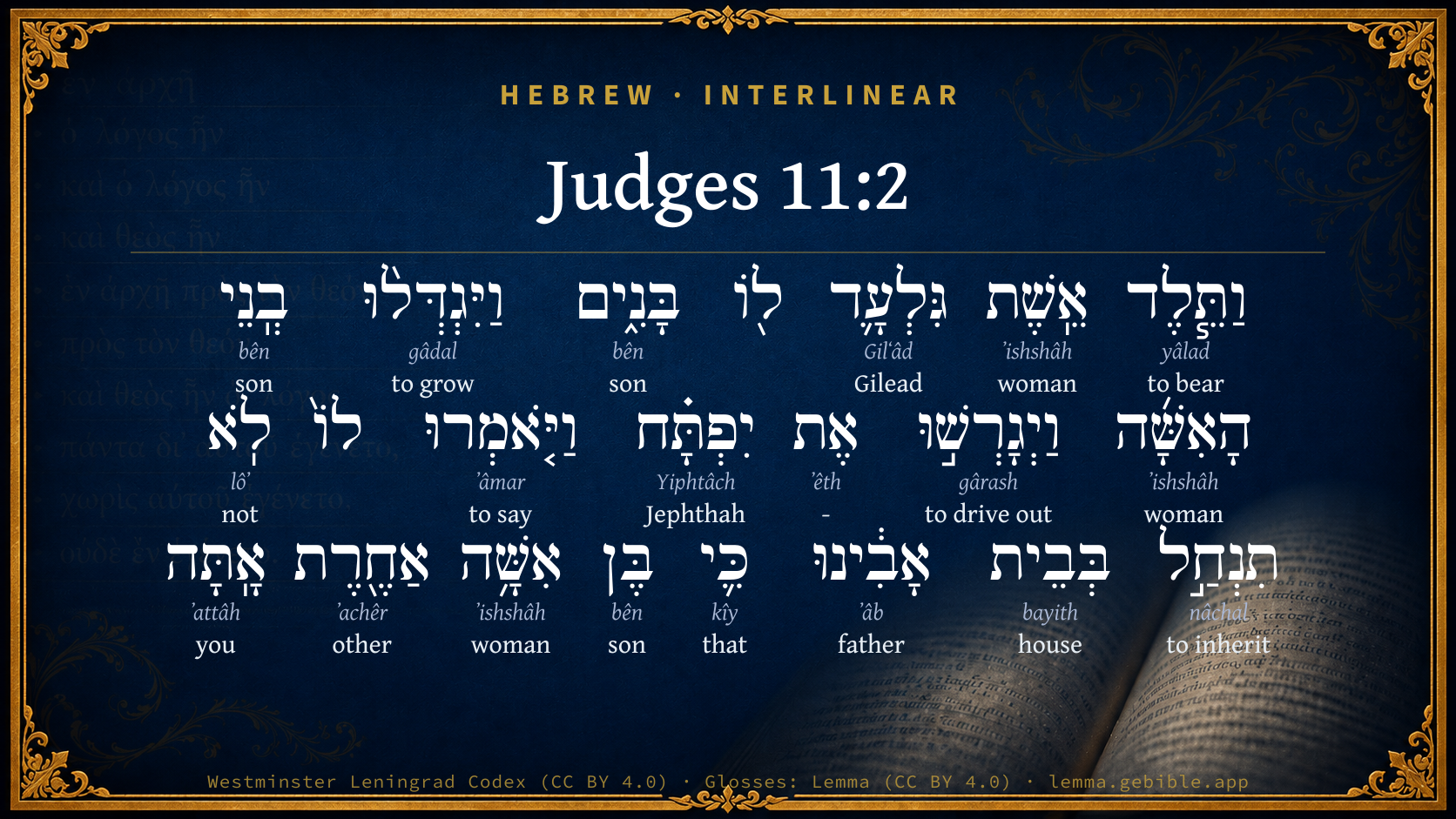
Judges 11:2

Hebrew (Westminster Leningrad Codex) Judges 11:2 appears in the Hebrew Old Testament. The text above is from the Westminster Leningrad Codex. Each word links to its Strong’s number, a concise gloss, and parsing drawn from the Open Scriptures Hebrew Bible morphology. Click any word for its full Brown-Driver-Briggs (BDB) entry.
Download image
Cite this verse

Judges 11:2 (World English Bible). Public Domain. Lemma interlinear Bible study tool, https://lemma.gebible.app/v/judges/11/2.

Show BibTeX & RIS
BibTeX
RIS
English Translation
Gilead's wife bore him sons; and when his wife's sons grew up, they drove out Jephthah, and said to him, You shall not inherit in our father's house; for you are the son of another woman.
World English Bible · Public Domain
Download a study sheet

One document with this verse’s original text, its word-by-word gloss line, the meaning frame, cross-references with their text, attributed commentary, and full source and license credits — printable, and it pastes into notes with its structure intact.

This verse Autodidact and up

Study sheet (.html) Plain text (.txt)

A passage Seminary Student

Up to 50 verses in one chapter. A passage sheet keeps up to 6 commentary sources and 12 cross-references per verse, in the order this page ranks them, and says so on the sheet whenever that leaves anything out. Ask for a single verse and you get the Autodidact verse sheet above.

Everything on this page stays free to read, with no account — the sheet is a download of what is already on screen, not access to it.

Want to remove ads? Support Godless Engineer
Compare translations 3

The same verse in 3 English versions, stacked beneath the original-language interlinear above. Click any original word for its lexicon entry.

Each is an independent rendering of the whole verse — the interlinear is not word-aligned to these translations.

Highlighted words mark where these versions differ — a whole-verse word diff, not a word-by-word alignment.

  • World English Bible Public Domain
    Gilead's wife bore him sons; and when his wife's sons grew up, they drove out Jephthah, and said to him, You shall not inherit in our father's house; for you are the son of another woman.
  • King James Version Public Domain
    And Gilead's wife bare him sons; and his wife's sons grew up, and they thrust out Jephthah, and said unto him, Thou shalt not inherit in our father's house; for thou art the son of a strange woman.
  • unfoldingWord Literal Text CC BY-SA 4.0
    And the wife of Gilead bore sons to him, and the sons of the wife grew up, and they drove out Jephthah and said to him, “You will not inherit in the house of our father, for you are the son of another woman.”

unfoldingWord Literal Text — © unfoldingWord, licensed CC BY-SA 4.0. Word-aligned USFM3 via Door43 (git.door43.org/unfoldingWord/en_ult).

Versions to compare (up to 4)

3 of 4 selected

Show all 18 translations

Every available English version of this verse, each an independent rendering of the whole verse.

  • World English Bible Public Domain
    Gilead's wife bore him sons; and when his wife's sons grew up, they drove out Jephthah, and said to him, You shall not inherit in our father's house; for you are the son of another woman.
  • Berean Standard Bible Public Domain
    And Gilead’s wife bore him sons who grew up, drove Jephthah out, and said to him, “You shall have no inheritance in our father’s house, because you are the son of another woman.”
  • Majority Standard Bible Public Domain
    And Gilead’s wife bore him sons who grew up, drove Jephthah out, and said to him, “You shall have no inheritance in our father’s house, because you are the son of another woman.”
  • King James Version Public Domain
    And Gilead's wife bare him sons; and his wife's sons grew up, and they thrust out Jephthah, and said unto him, Thou shalt not inherit in our father's house; for thou art the son of a strange woman.
  • American Standard Version (1901) Public Domain
    And Gilead's wife bare him sons; and when his wife's sons grew up, they drove out Jephthah, and said unto him, Thou shalt not inherit in our father's house; for thou art the son of another woman.
  • Revised Version (1885) Public Domain
    And Gilead’s wife bare him sons; and when his wife’s sons grew up, they drave out Jephthah, and said unto him, Thou shalt not inherit in our father’s house; for thou art the son of another woman.
  • Geneva Bible (1599) Public Domain
    And Gileads wife bare him sonnes, and when the womans children were come to age, they thrust out Iphtah, and sayd vnto him, Thou shalt not inherite in our fathers house: for thou art the sonne of a strange woman.
  • Douay-Rheims (1899) Public Domain
    Now Galaad had a wife of whom he had sons: who after they were grown up, thrust out Jephte, saying: Thou canst not inherit in the house of our father, because thou art born of another mother.
  • Young's Literal Translation Public Domain
    and the wife of Gilead beareth to him sons, and the wife's sons grow up and cast out Jephthah, and say to him, `Thou dost not inherit in the house of our father; for son of another woman `art' thou.'
  • Literal Standard Version CC BY-SA 4.0
    and the wife of Gilead bears sons to him, and the wife’s sons grow up and cast Jephthah out, and say to him, “You do not inherit in the house of our father; for you [are the] son of another woman.”
  • Unlocked Literal Bible CC BY-SA 4.0
    Gilead's wife also gave birth to his other sons. When his wife's sons grew up, they forced Jephthah to leave the house and said to him, “You are not going to inherit anything from our family. You are the son of another woman.”
  • unfoldingWord Literal Text CC BY-SA 4.0
    And the wife of Gilead bore sons to him, and the sons of the wife grew up, and they drove out Jephthah and said to him, “You will not inherit in the house of our father, for you are the son of another woman.”
  • Darby Bible Public Domain
    And Gilead's wife also bore him sons; and when his wife's sons grew up, they thrust Jephthah out, and said to him, "You shall not inherit in our father's house; for you are the son of another woman."
  • World Messianic Bible Public Domain
    Gilead’s wife bore him sons. When his wife’s sons grew up, they drove Jephthah out and said to him, “You will not inherit in our father’s house, for you are the son of another woman.”
  • Webster's Bible Public Domain
    And Gilead's wife bore him sons; and his wife's sons grew up, and they thrust out Jephthah, and said to him, Thou shalt not inherit in our father's house; for thou art the son of a strange woman.
  • Free Bible Version CC BY-SA 4.0
    Gilead's wife gave him sons, who when they grew up, drove Jephthah away, telling him, “You won't inherit anything from our father because you are another woman's son.”
  • Bible in Basic English Public Domain
    And Gilead's wife gave birth to sons, and when her sons became men, they sent Jephthah away, saying, You have no part in the heritage of our father's house, for you are the son of another woman.
  • JPS Tanakh (1917) Public Domain
    And Gilead's wife bore him sons; and when his wife's sons grew up, they drove out Jephthah, and said unto him: 'Thou shalt not inherit in our father's house; for thou art the son of another woman.'

Literal Standard Version (2020), Covenant Press — licensed CC BY-SA 4.0. Text via the HelloAO Bible API (eBible.org). Unlocked Literal Bible (unfoldingWord) — licensed CC BY-SA 4.0. Text via the HelloAO Bible API (eBible.org). unfoldingWord Literal Text — © unfoldingWord, licensed CC BY-SA 4.0. Word-aligned USFM3 via Door43 (git.door43.org/unfoldingWord/en_ult). Free Bible Version, Dr. Jonathan Gallagher — licensed CC BY-SA 4.0. Text via the HelloAO Bible API (eBible.org).

Word by word

More ways to search: Search by grammar → Find every occurrence → Compare this word →

Practice this passage: Drill this verse → Learn its vocabulary →

יִפְתָּ֗ח
Yiphtâch
H3316
“Jephthah”
Noun, Proper
Part of Speech
Noun
Type
Proper
Full BDB Definition

Origin: from H6605

TWOT: None

Jephthah or Jiphtah = "he opens" - a son of Gilead and a concubine and the judge who defeated the Ammonites; after the victory because of a vow taken before the battle he sacrificed his daughter as a burnt offering (noun proper masculine) - a city in Judah (noun proper locative)
  1. וַתֵּ֧לֶד yâlad H3205 “and · to bear” Conjunction + Verb, Qal, Sequential Imperfect, 3rd Person, Feminine, Singular
  2. אֵֽשֶׁת ʼishshâh H802 “woman of” Noun, Common, Feminine, Singular, Construct
  3. גִּלְעָ֛ד Gilʻâd H1568 “Gilead” Noun, Proper
  4. בָּנִ֑ים bên H1121 “sons” Noun, Common, Masculine, Plural, Absolute
  5. וַיִּגְדְּל֨וּ gâdal H1431 “and · to grow” Conjunction + Verb, Qal, Sequential Imperfect, 3rd Person, Masculine, Plural
  6. בְֽנֵי bên H1121 “sons of” Noun, Common, Masculine, Plural, Construct
  7. הָאִשָּׁ֜ה ʼishshâh H802 “the · woman” Particle, Definite Article + Noun, Common, Feminine, Singular, Absolute
  8. וַיְגָרְשׁ֣וּ gârash H1644 “and · to drive out” Conjunction + Verb, Piel, Sequential Imperfect, 3rd Person, Masculine, Plural
  9. אֶת ʼêth H853 “-” Particle, Direct Object
  10. וַיֹּ֤אמְרוּ ʼâmar H559 “and · to say” Conjunction + Verb, Qal, Sequential Imperfect, 3rd Person, Masculine, Plural
  11. לֹֽא lôʼ H3808 “not” Particle, Negative
  12. תִנְחַ֣ל nâchal H5157 “to inherit” Verb, Qal, Imperfect, 2nd Person, Masculine, Singular
  13. בְּבֵית bayith H1004 “in/at · house of” Preposition + Noun, Common, Masculine, Singular, Construct
  14. אָבִ֔ינוּ ʼâb H1 “father · our” Noun, Common, Masculine, Singular, Construct + Suffix, Personal, 1st Person, Common, Plural
  15. כִּ֛י kîy H3588 “that” Conjunction
  16. בֶּן bên H1121 “son of” Noun, Common, Masculine, Singular, Construct
  17. אִשָּׁ֥ה ʼishshâh H802 “woman” Noun, Common, Feminine, Singular, Absolute
  18. אַחֶ֖רֶת ʼachêr H312 “other” Adjective, Adjective, Feminine, Singular, Absolute
  19. אָֽתָּה ʼattâh H859 “you” Pronoun, Personal, 2nd Person, Masculine, Singular

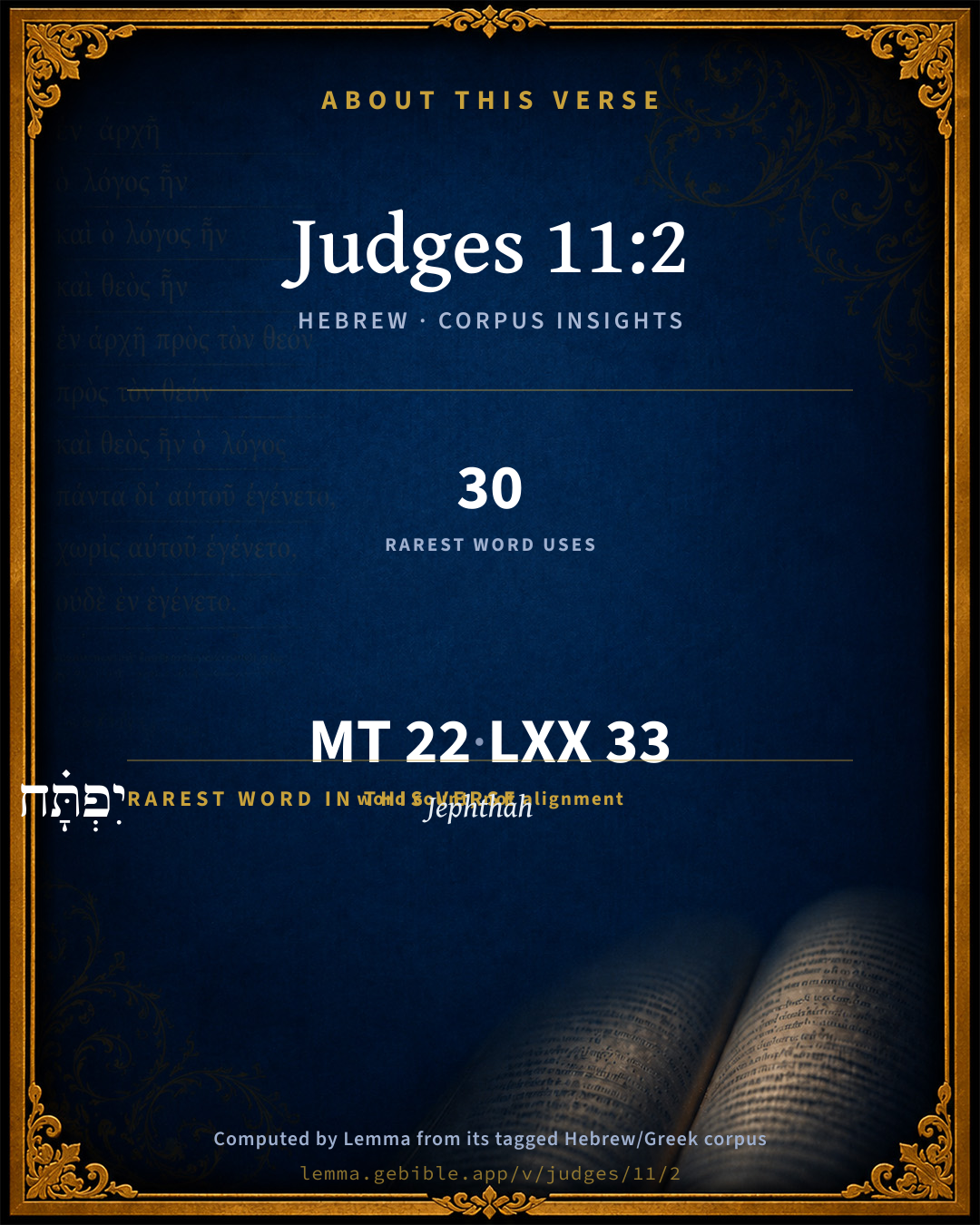
About this verse

These counts appear in no published source. They are computed here, from the morphology-tagged text and Lemma’s own curated glosses. What Lemma adds →

22
words
16
distinct lemmas
Historical
section

Shared distinctive vocabulary

יִפְתָּ֗ח Jephthah H3316 occurs in 26 verses of the Hebrew Bible. Also found in:

Grammatical profile

  • 5 verbs
  • 10 nouns
  • 1 adjective
  • 1 pronoun
  • 2 prepositions
  • 1 conjunction
  • 2 particles

Verb forms

  • וַתֵּ֧לֶד Qal · Sequential Imperfect
  • וַיִּגְדְּל֨וּ Qal · Sequential Imperfect
  • וַיְגָרְשׁ֣וּ Piel · Sequential Imperfect
  • וַיֹּ֤אמְרוּ Qal · Sequential Imperfect
  • תִנְחַ֣ל Qal · Imperfect

Repetition

Words recur within this verse — often emphatic in Hebrew:

  • אֵֽשֶׁת woman H802 ×3
  • בָּנִ֑ים son H1121 ×3

Hebrew & Septuagint length

In English translation the verse runs 36 words from the Hebrew and 43 from the Septuagint (LXX English) — closely comparable.

A rough comparison of the two English renderings, which tokenize alike — not a word-level alignment.

Word counts can differ between the Hebrew and the Greek without any difference in meaning — e.g. the Hebrew direct-object marker אֵת has no separate Greek word, and Greek often adds the article ὁ.

In the original languages it is 22 Hebrew tokens and 33 Greek tokens — but the two are counted differently (Hebrew bundles its prefixes and suffixes into one token; the Greek is in lemma form), so that isn’t a like-for-like length.

Cross-references

7

Topical passages linked to Judges 11:2 in the Treasury of Scripture Knowledge — connected by theme and wording, ordered by reader-vote popularity; previews shown in the World English Bible.

  • Genesis 12:10 There was a famine in the land. Abram went down into Egypt to live as a foreigner there, for the famine was sore in the land.
  • Deuteronomy 23:2 A bastard shall not enter into the assembly of Yahweh; even to the tenth generation shall none of his enter into the assembly of Yahweh.
  • Proverbs 2:16 To deliver you from the strange woman, Even from the foreigner who flatters with her words;
  • Proverbs 5:3 For the lips of an adulteress drip honey. Her mouth is smoother than oil,
  • Proverbs 5:20 For why should you, my son, be captivated with an adulteress? Why embrace the bosom of another?
  • Proverbs 6:24–26 To keep you from the immoral woman, From the flattery of the wayward wife's tongue.
  • Galatians 4:30 However what does the Scripture say? "Throw out the handmaid and her son, for the son of the handmaid will not inherit with the son of the free woman."

Cross-references courtesy of OpenBible.info (CC BY 4.0).

Hebrew and Greek witnesses Masoretic Hebrew ↔ Greek Septuagint

The same verse in the two great witnesses to the Old Testament, shown verse-for-verse.

These are two independent witnesses, not word-aligned to each other, and the Septuagint is shown in lemma (dictionary) form.

Hebrew Judges 11:2 Masoretic · Westminster Leningrad Codex

וַתֵּ֧לֶד אֵֽשֶׁת גִּלְעָ֛ד ל֖וֹ בָּנִ֑ים וַיִּגְדְּל֨וּ בְֽנֵי הָאִשָּׁ֜ה וַיְגָרְשׁ֣וּ אֶת יִפְתָּ֗ח וַיֹּ֤אמְרוּ לוֹ֙ לֹֽא תִנְחַ֣ל בְּבֵית אָבִ֔ינוּ כִּ֛י בֶּן אִשָּׁ֥ה אַחֶ֖רֶת אָֽתָּה

Gilead's wife bore him sons; and when his wife's sons grew up, they drove out Jephthah, and said to him, You shall not inherit in our father's house; for you are the son of another woman.

World English Bible · Public Domain

Greek LXX Judges 11:2 Septuagint · lemma form

καί τίκτω ὁ γυνή γαλαάδ αὐτός υἱός καί ἁδρύνω ὁ υἱός ὁ γυνή καί ἐκβάλλω ὁ ιεφθαε καί εἶπον αὐτός οὐ κληρονομέω ἐν ὁ οἶκος ὁ πατήρ ἐγώ ὅτι υἱός γυνή ἑταίρα σύ

And the wife of Galaad bore him sons; and the sons of his wife grew up, and they cast out Jephthae, and said to him, You shall not inherit in the house of our father, for you are the son of a concubine.

LXX2012 (modern English Septuagint) · Public Domain

On this verse, Haydock's Catholic Bible Commentary discusses the Septuagint’s reading. Read the note in Commentary ↓

Hebrew: Westminster Leningrad Codex (CC BY 4.0). Greek: Septuagint (public domain); English from LXX2012 (modern English Septuagint) (Public Domain). How the Septuagint differs from the Hebrew →

Targum (Aramaic paraphrase)

1

The Targum is the ancient Jewish Aramaic paraphrase of the Hebrew Scriptures — an interpretive translation, not the Hebrew text itself. Onkelos (literal) and Pseudo-Jonathan (expansive) render the Torah, and Jonathan the Prophets. Coverage is partial: where no permissively-licensed English translation exists for a verse, only the Aramaic is shown. This is verse-level text, not a word-by-word alignment to the Hebrew.

  1. Targum Jonathan Prophets (Joshua–Malachi)
    וִילֵידַת אִתַּת גִלְעָד לֵיהּ בְּנִין וּרְבִיאוּ בְנֵי אִתְּתָא וְתָרִיכוּ יַת יִפְתָּח וַאֲמַרוּ לֵיהּ לָא תַחְסֵין בְּבֵית אֲבוּנָא אֲרֵי בַּר אִתְּתָא אוֹחֲרִי אַתְּ:

    (no public-domain English translation for this verse)

    Targum Jonathan — Aramaic: “Mikraot Gedolot” (public domain). English: “Sefaria Community Translation” (CC0 1.0 (public-domain dedication)); “London "Chaldee Paraphrase," 1871” (public domain). Text via Sefaria.

Commentary

Notes on Judges 11:2 from classic Christian and Jewish commentators (each source and its license shown beneath its notes). The classic Christian expositions comment on the surrounding passage and are grouped to its opening verse, so a note may address several verses; the Jewish commentaries on the Tanakh (Rashi and others) are per-verse, so they appear only where the commentator wrote on this verse.

Lemma curates 59 commentaries, every one of them public domain or Creative Commons licensed, each selected and text-cleaned for this edition rather than reprinted as found. About our sources →

Trapp's Complete Commentary

John Trapp

Jdg 11:2 And Gilead’s wife bare him sons; and his wife’s sons grew up, and they thrust out Jephthah, and said unto him, Thou shalt not inherit in our father’s house; for thou [art] the son of a strange woman.

Ver. 2. They thrust out Jephthah.] Little thinking that they should one day be glad to be beholden to him. It is good for great men, who now work their own wills without wit, to remember that greatness may decay, the wheel may turn, and they may have need of those they now slight; as Sir James Paulet had of Cardinal Wolsey when he came to be Lord Chancellor, whom the said Sir James had, out of humour, set by the heels when he was a poor schoolmaster; {a} and as Sir Francis Askew had of Archbishop Holgat, whom he had much molested in law when he was a country minister. {b}

“ Discite iustitiam moniti, et non temnere quenquam. ”

The Pope, who is the devil’s by-blow, was worthily thrust out of England A.D. 1245, as before he had been out of France and Arragon, it being said that the Pope was but like a mouse in a satchel, or a snake in a man’s bosom, &c. England had been his ass; but at length she cast her rider, and would no longer bear his burdens. {c}

For thou art the son of a strange woman.] Vulgo quaesitus, as the Latins call such: the Hebrews shatuki, from shatack, tacere, because when others are praising their parents, such must hold their peace. But Jephthah was hardly dealt with, to be put to shift for a livelihood, and to get it before he ate it.

{a} Negotiat. of Card. Wolsey, p. 2.

{b} Godw., Catal., p. 625.

{c} Speed, 622.

John Trapp, A Commentary or Exposition upon All the Books of the Old and New Testament (1647–1656) — public domain. Text from a community e-Sword module.

Geneva Bible (1599)

Geneva Bible translators

That is, of an harlot as verse 1.

Geneva Bible (1599) marginal notes — public domain. Text via Bolls.life.

Jamieson, Fausset & Brown

Robert Jamieson, A. R. Fausset & David Brown

Thou shalt not inherit in our father's house--As there were children by the legitimate wife, the son of the secondary one was not entitled to any share of the patrimony, and the prior claim of the others was indisputable. Hence, as the brothers of Jephthah seem to have resorted to rude and violent treatment, they must have been influenced by some secret ill-will.

Jamieson, Fausset & Brown — Commentary Critical and Explanatory on the Whole Bible (1871) — public domain (CC PDM 1.0). Text via the HelloAO Bible API.

Ellicott's Commentary for English Readers

(2) They thrust out Jephthah.—This was in perfect accordance with the law (Deu_23:2-3), and with family rules and traditions. Abraham had sent the son of Hagar and the sons of Keturah to found other settlements (Gen_21:10; Gen_25:6).

A Bible Commentary for English Readers, edited by Charles John Ellicott (1878–1897) — public domain. Text from a community e-Sword module.

The Cambridge Bible for Schools and Colleges

gen. ed. J. J. S. Perowne

2. And Gilead’s wife] i.e. the lawful wife in distinction from another woman (1Ch_2:26). In Jdg_11:7 it is the elders of Gilead, not his half-brothers, who drove Jephthah out of his home; the present verse seems to be an attempt to provide some account of Jephthah’s antecedents by inference from his brethren (properly his tribesmen, Jdg_14:3) in Jdg_11:3, and from Jdg_11:7.

The Cambridge Bible for Schools and Colleges (gen. ed. J. J. S. Perowne; Cambridge University Press, 1878–1918) — public domain. Text from a community e-Sword module.

John Gill's Exposition

And Gilead's wife bare him sons,.... It seems that, after the birth of Jephthah, Gilead took him a lawful wife, who bore him sons:

and his wife's sons grew up; to the estate of men:

and they thrust out Jephthah: out of his father's house, his father in all likelihood being dead, or he would not have suffered it, and what follows confirms it that he was dead:

and said unto him, thou shalt not inherit in our father's house: as he might not, if the son of an harlot, or of a woman of another tribe, or of a concubine; though as Kimchi, from their Rabbins, observes, the son of such an one might, provided his mother was not an handmaid nor a stranger. And it looks as if this was not rightly done, but that Jephthah was injuriously dealt with by his brethren, of which he complains:

for thou art the son of a strange woman: or of another "woman" (e), that was not their father's lawful wife; or of a woman of another tribe, as the Targum; or of another nation, as others, prostitutes being used to go into foreign countries to get a livelihood, and hide the shame of their families; hence a strange woman, and a harlot, signified the same (f), see Jdg 11:1.

(e) "mulieris alterius", Pagninus, Montanus; "exterae", Junius & Tremellius, Piscator; so Tigurine version. (f) "Pro uxore hanc peregrinam", Terent. Audria, act 1, scen. 1. l. 118.

John Gill's Exposition of the Whole Bible (1746–1763) — public domain (CC PDM 1.0). Text via the HelloAO Bible API.

Haydock's Catholic Bible Commentary

Sons. Grabe’s Septuagint determines the number to be "two." (Haydock) --- They caused the magistrates to declare that Jephte should not partake in the inheritance, ver. 7. (Menochius)

George Leo Haydock (1774–1849), Haydock's Catholic Family Bible and Commentary, 1859 edition — public domain. Excludes Psalms (Douay-Rheims chapter numbering differs from Protestant) and Deuterocanonical books (Catholic canon only).

Matthew Poole's English Annotations

The Gileadite; so called, either from his father Gilead, Jos 17:1,2, or from the mountain or city of Gilead, the place of his birth or abode.

The son of an harlot, i.e. a bastard; for though such were not ordinarily to enter into the congregation of the Lord, Deu 23:2, yet God can dispense with his own laws, and hath sometimes done honour to base-born persons, so far, that some of them were admitted to be the progenitors of the Lord Jesus Christ.

Gilead; one of the children of that ancienter Gilead, Num 32:1; Jos 17:1.

Matthew Poole's English Annotations on the Holy Bible (1683–1685) — public domain. Text from a community e-Sword/MySword module.

Whedon's Commentary on the Bible

Daniel D. Whedon

2. They thrust out Jephthah — Their father, Gilead, was a man of wealth and power, and they were unwilling that the son of a strange woman and a harlot should share with them the paternal inheritance. Compare Gen_21:10; Gen_25:6. The law placed a bastard on the same footing with an Ammonite or a Moabite. Deu_23:2-3. Neither could enter the congregation of the Lord until the tenth generation. Mark that he who by the law was placed in the same category with the Ammonites was called to be the conqueror of those incestuous sons of Lot.

Strange woman — Hebrew, another woman. “Other is here to be taken in a bad sense, as in the expression other gods. As those are spurious gods, so another woman is a spurious wife.” — Cassel.

Daniel D. Whedon (gen. ed.), Commentary on the Old and New Testaments (1874–1909) — public domain. Text from a community e-Sword module.

The Pulpit Commentary

And Gilead"s wife. Whenever Gilead lived, besides the son by the foreign harlot, whom Jephthah represented, he had sons and descendants by his legitimate wife, who claimed to be his sole heirs, and who therefore drove Jephthah from the inheritance of their father"s house. They might, as far as the language used is concerned, have been Gilead"s own sons, or they may have been his grandsons or great-grandsons, and so either the brothers or the cousins and fellow-tribesmen of Jephthah.

The Pulpit Commentary (1880–1919), ed. H.D.M. Spence-Jones & Joseph S. Exell — public domain. Text from a community e-Sword module.

Lesson kit

Teaching starters — assembled from the data on this page, not authored interpretation. Every prompt links to the verse data it draws on. Edit before teaching.

Judges, in the Historical, opens this verse with 22 words (16 distinct Hebrew lemmas). Its most distinctive word is Yiphtâch (“Jephthah”). A historical commentator’s framing appears above. Read the whole chapter for the surrounding context.

Discussion questions

  1. The word Yiphtâch carries the sense “Jephthah.” How does it shape the verse?
  2. Joshua 15:43 shares the word «Jephthah» with this verse. How do the two illuminate each other?
  3. “woman” occurs 3× in this one verse. What is the effect of the repetition?
  4. These translations render this verse differently. What is at stake in choosing one wording over another?
  5. The verb «וַתֵּ֧לֶד» is Qal Sequential Imperfect. How does its form color the action?
  6. Reading how Trapp's Complete Commentary and Geneva Bible (1599) read this verse, where do the two commentators agree and where do they part?

Things to notice

Reading settings

Reading text

Shown beneath each verse's original-language words.

Old Testament
Old Testament edition

Read the OT as the Masoretic Hebrew (MT) or the Greek Septuagint (LXX).

English shown for the Greek Septuagint (in the Hebrew ↔ Greek comparison).

Comparing translations? Open the Compare panel on any verse page to stack up to four side by side.