Genesis 25:26

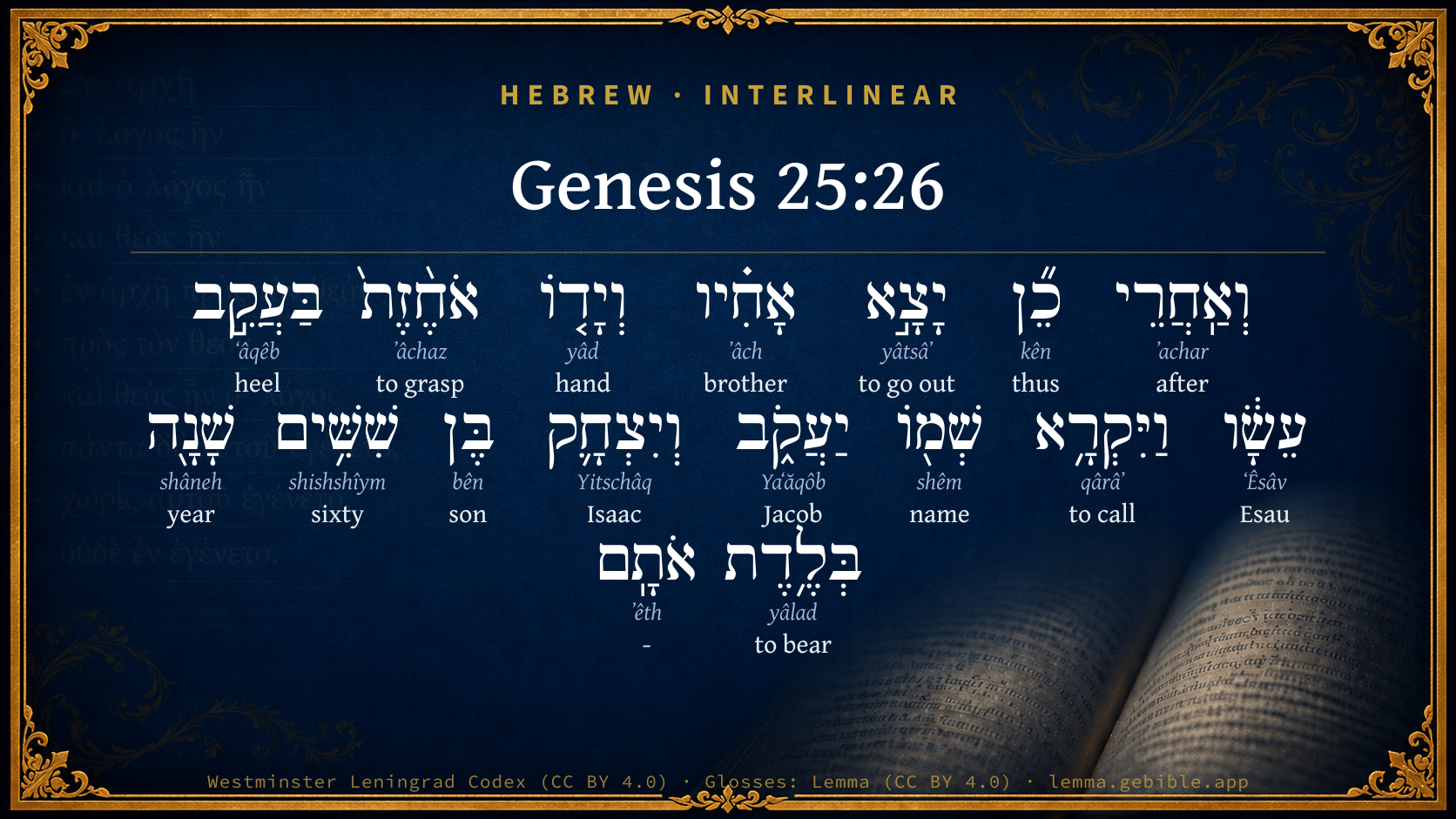
Hebrew (Westminster Leningrad Codex) Genesis 25:26 appears in the Hebrew Old Testament. The text above is from the Westminster Leningrad Codex. Each word links to its Strong’s number, a concise gloss, and parsing drawn from the Open Scriptures Hebrew Bible morphology. Click any word for its full Brown-Driver-Briggs (BDB) entry.
Download image
Cite this verse

Genesis 25:26 (World English Bible). Public Domain. Lemma interlinear Bible study tool, https://lemma.gebible.app/v/genesis/25/26.

Show BibTeX & RIS
BibTeX
RIS
English Translation
After that, his brother came out, and his hand had hold on Esau's heel. He was named Jacob. Isaac was sixty years old when she bore them.
World English Bible · Public Domain
Highlights
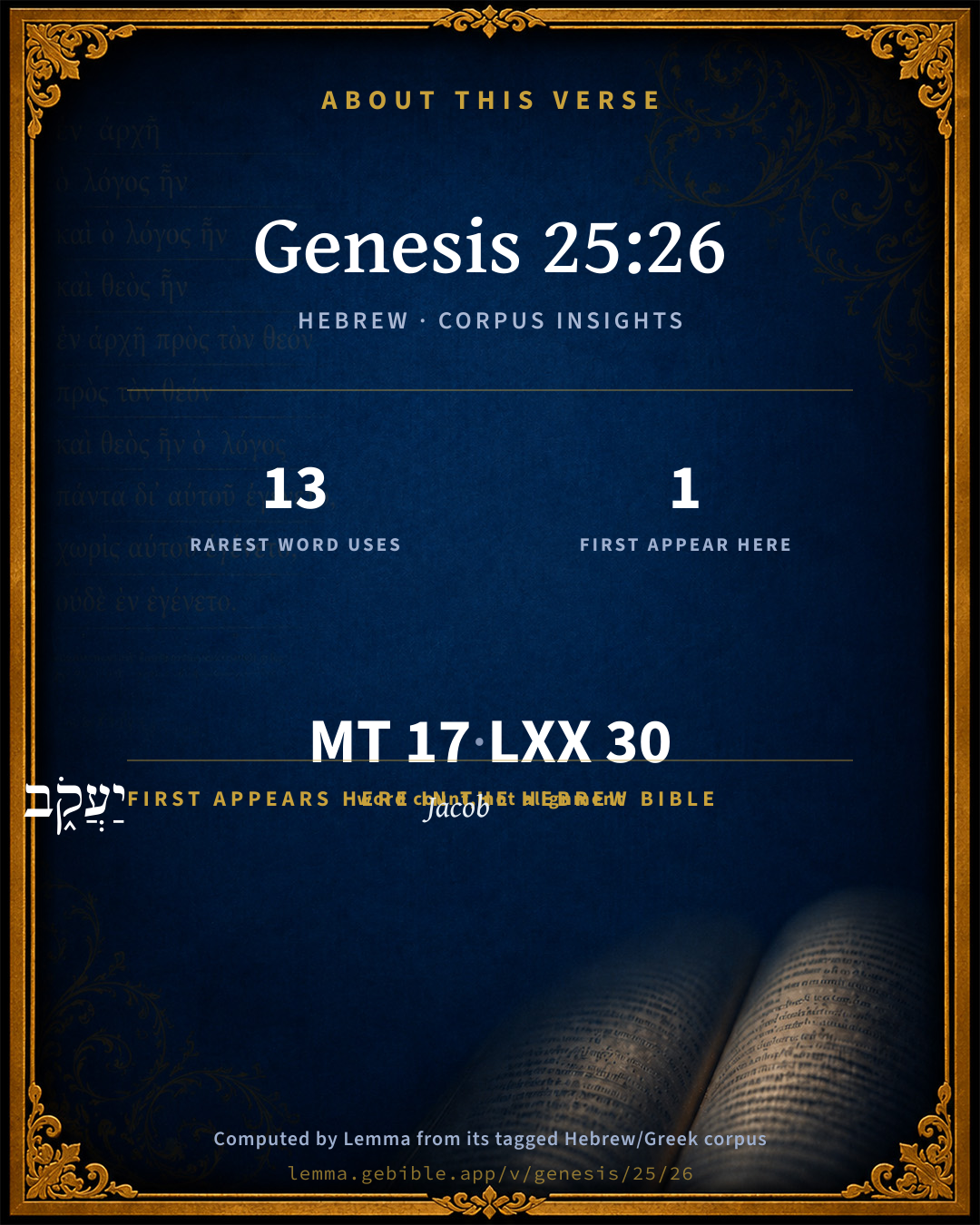
  • 1 first appearance in the Hebrew Bible
Full analysis ↓
Download a study sheet

One document with this verse’s original text, its word-by-word gloss line, the meaning frame, cross-references with their text, attributed commentary, and full source and license credits — printable, and it pastes into notes with its structure intact.

This verse Autodidact and up

Study sheet (.html) Plain text (.txt)

A passage Seminary Student

Up to 50 verses in one chapter. A passage sheet keeps up to 6 commentary sources and 12 cross-references per verse, in the order this page ranks them, and says so on the sheet whenever that leaves anything out. Ask for a single verse and you get the Autodidact verse sheet above.

Everything on this page stays free to read, with no account — the sheet is a download of what is already on screen, not access to it.

Want to remove ads? Support Godless Engineer
Compare translations 3

The same verse in 3 English versions, stacked beneath the original-language interlinear above. Click any original word for its lexicon entry.

Each is an independent rendering of the whole verse — the interlinear is not word-aligned to these translations.

Highlighted words mark where these versions differ — a whole-verse word diff, not a word-by-word alignment.

  • World English Bible Public Domain
    After that, his brother came out, and his hand had hold on Esau's heel. He was named Jacob. Isaac was sixty years old when she bore them.
  • King James Version Public Domain
    And after that came his brother out, and his hand took hold on Esau's heel; and his name was called Jacob: and Isaac was threescore years old when she bare them.
  • unfoldingWord Literal Text CC BY-SA 4.0
    Then after that, his brother came out, and his hand was grabbing on to the heel of Esau, so he called his name Jacob. And Isaac a son of sixty years when she bore them. Esau Sells His Birthright to Jacob 25:27-34

unfoldingWord Literal Text — © unfoldingWord, licensed CC BY-SA 4.0. Word-aligned USFM3 via Door43 (git.door43.org/unfoldingWord/en_ult).

Versions to compare (up to 4)

3 of 4 selected

Show all 18 translations

Every available English version of this verse, each an independent rendering of the whole verse.

  • World English Bible Public Domain
    After that, his brother came out, and his hand had hold on Esau's heel. He was named Jacob. Isaac was sixty years old when she bore them.
  • Berean Standard Bible Public Domain
    After this, his brother came out grasping Esau’s heel; so he was named Jacob. And Isaac was sixty years old when the twins were born.
  • Majority Standard Bible Public Domain
    After this, his brother came out grasping Esau’s heel; so he was named Jacob. And Isaac was sixty years old when the twins were born.
  • King James Version Public Domain
    And after that came his brother out, and his hand took hold on Esau's heel; and his name was called Jacob: and Isaac was threescore years old when she bare them.
  • American Standard Version (1901) Public Domain
    And after that came forth his brother, and his hand had hold on Esau's heel. And his name was called Jacob. And Isaac was threescore years old when she bare them.
  • Revised Version (1885) Public Domain
    And after that came forth his brother, and his hand had hold on Esau’s heel; and his name was called Jacob: and Isaac was threescore years old when she bare them.
  • Geneva Bible (1599) Public Domain
    And afterward came his brother out, and his hande helde Esau by the heele: therefore his name was called Iaakob. Nowe Izhak was threescore yeere olde when Rebekah bare them.
  • Douay-Rheims (1899) Public Domain
    Isaac was threescore years old when the children were born unto him.
  • Young's Literal Translation Public Domain
    and afterwards hath his brother come out, and his hand is taking hold on Esau's heel, and one calleth his name Jacob; and Isaac `is' a son of sixty years in her bearing them.
  • Literal Standard Version CC BY-SA 4.0
    and afterward his brother has come out, and his hand is taking hold on Esau’s heel, and one calls his name Jacob; and Isaac [is] a son of sixty years in her bearing them.
  • Unlocked Literal Bible CC BY-SA 4.0
    After that, his brother came out. His hand was grasping Esau's heel. He was called Jacob. Isaac was sixty years old when his wife bore them.
  • unfoldingWord Literal Text CC BY-SA 4.0
    Then after that, his brother came out, and his hand was grabbing on to the heel of Esau, so he called his name Jacob. And Isaac a son of sixty years when she bore them. Esau Sells His Birthright to Jacob 25:27-34
  • Darby Bible Public Domain
    And after that came his brother out; and his hand took hold of Esau's heel; and his name was called Jacob. And Isaac was sixty years old when they were born.
  • World Messianic Bible Public Domain
    After that, his brother came out, and his hand had hold on Esau’s heel. He was named Jacob. Isaac was sixty years old when she bore them.
  • Webster's Bible Public Domain
    And after that his brother was born, and his hand took hold on Esau's heel; and his name was called Jacob: and Isaac was sixty years old when she bore them.
  • Free Bible Version CC BY-SA 4.0
    Then his twin brother was born, holding on to Esau's heel. So he was named Jacob. Isaac was 60 when they were born.
  • Bible in Basic English Public Domain
    And after him, his brother came out, gripping Esau's foot; and he was named Jacob: Isaac was sixty years old when she gave birth to them.
  • JPS Tanakh (1917) Public Domain
    And after that came forth his brother, and his hand had hold on Esau's heel; and his name was called Jacob. And Isaac was threescore years old when she bore them.

Literal Standard Version (2020), Covenant Press — licensed CC BY-SA 4.0. Text via the HelloAO Bible API (eBible.org). Unlocked Literal Bible (unfoldingWord) — licensed CC BY-SA 4.0. Text via the HelloAO Bible API (eBible.org). unfoldingWord Literal Text — © unfoldingWord, licensed CC BY-SA 4.0. Word-aligned USFM3 via Door43 (git.door43.org/unfoldingWord/en_ult). Free Bible Version, Dr. Jonathan Gallagher — licensed CC BY-SA 4.0. Text via the HelloAO Bible API (eBible.org).

Word by word

More ways to search: Search by grammar → Find every occurrence → Compare this word →

Practice this passage: Drill this verse → Learn its vocabulary →

בַּעֲקֵ֣ב
ʻâqêb
H6119
“in/at · heel of”
Preposition + Noun, Common, Masculine, Singular, Construct
Part of Speech
Preposition + Noun
Type
Common
Gender
Masculine
Number
Singular
State
Construct
Full BDB Definition

Origin: from H6117

TWOT: 1676a

heel, rear, footprint, hinder part, hoof, rear of a troop, footstep - heel - mark of heel, footprint - hinder part, rear
  1. וְאַֽחֲרֵי ʼachar H310 “and · after” Conjunction + Preposition
  2. כֵ֞ן kên H3651 “thus” Adverb
  3. יָצָ֣א yâtsâʼ H3318 “to go out” Verb, Qal, Perfect, 3rd Person, Masculine, Singular
  4. אָחִ֗יו ʼâch H251 “brother · his” Noun, Common, Masculine, Singular, Construct + Suffix, Personal, 3rd Person, Masculine, Singular
  5. וְיָד֤וֹ yâd H3027 “and · hand · his” Conjunction + Noun, Common, Both, Singular, Construct + Suffix, Personal, 3rd Person, Masculine, Singular
  6. אֹחֶ֨זֶת֙ ʼâchaz H270 “grasping” Verb, Qal, Participle Active, Feminine, Singular, Absolute
  7. עֵשָׂ֔ו ʻÊsâv H6215 “Esau” Noun, Proper
  8. וַיִּקְרָ֥א qârâʼ H7121 “and · to call” Conjunction + Verb, Qal, Sequential Imperfect, 3rd Person, Masculine, Singular
  9. שְׁמ֖וֹ shêm H8034 “name · his” Noun, Common, Masculine, Singular, Construct + Suffix, Personal, 3rd Person, Masculine, Singular
  10. יַעֲקֹ֑ב Yaʻăqôb H3290 “Jacob” Noun, Proper
  11. וְיִצְחָ֛ק Yitschâq H3327 “and · Isaac” Conjunction + Noun, Proper
  12. בֶּן bên H1121 “son of” Noun, Common, Masculine, Singular, Construct
  13. שִׁשִּׁ֥ים shishshîym H8346 “sixty” Adjective, Cardinal number, Both, Plural, Absolute
  14. שָׁנָ֖ה shâneh H8141 “year” Noun, Common, Feminine, Singular, Absolute
  15. בְּלֶ֥דֶת yâlad H3205 “in/at · to bear” Preposition + Verb, Qal, Infinitive Construct
  16. אֹתָֽם ʼêth H853 “- · them” Particle, Direct Object + Suffix, Personal, 3rd Person, Masculine, Plural

About this verse

These counts appear in no published source. They are computed here, from the morphology-tagged text and Lemma’s own curated glosses. What Lemma adds →

17
words
17
distinct lemmas
Pentateuch
section

Notable vocabulary

The rarest word here is בַּעֲקֵ֣ב heel H6119 — appearing just 13 times in the whole Hebrew Bible.

First appearance in Scripture

This word makes its first canonical appearance in the Hebrew Bible here:

  • יַעֲקֹ֑ב Jacob H3290

Shared distinctive vocabulary

בַּעֲקֵ֣ב heel H6119 occurs in 13 verses of the Hebrew Bible. Also found in:

Grammatical profile

  • 4 verbs
  • 9 nouns
  • 1 adjective
  • 1 preposition
  • 1 adverb
  • 1 particle

Verb forms

  • יָצָ֣א Qal · Perfect
  • אֹחֶ֨זֶת֙ Qal · Participle Active
  • וַיִּקְרָ֥א Qal · Sequential Imperfect
  • בְּלֶ֥דֶת Qal · Infinitive Construct

Hebrew & Septuagint length

In English translation the verse runs 27 words from the Hebrew and 33 from the Septuagint (LXX English) — closely comparable.

A rough comparison of the two English renderings, which tokenize alike — not a word-level alignment.

Word counts can differ between the Hebrew and the Greek without any difference in meaning — e.g. the Hebrew direct-object marker אֵת has no separate Greek word, and Greek often adds the article ὁ.

In the original languages it is 17 Hebrew tokens and 30 Greek tokens — but the two are counted differently (Hebrew bundles its prefixes and suffixes into one token; the Greek is in lemma form), so that isn’t a like-for-like length.

Cross-references

3

Topical passages linked to Genesis 25:26 in the Treasury of Scripture Knowledge — connected by theme and wording, ordered by reader-vote popularity; previews shown in the World English Bible.

  • Genesis 27:36 He said, "Isn't he rightly named Jacob? For he has supplanted me these two times. He took away my birthright. See, now he has taken away my blessing." He said, "Haven't you reserved a blessing for me?"
  • Hosea 12:3 In the womb he took his brother by the heel; And in his manhood he had power with God.
  • Genesis 38:28–30 It happened, when she travailed, that one put out a hand: and the midwife took and tied a scarlet thread on his hand, saying, "This came out first."

Cross-references courtesy of OpenBible.info (CC BY 4.0).

Hebrew and Greek witnesses Masoretic Hebrew ↔ Greek Septuagint

The same verse in the two great witnesses to the Old Testament, shown verse-for-verse.

These are two independent witnesses, not word-aligned to each other, and the Septuagint is shown in lemma (dictionary) form.

Hebrew Genesis 25:26 Masoretic · Westminster Leningrad Codex

וְאַֽחֲרֵי כֵ֞ן יָצָ֣א אָחִ֗יו וְיָד֤וֹ אֹחֶ֨זֶת֙ בַּעֲקֵ֣ב עֵשָׂ֔ו וַיִּקְרָ֥א שְׁמ֖וֹ יַעֲקֹ֑ב וְיִצְחָ֛ק בֶּן שִׁשִּׁ֥ים שָׁנָ֖ה בְּלֶ֥דֶת אֹתָֽם

After that, his brother came out, and his hand had hold on Esau's heel. He was named Jacob. Isaac was sixty years old when she bore them.

World English Bible · Public Domain

Greek LXX Genesis 25:26 Septuagint · lemma form

καί μετά οὗτος ἐκἔρχομαι ὁ ἀδελφός αὐτός καί ὁ χείρ αὐτός ἐπιλαμβάνω ὁ πτέρνα ησαυ καί καλέω ὁ ὄνομα αὐτός ἰακώβ ισαακ δέ εἰμί ἔτος ἑξήκοντα ὅτε τίκτω αὐτός ρεβεκκα

And after this came forth his brother, and his hand took hold of the heel of Esau; and she called his name Jacob. And Isaac was sixty years old when Rebecca bore them.

LXX2012 (modern English Septuagint) · Public Domain

On this verse, The Pulpit Commentary discusses the Septuagint’s reading. Read the note in Commentary ↓

Hebrew: Westminster Leningrad Codex (CC BY 4.0). Greek: Septuagint (public domain); English from LXX2012 (modern English Septuagint) (Public Domain). How the Septuagint differs from the Hebrew →

Targum (Aramaic paraphrase)

2

The Targum is the ancient Jewish Aramaic paraphrase of the Hebrew Scriptures — an interpretive translation, not the Hebrew text itself. Onkelos (literal) and Pseudo-Jonathan (expansive) render the Torah, and Jonathan the Prophets. Coverage is partial: where no permissively-licensed English translation exists for a verse, only the Aramaic is shown. This is verse-level text, not a word-by-word alignment to the Hebrew.

  1. Targum Onkelos Torah (Genesis–Deuteronomy)
    וּבָתַר כֵּן נְפַק אֲחוּהִי וִידֵהּ אֲחִידָא בְּעִקְבָא דְעֵשָׂו וּקְרָא שְׁמֵהּ יַעֲקֹב וְיִצְחָק בַּר שִׁתִּין שְׁנִין כַּד יְלִידַת יָתְהוֹן

    (no public-domain English translation for this verse)

    Targum Onkelos — Aramaic: “Onkelos Genesis” (public domain); “Onkelos Exodus” (public domain); “Onkelos Leviticus” (public domain); “Onkelos Numbers” (public domain); “Onkelos Deuteronomy” (public domain). English: “Sefaria Community Translation” (CC0 1.0 (public-domain dedication)); “J.W. Etheridge. The Targums of Onkelos and Jonathan Ben Uzziel on the Pentateuch. London: Longmans, Green, 1862” (public domain). Text via Sefaria.

  2. Targum Pseudo-Jonathan Torah (Genesis–Deuteronomy)
    וּבָתַר כְּדֵין נְפַק אָחוֹי וִידֵיהּ אֲחִידָא בַּעֲקֵיבָא דְעֵשָו וּקְרָא שְׁמֵיהּ יַעֲקב וְיִצְחָק בַּר שִׁתִּין שְׁנִין כַּד יְלֵידַת יַתְהוֹם

    Afterward came forth his brother, and his hand had hold on the heel of Esau. And they called his name Jakob (Yaakov). And Izhak was a son of sixty years when he beget them.

    Targum Pseudo-Jonathan — Aramaic: “Targum Jonathan on Genesis” (public domain); “Targum Jonathan on Exodus” (public domain); “Targum Jonathan on Leviticus” (public domain); “Targum Jonathan on Numbers” (public domain); “Targum Jonathan on Deuteronomy” (public domain). English: “The Targum of Jonathan ben Uzziel, trans. J. W. Etheridge, London, 1862” (public domain). Text via Sefaria.

Commentary

Notes on Genesis 25:26 from classic Christian and Jewish commentators (each source and its license shown beneath its notes). The classic Christian expositions comment on the surrounding passage and are grouped to its opening verse, so a note may address several verses; the Jewish commentaries on the Tanakh (Rashi and others) are per-verse, so they appear only where the commentator wrote on this verse.

Lemma curates 59 commentaries, every one of them public domain or Creative Commons licensed, each selected and text-cleaned for this edition rather than reprinted as found. About our sources →

The Cambridge Bible for Schools and Colleges

gen. ed. J. J. S. Perowne

26. had hold … heel] As if, from the first, desirous to pull his brother, back, and get in front of him. See the reference to this passage in Hos_12:3. The character of the man was thus prefigured at birth. The idea of overreaching, or outwitting, by cunning and strategy, inspired the early Israelite with admiration and amusement rather than with repulsion.

Jacob] That is, One that takes by the heel or supplants. The Heb. for “heel” is ‘âḳêb, and the name “Jacob” was popularly regarded as having been derived from the same root, with the meaning of “one who seeks to trip up or supplant”; compare the use of the word; “supplant” in Jer_9:4. It appears as a place name = Y’ḳb’r, in Palestine, on the list of Thothmes III (c. 1450 b.c.), and as a personal name, Ya’ḳub-ilu, in a Babylonian tablet of Hammurabi’s period (c. 2100 b.c.).

threescore years old] See note on Gen_25:20 (P).

SPECIAL NOTE ON Gen_25:26

On the name “Jacob.”

The popular Israelite derivation of the name “Jacob” from the Heb. word ‘âḳêb, “a heel,” like so many other popular derivations, is simply based upon the resemblance in the sound of the proper name to a word in common use.

“It is another question,” says Driver, “whether this explanation expresses the actual meaning of the name. It has been supposed, for instance, that Jacob is really an elliptical form of Jaḳob’çl: in this case El, ‘God,’ would be the subject of the verb (like Ishmâ’çl, ‘God heareth,’ Isrâ’el, ‘God persisteth,’ Yeraḥme’çl, ‘God is compassionate’), and the word might be explained from the Arab., ‘God follows,’ or … ‘God rewards.’ In fact there is now evidence that the name is much older than the date at which, according to the Biblical narrative, Jacob must have lived. Mr Pinches has found on contract tables of the age of Khammurabi (c. 2300 b.c.) the personal name Ya‘ḳub-ilu (analogous to Yashup-ilu, Yarbi-ilu, Yamlik-ilu, Yakbar-ilu, etc., of the same age); and, according to Hommel (AHT. 203), the contracted form Yaḳubu occurs likewise. Further, in the lists of 118 places in Palestine conquered by Thothmes III (b.c. 1503–1449, Sayce and Petrie), which are inscribed on the pylons of the temple at Karnak, there occur (Nos. 78 and 102) the names Y-ša-p-’a-rḁ and Y-‘-ḳ-b-’â-rḁ. These names (the Egyp. r standing, as is well known, also for l) can be only יספאל Joseph-’çl and יעקבאל Jaḳob-’çl; and we learn consequently that places bearing these names (cf. for the form the place-names Jezre’çl, Jabne’çl, Jos_15:11 [= Jabneh, 2Ch_26:6]; Yiphtaḥ’çl, Jos_19:14; Jos_19:27; Yeḳabze’çl, Neh_11:25; Yirpe’çl, Jos_18:27) existed in Palestine, apparently in the central part, in the 15th cent. b.c. What connexion, if any, exists between these names and those of the patriarchs, may never perhaps be ascertained; but their existence at such a date in Palestine is remarkable. These facts, however, make it not improbable that (as had indeed been supposed even before their discovery) names of the type of Jacob, Joseph, Jephthah, etc., are elliptical forms of a more original Jaḳob’çl, Joseph’çl, etc. But, however that may be, to the Hebrews, as we know them, the idea which Jacob suggested, and in which it was supposed to have originated, was that of supplanter.” Driver in Art. Jacob in Hastings’ Dict. of the Bible, ii. 526.

The Cambridge Bible for Schools and Colleges (gen. ed. J. J. S. Perowne; Cambridge University Press, 1878–1918) — public domain. Text from a community e-Sword module.

Trapp's Complete Commentary

John Trapp

Gen 25:26 And after that came his brother out, and his hand took hold on Esau’s heel; and his name was called Jacob: and Isaac [was] threescore years old when she bare them.

Ver. 26. And after that came his brother out.] God could have brought Jacob out first, for it is he that "takes us out of the womb"; {Psa 22:9} but he suffereth Esau for a time to enjoy the first birthright, till his own time came to set things to rights. God "waits to be gracious; for he is a God of judgment". {Isa 30:18}

And his hand took hold on Esau’s heel.] As if he would have turned up his heels, and got to the goal before him.

And his name was called Jacob.] Calcanearius , a heel catcher, or supplanter, as he afterwards proved to Esau, who hit him also in the teeth with it. {Gen 27:36}

“Conveniunt rebus nomina saepe suis.”

And Isaac was threescore years old.] He lived twice threescore years after this, being a hundred and eighty when he died. {Gen 35:28} Five years longer he lived than his father Abraham, {Gen 25:17} being blind for the last forty. {Gen 27:1}

John Trapp, A Commentary or Exposition upon All the Books of the Old and New Testament (1647–1656) — public domain. Text from a community e-Sword module.

Joseph Benson's Commentary

Gen 25:26. His hand took hold on Esau’s heel — This signified, 1st, Jacob’s pursuit of the birthright and blessing; from the first he reached forth to have caught hold of it, and if possible to have prevented his brother. 2d, His prevailing for it at last: that, in process of time, he should gain his point. This passage is referred to, Hos 12:3, and from hence he had his name, Jacob, which means, He took him by the heel, or he supplanted.

Joseph Benson's Commentary on the Old and New Testaments (1811–1818) — public domain. Text from a community e-Sword module.

Tyndale Open Study Notes

Tyndale Open Resources

25:26 The name Jacob (Hebrew ya‘aqob, from Hebrew ‘aqeb, “heel, footprint”) was originally positive, meaning “protect” (like a rear guard), but it took on the negative meaning of “heel grabber” or “deceiver” in the context of Jacob’s deceptive, grasping, usurping character (see 27:36).

Tyndale Open Study Notes — © Tyndale Open Resources, licensed CC BY-SA 4.0. Text via the HelloAO Bible API.

Geneva Bible (1599)

Geneva Bible translators

Hos. 11:3; Matt. 1:2

Geneva Bible (1599) marginal notes — public domain. Text via Bolls.life.

Adam Clarke's Commentary

Verse 26. His name was called Jacob] יעקב Yaccob, from עקב akab, to defraud, deceive, to supplant, i.e., to overthrow a person by tripping up his heels. Hence this name was given to Jacob, because it was found he had laid hold on his brother's heel, which was emblematical of his supplanting Esau, and defrauding him of his birthright.

Adam Clarke's Commentary on the Bible (1810–1826) — public domain. Text from a community e-Sword/MySword module.

Ellicott's Commentary for English Readers

(26) His hand took hold on Esau’s heel.—Usually there is a considerable interval—an hour or more—between the birth of twins; but here Jacob appeared without delay, following immediately upon his brother. This is expressed by the metaphorical phrase that his hand had hold on Esau’s heel—that is, there was absolutely no interval between them. Though very rare, yet similar cases have been chronicled from time to time.

His name was called Jacob.—The name signifies one who follows at another’s heels. It was Esau who first put upon it a bad meaning (Gen_27:36), and this bad sense has been riveted to it by Jacob’s own unworthy conduct. It is constantly so used even in the Bible. Thus in Hos_12:3—a passage quoted in defence of a literal explanation of the metaphor in this verse by those who are acquainted only with the English Version—the Hebrew has, he Jacobed, literally, heeled—that is, overreached, got the better by cunning of—his brother in the womb. This is the very meaning put upon the name by Esau, and in Jer_9:4 and elsewhere; but it is not well rendered by our word supplant, which contains a different metaphor, the planta being the sole of the foot; whereas to be at a person’s heel is to be his determined pursuer, and one who on overtaking throws him down.

A Bible Commentary for English Readers, edited by Charles John Ellicott (1878–1897) — public domain. Text from a community e-Sword module.

John Gill's Exposition

And after that came his brother out,.... Out of his mother's womb, either by his own strength, or by the help of the midwife:

and his hand took hold on Esau's heel; to pluck him back and get out first; and this was not casual, but was so ordered in Providence, and had a meaning and mystery in it:

and his name was called Jacob; by his parents and others, and that for the above reason, because he took his brother by the heel, which his name has the signification of, and Esau has respect to in Gen 27:36,

and Isaac was threescore years old when she bare them; and so it was twenty years after he had been married to her; so long was his faith tried and exercised about the promised seed that was to spring from him.

John Gill's Exposition of the Whole Bible (1746–1763) — public domain (CC PDM 1.0). Text via the HelloAO Bible API.

Matthew Poole's English Annotations

1837 Jacob, i.e. supplanter, or one that taketh hold of or trippeth up his brother’s heels. See Gen 27:36.

Isaac was threescore years old. Thus God exercised his faith and patience twenty years, by comparing this with Gen 25:20, ere he gave him the promised blessing.

Matthew Poole's English Annotations on the Holy Bible (1683–1685) — public domain. Text from a community e-Sword/MySword module.

Whedon's Commentary on the Bible

Daniel D. Whedon

26. His hand took hold on Esau’s heel — His birth seems to have followed that of Esau more speedily than is usual in the case of twins, and his hand was so extended as to seem to grasp hold of Esau’s heel. Hence his name Jacob, heel-catcher. Compare Gen_27:36.

Threescore years old — Twenty years after the marriage of Isaac and Rebekah. Comp. Gen_25:20.

Daniel D. Whedon (gen. ed.), Commentary on the Old and New Testaments (1874–1909) — public domain. Text from a community e-Sword module.

The Pulpit Commentary

And after that came his brother out, and his hand took hold on Esau"s heel. The inf. constr, standing for the finite verb (Ewald"s "Hebrews Synt.," 304). Not simply followed close upon the heels of Esau (Kalisch), but seized Esau"s heel, as if he would trip him up (Keil, Murphy). It has been contended (De Wette, Schumann, Knobel) that such an act was impossible, a work on obstetrics by Busch maintaining that an hour commonly intervenes between the birth of twins; but practitioners of eminence who have been consulted declare the act to be distinctly possible, and indeed it is well known that "a multitude of surprising phenomena are connected with births" (Havernick), some of which are not greatly dissimilar to that which is here recorded. Delitzsch interprets the language as meaning only that the hand of Jacob reached out in the direction of his brother"s heel, as if to grasp it; but Hos_12:3 explicitly asserts that he had his brother"s heel by the hand while yet in his mother"s womb. And his name was called literally, and he (i.e. one) called his name; kailese to onoma aujtou (LXX); id circo appellavit eum. (Vulgate; cf. Gen_16:14 Gen_27:36) Jacob. Not "Successor," like the Latin secundus, from sequor (Knobel, Kalisch); but "Heel-catcher" (Rosenm Gesenius, Keil, Lange, Murphy), hence Supplanter (cf. Gen_37:36) And Isaac was threescore years old when she bare them. Literally, in the bearing of them, the inf. constr, taking the case of its verb (vide Gesenius, when she (the mother) bare them; ote eteken aujtoukka (LXX); quum nati sunt parvuli (Vulgate); though, as Rebekah"s name does not occur in the immediate context, and dly is applied to the father (Gen_4:18 Gen_10:8, Gen_10:13) as well as to the mother, the clause may be rendered when he (Isaac) begat them (Kalisch, Afford).

The Pulpit Commentary (1880–1919), ed. H.D.M. Spence-Jones & Joseph S. Exell — public domain. Text from a community e-Sword module.

John Wesley's Explanatory Notes

His hand took hold on Esau's heel - This signified,

1. Jacob's pursuit of the birth-right and blessing; from the first he reached forth to have catched hold of it, and if possible to have prevented his brother.

2. His prevailing for it at last: that in process of time he should gain his point. This passage is referred to Hosea xii, 3, and from hence he had his name Jacob, a supplanter.

John Wesley, Explanatory Notes Upon the Whole Bible (1754–1765) — public domain. Text via the GEBible commentary corpus.

Rashi

Rabbi Shlomo Yitzchaki (Rashi)

בעקב עשו ESAU’S HEEL — a sign that this one (Esau) will hardly have time to complete his period of domination before the other would rise and take it (his power) from him

ויקרא שמו יעקב AND HE CALLED HIS NAME JACOB — The Holy One, blessed be He, thus named him (Midrash Tanchuma, Shemot 4). [Some versions add: He said to them (to those who gave Esau that name cf. Genesis 5:25): You have given your first-born a name, I, too, will give my son, my firstborn, (cf. Exodus 4:23) a name. That is what is written, “And He called his name, Jacob” (Genesis 26:26).] Another explanation is: his father called him Jacob because he was grasping Esau’s heel.

בן ששים שנה THREESCORE YEARS OLD — Ten years passed from the time when he married her until she became thirteen years old and capable of child-bearing, and a further ten years he hopefully waited as his father did in regard to Sarah. When even then she did not become with child he realised that she was barren and he prayed for her. But He did not wish to take a maidservant as a second wife because he had been sanctified on Mount Moriah to be a burnt-offering without blemish.

Rashi on the Tanakh — English translations: “The Judaica Press complete Tanach with Rashi, translated by A. J. Rosenberg” (CC BY 4.0); “Pentateuch with Rashi's commentary by M. Rosenbaum and A.M. Silbermann, 1929-1934” (public domain); “The Metsudah Tanach series, Lakewood, N.J” (CC BY 4.0); and “The Book of Joshua, Metsudah Publications, 1997” (CC BY 4.0). Text via Sefaria.

Radak

Rabbi David Kimhi (Radak)

ואחרי כן...וידו אוחזת בעקב עשו, this too, was an allusion that at the end of time he would dominate Esau, as a human being dominates something matters which he grabs with his hand. The heel is the lower end of the body. It was clearly a hint from G’d concerning the future, as a normal baby does not manage to extend his hand outside the placenta and make contact with its twin.

ויקרא שמו יעקב, Yitzchok named him thus.

ויצחק בן ששים שנה, this is mentioned to let us know that Rivkah had been unable to bear a child during 20 years.

Radak on the Tanakh — English translations: “Sefaria Community Translation” (CC0 1.0 (public-domain dedication)); “Eliyahu Munk, HaChut Hameshulash” (CC BY 4.0); “Rabbi Mike Feuer, Jerusalem Anthology” (CC BY 4.0); and “R. David Kimhi on the first book of Psalms, Translated by R.G. Finch, London, 1919” (public domain). Text via Sefaria.

Lesson kit

Teaching starters — assembled from the data on this page, not authored interpretation. Every prompt links to the verse data it draws on. Edit before teaching.

Genesis, in the Pentateuch, opens this verse with 17 words (17 distinct Hebrew lemmas). Its most distinctive word is ʻâqêb (“heel”). A historical commentator’s framing appears above. Read the whole chapter for the surrounding context.

Discussion questions

  1. The word ʻâqêb carries the sense “heel.” How does it shape the verse?
  2. This is the first place “Jacob” appears in Scripture (first appears here). What does its debut here establish?
  3. How does Genesis 3:15, which shares the word «heel», read alongside this verse?
  4. These translations render this verse differently; the difference is in the English rendering, not the original. What questions does that raise?
  5. «יָצָ֣א» is a Qal Perfect verb. How does that grammatical form shape the action described?
  6. Compare how The Cambridge Bible for Schools and Colleges and Trapp's Complete Commentary read this verse. Where do they agree or differ?

Things to notice

Reading settings

Reading text

Shown beneath each verse's original-language words.

Old Testament
Old Testament edition

Read the OT as the Masoretic Hebrew (MT) or the Greek Septuagint (LXX).

English shown for the Greek Septuagint (in the Hebrew ↔ Greek comparison).

Comparing translations? Open the Compare panel on any verse page to stack up to four side by side.