Genesis 21:2

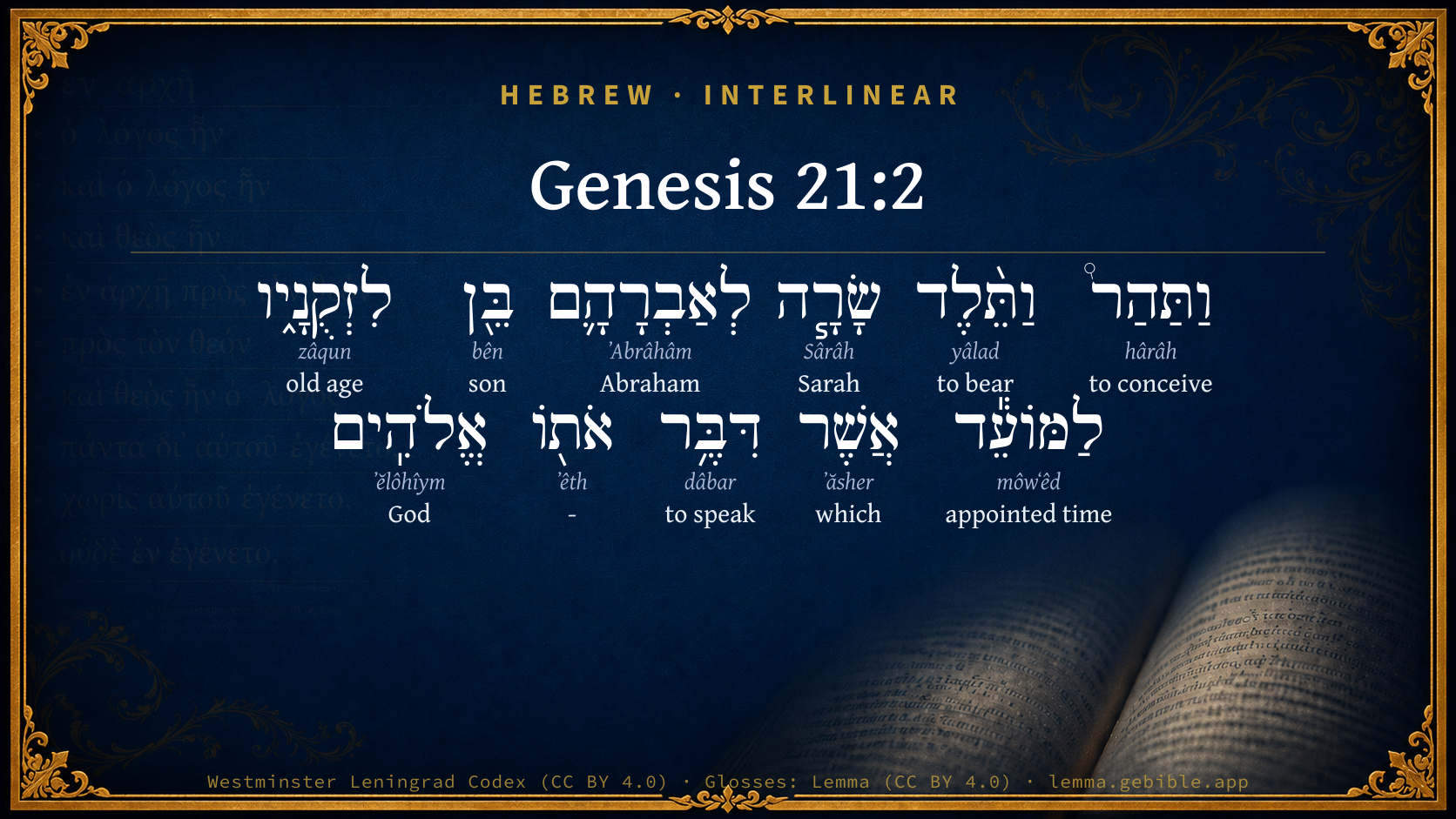
Hebrew (Westminster Leningrad Codex) Genesis 21:2 appears in the Hebrew Old Testament. The text above is from the Westminster Leningrad Codex. Each word links to its Strong’s number, a concise gloss, and parsing drawn from the Open Scriptures Hebrew Bible morphology. Click any word for its full Brown-Driver-Briggs (BDB) entry.
Download image
Cite this verse

Genesis 21:2 (World English Bible). Public Domain. Lemma interlinear Bible study tool, https://lemma.gebible.app/v/genesis/21/2.

Show BibTeX & RIS
BibTeX
RIS
English Translation
Sarah conceived, and bore Abraham a son in his old age, at the set time of which God had spoken to him.
World English Bible · Public Domain
Highlights
  • 1 first appearance in the Hebrew Bible
Full analysis ↓
Download a study sheet

One document with this verse’s original text, its word-by-word gloss line, the meaning frame, cross-references with their text, attributed commentary, and full source and license credits — printable, and it pastes into notes with its structure intact.

This verse Autodidact and up

Study sheet (.html) Plain text (.txt)

A passage Seminary Student

Up to 50 verses in one chapter. A passage sheet keeps up to 6 commentary sources and 12 cross-references per verse, in the order this page ranks them, and says so on the sheet whenever that leaves anything out. Ask for a single verse and you get the Autodidact verse sheet above.

Everything on this page stays free to read, with no account — the sheet is a download of what is already on screen, not access to it.

Want to remove ads? Support Godless Engineer
Compare translations 3

The same verse in 3 English versions, stacked beneath the original-language interlinear above. Click any original word for its lexicon entry.

Each is an independent rendering of the whole verse — the interlinear is not word-aligned to these translations.

Highlighted words mark where these versions differ — a whole-verse word diff, not a word-by-word alignment.

  • World English Bible Public Domain
    Sarah conceived, and bore Abraham a son in his old age, at the set time of which God had spoken to him.
  • King James Version Public Domain
    For Sarah conceived, and bare Abraham a son in his old age, at the set time of which God had spoken to him.
  • unfoldingWord Literal Text CC BY-SA 4.0
    so that Sarah conceived and bore a son for Abraham in his old age, at the appointed time which God had told him.

unfoldingWord Literal Text — © unfoldingWord, licensed CC BY-SA 4.0. Word-aligned USFM3 via Door43 (git.door43.org/unfoldingWord/en_ult).

Versions to compare (up to 4)

3 of 4 selected

Show all 18 translations

Every available English version of this verse, each an independent rendering of the whole verse.

  • World English Bible Public Domain
    Sarah conceived, and bore Abraham a son in his old age, at the set time of which God had spoken to him.
  • Berean Standard Bible Public Domain
    So Sarah conceived and bore a son to Abraham in his old age, at the very time God had promised.
  • Majority Standard Bible Public Domain
    So Sarah conceived and bore a son to Abraham in his old age, at the very time God had promised.
  • King James Version Public Domain
    For Sarah conceived, and bare Abraham a son in his old age, at the set time of which God had spoken to him.
  • American Standard Version (1901) Public Domain
    And Sarah conceived, and bare Abraham a son in his old age, at the set time of which God had spoken to him.
  • Revised Version (1885) Public Domain
    And Sarah conceived, and bare Abraham a son in his old age, at the set time of which God had spoken to him.
  • Geneva Bible (1599) Public Domain
    For Sarah conceiued, and bare Abraham a sonne in his olde age, at the same season that God tolde him.
  • Douay-Rheims (1899) Public Domain
    And she conceived and bore a son in her old age, at the time that God had foretold her.
  • Young's Literal Translation Public Domain
    and Sarah conceiveth, and beareth a son to Abraham, to his old age, at the appointed time that God hath spoken of with him;
  • Literal Standard Version CC BY-SA 4.0
    and Sarah conceives, and bears a son to Abraham, to his old age, at the appointed time that God has spoken of with him;
  • Unlocked Literal Bible CC BY-SA 4.0
    Sarah conceived and bore a son to Abraham in his old age, at the set time of which God had spoken to him.
  • unfoldingWord Literal Text CC BY-SA 4.0
    so that Sarah conceived and bore a son for Abraham in his old age, at the appointed time which God had told him.
  • Darby Bible Public Domain
    And Sarah conceived, and bore Abraham a son in his old age, at the appointed time of which God had spoken to him.
  • World Messianic Bible Public Domain
    Sarah conceived, and bore Abraham a son in his old age, at the set time of which God had spoken to him.
  • Webster's Bible Public Domain
    For Sarah conceived and bore Abraham a son in his old age, at the set time of which God had spoken to him.
  • Free Bible Version CC BY-SA 4.0
    She became pregnant and had a son for Abraham when he was old, at the exact time God said she would.
  • Bible in Basic English Public Domain
    And Sarah became with child, and gave Abraham a son when he was old, at the time named by God.
  • JPS Tanakh (1917) Public Domain
    And Sarah conceived, and bore Abraham a son in his old age, at the set time of which God had spoken to him.

Literal Standard Version (2020), Covenant Press — licensed CC BY-SA 4.0. Text via the HelloAO Bible API (eBible.org). Unlocked Literal Bible (unfoldingWord) — licensed CC BY-SA 4.0. Text via the HelloAO Bible API (eBible.org). unfoldingWord Literal Text — © unfoldingWord, licensed CC BY-SA 4.0. Word-aligned USFM3 via Door43 (git.door43.org/unfoldingWord/en_ult). Free Bible Version, Dr. Jonathan Gallagher — licensed CC BY-SA 4.0. Text via the HelloAO Bible API (eBible.org).

Word by word

More ways to search: Search by grammar → Find every occurrence → Compare this word →

Practice this passage: Drill this verse → Learn its vocabulary →

לִזְקֻנָ֑יו
zâqun
H2208
“to/for · old age · his”
Preposition + Noun, Common, Masculine, Plural, Construct + Suffix, Personal, 3rd Person, Masculine, Singular
Part of Speech
Preposition + Noun
Type
Common
Gender
Masculine
Number
Plural
State
Construct
Full BDB Definition

Origin: properly, passive participle of H2204 (used only in the plural as a noun)

TWOT: 574e

old age, extreme old age
  1. וַתַּהַר֩ hârâh H2029 “and · to conceive” Conjunction + Verb, Qal, Sequential Imperfect, 3rd Person, Feminine, Singular
  2. וַתֵּ֨לֶד yâlad H3205 “and · to bear” Conjunction + Verb, Qal, Sequential Imperfect, 3rd Person, Feminine, Singular
  3. שָׂרָ֧ה Sârâh H8283 “Sarah” Noun, Proper
  4. לְאַבְרָהָ֛ם ʼAbrâhâm H85 “to/for · Abraham” Preposition + Noun, Proper
  5. בֵּ֖ן bên H1121 “son” Noun, Common, Masculine, Singular, Absolute
  6. לַמּוֹעֵ֕ד môwʻêd H4150 “to/for the · appointed time” Preposition, Determined + Noun, Common, Masculine, Singular, Absolute
  7. אֲשֶׁר ʼăsher H834 “which” Particle, Relative
  8. דִּבֶּ֥ר dâbar H1696 “to speak” Verb, Piel, Perfect, 3rd Person, Masculine, Singular
  9. אֹת֖וֹ ʼêth H853 “- · him” Particle, Direct Object + Suffix, Personal, 3rd Person, Masculine, Singular
  10. אֱלֹהִֽים ʼĕlôhîym H430 “God(s)” Noun, Common, Masculine, Plural, Absolute

About this verse

These counts appear in no published source. They are computed here, from the morphology-tagged text and Lemma’s own curated glosses. What Lemma adds →

11
words
11
distinct lemmas
Pentateuch
section

Notable vocabulary

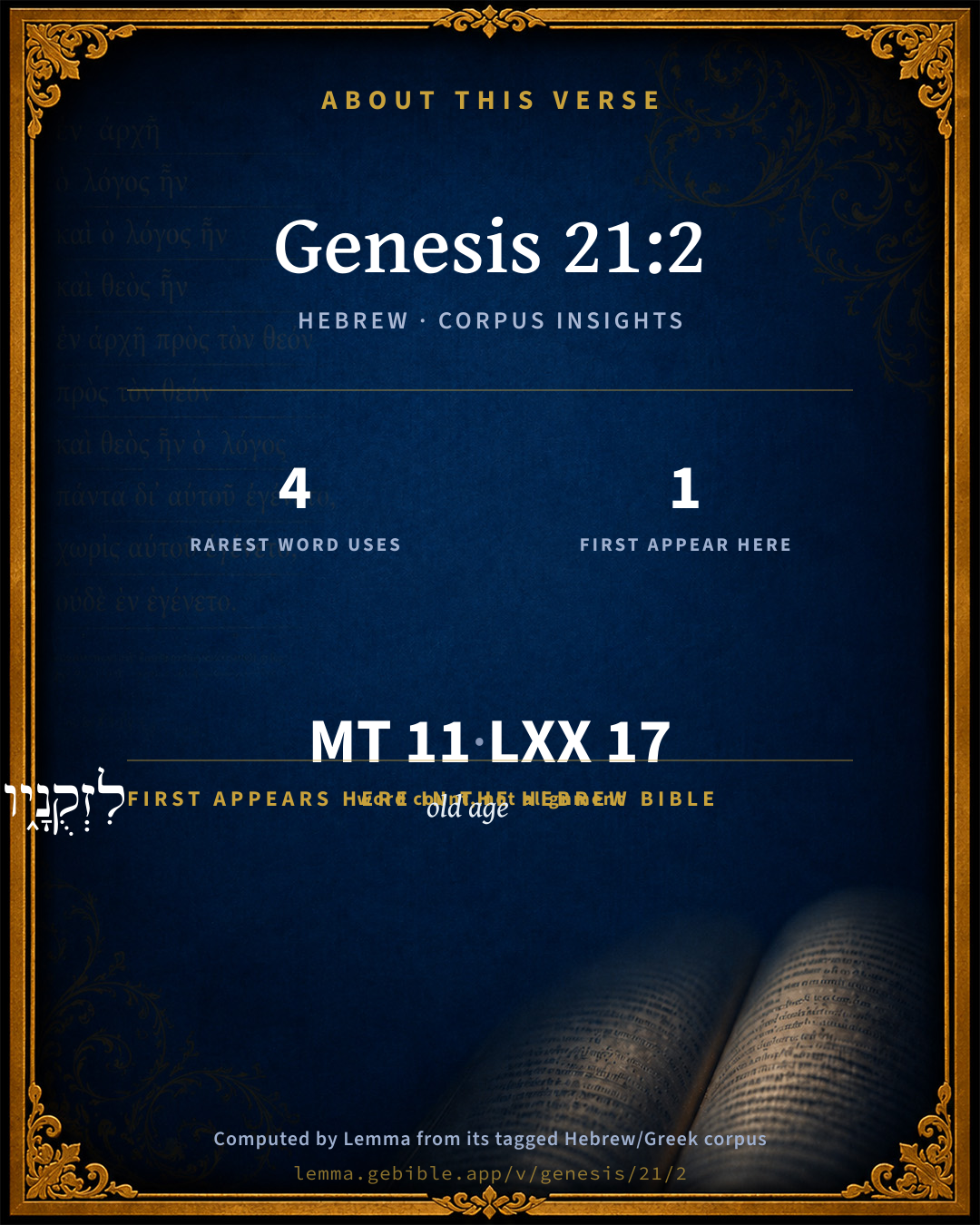
The rarest word here is לִזְקֻנָ֑יו old age H2208 — appearing just 4 times in the whole Hebrew Bible.

First appearance in Scripture

This word makes its first canonical appearance in the Hebrew Bible here:

  • לִזְקֻנָ֑יו old age H2208

Shared distinctive vocabulary

לִזְקֻנָ֑יו old age H2208 occurs in 4 verses of the Hebrew Bible. Also found in:

Grammatical profile

  • 3 verbs
  • 6 nouns
  • 2 particles

Verb forms

  • וַתַּהַר֩ Qal · Sequential Imperfect
  • וַתֵּ֨לֶד Qal · Sequential Imperfect
  • דִּבֶּ֥ר Piel · Perfect

Hebrew & Septuagint length

In English translation the verse runs 22 words from the Hebrew and 23 from the Septuagint (LXX English) — closely comparable.

A rough comparison of the two English renderings, which tokenize alike — not a word-level alignment.

Word counts can differ between the Hebrew and the Greek without any difference in meaning — e.g. the Hebrew direct-object marker אֵת has no separate Greek word, and Greek often adds the article ὁ.

In the original languages it is 11 Hebrew tokens and 17 Greek tokens — but the two are counted differently (Hebrew bundles its prefixes and suffixes into one token; the Greek is in lemma form), so that isn’t a like-for-like length.

Cross-references

11

Topical passages linked to Genesis 21:2 in the Treasury of Scripture Knowledge — connected by theme and wording, ordered by reader-vote popularity; previews shown in the World English Bible.

  • Galatians 4:22 For it is written that Abraham had two sons, one by the handmaid, and one by the free woman.
  • Hebrews 11:11 By faith, even Sarah herself received power to conceive, and she bore a child when she was past age, since she counted him faithful who had promised.
  • Genesis 17:19 God said, "No, but Sarah, your wife, will bear you a son. You shall call his name Isaac. I will establish my covenant with him for an everlasting covenant for his seed after him.
  • Genesis 17:21 But my covenant I establish with Isaac, whom Sarah will bear to you at this set time in the next year."
  • Genesis 18:10 He said, "I will certainly return to you when the season comes round. Behold, Sarah your wife will have a son." Sarah heard in the tent door, which was behind him.
  • Genesis 18:14 Is anything too hard for Yahweh? At the set time I will return to you, when the season comes round, and Sarah will have a son."
  • Luke 1:24–25 After these days Elizabeth, his wife, conceived, and she hid herself five months, saying,
  • Luke 1:36 Behold, Elizabeth, your relative, also has conceived a son in her old age; and this is the sixth month with her who was called barren.
  • Acts 7:8 He gave him the covenant of circumcision. So Abraham became the father of Isaac, and circumcised him the eighth day. Isaac became the father of Jacob, and Jacob became the father of the twelve patriarchs.
  • 2 Kings 4:16–17 He said, At this season, when the time comes round, you shall embrace a son. She said, No, my lord, you man of God, do not lie to your handmaid.
  • Romans 9:9 For this is a word of promise, "At the appointed time I will come, and Sarah will have a son."

Cross-references courtesy of OpenBible.info (CC BY 4.0).

Hebrew and Greek witnesses Masoretic Hebrew ↔ Greek Septuagint

The same verse in the two great witnesses to the Old Testament, shown verse-for-verse.

These are two independent witnesses, not word-aligned to each other, and the Septuagint is shown in lemma (dictionary) form.

Hebrew Genesis 21:2 Masoretic · Westminster Leningrad Codex

וַתַּהַר֩ וַתֵּ֨לֶד שָׂרָ֧ה לְאַבְרָהָ֛ם בֵּ֖ן לִזְקֻנָ֑יו לַמּוֹעֵ֕ד אֲשֶׁר דִּבֶּ֥ר אֹת֖וֹ אֱלֹהִֽים

Sarah conceived, and bore Abraham a son in his old age, at the set time of which God had spoken to him.

World English Bible · Public Domain

Greek LXX Genesis 21:2 Septuagint · lemma form

καί συνλαμβάνω τίκτω σαρρα ὁ αβρααμ υἱός εἰς ὁ γῆρας εἰς ὁ καιρός καθά λαλέω αὐτός κύριος

And she conceived and bore to Abraam a son in old age, at the set time according as the Lord spoke to him.

LXX2012 (modern English Septuagint) · Public Domain

On this verse, The Pulpit Commentary discusses the Septuagint’s reading. Read the note in Commentary ↓

Hebrew: Westminster Leningrad Codex (CC BY 4.0). Greek: Septuagint (public domain); English from LXX2012 (modern English Septuagint) (Public Domain). How the Septuagint differs from the Hebrew →

Targum (Aramaic paraphrase)

2

The Targum is the ancient Jewish Aramaic paraphrase of the Hebrew Scriptures — an interpretive translation, not the Hebrew text itself. Onkelos (literal) and Pseudo-Jonathan (expansive) render the Torah, and Jonathan the Prophets. Coverage is partial: where no permissively-licensed English translation exists for a verse, only the Aramaic is shown. This is verse-level text, not a word-by-word alignment to the Hebrew.

  1. Targum Onkelos Torah (Genesis–Deuteronomy)
    וְעַדִּיאַת וִילִידַת שָׂרָה לְאַבְרָהָם בַּר לְסִיבְתוֹהִי לִזְמַן דִּי מַלִּיל יָתֵהּ יְיָ

    (no public-domain English translation for this verse)

    Targum Onkelos — Aramaic: “Onkelos Genesis” (public domain); “Onkelos Exodus” (public domain); “Onkelos Leviticus” (public domain); “Onkelos Numbers” (public domain); “Onkelos Deuteronomy” (public domain). English: “Sefaria Community Translation” (CC0 1.0 (public-domain dedication)); “J.W. Etheridge. The Targums of Onkelos and Jonathan Ben Uzziel on the Pentateuch. London: Longmans, Green, 1862” (public domain). Text via Sefaria.

  2. Targum Pseudo-Jonathan Torah (Genesis–Deuteronomy)
    וְאִיתְעַבָּרַת וִילֵידַת שָרָה לְאַבְרָהָם בַּר דְדָמֵי לֵיהּ לְסֵיבְתוּ לְזִימְנָא דְמַלֵיל יָתֵיהּ יְיָ

    And she conceived, and Sarah bare to Abraham a son, who was like to himself in his age, at the time of which the Lord had spoken to him.

    Targum Pseudo-Jonathan — Aramaic: “Targum Jonathan on Genesis” (public domain); “Targum Jonathan on Exodus” (public domain); “Targum Jonathan on Leviticus” (public domain); “Targum Jonathan on Numbers” (public domain); “Targum Jonathan on Deuteronomy” (public domain). English: “The Targum of Jonathan ben Uzziel, trans. J. W. Etheridge, London, 1862” (public domain). Text via Sefaria.

Commentary

Notes on Genesis 21:2 from classic Christian and Jewish commentators (each source and its license shown beneath its notes). The classic Christian expositions comment on the surrounding passage and are grouped to its opening verse, so a note may address several verses; the Jewish commentaries on the Tanakh (Rashi and others) are per-verse, so they appear only where the commentator wrote on this verse.

Lemma curates 59 commentaries, every one of them public domain or Creative Commons licensed, each selected and text-cleaned for this edition rather than reprinted as found. About our sources →

Trapp's Complete Commentary

John Trapp

Gen 21:2 For Sarah conceived, and bare Abraham a son in his old age, at the set time of which God had spoken to him.

Ver. 2. For Sarah conceived.] By the force of her faith, though at first she faltered. {Heb 11:11}

And bare Abraham a son in his old age.] Beatae senectutis et emeritae fidei filium , as one well calleth Isaac. {a} St Paul, for this, saith he was "born after the Spirit". {Gal 4:29}

{a} Bucholcer.

John Trapp, A Commentary or Exposition upon All the Books of the Old and New Testament (1647–1656) — public domain. Text from a community e-Sword module.

Joseph Benson's Commentary

Gen 21:2. Sarah conceived — By faith Sarah received strength, (Heb 11:11,) to conceive seed, God, according to his promise, giving that strength. Abraham was old, and Sarah old, and both as good as dead, and then the promise took place.

Joseph Benson's Commentary on the Old and New Testaments (1811–1818) — public domain. Text from a community e-Sword module.

Geneva Bible (1599)

Geneva Bible translators

Therefore the miracle was greater.

Geneva Bible (1599) marginal notes — public domain. Text via Bolls.life.

John Calvin's Commentaries

2. She bare Abraham a son. This is said according to the accustomed manner of speaking; because the woman is neither the head of a family, nor brings forth properly for herself, but for her husband. What follows, however, is more worthy of notice, In his old age, at the set time, which God had predicted: for the old age of Abraham does, not a little, illustrate the glory of the miracle. And now Moses, for the third time, recalls us to the word of God, that the constancy of his truth may always be present to our minds. And though the time had been predicted, alike to Abraham and to his wife, yet this honor is expressly attributed to the holy man; because the promise had been especially given on his account. Both, however, are distinctly mentioned in the context.

John Calvin's Commentaries (1540-1563) — public domain. Text from the Calvin Translation Society English edition (1840s-50s) via the Christian Classics Ethereal Library (ccel.org). Calvin's coverage is partial (roughly two-thirds of the Bible); uncommented books and verses are honest gaps, never fabricated. The 19th-century editor's footnotes and remarks are omitted so the notes are faithfully Calvin's own voice.

The Cambridge Bible for Schools and Colleges

gen. ed. J. J. S. Perowne

2. in his old age] Cf. Gen_21:7, Gen_18:11, Gen_24:36, Gen_37:3, Gen_44:20 (al+l from J); meaning literally “to his old age.”

at the set time] Cf. Gen_17:21 (P).

It is to this verse that allusion is made in Heb_11:11, “by faith even Sarah herself received power to conceive seed, when she was past age, since she counted him faithful who had promised.”

The Cambridge Bible for Schools and Colleges (gen. ed. J. J. S. Perowne; Cambridge University Press, 1878–1918) — public domain. Text from a community e-Sword module.

John Gill's Exposition

For Sarah conceived,.... This explains what is meant by the Lord's visiting her, and doing to her according to his word, see Heb 11:11,

and bare Abraham a son in his old age; which circumstance is remarked, that the favour might appear the greater, and the more wonderful; or, "unto", or "for his old age" (n), for the comfort of him in his old age, who having lived so many years under the promise of a son, and in the expectation of one, even of the promised seed, from whom the Messiah should spring, now has one, than which nothing could yield him greater consolation:

at the set time of which God had spoken to him, Gen 17:21; God was not only faithful in fulfilling his promise, but in keeping the exact time of it.

(n) "pro senectute ejus", Vatablus; "senectuti ejus", Junius & Tremellius.

John Gill's Exposition of the Whole Bible (1746–1763) — public domain (CC PDM 1.0). Text via the HelloAO Bible API.

Matthew Poole's English Annotations

In his old age, or, for his old age, i.e. for the comfort of his old age.

Matthew Poole's English Annotations on the Holy Bible (1683–1685) — public domain. Text from a community e-Sword/MySword module.

Whedon's Commentary on the Bible

Daniel D. Whedon

2. At the set time — See Gen_17:21.

Daniel D. Whedon (gen. ed.), Commentary on the Old and New Testaments (1874–1909) — public domain. Text from a community e-Sword module.

The Pulpit Commentary

For Sarah conceived, through faith receiving strength from God for that purpose; (Heb_11:11) the fruit of the womb, in every instance God"s handiwork, (Isa_44:2) being in her case a special gift of grace and product of Divine powerand bare the usual construction (Gen_29:32 Gen_30:5) is here somewhat modified by the Jehovist (Kalisch); but the clause may be compared with Gen_30:22, Gen_30:23, commonly assigned to the ElohlstAbraham (literally, to Abraham) a son in his old age, literally, to his old age; eijv to ghrav (LXX)at the set time (vide Gen_17:21 Gen_18:10, Gen_18:14) of which God had spoken to him. God"s word gave Abraham strength to beget, Sarah to conceive, and Isaac to come forth. Three times repeated in two verses, the clause points to the supernatural character of Isaac"s birth.

The Pulpit Commentary (1880–1919), ed. H.D.M. Spence-Jones & Joseph S. Exell — public domain. Text from a community e-Sword module.

John Wesley's Explanatory Notes

Sarah conceived - Sarah by faith, received strength to conceive, Heb. xi, 11. God therefore, by promise, gave that strength. Abraham was old, and Sarah old, and both as good as dead, and then the word of God took place.

John Wesley, Explanatory Notes Upon the Whole Bible (1754–1765) — public domain. Text via the GEBible commentary corpus.

Rashi

Rabbi Shlomo Yitzchaki (Rashi)

למועד אשר דבר אתו Render it as Onkelos translates: “At the appointed time which He had spoken: — the time He had said and appointed. When He had said to him (18:4) “At the set time I will return unto thee”, He scratched a mark in the wall and said to him (Genesis 53:6), “When the sunrays touch this mark next year she will bear a son” (Yalkut Shimoni on Torah 59:1).

Rashi on the Tanakh — English translations: “The Judaica Press complete Tanach with Rashi, translated by A. J. Rosenberg” (CC BY 4.0); “Pentateuch with Rashi's commentary by M. Rosenbaum and A.M. Silbermann, 1929-1934” (public domain); “The Metsudah Tanach series, Lakewood, N.J” (CC BY 4.0); and “The Book of Joshua, Metsudah Publications, 1997” (CC BY 4.0). Text via Sefaria.

Radak

Rabbi David Kimhi (Radak)

ותהר, seeing that the conception had not been mentioned in the previous verse, the Torah now reports conception and birth as if it had been a consecutive activity. We find a similar construction in Genesis 4,1 ותהר ותלד את קין, “Chavah conceived and gave birth to Kayin.”

לאברהם, as G’d had said “אשר תלד לך שרה,” “whom Sarah will bear for you.” This is a customary form of syntax, as for instance in 16,15 ותלד הגר לאברהם בן, or Exodus 21,4 וילדה לו בנים ובנות, and many similar examples. A woman is considered similar to the earth in this respect, i.e. just as the earth yields fruit for its owners, so a woman produces children for her husband after he had planted his seed in her. The child was named after its father.

לזקוניו, the Torah writes this so that we better understand why Sarah had laughed when she had heard the prophecy in 18,12 and had said that her husband was too old to sire children. Another reason for the expression לזקוניו is to inform us that whereas Sarah had regained her youth at that time and had ovulated again after having ceased to do so for many years, Araham did not experience any rejuvenation, but sired a child in spite of not shedding signs of old age. There are some words in the Hebrew language which always appear in the plural mode, זקונים is one of them, so are נעורים and בתולים.

אשר דבר אותו, the word אותו here is the same as if the Torah had written עמו, “with him.”

Radak on the Tanakh — English translations: “Sefaria Community Translation” (CC0 1.0 (public-domain dedication)); “Eliyahu Munk, HaChut Hameshulash” (CC BY 4.0); “Rabbi Mike Feuer, Jerusalem Anthology” (CC BY 4.0); and “R. David Kimhi on the first book of Psalms, Translated by R.G. Finch, London, 1919” (public domain). Text via Sefaria.

Lesson kit

Teaching starters — assembled from the data on this page, not authored interpretation. Every prompt links to the verse data it draws on. Edit before teaching.

Genesis, in the Pentateuch, opens this verse with 11 words (11 distinct Hebrew lemmas). Its most distinctive word is zâqun (“old age”). A historical commentator’s framing appears above. Read the whole chapter for the surrounding context.

Discussion questions

  1. How does “old age” (zâqun) shape what this verse is saying?
  2. This is the first place “old age” appears in Scripture (first appears here). What does its debut here establish?
  3. How does Genesis 21:7, which shares the word «old age», read alongside this verse?
  4. The translations on this page render this verse differently — a whole-verse word diff, not a word-by-word alignment. What might account for the different wordings?
  5. «וַתַּהַר֩» is a Qal Sequential Imperfect verb. How does that grammatical form shape the action described?
  6. Compare how Trapp's Complete Commentary and Joseph Benson's Commentary read this verse. Where do they agree or differ?

Things to notice

Reading settings

Reading text

Shown beneath each verse's original-language words.

Old Testament
Old Testament edition

Read the OT as the Masoretic Hebrew (MT) or the Greek Septuagint (LXX).

English shown for the Greek Septuagint (in the Hebrew ↔ Greek comparison).

Comparing translations? Open the Compare panel on any verse page to stack up to four side by side.