
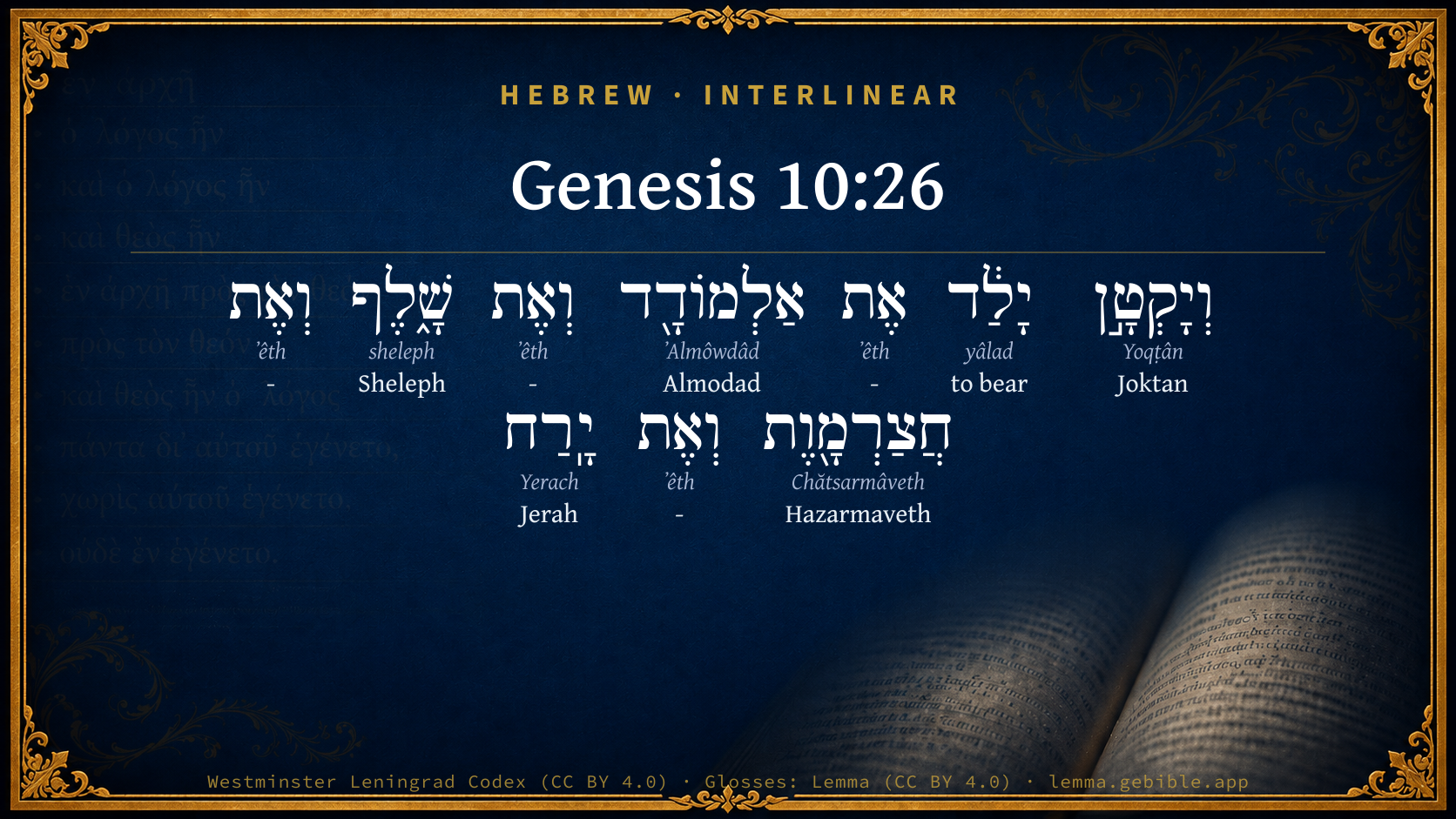
Genesis 10:26

Hebrew (Westminster Leningrad Codex) Genesis 10:26 appears in the Hebrew Old Testament. The text above is from the Westminster Leningrad Codex. Each word links to its Strong’s number, a concise gloss, and parsing drawn from the Open Scriptures Hebrew Bible morphology. Click any word for its full Brown-Driver-Briggs (BDB) entry.
Download image
Cite this verse

Genesis 10:26 (World English Bible). Public Domain. Lemma interlinear Bible study tool, https://lemma.gebible.app/v/genesis/10/26.

Show BibTeX & RIS
BibTeX
RIS
English Translation
Joktan became the father of Almodad, Sheleph, Hazarmaveth, Jerah,
World English Bible · Public Domain
Highlights
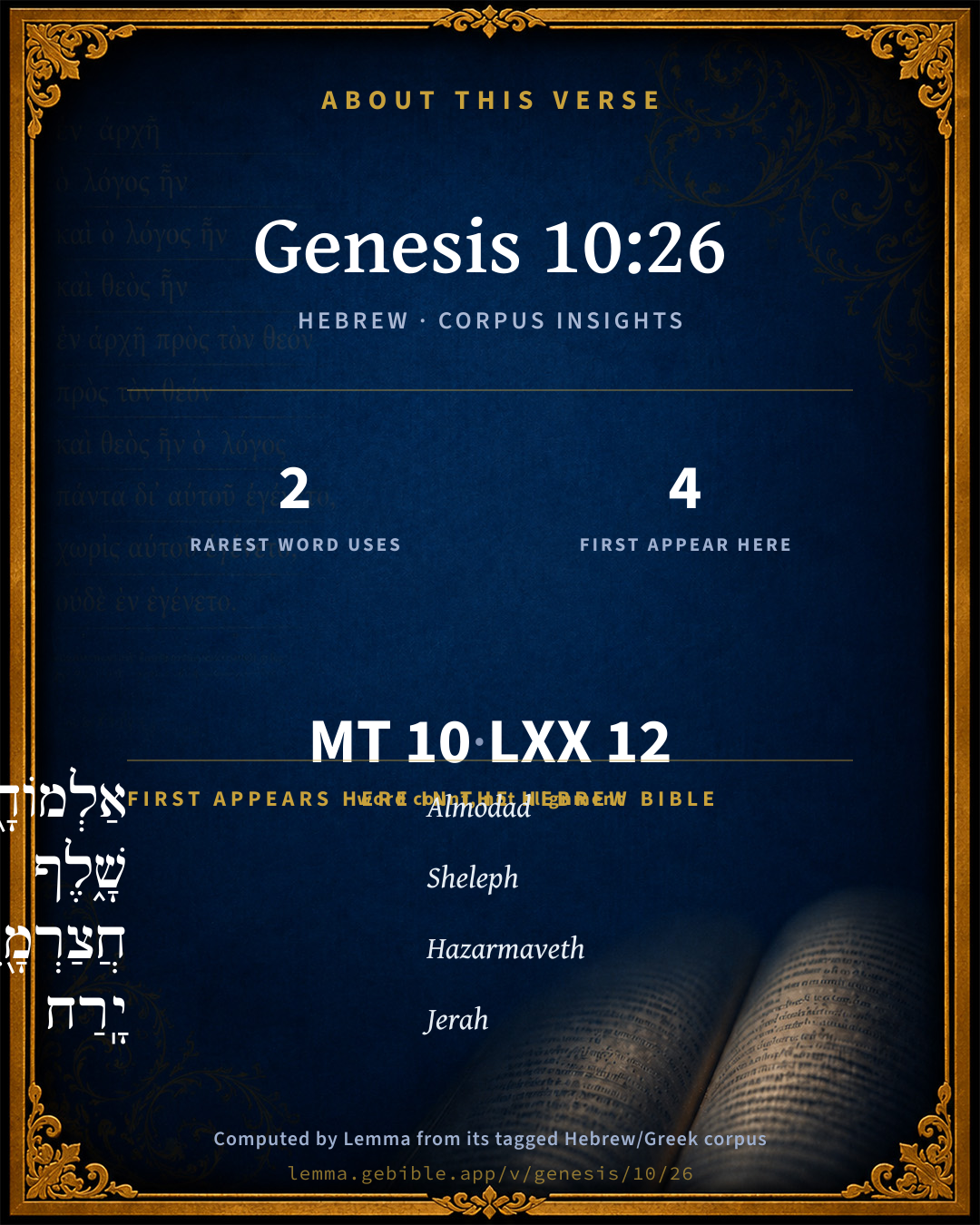
  • 4 first appearances in the Hebrew Bible
Full analysis ↓
Download a study sheet

One document with this verse’s original text, its word-by-word gloss line, the meaning frame, cross-references with their text, attributed commentary, and full source and license credits — printable, and it pastes into notes with its structure intact.

This verse Autodidact and up

Study sheet (.html) Plain text (.txt)

A passage Seminary Student

Up to 50 verses in one chapter. A passage sheet keeps up to 6 commentary sources and 12 cross-references per verse, in the order this page ranks them, and says so on the sheet whenever that leaves anything out. Ask for a single verse and you get the Autodidact verse sheet above.

Everything on this page stays free to read, with no account — the sheet is a download of what is already on screen, not access to it.

Want to remove ads? Support Godless Engineer
Compare translations 3

The same verse in 3 English versions, stacked beneath the original-language interlinear above. Click any original word for its lexicon entry.

Each is an independent rendering of the whole verse — the interlinear is not word-aligned to these translations.

Highlighted words mark where these versions differ — a whole-verse word diff, not a word-by-word alignment.

  • World English Bible Public Domain
    Joktan became the father of Almodad, Sheleph, Hazarmaveth, Jerah,
  • King James Version Public Domain
    And Joktan begat Almodad, and Sheleph, and Hazarmaveth, and Jerah,
  • unfoldingWord Literal Text CC BY-SA 4.0
    And Joktan fathered Almodad and Sheleph and Hazarmaveth and Jerah

unfoldingWord Literal Text — © unfoldingWord, licensed CC BY-SA 4.0. Word-aligned USFM3 via Door43 (git.door43.org/unfoldingWord/en_ult).

Versions to compare (up to 4)

3 of 4 selected

Show all 18 translations

Every available English version of this verse, each an independent rendering of the whole verse.

  • World English Bible Public Domain
    Joktan became the father of Almodad, Sheleph, Hazarmaveth, Jerah,
  • Berean Standard Bible Public Domain
    And Joktan was the father of Almodad, Sheleph, Hazarmaveth, Jerah,
  • Majority Standard Bible Public Domain
    And Joktan was the father of Almodad, Sheleph, Hazarmaveth, Jerah,
  • King James Version Public Domain
    And Joktan begat Almodad, and Sheleph, and Hazarmaveth, and Jerah,
  • American Standard Version (1901) Public Domain
    And Joktan begat Almodad, and Sheleph, and Hazarmaveth, and Jerah,
  • Revised Version (1885) Public Domain
    And Joktan begat Almodad, and Sheleph, and Hazarmaveth, and Jerah;
  • Geneva Bible (1599) Public Domain
    Then Ioktan begate Almodad and Sheleph, and Hazarmaueth, and Ierah,
  • Douay-Rheims (1899) Public Domain
    Which Jectan begot Elmodad, and Saleph, and Asarmoth, Jare,
  • Young's Literal Translation Public Domain
    And Joktan hath begotten Almodad, and Sheleph, and Hazarmaveth, and Jerah,
  • Literal Standard Version CC BY-SA 4.0
    And Joktan has begotten Almodad, and Sheleph, and Hazarmaveth, and Jerah,
  • Unlocked Literal Bible CC BY-SA 4.0
    Joktan became the father of Almodad, Sheleph, Hazarmaveth, Jerah,
  • unfoldingWord Literal Text CC BY-SA 4.0
    And Joktan fathered Almodad and Sheleph and Hazarmaveth and Jerah
  • Darby Bible Public Domain
    And Joktan begot Almodad, and Sheleph, and Hazarmaveth, and Jerah,
  • World Messianic Bible Public Domain
    Joktan became the father of Almodad, Sheleph, Hazarmaveth, Jerah,
  • Webster's Bible Public Domain
    And Joktan begat Almodad, and Sheleph, and Hazarmaveth, and Jerah,
  • Free Bible Version CC BY-SA 4.0
    Joktan was the father of Almodad, Sheleph, Hazarmaveth, Jerah,
  • Bible in Basic English Public Domain
    And Joktan was the father of Almodad and Sheleph and Hazarmaveth and Jerah
  • JPS Tanakh (1917) Public Domain
    And Joktan begot Almodad, and Sheleph, and Hazarmaveth, and Jerah;

Literal Standard Version (2020), Covenant Press — licensed CC BY-SA 4.0. Text via the HelloAO Bible API (eBible.org). Unlocked Literal Bible (unfoldingWord) — licensed CC BY-SA 4.0. Text via the HelloAO Bible API (eBible.org). unfoldingWord Literal Text — © unfoldingWord, licensed CC BY-SA 4.0. Word-aligned USFM3 via Door43 (git.door43.org/unfoldingWord/en_ult). Free Bible Version, Dr. Jonathan Gallagher — licensed CC BY-SA 4.0. Text via the HelloAO Bible API (eBible.org).

Word by word

More ways to search: Search by grammar → Find every occurrence → Compare this word →

Practice this passage: Drill this verse → Learn its vocabulary →

About this verse

These counts appear in no published source. They are computed here, from the morphology-tagged text and Lemma’s own curated glosses. What Lemma adds →

10
words
7
distinct lemmas
Pentateuch
section

Notable vocabulary

The rarest word here is אַלְמוֹדָ֖ד Almodad H486 — appearing just 2 times in the whole Hebrew Bible.

First appearance in Scripture

These words make their first canonical appearance in the Hebrew Bible here:

  • אַלְמוֹדָ֖ד Almodad H486
  • שָׁ֑לֶף Sheleph H8026
  • חֲצַרְמָ֖וֶת Hazarmaveth H2700
  • יָֽרַח Jerah H3392

Shared distinctive vocabulary

אַלְמוֹדָ֖ד Almodad H486 occurs in 2 verses of the Hebrew Bible. Also found in:

Grammatical profile

  • 1 verb
  • 5 nouns
  • 4 particles

Verb forms

  • יָלַ֔ד Qal · Perfect

Hebrew & Septuagint length

In English translation the verse runs 9 words from the Hebrew and 10 from the Septuagint (LXX English) — closely comparable.

A rough comparison of the two English renderings, which tokenize alike — not a word-level alignment.

Word counts can differ between the Hebrew and the Greek without any difference in meaning — e.g. the Hebrew direct-object marker אֵת has no separate Greek word, and Greek often adds the article ὁ.

In the original languages it is 10 Hebrew tokens and 12 Greek tokens — but the two are counted differently (Hebrew bundles its prefixes and suffixes into one token; the Greek is in lemma form), so that isn’t a like-for-like length.

Cross-references

1

Topical passages linked to Genesis 10:26 in the Treasury of Scripture Knowledge — connected by theme and wording, ordered by reader-vote popularity; previews shown in the World English Bible.

Cross-references courtesy of OpenBible.info (CC BY 4.0).

Hebrew and Greek witnesses Masoretic Hebrew ↔ Greek Septuagint

The same verse in the two great witnesses to the Old Testament, shown verse-for-verse.

These are two independent witnesses, not word-aligned to each other, and the Septuagint is shown in lemma (dictionary) form.

Hebrew Genesis 10:26 Masoretic · Westminster Leningrad Codex

וְיָקְטָ֣ן יָלַ֔ד אֶת אַלְמוֹדָ֖ד וְאֶת שָׁ֑לֶף וְאֶת חֲצַרְמָ֖וֶת וְאֶת יָֽרַח

Joktan became the father of Almodad, Sheleph, Hazarmaveth, Jerah,

World English Bible · Public Domain

Greek LXX Genesis 10:26 Septuagint · lemma form

ιεκταν δέ γεννάω ὁ ελμωδαδ καί ὁ σαλεφ καί ασαρμωθ καί ιαραχ

And Jektan begot Elmodad, and Saleth, and Sarmoth, and Jarach,

LXX2012 (modern English Septuagint) · Public Domain

Hebrew: Westminster Leningrad Codex (CC BY 4.0). Greek: Septuagint (public domain); English from LXX2012 (modern English Septuagint) (Public Domain). How the Septuagint differs from the Hebrew →

Targum (Aramaic paraphrase)

2

The Targum is the ancient Jewish Aramaic paraphrase of the Hebrew Scriptures — an interpretive translation, not the Hebrew text itself. Onkelos (literal) and Pseudo-Jonathan (expansive) render the Torah, and Jonathan the Prophets. Coverage is partial: where no permissively-licensed English translation exists for a verse, only the Aramaic is shown. This is verse-level text, not a word-by-word alignment to the Hebrew.

  1. Targum Onkelos Torah (Genesis–Deuteronomy)
    וְיָקְטָן אוֹלִיד יָת אַלְמוֹדָד וְיָת שָׁלֶף וְיָת חֲצַרְמָוֶת וְיָת יָרַח

    And Yoktan begat Almodad, and Shaleph, and Chatsarmaveth, and Yarech,

    Targum Onkelos — Aramaic: “Onkelos Genesis” (public domain); “Onkelos Exodus” (public domain); “Onkelos Leviticus” (public domain); “Onkelos Numbers” (public domain); “Onkelos Deuteronomy” (public domain). English: “Sefaria Community Translation” (CC0 1.0 (public-domain dedication)); “J.W. Etheridge. The Targums of Onkelos and Jonathan Ben Uzziel on the Pentateuch. London: Longmans, Green, 1862” (public domain). Text via Sefaria.

  2. Targum Pseudo-Jonathan Torah (Genesis–Deuteronomy)
    וְיָקְטָן אוֹלִיד יַת אַלְמוֹדָד דִמָשַׁח יַת אַרְעָא בְּאַשַׁלְוָן וְיַת שָׁלֶף דְשָׁלֶף מוֹי דְנַהַרְוָותָא וְיַת חַצַרְמָוֶת וְיַת יָרַח

    And Joktan begat Elmodad, who measured (or lined) the earth with lines; and Shaleph, who led forth the waters of rivers, and Chatsarmaveth, and Jarach, and

    Targum Pseudo-Jonathan — Aramaic: “Targum Jonathan on Genesis” (public domain); “Targum Jonathan on Exodus” (public domain); “Targum Jonathan on Leviticus” (public domain); “Targum Jonathan on Numbers” (public domain); “Targum Jonathan on Deuteronomy” (public domain). English: “The Targum of Jonathan ben Uzziel, trans. J. W. Etheridge, London, 1862” (public domain). Text via Sefaria.

Commentary

Notes on Genesis 10:26 from classic Christian and Jewish commentators (each source and its license shown beneath its notes). The classic Christian expositions comment on the surrounding passage and are grouped to its opening verse, so a note may address several verses; the Jewish commentaries on the Tanakh (Rashi and others) are per-verse, so they appear only where the commentator wrote on this verse.

Lemma curates 59 commentaries, every one of them public domain or Creative Commons licensed, each selected and text-cleaned for this edition rather than reprinted as found. About our sources →

Trapp's Complete Commentary

John Trapp

Gen 10:26 And Joktan begat Almodad, and Sheleph, and Hazarmaveth, and Jerah,

Ver. 26. Joktan begat Almodad, &c.] This man with his sons may seem to have seated in the East Indies; but, fallen from Heber’s faith to heathenism, they are written in the dust: there is little mention of them in the Scriptures. They have lost their genealogy, as those degenerate priests, who in the time of the captivity took scorn to be in the register, and were therefore worthily afterwards rejected by the Tirshatha. {Ezr 2:62-63}

John Trapp, A Commentary or Exposition upon All the Books of the Old and New Testament (1647–1656) — public domain. Text from a community e-Sword module.

Tyndale Open Study Notes

Tyndale Open Resources

10:26-32 There were fourteen sons of Shem by Eber through Joktan. The placement of the Babel story between the lines of Joktan and Peleg ties Joktan to the judgment of the Babel story (11:1-9) and ties Peleg to Abram (11:27–12:1).

10:26-29 Almodad was an ancestor, region, or tribe in modern Yemen. • Sheleph was a tribe of Yemen. • Hazarmaveth was related to Hadramaut in southern Arabia. • Jerah is unknown, but was possibly associated with Mount Barach. • Hadoram was an Arabian tribe. • Uzal was Sana’a, an old capital of Yemen in pre-Islamic times. • Diklah was a southern Arabian oasis in Mina. • Obal was between Hodeida and Sana’a in southwest Arabia. • Abimael was a Sabaean. • Sheba was in southern Arabia (see 10:7). • Ophir was a region of southern Arabia between Sheba and Havilah; it was a source of gold (Isa 13:12). • Havilah: See 10:7. • Jobab was possibly Jobebitai in southern Arabia.

Tyndale Open Study Notes — © Tyndale Open Resources, licensed CC BY-SA 4.0. Text via the HelloAO Bible API.

Adam Clarke's Commentary

Verse 26. - 30. Joktan] He had thirteen sons who had their dwelling from Mesha unto Sephar, a mount of the east, which places Calmet supposes to be mount Masius, on the west in Mesopotamia, and the mountains of the Saphirs on the east in Armenia, or of the Tapyrs farther on in Media.

In confirmation that all men have been derived from one family, let it be observed that there are many customs and usages, both sacred and civil, which have prevailed in all parts of the world; and that these could owe their origin to nothing but a general institution, which could never have existed, had not mankind been originally of the same blood, and instructed in the same common notions before they were dispersed. Among these usages may be reckoned,

1. The numbering by tens.

2. Their computing time by a cycle of seven days.

3. Their setting apart the seventh day for religious purposes.

4. Their use of sacrifices, propitiatory and eucharistical.

5. The consecration of temples and altars.

6. The institution of sanctuaries or places of refuge, and their privileges.

7. Their giving a tenth part of the produce of their fields, c., for the use of the altar.

8. The custom of worshipping the Deity bare-footed.

9. Abstinence of the men from all sensual gratifications previously to their offering sacrifice.

10. The order of priesthood and its support.

11. The notion of legal pollutions, defilements, &c.

12. The universal tradition of a general deluge.

13. The universal opinion that the rainbow was a Divine sign, or portent, &c., &c.

See Dodd.

The wisdom and goodness of God are particularly manifested in repeopling the earth by means of three persons, all of the same family, and who had witnessed that awful display of Divine justice in the destruction of the world by the flood, while themselves were preserved in the ark. By this very means the true religion was propagated over the earth for the sons of Noah would certainly teach their children, not only the precepts delivered to their father by God himself, but also how in his justice he had brought the flood on the world of the ungodly, and by his merciful providence preserved them from the general ruin. It is on this ground alone that we can account for the uniformity and universality of the above traditions, and for the grand outlines of religious truth which are found in every quarter of the world. God has so done his marvellous works that they may be had in everlasting remembrance.

Adam Clarke's Commentary on the Bible (1810–1826) — public domain. Text from a community e-Sword/MySword module.

Ellicott's Commentary for English Readers

(26-31) Joktan.—“The little one,” as being a younger son. Of the thirteen divisions of his family, few are of any importance, though several of the names are curious from their connection with the Arabic language. The Joktanite country was Arabia Felix, or Yemen, and as the people led a pastoral life without founding cities, the traces of their tribal names are insignificant. Those worth noting are Almodad, because it has the full form of the article, retained as Al in Arabic, but shortened in Hebrew into Ha. Hazarmaveth, “the court of death,” so called because of the unhealthiness of its climate, is now Hadramaut. Abimael means “the father of Mael.” While in Hebrew and Syriac men took the name of their father, in Arabic they often take the name of a son, with Abu or Abi (“father of”) prefixed. Sheba, the region afterwards famous for its commerce and its wealth of spices and precious stones. A Sheba also occurs among the race of Ham (see Gen_10:7). Opbir: the name, probably, at first of a district of Oman in Arabia, but afterwards given to some port in India or Ceylon, from some fancied similarity. Havilah: some commentators consider that this is the same district as that previously occupied by the Cushites (Gen_10:7); others argue that the two Havilahs are distinct, and that this is the region called Chawlân, in Northern Yemen. It is, however, certain that the Hamites possessed this country prior to its being occupied by the Joktanites.

A Bible Commentary for English Readers, edited by Charles John Ellicott (1878–1897) — public domain. Text from a community e-Sword module.

The Cambridge Bible for Schools and Colleges

gen. ed. J. J. S. Perowne

26. Hazarmaveth] This name is very probably reproduced in the district of S. E. Arabia called the Ḥadramaut.

The Cambridge Bible for Schools and Colleges (gen. ed. J. J. S. Perowne; Cambridge University Press, 1878–1918) — public domain. Text from a community e-Sword module.

John Gill's Exposition

And Joktan begat Almodad,.... And twelve more mentioned later: the Arabic writers (o) say be had thirty one sons by one woman, but all, excepting two, left Arabia, and settled in India; the Targum of Jonathan adds,"who measured the earth with ropes,''as if he was the first inventor and practiser of geometry: from him are thought to spring the Allumaeotae, a people whom Ptolemy (p) places in Arabia Felix, called so by the Greeks, instead of Almodaei: Mr. Broughton (q) sets Eldimaei over against this man's name, as if they were a people that sprung from him; whereas this word is wrongly put in Ptolemy (r) for Elymaeans, as it is in the Greek text, a people joining to the Persians:

and Sheleph and Hazarmaveth, and Jerah: to the first of these, Sheleph, the Targum of Jonathan adds,"who drew out the water of the rivers;''his people are supposed by Bochart (s), to be the Alapeni of Ptolemy (t), which should be read Salapeni, who were, he says, more remote from the rest, almost as far as the neck of Arabia, and not far from the spring of the river Betius. The next son, Hazarmaveth, or Hasermoth, as in the Vulgate Latin, is thought to give name to a people in Arabia, called by Pliny (u) Chatramotitae, and by Ptolemy Cathramonitae, whose country, Strabo says (w), produces myrrh; according to Ptolemy (x) they reached from the mountain Climax to the Sabaeans, among whom were a people, called, by Pliny (y), Atramitae, who inhabited a place of the same name, and which Theophrastus calls Adramyta, which comes nearer the name of this man, and signifies the court or country of death: and in those parts might be places so called, partly from the unwholesomeness of the air, being thick and foggy, and partly from the frankincense which grew there, which was fatal to those that gathered it, and therefore only the king's slaves, and such as were condemned to die, were employed in it, as Bochart (z) has observed from Arrianus; as also because of the multitude of serpents, with which those odoriferous countries abounded, as the same writer relates from Agatharcides and Pliny. The next son of Joktan is Jerah, which signifies the moon, as Hilal does in Arabic; and Alilat with the Arabians, according to Herodotus (a), is "Urania", or the moon; hence Bochart (b) thinks, that the Jeracheans, the posterity of Jerah, are the Alilaeans of Diodorus Siculus (c), and others, a people of the Arabs; and the Arabic geographer, as he observes, makes mention of a people near Mecca called Bene Hilal, or the children of Jerah; and he is of opinion that the island Hieracon, which the Greeks call the island of the Hawks placed by Ptolemy (d), in Arabia Felix, adjoining to the country which lies upon the Arabian Gulf, is no other than the island of the Jeracheans, the posterity of this man: the Arabs (e) speak of a son of Joktan or Cahtan, they call Jareb, who succeeded his father, which perhaps may be a corruption of Jerah; and another, called by them Jorham.

(o) Apud Pocock. Specimen. Arab. Hist., p. 40. (p) Geograph. l. 6. c. 7. (q) See his Works, p. 3. 59. (r) Ut supra, (Geograph. l. 6.) c. 5. (s) Phaleg. l. 2. c. 16. col. 99. (t) Ut supra. (Geograph. l. 6. c. 5.) (u) Nat. Hist. l. 6. c. 28. (w) Geograph. l. 16. p. 528. (x) Ut supra. (Geograph. l. 6. c. 5.) (y) Nat. Hist. l. 12. c. 14. (z) Phaleg. l. 2. c. 17. col. 102. (a) Thalia sive, l. 3. c. 8. (b) Ut supra, (Phaleg. l. 2.) c. 19. (c) Bibliothec. l. 3. p. 179. (d) Ut supra. (Geograph. l. 6. c. 5.) (e) Apud Pocock. Specimem. Arab. Hist. p. 40.

John Gill's Exposition of the Whole Bible (1746–1763) — public domain (CC PDM 1.0). Text via the HelloAO Bible API.

Matthew Poole's English Annotations

From

Almodad and the rest of Joktan’s sons here mentioned, come either,

1. The various nations of India, as most think; or rather,

2. The several people that live in the innermost parts of Arabia, who profess themselves the posterity of Joktan, and have a city near Mecca called Jectan. And the Homerites, one sort of them, are deduced from him by divers writers.

Matthew Poole's English Annotations on the Holy Bible (1683–1685) — public domain. Text from a community e-Sword/MySword module.

Whedon's Commentary on the Bible

Daniel D. Whedon

26. Almodad — This name seems to be preserved in the Arabic El-Mudad, or Al-Modhadh, a famous Arab prince. The name was borne by several Arab chiefs in a tribe that lived first in Yemen, (South-west Arabia,) and then in Hedjaz, (along the upper Red Sea.)

Sheleph — Probably Salif, or Sulaf, the Salapani of Ptolemy, an Arab people of Yemen.

Hazarmaveth — Court of death. The modern Hadhramant, or Hadramant, east of Yemen, in south Arabia, on the Indian Ocean; so named for its unhealthy climate. The modern name has the same meaning. This identification is undisputed.

Jerah — The moon. Michaelis and Gesenius understand this to designate what are now called the Moon Coast and the Moon Mountain, near Hadhramant.

Daniel D. Whedon (gen. ed.), Commentary on the Old and New Testaments (1874–1909) — public domain. Text from a community e-Sword module.

The Pulpit Commentary

Vers. 26-30. And Joktan begat Almodad. Usually said to be Yemen. And Sheleph. The Salapenoi of Ptolemy, belonging to the interior of Arabia. And Hazarmaveth. Hadramaut, southeast of Arabia (Bochart, Michaelis). And Jerah. Contiguous to Hadramaut. And Hadoram. Adramitae of Ptolemy, or the Atramitae of Pliny (Bochart) And Uzal. Awzal, the capital of Yemen (Bochart). And Diklah. The palm-bearing region of Arabia Felix (Bochart); a tribe between the mouth of the Tiber and the Persian Gulf (Michaelis). And Obal, and Abimael, whose settlements are not known. And Sheba. Vide supra, ver. 7. And Ophir. In Arabia; probably in Oman, on the Persian Gulf (Michaelis, Rosenm Kalisch, Keil), though it has also been located in India (Josephus, Vitringa, Gesenius, Delitzsch). The gold of Ophir celebrated. (1Ki_9:27, 1Ki_9:28; 2Ch_9:10, 2Ch_9:13, 2Ch_9:21) And Havilah. The Chaulan in Arabia Felix, but vide supra, ver. 7. And Jobab. The Jobabitae of Ptolemy, near the Indian Sea (Michaelis, Rosenm but more probably a tribe in Arabia Deserta if Jobab Arabic jebab, a desert (Bochart, Gesenius, Kalisch). All these were the sons of Joktan. And their dwelling was from Mesha. The seaport of Muza (Bochart); Messene, at the mouth of the Tigris (Michaelis, Rosenm Kalisch). As thou goest into Zephar. Zafar or Dhafari, on the coast of the Hadramut. The difficulty of identifying a seaport town with a mountain is got over (Kalisch) by reading "to the" instead of a mount of the east the thunderous range of hills in the vicinity.

The Pulpit Commentary (1880–1919), ed. H.D.M. Spence-Jones & Joseph S. Exell — public domain. Text from a community e-Sword module.

unfoldingWord translationNotes

Door43 World Missions Community

Joktan

Joktan was one of Eber's sons. (See: How to Translate Names)

All these

"These" here refers to the sons of Joktan.

unfoldingWord translationNotes — © Distant Shores Media and the Door43 World Missions Community, licensed CC BY-SA 4.0. Source: git.door43.org/Door43/en_tn.

Rashi

Rabbi Shlomo Yitzchaki (Rashi)

חצרמות He was so called (Court of Death) after his city. So is the statement of the Agada (Genesis Rabbah 37:8).

Rashi on the Tanakh — English translations: “The Judaica Press complete Tanach with Rashi, translated by A. J. Rosenberg” (CC BY 4.0); “Pentateuch with Rashi's commentary by M. Rosenbaum and A.M. Silbermann, 1929-1934” (public domain); “The Metsudah Tanach series, Lakewood, N.J” (CC BY 4.0); and “The Book of Joshua, Metsudah Publications, 1997” (CC BY 4.0). Text via Sefaria.

Radak

Rabbi David Kimhi (Radak)

חצרמות, this is one word though it may sound as if it should be two words.

Radak on the Tanakh — English translations: “Sefaria Community Translation” (CC0 1.0 (public-domain dedication)); “Eliyahu Munk, HaChut Hameshulash” (CC BY 4.0); “Rabbi Mike Feuer, Jerusalem Anthology” (CC BY 4.0); and “R. David Kimhi on the first book of Psalms, Translated by R.G. Finch, London, 1919” (public domain). Text via Sefaria.

Lesson kit

Teaching starters — assembled from the data on this page, not authored interpretation. Every prompt links to the verse data it draws on. Edit before teaching.

Genesis, in the Pentateuch, opens this verse with 10 words (7 distinct Hebrew lemmas). Its most distinctive word is ʼAlmôwdâd (“Almodad”). A historical commentator’s framing appears above. Read the whole chapter for the surrounding context.

Discussion questions

  1. The word ʼAlmôwdâd carries the sense “Almodad.” How does it shape the verse?
  2. 4 words make their first appearance in Scripture here. What does this debut establish?
  3. How does 1 Chronicles 1:20, which shares the word «Almodad», read alongside this verse?
  4. These translations render this verse differently. What is at stake in choosing one wording over another?
  5. «יָלַ֔ד» is a Qal Perfect verb. How does that grammatical form shape the action described?
  6. Compare how Trapp's Complete Commentary and Tyndale Open Study Notes read this verse. Where do they agree or differ?

Things to notice

Reading settings

Reading text

Shown beneath each verse's original-language words.

Old Testament
Old Testament edition

Read the OT as the Masoretic Hebrew (MT) or the Greek Septuagint (LXX).

English shown for the Greek Septuagint (in the Hebrew ↔ Greek comparison).

Comparing translations? Open the Compare panel on any verse page to stack up to four side by side.