2 Samuel 5:13

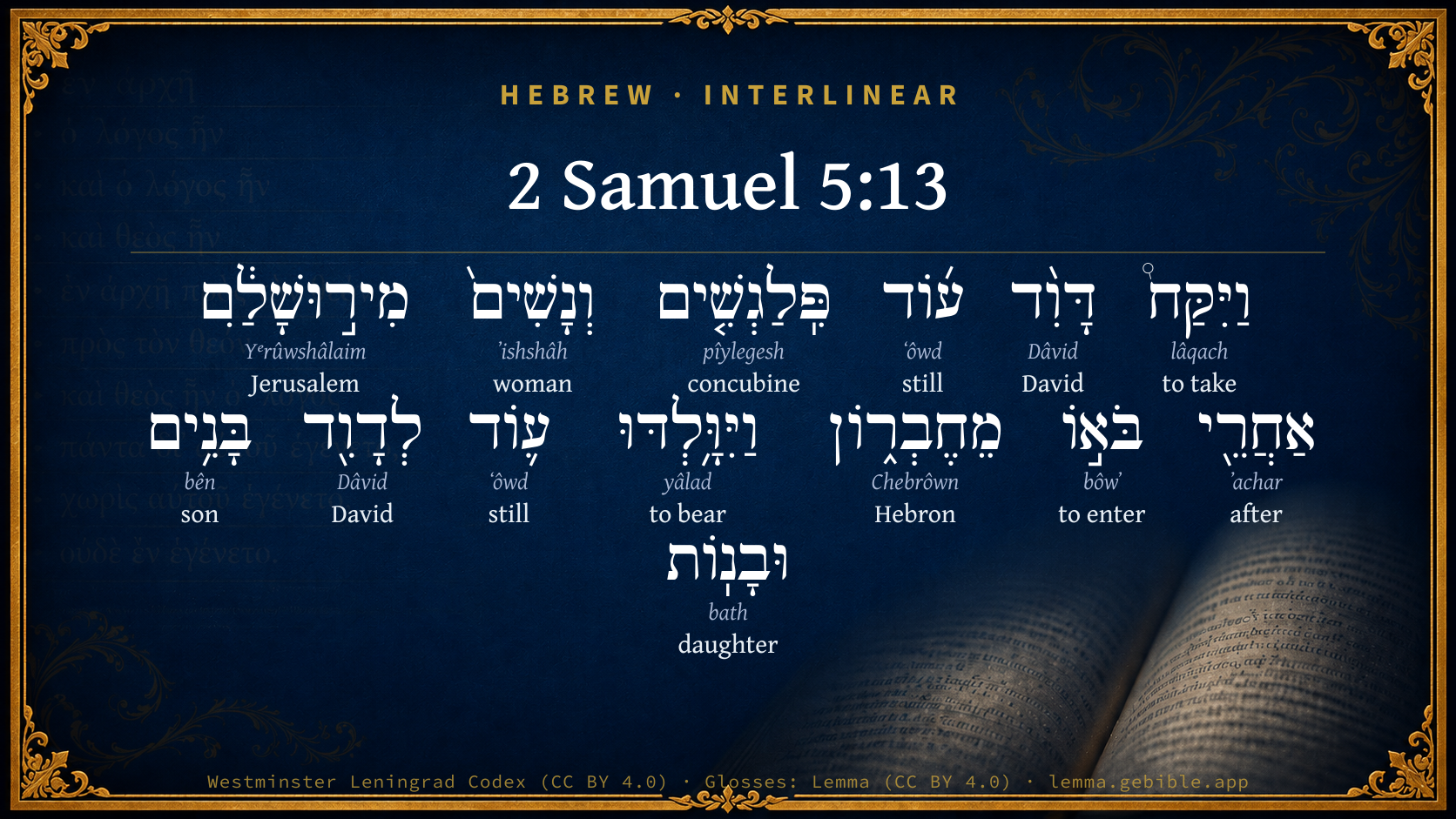
Hebrew (Westminster Leningrad Codex) 2 Samuel 5:13 appears in the Hebrew Old Testament. The text above is from the Westminster Leningrad Codex. Each word links to its Strong’s number, a concise gloss, and parsing drawn from the Open Scriptures Hebrew Bible morphology. Click any word for its full Brown-Driver-Briggs (BDB) entry.
Download image
Cite this verse

2 Samuel 5:13 (World English Bible). Public Domain. Lemma interlinear Bible study tool, https://lemma.gebible.app/v/2-samuel/5/13.

Show BibTeX & RIS
BibTeX
RIS
English Translation
David took him more concubines and wives out of Jerusalem, after he was come from Hebron; and there were yet sons and daughters born to David.
World English Bible · Public Domain
Download a study sheet

One document with this verse’s original text, its word-by-word gloss line, the meaning frame, cross-references with their text, attributed commentary, and full source and license credits — printable, and it pastes into notes with its structure intact.

This verse Autodidact and up

Study sheet (.html) Plain text (.txt)

A passage Seminary Student

Up to 50 verses in one chapter. A passage sheet keeps up to 6 commentary sources and 12 cross-references per verse, in the order this page ranks them, and says so on the sheet whenever that leaves anything out. Ask for a single verse and you get the Autodidact verse sheet above.

Everything on this page stays free to read, with no account — the sheet is a download of what is already on screen, not access to it.

Want to remove ads? Support Godless Engineer
Compare translations 3

The same verse in 3 English versions, stacked beneath the original-language interlinear above. Click any original word for its lexicon entry.

Each is an independent rendering of the whole verse — the interlinear is not word-aligned to these translations.

Highlighted words mark where these versions differ — a whole-verse word diff, not a word-by-word alignment.

  • World English Bible Public Domain
    David took him more concubines and wives out of Jerusalem, after he was come from Hebron; and there were yet sons and daughters born to David.
  • King James Version Public Domain
    And David took him more concubines and wives out of Jerusalem, after he was come from Hebron: and there were yet sons and daughters born to David.
  • unfoldingWord Literal Text CC BY-SA 4.0
    And David again took concubines and wives at Jerusalem after his coming from Hebron. And again sons and daughters were born to David.

unfoldingWord Literal Text — © unfoldingWord, licensed CC BY-SA 4.0. Word-aligned USFM3 via Door43 (git.door43.org/unfoldingWord/en_ult).

Versions to compare (up to 4)

3 of 4 selected

Show all 18 translations

Every available English version of this verse, each an independent rendering of the whole verse.

  • World English Bible Public Domain
    David took him more concubines and wives out of Jerusalem, after he was come from Hebron; and there were yet sons and daughters born to David.
  • Berean Standard Bible Public Domain
    After he had arrived from Hebron, David took more concubines and wives from Jerusalem, and more sons and daughters were born to him.
  • Majority Standard Bible Public Domain
    After he had arrived from Hebron, David took more concubines and wives from Jerusalem, and more sons and daughters were born to him.
  • King James Version Public Domain
    And David took him more concubines and wives out of Jerusalem, after he was come from Hebron: and there were yet sons and daughters born to David.
  • American Standard Version (1901) Public Domain
    And David took him more concubines and wives out of Jerusalem, after he was come from Hebron; and there were yet sons and daughters born to David.
  • Revised Version (1885) Public Domain
    And David took him more concubines and wives out of Jerusalem, after he was come from Hebron: and there were yet sons and daughters born to David.
  • Geneva Bible (1599) Public Domain
    And Dauid tooke him more concubines and wiues out of Ierusalem, after hee was come from Hebron, and more sonnes and daughters were borne to Dauid.
  • Douay-Rheims (1899) Public Domain
    And David knew that the Lord bad confirmed him king over Israel, and that he had exalted his kingdom over his people Israel.
  • Young's Literal Translation Public Domain
    And David taketh again concubines and wives out of Jerusalem, after his coming from Hebron, and there are born again to David sons and daughters.
  • Literal Standard Version CC BY-SA 4.0
    And again David takes concubines and wives out of Jerusalem, after his coming from Hebron, and again there are born to David sons and daughters.
  • Unlocked Literal Bible CC BY-SA 4.0
    After David left Hebron and came to Jerusalem, he took more concubines and wives in Jerusalem, and more sons and daughters were born to him.
  • unfoldingWord Literal Text CC BY-SA 4.0
    And David again took concubines and wives at Jerusalem after his coming from Hebron. And again sons and daughters were born to David.
  • Darby Bible Public Domain
    And David took him more concubines and wives out of Jerusalem, after he had come from Hebron; and there were yet sons and daughters born to David.
  • World Messianic Bible Public Domain
    David took more concubines and wives for himself out of Jerusalem, after he had come from Hebron; and more sons and daughters were born to David.
  • Webster's Bible Public Domain
    And David took him more concubines and wives out of Jerusalem, after he had come from Hebron: and there were yet sons and daughters born to David.
  • Free Bible Version CC BY-SA 4.0
    After he moved from Hebron, David added more concubines and wives from Jerusalem, and he had more sons and daughters.
  • Bible in Basic English Public Domain
    And David took more women and wives in Jerusalem, after he had come from Hebron: and he had more sons and daughters.
  • JPS Tanakh (1917) Public Domain
    And David took him more concubines and wives out of Jerusalem, after he was come from Hebron; and there were yet sons and daughters born to David.

Literal Standard Version (2020), Covenant Press — licensed CC BY-SA 4.0. Text via the HelloAO Bible API (eBible.org). Unlocked Literal Bible (unfoldingWord) — licensed CC BY-SA 4.0. Text via the HelloAO Bible API (eBible.org). unfoldingWord Literal Text — © unfoldingWord, licensed CC BY-SA 4.0. Word-aligned USFM3 via Door43 (git.door43.org/unfoldingWord/en_ult). Free Bible Version, Dr. Jonathan Gallagher — licensed CC BY-SA 4.0. Text via the HelloAO Bible API (eBible.org).

Word by word

More ways to search: Search by grammar → Find every occurrence → Compare this word →

Practice this passage: Drill this verse → Learn its vocabulary →

פִּֽלַגְשִׁ֤ים
pîylegesh
H6370
“concubines”
Noun, Common, Feminine, Plural, Absolute
Part of Speech
Noun
Type
Common
Gender
Feminine
Number
Plural
State
Absolute
Full BDB Definition

Origin: of uncertain derivation

TWOT: 1770

concubine, paramour - concubine - paramour
  1. וַיִּקַּח֩ lâqach H3947 “and · to take” Conjunction + Verb, Qal, Sequential Imperfect, 3rd Person, Masculine, Singular
  2. דָּוִ֨ד Dâvid H1732 “David” Noun, Proper
  3. ע֜וֹד ʻôwd H5750 “still” Adverb
  4. וְנָשִׁים֙ ʼishshâh H802 “and · women” Conjunction + Noun, Common, Feminine, Plural, Absolute
  5. מִיר֣וּשָׁלִַ֔ם Yᵉrûwshâlaim H3389 “from · Jerusalem” Preposition + Noun, Proper
  6. אַחֲרֵ֖י ʼachar H310 “after” Preposition
  7. בֹּא֣וֹ bôwʼ H935 “to enter · him” Verb, Qal, Infinitive Construct + Suffix, Personal, 3rd Person, Masculine, Singular
  8. מֵחֶבְר֑וֹן Chebrôwn H2275 “from · Hebron” Preposition + Noun, Proper
  9. וַיִּוָּ֥לְדּוּ yâlad H3205 “and · to bear” Conjunction + Verb, Niphal, Sequential Imperfect, 3rd Person, Masculine, Plural
  10. ע֛וֹד ʻôwd H5750 “still” Adverb
  11. לְדָוִ֖ד Dâvid H1732 “to/for · David” Preposition + Noun, Proper
  12. בָּנִ֥ים bên H1121 “sons” Noun, Common, Masculine, Plural, Absolute
  13. וּבָנֽוֹת bath H1323 “and · daughters” Conjunction + Noun, Common, Feminine, Plural, Absolute

About this verse

These counts appear in no published source. They are computed here, from the morphology-tagged text and Lemma’s own curated glosses. What Lemma adds →

14
words
12
distinct lemmas
Historical
section

Shared distinctive vocabulary

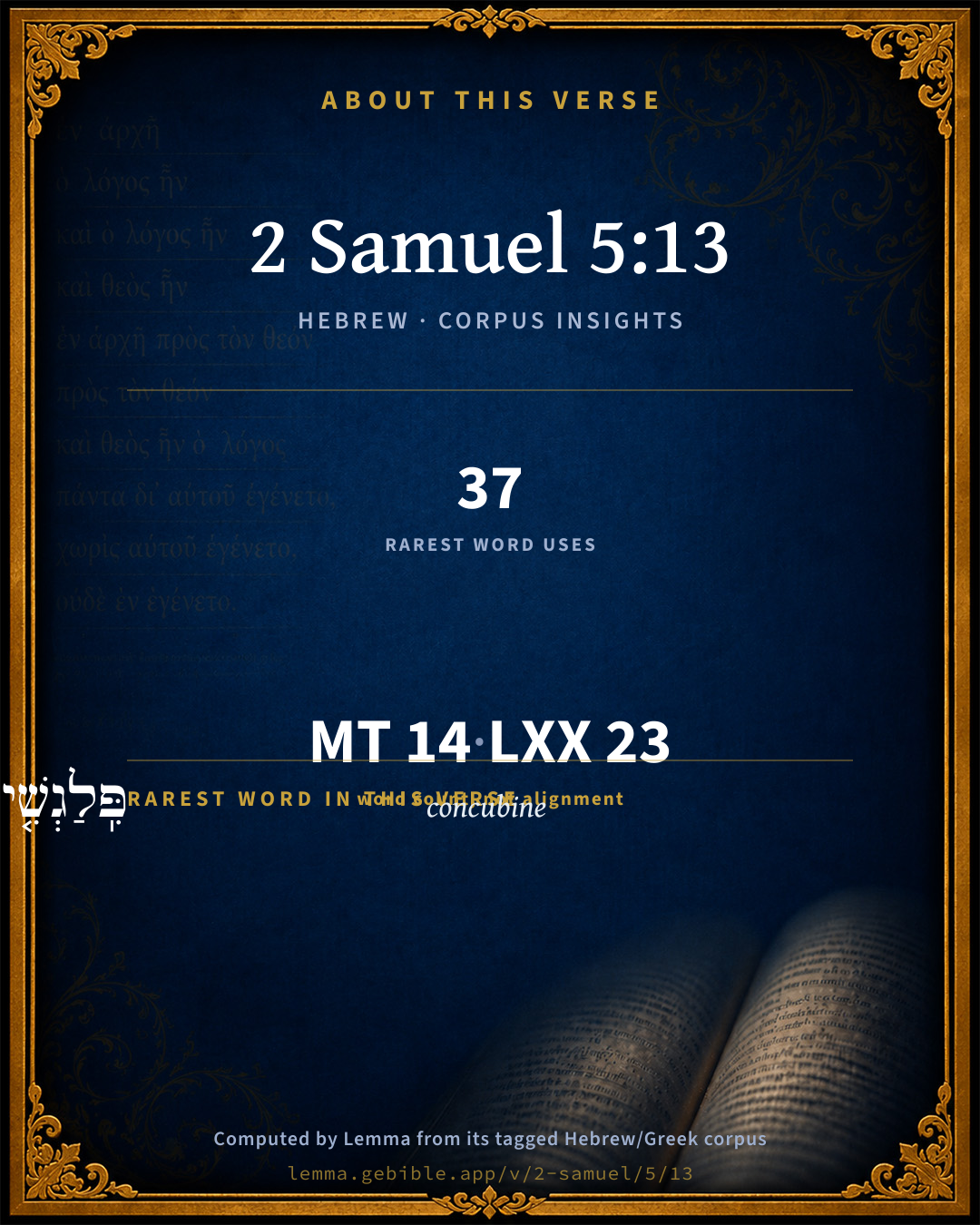
פִּֽלַגְשִׁ֤ים concubine H6370 occurs in 35 verses of the Hebrew Bible. Also found in:

Grammatical profile

  • 3 verbs
  • 8 nouns
  • 1 preposition
  • 2 adverbs

Verb forms

  • וַיִּקַּח֩ Qal · Sequential Imperfect
  • בֹּא֣וֹ Qal · Infinitive Construct
  • וַיִּוָּ֥לְדּוּ Niphal · Sequential Imperfect

Repetition

Words recur within this verse — often emphatic in Hebrew:

  • דָּוִ֨ד David H1732 ×2
  • ע֜וֹד still H5750 ×2

Hebrew & Septuagint length

In English translation the verse runs 26 words from the Hebrew and 26 from the Septuagint (LXX English) — the same length.

A rough comparison of the two English renderings, which tokenize alike — not a word-level alignment.

Word counts can differ between the Hebrew and the Greek without any difference in meaning — e.g. the Hebrew direct-object marker אֵת has no separate Greek word, and Greek often adds the article ὁ.

In the original languages it is 14 Hebrew tokens and 23 Greek tokens — but the two are counted differently (Hebrew bundles its prefixes and suffixes into one token; the Greek is in lemma form), so that isn’t a like-for-like length.

Cross-references

6

Topical passages linked to 2 Samuel 5:13 in the Treasury of Scripture Knowledge — connected by theme and wording, ordered by reader-vote popularity; previews shown in the World English Bible.

  • 1 Chronicles 3:9 All these were the sons of David, besides the sons of the concubines; and Tamar was their sister.
  • Deuteronomy 17:17 Neither shall he multiply wives to himself, that his heart not turn away: neither shall he greatly multiply to himself silver and gold.
  • Genesis 25:5–6 Abraham gave all that he had to Isaac,
  • 1 Chronicles 14:3–7 David took more wives at Jerusalem; and David became the father of more sons and daughters.
  • 2 Chronicles 11:18–21 Rehoboam took him a wife, Mahalath the daughter of Jerimoth the son of David, [and of] Abihail the daughter of Eliab the son of Jesse;
  • 2 Chronicles 13:21 But Abijah grew mighty, and took to himself fourteen wives, and became the father of twenty-two sons, and sixteen daughters.

Cross-references courtesy of OpenBible.info (CC BY 4.0).

Hebrew and Greek witnesses Masoretic Hebrew ↔ Greek Septuagint

The same verse in the two great witnesses to the Old Testament, shown verse-for-verse.

These are two independent witnesses, not word-aligned to each other, and the Septuagint is shown in lemma (dictionary) form.

Hebrew 2 Samuel 5:13 Masoretic · Westminster Leningrad Codex

וַיִּקַּח֩ דָּוִ֨ד ע֜וֹד פִּֽלַגְשִׁ֤ים וְנָשִׁים֙ מִיר֣וּשָׁלִַ֔ם אַחֲרֵ֖י בֹּא֣וֹ מֵחֶבְר֑וֹן וַיִּוָּ֥לְדּוּ ע֛וֹד לְדָוִ֖ד בָּנִ֥ים וּבָנֽוֹת

David took him more concubines and wives out of Jerusalem, after he was come from Hebron; and there were yet sons and daughters born to David.

World English Bible · Public Domain

Greek LXX 2 Samuel 5:13 Septuagint · lemma form

καί λαμβάνω δαυίδ ἔτι γυνή καί παλλακή ἐκ ἰερουσαλήμ μετά ὁ ἔρχομαι αὐτός ἐκ χεβρων καί γίγνομαι ὁ δαυίδ ἔτι υἱός καί θυγάτηρ

And David took again wives and concubines out of Jerusalem, after he came from Chebron: and David had still more sons and daughters born to him.

LXX2012 (modern English Septuagint) · Public Domain

Hebrew: Westminster Leningrad Codex (CC BY 4.0). Greek: Septuagint (public domain); English from LXX2012 (modern English Septuagint) (Public Domain). How the Septuagint differs from the Hebrew →

Targum (Aramaic paraphrase)

1

The Targum is the ancient Jewish Aramaic paraphrase of the Hebrew Scriptures — an interpretive translation, not the Hebrew text itself. Onkelos (literal) and Pseudo-Jonathan (expansive) render the Torah, and Jonathan the Prophets. Coverage is partial: where no permissively-licensed English translation exists for a verse, only the Aramaic is shown. This is verse-level text, not a word-by-word alignment to the Hebrew.

  1. Targum Jonathan Prophets (Joshua–Malachi)
    וּנְסִיב דָוִד עוֹד לְחֵינָן וּנְשִׁין מִירוּשְׁלֵם בָּתַר דַאֲתָא מֵחֶבְרוֹן וְאִתְיְלִידוּ עוֹד לְדָוִד בְּנִין וּבְנָן:

    (no public-domain English translation for this verse)

    Targum Jonathan — Aramaic: “Mikraot Gedolot” (public domain). English: “Sefaria Community Translation” (CC0 1.0 (public-domain dedication)); “London "Chaldee Paraphrase," 1871” (public domain). Text via Sefaria.

Commentary

Notes on 2 Samuel 5:13 from classic Christian and Jewish commentators (each source and its license shown beneath its notes). The classic Christian expositions comment on the surrounding passage and are grouped to its opening verse, so a note may address several verses; the Jewish commentaries on the Tanakh (Rashi and others) are per-verse, so they appear only where the commentator wrote on this verse.

Lemma curates 59 commentaries, every one of them public domain or Creative Commons licensed, each selected and text-cleaned for this edition rather than reprinted as found. About our sources →

Jamieson, Fausset & Brown

Robert Jamieson, A. R. Fausset & David Brown

ELEVEN SONS BORN TO HIM. (Sa2 5:13-16)

David took him more concubines and wives--In this conduct David transgressed an express law, which forbade the king of Israel to multiply wives unto himself (Deu 17:17).

Jamieson, Fausset & Brown — Commentary Critical and Explanatory on the Whole Bible (1871) — public domain (CC PDM 1.0). Text via the HelloAO Bible API.

Trapp's Complete Commentary

John Trapp

2Sa 5:13 And David took [him] more concubines and wives out of Jerusalem, after he was come from Hebron: and there were yet sons and daughters born to David.

Ver. 13. And David took him more concubines.] Directly against God’s commandment, {Deu 17:17} and his own practice in other points. {Psa 23:5-6} Apprehensions of mercy in God should work resolutions of obedience in us. David was afterwards punished in these concubines, and made to vomit up that again which now he swalloweth down with so much delight. See 2Sa 20:3. They who would excuse him herein, say that he did it to strengthen himself in his kingdom by new friends and allies. But it is no good policy to leap the pale of God’s precepts upon any pretence.

John Trapp, A Commentary or Exposition upon All the Books of the Old and New Testament (1647–1656) — public domain. Text from a community e-Sword module.

Joseph Benson's Commentary

2Sa 5:13. David took him more concubines and wives — This may well be reckoned among David’s miscarriages, the multiplication of wives being expressly forbidden to the kings of Israel, Deu 17:17. It may however be observed, perhaps in extenuation of this fault of David, that it has always been looked upon as a piece of political wisdom in princes to endeavour to have many children; that by matching them into potent families, they might strengthen their interest, and have the more supporters of their authority. And this seems to have been the reason why David took so many wives. Some of his first wives had no children, and he was induced to take others that he might obtain an issue, enlarge his family, and thereby strengthen his interest. But the many wives and concubines he took did not preserve him from coveting his neighbour’s wife. On the contrary, they inclined him to it; for men who have once broken the fence, will wander carelessly.

Joseph Benson's Commentary on the Old and New Testaments (1811–1818) — public domain. Text from a community e-Sword module.

Tyndale Open Study Notes

Tyndale Open Resources

5:13-16 The expansion of David’s family reflected his growing success and power as Israel’s king. Solomon was David’s most important Jerusalem-born son (see 12:24-25).

Tyndale Open Study Notes — © Tyndale Open Resources, licensed CC BY-SA 4.0. Text via the HelloAO Bible API.

Adam Clarke's Commentary

Verse 13. David took him more concubines] He had, in all conscience, enough before; he had, in the whole, eight wives and ten concubines. That dispensation permitted polygamy, but from the beginning it was not so; and as upon an average there are about fourteen males born to thirteen females, polygamy is unnatural, and could never have entered into the original design of God.

Adam Clarke's Commentary on the Bible (1810–1826) — public domain. Text from a community e-Sword/MySword module.

Ellicott's Commentary for English Readers

(13) More concubines and wives.—In Deu_17:17, the law had been given for the future king, “Neither shall he multiply wives to himself.” David certainly came perilously near a violation of this law, although he did not, like his son Solomon, take wives and concubines in enormous number for the sake of having a great harem—an important element in the Oriental ideas of regal magnificence. Any possible ambiguity in the phrase “out of Jerusalem” is removed by the expression in the parallel place (1Ch_14:3), “at Jerusalem.” Altogether, here and in Chronicles, the names of nineteen sons are mentioned; those of the daughters are not given, although one, Thamar, is mentioned in the story in 2 Samuel 13.

A Bible Commentary for English Readers, edited by Charles John Ellicott (1878–1897) — public domain. Text from a community e-Sword module.

The Cambridge Bible for Schools and Colleges

gen. ed. J. J. S. Perowne

13. took him mo concubines and wives] In accordance with the general custom of Oriental monarchs. The law of the king in Deu_17:17 imposes some limitation on the practice. See note on ch. 2Sa_3:5.

Mo as the comparative of many is an archaism which has disappeared from modern editions of the Bible. It occurs frequently in Shakespeare, e. g. Richard II., A. II. S. I. 239, “Many moe of noble blood.”

The Cambridge Bible for Schools and Colleges (gen. ed. J. J. S. Perowne; Cambridge University Press, 1878–1918) — public domain. Text from a community e-Sword module.

John Gill's Exposition

And David took him more concubines and wives out of Jerusalem, after he was come from Hebron,.... He had six when he was at Hebron, Sa2 3:2, and now he took more, which was not to his honour, and contrary to the law of God, Deu 17:17; the concubines were a sort of half wives, as the word may signify, or secondary ones, and under the others:

and there were yet sons and daughters born to David; besides those in Hebron mentioned in Sa2 3:2.

John Gill's Exposition of the Whole Bible (1746–1763) — public domain (CC PDM 1.0). Text via the HelloAO Bible API.

Haydock's Catholic Bible Commentary

David took more concubines and wives of Jerusalem. Not harlots, but wives of an inferior condition: for such in Scripture are styled concubines. (Challoner) --- He had in all eight wives, and ten whom he married with less solemnity. He might desire to attach the principal families of the nation, as well as some foreign princes, to his interests. Moses forbids a king to have too many wives, Deuteronomy xvii. 17. (Calmet) --- But David is never blamed for the transgression of this precept. See chap. iii. 1. (Menochius)

George Leo Haydock (1774–1849), Haydock's Catholic Family Bible and Commentary, 1859 edition — public domain. Excludes Psalms (Douay-Rheims chapter numbering differs from Protestant) and Deuterocanonical books (Catholic canon only).

Matthew Poole's English Annotations

This may well be reckoned amongst David’s miscarriages, the multiplication of wives being expressly forbidden to the king, Deu 17:17. The use of it seems to have been his policy, that hereby he might enlarge his family, and strengthen his interest by alliances with so many considerable families. And the number of wives being not limited, Deu 17, he might conceive this was no transgression of that law.

Matthew Poole's English Annotations on the Holy Bible (1683–1685) — public domain. Text from a community e-Sword/MySword module.

Whedon's Commentary on the Bible

Daniel D. Whedon

13. More concubines and wives — “He had, in all conscience, enough before; he had, in the whole, eight wives and ten concubines. True, that dispensation permitted polygamy, but from the beginning it was not so; and as upon an average there are about fourteen males born to thirteen females, polygamy is unnatural, and could never have entered into the original design of God.” — Clarke.

Out of Jerusalem — That is, in or at Jerusalem, as appears from 1Ch_14:3.

Daniel D. Whedon (gen. ed.), Commentary on the Old and New Testaments (1874–1909) — public domain. Text from a community e-Sword module.

The Pulpit Commentary

David took him more concubines. Thus with increase of power came also the increased gratification of David"s weakness and sin. Well for him would it have been if, like Saul, he had been content with one wife. But this enlargement of his harem was gradual, and the list includes all the sons born at Jerusalem. Of these four, namely, Shammuah, Shobab, Nathan, and Solomon. were his children by Bathsheba. (see 1Ch_3:5, where the names are differently spelt) Besides a variation in the spelling, two sons are mentioned in Chronicles, Nogah and an earlier Eliphelet, whose names are not given here, perhaps because they died young. From 1Ch_3:9 we learn that only the names of the sons of wives are given in these tables.

The Pulpit Commentary (1880–1919), ed. H.D.M. Spence-Jones & Joseph S. Exell — public domain. Text from a community e-Sword module.

John Wesley's Explanatory Notes

David took, &c. - This may well be reckoned amongst David's miscarriages, the multiplication of wives being expresly forbidden to the king, Deut. xvii, 17. It seems to have been his policy, that hereby he might enlarge his family, and strengthen his interest by alliances with so many considerable families. But all these did not preserve him from coveting his neighbour's wife. Rather they inclined him to it: for men who have once broke the fence, will wander carelesly.

John Wesley, Explanatory Notes Upon the Whole Bible (1754–1765) — public domain. Text via the GEBible commentary corpus.

unfoldingWord translationNotes

Door43 World Missions Community

Shammua ... Shobab ... Nathan ... Solomon ... Ibhar ... Elishua ... Nepheg ... Japhia ... Elishama ... Eliada ... Eliphelet

These are the names of David's sons. (See: How to Translate Names)

more sons and daughters were born to him

This can be stated in active form. AT: "he had more sons and daughters" or "they bore him more sons and daughters" (See: Active or Passive)

who were born to him

This can be stated in active form. AT: "that his wives bore for him" or "he had" (See: Active or Passive)

translationWords

concubine

Jerusalem

name

Solomon

unfoldingWord translationNotes — © Distant Shores Media and the Door43 World Missions Community, licensed CC BY-SA 4.0. Source: git.door43.org/Door43/en_tn.

Lesson kit

Teaching starters — assembled from the data on this page, not authored interpretation. Every prompt links to the verse data it draws on. Edit before teaching.

2 Samuel, in the Historical, opens this verse with 14 words (12 distinct Hebrew lemmas). Its most distinctive word is pîylegesh (“concubine”). A historical commentator’s framing appears above. Read the whole chapter for the surrounding context.

Discussion questions

  1. The word pîylegesh carries the sense “concubine.” How does it shape the verse?
  2. Genesis 22:24 shares the word «concubine» with this verse. How do the two illuminate each other?
  3. “David” occurs 2× in this one verse. What is the effect of the repetition?
  4. These translations render this verse differently. What is at stake in choosing one wording over another?
  5. The verb «וַיִּקַּח֩» is Qal Sequential Imperfect. How does its form color the action?
  6. Reading how Jamieson, Fausset & Brown and Trapp's Complete Commentary read this verse, where do the two commentators agree and where do they part?

Things to notice

Reading settings

Reading text

Shown beneath each verse's original-language words.

Old Testament
Old Testament edition

Read the OT as the Masoretic Hebrew (MT) or the Greek Septuagint (LXX).

English shown for the Greek Septuagint (in the Hebrew ↔ Greek comparison).

Comparing translations? Open the Compare panel on any verse page to stack up to four side by side.