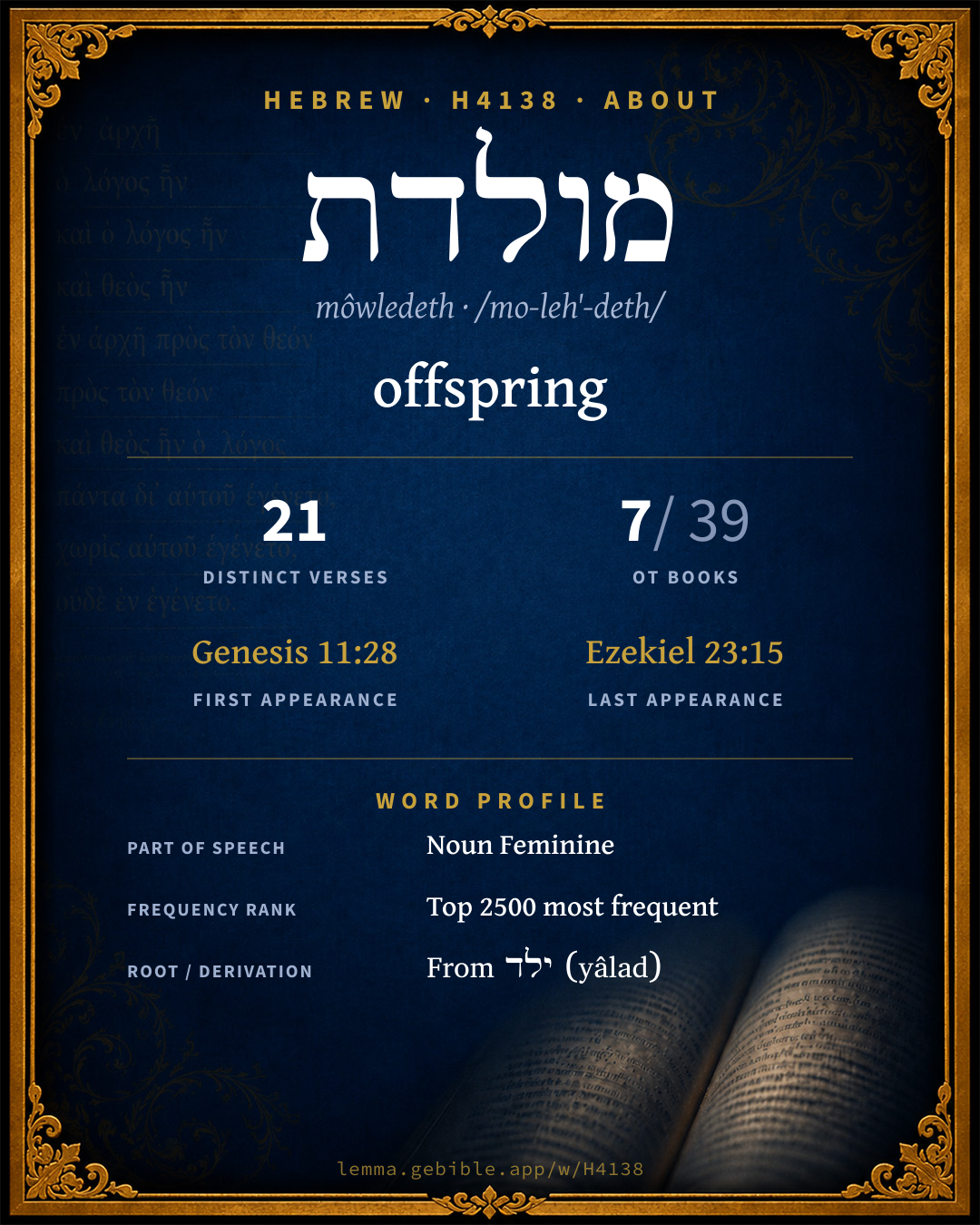
מוֹלֶ֫דֶת
offspring
also: kindred, birth, relatives fuller range ↓
Full lexicon entry — Brown-Driver-Briggs (BDB)
From Brown-Driver-Briggs (BDB)
Where this word appears
Grammar key — what these labels mean
Part of speech
- Noun
- A naming word — a person, place, thing, or idea.
Noun type
- Common
- A common noun — a general class of person, place, or thing (“king,” “city,” “water”), not a specific name.
State
- Construct
- A noun bound to a following noun in a possessive / “of” relationship (the construct chain).
Gender
- Feminine
- Grammatically feminine.
Number
- Singular
- One.
- Plural
- More than one (in Hebrew, generally three or more).
Grammatical forms
- Noun, Common, Feminine, Singular, Construct 20 times (91%)
- Noun, Common, Feminine, Plural, Construct 2 times (9%)
Parsed forms decoded from the imported morphology (morphhb / Westminster Leningrad Codex — WLC text public domain, morphhb tagging CC BY 4.0), counted across 22 parsed occurrences — not distinct verses.
Every verse where H4138 appears — 21 distinct verses across 7 books. Click any verse to open its interlinear word-by-word view. Verse text shown in the World English Bible for context — . Each verse’s Hebrew form is shown with its reference; the English is not keyword-highlighted, since the data carries no word-level English alignment. Use “Compare translations” on any verse to read it across multiple English versions. This concordance covers the Hebrew Bible; Septuagint (Greek Old Testament) occurrences are not indexed here.
Genesis 9 verses
- Genesis 11:28 מוֹלַדְתּ֖/וֹ n c fs cs + sfx pers 3ms Haran died before his father Terah in the land of his birth, in Ur of the Chaldees.
- Genesis 12:1 וּ/מִ/מּֽוֹלַדְתְּ/ךָ֖ conj + prep + n c fs cs + sfx pers 2ms Now Yahweh said to Abram, "Get out of your country, and from your relatives, and from your father's house, to the land that I will show you.
- Genesis 24:4 מוֹלַדְתִּ֖/י n c fs cs + sfx pers 1cs But you shall go to my country, and to my relatives, and take a wife for my son Isaac."
- Genesis 24:7 מֽוֹלַדְתִּ/י֒ n c fs cs + sfx pers 1cs Yahweh, the God of heaven, who took me from my father's house, and from the land of my birth, who spoke to me, and who swore to me, saying, 'I will give this land to your seed.' He will send his angel before you, and you shall take a wife for my son from there.
- Genesis 31:3 וּ/לְ/מוֹלַדְתֶּ֑/ךָ conj + prep + n c fs cs + sfx pers 2ms Yahweh said to Jacob, "Return to the land of your fathers, and to your relatives, and I will be with you."
- Genesis 31:13 מוֹלַדְתֶּֽ/ךָ n c fs cs + sfx pers 2ms I am the God of Bethel, where you anointed a pillar, where you vowed a vow to me. Now arise, get out from this land, and return to the land of your birth."
- Genesis 32:9 וּ/לְ/מוֹלַדְתְּ/ךָ֖ conj + prep + n c fs cs + sfx pers 2ms Jacob said, "God of my father Abraham, and God of my father Isaac, Yahweh, who said to me, 'Return to your country, and to your relatives, and I will do you good.'
- Genesis 43:7 וּ/לְ/מֽוֹלַדְתֵּ֜/נוּ conj + prep + n c fs cs + sfx pers 1cp They said, "The man asked directly concerning ourselves, and concerning our relatives, saying, 'Is your father still alive? Have you another brother?' We just answered his questions. Is there any way we could know that he would say, 'Bring your brother down?'"
- Genesis 48:6 וּ/מוֹלַדְתְּ/ךָ֛ conj + n c fs cs + sfx pers 2ms Your issue, who you become the father of after them, will be yours. They will be called after the name of their brothers in their inheritance.
Leviticus 2 verses
- Leviticus 18:9 מוֹלֶ֣דֶת מוֹלֶ֣דֶת n c fs cs n c fs cs "'You shall not uncover the nakedness of your sister, the daughter of your father, or the daughter of your mother, whether born at home, or born abroad.
- Leviticus 18:11 מוֹלֶ֣דֶת n c fs cs "'You shall not uncover the nakedness of your father's wife's daughter, conceived by your father, since she is your sister. "'
Numbers 1 verse
Ruth 1 verse
Esther 3 verses
- Esther 2:10 מֽוֹלַדְתָּ֑/הּ n c fs cs + sfx pers 3fs Esther had not made known her people nor her relatives; for Mordecai had charged her that she should not make it known.
- Esther 2:20 מֽוֹלַדְתָּ/הּ֙ n c fs cs + sfx pers 3fs Esther had not yet made known her relatives nor her people; as Mordecai had charged her: for Esther did the commandment of Mordecai, like as when she was brought up with him.
- Esther 8:6 מוֹלַדְתִּֽ/י n c fs cs + sfx pers 1cs for how can I endure to see the evil that shall come to my people? or how can I endure to see the destruction of my relatives?
Jeremiah 2 verses
- Jeremiah 22:10 מוֹלַדְתּֽ/וֹ n c fs cs + sfx pers 3ms Don't you weep for the dead, neither bemoan him; but weep sore for him who goes away; for he shall return no more, nor see his native country.
- Jeremiah 46:16 מֽוֹלַדְתֵּ֔/נוּ n c fs cs + sfx pers 1cp He made many to stumble, yes, they fell one on another: and they said, Arise, and let us go again to our own people, and to the land of our birth, from the oppressing sword.
Ezekiel 3 verses
- Ezekiel 16:3 וּ/מֹ֣לְדֹתַ֔יִ/ךְ conj + n c fp cs + sfx pers 2fs and say, Thus says the Lord Yahweh to Jerusalem: Your birth and your birth is of the land of the Canaanite; the Amorite was your father, and your mother was a Hittite.
- Ezekiel 16:4 וּ/מוֹלְדוֹתַ֗יִ/ךְ conj + n c fp cs + sfx pers 2fs As for your birth, in the day you were born your navel was not cut, neither were you washed in water to cleanse you; you weren't salted at all, nor swaddled at all.
- Ezekiel 23:15 מוֹלַדְתָּֽ/ם n c fs cs + sfx pers 3mp girded with girdles on their loins, with flowing turbans on their heads, all of them princes to look on, after the likeness of the Babylonians in Chaldea, the land of their birth.
About this entry
At a glance — auto-summarized from this page’s data, not written by a person. Every figure links to its source below. This summary describes the numbers; it doesn’t interpret them.
At its core, מולדת (môwledeth) means “offspring.” Older and newer Bibles part ways — “kindred” in the King James Version, “birth” (Berean Standard Bible) and “relatives” (unfoldingWord Literal Text) in modern versions. See the renderings breakdown. It turns up in 21 verses across 7 books, an uncommon footprint. The word gravitates to Genesis (43%), then Esther and Ezekiel. Not a single-sense word: its full sense range also takes in “kindred”, “birth”, and “relatives”. Dig into 21-verse concordance and the renderings breakdown below.
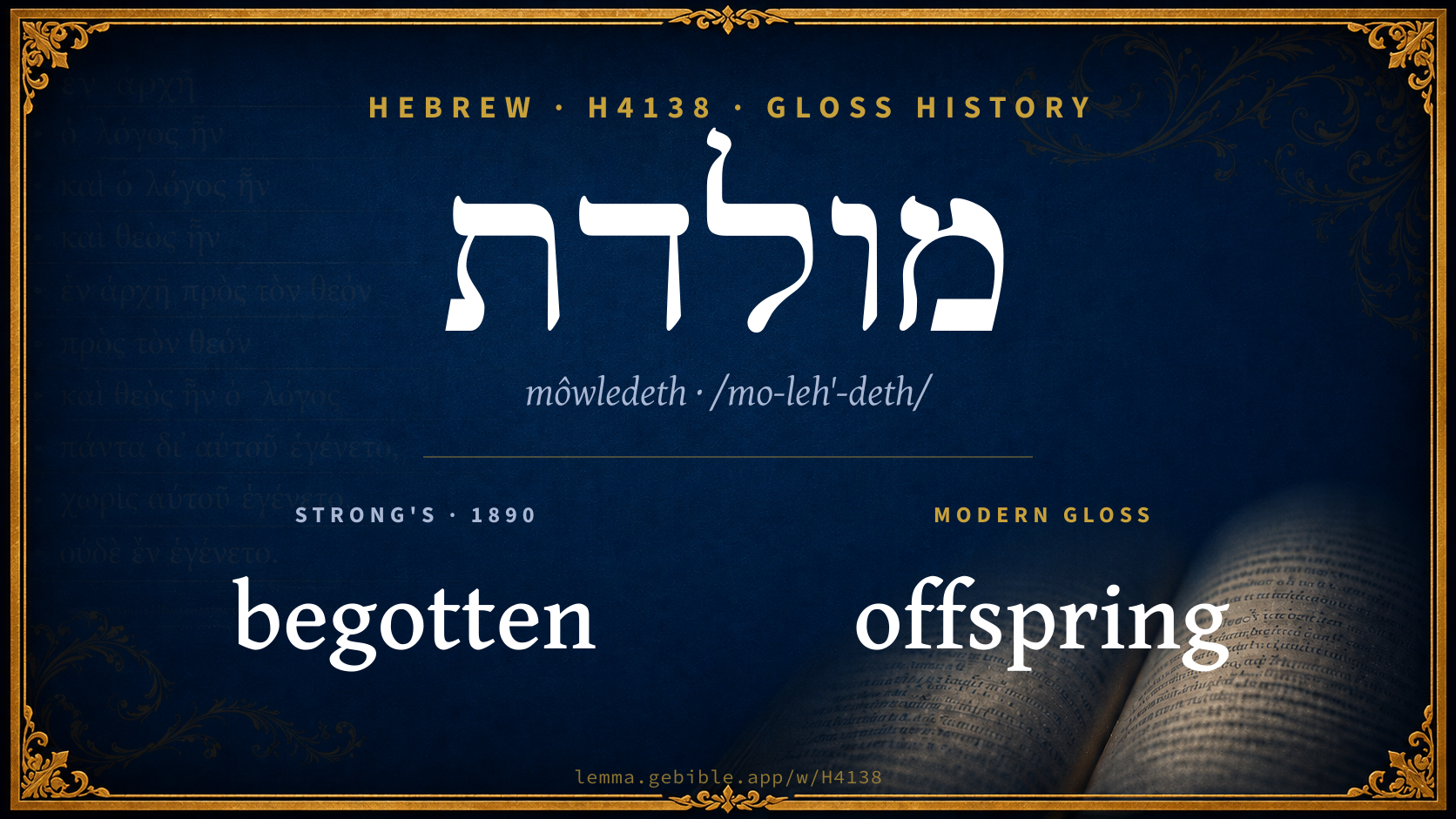
Gloss history
Strong's 1890 vs modern scholarship
About this word
Strong's H4138 catalogs a Hebrew word from the Hebrew Old Testament.
These counts are not copied from any lexicon or concordance. They are computed here, from the morphology-tagged Hebrew Old Testament. What Lemma adds →
- 21
- distinct verses
- The word appears in 21 distinct verses.
- 7 / 39
- OT books
- The word appears in 7 of 39 Old Testament books.
- #1,412
- by frequency
- Top 2500 most frequent Hebrew words (rank 1,412 of 8,640 Hebrew words by occurrence).
View all 21 occurrences in the concordance →
By section of the Old Testament
By traditional corpus
Conventional, traditional groupings — biblical authorship is debated, so this is a traditional corpus grouping, not an authorship claim. Each share is this word’s portion of its verses in that division of the Hebrew canon. Each figure is a share of the word’s 21 distinct verses.
- Torah (Pentateuch) 12 verses · 57%
- Prophets (Nevi'im) 5 verses · 24%
- Writings (Ketuvim) 4 verses · 19%
How translations render this word
Counts come from each version’s own published word-to-Strong’s tagging or interlinear alignment — an approximate guide to how each version renders this word, not a word-level alignment the data otherwise carries. Because each total is that version’s own tagged count, the per-version totals vary from one another and need not match the appearance or distinct-verse counts above. These counts may also differ from a printed concordance because Lemma counts each distinctly tagged rendering and does not collapse phrase taggings into a single head-word total. This is a fixed set of word-tagged versions (KJV, ASV, BSB, ULT) and does not change with the reading translation you choose elsewhere. Each version’s license is shown beside its name below (and on Sources).
- King James Version: Kindred 10×, Nativity 6×
- American Standard Version: Kindred 8×, Nativity 8×
- Berean Standard Bible: Birth 5×, Kindred 5×, Native 4×
- unfoldingWord Literal Text: Relatives 7×, Birth 4×, Ancestry 2×
King James Version Public Domain
Renders H4138 across 22 tagged occurrences — most commonly:
Plus 6 renderings that appear only once — usually multi-word phrases or single function words the recovered tagging swept in, not distinct renderings.
American Standard Version Public Domain
Renders H4138 across 22 tagged occurrences — most commonly:
Plus 6 renderings that appear only once — usually multi-word phrases or single function words the recovered tagging swept in, not distinct renderings.
Berean Standard Bible Public Domain
Renders H4138 across 21 tagged occurrences — most commonly:
Plus 5 renderings that appear only once — usually multi-word phrases or single function words the recovered tagging swept in, not distinct renderings. Not rendered by a distinct English word in 1 further occurrence.
unfoldingWord Literal Text CC BY-SA 4.0
Renders H4138 across 21 tagged occurrences — most commonly:
Plus 6 renderings that appear only once — usually multi-word phrases or single function words the recovered tagging swept in, not distinct renderings.
Senses in the full BDB
What do BDB’s symbols mean?
BDB uses these scholarly abbreviations:
| Symbol | Meaning |
|---|---|
| 𝔊 | the Septuagint (the ancient Greek translation, LXX) |
| 𝔙 | the Vulgate (the Latin translation) |
| 𝔖 | the Syriac version (the Peshitta) |
| 𝔗 | the Targum (the Aramaic translation) |
| ψ | the Psalms |
| √ | root (the underlying root or stem) |
| ‖ | parallel passage (a synonymous or contrasted parallel) |
| † | the dagger: every passage where the word occurs is cited |
The 3 senses and sub-senses the full Brown-Driver-Briggs lexicon distinguishes for this word, in lexicon order (not ranked by frequency), with BDB’s own verbatim wording and sub-sense lettering. Shown in Hebrew script with BDB’s own scholarly abbreviations. The condensed entry is in the Lexicon Entry tab. See also the Forms in the corpus table below.
- 1. kindred Gn 12:1 (‖ ארצך, ביתאביך), 24:4; 32:10 (‖ ארץ), Nu 10:30 (‖ id.), Gn 31:3 (‖ ארץ אבותיך), 43:7 (all J); ‖ עַם Est 2:10, 20 8:6; especially אֶרֶץ מ׳ land of one’s kindred Gn 11:28; 24:7 (both J), 31:13 (E), Je 22:10; 46:16 Ez 23:15; Ru 2:11. e.g. Genesis 12:1
- 2. pl. circumstances of birth, birth (fig. of origin of Jerus.) מְכֹרֹתַיִךְ וּמ׳ מֵאֶרֶץ הַכְּנַעֲנִי Ez 16:3, cf. v 4. e.g. Ezekiel 16:3
- 3. (female) offspring, one born Lv 18:9(×2), begotten v 11 (all H); coll. = issue, offspring מוֹלַדְתְּךָ אֲשֶׁר הוֹלַ֫דְתָּ Gn 48:6 (P). e.g. Leviticus 18:9
Senses from the full Brown-Driver-Briggs lexicon (Brown, Driver, Briggs; Oxford 1906 — public domain), digitized via Sefaria, supplemented by the OpenScriptures HebrewLexicon (CC BY 4.0). Full attribution on Sources.
Word origin
n.f. kindred, birth, offspring;—מ׳ cstr. Lv 18:9, 11; sf. מוֹלַדְתִּי Gn 24:4 + 3 times, etc.; pl. sf. מוֹלְדוֹתַיִךְ Ez 16:4; מֹלְדֹתַיִךְ v 3;—
— Brown-Driver-Briggs (Oxford 1906, public domain), digitized via Sefaria, supplemented by the OpenScriptures HebrewLexicon (CC BY 4.0). See Sources.
Derived from ילד (yâlad) (H3205) — to bear.
Forms in the corpus
The 19 distinct written forms H4138 takes in the Hebrew Bible, most frequent first — each parse links to that state’s occurrences in the concordance. Hebrew forms include their vowel points and cantillation, so a single lemma takes many written forms.
| Form | Parsing | Example | Uses |
|---|---|---|---|
| מוֹלֶ֣דֶת | Noun, Common, Feminine, Singular, Construct | Leviticus 18:9 | 3 |
| מוֹלַדְתִּ֖/י | Noun, Common, Feminine, Singular, Construct | Genesis 24:4 | 2 |
| וּ/לְ/מֽוֹלַדְתֵּ֜/נוּ | Noun, Common, Feminine, Singular, Construct | Genesis 43:7 | 1 |
| וּ/לְ/מוֹלַדְתְּ/ךָ֖ | Noun, Common, Feminine, Singular, Construct | Genesis 32:9 | 1 |
| וּ/לְ/מוֹלַדְתֶּ֑/ךָ | Noun, Common, Feminine, Singular, Construct | Genesis 31:3 | 1 |
| וּ/מִ/מּֽוֹלַדְתְּ/ךָ֖ | Noun, Common, Feminine, Singular, Construct | Genesis 12:1 | 1 |
| וּ/מֹ֣לְדֹתַ֔יִ/ךְ | Noun, Common, Feminine, Plural, Construct | Ezekiel 16:3 | 1 |
| וּ/מוֹלְדוֹתַ֗יִ/ךְ | Noun, Common, Feminine, Plural, Construct | Ezekiel 16:4 | 1 |
| וּ/מוֹלַדְתְּ/ךָ֛ | Noun, Common, Feminine, Singular, Construct | Genesis 48:6 | 1 |
| מֽוֹלַדְתִּ/י֒ | Noun, Common, Feminine, Singular, Construct | Genesis 24:7 | 1 |
| מֽוֹלַדְתֵּ֔/ךְ | Noun, Common, Feminine, Singular, Construct | Ruth 2:11 | 1 |
| מֽוֹלַדְתֵּ֔/נוּ | Noun, Common, Feminine, Singular, Construct | Jeremiah 46:16 | 1 |
| מֽוֹלַדְתָּ/הּ֙ | Noun, Common, Feminine, Singular, Construct | Esther 2:20 | 1 |
| מֽוֹלַדְתָּ֑/הּ | Noun, Common, Feminine, Singular, Construct | Esther 2:10 | 1 |
| מוֹלַדְתּ֖/וֹ | Noun, Common, Feminine, Singular, Construct | Genesis 11:28 | 1 |
| מוֹלַדְתִּֽ/י | Noun, Common, Feminine, Singular, Construct | Esther 8:6 | 1 |
| מוֹלַדְתֶּֽ/ךָ | Noun, Common, Feminine, Singular, Construct | Genesis 31:13 | 1 |
| מוֹלַדְתָּֽ/ם | Noun, Common, Feminine, Singular, Construct | Ezekiel 23:15 | 1 |
| מוֹלַדְתּֽ/וֹ | Noun, Common, Feminine, Singular, Construct | Jeremiah 22:10 | 1 |
Same root — word family
Other BDB entries built from the same root as H4138, grouped by Strong’s listed origin. These share a root / origin per the lexicon — not necessarily a shared meaning. Each links to that word’s own entry.
Derives from
Shares the same root
- ילד yeled H3206 child
- ילוד yillôwd H3209 born
- יליד yâlîyd H3211 born
- תולדה tôwlᵉdâh H8435 generations
Proper names from this root
People and places named from this root — a name, not an additional meaning of the word.
Compare all same-root words → Showing 4 of 9 — not the complete family. 3 of the same-root words are proper names (people or places). They share a root, not necessarily a meaning.
Septuagint verse parallels
This word appears in 20 verses that also exist in the Greek Old Testament (Septuagint), out of the 21 Hebrew verses it occurs in. You can read those verses in Greek by switching the Old Testament edition to the Septuagint.
Read these verses in the Septuagint
This is a verse-level parallel only — the same verses exist in both the Hebrew and Greek Old Testaments. No word-level Hebrew↔Greek correspondence is claimed: the data carries no such alignment, so no Greek word is shown as this Hebrew word’s translation. Coverage is not total — the Septuagint omits the deuterocanon and renumbers the Psalms, so some Hebrew verses have no direct Greek parallel.