Genesis 20:17

Hebrew (Westminster Leningrad Codex) Genesis 20:17 appears in the Hebrew Old Testament. The text above is from the Westminster Leningrad Codex. Each word links to its Strong’s number, a concise gloss, and parsing drawn from the Open Scriptures Hebrew Bible morphology. Click any word for its full Brown-Driver-Briggs (BDB) entry.
Download image
Cite this verse

Genesis 20:17 (World English Bible). Public Domain. Lemma interlinear Bible study tool, https://lemma.gebible.app/v/genesis/20/17.

Show BibTeX & RIS
BibTeX
RIS
English Translation
Abraham prayed to God. God healed Abimelech, and his wife, and his maid-servants, and they bore children.
World English Bible · Public Domain
Highlights
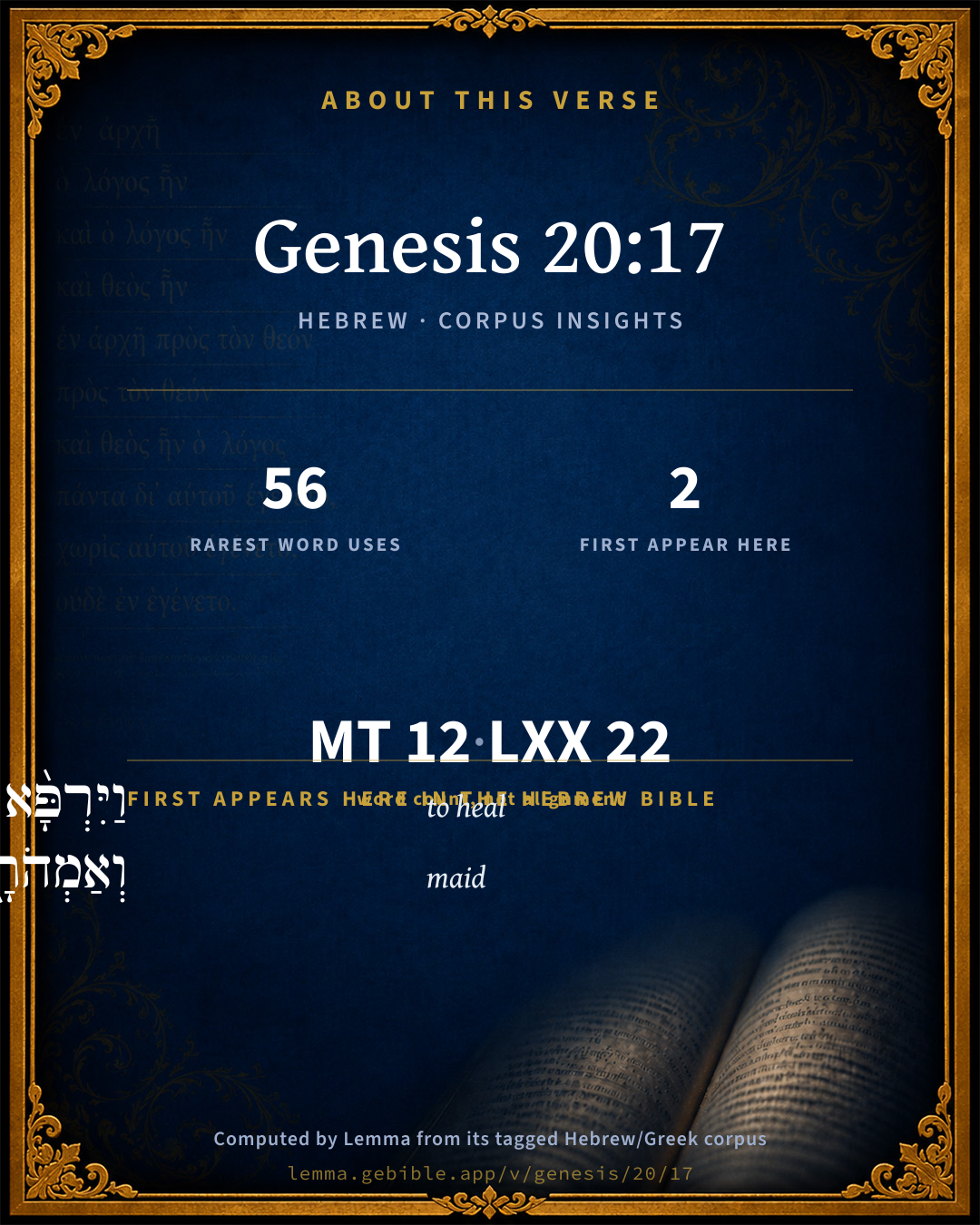
  • 2 first appearances in the Hebrew Bible
Full analysis ↓
Download a study sheet

One document with this verse’s original text, its word-by-word gloss line, the meaning frame, cross-references with their text, attributed commentary, and full source and license credits — printable, and it pastes into notes with its structure intact.

This verse Autodidact and up

Study sheet (.html) Plain text (.txt)

A passage Seminary Student

Up to 50 verses in one chapter. A passage sheet keeps up to 6 commentary sources and 12 cross-references per verse, in the order this page ranks them, and says so on the sheet whenever that leaves anything out. Ask for a single verse and you get the Autodidact verse sheet above.

Everything on this page stays free to read, with no account — the sheet is a download of what is already on screen, not access to it.

Want to remove ads? Support Godless Engineer
Compare translations 3

The same verse in 3 English versions, stacked beneath the original-language interlinear above. Click any original word for its lexicon entry.

Each is an independent rendering of the whole verse — the interlinear is not word-aligned to these translations.

Highlighted words mark where these versions differ — a whole-verse word diff, not a word-by-word alignment.

  • World English Bible Public Domain
    Abraham prayed to God. God healed Abimelech, and his wife, and his maid-servants, and they bore children.
  • King James Version Public Domain
    So Abraham prayed unto God: and God healed Abimelech, and his wife, and his maidservants; and they bare children.
  • unfoldingWord Literal Text CC BY-SA 4.0
    Then Abraham prayed to God, and God healed Abimelech and his wife and his slave women, so that they bore children,

unfoldingWord Literal Text — © unfoldingWord, licensed CC BY-SA 4.0. Word-aligned USFM3 via Door43 (git.door43.org/unfoldingWord/en_ult).

Versions to compare (up to 4)

3 of 4 selected

Show all 17 translations

Every available English version of this verse, each an independent rendering of the whole verse.

  • World English Bible Public Domain
    Abraham prayed to God. God healed Abimelech, and his wife, and his maid-servants, and they bore children.
  • Berean Standard Bible Public Domain
    Then Abraham prayed to God, and God healed Abimelech and his wife and his maidservants, so that they could again bear children—
  • Majority Standard Bible Public Domain
    Then Abraham prayed to God, and God healed Abimelech and his wife and his maidservants, so that they could again bear children—
  • King James Version Public Domain
    So Abraham prayed unto God: and God healed Abimelech, and his wife, and his maidservants; and they bare children.
  • American Standard Version (1901) Public Domain
    And Abraham prayed unto God. And God healed Abimelech, and his wife, and his maid-servants. And they bare children.
  • Revised Version (1885) Public Domain
    And Abraham prayed unto God: and God healed Abimelech, and his wife, and his maidservants; and they bare children.
  • Geneva Bible (1599) Public Domain
    Then Abraham prayed vnto God, and God healed Abimelech, and his wife, and his women seruants: and they bare children.
  • Young's Literal Translation Public Domain
    And Abraham prayeth unto God, and God healeth Abimelech and his wife, and his handmaids, and they bear:
  • Literal Standard Version CC BY-SA 4.0
    And Abraham prays to God, and God heals Abimelech and his wife, and his handmaids, and they bear:
  • Unlocked Literal Bible CC BY-SA 4.0
    Then Abraham prayed to God, and God healed Abimelech, his wife, and his female slaves so that they were able to have children.
  • unfoldingWord Literal Text CC BY-SA 4.0
    Then Abraham prayed to God, and God healed Abimelech and his wife and his slave women, so that they bore children,
  • Darby Bible Public Domain
    And Abraham prayed to God, and God healed Abimelech, and his wife and his handmaids, and they bore [children].
  • World Messianic Bible Public Domain
    Abraham prayed to God. So God healed Abimelech, his wife, and his female servants, and they bore children.
  • Webster's Bible Public Domain
    So Abraham prayed to God: and God healed Abimelech, and his wife, and his maid-servants, and they bore children.
  • Free Bible Version CC BY-SA 4.0
    Then Abraham prayed to God, and God healed Abimelech, his wife, and his female slaves, so that they could have children again.
  • Bible in Basic English Public Domain
    Then Abraham made prayer to God, and God made Abimelech well again, and his wife and his women-servants, so that they had children.
  • JPS Tanakh (1917) Public Domain
    And Abraham prayed unto God; and God healed Abimelech, and his wife, and his maid-servants; and they bore children.

Literal Standard Version (2020), Covenant Press — licensed CC BY-SA 4.0. Text via the HelloAO Bible API (eBible.org). Unlocked Literal Bible (unfoldingWord) — licensed CC BY-SA 4.0. Text via the HelloAO Bible API (eBible.org). unfoldingWord Literal Text — © unfoldingWord, licensed CC BY-SA 4.0. Word-aligned USFM3 via Door43 (git.door43.org/unfoldingWord/en_ult). Free Bible Version, Dr. Jonathan Gallagher — licensed CC BY-SA 4.0. Text via the HelloAO Bible API (eBible.org).

Word by word

More ways to search: Search by grammar → Find every occurrence → Compare this word →

Practice this passage: Drill this verse → Learn its vocabulary →

וְאַמְהֹתָ֖יו
ʼâmâh
H519
“and · maids · his”
Conjunction + Noun, Common, Feminine, Plural, Construct + Suffix, Personal, 3rd Person, Masculine, Singular
Part of Speech
Conjunction + Noun
Type
Common
Gender
Feminine
Number
Plural
State
Construct
Full BDB Definition

Origin: apparently a primitive word

TWOT: 112

maid-servant, female slave, maid, handmaid, concubine - of humility (figuratively)
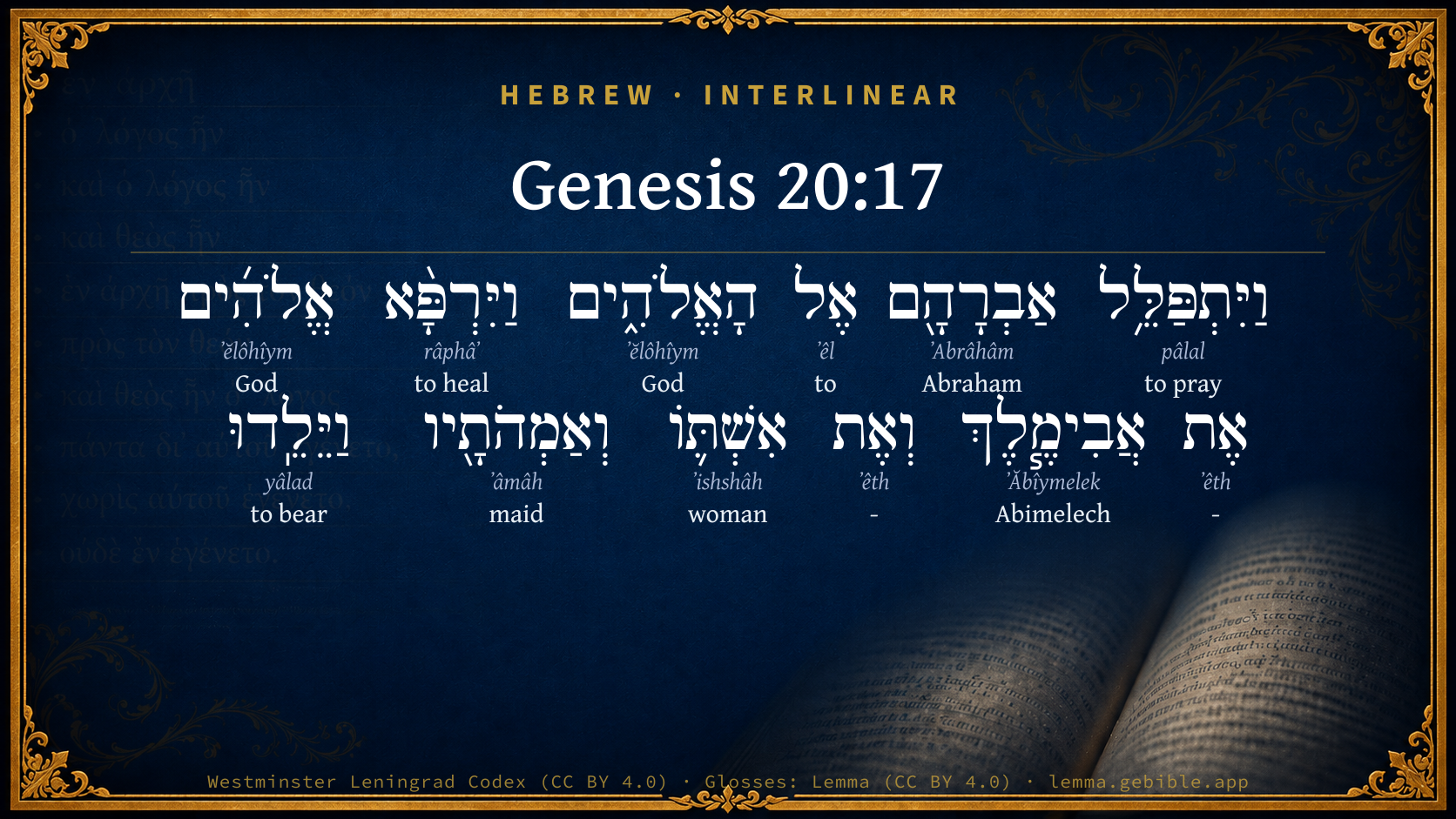
  1. וַיִּתְפַּלֵּ֥ל pâlal H6419 “and · to pray” Conjunction + Verb, Hithpael, Sequential Imperfect, 3rd Person, Masculine, Singular
  2. אַבְרָהָ֖ם ʼAbrâhâm H85 “Abraham” Noun, Proper
  3. אֶל ʼêl H413 “to” Preposition
  4. הָאֱלֹהִ֑ים ʼĕlôhîym H430 “the · God(s)” Particle, Definite Article + Noun, Common, Masculine, Plural, Absolute
  5. וַיִּרְפָּ֨א râphâʼ H7495 “and · to heal” Conjunction + Verb, Qal, Sequential Imperfect, 3rd Person, Masculine, Singular
  6. אֱלֹהִ֜ים ʼĕlôhîym H430 “God(s)” Noun, Common, Masculine, Plural, Absolute
  7. אֶת ʼêth H853 “-” Particle, Direct Object
  8. אֲבִימֶ֧לֶךְ ʼĂbîymelek H40 “Abimelech” Noun, Proper
  9. וְאֶת ʼêth H853 “and · -” Conjunction + Particle, Direct Object
  10. אִשְׁתּ֛וֹ ʼishshâh H802 “woman · his” Noun, Common, Feminine, Singular, Construct + Suffix, Personal, 3rd Person, Masculine, Singular
  11. וַיֵּלֵֽדוּ yâlad H3205 “and · to bear” Conjunction + Verb, Qal, Sequential Imperfect, 3rd Person, Masculine, Plural

About this verse

These counts appear in no published source. They are computed here, from the morphology-tagged text and Lemma’s own curated glosses. What Lemma adds →

12
words
10
distinct lemmas
Pentateuch
section

First appearance in Scripture

These words make their first canonical appearance in the Hebrew Bible here:

  • וַיִּרְפָּ֨א to heal H7495
  • וְאַמְהֹתָ֖יו maid H519

Shared distinctive vocabulary

וְאַמְהֹתָ֖יו maid H519 occurs in 49 verses of the Hebrew Bible. Also found in:

Grammatical profile

  • 3 verbs
  • 6 nouns
  • 1 preposition
  • 2 particles

Verb forms

  • וַיִּתְפַּלֵּ֥ל Hithpael · Sequential Imperfect
  • וַיִּרְפָּ֨א Qal · Sequential Imperfect
  • וַיֵּלֵֽדוּ Qal · Sequential Imperfect

Repetition

A word recurs within this verse — often emphatic in Hebrew:

  • הָאֱלֹהִ֑ים God H430 ×2

Hebrew & Septuagint length

In English translation the verse runs 17 words from the Hebrew and 20 from the Septuagint (LXX English) — closely comparable.

A rough comparison of the two English renderings, which tokenize alike — not a word-level alignment.

Word counts can differ between the Hebrew and the Greek without any difference in meaning — e.g. the Hebrew direct-object marker אֵת has no separate Greek word, and Greek often adds the article ὁ.

In the original languages it is 12 Hebrew tokens and 22 Greek tokens — but the two are counted differently (Hebrew bundles its prefixes and suffixes into one token; the Greek is in lemma form), so that isn’t a like-for-like length.

Cross-references

14

Topical passages linked to Genesis 20:17 in the Treasury of Scripture Knowledge — connected by theme and wording, ordered by reader-vote popularity; previews shown in the World English Bible.

  • James 5:16 Confess your offenses to one another, and pray one for another, that you may be healed. The effective, earnest prayer of a righteous man is powerfully effective.
  • Job 42:9–10 So Eliphaz the Temanite and Bildad the Shuhite and Zophar the Naamathite went, and did what Yahweh commanded them, and Yahweh accepted Job.
  • Proverbs 15:8 The sacrifice made by the wicked is an abomination to Yahweh, But the prayer of the upright is his delight.
  • Matthew 21:22 All things, whatever you ask in prayer, believing, you will receive."
  • Philippians 4:6 In nothing be anxious, but in everything, by prayer and petition with thanksgiving, let your requests be made known to God.
  • Genesis 20:7 Now therefore, restore the man's wife. For he is a prophet, and he will pray for you, and you will live. If you don't restore her, know for sure that you will die, you, and all who are yours."
  • Genesis 29:31 Yahweh saw that Leah was hated, and he opened her womb, but Rachel was barren.
  • 1 Samuel 5:11–12 They sent therefore and gathered together all the lords of the Philistines, and they said, Send away the ark of the God of Israel, and let it go again to its own place, that it not kill us and our people. For there was a deadly confusion throughout all the city; the hand of God was very heavy there.
  • Ezra 6:10 that they may offer sacrifices of sweet savor to the God of heaven, and pray for the life of the king, and of his sons.
  • Isaiah 45:11 Thus says Yahweh, the Holy One of Israel, and his Maker: Ask me of the things that are to come; concerning my sons, and concerning the work of my hands, command you me.
  • Matthew 7:7 "Ask, and it will be given you. Seek, and you will find. Knock, and it will be opened for you.
  • 1 Thessalonians 5:25 Brothers, pray for us.
  • Proverbs 15:29 Yahweh is far from the wicked, But he hears the prayer of the righteous.
  • Acts 3:24 Yes, and all the prophets from Samuel and those who followed after, as many as have spoken, they also told of these days.

Cross-references courtesy of OpenBible.info (CC BY 4.0).

Hebrew and Greek witnesses Masoretic Hebrew ↔ Greek Septuagint

The same verse in the two great witnesses to the Old Testament, shown verse-for-verse.

These are two independent witnesses, not word-aligned to each other, and the Septuagint is shown in lemma (dictionary) form.

Hebrew Genesis 20:17 Masoretic · Westminster Leningrad Codex

וַיִּתְפַּלֵּ֥ל אַבְרָהָ֖ם אֶל הָאֱלֹהִ֑ים וַיִּרְפָּ֨א אֱלֹהִ֜ים אֶת אֲבִימֶ֧לֶךְ וְאֶת אִשְׁתּ֛וֹ וְאַמְהֹתָ֖יו וַיֵּלֵֽדוּ

Abraham prayed to God. God healed Abimelech, and his wife, and his maid-servants, and they bore children.

World English Bible · Public Domain

Greek LXX Genesis 20:17 Septuagint · lemma form

προςεὔχομαι δέ αβρααμ πρός ὁ θεός καί ἰάομαι ὁ θεός ὁ αβιμελεχ καί ὁ γυνή αὐτός καί ὁ παιδίσκη αὐτός καί τίκτω

And Abraam prayed to God, and God healed Abimelech, and his wife, and his women servants, and they bore children.

LXX2012 (modern English Septuagint) · Public Domain

Hebrew: Westminster Leningrad Codex (CC BY 4.0). Greek: Septuagint (public domain); English from LXX2012 (modern English Septuagint) (Public Domain). How the Septuagint differs from the Hebrew →

Targum (Aramaic paraphrase)

2

The Targum is the ancient Jewish Aramaic paraphrase of the Hebrew Scriptures — an interpretive translation, not the Hebrew text itself. Onkelos (literal) and Pseudo-Jonathan (expansive) render the Torah, and Jonathan the Prophets. Coverage is partial: where no permissively-licensed English translation exists for a verse, only the Aramaic is shown. This is verse-level text, not a word-by-word alignment to the Hebrew.

  1. Targum Onkelos Torah (Genesis–Deuteronomy)
    וְצַלִּי אַבְרָהָם קֳדָם יְיָ וְאַסִּי יְיָ יָת אֲבִימֶלֶךְ וְיָת אִתְּתֵהּ וְאַמְהָתֵהּ וְאִתְרְוָחוּ

    (no public-domain English translation for this verse)

    Targum Onkelos — Aramaic: “Onkelos Genesis” (public domain); “Onkelos Exodus” (public domain); “Onkelos Leviticus” (public domain); “Onkelos Numbers” (public domain); “Onkelos Deuteronomy” (public domain). English: “Sefaria Community Translation” (CC0 1.0 (public-domain dedication)); “J.W. Etheridge. The Targums of Onkelos and Jonathan Ben Uzziel on the Pentateuch. London: Longmans, Green, 1862” (public domain). Text via Sefaria.

  2. Targum Pseudo-Jonathan Torah (Genesis–Deuteronomy)
    וְצַלִי אַבְרָהָם קֳדָם יְיָ וְאָסֵי יְיָ יַת אֲבִימֶלֶךְ וְיַת אִנְתְּתֵיהּ וּלְחֵינְתוּ וְאִתְרַוָחוּ אֲרוּם מֵיחַד אָחִיד מֵימְרָא דַיְיָ בְּאַנְפֵּי כָּל צִירֶיהָ בֵּית וַלְדָא לִנְשַׁיָא דִבְּבֵית אֲבִימֶלֶךְ עַל עֵיסַק שָרָה אִתַּת אַבְרָהָם

    (no public-domain English translation for this verse)

    Targum Pseudo-Jonathan — Aramaic: “Targum Jonathan on Genesis” (public domain); “Targum Jonathan on Exodus” (public domain); “Targum Jonathan on Leviticus” (public domain); “Targum Jonathan on Numbers” (public domain); “Targum Jonathan on Deuteronomy” (public domain). English: “The Targum of Jonathan ben Uzziel, trans. J. W. Etheridge, London, 1862” (public domain). Text via Sefaria.

Commentary

Notes on Genesis 20:17 from classic Christian and Jewish commentators (each source and its license shown beneath its notes). The classic Christian expositions comment on the surrounding passage and are grouped to its opening verse, so a note may address several verses; the Jewish commentaries on the Tanakh (Rashi and others) are per-verse, so they appear only where the commentator wrote on this verse.

Lemma curates 59 commentaries, every one of them public domain or Creative Commons licensed, each selected and text-cleaned for this edition rather than reprinted as found. About our sources →

Trapp's Complete Commentary

John Trapp

Gen 20:17 So Abraham prayed unto God: and God healed Abimelech, and his wife, and his maidservants; and they bare [children].

Ver. 17. So Abraham prayed unto God, and God healed Abimelech.] Here was that of St James verified, "The prayer of faith shall save the sick; and if he have committed sins, they shall be forgiven him". {Jas 5:15} So he is healed on both sides. The story of Luther is well known, how by his prayers he recovered Theodorus Virus of a consumption, after the physicians had given him up for dead. {a} The saints are God’s favourites; they may have anything of him. Sejanus found Tiberius so facile, that he needed only to ask, and give thanks. {b} He never denied him anything, and ofttimes anticipated his request. What shall we think of God’s goodwill to his faithful servants and suppliants?

{a} Melch. Adam. in Vita Luther.

{b} Life of Sejanus, by P. M., p. 5.

John Trapp, A Commentary or Exposition upon All the Books of the Old and New Testament (1647–1656) — public domain. Text from a community e-Sword module.

The Biblical Illustrator

Joseph S. Exell

Gen_20:17-18

So Abraham prayed unto God: and God healed Abimelech

An efficacious interesting prayer

Abrahams prayer for the doomed cities was not granted, but his prayer for Abimelech was answered in full.

God healed Abimelech and his wife and his maid-servants. But in the present instance we can see some reasons why it was likely that this prayer should be answered.

I. BECAUSE FAITH WAS MAINTAINED NOTWITHSTANDING PAST FAILURES. Persevering faith, which is superior to all discouragements, must be rewarded.

II. BECAUSE THE OBJECTS OF IT WERE DISPOSED TO RECEIVE THE BLESSING. The hindrances to the gracious effects of prayer lie in mans rebellious heart. There must be a Godward direction imparted to souls which are to be blest. God meets those who are looking towards Him. Abimelech and his household had this receptivity.

III. BECAUSE GOD DELIGHTS TO PUT HONOUR UPON HIS SERVANTS. God had entered into covenant with Abraham. He was Gods prophet and faithful friend. God will set His visible marks of approval upon His own appointed means of blessing. Learn the importance of the prophet to mankind.

1. He makes known the will of God. He is a messenger who has received instructions from the Supreme Ruler of all mankind.

2. He is the human channel of spiritual blessings. He teaches men the way of righteousness, how they may find the chief good and reach true blessedness. (T. H. Leate.)

.

The Biblical Illustrator, edited by Joseph S. Exell (c. 1880s–1900s) — public domain. Text from a community e-Sword module.

The Preacher's Complete Homiletical Commentary

Joseph S. Exell (gen. ed.)

CRITICAL NOTES.—

Gen_20:17. God healed Abimelech.] This may explain in what sense he was on the point of dying (Gen_20:3), that he was to be considered dead, as regards progeny. His wife, i.e., she who was eminently such—the queen. Maid servants. Concubines are intended, a different word being used for ordinary servants. (1Sa_25:41.) And they bare. They were rendered capable of procreating children. The verb is masculine, for both sexes were involved in this judicial malady. It may be that this was inflicted with the design of preserving the purity of Sarah. Abimelech was not suffered to touch her. (Gen_20:6).

Gen_20:18. For the Lord had fast closed up all the wombs of the house of Abimelech.] “To be taken with reference to both sexes. God had visited all with incapacity, which visitation was now removed.” (Alford.)

MAIN HOMILETICS OF THE PARAGRAPH.—Gen_20:17-18

AN EFFICACIOUS INTERCESSORY PRAYER

Abraham’s prayer for the doomed cities was not granted, but his prayer for Abimelech was answered in full. “God healed Abimelech and his wife and his maid-servants.” Why was this prayer successful? God has reasons for refusing the requests of His servants, which are often hid from them; and he who prays best is most satisfied calmly to accept the good pleasure of the Divine will. But in the present instance we can see some reasons why it was likely that this prayer should be answered.

I. Because faith was maintained notwithstanding past failures. Abraham had pleaded hard for the cities of the plain, yet he had seen them swept into destruction. His prayer had failed to save that wicked people from their doom. A less hardier soul than his might have been discouraged, and have lost all faith in prayer. But no difficulties daunted this believing man. It is the nature and property of genuine faith to hold out against all discouragements, to believe still in God both when He grants and when He denies. If we have proper confidence in the Divine character we have only patiently to wait and real success will come at last. Abraham still pleaded with God, notwithstanding his failure in a great instance. Persevering faith, which is superior to all discouragements, must be rewarded.

II. Because the objects of it were disposed to receive the blessing. The hindrances to the gracious effects of prayer lie in man’s rebellious heart. God willeth not the death of any sinner. Prayers for others are more likely to be answered when, on their part, there is some disposition to receive Divine blessings. There must be a Godward direction imparted to souls which are to be blest. God meets those who are looking towards Him. Abimelech and his household had this receptivity. By desire and submission they were prepared for healing and blessing. How different with the people of Sodom and Gomorrah! They maintained open defiance against God. In their rebellious souls there was nothing to answer any movement of the Divine goodness towards them. Therefore they were left to the fate of all who contend with their Maker. Thus God’s gracious purposes can be hindered by man. “I would have gathered thy children together, … and ye would not.” (Mat_23:37).

III. Because God delights to put honour upon His servants. God had entered into covenant with Abraham. He was God’s prophet and faithful friend. It was not for nought that he was called to interpret the Divine will, and to intercede for men. God will set His visible marks of approval upon His own appointed means of blessing. He will not cause his servants to become ashamed of their confidence, but will show the world that He is with them. Learn the importance of the prophet to mankind.

(1) He makes known the will of God. He is a messenger who has received instructions from the Supreme Ruler of all mankind. He comes to speak on behalf of God, for warning, for reproof, for the announcement of gracious purposes.

(2) He is the human channel of spiritual blessings. He teaches men the way of righteousness, how they may find the chief good and reach true blessedness. Who is such a benefactor to the race as this—so important to the dearest interests of mankind! Abimelech could bring his gold, but Abraham could put him in the way of obtaining far better gifts.

SUGGESTIVE COMMENTS ON THE VERSES

Gen_20:17. Abraham, by his prevarication, had brought distress on Abimelech and all his household. Being now humbled by the rebuke he had received, he prayed to God for the removal of the judgments which he had been instrumental in procuring. By this means, as far as in him lay, he counteracted and reversed the mischief that he had done. It is but seldom that we can cancel in any degree the evil that we have committed; but if any way whatever present itself, we should embrace it gladly, and put forth our utmost endeavours to undo the injury we may have wrought, At all events, the course adopted by Abraham is open to us all. We may pray for those whom we have injured; we may beg of God to obliterate from their minds any bad impressions which, either by word or deed, we may have made on them. And if we find in them a kind, forgiving spirit, we should so much the more redouble our exertions to obtain for them the blessings of salvation, which will infinitely overbalance any evils that they may have suffered through our means.—(Bush.)

Our prayers have power to heal the wrongs we may have done to others by our unbelief.

The effect of Abraham’s prayer is an illustration of salvation, which is the healing of the soul of those diseases sin has brought upon it.

How great is the power of the intercession of the believer with God, when it can stay the hand of judgment, and even prevail notwithstanding the infirmities and lapses of the intercessor! What efficacy, then, must we ascribe to the intercessions of that Divine Advocate who was without sin!

Gen_20:18. The name Jehovah is employed at the end of the chapter, because the relation of the Creator and Preserver to Sarah is there prominent.—(Murphy.)

The Preacher's Complete Homiletical Commentary (gen. ed. Joseph S. Exell; Funk & Wagnalls, c. 1892) — public domain (pre-1929). A full-Bible homiletical/sermon-outline anthology covering 65 of 66 books (2 John is absent from the source module). Text from a community e-Sword module.

Keil & Delitzsch

C. F. Keil & F. Delitzsch

After this reparation, God healed Abimelech at Abraham's intercession; also his wife and maids, so that they could bear again, for Jehovah had closed up every womb in Abimelech's house on Sarah's account. אמהות, maids whom the king kept as concubines, are to be distinguished from שׁפחות female slaves (Gen 20:14). That there was a material difference between them, is proved by Sa1 25:41. כּל־רחם עצר כּל does not mean, as is frequently supposed, to prevent actual childbirth, but to prevent conception, i.e., to produce barrenness (Sa1 1:5-6). This is evident from the expression "He hath restrained me from bearing" in Gen 16:2 (cf. Isa 66:9, and Sa1 21:6), and from the opposite phrase, "open the womb," so as to facilitate conception (Gen 29:31, and Gen 30:22). The plague brought upon Abimelech's house, therefore, consisted of some disease which rendered the begetting of children (the coitus) impossible. This might have occurred as soon as Sarah was taken into the royal harem, and therefore need not presuppose any lengthened stay there. There is no necessity, therefore, to restrict ויּלדוּ to the women and regard it as equivalent to ותּלדנה, which would be grammatically inadmissible; for it may refer to Abimelech also, since ילד signifies to beget as well as to bear. We may adopt Knobel's explanation, therefore, though without approving of the inference that Gen 20:18 was an appendix of the Jehovist, and arose from a misunderstanding of the word ויּלדוּ in Gen 20:17. A later addition Gen 20:18 cannot be; for the simple reason, that without the explanation give there, the previous verse would be unintelligible, so that it cannot have been wanting in any of the accounts. The name Jehovah, in contrast with Elohim and Ha-Elohim in Gen 20:17, is obviously significant. The cure of Abimelech and his wives belonged to the Deity (Elohim). Abraham directed his intercession not to Elohim, an indefinite and unknown God, but to האלהים; for the God, whose prophet he was, was the personal and true God. It was He too who had brought the disease upon Abimelech and his house, not as Elohim or Ha-Elohim, but as Jehovah, the God of salvation; for His design therein was to prevent the disturbance of frustration of His saving design, and the birth of the promised son from Sarah.

But if the divine names Elohim and Ha-Elohim indicate the true relation of God to Abimelech, and here also it was Jehovah who interposed for Abraham and preserved the mother of the promised seed, our narrative cannot be merely an Elohistic side-piece appended to the Jehovistic account in Gen 12:14., and founded upon a fictitious legend. The thoroughly distinctive character of this event is a decisive proof of the fallacy of any such critical conjecture. Apart from the one point of agreement-the taking of Abraham's wife into the royal harem, because he said she was his sister in the hope of thereby saving his own life (an event, the repetition of which in the space of 24 years is by no means startling, when we consider the customs of the age) - all the more minute details are entirely different in the two cases. In king Abimelech we meet with a totally different character from that of Pharaoh. We see in him a heathen imbued with a moral consciousness of right, and open to receive divine revelation, of which there is not the slightest trace in the king of Egypt. And Abraham, in spite of his natural weakness, and the consequent confusion which he manifested in the presence of the pious heathen, was exalted by the compassionate grace of God to the position of His own friend, so that even the heathen king, who seems to have been in the right in this instance, was compelled to bend before him and to seek the removal of the divine punishment, which had fallen upon him and his house, through the medium of his intercession. In this way God proved to the Philistine king, on the one hand, that He suffers no harm to befall His prophets (Psa 105:15), and to Abraham, on the other, that He can maintain His covenant and secure the realization of His promise against all opposition from the sinful desires of earthly potentates. It was in this respect that the event possessed a typical significance in relation to the future attitude of Israel towards surrounding nations.

Keil & Delitzsch — Biblical Commentary on the Old Testament (1861–1891) — public domain (CC PDM 1.0). Text via the HelloAO Bible API. (Old Testament only.)

Tyndale Open Study Notes

Tyndale Open Resources

20:17-18 The infertility suggests that some time had passed. God controls births; he opens and closes wombs (25:21; 29:31; 30:2, 17, 22-23; 1 Sam 1:19-20; Pss 113:9; 127:3; Luke 1:13).

Tyndale Open Study Notes — © Tyndale Open Resources, licensed CC BY-SA 4.0. Text via the HelloAO Bible API.

Adam Clarke's Commentary

Verse 17. So Abraham prayed] This was the prime office of the נביא nabi; see Ge 20:7.

Adam Clarke's Commentary on the Bible (1810–1826) — public domain. Text from a community e-Sword/MySword module.

John Calvin's Commentaries

17. So Abraham prayed. In two respects the wonderful favor of God towards Abraham was apparent; firsts that, with outstretched hand, He avenged the injury done to him; and, secondly, that, through Abraham’s prayer, He became pacified towards the house of Abimelech. It was necessary to declare, that the house of Abimelech had been healed in answer to Abraham’s prayers; in order that, by such a benefit, the inhabitants might be the more closely bound to him. A question, however, may be agitated respecting the kind of punishment described in the expression, the whole house was barren. For if Abraham had gone into the land of Gerar, after Sarah had conceived, and if the whole of what Moses has here related was fulfilled before Isaac was born, how was it possible that, in so short a time, this sterility should be manifest? If we should say, that the judgment of God was then made plain, in a manner to us unknown, the answer would not be inappropriate. Yet I am not certain, that the series of the history has not been inverted. The more probable supposition may seem to be, that Abraham had already been resident in Gerar, when Isaac was promised to him; but that the part, which had before been omitted, is now inserted by Moses. Should any one object, that Abraham dwelt in Mamre till the destruction of Sodom, there would be nothing absurd in the belief, that what Moses here relates had taken place previously. Yet, since the correct notation of time does little for the confirmation of our faith, I leave both opinions undecided.

John Calvin's Commentaries (1540-1563) — public domain. Text from the Calvin Translation Society English edition (1840s-50s) via the Christian Classics Ethereal Library (ccel.org). Calvin's coverage is partial (roughly two-thirds of the Bible); uncommented books and verses are honest gaps, never fabricated. The 19th-century editor's footnotes and remarks are omitted so the notes are faithfully Calvin's own voice.

Ellicott's Commentary for English Readers

(17) Abraham prayed . . . —As Abimelech had now made very liberal compensation, it became the duty of Abraham to intercede for him. The malady seems to have been one confined to Abimelech, as its object was to protect Sarah; but in some way it so affected the whole household as to produce general barrenness.

Maidservants.—Not the word rendered women-servants in Gen_20:14, but one specially used of concubines.

A Bible Commentary for English Readers, edited by Charles John Ellicott (1878–1897) — public domain. Text from a community e-Sword module.

The Cambridge Bible for Schools and Colleges

gen. ed. J. J. S. Perowne

17. Abraham prayed] See note on Gen_20:7. This verse explains Gen_20:4.

Barrenness was regarded as the sign of Divine displeasure, which might be averted by prayer and intercession: cf. Gen_25:21, Gen_30:2; Gen_30:22; 1Sa_1:10. See note on Gen_12:17.

The Cambridge Bible for Schools and Colleges (gen. ed. J. J. S. Perowne; Cambridge University Press, 1878–1918) — public domain. Text from a community e-Sword module.

John Gill's Exposition

So Abraham prayed unto God,.... As the Lord had told Abimelech be would, Gen 20:7; he might pray for the forgiveness of him and his wife, and might give thanks that Sarah had been restored to him; but chiefly it was on account of Abimelech and his family:

and God healed Abimelech, and his wife, and his maidservants: who by reason of some disease were rendered unfit for and incapable of cohabitation with their husbands, and they with them; but upon Abraham's prayer for them, who was heard, they were healed, and the disorder removed; the Targum of Jonathan is,"his wife and concubines;"

and they bare children; cohabited and conceived, and bare and brought forth children, all which are comprehended in this expression.

John Gill's Exposition of the Whole Bible (1746–1763) — public domain (CC PDM 1.0). Text via the HelloAO Bible API.

Haydock's Catholic Bible Commentary

Healed. It is not known how God afflicted Abimelech; but the women could not be delivered during the short time that Sara was detained: on her being set at liberty, they bore children. (Menochius)

George Leo Haydock (1774–1849), Haydock's Catholic Family Bible and Commentary, 1859 edition — public domain. Excludes Psalms (Douay-Rheims chapter numbering differs from Protestant) and Deuterocanonical books (Catholic canon only).

Whedon's Commentary on the Bible

Daniel D. Whedon

17. Prayed unto God — He prayed unto האלהים, the true God; as one who felt the responsibility of being a prophet.

Healed Abimelech — From this it is clear that Abimelech and his wife and concubines had been plagued with some malady, as a curse for his taking Sarah.

They bare — ילדוin pause for ילדו. The grammatical reference being to the three nouns of the preceding sentence, in which Abimelech stands first, the verb is put in the masculine plural.

Daniel D. Whedon (gen. ed.), Commentary on the Old and New Testaments (1874–1909) — public domain. Text from a community e-Sword module.

The Pulpit Commentary

So Abraham prayed unto God. Literally, the Elohim, the personal and true God, and not Elohim, or Deity in general, to whom belonged the cure of Abimelech and his household (Keil), as the next clause shows. And God (Elohim, without the art.) healed Abimelech, and his wife, and his maid-servants; i.e. his concubines, as distinguished from the women servants (Ver. 14)and they bare children. The verb may apply to both sexes, and the malady under which they suffered may be here described as one which prevented procreation, as the next verse explains.

The Pulpit Commentary (1880–1919), ed. H.D.M. Spence-Jones & Joseph S. Exell — public domain. Text from a community e-Sword module.

unfoldingWord translationNotes

Door43 World Missions Community

completely infertile

"totally unable to have children"

because of Sarah, Abraham's wife

The full meaning can be stated explicitly. AT: "because Abimelech had taken Abraham's wife Sarah" (See: Assumed Knowledge and Implicit Information)

translationWords

Abraham

pray

God

cure

Abimelech

servant

Yahweh

household

Sarah

unfoldingWord translationNotes — © Distant Shores Media and the Door43 World Missions Community, licensed CC BY-SA 4.0. Source: git.door43.org/Door43/en_tn.

Rashi

Rabbi Shlomo Yitzchaki (Rashi)

וילדו AND THEY BROUGHT FORTH — Explain it as the Targum takes it: “and they were relieved” — their channels were opened (cf. 5:9) and they brought forth their secretions — and this is לידה “bringing forth”, as far as they are concerned.

Rashi on the Tanakh — English translations: “The Judaica Press complete Tanach with Rashi, translated by A. J. Rosenberg” (CC BY 4.0); “Pentateuch with Rashi's commentary by M. Rosenbaum and A.M. Silbermann, 1929-1934” (public domain); “The Metsudah Tanach series, Lakewood, N.J” (CC BY 4.0); and “The Book of Joshua, Metsudah Publications, 1997” (CC BY 4.0). Text via Sefaria.

Ramban (Nachmanides)

Rabbi Moshe ben Nachman (Ramban / Nachmanides)

‘VAYEILEIDU’ (AND THEY BORE CHILDREN). If this is understood literally as referring to his wife, and his maidservants and stating that the Eternal had restrained their wombs, it is astonishing! For it appears that on the first night that Sarah was taken to Abimelech’s house, and he had not even approached her, G-d immediately came to him in the dream, and in the morning he rose early and called his servants and also Abraham. When then did they experience this restraining of the womb? Perhaps it so happened that they were in their due time, experiencing the pangs of childbirth, unable to be relieved by giving birth. Perhaps, also, Abraham delayed his prayer for many days. But according to this interpretation, the nature of Abimelech’s healing as well as his sickness have not been explained in Scripture.Now Rashi comments: “Vayeileidu — and they were relieved, their channels were opened, and they brought forth their wastes. This was the leidah (bringing forth) as it referred to them. All the wombs means every opening of the body.”But this is not correct. Even if we were to say concerning the word vayeileidu that it means “bringing forth” — as we do indeed find the word leidah used in many contexts, such as: Yea, he conceiveth mischief ‘veyolad’ (and bringeth forth) falsehood; Before the decree ‘ledeth’ (bring forth); for thou knowest not what a day ‘yolad’ (may bring forth), meaning what the days will bring forth and originate — but the word rechem (womb) never refers to any other openings. This is not contradicted by the verse, Or, who shut up the sea with doors, when it broke forth, and issued out of the womb, for this is merely a figure of speech,) similar to “the belly of the earth.”.Now Onkelos’ opinion is not like that of the Rabbi for even if he translated, “and they were relieved,” yet the word rechem (womb) he renders literally as “the opening for giving birth to a child.” However, [the reason why Onkelos translated it, “and they were relieved,” and not “and they gave birth,” is that] he wanted to include Abimelech also in the word vayeileidu.In Bereshith Rabbah it is said: “For the Eternal had fast closed up (‘atzor atzar’), i.e., closed up the mouth, closed up the neck, closed up the eye, closed up the ear, closed up above, and closed up below.” Now the Rabbis derived this exposition from the double usage of the expression, atzor atzar, but they did not explain the expression, every womb, as meaning every opening of the body.The correct interpretation appears to me to be that from the day Sarah was taken to Abimelech’s house, Abimelech was stricken in his limbs and was unable to fulfill his needs. This is [what the verse alludes to when it says], Therefore I did not suffer thee to touch her, as “touching” or “approaching” women are euphemisms for sexual intercourse, as in the verse, Draw not near a woman; And I came unto the prophetess. And He restrained the wombs of his wife and his maidservants who were pregnant so they could not give birth. “Restraining a womb” means that the woman could not conceive, even as it says, And the Eternal had closed up her womb. But “restraining the womb” denotes inability to give birth, similar in usage to the verse, He hath hedged me about, that I cannot go forth. Sarah stayed in Abimelech’s house many days, and Abimelech did not repent his way as he did not understand his transgression until G-d came to him in a dream and informed him of it. Now Scripture does not explain Abimelech’s sickness explicitly but mentions it only by hint in an ethical manner and out of respect for Sarah. After Abraham’s prayer, Abimelech and his wife and his maidservants were healed, and the women gave birth.

Ramban (Nachmanides) on the Tanakh — English translation: “Commentary on the Torah by Ramban (Nachmanides). Translated and annotated by Charles B. Chavel. New York, Shilo Pub. House, 1971-1976” (CC BY 4.0). Text via Sefaria.

Radak

Rabbi David Kimhi (Radak)

ויתפלל...את אבימלך, he again possessed an active libido, just as he had before G’d struck him.

ואת אשתו ואמהותיו, the ones who had been supposed to give birth but had been unable to due to this affliction. Even though, generally speaking, we cannot determine precisely when a baby that is due to be born will be born, the women who had entered labour at the time the affliction struck could not give birth so that it was clear what the affliction was connected to. After Avimelech had dreamt the dream which the Torah described in detail, he called together both his servants as well as Avraham early in the morning. If so, when did they experience the impediment to delivering the babies due? Perhaps they experienced labour pains which were not relieved for even brief periods in between. Or, perhaps, Avraham took his time before he appealed to G’d in prayer to relieve the situation. We know that when women are in labour there are a number of ways in which their husbands can alleviate their pains and bring on the birth. All of these attempts had failed so that it became clear that some supernatural power had its hand in what was happening.

וילדו, this word may refer to Avimelech’s wife and his maidservants; alternately, it may refer to Avimelech’s ability to ejaculate semen again, something he had not been able to do. Onkelos translates this as ואתרוחו, meaning that their orifices which had been closed opened up again. Why would he not translate the word וילדו as “they gave birth?” Perhaps what he meant was that they did give birth, and he did not really mean that their orifices had been closed so that they could neither urinate nor defecate, as seems to be the opinion of our sages (Baba Kama 92b).

Radak on the Tanakh — English translations: “Sefaria Community Translation” (CC0 1.0 (public-domain dedication)); “Eliyahu Munk, HaChut Hameshulash” (CC BY 4.0); “Rabbi Mike Feuer, Jerusalem Anthology” (CC BY 4.0); and “R. David Kimhi on the first book of Psalms, Translated by R.G. Finch, London, 1919” (public domain). Text via Sefaria.

Lesson kit

Teaching starters — assembled from the data on this page, not authored interpretation. Every prompt links to the verse data it draws on. Edit before teaching.

Genesis, in the Pentateuch, opens this verse with 12 words (10 distinct Hebrew lemmas). Its most distinctive word is ʼâmâh (“maid”). A historical commentator’s framing appears above. Read the whole chapter for the surrounding context.

Discussion questions

  1. How does “maid” (ʼâmâh) shape what this verse is saying?
  2. 2 words here appear for the first time in Scripture. What is being introduced at this debut?
  3. Genesis 21:10 shares the word «maid» with this verse. How do the two illuminate each other?
  4. “God” occurs 2× in this one verse. What is the effect of the repetition?
  5. These translations render this verse differently. What is at stake in choosing one wording over another?
  6. The verb «וַיִּתְפַּלֵּ֥ל» is Hithpael Sequential Imperfect. How does its form color the action?
  7. Reading how Trapp's Complete Commentary and The Biblical Illustrator read this verse, where do the two commentators agree and where do they part?

Things to notice

Reading settings

Reading text

Shown beneath each verse's original-language words.

Old Testament
Old Testament edition

Read the OT as the Masoretic Hebrew (MT) or the Greek Septuagint (LXX).

English shown for the Greek Septuagint (in the Hebrew ↔ Greek comparison).

Comparing translations? Open the Compare panel on any verse page to stack up to four side by side.