Genesis 21:7

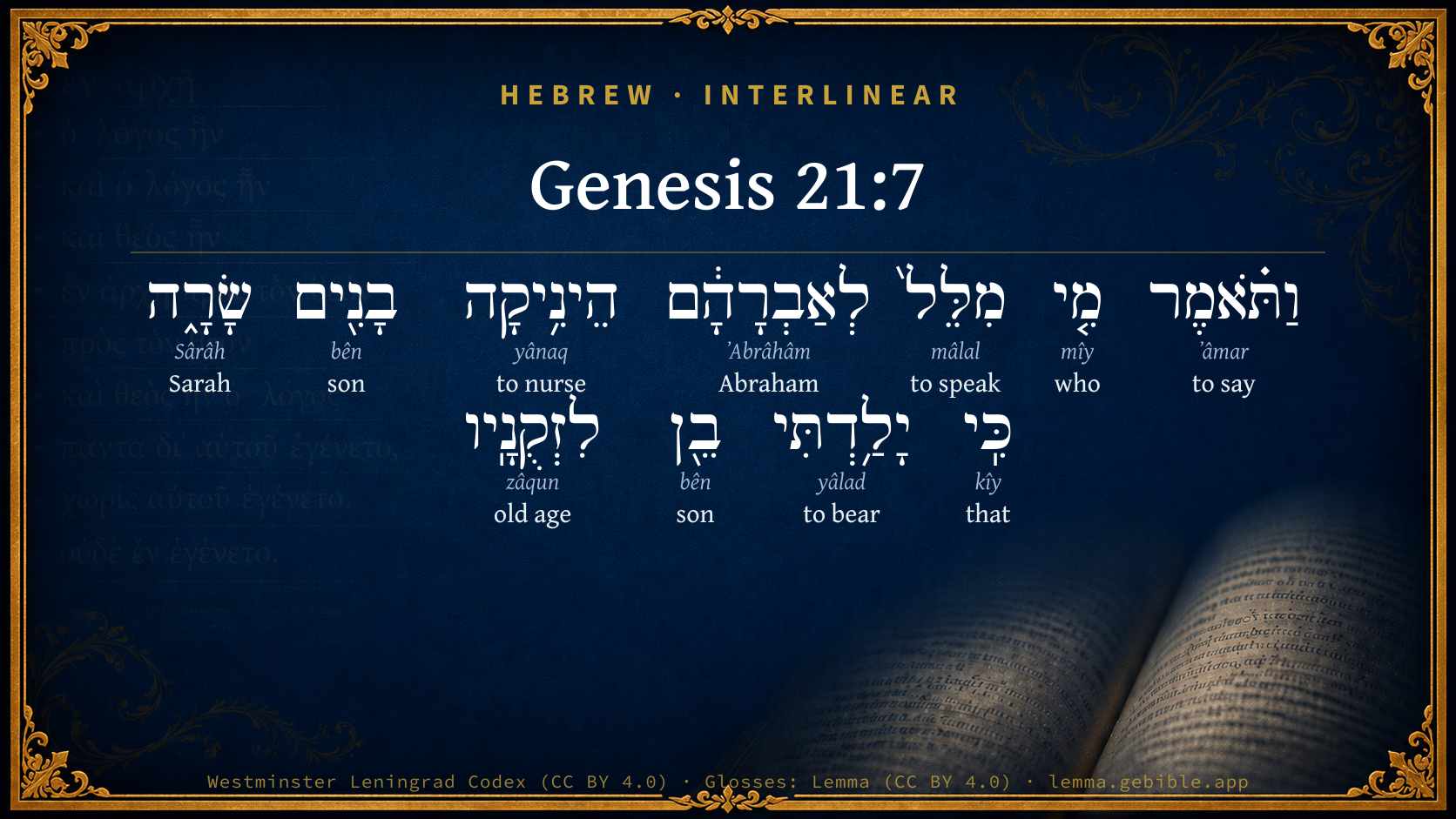
Hebrew (Westminster Leningrad Codex) Genesis 21:7 appears in the Hebrew Old Testament. The text above is from the Westminster Leningrad Codex. Each word links to its Strong’s number, a concise gloss, and parsing drawn from the Open Scriptures Hebrew Bible morphology. Click any word for its full Brown-Driver-Briggs (BDB) entry.
Download image
Cite this verse

Genesis 21:7 (World English Bible). Public Domain. Lemma interlinear Bible study tool, https://lemma.gebible.app/v/genesis/21/7.

Show BibTeX & RIS
BibTeX
RIS
English Translation
She said, "Who would have said to Abraham, that Sarah would nurse children? For I have borne him a son in his old age."
World English Bible · Public Domain
Highlights
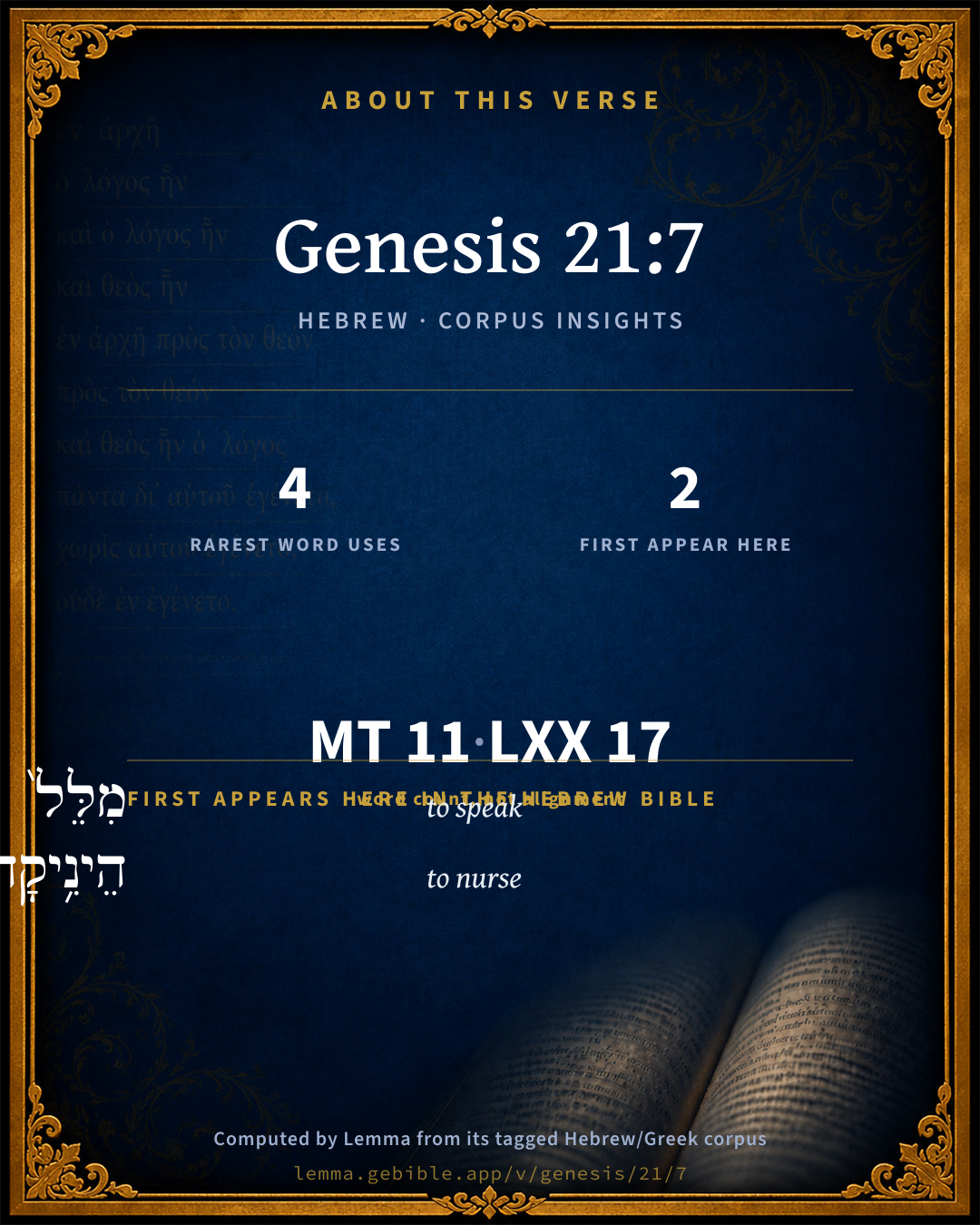
  • 2 first appearances in the Hebrew Bible
Full analysis ↓
Download a study sheet

One document with this verse’s original text, its word-by-word gloss line, the meaning frame, cross-references with their text, attributed commentary, and full source and license credits — printable, and it pastes into notes with its structure intact.

This verse Autodidact and up

Study sheet (.html) Plain text (.txt)

A passage Seminary Student

Up to 50 verses in one chapter. A passage sheet keeps up to 6 commentary sources and 12 cross-references per verse, in the order this page ranks them, and says so on the sheet whenever that leaves anything out. Ask for a single verse and you get the Autodidact verse sheet above.

Everything on this page stays free to read, with no account — the sheet is a download of what is already on screen, not access to it.

Want to remove ads? Support Godless Engineer
Compare translations 3

The same verse in 3 English versions, stacked beneath the original-language interlinear above. Click any original word for its lexicon entry.

Each is an independent rendering of the whole verse — the interlinear is not word-aligned to these translations.

Highlighted words mark where these versions differ — a whole-verse word diff, not a word-by-word alignment.

  • World English Bible Public Domain
    She said, "Who would have said to Abraham, that Sarah would nurse children? For I have borne him a son in his old age."
  • King James Version Public Domain
    And she said, Who would have said unto Abraham, that Sarah should have given children suck? for I have born him a son in his old age.
  • unfoldingWord Literal Text CC BY-SA 4.0
    And she said, “Who would have said to Abraham Sarah would nurse children? Yet I have born a son in his old age!” Sarah Has Abraham Send Hagar and Ishmael Away 21:8-21

unfoldingWord Literal Text — © unfoldingWord, licensed CC BY-SA 4.0. Word-aligned USFM3 via Door43 (git.door43.org/unfoldingWord/en_ult).

Versions to compare (up to 4)

3 of 4 selected

Show all 18 translations

Every available English version of this verse, each an independent rendering of the whole verse.

  • World English Bible Public Domain
    She said, "Who would have said to Abraham, that Sarah would nurse children? For I have borne him a son in his old age."
  • Berean Standard Bible Public Domain
    She added, “Who would have told Abraham that Sarah would nurse children? Yet I have borne him a son in his old age.”
  • Majority Standard Bible Public Domain
    She added, “Who would have told Abraham that Sarah would nurse children? Yet I have borne him a son in his old age.”
  • King James Version Public Domain
    And she said, Who would have said unto Abraham, that Sarah should have given children suck? for I have born him a son in his old age.
  • American Standard Version (1901) Public Domain
    And she said, Who would have said unto Abraham, that Sarah should give children suck? For I have borne him a son in his old age.
  • Revised Version (1885) Public Domain
    And she said, Who would have said unto Abraham, that Sarah should give children suck? for I have borne him a son in his old age.
  • Geneva Bible (1599) Public Domain
    Againe she said, Who would haue saide to Abraham, that Sarah shoulde haue giuen children sucke? for I haue borne him a sonne in his olde age.
  • Douay-Rheims (1899) Public Domain
    And again she said: Who would believe that Abraham should hear that Sara gave suck to a son, whom she bore to him in his old age.
  • Young's Literal Translation Public Domain
    She saith also, `Who hath said to Abraham, Sarah hath suckled sons, that I have born a son for his old age?'
  • Literal Standard Version CC BY-SA 4.0
    She also says, “Who has said to Abraham, Sarah has suckled sons, that I have born a son for his old age?”
  • Unlocked Literal Bible CC BY-SA 4.0
    She also said, “Who would have said to Abraham that Sarah would nurse children, and yet I have borne him a son in his old age!”
  • unfoldingWord Literal Text CC BY-SA 4.0
    And she said, “Who would have said to Abraham Sarah would nurse children? Yet I have born a son in his old age!” Sarah Has Abraham Send Hagar and Ishmael Away 21:8-21
  • Darby Bible Public Domain
    And she said, Who would have said to Abraham, Sarah will suckle children? For I have borne [him] a son in his old age.
  • World Messianic Bible Public Domain
    She said, “Who would have said to Abraham that Sarah would nurse children? For I have borne him a son in his old age.”
  • Webster's Bible Public Domain
    And she said, Who would have said to Abraham, that Sarah shall nurse children? for I have borne him a son in his old age.
  • Free Bible Version CC BY-SA 4.0
    She also said, “Would anyone have announced to Abraham that Sarah was going to have children to nurse? But now I have had a son for Abraham even when he was old!”
  • Bible in Basic English Public Domain
    And she said, Who would have said to Abraham that Sarah would have a child at her breast? for see, I have given him a son now when he is old.
  • JPS Tanakh (1917) Public Domain
    And she said: 'Who would have said unto Abraham, that Sarah should give children suck? for I have borne him a son in his old age.'

Literal Standard Version (2020), Covenant Press — licensed CC BY-SA 4.0. Text via the HelloAO Bible API (eBible.org). Unlocked Literal Bible (unfoldingWord) — licensed CC BY-SA 4.0. Text via the HelloAO Bible API (eBible.org). unfoldingWord Literal Text — © unfoldingWord, licensed CC BY-SA 4.0. Word-aligned USFM3 via Door43 (git.door43.org/unfoldingWord/en_ult). Free Bible Version, Dr. Jonathan Gallagher — licensed CC BY-SA 4.0. Text via the HelloAO Bible API (eBible.org).

Word by word

More ways to search: Search by grammar → Find every occurrence → Compare this word →

Practice this passage: Drill this verse → Learn its vocabulary →

לִזְקֻנָֽיו
zâqun
H2208
“to/for · old age · his”
Preposition + Noun, Common, Masculine, Plural, Construct + Suffix, Personal, 3rd Person, Masculine, Singular
Part of Speech
Preposition + Noun
Type
Common
Gender
Masculine
Number
Plural
State
Construct
Full BDB Definition

Origin: properly, passive participle of H2204 (used only in the plural as a noun)

TWOT: 574e

old age, extreme old age
  1. וַתֹּ֗אמֶר ʼâmar H559 “and · to say” Conjunction + Verb, Qal, Sequential Imperfect, 3rd Person, Feminine, Singular
  2. מִ֤י mîy H4310 “who” Particle, Interrogative
  3. מִלֵּל֙ mâlal H4448 “to speak” Verb, Piel, Perfect, 3rd Person, Masculine, Singular
  4. לְאַבְרָהָ֔ם ʼAbrâhâm H85 “to/for · Abraham” Preposition + Noun, Proper
  5. הֵינִ֥יקָה yânaq H3243 “to nurse” Verb, Hiphil, Perfect, 3rd Person, Feminine, Singular
  6. בָנִ֖ים bên H1121 “sons” Noun, Common, Masculine, Plural, Absolute
  7. שָׂרָ֑ה Sârâh H8283 “Sarah” Noun, Proper
  8. כִּֽי kîy H3588 “that” Conjunction
  9. יָלַ֥דְתִּי yâlad H3205 “to bear” Verb, Qal, Perfect, 1st Person, Common, Singular
  10. בֵ֖ן bên H1121 “son” Noun, Common, Masculine, Singular, Absolute

About this verse

These counts appear in no published source. They are computed here, from the morphology-tagged text and Lemma’s own curated glosses. What Lemma adds →

11
words
10
distinct lemmas
Pentateuch
section

Notable vocabulary

The rarest word here is לִזְקֻנָֽיו old age H2208 — appearing just 4 times in the whole Hebrew Bible.

First appearance in Scripture

These words make their first canonical appearance in the Hebrew Bible here:

  • מִלֵּל֙ to speak H4448
  • הֵינִ֥יקָה to nurse H3243

Shared distinctive vocabulary

לִזְקֻנָֽיו old age H2208 occurs in 4 verses of the Hebrew Bible. Also found in:

Grammatical profile

  • 4 verbs
  • 5 nouns
  • 1 conjunction
  • 1 particle

Verb forms

  • וַתֹּ֗אמֶר Qal · Sequential Imperfect
  • מִלֵּל֙ Piel · Perfect
  • הֵינִ֥יקָה Hiphil · Perfect
  • יָלַ֥דְתִּי Qal · Perfect

Repetition

A word recurs within this verse — often emphatic in Hebrew:

  • בָנִ֖ים son H1121 ×2

Hebrew & Septuagint length

In English translation the verse runs 24 words from the Hebrew and 23 from the Septuagint (LXX English) — closely comparable.

A rough comparison of the two English renderings, which tokenize alike — not a word-level alignment.

Word counts can differ between the Hebrew and the Greek without any difference in meaning — e.g. the Hebrew direct-object marker אֵת has no separate Greek word, and Greek often adds the article ὁ.

In the original languages it is 11 Hebrew tokens and 17 Greek tokens — but the two are counted differently (Hebrew bundles its prefixes and suffixes into one token; the Greek is in lemma form), so that isn’t a like-for-like length.

Cross-references

9

Topical passages linked to Genesis 21:7 in the Treasury of Scripture Knowledge — connected by theme and wording, ordered by reader-vote popularity; previews shown in the World English Bible.

  • Genesis 18:11–12 Now Abraham and Sarah were old, well advanced in age. It had ceased to be with Sarah after the manner of women.
  • Isaiah 66:8 Who has heard such a thing? who has seen such things? Shall a land be born in one day? shall a nation be brought forth at once? for as soon as Zion travailed, she brought forth her children.
  • Numbers 23:23 Surely there is no enchantment with Jacob; Neither is there any divination with Israel: Now shall it be said of Jacob and of Israel, What has God done!
  • Deuteronomy 4:32–34 For ask now of the days that are past, which were before you, since the day that God created man on the earth, and from the one end of the sky to the other, whether there has been [any such thing] as this great thing is, or has been heard like it?
  • Ephesians 3:10 to the intent that now through the assembly the manifold wisdom of God might be made known to the principalities and the powers in the heavenly places,
  • 2 Thessalonians 1:10 when he comes to be glorified in his saints, and to be admired among all those who have believed (because our testimony to you was believed) in that day.
  • Psalms 86:8 There is no one like you among the gods, Lord, Nor any deeds like your deeds.
  • Psalms 86:10 For you are great, and do wondrous things. You are God alone.
  • Isaiah 49:21 Then shall you say in your heart, Who has conceived these for me, seeing I have been bereaved of my children, and am solitary, an exile, and wandering back and forth? and who has brought up these? Behold, I was left alone; these, where were they?

Cross-references courtesy of OpenBible.info (CC BY 4.0).

Hebrew and Greek witnesses Masoretic Hebrew ↔ Greek Septuagint

The same verse in the two great witnesses to the Old Testament, shown verse-for-verse.

These are two independent witnesses, not word-aligned to each other, and the Septuagint is shown in lemma (dictionary) form.

Hebrew Genesis 21:7 Masoretic · Westminster Leningrad Codex

וַתֹּ֗אמֶר מִ֤י מִלֵּל֙ לְאַבְרָהָ֔ם הֵינִ֥יקָה בָנִ֖ים שָׂרָ֑ה כִּֽי יָלַ֥דְתִּי בֵ֖ן לִזְקֻנָֽיו

She said, "Who would have said to Abraham, that Sarah would nurse children? For I have borne him a son in his old age."

World English Bible · Public Domain

Greek LXX Genesis 21:7 Septuagint · lemma form

καί εἶπον τίς ἀναἀγγέλλω ὁ αβρααμ ὅτι θηλάζω παιδίον σαρρα ὅτι τίκτω υἱός ἐν ὁ γῆρας ἐγώ

And she said, Who shall say to Abraam that Sarrha suckles a child? for I have born a child in my old age.

LXX2012 (modern English Septuagint) · Public Domain

On this verse, The Pulpit Commentary discusses the Septuagint’s reading. Read the note in Commentary ↓

Hebrew: Westminster Leningrad Codex (CC BY 4.0). Greek: Septuagint (public domain); English from LXX2012 (modern English Septuagint) (Public Domain). How the Septuagint differs from the Hebrew →

Targum (Aramaic paraphrase)

2

The Targum is the ancient Jewish Aramaic paraphrase of the Hebrew Scriptures — an interpretive translation, not the Hebrew text itself. Onkelos (literal) and Pseudo-Jonathan (expansive) render the Torah, and Jonathan the Prophets. Coverage is partial: where no permissively-licensed English translation exists for a verse, only the Aramaic is shown. This is verse-level text, not a word-by-word alignment to the Hebrew.

  1. Targum Onkelos Torah (Genesis–Deuteronomy)
    וַאֲמֶרֶת מָאן מְהֵימָן דַּאֲמַר לְאַבְרָהָם קַיָּם דְּתוֹנִיק בְּנִין שָׂרָה אֲרֵי יְלֵידִית בַּר לְסִיבְתוֹהִי

    (no public-domain English translation for this verse)

    Targum Onkelos — Aramaic: “Onkelos Genesis” (public domain); “Onkelos Exodus” (public domain); “Onkelos Leviticus” (public domain); “Onkelos Numbers” (public domain); “Onkelos Deuteronomy” (public domain). English: “Sefaria Community Translation” (CC0 1.0 (public-domain dedication)); “J.W. Etheridge. The Targums of Onkelos and Jonathan Ben Uzziel on the Pentateuch. London: Longmans, Green, 1862” (public domain). Text via Sefaria.

  2. Targum Pseudo-Jonathan Torah (Genesis–Deuteronomy)
    וַאֲמָרַת מַה מְהֵימָן מְבַשְרָא דִבְשַר לְאַבְרָהָם וְאָמַר עֲתִידָה דְתוֹנִיק בְּנִין שָרָה אֲרוּם יְלֵידַת לֵיהּ בַּר לְאִישׁוֹן סֵיבוּתֵיהּ

    And she said, How faithful was the messenger who announced to Abraham, and said, Sarah will nurse children, for she shall bring forth a son in her old age!

    Targum Pseudo-Jonathan — Aramaic: “Targum Jonathan on Genesis” (public domain); “Targum Jonathan on Exodus” (public domain); “Targum Jonathan on Leviticus” (public domain); “Targum Jonathan on Numbers” (public domain); “Targum Jonathan on Deuteronomy” (public domain). English: “The Targum of Jonathan ben Uzziel, trans. J. W. Etheridge, London, 1862” (public domain). Text via Sefaria.

Commentary

Notes on Genesis 21:7 from classic Christian and Jewish commentators (each source and its license shown beneath its notes). The classic Christian expositions comment on the surrounding passage and are grouped to its opening verse, so a note may address several verses; the Jewish commentaries on the Tanakh (Rashi and others) are per-verse, so they appear only where the commentator wrote on this verse.

Lemma curates 59 commentaries, every one of them public domain or Creative Commons licensed, each selected and text-cleaned for this edition rather than reprinted as found. About our sources →

Trapp's Complete Commentary

John Trapp

Gen 21:7 And she said, Who would have said unto Abraham, that Sarah should have given children suck? for I have born [him] a son in his old age.

Ver. 7. That Sarah should have given children suck.] So she had a double blessing, - of the womb, and of the breasts. Milk she had at those years, and great store of it too: whence she is said to "give children suck," not a child only. She could have nursed another for a need, besides her own. Note, that though she were a great lady, yet she was a nurse. Let it not be niceness, but necessity that hinders any mother from so doing; lest she be found more monstrous than the "sea-monsters," that "draw out their breast, and give suck to their young". {Lam 4:3} If the child must be set out, let a fit nurse be looked after. Quidam scrofae lacte nutritus cum esset, in coeno sese identidem volutabat. {a}

{a} Sphinz Philosoph., p. 235.

John Trapp, A Commentary or Exposition upon All the Books of the Old and New Testament (1647–1656) — public domain. Text from a community e-Sword module.

Joseph Benson's Commentary

Gen 21:7. Sarah should have given children suck — She says children, expecting, it seems, that, having received of God new strength, she would have more than one child. Here all mothers are taught their duty, which is to give their children suck if they be able. Not to do this is a sin against the God of nature, which no rank in life, no fortune nor business, can or will excuse.

Joseph Benson's Commentary on the Old and New Testaments (1811–1818) — public domain. Text from a community e-Sword module.

Geneva Bible (1599)

Geneva Bible translators

She accuseth herself of ingratitude, that she did not believe the Angel.

Geneva Bible (1599) marginal notes — public domain. Text via Bolls.life.

John Calvin's Commentaries

7. Who would have said unto Abraham, that Sarah should have given children suck ? I understand the future tense to be here put for the subjunctive mood. And the meaning is, that such a thing would never have entered into the mind of any one. Whence she concludes, that God alone was the Author of it; and she now condemns herself for ingratitude because she had been so slow in giving credit to the angel who had told her of it. Now, since she speaks of children in the plural number, the Jews, according to their custom, invent the fable, that whereas a rumor was spread, that the child was supposititious, a great number of infants were brought by the neighbors, in order that Sarah, by suckling them, might prove herself a mother. As if, truly, this might not easily be known, when they saw Isaac hanging on her breast, and as if this was not a more clear and distinct proof, that the milk, pressed out by the fingers, flowed before their eyes. But the Jews are doubly foolish and infatuated, as not perceiving, that this form of expression is of exactly the same import, as if Sarah had called herself a nurse. Meanwhile, it is to be observed, that Sarah joins the office of nurse with that of mother; for the Lord does not in vain prepare nutriment for children in their mothers’ bosoms, before they are born. But those on whom he confers the honor of mothers, he, in this way, constitutes nurses; and they who deem it a hardship to nourish their own offspring, break, as far as they are able, the sacred bond of nature. If disease, or anything of that kind, is the hindrance, they have a just excuse; but for mothers voluntarily, and for their own pleasure, to avoid the trouble of nursing, and thus to make themselves only half-mothers, is a shameful corruption.

John Calvin's Commentaries (1540-1563) — public domain. Text from the Calvin Translation Society English edition (1840s-50s) via the Christian Classics Ethereal Library (ccel.org). Calvin's coverage is partial (roughly two-thirds of the Bible); uncommented books and verses are honest gaps, never fabricated. The 19th-century editor's footnotes and remarks are omitted so the notes are faithfully Calvin's own voice.

John Gill's Exposition

And the child grew, and was weaned,.... He throve under the nursing of its mother, and through the blessing of God upon him; and being healthy and robust, and capable of digesting stronger food, and living upon it, he was weaned from the breast: at what age Isaac was when weaned is not certain, there being no fixed time for such an affair, but it was at the discretion of parents, and as they liked it, and the case of their children required; and in those times, when men lived to a greater age than now, they might not be weaned so early, as we find their marrying and begetting children were when they were more advanced in years. The Jewish writers are not agreed about this matter. Jarchi and Ben Melech say that Isaac was weaned twenty four months after his birth; a chronologer of theirs says (q) it was in the hundred and third year of Abraham, that is, when Isaac was three years old, which agrees with the Apocrypha:"But she bowing herself toward him, laughing the cruel tyrant to scorn, spake in her country language on this manner; O my son, have pity upon me that bare thee nine months in my womb, and gave thee such three years, and nourished thee, and brought thee up unto this age, and endured the troubles of education.'' (2 Maccabees 7:27)According to Jerom (r), it was the opinion of some of the Hebrews that he was five years old; and at this age Bishop Usher (s) places the weaning of him; for to make him ten or twelve years of age, as some of the Rabbins do (t), when this was done, is very unlikely. Philo the Jew (u) makes him to be seven years of age at this time:

and Abraham made a great feast the same day that Isaac was weaned; because he had now escaped the dangers of infancy, and had gone through or got over those disorders infants are exposed unto, and had his health confirmed, and there was great likelihood of his living and becoming a man, since now he could eat and digest more solid and substantial food; and this was great joy to Abraham, which he expressed by making a grand and sumptuous entertainment for his family, and for his neighbours, whom he might invite upon this occasion. Jarchi says, the great men of that age were at it, even Heber and Abimelech. The Jews very impertinently produce this passage, to show the obligation they lie under to make a feast at the circumcision of their infants (w); for this was not at Isaac's circumcision, but at his weaning.

(q) R. Gedaliah, Shalshalet Hakabala, fol. 2. 2. (r) Quaestion. in Genesin, fol. 68. K. tom. 3. (s) Annal. Vet Test. p. 9. (t) Pirke Eliezer, c. 30. Vid. Hieron. Quaest. ut supra. (in Genesin, fol. 68. K. tom. 3.) (u) De his Verb. Resipuit. Noe, p. 275. (w) Pirke Eliezer, c. 29. fol. 30. 1.

John Gill's Exposition of the Whole Bible (1746–1763) — public domain (CC PDM 1.0). Text via the HelloAO Bible API.

Haydock's Catholic Bible Commentary

Gave suck; a certain proof that the child was born of her. (Menochius) --- His old age, when both the parents were far advanced in years, ver. 2. The mother being ninety at this time, would render the event most surprising. (Haydock)

George Leo Haydock (1774–1849), Haydock's Catholic Family Bible and Commentary, 1859 edition — public domain. Excludes Psalms (Douay-Rheims chapter numbering differs from Protestant) and Deuterocanonical books (Catholic canon only).

Matthew Poole's English Annotations

What man or woman could believe so improbable a thing? Or, who but a God could have foreseen and foretold it? She saith

children, though she had but one child, either by a usual enallage of the plural number for the singular, whereby the word sons or daughters is used when there was but one, as Gen 36:25; 46:23; Num 26:8; or presaging, that having received from God a new strength, she might have more children. By her expression she showeth all mothers what their duty is, viz. to give their children suck when they are able to do it; and that neither greatness of quality, nor multitude of business, nor other difficulties and inconveniences, will be a sufficient excuse to those that neglect it.

Matthew Poole's English Annotations on the Holy Bible (1683–1685) — public domain. Text from a community e-Sword/MySword module.

The Pulpit Commentary

And she said, Who would have said unto Abraham, lL,mi, the poetic word for rBeD, is introduced by ymi in order to express astonishment; the meaning being that what had happened was altogether out of the ordinary course of nature, was, in fact, God"s work alone (Vatablus, Calvin, Rosenm Keil, Kalisch, "Speaker"s Commentary"). Less happy are tiv ajnaggelei tw jAbraam (LXX); quis auditurum crederet Abraham quod (Vulgate); quam fidelis est ille qui dixit Abrahamo (Onkelos)that Sarah should have given children suck? Literally, Sarah suckleth sons. "Many of the greatest saints in Holy Scripture, and even our Lord himself, were nursed by their own mothers" (Wordsworth). For I have born him a son in his old age. Literally, I have born a son to his old age. The LXX incorrectly render ejn tw ghra mou.

The Pulpit Commentary (1880–1919), ed. H.D.M. Spence-Jones & Joseph S. Exell — public domain. Text from a community e-Sword module.

Rashi

Rabbi Shlomo Yitzchaki (Rashi)

מי מלל לאברהם The word מי is used as an exclamation of praise alluding to the distinguished position of the Being spoken of. The sense therefore is: See, Who it is, and to what extent He keeps his promise! The Holy One, blessed be He, promises and performs!

מלל SAID — Scripture employs here an unusual expression and does not use דבר, said, because its numerical value (i. e. of מלל) is one hundred, signifying as much as: Who was it who spoke in reference to the end of one hundred years of Abraham’s life (Genesis Rabbah 53:9).

הניקה בנים שרה THAT SARAH WILL HAVE SUCKLED CHILDREN. What is the force of the word “children”, in the plural? On the feast-day princesses brought their children with them and she (Sarah) gave them suck, for these women said, “Sarah has not given birth to a son; she has brought into her house a foundling from the street” (Bava Metzia 87a).

Rashi on the Tanakh — English translations: “The Judaica Press complete Tanach with Rashi, translated by A. J. Rosenberg” (CC BY 4.0); “Pentateuch with Rashi's commentary by M. Rosenbaum and A.M. Silbermann, 1929-1934” (public domain); “The Metsudah Tanach series, Lakewood, N.J” (CC BY 4.0); and “The Book of Joshua, Metsudah Publications, 1997” (CC BY 4.0). Text via Sefaria.

Ramban (Nachmanides)

Rabbi Moshe ben Nachman (Ramban / Nachmanides)

‘MI’ (WHO) WOULD HAVE SAID UNTO ABRAHAM. The word mi is used as an exclamation of praise and distinction. The sense of the verse is thus: “See Whom it is and to what extent He keeps His promise. He promises and performs!” Thus the language of Rashi.But we do not find the word mi used in this way in expressions of distinction and honor. Instead, we find it used only in a derogatory sense: ‘Mi’ (Who is) Abimelech, and ‘mi’ (who is) Shechem? ‘Mi’ (Who is) the son of Jesse? The correct interpretation appears to me to be that Sarah said, “G-d hath made laughter for me; and every one that heareth will laugh on account of me, filling his mouth with song and laughter for the wonder that has been done to me, for who among the hearers would have previously said to Abraham that Sarah will suckle children? There is not a person in the world who would have told him this, even merely to console him, for the possibility would never have occurred to anyone.” Onkelos’ rendition is close to this interpretation: “How faithful is He who spoke to Abraham! He has fulfilled His word that Sarah will suckle children.” That is to say, “Everyone that heareth will laugh on account of me” for there is no person who would have maintained his credulity even in the eyes of Abraham if he were to have told him this wonder.

Ramban (Nachmanides) on the Tanakh — English translation: “Commentary on the Torah by Ramban (Nachmanides). Translated and annotated by Charles B. Chavel. New York, Shilo Pub. House, 1971-1976” (CC BY 4.0). Text via Sefaria.

Radak

Rabbi David Kimhi (Radak)

ותאמר, she said something else reflecting her happy surprise,

מי מלל לאברהם, who would have dared foretell Avraham that Sarah would nurse babies? If G’d Himself had not been at work in this, no one would have foretold Avraham that something like this could occur.

לזקוניו, we already explained the meaning of this word in verse 2. As to Sarah speaking of בנים, children in the plural mode, although she had given birth to only one child, she assumed that if she had been able to nurse one child there would be nothing to prevent her from nursing more children if she so desired. There is an allegorical Midrash on this verse (quoted by Rashi) saying that many women did not believe that Yitzchok was drinking mother’s milk from Sarah’s breast. In order to silence their doubts or derision, Sarah offered to nurse also the children of such women.

Radak on the Tanakh — English translations: “Sefaria Community Translation” (CC0 1.0 (public-domain dedication)); “Eliyahu Munk, HaChut Hameshulash” (CC BY 4.0); “Rabbi Mike Feuer, Jerusalem Anthology” (CC BY 4.0); and “R. David Kimhi on the first book of Psalms, Translated by R.G. Finch, London, 1919” (public domain). Text via Sefaria.

Lesson kit

Teaching starters — assembled from the data on this page, not authored interpretation. Every prompt links to the verse data it draws on. Edit before teaching.

Genesis, in the Pentateuch, opens this verse with 11 words (10 distinct Hebrew lemmas). Its most distinctive word is zâqun (“old age”). A historical commentator’s framing appears above. Read the whole chapter for the surrounding context.

Discussion questions

  1. What does “old age” (zâqun) contribute to the verse as a whole?
  2. 2 words here appear for the first time in Scripture. What is being introduced at this debut?
  3. Genesis 21:2 shares the word «old age» with this verse. How do the two illuminate each other?
  4. “son” occurs 2× in this one verse. What is the effect of the repetition?
  5. The translations on this page render this verse differently — a whole-verse word diff, not a word-by-word alignment. What might account for the different wordings?
  6. The verb «וַתֹּ֗אמֶר» is Qal Sequential Imperfect. How does its form color the action?
  7. Reading how Trapp's Complete Commentary and Joseph Benson's Commentary read this verse, where do the two commentators agree and where do they part?

Things to notice

Reading settings

Reading text

Shown beneath each verse's original-language words.

Old Testament
Old Testament edition

Read the OT as the Masoretic Hebrew (MT) or the Greek Septuagint (LXX).

English shown for the Greek Septuagint (in the Hebrew ↔ Greek comparison).

Comparing translations? Open the Compare panel on any verse page to stack up to four side by side.