Ruth 4:13

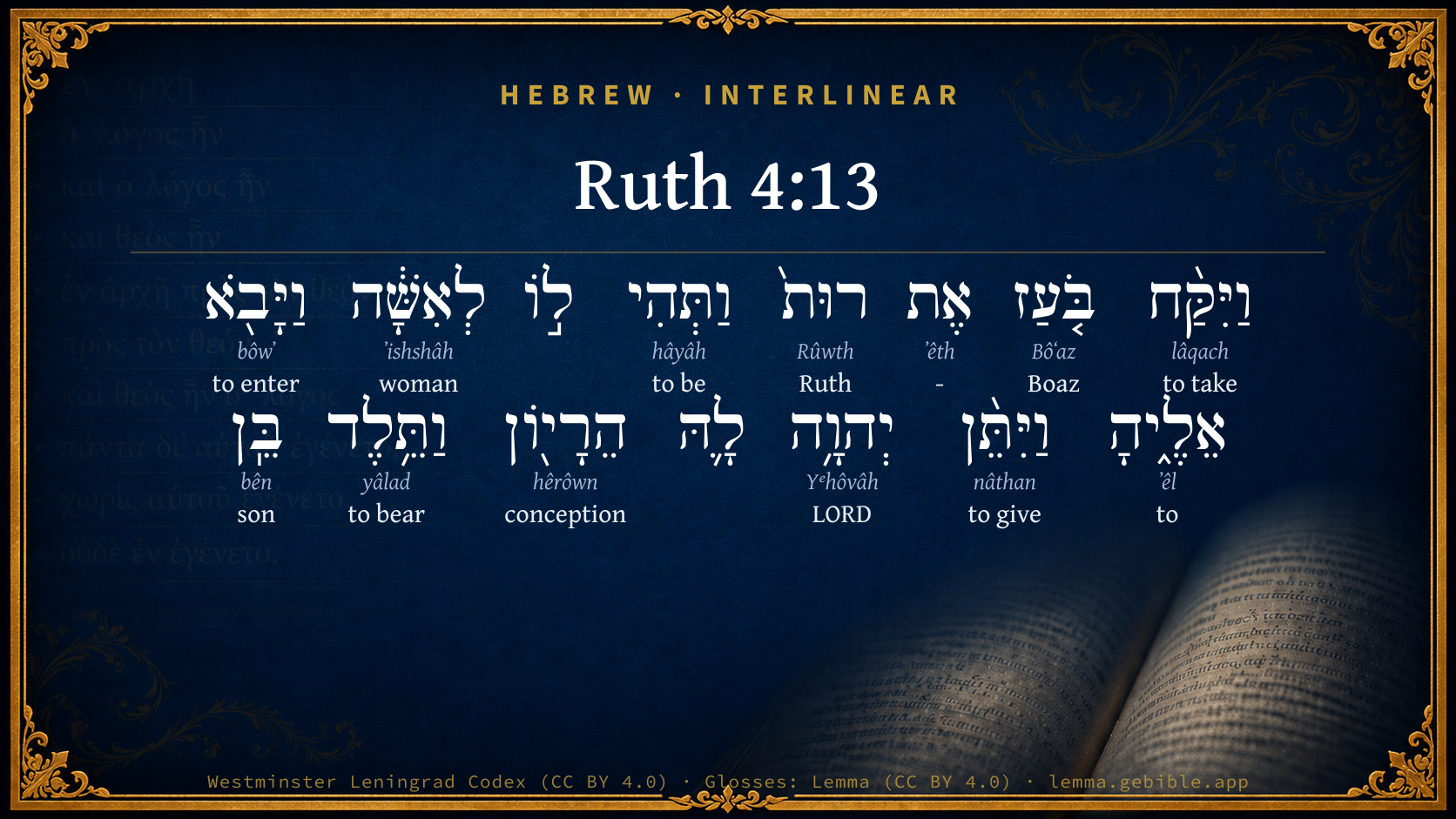
Hebrew (Westminster Leningrad Codex) Ruth 4:13 appears in the Hebrew Old Testament. The text above is from the Westminster Leningrad Codex. Each word links to its Strong’s number, a concise gloss, and parsing drawn from the Open Scriptures Hebrew Bible morphology. Click any word for its full Brown-Driver-Briggs (BDB) entry.
Download image
Cite this verse

Ruth 4:13 (World English Bible). Public Domain. Lemma interlinear Bible study tool, https://lemma.gebible.app/v/ruth/4/13.

Show BibTeX & RIS
BibTeX
RIS
English Translation
So Boaz took Ruth, and she became his wife; and he went in to her, and Yahweh gave her conception, and she bore a son.
World English Bible · Public Domain
Download a study sheet

One document with this verse’s original text, its word-by-word gloss line, the meaning frame, cross-references with their text, attributed commentary, and full source and license credits — printable, and it pastes into notes with its structure intact.

This verse Autodidact and up

Study sheet (.html) Plain text (.txt)

A passage Seminary Student

Up to 50 verses in one chapter. A passage sheet keeps up to 6 commentary sources and 12 cross-references per verse, in the order this page ranks them, and says so on the sheet whenever that leaves anything out. Ask for a single verse and you get the Autodidact verse sheet above.

Everything on this page stays free to read, with no account — the sheet is a download of what is already on screen, not access to it.

Want to remove ads? Support Godless Engineer
Compare translations 3

The same verse in 3 English versions, stacked beneath the original-language interlinear above. Click any original word for its lexicon entry.

Each is an independent rendering of the whole verse — the interlinear is not word-aligned to these translations.

Highlighted words mark where these versions differ — a whole-verse word diff, not a word-by-word alignment.

  • World English Bible Public Domain
    So Boaz took Ruth, and she became his wife; and he went in to her, and Yahweh gave her conception, and she bore a son.
  • King James Version Public Domain
    So Boaz took Ruth, and she was his wife: and when he went in unto her, the LORD gave her conception, and she bare a son.
  • unfoldingWord Literal Text CC BY-SA 4.0
    So Boaz took Ruth, and she became his wife, and he went in to her. Then Yahweh gave her conception, and she bore a son.

unfoldingWord Literal Text — © unfoldingWord, licensed CC BY-SA 4.0. Word-aligned USFM3 via Door43 (git.door43.org/unfoldingWord/en_ult).

Versions to compare (up to 4)

3 of 4 selected

Show all 18 translations

Every available English version of this verse, each an independent rendering of the whole verse.

  • World English Bible Public Domain
    So Boaz took Ruth, and she became his wife; and he went in to her, and Yahweh gave her conception, and she bore a son.
  • Berean Standard Bible Public Domain
    So Boaz took Ruth, and she became his wife. And when he had relations with her, the LORD enabled her to conceive, and she gave birth to a son.
  • Majority Standard Bible Public Domain
    So Boaz took Ruth, and she became his wife. And when he had relations with her, the LORD enabled her to conceive, and she gave birth to a son.
  • King James Version Public Domain
    So Boaz took Ruth, and she was his wife: and when he went in unto her, the LORD gave her conception, and she bare a son.
  • American Standard Version (1901) Public Domain
    So Boaz took Ruth, and she became his wife; and he went in unto her, and Jehovah gave her conception, and she bare a son.
  • Revised Version (1885) Public Domain
    So Boaz took Ruth, and she became his wife; and he went in unto her, and the LORD gave her conception, and she bare a son.
  • Geneva Bible (1599) Public Domain
    So Boaz tooke Ruth, and she was his wife: and when he went in vnto her, the Lord gaue that she conceiued, and bare a sonne.
  • Douay-Rheims (1899) Public Domain
    Booz therefore took Ruth, and married her: and went in unto her, and the Lord gave her to conceive and to bear a son.
  • Young's Literal Translation Public Domain
    And Boaz taketh Ruth, and she becometh his wife, and he goeth in unto her, and Jehovah giveth to her conception, and she beareth a son.
  • Literal Standard Version CC BY-SA 4.0
    And Boaz takes Ruth, and she becomes his wife, and he goes in to her, and YHWH gives conception to her, and she bears a son.
  • Unlocked Literal Bible CC BY-SA 4.0
    So Boaz took Ruth, and she became his wife. He slept with her, and Yahweh allowed her to become pregnant, and she bore a son.
  • unfoldingWord Literal Text CC BY-SA 4.0
    So Boaz took Ruth, and she became his wife, and he went in to her. Then Yahweh gave her conception, and she bore a son.
  • Darby Bible Public Domain
    And Boaz took Ruth, and she became his wife; and he went in unto her, and Jehovah gave her conception, and she bore a son.
  • World Messianic Bible Public Domain
    So Boaz took Ruth and she became his wife; and he went in to her, and the LORD enabled her to conceive, and she bore a son.
  • Webster's Bible Public Domain
    So Boaz took Ruth, and she was his wife: and when he went in to her, the LORD gave her conception, and she bore a son.
  • Free Bible Version CC BY-SA 4.0
    Boaz took Ruth home, and she became his wife. He slept with her, and the Lord arranged for her to become pregnant, and she gave birth to a son.
  • Bible in Basic English Public Domain
    So Boaz took Ruth and she became his wife; and he went in to her, and the Lord made her with child and she gave birth to a son.
  • JPS Tanakh (1917) Public Domain
    So Boaz took Ruth, and she became his wife; and he went in unto her, and the LORD gave her conception, and she bore a son.

Literal Standard Version (2020), Covenant Press — licensed CC BY-SA 4.0. Text via the HelloAO Bible API (eBible.org). Unlocked Literal Bible (unfoldingWord) — licensed CC BY-SA 4.0. Text via the HelloAO Bible API (eBible.org). unfoldingWord Literal Text — © unfoldingWord, licensed CC BY-SA 4.0. Word-aligned USFM3 via Door43 (git.door43.org/unfoldingWord/en_ult). Free Bible Version, Dr. Jonathan Gallagher — licensed CC BY-SA 4.0. Text via the HelloAO Bible API (eBible.org).

Word by word

More ways to search: Search by grammar → Find every occurrence → Compare this word →

Practice this passage: Drill this verse → Learn its vocabulary →

הֵרָי֖וֹן
hêrôwn
H2032
“conception”
Noun, Common, Masculine, Singular, Absolute
Part of Speech
Noun
Type
Common
Gender
Masculine
Number
Singular
State
Absolute
Full BDB Definition

Origin: from H2029

TWOT: 515c

physical conception, pregnancy, conception
  1. וַיִּקַּ֨ח lâqach H3947 “and · to take” Conjunction + Verb, Qal, Sequential Imperfect, 3rd Person, Masculine, Singular
  2. בֹּ֤עַז Bôʻaz H1162 “Boaz” Noun, Proper
  3. אֶת ʼêth H853 “-” Particle, Direct Object
  4. רוּת֙ Rûwth H7327 “Ruth” Noun, Proper
  5. וַתְּהִי hâyâh H1961 “and · to be” Conjunction + Verb, Qal, Sequential Imperfect, 3rd Person, Feminine, Singular
  6. לְאִשָּׁ֔ה ʼishshâh H802 “to/for · woman” Preposition + Noun, Common, Feminine, Singular, Absolute
  7. וַיָּבֹ֖א bôwʼ H935 “and · to enter” Conjunction + Verb, Qal, Sequential Imperfect, 3rd Person, Masculine, Singular
  8. אֵלֶ֑יהָ ʼêl H413 “to · her” Preposition + Suffix, Personal, 3rd Person, Feminine, Singular
  9. וַיִּתֵּ֨ן nâthan H5414 “and · to give” Conjunction + Verb, Qal, Sequential Imperfect, 3rd Person, Masculine, Singular
  10. יְהוָ֥ה Yᵉhôvâh H3068 “LORD” Noun, Proper
  11. וַתֵּ֥לֶד yâlad H3205 “and · to bear” Conjunction + Verb, Qal, Sequential Imperfect, 3rd Person, Feminine, Singular
  12. בֵּֽן bên H1121 “son” Noun, Common, Masculine, Singular, Absolute

About this verse

These counts appear in no published source. They are computed here, from the morphology-tagged text and Lemma’s own curated glosses. What Lemma adds →

15
words
13
distinct lemmas
Historical
section

Notable vocabulary

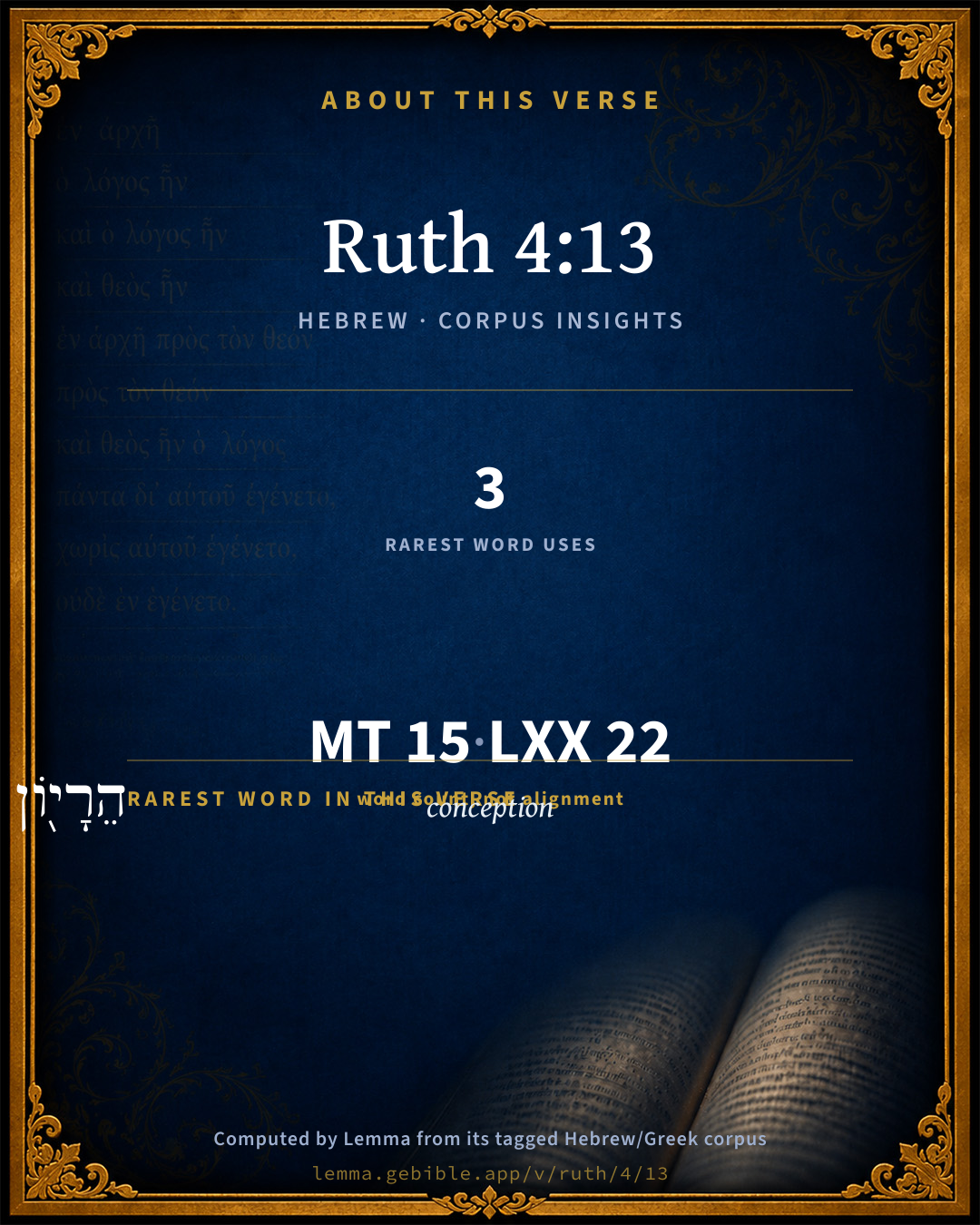
The rarest word here is הֵרָי֖וֹן conception H2032 — appearing just 3 times in the whole Hebrew Bible.

Shared distinctive vocabulary

הֵרָי֖וֹן conception H2032 occurs in 3 verses of the Hebrew Bible. Also found in:

Grammatical profile

  • 5 verbs
  • 6 nouns
  • 3 prepositions
  • 1 particle

Verb forms

  • וַיִּקַּ֨ח Qal · Sequential Imperfect
  • וַתְּהִי Qal · Sequential Imperfect
  • וַיָּבֹ֖א Qal · Sequential Imperfect
  • וַיִּתֵּ֨ן Qal · Sequential Imperfect
  • וַתֵּ֥לֶד Qal · Sequential Imperfect

Hebrew & Septuagint length

In English translation the verse runs 25 words from the Hebrew and 26 from the Septuagint (LXX English) — closely comparable.

A rough comparison of the two English renderings, which tokenize alike — not a word-level alignment.

Word counts can differ between the Hebrew and the Greek without any difference in meaning — e.g. the Hebrew direct-object marker אֵת has no separate Greek word, and Greek often adds the article ὁ.

In the original languages it is 15 Hebrew tokens and 22 Greek tokens — but the two are counted differently (Hebrew bundles its prefixes and suffixes into one token; the Greek is in lemma form), so that isn’t a like-for-like length.

Cross-references

12

Topical passages linked to Ruth 4:13 in the Treasury of Scripture Knowledge — connected by theme and wording, ordered by reader-vote popularity; previews shown in the World English Bible.

  • Genesis 29:31 Yahweh saw that Leah was hated, and he opened her womb, but Rachel was barren.
  • Genesis 33:5 He lifted up his eyes, and saw the women and the children; and said, "Who are these with you?" He said, "The children whom God has graciously given your servant."
  • Psalms 127:3 Behold, children are a heritage of Yahweh. The fruit of the womb is his reward.
  • Ruth 3:11 Now, my daughter, don't be afraid; I will do to you all that you say; for all the city of my people does know that you are a worthy woman.
  • Genesis 25:21 Isaac entreated Yahweh for his wife, because she was barren. Yahweh was entreated by him, and Rebekah his wife conceived.
  • Genesis 30:2 Jacob's anger was kindled against Rachel, and he said, "Am I in God's place, who has withheld from you the fruit of the womb?"
  • Genesis 30:22–23 God remembered Rachel, and God listened to her, and opened her womb.
  • Ruth 4:12 and let your house be like the house of Perez, whom Tamar bore to Judah, of the seed which Yahweh shall give you of this young woman.
  • 1 Samuel 1:27 For this child I prayed; and Yahweh has given me my petition which I asked of him:
  • 1 Samuel 2:5 Those who were full have hired out themselves for bread; Those who were hungry have ceased [to hunger]: Yes, the barren has borne seven; She who has many children languishes.
  • Psalms 113:9 He settles the barren woman in her home, As a joyful mother of children. Praise Yah!
  • Genesis 20:17–21:3 Abraham prayed to God. God healed Abimelech, and his wife, and his maid-servants, and they bore children.

Cross-references courtesy of OpenBible.info (CC BY 4.0).

Hebrew and Greek witnesses Masoretic Hebrew ↔ Greek Septuagint

The same verse in the two great witnesses to the Old Testament, shown verse-for-verse.

These are two independent witnesses, not word-aligned to each other, and the Septuagint is shown in lemma (dictionary) form.

Hebrew Ruth 4:13 Masoretic · Westminster Leningrad Codex

וַיִּקַּ֨ח בֹּ֤עַז אֶת רוּת֙ וַתְּהִי ל֣וֹ לְאִשָּׁ֔ה וַיָּבֹ֖א אֵלֶ֑יהָ וַיִּתֵּ֨ן יְהוָ֥ה לָ֛הּ הֵרָי֖וֹן וַתֵּ֥לֶד בֵּֽן

So Boaz took Ruth, and she became his wife; and he went in to her, and Yahweh gave her conception, and she bore a son.

World English Bible · Public Domain

Greek LXX Ruth 4:13 Septuagint · lemma form

καί λαμβάνω βοος ὁ ρουθ καί γίγνομαι αὐτός εἰς γυνή καί εἰςἔρχομαι πρός αὐτός καί δίδωμι αὐτός κύριος κύησις καί τίκτω υἱός

And Booz took Ruth, and she became his wife, and he went in to her; and the Lord gave her conception, and she bore a son.

LXX2012 (modern English Septuagint) · Public Domain

Hebrew: Westminster Leningrad Codex (CC BY 4.0). Greek: Septuagint (public domain); English from LXX2012 (modern English Septuagint) (Public Domain). How the Septuagint differs from the Hebrew →

Commentary

Notes on Ruth 4:13 from classic Christian and Jewish commentators (each source and its license shown beneath its notes). The classic Christian expositions comment on the surrounding passage and are grouped to its opening verse, so a note may address several verses; the Jewish commentaries on the Tanakh (Rashi and others) are per-verse, so they appear only where the commentator wrote on this verse.

Lemma curates 59 commentaries, every one of them public domain or Creative Commons licensed, each selected and text-cleaned for this edition rather than reprinted as found. About our sources →

Matthew Henry's Commentary

Here is, I. Ruth a wife. Boaz took her, with the usual solemnities, to his house, and she became his wife (Rut 4:13), all the city, no doubt, congratulating the preferment of a virtuous woman, purely for her virtues. We have reason to think that Orpah, who returned from Naomi to her people and her gods, was never half so well preferred as Ruth was. He that forsakes all for Christ shall find more than all with him; it shall be recompensed a hundred-fold in this present time. Now Orpah wished she had gone with Naomi too; but she, like the other kinsman, stood in her own light. Boaz had prayed that this pious proselyte might receive a full reward of her courage and constancy from the God of Israel, under whose wings she had come to trust; and now he became an instrument of that kindness, which was an answer to his prayer, and helped to make his own words good. Now she had the command of those servants with whom she had associated and of those fields in which she had gleaned. Thus sometimes God raiseth up the poor out of the dust, to set them with princes, Psa 113:7, Psa 113:8.

II. Ruth a mother: The Lord gave her conception; for the fruit of the womb is his reward, Psa 127:3. It is one of the keys he hath in his hand; and he sometimes makes the barren woman that had been long so to be a joyful mother of children, Psa 113:9; Isa 54:1.

III. Ruth still a daughter-in-law, and the same that she always was, to Naomi, who was so far from being forgotten that she was a principal sharer in these new joys. The good women that were at the labour when this child was born congratulated Naomi upon it more than either Boaz or Ruth, because she was the match-maker, and it was the family of her husband that was hereby built up. See here, as before, what an air of devotion there was then even in the common expressions of civility among the Israelites. Prayer to God attended the birth of the child. What a pity it is that such pious language should either be disused among Christians or degenerate into a formality. "Blessed be the Lord that has sent thee this grandson," Rut 4:14, Rut 4:15. 1. Who was the preserver of the name of her family, and who, they hoped, would be famous, because his father was so. 2. Who would be hereafter dutiful and kind to her, so they hoped, because his mother was so. If he would but take after her, he would be a comfort to his aged grandmother, a restorer of her life, and, if there should be occasion, would have wherewithal to be the nourisher of her old age. It is a great comfort to those that are going into years to see any of those that descend from them growing up, that are likely, by the blessing of God, to be a stay and support to them, when the years come wherein they will need such, and of which they will say they have no pleasure in them. Observe, They say of Ruth that she loved Naomi, and therefore was better to her than seven sons. See how God in his providence sometimes makes up the want and loss of those relations from whom we expected most comfort in those from whom we expected least. The bonds of love prove stronger than those of nature, and there is a friend that sticks closer than a brother; so here there was a daughter-in-law better than an own child. See what wisdom and grace will do. Now here, (1.) The child is named by the neighbours, Rut 4:17. The good women would have it called Obed, a servant, either in remembrance of the meanness and poverty of the mother or in prospect of his being hereafter a servant, and very serviceable, to his grandmother. It is no dishonour to those that are ever so well born to be servants to God, their friends, and their generation. The motto of the princes of Wales is Ich dien - I serve. (2.) The child is nursed by the grandmother, that is, dry-nursed, when the mother had weaned him from the breast, Rut 4:16. She laid it in her bosom, in token of her tender affection to it and care of it. Grandmothers are often the most fond.

IV. Ruth is hereby brought in among the ancestors of David and Christ, which was the greatest honour. The genealogy is here drawn from Pharez, through Boaz and Obed, to David, and so leads towards the Messiah, and therefore it is not an endless genealogy.

Matthew Henry's Commentary on the Whole Bible (1708–1710) — public domain (CC PDM 1.0). Text via the HelloAO Bible API.

Trapp's Complete Commentary

John Trapp

Rth 4:13 So Boaz took Ruth, and she was his wife: and when he went in unto her, the LORD gave her conception, and she bare a son.

Ver. 13. So Boaz took Ruth.] Solemnly, in the face of that assembly, where, it appeareth by the former verse, she was personally present.

And when he went in unto her.] A modest expression of the marriage act. {a} Note this against those broad spoken barbarologi qui dum spurcetias Veneris eliminant, non aliud quam podicem ex ore faciunt.

The Lord gave her conception.] By Boaz an old man: whereas by her first husband, a young man, she had no child. This was, therefore, a singular act of God’s blessing.

And she bare a son.] Which was greater joy than to have born a daughter; not only because he was columen familiae, the upholder of the name and family, but especially because they looked for the Messiah of the line of Judah. And this was, indeed, the end wherefore this Book of Ruth was written, to continue and declare the genealogy of Christ, and what patriarchs lived from Judah (to whom Shiloh was promised) to David, to whom that promise was renewed. But how blank were the foolish Jews when they saw the long hoped for issue of their late Jewish virgin turned to a daughter!

{a} Lingua Hebraica ideo vocatur sancta, quod nulla in ea inveniantur propria nomina, quae significent pudenda utriusque sexus, coitum, excrementa, &c. Sed res turpes aliqua pudica periphrasi circumloquatur. -Munster in Deut. xxiii.

John Trapp, A Commentary or Exposition upon All the Books of the Old and New Testament (1647–1656) — public domain. Text from a community e-Sword module.

Joseph Benson's Commentary

Rth 4:13. Took Ruth — Which he might do, though she was a Moabitess, because the prohibition against marrying such is to be restrained to those who continued heathen; whereas Ruth was a sincere proselyte and convert to the God of Israel. Thus he that forsakes all for Christ, shall find more than all with him.

Joseph Benson's Commentary on the Old and New Testaments (1811–1818) — public domain. Text from a community e-Sword module.

Whedon's Commentary on the Bible

Daniel D. Whedon

MARRIAGE OF BOAZ AND RUTH, AND BIRTH OF OBED, Rth_4:13-17.

13. Boaz took Ruth — Whatever scruples a pious Hebrew might have had about marriage with a Moabitess, Boaz could have had none in this case, inasmuch as Ruth was the widow of an Israelite, and had left her native land and kindred to become a proselyte to the Hebrew faith. Compare note on Rth_1:4.

Daniel D. Whedon (gen. ed.), Commentary on the Old and New Testaments (1874–1909) — public domain. Text from a community e-Sword module.

Lange's Commentary on the Holy Scriptures

Rth_4:13-22

The Completion of the Blessing.

13So Boaz took Ruth, and she was [became] his wife: and when [omit: when] he went in unto her, [and] the Lord [Jehovah] gave her conception, and she bare a son. 14And the women said unto Naomi, Blessed be the Lord [Jehovah], which hath not left thee this day without a kinsman [redeemer], that his name may be [and may his name be] famous in Israel. 15And he shall [may he] be unto thee a restorer of thy life [soul], and a nourisher [support]18 of thine old age: for thy daughter-in-law, 16which loveth thee, which is better to thee than seven sons, hath borne him. And Naomi took the child, and laid it in her bosom, and became nurse unto it. 17And the women her neighbors gave it a name, saying, There is a son born to Naomi; and they called his name Obed: he is the father of Jesse, the father of David.

18Now these are the generations of Pharez: Pharez begat Hezron, and 19Hezron begat Ram, and Ram begat Aminadab, 20and Aminadab begat Nahshon, and Nahshon begat Salmon [Salmah],19 21and Salmon begat Boaz, and Boaz begat Obed, 22and Obed begat Jesse, and Jesse begat David.

TEXTUAL AND GRAMMATICAL

[1 Rth_4:15.—Lit. “and may he support thine old age.” On the form of כַּלְכֵּל (from כּיּל), cf. Ges. 55, 4; on its construction after הָיָה, which here however has the force of the jussive (optative) through its connection with the preceding verb, Ges. 132, 3, Rem. 1.—On the forms אֲהֵבָתֶךְ and יְלָדַתּיּ, cf. Ges. 59, Rem. 3.—Tr.]

[2 Rth_4:20.—Salmah (שַׂלְמָה or *שַׂלְמָא, 1Ch_2:11) appears in Rth_4:21 as Salmon, which many MSS. read here also. Originally, the name was probably used indiscriminately either with the termination *–ׇן or וֹן cf. Ges. 84, 15). By detrition of the שַׂלְמָן ,כ became שַׂלְמָה.—Tr.]

EXEGETICAL AND DOCTRINAL

Rth_4:13. And she brought forth a son. With this happy event the last shadows disappear from the checkered lives of the two women. The fears of superstition are shown to have been groundless. Sorrow in Moab has been changed into happiness in Israel. The reward of love has begun, and Jehovah mercifully owns the daughter of Moab, who has left home and native land for his people’s sake. Great are the joys which surround the cradle of the child of such parents as Boaz and Ruth. The father of Nero is said to have made the terrible exclamation: “What shall come of a son who has me for his father and Agrippina for his mother!” But here, where love had been married to piety, humility to heroism, innocence to believing insight, everybody must look for a future of blessings. A child of Ruth and Boaz had no need of goddesses and fairies to come to its cradle, in order, according to popular legends, to bring wealth and good wishes. The blessing of the Almighty God, who locks not at the person, but at the heart, has spread out its wings over the child.

Rth_4:14. And the women said unto Naomi. What a difference between the beginning and the end of Naomi’s life in Israel since her return! When she came back, poor and lonely, where were the women and neighbors, who ought to have comforted, supported, and stood by her in her necessity? Nothing is heard of them. Nobody was with her but Ruth. But now they appear with their good wishes for Naomi and praises to God; for adversity has vanished. Ruth is no longer the poor gleaner, who painfully gathers a living for her mother, but the happy wife of Boaz. A new name has been raised up for the inheritance of Elimelech.

Who hath not left a redeemer to be wanting to thee this day. It is one of the peculiar beauties of our narrative that its last words are almost wholly devoted to Naomi (Rth_4:14-18). And justly so; for it was Naomi who by her exemplary life in Moab had been the instructress of Ruth. For her sake, the noble woman had come to Israel. Upon her, affliction had fallen most severely (Rth_1:13), bereaving her of both husband and children. Against her, the hand of Jehovah had gone forth, so that she bade acquaintances to call her, not Naomi, but Mara. Moreover, a heart-union existed between herself and Ruth, such as is not often to be found between even natural mother and daughter. The happiness of Ruth would have been her happiness also, even if no national usages and habits had come in to make it such. How tender and delicate is the feeling which these usages and habits set forth, of the sacred and indissoluble character of the marriage bond. And yet modern self-conceit—that, and not Christian self-knowledge—perpetually talks of the inferiority of woman’s position under the old covenant! Boaz had married Ruth, as a blood-relative of her former husband, in order to raise up the name of the latter upon his inheritance. The childless widow did not, as happens so often among us, leave the family of her deceased husband, as if she had never become a member of it. The blood-relative obtains a son by her, and the birth of this son becomes an occasion for congratulations to the mother of the former husband. The child borne by Ruth to Boaz as a blood-relative, although not the nearest, of Naomi’s husband, is called by the women the goel of Naomi, and they praise God that he has not left Naomi without him. There is, no doubt, a legal ground for this. For the child inherits the estate of Elimelech, because its mother was formerly the wife of his son, and with this estate the life of Naomi also is connected. Not Boaz, who has redeemed the inheritance, but the child for whom he redeemed it, is the real goel of Naomi—the person, that is, in whom her sinking house again raises itself; for he is the son of her son’s wife, albeit by another husband. He is the grandson of her family, though not of her blood. Ruth’s goel was Boaz, but Naomi’s the son of Ruth; for Ruth lives in the house of Boaz, but Naomi in that of the child, which belongs to him by virtue of his birth from Ruth. These are practical definitions of the leviratical law; but how thoroughly moral the views on which they rest! how close the sympathy and brotherhood they seek to establish, and how indissoluble the marriage covenant which they presuppose!

Undoubtedly, the most moral law can become torpid, and receive only an external fulfillment or even be evaded. Laws are living and active among a people only so long as the spirit that gave them, being continues to live. The conduct of the unknown blood-relative has sufficiently shown, that the law alone could have afforded no help to Ruth and Naomi. The whole history of Naomi in Israel, after her return from Moab and up to the intervention of Boaz, testifies to the inability of the letter of the law to avert misery and distress. Boaz followed, not the letter of the law, but its spirit; and hence did more than the letter demanded. In the persons of those with whom our narrative is mainly concerned, the doctrine verifies itself that there is no law so strong as the law of love. It is this doctrine which the women also have come to recognize when they say to Naomi:—

Rth_4:15. For thy daughter-in-law, who loveth thee, and who is better to thee than seven sons, hath borne him. The child, say the women, shall refresh thy soul,—the soul נֶפֶשׁ, animus, of Naomi was bowed down with sorrow, the child will restore (הֵשִׁיב) her courage,—and support thy old age; and this, they add, not because the law makes him heir to the estate of his mother’s family, but because Ruth has borne him. The revivication of Naomi’s happiness through the birth of this child, was more securely guaranteed by the love of Ruth, than by friendship and blood-relationship. True, Naomi herself is childless; but seven sons could not have done for her what Ruth did. The women acknowledge now how far short the legal friendship of Israel towards Naomi has fallen, in comparison with the self-sacrifice of the daughter of Moab. And thus there comes to view here so much the more plainly, the doctrine—in its higher sense prophetic, under the old covenant—that love, living, active, self-forgetful, self-sacrificing love, transcends all law and family considerations. Christ announces the same doctrine in its highest form, when he says: “Whosoever shall do the will of my Father which is in heaven, the same is my brother, and sister, and mother” (Mat_12:50). Ruth’s love for Naomi takes the place of physical descent. It engrafts her child, as it were, into the heart of Naomi. In itself the child is only the grandson of her family and estate; on account of Ruth’s love, it becomes to her a veritable grandchild of love, nearer to her heart than if a daughter of her own had given birth to it. The power of pure and self-forgetful love, such as Ruth had entertained, could not be more beautifully delineated.

Rth_4:16. And she became foster-mother to it. She took it into her lap, like an actual grandmother. She formed the child in Israelitish life and customs. She became to it what Mordecai was to Esther, an instructress in the law and Israelitish culture. The son of Ruth became to her an actual grandchild of love. For this reason the female neighbors give him a name whose signification is equivalent to Naomi’s son.

Rth_4:17. They called his name, Obed. There are several noteworthy points connected with this. The female neighbors, in order to give pleasure to Naomi, give the child a name. But beside this, he doubtless received a name from his parents, probably one that belonged to the family. But that given by the women continued to be his usual name, and by it he was inserted into the family genealogy. Consequently, the idea enunciated in it must have been specially characteristic. The text says: “They gave him a name, namely, a son is born to Naomi;” and hence they called him Obed. Now, whether the name Obed be explained as servant of God or servant of Naomi, the sense in either case remains insipid.20 What the women mean is, not that the child is the servant of Naomi, but that he is to her as a son.21 If the words of Rth_4:17 are to have a plain sense; nay, if the preservation of just that name which the female neighbors gave him is to have an explanation, the name Obed must in some way express the idea of the word “son.” For in this name “son,” given with reference to Naomi, there is contained the idea that the sin which lay at the base of her evil fortune had been atoned for. She who lost the children of her own body, had now a son in the spirit of true love. It is true, that from the philological stores extant in the Bible, the explanation of Obed in the sense of “son” is not possible; but it may be done by the assistance of other languages. It is sufficiently clear that Obed is to be connected with the Greek παιδίον (παῖς, παιδός), Latin putus, Sanskrit pôta, putra, Persian puser.22

The circumstance that Obed was used in the sense of “son,” justifies the conjecture that in the Hebrew of that day there were various foreign words in use, probably introduced through Aramaic influences, without postulating a closer contact of the so-called Semitic with the Indo-germanic tongues than is usually assumed.

He is the father of Jesse, the father of David. In these words the doctrine of the whole Book reaches its point of culmination. They point out the completion of the blessing pronounced on Ruth by Boaz. The name of the superstitious kinsman, who thought that marriage with the Moabitess would endanger his inheritance, is forgotten; but from Boaz descends the Hero (גִּבּוֹר חַיִל), the King of Poets, David, the Prophet, and type of the Messiah. Prom him Christ comes through the promise, even as Obed was the son of Naomi through the love of Ruth.23 The doctrine of the whole narrative is expressed in the words of the Apostle, “Love is the fulfilling of the law.”

Note.

Verses 18–22 are an addition from the genealogical tables of the House of David. The chronological question involved in them must be considered in connection with the other analogous data, for which reason we refer here to 1Ch_2:8 ff.

HOMILETICAL AND PRACTICAL

“Naomi took the child.” Whoever was once capable of true love, preserves its power forever after. Throughout her history, until the close of the narrative, Naomi’s name is truly descriptive of her character. Her love is the cause of the blessing that finally ensues; for by it she won love. It sustained her in suffering,—it prompted her to action in behalf of her daughter-in-law. Now in the end she enjoys its blessing, and becomes the loving foster-mother of the child of her who was better to her than seven sons.

Naomi is everywhere an image of the Church of Christ, which wins, confesses, and fosters through, love. Men whose natural hearts are hostile to her, become her obedient children. When there is apostasy and misery in the church, it is for priests and preachers to repent, as Naomi did, and not to excuse themselves. If they really have the spirit of love, they cannot but feel that they have to blame themselves first of all. When the church does not make converts among heathen and Jews, the attempt to lay the guilt of this judgment on them, and to excuse ourselves, is a sign of a hard heart. Alas! God alone knows what heavy loads of guilty responsibility rest on the church for having herself given the impulse by which thousands were kept from coming to the Saviour. And how greatly she sins, when she does not rightly, foster those who do come, exhibiting neither love, nor wisdom, nor faith in her treatment of them,—that too will one day be made manifest. Impatience is not in love; and a little money does not make amends for the coldness of consummate self-righteousness. They are children, who are laid in the lap of the church,—children according to the spirit, that is to say real children, who, by God’s grace, bring a greater blessing to the church that seven sons according to the flesh.

Pascal: “Two laws are sufficient to regulate the whole Christian Church more completely that all political law could do: love to God, and love to one’s neighbor.”

“They said, there is a son born to Naomi, and called his name Obed; he is the father of Jesse, the father of David.” Boaz predicted a blessing for Ruth, and the faith through which he did it was rewarded by his being made a sharer in it. All he did was to utter a word of prophecy, prompted by his faith in the grace of his God, and lo, he was made the progenitor of David, the prophet! He who firmly relies on the love of God, is always a seer. Boaz had faith enough to bring about, in due time, the fulfillment of his own benediction, and became the ancestor of Him in whom all the prophecies of David are fulfilled. Of Boaz himself no warrior deeds are known, and yet the greatest of Israel’s heroes, the conqueror of Goliath,24 sprang from him. He conquered himself, and on that account became the ancestor of Him who triumphed over sin and death. Similarly, Ruth had nothing but a heart full of love, and yet to her, once a daughter of Moab, there was given what neither Deborah nor Jael obtained,—to become the mother of Him by whom all the nations are redeemed.

Jerome (on Isa_16:1): “O Moab! out of thee shall come forth the unspotted Lamb, which bears the sins of the world, and rules over the whole earth! From the rock of the wilderness, i.e. from Ruth, widowed by the death of her husband, Boaz derived Obed. … and from David came Christ.”

Gerlach: “Thus the coming of the great King is prepared for, upon whom the Lord had determined to confirm the dominion over his people for evermore; and the converted Moabitess, who entered as a worthy member into the commonwealth of the people of God, became the mother of David and of Christ.”

______________________

The Jewish tradition which makes Ruth a descendant of Eglon, the Moabitish king who oppressed Israel as a punishment for its sins, contains an allegory worthy of notice. The daughter of the oppressor, becomes the mother of the Liberator, the Redeemer out of the House of David. According to the Jewish expositors the name Ruth is derived from a root which signifies to give drink, to assuage thirst (Berachoth, 7 a); and from her, say they, David came, who with his songs and psalms supplied the wants of those who thirst after God. And from David, we may add, came the Saviour who gave to the Samaritan woman when she thirsted, of that fountain which springs up unto everlasting life.

The ancient church selected the sixteenth of July as the day on which to commemorate Ruth.25 The reason for this is probably to be found in the following considerations: In Deu_23:3, it is said: “An Ammonite or Moabite shall not enter into the congregation of Jehovah; even to their tenth generation they shall not enter.” This was supposed to have been fulfilled in Ruth. In the genealogy of the Gospel according to Matthew, Boaz, through whom Ruth was received into the congregation of Jehovah, is the tenth from Abraham. But it was the Lord and Saviour, whose day Abraham saw, and who according to the flesh descended from Ruth, who first took away the curse from Moab also. This was announced by Isaiah, when in addressing Moab, he says (Isa_16:5): “In mercy shall a throne be prepared, that one sit upon it in truth, in the tabernacle of David, and judge, and seek judgment, and hasten righteousness.” Now, as the ancient church set apart the sixth of July for Isaiah, because he prophesied of Christ, who suffered on the sixth day of the week, and whose incarnation was celebrated on the sixth of January, it fixed the anniversary of Ruth ten days later, on the sixteenth of July. Thus her name and the number of her day are symbolical of prophecy and grace. But ten days farther on, the twenty-sixth, is the day of Anna, whom tradition makes to be the mother of the Virgin Mary. Thus the name of Ruth stood ten days after the prophecy and ten days before its approaching fulfillment, equally distant from him who prophecied of the Virgin and from her who was the Virgin’s mother. The Moabitish stranger finds herself in the middle between the seer who beheld the wilderness of Moab become fruitful, and the nearest ancestress of Him who delivers Moab and all the world from barrenness and thirst.

Pictorially, the ancient church represented Ruth with a sheaf in her hand. As was natural, she was always conceived as youthful. She might be represented with a rose, in accordance with what may be the meaning of her name (see on Rth_1:4). The Rose of Bethlehem was the ancestress of the Rose of Jesse (Mary), whom ancient pictures represent sitting in a rosebush. Both rose and sheaf are symbols of the truth that though love may sow in tears, it will through God’s compassion reap in joy.

Footnotes:

[18][Rth_4:15.—Lit. “and may he support thine old age.” On the form of כַּלְכֵּל (from כּיּל), cf. Ges. 55, 4; on its construction after הָיָה, which here however has the force of the jussive (optative) through its connection with the preceding verb, Ges. 132, 3, Rem. 1.—On the forms אֲהֵבָתֶךְ and יְלָדַתּיּ, cf. Ges. 59, Rem. 3.—Tr.]

[19][Rth_4:20.—Salmah (שַׂלְמָה or *שַׂלְמָא, 1Ch_2:11) appears in Rth_4:21 as Salmon, which many MSS. read here also. Originally, the name was probably used indiscriminately either with the termination *–ׇן or וֹן cf. Ges. 84, 15). By detrition of the שַׂלְמָן ,כ became שַׂלְמָה.—Tr.]

[20]The subterfuge of Le Clerc, who proposes to read אוֹבד, in the sense of “unfortunate, poor one,” with reference to the poverty once suffered by Ruth, is entirely wrong, to say nothing of the fact that the word itself does not have the sense which he assigns to it.

[21][But is not the emphasis to be laid on “to Naomi” rather than on “son?” It is true, that analogy leads us to expect the name to contain specifically the same idea expressed by the women (cf. however Gen_29:32); but it must also be admitted (with Berth.) that Obed in the sense of “one that serves,” sc. Naomi, harmonizes well with the words in Rth_4:15 : “May he be to thee a soul-restorer, and a support of thine old age.”—Tr.]

[22]As regards the ע in עֹבֵד, its value (best compared perhaps with a spiritus asper) is exactly the same as in עלץ to be compared with lœtari and lœtus,, עמל with moliri, עמק with μῆκος, etc.

[23]The reference of Grotius to the traditionary history of Ocrisia, who became the mother of Servius Tullius, is very unfortunate. Ocrisia was a slave. Her story has no ethical background. The legends concerning her were only designed to glorify the derivation of the king. Cf. Niebuhr, Röm. Gesch. i. 376 (2d edit.).

[24] It is on the ground of this contrast that Jewish tradition homiletically advanced the idea that Goliath descended from Orpah, who returned to Moab, as David from Ruth. The early teachers of the church were acquainted with this tradition, and Prudentius even introduced it into his poem, Hamartigenia, 4:782:—

“Sed pristinus Orphæ

Fanorum ritus præputia barbara suasit

Malle, et semiferi stirpem nutrire Goliæ.

Ruth, dum per stipulas agresti amburitur æstu

Fulcra Booz meruit, castoque adscita cubili

Christigenam fecunda domum, Davidica regna

Edidit atque deo mortales miscuit ortus.”

[25]Cf. my article in the Berl. Wochenblatt, 1863, Numbers 32.

Lange's Commentary on the Holy Scriptures (Critical, Doctrinal, and Homiletical), ed. John Peter Lange, English translation edited by Philip Schaff (1864–1880) — public domain. Text from a community e-Sword module.

Tyndale Open Study Notes

Tyndale Open Resources

4:13 the Lord enabled: See study note on 1:6.

Tyndale Open Study Notes — © Tyndale Open Resources, licensed CC BY-SA 4.0. Text via the HelloAO Bible API.

Adam Clarke's Commentary

Verse 13. So Boaz took Ruth] The law of Moses had prohibited the Moabites, even to the tenth generation, from entering into the congregation of the Lord; but this law, the Jews think, did not extend to women; and even if it had, Ruth's might be considered an exempt case, as she had been already incorporated into the family by marriage; and left her own country, people, and gods, to become a proselyte to the true God in the land of Israel.

Adam Clarke's Commentary on the Bible (1810–1826) — public domain. Text from a community e-Sword/MySword module.

John Gill's Exposition

So Boaz took Ruth, and she was his wife,.... Without any other rites or ceremonies than what are here expressed; for as yet the rites and ceremonies now in use with the Jews (o), in marriages had not obtained: and when he went in unto her; which is a modest expression of the conjugal duty performed him:

the Lord gave her conception; for this is of God, let the circumstance of the person, as to age, be as it may:

and she bare a son; at the year's end, as Josephus (p) relates,

(o) Vid. Buxtorf. Synagog. Jud. c. 39. Leo Modena's History of the Rites of the present Jews, part 4. c. 3. (p) Ut supra. (Antiqu. l. 5. c. 9. sect. 4.)

John Gill's Exposition of the Whole Bible (1746–1763) — public domain (CC PDM 1.0). Text via the HelloAO Bible API.

Matthew Poole's English Annotations

Boaz took Ruth; which he might do, though she was a Moabite, because the prohibition against marrying such is to be restrained to those who continue in the heathenish estate, as is evident from the reason of it; whereas Ruth was a sincere proselyte and convert to the God and faith of Israel.

He went in unto her, i.e. had conjugal converse with her. See Gen 6:4.

Conception, i.e. strength to conceive and retain seed.

Matthew Poole's English Annotations on the Holy Bible (1683–1685) — public domain. Text from a community e-Sword/MySword module.

The Pulpit Commentary

And Boaz took Ruth, and she became to him his wife; and he went in to her, and Yahveh gave her conception, and she bore a son.

Vers. 13-22. Little Obed.

A birth, and in particular a first birth, in the homes of the "excellent of the earth" is always an interesting and exciting event. What multitudes of beginnings there are in childhood! What multitudes of buds and beautiful rose-buddings! What possibilities and uncertainties! What wonderful littlenesses of hands and feet, and other organs, all so marvelously harmonized and complete! What wondrous and wondering eyes, looking, and still looking, as if they would really read your very heart! What winsome smiles and early recognitions!

I LITTLE OBED WAS A FORTUNATE CHILD. He had three great privileges. He had a good father, a good mother, and a good grandmother. What a blessing! His father was one of the most upright, most honorable, most gracious of men. His mother was "one among a thousand." She had a large heart, full of singular affection and self-denying devotedness. His grandmother was a woman with bold outline of character, but with a capability of yearning and attachment unfathomably deep.

II If little Obed grew up, as is likely, IN THE FEAR AND FAVOR OF GOD, then what was long afterwards said of Timothy might by some one be said of him, "I call to remembrance the unfeigned faith that is in thee, which dwelt at first in thy grandmother Lois, and thy mother Eunice, and I am persuaded in thee also". (2Ti_1:5)

III FROM HIS VERY BIRTH HE WOULD BE CRADLED IN LOVE, the threefold love of Ruth, Boaz, and Naomi, intertwined into a delightful unity of affection.

IV GREAT WOULD BE THE REJOICINGS OVER HIS ADVENT.

1. Ruth would think of Machlon, and rejoice.

2. Naomi would think of Elimelech, and rejoice.

3. Boaz would think of both the deceased, and rejoice that their names were not to be cut off from among their brethren.

Then again

(1) Ruth would rejoice for her husband"s sake, whose home would be brighter now than ever. And she would have peculiar joy for Naomi s sake, whose fondest wishes and hopes and plans had been so happily consummated.

(2) Boaz would rejoice over the joy and consolation of Ruth and Naomi; and he would drink from another fountain of joy as he realized that he himself, instead of being the terminal link in the genealogical chain, might now have a place in the line of future generations.

(3) Naomi would rejoice because her deepest desires had been brought up into the light, and crowned with the blessing of the Almighty. No longer was He the embitterer of her lot (Rth_1:20) Her name was true, and not to be exchanged for Mars. She was herself again Naomi, for "sweet is Jah." His character is "sweet," his thoughts, his feelings, his plans, his ways, all are "sweet.

V In another respect would there be peculiar rejoicings over Obed"s advent. HE WAS THE MUCH LONGED-FOR HEIR OF TWO DISTINCT ESTATES. Let us hope that he would be trained up to think of the responsibilities as well as of the privileges that would come to him in virtue of being born into a good position in society.

VI HIS NAME WOULD BE BEAUTIFULLY SIGNIFICANT TO HIM IN PROPORTION AS HIS MIND UNFOLDED AND EXPANDED. He would have various ministries to fulfill. A ministry to his grandmother. A ministry to his mother. A ministry to his father. A ministry to his dependents. A ministry to his friends and neighbors, and countrymen in general. Above all, he would have a ministry to the God of his fathers and of their children"s children. It would be his business to be OBED in all relations. Even Jesus, out of all compare the greatest of his descendants, became OBED, and took upon himself "the form of a SERVANT," and took far more than the form; he came "not to be ministered unto, but to minister.

VII It was the hope of the congratulatory matrons who fondled the welcome child, that he would be to his grandmother "a restorer of life" and "a nourisher of her old age" (ver. 15). High is the privilege of children and grand-children thus to brighten to the aged the evening of life, when the long shadows are stretching far away. Happy they who count this a privilege!

VIII What a charm is thrown over infant life by the action of Obed"s great descendant in reference to children. He said, "Suffer the little children to come unto me, and forbid them not, for of such is the kingdom of heaven." He took them up in his arms, laid his hand upon their heads, and blessed them. (Mat_19:14 Mar_10:14-16) At another time he called a little child to him and set him in the midst of his ambitious disciples, and said, "Except ye be converted, and become as little children, ye shall not enter into the kingdom of heaven". (Mat_18:2, Mat_18:3) In this love for little children Jesus, as in so many other respects, was "the imago of the invisible God." He shows us exactly what is the heart, and what are the heart affections, of God. Such as was the visible Jesus in feelings and character, such is the invisible God. He, therefore, he, even he, is a lover of little children, without distinction or exception.

The birth of a son.

With true piety as well as justice the author of this book refers the blessings of domestic life to him Who setteth his people in families, and of whom it is said, "Lo, children are a heritage of the Lord, and the fruit of the womb is his reward." Whenever a child is born into the world the Spirit of wisdom teaches us, as Christians, lessons of the most practical and valuable kind.

I GRATITUDE TO GOD FOR A PRECIOUS GIFT. Christian parents feel that they receive no gifts so valuable, so dear as the children bestowed upon them by the goodness of God. Thanks are ever due for the Divine favor thus shown.

II A SENSE OF PARENTAL RESPONSIBILITY. He must be stolid and insensible indeed who, when his firstborn is placed in his arms, has no thought of the sacred charge laid upon him. Gifts are trusts. The parent"s desire and prayer should be for grace to fulfill solemn responsibilities.

III RESOLUTIONS REGARDING EDUCATION. Remembering that for the first years of life a child is almost entirely under the parents" influence, fathers and mothers will not only at the first seriously and prayerfully dedicate their offspring to God, but will consider how they may train them up in the way they should go, that when they are old they may not depart from it.

IV A SPIRIT OF DEPENDENCE UPON "THE FATHER OF THE SPIRITS OF ALL FLESH" FOR A BLESSING. We cannot too much connect our children with the throne of grace. Private and family prayer will be the means of domestic happiness, and will assist parents in exercising a watchful care and faithful guidance, and children in using aright the opportunities of improvement with which they are favored. T.

HOMILIES BY W.M. STATHAM Ver. 13. The birth-hour.

"And she bare a son." Memorable day that I Read to the end of the chapter: "There was a son born to Naomi; and they called his name Obed: he is the father of Jesse, the father of DAVID." The old divines used to consider that Ruth the Moabitess becoming an ancestor of David was a prefigurement of the admission of the Gentiles into the Christian Church. Certain it is that the Jews did think this a dishonor to David, and Shimei in his revilings is supposed to taunt David with his" descent from Ruth. Rut the descent of the same true spirit is the real descent of honor.

I THE CHILD"S NAME. Obed, a servant. It may be a remembrancer of duty. Just as the motto of the Prince of Wales is dien," I serve. Any way it is beautiful never to despise service. A Christian is to be meet for the Master"s use." How many there are who are of no use in the world I Some dislike all service, and prefer the dainty hand that is never soiled, and the life that is never separated from selfishness.

II THE BENEDICTION ON NAOMI Naomi was there to receive congratulations. What a time for the mother in Israel to be with the new mother! There is sacred anxiety in such hours in the household. Why should the name of mother-in-law be the butt for satire? Many can testify how precious her care and kindness is in such a season. It is easy, but wicked as easy, to satirize a relationship which, if it creates responsibilities, confers also kindness which cannot be bought.

III THE PROPHECY CONCERNING THE BABE. How soon infancy merges into youth and manhood. In a few years Naomi will be bent and bowed. The white winter of age is coming, and then this child shall be a nourisher of Naomi"s old age. A desolate time indeed for those who have no children"s children to brighten their declining days, and, if needful, to succor them when friend and helper are gone. But all here is traced, as in Hebrew history all is ever traced, to the good hand of God. "Blessed be the Lord, which hath not left thee this day without a kinsman. W.M.S.

The Pulpit Commentary (1880–1919), ed. H.D.M. Spence-Jones & Joseph S. Exell — public domain. Text from a community e-Sword module.

John Wesley's Explanatory Notes

Took Ruth - Which he might do, though she was a Moabite, because the prohibition against marrying such, is to be restrained to those who continue Heathens; whereas Ruth was a sincere proselyte and convert to the God of Israel. Thus he that forsakes all for Christ, shall find more than all with him.

John Wesley, Explanatory Notes Upon the Whole Bible (1754–1765) — public domain. Text via the GEBible commentary corpus.

Keil & Delitzsch

C. F. Keil & F. Delitzsch

This blessing began very speedily to be fulfilled. When Boaz had married Ruth, Jehovah gave her conception, and she bare a son.

Rut 4:14

At his birth the women said to Naomi, "Blessed be the Lord, who hath not let a redeemer be wanting to thee to-day." This redeemer was not Boaz, but the son just born. They called him a redeemer of Naomi, not because he would one day redeem the whole of Naomi's possessions (Carpzov, Rosenmller, etc.), but because as the son of Ruth he was also the son of Naomi (Rut 4:17), and as such would take away the reproach of childlessness from her, would comfort her, and tend her in her old age, and thereby become her true gol, i.e., her deliverer (Bertheau). "And let his name be named in Israel," i.e., let the boy acquire a celebrated name, one often mentioned in Israel.

Rut 4:15

"And may the boy come to thee a refresher of the soul, and a nourisher of thine old age; for thy daughter-in-law, who loveth thee (who hath left her family, her home, and her gods, out of love to thee), hath born him; she is better to thee than seven sons." Seven, as the number of the works of God, is used to denote a large number of sons of a mother whom God has richly blessed with children (vid., Sa1 2:5). A mother of so many sons was to be congratulated, inasmuch as she not only possessed in these sons a powerful support to her old age, but had the prospect of the permanent continuance of her family. Naomi, however, had a still more valuable treasure in her mother-in-law, inasmuch as through her the loss of her own sons had been supplied in her old age, and the prospect was now presented to her of becoming in her childless old age the tribe-mother of a numerous and flourishing family.

Rut 4:16

Naomi therefore adopted this grandson as her own child; she took the boy into her bosom, and became his nurse.

Rut 4:17

And the neighbours said, "A son is born to Naomi," and gave him the name of Obed. This name was given to the boy (the context suggests this) evidently with reference to what he was to become to his grandmother. Obed, therefore, does not mean "servant of Jehovah" (Targum), but "the serving one," as one who lived entirely for his grandmother, and would take care of her, and rejoice her heat (O. v. Gerlach, after Josephus, Ant. v. 9, 4). The last words of Rut 4:17, "he is the father of Jesse, the father of David," show the object which the author kept in view in writing down these events, or composing the book itself. This conjecture is raised into a certainty by the genealogy which follows, and with which the book closes.

Keil & Delitzsch — Biblical Commentary on the Old Testament (1861–1891) — public domain (CC PDM 1.0). Text via the HelloAO Bible API. (Old Testament only.)

unfoldingWord translationNotes

Door43 World Missions Community

Boaz took Ruth

"Boaz married Ruth" or "Boaz took Ruth as a wife"

He slept with her

This is a euphemism that refers to having sexual intercourse. AT: "He had sexual relations with her" (See: Euphemism)

who has not left you today without a near kinsman

This phrase can be expressed positively. AT: "who has provided you today with a near kinsman" (See: Double Negatives)

May his name be famous

This refers to the reputation and character of Naomi's grandson.

a restorer of life

This phrase probably refers to how Naomi will again experience joy and hope in her life as a result of having a new grandson. AT: "one who brings joy to you again" or "one who will make you feel young again"

a nourisher of your old age

"he will take care of you when you become old"

better to you than seven sons

"Seven" was the Hebrew number of completeness. Naomi's sons both died before they produced any offspring, but Ruth bore a grandson to Naomi by Boaz. AT: "better to you than any son" (See: Idiom)

translationWords

Boaz

Ruth

had relations with

Yahweh

kin

name

Israel

unfoldingWord translationNotes — © Distant Shores Media and the Door43 World Missions Community, licensed CC BY-SA 4.0. Source: git.door43.org/Door43/en_tn.

Lesson kit

Teaching starters — assembled from the data on this page, not authored interpretation. Every prompt links to the verse data it draws on. Edit before teaching.

Ruth, in the Historical, opens this verse with 15 words (13 distinct Hebrew lemmas). Its most distinctive word is hêrôwn (“conception”). A historical commentator’s framing appears above. Read the whole chapter for the surrounding context.

Discussion questions

  1. How does “conception” (hêrôwn) shape what this verse is saying?
  2. How does Genesis 3:16, which shares the word «conception», read alongside this verse?
  3. These translations render this verse differently; the difference is in the English rendering, not the original. What questions does that raise?
  4. «וַיִּקַּ֨ח» is a Qal Sequential Imperfect verb. How does that grammatical form shape the action described?
  5. Compare how Matthew Henry's Commentary and Trapp's Complete Commentary read this verse. Where do they agree or differ?

Things to notice

Reading settings

Reading text

Shown beneath each verse's original-language words.

Old Testament
Old Testament edition

Read the OT as the Masoretic Hebrew (MT) or the Greek Septuagint (LXX).

English shown for the Greek Septuagint (in the Hebrew ↔ Greek comparison).

Comparing translations? Open the Compare panel on any verse page to stack up to four side by side.