Exodus 1:15

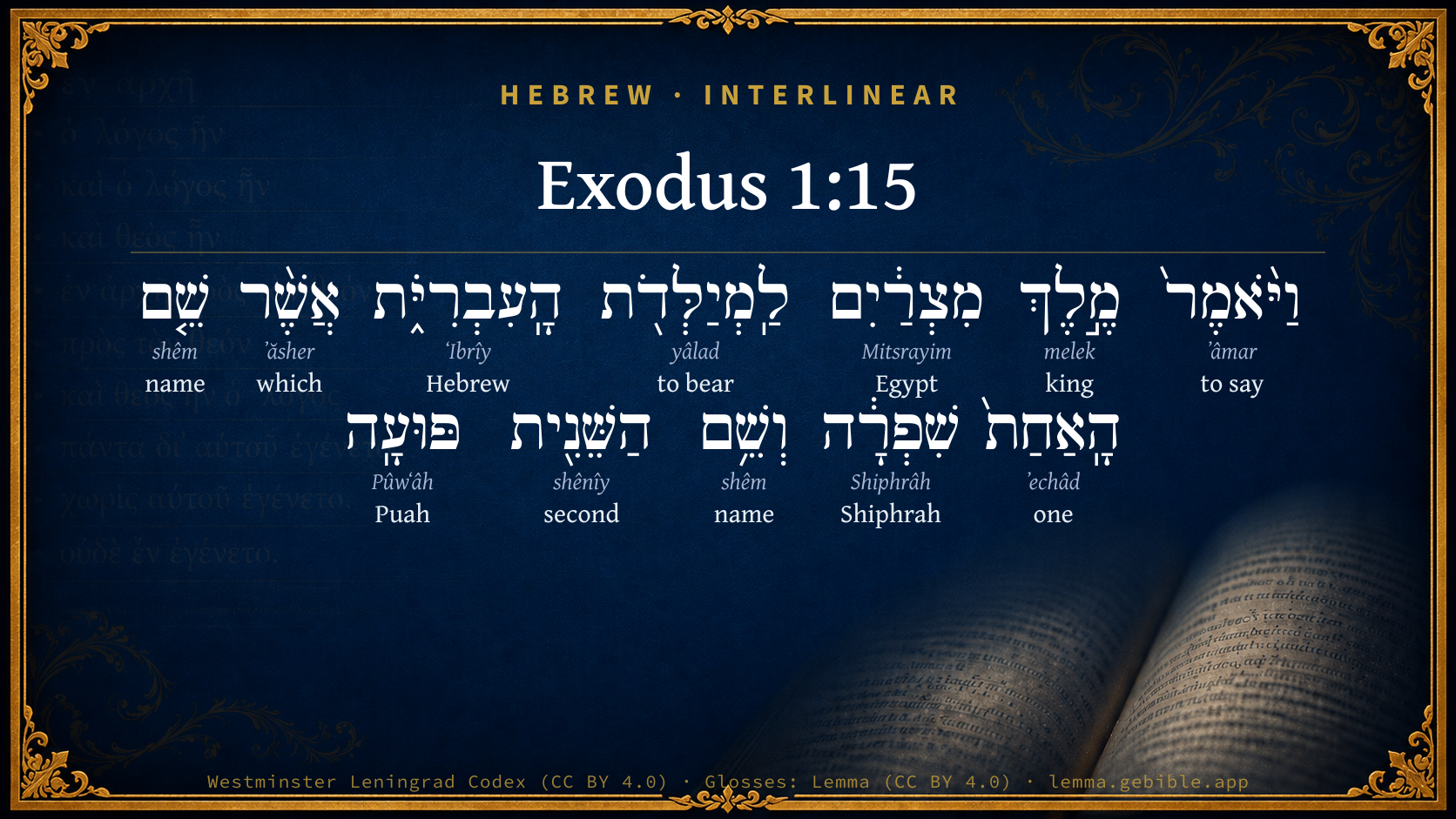
Hebrew (Westminster Leningrad Codex) Exodus 1:15 appears in the Hebrew Old Testament. The text above is from the Westminster Leningrad Codex. Each word links to its Strong’s number, a concise gloss, and parsing drawn from the Open Scriptures Hebrew Bible morphology. Click any word for its full Brown-Driver-Briggs (BDB) entry.
Download image
Cite this verse

Exodus 1:15 (World English Bible). Public Domain. Lemma interlinear Bible study tool, https://lemma.gebible.app/v/exodus/1/15.

Show BibTeX & RIS
BibTeX
RIS
English Translation
The king of Egypt spoke to the Hebrew midwives, of whom the name of the one was Shiphrah, and the name of the other Puah,
World English Bible · Public Domain
Highlights
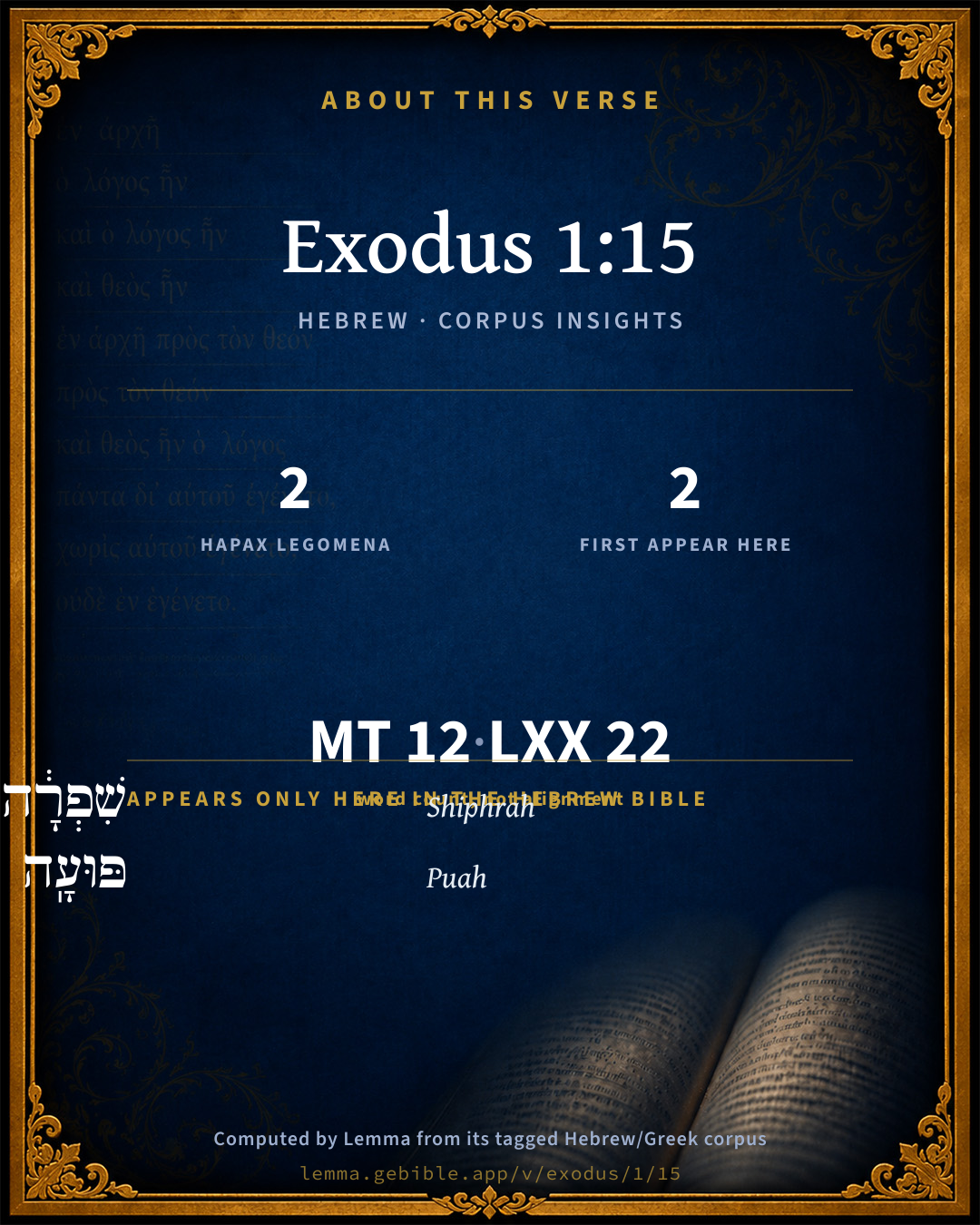
  • 2 hapax legomena — only here in the Hebrew Bible
  • 2 first appearances in the Hebrew Bible
Full analysis ↓
Download a study sheet

One document with this verse’s original text, its word-by-word gloss line, the meaning frame, cross-references with their text, attributed commentary, and full source and license credits — printable, and it pastes into notes with its structure intact.

This verse Autodidact and up

Study sheet (.html) Plain text (.txt)

A passage Seminary Student

Up to 50 verses in one chapter. A passage sheet keeps up to 6 commentary sources and 12 cross-references per verse, in the order this page ranks them, and says so on the sheet whenever that leaves anything out. Ask for a single verse and you get the Autodidact verse sheet above.

Everything on this page stays free to read, with no account — the sheet is a download of what is already on screen, not access to it.

Want to remove ads? Support Godless Engineer
Compare translations 3

The same verse in 3 English versions, stacked beneath the original-language interlinear above. Click any original word for its lexicon entry.

Each is an independent rendering of the whole verse — the interlinear is not word-aligned to these translations.

Highlighted words mark where these versions differ — a whole-verse word diff, not a word-by-word alignment.

  • World English Bible Public Domain
    The king of Egypt spoke to the Hebrew midwives, of whom the name of the one was Shiphrah, and the name of the other Puah,
  • King James Version Public Domain
    And the king of Egypt spake to the Hebrew midwives, of which the name of the one was Shiphrah, and the name of the other Puah:
  • unfoldingWord Literal Text CC BY-SA 4.0
    And the king of Egypt spoke to the Hebrew midwives, of whom the name of the one was Shiphrah, and the name of the second was Puah.

unfoldingWord Literal Text — © unfoldingWord, licensed CC BY-SA 4.0. Word-aligned USFM3 via Door43 (git.door43.org/unfoldingWord/en_ult).

Versions to compare (up to 4)

3 of 4 selected

Show all 18 translations

Every available English version of this verse, each an independent rendering of the whole verse.

  • World English Bible Public Domain
    The king of Egypt spoke to the Hebrew midwives, of whom the name of the one was Shiphrah, and the name of the other Puah,
  • Berean Standard Bible Public Domain
    Then the king of Egypt said to the Hebrew midwives, whose names were Shiphrah and Puah,
  • Majority Standard Bible Public Domain
    Then the king of Egypt said to the Hebrew midwives, whose names were Shiphrah and Puah,
  • King James Version Public Domain
    And the king of Egypt spake to the Hebrew midwives, of which the name of the one was Shiphrah, and the name of the other Puah:
  • American Standard Version (1901) Public Domain
    And the king of Egypt spake to the Hebrew midwives, of whom the name of the one was Shiphrah, and the name of the other Puah:
  • Revised Version (1885) Public Domain
    And the king of Egypt spake to the Hebrew midwives, of which the name of the one was Shiphrah, and the name of the other Puah:
  • Geneva Bible (1599) Public Domain
    Moreouer the King of Egypt commanded ye midwiues of the Ebrewe women, (of which the ones name was Shiphrah, and the name of the other Puah)
  • Douay-Rheims (1899) Public Domain
    And the king of Egypt spoke to the midwives of the Hebrews: of whom one was called Sephora, the other Phua,
  • Young's Literal Translation Public Domain
    And the king of Egypt speaketh to the midwives, the Hebrewesses, (of whom the name of the one `is' Shiphrah, and the name of the second Puah),
  • Literal Standard Version CC BY-SA 4.0
    And the king of Egypt speaks to the midwives, the Hebrewesses (of whom the name of the first [is] Shiphrah, and the name of the second Puah),
  • Unlocked Literal Bible CC BY-SA 4.0
    Then the king of Egypt spoke to the Hebrew midwives; the name of the one was Shiphrah, and the other Puah.
  • unfoldingWord Literal Text CC BY-SA 4.0
    And the king of Egypt spoke to the Hebrew midwives, of whom the name of the one was Shiphrah, and the name of the second was Puah.
  • Darby Bible Public Domain
    And the king of Egypt spoke to the Hebrew midwives -- of whom the name of the one was Shiphrah, and the name of the other was Puah --
  • World Messianic Bible Public Domain
    The king of Egypt spoke to the Hebrew midwives, of whom the name of the one was Shiphrah, and the name of the other Puah,
  • Webster's Bible Public Domain
    And the king of Egypt spoke to the Hebrew midwives (of which the name of one was Shiphrah, and the name of the other Puah:)
  • Free Bible Version CC BY-SA 4.0
    Then the king gave orders to the Hebrew midwives, Shiphrah and Puah.
  • Bible in Basic English Public Domain
    And the king of Egypt said to the Hebrew women who gave help at the time of childbirth (the name of the one was Shiphrah and the name of the other Puah),
  • JPS Tanakh (1917) Public Domain
    And the king of Egypt spoke to the Hebrew midwives, of whom the name of the one was Shiphrah, and the name of the other Puah;

Literal Standard Version (2020), Covenant Press — licensed CC BY-SA 4.0. Text via the HelloAO Bible API (eBible.org). Unlocked Literal Bible (unfoldingWord) — licensed CC BY-SA 4.0. Text via the HelloAO Bible API (eBible.org). unfoldingWord Literal Text — © unfoldingWord, licensed CC BY-SA 4.0. Word-aligned USFM3 via Door43 (git.door43.org/unfoldingWord/en_ult). Free Bible Version, Dr. Jonathan Gallagher — licensed CC BY-SA 4.0. Text via the HelloAO Bible API (eBible.org).

Word by word

More ways to search: Search by grammar → Find every occurrence → Compare this word →

Practice this passage: Drill this verse → Learn its vocabulary →

שִׁפְרָ֔ה
Shiphrâh
H8236
“Shiphrah”
Noun, Proper
Part of Speech
Noun
Type
Proper
Full BDB Definition

Origin: the same as H8235

TWOT: None

Shiphrah = "fair" - one of the two Hebrew midwives who were ordered by Pharaoh to kill all the male children born to the Hebrews but who disobeyed
  1. וַיֹּ֨אמֶר֙ ʼâmar H559 “and · to say” Conjunction + Verb, Qal, Sequential Imperfect, 3rd Person, Masculine, Singular
  2. מֶ֣לֶךְ melek H4428 “king of” Noun, Common, Masculine, Singular, Construct
  3. מִצְרַ֔יִם Mitsrayim H4714 “Egypt” Noun, Proper
  4. לַֽמְיַלְּדֹ֖ת yâlad H3205 “to/for the · bearing” Preposition, Determined + Verb, Piel, Participle Active, Feminine, Plural, Absolute
  5. הָֽעִבְרִיֹּ֑ת ʻIbrîy H5680 “the · Hebrews” Particle, Definite Article + Noun, Gentilic, Feminine, Plural, Absolute
  6. אֲשֶׁ֨ר ʼăsher H834 “which” Particle, Relative
  7. שֵׁ֤ם shêm H8034 “name of” Noun, Common, Masculine, Singular, Construct
  8. הָֽאַחַת֙ ʼechâd H259 “the · one” Particle, Definite Article + Adjective, Cardinal number, Feminine, Singular, Absolute
  9. וְשֵׁ֥ם shêm H8034 “and · name of” Conjunction + Noun, Common, Masculine, Singular, Construct
  10. הַשֵּׁנִ֖ית shênîy H8145 “the · second” Particle, Definite Article + Adjective, Ordinal number, Feminine, Singular, Absolute
  11. פּוּעָֽה Pûwʻâh H6326 “Puah” Noun, Proper

About this verse

These counts appear in no published source. They are computed here, from the morphology-tagged text and Lemma’s own curated glosses. What Lemma adds →

12
words
11
distinct lemmas
Pentateuch
section

Notable vocabulary

2 hapax legomena — words that appear only here in the entire Hebrew Bible:

  • שִׁפְרָ֔ה Shiphrah H8236
  • פּוּעָֽה Puah H6326

First appearance in Scripture

These words make their first canonical appearance in the Hebrew Bible here:

  • שִׁפְרָ֔ה Shiphrah H8236
  • פּוּעָֽה Puah H6326

Shared distinctive vocabulary

הָֽעִבְרִיֹּ֑ת Hebrew H5680 occurs in 32 verses of the Hebrew Bible. Also found in:

Grammatical profile

  • 2 verbs
  • 7 nouns
  • 2 adjectives
  • 1 particle

Verb forms

  • וַיֹּ֨אמֶר֙ Qal · Sequential Imperfect
  • לַֽמְיַלְּדֹ֖ת Piel · Participle Active

Repetition

A word recurs within this verse — often emphatic in Hebrew:

  • שֵׁ֤ם name H8034 ×2

Hebrew & Septuagint length

In English translation the verse runs 25 words from the Hebrew and 27 from the Septuagint (LXX English) — closely comparable.

A rough comparison of the two English renderings, which tokenize alike — not a word-level alignment.

Word counts can differ between the Hebrew and the Greek without any difference in meaning — e.g. the Hebrew direct-object marker אֵת has no separate Greek word, and Greek often adds the article ὁ.

In the original languages it is 12 Hebrew tokens and 22 Greek tokens — but the two are counted differently (Hebrew bundles its prefixes and suffixes into one token; the Greek is in lemma form), so that isn’t a like-for-like length.

Hebrew and Greek witnesses Masoretic Hebrew ↔ Greek Septuagint

The same verse in the two great witnesses to the Old Testament, shown verse-for-verse.

These are two independent witnesses, not word-aligned to each other, and the Septuagint is shown in lemma (dictionary) form.

Hebrew Exodus 1:15 Masoretic · Westminster Leningrad Codex

וַיֹּ֨אמֶר֙ מֶ֣לֶךְ מִצְרַ֔יִם לַֽמְיַלְּדֹ֖ת הָֽעִבְרִיֹּ֑ת אֲשֶׁ֨ר שֵׁ֤ם הָֽאַחַת֙ שִׁפְרָ֔ה וְשֵׁ֥ם הַשֵּׁנִ֖ית פּוּעָֽה

The king of Egypt spoke to the Hebrew midwives, of whom the name of the one was Shiphrah, and the name of the other Puah,

World English Bible · Public Domain

Greek LXX Exodus 1:15 Septuagint · lemma form

καί εἶπον ὁ βασιλεύς ὁ αἰγύπτιος ὁ μαῖα ὁ εβραῖος ὁ εἷς αὐτός ὅς ὄνομα σεπφωρα καί ὁ ὄνομα ὁ δεύτερος φουα

And the king of the Egyptians spoke to the midwives of the Hebrews; the name of the one was, Sepphora; and the name of the second, Phua.

LXX2012 (modern English Septuagint) · Public Domain

On this verse, Ellicott's Commentary for English Readers discusses the Septuagint’s reading. Read the note in Commentary ↓

Hebrew: Westminster Leningrad Codex (CC BY 4.0). Greek: Septuagint (public domain); English from LXX2012 (modern English Septuagint) (Public Domain). How the Septuagint differs from the Hebrew →

Targum (Aramaic paraphrase)

2

The Targum is the ancient Jewish Aramaic paraphrase of the Hebrew Scriptures — an interpretive translation, not the Hebrew text itself. Onkelos (literal) and Pseudo-Jonathan (expansive) render the Torah, and Jonathan the Prophets. Coverage is partial: where no permissively-licensed English translation exists for a verse, only the Aramaic is shown. This is verse-level text, not a word-by-word alignment to the Hebrew.

  1. Targum Onkelos Torah (Genesis–Deuteronomy)
    וַאֲמַר מַלְכָּא דְמִצְרַיִם לְחַיָתָא יְהוּדַיָתָא דְשׁוּם חָדָא שִׁפְרָה וְשּׁוּם תִּנְיֵתָא פּוּעָה:

    (no public-domain English translation for this verse)

    Targum Onkelos — Aramaic: “Onkelos Genesis” (public domain); “Onkelos Exodus” (public domain); “Onkelos Leviticus” (public domain); “Onkelos Numbers” (public domain); “Onkelos Deuteronomy” (public domain). English: “Sefaria Community Translation” (CC0 1.0 (public-domain dedication)); “J.W. Etheridge. The Targums of Onkelos and Jonathan Ben Uzziel on the Pentateuch. London: Longmans, Green, 1862” (public domain). Text via Sefaria.

  2. Targum Pseudo-Jonathan Torah (Genesis–Deuteronomy)
    וַאֲמַר פַּרְעה דָמָךְ הֲוָה חָמֵי בְּחֵילְמֵיהּ וְהָא כָּל אַרְעָא דְמִצְרַיִם קַיְימָא בְּכַף מוֹדָנָא חֲדָא וְטַלְיָא בַּר אִימְרָתָא בְּכַף מוֹדָנָא חֲדָא וַהֲוַת כַּרְעָא כַּף מוֹדָנָא מְטַלְיָא בְּגַוָה מִן יַד שָׁדַר וּקְרָא כָּל חַרְשֵׁי מִצְרַיִם וְתָנֵי לְהוֹן יַת חוּלְמֵיהּ מִן יַד פַּתְחִין פּוּמְהוֹן יֵינִיס וְיִמְבְּרֵס רֵישֵׁי חַרְשַׁיָא וְאָמְרִין לְפַרְעה בִּיר חַד עָתִיד לְמֶהֱוֵי מִתְיְלִיד בִּכְנִישַׁתְהוֹן דְיִשְרָאֵל דְעַל יְדוֹ עֲתִידָא לִמְחַרְבָא כָּל אַרְעָא דְמִצְרַיִם וּבְגִין כֵּן אִתְיַעַט פַּרְעה מַלְכָּא דְמִצְרַיִם לְחַיָיתָא יְהוֹדַיְיתָא דִשְׁמָא דְחָדָא שִׁפְרָה הִיא יוֹכֶבֶד וּשְׁמָא דְתִּנְיֵיתָא פּוּעָה הִיא מִרְיָם בְּרַתָּה

    And Pharoh told that he, being asleep, had seen in his dream, and, behold, all the land of Mizraim was placed in one scale of a balance, and a lamb, the young of a sheep, was ill the other scale; and the scale with the lamb in it overweighed. Forthwith he sent and called all the magicians of Mizraim, and imparted to them his dream. Immediately Jannis and Jambres, the chief of the magicians, opened their mouth and answered Pharoh,?A certain child is about to be born in the congregation of Israel, by whose hand will be destruc-tion to all the land of Mizraim. Therefore did Pharoh, king of Mizraim, give counsel to the Jehudith midwives, the name of one of whom was Shifra, who is Jokeved, and the name of the other Puvah, who is Miriam her daughter.

    Targum Pseudo-Jonathan — Aramaic: “Targum Jonathan on Genesis” (public domain); “Targum Jonathan on Exodus” (public domain); “Targum Jonathan on Leviticus” (public domain); “Targum Jonathan on Numbers” (public domain); “Targum Jonathan on Deuteronomy” (public domain). English: “The Targum of Jonathan ben Uzziel, trans. J. W. Etheridge, London, 1862” (public domain). Text via Sefaria.

Commentary

Notes on Exodus 1:15 from classic Christian and Jewish commentators (each source and its license shown beneath its notes). The classic Christian expositions comment on the surrounding passage and are grouped to its opening verse, so a note may address several verses; the Jewish commentaries on the Tanakh (Rashi and others) are per-verse, so they appear only where the commentator wrote on this verse.

Lemma curates 59 commentaries, every one of them public domain or Creative Commons licensed, each selected and text-cleaned for this edition rather than reprinted as found. About our sources →

Matthew Henry's Commentary

The Egyptians' indignation at Israel's increase, notwithstanding the many hardships they put upon them, drove them at length to the most barbarous and inhuman methods of suppressing them, by the murder of their children. It was strange that they did not rather pick quarrels with the grown men, against whom they might perhaps find some occasion: to be thus bloody towards the infants, whom all must own to be innocents, was a sin which they had to cloak for. Note, 1. There is more cruelty in the corrupt heart of man than one would imagine, Rom 3:15, Rom 3:16. The enmity that is in the seed of the serpent against the seed of the woman divests men of humanity itself, and makes them forget all pity. One would not think it possible that ever men should be so barbarous and blood-thirsty as the persecutors of God's people have been, Rev 17:6. 2. Even confessed innocence is no defence against the old enmity. What blood so guiltless as that of a child new-born? Yet that is prodigally shed like water, and sucked with delight like milk or honey. Pharaoh and Herod sufficiently proved themselves agents for that great red dragon, who stood to devour the man-child as soon as it was born, Rev 12:3, Rev 12:4. Pilate delivered Christ to be crucified, after he had confessed that he found no fault in him. It is well for us that, though man can kill the body, this is all he can do. Two bloody edicts are here signed for the destruction of all the male children that were born to the Hebrews.

I. The midwives were commanded to murder them. Observe, 1. The orders given them, Exo 1:15, Exo 1:16. It added much to the barbarity of the intended executions that the midwives were appointed to be the executioners; for it was to make them, not only bloody, but perfidious, and to oblige them to betray a trust, and to destroy those whom they undertook to save and help. Could he think that their sex would admit such cruelty, and their employment such base treachery? Note, Those who are themselves barbarous think to find, or make, others as barbarous. Pharaoh's project was secretly to engage the midwives to stifle the men-children as soon as they were born, and then to lay it upon the difficulty of the birth, or some mischance common in that case, Job 3:11. The two midwives he tampered with in order hereunto are here named; and perhaps, at this time, which was above eighty years before their going out of Egypt, those two might suffice for all the Hebrew women, at least so many of them as lay near the court, as it is plain by Exo 2:5, Exo 2:6, many of them did, and of them he was most jealous. They are called Hebrew midwives, probably not because they were themselves Hebrews (for surely Pharaoh could never expect they should be so barbarous to those of their own nation), but because they were generally made use of by the Hebrews; and, being Egyptians, he hoped to prevail with them. 2. Their pious disobedience to this impious command, Exo 1:17. They feared God, regarded his law, and dreaded his wrath more than Pharaoh's and therefore saved the men-children alive. Note, If men's commands be any way contrary to the commands of God, we must obey God and not man, Act 4:19; Act 5:29. No power on earth can warrant us, much less oblige us, to sin against God, our chief Lord. Again, Where the fear of God rules in the heart, it will preserve it from the snare which the inordinate fear of man brings. 3. Their justifying themselves in this disobedience, when they were charged with it as a crime, Exo 1:18. They gave a reason for it, which, it seems, God's gracious promise furnished them with - that they came too late to do it, for generally the children were born before they came, Exo 1:19. I see no reason we have to doubt the truth of this; it is plain that the Hebrews were now under an extraordinary blessing of increase, which may well be supposed to have this effect, that the women had very quick and easy labour, and, the mothers and children being both lively, they seldom needed the help of midwives: this these midwives took notice of, and, concluding it to the finger of God, were thereby emboldened to disobey the king, in favour of those whom Heaven thus favoured, and with this justified themselves before Pharaoh, when he called them to an account for it. Some of the ancient Jews expound it thus, Ere the midwife comes to them they pray to their Father in heaven, and he answereth them, and they do bring forth. Note, God is a readier help to his people in distress than any other helpers are, and often anticipates them with the blessings of his goodness; such deliverances lay them under peculiarly strong obligations. 4. The recompence God gave them for their tenderness towards his people: He dealt well with them, Exo 1:20. Note, God will be behind-hand with none for any kindness done to his people, taking it as done to himself. In particular, he made them houses (Exo 1:21), built them up into families, blessed their children, and prospered them in all they did. Note, The services done for God's Israel are often repaid in kind. The midwives kept up the Israelites' houses, and, in recompence for it, God made them houses. Observe, The recompence has relation to the principle upon which they went: Because they feared God, he made them houses. Note, Religion and piety are good friends to outward prosperity: the fear of God in a house will help to build it up and establish it. Dr. Lightfoot's notion of it is, That, for their piety, they were married to Israelites, and Hebrew families were built up by them.

II. When this project did not take effect, Pharaoh gave public orders to all his people to drown all the male children of the Hebrews, Exo 1:22. We may suppose it was made highly penal for any to know of the birth of a son to an Israelite, and not to give information to those who were appointed to throw him into the river. Note, The enemies of the church have been restless in their endeavours to wear out the saints of the Most High, Dan 7:25. But he that sits in heaven shall laugh at them. See Psa 2:4.

Matthew Henry's Commentary on the Whole Bible (1708–1710) — public domain (CC PDM 1.0). Text via the HelloAO Bible API.

Trapp's Complete Commentary

John Trapp

Exo 1:15 And the king of Egypt spake to the Hebrew midwives, of which the name of the one [was] Shiphrah, and the name of the other Puah:

Ver. 15. To the Hebrew midwives.] In Egypt and Greece the midwives of old had their schools; and some of them were great writers. I know not whether the priests were then so officious to them as many are now among the Papists; who say they therefore study Albertus Magnus de secrelis mulierum, that they may advise the midwives: but I doubt it is for a worse purpose; to gratify and greaten those abominable lusts wherewith they are scalded. {εξεκαυθησαν, Rom 1:27}

John Trapp, A Commentary or Exposition upon All the Books of the Old and New Testament (1647–1656) — public domain. Text from a community e-Sword module.

Joseph Benson's Commentary

Exo 1:15. The king spake to the Hebrew midwives — The two chief of them. They are called Hebrew midwives, probably not because they were themselves Hebrews; for sure Pharaoh could never expect they should be so barbarous to those of their own nation; but because they were generally made use of among the Hebrews, and being Egyptians, he hoped to prevail with them.

Joseph Benson's Commentary on the Old and New Testaments (1811–1818) — public domain. Text from a community e-Sword module.

The Preacher's Complete Homiletical Commentary

Joseph S. Exell (gen. ed.)

CRITICAL NOTES.—

Exo_1:15. Hebrew midwives] It is curious, though it may not throw light on the precise relation in which these women stood to the Hebrew women, that their names should be of a like sig. (according to Fürst): Shiphrah = “beauty;” Puah = “gracefulness.”

Exo_1:16. Upon the stools] Perhaps a low seat employed by the mid wives; or the word may be used for a washing vessel of stone, in which they used to wash infants (Ges.) But the explanation of Fürst appears to be, contextually, more forcible: “Look to the two sexes.”

MAIN HOMILETICS OF THE PARAGRAPH.—Exo_1:15-21

HIGH SOCIAL POSITION USED FOR THE FURTHERANCE OF A WICKED PURPOSE

I. That sometimes high social position exerts its authority for the accomplishment of a wicked and cruel purpose. (Exo_1:15.)

1. The king commands the murder of the male children of the Israelites. What could be more diabolical than this? They were to be murdered in the birth. They were innocent of any plot against the Egyptian government. They had in no way injured the country—yet they are to be put to death—almost before their first experience of life. None but the king dared to have uttered such a cruel mandate. Kings seem to have an idea that they can do what they like. What an abuse and degradation of regal power. It is this kind of thing that brings them into contempt.

2. He seeks to accomplish this by bringing the innocent into a participation of his murderous deed. These Hebrew midwives were of godly moral character. They feared Jehovah; they sympathised with the enslaved Israelites; they had no thought of doing their comrades any harm; as for murdering the offspring of those whom they attended in childbirth, the very suggestion was most revolting to them. Thus, the king tries to enkindle within the hearts and minds of these midwives the same envy, and unholy thought that occupied his own. It is almost unpardonable to suggest sin to those that have no previous occasion for, or idea of committing it, and especially when the suggestion is rendered authoritative by power and national supremacy. This suggestion was not only cruel and murderous, but it was subtle. In this way the king would be concealed as the murderer. It would be done by the midwives, and they even would not be detected in the act. Thus many simple lives would have been plunged into awful crime—and innocent victims would have suffered for the guilty. Tyrants are generally cowards, and seek such means for the accomplishment of their designs as are more likely to involve others than themselves.

II. When high social authority is used to further a wicked design we are justified in opposing its effort. (Exo_1:17.)

1. We are not to do wrong because a king commands it. Many weak-minded people will do anything a king tells them. They think what he says must be right; they are flattered by his personal attention to them; they are awed by his pomp and splendour; they are bribed by his offer of reward (the king would no doubt promise these midwives ample recompense). When the highest personage in the realm needs an accomplice to aid in an evil deed, never help him, however humble or poor your station in life may be. It will be your ruin if you do; he will soon want to dispatch you, to shield himself from the possibility of detection. Right is the supreme monarch of the soul, and claims obedience before any temporal power. To oppose murder, when advocated by a king, and when it could be accomplished unknown—and when, if known, would win the applause of a hostile nation, is heroic—benevolent—divinely rewardable, and is the duty of all who fear God.

2. Such opposition must embody the true principle of piety. The midwives feared God—more than they did the king. This opposition to the cruel intent of the monarch was not obstinate, but it was the outcome of a conscience influenced by the Divine Spirit. We must always reject the idea of sin in a pious spirit—from Christian motive.

3. Such opposition will secure for us the Divine protection. The king summoned the midwives to himself again. He asked why they had neglected his command. They replied fearlessly. No harm came to them. God will protect brave souls that dare to defy a wicked king.

III. That for such opposition we shall be Divinely Rewarded.

1. God dealt well with the midwives.

2. God made the midwives houses.

3. Men lose nothing by serving God in preference to a cruel king.

SUGGESTIVE COMMENTS ON THE VERSES

Exo_1:15. Sin often brings men into companionships that otherwise they would despise.

It is a mercy that tyrants are often dependent upon others, of more tender sympathies, for the accomplishment of their designs.

The plan of murder is not so easy after all; there are persons to be consulted who may turn round upon us, and, on some ground, deny our authority. What if the midwives set themselves against Pharaoh? Two humble women may be more than a match for the great king of Egypt. No influence, how obscure soever, is to be treated with contempt [City Temple.]

Exo_1:16. When burdens do not effect the will of tyrants on the Church, murder shall.

Cruelty on the first onset seeks to shed blood by subtilty.

Tyrants will make helps for life to be instruments of death—midwives to be murderers.

Bloody powers suborn either such as be of the Church, or strangers to destroy them.

Subtle tyrants order the best opportunity at first, to hide their cruelty.

It is devilish to set a tender soul upon such bloody designs [Hughes].

Satan, in all his instruments, hath always aimed at the death of Israel’s males [Hughes].

No greater argument of an ill cause than a bloody persecution [Trapp].

Why were the males to be put to death?—

1. Because they were the most capable of insurrection and war.

2. Because the Israelitish women were fairer than the Egyptian, and so might be kept for the purposes of lust.

3. Because the Israelitish women were industrious in spinning and needlework, and so were kept for service.

Exo_1:17. The tyrant-projects of a wicked king may be thwarted by the piety of his subjects.

God has instruments in the world to aid His Church, as well as to persecute it.

Religion will deter men from the most terrible sins.

God gives courage to timid souls, to enable them to resist kingly wrong.

God makes them save life whom men appoint to destroy it.

The good hand of God doth keep the males, or best helps of the Church’s peace, when persecutors would kill.

Still the conflict rages between God and the tyrant king. On which side are we found?

Those who fear God are superior to all other fear. When our notion of authority terminates upon the visible and temporary, we become the victims of fickle circumstances; when that notion rises to the unseen and eternal, we enjoy rest amid the tumult of all that is merely outward, and therefore perishing. The men who fear God the most save their country. They make little noise, they hold no open-air demonstrations. All great workers in society are not in the front [City Temple].

Exo_1:18. That tyrants are sometimes disappointed in those whom they expected to fulfil their designs.

That tyrants can call those who disappoint them to account:—

1. In anger—the king was in a rage that his purpose had failed.

2. In disquietude—the king was perplexed as to the issue of Israel’s growth.

3. In astonishment—that two women should have set at naught his royal commands. He did not know the great force of true womanhood.

Exo_1:19. Faith in God enables men to give a reason for not doing wrong.

Tyrants are foiled by little instrumentalities in their efforts to destroy or injure the Church.

God can make His persecuted creatures more lively and strong to bear than others.… Religion fires a timid soul with heroism.

Exo_1:20. Persons who are instrumental in the saving of human life are pleasing to God.

Persons who render ineffective the designs of a tyrant, and preserve the Church from harm, are Divinely blessed.

All who fear God will be favourably dealt with—now and hereafter.

They who serve God serve a good master. Was God indifferent to the character and claims of the midwives who bore practical testimony for Him in the time of a nation’s trial? His eye was upon them for good, and His hand was stretched out day and night for their defence. They learned still more deeply that there was another King beside Pharoah; and in the realization of His presence Pharaoh dwindled into a secondary power, whose breath was in his nostrils, and whose commands were the ebullitions of moral insanity. No honest man or woman can do a work for God without receiving a great reward [City Temple].

There are times when nations are called upon to say “No,” to their Sovereigns. Such times are not to be sought for with pertinacious self-assertion, whose object is to make itself very conspicuous and important; but where they do occur, conscience is to assert itself with a dignity too calm to be impatient, and too righteous to be deceived [City Temple].

The Church must grow, even though the king seeks its death.

Exo_1:21. God makes sure houses for the sons of His Church when persecutors destroy them [Hughes].

Our reward is proportionate to our fear of God.

ILLUSTRATIONS

Exo_1:17.—

The conscience, that sole monarchy in man,

Owing allegiance to no earthly prince;

Made by the edict of creation free;

Made sacred, made above all human laws,

Holding of heaven alone; of most divine

And indefeasible authority [Pollock].

Exo_1:22. There is a woful gradation in sin. As mariners, setting sail, lose sight of the shore, then of the houses, then of the steeples, and then of the mountains and land; and as those that are waylaid by a consumption first lose vigour, then appetite, and then colour; thus it is that sin hath its woful gradations. None decline to the worst at first, but go from one degree of turpitude to another, until the very climax is reached.

The Preacher's Complete Homiletical Commentary (gen. ed. Joseph S. Exell; Funk & Wagnalls, c. 1892) — public domain (pre-1929). A full-Bible homiletical/sermon-outline anthology covering 65 of 66 books (2 John is absent from the source module). Text from a community e-Sword module.

Keil & Delitzsch

C. F. Keil & F. Delitzsch

As the first plan miscarried, the king proceeded to try a second, and that a bloody act of cruel despotism. He commanded the midwives to destroy the male children in the birth and to leave only the girls alive. The midwives named in Exo 1:15, who are not Egyptian but Hebrew women, were no doubt the heads of the whole profession, and were expected to communicate their instructions to their associates. ויּאמר in Exo 1:16 resumes the address introduced by ויאמר in Exo 1:15. The expression על־האבנים, of which such various renderings have been given, is used in Jer 18:3 to denote the revolving table of a potter, i.e., the two round discs between which a potter forms his earthenware vessels by turning, and appears to be transferred here to the vagina out of which the child twists itself, as it were like the vessel about to be formed out of the potter's discs. Knobel has at length decided in favour of this explanation, at which the Targumists hint with their מתברא. When the midwives were called in to assist at a birth, they were to look carefully at the vagina; and if the child were a boy, they were to destroy it as it came out of the womb. וחיה for חייה rof ו from חיי, see Gen 3:22. The w takes kametz before the major pause, as in Gen 44:9 (cf. Ewald, 243a).

Keil & Delitzsch — Biblical Commentary on the Old Testament (1861–1891) — public domain (CC PDM 1.0). Text via the HelloAO Bible API. (Old Testament only.)

Tyndale Open Study Notes

Tyndale Open Resources

1:15 Pharaoh is a title for the Egyptian ruler, not a personal name. • The origins of the word Hebrew are unclear. As used by the Egyptians and Philistines in reference to the Israelites, it was apparently a derogatory term for a despised underclass. • Whatever the number of Hebrew people (see study note on 12:37), there were clearly more than two midwives for the whole nation. Probably the two named here, Shiphrah and Puah, are representatives of the whole group. The differences between Pharaoh and the midwives are dramatic. He had great political and military power; they had none. He had great official prestige; they had very little. He was a man; they were women. He was of the ruling people; they were slaves. He was rich; they were poor. They could easily have been cowed into obedience, but they were not.

Tyndale Open Study Notes — © Tyndale Open Resources, licensed CC BY-SA 4.0. Text via the HelloAO Bible API.

Geneva Bible (1599)

Geneva Bible translators

These seem to have been the chief of the rest.

Geneva Bible (1599) marginal notes — public domain. Text via Bolls.life.

Jamieson, Fausset & Brown

Robert Jamieson, A. R. Fausset & David Brown

the king of Egypt spake to the Hebrew midwives--Two only were spoken to--either they were the heads of a large corporation [LABORDE], or, by tampering with these two, the king designed to terrify the rest into secret compliance with his wishes [CALVIN].

Jamieson, Fausset & Brown — Commentary Critical and Explanatory on the Whole Bible (1871) — public domain (CC PDM 1.0). Text via the HelloAO Bible API.

Adam Clarke's Commentary

Verse 15. Hebrew midwives] Shiphrah and Puah, who are here mentioned, were probably certain chiefs, under whom all the rest acted, and by whom they were instructed in the obstetric art. Aben Ezra supposes there could not have been fewer than five hundred midwives among the Hebrew women at this time, but that very few were requisite see proved on Ex 1:19. See Clark on "Ex 1:19".

Adam Clarke's Commentary on the Bible (1810–1826) — public domain. Text from a community e-Sword/MySword module.

Ellicott's Commentary for English Readers

(15) The Hebrew midwives.—Or the midwives of the Hebrew women (ταῖς μαίαις τῶν Έβραίων, LXX.). The Hebrew construction admits of either rendering. In favour of the midwives being Egyptians is the consideration that the Pharaoh would scarcely have expected Hebrew women to help him in the extirpation of the Hebrew race (Kalisch); against it is the Semitic character of the names—Shiphrah, “beautiful;” Puah, “one who cries out;” and also the likelihood that a numerous and peculiar people, like the Hebrews, would have accoucheurs of their own race.

A Bible Commentary for English Readers, edited by Charles John Ellicott (1878–1897) — public domain. Text from a community e-Sword module.

The Cambridge Bible for Schools and Colleges

gen. ed. J. J. S. Perowne

15. The names were preserved by tradition (Di.) as those of two noble-minded women, who in perilous times had done their duty to God and their people, and refused to obey the inhuman command of the heathen king. Obviously if the numbers of the Israelites even remotely approached 600,000 males (Exo_12:37), far more than two midwives must have been required: either the numbers were in reality very much less, or these were the only midwives whose names were remembered.

15–22. The second measure. The Heb. midwives are commanded to slay all male infants that are born. V. 15 connects directly with v. 12.

The Cambridge Bible for Schools and Colleges (gen. ed. J. J. S. Perowne; Cambridge University Press, 1878–1918) — public domain. Text from a community e-Sword module.

John Gill's Exposition

And the king of Egypt spake to the Hebrew midwives,.... It is difficult to say who these midwives were, whether Egyptian or Hebrew women. Josephus is of opinion that they were Egyptians, and indeed those the king was most likely to succeed with; and it may seem improbable that he should offer such a thing to Hebrew women, who he could never think would ever comply with it, through promises or threatenings; and the answer they afterwards gave him, that the Hebrew women were not as the Egyptian women, looks as if they were of the latter: and yet, after all, it is more likely that these midwives were Hebrew women, their names are Hebrew; and besides, they are not said to be the midwives of Hebrew women, but Hebrew midwives; nor does it seem probable that the Hebrew women should have Egyptian midwives, and not those of their own nation; and they were such as feared the Lord; and the Targums of Jonathan and Jerusalem are express for it, and they pretend to tell us who they were: "of which the name of the one was Shiphrah, and the name of the other Puah"; the one, they say, was Jochebed, the wife of Amram, and mother of Moses and Aaron, and the other Miriam their sister; and this is the sense of many of the Jewish writers (f): but whatever may be said for Jochebed, it is not credible that Miriam should be a midwife, who was but a girl, or maid, at this time, about seven years of age, as the following chapter shows, and much less one of so much repute as to be spoke to by the king. It may seem strange, that only two should be spoke to on this account, when, as Aben Ezra supposes, there might be five hundred of them: to which it may be answered, that these were the most noted in their profession, and the king began with these, that if he could succeed with them, he would go on to prevail on others, or engage them to use their interest with others to do the like; or these might be the midwives of the principal ladies among the Israelites, in one of whose families, according as his magicians had told, as the Targum of Jonathan observes, should be born a son, by whom the land of Egypt would be destroyed; of which Josephus (g) also takes notice; and therefore he might be chiefly solicitous to destroy the male children of such families; but Aben Ezra thinks, that these two were the chief over the rest of the midwives, and who collected and paid to the king the tribute out of their salaries, which was laid upon them, and so he had an opportunity of conversing with them on this subject.

(f) T. Bab. Sotah, fol. 11. 2. Midrash Kohelet, fol. 74. 1. Jarchi in loc. (g) Ut supra. (Antiq. l. 2. c. 9. sect. 1.)

John Gill's Exposition of the Whole Bible (1746–1763) — public domain (CC PDM 1.0). Text via the HelloAO Bible API.

Albert Barnes' Notes on the Bible

Hebrew midwifes - Or “midwives of the Hebrew women.” This measure at once attested the inefficacy of the former measures, and was the direct cause of the event which issued in the deliverance of Israel, namely, the exposure of Moses. The women bear Egyptian names, and were probably Egyptians.

Albert Barnes' Notes on the Bible (1834–1885) — public domain. Text from a community e-Sword/MySword module.

Haydock's Catholic Bible Commentary

Midwives. Egyptian women, who assisted all of that district. (Josephus, [Antiquities] xi. 5.) There were others under them. Some think all these midwives were of Hebrew extraction, as their names are Hebrew, &c. (Calmet)

George Leo Haydock (1774–1849), Haydock's Catholic Family Bible and Commentary, 1859 edition — public domain. Excludes Psalms (Douay-Rheims chapter numbering differs from Protestant) and Deuterocanonical books (Catholic canon only).

Matthew Poole's English Annotations

The Hebrew midwives; such as not only were employed about the Hebrew women, but were Hebrews themselves, not Egyptians, as some suppose; as may appear,

1. Because they are expressly called, not the midwives of the Hebrews, but

the Hebrew midwives.

2. The Egyptian midwives would not willingly employ their time and pains among the meanest and poorest of servants, as these were. And if they were sent in design by the king, he had lost his end, which was to cover his cruelty with cunning, and to persuade the people that their death was not from his intention, but from the ellarices and dangers of child-bearing.

3. The Hebrew women, as they had doubtless midwives of their own, so they would never have admitted others.

4. They are said to fear God, Exo 2:17,21.

You are not to think that these were the only midwives to so many thousands of Hebrew women, but they were the most eminent among them; and it may be, for their excellency in that profession called to the service of some Egyptian ladies, and by them known to Pharaoh, who might therefore think by their own interest, and by the promise of great rewards, or by severe threatenings, to oblige them to comply with his desires; and if he met with the desired success by them, he meant to proceed further, and to engage the rest in like manner.

Matthew Poole's English Annotations on the Holy Bible (1683–1685) — public domain. Text from a community e-Sword/MySword module.

Whedon's Commentary on the Bible

Daniel D. Whedon

15, 16. A second and far more cruel edict now went forth. Herodotus shows (vol. 2:84) that medical theory and practice were highly perfected in Egypt, medical specialties being carefully cultivated; and the monuments show that the women were accoucheurs. Shiphrah and Puah were superintendents of the midwives, and are here designated the midwives, as Pharaoh’s chief butler and baker are called the butler and baker in Gen_11:1. This orderly superintendence of all industries is abundantly illustrated on the Theban tombs.

When ye… see them upon the stools — When ye look upon the birth, (Targ. Onk.) At the very moment of birth they were to destroy the child, if a male, as they could easily do even before the mother had seen it. This edict was probably aimed specially at the leading families of Israel, for such only would be likely to employ a professional midwife. See Concluding Notes. (2.)

Daniel D. Whedon (gen. ed.), Commentary on the Old and New Testaments (1874–1909) — public domain. Text from a community e-Sword module.

The Pulpit Commentary

Vers. 15-22. some time say five or six years having elapsed and the Pharaoh"s first plan having manifestly failed, it was necessary for him either to give up his purpose, or to devise something else. Persevering and tenacious, he preferred the latter course. He bethought himself that a stop might be put to the multiplication of the Israelites by means of infanticide on a large scale. Infanticide was no doubt a crime in Egypt, as in most countries except Rome; but the royal command would legitimate almost any action, since the king was recognised as a god; and the wrongs of a foreign and subject race would not sensibly move the Egyptian people, or be likely to provoke remonstrance. On looking about for suitable instruments to carry out his design, it struck the monarch that something, at any rate, might be done by means of the midwives who attended the Hebrew women in their confinements. It has been supposed that the two mentioned, Shiphrah and Puah, might be the only midwives employed by the Israelites (Canon Cook and others), and no doubt in the East a small number suffice for a large population: but what impression could the monarch expect to make on a population of from one to two millions of souls by engaging the services of two persons only, who could not possibly attend more than about one in fifty of the births? The midwives mentioned must therefore be regarded as "superintendents," chiefs of the guild or faculty, who were expected to give their orders to the rest. (So Kalisch, Knobel, Aben Ezra, etc.) It was no doubt well known that midwives were not always called in; but the king supposed that they were employed sufficiently often for the execution of his orders to produce an important result. And the narrative implies that he had not miscalculated. It was the disobedience of the midwives (ver. 17) that frustrated the king"s intention, not any inherent weakness in his plan. The midwives, while professing the intention of carrying out the orders given them, in reality killed none of the infants; and, when taxed by the Pharaoh with disobedience, made an untrue excuse (ver. 19). Thus the king"s second plan failed as completely as his first people" still "multiplied and waxed very mighty" (ver. 20).

Foiled a second time, the wicked king threw off all reserve and all attempt at concealment. If the midwives will not stain their hands with murder at his secret command, he will make the order a general and public one. "All his people" shall be commanded to put their hand to the business, and to assist in the massacre of the innocents it shall he the duty of every loyal subject to cast into the waters of the Nile any Hebrew male child of whose birth he has cognisance. The object is a national one-to secure the public safety (see ver. 10): the whole nation may well be called upon to aid in carrying it out.

The Hebrew midwives. It is questioned whether the midwives were really Hebrew women, and not rather Egyptian women, whose special business it was to attend the Hebrew women in their labours. Kalisch translates, "the women who served as midwives to the Hebrews," and assumes that they were Egyptians. (So also Canon Cook.) But the names are apparently Semitic, Shiphrah being "elegant, beautiful," and Puah, "one who cries out." And the most natural rendering of the Hebrew text is that of A.V..

Vers. 15-22. Steps in sin.

Bad men, when their designs are frustrated, and things fall out otherwise than as they wish, are far from suspecting that it is God who opposes them and brings their counsels to nought. They find fault with themselves or their advisers, and suppose that, if their end is not to be compassed in one way, it may he obtained in another. Like Balak, (Num_22:23) they would outwit God; or rather, not realising his existence, they would force fortune by a combination of inventiveness, perseverance, and audacity. When one means fails, they do not lay aside their design, but seek another means. And their second plan is almost always more wicked than their first. Pharaoh follows up the cruel thought of grinding oppression by the still more cruel resolve to effect his purpose through murder. And not liking to incur the odium of open murder, he devises a secret system, a crypteia, which shall rid him of a certain number of his enemies, and yet keep him clear, even of suspicion. The midwives, had they come into his plan, would of course have said that the children they murdered were stillborn, or died from natural causes. But this crafty scheme likewise fails; and then what follows? His subtle brain invents a third plan, and it is the cruelest and wickedest of all. Grown shameless, he openly avows himself a murderer, takes his whole people into his confidence, compels them, so far as he can, to be a nation of murderers, and extends his homicidal project to all the males. "Every son that is born ye shall cast into the river." The Nile, according to his own religion, was a god, and no Egyptian corpse ever defiled it; but everything must give way that the king may work his wicked will, and the restraints of the national creed are as little regarded as those of natural morality. Facilis descensus Averni; the steps by which men go down the road to hell are easy; each is in advance of the other, a little further on in guilt; there is no startling transition; and so, by little and little, advance is made, and the neophyte becomes a graduate in the school of crime.

HOMILIES BY J. ORR Vers. 15-22. A king"s edicts.

I THE COMMAND TO THE MIDWIVES TO DESTROY THE MALES (ver. 16). This was a further stage in the persecution of the Hebrews. Happily the command was not obeyed. There is a limit even to the power of kings. Stronger than kings is

1. The power of religion. "The midwives feared God" (ver. 17).

2. The force of patriotism. They were "Hebrew midwives" (ver. 15), and would not, even at the king"s bidding, be murderers of their race.

3. The instincts of humanity. These came in to thwart both this and the next expedient for destroying the children.

4. The cunning of evasion. It is hopeless to attempt to force laws upon a people determined not to obey them. The midwives had only to stay away, and let the Hebrew women help themselves, to reduce the, king"s decree to a dead letter. And this was probably what they did (ver. 19). The result shows how much better it is, even at some risk, to obey God than to obey man. The midwives

1. Lost nothing.

2. Retained a good conscience.

3. Were signally honoured and rewarded: God made them houses (ver. 21). Kindness shown to God"s people never fails of its reward.

II THE COMMAND TO THE PEOPLE TO CAST THE MALES INTO THE RIVER (ver. 22). He must indeed have been a foolish king, if he thought to secure obedience to so inhuman a decree. Parents would not obey it. The work was of a kind which would soon grow hateful even to those who might at first be willing to do it for reward. The hearts of the most abandoned ere long sicken at murder. Public sympathy does not appear to have gone with the edict, and the number of males at the Exodus makes it certain that it was not long in operation. Its chief fruit was one little contemplated by the tyrant the salvation and courtly upbringing of Moses. Learn

1. How one cruelty leads to another, and increasingly hardens the heart. Itis told of Robespierre that when judge at Arras, half-a-dozen years before he took his place in the popular mind of France and Europe as one of the bloodiest monsters of myth or history, he resigned his post in a fit of remorse after condemning a criminal to be executed. "He is a criminal, no doubt," he kept groaning to his sister, "a criminal no doubt; but to put a man to death!" (Morley).

2. The impotence of human devices.

3. The certainty of the Church surviving under the worst that man can doagainst it,. The more Pharaoh persecuted, the more the people multiplied and grew (vers. 12, 20). J.O.

HOMILIES BY D. YOUNG Vers. 15-21. The conduct of the midwives.

I NOTICE WHAT WAS PRAISEWORTHY IN THEIR CONDUCT. "They did not as the king of Egypt commanded them, but saved the men-children alive," and this conduct was made possible because behind it there was a praiseworthy feeling. "The midwives feared God." They saw how real was the power of Pharaoh in enslaving and oppressing the Israelites, but they were not thereby misled into supposing the power of Pharaoh to be greater than the power of God. They had ample opportunity, even more than the rest of Israel, to mark the Hand that was producing this extraordinary,increase in the numbers of the people. Their very professional experience was of a kind to impress them deeply with the fact that Israel was increasing at a rate not to be accounted for by the ordinary processes of nature. They could not see God as they saw Pharaoh, but his superior power was made evident by the things he did. Then, on the other hand, with all the manifestations of Pharaoh"s power, it was impossible for him to conceal that he was afraid himself. Moreover, as the oppression and affliction of Israel increased, it became still clearer that God was with the people, and the-more confirmed would the midwives be in their fear of him. Hence it would have been a very poor sort of prudence to comply with Pharaoh"s order, to avoid his displeasure, perhaps to gain his rewards, and then find themselves face to face with an angry God, from whom there was no escape. What a rebuke, out of these depths of bondage and suffering, and out of a very imperfect moral state, these two women give to us! They feared God, and that fear kept them safe, and made them prosperous. The fear of man ever bringeth a snare; but a real, practical and all-dominating sense of the presence and the power of God takes snares and stumbling-blocks out of our path.

II NOTICE WHAT WAS CENSURABLE IN THEIR CONDUCT. It must not be supposed that because they feared God, and God dealt well with them, everything therefore which they did was quite as it should be. With all their deep sense of God"s presence, these women were living but in the twilight of the revelation, as far as they personally were concerned. They knew enough to fear God, i.e. they knew the reality and greatness of his power, but they did not know enough to love him. With them, conscience was in such a half-enlightened, half-awakened state, that while they felt it wrong to obey Pharaoh"s command, and would probably not have obeyed it if the sword had been hanging over their heads, yet they have no scruple as to deceiving Pharaoh. Undoubtedly, women who had been fully instructed in all the will of God, and who were fully alive to all the round of duty, would have faced the king boldly, and said, "We cannot do this thing, come what may." But they were living, as we have already noticed, in a very imperfect moral state. They honestly felt that deceiving Pharaoh was a quite permissible way of showing their obedience to God. Hence, while upon certain considerations we may excuse their deception, we must not slur it over as a matter of no moment; and though it is said that God was pleased with them as it was, this does not prevent us from feeling that he would have been even better pleased if they had said straight out to Pharaoh, "How can we do this great wickedness and sin against God?

III CONSIDER THE CONDUCT OF THESE TWO WOMEN AS ILLUSTRATIVE OF A CERTAIN STAGE IN THE PROGRESS OF SINNERS TOWARDS GOD. There are many who have got so far as to fear God, and this is no small attainment. It may be that there is something slavish, terrifying, paralysing even in the fear; but, even so, it is better to have the fear than be as those who are completely destitute of it. For, with a feeling of real fear to lay hold of, God can do great things. He can gradually bring us nearer and nearer, so that we shall love as well as fear him. He can show us his loving spirit, and his power to fill our lives with blessing and surround them with security. He can show us that there is really no more reason to live in restless dread of him than there is for a little bird to fly hastily away at the approach of some kind-hearted human being. But where there is no fear of God, what can be done? When the chief thing you dread is the laughter of fools; or the censure of unsympathising friends and neighbours or threatening superiors; or the fear of temporal loss and pain in general.; what can then be done? Be thankful if you have got so far as to fear God. Fearing him, dreading him, trembling before him, feeling his power more than any other of his attributes this is a long way short of loving him, but nevertheless it is a stage toward that glorious state of the heart; and it is incomparably better than to have no feeling for God at all, and to let an arrogant world fill his place. It is a great point gained, when once we clearly perceive, and act upon the perception, that to be safe and right with man is a mere trifle to the great necessity of being safe and right with God. One Pharaoh goes and another comes, but the God of Israel, the God who is bringing all these men-children to the birth, abides for ever. Before we begin to pity Shiphrah and Puah for their defective notions with regard to truth, we had better make sure that they do not rise in the judgment against us, on account of our gross indifference to the majesty and authority of God. Y.

HOMILIES BY J. URQUHART Vers. 15-22. The way of sin.

I THE GROWING SHAMELESSNESS OF CRIME.

1. Murder was intended from the first the hope was that the people should be diminished but the intention was veiled.

2. (15, 16.) The crime was now looked in the face, but it was so arrangedthat. it might be done secretly.

3. When this failed, then public proclamation was made that the murdershould be deliberately and openly done (22). No man steps at first into shameless commission of sin. Every sin is a deadening of the moral sense and a deepening of shame.

II THOSE WHO REFUSE TO AID IN PHARAOH"S CRIME FIND BLESSING.

1. The refusal of the midwives was service to God.

(1.) It prevented secret murder.

(2.) It rebuked Pharaoh"s sin.

2. Their refusal was justified because it sprang from obedience to a higherauthority: "they feared God." Disobedience to human law must have a higher sanction than a factious spirit.

3. God gave them inheritance among his people. In that dread of sin andheroism for the right they were fit allies for God"s people. Those who separate themselves from evil God will lead into the light.

III THOSE WHO AID BRING JUDGMENT UPON THEMSELVES. The king appeals to his people and they make his crime their own. But Egypt"s sin is set at last in the light of Egypt"s desolation. Obedience to unjust laws will not protect us from God"s just judgment. The wrong decreed by authority becomes by obedience a nation"s crime. U.

The Pulpit Commentary (1880–1919), ed. H.D.M. Spence-Jones & Joseph S. Exell — public domain. Text from a community e-Sword module.

John Wesley's Explanatory Notes

And the king spake to the Hebrew midwives - The two chief of them. They are called Hebrew midwives, probably not because they were themselves Hebrews; for sure Pharaoh could never expect they should be so barbarous to those of their own nation, but because they were generally made use of by the Hebrews, and being Egyptians he hoped to prevail with them.

John Wesley, Explanatory Notes Upon the Whole Bible (1754–1765) — public domain. Text via the GEBible commentary corpus.

Kretzmann's Popular Commentary

Paul E. Kretzmann

The Command to Kill all the Male Children

v. 15. And the king of Egypt spake to the Hebrew midwives, of which the name of the one was Shiphrah, and the name of the other Puah, their names being recorded to their lasting honor;

v. 16. and he said, When ye do the office of a midwife to the Hebrew women, and see them upon the stools, in determining the sex;if it be a son, then ye shall kill him, the male children should be killed right after birth; but if it be a daughter, then she shall live. Whether these two women were the only midwives in Israel, or whether they were the heads of the order of midwives, is immaterial, the devilish command to use inhuman violence referred to all male children among the Hebrews.

v. 17. But the midwives feared God, and did not as the king of Egypt commanded them, but saved the men children alive. They placed the reverential fear of God before the slavish fear of the tyrant.

v. 18. And the king of Egypt called for the midwives, he stormed at them with an angry cry, and said unto them, Why have ye done this thing, and have saved the men children alive?

v. 19. And the midwives said unto Pharaoh, Because the Hebrew women are not as the Egyptian women; for they are lively, full of life and energy, and are delivered ere the midwives come in unto them. This was not a mere evasion or deception, but agreed with the general experience, although in this case art untruth would have been defensible.

v. 20. Therefore God dealt well with the midwives, gave them evidence of His goodness; and the people multiplied, and waxed very mighty under their ministrations, the remarkable growth of the children of Israel continued.

v. 21. And it came to pass, because the midwives feared God, that He made them houses. He blessed them with abundant prosperity.

v. 22. And Pharaoh charged all his people, saying, Every son that is born (to the Hebrews) ye shall cast into the river (Nile), and every daughter ye shall save alive. Since his first plan had failed, he made use of open, violent brutality in not only giving permission, but even a command that his people might at any time drown the male babies of the Israelites. No Christian will permit himself to be made the instrument of a tyrant who seeks to destroy the Church of God. And it will be found that it is to the advantage of believers to obey God rather than men, even here in time.

Paul E. Kretzmann, Popular Commentary of the Bible (1921–1924) — public domain. Text from a community e-Sword module.

unfoldingWord translationNotes

Door43 World Missions Community

king of Egypt

The king of Egypt is called Pharaoh.

midwives

These were women who helped a woman give birth to a baby.

Shiphrah ... Puah

These are Hebrew women's names. (See: How to Translate Names)

on the birthstool

Women sat on this short stool as they gave birth. Therefore, it is associated with birth. AT: "as they give birth" (See: Metonymy)

translationWords

Pharaoh

Hebrew

fear

God

unfoldingWord translationNotes — © Distant Shores Media and the Door43 World Missions Community, licensed CC BY-SA 4.0. Source: git.door43.org/Door43/en_tn.

Rashi

Rabbi Shlomo Yitzchaki (Rashi)

למילדת (the Piel participle) — This is synonymous with מולידות (the Hiphil participle, and both denote the women who assist the mother in bringing the child to birth). But some verbs are used in forms of a light conjugation (i. e. one which has no strong Dagesh as a characteristic) or in forms of a strong conjugation (one that has such a Dagesh), as e. g., שׁוֹבֵר (Kal) and מְשַׁבֵּר (Piel); דּוֹבֵר (Kal) and מְדַבֵּר (Piel). both having the same meaning; similarly here we may have מוליד (the Hiphil — without a strong Dagesh) or מְיַלֵּד (the Piel), both signifying one who helps to bring to birth.

שפרה SHIPHRAH — This was Jochebed; she bore this additional name because she used to put the babe after its birth into good physical condition (משפרת) by the care she bestowed upon it (Sotah 11b).

פועה PUAH — This was Miriam, and she bore this additional name because she used to Call aloud and speak and croon to the babe just as women do who soothe a child when it is crying (Sotah 11b).

פועה has the meaning of crying aloud, as (Isaiah 42:14) “I will cry (אפעה) like a travailing woman”.

Rashi on the Tanakh — English translations: “The Judaica Press complete Tanach with Rashi, translated by A. J. Rosenberg” (CC BY 4.0); “Pentateuch with Rashi's commentary by M. Rosenbaum and A.M. Silbermann, 1929-1934” (public domain); “The Metsudah Tanach series, Lakewood, N.J” (CC BY 4.0); and “The Book of Joshua, Metsudah Publications, 1997” (CC BY 4.0). Text via Sefaria.

Ibn Ezra

Rabbi Abraham ibn Ezra

To the midwives. Shifrah and Puah were administrators in charge of all the other midwives, for there were undoubtedly more than five hundred midwives for the entire population. Therefore, it must be that these two were administrators who were responsible for collecting taxes from the midwives’ earnings for Pharaoh; and so have I seen today in many locales. According to the tradition from our Sages they were a mother and daughter, and this is correct.

Ibn Ezra on the Tanakh — English translations: “Sefaria Community Translation” (CC0 1.0 (public-domain dedication)); “Yalkut, Sifsei Chachomim Chumash, Metsudah Publications, 2009” (CC BY 4.0); and “Commentary of Ibn Ezra on Isaiah - trans. by M. Friedlander, 1873” (public domain). Text via Sefaria.

Lesson kit

Teaching starters — assembled from the data on this page, not authored interpretation. Every prompt links to the verse data it draws on. Edit before teaching.

Exodus, in the Pentateuch, opens this verse with 12 words (11 distinct Hebrew lemmas). Its most distinctive word is Shiphrâh (“Shiphrah”). A historical commentator’s framing appears above. Read the whole chapter for the surrounding context.

Discussion questions

  1. What does “Shiphrah” (Shiphrâh) contribute to the verse as a whole?
  2. 2 words here appear nowhere else in the Hebrew Bible. Why might the author reach for such rare wording?
  3. 2 words make their first appearance in Scripture here. What does this debut establish?
  4. How does Genesis 14:13, which shares the word «Hebrew», read alongside this verse?
  5. What does the repetition of “name” (2× in this one verse) do in this verse?
  6. The translations on this page render this verse differently — a whole-verse word diff, not a word-by-word alignment. What might account for the different wordings?
  7. «וַיֹּ֨אמֶר֙» is a Qal Sequential Imperfect verb. How does that grammatical form shape the action described?
  8. Compare how Matthew Henry's Commentary and Trapp's Complete Commentary read this verse. Where do they agree or differ?

Things to notice

  • 2 words in this verse appear nowhere else in the Hebrew Bible.
  • 2 words make their first canonical appearance in Scripture here.
  • This verse counts 12 Hebrew ↔ 22 Greek words.
  • These translations choose different wording for 6 words in this verse.
  • “name” occurs 2× in this single verse.

Reading settings

Reading text

Shown beneath each verse's original-language words.

Old Testament
Old Testament edition

Read the OT as the Masoretic Hebrew (MT) or the Greek Septuagint (LXX).

English shown for the Greek Septuagint (in the Hebrew ↔ Greek comparison).

Comparing translations? Open the Compare panel on any verse page to stack up to four side by side.