Genesis 5:4

Hebrew (Westminster Leningrad Codex) Genesis 5:4 appears in the Hebrew Old Testament. The text above is from the Westminster Leningrad Codex. Each word links to its Strong’s number, a concise gloss, and parsing drawn from the Open Scriptures Hebrew Bible morphology. Click any word for its full Brown-Driver-Briggs (BDB) entry.
Download image
Cite this verse

Genesis 5:4 (World English Bible). Public Domain. Lemma interlinear Bible study tool, https://lemma.gebible.app/v/genesis/5/4.

Show BibTeX & RIS
BibTeX
RIS
English Translation
The days of Adam after he became the father of Seth were eight hundred years, and he became the father of sons and daughters.
World English Bible · Public Domain
Highlights
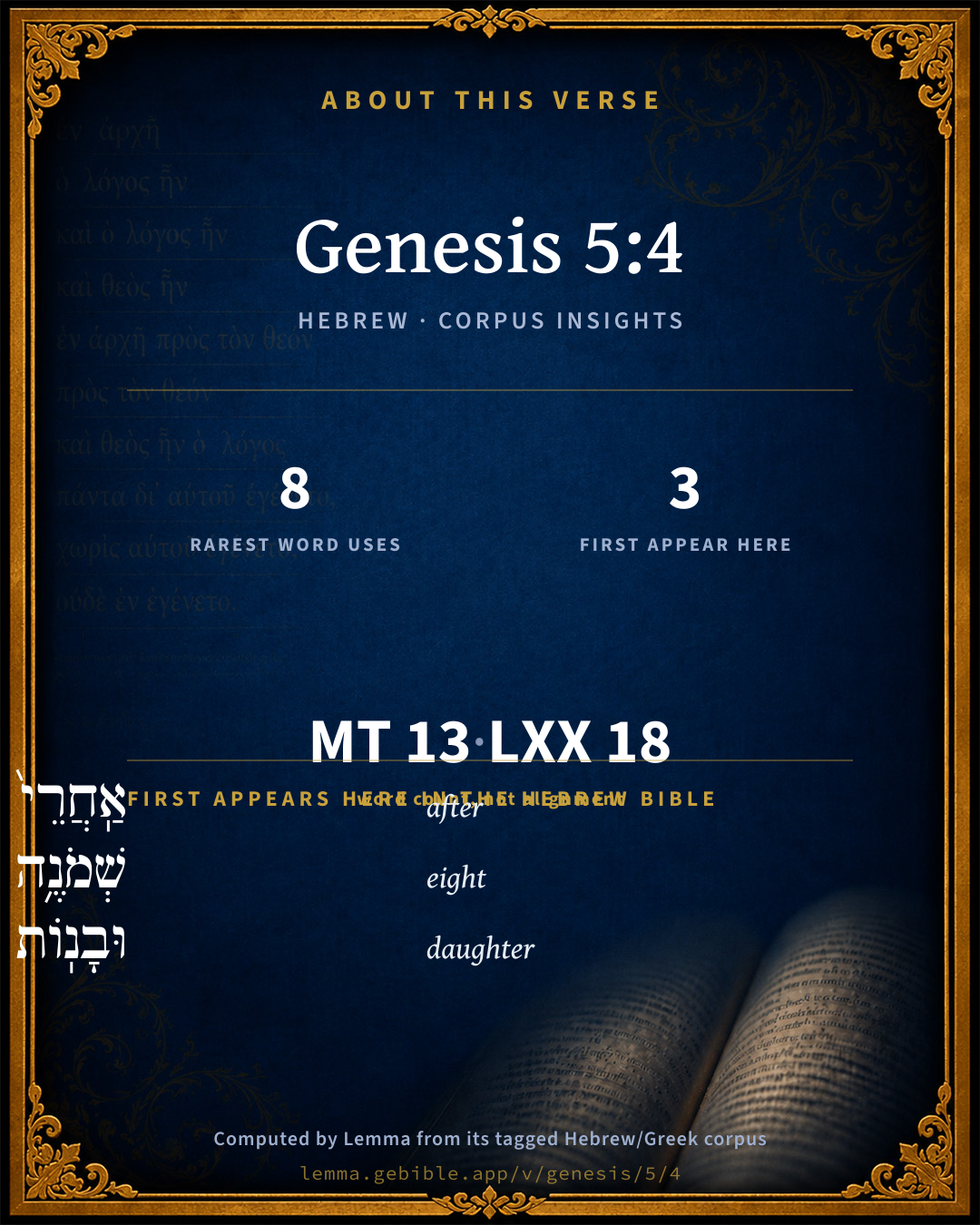
  • 3 first appearances in the Hebrew Bible
Full analysis ↓
Download a study sheet

One document with this verse’s original text, its word-by-word gloss line, the meaning frame, cross-references with their text, attributed commentary, and full source and license credits — printable, and it pastes into notes with its structure intact.

This verse Autodidact and up

Study sheet (.html) Plain text (.txt)

A passage Seminary Student

Up to 50 verses in one chapter. A passage sheet keeps up to 6 commentary sources and 12 cross-references per verse, in the order this page ranks them, and says so on the sheet whenever that leaves anything out. Ask for a single verse and you get the Autodidact verse sheet above.

Everything on this page stays free to read, with no account — the sheet is a download of what is already on screen, not access to it.

Want to remove ads? Support Godless Engineer
Compare translations 3

The same verse in 3 English versions, stacked beneath the original-language interlinear above. Click any original word for its lexicon entry.

Each is an independent rendering of the whole verse — the interlinear is not word-aligned to these translations.

Highlighted words mark where these versions differ — a whole-verse word diff, not a word-by-word alignment.

  • World English Bible Public Domain
    The days of Adam after he became the father of Seth were eight hundred years, and he became the father of sons and daughters.
  • King James Version Public Domain
    And the days of Adam after he had begotten Seth were eight hundred years: and he begat sons and daughters:
  • unfoldingWord Literal Text CC BY-SA 4.0
    And the days of Adam after he fathered Seth were 800 years, and he fathered sons and daughters.

unfoldingWord Literal Text — © unfoldingWord, licensed CC BY-SA 4.0. Word-aligned USFM3 via Door43 (git.door43.org/unfoldingWord/en_ult).

Versions to compare (up to 4)

3 of 4 selected

Show all 18 translations

Every available English version of this verse, each an independent rendering of the whole verse.

  • World English Bible Public Domain
    The days of Adam after he became the father of Seth were eight hundred years, and he became the father of sons and daughters.
  • Berean Standard Bible Public Domain
    And after he had become the father of Seth, Adam lived 800 years and had other sons and daughters.
  • Majority Standard Bible Public Domain
    And after he had become the father of Seth, Adam lived 800 years and had other sons and daughters.
  • King James Version Public Domain
    And the days of Adam after he had begotten Seth were eight hundred years: and he begat sons and daughters:
  • American Standard Version (1901) Public Domain
    and the days of Adam after he begat Seth were eight hundred years: and he begat sons and daughters.
  • Revised Version (1885) Public Domain
    and the days of Adam after he begat Seth were eight hundred years: and he begat sons and daughters.
  • Geneva Bible (1599) Public Domain
    And the dayes of Adam, after he had begotten Sheth, were eight hundreth yeeres, and he begate sonnes and daughters.
  • Douay-Rheims (1899) Public Domain
    And the days of Adam, after he begot Seth, were eight hundred years: and he begot sons and daughters.
  • Young's Literal Translation Public Domain
    And the days of Adam after his begetting Seth are eight hundred years, and he begetteth sons and daughters.
  • Literal Standard Version CC BY-SA 4.0
    And the days of Adam after his begetting Seth are eight hundred years [[or seven hundred years]], and he begets sons and daughters.
  • Unlocked Literal Bible CC BY-SA 4.0
    After Adam became the father of Seth, he lived eight hundred years. He became the father of more sons and daughters.
  • unfoldingWord Literal Text CC BY-SA 4.0
    And the days of Adam after he fathered Seth were 800 years, and he fathered sons and daughters.
  • Darby Bible Public Domain
    And the days of Adam after he had begotten Seth were eight hundred years; and he begot sons and daughters.
  • World Messianic Bible Public Domain
    The days of Adam after he became the father of Seth were eight hundred years, and he became the father of other sons and daughters.
  • Webster's Bible Public Domain
    And the days of Adam after he had begotten Seth were eight hundred years: and he begat sons and daughters:
  • Free Bible Version CC BY-SA 4.0
    Adam lived another 800 years after Seth was born, and had other sons and daughters.
  • Bible in Basic English Public Domain
    And after the birth of Seth, Adam went on living for eight hundred years, and had sons and daughters:
  • JPS Tanakh (1917) Public Domain
    And the days of Adam after he begot Seth were eight hundred years; and he begot sons and daughters.

Literal Standard Version (2020), Covenant Press — licensed CC BY-SA 4.0. Text via the HelloAO Bible API (eBible.org). Unlocked Literal Bible (unfoldingWord) — licensed CC BY-SA 4.0. Text via the HelloAO Bible API (eBible.org). unfoldingWord Literal Text — © unfoldingWord, licensed CC BY-SA 4.0. Word-aligned USFM3 via Door43 (git.door43.org/unfoldingWord/en_ult). Free Bible Version, Dr. Jonathan Gallagher — licensed CC BY-SA 4.0. Text via the HelloAO Bible API (eBible.org).

Word by word

More ways to search: Search by grammar → Find every occurrence → Compare this word →

Practice this passage: Drill this verse → Learn its vocabulary →

שֵׁ֔ת
Shêth
H8352
“Seth”
Noun, Proper
Part of Speech
Noun
Type
Proper
Full BDB Definition

Origin: from H7896

TWOT: None

Seth = "compensation" - the 3rd son of Adam by Eve - also 'Sheth'
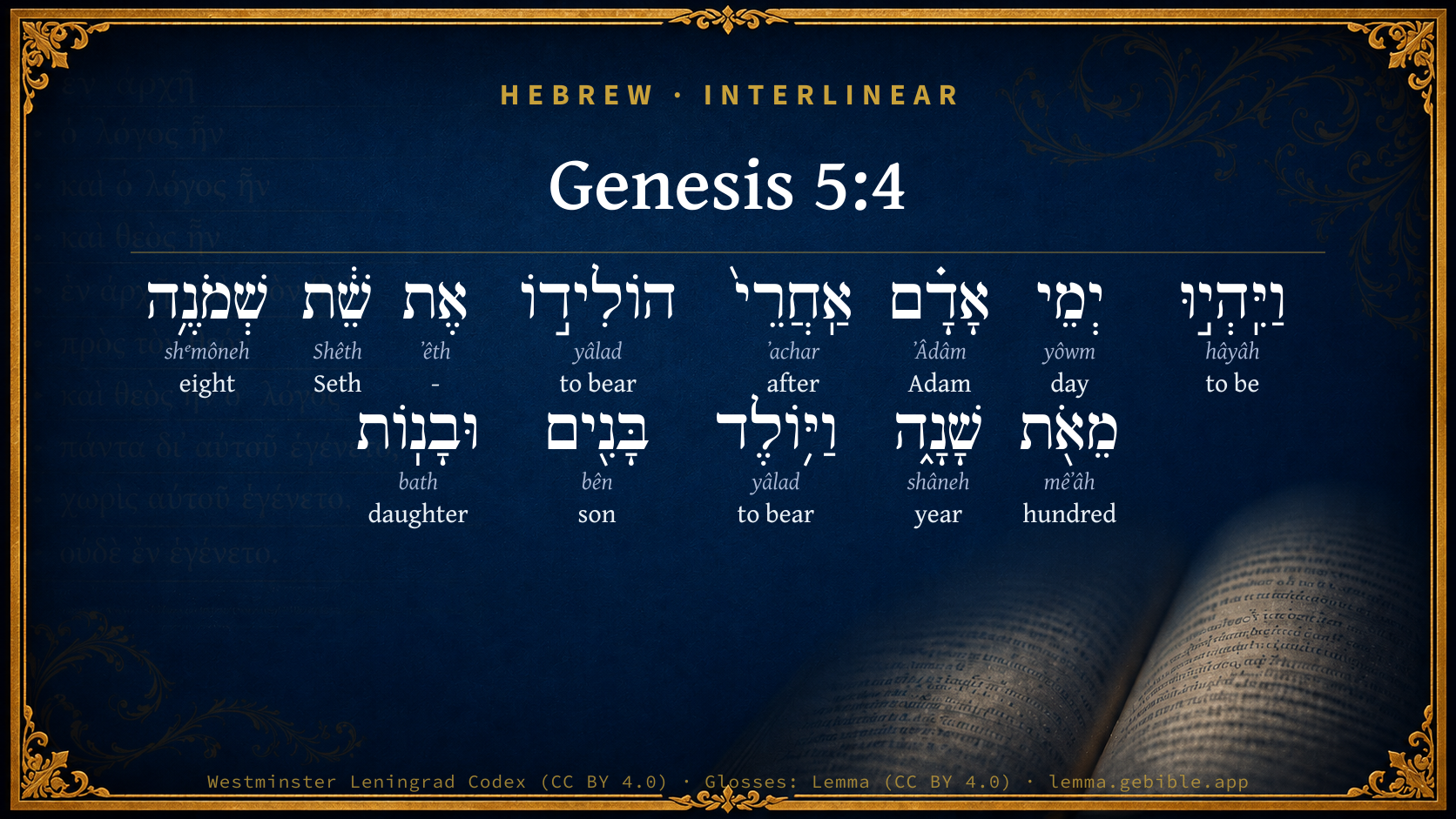
  1. וַיִּֽהְי֣וּ hâyâh H1961 “and · to be” Conjunction + Verb, Qal, Sequential Imperfect, 3rd Person, Masculine, Plural
  2. יְמֵי yôwm H3117 “days of” Noun, Common, Masculine, Plural, Construct
  3. אָדָ֗ם ʼÂdâm H121 “Adam” Noun, Proper
  4. אַֽחֲרֵי֙ ʼachar H310 “after” Preposition
  5. הוֹלִיד֣וֹ yâlad H3205 “to bear · him” Verb, Hiphil, Infinitive Construct + Suffix, Personal, 3rd Person, Masculine, Singular
  6. אֶת ʼêth H853 “-” Particle, Direct Object
  7. שְׁמֹנֶ֥ה shᵉmôneh H8083 “eight” Adjective, Cardinal number, Feminine, Singular, Absolute
  8. מֵאֹ֖ת mêʼâh H3967 “hundred” Adjective, Cardinal number, Both, Plural, Absolute
  9. שָׁנָ֑ה shâneh H8141 “year” Noun, Common, Feminine, Singular, Absolute
  10. וַיּ֥וֹלֶד yâlad H3205 “and · to bear” Conjunction + Verb, Hiphil, Sequential Imperfect, 3rd Person, Masculine, Singular
  11. בָּנִ֖ים bên H1121 “sons” Noun, Common, Masculine, Plural, Absolute
  12. וּבָנֽוֹת bath H1323 “and · daughters” Conjunction + Noun, Common, Feminine, Plural, Absolute

About this verse

These counts appear in no published source. They are computed here, from the morphology-tagged text and Lemma’s own curated glosses. What Lemma adds →

13
words
12
distinct lemmas
Pentateuch
section

Notable vocabulary

The rarest word here is שֵׁ֔ת Seth H8352 — appearing just 8 times in the whole Hebrew Bible.

First appearance in Scripture

These words make their first canonical appearance in the Hebrew Bible here:

  • אַֽחֲרֵי֙ after H310
  • שְׁמֹנֶ֥ה eight H8083
  • וּבָנֽוֹת daughter H1323

Shared distinctive vocabulary

שֵׁ֔ת Seth H8352 occurs in 8 verses of the Hebrew Bible. Also found in:

Grammatical profile

  • 3 verbs
  • 6 nouns
  • 2 adjectives
  • 1 preposition
  • 1 particle

Verb forms

  • וַיִּֽהְי֣וּ Qal · Sequential Imperfect
  • הוֹלִיד֣וֹ Hiphil · Infinitive Construct
  • וַיּ֥וֹלֶד Hiphil · Sequential Imperfect

Repetition

A word recurs within this verse — often emphatic in Hebrew:

  • הוֹלִיד֣וֹ to bear H3205 ×2

Hebrew & Septuagint length

In English translation the verse runs 24 words from the Hebrew and 22 from the Septuagint (LXX English) — closely comparable.

A rough comparison of the two English renderings, which tokenize alike — not a word-level alignment.

Word counts can differ between the Hebrew and the Greek without any difference in meaning — e.g. the Hebrew direct-object marker אֵת has no separate Greek word, and Greek often adds the article ὁ.

In the original languages it is 13 Hebrew tokens and 18 Greek tokens — but the two are counted differently (Hebrew bundles its prefixes and suffixes into one token; the Greek is in lemma form), so that isn’t a like-for-like length.

Cross-references

15

Topical passages linked to Genesis 5:4 in the Treasury of Scripture Knowledge — connected by theme and wording, ordered by reader-vote popularity; previews shown in the World English Bible.

  • 1 Chronicles 1:1–3 Adam, Seth, Enosh,
  • Luke 3:36–38 the son of Cainan, the son of Arphaxad, the son of Shem, the son of Noah, the son of Lamech,
  • Genesis 5:7 Seth lived after he became the father of Enosh eight hundred seven years, and became the father of sons and daughters.
  • Genesis 5:10 Enosh lived after he became the father of Kenan, eight hundred fifteen years, and became the father of sons and daughters.
  • Genesis 5:13 Kenan lived after he became the father of Mahalalel eight hundred forty years, and became the father of sons and daughters
  • Genesis 5:19 Jared lived after he became the father of Enoch eight hundred years, and became the father of sons and daughters.
  • Genesis 5:22 Enoch walked with God after he became the father of Methuselah three hundred years, and became the father of sons and daughters.
  • Genesis 5:26 Methuselah lived after he became the father of Lamech seven hundred eighty-two years, and became the father of sons and daughters.
  • Genesis 5:30 Lamech lived after he became the father of Noah five hundred ninety-five years, and became the father of sons and daughters.
  • Genesis 1:28 God blessed them. God said to them, "Be fruitful, multiply, fill the earth, and subdue it. Have dominion over the fish of the sea, over the birds of the sky, and over every living thing that moves on the earth."
  • Genesis 9:1 God blessed Noah and his sons, and said to them, "Be fruitful, and multiply, and replenish the earth.
  • Genesis 9:7 Be fruitful, and multiply. Bring forth abundantly in the earth, and multiply in it."
  • Genesis 11:12 Arpachshad lived thirty-five years, and became the father of Shelah.
  • Psalms 127:3 Behold, children are a heritage of Yahweh. The fruit of the womb is his reward.
  • Psalms 144:12 Then our sons will be like well-nurtured plants, Our daughters like pillars carved to adorn a palace.

Cross-references courtesy of OpenBible.info (CC BY 4.0).

Hebrew and Greek witnesses Masoretic Hebrew ↔ Greek Septuagint

The same verse in the two great witnesses to the Old Testament, shown verse-for-verse.

These are two independent witnesses, not word-aligned to each other, and the Septuagint is shown in lemma (dictionary) form.

Hebrew Genesis 5:4 Masoretic · Westminster Leningrad Codex

וַיִּֽהְי֣וּ יְמֵי אָדָ֗ם אַֽחֲרֵי֙ הוֹלִיד֣וֹ אֶת שֵׁ֔ת שְׁמֹנֶ֥ה מֵאֹ֖ת שָׁנָ֑ה וַיּ֥וֹלֶד בָּנִ֖ים וּבָנֽוֹת

The days of Adam after he became the father of Seth were eight hundred years, and he became the father of sons and daughters.

World English Bible · Public Domain

Greek LXX Genesis 5:4 Septuagint · lemma form

γίγνομαι δέ ὁ ἡμέρα αδαμ μετά ὁ γεννάω αὐτός ὁ σηθ ἑπτακόσιοι ἔτος καί γεννάω υἱός καί θυγάτηρ

And the days of Adam, which he lived after his begetting Seth, were seven hundred years; and he begot sons and daughters.

LXX2012 (modern English Septuagint) · Public Domain

On this verse, John Gill's Exposition discusses the Septuagint’s reading. Read the note in Commentary ↓

Hebrew: Westminster Leningrad Codex (CC BY 4.0). Greek: Septuagint (public domain); English from LXX2012 (modern English Septuagint) (Public Domain). How the Septuagint differs from the Hebrew →

Targum (Aramaic paraphrase)

2

The Targum is the ancient Jewish Aramaic paraphrase of the Hebrew Scriptures — an interpretive translation, not the Hebrew text itself. Onkelos (literal) and Pseudo-Jonathan (expansive) render the Torah, and Jonathan the Prophets. Coverage is partial: where no permissively-licensed English translation exists for a verse, only the Aramaic is shown. This is verse-level text, not a word-by-word alignment to the Hebrew.

  1. Targum Onkelos Torah (Genesis–Deuteronomy)
    וַהֲווֹ יוֹמֵי אָדָם בָּתַר דְּאוֹלִיד יָת שֵׁת תַּמְנֵי מְאָה שְׁנִין וְאוֹלִיד בְּנִין וּבְנָן

    (no public-domain English translation for this verse)

    Targum Onkelos — Aramaic: “Onkelos Genesis” (public domain); “Onkelos Exodus” (public domain); “Onkelos Leviticus” (public domain); “Onkelos Numbers” (public domain); “Onkelos Deuteronomy” (public domain). English: “Sefaria Community Translation” (CC0 1.0 (public-domain dedication)); “J.W. Etheridge. The Targums of Onkelos and Jonathan Ben Uzziel on the Pentateuch. London: Longmans, Green, 1862” (public domain). Text via Sefaria.

  2. Targum Pseudo-Jonathan Torah (Genesis–Deuteronomy)
    וַהֲווֹ יוֹמֵי אָדָם בָּתַר דְאוֹלִיד יַת שֵׁת תַּמְנֵי מְאָה שְׁנִין וְאוֹלִיד בְּנִין וּבְנָן

    And the days of Adam after he begat Sheth were eight hundred years, and he begat sons and daughters.

    Targum Pseudo-Jonathan — Aramaic: “Targum Jonathan on Genesis” (public domain); “Targum Jonathan on Exodus” (public domain); “Targum Jonathan on Leviticus” (public domain); “Targum Jonathan on Numbers” (public domain); “Targum Jonathan on Deuteronomy” (public domain). English: “The Targum of Jonathan ben Uzziel, trans. J. W. Etheridge, London, 1862” (public domain). Text via Sefaria.

Commentary

Notes on Genesis 5:4 from classic Christian and Jewish commentators (each source and its license shown beneath its notes). The classic Christian expositions comment on the surrounding passage and are grouped to its opening verse, so a note may address several verses; the Jewish commentaries on the Tanakh (Rashi and others) are per-verse, so they appear only where the commentator wrote on this verse.

Lemma curates 59 commentaries, every one of them public domain or Creative Commons licensed, each selected and text-cleaned for this edition rather than reprinted as found. About our sources →

Trapp's Complete Commentary

John Trapp

Gen 5:4 And the days of Adam after he had begotten Seth were eight hundred years: and he begat sons and daughters:

Ver. 4. He begat sons and daughters.] Philo and Epiphanius give him twelve sons; Beda thirty sons, and as many daughters.

John Trapp, A Commentary or Exposition upon All the Books of the Old and New Testament (1647–1656) — public domain. Text from a community e-Sword module.

John Calvin's Commentaries

4. And the days of Adam after he had begotten Seth. In the number of years here recorded we must especially consider the long period which the patriarchs lived together. For through six successive ages, when the family of Seth had grown into a great people, the voice of Adam might daily resound, in order to renew the memory of the creation, the fall, and the punishment of man; to testify of the hope of salvation which remained after chastisement, and to recite the judgments of God, by which all might be instructed. After his death his sons might indeed deliver, as from hand to hand, what they had learned, to their descendants; but far more efficacious would be the instruction from the mouth of him, who had been himself the eyewitness of all these things. Yet so wonderful, and even monstrous, was the general obstinacy, that not even the sounder part of the human race could be retained in the obedience and the fear of God.

John Calvin's Commentaries (1540-1563) — public domain. Text from the Calvin Translation Society English edition (1840s-50s) via the Christian Classics Ethereal Library (ccel.org). Calvin's coverage is partial (roughly two-thirds of the Bible); uncommented books and verses are honest gaps, never fabricated. The 19th-century editor's footnotes and remarks are omitted so the notes are faithfully Calvin's own voice.

John Gill's Exposition

And the days of Adam, after he had begotten Seth, were eight hundred years,.... The Septuagint version is seven hundred; for having added one hundred years more the should be, to the years of his life before the birth of Seth, here they are taken away to make the number of his years complete:

and he begat sons and daughters; not only after the birth of Seth, but before, though we have no account of any, unless of Cain's wife; but what their number was is not certain, either before or after; some say he had thirty children, besides Cain, Abel, and Seth; and others a hundred (c). Josephus says the number of children, according to the old tradition, was thirty three sons and twenty three daughters. (d)(These families had at least five children, for one son is named as well as other sons and daughters. Therefore there must be at least three sons and two daughters in each family. For a family to have at least three sons and two daughters, according to the laws of chance, a family must on the average have nine children for this to be a near certainty. Hence the families listed in this chapter must have been large by today's standards. Given their long life, this is not at all unusual. However even today, the Old Order Mennonites of Waterloo County in Ontario and Lancaster County in Pennsylvannia, have many families this large. Ed.)

(c) Shalshalet Hakabala, fol. 74. 2. (d) Joseph. Antiqu. l. 1. c. 1. footnote on point 3.

John Gill's Exposition of the Whole Bible (1746–1763) — public domain (CC PDM 1.0). Text via the HelloAO Bible API.

Matthew Poole's English Annotations

Whose names and numbers are here passed over in silence, as not belonging to the genealogy of Christ, nor to the following history.

Matthew Poole's English Annotations on the Holy Bible (1683–1685) — public domain. Text from a community e-Sword/MySword module.

Ramban (Nachmanides)

Rabbi Moshe ben Nachman (Ramban / Nachmanides)

AND THE DAYS OF ADAM AFTER HE BEGOT SETH WERE EIGHT HUNDRED YEARS. Because of the long lives of these first men, Scripture states their ages before they begot children and also afterwards, and then sums them all up in the end until the generations which followed the flood.The reason for their longevity is that the first man, the handiwork of the Holy One, blessed be He, was made in absolute perfection as regards beauty, strength, and height. Even after it was decreed upon him that he be mortal, it was in his nature to live a long time. But when the flood came upon the earth, the atmosphere became tainted, and as a result their days kept on decreasing. Until the flood, their days were about the length of Adam’s; some even lived longer than Adam. And Shem [Noah’s son], who was born before the flood, lived six hundred years; he benefitted from his innate strength, but the tainted air after the flood caused him harm, [hence he died at a younger age than that attained by the preceding generations]. The days of his sons who were born after the flood were still more shortened until they came down to four hundred years., Verses 10-17. You can see that this degree of longevity remained with them until the generation of the Dispersion, when the change of climates caused by the Dispersion affected them, and their days were again shortened. Thus you find that the life of Peleg, in whose days the earth was divided, 10:25. came down to half their days, i.e., two hundred years., 11:19.It would appear that in the generations of Abraham, Isaac, and Jacob, people lived seventy and eighty years, just as Moses, our teacher, mentioned in his prayer.. But as for the righteous ones in their generations, The fear of the Eternal prolongeth days for them. For Pharaoh wondered about Jacob’s old age, and Jacob in turn spoke to him about the long days of his fathers, even as he said, And they have not attained unto the days of the years of the life of my fathers in the days of their sojournings. Now what the Rabbi has written in the Moreh Nebuchim does not seem right to me, namely, that the longevity was only in those individuals mentioned, while the rest of the people in those generations lived lives of ordinary natural length. He further said that this exception was due to the mode of living and food of such people or by way of a miracle. But these are words without substance. Why should this miracle have happened to them since they were neither prophets nor righteous, nor worthy that a miracle be done for them, especially for generation after generation. And how could a proper mode of living and proper food prolong their years to the extent that they are so many times greater than that of the entire generation? It is possible that there were also others who observed such a mode of living, in which case all or most of them should have attained similar longevity. And how did it happen that enough of the wisdom concerning this good mode of living did not come down to just one of all the sons of Noah after the flood [to enable him to match the longevity of his ancestors], for there was among them a little wisdom of their ancestors even though it steadily decreased from generation to generation?

Ramban (Nachmanides) on the Tanakh — English translation: “Commentary on the Torah by Ramban (Nachmanides). Translated and annotated by Charles B. Chavel. New York, Shilo Pub. House, 1971-1976” (CC BY 4.0). Text via Sefaria.

Radak

Rabbi David Kimhi (Radak)

ויהיו ימי אדם, it appears that all the people mentioned prior to Noach, whose lifespan is given by the Torah, were included in the ones described as being born בדמותו כצלמו, as reflecting the qualities expected of a human being in the true sense of the word, whereas their brothers and sisters did not. This is why they were wiped out during the deluge. It is possible that the long lives of the people mentioned in this list was a standard set by G’d at the time, and shared by their contemporaries, their siblings. On the other hand, it is possible that only the select list mentioned by the Torah enjoyed such an exceedingly long life on earth. Perhaps the reason G’d granted those generations such long lives may have been to enable them to study phenomena over a long period of time and to record the results of their observations for posterity. A lifespan of 70 years as we know it today is simply not long enough to accumulate this type of knowledge. Once these basic data had become known and recorded, later generations could study them out of books, making it unnecessary for them to live for so many years. The outstanding scholar Rabbi Moses Maimonides wrote in his Moreh Nevuchim 2,47 that only the men mentioned by name in our chapter lived to such an old age. He goes on to write that exceptional sizes, years, and numbers mentioned in the Bible are all just that i.e. exceptional. They do not purport to describe the norms in the time or environment during which such exceptions occurred. There were varying sets of circumstances which accounted for these exceptions.

Radak on the Tanakh — English translations: “Sefaria Community Translation” (CC0 1.0 (public-domain dedication)); “Eliyahu Munk, HaChut Hameshulash” (CC BY 4.0); “Rabbi Mike Feuer, Jerusalem Anthology” (CC BY 4.0); and “R. David Kimhi on the first book of Psalms, Translated by R.G. Finch, London, 1919” (public domain). Text via Sefaria.

Lesson kit

Teaching starters — assembled from the data on this page, not authored interpretation. Every prompt links to the verse data it draws on. Edit before teaching.

Genesis, in the Pentateuch, opens this verse with 13 words (12 distinct Hebrew lemmas). Its most distinctive word is Shêth (“Seth”). A historical commentator’s framing appears above. Read the whole chapter for the surrounding context.

Discussion questions

  1. What does “Seth” (Shêth) contribute to the verse as a whole?
  2. 3 words make their first appearance in Scripture here. What does this debut establish?
  3. How does Genesis 4:25, which shares the word «Seth», read alongside this verse?
  4. What does the repetition of “to bear” (2× in this one verse) do in this verse?
  5. These translations render this verse differently. What is at stake in choosing one wording over another?
  6. «וַיִּֽהְי֣וּ» is a Qal Sequential Imperfect verb. How does that grammatical form shape the action described?
  7. Compare how Trapp's Complete Commentary and John Calvin's Commentaries read this verse. Where do they agree or differ?

Things to notice

Reading settings

Reading text

Shown beneath each verse's original-language words.

Old Testament
Old Testament edition

Read the OT as the Masoretic Hebrew (MT) or the Greek Septuagint (LXX).

English shown for the Greek Septuagint (in the Hebrew ↔ Greek comparison).

Comparing translations? Open the Compare panel on any verse page to stack up to four side by side.