
2 Samuel 21:8

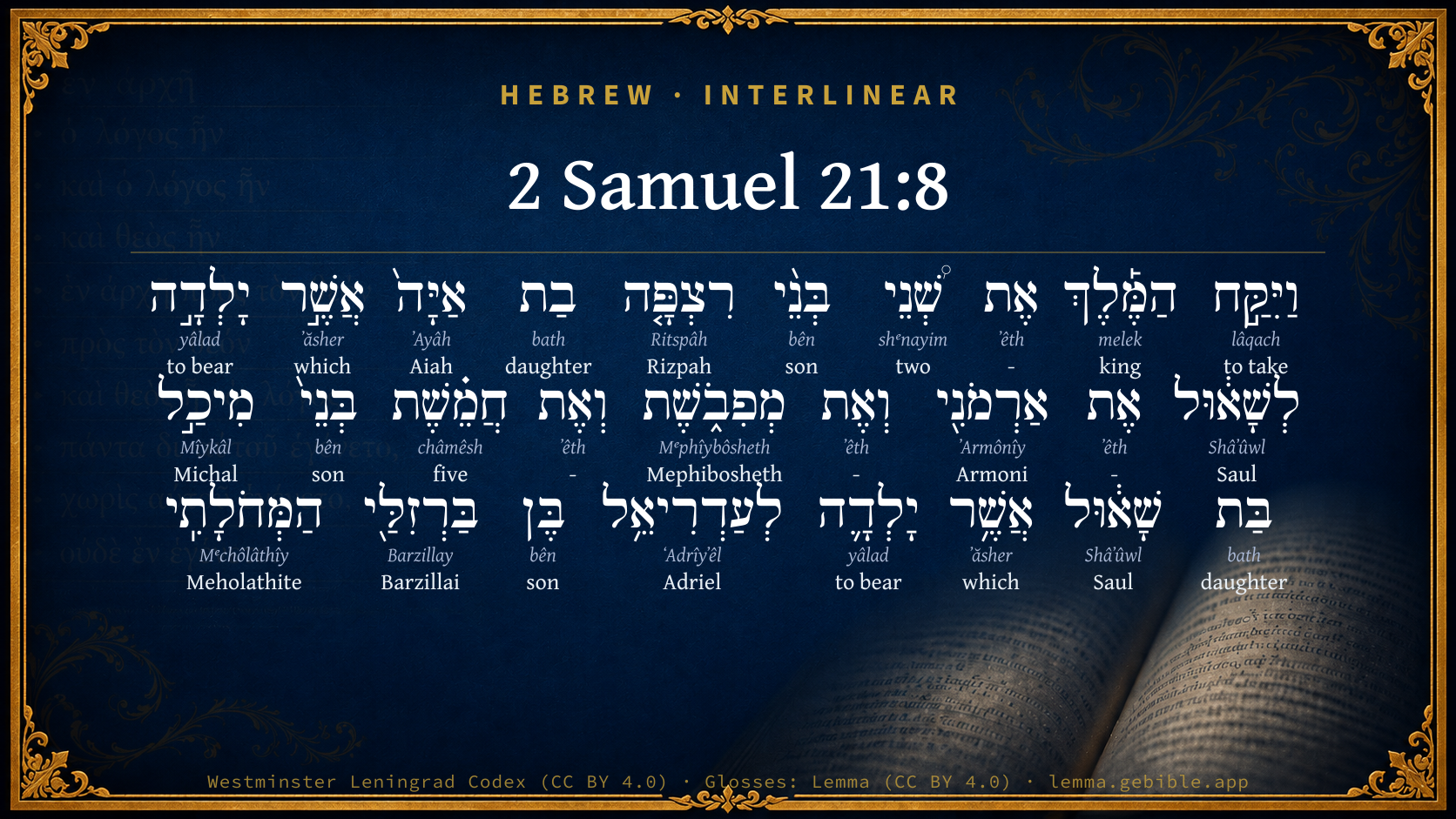
Hebrew (Westminster Leningrad Codex) 2 Samuel 21:8 appears in the Hebrew Old Testament. The text above is from the Westminster Leningrad Codex. Each word links to its Strong’s number, a concise gloss, and parsing drawn from the Open Scriptures Hebrew Bible morphology. Click any word for its full Brown-Driver-Briggs (BDB) entry.
Download image
Cite this verse

2 Samuel 21:8 (World English Bible). Public Domain. Lemma interlinear Bible study tool, https://lemma.gebible.app/v/2-samuel/21/8.

Show BibTeX & RIS
BibTeX
RIS
English Translation
But the king took the two sons of Rizpah the daughter of Aiah, whom she bore to Saul, Armoni and Mephibosheth; and the five sons of Michal the daughter of Saul, whom she bore to Adriel the son of Barzillai the Meholathite:
World English Bible · Public Domain
Highlights
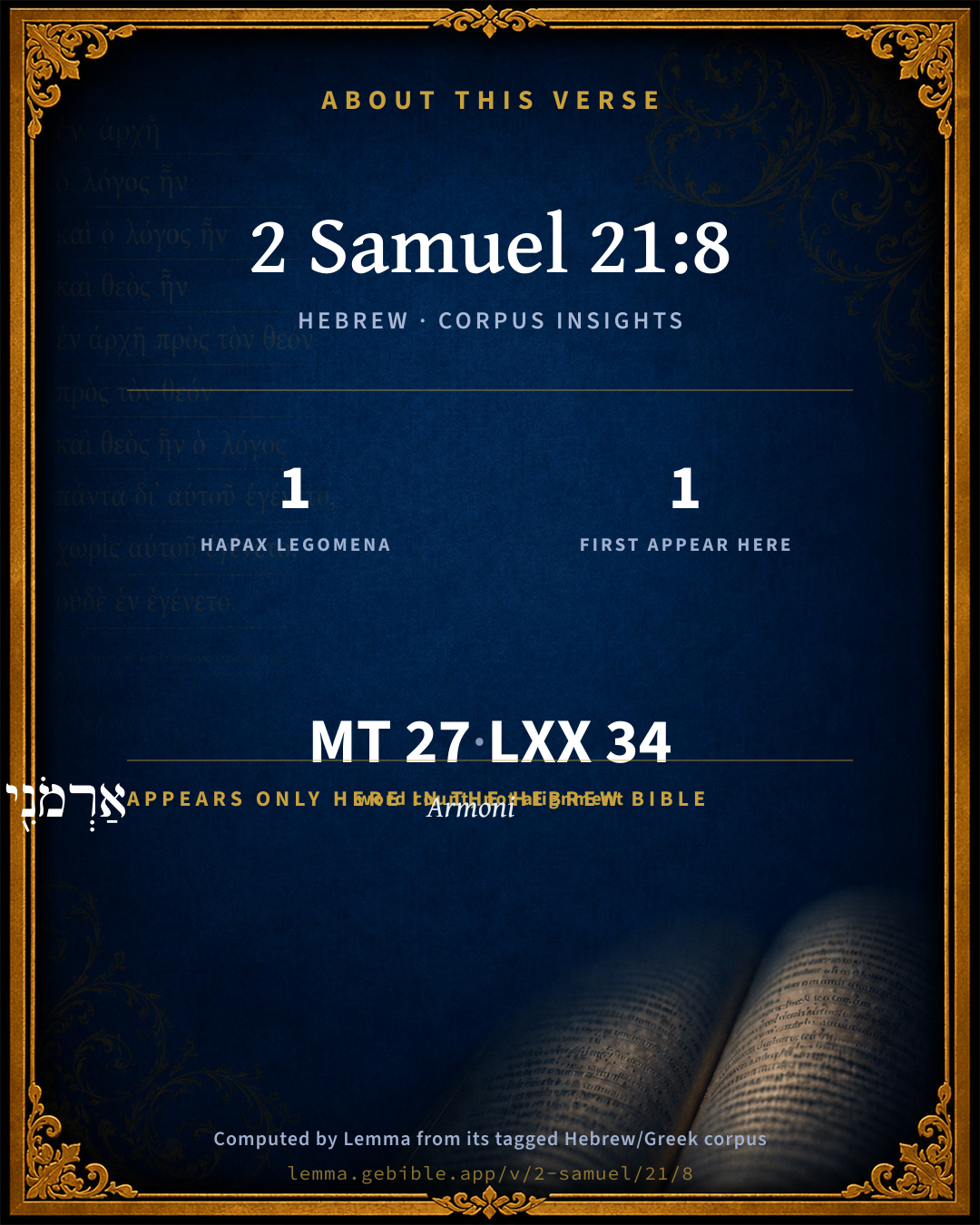
  • 1 hapax legomenon — only here in the Hebrew Bible
  • 1 first appearance in the Hebrew Bible
Full analysis ↓
Download a study sheet

One document with this verse’s original text, its word-by-word gloss line, the meaning frame, cross-references with their text, attributed commentary, and full source and license credits — printable, and it pastes into notes with its structure intact.

This verse Autodidact and up

Study sheet (.html) Plain text (.txt)

A passage Seminary Student

Up to 50 verses in one chapter. A passage sheet keeps up to 6 commentary sources and 12 cross-references per verse, in the order this page ranks them, and says so on the sheet whenever that leaves anything out. Ask for a single verse and you get the Autodidact verse sheet above.

Everything on this page stays free to read, with no account — the sheet is a download of what is already on screen, not access to it.

Want to remove ads? Support Godless Engineer
Compare translations 3

The same verse in 3 English versions, stacked beneath the original-language interlinear above. Click any original word for its lexicon entry.

Each is an independent rendering of the whole verse — the interlinear is not word-aligned to these translations.

Highlighted words mark where these versions differ — a whole-verse word diff, not a word-by-word alignment.

  • World English Bible Public Domain
    But the king took the two sons of Rizpah the daughter of Aiah, whom she bore to Saul, Armoni and Mephibosheth; and the five sons of Michal the daughter of Saul, whom she bore to Adriel the son of Barzillai the Meholathite:
  • King James Version Public Domain
    But the king took the two sons of Rizpah the daughter of Aiah, whom she bare unto Saul, Armoni and Mephibosheth; and the five sons of Michal the daughter of Saul, whom she brought up for Adriel the son of Barzillai the Meholathite:
  • unfoldingWord Literal Text CC BY-SA 4.0
    But the king took two of the sons of Rizpah, the daughter of Aiah, whom she bore to Saul, Armoni and Mephibosheth, and five of the sons of Michal, the daughter of Saul, whom she bore to Adriel, the son of Barzillai the Meholathite.

unfoldingWord Literal Text — © unfoldingWord, licensed CC BY-SA 4.0. Word-aligned USFM3 via Door43 (git.door43.org/unfoldingWord/en_ult).

Versions to compare (up to 4)

3 of 4 selected

Show all 18 translations

Every available English version of this verse, each an independent rendering of the whole verse.

  • World English Bible Public Domain
    But the king took the two sons of Rizpah the daughter of Aiah, whom she bore to Saul, Armoni and Mephibosheth; and the five sons of Michal the daughter of Saul, whom she bore to Adriel the son of Barzillai the Meholathite:
  • Berean Standard Bible Public Domain
    But the king took Armoni and Mephibosheth, the two sons whom Rizpah daughter of Aiah had borne to Saul, as well as the five sons whom Merab daughter of Saul had borne to Adriel son of Barzillai the Meholathite.
  • Majority Standard Bible Public Domain
    But the king took Armoni and Mephibosheth, the two sons whom Rizpah daughter of Aiah had borne to Saul, as well as the five sons whom Merab daughter of Saul had borne to Adriel son of Barzillai the Meholathite.
  • King James Version Public Domain
    But the king took the two sons of Rizpah the daughter of Aiah, whom she bare unto Saul, Armoni and Mephibosheth; and the five sons of Michal the daughter of Saul, whom she brought up for Adriel the son of Barzillai the Meholathite:
  • American Standard Version (1901) Public Domain
    But the king took the two sons of Rizpah the daughter of Aiah, whom she bare unto Saul, Armoni and Mephibosheth; and the five sons of Michal the daughter of Saul, whom she bare to Adriel the son of Barzillai the Meholathite:
  • Revised Version (1885) Public Domain
    But the king took the two sons of Rizpah the daughter of Aiah, whom she bare unto Saul, Armoni and Mephibosheth; and the five sons of Michal the daughter of Saul, whom she bare to Adriel the son of Barzillai the Meholathite:
  • Geneva Bible (1599) Public Domain
    But the King tooke the two sonnes of Rizpah the daughter of Aiah, whome shee bare vnto Saul, euen Armoni and Mephibosheth and the fiue sonnes of Michal, the daughter of Saul, whome shee bare to Adriel the sonne of Barzillai the Meholathite.
  • Douay-Rheims (1899) Public Domain
    So the king took the two sons of Respha the daughter of Aia, whom she bore to Saul, Armoni, and Miphiboseth: and the five sons of Michol the daughter of Saul, whom she bore to Hadriel the son of Berzellai, that was of Molathi:
  • Young's Literal Translation Public Domain
    and the king taketh the two sons of Rizpah daughter of Aiah, whom she bore to Saul, Armoni and Mephibosheth, and the five sons of Michal daughter of Saul whom she bare to Adriel son of Barzillai the Meholathite,
  • Literal Standard Version CC BY-SA 4.0
    and the king takes the two sons of Rizpah daughter of Aiah, whom she bore to Saul, Armoni and Mephibosheth, and the five sons of Michal daughter of Saul whom she bore to Adriel son of Barzillai the Meholathite,
  • Unlocked Literal Bible CC BY-SA 4.0
    But the king took the two sons of Rizpah daughter of Aiah, sons whom she bore to Saul—the two sons were named Armoni and Mephibosheth; and David also took the five sons of Merab daughter of Saul, whom she bore to Adriel son of Barzillai the Meholathite.
  • unfoldingWord Literal Text CC BY-SA 4.0
    But the king took two of the sons of Rizpah, the daughter of Aiah, whom she bore to Saul, Armoni and Mephibosheth, and five of the sons of Michal, the daughter of Saul, whom she bore to Adriel, the son of Barzillai the Meholathite.
  • Darby Bible Public Domain
    And the king took the two sons of Rizpah the daughter of Aiah, whom she had borne to Saul, Armoni and Mephibosheth; and the five sons of [the sister of] Michal the daughter of Saul, whom she had borne to Adriel the son of Barzillai the Meholathite;
  • World Messianic Bible Public Domain
    But the king took the two sons of Rizpah the daughter of Aiah, whom she bore to Saul, Armoni and Mephibosheth; and the five sons of Merab the daughter of Saul, whom she bore to Adriel the son of Barzillai the Meholathite.
  • Webster's Bible Public Domain
    But the king took the two sons of Rizpah the daughter of Aiah, whom she bore to Saul, Armoni and Mephibosheth; and the five sons of Michal the daughter of Saul, whom she brought up for Adriel the son of Barzillai the Meholathite:
  • Free Bible Version CC BY-SA 4.0
    The king took Armoni and Mephibosheth, the two sons of Rizpah the daughter of Aiah, whom she had borne to Saul, and the five sons of Merab, the daughter of Saul, whom she had borne to Adriel, son of Barzillai the Meholathite.
  • Bible in Basic English Public Domain
    But the king took Armoni and Mephibosheth, the two sons of Saul to whom Rizpah, the daughter of Aiah, had given birth; and the five sons of Saul's daughter Merab, whose father was Adriel, the son of Barzillai the Meholathite:
  • JPS Tanakh (1917) Public Domain
    But the king took the two sons of Rizpah the daughter of Aiah, whom she bore unto Saul, Armoni and Mephibosheth; and the five sons of Michal the daughter of Saul, whom she bore to Adriel the son of Barzillai the Meholathite;

Literal Standard Version (2020), Covenant Press — licensed CC BY-SA 4.0. Text via the HelloAO Bible API (eBible.org). Unlocked Literal Bible (unfoldingWord) — licensed CC BY-SA 4.0. Text via the HelloAO Bible API (eBible.org). unfoldingWord Literal Text — © unfoldingWord, licensed CC BY-SA 4.0. Word-aligned USFM3 via Door43 (git.door43.org/unfoldingWord/en_ult). Free Bible Version, Dr. Jonathan Gallagher — licensed CC BY-SA 4.0. Text via the HelloAO Bible API (eBible.org).

Word by word

More ways to search: Search by grammar → Find every occurrence → Compare this word →

Practice this passage: Drill this verse → Learn its vocabulary →

אַרְמֹנִ֖י
ʼArmônîy
H764
“Armoni”
Noun, Proper
Part of Speech
Noun
Type
Proper
Full BDB Definition

Origin: from H759

TWOT: None

Armoni = "one of the palace" - a son of Saul
  1. וַיִּקַּ֣ח lâqach H3947 “and · to take” Conjunction + Verb, Qal, Sequential Imperfect, 3rd Person, Masculine, Singular
  2. הַמֶּ֡לֶךְ melek H4428 “the · king” Particle, Definite Article + Noun, Common, Masculine, Singular, Absolute
  3. אֶת ʼêth H853 “-” Particle, Direct Object
  4. שְׁ֠נֵי shᵉnayim H8147 “two” Adjective, Cardinal number, Masculine, Dual, Construct
  5. בְּנֵ֨י bên H1121 “sons of” Noun, Common, Masculine, Plural, Construct
  6. רִצְפָּ֤ה Ritspâh H7532 “Rizpah” Noun, Proper
  7. בַת bath H1323 “daughter of” Noun, Common, Feminine, Singular, Construct
  8. אַיָּה֙ ʼAyâh H345 “Aiah” Noun, Proper
  9. אֲשֶׁ֣ר ʼăsher H834 “which” Particle, Relative
  10. יָלְדָ֣ה yâlad H3205 “to bear” Verb, Qal, Perfect, 3rd Person, Feminine, Singular
  11. לְשָׁא֔וּל Shâʼûwl H7586 “to/for · Saul” Preposition + Noun, Proper
  12. אֶת ʼêth H853 “-” Particle, Direct Object
  13. וְאֶת ʼêth H853 “and · -” Conjunction + Particle, Direct Object
  14. מְפִבֹ֑שֶׁת Mᵉphîybôsheth H4648 “Mephibosheth” Noun, Proper
  15. וְאֶת ʼêth H853 “and · -” Conjunction + Particle, Direct Object
  16. חֲמֵ֗שֶׁת châmêsh H2568 “five” Adjective, Cardinal number, Masculine, Singular, Construct
  17. בְּנֵי֙ bên H1121 “sons of” Noun, Common, Masculine, Plural, Construct
  18. מִיכַ֣ל Mîykâl H4324 “Michal” Noun, Proper
  19. בַּת bath H1323 “daughter of” Noun, Common, Feminine, Singular, Construct
  20. שָׁא֔וּל Shâʼûwl H7586 “Saul” Noun, Proper
  21. אֲשֶׁ֥ר ʼăsher H834 “which” Particle, Relative
  22. יָלְדָ֛ה yâlad H3205 “to bear” Verb, Qal, Perfect, 3rd Person, Feminine, Singular
  23. לְעַדְרִיאֵ֥ל ʻAdrîyʼêl H5741 “to/for · Adriel” Preposition + Noun, Proper
  24. בֶּן bên H1121 “son of” Noun, Common, Masculine, Singular, Construct
  25. בַּרְזִלַּ֖י Barzillay H1271 “Barzillai” Noun, Proper
  26. הַמְּחֹלָתִֽי Mᵉchôlâthîy H4259 “the · Meholathite” Particle, Definite Article + Noun, Gentilic, Masculine, Singular, Absolute

About this verse

These counts appear in no published source. They are computed here, from the morphology-tagged text and Lemma’s own curated glosses. What Lemma adds →

27
words
18
distinct lemmas
Historical
section

Notable vocabulary

1 hapax legomenon — a word that appears only here in the entire Hebrew Bible:

  • אַרְמֹנִ֖י Armoni H764

First appearance in Scripture

This word makes its first canonical appearance in the Hebrew Bible here:

  • אַרְמֹנִ֖י Armoni H764

Shared distinctive vocabulary

לְעַדְרִיאֵ֥ל Adriel H5741 occurs in 2 verses of the Hebrew Bible. Also found in:

Grammatical profile

  • 3 verbs
  • 16 nouns
  • 2 adjectives
  • 6 particles

Verb forms

  • וַיִּקַּ֣ח Qal · Sequential Imperfect
  • יָלְדָ֣ה Qal · Perfect
  • יָלְדָ֛ה Qal · Perfect

Repetition

Words recur within this verse — often emphatic in Hebrew:

  • בְּנֵ֨י son H1121 ×3
  • בַת daughter H1323 ×2
  • יָלְדָ֣ה to bear H3205 ×2
  • לְשָׁא֔וּל Saul H7586 ×2
  • אֲשֶׁ֣ר which H834 ×2

Hebrew & Septuagint length

In English translation the verse runs 42 words from the Hebrew and 40 from the Septuagint (LXX English) — closely comparable.

A rough comparison of the two English renderings, which tokenize alike — not a word-level alignment.

Word counts can differ between the Hebrew and the Greek without any difference in meaning — e.g. the Hebrew direct-object marker אֵת has no separate Greek word, and Greek often adds the article ὁ.

In the original languages it is 27 Hebrew tokens and 34 Greek tokens — but the two are counted differently (Hebrew bundles its prefixes and suffixes into one token; the Greek is in lemma form), so that isn’t a like-for-like length.

Cross-references

2

Topical passages linked to 2 Samuel 21:8 in the Treasury of Scripture Knowledge — connected by theme and wording, ordered by reader-vote popularity; previews shown in the World English Bible.

  • 1 Samuel 18:19 But it happened at the time when Merab, Saul's daughter, should have been given to David, that she was given to Adriel the Meholathite as wife.
  • 2 Samuel 3:7 Now Saul had a concubine, whose name was Rizpah, the daughter of Aiah: and [Ish-bosheth] said to Abner, Why have you gone in to my father's concubine?

Cross-references courtesy of OpenBible.info (CC BY 4.0).

Hebrew and Greek witnesses Masoretic Hebrew ↔ Greek Septuagint

The same verse in the two great witnesses to the Old Testament, shown verse-for-verse.

These are two independent witnesses, not word-aligned to each other, and the Septuagint is shown in lemma (dictionary) form.

Hebrew 2 Samuel 21:8 Masoretic · Westminster Leningrad Codex

וַיִּקַּ֣ח הַמֶּ֡לֶךְ אֶת שְׁ֠נֵי בְּנֵ֨י רִצְפָּ֤ה בַת אַיָּה֙ אֲשֶׁ֣ר יָלְדָ֣ה לְשָׁא֔וּל אֶת אַרְמֹנִ֖י וְאֶת מְפִבֹ֑שֶׁת וְאֶת חֲמֵ֗שֶׁת בְּנֵי֙ מִיכַ֣ל בַּת שָׁא֔וּל אֲשֶׁ֥ר יָלְדָ֛ה לְעַדְרִיאֵ֥ל בֶּן בַּרְזִלַּ֖י הַמְּחֹלָתִֽי

But the king took the two sons of Rizpah the daughter of Aiah, whom she bore to Saul, Armoni and Mephibosheth; and the five sons of Michal the daughter of Saul, whom she bore to Adriel the son of Barzillai the Meholathite:

World English Bible · Public Domain

Greek LXX 2 Samuel 21:8 Septuagint · lemma form

καί λαμβάνω ὁ βασιλεύς ὁ δύο υἱός ρεσφα θυγάτηρ αια ὅς τίκτω ὁ σαούλ ὁ ερμωνι καί ὁ μεμφιβοσθε καί ὁ πέντε υἱός μιχολ θυγάτηρ σαούλ ὅς τίκτω ὁ εσριηλ υἱός βερζελλι ὁ μοουλαθι

And the king took the two sons of Respha the daughter of Aia, whom she bore to Saul, Hermonoi and Memphibosthe, and the five sons of Michol daughter of Saul, whom she bore to Esdriel son of Berzelli the Moulathite.

LXX2012 (modern English Septuagint) · Public Domain

Hebrew: Westminster Leningrad Codex (CC BY 4.0). Greek: Septuagint (public domain); English from LXX2012 (modern English Septuagint) (Public Domain). How the Septuagint differs from the Hebrew →

Targum (Aramaic paraphrase)

1

The Targum is the ancient Jewish Aramaic paraphrase of the Hebrew Scriptures — an interpretive translation, not the Hebrew text itself. Onkelos (literal) and Pseudo-Jonathan (expansive) render the Torah, and Jonathan the Prophets. Coverage is partial: where no permissively-licensed English translation exists for a verse, only the Aramaic is shown. This is verse-level text, not a word-by-word alignment to the Hebrew.

  1. Targum Jonathan Prophets (Joshua–Malachi)
    וּנְסֵיב מַלְכָּא יַת תְּרֵין בְּנֵי רִצְפָה בַת אַיָה דִילֵידַת לְשָׁאוּל יַת אַרְמוֹנִי וְיַת מְפִיבֹשֶׁת וְיַת חַמְשַׁת בְּנֵי מֵרַב דְרָבִיאַת מִיכַל בַּת שָׁאוּל דִילֵידַת לְעַדְרִיאֵל בַּר בַּרְזִילַי דְמִמְחוֹלוֹת:

    (no public-domain English translation for this verse)

    Targum Jonathan — Aramaic: “Mikraot Gedolot” (public domain). English: “Sefaria Community Translation” (CC0 1.0 (public-domain dedication)); “London "Chaldee Paraphrase," 1871” (public domain). Text via Sefaria.

Commentary

Notes on 2 Samuel 21:8 from classic Christian and Jewish commentators (each source and its license shown beneath its notes). The classic Christian expositions comment on the surrounding passage and are grouped to its opening verse, so a note may address several verses; the Jewish commentaries on the Tanakh (Rashi and others) are per-verse, so they appear only where the commentator wrote on this verse.

Lemma curates 59 commentaries, every one of them public domain or Creative Commons licensed, each selected and text-cleaned for this edition rather than reprinted as found. About our sources →

Trapp's Complete Commentary

John Trapp

2Sa 21:8 But the king took the two sons of Rizpah the daughter of Aiah, whom she bare unto Saul, Armoni and Mephibosheth; and the five sons of Michal the daughter of Saul, whom she brought up for Adriel the son of Barzillai the Meholathite:

Ver. 8. But the king took the two sons of Rizpah.] By God’s warrant and direction doubtless, who can, at his pleasure, dispense with his own laws.

And the five sons of Michal, the daughter of Saul.] Or, Of Michal’s sister, - via, Merab: whose children, Michal, having none of her own, had adopted and educated. See the like ellipsis, 2Sa 21:19 Jer 32:12.

John Trapp, A Commentary or Exposition upon All the Books of the Old and New Testament (1647–1656) — public domain. Text from a community e-Sword module.

Tyndale Open Study Notes

Tyndale Open Resources

21:8 Armoni and Mephibosheth were Saul’s only two remaining sons. • Saul’s daughter Merab: See NLT note; the NLT follows the Greek here because Michal remained childless (6:22-23). Also, Merab was married to Adriel (1 Sam 18:19), whereas Michal’s other husband was Palti (2 Sam 3:15). • Barzillai from Meholah (cp. 1 Sam 18:19) should not be confused with Barzillai of Gilead (2 Sam 19:31).

Tyndale Open Study Notes — © Tyndale Open Resources, licensed CC BY-SA 4.0. Text via the HelloAO Bible API.

Geneva Bible (1599)

Geneva Bible translators

Here Michal is named for Merab, Adriel’s wife, as appeareth, 1 Sam. 18:19, for Michal was the wife of Paltiel, 1 Sam. 25:44, and never had child, 2 Sam. 6:23.

Geneva Bible (1599) marginal notes — public domain. Text via Bolls.life.

Jamieson, Fausset & Brown

Robert Jamieson, A. R. Fausset & David Brown

the five sons of Michal the daughter of Saul, whom she brought up for Adriel--Merab, Michal's sister, was the wife of Adriel; but Michal adopted and brought up the boys under her care.

Jamieson, Fausset & Brown — Commentary Critical and Explanatory on the Whole Bible (1871) — public domain (CC PDM 1.0). Text via the HelloAO Bible API.

Adam Clarke's Commentary

Verse 8. Five sons of Michal - whom she brought up] Michal, Saul's daughter, was never married to Adriel, but to David, and afterwards to Phaltiel; though it is here said she bore ילדה yaledah, not brought up, as we falsely translate it: but we learn from 1Sa 18:19, that Merab, one of Saul's daughters, was married to Adriel.

Two of Dr. Kennicott's MSS. have Merab, not Michal; the Syriac and Arabic have Nadab; the Chaldee has properly Merab; but it renders the passage thus: - And the five sons of Merab which Michal the daughter of Saul brought up, which she brought forth to Adriel the son of Barzillai. This cuts the knot.

Adam Clarke's Commentary on the Bible (1810–1826) — public domain. Text from a community e-Sword/MySword module.

Ellicott's Commentary for English Readers

(8) Took the two sons of Rizpah.—The suggestion that David took advantage of this opportunity to strengthen himself further against the house of Saul is utterly set aside by two considerations: (1) David could not lawfully refuse the demand of the Gibeonites, since the Law absolutely required that blood-guiltiness should be expiated by the blood of the offender (Num_35:33), which, in this case, became that of his representatives; and (2) David’s choice of victims was directly opposed to such a supposition. He spared, for Jonathan’s sake, the only descendants of Saul in the male line, who only could have advanced any claim to the throne, and took (1) the two sons of Rizpah, a concubine of Saul, with whom Abner had committed adultery (2Sa_3:7), and (2) five sons of Saul’s eldest daughter Merab, who had been promised in marriage to David himself, and then given to another (1Sa_18:17-19). The text has Michal instead of Merab; but this must be an error of the scribe, since it was Merab, not Michal, who was married to “Adriel the Meholathite” (1Sa_18:19), and Michal was childless (2Sa_6:23). The English phrase “brought up for” is taken from the Chaldee; the Hebrew, as noted in the margin, is bare to.

A Bible Commentary for English Readers, edited by Charles John Ellicott (1878–1897) — public domain. Text from a community e-Sword module.

The Cambridge Bible for Schools and Colleges

gen. ed. J. J. S. Perowne

8. the five sons of Michal … whom she brought up for Adriel] The Heb. text can only mean whom she bare to Adriel. But it was Merab, not Michal, who was married to Adriel (1Sa_18:19). Consequently we must either read Merab for Michal, or take the explanation given in the Targum and adopted by the E. V.: “the five sons of Merab, (whom Michal the daughter of Saul brought up), whom she bare to Adriel.”

the Meholathite] Of Abel-Meholah, a town in the Jordan valley near Beth-shan, famous as the birth-place of Elisha (1Ki_19:16).

The Cambridge Bible for Schools and Colleges (gen. ed. J. J. S. Perowne; Cambridge University Press, 1878–1918) — public domain. Text from a community e-Sword module.

John Gill's Exposition

But the king took the two sons of Rizpah the daughter of Aiah,.... Saul's concubine, Sa2 3:7,

whom she bare unto Saul, Armoni and Mephibosheth; of whom we read nowhere else; after the name of the latter, it is probable, Jonathan's son was called, before mentioned:

and the five sons of Michal the daughter of Saul, whom she brought up for Adriel the son of Barzillai the Meholathite; Michal had no children to the day of her death, nor was she the wife of Adriel, but Merab her sister, Sa1 18:19; wherefore these sons were not whom she "bare", as the word used signifies, but, as we rightly render it, whom she "brought up" or educated, so the Targum, her sister being dead; and so the Jews say (k), Merab brought them forth, and Michal brought them up, therefore they were called by her name; or the words may be supplied thus, "and the five sons of the sister of Michal", and, as in Sa2 21:19, is supplied, "the brother of Goliath". Barzillai is here called the Meholathite, to distinguish him from Barzillai the Gileadite, spoken of in a former chapter, see Sa2 17:27.

(k) T. Bab. Sanhedrin, fol. 19. 2.

John Gill's Exposition of the Whole Bible (1746–1763) — public domain (CC PDM 1.0). Text via the HelloAO Bible API.

Albert Barnes' Notes on the Bible

Rizpah - See the marginal reference. A foreign origin was possibly the cause of the selection of Rizpah’s sons as victims.

Sons of Michal - An obvious error for “Merab” (1Sa 18:19 note).

Albert Barnes' Notes on the Bible (1834–1885) — public domain. Text from a community e-Sword/MySword module.

Haydock's Catholic Bible Commentary

Of Michol. They were the sons of Merob, who was married to Hadriel; but they are here called the sons of Michol, because she adopted them, and brought them up as her own: (Challoner; Chaldean; St. Jerome, Trad.) or Merob ws called Michol; (Sa) or, what seems most probable, from the word she bore being used, (Cajetan) and as two sisters would hardly have the same name, (Haydock) Micholhas crept into the text instead of Merob. (Capel; Salien; Calmet) (1 Kings xxv. 44.)

George Leo Haydock (1774–1849), Haydock's Catholic Family Bible and Commentary, 1859 edition — public domain. Excludes Psalms (Douay-Rheims chapter numbering differs from Protestant) and Deuterocanonical books (Catholic canon only).

Matthew Poole's English Annotations

Rizpah; Saul’s concubine, 2Sa 21:11; 2Sa 3:7.

The five sons of Michal, or, of Michal’s sister, to wit, Merab; for Michal had no children, 2Sa 6:23, nor was she married to this Adriel, but to Phalti, or Phaltiel, the son of Laish, 1Sa 25:44; 2Sa 3:15; and Merab her sister was married to this very Adriel the Meholathite, 1Sa 18:19. And it must be remembered, that the Hebrew language is very short, and full of ellipses or defects of words, which yet may be easily understood from the sense. Particularly relative words are oft lacking, and to be supplied; as Goliath is put for Goliath’s brother, here, 2Sa 21:19, and uncle for uncle’s son, Jer 32:7,12. Or, the sons of Merab are called the sons of Michal, to wit, by adoption; or, the near kindred and next heirs of Michal, and brought up by her; for upon that and such-like accounts the title of son is oft given in Scripture, as Gen 48:5; Exo 2:10; Deu 25:5,6; Rth 1:11,12; 4:17.

Quest. But why then are not these called the sons of Merab?

Answ. Because they were better known by their relation to Michal, who was David’s wife, and, it may be, alive at this time, and having no children of her own, took these, and bred them up as her own; when Merab was now a more obscure person, and possibly dead many years before this.

Whom she brought up; for so this Hebrew verb, which primarily and properly signifies to bear, is sometimes used, as Gen 1:23; Rth 4:17, because the education of children is a kind of bearing of them, as requiring frequently no less care and pains than the bearing doth; whence it is that nurses are reputed as mothers, and sometimes go under that name both in sacred and profane writers. See Rth 4:16,17; and compare Gen 16:2; 30:3; Num 11:12; Gal 4:19.

The Meholathite; of Abel-meholah in the tribe of Benjamin, Jdg 7:22; so he is here called by way of distinction from Barzillai the Gileadite, 2Sa 19:31.

Matthew Poole's English Annotations on the Holy Bible (1683–1685) — public domain. Text from a community e-Sword/MySword module.

Whedon's Commentary on the Bible

Daniel D. Whedon

8. Rizpah — A concubine of Saul. 2Sa_3:7.

Michal — Rather, Merab. See 1Sa_18:19. The insertion of Michal for Merab was, probably, the mistake of an early copyist.

Daniel D. Whedon (gen. ed.), Commentary on the Old and New Testaments (1874–1909) — public domain. Text from a community e-Sword module.

The Pulpit Commentary

Michal. It was Merab who became the wife of Adriel the Meholathite. (1Sa_18:19) Michal was childless. (see 2Sa_6:23) Whom she brought up for. This is one of the many cases of untrustworthiness in the renderings of the Authorized Version. We have noticed a very flagrant instance before in 2Sa_5:21. The object of these mistranslations is always the same, namely, to remove some verbal discrepancy in the Hebrew text. The Hebrew says here "five sons of Michal, whom she bare to Adriel;" but Michal never bore a child, therefore something must be substituted which will save the Hebrew from this verbal inaccuracy, and Michal must be represented as having taken Merab"s place (perhaps at her death) and been foster mother to her children. This explanation is, it is true, taken from the Jewish Targum; but the Targum never professes to be an exact translation, and constantly perverts the meaning of the plainest passages for preconceived reasons.

Vers. 8-14. (GIBEAH.)

Rizpah.

Rizpah the daughter of Aiah took sackcloth," etc. (ver. 10; 2Sa_3:7) The days of harvest had come; but not the fruits of harvest. The heaven was brass, and the earth iron. (Deu_28:23) The misery of famine was accompanied by a sense of Divine wrath on account of sin. The guilt of blood was on the land, and especially on "the house of Saul," for the destruction of the Gibeonites. Nothing would satisfy the demand of the sorrowing bondservants of Israel, or (as it was believed) restore Divine favour, save the death of seven men of Saul"s family. (Joh_11:50) These, therefore, two of them being sons of Rizpah, were taken and crucified (Num_25:4) at once on the hill before Jehovah, and their remains left unburied, a prey to ravenous birds and beasts. And in her maternal grief and affection, spreading sackcloth on the rocky floor (either for her bed or as a rough tent to shelter her), she watched them there, under the scorching sun by day and the drenching dews by night, and protected them from molestation until they received an honourable burial. "They were accounted as accursed and unworthy of the burial of dogs; but she would not cast them out of her heart. The more they were shunned by others, the more she clung to them; and the deeper the disgrace, the deeper her compassion." Observe

I HER SPECIAL DESIRE AND AIM; for it was more than an instinct of natural affection that prompted her watching near the dead. Regarding their unburied condition as one of ignominy, (Psa_79:2) and perhaps as, in some way, affecting their happiness in the future life, she was desirous of their being honourably interred. It was deemed necessary (unlike what was required in other instances, (Deu_21:22, Deu_21:23) that they should remain exposed before Jehovah till assurance was given, by the fall of rain, that the satisfaction was accepted. If she could not do what she would, she would do what she could; (Mar_14:8) and, by preventing further injury, render the fulfilment of her desire possible. Her intense maternal love led her to seek the safety and honour of the dead; well may a similar love lead others to seek the safety and honour of the living!

II HER EXTRAORDINARY DEVOTION; as it appears in:

1. Her unquenchable attachment. Others might despise them as criminals, but she could only regard them and cling to them as children. (Son_8:7)

2. Her humble submission and resignation to what was unavoidable. "Truly this is a grief, and I must bear it". (Jer_10:19)

3. Her entire self-surrender and self-sacrifice. If she could not remove their reproach, she could share it with them.

4. Her patient endurance of suffering; through long and lonely nights, and dark and dreary days.

5. Her ceaseless vigilance, zeal, and courage.

6. Her unwearied, faithful, hopeful perseverance. "The emotions in woman act as powerful motives on the will, and, when strongly called forth, produce a degree of vigour and determination which is very surprising to those who have usually seen the individual under a different aspect" (Carpenter).

7. Her importunate prayers for the fulfilment of her desire. "She refrained from all violent and illegal methods of gaining her object. She used no force or stratagem to secure for her beloved ones a safe and decent burial; but waited watchfully, meekly, and humbly, for the time appointed by the Lord. Neither did she give way to despondency, and quit the melancholy scene in wild despair; but did what she could to alleviate the dreadful evil. Though her heart was broken and her grief too bitter for utterance, she still hoped in God, still looked for his merciful interposition, and waited day after day, and night after night until the rain of heaven came down and released the bodies of her beloved ones" (Hughes, "Female Characters of Holy Writ").

III HER EFFECTUAL ENDEAVOUR. At length (how long is not stated) "showers of blessing" fell, and her wish was accomplished. Loving, faithful, devoted service:

1. Exerts an undesigned influence on others. "And it was told David," etc. (ver. 11).

2. Fails not, sooner or later, to receive its due reward.

3. Is followed by effects greater than any that were desired or Expected."david was pleased with her tenderness, and was excited by her example to do honour to the bodies of Saul and Jonathan (1Sa_31:12, 1Sa_31:13; 2Sa_2:5-7) and thus showed that he did not war with the dead, and that his recent act in delivering up Saul"s sons was not one of personal revenge, but of public justice" (Wordsworth). She did more than she intended; and what she did is to this day "told for a memorial for her. D.

The Pulpit Commentary (1880–1919), ed. H.D.M. Spence-Jones & Joseph S. Exell — public domain. Text from a community e-Sword module.

Scofield Reference Notes

C. I. Scofield

sons

CF. 2Sa 6:23. The "five sons" were children of Michal’s sister Merab, wife of Adriel, "whom she brought up for Adriel". 1Sa 18:19.

The Scofield Reference Bible (1917 edition), notes by C. I. Scofield — public domain. Text from a community e-Sword module.

Rashi

Rabbi Shlomo Yitzchaki (Rashi)

Sons of Michal, the daughter of Shaul who had bore them to Adriel. Did Michal give birth [to these children]? It was Meirav who bore [those children] to [Adriel]. [The explanation is] that Meirav gave birth [to them] and Michal raised them, that is why they are called by her name because someone who raises male and female orphans in their house it is considered as if that person gave birth [to the child] and [the child] is called by his name.

Rashi on the Tanakh — English translations: “The Judaica Press complete Tanach with Rashi, translated by A. J. Rosenberg” (CC BY 4.0); “Pentateuch with Rashi's commentary by M. Rosenbaum and A.M. Silbermann, 1929-1934” (public domain); “The Metsudah Tanach series, Lakewood, N.J” (CC BY 4.0); and “The Book of Joshua, Metsudah Publications, 1997” (CC BY 4.0). Text via Sefaria.

Lesson kit

Teaching starters — assembled from the data on this page, not authored interpretation. Every prompt links to the verse data it draws on. Edit before teaching.

2 Samuel, in the Historical, opens this verse with 27 words (18 distinct Hebrew lemmas). Its most distinctive word is ʼArmônîy (“Armoni”). A historical commentator’s framing appears above. Read the whole chapter for the surrounding context.

Discussion questions

  1. What does “Armoni” (ʼArmônîy) contribute to the verse as a whole?
  2. This verse holds 1 word here found nowhere else in the Hebrew Bible. What might the rare word draw attention to?
  3. The word “Armoni” first appears here in Scripture. What is being introduced at this debut?
  4. 1 Samuel 18:19 shares the word «Adriel» with this verse. How do the two illuminate each other?
  5. “son” occurs 3× in this one verse. What is the effect of the repetition?
  6. These translations render this verse differently; the difference is in the English rendering, not the original. What questions does that raise?
  7. The verb «וַיִּקַּ֣ח» is Qal Sequential Imperfect. How does its form color the action?
  8. Reading how Trapp's Complete Commentary and Tyndale Open Study Notes read this verse, where do the two commentators agree and where do they part?

Things to notice

  • 1 word in this verse appears nowhere else in the Hebrew Bible.
  • 1 word makes its first canonical appearance in Scripture here.
  • This verse counts 27 Hebrew ↔ 34 Greek words.
  • These translations choose different wording for 4 words in this verse.
  • “son” occurs 3× in this single verse.

Reading settings

Reading text

Shown beneath each verse's original-language words.

Old Testament
Old Testament edition

Read the OT as the Masoretic Hebrew (MT) or the Greek Septuagint (LXX).

English shown for the Greek Septuagint (in the Hebrew ↔ Greek comparison).

Comparing translations? Open the Compare panel on any verse page to stack up to four side by side.