Genesis 46:20

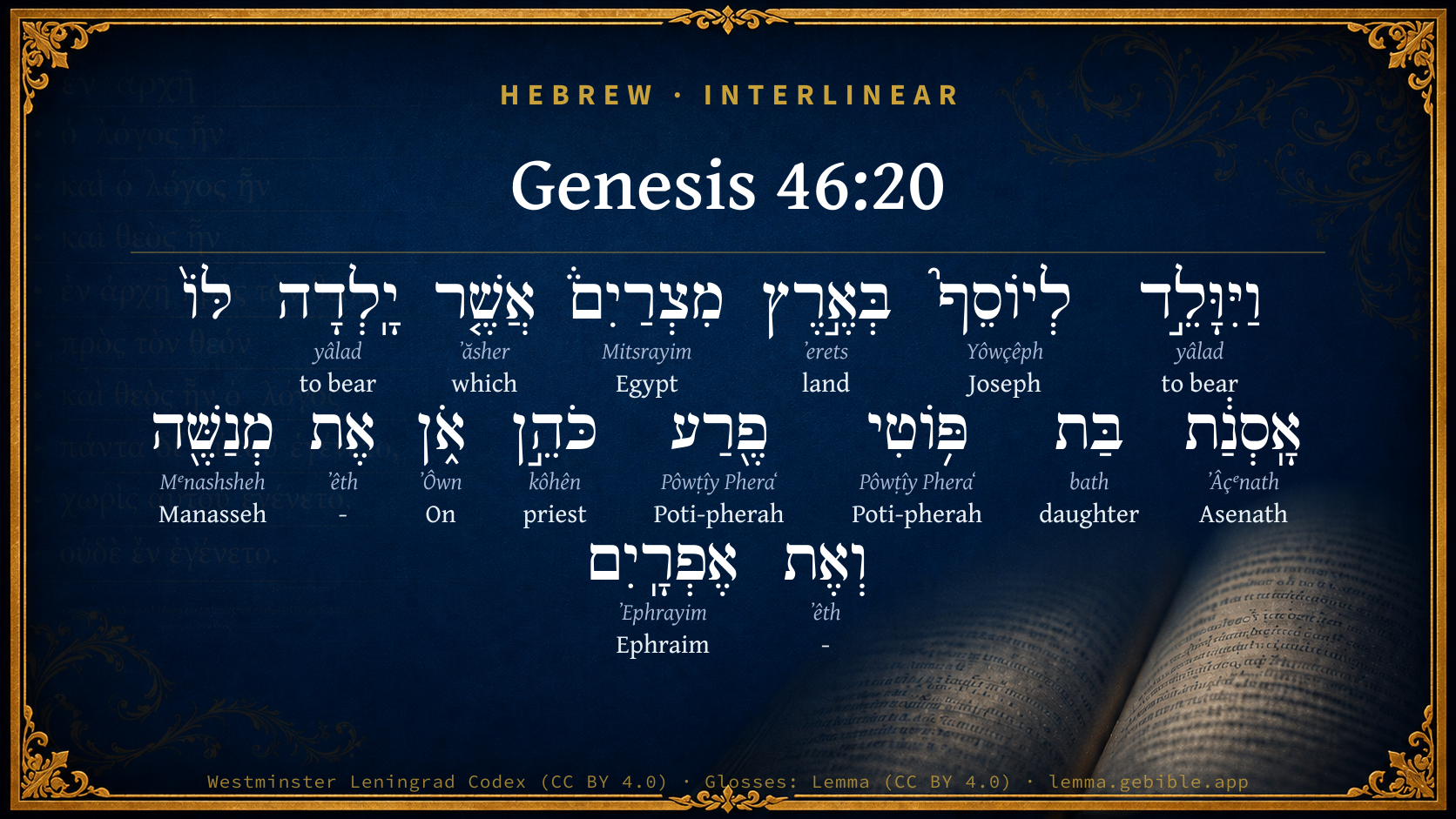
Hebrew (Westminster Leningrad Codex) Genesis 46:20 appears in the Hebrew Old Testament. The text above is from the Westminster Leningrad Codex. Each word links to its Strong’s number, a concise gloss, and parsing drawn from the Open Scriptures Hebrew Bible morphology. Click any word for its full Brown-Driver-Briggs (BDB) entry.
Download image
Cite this verse

Genesis 46:20 (World English Bible). Public Domain. Lemma interlinear Bible study tool, https://lemma.gebible.app/v/genesis/46/20.

Show BibTeX & RIS
BibTeX
RIS
English Translation
To Joseph in the land of Egypt were born Manasseh and Ephraim, whom Asenath, the daughter of Potiphera, priest of On, bore to him.
World English Bible · Public Domain
Download a study sheet

One document with this verse’s original text, its word-by-word gloss line, the meaning frame, cross-references with their text, attributed commentary, and full source and license credits — printable, and it pastes into notes with its structure intact.

This verse Autodidact and up

Study sheet (.html) Plain text (.txt)

A passage Seminary Student

Up to 50 verses in one chapter. A passage sheet keeps up to 6 commentary sources and 12 cross-references per verse, in the order this page ranks them, and says so on the sheet whenever that leaves anything out. Ask for a single verse and you get the Autodidact verse sheet above.

Everything on this page stays free to read, with no account — the sheet is a download of what is already on screen, not access to it.

Want to remove ads? Support Godless Engineer
Compare translations 3

The same verse in 3 English versions, stacked beneath the original-language interlinear above. Click any original word for its lexicon entry.

Each is an independent rendering of the whole verse — the interlinear is not word-aligned to these translations.

Highlighted words mark where these versions differ — a whole-verse word diff, not a word-by-word alignment.

  • World English Bible Public Domain
    To Joseph in the land of Egypt were born Manasseh and Ephraim, whom Asenath, the daughter of Potiphera, priest of On, bore to him.
  • King James Version Public Domain
    And unto Joseph in the land of Egypt were born Manasseh and Ephraim, which Asenath the daughter of Potipherah priest of On bare unto him.
  • unfoldingWord Literal Text CC BY-SA 4.0
    And Manasseh and Ephraim were born to Joseph in the land of Egypt, whom Asenath, the daughter of Potiphera the priest of On, bore for him.

unfoldingWord Literal Text — © unfoldingWord, licensed CC BY-SA 4.0. Word-aligned USFM3 via Door43 (git.door43.org/unfoldingWord/en_ult).

Versions to compare (up to 4)

3 of 4 selected

Show all 18 translations

Every available English version of this verse, each an independent rendering of the whole verse.

  • World English Bible Public Domain
    To Joseph in the land of Egypt were born Manasseh and Ephraim, whom Asenath, the daughter of Potiphera, priest of On, bore to him.
  • Berean Standard Bible Public Domain
    Manasseh and Ephraim were born to Joseph in the land of Egypt by Asenath daughter of Potiphera, priest of On.
  • Majority Standard Bible Public Domain
    Manasseh and Ephraim were born to Joseph in the land of Egypt by Asenath daughter of Potiphera, priest of On.
  • King James Version Public Domain
    And unto Joseph in the land of Egypt were born Manasseh and Ephraim, which Asenath the daughter of Potipherah priest of On bare unto him.
  • American Standard Version (1901) Public Domain
    And unto Joseph in the land of Egypt were born Manasseh and Ephraim, whom Asenath, the daughter of Poti-phera priest of On, bare unto him.
  • Revised Version (1885) Public Domain
    And unto Joseph in the land of Egypt were born Manasseh and Ephraim, which Asenath the daughter of Poti-phera priest of On bare unto him.
  • Geneva Bible (1599) Public Domain
    And vnto Ioseph in the lande of Egypt were borne Manasseh, and Ephraim, which Asenath the daughter of Poti-pherah prince of On bare vnto him.
  • Douay-Rheims (1899) Public Domain
    And sons were born to Joseph, in the land of Egypt, whom Aseneth the daughter of Putiphare priest of Heliopolis bore him: Manasses and Ephraim.
  • Young's Literal Translation Public Domain
    And born to Joseph in the land of Egypt (whom Asenath daughter of Poti-Pherah, priest of On, hath borne to him) `are' Manasseh and Ephraim.
  • Literal Standard Version CC BY-SA 4.0
    And born to Joseph in the land of Egypt (whom Asenath daughter of Poti-Pherah, priest of On, has borne to him) [are] Manasseh and Ephraim.
  • Unlocked Literal Bible CC BY-SA 4.0
    In Egypt Manasseh and Ephraim were born to Joseph by Asenath, the daughter of Potiphera priest of On.
  • unfoldingWord Literal Text CC BY-SA 4.0
    And Manasseh and Ephraim were born to Joseph in the land of Egypt, whom Asenath, the daughter of Potiphera the priest of On, bore for him.
  • Darby Bible Public Domain
    And to Joseph in the land of Egypt were born Manasseh and Ephraim, whom Asnath bore to him, the daughter of Potipherah the priest in On.
  • World Messianic Bible Public Domain
    To Joseph in the land of Egypt were born Manasseh and Ephraim, whom Asenath, the daughter of Potiphera, priest of On, bore to him.
  • Webster's Bible Public Domain
    And to Joseph in the land of Egypt were born Manasseh and Ephraim, whom Asenath the daughter of Poti-pherah priest of On bore to him.
  • Free Bible Version CC BY-SA 4.0
    The sons Joseph had in the land of Egypt by Asenath, daughter of Potiphera, priest of On: Manasseh and Ephraim.
  • Bible in Basic English Public Domain
    And Joseph had Manasseh and Ephraim in the land of Egypt, by Asenath, the daughter of Poti-phera, priest of On.
  • JPS Tanakh (1917) Public Domain
    And unto Joseph in the land of Egypt were born Manasseh and Ephraim, whom Asenath the daughter of Poti-phera priest of On bore unto him.

Literal Standard Version (2020), Covenant Press — licensed CC BY-SA 4.0. Text via the HelloAO Bible API (eBible.org). Unlocked Literal Bible (unfoldingWord) — licensed CC BY-SA 4.0. Text via the HelloAO Bible API (eBible.org). unfoldingWord Literal Text — © unfoldingWord, licensed CC BY-SA 4.0. Word-aligned USFM3 via Door43 (git.door43.org/unfoldingWord/en_ult). Free Bible Version, Dr. Jonathan Gallagher — licensed CC BY-SA 4.0. Text via the HelloAO Bible API (eBible.org).

Word by word

More ways to search: Search by grammar → Find every occurrence → Compare this word →

Practice this passage: Drill this verse → Learn its vocabulary →

אָֽסְנַ֔ת
ʼÂçᵉnath
H621
“Asenath”
Noun, Proper
Part of Speech
Noun
Type
Proper
Full BDB Definition

Origin: of Egyptian derivation

TWOT: None

Asenath = "belonging to the goddess Neith" - the wife of Joseph
  1. וַיִּוָּלֵ֣ד yâlad H3205 “and · to bear” Conjunction + Verb, Niphal, Sequential Imperfect, 3rd Person, Masculine, Singular
  2. לְיוֹסֵף֮ Yôwçêph H3130 “to/for · Joseph” Preposition + Noun, Proper
  3. בְּאֶ֣רֶץ ʼerets H776 “in/at · land of” Preposition + Noun, Common, Both, Singular, Construct
  4. מִצְרַיִם֒ Mitsrayim H4714 “Egypt” Noun, Proper
  5. אֲשֶׁ֤ר ʼăsher H834 “which” Particle, Relative
  6. יָֽלְדָה yâlad H3205 “to bear” Verb, Qal, Perfect, 3rd Person, Feminine, Singular
  7. בַּת bath H1323 “daughter of” Noun, Common, Feminine, Singular, Construct
  8. פּ֥וֹטִי Pôwṭîy Pheraʻ H6319 “Poti-pherah” Noun, Proper
  9. פֶ֖רַע Pôwṭîy Pheraʻ H6319 “Poti-pherah” Noun, Proper
  10. כֹּהֵ֣ן kôhên H3548 “priest of” Noun, Common, Masculine, Singular, Construct
  11. אֹ֑ן ʼÔwn H204 “On” Noun, Proper
  12. אֶת ʼêth H853 “-” Particle, Direct Object
  13. מְנַשֶּׁ֖ה Mᵉnashsheh H4519 “Manasseh” Noun, Proper
  14. וְאֶת ʼêth H853 “and · -” Conjunction + Particle, Direct Object
  15. אֶפְרָֽיִם ʼEphrayim H669 “Ephraim” Noun, Proper

About this verse

These counts appear in no published source. They are computed here, from the morphology-tagged text and Lemma’s own curated glosses. What Lemma adds →

17
words
13
distinct lemmas
Pentateuch
section

Notable vocabulary

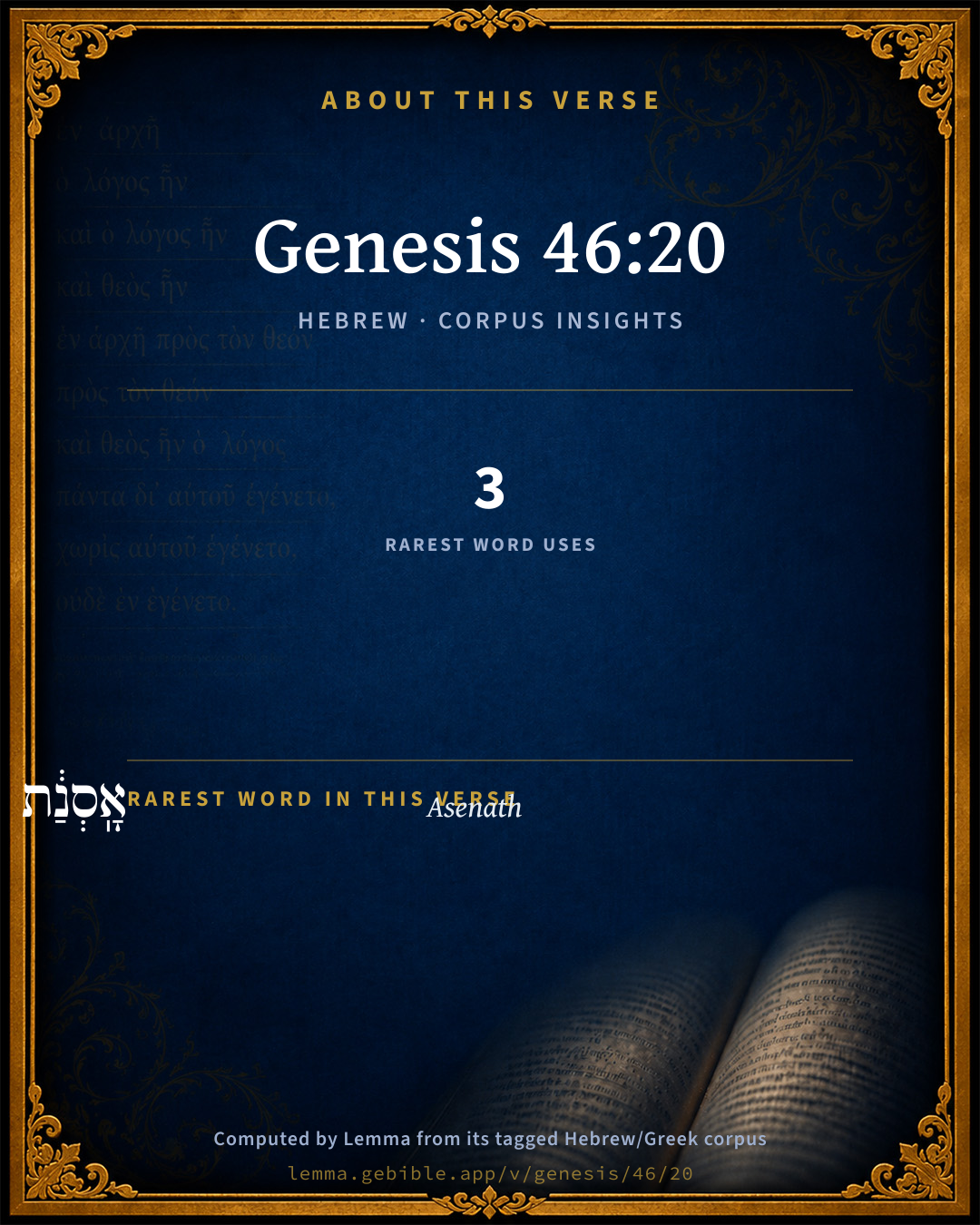
The rarest word here is אָֽסְנַ֔ת Asenath H621 — appearing just 3 times in the whole Hebrew Bible.

Shared distinctive vocabulary

אָֽסְנַ֔ת Asenath H621 occurs in 3 verses of the Hebrew Bible. Also found in:

Grammatical profile

  • 2 verbs
  • 11 nouns
  • 1 preposition
  • 3 particles

Verb forms

  • וַיִּוָּלֵ֣ד Niphal · Sequential Imperfect
  • יָֽלְדָה Qal · Perfect

Repetition

Words recur within this verse — often emphatic in Hebrew:

  • וַיִּוָּלֵ֣ד to bear H3205 ×2
  • פּ֥וֹטִי Poti-pherah H6319 ×2

Hebrew & Septuagint length

In English translation the verse runs 24 words from the Hebrew and 66 from the Septuagint (LXX English) — the Septuagint runs noticeably longer here. See the side-by-side →

A rough comparison of the two English renderings, which tokenize alike — not a word-level alignment.

Word counts can differ between the Hebrew and the Greek without any difference in meaning — e.g. the Hebrew direct-object marker אֵת has no separate Greek word, and Greek often adds the article ὁ.

Cross-references

10

Topical passages linked to Genesis 46:20 in the Treasury of Scripture Knowledge — connected by theme and wording, ordered by reader-vote popularity; previews shown in the World English Bible.

  • Genesis 41:50–52 To Joseph were born two sons before the year of famine came, whom Asenath, the daughter of Potiphera priest of On, bore to him.
  • Genesis 41:45 Pharaoh called Joseph's name Zaphenath-paneah; and he gave him Asenath, the daughter of Potiphera priest of On as a wife. Joseph went out over the land of Egypt.
  • Genesis 48:4–5 and said to me, 'Behold, I will make you fruitful, and multiply you, and I will make of you a company of peoples, and will give this land to your seed after you for an everlasting possession.'
  • Genesis 48:13–14 Joseph took them both, Ephraim in his right hand toward Israel's left hand, and Manasseh in his left hand toward Israel's right hand, and brought them near to him.
  • Genesis 48:20 He blessed them that day, saying, "In you will Israel bless, saying, 'God make you as Ephraim and as Manasseh'" He set Ephraim before Manasseh.
  • Numbers 1:32–35 Of the children of Joseph, of the children of Ephraim, their generations, by thir families, by their fathers' houses, according to the number of the names, from twenty years old and upward, all who were able to go out to war;
  • Numbers 26:28–37 The sons of Joseph after their families: Manasseh and Ephraim.
  • Deuteronomy 33:13–17 Of Joseph he said, Blessed of Yahweh be his land, For the precious things of the heavens, for the dew, For the deep that couches beneath,
  • 1 Chronicles 5:23–26 The children of the half-tribe of Manasseh lived in the land: they increased from Bashan to Baal Hermon and Senir and Mount Hermon.
  • 1 Chronicles 7:14–29 The sons of Manasseh: Asriel, whom his concubine the Aramitess bore: she bore Machir the father of Gilead:

Cross-references courtesy of OpenBible.info (CC BY 4.0).

Hebrew and Greek witnesses Masoretic Hebrew ↔ Greek Septuagint

The same verse in the two great witnesses to the Old Testament, shown verse-for-verse.

Here the Septuagint runs noticeably longer than the Hebrew — LXX2012 (modern English Septuagint) 66 words vs World English Bible 24. A rough length comparison of the two English translations, not a word-level alignment — read both below.

These are two independent witnesses, not word-aligned to each other, and the Septuagint is shown in lemma (dictionary) form.

Hebrew Genesis 46:20 Masoretic · Westminster Leningrad Codex

וַיִּוָּלֵ֣ד לְיוֹסֵף֮ בְּאֶ֣רֶץ מִצְרַיִם֒ אֲשֶׁ֤ר יָֽלְדָה לּוֹ֙ אָֽסְנַ֔ת בַּת פּ֥וֹטִי פֶ֖רַע כֹּהֵ֣ן אֹ֑ן אֶת מְנַשֶּׁ֖ה וְאֶת אֶפְרָֽיִם

To Joseph in the land of Egypt were born Manasseh and Ephraim, whom Asenath, the daughter of Potiphera, priest of On, bore to him.

World English Bible · Public Domain

Greek LXX Genesis 46:20 Septuagint · lemma form

γίγνομαι δέ υἱός ιωσηφ ἐν γῆ αἴγυπτος ὅς τίκτω αὐτός ασεννεθ θυγάτηρ πετεφρης ἱερεύς ἥλιος πόλις ὁ μανασσή καί ὁ ἐφράιμ γίγνομαι δέ υἱός μανασσή ὅς τίκτω αὐτός ὁ παλλακή ὁ σύρα ὁ μαχιρ μαχιρ δέ γεννάω ὁ γαλαάδ υἱός δέ ἐφράιμ ἀδελφός μανασσή σουταλααμ καί τααμ υἱός δέ σουταλααμ εδεμ

And there were sons born to Joseph in the land of Egypt, whom Aseneth, the daughter of Petephres, priest of Heliopolis, bore to him, even Manasses and Ephraim. And there were sons born to Manasses, which the Syrian concubine bore to him, even Machir. And Machir begot Galaad. And the sons of Ephraim, the brother of Manasses; Sutalaam, and Taam. And the sons of Sutalaam; Edom.

LXX2012 (modern English Septuagint) · Public Domain

On this verse, Adam Clarke's Commentary discusses the Septuagint’s reading. Read the note in Commentary ↓

Hebrew: Westminster Leningrad Codex (CC BY 4.0). Greek: Septuagint (public domain); English from LXX2012 (modern English Septuagint) (Public Domain). How the Septuagint differs from the Hebrew →

Targum (Aramaic paraphrase)

2

The Targum is the ancient Jewish Aramaic paraphrase of the Hebrew Scriptures — an interpretive translation, not the Hebrew text itself. Onkelos (literal) and Pseudo-Jonathan (expansive) render the Torah, and Jonathan the Prophets. Coverage is partial: where no permissively-licensed English translation exists for a verse, only the Aramaic is shown. This is verse-level text, not a word-by-word alignment to the Hebrew.

  1. Targum Onkelos Torah (Genesis–Deuteronomy)
    וְאִתְיְלִידוּ לְיוֹסֵף בְּאַרְעָא דְמִצְרַיִם דִּילִידַת לֵהּ אָסְנַת בַּת פּוֹטִי פֶרַע רַבָּא דְאוֹן יָת מְנַשֶּׁה וְיָת אֶפְרָיִם

    (no public-domain English translation for this verse)

    Targum Onkelos — Aramaic: “Onkelos Genesis” (public domain); “Onkelos Exodus” (public domain); “Onkelos Leviticus” (public domain); “Onkelos Numbers” (public domain); “Onkelos Deuteronomy” (public domain). English: “Sefaria Community Translation” (CC0 1.0 (public-domain dedication)); “J.W. Etheridge. The Targums of Onkelos and Jonathan Ben Uzziel on the Pentateuch. London: Longmans, Green, 1862” (public domain). Text via Sefaria.

  2. Targum Pseudo-Jonathan Torah (Genesis–Deuteronomy)
    וְאִתְיְלִיד לְיוֹסֵף בְּנִין בְּאַרְעָא דְמִצְרַיִם דִילֵידַת לֵיהּ אָסְנַת בַּת דִינָה וְרָבַת בְּבֵית פּוֹטִיפֶרַע רַבָּא דְטָנִיס יַת מְנַשֶׁה וְיַת אֶפְרָיִם

    And to Joseph were born two sons in the land of Mizraim, whom Asenath the daughter of Dinah, educated in the house of Potiphera prince of Tanis, bare, Menasheh and Ephraim.

    Targum Pseudo-Jonathan — Aramaic: “Targum Jonathan on Genesis” (public domain); “Targum Jonathan on Exodus” (public domain); “Targum Jonathan on Leviticus” (public domain); “Targum Jonathan on Numbers” (public domain); “Targum Jonathan on Deuteronomy” (public domain). English: “The Targum of Jonathan ben Uzziel, trans. J. W. Etheridge, London, 1862” (public domain). Text via Sefaria.

Commentary

Notes on Genesis 46:20 from classic Christian and Jewish commentators (each source and its license shown beneath its notes). The classic Christian expositions comment on the surrounding passage and are grouped to its opening verse, so a note may address several verses; the Jewish commentaries on the Tanakh (Rashi and others) are per-verse, so they appear only where the commentator wrote on this verse.

Lemma curates 59 commentaries, every one of them public domain or Creative Commons licensed, each selected and text-cleaned for this edition rather than reprinted as found. About our sources →

Tyndale Open Study Notes

Tyndale Open Resources

46:20 On: See study note on 41:45.

Tyndale Open Study Notes — © Tyndale Open Resources, licensed CC BY-SA 4.0. Text via the HelloAO Bible API.

Adam Clarke's Commentary

Verse 20. Unto Joseph - were born Manasseh and Ephraim] There is a remarkable addition here in the Septuagint, which must be noticed: Εγενοντο δε υἱοι Μανασση, οὑς ετεκεν αυτῳ ἡ παλλακη ἡ Συρα, τον Μαχιρ· Μαχιρ δε εγεννησε τον Γαλααδ. Υἱοι δε Εφραιμ αδελφου Μανασσῃ, Σουταλααμ και Τααμ. Υἱοι δε Σουταλααμ, Εδεμ· These were the sons of Manasseh whom his Syrian concubine bore unto him: Machir; and Machir begat Galaad. The sons of Ephraim, Manasseh's brother, were Sutalaam and Taam; and the sons of Sutalaam, Edem. These add five persons to the list, and make out the number given by Stephen, Ac 7:14, which it seems he had taken from the text of the Septuagint, unless we could suppose that the text of Stephen had been altered to make it correspond to the Septuagint, of which there is not the slightest evidence from ancient MSS. or versions. The addition in the Septuagint is not found in either the Hebrew or the Samaritan at present; and some suppose that it was taken either from Nu 26:29, Nu 26:35, or 1Ch 7:14-20, but in none of these places does the addition appear as it stands in the Septuagint, thought some of the names are found interspersed. Various means have been proposed to find the seventy persons in the text, and to reconcile the Hebrew with the Septuagint and the New Testament.

A table given by Scheuchzer, extracted from the Memoires de Trevoux, gives the following general view:

The twelve sons of JACOB with their children and grandchildren.

Reuben and his four sons . . .

5

Simeon and his six sons . . .

7

Levi and his three sons . . .

4

Judah and his seven sons and grand-sons . . .

8

Issachar and his four sons . . .

5

Zebulun and his three sons . . .

4

Total sons of JACOB and LEAH

33

Gad and his seven sons . . .

8

Asher and his seven sons and grand-sons . . .

8

Total sons of JACOB and ZILPAH

16

Joseph and his two sons . . .

3

Benjamin and his ten sons . . .

11

Total sons of JACOB and RACHEL

14

Dan and his son . . .

2

Naphtali and his four sons . . .

5

Total sons of JACOB and BILHAH

7

Total sons of Jacob and his four wives

70

"To harmonize this with the Septuagint and St. Stephen, Ac 7:14, to the number sixty-six (all the souls that came out of Jacob's loins, Ge 46:26) add nine of the patriarchs' wives, Judah's wife being already dead in Canaan, (Ge 38:12), Benjamin being supposed to be as yet unmarried, and the wife of Joseph being already in Egypt, and therefore out of the case: the number will amount to seventy-five, which is that found in the Acts." - Universal History.

Dr. Hales' method is more simple, and I think more satisfactory: "Moses states that all the souls that came with Jacob into Egypt which issued from his loins, (except his sons wives,) were sixty-six souls, Ge 46:26; and this number is thus collected: -

JACOB'S children, eleven sons and one daughter . . .

12

Reuben's sons . . .

4

Simeon's sons . . .

6

Levi's sons . . .

3

Judah's three sons and two grandsons . . .

5

Issachar's sons . . .

4

Zebulun's sons . . .

3

Gad's sons . . .

7

Asher's four sons, one daughter, and two grandsons

7

Dan's son . . .

1

Naphtali's sons . . .

4

Benjamin's sons . . .

10

----

66

"If to these sixty-six children, and grandchildren, and great grandchildren, we add Jacob himself, Joseph and his two sons, the amount is seventy, the whole amount of Jacob's family which settled in Egypt.

"In this statement the wives of Jacob's sons, who formed part of the household, are omitted; but they amounted to nine, for of the twelve wives of the twelve sons of Jacob, Judah's wife was dead, Ge 38:12, and Simeon's also, as we may collect from his youngest son Shaul by a Canannitess, Ge 46:10, and Joseph's wife was already in Egypt. These nine wives, therefore, added to the sixty-six, give seventy-five souls the whole amount of Jacob's household that went down with him to Egypt; critically corresponding with the statement in the New Testament, that 'Joseph sent for his father Jacob and all his kindred, amounting to seventy-five souls.' The expression all his kindred, including the wives which were Joseph's kindred, not only by affinity, but also by consanguinity, being probably of the families of Esau, Ishmael, or Keturah. Thus does the New Testament furnish an admirable comment on the Old." - Analysis, vol. ii., p. 159.

It is necessary to observe that this statement, which appears on the whole the most consistent, supposes that Judah was married when about fourteen years of age, his son Er at the same age, Pharez at the same, Asher and his fourth son Beriah under twenty, Benjamin about fifteen, and Joseph's sons and grandsons about twenty. But this is not improbable, as the children of Israel must all have married at a very early age, to have produced in about two hundred and fifteen years no less than six hundred thousand persons above twenty years old, besides women and children.

Adam Clarke's Commentary on the Bible (1810–1826) — public domain. Text from a community e-Sword/MySword module.

Ellicott's Commentary for English Readers

(20) Manasseh and Ephraim.—In these names all the documents agree.

A Bible Commentary for English Readers, edited by Charles John Ellicott (1878–1897) — public domain. Text from a community e-Sword module.

The Cambridge Bible for Schools and Colleges

gen. ed. J. J. S. Perowne

20. unto Joseph] Cf. Gen_41:50-52. LXX adds to this verse “and there were born the sons of Manasseh which the concubine, the Syrian, bare unto him, Machir; and Machir begat Gilead. And the sons of Ephraim the brother of Manasseh were Soutalaam and Taam, and the sons of Soutalaam Edem.” LXX, therefore, here records five additional names.

The Cambridge Bible for Schools and Colleges (gen. ed. J. J. S. Perowne; Cambridge University Press, 1878–1918) — public domain. Text from a community e-Sword module.

John Gill's Exposition

And the sons of Dan, Hushim. He had but one son, wherefore the plural is put for the singular, see Gen 46:7; Aben Ezra thinks he had two sons, and that one of them was dead, and therefore not mentioned; but the other way best accounts for the expression; though, as Schmidt observes, the plural may be indefinitely put, and the sense be this, as for the sons of Dan, there was only one, whose name was Hushim. Dan was a son of Jacob by Bilhah, Rachel's maid, as the following was another.

; Aben Ezra thinks he had two sons, and that one of them was dead, and therefore not mentioned; but the other way best accounts for the expression; though, as Schmidt observes, the plural may be indefinitely put, and the sense be this, as for the sons of Dan, there was only one, whose name was Hushim. Dan was a son of Jacob by Bilhah, Rachel's maid, as the following was another.

Genesis 46:24

gen 46:24

gen 46:24

gen 46:24And the sons of Naphtali, Jahzeel, and Guni, and Jezer, and Shillem. The last is called Shallum in Ch1 7:13.

John Gill's Exposition of the Whole Bible (1746–1763) — public domain (CC PDM 1.0). Text via the HelloAO Bible API.

Haydock's Catholic Bible Commentary

Ephraim. The Septuagint take in here the children of both, Numbers xxvi. 29, 35.

George Leo Haydock (1774–1849), Haydock's Catholic Family Bible and Commentary, 1859 edition — public domain. Excludes Psalms (Douay-Rheims chapter numbering differs from Protestant) and Deuterocanonical books (Catholic canon only).

The Pulpit Commentary

And unto Joseph in the land of Eygpt were born Manasseh and Ephraim, which Asenath the daughter of Potipherah priest of On bare unto him. (vide Gen_41:50) The LXX, having probably transferred them from 1Ch_7:14, append the words, jEgenonto de uiJoi Manassh ouv eteken aujtw hJ pallakh hJ Sura tor Macir de ejgennhse tod UiJoi dem UiJoi de Soutalaam. Since they are not to be found in the Samaritan text, Rosenm thinks they may have been originally written on the margin, and thence by some subsequent copyist transferred to the text.

The Pulpit Commentary (1880–1919), ed. H.D.M. Spence-Jones & Joseph S. Exell — public domain. Text from a community e-Sword module.

Lesson kit

Teaching starters — assembled from the data on this page, not authored interpretation. Every prompt links to the verse data it draws on. Edit before teaching.

Genesis, in the Pentateuch, opens this verse with 17 words (13 distinct Hebrew lemmas). Its most distinctive word is ʼÂçᵉnath (“Asenath”). The Greek Septuagint runs longer here. A historical commentator’s framing appears above. Read the whole chapter for the surrounding context.

Discussion questions

  1. The word ʼÂçᵉnath carries the sense “Asenath.” How does it shape the verse?
  2. Genesis 41:45 shares the word «Asenath» with this verse. How do the two illuminate each other?
  3. “to bear” occurs 2× in this one verse. What is the effect of the repetition?
  4. Compared with the Hebrew, the Septuagint runs longer here. What questions does that raise?
  5. These translations render this verse differently; the difference is in the English rendering, not the original. What questions does that raise?
  6. The verb «וַיִּוָּלֵ֣ד» is Niphal Sequential Imperfect. How does its form color the action?
  7. Reading how Tyndale Open Study Notes and Adam Clarke's Commentary read this verse, where do the two commentators agree and where do they part?

Things to notice

Reading settings

Reading text

Shown beneath each verse's original-language words.

Old Testament
Old Testament edition

Read the OT as the Masoretic Hebrew (MT) or the Greek Septuagint (LXX).

English shown for the Greek Septuagint (in the Hebrew ↔ Greek comparison).

Comparing translations? Open the Compare panel on any verse page to stack up to four side by side.