Genesis 4:18

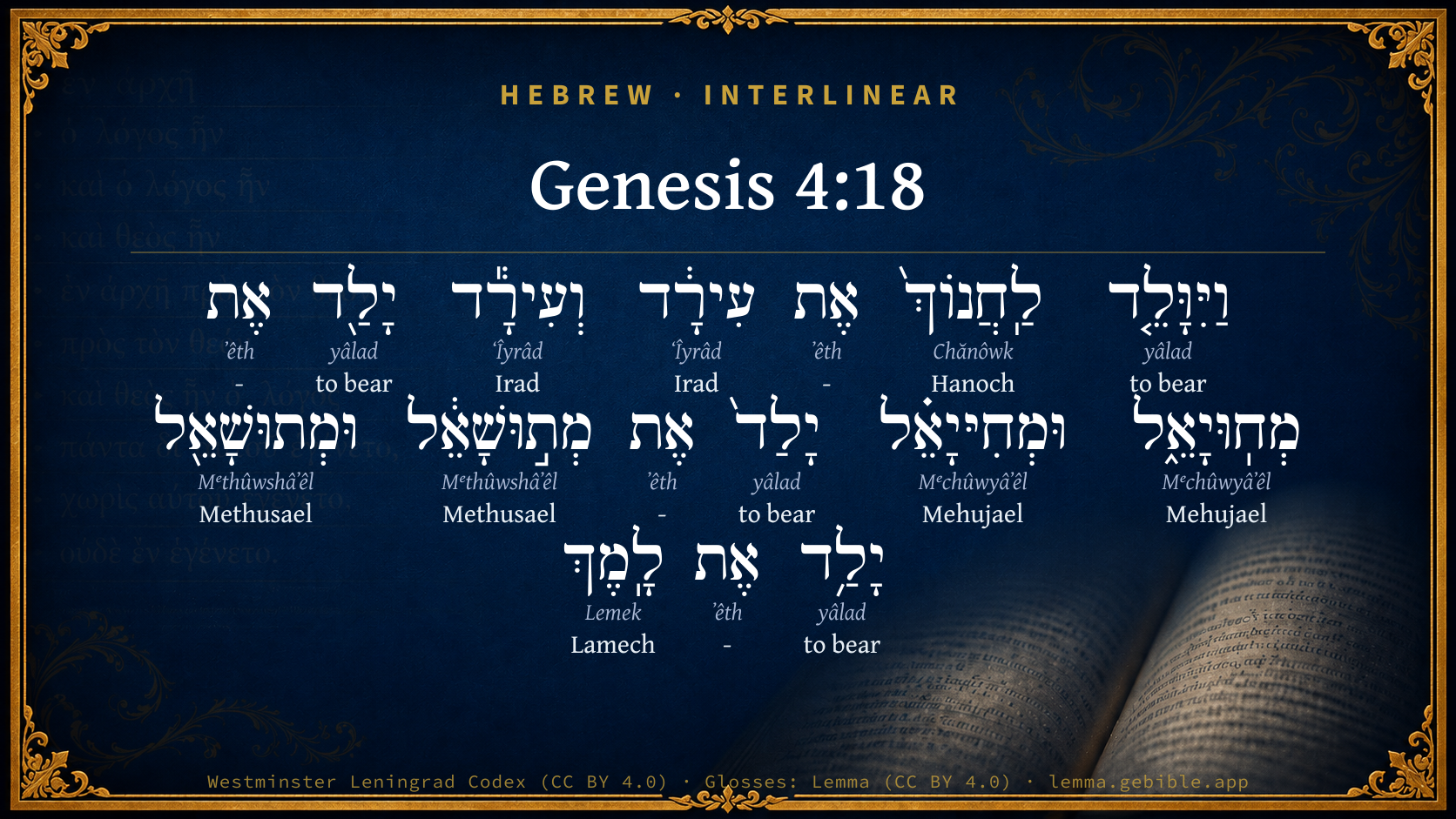
Hebrew (Westminster Leningrad Codex) Genesis 4:18 appears in the Hebrew Old Testament. The text above is from the Westminster Leningrad Codex. Each word links to its Strong’s number, a concise gloss, and parsing drawn from the Open Scriptures Hebrew Bible morphology. Click any word for its full Brown-Driver-Briggs (BDB) entry.
Download image
Cite this verse

Genesis 4:18 (World English Bible). Public Domain. Lemma interlinear Bible study tool, https://lemma.gebible.app/v/genesis/4/18.

Show BibTeX & RIS
BibTeX
RIS
English Translation
To Enoch was born Irad. Irad became the father of Mehujael. Mehujael became the father of Methushael. Methushael became the father of Lamech.
World English Bible · Public Domain
Highlights
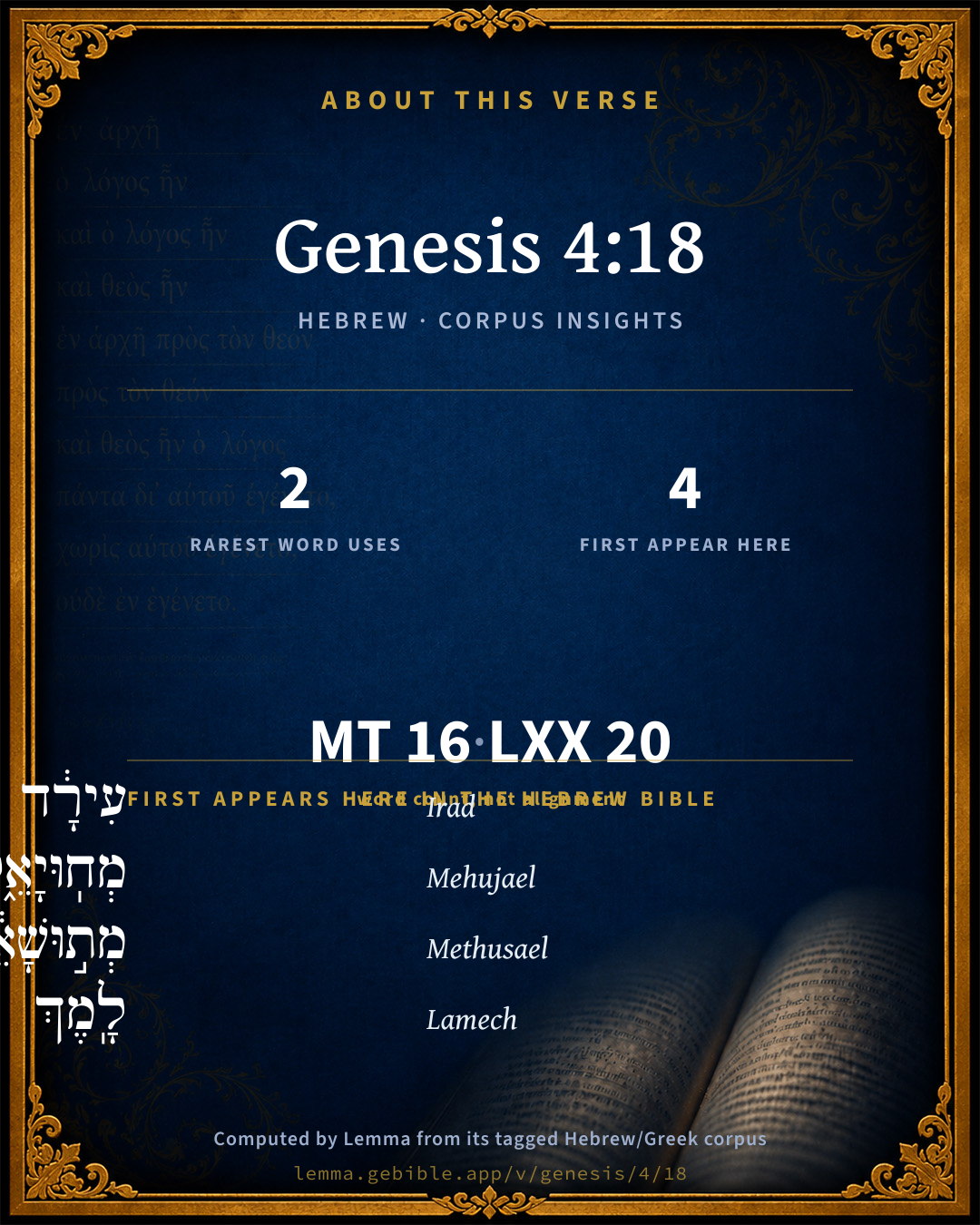
  • 4 first appearances in the Hebrew Bible
Full analysis ↓
Download a study sheet

One document with this verse’s original text, its word-by-word gloss line, the meaning frame, cross-references with their text, attributed commentary, and full source and license credits — printable, and it pastes into notes with its structure intact.

This verse Autodidact and up

Study sheet (.html) Plain text (.txt)

A passage Seminary Student

Up to 50 verses in one chapter. A passage sheet keeps up to 6 commentary sources and 12 cross-references per verse, in the order this page ranks them, and says so on the sheet whenever that leaves anything out. Ask for a single verse and you get the Autodidact verse sheet above.

Everything on this page stays free to read, with no account — the sheet is a download of what is already on screen, not access to it.

Want to remove ads? Support Godless Engineer
Compare translations 3

The same verse in 3 English versions, stacked beneath the original-language interlinear above. Click any original word for its lexicon entry.

Each is an independent rendering of the whole verse — the interlinear is not word-aligned to these translations.

Highlighted words mark where these versions differ — a whole-verse word diff, not a word-by-word alignment.

  • World English Bible Public Domain
    To Enoch was born Irad. Irad became the father of Mehujael. Mehujael became the father of Methushael. Methushael became the father of Lamech.
  • King James Version Public Domain
    And unto Enoch was born Irad: and Irad begat Mehujael: and Mehujael begat Methusael: and Methusael begat Lamech.
  • unfoldingWord Literal Text CC BY-SA 4.0
    Then to Enoch was born Irad, and Irad fathered Mehujael, and Mehujael fathered Methushael, and Methushael fathered Lamech.

unfoldingWord Literal Text — © unfoldingWord, licensed CC BY-SA 4.0. Word-aligned USFM3 via Door43 (git.door43.org/unfoldingWord/en_ult).

Versions to compare (up to 4)

3 of 4 selected

Show all 18 translations

Every available English version of this verse, each an independent rendering of the whole verse.

  • World English Bible Public Domain
    To Enoch was born Irad. Irad became the father of Mehujael. Mehujael became the father of Methushael. Methushael became the father of Lamech.
  • Berean Standard Bible Public Domain
    Now to Enoch was born Irad, and Irad was the father of Mehujael, and Mehujael was the father of Methusael, and Methusael was the father of Lamech.
  • Majority Standard Bible Public Domain
    Now to Enoch was born Irad, and Irad was the father of Mehujael, and Mehujael was the father of Methusael, and Methusael was the father of Lamech.
  • King James Version Public Domain
    And unto Enoch was born Irad: and Irad begat Mehujael: and Mehujael begat Methusael: and Methusael begat Lamech.
  • American Standard Version (1901) Public Domain
    And unto Enoch was born Irad: and Irad begat Mehujael: and Mehujael begat Methushael; and Methushael begat Lamech.
  • Revised Version (1885) Public Domain
    And unto Enoch was born Irad: and Irad begat Mehujael: and Mehujael begat Methushael: and Methushael begat Lamech.
  • Geneva Bible (1599) Public Domain
    And to Henoch was borne Irad, and Irad begate Mehuiael, and Mehuiael begate Methushael, and Methushael begate Lamech.
  • Douay-Rheims (1899) Public Domain
    And Henoch begot Irad, and Irad begot Maviael, and Maviael begot Mathusael, and Mathusael begot Lamech:
  • Young's Literal Translation Public Domain
    And born to Enoch is Irad; and Irad hath begotten Mehujael; and Mehujael hath begotten Methusael; and Methusael hath begotten Lamech.
  • Literal Standard Version CC BY-SA 4.0
    And born to Enoch is Irad; and Irad has begotten Mehujael; and Mehujael has begotten Methusael; and Methusael has begotten Lamech.
  • Unlocked Literal Bible CC BY-SA 4.0
    To Enoch was born Irad. Irad became the father of Mehujael. Mehujael became the father of Methushael. Methushael became the father of Lamech.
  • unfoldingWord Literal Text CC BY-SA 4.0
    Then to Enoch was born Irad, and Irad fathered Mehujael, and Mehujael fathered Methushael, and Methushael fathered Lamech.
  • Darby Bible Public Domain
    And to Enoch was born Irad; and Irad begot Mehujael; and Mehujael begot Methushael; and Methushael begot Lemech.
  • World Messianic Bible Public Domain
    Irad was born to Enoch. Irad became the father of Mehujael. Mehujael became the father of Methushael. Methushael became the father of Lamech.
  • Webster's Bible Public Domain
    And to Enoch was born Irad: and Irad begat Mehujael: and Mehujael begat Methusael: and Methusael begat Lamech.
  • Free Bible Version CC BY-SA 4.0
    Enoch had a son named Irad. Irad was the father of Mehujael, Mehujael was the father of Methushael, and Methushael was the father of Lamech.
  • Bible in Basic English Public Domain
    And Enoch had a son Irad: and Irad became the father of Mehujael: and Mehujael became the father of Methushael: and Methushael became the father of Lamech.
  • JPS Tanakh (1917) Public Domain
    And unto Enoch was born Irad; and Irad begot Mehujael; and Mehujael begot Methushael; and Methushael begot Lamech.

Literal Standard Version (2020), Covenant Press — licensed CC BY-SA 4.0. Text via the HelloAO Bible API (eBible.org). Unlocked Literal Bible (unfoldingWord) — licensed CC BY-SA 4.0. Text via the HelloAO Bible API (eBible.org). unfoldingWord Literal Text — © unfoldingWord, licensed CC BY-SA 4.0. Word-aligned USFM3 via Door43 (git.door43.org/unfoldingWord/en_ult). Free Bible Version, Dr. Jonathan Gallagher — licensed CC BY-SA 4.0. Text via the HelloAO Bible API (eBible.org).

Word by word

More ways to search: Search by grammar → Find every occurrence → Compare this word →

Practice this passage: Drill this verse → Learn its vocabulary →

עִירָ֔ד
ʻÎyrâd
H5897
“Irad”
Noun, Proper
Part of Speech
Noun
Type
Proper
Full BDB Definition

Origin: from the same as H6166

TWOT: None

Irad = "fleet" - son of Enoch, grandson of Cain, and father of Mehujael
  1. וַיִּוָּלֵ֤ד yâlad H3205 “and · to bear” Conjunction + Verb, Niphal, Sequential Imperfect, 3rd Person, Masculine, Singular
  2. לַֽחֲנוֹךְ֙ Chănôwk H2585 “to/for · Hanoch” Preposition + Noun, Proper
  3. אֶת ʼêth H853 “-” Particle, Direct Object
  4. וְעִירָ֕ד ʻÎyrâd H5897 “and · Irad” Conjunction + Noun, Proper
  5. יָלַ֖ד yâlad H3205 “to bear” Verb, Qal, Perfect, 3rd Person, Masculine, Singular
  6. אֶת ʼêth H853 “-” Particle, Direct Object
  7. מְחֽוּיָאֵ֑ל Mᵉchûwyâʼêl H4232 “Mehujael” Noun, Proper
  8. וּמְחִיּיָאֵ֗ל Mᵉchûwyâʼêl H4232 “and · Mehujael” Conjunction + Noun, Proper
  9. יָלַד֙ yâlad H3205 “to bear” Verb, Qal, Perfect, 3rd Person, Masculine, Singular
  10. אֶת ʼêth H853 “-” Particle, Direct Object
  11. מְת֣וּשָׁאֵ֔ל Mᵉthûwshâʼêl H4967 “Methusael” Noun, Proper
  12. וּמְתוּשָׁאֵ֖ל Mᵉthûwshâʼêl H4967 “and · Methusael” Conjunction + Noun, Proper
  13. יָלַ֥ד yâlad H3205 “to bear” Verb, Qal, Perfect, 3rd Person, Masculine, Singular
  14. אֶת ʼêth H853 “-” Particle, Direct Object
  15. לָֽמֶךְ Lemek H3929 “Lamech” Noun, Proper

About this verse

These counts appear in no published source. They are computed here, from the morphology-tagged text and Lemma’s own curated glosses. What Lemma adds →

16
words
7
distinct lemmas
Pentateuch
section

Notable vocabulary

The rarest word here is עִירָ֔ד Irad H5897 — appearing just 2 times in the whole Hebrew Bible.

First appearance in Scripture

These words make their first canonical appearance in the Hebrew Bible here:

  • עִירָ֔ד Irad H5897
  • מְחֽוּיָאֵ֑ל Mehujael H4232
  • מְת֣וּשָׁאֵ֔ל Methusael H4967
  • לָֽמֶךְ Lamech H3929

Grammatical profile

  • 4 verbs
  • 8 nouns
  • 4 particles

Verb forms

  • וַיִּוָּלֵ֤ד Niphal · Sequential Imperfect
  • יָלַ֖ד Qal · Perfect
  • יָלַד֙ Qal · Perfect
  • יָלַ֥ד Qal · Perfect

Repetition

Words recur within this verse — often emphatic in Hebrew:

  • וַיִּוָּלֵ֤ד to bear H3205 ×4
  • עִירָ֔ד Irad H5897 ×2
  • מְחֽוּיָאֵ֑ל Mehujael H4232 ×2
  • מְת֣וּשָׁאֵ֔ל Methusael H4967 ×2

Hebrew & Septuagint length

In English translation the verse runs 23 words from the Hebrew and 18 from the Septuagint (LXX English) — closely comparable.

A rough comparison of the two English renderings, which tokenize alike — not a word-level alignment.

Word counts can differ between the Hebrew and the Greek without any difference in meaning — e.g. the Hebrew direct-object marker אֵת has no separate Greek word, and Greek often adds the article ὁ.

In the original languages it is 16 Hebrew tokens and 20 Greek tokens — but the two are counted differently (Hebrew bundles its prefixes and suffixes into one token; the Greek is in lemma form), so that isn’t a like-for-like length.

Cross-references

2

Topical passages linked to Genesis 4:18 in the Treasury of Scripture Knowledge — connected by theme and wording, ordered by reader-vote popularity; previews shown in the World English Bible.

  • Genesis 36:2 Esau took his wives from the daughters of Canaan: Adah the daughter of Elon, the Hittite; and Oholibamah the daughter of Anah, the daughter of Zibeon, the Hivite;
  • Genesis 5:21 Enoch lived sixty-five years, and became the father of Methuselah.

Cross-references courtesy of OpenBible.info (CC BY 4.0).

Hebrew and Greek witnesses Masoretic Hebrew ↔ Greek Septuagint

The same verse in the two great witnesses to the Old Testament, shown verse-for-verse.

These are two independent witnesses, not word-aligned to each other, and the Septuagint is shown in lemma (dictionary) form.

Hebrew Genesis 4:18 Masoretic · Westminster Leningrad Codex

וַיִּוָּלֵ֤ד לַֽחֲנוֹךְ֙ אֶת עִירָ֔ד וְעִירָ֕ד יָלַ֖ד אֶת מְחֽוּיָאֵ֑ל וּמְחִיּיָאֵ֗ל יָלַד֙ אֶת מְת֣וּשָׁאֵ֔ל וּמְתוּשָׁאֵ֖ל יָלַ֥ד אֶת לָֽמֶךְ

To Enoch was born Irad. Irad became the father of Mehujael. Mehujael became the father of Methushael. Methushael became the father of Lamech.

World English Bible · Public Domain

Greek LXX Genesis 4:18 Septuagint · lemma form

γίγνομαι δέ ὁ ενωχ γαιδαδ καί γαιδαδ γεννάω ὁ μαιηλ καί μαιηλ γεννάω ὁ μαθουσαλα καί μαθουσαλα γεννάω ὁ λαμεχ

And to Enoch was born Gaidad; and Gaidad begot Maleleel; and Maleleel begot Mathusala; and Mathusala begot Lamech.

LXX2012 (modern English Septuagint) · Public Domain

On this verse, The Cambridge Bible for Schools and Colleges discusses the Septuagint’s reading. Read the note in Commentary ↓

Hebrew: Westminster Leningrad Codex (CC BY 4.0). Greek: Septuagint (public domain); English from LXX2012 (modern English Septuagint) (Public Domain). How the Septuagint differs from the Hebrew →

Targum (Aramaic paraphrase)

2

The Targum is the ancient Jewish Aramaic paraphrase of the Hebrew Scriptures — an interpretive translation, not the Hebrew text itself. Onkelos (literal) and Pseudo-Jonathan (expansive) render the Torah, and Jonathan the Prophets. Coverage is partial: where no permissively-licensed English translation exists for a verse, only the Aramaic is shown. This is verse-level text, not a word-by-word alignment to the Hebrew.

  1. Targum Onkelos Torah (Genesis–Deuteronomy)
    וְאִתְיְלִיד לַחֲנוֹךְ יָת עִירָד וְעִירָד אוֹלִיד יָת מְחוּיָאֵל וּמְחִיָּיאֵל אוֹלִיד יָת מְתוּשָׁאֵל וּמְתוּשָׁאֵל אוֹלִיד יָת לָמֶךְ

    (no public-domain English translation for this verse)

    Targum Onkelos — Aramaic: “Onkelos Genesis” (public domain); “Onkelos Exodus” (public domain); “Onkelos Leviticus” (public domain); “Onkelos Numbers” (public domain); “Onkelos Deuteronomy” (public domain). English: “Sefaria Community Translation” (CC0 1.0 (public-domain dedication)); “J.W. Etheridge. The Targums of Onkelos and Jonathan Ben Uzziel on the Pentateuch. London: Longmans, Green, 1862” (public domain). Text via Sefaria.

  2. Targum Pseudo-Jonathan Torah (Genesis–Deuteronomy)
    וְאִיתְיְלִיד לַחֲנוֹךְ יַת עִירָד וְעִירָד אוֹלִיד יַת מְחוּיָאֵל וּמְחִיָיאֵל אוֹלִיד יַת מְתוּשָׁאֵל וּמְתוּשָׁאֵל אוֹלִיד יַת לָמֶךְ

    And there was born unto Hanok Irad, and Irad begat Mechujael, and Mechujael begat Methushael, and Methushael begat Lemek.

    Targum Pseudo-Jonathan — Aramaic: “Targum Jonathan on Genesis” (public domain); “Targum Jonathan on Exodus” (public domain); “Targum Jonathan on Leviticus” (public domain); “Targum Jonathan on Numbers” (public domain); “Targum Jonathan on Deuteronomy” (public domain). English: “The Targum of Jonathan ben Uzziel, trans. J. W. Etheridge, London, 1862” (public domain). Text via Sefaria.

Commentary

Notes on Genesis 4:18 from classic Christian and Jewish commentators (each source and its license shown beneath its notes). The classic Christian expositions comment on the surrounding passage and are grouped to its opening verse, so a note may address several verses; the Jewish commentaries on the Tanakh (Rashi and others) are per-verse, so they appear only where the commentator wrote on this verse.

Lemma curates 59 commentaries, every one of them public domain or Creative Commons licensed, each selected and text-cleaned for this edition rather than reprinted as found. About our sources →

The Cambridge Bible for Schools and Colleges

gen. ed. J. J. S. Perowne

18. And unto Enoch, &c.] The genealogy of Cain is a framework of names, each of which may have been connected with traditions that either had been forgotten, or were not deemed suitable for preservation in this context. It is a mistake, into which some commentators have been betrayed, to endeavour to extract meanings from the proper names of the antediluvian patriarchs. It is very doubtful, whether the original names would have conveyed the same thoughts which their later Hebraized pronunciation has suggested to devout, but fanciful, imagination. The facts of history are not to be spelt out from the obscure etymology of primaeval proper names. These well-meaning endeavours have sometimes been based on the assumption that Hebrew was the original language.

The most that can be said is that these names preserve the recollection of legendary persons, and that they have received a Hebraized form which rendered them easier of pronunciation and facilitated a symbolical interpretation.

Irad] The name occurs in 1Ch_4:18; see note on Jared, Gen_5:16.

Mehujael] Cf. Mahalalel, Gen_5:12. If a Hebrew word, it may mean “blotted out by God.” Cf. Gen_6:7, where “destroy” is in the marg. blot out.

The LXX Μαίηλ must have read Mahyiel = “God maketh me to live.”

Methushael] Cf. Methuselah, Gen_5:21. Assyriologists say that the name means “Man of God,” and is the same as Mutu-sha-ili.

The Cambridge Bible for Schools and Colleges (gen. ed. J. J. S. Perowne; Cambridge University Press, 1878–1918) — public domain. Text from a community e-Sword module.

Trapp's Complete Commentary

John Trapp

Gen 4:18 And unto Enoch was born Irad: and Irad begat Mehujael: and Mehujael begat Methusael: and Methusael begat Lamech.

Ver. 18. And unto Enoch was born Irad, &c.] Cain had a numerous offspring. Seven generations of his are here reckoned. Seth is not yet born, that we hear of. The wicked "are full of children, and leave the rest of their substance to their babes." {Psa 17:14} "They send forth their little ones like a flock, and their children dance." They dance to "the timbrel and harp," (as here Jabal and Jubal did,) but they suddenly turn into hell, and so their merry dance ends in a miserable downfall. {Job 21:11-13}

John Trapp, A Commentary or Exposition upon All the Books of the Old and New Testament (1647–1656) — public domain. Text from a community e-Sword module.

Tyndale Open Study Notes

Tyndale Open Resources

4:18 the father of: Or the ancestor of, and so throughout the verse. Hebrew genealogies do not necessarily list every single generation.

Tyndale Open Study Notes — © Tyndale Open Resources, licensed CC BY-SA 4.0. Text via the HelloAO Bible API.

Ellicott's Commentary for English Readers

(18) Unto Enoch was born Irad.—Cain was building a city, ‘Ir, and it was this probably which suggested the name ‘Irad. It has little in common with Jared, as it begins with a harsh guttural, usually omitted in English because unpronounceable, but which appears as g in Gomorrah. Possibly ‘Irad means citizen; but these names have been so corrupted by transcribers that we cannot feel sure of them. Thus, here the LXX. calls ‘Irad Gaïdad, and the Syriac ‘Idor. In the list that follows, the names Mehujael (Samaritan Michel, Syriac Mahvoyel), Methusael, Enoch, and Lamech (Heb., Lemech), have a certain degree of similitude with those in the line of the Sethites, whence many commentators have assumed that the two lists are variations of the same original record. But it is usually a similarity of sound only with a diversity of meaning. Thus Mehujael, smitten of God, answers to Mahalaleel, glory to God; Methusael, God’s hero, to Methuselah, the armed warrior. Even when the names are the same, their history is often most diverse. Thus in the Cainite line Enoch is initiation into city life, in the Sethite into a life of holiness; and the Cainite polygamist Lemech, rejoicing in the weapons invented by his son, is the very opposite of the Sethite Lemech, who calls his son Noah, quiet, rest

A Bible Commentary for English Readers, edited by Charles John Ellicott (1878–1897) — public domain. Text from a community e-Sword module.

John Gill's Exposition

And Lamech took unto him two wives,.... He was the first we read of that introduced polygamy, contrary to the first institution of marriage, whereby only one man and one woman were to be joined together, and become one flesh, Gen 2:24. This evil practice, though it began in the race of wicked Cain, was in later ages followed by some among the people of God, which was connived at because of the hardness of their hearts; otherwise it was not so from the beginning. This was the first instance of it known; Jarchi says it was the way of the generation before the flood to have one wife for procreation of children, and the other for carnal pleasure; the latter drank a cup of sterility, that she might be barren, and was adorned as a bride, and lived deliciously; and the other was used roughly, and mourned like a widow; but by this instance it does not appear, for these both bore children to Lamech.

The name of the one was Adah, and the name of the other Zillah; whose daughters they were cannot be said, no doubt of the race of Cain; the name of the one signifies an "ornament", or beauty, and might seem to answer to the account Jarchi gives of the wife for pleasure, if there were any foundation for it; and the other signifies a "shadow", being continually under the shadow of her husband.

John Gill's Exposition of the Whole Bible (1746–1763) — public domain (CC PDM 1.0). Text via the HelloAO Bible API.

Whedon's Commentary on the Bible

Daniel D. Whedon

18. Irad… Mehujael… Methusael — Compare the similar names in the Sethite genealogy recorded in the next chapter, Jared, Mahalaleel, and Methuselah. Hence some have supposed a confusion growing out of two forms of one and the same old legend. But why may not different families have adopted similar or identical names in that as in later ages? Enoch and Lamech are names that occur in both genealogies, but the piety of the sons of Seth, bearing these names, is in notable contrast with the worldliness of Cain’s Enoch and the polygamy of Cain’s Lamech. This contrast seems to have been drawn out, as if to prevent the possibility of confounding the two genealogies.

Daniel D. Whedon (gen. ed.), Commentary on the Old and New Testaments (1874–1909) — public domain. Text from a community e-Sword module.

The Pulpit Commentary

Years passed away, the family of Cain grew to manhood, and, in imitation of their parents, founded homes for themselves. And unto Enoch (whose wife probably would also be his sister, few caring at this early stage to intermarry with the accursed race) was born Irad. Townsman, citizen, urbanus civilis (Keil, Lange); fleet as a wild ass (Murphy); ornament of a city, from Ir, a city (Wordsworth). And Irad begat Mehujael. Smitten of God (Keil, Gesenius, Murphy), the purified or formed of God (Lange). And Mehujael begat Methusael. Man of God (Gesenius, Lange), man asked or man of El (Murphy), man of prayer (Keil). And Methusael begat Lamech. Strong youth (Gesenius, Lange); man of prayer, youth (Murphy); king, by metathesis for melech (Wordsworth). The resemblance between these names and those in the line of Seth has been accounted for by supposing a commingling of the two genealogies, or one common primitive legend in two forms (Ewald, Knobel). But

1. The similarity of the names does not necessarily imply the identity of the persons. Cf. Korah in the families of Levi (Exo_6:21) and Esau; (Gen_36:5) Hanoch in those of Reuben (Gen_46:9) and Midian; (Gen_25:4) Kenaz in those of Esau (Gen_36:11) and Judah. (Num_32:12)

1. The similarity of the names only proves that the two collateral branches of the same family did not keep entirely apart.

2. The paucity of names at that early period may have led to their repetition.

3. The names in the two lines are only similar, not identical (cf. with Irad, Jared, descent; with Mehujael, Mahalaleel, praise of God; with Methusael, Methuselah, man of the sword).

4. The particulars related of Enoch and Lamech in the line of Seth forbid their identification with those of the same name in the line of Cain.

The Pulpit Commentary (1880–1919), ed. H.D.M. Spence-Jones & Joseph S. Exell — public domain. Text from a community e-Sword module.

unfoldingWord translationNotes

Door43 World Missions Community

To Enoch was born Irad

It is implied that Enoch grew up and married a woman. AT: "Enoch grew up and married and became the father of a son whom he named Irad" (See: Assumed Knowledge and Implicit Information)

Irad

the name of a man (See: How to Translate Names)

Adah ... Zillah

women's names (See: How to Translate Names)

translationWords

Lamech

unfoldingWord translationNotes — © Distant Shores Media and the Door43 World Missions Community, licensed CC BY-SA 4.0. Source: git.door43.org/Door43/en_tn.

Rashi

Rabbi Shlomo Yitzchaki (Rashi)

.חנוך AND IRAD BEGET — There are passages where it says of the male הוליד, and there are places where it says ילד, because this root ילד is used in two senses: in reference to a woman giving birth to a child through the agency of a male old French naitre; English to give birth to and the act of begetting by a man old French engendrer; English engender, beget. When it says הוליד, [in the Hiphil form] it speaks of the man in his relation to the act of giving birth by the woman — this or that man caused his wife to give birth to a son or daughter; when it says ילד it refers to the act of begetting by the man himself.

Rashi on the Tanakh — English translations: “The Judaica Press complete Tanach with Rashi, translated by A. J. Rosenberg” (CC BY 4.0); “Pentateuch with Rashi's commentary by M. Rosenbaum and A.M. Silbermann, 1929-1934” (public domain); “The Metsudah Tanach series, Lakewood, N.J” (CC BY 4.0); and “The Book of Joshua, Metsudah Publications, 1997” (CC BY 4.0). Text via Sefaria.

Radak

Rabbi David Kimhi (Radak)

ויולד, he called the first one מחויאל with the letters ו and י, whereas the second one he called מחייאל with two letters י. The first one has dagesh in the letter ו and is read with the vowel kametz, whereas the second letter י in מחייאל is not heard. We have a similar example in Jeremiah 37,13. All the names mentioned here are a reminder of certain events in the lives of the fathers naming the sons. This was a very common method of people remembering important occurrences in their lives in former times. Sometimes, the Torah recorded the event in question, other times it did not. In Bereshit Rabbah 23,2 an attempt is made by Rabbi Yehoshua ben Levi to see in these names proof of the father’s rebellious attitude. [Basically, according to this line of approach, the names reflected the fact that Chanoch, or the respective father naming his son, wished for the name of G’d to be uprooted from the earth. Ed.]

Radak on the Tanakh — English translations: “Sefaria Community Translation” (CC0 1.0 (public-domain dedication)); “Eliyahu Munk, HaChut Hameshulash” (CC BY 4.0); “Rabbi Mike Feuer, Jerusalem Anthology” (CC BY 4.0); and “R. David Kimhi on the first book of Psalms, Translated by R.G. Finch, London, 1919” (public domain). Text via Sefaria.

Lesson kit

Teaching starters — assembled from the data on this page, not authored interpretation. Every prompt links to the verse data it draws on. Edit before teaching.

Genesis, in the Pentateuch, opens this verse with 16 words (7 distinct Hebrew lemmas). Its most distinctive word is ʻÎyrâd (“Irad”). A historical commentator’s framing appears above. Read the whole chapter for the surrounding context.

Discussion questions

  1. The word ʻÎyrâd carries the sense “Irad.” How does it shape the verse?
  2. 4 words make their first appearance in Scripture here. What does this debut establish?
  3. How does Genesis 36:2, which shares this passage’s theme, read alongside this verse?
  4. What does the repetition of “to bear” (4× in this one verse) do in this verse?
  5. These translations render this verse differently. What is at stake in choosing one wording over another?
  6. «וַיִּוָּלֵ֤ד» is a Niphal Sequential Imperfect verb. How does that grammatical form shape the action described?
  7. Compare how The Cambridge Bible for Schools and Colleges and Trapp's Complete Commentary read this verse. Where do they agree or differ?

Things to notice

Reading settings

Reading text

Shown beneath each verse's original-language words.

Old Testament
Old Testament edition

Read the OT as the Masoretic Hebrew (MT) or the Greek Septuagint (LXX).

English shown for the Greek Septuagint (in the Hebrew ↔ Greek comparison).

Comparing translations? Open the Compare panel on any verse page to stack up to four side by side.