
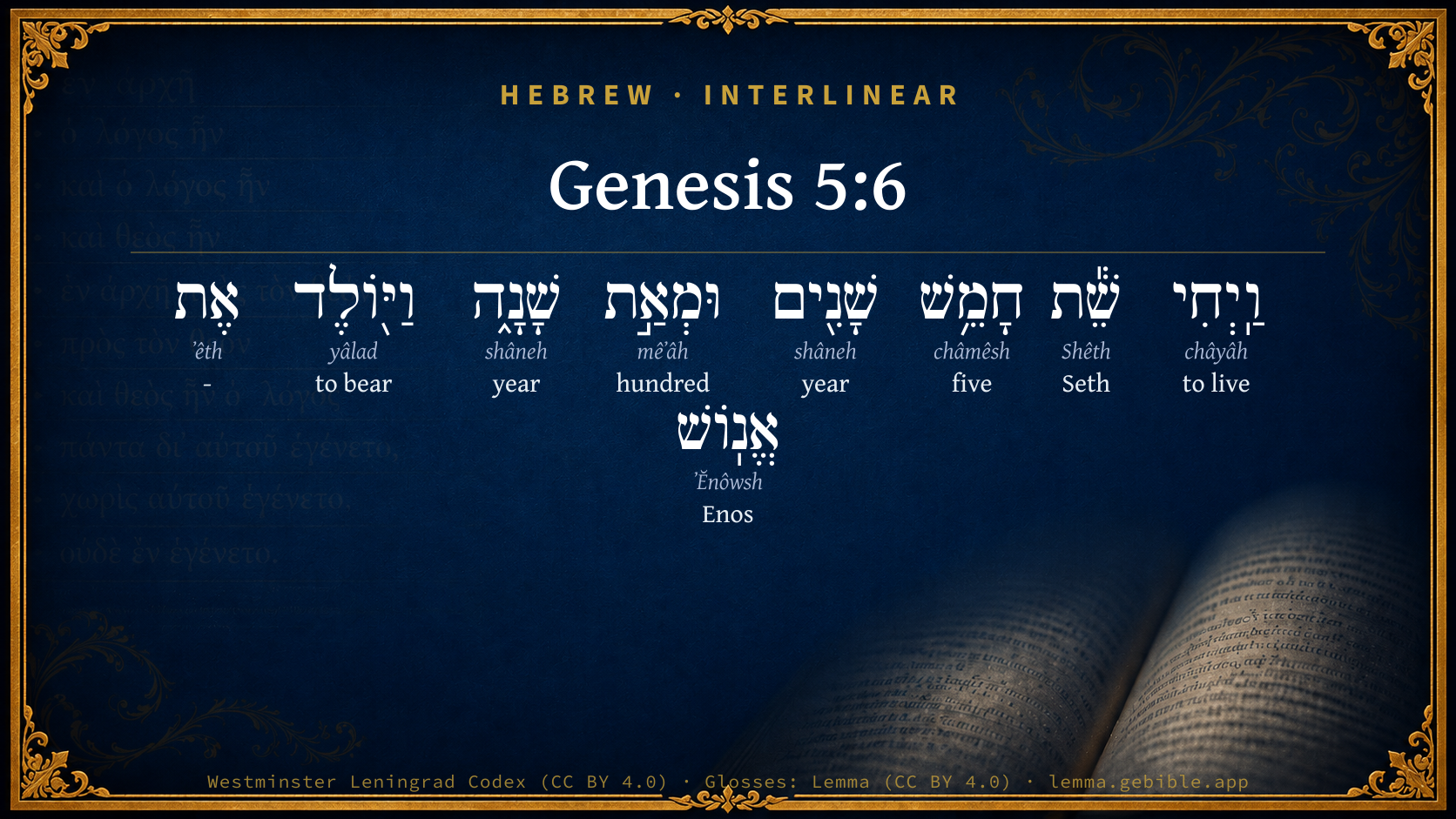
Genesis 5:6

Hebrew (Westminster Leningrad Codex) Genesis 5:6 appears in the Hebrew Old Testament. The text above is from the Westminster Leningrad Codex. Each word links to its Strong’s number, a concise gloss, and parsing drawn from the Open Scriptures Hebrew Bible morphology. Click any word for its full Brown-Driver-Briggs (BDB) entry.
Download image
Cite this verse

Genesis 5:6 (World English Bible). Public Domain. Lemma interlinear Bible study tool, https://lemma.gebible.app/v/genesis/5/6.

Show BibTeX & RIS
BibTeX
RIS
English Translation
Seth lived one hundred five years, and became the father of Enosh.
World English Bible · Public Domain
Highlights
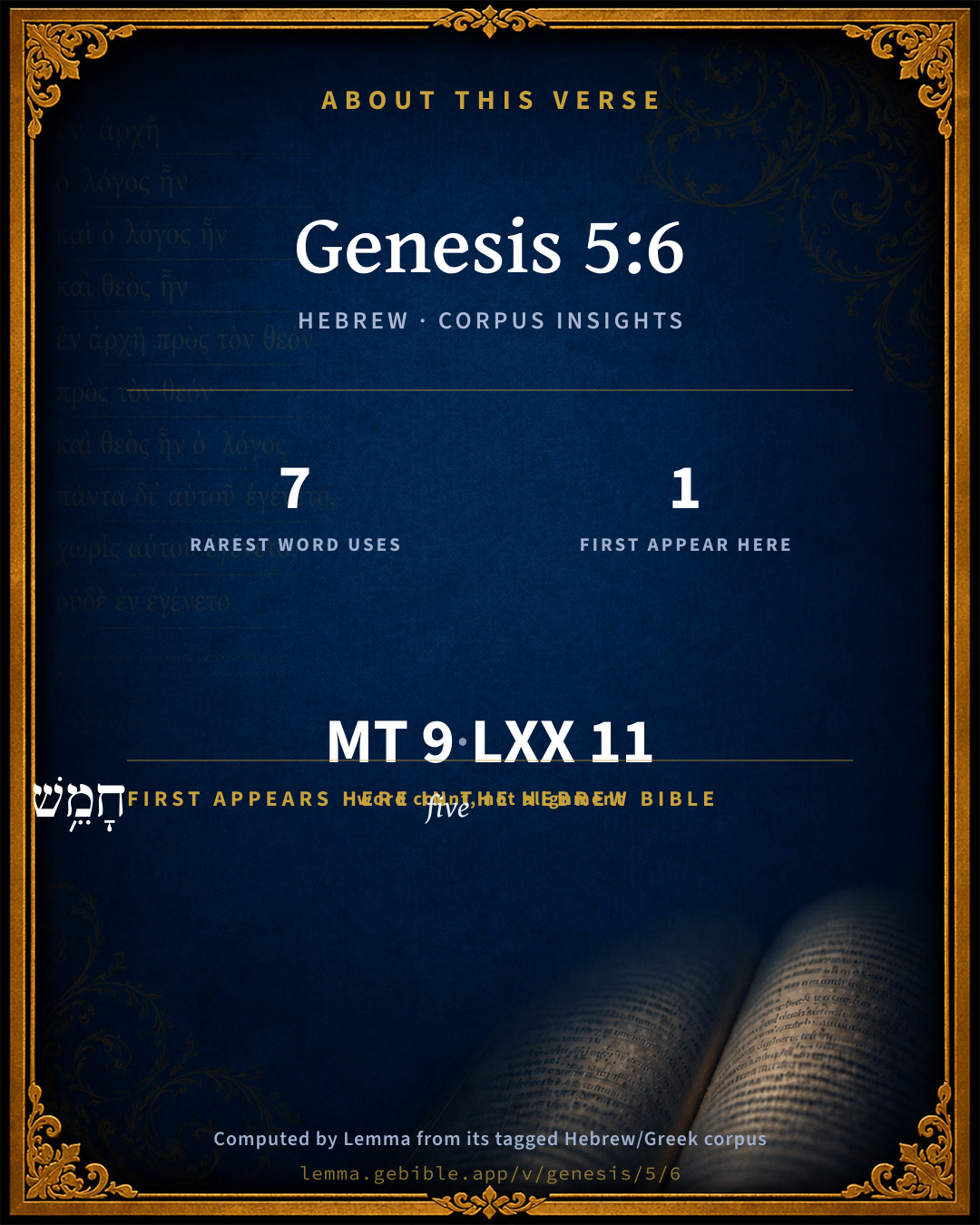
  • 1 first appearance in the Hebrew Bible
Full analysis ↓
Download a study sheet

One document with this verse’s original text, its word-by-word gloss line, the meaning frame, cross-references with their text, attributed commentary, and full source and license credits — printable, and it pastes into notes with its structure intact.

This verse Autodidact and up

Study sheet (.html) Plain text (.txt)

A passage Seminary Student

Up to 50 verses in one chapter. A passage sheet keeps up to 6 commentary sources and 12 cross-references per verse, in the order this page ranks them, and says so on the sheet whenever that leaves anything out. Ask for a single verse and you get the Autodidact verse sheet above.

Everything on this page stays free to read, with no account — the sheet is a download of what is already on screen, not access to it.

Want to remove ads? Support Godless Engineer
Compare translations 3

The same verse in 3 English versions, stacked beneath the original-language interlinear above. Click any original word for its lexicon entry.

Each is an independent rendering of the whole verse — the interlinear is not word-aligned to these translations.

Highlighted words mark where these versions differ — a whole-verse word diff, not a word-by-word alignment.

  • World English Bible Public Domain
    Seth lived one hundred five years, and became the father of Enosh.
  • King James Version Public Domain
    And Seth lived an hundred and five years, and begat Enos:
  • unfoldingWord Literal Text CC BY-SA 4.0
    And Seth lived 105 years, then he fathered Enosh.

unfoldingWord Literal Text — © unfoldingWord, licensed CC BY-SA 4.0. Word-aligned USFM3 via Door43 (git.door43.org/unfoldingWord/en_ult).

Versions to compare (up to 4)

3 of 4 selected

Show all 18 translations

Every available English version of this verse, each an independent rendering of the whole verse.

  • World English Bible Public Domain
    Seth lived one hundred five years, and became the father of Enosh.
  • Berean Standard Bible Public Domain
    When Seth was 105 years old, he became the father of Enosh.
  • Majority Standard Bible Public Domain
    When Seth was 105 years old, he became the father of Enosh.
  • King James Version Public Domain
    And Seth lived an hundred and five years, and begat Enos:
  • American Standard Version (1901) Public Domain
    And Seth lived a hundred and five years, and begat Enosh:
  • Revised Version (1885) Public Domain
    And Seth lived an hundred and five years, and begat Enosh:
  • Geneva Bible (1599) Public Domain
    And Sheth liued an hundreth and fiue yeeres, and begate Enosh.
  • Douay-Rheims (1899) Public Domain
    Seth also lived a hundred and five years, and begot Enos.
  • Young's Literal Translation Public Domain
    And Seth liveth an hundred and five years, and begetteth Enos.
  • Literal Standard Version CC BY-SA 4.0
    And Seth lives one hundred and five years [[or two hundred and five years]], and begets Enos.
  • Unlocked Literal Bible CC BY-SA 4.0
    When Seth had lived 105 years, he became the father of Enosh.
  • unfoldingWord Literal Text CC BY-SA 4.0
    And Seth lived 105 years, then he fathered Enosh.
  • Darby Bible Public Domain
    And Seth lived a hundred and five years, and begot Enosh.
  • World Messianic Bible Public Domain
    Seth lived one hundred five years, then became the father of Enosh.
  • Webster's Bible Public Domain
    And Seth lived a hundred and five years, and begat Enos:
  • Free Bible Version CC BY-SA 4.0
    When Seth was 105, he had Enosh.
  • Bible in Basic English Public Domain
    And Seth was a hundred and five years old when he became the father of Enosh:
  • JPS Tanakh (1917) Public Domain
    And Seth lived a hundred and five years, and begot Enosh.

Literal Standard Version (2020), Covenant Press — licensed CC BY-SA 4.0. Text via the HelloAO Bible API (eBible.org). Unlocked Literal Bible (unfoldingWord) — licensed CC BY-SA 4.0. Text via the HelloAO Bible API (eBible.org). unfoldingWord Literal Text — © unfoldingWord, licensed CC BY-SA 4.0. Word-aligned USFM3 via Door43 (git.door43.org/unfoldingWord/en_ult). Free Bible Version, Dr. Jonathan Gallagher — licensed CC BY-SA 4.0. Text via the HelloAO Bible API (eBible.org).

Word by word

More ways to search: Search by grammar → Find every occurrence → Compare this word →

Practice this passage: Drill this verse → Learn its vocabulary →

About this verse

These counts appear in no published source. They are computed here, from the morphology-tagged text and Lemma’s own curated glosses. What Lemma adds →

9
words
8
distinct lemmas
Pentateuch
section

Notable vocabulary

The rarest word here is אֱנֽוֹשׁ Enos H583 — appearing just 7 times in the whole Hebrew Bible.

First appearance in Scripture

This word makes its first canonical appearance in the Hebrew Bible here:

  • חָמֵ֥שׁ five H2568

Shared distinctive vocabulary

אֱנֽוֹשׁ Enos H583 occurs in 7 verses of the Hebrew Bible. Also found in:

Grammatical profile

  • 2 verbs
  • 4 nouns
  • 2 adjectives
  • 1 particle

Verb forms

  • וַֽיְחִי Qal · Sequential Imperfect
  • וַיּ֖וֹלֶד Hiphil · Sequential Imperfect

Repetition

A word recurs within this verse — often emphatic in Hebrew:

  • שָׁנִ֖ים year H8141 ×2

Hebrew & Septuagint length

In English translation the verse runs 12 words from the Hebrew and 11 from the Septuagint (LXX English) — closely comparable.

A rough comparison of the two English renderings, which tokenize alike — not a word-level alignment.

Word counts can differ between the Hebrew and the Greek without any difference in meaning — e.g. the Hebrew direct-object marker אֵת has no separate Greek word, and Greek often adds the article ὁ.

In the original languages it is 9 Hebrew tokens and 11 Greek tokens — but the two are counted differently (Hebrew bundles its prefixes and suffixes into one token; the Greek is in lemma form), so that isn’t a like-for-like length.

Cross-references

1

Topical passages linked to Genesis 5:6 in the Treasury of Scripture Knowledge — connected by theme and wording, ordered by reader-vote popularity; previews shown in the World English Bible.

  • Genesis 4:26 There was also born a son to Seth, and he named him Enosh. Then men began to call on Yahweh's name.

Cross-references courtesy of OpenBible.info (CC BY 4.0).

Hebrew and Greek witnesses Masoretic Hebrew ↔ Greek Septuagint

The same verse in the two great witnesses to the Old Testament, shown verse-for-verse.

These are two independent witnesses, not word-aligned to each other, and the Septuagint is shown in lemma (dictionary) form.

Hebrew Genesis 5:6 Masoretic · Westminster Leningrad Codex

וַֽיְחִי שֵׁ֕ת חָמֵ֥שׁ שָׁנִ֖ים וּמְאַ֣ת שָׁנָ֑ה וַיּ֖וֹלֶד אֶת אֱנֽוֹשׁ

Seth lived one hundred five years, and became the father of Enosh.

World English Bible · Public Domain

Greek LXX Genesis 5:6 Septuagint · lemma form

ζάω δέ σηθ διακόσιοι καί πέντε ἔτος καί γεννάω ὁ ενως

Now Seth lived two hundred and five years, and begot Enos.

LXX2012 (modern English Septuagint) · Public Domain

On this verse, John Gill's Exposition discusses the Septuagint’s reading. Read the note in Commentary ↓

Hebrew: Westminster Leningrad Codex (CC BY 4.0). Greek: Septuagint (public domain); English from LXX2012 (modern English Septuagint) (Public Domain). How the Septuagint differs from the Hebrew →

Targum (Aramaic paraphrase)

1

The Targum is the ancient Jewish Aramaic paraphrase of the Hebrew Scriptures — an interpretive translation, not the Hebrew text itself. Onkelos (literal) and Pseudo-Jonathan (expansive) render the Torah, and Jonathan the Prophets. Coverage is partial: where no permissively-licensed English translation exists for a verse, only the Aramaic is shown. This is verse-level text, not a word-by-word alignment to the Hebrew.

  1. Targum Onkelos Torah (Genesis–Deuteronomy)
    וַחֲיָא שֵׁת מְאָה וַחֲמֵשׁ שְׁנִין וְאוֹלִיד יָת אֱנוֹשׁ

    (no public-domain English translation for this verse)

    Targum Onkelos — Aramaic: “Onkelos Genesis” (public domain); “Onkelos Exodus” (public domain); “Onkelos Leviticus” (public domain); “Onkelos Numbers” (public domain); “Onkelos Deuteronomy” (public domain). English: “Sefaria Community Translation” (CC0 1.0 (public-domain dedication)); “J.W. Etheridge. The Targums of Onkelos and Jonathan Ben Uzziel on the Pentateuch. London: Longmans, Green, 1862” (public domain). Text via Sefaria.

Commentary

Notes on Genesis 5:6 from classic Christian and Jewish commentators (each source and its license shown beneath its notes). The classic Christian expositions comment on the surrounding passage and are grouped to its opening verse, so a note may address several verses; the Jewish commentaries on the Tanakh (Rashi and others) are per-verse, so they appear only where the commentator wrote on this verse.

Lemma curates 59 commentaries, every one of them public domain or Creative Commons licensed, each selected and text-cleaned for this edition rather than reprinted as found. About our sources →

Trapp's Complete Commentary

John Trapp

Gen 5:6 And Seth lived an hundred and five years, and begat Enos:

Ver. 6. And begat Enos,] that is, Sorry-man, which was appellatio a dolore. Nomen cure re convenit. Homo enim est animal aerumnis plenum, imo ipsa aerumna, et calamitas, ut est apud Herodotum {See Trapp on "Gen 5:9"}.

John Trapp, A Commentary or Exposition upon All the Books of the Old and New Testament (1647–1656) — public domain. Text from a community e-Sword module.

Joseph Benson's Commentary

Gen 5:6-19. We have here all that the Holy Ghost thought fit to leave upon record concerning five of the patriarchs before the flood, Seth, Enos, Cainan, Mahalaleel, and Jared. There is nothing noticed concerning any of those particularly, though we have reason to think they were men of eminence, both for prudence and piety; but, in general, their generations are largely and expressly recorded. We are told how long they lived that lived in God’s fear, and when they died, that died in his favour; but as for others it is no matter: the “memory of the just is blessed, but the name of the wicked shall rot.” That which is especially observable is, that they all lived very long; not one of them died till he had seen the revolution of almost eight hundred years, and some of them much longer; a great while for an immortal soul to be imprisoned in a house of clay. The present life surely was not to them such a burden as commonly it is now, else they would have been weary of it; nor was the future life so clearly revealed then as it is now under the gospel, else they would have been impatient to remove to it. Some natural causes may be assigned for their long life in those first ages. It is very probable that the earth was more fruitful, the products of it more strengthening, and the air more healthful, before the flood, than they were after. Though man was driven out of paradise, yet the earth itself was then paradisiacal; a garden in comparison with its present state. Their living so long, however, must chiefly be resolved into the power and providence of God. All the patriarchs here, except Noah, were born before Adam died, so that from him they might receive a full account of the creation, paradise, the fall, the promise, and those divine precepts which concerned religious worship and a religious life; and if any mistake arose, they might have recourse to him while he lived, as to an oracle, for the rectifying of it, and after his death to Methuselah, and others that had conversed with him; so great was the care of Almighty God to preserve in his church the knowledge of his will, and the purity of his worship.

Joseph Benson's Commentary on the Old and New Testaments (1811–1818) — public domain. Text from a community e-Sword module.

Tyndale Open Study Notes

Tyndale Open Resources

5:6 the father of: Or the ancestor of; Hebrew genealogies do not necessarily list every single generation.

Tyndale Open Study Notes — © Tyndale Open Resources, licensed CC BY-SA 4.0. Text via the HelloAO Bible API.

Geneva Bible (1599)

Geneva Bible translators

He proveth Adam’s generation by them which came of Seth, to show which is the true Church, and also what care God had over the same from the beginning, in that he continued ever his graces toward it by a continual succession.

Geneva Bible (1599) marginal notes — public domain. Text via Bolls.life.

Matthew Henry's Commentary

We have here all that the Holy Ghost thought fit to leave upon record concerning five of the patriarchs before the flood, Seth, Enos, Cainan, Mahalaleel, and Jared. There is nothing observable concerning any of these particularly, though we have reason to think they were men of eminence, both for prudence and piety, in their day: but in general,

I. Observe how largely and expressly their generations are recorded. This matter, one would think, might have been delivered in fewer words; but it is certain that there is not one idle word in God's books, whatever there is in men's. It is thus plainly set down, 1. To make it easy and intelligible to the meanest capacity. When we are informed how old they were when they begat such a son, and how many years they lived afterwards, a very little skill in arithmetic will enable a man to tell how long they lived in all; yet the Holy Ghost sets down the sum total, for the sake of those that have not even so much skill as this. 2. To show the pleasure God takes in the names of his people. We found Cain's generation numbered in haste (Gen 4:18), but this account of the holy seed is enlarged upon, and given in words at length, and not in figures; we are told how long those lived that lived in God's fear, and when those died that died in his favour; but as for others it is no matter. The memory of the just is blessed, but the name of the wicked shall rot.

II. Their life is reckoned by days (Gen 5:8): All the days of Seth, and so of the rest, which intimates the shortness of the life of man when it is at the longest, and the quick revolution of our times on earth. If they reckoned by days, surely we must reckon by hours, or rather make that our frequent prayer (Psa 90:12), Teach us to number our days.

III. Concerning each of them, except Enoch, it is said, and he died. It is implied in the numbering of the years of their life that their life, when those years were numbered and finished, came to an end; and yet it is still repeated, and he died, to show that death passed upon all men without exception, and that it is good for us particularly to observe and improve the deaths of others for our own edification. Such a one was a strong healthful man, but he died; such a one was a great and rich man, but he died; such a one was a wise politic man, but he died; such a one was a very good man, perhaps a very useful man, but he died, etc.

IV. That which is especially observable is that they all lived very long; not one of them died till he had seen the revolution of almost eight hundred years, and some of them lived much longer, a great while for an immortal soul to be imprisoned in a house of clay. The present life surely was not to them such a burden as commonly it is now, else they would have been weary of it; nor was the future life so clearly revealed then as it is now under the gospel, else they would have been impatient to remove to it: long life to the pious patriarchs was a blessing and made them blessings. 1. Some natural causes may be assigned for their long life in those first ages of the world. It is very probable that the earth was more fruitful, that the productions of it were more strengthening, that the air was more healthful, and that the influences of the heavenly bodies were more benign, before the flood, than afterwards. Though man was driven out of paradise, yet the earth itself was then paradisiacal - a garden in comparison with its present wilderness-state: and some think that their great knowledge of the creatures, and of their usefulness both for food and medicine, together with their sobriety and temperance, contributed much to it; yet we do not find that those who were intemperate, as many were (Luk 17:27), were as short-lived as intemperate men generally are now. 2. It must chiefly be resolved into the power and providence of God. He prolonged their lives, both for the more speedy replenishing of the earth and for the more effectual preservation of the knowledge of God and religion, then, when there was no written word, but tradition was the channel of its conveyance. All the patriarchs here, except Noah, were born before Adam died; so that from him they might receive a full and satisfactory account of the creation, paradise, the fall, the promise, and those divine precepts which concerned religious worship and a religious life: and, if any mistake arose, they might have recourse to him while he lived, as to an oracle, for the rectifying of it, and after his death to Methuselah, and others, that had conversed with him: so great was the care of Almighty God to preserve in his church the knowledge of his will and the purity of his worship.

Matthew Henry's Commentary on the Whole Bible (1708–1710) — public domain (CC PDM 1.0). Text via the HelloAO Bible API.

The Cambridge Bible for Schools and Colleges

gen. ed. J. J. S. Perowne

6. Enosh] See note on Gen_4:26.

The Cambridge Bible for Schools and Colleges (gen. ed. J. J. S. Perowne; Cambridge University Press, 1878–1918) — public domain. Text from a community e-Sword module.

John Gill's Exposition

And Seth lived an hundred and five years, and begat Enos. Not that this was his firstborn, no doubt but he had other children before this time; but this is only mentioned, because it carried the lineage and descent directly from Adam to Noah, the father of the new world, and from whom the Messiah was to spring; whose genealogy to give is a principal view of this book, or account of generations from Adam to Noah.

And Seth lived an hundred and five years, and begat Enos. Not that this was his firstborn, no doubt but he had other children before this time; but this is only mentioned, because it carried the lineage and descent directly from Adam to Noah, the father of the new world, and from whom the Messiah was to spring; whose genealogy to give is a principal view of this book, or account of generations from Adam to Noah.

Genesis 5:7

gen 5:7

gen 5:7

gen 5:7And Seth lived, after he begat Enos, eight hundred and seven years,.... The Septuagint version makes the same mistake in the numbers of Seth as of Adam, giving him two hundred and five years before the birth of Enos, and but seven hundred and seven years after:

and begat sons and daughters; very probably both before and after Enos was born; but how many is not said.

John Gill's Exposition of the Whole Bible (1746–1763) — public domain (CC PDM 1.0). Text via the HelloAO Bible API.

Whedon's Commentary on the Bible

Daniel D. Whedon

6. Enos — This word signifies man, and may denote that the race begins anew from Seth. For the meaning of the other names in the list, see above, page 110.

Daniel D. Whedon (gen. ed.), Commentary on the Old and New Testaments (1874–1909) — public domain. Text from a community e-Sword module.

The Pulpit Commentary

Vers. 6-20 The lives of the succeeding patriarchs are framed upon the model of this Adamic biography, and do not call for separate notice. The names of the next six were Seth (ver. 6; vide; Gen_4:25) Enos (ver. 9; vide; Gen_4:26) Cainan, possession (Gesenius); a child, one begotten (Furst); a created thing, a creature, a young man (Ewald); possessor, or spearsman (Murphy; ver. 12); Mahalaleel, praise of God (Gesenius, Furst, Murphy; ver. 15); Jared, descent (Gesenius); low ground, water, or marching down (Furst); going down (Murphy; ver. 18); Enoch, dedicated, initiated. (ver. 19; cf. Gen_4:17)

The Pulpit Commentary (1880–1919), ed. H.D.M. Spence-Jones & Joseph S. Exell — public domain. Text from a community e-Sword module.

unfoldingWord translationNotes

Door43 World Missions Community

105 years

"one hundred and five years" (See: Numbers)

he became the father of Enosh

Here "father" means his actual father, not his grandfather. AT: "he had his son Enosh"

Enosh

This is the name of a person. (See: How to Translate Names)

807 years

"eight hundred and seven years" (See: Numbers)

and became the father of more sons and daughters

"and had more sons and daughters"

Seth lived 912 years

"Seth lived nine hundred and twelve years." Seth lived a total of 912 years. (See: Numbers)

then he died

This phrase is repeated throughout the chapter. Use the ordinary word for "died."

translationWords

ancestor

unfoldingWord translationNotes — © Distant Shores Media and the Door43 World Missions Community, licensed CC BY-SA 4.0. Source: git.door43.org/Door43/en_tn.

Lesson kit

Teaching starters — assembled from the data on this page, not authored interpretation. Every prompt links to the verse data it draws on. Edit before teaching.

Genesis, in the Pentateuch, opens this verse with 9 words (8 distinct Hebrew lemmas). Its most distinctive word is ʼĔnôwsh (“Enos”). A historical commentator’s framing appears above. Read the whole chapter for the surrounding context.

Discussion questions

  1. How does “Enos” (ʼĔnôwsh) shape what this verse is saying?
  2. This is the first place “five” appears in Scripture (first appears here). What does its debut here establish?
  3. How does Genesis 4:26, which shares the word «Enos», read alongside this verse?
  4. What does the repetition of “year” (2× in this one verse) do in this verse?
  5. The translations on this page render this verse differently — a whole-verse word diff, not a word-by-word alignment. What might account for the different wordings?
  6. «וַֽיְחִי» is a Qal Sequential Imperfect verb. How does that grammatical form shape the action described?
  7. Compare how Trapp's Complete Commentary and Joseph Benson's Commentary read this verse. Where do they agree or differ?

Things to notice

Reading settings

Reading text

Shown beneath each verse's original-language words.

Old Testament
Old Testament edition

Read the OT as the Masoretic Hebrew (MT) or the Greek Septuagint (LXX).

English shown for the Greek Septuagint (in the Hebrew ↔ Greek comparison).

Comparing translations? Open the Compare panel on any verse page to stack up to four side by side.