
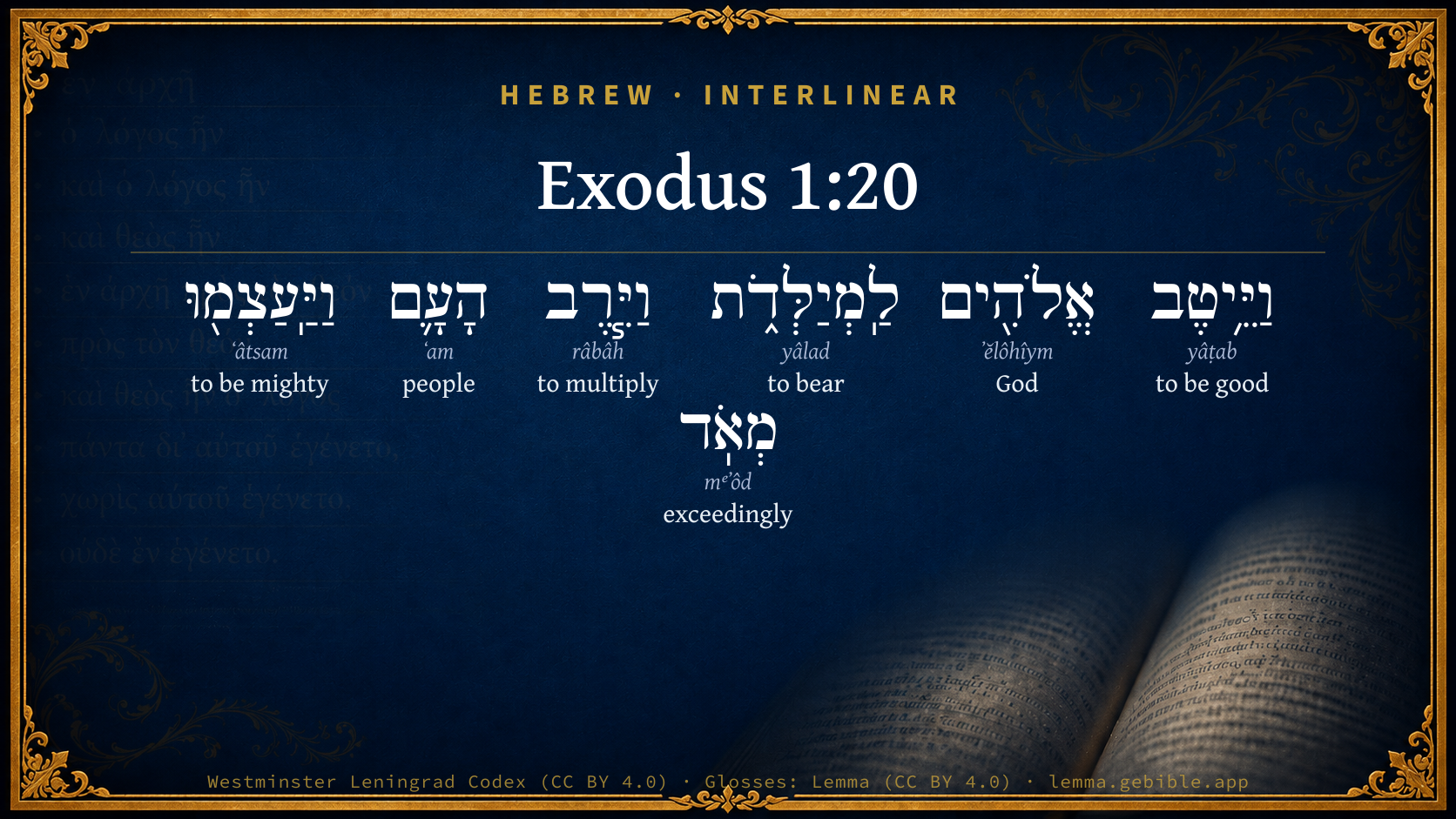
Exodus 1:20

Hebrew (Westminster Leningrad Codex) Exodus 1:20 appears in the Hebrew Old Testament. The text above is from the Westminster Leningrad Codex. Each word links to its Strong’s number, a concise gloss, and parsing drawn from the Open Scriptures Hebrew Bible morphology. Click any word for its full Brown-Driver-Briggs (BDB) entry.
Download image
Cite this verse

Exodus 1:20 (World English Bible). Public Domain. Lemma interlinear Bible study tool, https://lemma.gebible.app/v/exodus/1/20.

Show BibTeX & RIS
BibTeX
RIS
English Translation
God dealt well with the midwives, and the people multiplied, and grew very mighty.
World English Bible · Public Domain
Download a study sheet

One document with this verse’s original text, its word-by-word gloss line, the meaning frame, cross-references with their text, attributed commentary, and full source and license credits — printable, and it pastes into notes with its structure intact.

This verse Autodidact and up

Study sheet (.html) Plain text (.txt)

A passage Seminary Student

Up to 50 verses in one chapter. A passage sheet keeps up to 6 commentary sources and 12 cross-references per verse, in the order this page ranks them, and says so on the sheet whenever that leaves anything out. Ask for a single verse and you get the Autodidact verse sheet above.

Everything on this page stays free to read, with no account — the sheet is a download of what is already on screen, not access to it.

Want to remove ads? Support Godless Engineer
Compare translations 3

The same verse in 3 English versions, stacked beneath the original-language interlinear above. Click any original word for its lexicon entry.

Each is an independent rendering of the whole verse — the interlinear is not word-aligned to these translations.

Highlighted words mark where these versions differ — a whole-verse word diff, not a word-by-word alignment.

  • World English Bible Public Domain
    God dealt well with the midwives, and the people multiplied, and grew very mighty.
  • King James Version Public Domain
    Therefore God dealt well with the midwives: and the people multiplied, and waxed very mighty.
  • unfoldingWord Literal Text CC BY-SA 4.0
    And God caused good to the midwives. And the people multiplied and became very mighty.

unfoldingWord Literal Text — © unfoldingWord, licensed CC BY-SA 4.0. Word-aligned USFM3 via Door43 (git.door43.org/unfoldingWord/en_ult).

Versions to compare (up to 4)

3 of 4 selected

Show all 18 translations

Every available English version of this verse, each an independent rendering of the whole verse.

  • World English Bible Public Domain
    God dealt well with the midwives, and the people multiplied, and grew very mighty.
  • Berean Standard Bible Public Domain
    So God was good to the midwives, and the people multiplied and became even more numerous.
  • Majority Standard Bible Public Domain
    So God was good to the midwives, and the people multiplied and became even more numerous.
  • King James Version Public Domain
    Therefore God dealt well with the midwives: and the people multiplied, and waxed very mighty.
  • American Standard Version (1901) Public Domain
    And God dealt well with the midwives: and the people multiplied, and waxed very mighty.
  • Revised Version (1885) Public Domain
    And God dealt well with the midwives: and the people multiplied, and waxed very mighty.
  • Geneva Bible (1599) Public Domain
    God therefore prospered the midwiues, and the people multiplied and were very mightie.
  • Douay-Rheims (1899) Public Domain
    Therefore God dealt well with the midwives: and the people multiplied and grew exceedingly strong.
  • Young's Literal Translation Public Domain
    And God doth good to the midwives, and the people multiply, and are very mighty;
  • Literal Standard Version CC BY-SA 4.0
    And God does good to the midwives, and the people multiply, and are very mighty;
  • Unlocked Literal Bible CC BY-SA 4.0
    God protected these midwives. The people increased in numbers and became very strong.
  • unfoldingWord Literal Text CC BY-SA 4.0
    And God caused good to the midwives. And the people multiplied and became very mighty.
  • Darby Bible Public Domain
    And God dealt well with the midwives; and the people multiplied and became very strong.
  • World Messianic Bible Public Domain
    God dealt well with the midwives, and the people multiplied, and grew very mighty.
  • Webster's Bible Public Domain
    Therefore God dealt well with the midwives: and the people multiplied, and became very mighty.
  • Free Bible Version CC BY-SA 4.0
    God treated the midwives well, and the people increased in number so there were even more of them.
  • Bible in Basic English Public Domain
    And the blessing of God was on these women: and the people were increased in number and became very strong.
  • JPS Tanakh (1917) Public Domain
    And God dealt well with the midwives; and the people multiplied, and waxed very mighty.

Literal Standard Version (2020), Covenant Press — licensed CC BY-SA 4.0. Text via the HelloAO Bible API (eBible.org). Unlocked Literal Bible (unfoldingWord) — licensed CC BY-SA 4.0. Text via the HelloAO Bible API (eBible.org). unfoldingWord Literal Text — © unfoldingWord, licensed CC BY-SA 4.0. Word-aligned USFM3 via Door43 (git.door43.org/unfoldingWord/en_ult). Free Bible Version, Dr. Jonathan Gallagher — licensed CC BY-SA 4.0. Text via the HelloAO Bible API (eBible.org).

Word by word

More ways to search: Search by grammar → Find every occurrence → Compare this word →

Practice this passage: Drill this verse → Learn its vocabulary →

וַיַּֽעַצְמ֖וּ
ʻâtsam
H6105
“and · to be mighty”
Conjunction + Verb, Qal, Sequential Imperfect, 3rd Person, Masculine, Plural
Part of Speech
Conjunction + Verb
Stem
Qal
Form
Sequential Imperfect
Person
3rd Person
Gender
Masculine
Number
Plural
Full BDB Definition

Origin: a primitive root

TWOT: 1673 , 1674

to be vast, be numerous, be mighty - (Qal) - to be mighty - to be numerous - (Hiphil) to make strong, make mighty - to shut (the eyes), close (the eyes) - (Qal) to shut (the eyes) - (Piel) to shut tightly (the eyes)
  1. וַיֵּ֥יטֶב yâṭab H3190 “and · to be good” Conjunction + Verb, Hiphil, Sequential Imperfect, 3rd Person, Masculine, Singular
  2. אֱלֹהִ֖ים ʼĕlôhîym H430 “God(s)” Noun, Common, Masculine, Plural, Absolute
  3. לַֽמְיַלְּדֹ֑ת yâlad H3205 “to/for the · bearing” Preposition, Determined + Verb, Piel, Participle Active, Feminine, Plural, Absolute
  4. וַיִּ֧רֶב râbâh H7235 “and · to multiply” Conjunction + Verb, Qal, Sequential Imperfect, 3rd Person, Masculine, Singular
  5. הָעָ֛ם ʻam H5971 “the · people” Particle, Definite Article + Noun, Common, Masculine, Singular, Absolute
  6. מְאֹֽד mᵉʼôd H3966 “exceedingly” Adverb

About this verse

These counts appear in no published source. They are computed here, from the morphology-tagged text and Lemma’s own curated glosses. What Lemma adds →

7
words
7
distinct lemmas
Pentateuch
section

Notable vocabulary

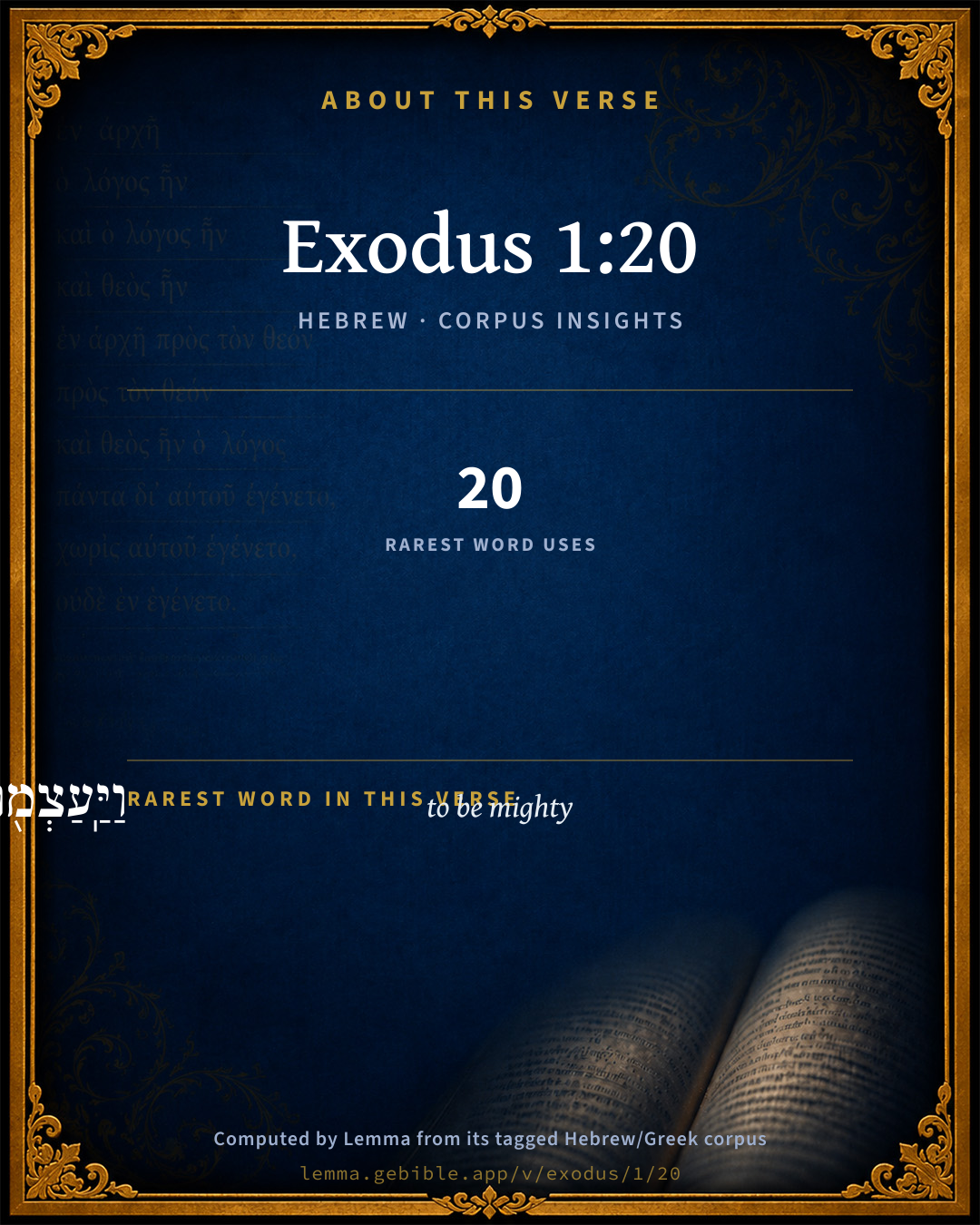
The rarest word here is וַיַּֽעַצְמ֖וּ to be mighty H6105 — appearing just 20 times in the whole Hebrew Bible.

Shared distinctive vocabulary

וַיַּֽעַצְמ֖וּ to be mighty H6105 occurs in 20 verses of the Hebrew Bible. Also found in:

Grammatical profile

  • 4 verbs
  • 2 nouns
  • 1 adverb

Verb forms

  • וַיֵּ֥יטֶב Hiphil · Sequential Imperfect
  • לַֽמְיַלְּדֹ֑ת Piel · Participle Active
  • וַיִּ֧רֶב Qal · Sequential Imperfect
  • וַיַּֽעַצְמ֖וּ Qal · Sequential Imperfect

Hebrew & Septuagint length

In English translation the verse runs 14 words from the Hebrew and 15 from the Septuagint (LXX English) — closely comparable.

A rough comparison of the two English renderings, which tokenize alike — not a word-level alignment.

Word counts can differ between the Hebrew and the Greek without any difference in meaning — e.g. the Hebrew direct-object marker אֵת has no separate Greek word, and Greek often adds the article ὁ.

Cross-references

16

Topical passages linked to Exodus 1:20 in the Treasury of Scripture Knowledge — connected by theme and wording, ordered by reader-vote popularity; previews shown in the World English Bible.

  • Ecclesiastes 8:12 Though a sinner commits crimes a hundred times, and lives long, yet surely I know that it will be better with those who fear God, who are reverent before him.
  • Isaiah 3:10 Tell the righteous "Good!" For they shall eat the fruit of their deeds.
  • Proverbs 11:18 Wicked people earn deceitful wages, But one who sows righteousness reaps a sure reward.
  • Exodus 1:12 But the more they afflicted them, the more they multiplied and the more they spread out. They were grieved because of the children of Israel.
  • Psalms 111:5 He has given food to those who fear him. He always remembers his covenant.
  • Hebrews 6:10 For God is not unrighteous, so as to forget your work and the labor of love which you showed toward his name, in that you served the saints, and still do serve them.
  • Exodus 1:7 The children of Israel were fruitful, and increased abundantly, and multiplied, and grew exceedingly mighty; and the land was filled with them.
  • Psalms 41:1–2 Blessed is he who considers the poor: Yahweh will deliver him in the day of evil.
  • Psalms 61:5 For you, God, have heard my vows. You have given me the heritage of those who fear your name.
  • Psalms 85:9 Surely his salvation is near those who fear him, That glory may dwell in our land.
  • Psalms 103:11 For as the heavens are high above the earth, So great is his loving kindness toward those who fear him.
  • Psalms 145:19 He will fulfill the desire of those who fear him. He also will hear their cry, and will save them.
  • Proverbs 19:17 He who has pity on the poor lends to Yahweh; He will reward him.
  • Matthew 10:42 Whoever gives one of these little ones just a cup of cold water to drink in the name of a disciple, most assuredly I tell you he will in no way lose his reward."
  • Matthew 25:40 "The King will answer them, 'Most assuredly I tell you, inasmuch as you did it to one of the least of these my brothers, you did it to me.'
  • Luke 1:50 His mercy is for generations of generations on those who fear him.

Cross-references courtesy of OpenBible.info (CC BY 4.0).

Hebrew and Greek witnesses Masoretic Hebrew ↔ Greek Septuagint

The same verse in the two great witnesses to the Old Testament, shown verse-for-verse.

These are two independent witnesses, not word-aligned to each other, and the Septuagint is shown in lemma (dictionary) form.

Hebrew Exodus 1:20 Masoretic · Westminster Leningrad Codex

וַיֵּ֥יטֶב אֱלֹהִ֖ים לַֽמְיַלְּדֹ֑ת וַיִּ֧רֶב הָעָ֛ם וַיַּֽעַצְמ֖וּ מְאֹֽד

God dealt well with the midwives, and the people multiplied, and grew very mighty.

World English Bible · Public Domain

Greek LXX Exodus 1:20 Septuagint · lemma form

εὖ δέ ποιέω ὁ θεός ὁ μαῖα καί πληθύνω ὁ λαός καί ἰσχύω σφόδρα

And God did well to the midwives, and the people multiplied, and grew very strong.

LXX2012 (modern English Septuagint) · Public Domain

Hebrew: Westminster Leningrad Codex (CC BY 4.0). Greek: Septuagint (public domain); English from LXX2012 (modern English Septuagint) (Public Domain). How the Septuagint differs from the Hebrew →

Targum (Aramaic paraphrase)

2

The Targum is the ancient Jewish Aramaic paraphrase of the Hebrew Scriptures — an interpretive translation, not the Hebrew text itself. Onkelos (literal) and Pseudo-Jonathan (expansive) render the Torah, and Jonathan the Prophets. Coverage is partial: where no permissively-licensed English translation exists for a verse, only the Aramaic is shown. This is verse-level text, not a word-by-word alignment to the Hebrew.

  1. Targum Onkelos Torah (Genesis–Deuteronomy)
    וְאוֹטֵּיב יְיָ לְחַיָתָא וּסְגִי עַמָא וּתְקִיפוּ לַחֲדָא:

    (no public-domain English translation for this verse)

    Targum Onkelos — Aramaic: “Onkelos Genesis” (public domain); “Onkelos Exodus” (public domain); “Onkelos Leviticus” (public domain); “Onkelos Numbers” (public domain); “Onkelos Deuteronomy” (public domain). English: “Sefaria Community Translation” (CC0 1.0 (public-domain dedication)); “J.W. Etheridge. The Targums of Onkelos and Jonathan Ben Uzziel on the Pentateuch. London: Longmans, Green, 1862” (public domain). Text via Sefaria.

  2. Targum Pseudo-Jonathan Torah (Genesis–Deuteronomy)
    וְאוֹטִיב יְיָ לְחַיְיתָא וּסְגוֹ עַמָא וּתְקִיפוּ לַחֲדָא

    And the Lord did good to the midwives, and the people multiplied and prevailed greatly.

    Targum Pseudo-Jonathan — Aramaic: “Targum Jonathan on Genesis” (public domain); “Targum Jonathan on Exodus” (public domain); “Targum Jonathan on Leviticus” (public domain); “Targum Jonathan on Numbers” (public domain); “Targum Jonathan on Deuteronomy” (public domain). English: “The Targum of Jonathan ben Uzziel, trans. J. W. Etheridge, London, 1862” (public domain). Text via Sefaria.

Commentary

Notes on Exodus 1:20 from classic Christian and Jewish commentators (each source and its license shown beneath its notes). The classic Christian expositions comment on the surrounding passage and are grouped to its opening verse, so a note may address several verses; the Jewish commentaries on the Tanakh (Rashi and others) are per-verse, so they appear only where the commentator wrote on this verse.

Lemma curates 59 commentaries, every one of them public domain or Creative Commons licensed, each selected and text-cleaned for this edition rather than reprinted as found. About our sources →

Trapp's Complete Commentary

John Trapp

Exo 1:20 Therefore God dealt well with the midwives: and the people multiplied, and waxed very mighty.

Ver. 20. Dealt well with the midwives.] God is a liberal paymaster: and his retributions are more than bountiful. "Be ye therefore steadfast and unmoveable, always abounding in the work of the Lord, forasmuch as ye know that your labour is not in vain in the Lord." {1Co 15:58}

And the people multiplied.] Sic divinum consilium dum devitatur, impletur: humana sapientia, dum reluctatur, comprehenditur, as Gregory hath it. {a} "There are many devices in the heart of a man: but the counsel of the Lord, that shall stand." {Pro 19:21} Among the Romans, the more children any man had, the more he was freed from public burdens. And of Adrian the Emperor it is storied, that when those that had many children were accused of any crime, he mitigated their punishment according to the number of their children. {b} But these poor Israelites were otherwise used.

{a} Greg., Moral.

{b} Dio, in Adriano.

John Trapp, A Commentary or Exposition upon All the Books of the Old and New Testament (1647–1656) — public domain. Text from a community e-Sword module.

Joseph Benson's Commentary

Exo 1:20-21. God dealt well with the midwives — he made them houses — He blessed them in kind: for as they kept up Israel’s houses or families, so God, in recompense, built them up into families, blessed their children, and made them prosperous. But a late learned writer interprets the passage as follows: Pharaoh, resolving effectually to prevent the increase of the Israelites, built houses for them, that so they might no longer have it in their power to lodge their women in child-bed out of the way to save their children, by removing them from place to place, as they had before done when they lived in the fields in tents, which was their ancient way of living. But the other seems the true interpretation.

Joseph Benson's Commentary on the Old and New Testaments (1811–1818) — public domain. Text from a community e-Sword module.

Tyndale Open Study Notes

Tyndale Open Resources

1:20-21 he gave them families: For most of history, children have had the worthy goal of growing up to raise a family. God graciously granted the universal wish of these women who served him courageously and faithfully.

Tyndale Open Study Notes — © Tyndale Open Resources, licensed CC BY-SA 4.0. Text via the HelloAO Bible API.

Jamieson, Fausset & Brown

Robert Jamieson, A. R. Fausset & David Brown

God dealt well with the midwives--This represents God as rewarding them for telling a lie. This difficulty is wholly removed by a more correct translation. To "make" or "build up a house" in Hebrew idiom, means to have a numerous progeny. The passage then should be rendered thus: "God protected the midwives, and the people waxed very mighty; and because the midwives feared, the Hebrews grew and prospered."

Next: Exodus Chapter 2

Jamieson, Fausset & Brown — Commentary Critical and Explanatory on the Whole Bible (1871) — public domain (CC PDM 1.0). Text via the HelloAO Bible API.

Adam Clarke's Commentary

Verse 20. Therefore God dealt well with the midwives: and the people multiplied, and waxed very mighty.] This shows an especial providence and blessing of God; for though in all cases where females are kept to hard labour they have comparatively easy and safe travail, yet in a state of slavery the increase is generally very small, as the children die for want of proper nursing, the women, through their labour, being obliged to neglect their offspring; so that in the slave countries the stock is obliged to be recruited by foreign imports: yet in the case above it was not so; there was not one barren among their tribes, and even their women, though constantly obliged to perform their daily tasks, were neither rendered unfruitful by it, nor taken off by premature death through the violence and continuance of their labour, when even in the delicate situation mentioned above.

Adam Clarke's Commentary on the Bible (1810–1826) — public domain. Text from a community e-Sword/MySword module.

Ellicott's Commentary for English Readers

(20) Therefore God dealt well with the midwives.—Heb., and God dealt well, &c. The reason is stated in Exo_1:21. It was not because they equivocated and deceived the king, but because they feared God sufficiently to disobey the king, and run the risk of discovery. If they had been discovered, their life would have paid the forfeit.

A Bible Commentary for English Readers, edited by Charles John Ellicott (1878–1897) — public domain. Text from a community e-Sword module.

The Cambridge Bible for Schools and Colleges

gen. ed. J. J. S. Perowne

20b. Assigned to J, because, while agreeing with v. 7, even in expression—‘âṣam, to wax mighty, occurs elsewhere in prose only in Gen_26:16, also J—it seems to imply a far greater people than is done by vv. 15–20a.

The Cambridge Bible for Schools and Colleges (gen. ed. J. J. S. Perowne; Cambridge University Press, 1878–1918) — public domain. Text from a community e-Sword module.

John Gill's Exposition

Wherefore God dealt well with the midwives,.... He approved of their conduct upon the whole, however difficult it may be to clear them from all blame in this matter; though some think that what they said was the truth, though they might not tell all the truth; yea, that they made a glorious confession of their faith in God, and plainly told the king, that it was nothing but the immediate hand of God that the Hebrew women were so lively and strong, and therefore were resolved not to oppose it, let him command what he would; so Dr. Lightfoot (r), who takes the midwives to be Egyptians:

and the people multiplied, and waxed very mighty; became very numerous, and strong, and robust, being the offspring of such lively women.

(r) Works, vol. 1. p. 700.

John Gill's Exposition of the Whole Bible (1746–1763) — public domain (CC PDM 1.0). Text via the HelloAO Bible API.

Matthew Poole's English Annotations

Therefore, because they feared God, and spared the children, Exo 1:17, whereby they exposed themselves to the king’s displeasure; because they would not offend God by murdering the children, which they might have done many times secretly, and therefore it was only the fear of God which restrained them from it.

Matthew Poole's English Annotations on the Holy Bible (1683–1685) — public domain. Text from a community e-Sword/MySword module.

Whedon's Commentary on the Bible

Daniel D. Whedon

20. God dealt well with the mid-wives — Augustine well says: “Not their falsehood, but their mercy, kindness, and fear of God, were rewarded. For the sake of the good, God forgave the evil.” It was well that the fear of God kept them from murder; it had been better if it had also kept them from falsehood.

Daniel D. Whedon (gen. ed.), Commentary on the Old and New Testaments (1874–1909) — public domain. Text from a community e-Sword module.

The Pulpit Commentary

Vers. 20, 21. Therefore God did well to the midwives. Literally, "And God did well," etc. (see ver. 21). Because they feared him sufficiently to disobey the king, and take their chance of a punishment, which might have been very severe-even perhaps death God overlooked their weak and unfaithful divergence from truth, and gave them a reward. He made them houses. He Messed them by giving them children of their own, who grew up, and gave them the comfort, support, and happiness which children were intended to give. There was a manifest fitness in rewarding those who had refused to bring misery and desolation into families by granting them domestic happiness themselves.

The Pulpit Commentary (1880–1919), ed. H.D.M. Spence-Jones & Joseph S. Exell — public domain. Text from a community e-Sword module.

John Wesley's Explanatory Notes

Therefore God dealt well with them - That is, built them up in families, and blessed their children.

John Wesley, Explanatory Notes Upon the Whole Bible (1754–1765) — public domain. Text via the GEBible commentary corpus.

Keil & Delitzsch

C. F. Keil & F. Delitzsch

God rewarded them for their conduct, and "made them houses," i.e., gave them families and preserved their posterity. In this sense to "make a house" in Sa2 7:11 is interchanged with to "build a house" in Sa2 7:27 (vid., Rut 4:11). להם for להן as in Gen 31:9, etc. Through not carrying out the ruthless command of the king, they had helped to build up the families of Israel, and their own families were therefore built up by God. Thus God rewarded them, "not, however, because they lied, but because they were merciful to the people of God; it was not their falsehood therefore that was rewarded, but their kindness (more correctly, their fear of God), their benignity of mind, not the wickedness of their lying; and for the sake of what was good, God forgave what was evil." (Augustine, contra mendac. c. 19.)

Keil & Delitzsch — Biblical Commentary on the Old Testament (1861–1891) — public domain (CC PDM 1.0). Text via the HelloAO Bible API. (Old Testament only.)

unfoldingWord translationNotes

Door43 World Missions Community

God protected these midwives

God kept Pharaoh from killing these midwives.

midwives

These were women who helped a woman give birth to a baby. See how you translated this in Exodus 1:16.

The people increased in numbers

"The Israelites increased in numbers"

feared God

"revered God" or "had reverence for God"

he gave them families

"the enabled them to have children"

You must throw every son ... into the river

This order was given in order to drown the male children. The full meaning of this may be made explicit. AT: "You must ... into the river so they will drown" (See: Assumed Knowledge and Implicit Information)

translationWords

fear

God

family

unfoldingWord translationNotes — © Distant Shores Media and the Door43 World Missions Community, licensed CC BY-SA 4.0. Source: git.door43.org/Door43/en_tn.

Rashi

Rabbi Shlomo Yitzchaki (Rashi)

וַיֵּיטָב means HE DID GOOD TO THEM. — The following is the difference between certain forms in a word (verb) whose root is two letters when one prefixes ו and י to them: when it intends to express the meaning “and he caused someone or something to do a particular action” (i. e. the 3rd masc. sing, imperf. Hiphil with Vau conversive), the י has the vowel Tzéré which is what we call Kametz Katan, as, (in this verse) “And God dealt well (וַיֶּיטָב) with the midwives” (to Rashi the root it טב; we take it as יטב); (Lamentations 2:5) “וַיָרָב for the daughter of Judah [mourning]” i. e. He increased (made great) the mourning; (root רֹב; we take it as רבה). Similarly (II Chronicles 36:20) “וַיָּגָל the remnant” which occurs in connection with Nebuzaradon, i. e. he caused the remnant to be exiled; (Judges 15:4) וַיָּפָן tail to tail”, i. e. he turned the tails one towards the other (more lit., he caused one tail to turn to the other) — all these express the meaning “he caused others to do something” (i. e. they are of the Hiphil conjugation). When, however, it speaks in the sense of “and he did something” (3rd masc. sing, imperf. Kal with Vau conv.), the י has the vowel Chirik. For example, (Leviticus 10:20) “וַיִיטַב in his eyes” — this means, “it was good”. Similarly (in this verse) the people”, i. e. the people became many; (2 Kings 25:21) “וַיִגָל Judah”, i. e. Judah became an exile; (2:12) “וַיִפֵן this way and that way”, i. e. he turned this way and that way. Do not answer me (do not raise an objection) by quoting the words וַיֵּלֶךְ and וַיֵּשֶׁב and וַיַרֶד and וַיֵּצֵא (saying that these verbal forms also have ו and י prefixed and the י has the vowel Tzéré and yet they are Kal, not Hiphil forms), because these are not of the same class of verbs as those above-mentioned, for the י is part of the root in them — in יֵלֵךְ and יֵשֵׁב and יֵרֵד and יֵצֵא, the י is a third root letter in each of these.

וייטב אלהים למילדת THEREFORE GOD DEALT WELL WITH THE MIDWIVES — What was the good He dealt out to them? The next verse gives the reply to this —

Rashi on the Tanakh — English translations: “The Judaica Press complete Tanach with Rashi, translated by A. J. Rosenberg” (CC BY 4.0); “Pentateuch with Rashi's commentary by M. Rosenbaum and A.M. Silbermann, 1929-1934” (public domain); “The Metsudah Tanach series, Lakewood, N.J” (CC BY 4.0); and “The Book of Joshua, Metsudah Publications, 1997” (CC BY 4.0). Text via Sefaria.

Lesson kit

Teaching starters — assembled from the data on this page, not authored interpretation. Every prompt links to the verse data it draws on. Edit before teaching.

Exodus, in the Pentateuch, opens this verse with 7 words (7 distinct Hebrew lemmas). Its most distinctive word is ʻâtsam (“to be mighty”). A historical commentator’s framing appears above. Read the whole chapter for the surrounding context.

Discussion questions

  1. What does “to be mighty” (ʻâtsam) contribute to the verse as a whole?
  2. How does Genesis 26:16, which shares the word «to be mighty», read alongside this verse?
  3. These translations render this verse differently. What is at stake in choosing one wording over another?
  4. «וַיֵּ֥יטֶב» is a Hiphil Sequential Imperfect verb. How does that grammatical form shape the action described?
  5. Compare how Trapp's Complete Commentary and Joseph Benson's Commentary read this verse. Where do they agree or differ?

Things to notice

Reading settings

Reading text

Shown beneath each verse's original-language words.

Old Testament
Old Testament edition

Read the OT as the Masoretic Hebrew (MT) or the Greek Septuagint (LXX).

English shown for the Greek Septuagint (in the Hebrew ↔ Greek comparison).

Comparing translations? Open the Compare panel on any verse page to stack up to four side by side.