

Judges 13:8

Hebrew (Westminster Leningrad Codex) Judges 13:8 appears in the Hebrew Old Testament. The text above is from the Westminster Leningrad Codex. Each word links to its Strong’s number, a concise gloss, and parsing drawn from the Open Scriptures Hebrew Bible morphology. Click any word for its full Brown-Driver-Briggs (BDB) entry.
Download image
Cite this verse

Judges 13:8 (World English Bible). Public Domain. Lemma interlinear Bible study tool, https://lemma.gebible.app/v/judges/13/8.

Show BibTeX & RIS
BibTeX
RIS
English Translation
Then Manoah entreated Yahweh, and said, Oh, Lord, please let the man of God whom you did send come again to us, and teach us what we shall do to the child who shall be born.
World English Bible · Public Domain
Download a study sheet

One document with this verse’s original text, its word-by-word gloss line, the meaning frame, cross-references with their text, attributed commentary, and full source and license credits — printable, and it pastes into notes with its structure intact.

This verse Autodidact and up

Study sheet (.html) Plain text (.txt)

A passage Seminary Student

Up to 50 verses in one chapter. A passage sheet keeps up to 6 commentary sources and 12 cross-references per verse, in the order this page ranks them, and says so on the sheet whenever that leaves anything out. Ask for a single verse and you get the Autodidact verse sheet above.

Everything on this page stays free to read, with no account — the sheet is a download of what is already on screen, not access to it.

Want to remove ads? Support Godless Engineer
Compare translations 3

The same verse in 3 English versions, stacked beneath the original-language interlinear above. Click any original word for its lexicon entry.

Each is an independent rendering of the whole verse — the interlinear is not word-aligned to these translations.

Highlighted words mark where these versions differ — a whole-verse word diff, not a word-by-word alignment.

  • World English Bible Public Domain
    Then Manoah entreated Yahweh, and said, Oh, Lord, please let the man of God whom you did send come again to us, and teach us what we shall do to the child who shall be born.
  • King James Version Public Domain
    Then Manoah intreated the LORD, and said, O my Lord, let the man of God which thou didst send come again unto us, and teach us what we shall do unto the child that shall be born.
  • unfoldingWord Literal Text CC BY-SA 4.0
    And Manoah prayed to Yahweh and said, “Please, my Lord, the man of God whom you sent, please let him come again to us and teach us what we should do for the boy, the one to be born.”

unfoldingWord Literal Text — © unfoldingWord, licensed CC BY-SA 4.0. Word-aligned USFM3 via Door43 (git.door43.org/unfoldingWord/en_ult).

Versions to compare (up to 4)

3 of 4 selected

Show all 18 translations

Every available English version of this verse, each an independent rendering of the whole verse.

  • World English Bible Public Domain
    Then Manoah entreated Yahweh, and said, Oh, Lord, please let the man of God whom you did send come again to us, and teach us what we shall do to the child who shall be born.
  • Berean Standard Bible Public Domain
    Then Manoah prayed to the LORD, “Please, O Lord, let the man of God You sent us come to us again to teach us how to raise the boy who is to be born.”
  • Majority Standard Bible Public Domain
    Then Manoah prayed to the LORD, “Please, O Lord, let the man of God You sent us come to us again to teach us how to raise the boy who is to be born.”
  • King James Version Public Domain
    Then Manoah intreated the LORD, and said, O my Lord, let the man of God which thou didst send come again unto us, and teach us what we shall do unto the child that shall be born.
  • American Standard Version (1901) Public Domain
    Then Manoah entreated Jehovah, and said, Oh, Lord, I pray thee, let the man of God whom thou didst send come again unto us, and teach us what we shall do unto the child that shall be born.
  • Revised Version (1885) Public Domain
    Then Manoah entreated the LORD, and said, Oh Lord, I pray thee, let the man of God whom thou didst send come again unto us, and teach us what we shall do onto the child that shall be born.
  • Geneva Bible (1599) Public Domain
    Then Manoah prayed to the Lord and saide, I pray thee, my Lord, Let the man of God, whome thou sentest, come againe nowe vnto vs, and teach vs what we shall doe vnto the child when he is borne.
  • Douay-Rheims (1899) Public Domain
    Then Manue prayed to the Lord, and said: I beseech thee, O Lord, that the mail of God, whom thou didst send, may come again, and teach us what we ought to do concerning the child that shall be born.
  • Young's Literal Translation Public Domain
    And Manoah maketh entreaty unto Jehovah, and saith, `O, my Lord, the man of God whom Thou didst send, let him come in, I pray thee, again unto us, and direct us what we do to the youth who is born.'
  • Literal Standard Version CC BY-SA 4.0
    And Manoah makes plea to YHWH and says, “O my Lord, the Man of God whom You sent, please let Him come in again to us, and direct us what we do to the youth who is born.”
  • Unlocked Literal Bible CC BY-SA 4.0
    Then Manoah prayed to Yahweh and said, “Oh, Lord, please let the man of God you sent come again to us so that he may teach us what we are to do for the child who soon will be born.”
  • unfoldingWord Literal Text CC BY-SA 4.0
    And Manoah prayed to Yahweh and said, “Please, my Lord, the man of God whom you sent, please let him come again to us and teach us what we should do for the boy, the one to be born.”
  • Darby Bible Public Domain
    Then Mano'ah entreated the LORD, and said, "O, LORD, I pray thee, let the man of God whom thou didst send come again to us, and teach us what we are to do with the boy that will be born."
  • World Messianic Bible Public Domain
    Then Manoah entreated the LORD, and said, “Oh, Lord, please let the man of God whom you sent come again to us, and teach us what we should do to the child who shall be born.”
  • Webster's Bible Public Domain
    Then Manoah entreated the LORD, and said, O my Lord, let the man of God, whom thou didst send come again to us, and teach us what we shall do to the child that shall be born.
  • Free Bible Version CC BY-SA 4.0
    Then Manoah prayed to the Lord, “Please, Lord, let the man of God you sent us return to us to explain what we're supposed to do with the boy who is to be born.”
  • Bible in Basic English Public Domain
    Then Manoah made prayer to the Lord, and said, O Lord, let the man of God whom you sent come to us again and make clear to us what we are to do for the child who is to come.
  • JPS Tanakh (1917) Public Domain
    Then Manoah entreated the LORD, and said: 'Oh, LORD, I pray Thee, let the man of God whom Thou didst send come again unto us, and teach us what we shall do unto the child that shall be born.'

Literal Standard Version (2020), Covenant Press — licensed CC BY-SA 4.0. Text via the HelloAO Bible API (eBible.org). Unlocked Literal Bible (unfoldingWord) — licensed CC BY-SA 4.0. Text via the HelloAO Bible API (eBible.org). unfoldingWord Literal Text — © unfoldingWord, licensed CC BY-SA 4.0. Word-aligned USFM3 via Door43 (git.door43.org/unfoldingWord/en_ult). Free Bible Version, Dr. Jonathan Gallagher — licensed CC BY-SA 4.0. Text via the HelloAO Bible API (eBible.org).

Word by word

More ways to search: Search by grammar → Find every occurrence → Compare this word →

Practice this passage: Drill this verse → Learn its vocabulary →

בִּ֣י
bîy
H994
“please”
Particle, Exhortation
Part of Speech
Particle
Type
Exhortation
Full BDB Definition

Origin: perhaps from H1158 (sense of asking)

TWOT: 238a

if it please, pray excuse me, excuse me please - used to introduce an entreaty or request
  1. וַיֶּעְתַּ֥ר ʻâthar H6279 “and · to pray” Conjunction + Verb, Qal, Sequential Imperfect, 3rd Person, Masculine, Singular
  2. מָנ֛וֹחַ Mânôwach H4495 “Manoah” Noun, Proper
  3. אֶל ʼêl H413 “to” Preposition
  4. יְהוָ֖ה Yᵉhôvâh H3068 “LORD” Noun, Proper
  5. וַיֹּאמַ֑ר ʼâmar H559 “and · to say” Conjunction + Verb, Qal, Sequential Imperfect, 3rd Person, Masculine, Singular
  6. אֲדוֹנָ֔י ʼĂdônây H136 “Lord · my” Noun, Common, Masculine, Plural, Construct + Suffix, Personal, 1st Person, Common, Singular
  7. אִ֣ישׁ ʼîysh H376 “man of” Noun, Common, Masculine, Singular, Construct
  8. הָאֱלֹהִ֞ים ʼĕlôhîym H430 “the · God(s)” Particle, Definite Article + Noun, Common, Masculine, Plural, Absolute
  9. אֲשֶׁ֣ר ʼăsher H834 “which” Particle, Relative
  10. שָׁלַ֗חְתָּ shâlach H7971 “to send” Verb, Qal, Perfect, 2nd Person, Masculine, Singular
  11. יָבוֹא bôwʼ H935 “to enter” Verb, Qal, Jussive, 3rd Person, Masculine, Singular
  12. נָ֥א nâʼ H4994 “please” Particle, Exhortation
  13. עוֹד֙ ʻôwd H5750 “still” Adverb
  14. אֵלֵ֔ינוּ ʼêl H413 “to · us” Preposition + Suffix, Personal, 1st Person, Common, Plural
  15. וְיוֹרֵ֕נוּ yârâh H3384 “and · to throw · us” Conjunction + Verb, Hiphil, Imperfect, 3rd Person, Masculine, Singular + Suffix, Personal, 1st Person, Common, Plural
  16. מַֽה mâh H4100 “what” Particle, Interrogative
  17. נַּעֲשֶׂ֖ה ʻâsâh H6213 “to do” Verb, Qal, Imperfect, 1st Person, Common, Plural
  18. לַנַּ֥עַר naʻar H5288 “to/for the · boy” Preposition, Determined + Noun, Common, Masculine, Singular, Absolute
  19. הַיּוּלָּֽד yâlad H3205 “the the · borne” Preposition, Determined + Verb, Qal Passive, Participle Passive, Masculine, Singular, Absolute

About this verse

These counts appear in no published source. They are computed here, from the morphology-tagged text and Lemma’s own curated glosses. What Lemma adds →

20
words
19
distinct lemmas
Historical
section

Notable vocabulary

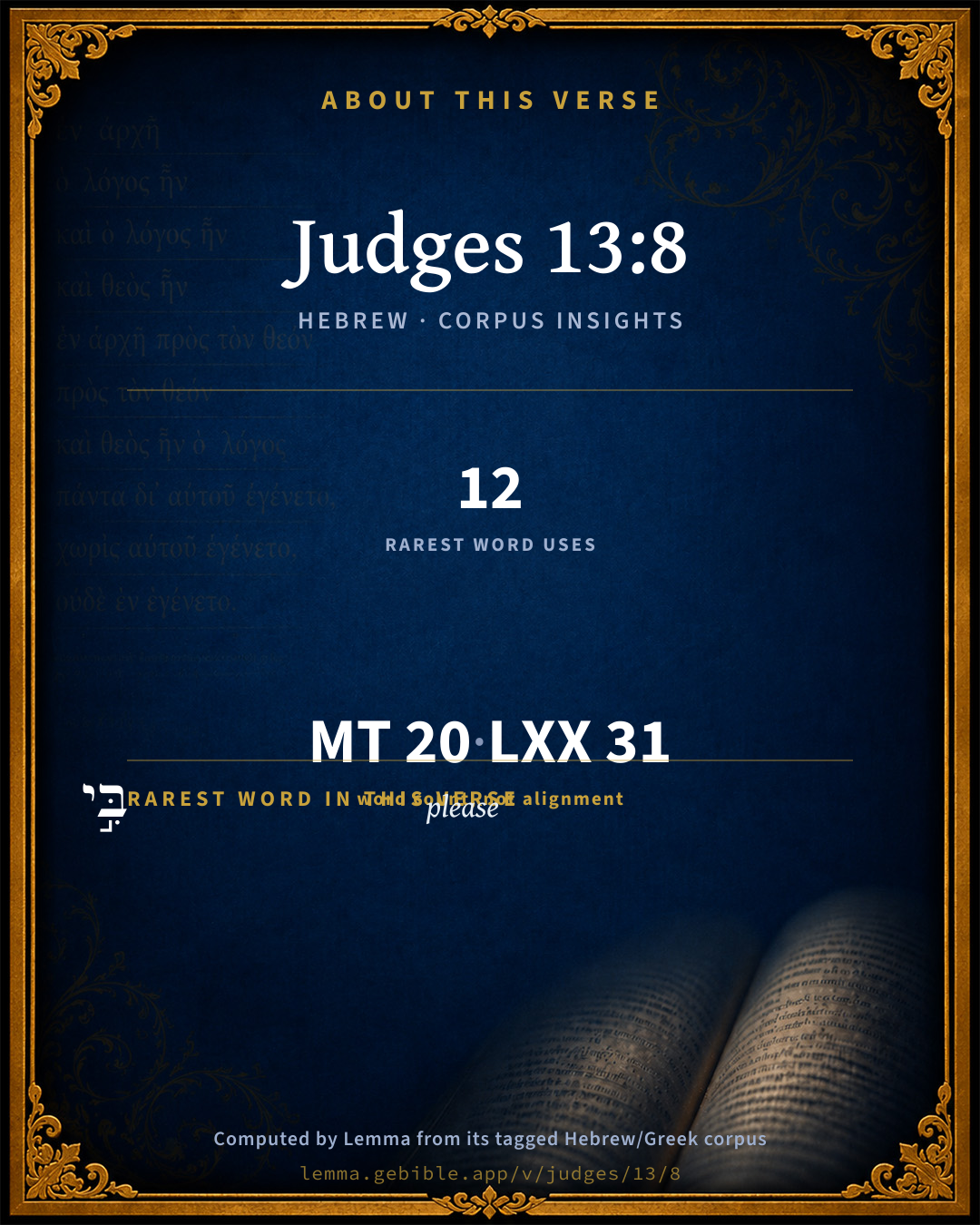
The rarest word here is בִּ֣י please H994 — appearing just 12 times in the whole Hebrew Bible.

Shared distinctive vocabulary

בִּ֣י please H994 occurs in 12 verses of the Hebrew Bible. Also found in:

Grammatical profile

  • 7 verbs
  • 6 nouns
  • 2 prepositions
  • 1 adverb
  • 4 particles

Verb forms

  • וַיֶּעְתַּ֥ר Qal · Sequential Imperfect
  • וַיֹּאמַ֑ר Qal · Sequential Imperfect
  • שָׁלַ֗חְתָּ Qal · Perfect
  • יָבוֹא Qal · Jussive
  • וְיוֹרֵ֕נוּ Hiphil · Imperfect
  • נַּעֲשֶׂ֖ה Qal · Imperfect
  • הַיּוּלָּֽד Qal Passive · Participle Passive

Repetition

A word recurs within this verse — often emphatic in Hebrew:

  • אֶל to H413 ×2

Hebrew & Septuagint length

In English translation the verse runs 36 words from the Hebrew and 45 from the Septuagint (LXX English) — closely comparable.

A rough comparison of the two English renderings, which tokenize alike — not a word-level alignment.

Word counts can differ between the Hebrew and the Greek without any difference in meaning — e.g. the Hebrew direct-object marker אֵת has no separate Greek word, and Greek often adds the article ὁ.

In the original languages it is 20 Hebrew tokens and 31 Greek tokens — but the two are counted differently (Hebrew bundles its prefixes and suffixes into one token; the Greek is in lemma form), so that isn’t a like-for-like length.

Cross-references

3

Topical passages linked to Judges 13:8 in the Treasury of Scripture Knowledge — connected by theme and wording, ordered by reader-vote popularity; previews shown in the World English Bible.

  • Acts 9:6 But rise up, and enter into the city, and you will be told what you must do."
  • Job 34:32 Teach me that which I don't see. If I have done iniquity, I will do it no more'?
  • Proverbs 3:5–6 Trust in Yahweh with all your heart, And don't lean on your own understanding.

Cross-references courtesy of OpenBible.info (CC BY 4.0).

Hebrew and Greek witnesses Masoretic Hebrew ↔ Greek Septuagint

The same verse in the two great witnesses to the Old Testament, shown verse-for-verse.

These are two independent witnesses, not word-aligned to each other, and the Septuagint is shown in lemma (dictionary) form.

Hebrew Judges 13:8 Masoretic · Westminster Leningrad Codex

וַיֶּעְתַּ֥ר מָנ֛וֹחַ אֶל יְהוָ֖ה וַיֹּאמַ֑ר בִּ֣י אֲדוֹנָ֔י אִ֣ישׁ הָאֱלֹהִ֞ים אֲשֶׁ֣ר שָׁלַ֗חְתָּ יָבוֹא נָ֥א עוֹד֙ אֵלֵ֔ינוּ וְיוֹרֵ֕נוּ מַֽה נַּעֲשֶׂ֖ה לַנַּ֥עַר הַיּוּלָּֽד

Then Manoah entreated Yahweh, and said, Oh, Lord, please let the man of God whom you did send come again to us, and teach us what we shall do to the child who shall be born.

World English Bible · Public Domain

Greek LXX Judges 13:8 Septuagint · lemma form

καί προςεὔχομαι μανωε πρός κύριος καί εἶπον ἐν ἐγώ κύριος ἀδωναϊέ ὁ ἄνθρωπος ὁ θεός ὅς ἀποστέλλω ἔρχομαι δή ἔτι πρός ἐγώ καί συνβιβάζω ἐγώ τίς ποιέω ὁ παιδίον ὁ τίκτω

And Manoe prayed to the Lord and said, I pray you, O Lord my lord, concerning the man of God whom you sent; let him now come to us once more, and teach us what we shall do to the child about to be born.

LXX2012 (modern English Septuagint) · Public Domain

Hebrew: Westminster Leningrad Codex (CC BY 4.0). Greek: Septuagint (public domain); English from LXX2012 (modern English Septuagint) (Public Domain). How the Septuagint differs from the Hebrew →

Targum (Aramaic paraphrase)

1

The Targum is the ancient Jewish Aramaic paraphrase of the Hebrew Scriptures — an interpretive translation, not the Hebrew text itself. Onkelos (literal) and Pseudo-Jonathan (expansive) render the Torah, and Jonathan the Prophets. Coverage is partial: where no permissively-licensed English translation exists for a verse, only the Aramaic is shown. This is verse-level text, not a word-by-word alignment to the Hebrew.

  1. Targum Jonathan Prophets (Joshua–Malachi)
    וְצַלִי מָנוֹחַ קֳדָם יְיָ וַאֲמַר בְבָעוּ יְיָ נְבִיָא דַייָ דִשְׁלַחְתָּא יֵיתֵי כְעַן עוֹד לְוָתָנָא וְיַלְפִינָנָא מַה נַעְבֵּד לְרַבְיָא דְאִתְיְלִיד:

    (no public-domain English translation for this verse)

    Targum Jonathan — Aramaic: “Mikraot Gedolot” (public domain). English: “Sefaria Community Translation” (CC0 1.0 (public-domain dedication)); “London "Chaldee Paraphrase," 1871” (public domain). Text via Sefaria.

Commentary

Notes on Judges 13:8 from classic Christian and Jewish commentators (each source and its license shown beneath its notes). The classic Christian expositions comment on the surrounding passage and are grouped to its opening verse, so a note may address several verses; the Jewish commentaries on the Tanakh (Rashi and others) are per-verse, so they appear only where the commentator wrote on this verse.

Lemma curates 59 commentaries, every one of them public domain or Creative Commons licensed, each selected and text-cleaned for this edition rather than reprinted as found. About our sources →

Matthew Henry's Commentary

We have here an account of a second visit which the angel of God made to Manoah and his wife.

I. Manoah earnestly prayed for it, Jdg 13:8. He was not incredulous of the story his wife told him; he knew she was a virtuous woman, and therefore the heart of her husband did safely trust in her; he knew she would not go about to impose upon him, much less was he, as Josephus unworthily represents him, jealous of his wife's conversation with this stranger; but, 1. He takes it for granted that this child of promise shall in due time be given them, and speaks without hesitation of the child that shall be born. There was not found so great faith, no, not in Zechariah, a priest, then in waiting at the altar of the Lord, and to whom the angel himself appeared, as was in this honest Danite. Things hidden from the wise and prudent, who value themselves upon the niceness of their enquiries, are often revealed unto babes, who know how to prize God's gifts and to take God's word. Blessed are those that have not seen and yet, as Manoah here, have believed. 2. All his care is what they should do to the child that should be born. Note, Good men are more solicitous and desirous to know the duty that is to be done by them than to know the events that shall occur concerning them; for duty is ours, events are God's. Solomon enquires concerning the good men should do, not the good they should have, Ecc 2:3. 3. He therefore prays to God to send the same blessed messenger again, to give them further instructions concerning the management of this Nazarite, fearing lest his wife's joy for the promise might have made her forget some part of the precept, in which he was desirous to be fully informed, and lie under no mistake: "Lord, let the man of God come again unto us, for we desire to be better acquainted with him." Note, Those that have heard from heaven cannot but wish to hear more thence, again and again to meet with the man of God. Observe, He does not go or send his servants abroad, to find out this man of God, but seeks him upon his knees, prays to God to send him, and, thus seeking, finds him. Would we have God's messengers, the ministers of his gospel, to bring a word proper for us, and for our instruction? Entreat the Lord to send them to us, to teach us, Rom 15:30, Rom 15:32.

II. God graciously granted it: God hearkened to the voice of Manoah, Jdg 13:9. Note, God will not fail some way or other to guide those by his counsel that are sincerely desirous to know their duty, and apply themselves to him to teach them, Psa 25:8, Psa 25:9.

1. The angel appears the second time also to the wife, when she is sitting alone, probably tending the flocks, or otherwise well employed in the field where she has retired. Solitude is often a good opportunity of communion with God; good people have thought themselves never less alone than when alone, if God be with them.

2. She goes in all haste to call her husband, doubtless humbly beseeching the stay of this blessed messenger till she should return and her husband with her, Jdg 13:10, Jdg 13:11. She did not desire him to go with her to her husband, but would fetch her husband to him. Those that would meet with God must attend where he is pleased to manifest himself. "Oh," says she, overjoyed, "my dear love, thy prayers are answered - yonder is the man of God, come to make us another visit - he that came the other day," or, as some read it, this day, for other is not in the original, and it is probable enough that both these visits were on the same day, and at the same place, and that the second time she sat expecting him. The man of God is very willing she should call her husband, Joh 4:16. Those that have an acquaintance with the things of God themselves should invite others to the same acquaintance, Joh 1:45, Joh 1:46. Manoah is not disgusted that the angel did not this second time appear to him, but very willingly goes after his wife to the man of God. To atone (as it were) for the first fatal miscarriage, when Eve earnestly pressed Adam to that which was evil, and he too easily yielded to her, let yoke-fellows excite one another to love and good works; and, if the wife will lead, let not the husband think it any disparagement to him to follow her in that which is virtuous and praiseworthy.

3. Manoah having come to the angel, and being satisfied by him that he was the same that had appeared to his wife, does, with all humility, (1.) Welcome the promise (Jdg 13:12): Now let thy words come to pass; this was the language, not only of his desire, but of his faith, like that of the blessed Virgin, Luk 1:38. "Be it according to thy word. Lord, I lay hold on what thou hast said, and depend upon it; let it come to pass." (2.) Beg that the prescriptions given might be repeated: How shall we order the child? The directions were given to his wife, but he looks upon himself as concerned to assist her in the careful management of this promised seed, according to order; for the utmost care of both the parents, and their constant joint endeavour, are little enough to be engaged for the good ordering of children that are devoted to God and to be brought up for him. Let not one devolve it on the other, but both do their best. Observe from Manoah's enquiry, [1.] In general, that, when God is pleased to bestow any mercy upon us, our great care must be how to use it well, and as we ought, because it is then only a mercy indeed when it is rightly managed. God has given us bodies, souls, estates; how shall we order them, that we may answer the intent of the donor, and give a good account of them? [2.] In particular, those to whom God has given children must be very careful how they order them, and what they do unto them, that they may drive out the foolishness that is bound up in their hearts, form their minds and manners well betimes, and train them in the way wherein they should go. Herein pious parents will beg divine assistance. "Lord, teach us how we may order our children, that they may be Nazarites, and living sacrifices to thee."

4. The angel repeats the directions he had before given (Jdg 13:13, Jdg 13:14): Of all that I forbad let her beware; and all that I commanded her let her observe. Note, There is need of a good deal both of caution and observation, for the right ordering both of ourselves and of our children. Beware and observe; take heed not only of drinking wine or strong drink, but of eating any thing that cometh of the vine. Those that would preserve themselves pure must keep at a distance from that which borders upon sin or leads to it. When she was with child of a Nazarite, she must not eat any unclean thing; so those in whom Christ is formed must carefully cleanse themselves from all filthiness of flesh and spirit, and do nothing to the prejudice of that new man.

Matthew Henry's Commentary on the Whole Bible (1708–1710) — public domain (CC PDM 1.0). Text via the HelloAO Bible API.

Trapp's Complete Commentary

John Trapp

Jdg 13:8 Then Manoah intreated the LORD, and said, O my Lord, let the man of God which thou didst send come again unto us, and teach us what we shall do unto the child that shall be born.

Ver. 8. Then Manoah entreated the Lord.] So should we as oft as any difficulty ariseth in wedlock, or otherwise, especially about the breeding or disposing of our dear children. There is a woe to such as "take counsel, but not of God; and that cover with a covering, but not of his Spirit." {Isa 30:1}

John Trapp, A Commentary or Exposition upon All the Books of the Old and New Testament (1647–1656) — public domain. Text from a community e-Sword module.

Joseph Benson's Commentary

Jdg 13:8. Then Manoah entreated the Lord, &c. — Not hesitating or doubting, on account of his wife’s long barrenness, he believed the heavenly message, and looked upon the thing as quite certain, only he desired that the man of God might appear to them again, to instruct them in what manner they should treat the child when it should be born. And God graciously answered his humble petition.

Joseph Benson's Commentary on the Old and New Testaments (1811–1818) — public domain. Text from a community e-Sword module.

Lange's Commentary on the Holy Scriptures

Manoah, believing, yet desirous of confirmation, prays that the “Man of God” may return, and is heard

Jdg_13:8-23.

8Then [And] Manoah entreated the Lord [Jehovah], and said, O my Lord [Pray, Lord—cf. Jdg_6:15], let the man of God which thou didst send come again unto us, and teach us what we shall do unto the child that shall be born.4 9And God hearkened to the voice of Manoah; and the angel of God came again unto the woman as she sat in the field: but Manoah her husband was not with her. 10And the woman made haste, and ran, and shewed [informed] her husband, and said unto him, Behold, the man hath appeared unto me, that came unto me the other day. 11And Manoah arose, and went after his wife, and came to the man, and said unto him, Art thou the man that spakest unto the woman? And he said, I am. 12And Manoah said, Now let [When now] thy words come to pass. [,] How [how] shall we order the child, and how shall we do unto him?5 13And the angel of the Lord [Jehovah] said unto Manoah, Of all that I said unto the woman, let her beware. 14She may not eat of any thing that cometh of the vine, neither let her drink wine or strong drink, nor eat any unclean thing: all that I commanded her let her observe. 15And Manoah said unto the angel of the Lord [Jehovah], I pray thee, let us detain thee, until we shall have made [and make] ready a kid for [lit. before] thee. 16And the angel of the Lord [Jehovah] said unto Manoah, Though thou detain me, I will not eat of thy bread: and if thou wilt offer [prepare] a burnt-offering, thou must [omit: thou must] offer it unto the Lord [Jehovah]. For Manoah knew not that he was an angel of the Lord [Jehovah]. 17And Manoah said unto the angel of the Lord [Jehovah], What is thy name,6 that when thy sayings come [word comes] to pass, we may do thee honour? 18And the angel of the Lord [Jehovah] said unto him, Why askest thou thus [omit: thus] after my name, 19seeing [and] it is secret [Peli, Wonderful]? So [And] Manoah took a [the] kid, with a [and the] meat-offering, and offered it upon a [the] rock unto the Lord [Jehovah]; and the angel did wondrously [and he caused a wonder to take place], and Manoah and his wife looked on. 20For it came to pass, when the flame went up toward heaven from off the altar, that the angel of the Lord [Jehovah] ascended in the flame of the altar, and Manoah and his wife looked on it [omit: it], 21and fell on their faces to the ground. But [And] the angel of the Lord [Jehovah] did no more appear to Manoah and to his wife. Then Manoah knew that he was an angel of the Lord [Jehovah]. 22And Manoah said unto his wife, We shall surely die, because we have seen God [Elohim]. 23But his wife said unto him, If the Lord [Jehovah] were pleased to kill us, he would not have received a burnt-offering and a meat-offering at our hands, neither would he have shewed us all these things, nor would as at this time have told us such things as these.

TEXTUAL AND GRAMMATICAL

[1 Jdg_13:8.—הַיּוּלָּד. This form may be the imperfect of pual, with the article used as a relative; but it is probably more correct, with Keil (after Ewald, 169 d), to regard it as the pual participle, the preformative מ being fallen away. Even then, however, the more regular mode of writing would be היֻּלָּד.—Tr.].

[2 Jdg_13:12.—Dr. Cassel renders the clause more literally: “What will be the manner of the boy, and his doing?” But the rendering of the E. V. correctly interprets the language of the original, and agrees with our author’s exposition. Whatever obscurity there may appear to be in Jdg_13:12, is removed by Jdg_13:8; for it is clear that the petition preferred in Jdg_13:12 can be no other than that made in Jdg_13:8. מִשְׁפַּט הַגַּעַר is the statute or precept (cf. the monastic term “rule”) to be observed with regard to the boy—the right treatment of him by his parents; and, similarly, מַעֲשׂהוּ is that which they are to do to him. The genitives are genitives of the object, cf. Ges. Gram. 114, 2; 121, ***—Tr.].

[2 Jdg_13:17.—“מי שְׁמֶךָ; properly quis nomen tuum, equivalent to quis nominaris מִי asks after the person, מַה after the nature, the quality, see Ewald, 325 a.” (Keil).—Tr.].

EXEGETICAL AND DOCTRINAL

Jdg_13:8 ff. And Manoah entreated Jehovah. The narrative affords a pleasing view of the childlike piety of an Israelitish husband and wife under the old covenant.

The adventure with the angel takes upon the whole the same course as the similar incident in the life of Gideon (cf. on Judges 6). The angel here comes and goes as there, yields to entreaties to tarry, receives an offering, disappears in the flame. But the present passage discloses also new and beautiful features, growing out of the mutual relations of Manoah and his wife. The peculiar characteristics of both husband and wife are most delicately drawn. Manoah is a pious man, he knows how to seek God in prayer, and is not unbelieving; but the statements of his wife do not appear to him to be sure enough, he would gladly have them confirmed. And for the instruction and strengthening of Israel, that faith may be full and strong, not being compelled to content itself with the testimony of one woman only to the wonderful event,—God, having respect to the unawakened condition of the people, allows himself to be entreated.7 But although Manoah sees in the second appearance of the angel the fulfillment of his prayer, he still recognizes in him nothing but a man (אִישׁ). And truly, nothing is more difficult for man, even though he prays, than to receive the fulfillment of prayer! The believing obedience of Manoah to the commands touching his wife’s conduct with reference to the promised child, although he conceives them to be delivered by no other than a man, indicates that the coming and preaching of such a man, here spoken of as a “man of God,” was nothing unusual. There had probably been a lack only of such obedience as Manoah here shows him. What is more surprising, is, that even when the angel declines to eat of his bread, Manoah yet does not perceive that his visitor is not a man. He had intended, according to the manner of ancient hospitality, as known also to Homer, first to entertain his guest, and then to inquire after his home and name. Such inquiries have interest, and afford guarantees, only in the case of a man. But even the answer concerning the “wonderful” name, does not yet excite his attention. It is only after the angel’s disappearance in the flame that he perceives,—what, however, none but a believing heart could perceive,—that he who had just departed was not a man. The wife shows herself more receptive and sensitive to the presence of a divine being. To her, the stranger’s appearance, even at his first visit, seemed like that of an angel. At his second visit also, she speaks of his coming in language usually applied to angels,—“Behold, he hath appeared unto me (נִרְאָה, Jdg_13:10). She had needed no proof or explanation. She asks no questions, but knows what he has said to her heart; and hence, she also is in no dread when now it becomes manifest that it was indeed an angel of God. Her husband is apprehensive of death; she is of good courage, and infers the contrary. She had long since foreboded the truth, and belongs to the number of those women of sacred history whose sensitive hearts enabled them to feel and see divine secrets, and whose appearance is the more attractive, the more unbelieving and unreceptive the times are, in which, as here, angels reveal themselves to women rather than to men. For although it is Manoah who prays that the man of God may come again, he appears not to him, but again to the wife. He waits, however, while she, intuitively certain that though feelings of reverence do not allow her to entreat him to tarry, he will nevertheless do so, hastens to call her husband.

Jdg_13:12-13. And Manoah said, When now thy words come to pass, what will be the manner of the boy and his doing? It is peculiar that notwithstanding the plain words told him by his wife, Manoah cannot rest satisfied with them. Doubtless, it could not but appear singular to him, that his wife tells him of what she is to do, although the call to be a Nazir pertains to the son whose birth is promised. Of such directions, the Mosaic statute contained no traces. It appeared to him as if the report of his wife must contain a misunderstanding on this point. He therefore asks twice, what is to be done with the child, since hitherto he had principally heard only what the mother is to do. Hence, the angel answers him plainly: “What I commanded the mother, that do!”

Nor eat any unclean thing. It had already been said in Jdg_13:4, “Thou shalt drink neither wine nor intoxicating drink, nor eat any thing unclean.” The older expositors identified this prohibition as to food and drink with that imposed on Nazarites in Num_6:4. But this is not altogether accurate, as appears from Jdg_13:14 of our passage. Express mention is here made of all that Num_6:4 forbade to be eaten, namely, everything that comes from the vine, and yet it is added, “nor eat any unclean thing.” Numbers 6 does not speak at all of anything “unclean,” as forbidden to the Nazarite, because no Israelite was allowed to eat what was unclean. Here the angel adds this injunction, first, because it was a time in which much of the law and customs of Israel had perhaps fallen into neglect; and, secondly, in order to serve to Manoah and his wife as an explanation of all that was enjoined upon the latter. The wife was to abstain from the use of everything that can render unclean, because a holy and pure consecration was to rest on him whom she was to bring forth.

Jdg_13:17 ff. Why askest thou after my name, and it is Peli? Renewed attention must constantly be directed to the nice discrimination with which the designations Jehovah, Elohim, and the Elohim, are used in the narrative. Whenever the narrator speaks, he always writes Jehovah. Concerning Samson, the expression (Jdg_13:5) is, that he will be a Nazir of Elohim; because there Elohim indicates the general divine afflatus by which he is to be surrounded, and is the term also used in Num_6:7 : “For the consecration of his God (אֱלֹהָיו נֵזֶר) is upon his head.” When the believing parents first speak, they speak, as in Jdg_6:20 (see above), of the man or angel of “the God,” i. e., the God of Israel (Jdg_13:6; Jdg_13:8). Especially, however, do they characterize themselves in Jdg_13:22-23. Manoah anticipates death, “for we have seen Elohim,” a divine being in general. The wife, impressed by the appearance and announcement, says: “If Jehovah were pleased to kill us, he would not have accepted our offerings.” Whenever full faith returns in Israel, the full name of Israel’s God, Jehovah, returns with it.

But when Manoah asks the angel for his name, the reply is not, Jehovah, but פלאי. The Masora reads פֶּלִי, Peli; later authorities (cf. Keil in loc.), פִּלְאִי, Pilei. In either case, the word is adjective, but identical in meaning with פֶּלֶא. In Isa_9:5 (6), it is said: “Unto us a child is born, and his name is פֶּלֶא.” His name is Wonder, Wonder-worker. Isa_29:14, which passage serves literally to explain our present passage, says: “וָפֶלֶא הִנְנִי יוֹסִף לְהַפְלִיא אֶת־הָעַם־הַזֶּה הַפְלֵא לָכֵן, I will continue to show myself doing wonders to this people, doing wonder upon wonder.” The epithet of wonder points to the power of him to whom it is applied. He who is a wonder, does wonders. In Isa_9:5 (6) the child is named Pele, not as a passive wonder, but as active; all its epithets are active: Pele, Counsellor, Mighty God, Father, Prince. Hence, here the angel also calls himself Peli, Wonder-worker. for what he does appears extraordinary. A child was chosen in the matrix, and endued with the power of doing wonders. God testifies in times of distress that He saves Israel by wonders, and does not cease, even in their ruin, to interest himself wonderfully in their behalf. Ordinary means of salvation are wanting. God ever again manifests himself in Israel as the עשֵֹׁה־פֶלֶא, “the wonder-worker,” as He is styled Exo_15:11. As such He gives his name in Jdg_13:18, and shows his power in Jdg_13:19, when He reveals himself in the wonderful manner of his vanishing away: for the expression וּמַפְלִיא (“he caused a wonder”), in the latter verse, refers back to פֶּלִאי, Peli, of Jdg_13:18. The name Manoah had not understood; but in the deed he recognized the God of wonders.

The key to the whole narrative is contained in this word. It sets forth that Israel’s preservation and deliverance rest not in itself, but in the grace of Him who is wonderful and does wonders beyond all understanding, not merely in nature, but also in human life and history. Those explanations are therefore wholly insufficient, which render the word by “secret” or “ineffable.” From the old Jewish point of view, this interpretation is intelligible; for to them the external ineffableness of the name Jehovah appeared to be its chief characteristic. Jacob, when he wrestled with the angel, asked after his name. “Why askest thou?” replied the angel, and gave it not. As he wrestled in the night, so he gave no name. Here the unseen corresponds with the unnamed. But in the instance of Samson’s parents, the angel is seen. What he says and does is manifest and visible. It is stated with emphasis, that both “saw” (רֹאִים). If the angel, by saying, “Why askest thou after my name?” had designed to refuse an answer to Manoah’s question, he would have contented himself with these words. But he gives him a name, and that name teaches that Manoah is to attend rather to the message than the manner of him who brings it. If from the word “Peli” Manoah was to learn that the name for which he asked was “ineffable,” he would on hearing it have already perceived that the messenger was no man, for there was only One to whose name this could apply. But it was not till afterwards that Manoah made this discovery. The angel, however, does not design, in this manner to reveal himself. As in the case of Gideon, so here, the deed is to show who the announcer was. Therefore, with fresh kindness, he gives him the name he bears. Angels on earth are always named from their mission and work. The Word of the New Covenant, likewise, when He became flesh, was called Christ Jesus, from his work. The angel in saying “Peli,” gave one of the names of God,—that name to which his work here testified (לַעֲשׂוֹת וּמַפְלִא). Manoah received it as the name of a man, as later a man occurs named Pelaiah (פְּלָאיָה, Neh_8:7).

HOMILETICAL AND PRACTICAL

Starke: The names of God are of great circumference and vast importance, and enclose many secrets. Nomina Dei non sunt nominalia, sed realia.—Lisco: “My name is wonderful,” mysterious, whose depths of meaning can only be guessed at by human thought, never fully comprehended.

[Bush: The petition of Manoah reminds us also that the care of children is a great concern, and that those who have the parental relation in prospect can make no more suitable prayer at the throne of grace than that of the pious Danite on this occasion. Who upon the eve of becoming parents have not need to say, as said Manoah, “Teach us what we shall do to the child that shall be born.”—Bp. Hall: He that before sent his angel unasked, will much more send him again upon entreaty.—The same: We can never feast the angels better, than with our hearty sacrifices to God.—Bush (on Jdg_13:23): This was a just mode of arguing; for such mercies were both evidences and pledges of God’s love; and therefore were rather to be considered as earnests of future blessings, than as harbingers of ill. The woman in this showed herself not only the strongest believer, but the wisest reasoner. The incidents related may teach us, (1) That in times of dark and discouraging providences or sore temptations we should remember the past experience of God’s goodness as a ground of present support. “Account the long suffering of God to be salvation.” He that hath so kindly helped us and dealt with us hitherto, means not to destroy us at last. (2) That the sinner oppressed with a sense of his deserts has no reason to despair. Let him remember what Christ has done for him by his bloody sacrifice, and read in it a sure proof, that he does not design his death.—Tr.].

Footnotes:

[4][Jdg_13:8.—הַיּוּלָּד. This form may be the imperfect of pual, with the article used as a relative; but it is probably more correct, with Keil (after Ewald, 169 d), to regard it as the pual participle, the preformative מ being fallen away. Even then, however, the more regular mode of writing would be היֻּלָּד.—Tr.].

[5][Jdg_13:12.—Dr. Cassel renders the clause more literally: “What will be the manner of the boy, and his doing?” But the rendering of the E. V. correctly interprets the language of the original, and agrees with our author’s exposition. Whatever obscurity there may appear to be in Jdg_13:12, is removed by Jdg_13:8; for it is clear that the petition preferred in Jdg_13:12 can be no other than that made in Jdg_13:8. מִשְׁפַּט הַגַּעַר is the statute or precept (cf. the monastic term “rule”) to be observed with regard to the boy—the right treatment of him by his parents; and, similarly, מַעֲשׂהוּ is that which they are to do to him. The genitives are genitives of the object, cf. Ges. Gram. 114, 2; 121, ***—Tr.].

[6][Jdg_13:17.—“מי שְׁמֶךָ; properly quis nomen tuum, equivalent to quis nominaris מִי asks after the person, מַה after the nature, the quality, see Ewald, 325 a.” (Keil).—Tr.].

[7] וַיֶּעְתַּר, as in Gen_25:21; Exo_8:25.

Lange's Commentary on the Holy Scriptures (Critical, Doctrinal, and Homiletical), ed. John Peter Lange, English translation edited by Philip Schaff (1864–1880) — public domain. Text from a community e-Sword module.

Geneva Bible (1599)

Geneva Bible translators

He showeth himself ready to obey God’s will, and therefore desireth to know farther.

Geneva Bible (1599) marginal notes — public domain. Text via Bolls.life.

Ellicott's Commentary for English Readers

(8) And teach us.—Manoah, yearning for the deliverance of his race, desired further guidance as to the training of the child, which he receives in Jdg_13:13-14.

A Bible Commentary for English Readers, edited by Charles John Ellicott (1878–1897) — public domain. Text from a community e-Sword module.

John Gill's Exposition

Then Manoah entreated the Lord,.... Josephus (l) makes the woman to entreat the Lord; but the text is clear for it that it was Manoah that prayed:

and said, O my Lord, let the man of God which thou didst send unto us; he believed that the man that came to his wife was a man of God, and that he was of his sending; nor was he incredulous of the message he brought, as appears by what follows:

and teach us what we shall do unto the child that shall be born; he believed there would be a child born, and he knew what was to be done to a Nazarite in common, according to the law of God respecting such, and the angel had mentioned somewhat to the woman; yet this being an extraordinary case, a Nazarite from his birth to his death, he was desirous of knowing what was further to be done; or if there was any thing more special and particular to be observed concerning him; which showed his readiness and cheerfulness to obey the will of God in all things.

(l) Ut supra, (Antiqu. l. 5. c. 8.) sect. 3.

John Gill's Exposition of the Whole Bible (1746–1763) — public domain (CC PDM 1.0). Text via the HelloAO Bible API.

Haydock's Catholic Bible Commentary

Born. Josephus ([Antiquities?] v. 10.) insinuates that Manue was touched with a sort of jealousy, as his wife had mentioned the comeliness of the stranger. (Haydock) --- But St. Ambrose (ep. 70) has undertaken his defence; and surely God would not have wrought a miracle to gratify his request, if it had not proceeded from a virtuous motive, desiring to enjoy the same happiness as his wife, and to know precisely how they were to educate their son. (Calmet) --- Procopius thinks that the wife of Manue was of more eminent virtue than her husband, and was therefore honoured with the first vision. She had been more afflicted at her sterility, and had prayed more earnestly for the people’s safety. (Menochius)

George Leo Haydock (1774–1849), Haydock's Catholic Family Bible and Commentary, 1859 edition — public domain. Excludes Psalms (Douay-Rheims chapter numbering differs from Protestant) and Deuterocanonical books (Catholic canon only).

Whedon's Commentary on the Bible

Daniel D. Whedon

8. Manoah entreated — His faith, like Gideon’s, demands a repetition of wonders.

Daniel D. Whedon (gen. ed.), Commentary on the Old and New Testaments (1874–1909) — public domain. Text from a community e-Sword module.

The Pulpit Commentary

The training of children.

I CHILDREN NEED TRAINING.

1. Children do not attain to the best character and conduct spontaneously, by natural growth and development, Left to themselves they would make little progress and many errors. But they cannot be thus left. If good influences are not brought to bear upon them, they cannot be entirely shielded from evil influences which will prove fatal unless they are counteracted. Training is necessary

(1) to assist and promote the natural development of the good which is already in children,

(2) to check and eradicate hereditary tendencies to sin derived from parents, e.g. the inclinations to intemperance likely to be felt by the children of the intemperate, and

(3) to counteract the effect of the temptations of the world.

2. Children do not attain to the best character and conduct without care and effort. They need specific training. Example does much; the atmosphere of a Christian society is also effective. Yet these general and vague, though real and powerful, influences are not sufficient without definite teaching and personal discipline. Christianity must be taught, and it cannot be learnt from any spirit of Christianity in the air.

II THE TRAINING OF CHILDREN SHOULD BEGIN EARLY. The danger accompanying the process of intellectual forcing which results in unnatural precocity is not so great in moral training. The intellect need not be taxed with complex dogmas, nor the feelings stirred with unhealthy emotions, and yet children may be trained in integrity and unselfishness, in love to God and man the great fundamental principles of the highest moral character. It is foolish to postpone this training. It is most easy when the mind is plastic. A natural economy would teach us that it is better that the whole life should be right from the first, than that there should be an early time of mistakes and faults and a subsequent conversion to better things.

III THE SUPREME END OF THE TRAINING OF CHILDREN SHOULD BE TO FIT THEM FOR THE SERVICE OF GOD. Samson is to be trained for God. Parents are too negligent of the highest ends of their children"s lives. Careful to preserve their health and develop their natural powers of body and mind, anxious to instruct them in useful and liberalising secular knowledge, energetic in securing them a prosperous career in the world, parents often forget the real purpose of life, and fail to fit their children for the great mission of serving God. Children should be regarded as God"s from their birth, and as only lent by him. The significance of baptism, as implying God"s claim on the children and their dedication to him, should be remembered in all the subsequent training of them.

IV THE CHIEF RESPONSIBILITY OF THE TRAINING OF CHILDREN RESTS ON THEIR PARENTS. This cannot be delegated to teachers. Though the work may be largely done by special teachers, the responsibility still remains on the father and mother, and can never be shifted. They too have the most influence by the constant intercourse of home, the force of parental example, authority, and affection, their knowledge of their children and interest in them.

V GUIDANCE FOR THE TRAINING OF CHILDREN SHOULD BE SOUGHT FROM GOD. Manoah and his wife show their humility, their faith, and their devotion in praying for guidance. This is necessary for many reasons. The issues of the work are supremely important; error may lead to fearful disaster. The execution of the work is exceedingly difficult. The ideal to be aimed at is great and high. There is mystery in the character of every soul, mystery in the will of God as to its destiny, mystery in the innumerable subtle influences which play upon it. He who realises these things will seek light as to the end of the training of the children and the method of pursuing it. A.

Vers. 8-11. Repetition of Divine favours.

There are visitations of God and signs of his favour that are not fully comprehended the first time, and their repetition alone can satisfy the cravings of the heart and the wonder of the spiritual understanding. And God is considerate of our human weakness. "In the mouth of two or three witnesses shall every word be established." The blessing is then realised in absolute certainty, and a communion of faith.

I GOD"S PROMISES ARE SO PRECIOUS THAT WE WISH TO BE ASSURED OF THEM. His words, so mysterious and far-sent, are like clouds full of rain for the thirsty soil, if we can only secure the blessing. When he condescends to visit thus the home of men it is for good, and not evil. And the blessings which he promises are not such as the world can give. The spiritual understanding can alone discern their true worth, and alone yearns for their fulfilment. The mere repetition of the terms and words is soothing and confirming. And to the faithful they will be spoken again as a token of favour, and the signs will be repeated; but to a "faithless generation shall no sign be given," save that which plunges in deeper wonder or increases the certainty of doom.

II How ARE GOD"S PROMISES TO BE REALISED?

1. By interested attention to them. Manoah"s mind is full of the message received by his wife. He does not dismiss it from mind and memory as a trifling thing. It is this pondering and waiting and searching spirit that is blessed. "How shall we escape if we neglect so great salvation?

2. By implicit faith. He does not question the reality of the Divine message. He is eager to hear it, so that all its significance may be understood. He speaks even at first of "the child that shall be born.

3. By believing prayer. How earnest is this man! "Manoah entreated Jehovah." There is no unnecessary delay: "God hearkened to the voice of Manoah." He loves to hear the voice of praying men. He loves to be "inquired of," and "entreated," and "wrestled" with. "The effectual, fervent prayer of a righteous man availeth much.

4. By expectation, and diluent watching for the answer. The reality of our prayer is thus shown. How often is prayer but an idle word uttered thoughtlessly when in a devout frame I Let us look for what we ask, and God will not weary our patience or betray our confidence. Ask, seek,. M. (2Ti_4:8 Tit_2:13)

The Pulpit Commentary (1880–1919), ed. H.D.M. Spence-Jones & Joseph S. Exell — public domain. Text from a community e-Sword module.

Keil & Delitzsch

C. F. Keil & F. Delitzsch

Being firmly convinced of the truth of this announcement, and at the same time reflecting upon the obligation which it imposed upon the parents, Manoah prayed to the Lord that He would let the man of God whom He had sent come to them again, to teach them what they were to do to the boy that should be born, i.e., how they should treat him. היּוּלד, according to the Keri היּלּד, is a participle Pual with the מ dropped (see Ewald, 169, b.). This prayer was heard. The angel of God appeared once more to the woman when she was sitting alone in the field without her husband.

Keil & Delitzsch — Biblical Commentary on the Old Testament (1861–1891) — public domain (CC PDM 1.0). Text via the HelloAO Bible API. (Old Testament only.)

Kretzmann's Popular Commentary

Paul E. Kretzmann

The Second Appearance of the Angel

v. 8. Then Manoah intreated the Lord and said, O my Lord, let the man of God which Thou didst send come again unto us and teach us what we shall do unto the child that shall be born. He was not unbelieving, but he desired a confirmation of his wife’s statements and further instructions as to their manner of conducting themselves.

v. 9. And God hearkened unto the voice of Manoah, for He has respect to the scruples of His weak children if they but turn to Him in childlike trust. And the Angel of God came again unto the woman as she sat in the field; but Manoah, her husband, was not with her.

v. 10. And the woman made haste, and ran, and showed her husband, announced the fact of the Angel’s coming to her husband, and said unto him, Behold, the man hath appeared unto me that came unto me the other day. Her language was again that which implied that she believed the visitor to be the Angel of the Lord.

v. 11. And Manoah arose, from the work which he just then had in hand, and went after his wife, who ran ahead in her eagerness, and came to the man and said unto him, Art thou the man that spakest unto the woman? And He said, I am.

v. 12. And Manoah said, Now let thy words come to pass. How shall we order the child, and how shall we do unto him? When this happy event would take place, he wanted to be sure of treating the boy in a manner which would accord entirely with God’s plans.

v. 13. And the Angel of the Lord said unto Manoah, of all that I said unto the woman let her beware; she had sufficient instructions concerning her conduct.

v. 14. She may not eat of anything that cometh of the vine, not even the tendrils and leaves, neither let her drink wine or strong drink, nor eat any unclean thing; all that I commanded her let her observe, the responsibility was naturally laid on the mother, because a holy and pure consecration was to rest on him whom she was to bring forth.

v. 15. And Manoah said unto the Angel of the Lord, I pray Thee, let us detain Thee until we shall have made ready a kid for Thee. This reminds us of the manner in which Gideon wanted to show hospitality to the Angel of the Lord, Jdg 6:18-21.

v. 16. And the Angel of the Lord said unto Manoah, Though thou detain Me, I will not eat of thy bread, of the meal prepared for Him; and if thou wilt offer a burnt offering, thou must offer it unto the Lord, literally, "But if thou wilt offer a burnt sacrifice to Jehovah, offer it"; that is, He would not hinder Manoah, he might go ahead with his preparations. For Manoah knew not that He was an Angel of the Lord, the Angel of the Lord in the very special sense of the word.

v. 17. And Manoah said unto the Angel of the Lord, What is Thy name, that, when Thy sayings come to pass, we may do Thee honor? namely, by sending presents.

v. 18. And the Angel of the Lord said unto him, Why askest thou thus after My name, seeing it is secret? The great name of the heavenly Visitor was Peli, that is, Wonderful, the God of wonders, Isa 9:6 (5) A miracle He performed here before Manoah and his wife, but a far greater miracle was to be performed in the future, when He whose name is Wonderful would be born of a virgin.

v. 19. So Manoah, still not knowing the identity of the visitor, took a kid with a meat-offering, and offered it upon a rock unto the Lord, as a burnt offering; and the Angel did wondrously, performed a miracle with it before their eyes; and Manoah and his wife looked on.

v. 20. For it came to pass, when the flame went up toward heaven from off the altar, evidently in a manner similar to that related in the case of Gideon, Jdg 6:21, for the flame seems to have come out of the rock, that the Angel of the Lord ascended in the flame of the altar, thereby revealing His identity. And Manoah and his wife looked on it and fell on their faces to the ground, in worshipful adoration at the presence of God.

v. 21. But the Angel of the Lord did no more appear to Manoah and to his wife, He did not present Himself in visible form again. Then Manoah knew, he finally understood and was convinced, that he was an Angel of the Lord.

v. 22. And Manoah said unto his wife, We shall surely die because we have seen God. Cf Gen 16:13; Exo 33:20.

v. 23. But his wife, whose faith was more childlike, but also firmer, said unto him, If the Lord were pleased to kill us, He would not have received a burnt offering and a meat-offering at our hands, neither would He have showed us all these things; the acceptance of their sacrifice, together with the miraculous Revelation showed that the Lord was not angry with them; nor would as at this time have told us such things as these, He would not have given them the promise of a son at a stated time if He had planned to put them to death.

v. 24. And the woman, the wife of Manoah, in due time bare a son and called his name Samson; and the child grew, and the Lord blessed him. Cf 1Sa 2:21.

v. 25. And the Spirit of the Lord began to move him at times in the camp of Dan between Zorah and Eshtaol. This statement serves as an introduction to the following chapters, with their narration of Samson’s exploits, for in every case the Spirit of Jehovah took hold on him and impelled him to perform special deeds of valor against the Philistines. Samson is clearly a type of Christ, whose conception and birth was far more miraculous, however. And Christ was always and in extraordinary measure filled with the Holy Ghost, for He was, even in His human existence, united with the Father in the most intimate relationship. And as Samson was a savior of his people, so Christ, again in a measure beyond compare, is the Redeemer of all His people, of the whole world, from the oppression of death and the devil.

Paul E. Kretzmann, Popular Commentary of the Bible (1921–1924) — public domain. Text from a community e-Sword module.

unfoldingWord translationNotes

Door43 World Missions Community

Manoah

See how you translated this man's name in Judges 13:2.

came to the woman

You can make explicit the implicit meaning of the author's words. AT: "came to Manoah's wife" (See: Assumed Knowledge and Implicit Information)

translationWords

pray

Yahweh

lord

God

send

angel

unfoldingWord translationNotes — © Distant Shores Media and the Door43 World Missions Community, licensed CC BY-SA 4.0. Source: git.door43.org/Door43/en_tn.

Rashi

Rabbi Shlomo Yitzchaki (Rashi)

With the boy who will be [lit. who was] born. Who is destined to be born.

Rashi on the Tanakh — English translations: “The Judaica Press complete Tanach with Rashi, translated by A. J. Rosenberg” (CC BY 4.0); “Pentateuch with Rashi's commentary by M. Rosenbaum and A.M. Silbermann, 1929-1934” (public domain); “The Metsudah Tanach series, Lakewood, N.J” (CC BY 4.0); and “The Book of Joshua, Metsudah Publications, 1997” (CC BY 4.0). Text via Sefaria.

Lesson kit

Teaching starters — assembled from the data on this page, not authored interpretation. Every prompt links to the verse data it draws on. Edit before teaching.

Judges, in the Historical, opens this verse with 20 words (19 distinct Hebrew lemmas). Its most distinctive word is bîy (“please”). A historical commentator’s framing appears above. Read the whole chapter for the surrounding context.

Discussion questions

  1. The word bîy carries the sense “please.” How does it shape the verse?
  2. Genesis 43:20 shares the word «please» with this verse. How do the two illuminate each other?
  3. “to” occurs 2× in this one verse. What is the effect of the repetition?
  4. These translations render this verse differently. What is at stake in choosing one wording over another?
  5. The verb «וַיֶּעְתַּ֥ר» is Qal Sequential Imperfect. How does its form color the action?
  6. Reading how Matthew Henry's Commentary and Trapp's Complete Commentary read this verse, where do the two commentators agree and where do they part?

Things to notice

Reading settings

Reading text

Shown beneath each verse's original-language words.

Old Testament
Old Testament edition

Read the OT as the Masoretic Hebrew (MT) or the Greek Septuagint (LXX).

English shown for the Greek Septuagint (in the Hebrew ↔ Greek comparison).

Comparing translations? Open the Compare panel on any verse page to stack up to four side by side.