Genesis 5:3

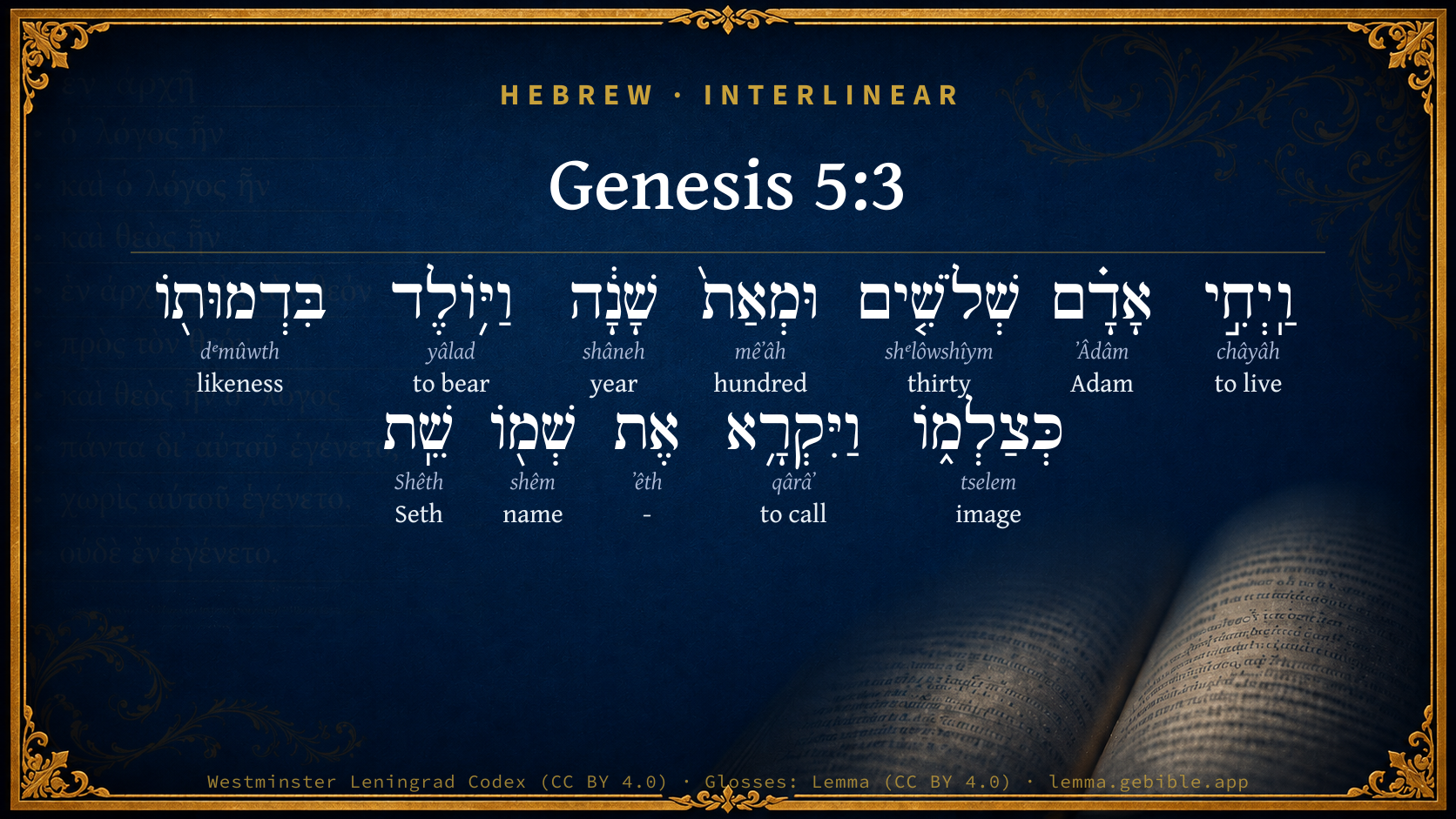
Hebrew (Westminster Leningrad Codex) Genesis 5:3 appears in the Hebrew Old Testament. The text above is from the Westminster Leningrad Codex. Each word links to its Strong’s number, a concise gloss, and parsing drawn from the Open Scriptures Hebrew Bible morphology. Click any word for its full Brown-Driver-Briggs (BDB) entry.
Download image
Cite this verse

Genesis 5:3 (World English Bible). Public Domain. Lemma interlinear Bible study tool, https://lemma.gebible.app/v/genesis/5/3.

Show BibTeX & RIS
BibTeX
RIS
English Translation
Adam lived one hundred thirty years, and became the father of a son in his own likeness, after his image, and named him Seth.
World English Bible · Public Domain
Highlights
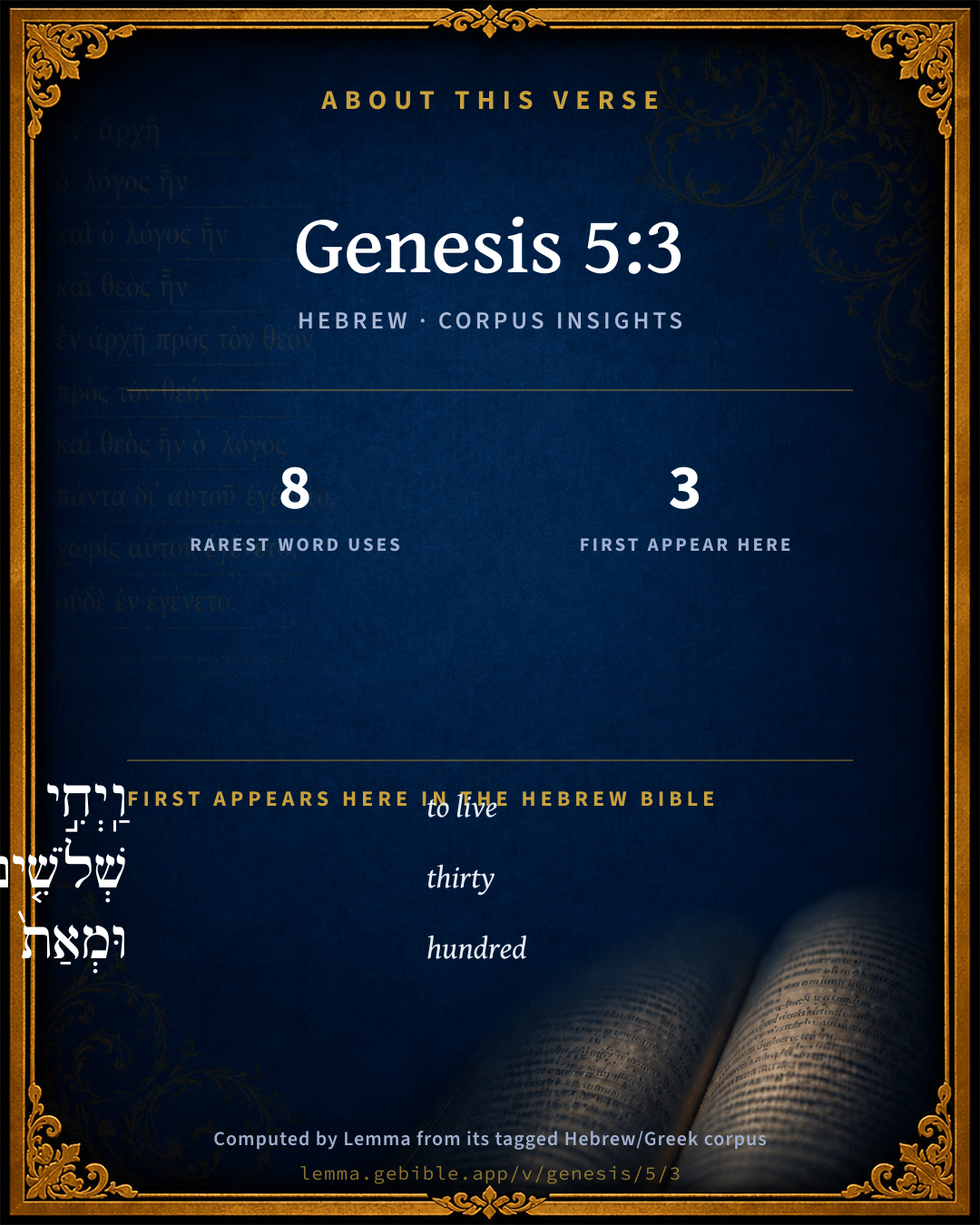
  • 3 first appearances in the Hebrew Bible
Full analysis ↓
Download a study sheet

One document with this verse’s original text, its word-by-word gloss line, the meaning frame, cross-references with their text, attributed commentary, and full source and license credits — printable, and it pastes into notes with its structure intact.

This verse Autodidact and up

Study sheet (.html) Plain text (.txt)

A passage Seminary Student

Up to 50 verses in one chapter. A passage sheet keeps up to 6 commentary sources and 12 cross-references per verse, in the order this page ranks them, and says so on the sheet whenever that leaves anything out. Ask for a single verse and you get the Autodidact verse sheet above.

Everything on this page stays free to read, with no account — the sheet is a download of what is already on screen, not access to it.

Want to remove ads? Support Godless Engineer
Compare translations 3

The same verse in 3 English versions, stacked beneath the original-language interlinear above. Click any original word for its lexicon entry.

Each is an independent rendering of the whole verse — the interlinear is not word-aligned to these translations.

Highlighted words mark where these versions differ — a whole-verse word diff, not a word-by-word alignment.

  • World English Bible Public Domain
    Adam lived one hundred thirty years, and became the father of a son in his own likeness, after his image, and named him Seth.
  • King James Version Public Domain
    And Adam lived an hundred and thirty years, and begat a son in his own likeness, and after his image; and called his name Seth:
  • unfoldingWord Literal Text CC BY-SA 4.0
    And Adam lived 130 years, then he fathered in his own likeness, according to his image, and he called his name Seth.

unfoldingWord Literal Text — © unfoldingWord, licensed CC BY-SA 4.0. Word-aligned USFM3 via Door43 (git.door43.org/unfoldingWord/en_ult).

Versions to compare (up to 4)

3 of 4 selected

Show all 18 translations

Every available English version of this verse, each an independent rendering of the whole verse.

  • World English Bible Public Domain
    Adam lived one hundred thirty years, and became the father of a son in his own likeness, after his image, and named him Seth.
  • Berean Standard Bible Public Domain
    When Adam was 130 years old, he had a son in his own likeness, after his own image; and he named him Seth.
  • Majority Standard Bible Public Domain
    When Adam was 130 years old, he had a son in his own likeness, after his own image; and he named him Seth.
  • King James Version Public Domain
    And Adam lived an hundred and thirty years, and begat a son in his own likeness, and after his image; and called his name Seth:
  • American Standard Version (1901) Public Domain
    And Adam lived a hundred and thirty years, and begat `a son' in his own likeness, after his image; and called his name Seth:
  • Revised Version (1885) Public Domain
    And Adam lived an hundred and thirty years, and begat a son in his own likeness, after his image; and called his name Seth:
  • Geneva Bible (1599) Public Domain
    Nowe Adam liued an hundred and thirtie yeeres, and begate a childe in his owne likenes after his image, and called his name Sheth.
  • Douay-Rheims (1899) Public Domain
    And Adam lived a hundred and thirty years, and begot a son to his own image and likeness, and called his name Seth.
  • Young's Literal Translation Public Domain
    And Adam liveth an hundred and thirty years, and begetteth `a son' in his likeness, according to his image, and calleth his name Seth.
  • Literal Standard Version CC BY-SA 4.0
    And Adam lives one hundred and thirty years [[or two hundred and thirty years]], and begets [a son] in his likeness, according to his image, and calls his name Seth.
  • Unlocked Literal Bible CC BY-SA 4.0
    When Adam had lived 130 years, he became the father of a son in his own likeness, after his image, and he called his name Seth.
  • unfoldingWord Literal Text CC BY-SA 4.0
    And Adam lived 130 years, then he fathered in his own likeness, according to his image, and he called his name Seth.
  • Darby Bible Public Domain
    And Adam lived a hundred and thirty years, and begot [a son] in his likeness, after his image, and called his name Seth.
  • World Messianic Bible Public Domain
    Adam lived one hundred thirty years, and became the father of a son in his own likeness, after his image, and named him Seth.
  • Webster's Bible Public Domain
    And Adam lived a hundred and thirty years, and begat a son in his own likeness, after his image; and called his name Seth:
  • Free Bible Version CC BY-SA 4.0
    When Adam was 130, he had a son who was like him, made in his image; and he named him Seth.
  • Bible in Basic English Public Domain
    Adam had been living for a hundred and thirty years when he had a son like himself, after his image, and gave him the name of Seth:
  • JPS Tanakh (1917) Public Domain
    And Adam lived a hundred and thirty years, and begot a son in his own likeness, after his image; and called his name Seth.

Literal Standard Version (2020), Covenant Press — licensed CC BY-SA 4.0. Text via the HelloAO Bible API (eBible.org). Unlocked Literal Bible (unfoldingWord) — licensed CC BY-SA 4.0. Text via the HelloAO Bible API (eBible.org). unfoldingWord Literal Text — © unfoldingWord, licensed CC BY-SA 4.0. Word-aligned USFM3 via Door43 (git.door43.org/unfoldingWord/en_ult). Free Bible Version, Dr. Jonathan Gallagher — licensed CC BY-SA 4.0. Text via the HelloAO Bible API (eBible.org).

Word by word

More ways to search: Search by grammar → Find every occurrence → Compare this word →

Practice this passage: Drill this verse → Learn its vocabulary →

שֵֽׁת
Shêth
H8352
“Seth”
Noun, Proper
Part of Speech
Noun
Type
Proper
Full BDB Definition

Origin: from H7896

TWOT: None

Seth = "compensation" - the 3rd son of Adam by Eve - also 'Sheth'
  1. וַֽיְחִ֣י châyâh H2421 “and · to live” Conjunction + Verb, Qal, Sequential Imperfect, 3rd Person, Masculine, Singular
  2. אָדָ֗ם ʼÂdâm H121 “Adam” Noun, Proper
  3. שְׁלֹשִׁ֤ים shᵉlôwshîym H7970 “thirty” Adjective, Cardinal number, Both, Plural, Absolute
  4. וּמְאַת֙ mêʼâh H3967 “and · hundred” Conjunction + Adjective, Cardinal number, Both, Singular, Construct
  5. שָׁנָ֔ה shâneh H8141 “year” Noun, Common, Feminine, Singular, Absolute
  6. וַיּ֥וֹלֶד yâlad H3205 “and · to bear” Conjunction + Verb, Hiphil, Sequential Imperfect, 3rd Person, Masculine, Singular
  7. בִּדְמוּת֖וֹ dᵉmûwth H1823 “in/at · likeness · his” Preposition + Noun, Common, Feminine, Singular, Construct + Suffix, Personal, 3rd Person, Masculine, Singular
  8. כְּצַלְמ֑וֹ tselem H6754 “like/as · image · his” Preposition + Noun, Common, Masculine, Singular, Construct + Suffix, Personal, 3rd Person, Masculine, Singular
  9. וַיִּקְרָ֥א qârâʼ H7121 “and · to call” Conjunction + Verb, Qal, Sequential Imperfect, 3rd Person, Masculine, Singular
  10. אֶת ʼêth H853 “-” Particle, Direct Object
  11. שְׁמ֖וֹ shêm H8034 “name · his” Noun, Common, Masculine, Singular, Construct + Suffix, Personal, 3rd Person, Masculine, Singular

About this verse

These counts appear in no published source. They are computed here, from the morphology-tagged text and Lemma’s own curated glosses. What Lemma adds →

12
words
12
distinct lemmas
Pentateuch
section

Notable vocabulary

The rarest word here is שֵֽׁת Seth H8352 — appearing just 8 times in the whole Hebrew Bible.

First appearance in Scripture

These words make their first canonical appearance in the Hebrew Bible here:

  • וַֽיְחִ֣י to live H2421
  • שְׁלֹשִׁ֤ים thirty H7970
  • וּמְאַת֙ hundred H3967

Shared distinctive vocabulary

שֵֽׁת Seth H8352 occurs in 8 verses of the Hebrew Bible. Also found in:

Grammatical profile

  • 3 verbs
  • 6 nouns
  • 2 adjectives
  • 1 particle

Verb forms

  • וַֽיְחִ֣י Qal · Sequential Imperfect
  • וַיּ֥וֹלֶד Hiphil · Sequential Imperfect
  • וַיִּקְרָ֥א Qal · Sequential Imperfect

Hebrew & Septuagint length

In English translation the verse runs 24 words from the Hebrew and 27 from the Septuagint (LXX English) — closely comparable.

A rough comparison of the two English renderings, which tokenize alike — not a word-level alignment.

Word counts can differ between the Hebrew and the Greek without any difference in meaning — e.g. the Hebrew direct-object marker אֵת has no separate Greek word, and Greek often adds the article ὁ.

Cross-references

11

Topical passages linked to Genesis 5:3 in the Treasury of Scripture Knowledge — connected by theme and wording, ordered by reader-vote popularity; previews shown in the World English Bible.

  • Genesis 4:25 Adam knew his wife again. She gave birth to a son, and named him Seth. For, she said, "God has appointed me another child instead of Abel, for Cain killed him."
  • Job 14:4 Who can bring a clean thing out of an unclean? Not one.
  • Job 15:14–16 What is man, that he should be clean? He who is born of a woman, that he should be righteous?
  • Job 25:4 How then can man be just with God? Or how can he who is born of a woman be clean?
  • Psalms 14:2–3 Yahweh looked down from heaven on the children of men, To see if there were any who did understand, Who did seek after God.
  • Luke 1:35 The angel answered her, "The Holy Spirit will come on you, and the power of the Most High will overshadow you. Therefore also the holy one who is born from you will be called the Son of God.
  • John 3:6 That which is born of the flesh is flesh. That which is born of the Spirit is spirit.
  • Romans 5:12 Therefore, as sin entered into the world through one man, and death through sin; and so death passed to all men, because all sinned.
  • 1 Corinthians 15:39 All flesh is not the same flesh, but there is one flesh of men, another flesh of animals, another of fish, and another of birds.
  • Ephesians 2:3 among whom we also all once lived in the lust of our flesh, doing the desires of the flesh and of the mind, and were by nature children of wrath, even as the rest.
  • Psalms 51:5 Behold, I was brought forth in iniquity. In sin my mother conceived me.

Cross-references courtesy of OpenBible.info (CC BY 4.0).

Hebrew and Greek witnesses Masoretic Hebrew ↔ Greek Septuagint

The same verse in the two great witnesses to the Old Testament, shown verse-for-verse.

These are two independent witnesses, not word-aligned to each other, and the Septuagint is shown in lemma (dictionary) form.

Hebrew Genesis 5:3 Masoretic · Westminster Leningrad Codex

וַֽיְחִ֣י אָדָ֗ם שְׁלֹשִׁ֤ים וּמְאַת֙ שָׁנָ֔ה וַיּ֥וֹלֶד בִּדְמוּת֖וֹ כְּצַלְמ֑וֹ וַיִּקְרָ֥א אֶת שְׁמ֖וֹ שֵֽׁת

Adam lived one hundred thirty years, and became the father of a son in his own likeness, after his image, and named him Seth.

World English Bible · Public Domain

Greek LXX Genesis 5:3 Septuagint · lemma form

ζάω δέ αδαμ διακόσιοι καί τριάκοντα ἔτος καί γεννάω κατά ὁ ἰδέα αὐτός καί κατά ὁ εἰκών αὐτός καί ἐπιὀνομάζω ὁ ὄνομα αὐτός σηθ

And Adam lived two hundred and thirty years, and begot a son after his own form, and after his own image, and he called his name Seth.

LXX2012 (modern English Septuagint) · Public Domain

On this verse, Adam Clarke's Commentary discusses the Septuagint’s reading. Read the note in Commentary ↓

Hebrew: Westminster Leningrad Codex (CC BY 4.0). Greek: Septuagint (public domain); English from LXX2012 (modern English Septuagint) (Public Domain). How the Septuagint differs from the Hebrew →

Targum (Aramaic paraphrase)

2

The Targum is the ancient Jewish Aramaic paraphrase of the Hebrew Scriptures — an interpretive translation, not the Hebrew text itself. Onkelos (literal) and Pseudo-Jonathan (expansive) render the Torah, and Jonathan the Prophets. Coverage is partial: where no permissively-licensed English translation exists for a verse, only the Aramaic is shown. This is verse-level text, not a word-by-word alignment to the Hebrew.

  1. Targum Onkelos Torah (Genesis–Deuteronomy)
    וַחֲיָא אָדָם מְאָה וּתְלָתִין שְׁנִין וְאוֹלִיד בִּדְמוּתֵהּ דְּדָמֵי לֵהּ וּקְרָא יָת שְׁמֵהּ שֵׁת

    (no public-domain English translation for this verse)

    Targum Onkelos — Aramaic: “Onkelos Genesis” (public domain); “Onkelos Exodus” (public domain); “Onkelos Leviticus” (public domain); “Onkelos Numbers” (public domain); “Onkelos Deuteronomy” (public domain). English: “Sefaria Community Translation” (CC0 1.0 (public-domain dedication)); “J.W. Etheridge. The Targums of Onkelos and Jonathan Ben Uzziel on the Pentateuch. London: Longmans, Green, 1862” (public domain). Text via Sefaria.

  2. Targum Pseudo-Jonathan Torah (Genesis–Deuteronomy)
    וַחֲיָא אָדָם מְאָה וּתְלָתִין שְׁנִין וְאוֹלִיד יַת שֵׁת דְדָמֵי לְאִקוּנֵיהּ וְלִדְמוּתֵיהּ אֲרוּם מִן קַדְמַת דְנָא אוֹלֵידַת חַוָה יַת קַיִן דְלָא דָמֵי לֵיהּ וְהֶבֶל אִתְקְטֵיל עַל יְדוֹי וְקַיִן אִטְרַד וְלָא אִתְיַיחְסוּ זַרְעִיתֵיהּ בְּסֵפֶר יֵיחוּס אָדָם וּבָתַר כֵּן אוֹלִיד יַת דְדָמֵי לֵיהּ וּקְרָא יַת שְׁמֵיהּ שֵׁת

    And Adam lived a hundred and thirty years, and begat Sheth, who had the likeness of his image and of his similitude: for before had Hava born Kain, who was not like to him; and Habel was killed by his hand. And Kain was cast out; neither is his seed genealogized in the book of the genealogy of Adam. But afterwards there was born one like him, and he called his name Sheth.

    Targum Pseudo-Jonathan — Aramaic: “Targum Jonathan on Genesis” (public domain); “Targum Jonathan on Exodus” (public domain); “Targum Jonathan on Leviticus” (public domain); “Targum Jonathan on Numbers” (public domain); “Targum Jonathan on Deuteronomy” (public domain). English: “The Targum of Jonathan ben Uzziel, trans. J. W. Etheridge, London, 1862” (public domain). Text via Sefaria.

Commentary

Notes on Genesis 5:3 from classic Christian and Jewish commentators (each source and its license shown beneath its notes). The classic Christian expositions comment on the surrounding passage and are grouped to its opening verse, so a note may address several verses; the Jewish commentaries on the Tanakh (Rashi and others) are per-verse, so they appear only where the commentator wrote on this verse.

Lemma curates 59 commentaries, every one of them public domain or Creative Commons licensed, each selected and text-cleaned for this edition rather than reprinted as found. About our sources →

Trapp's Complete Commentary

John Trapp

Gen 5:3 And Adam lived an hundred and thirty years, and begat [a son] in his own likeness, after his image; and called his name Seth:

Ver. 3. Adam lived one hundred and thirty years, and begat.] This was a great trial to his faith, to wait so long for a better issue, when the Cainites spread abroad, erected cities, and perhaps meditated monarchies.

After his own image.] Corruptus corruptum . For "who can bring a clean thing out of an unclean?" says Job. {Job 14:4} "That which is born of the flesh is flesh," {Joh 3:6} saith our Saviour, and we can say no better of it. This is hard to persuade men to; for each one is apt to think his own penny as good silver: and a dead woman will have four to carry her forth, as the proverb has it. The Pharisee, bad enough though he be, yet is very braggardly of his good estate to Godward: And Novatus cries out, Non habeo, Domine, quod mihi ignoscas . How much better St Augustine, Ego admisi, Domine, unde tu damnare potes me; sed non amisisti, unde tu salvare potes me . One has destroyed me, but from you is my help - my safety here, and salvation hereafter. Lord I am hell, but you are heaven, as that martyr {a} once said, &c. “One depth called upon another”; {Psa 42:7} the depth of my misery, the depth of thy mercy. Heaven denies me; earth groans under me; hell gapes for me: help, Lord, or your servant perishes. "Wash me throughly from my iniquity, and purge me from my sin"; {Psa 51:2} whether that imputed to me, inherent in me, or issuing from me.

{a} Bp. Hooper.

John Trapp, A Commentary or Exposition upon All the Books of the Old and New Testament (1647–1656) — public domain. Text from a community e-Sword module.

The Biblical Illustrator

Joseph S. Exell

Gen_5:3

And Adam begat a son in his own likeness, after his image

Human depravity

I.

THAT HUMAN DEPRAVITY IS TOTAL AS TO ITS INFLUENCE OVER THE HUMAN MIND. By the phrase, human depravity, we mean that corruption of our nature, whereby we are inclined to sin rather than to holiness. The seat of this depravity is within; external forms of wickedness, in words and actions, are only the results and expressions of it, etc. By the heart, we mean the mind and all its faculties and powers; and by the depravity of the heart, we mean that principle within it, call it disposition, energy, or cause, whence those powers receive their inclination and bias, and from the quality of which, they, and the actions resulting from them, derive their character.

II. I now proceed to prove, that THIS DEPRAVITY IS UNIVERSAL IN ITS PREVALENCE AMONGST MANKIND.

1. It exists in all ages. Our proof of this is in universal history.

2. It exists in all countries.

3. In all communities.

4. In all families.

5. In all individuals.

III. IT IS INHERENT IN OUR NATURE, IN CONSEQUENCE OF THE FALL OF ADAM. (T. Raffles, D. D.)

The Biblical Illustrator, edited by Joseph S. Exell (c. 1880s–1900s) — public domain. Text from a community e-Sword module.

Joseph Benson's Commentary

Gen 5:3. Seth was born in the one hundred and thirtieth year of Adam’s life, and probably the murder of Abel was not long before. Many other sons and daughters were born to Adam besides Cain and Abel, before this; but no notice is taken of them, because an honourable mention must be made of his name only, in whose loins Christ and the church were: but that which is most observable here concerning Seth, is, that Adam begat him in his own likeness, after his image. Adam was made in the image of God; but when he was fallen and corrupted, he begat a son in his own image, sinful and defiled, frail and mortal, and miserable like himself; not only a man like himself, consisting of body and soul; but a sinner like himself, guilty and obnoxious, degenerate and corrupt. This was Adam’s own likeness, the reverse of that divine likeness in which he was made, and which, having lost it himself, he could not convey to his seed.

Joseph Benson's Commentary on the Old and New Testaments (1811–1818) — public domain. Text from a community e-Sword module.

Tyndale Open Study Notes

Tyndale Open Resources

5:3 just like him—in his very image: The image and likeness of God (see note on 1:26) is preserved in human beings despite sin. Adam’s sinful nature was also carried forward (Rom 5:12-14).

Tyndale Open Study Notes — © Tyndale Open Resources, licensed CC BY-SA 4.0. Text via the HelloAO Bible API.

Geneva Bible (1599)

Geneva Bible translators

As well concerning his creation, as his corruption.

Geneva Bible (1599) marginal notes — public domain. Text via Bolls.life.

Adam Clarke's Commentary

Verse 3. And Adam lived a hundred and thirty years, c.] The Scripture chronology especially in the ages of some of the antediluvian and postdiluvian patriarchs, has exceedingly puzzled chronologists, critics, and divines. The printed Hebrew text, the Samaritan, the Septuagint, and Josephus, are all different, and have their respective vouchers and defenders. The following tables of the genealogies of the patriarchs before and after the flood, according to the Hebrew, Samaritan, and Septuagint, will at once exhibit the discordances.

ANTEDILUVIAN PATRIARCHS LIVED BEFORE THEIR SONS' BIRTH

Heb.

Samar.

Sept.

Adam, Gen. v. 3.

130

130

230

Seth, ---- 6.

105

105

205

Enos, ---- 9.

90

90

190

Cainan, ---- 12.

70

70

170

Mahalaleel, ---- 15.

65

65

165

Jared, ---- 18.

162

62

162

Enoch, ---- 21.

65

65

165

Methuselah, ---- 25.

187

67

167

Lamech ---- 28.

182

53

188

Noah, at the flood, Gen. vii. 6.

600

600

600

Total before the flood,

1656

1307

2242*

In this first period the sum in Josephus is 2256, which is also adopted by Dr. Hales in his New Analysis of Chronology.

POSTDILUVIAN PATRIARCHS LIVED BEFORE THEIR SONS' BIRTH

Heb.

Samar.

Sept.

Shem begot Arphaxad after the flood, Gen xi.10.

2

2

2

Arphaxad, Gen xi.12.

35

135

135

Cainan (2d) mentioned only by the LXX. and Luke iii.36.

0

0

130

Salah, Gen. xi. 14.

30

130

130

Eber, ----- 16.

34

134

134

Peleg, ----- 18.

30

130

130

Reu, ----- 20.

32

132

132

Serug, ----- 22.

30

130

130

Nahor, ----- 24.

29

79

179

Terah, ----- 26.

70

70

70

Total to the 70th year of Terah,

292

942

1172*

In this second period the sum in Josephus is 1002.

* The Septuagint account of the ages of the antediluvian and postdiluvian patriarchs in the above tables, is taken from the VATICAN copy, but if we follow the ALEXANDRIAN MS., we shall have in the first period the whole sum of 2262 instead of 2242 and in the second period, 1072 instead of 1172. On this subject the different MSS. of the Septuagint abound with various readings.

For much satisfactory information on this subject I must refer to A New Analysis of Chronology, by the Rev. William Hales, D.D., 3 vols. 4to., London, 1809.

And begat a son in his own likeness, after his image] Words nearly the same with those Ge 1:26: Let us make man in our image, after our likeness. What this image and likeness of God were, we have already seen, and we may rest assured that the same image and likeness are not meant here. The body of Adam was created provisionally immortal, i.e. while he continued obedient he could not die; but his obedience was voluntary, and his state a probationary one. The soul of Adam was created in the moral image of God, in knowledge, righteousness, and true holiness. He had now sinned, and consequently had lost his moral resemblance to his Maker; he had also become mortal through his breach of the law. His image and likeness were therefore widely different at this time from what they were before; and his begetting children in this image and likeness plainly implies that they were imperfect like himself, mortal like himself, sinful and corrupt like himself. For it is impossible that he, being impure, fallen from the Divine image, could beget a pure and holy offspring, unless we could suppose it possible that a bitter fountain could send forth sweet waters, or that a cause could produce effects totally dissimilar from itself. What is said here of Seth might have been said of all the other children of Adam, as they were all begotten after his fall; but the sacred writer has thought proper to mark it only in this instance.

Adam Clarke's Commentary on the Bible (1810–1826) — public domain. Text from a community e-Sword/MySword module.

John Calvin's Commentaries

3. And begat a son in his own likeness. We have lately said that Moses traces the offspring of Adam only through the line of Seth, to propose for our consideration the succession of the Church. In saying that Seth begat a son after his own image, he refers in part to the first origin of our nature: at the same time its corruption and pollution is to be noticed, which having been contracted by Adam through the fall, has flowed down to all his posterity. If he had remained upright, he would have transmitted to all his children what he had received: but now we read that Seth, as well as the rest, was defiled; because Adams who had fallen from his original state, could beget none but such as were like himself. If any one should object that Seth with his family had been elected by the special grace of God: the answer is easy and obvious; namely, that a supernatural remedy does not prevent carnal generation from participating in the corruption of sin. Therefore, according to the flesh, Seth was born a sinner; but afterwards he was renewed by the grace of the Spirit. This sad instance of the holy patriarch furnishes us with ample occasion to deplore our own wretchedness.

John Calvin's Commentaries (1540-1563) — public domain. Text from the Calvin Translation Society English edition (1840s-50s) via the Christian Classics Ethereal Library (ccel.org). Calvin's coverage is partial (roughly two-thirds of the Bible); uncommented books and verses are honest gaps, never fabricated. The 19th-century editor's footnotes and remarks are omitted so the notes are faithfully Calvin's own voice.

Ellicott's Commentary for English Readers

(3) In his own likeness, after his image.—That is, Adam handed down to his posterity that Divine likeness which he had himself received.

Seth.—See on Gen_4:25.

A Bible Commentary for English Readers, edited by Charles John Ellicott (1878–1897) — public domain. Text from a community e-Sword module.

The Cambridge Bible for Schools and Colleges

gen. ed. J. J. S. Perowne

3. in his own likeness, after his image] Cf. Gen_1:26. Man was made in God’s image, after His likeness; he begets a son, in his own likeness, after his image. Many Heb. MSS., however, only read “in his image.” On the words “image” and “likeness,” see note on Gen_1:26. The phrase here is evidently intended to shew that the elements of resemblance to the Divine image, which at the first were implanted in man’s nature, were communicated from father to son.

That the priestly document contained any tradition respecting the Fall, or the murder of Abel, seems improbable.

Seth] See note on Gen_4:25. The father here gives the name; the mother’s name is not mentioned in this genealogy.

The Cambridge Bible for Schools and Colleges (gen. ed. J. J. S. Perowne; Cambridge University Press, 1878–1918) — public domain. Text from a community e-Sword module.

John Gill's Exposition

And Adam lived an hundred and thirty years,.... The Septuagint version, through mistaken, gives the number two hundred and thirty years:

and begat a son; not that he had no other children during this time than Cain and Abel; this is only observed to show how old he was when Seth was born, the son here meant; who was begotten

in his own likeness, after his image; not in the likeness, and after the image of God, in which Adam was created; for having sinned, he lost that image, at least it was greatly defaced, and he came short of that glory of God, and could not convey it to his posterity; who are, and ever have been conceived in sin, and shapen in iniquity; are polluted and unclean, foolish and disobedient; averse to all that is good, and prone to all that is evil: the sinfulness of nature is conveyed by natural generation, but not holiness and grace; that is not of blood, nor of the will of man, nor of the flesh, but of God, and produced of his own will, by his mighty power impressing the image of his Son in regeneration on his people; which by beholding his glory they are more and more changed into by the Spirit of God. The Jewish writers understand this in a good sense, of Seth being like to Adam in goodness, when Cain was not: so the Targum of Jonathan,"and he begat Seth, who was like to his image and similitude; for before Eve had brought forth Cain, who was not like unto him---but afterwards she brought forth him who was like unto him, and called his name Seth.''So they say (z) Cain was not of the seed, nor of the image of Adam, nor his works like Abel his brother; but Seth was of the seed and image of Adam, and his works were like the works of his brother Abel; according to that, "he begat (a son) in his own likeness". And they assert (a), that Adam delivered all his wisdom to Seth his son, who was born after his image and likeness; and particularly Maimonides (b) observes, that all the sons of Adam before Seth were rather beasts than men, and had not the true human form, not the form and image of men; but Seth, after Adam had taught and instructed him, was in human perfection, as it is said of him, "and he begat in his likeness": but the text speaks not of the education of Seth, and of what he was through that, but of his birth, and what he was in consequence of it; and we are told by good authority, that "that which is born of the flesh is flesh", carnal and corrupt, and such are all the sons of Adam by natural generation; see Job 14:4.

(z) Pirke Eliezer, c. 22. (a) Shalshalet Hakabala, apud Hottinger. Smegma, p. 212. (b) More Nevochim, par. 1. c. 7.

John Gill's Exposition of the Whole Bible (1746–1763) — public domain (CC PDM 1.0). Text via the HelloAO Bible API.

Matthew Poole's English Annotations

Adam lived an hundred and thirty years after he was created, in which time he begat other sons and daughters, as appears from what was said before.

After his image; either,

1. In regard of the natural frame of his body and soul; but this was so evident of itself, that the mention of it had been frivolous. Nor is there any reason why that should be said of Seth, rather than of Cain or Abel. Or,

2. In regard of his corruption, q.d. a weak, sinful, mortal man, like himself; for Adam's image is here plainly opposed to the likeness of God, wherein Adam is said to be created, Gen 5:1. And this is fitly said of Seth to signify, that although he was a worthy and good man, and, Adam excepted, the most eminent person of the whole church of God; yet he, no less than wicked Cain, was begotten and born in sin; and that all the difference which was between him, and consequently between other good men, and the wicked progeny of Cain, was not from the nature which they received from Adam, but from the grace infused into them by God.

Matthew Poole's English Annotations on the Holy Bible (1683–1685) — public domain. Text from a community e-Sword/MySword module.

The Pulpit Commentary

Vers. 3-5. At the head of the Adamic race stands the first man, whose career is summarized in three short verses, which serve as a model for the subsequent biographies. And Adam lived a hundred and thirty years. Shanah, a repetition, a return of the sun s circuit, or of similar natural phenomena; from shanah, to fold together, to repeat; hence a year (Gesenius, Furst). Cf. Latin, annus; Greek, ejniautov; Gothic, Jar, jar, jet ; German, jahr; English, year all of which "seem to carry the same thought, viz., that which comes again" (T. Lewis). Shanah never means month" (Kalisch). And begat a son in his own likeness, damuth (cf. Gen_1:26) after his image tselem (cf. Gen_1:26); not the Divine image in which he was himself created (Kalisch, Knobel, Alford), but the image or likeness of his own fallen nature, i.e. the image of God modified and corrupted by sin (Keil, Murphy, Wordsworth). "A supernatural remedy does not prevent generation from participating in the corruption of sin. Therefore, according to the flesh Seth was born a sinner, though he was afterwards renewed by the Spirit of grace" (Calvin). The doctrine of inherited depravity or transmitted sin has been commonly held to favor the theory which accounts for the origin of the human soul per traducem (Tertullian, Luther, Delitzsch), in opposition to that which holds it to be due to the creative power of God (Jerome, Augustine, Calvin, Beza, Turretin). Kalisch thinks the statement "Adam begat Seth in his own image " decisive in favor of Traducianism, while Hodge affirms "it only asserts that Seth was like his father, and sheds no light, on the mysterious process of generation ("Syst. Theol.," Part 1 Ge 3. The truth is that Scripture seems to recognize both sides of this question. Vide Psa_51:5 in favor of Traducianism, and Psa_139:14-16 Jer_50:5 in support of Creationism (cf. Martensen"s "Dogmatics," though there is much force in the words of Augustine "De re obscurissima disputatur, non adjuvantibus divinarum scripturarum certis clarisque documentis." And called his name probably concurring in the name selected by Eve (Gen_4:25) Seth Appointed, placed, substituted; hence compensation. (Gen_4:25) And the days of Adam after he had begotten literally, his begetting Seth were eight hundred years: and he begat sons and daughters. "In that primitive time the births did not rapidly follow each other a fact which had to indicate that his having a posterity at all was conditioned by the ripeness of his faith. At the same time the lateness of paternity among these primeval men may have been partly due to a physical cause as well, "since in exact accordance with the increasing degeneracy and rankness of human life is there, in a literal sense, the increase of a numerous and wretched offspring" (Lange). And all the days that Adam not the whole tribe (Gatterer, vide Bohlen; cf. Balgarnie, "Expositor," vol. 8.), "as in this case Enoch must have been taken to heaven with his whole family" (Kalisch); but the individual bearing that namelived were nine hundred and thirty years. The remarkable longevity of the Macrobii has been explained

1. On the supposition of its non-authenticity.

(1) As a purely mythical conception (Knobel, Bauer, Hartmann, Bohlen); which, however, may be safely rejected as an altogether inadequate hypothesis.

(2) As due to an error in the traditional transmission of the genealogical registers, several names having fallen out, leaving their years to be reckoned to those that remained (Rosenm but against this conjecture stands the orderly succession of father and son through ten generations.

(3) As representing not the lifetimes of individuals, but dynastic epochs (vide supra); and

(4) as signifying lesser spaces of time e.g. three months (Hensler), or one month (Raske) than solar years; but even Knobel admits that "no shorter year have the Hebrews ever had than the period of a year"s time.

2. On the basis of its historic credibility; as attributable to

(1) The original immortality with which man was endowed, and which was now being frayed away by the inroads of sin (Kalisch).

(2) The superior piety and intelligence of these early father"s of the race (Josephus, "Antiq.," I 3:9).

(3) The influence of the fruit of the tree of life which, while in the garden, Adam ate (Whately, "Ency. Brit.," eighth ed., Art. Christianity).

(4) The original vigor of their physical constitutions, and the greater excellence of the food on which they lived (Willet). But if the first and second opinions are correct, then the Cainites should have died earlier than the Sethites, which there is no reason to believe they did; while the third is a pure conjecture (vide, Gen_2:9) and the fourth may contain some degree of truth.

We prefer to ascribe the longevity of these antediluvian men to a distinct exercise of grace on the part of God, who designed it to be

(1) a proof of the Divine clemency in suspending the penalty of sin;

(2) a symbol of that immortality which had been recovered for men by the promise of the woman"s seed; and

(3) a medium of transmission for the faith, for the benefit of both the Church and the world. And he died. "The,solemn toll of the patriarchal funeral bell (Bonar). Its constant recurrence at the close of each biography proves the dominion of death from Adam onward, as an immutable law; (Rom_5:11; Baumgarten, Kefi, Lange) "warns us that death was not denounced in vain against men" (Calvin); "is a standing demonstration of the effect of disobedience" (Murphy); "was intended to show what the condition of all mankind was after Adam"s fall (Willet). The expression is not appended to the genealogical list of the Fathers after the Flood, doubtless as being then sufficiently understood; and it is not said of the descendants of Cain that they died, "as if the inheritance of the sons of God were not here on earth, but in death, as the days of the deaths of martyrs are held in honor by the Church as their birthdays" (Wordsworth).

The Pulpit Commentary (1880–1919), ed. H.D.M. Spence-Jones & Joseph S. Exell — public domain. Text from a community e-Sword module.

John Wesley's Explanatory Notes

Seth was born in the 130th year of Adam's life, and probably the murder of Abel was not long before. Many other sons and daughters were born to Adam besides Cain and Abel before this; but no notice is taken of them, because an honourable mention must be made of his name only, in whose loins Christ and the church were. But that which is most observable here concerning Seth, is, that Adam begat him in his own likeness after his image - Adam was made in the image of God; but when he was fallen and corrupted, he begat a son in his own image, sinful and defiled, frail and mortal, and miserable like himself; not only a man like himself, consisting of body and soul; but a sinner like himself, guilty and obnoxious, degenerate and corrupt. He was conceived and born in sin, Psalm li, 5. This was Adam's own likeness, the reverse of that Divine likeness in which Adam was made; but having lost it himself he could not convey it to his seed.

John Wesley, Explanatory Notes Upon the Whole Bible (1754–1765) — public domain. Text via the GEBible commentary corpus.

Keil & Delitzsch

C. F. Keil & F. Delitzsch

As Adam was created in the image of God, so did he beget "in his own likeness, after his image;" that is to say, he transmitted the image of God in which he was created, not in the purity in which it came direct from God, but in the form given to it by his own self-determination, modified and corrupted by sin. The begetting of the son by whom the line was perpetuated (no doubt in every case the first-born), is followed by an account of the number of years that Adam and the other fathers lived after that, by the statement that each one begat (other) sons and daughters, by the number of years that he lived altogether, and lastly, by the assertion ויּמת "and he died." This apparently superfluous announcement is "intended to indicate by its constant recurrence that death reigned from Adam downwards as an unchangeable law (vid., Rom 5:14). But against this background of universal death, the power of life was still more conspicuous. For the man did not die till he had propagated life, so that in the midst of the death of individuals the life of the race was preserved, and the hope of the seed sustained, by which the author of death should be overcome." In the case of one of the fathers indeed, viz., Enoch (Gen 5:21.), life had not only a different issue, but also a different form. Instead of the expression "and he lived," which introduces in every other instance the length of life after the birth of the first-born, we find in the case of Enoch this statement, "he walked with God (Elohim);" and instead of the expression "and he died," the announcement, "and he was not, for God (Elohim) took him." The phrase "walked with God," which is only applied to Enoch and Noah (Gen 6:9), denotes the most confidential intercourse, the closest communion with the personal God, a walking as it were by the side of God, who still continued His visible intercourse with men (vid., Gen 3:8). It must be distinguished from "walking before God" (Gen 17:1; Gen 24:40, etc.), and "walking after God" (Deu 13:4), both which phrases are used to indicate a pious, moral, blameless life under the law according to the directions of the divine commands. The only other passage in which this expression "walk with God" occurs is Mal 2:6, where it denotes not the piety of the godly Israelites generally, but the conduct of the priests, who stood in a closer relation to Jehovah under the Old Testament than the rest of the faithful, being permitted to enter the Holy Place, and hold direct intercourse with Him there, which the rest of the people could not do. The article in האלהים gives prominence to the personality of Elohim, and shows that the expression cannot refer to intercourse with the spiritual world.

In Enoch, the seventh from Adam through Seth, godliness attained its highest point; whilst ungodliness culminated in Lamech, the seventh from Adam through Cain, who made his sword his god. Enoch, therefore, like Elijah, was taken away by God, and carried into the heavenly paradise, so that he did not see (experience) death (Heb 11:5); i.e., he was taken up from this temporal life and transfigured into life eternal, being exempted by God from the law of death and of return to the dust, as those of the faithful will be, who shall be alive at the coming of Christ to judgment, and who in like manner shall not taste of death and corruption, but be changed in a moment. There is no foundation for the opinion, that Enoch did not participate at his translation in the glorification which awaits the righteous at the resurrection. For, according to Co1 15:20, Co1 15:23, it is not in glorification, but in the resurrection, that Christ is the first-fruits. Now the latter presupposes death. Whoever, therefore, through the grace of God is exempted from death, cannot rise from the dead, but reaches ἀφθαρσία, or the glorified state of perfection, through being "changed" or "clothed upon" (Co2 5:4). This does not at all affect the truth of the statement in Rom 5:12, Rom 5:14. For the same God who has appointed death as the wages of sin, and given us, through Christ, the victory over death, possesses the power to glorify into eternal life an Enoch and an Elijah, and all who shall be alive at the coming of the Lord without chaining their glorification to death and resurrection. Enoch and Elijah were translated into eternal life with God without passing through disease, death, and corruption, for the consolation of believers, and to awaken the hope of a life after death. Enoch's translation stands about half way between Adam and the flood, in the 987th year after the creation of Adam. Seth, Enos, Cainan, Mahalaleel, and Jared were still alive. His son Methuselah and his grandson Lamech were also living, the latter being 113 years old. Noah was not yet born, and Adam was dead. His translation, in consequence of his walking with God, was "an example of repentance to all generations," as the son of Sirach says (Ecclus. 44:16); and the apocryphal legend in the book of Enoch Gen 1:9 represents him as prophesying of the coming of the Lord, to execute judgment upon the ungodly (Jde 1:14-15). In comparison with the longevity of the other fathers, Enoch was taken away young, before he had reached half the ordinary age, as a sign that whilst long life, viewed as a time for repentance and grace, is indeed a blessing from God, when the ills which have entered the world through sin are considered, it is also a burden and trouble which God shortens for His chosen. That the patriarchs of the old world felt the ills of this earthly life in all their severity, was attested by Lamech (Gen 5:28, Gen 5:29), when he gave his son, who was born 69 years after Enoch's translation, the name of Noah, saying, "This same shall comfort us concerning our work and the toil of our hands, because of the ground which the Lord hath cursed." Noah, נוח from נוּח to rest and הניח to bring rest, is explained by נחם to comfort, in the sense of helpful and remedial consolation. Lamech not only felt the burden of his work upon the ground which God had cursed, but looked forward with a prophetic presentiment to the time when the existing misery and corruption would terminate, and a change for the better, a redemption from the curse, would come. This presentiment assumed the form of hope when his son was born; he therefore gave expression to it in his name. But his hope was not realized, at least not in the way that he desired. A change did indeed take place in the lifetime of Noah. By the judgment of the flood the corrupt race was exterminated, and in Noah, who was preserved because of his blameless walk with God, the restoration of the human race was secured; but the effects of the curse, though mitigated, were not removed; whilst a covenant sign guaranteed the preservation of the human race, and therewith, by implication, his hope of the eventual removal of the curse (Gen 9:8-17).

The genealogical table breaks off with Noah; all that is mentioned with reference to him being the birth of his three sons, when he was 500 years old (Gen 5:32; see Gen 11:10), without any allusion to the remaining years of his life-an indication of a later hand. "The mention of three sons leads to the expectation, that whereas hitherto the line has been perpetuated through one member alone, in the future each of the three sons will form a new beginning (vid., Gen 9:18-19; Gen 10:1)." - M. Baumgarten.

Keil & Delitzsch — Biblical Commentary on the Old Testament (1861–1891) — public domain (CC PDM 1.0). Text via the HelloAO Bible API. (Old Testament only.)

unfoldingWord translationNotes

Door43 World Missions Community

130 ... eight hundred

Translators may write the numerals "130" and "800" or the words "one hundred thirty" and "eight hundred." (The ULB and the UDB use numerals if the number has three or more words; they use words if a number has only one or two words.) (See: Numbers)

he became the father of a son

"he had a son"

in his own likeness, after his image

These two phrases mean the same thing. They are used as a reminder that God made man in his own image. See how you translated similar phrases in Genesis 1:26.

Seth

See how you translated this name in Genesis 4:25.

He became the father of more sons and daughters

"He had more sons and daughters"

then he died

This phrase will be repeated throughout the chapter. Use the ordinary word for "died."

Adam lived 930 years

"Adam lived nine hundred and thirty years." People used to live a very long time. Use your ordinary word for "years." AT: "Adam lived a total of 930 years" (See: Numbers)

translationWords

Adam

unfoldingWord translationNotes — © Distant Shores Media and the Door43 World Missions Community, licensed CC BY-SA 4.0. Source: git.door43.org/Door43/en_tn.

Rashi

Rabbi Shlomo Yitzchaki (Rashi)

שלשים ומאת שנה A HUNDRED AND THIRTY YEARS — Until then he lived apart from his wife (Genesis Rabbah 24:6).

Rashi on the Tanakh — English translations: “The Judaica Press complete Tanach with Rashi, translated by A. J. Rosenberg” (CC BY 4.0); “Pentateuch with Rashi's commentary by M. Rosenbaum and A.M. Silbermann, 1929-1934” (public domain); “The Metsudah Tanach series, Lakewood, N.J” (CC BY 4.0); and “The Book of Joshua, Metsudah Publications, 1997” (CC BY 4.0). Text via Sefaria.

Ramban (Nachmanides)

Rabbi Moshe ben Nachman (Ramban / Nachmanides)

AND HE BEGOT A SON IN HIS OWN LIKENESS, AFTER HIS IMAGE. It is known that all who are born from the living are in the likeness and in the image of those who give birth to them, [so why was this verse necessary?] However, because Adam was elevated in his likeness and image in that Scripture said of him, In the likeness of G-d He made him, Scripture explains that his offspring were also in this ennobled likeness. Scripture did not state this concerning Cain and Abel for it did not want to prolong the discussion of them. It explains it, however, in the case of Seth because the world was founded from him, [Noah being his direct descendant]. Or it may be that because Adam was created with absolutely perfect form, Scripture relates concerning Seth that he was like him [Adam] in strength and beauty.

Ramban (Nachmanides) on the Tanakh — English translation: “Commentary on the Torah by Ramban (Nachmanides). Translated and annotated by Charles B. Chavel. New York, Shilo Pub. House, 1971-1976” (CC BY 4.0). Text via Sefaria.

Radak

Rabbi David Kimhi (Radak)

ויחי ארם, after Adam had lived on earth for 130 years, he begat a son in his image and in his form, as we have explained already. (1,26 where this term has been explained) This was possible now, since Adam, after having completed his penitence had become a thoroughly good person. It is possible to understand the word כדמותו as referring to Adam’s body reflecting the quality of his soul, whereas the meaning of the word בצלמו refers to his intellectual qualities. After he had done תשובה, Adam’s intellectual qualities also had fully recovered from the negative fallout they had experienced as a result of his sin. It is also possible that he did not recover these faculties to the full until the last tenth of his life on earth, seeing that the prophet Isaiah 65,20 describes people in the times of the Messiah as remaining adolescent until they attain the age of 100. Adam’s offspring also might have been in an adolescent state until they came of age at about 100 years old, and that is why they did not marry until then. Once they had matured both physically and mentally, they could be expected to reproduce so that their children could be described as being בצלמיהם בדמותיהם, reflecting the good qualities of their respective parents. Our sages (Eyruvin 18) say that during all these 130 years that Adam had lived the life of a bachelor he was generating all kinds of spirits, demons, and the like, (whenever he had a nocturnal seminal emission, these emissions did not go to waste). The sages derive this from the emphasis in our verse that finally Adam “begat in his image in his form,” i.e. up until then he had involuntarily begotten inferior beings. [the Talmud implies criticism of Adam, who, though he flagellated himself in this manner, did not fulfill the commandment to be fruitful during those years. Rabbeinu Nissim, in the name of Rabbi Sherirah gaon, writes G’d had indicated to him at the time of his sin that henceforth his children, if any, would not be true reproductions, i.e. that he just like women sometimes who suffer from giving birth to malformed beings, would produce such malformed creatures. The matter is discussed in Niddah 24. Rabbi Yehudah in the name of Shemuel says that when a woman gives birth to a malformed being with wings, she is still considered as ritually as impure as if she had given birth to a normal human being. While Adam was in a state of disgrace he was unable to sire regular human beings, but grotesque looking creatures with ugly faces, resembling demons. We know that people are in the habit of referring to such malformed human specimens as demons and ghosts. When Adam regained his former good standing in the eyes of G’d, and He lifted the curse from him, he was once more able to father children that could be described as בדמותו כצלמו, in his image.

Radak on the Tanakh — English translations: “Sefaria Community Translation” (CC0 1.0 (public-domain dedication)); “Eliyahu Munk, HaChut Hameshulash” (CC BY 4.0); “Rabbi Mike Feuer, Jerusalem Anthology” (CC BY 4.0); and “R. David Kimhi on the first book of Psalms, Translated by R.G. Finch, London, 1919” (public domain). Text via Sefaria.

Lesson kit

Teaching starters — assembled from the data on this page, not authored interpretation. Every prompt links to the verse data it draws on. Edit before teaching.

Genesis, in the Pentateuch, opens this verse with 12 words (12 distinct Hebrew lemmas). Its most distinctive word is Shêth (“Seth”). A historical commentator’s framing appears above. Read the whole chapter for the surrounding context.

Discussion questions

  1. How does “Seth” (Shêth) shape what this verse is saying?
  2. 3 words here appear for the first time in Scripture. What is being introduced at this debut?
  3. Genesis 4:25 shares the word «Seth» with this verse. How do the two illuminate each other?
  4. The translations on this page render this verse differently — a whole-verse word diff, not a word-by-word alignment. What might account for the different wordings?
  5. The verb «וַֽיְחִ֣י» is Qal Sequential Imperfect. How does its form color the action?
  6. Reading how Trapp's Complete Commentary and The Biblical Illustrator read this verse, where do the two commentators agree and where do they part?

Things to notice

Reading settings

Reading text

Shown beneath each verse's original-language words.

Old Testament
Old Testament edition

Read the OT as the Masoretic Hebrew (MT) or the Greek Septuagint (LXX).

English shown for the Greek Septuagint (in the Hebrew ↔ Greek comparison).

Comparing translations? Open the Compare panel on any verse page to stack up to four side by side.