
Genesis 11:26

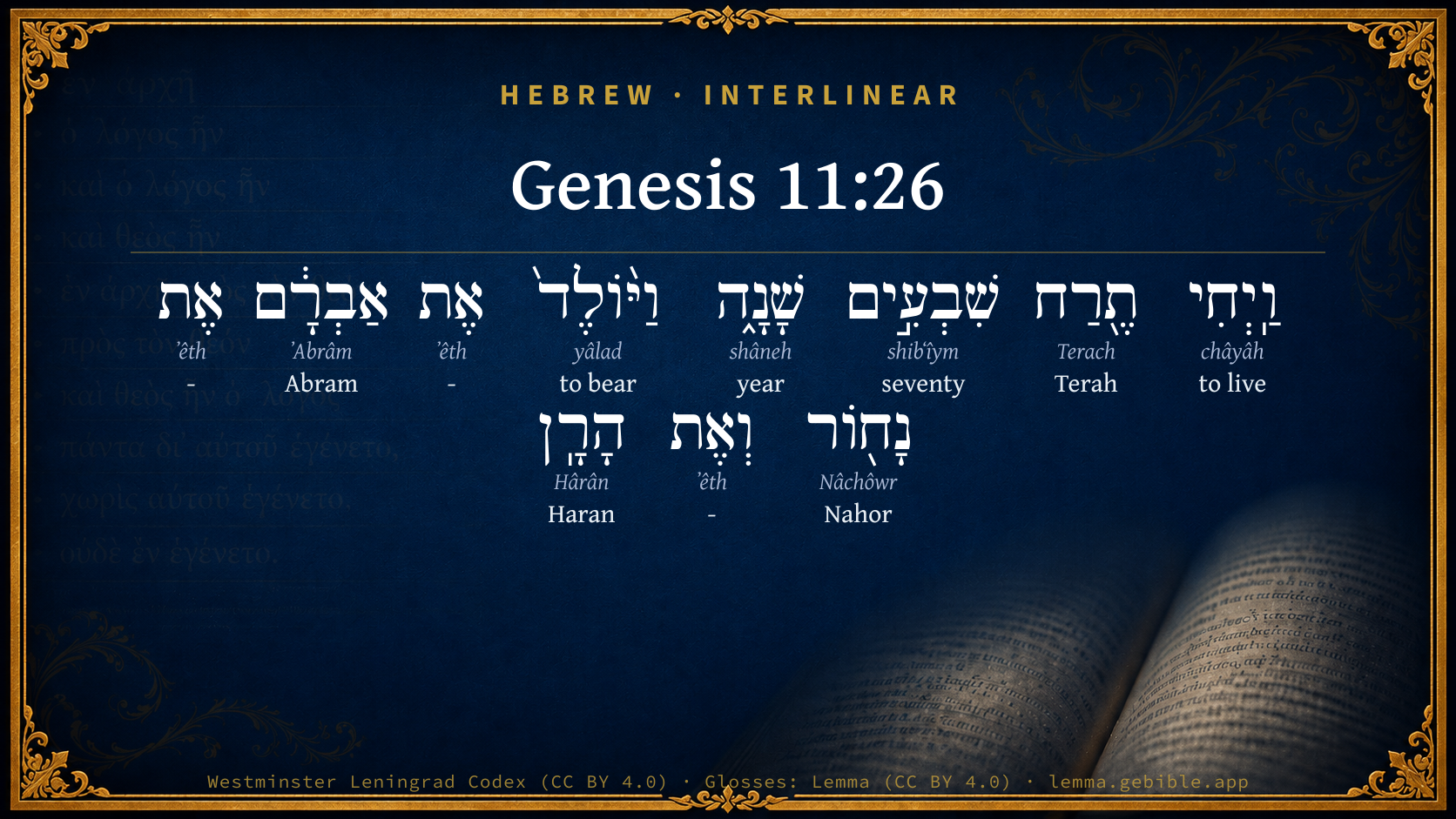
Hebrew (Westminster Leningrad Codex) Genesis 11:26 appears in the Hebrew Old Testament. The text above is from the Westminster Leningrad Codex. Each word links to its Strong’s number, a concise gloss, and parsing drawn from the Open Scriptures Hebrew Bible morphology. Click any word for its full Brown-Driver-Briggs (BDB) entry.
Download image
Cite this verse

Genesis 11:26 (World English Bible). Public Domain. Lemma interlinear Bible study tool, https://lemma.gebible.app/v/genesis/11/26.

Show BibTeX & RIS
BibTeX
RIS
English Translation
Terah lived seventy years, and became the father of Abram, Nahor, and Haran.
World English Bible · Public Domain
Highlights
  • 2 first appearances in the Hebrew Bible
Full analysis ↓
Download a study sheet

One document with this verse’s original text, its word-by-word gloss line, the meaning frame, cross-references with their text, attributed commentary, and full source and license credits — printable, and it pastes into notes with its structure intact.

This verse Autodidact and up

Study sheet (.html) Plain text (.txt)

A passage Seminary Student

Up to 50 verses in one chapter. A passage sheet keeps up to 6 commentary sources and 12 cross-references per verse, in the order this page ranks them, and says so on the sheet whenever that leaves anything out. Ask for a single verse and you get the Autodidact verse sheet above.

Everything on this page stays free to read, with no account — the sheet is a download of what is already on screen, not access to it.

Want to remove ads? Support Godless Engineer
Compare translations 3

The same verse in 3 English versions, stacked beneath the original-language interlinear above. Click any original word for its lexicon entry.

Each is an independent rendering of the whole verse — the interlinear is not word-aligned to these translations.

Highlighted words mark where these versions differ — a whole-verse word diff, not a word-by-word alignment.

  • World English Bible Public Domain
    Terah lived seventy years, and became the father of Abram, Nahor, and Haran.
  • King James Version Public Domain
    And Terah lived seventy years, and begat Abram, Nahor, and Haran.
  • unfoldingWord Literal Text CC BY-SA 4.0
    And Terah lived seventy years, then he fathered Abram, Nahor, and Haran. Terah’s Children, including Abram 11:27-32

unfoldingWord Literal Text — © unfoldingWord, licensed CC BY-SA 4.0. Word-aligned USFM3 via Door43 (git.door43.org/unfoldingWord/en_ult).

Versions to compare (up to 4)

3 of 4 selected

Show all 18 translations

Every available English version of this verse, each an independent rendering of the whole verse.

  • World English Bible Public Domain
    Terah lived seventy years, and became the father of Abram, Nahor, and Haran.
  • Berean Standard Bible Public Domain
    When Terah was 70 years old, he became the father of Abram, Nahor, and Haran.
  • Majority Standard Bible Public Domain
    When Terah was 70 years old, he became the father of Abram, Nahor, and Haran.
  • King James Version Public Domain
    And Terah lived seventy years, and begat Abram, Nahor, and Haran.
  • American Standard Version (1901) Public Domain
    And Terah lived seventy years, and begat Abram, Nahor, and Haran.
  • Revised Version (1885) Public Domain
    And Terah lived seventy years, and begat Abram, Nahor, and Haran.
  • Geneva Bible (1599) Public Domain
    So Terah liued seuentie yeeres, and begate Abram, Nahor, and Haran.
  • Douay-Rheims (1899) Public Domain
    And Thare lived seventy years, and begot Abram, and Nachor, and Aran.
  • Young's Literal Translation Public Domain
    And Terah liveth seventy years, and begetteth Abram, Nahor, and Haran.
  • Literal Standard Version CC BY-SA 4.0
    And Terah lives seventy years, and begets Abram, Nahor, and Haran.
  • Unlocked Literal Bible CC BY-SA 4.0
    After Terah had lived seventy years, he became the father of Abram, Nahor, and Haran.
  • unfoldingWord Literal Text CC BY-SA 4.0
    And Terah lived seventy years, then he fathered Abram, Nahor, and Haran. Terah’s Children, including Abram 11:27-32
  • Darby Bible Public Domain
    And Terah lived seventy years, and begot Abram, Nahor, and Haran.
  • World Messianic Bible Public Domain
    Terah lived seventy years, and became the father of Abram, Nahor, and Haran.
  • Webster's Bible Public Domain
    And Terah lived seventy years, and begat Abram, Nahor, and Haran.
  • Free Bible Version CC BY-SA 4.0
    When Terah was 70, he had Abram, Nahor, and Haran.
  • Bible in Basic English Public Domain
    And Terah was seventy years old when he became the father of Abram, Nahor, and Haran.
  • JPS Tanakh (1917) Public Domain
    And Terah lived seventy years, and begot Abram, Nahor, and Haran.

Literal Standard Version (2020), Covenant Press — licensed CC BY-SA 4.0. Text via the HelloAO Bible API (eBible.org). Unlocked Literal Bible (unfoldingWord) — licensed CC BY-SA 4.0. Text via the HelloAO Bible API (eBible.org). unfoldingWord Literal Text — © unfoldingWord, licensed CC BY-SA 4.0. Word-aligned USFM3 via Door43 (git.door43.org/unfoldingWord/en_ult). Free Bible Version, Dr. Jonathan Gallagher — licensed CC BY-SA 4.0. Text via the HelloAO Bible API (eBible.org).

Word by word

More ways to search: Search by grammar → Find every occurrence → Compare this word →

Practice this passage: Drill this verse → Learn its vocabulary →

הָרָֽן
Hârân
H2039
“Haran”
Noun, Proper
Part of Speech
Noun
Type
Proper
Full BDB Definition

Origin: perhaps from H2022

TWOT: None

Haran = "mountaineer" - youngest son of Terah, brother of Abraham, father of Lot, Milcah, and Iscah; born and died in Ur of the Chaldees (noun proper masculine) - a Gershonite Levite in the time of David, one of the family of Shimei (noun proper masculine) - a son of Caleb by the concubine Ephah (noun proper masculine) - name of the place to which Abraham migrated from Ur of the Chaldees and where the descendants of his brother Nahor established themselves; probably located in Mesopotamia, in Padanaram, the cultivated district at the foot of the hills between the Khabour and the Euphrates below Mount Masius (noun proper locative)
  1. וַֽיְחִי châyâh H2421 “and · to live” Conjunction + Verb, Qal, Sequential Imperfect, 3rd Person, Masculine, Singular
  2. תֶ֖רַח Terach H8646 “Terah” Noun, Proper
  3. שִׁבְעִ֣ים shibʻîym H7657 “seventy” Adjective, Cardinal number, Both, Plural, Absolute
  4. שָׁנָ֑ה shâneh H8141 “year” Noun, Common, Feminine, Singular, Absolute
  5. וַיּ֨וֹלֶד֙ yâlad H3205 “and · to bear” Conjunction + Verb, Hiphil, Sequential Imperfect, 3rd Person, Masculine, Singular
  6. אֶת ʼêth H853 “-” Particle, Direct Object
  7. אַבְרָ֔ם ʼAbrâm H87 “Abram” Noun, Proper
  8. אֶת ʼêth H853 “-” Particle, Direct Object
  9. נָח֖וֹר Nâchôwr H5152 “Nahor” Noun, Proper
  10. וְאֶת ʼêth H853 “and · -” Conjunction + Particle, Direct Object

About this verse

These counts appear in no published source. They are computed here, from the morphology-tagged text and Lemma’s own curated glosses. What Lemma adds →

11
words
9
distinct lemmas
Pentateuch
section

Notable vocabulary

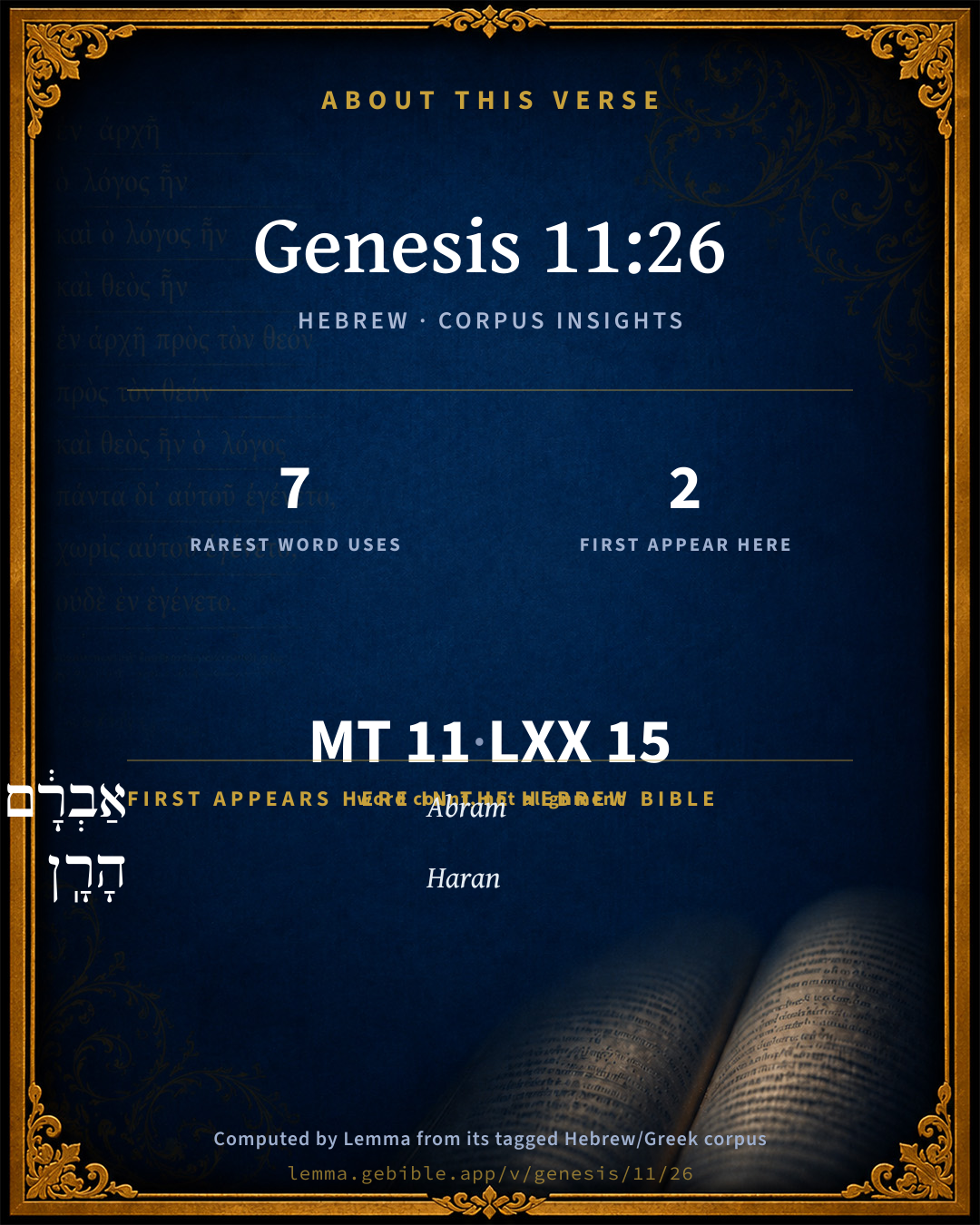
The rarest word here is הָרָֽן Haran H2039 — appearing just 7 times in the whole Hebrew Bible.

First appearance in Scripture

These words make their first canonical appearance in the Hebrew Bible here:

  • אַבְרָ֔ם Abram H87
  • הָרָֽן Haran H2039

Shared distinctive vocabulary

הָרָֽן Haran H2039 occurs in 6 verses of the Hebrew Bible. Also found in:

Grammatical profile

  • 2 verbs
  • 5 nouns
  • 1 adjective
  • 3 particles

Verb forms

  • וַֽיְחִי Qal · Sequential Imperfect
  • וַיּ֨וֹלֶד֙ Hiphil · Sequential Imperfect

Hebrew & Septuagint length

In English translation the verse runs 13 words from the Hebrew and 12 from the Septuagint (LXX English) — closely comparable.

A rough comparison of the two English renderings, which tokenize alike — not a word-level alignment.

Word counts can differ between the Hebrew and the Greek without any difference in meaning — e.g. the Hebrew direct-object marker אֵת has no separate Greek word, and Greek often adds the article ὁ.

In the original languages it is 11 Hebrew tokens and 15 Greek tokens — but the two are counted differently (Hebrew bundles its prefixes and suffixes into one token; the Greek is in lemma form), so that isn’t a like-for-like length.

Cross-references

5

Topical passages linked to Genesis 11:26 in the Treasury of Scripture Knowledge — connected by theme and wording, ordered by reader-vote popularity; previews shown in the World English Bible.

  • Joshua 24:2 Joshua said to all the people, Thus says Yahweh, the God of Israel, Your fathers lived of old time beyond the River, even Terah, the father of Abraham, and the father of Nahor: and they served other gods.
  • Genesis 12:4–5 So Abram went, as Yahweh had spoken to him. Lot went with him. Abram was seventy-five years old when he departed out of Haran.
  • 1 Chronicles 1:26–27 Serug, Nahor, Terah,
  • Genesis 22:20–24 It happened after these things, that it was told Abraham, saying, "Behold, Milcah, she also has borne children to your brother Nahor:
  • Genesis 29:4–5 Jacob said to them, "My relatives, where are you from?" They said, "We are from Haran."

Cross-references courtesy of OpenBible.info (CC BY 4.0).

Hebrew and Greek witnesses Masoretic Hebrew ↔ Greek Septuagint

The same verse in the two great witnesses to the Old Testament, shown verse-for-verse.

These are two independent witnesses, not word-aligned to each other, and the Septuagint is shown in lemma (dictionary) form.

Hebrew Genesis 11:26 Masoretic · Westminster Leningrad Codex

וַֽיְחִי תֶ֖רַח שִׁבְעִ֣ים שָׁנָ֑ה וַיּ֨וֹלֶד֙ אֶת אַבְרָ֔ם אֶת נָח֖וֹר וְאֶת הָרָֽן

Terah lived seventy years, and became the father of Abram, Nahor, and Haran.

World English Bible · Public Domain

Greek LXX Genesis 11:26 Septuagint · lemma form

καί ζάω θαρα ἑβδομήκοντα ἔτος καί γεννάω ὁ αβραμ καί ὁ ναχωρ καί ὁ αρραν

And Tharrha lived seventy years, and begot Abram, and Nachor, and Arrhan.

LXX2012 (modern English Septuagint) · Public Domain

On this verse, The Pulpit Commentary discusses the Septuagint’s reading. Read the note in Commentary ↓

Hebrew: Westminster Leningrad Codex (CC BY 4.0). Greek: Septuagint (public domain); English from LXX2012 (modern English Septuagint) (Public Domain). How the Septuagint differs from the Hebrew →

Targum (Aramaic paraphrase)

2

The Targum is the ancient Jewish Aramaic paraphrase of the Hebrew Scriptures — an interpretive translation, not the Hebrew text itself. Onkelos (literal) and Pseudo-Jonathan (expansive) render the Torah, and Jonathan the Prophets. Coverage is partial: where no permissively-licensed English translation exists for a verse, only the Aramaic is shown. This is verse-level text, not a word-by-word alignment to the Hebrew.

  1. Targum Onkelos Torah (Genesis–Deuteronomy)
    וַחֲיָא תֶרַח שִׁבְעִין שְׁנִין וְאוֹלִיד יָת אַבְרָם יָת נָחוֹר וְיָת הָרָן

    And Terach lived seventy years, and begat Abram, Nachor, and Haran.

    Targum Onkelos — Aramaic: “Onkelos Genesis” (public domain); “Onkelos Exodus” (public domain); “Onkelos Leviticus” (public domain); “Onkelos Numbers” (public domain); “Onkelos Deuteronomy” (public domain). English: “Sefaria Community Translation” (CC0 1.0 (public-domain dedication)); “J.W. Etheridge. The Targums of Onkelos and Jonathan Ben Uzziel on the Pentateuch. London: Longmans, Green, 1862” (public domain). Text via Sefaria.

  2. Targum Pseudo-Jonathan Torah (Genesis–Deuteronomy)
    וַחֲיָא תֶּרַח שַׁבְעִין שְׁנִין וְאוֹלִיד יַת אַבְרָם יַת נָחוֹר וְיַת הָרָן

    And Terah lived seventy years, and begat Abram and Nahor and Haran.

    Targum Pseudo-Jonathan — Aramaic: “Targum Jonathan on Genesis” (public domain); “Targum Jonathan on Exodus” (public domain); “Targum Jonathan on Leviticus” (public domain); “Targum Jonathan on Numbers” (public domain); “Targum Jonathan on Deuteronomy” (public domain). English: “The Targum of Jonathan ben Uzziel, trans. J. W. Etheridge, London, 1862” (public domain). Text via Sefaria.

Commentary

Notes on Genesis 11:26 from classic Christian and Jewish commentators (each source and its license shown beneath its notes). The classic Christian expositions comment on the surrounding passage and are grouped to its opening verse, so a note may address several verses; the Jewish commentaries on the Tanakh (Rashi and others) are per-verse, so they appear only where the commentator wrote on this verse.

Lemma curates 59 commentaries, every one of them public domain or Creative Commons licensed, each selected and text-cleaned for this edition rather than reprinted as found. About our sources →

Adam Clarke's Commentary

Verse 26. And Terah lived seventy years, and begat Abram, Nahor, and Haran.] Haran was certainly the eldest son of Terah, and he appears to have been born when Terah was about seventy years of age, and his birth was followed in successive periods with those of Nahor his second, and Abram his youngest son. Many have been greatly puzzled with the account here, supposing because Abram is mentioned first, that therefore he was the eldest son of Terah: but he is only put first by way of dignity. An in stance of this we have already seen, Ge 5:32, where Noah is represented as having Shem, Ham, and Japheth in this order of succession; whereas it is evident from other scriptures that Shem was the youngest son, who for dignity is named first, as Abram is here; and Japheth the eldest, named last, as Haran is here. Terah died two hundred and five years old, Ge 11:32; then Abram departed from Haran when seventy-five years old, Ge 12:4; therefore Abram was born, not when his father Terah was seventy, but when he was one hundred and thirty.

When any case of dignity or pre-eminence is to be marked, then even the youngest son is set before all the rest, though contrary to the usage of the Scriptures in other cases. Hence we find Shem, the youngest son of Noah, always mentioned first; Moses is mentioned before his elder brother Aaron; and Abram before his two elder brethren Haran and Nahor. These observations are sufficient to remove all difficulty from this place.

Adam Clarke's Commentary on the Bible (1810–1826) — public domain. Text from a community e-Sword/MySword module.

The Cambridge Bible for Schools and Colleges

gen. ed. J. J. S. Perowne

26. seventy years] The birth of Terah’s firstborn is postponed for a period twice as long as in the case of the other patriarchs since Shem. Shem was 100 years old when he begat Arpachshad (Gen_11:10). This greater duration of time is connected with the features of faith and discipline attaching to the careers of the greater personages in the Israelite ancestry.

Abram] According to the Hebrew tradition, the name means “the father (ab) is exalted (ram).” It might also mean “Ram (= Ramman) is father.” Compare, in the one case, Jehoram (= Jah is exalted); in the other, Abijah (= Jah is father). See note on Gen_17:5.

Nahor] See on Gen_11:22.

Haran] This name has by some scholars been derived from the Heb. har = “a mountain,” and explained as meaning “Highlanders.” “Beth-haran” is the name of a town built by the “children of Gad” (Num_32:36) and mentioned along with “Beth-Nimrah.” Possibly, therefore, Haran was also the name of a local deity.

The Cambridge Bible for Schools and Colleges (gen. ed. J. J. S. Perowne; Cambridge University Press, 1878–1918) — public domain. Text from a community e-Sword module.

John Gill's Exposition

And the days of Terah were two hundred years,.... His days are summed up as none of the rest are in this genealogy, that it might be observed; his death being the time of Abram's leaving Chaldea and coming into the land of Canaan, given to him and his seed for an inheritance; see Act 7:4.

and Terah died in Haran: the Arabic historian (s) says, he died in Haran in the month Elul, in the year of his age two hundred and sixty five; but he gives him sixty years too many: a Jewish chronologer (t) says he died in the thirty fifth year of Isaac. Perhaps he gave the name to this place, where he dwelt a while, in memory of his son Haran, which before might be called by another name, Padanaram, as it seems to be called even after this; see Gen 24:10.

(s) Elmaaciuns, ut supra. (p. 31. apud Hottinger. p. 282.) (t) R. Gedaliah, Shalshalet, fol. 2. 1.

Next: Genesis Chapter 12

John Gill's Exposition of the Whole Bible (1746–1763) — public domain (CC PDM 1.0). Text via the HelloAO Bible API.

Matthew Poole's English Annotations

i.e. Began to beget, as Gen 5:32.

Abram, who is first named in order of dignity, (for which cause Shem is put before Ham and Japheth, and Moses before Aaron), not in order of time, which seems to be this: Haran probably was the eldest, because Nahor married his daughter; Nahor the second; and Abram certainly was the youngest, because Terah, Abram's father, lived two hundred and five years, Gen 11:32, and Abram after his father's death, Act 7:4, went out of Haran, when he was seventy-five years old, Gen 12:4-5; therefore he was not begotten in Terah's seventieth year, when Terah began to beget his sons, as here is said, but in his one hundred and thirtieth year, and so there remains seventy-five years precisely to Abram's departure. And Sarai, Haran's daughter, was but ten years younger than Abram, Gen 17:17; and therefore Haran was Abram's elder brother.

Matthew Poole's English Annotations on the Holy Bible (1683–1685) — public domain. Text from a community e-Sword/MySword module.

The Pulpit Commentary

And Terah lived seventy years, and begat Abram. First named on account of his spiritual pre-eminence. If Abram was Terah"s eldest son, then, as Abram was seventy-five years of age when Terah died, (Gen_12:4) Terah"s whole life could only have been 145 years. But Terah lived to the age of 205 years; (Gen_11:32) therefore Abram was born in Terah"s 130th year. This, however, makes it surprising that Abraham should have reckoned it impossible for him to have a son at 100; (Gen_17:17) only, after having lived so long in childless wedlock, it was not strange that he should feel somewhat doubtful of any issue by Sarai. Kalisch believes that Stephen (Act_7:4) made a mistake in saying Terah died before his son"s migration from Charran, and that he really survived that event by sixty years; while the Samaritan text escapes the difficulty by shortening the life of Terah to 145 years. And Nahor, who must have been younger than Haran, since he married Haran"s daughter. And Haran, who, as the eldest, must have been born in Terah"s seventieth year. Thus the second family register, like the flint, concludes after ten generations with the birth of three sons, who, like Noah"s, are mentioned not in the order of their ages, but of their spiritual pre-eminence.

CHRONOLOGICAL TABLE

HEBREW TEXT SAMARITAN SEPTUAGINT NAMES OF AGE AT REST TOTAL AGE AT REST TOTAL AGE AT REST TOTAL PATRIARCHS SON"S OF NO. OF SON"S OF NO. OF SON"S OF NO. OF BIRTH LIFE YEARS BIRTH LIFE YEARS BIRTH LIFE YEARS SHEM 100 500 600 100 500 600 100 500 600 ARPHXAD 35 403 438 135 303 438 135 400 535 Kai"nan 130 330 460 SALAH 30 403 433 130 303 433 130 330 460 EBER 34 430 464 134 270 404 134 270 404 PELEG 30 209 239 130 109 239 130 209 339 REU 32 207 239 132 107 239 132 207 339 SERUG 30 200 230 130 100 230 130 200 330 NAHOR 29 119 148 79 96 148 179 125 304 TERAH 70 135 205 70 75 145 70 135 205 From this table it appears that 292 years, according to the Hebrew text, passed away between the Flood and the birth, or 292 + 75 = 367 between the Flood and the call of Abraham. Reckoning, however, the age of Torah at Abram"s birth as 130 (vide Exposition), the full period between the Deluge and the patriarch"s departure from Haran will be 367 + 60 = 427 years, which, allowing five pairs to each family, Murphy computes, would in the course of ten generations yield a population of 15, 625, 000 souls; or, supposing a rate of increase equal to that of Abraham"s posterity in Egypt during the 400 years that elapsed from the call to the exodus, the inhabitants of the world in the time of Abraham would be between seven and eight millions. It must, however, be remembered that an element of uncertainty enters into all computations based upon even the Hebrew text. The age of Terah at the birth (apparently) of Abram is put down at seventy. But it admits of demonstration that Abram was born in the 130th year of Terah. What guarantee then do we possess that in every instance the registered son was the firstborn? In the case of Arphaxad this is almost implied in the statement that he was born two years after the Flood. But if the case of Eber were parallel with that of Terah, and Joktan were the son that he begat in his thirty-fourth year, then obviously the birth of Peleg, like that of Abram, may have happened sixty years later; in which case it is apparent that any reckoning which proceeded on the minute verbal accuracy of the registered numbers would be entirely at fault. This consideration might have gone far to explain the wide divergence between the numbers of the Samaritan and Septuagint as compared with the Hebrew text, had it not been that they both agree with it in setting down seventy as the age of Terah at the date of Abram"s birth. The palpable artificiality also of these later tables renders them even less worthy of credit than the Hebrew. The introduction by the LXX of Cainan as the son of Arphaxad, though seemingly confirmed by Luke, (Luk_3:35, Luk_3:36) is clearly an interpolation. It does not occur in the LXX version of 1Ch_1:24, and is not found in either the Samaritan Pentateuch, the Targums or the ancient versions, in Josephus or Philo, or in the Codex Beza of the Gospel of Luke. Its appearance in Luke (and probably also in the LXX) can only be explained as an interpolation. Wordsworth is inclined to regard it as authentic in Luke, and to suppose that Cainaan was excluded from the Mosaic table either to render it symmetrical, as Luke"s table is rendered symmetrical by its insertion, or because of some moral offence, which, though necessitating his expulsion from a Hebrew register, would not prevent his reappearance in his proper place under the gospel.

The Pulpit Commentary (1880–1919), ed. H.D.M. Spence-Jones & Joseph S. Exell — public domain. Text from a community e-Sword module.

Lesson kit

Teaching starters — assembled from the data on this page, not authored interpretation. Every prompt links to the verse data it draws on. Edit before teaching.

Genesis, in the Pentateuch, opens this verse with 11 words (9 distinct Hebrew lemmas). Its most distinctive word is Hârân (“Haran”). A historical commentator’s framing appears above. Read the whole chapter for the surrounding context.

Discussion questions

  1. The word Hârân carries the sense “Haran.” How does it shape the verse?
  2. 2 words here appear for the first time in Scripture. What is being introduced at this debut?
  3. Genesis 11:27 shares the word «Haran» with this verse. How do the two illuminate each other?
  4. These translations render this verse differently. What is at stake in choosing one wording over another?
  5. The verb «וַֽיְחִי» is Qal Sequential Imperfect. How does its form color the action?
  6. Reading how Adam Clarke's Commentary and The Cambridge Bible for Schools and Colleges read this verse, where do the two commentators agree and where do they part?

Things to notice

Reading settings

Reading text

Shown beneath each verse's original-language words.

Old Testament
Old Testament edition

Read the OT as the Masoretic Hebrew (MT) or the Greek Septuagint (LXX).

English shown for the Greek Septuagint (in the Hebrew ↔ Greek comparison).

Comparing translations? Open the Compare panel on any verse page to stack up to four side by side.