Genesis 22:20

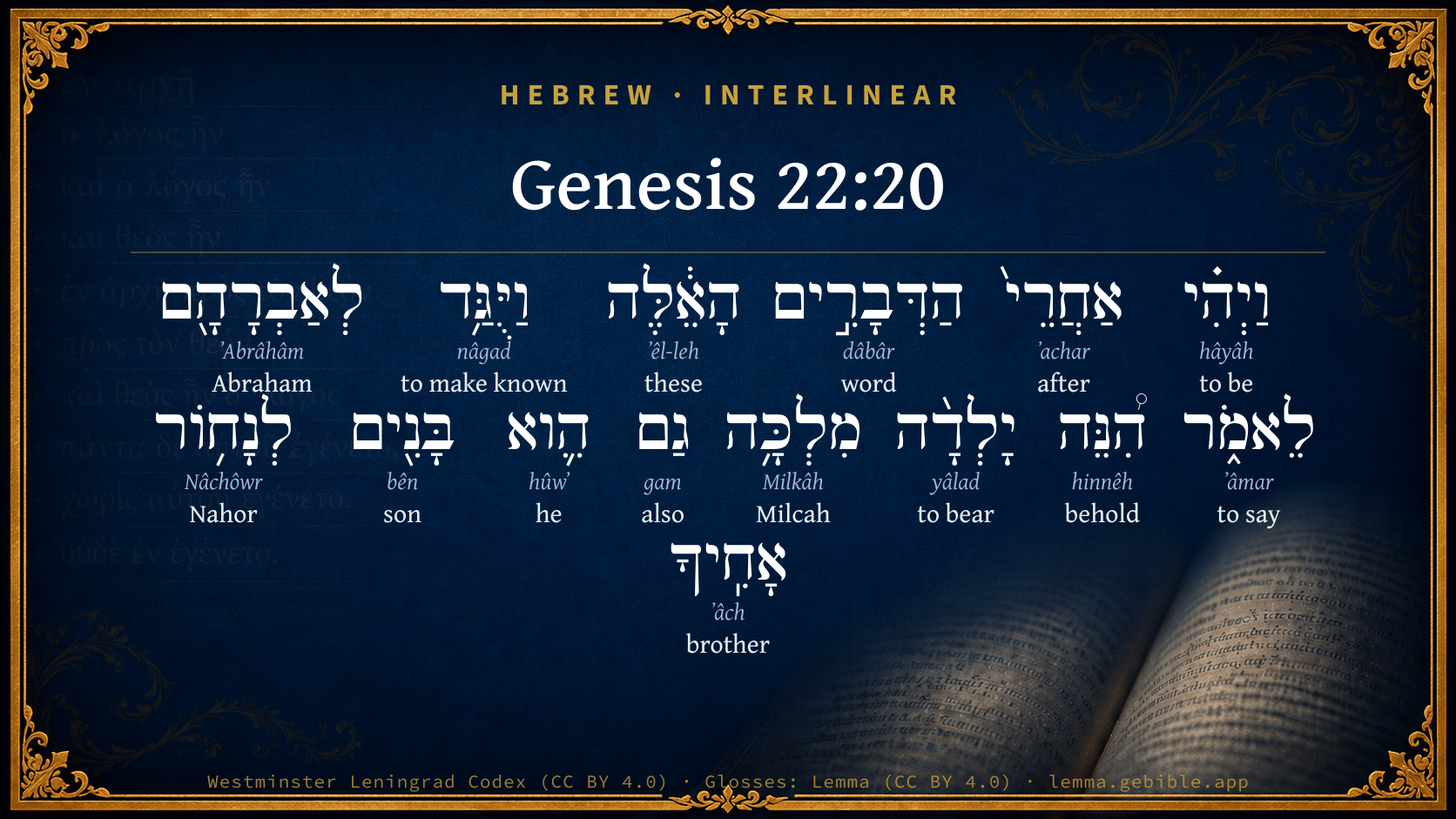
Hebrew (Westminster Leningrad Codex) Genesis 22:20 appears in the Hebrew Old Testament. The text above is from the Westminster Leningrad Codex. Each word links to its Strong’s number, a concise gloss, and parsing drawn from the Open Scriptures Hebrew Bible morphology. Click any word for its full Brown-Driver-Briggs (BDB) entry.
Download image
Cite this verse

Genesis 22:20 (World English Bible). Public Domain. Lemma interlinear Bible study tool, https://lemma.gebible.app/v/genesis/22/20.

Show BibTeX & RIS
BibTeX
RIS
English Translation
It happened after these things, that it was told Abraham, saying, "Behold, Milcah, she also has borne children to your brother Nahor:
World English Bible · Public Domain
Download a study sheet

One document with this verse’s original text, its word-by-word gloss line, the meaning frame, cross-references with their text, attributed commentary, and full source and license credits — printable, and it pastes into notes with its structure intact.

This verse Autodidact and up

Study sheet (.html) Plain text (.txt)

A passage Seminary Student

Up to 50 verses in one chapter. A passage sheet keeps up to 6 commentary sources and 12 cross-references per verse, in the order this page ranks them, and says so on the sheet whenever that leaves anything out. Ask for a single verse and you get the Autodidact verse sheet above.

Everything on this page stays free to read, with no account — the sheet is a download of what is already on screen, not access to it.

Want to remove ads? Support Godless Engineer
Compare translations 3

The same verse in 3 English versions, stacked beneath the original-language interlinear above. Click any original word for its lexicon entry.

Each is an independent rendering of the whole verse — the interlinear is not word-aligned to these translations.

Highlighted words mark where these versions differ — a whole-verse word diff, not a word-by-word alignment.

  • World English Bible Public Domain
    It happened after these things, that it was told Abraham, saying, "Behold, Milcah, she also has borne children to your brother Nahor:
  • King James Version Public Domain
    And it came to pass after these things, that it was told Abraham, saying, Behold, Milcah, she hath also born children unto thy brother Nahor;
  • unfoldingWord Literal Text CC BY-SA 4.0
    Then it happened after those things that it was told to Abraham, saying, “Behold, Milcah, she too, has born sons for Nahor your brother:

unfoldingWord Literal Text — © unfoldingWord, licensed CC BY-SA 4.0. Word-aligned USFM3 via Door43 (git.door43.org/unfoldingWord/en_ult).

Versions to compare (up to 4)

3 of 4 selected

Show all 18 translations

Every available English version of this verse, each an independent rendering of the whole verse.

  • World English Bible Public Domain
    It happened after these things, that it was told Abraham, saying, "Behold, Milcah, she also has borne children to your brother Nahor:
  • Berean Standard Bible Public Domain
    Some time later, Abraham was told, “Milcah has also borne sons to your brother Nahor:
  • Majority Standard Bible Public Domain
    Some time later, Abraham was told, “Milcah has also borne sons to your brother Nahor:
  • King James Version Public Domain
    And it came to pass after these things, that it was told Abraham, saying, Behold, Milcah, she hath also born children unto thy brother Nahor;
  • American Standard Version (1901) Public Domain
    And it came to pass after these things, that it was told Abraham, saying, Behold, Milcah, she also hath borne children unto they brother Nahor.
  • Revised Version (1885) Public Domain
    And it came to pass after these things, that it was told Abraham, saying, Behold, Milcah, she also hath borne children unto thy brother Nahor;
  • Geneva Bible (1599) Public Domain
    And after these things one tolde Abraham, saying, Beholde Milcah, she hath also borne children vnto thy brother Nahor:
  • Douay-Rheims (1899) Public Domain
    After these things, it was told Abraham that Melcha also had borne children to Nachor his brother.
  • Young's Literal Translation Public Domain
    And it cometh to pass after these things that it is declared to Abraham, saying, `Lo, Milcah hath borne, even she, sons to Nahor thy brother:
  • Literal Standard Version CC BY-SA 4.0
    And it comes to pass after these things that it is declared to Abraham, saying, “Behold, Milcah has borne, even she, sons to your brother Nahor:
  • Unlocked Literal Bible CC BY-SA 4.0
    It came about after these things that Abraham was told, “Milkah has borne children, as well, to your brother Nahor.”
  • unfoldingWord Literal Text CC BY-SA 4.0
    Then it happened after those things that it was told to Abraham, saying, “Behold, Milcah, she too, has born sons for Nahor your brother:
  • Darby Bible Public Domain
    And it came to pass after these things, that it was told Abraham, saying, Behold, Milcah, she also has borne sons to thy brother Nahor:
  • World Messianic Bible Public Domain
    After these things, Abraham was told, “Behold, Milcah, she also has borne children to your brother Nahor:
  • Webster's Bible Public Domain
    And it came to pass after these things, that it was told to Abraham, saying, Behold, Milcah, she hath also borne children to thy brother Nahor;
  • Free Bible Version CC BY-SA 4.0
    Sometime later, Abraham was told, “Milcah has had sons for your brother Nahor.”
  • Bible in Basic English Public Domain
    After these things, Abraham had news that Milcah, the wife of his brother Nahor, had given birth to children;
  • JPS Tanakh (1917) Public Domain
    And it came to pass after these things, that it was told Abraham, saying: 'Behold, Milcah, she also hath borne children unto thy brother Nahor:

Literal Standard Version (2020), Covenant Press — licensed CC BY-SA 4.0. Text via the HelloAO Bible API (eBible.org). Unlocked Literal Bible (unfoldingWord) — licensed CC BY-SA 4.0. Text via the HelloAO Bible API (eBible.org). unfoldingWord Literal Text — © unfoldingWord, licensed CC BY-SA 4.0. Word-aligned USFM3 via Door43 (git.door43.org/unfoldingWord/en_ult). Free Bible Version, Dr. Jonathan Gallagher — licensed CC BY-SA 4.0. Text via the HelloAO Bible API (eBible.org).

Word by word

More ways to search: Search by grammar → Find every occurrence → Compare this word →

Practice this passage: Drill this verse → Learn its vocabulary →

מִלְכָּ֥ה
Milkâh
H4435
“Milcah”
Noun, Proper
Part of Speech
Noun
Type
Proper
Full BDB Definition

Origin: a form of H4436

TWOT: None

Milcah = "queen" - daughter of Haran and wife of Nahor, her uncle and Abraham's brother, to whom she bore 8 children - a daughter of Zelophehad and granddaughter of Manasseh
  1. וַיְהִ֗י hâyâh H1961 “and · to be” Conjunction + Verb, Qal, Sequential Imperfect, 3rd Person, Masculine, Singular
  2. אַחֲרֵי֙ ʼachar H310 “after” Preposition
  3. הַדְּבָרִ֣ים dâbâr H1697 “the · words” Particle, Definite Article + Noun, Common, Masculine, Plural, Absolute
  4. הָאֵ֔לֶּה ʼêl-leh H428 “the · these” Particle, Definite Article + Pronoun, Demonstrative, Common, Plural
  5. וַיֻּגַּ֥ד nâgad H5046 “and · to make known” Conjunction + Verb, Hophal, Sequential Imperfect, 3rd Person, Masculine, Singular
  6. לְאַבְרָהָ֖ם ʼAbrâhâm H85 “to/for · Abraham” Preposition + Noun, Proper
  7. לֵאמֹ֑ר ʼâmar H559 “to say” Preposition + Verb, Qal, Infinitive Construct
  8. הִ֠נֵּה hinnêh H2009 “behold” Particle, Demonstrative
  9. יָלְדָ֨ה yâlad H3205 “to bear” Verb, Qal, Perfect, 3rd Person, Feminine, Singular
  10. גַם gam H1571 “also” Adverb
  11. הִ֛וא hûwʼ H1931 “he” Pronoun, Personal, 3rd Person, Feminine, Singular
  12. בָּנִ֖ים bên H1121 “sons” Noun, Common, Masculine, Plural, Absolute
  13. לְנָח֥וֹר Nâchôwr H5152 “to/for · Nahor” Preposition + Noun, Proper
  14. אָחִֽיךָ ʼâch H251 “brother · your” Noun, Common, Masculine, Singular, Construct + Suffix, Personal, 2nd Person, Masculine, Singular

About this verse

These counts appear in no published source. They are computed here, from the morphology-tagged text and Lemma’s own curated glosses. What Lemma adds →

15
words
15
distinct lemmas
Pentateuch
section

Notable vocabulary

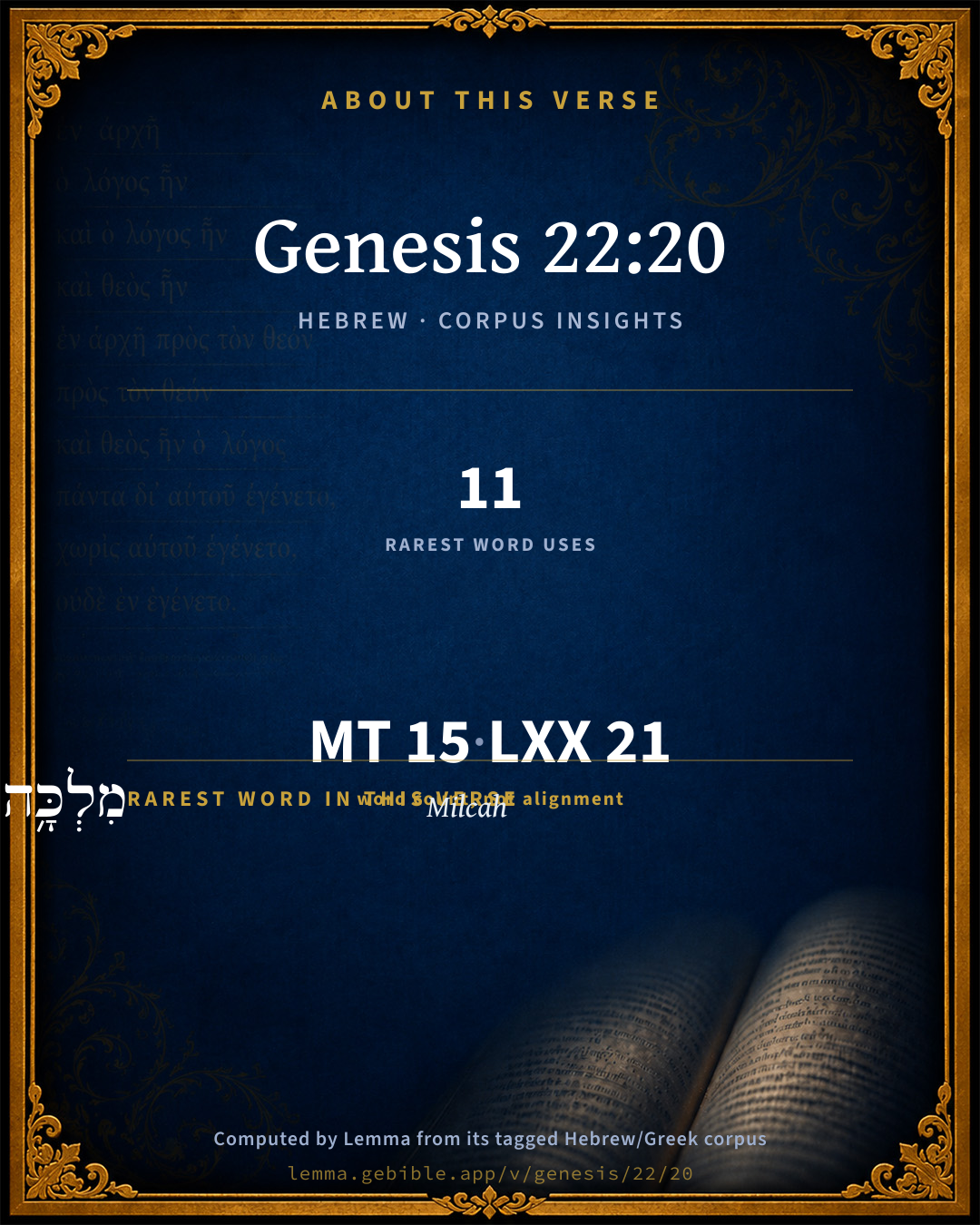
The rarest word here is מִלְכָּ֥ה Milcah H4435 — appearing just 11 times in the whole Hebrew Bible.

Shared distinctive vocabulary

מִלְכָּ֥ה Milcah H4435 occurs in 10 verses of the Hebrew Bible. Also found in:

Grammatical profile

  • 4 verbs
  • 6 nouns
  • 2 pronouns
  • 1 preposition
  • 1 adverb
  • 1 particle

Verb forms

  • וַיְהִ֗י Qal · Sequential Imperfect
  • וַיֻּגַּ֥ד Hophal · Sequential Imperfect
  • לֵאמֹ֑ר Qal · Infinitive Construct
  • יָלְדָ֨ה Qal · Perfect

Hebrew & Septuagint length

In English translation the verse runs 22 words from the Hebrew and 17 from the Septuagint (LXX English) — closely comparable.

A rough comparison of the two English renderings, which tokenize alike — not a word-level alignment.

Word counts can differ between the Hebrew and the Greek without any difference in meaning — e.g. the Hebrew direct-object marker אֵת has no separate Greek word, and Greek often adds the article ὁ.

In the original languages it is 15 Hebrew tokens and 21 Greek tokens — but the two are counted differently (Hebrew bundles its prefixes and suffixes into one token; the Greek is in lemma form), so that isn’t a like-for-like length.

Cross-references

7

Topical passages linked to Genesis 22:20 in the Treasury of Scripture Knowledge — connected by theme and wording, ordered by reader-vote popularity; previews shown in the World English Bible.

  • Genesis 11:29 Abram and Nahor took wives. The name of Abram's wife was Sarai, and the name of Nahor's wife, Milcah, the daughter of Haran who was also the father of Iscah.
  • Genesis 24:24 She said to him, "I am the daughter of Bethuel the son of Milcah, whom she bore to Nahor."
  • Genesis 11:26 Terah lived seventy years, and became the father of Abram, Nahor, and Haran.
  • Genesis 24:10 The servant took ten camels, of his master's camels, and departed, having all goodly things of his master's in his hand. He arose, and went to Mesopotamia, to the city of Nahor.
  • Genesis 24:15 It happened, before he had done speaking, that behold, Rebekah came out, who was born to Bethuel the son of Milcah, the wife of Nahor, Abraham's brother, with her pitcher on her shoulder.
  • Genesis 31:53 The God of Abraham, and the God of Nahor, the God of their father, judge between us." Then Jacob swore by the fear of his father, Isaac.
  • Proverbs 25:25 Like cold water to a thirsty soul, So is good news from a far country.

Cross-references courtesy of OpenBible.info (CC BY 4.0).

Hebrew and Greek witnesses Masoretic Hebrew ↔ Greek Septuagint

The same verse in the two great witnesses to the Old Testament, shown verse-for-verse.

These are two independent witnesses, not word-aligned to each other, and the Septuagint is shown in lemma (dictionary) form.

Hebrew Genesis 22:20 Masoretic · Westminster Leningrad Codex

וַיְהִ֗י אַחֲרֵי֙ הַדְּבָרִ֣ים הָאֵ֔לֶּה וַיֻּגַּ֥ד לְאַבְרָהָ֖ם לֵאמֹ֑ר הִ֠נֵּה יָלְדָ֨ה מִלְכָּ֥ה גַם הִ֛וא בָּנִ֖ים לְנָח֥וֹר אָחִֽיךָ

It happened after these things, that it was told Abraham, saying, "Behold, Milcah, she also has borne children to your brother Nahor:

World English Bible · Public Domain

Greek LXX Genesis 22:20 Septuagint · lemma form

γίγνομαι δέ μετά ὁ ῥῆμα οὗτος καί ἀναἀγγέλλω ὁ αβρααμ λέγω ἰδού τίκτω μελχα καί αὐτός υἱός ναχωρ ὁ ἀδελφός σύ

Uz the firstborn, and Baux his brother, and Camuel the father of the Syrians, and Chazad, and

LXX2012 (modern English Septuagint) · Public Domain

On this verse, Lange's Commentary on the Holy Scriptures discusses the Septuagint’s reading. Read the note in Commentary ↓

Hebrew: Westminster Leningrad Codex (CC BY 4.0). Greek: Septuagint (public domain); English from LXX2012 (modern English Septuagint) (Public Domain). How the Septuagint differs from the Hebrew →

Targum (Aramaic paraphrase)

2

The Targum is the ancient Jewish Aramaic paraphrase of the Hebrew Scriptures — an interpretive translation, not the Hebrew text itself. Onkelos (literal) and Pseudo-Jonathan (expansive) render the Torah, and Jonathan the Prophets. Coverage is partial: where no permissively-licensed English translation exists for a verse, only the Aramaic is shown. This is verse-level text, not a word-by-word alignment to the Hebrew.

  1. Targum Onkelos Torah (Genesis–Deuteronomy)
    וַהֲוָה בָּתַר פִּתְגָּמַיָּא הָאִלֵּין וְאִתְחֲוָא לְאַבְרָהָם לְמֵימָר הָא יְלֵידַת מִלְכָּה אַף הִיא בְּנִין לְנָחוֹר אָחוּךְ

    (no public-domain English translation for this verse)

    Targum Onkelos — Aramaic: “Onkelos Genesis” (public domain); “Onkelos Exodus” (public domain); “Onkelos Leviticus” (public domain); “Onkelos Numbers” (public domain); “Onkelos Deuteronomy” (public domain). English: “Sefaria Community Translation” (CC0 1.0 (public-domain dedication)); “J.W. Etheridge. The Targums of Onkelos and Jonathan Ben Uzziel on the Pentateuch. London: Longmans, Green, 1862” (public domain). Text via Sefaria.

  2. Targum Pseudo-Jonathan Torah (Genesis–Deuteronomy)
    וַהֲוָה בָּתַר פִּתְגָמַיָא הָאִילֵין מִן בָּתַר דְכָפַת אַבְרָהָם יַת יִצְחָק וַאֲזַל סִטְנָא וְתַנִי לְוַת שָרָה דְאַבְרָהָם נְכַס יַת יִצְחָק וְקָמַת שָרָה וּפַגְנַת וְאַשְׁתַּנְקַת וּמִיתַת מִן אֲנִיקָא וְאָתָא אַבְרָהָם וּבַת בְּאָרְחָא וְתַנְיָא לְאַבְרָהָם לְמֵימַר הָא יְלִידַת מִלְכָּה אוּף הִיא אִתְרְוָוחַת בִּזְכוּת דְאַחְתָהּ לְמֵילַד בְּנִין לְנָחוֹר אָחוּךְ

    And it was after these things, after Abraham had bound Izhak, that Satana came and told unto Sarah that Abraham had killed Izhak. And Sarah arose, and cried out, and was strangled, and died from agony. But Abraham had come, and was resting in the way. And it was told Abraham, saying, Behold, Milcha also hath borne; she hath enlargement, through the righteousness of her sister, for bring forth sons unto Nachor thy brother:

    Targum Pseudo-Jonathan — Aramaic: “Targum Jonathan on Genesis” (public domain); “Targum Jonathan on Exodus” (public domain); “Targum Jonathan on Leviticus” (public domain); “Targum Jonathan on Numbers” (public domain); “Targum Jonathan on Deuteronomy” (public domain). English: “The Targum of Jonathan ben Uzziel, trans. J. W. Etheridge, London, 1862” (public domain). Text via Sefaria.

Commentary

Notes on Genesis 22:20 from classic Christian and Jewish commentators (each source and its license shown beneath its notes). The classic Christian expositions comment on the surrounding passage and are grouped to its opening verse, so a note may address several verses; the Jewish commentaries on the Tanakh (Rashi and others) are per-verse, so they appear only where the commentator wrote on this verse.

Lemma curates 59 commentaries, every one of them public domain or Creative Commons licensed, each selected and text-cleaned for this edition rather than reprinted as found. About our sources →

Trapp's Complete Commentary

John Trapp

Gen 22:20 And it came to pass after these things, that it was told Abraham, saying, Behold, Milcah, she hath also born children unto thy brother Nahor;

Ver. 20. It was told Abraham.] Good news out of a far country; God usually cheers up his children after sharpest trials; brings them, as once, from Marah to Elim, &c.

John Trapp, A Commentary or Exposition upon All the Books of the Old and New Testament (1647–1656) — public domain. Text from a community e-Sword module.

Joseph Benson's Commentary

Gen 22:20. This is recorded here, 1st, To show that though Abraham saw his own family highly dignified with peculiar privileges, yet he did not look with contempt upon his relations, but was glad to hear of the increase and prosperity of their families. 2d, To make way for the following story of the marriage of Isaac to Rebekah, a daughter of this family.

Joseph Benson's Commentary on the Old and New Testaments (1811–1818) — public domain. Text from a community e-Sword module.

The Pulpit Commentary

CHAPTER 22:20-24

And it came to pass after these things (probably not long after his return to Beersheba), that it was told (by some unknown messenger or accidental traveler from Mesopotamia) Abraham, saying, Behold, Milcah, (vide Gen_11:29) she hath also born children unto thy brother Nahor as Sarah has born a son to thee. From this it would almost seem as if Milcah had not begun to have her family at the time Abram left Ur of the Chaldees; but vide Gen_11:30. The present brief table of Nahor"s descendants is introduced for the sake of showing the descent of Rebekah, who is soon to become Isaac"s wife.

Vers. 20-24.

Good news from a far country.

I THE JOYFUL BUDGET.

1. Tidings from home. For nearly half a century Abraham had been a wanderer in Palestine, and with something like an emigrant"s emotion on receiving letters from the old country would the patriarch listen to the message come from Haran beyond the river.

2. News concerning Nahor. It demands no violent exercise of fancy to believe that Abraham regarded his distant brother with intense fraternal affection, and that the unexpected report of that distant brother"s prosperity struck a chord of joy within his aged bosom.

3. A message about Milcah. When the two brothers parted it would seem that neither of their spouses had begun to have a family. Now information reaches the patriarchal tent that the union of Nahor and Milcah, like that of himself and Sarai, has been blessed with offspring; and, in particular, that the second generation had begun to appear in Nahor"s house, the queenly grace of Milcah being reproduced in her captivating grandchild Rebekah.

II THE WELCOME MESSENGER.

1. His unknown name. One is curious to know who it was that brought the tidings from the old home. Some spirited adventurer who at the distance of half a century sought to emulate the Chaldaean chieftain who left the valley of the Euphrates for the bleak hills of Palestine; some Mesopotamian Stanley whom Nahor, now a wealthy Emir, had dispatched upon a mission of inquiry after his long-lost brother; or some chance traveler who had come across the patriarch"s tent.

2. His timely arrival. Whoever he was, his appearance at this particular juncture was exceedingly opportune, when, the great trial having passed, Isaac"s marriage must have loomed in the prospect as a near possibility. To Abraham it must have seemed not a fortuitous occurrence, but a providential arrangement.

Learn

1. That no passage of Scripture can be said to be entirely useless.

2. That joy and sorrow mostly lie in close contiguity in human life.

3. That it becomes good men and women to be interested in each other"s welfare.

4. That in God"s government of the world there are no such things as accidents.

5. That it becomes good men to keep an outlook upon the leadings of Divine providence.

The Pulpit Commentary (1880–1919), ed. H.D.M. Spence-Jones & Joseph S. Exell — public domain. Text from a community e-Sword module.

Keil & Delitzsch

C. F. Keil & F. Delitzsch

Descendants of Nahor. - With the sacrifice of Isaac the test of Abraham's faith was now complete, and the purpose of his divine calling answered: the history of his life, therefore, now hastens to its termination. But first of all there is introduced quite appropriately an account of the family of his brother Nahor, which is so far in place immediately after the story of the sacrifice of Isaac, that it prepares the way for the history of the marriage of the heir of the promise. The connection is pointed out in Gen 22:20, as compared with Gen 11:29, in the expression, "she also." Nahor, like Ishmael and Jacob, had twelve sons, eight by his wife Milcah and four by his concubine; whereas Jacob had his by two wives and two maids, and Ishmael apparently all by one wife. This difference with regard to the mothers proves that the agreement as to the number twelve rests upon a good historical tradition, and is no product of a later myth, which traced to Nahor the same number of tribes as to Ishmael and Jacob. For it is a perfectly groundless assertion or assumption, that Nahor's twelve sons were the fathers of as many tribes. There are only a few names, of which it is probable that their bearers were the founders of tribes of the same name. On Uz, see Gen 10:23. Buz is mentioned in Jer 25:23 along with Dedan and Tema as an Arabian tribe; and Elihu was a Buzite of the family of Ram (Job 32:2). Kemuel, the father of Aram, was not the founder of the Aramaeans, but the forefather of the family of Ram, to which the Buzite Elihu belonged, - Aram being written for Ram, like Arammim in Kg2 8:29 for Rammim in Ch2 22:5. Chesed again was not the father of the Chasdim (Chaldeans), for they were older than Chesed; at the most he was only the founder of one branch of the Chasdim, possibly those who stole Job's camels (Knobel; vid., Job 1:17). Of the remaining names, Bethuel was not the founder of a tribe, but the father of Laban and Rebekah (Gen 25:20). The others are never met with again, with the exception of Maachach, from whom probably the Maachites (Deu 3:14; Jos 12:5) in the land of Maacah, a small Arabian kingdom in the time of David (Sa2 10:6, Sa2 10:8; Ch1 19:6), derived their origin and name; though Maachah frequently occurs as the name of a person (Kg1 2:39; Ch1 11:43; Ch1 27:16).

Keil & Delitzsch — Biblical Commentary on the Old Testament (1861–1891) — public domain (CC PDM 1.0). Text via the HelloAO Bible API. (Old Testament only.)

Lange's Commentary on the Holy Scriptures

ELEVENTH SECTION

The sorrows and joys of Abraham’s domestic life. The account and genealogy of those at home. Sarah’s death. Her burial-place at Hebron; the seed of the future inheritance of Canaan. The theocratic foundation of the consecrated burial

Gen_22:20 to Gen_23:20

20And it came to pass after these things that it was told Abraham, saying [what follows], 21Behold, Milcah, she hath also borne children unto thy brother Nahor; Huz [see Gen_10:23; a light sandy land, in northern Arabia] his first born, and Buz [a people and region in western Arabia] 22his brother, and Kemuel [the congregation of God] the father of Aram. And Chesed [the name of a Chaldaic tribe], and Hazo [an Aramaic and Chaldaic tribe; Gesenius: perhaps for חָזוֹה, vision], and Pildash [Fürst: פֶּלֶד אָשׁ, flame of fire], and Jidlaph [Gesenius: tearful; Fürst: melting away, pining], and Bethuel [Gesenius: man of God. Fürst: dwelling-place or people of God]. 23And Bethuel begat Rebekah [Ribkah, captivating, ensnaring; Fürst: through beauty]: these eight Milcah did bear to Nahor, Abraham’s brother. 24And his concubine, whose name was Reumah [Gesenius: raised, elevated; Fürst: pearl or coral], she bare also Tebah [Fürst: extension, breadth; a locality in Mesopotamia], and Gaham [Gesenius: having flaming eyes; Fürst: the black; an Aramaic, dark-colored tribe], and Thahash [the name of an unknown animal: badger, marten, seal?], and Maachah [low-lands; a locality at the foot of Hermon; used besides as a female name].

Gen_23:1.And Sarah was an hundred and twenty and seven years old: these were the years of the life of Sarah. 2And Sarah died in Kirjath-arba [city of Arba]; the same is Hebron in the land of Canaan: and Abraham came to mourn for Sarah, and to weep for her.

3And Abraham stood-up from before his dead, and spake unto the sons of Heth, saying, 4I am a stranger and a sojourner [not a citizen] with you: give me a possession of a burying-place with you, that I may bury my dead out of my sight. 5And the children of Heth answered Abraham, saying unto him, 6Hear us, my lord: thou art a mighty prince [a prince of God] among us: in the choice [most excellent] of our sepulchres bury thy dead: none of us shall withhold from thee his sepulchre, but that thou mayest bury thy dead. 7And Abraham stood up, and bowed himself to the people of the land, even to the children of Heth. 8And he communed with them, saying, If it be your mind [soul, soul-desire] that I should bury my dead out of my sight, hear me, and entreat for me to Ephron [Fürst: more powerful, stronger] the son of Zohar [splendor, noble]. 9That he may give me the cave of Machpelah [Gesenius: doubling; Fürst: winding, serpentine], which he hath, which is in the end of his field; for as much money as it is worth [full money] he shall give it me for a possession of a burying-place [hereditary sepulchre] among you. 10And Ephron dwelt [sat] among the children of Heth. And Ephron the Hittite answered Abraham in the audience [ears] of the children of Heth, even of all that went in at the gate of his city, saying, 11Nay, my lord, hear me: the field give I thee, and the cave that is therein, I give it thee; in the presence of the sons of my people give I it thee: bury thy dead. 12And Abraham bowed down himself before the people of the land. 13And he spake unto Ephron in the audience of the people of the land, saying, But if thou wilt give it, I pray thee, hear me [give me hearing]: I will give thee money for the field; take it from me, and I will bury my dead there. 14And Ephron answered Abraham, saying unto him, 15My lord, hearken unto me: the land is worth four hundred shekels of silver; what is that betwixt me and thee? bury therefore thy dead. 16And Abraham hearkened [followed] unto Ephron; and Abraham weighed to Ephron the silver which he had named in the audience of the sons of Heth, four hundred shekels of silver, current money with the merchant.

17And the field of Ephron, which was in Machpelah, which was before Mamre, the field, and the cave which was therein, and all the trees which were in the field, that were in all the borders round about, were made sure [stood] 18Unto Abraham for a possession in the presence of the children of Heth, before all that went in at the gate of his city. 19And after this Abraham buried Sarah his wife in the cave of the field of Machpelah before Mamre: the same is Hebron in the land of Canaan. 20And the field, and the cave that is therein, were made sure unto Abraham for a possession of a burying-place by the sons of Heth.

EXEGETICAL AND CRITICAL

1. Survey. The two sections which we have here placed together, with the following and the last sections of the life of Abraham, form a contrast with his previous history. The revelations from God, the wonderful events of his life, cease, for Abraham’s life of faith is completed with the sacrifice of Isaac. To the wonderful completion of the faith of Abraham there is now added the purely natural and human perfection of Abraham. Its history is certainly much shorter, but it is at the same time a proof that the miraculous in the Old Testament does not stand in any exclusive relation to the material and human. A mythology seeking to produce effect, would have closed the life of the father of the faithful with some splendid supernatural or heroic events. It is, on the other hand, a trait of the true historical character of the tradition here, that it closes the life of Abraham in the way already stated. But at the same time the true christological character of the Old Testament history, wherein it forms the introduction to the New Testament manifestation of the God-man, discovers itself therein, that the history of the life of Abraham does not close abruptly with his greatest act of faith, but that from and out of this act of faith there proceeds a natural and human progress of a consecrated and sanctified life, a course of life into which even the second marriage of Abraham does not enter as a disturbing element. A termination of this kind has already appeared in the life of Noah, appears later in the life of Jacob; and has its New Testament counterpart in the history of the forty days of the risen Christ. But as in the life of Jesus, so in the life of Abraham, the events after the great contests of faith are not without importance. The two sections which we have combined under this point of view, the family sorrows and family joys of Abraham point downwards to the history of Isaac and Israel. From the son of Abraham there must now be a family of Abraham, and to this the family genealogy of the house of Nahor serves as an introduction. This genealogical register first names Rebekah, and then lays the ground for the mission and the wooing of the bride by Eliezer (Genesis 24), a history in which also the wooing of his bride by Jacob is introduced through the mention of Laban. But as the history of the family of Abraham is introduced through the record of the house of Nahor, so also is the first possession of Abraham and his descendants in Canaan introduced by the narrative of the death of Sarah. The burial-place in the cave and field of Machpelah, are made a point of union for the later appropriation of Canaan by the people of God, just as in the new covenant, the grave of Christ has introduced for Christians the future possession of the earth; a method of conquest which unfolds itself through the graves of the martyrs and the crypts of Christian churches throughout the whole world. “The testing of the faith of Abraham is completed with the sacrifice of Isaac, the end of his divine calling is fulfilled, and henceforward the history of his life hastens to its conclusion. It is altogether fitting that there should follow now, after this event, a communication to him concerning the family of his brother Nahor (Gen_11:27 ff.), which is joined with so much appropriateness to the sacrifice of Isaac, since it leads on to the history of the marriage of the heir of the promise. The גַּם הִיא (comp. Gen _2:29) also points to this actual connection. As Sarah had borne a son to Abraham, Milcah also bare sons to Nahor. גַּם הִיא of Gen_23:24 refers back to Gen_23:20.” Keil.—Schröder: “This paragraph is merely a continuation of Gen_11:27 ff. As Gen_19:37-38, brought the side line of Haran to its goal and end, so here the side line of Nahor is continued still further, a testimony, moreover, that Moses never loses the genealogical thread of the history.”

2. Gen_22:20-24. Knobel holds the number twelve of the sons of Nahor, as also of the sons of Ishmael (Gen_25:13 ff.) for an imitation of the twelve tribes of Israel. It is unjustifiable to infer from such accidental, or even important resemblances, without further grounds, that the record is fiction. It is certainly true also, that of the sons of Nahor, as also of the sons of Jacob, four are the sons of a concubine. Still, as Keil observes in the history of the sons of Jacob, there are two mothers as also two concubines. Keil also opposes, upon valid grounds, the view of Knobel, that the twelve sons of Nahor must signify twelve tribes of his descendants; thus, e.g., Bethuel does not appear as the founder of a tribe. “It is probably true only of some of the names, that those who bore them were ancestors of tribes of the same name.” Keil.—Huz his first-born.—He must be distinguished from the son of Aram (Gen_10:23), and from the Edomite (Gen_30:28). Knobel holds that he must be sought in the neighborhood of the Edomites.—Buz.—“Also, since this tribe is mentioned (Jer_25:23) in connection with Dedan, and Thema, aud since Elihu, the fourth opponent of Job, belonged to it (Job_32:2).” Knobel.—Kemuel—“Is not the ancestor or founder of the Aramaic people, but an ancestor of the family of Ram, to which the Buzite, Elihu, also belonged, since אֲרָם stands for רָם.” Keil.—Chesed.—The chief tribe of the Chaldees appears to have been older than Chesed, but he seems to have been the founder of a younger branch of the Chaldees who plundered Job (Job_1:17).—Bethuel, the father of Rebekah (see Gen_25:20).—Maacha.—Deu_3:14; Jos_12:5, allude to the Maachathites. At the time of David the land Maacha was a small Aramaic kingdom (2Sa_10:6-8; 1Ch_19:6). “The others never appear again.” Keil. For conjectures in regard to them, see Knobel, p. 194. For the difference in the names Aram, Uz, Chasdim, see Delitzsch, p. 422.

3. Gerlach: “The German word ‘Kebsweib’ signifies a woman taken out of the condition of service, or bondage, and this is the meaning of the Hebrew term. Besides one or more legal wives, a man might take, according to the custom of the ancients, one from the rank of slaves, whose children, not by Abraham, but by Jacob, were made sharers alike with the legally born (naturally, since, they were held for the adopted children of Rachel and Leah). It was a kind of lower marriage, as with us the marriage ‘on the left,’1 for the concubine was bound to remain faithful (Jdg_19:2; 2Sa_3:7), and any other man who went in unto her, must bring his trespass offering (Lev_19:20); the father must treat the concubine of his son as his child, and the son also, after the contraction of a marriage with one of equal rank, must still treat her as his concubine (Exo_21:9-10).”

4. Gen_23:1-20. Sarah’s death and burial in the cave of Machpelah, purchased with the adjoining field, by Abraham, from the children of Heth as a possession of a burying-place. Knobel and Delitzsch find in the antique and detailed method of statement, and similar traits, the stamp of the characteristics of the fundamental Elohistic writing. The more truly the human side of the theocratic history comes into relief, this peculiar, pleasant, picturesque tone of the narrative appears, as, e.g., in the next so-called Jehovistic chapter. The division of this section into two parts, the one of which should embrace only the two first verses, Sarah’s death (Delitzsch) is not in accordance with the unique, pervading method of statement throughout the whole. Sarah’s grave was the cradle of the Abrahamic kingdom in Canaan. The scene of the narration is in Hebron (now El Chalil). When Isaac was born, and also at the time of his sacrifice, Abraham dwelt at Beersheba (Gen_22:19). At Isaac’s birth Sarah was ninety years old (Gen_17:17), now she has reached 127 years, and Isaac is thus in his 37th year (see Gen_25:20). “Between the journey to Moriah, and Sarah’s death, there is thus an interval of at least 20 years.” Delitzsch. During this interval Abraham must have changed his dwelling place to Hebron again. The mention of this change of residence may have appeared, therefore, superfluous to the writer, and further, it may be that even during his abode at Beersheba, Hebron was his principal residence, as Knobel conjectures.—The years of the life of Sarah.—The age of Sarah was impressed on the memory of the Israelites through this repetition, as a number which should not be forgotten. Keil: “Sarah is the only woman whose age is recorded in the Bible, because, as the mother of the seed of promise, she became the mother of all believers (1Pe_3:6).”—Kirjath-Arba, the same is Hebron (see Gen_13:18).—The name Kirjath-Arba, i.e., city of Arba, is marked by Keil after Hengstenberg as the later name (coming after Hebron), since the Anakim had not dwelt there at the time of the patriarchs, but Delitzsch, on the contrary, according to Jos_14:15, and Jdg_1:10, views it as the earlier name. Since, however, Num_13:22, the city at the very blooming period of the Anakim, was called Hebron, and, indeed, with reference to its being founded seven years before Zoan (Tanis) in Egypt, it seems clear that while the time mentioned in the books of Joshua and Judges, was an earlier time, it was not the earliest, and the succession in the names is this: Hebron, Kirjath-Arba, Hebron, El Chalil (the friend of God, viz., Abraham). It is still, however, a question whether Hebron may not designate specially a valley city of this locality, which belonged to the Hittites (see Gen_37:14, where Hebron is described as a valley), the name Kirjath-Arba, on the contrary, the mountain and mountain city, belonging to the Anakim. The locality seems to favor the supposition of two neighboring cities, of which one could now use the valley city as the abode of Abraham for the whole locality, and now the mountain city. We have confessedly to accept such a relation between Sichem and the neighboring town Sichar, in order to meet the difficulty in Joh_4:5. Delitzsch explains the change of names through a change of owners. Even now Hebron is a celebrated city, at the same time a hill and valley city, although no longer, great and populous, situated upon the way from Beersheba to Jerusalem, and about midway between them (7–8 hours from Jerusalem), surrounded by beautiful vineyards, olive trees and orchards; comp. the articles in Winer’s “Dictionary,” Von Raumer, and the various descriptions of travellers. [Robinson’s description (ii. 431–462) is full and accurate, and leaves little to be desired.—A. G.]—In the land of Canaan.—This circumstance appears here conspicuously in honor of Sarah, and from the importance of her burial-place.—And Abraham came.—The shepherd prince was busy in his calling in the field, or in the environs. It is not said that he was absent at the death of Sarah, but only that he now sat down by the corpse at Hebron, to complete the usages of mourning (to mourn for Sarah, and to weep for her), and to provide for her burial.—From before his dead (corpse).—From before his dead.2 He had mourned in the presence of the dead; now he goes to the gate of the city, where the people assembled, where the business was transacted, and where he could thus purchase a grave.—To the sons of Heth.—The name, according to Knobel, appears only in the Elohistic writings. [This attempt to define and characterize particular points of the book by the use of special names, breaks down so often that it may be regarded as no longer of any serious importance.—A. G.]—A possession of a burying-place with you.—It is, as F. C. V. Moser remarks, a beautiful scene of politeness, simplicity, kindness, frankness, humility, modesty, not unmingled with some shades of avarice, and of a kind of expectation when one in effecting a sale, throws himself upon the generosity of the purchaser.” Delitzsch. The delicate affair is introduced by the modest request of Abraham. As a stranger and a sojourner3 he had no possession, thus even no burying-place among them. He therefore asks that they would sell him a piece of ground for the purpose of a burial-place.—Thou art a mighty prince (a prince of God).—That is, a man to whom God has given a princely aspect, in consequence of communion with him. [A man whom God has favored and made great.—A. G.] They offer him a sepulchre, among the most select of their sepulchres (upon the exchange of לוֹ for לוּ see Knobel and the opposing remarks by Keil). [לֵאמֹּר is generally used absolutely, but the peculiarity here is not without analogy (see Lev_11:1), and does not justify the change to לוֹ nor that adopted by the Sept. לֹא.—A. G.] But Abraham cannot consent thus to mingle himself with them. He has a separate burying-place in his eye.—And Abraham stood up.—The reverential bowing is an expression of his gratitude and of his declining the offer. In the oriental bowing the person touches the earth with his brow. Luther often translates the word in question by “to worship,” in relation to men, where it is obviously unsuited to the sense.—If it be your mind.—Abraham introduces, in a very courtly and prudent way, his purpose to secure the cave of Ephron. It marks Ephron as a man of prominence and rank, that he avails himself of their intercession; Keil infers from the words his city (Gen_23:10), that he was then lord of the city. This is doubtful.—The cave of Machpelah.—“The name is rendered in the Septuagint: τὸ σπήλαιον τὸ διπλοῦν, according to the meaning of מַכְפֵּלָה. But it is a proper name, which is also true of the field (Gen_49:30; Gen_50:13), although it was originally derived from the form of the cave.” Keil. Caves were often used for sepulchres in Palestine (see Winer, sepulchres).—And Ephron, the Hittite, answered.—“When now Ephron offered to give the cave to Abraham—this is a mode of expression still in use in the East, by which, so far as it is seriously intended, leaving out of view any regard to a counterpresent, richly compensating the value of the present, for the most part it is designed to prevent any abatement from the price desired. [See ‘The Land and the Book,’ by Thompson, ii. 381–388.—A. G.] (Comp. Dieterici and descriptions of the Eastern lands, ii. p. 168 f.).” Keil. It is not certain that we should identify so directly the original utterance of true generosity with the like sounding form of a later custom. It must be observed, still, that Abraham modestly desired only to gain the cave, a place which was at the end of the field, and to this no one objected; on the contrary, Ephron offered him at the same time, the adjoining field. And this is in favor of the good intention of Ephron, since he could have sold to him the cave alone at a costly price.—And Abraham bowed down himself (again).—An expression, again, of esteem, thankfulness, and at the same time, of a declinature, but, also, an introduction to what follows. He presses, repeatedly, for a definite purchase. The answer of Ephron: “The field, four hundred shekels,” etc., announces again the price in courtly terms. Knobel explains: “A piece of land of so little value could not be the matter of a large transaction between two rich men.” But it is the more distinct echo of the offer of the present, and with this utters an excuse or apology for the demand, because he (Abraham) would insist upon having it thus.—And Abraham weighed.—“At that time none of the states had stamped coins which could be reckoned, but pieces of the metals were introduced in the course of trade, and these pieces were of definite weight, and, indeed, also marked with designations of the weight, but it was necessary to weigh these pieces in order to guard against fraud” (see Winer, article Münzen). Knobel. The use of coins for the greater convenience of original barter, has been regarded as the invention of the Phœnicians, as also the invention of letters is ascribed to them.—Current money with the merchant.—The Hebrew term is עֹבֵר לַסֹּחֵר, passing over, transitive; i.e., current, fitted for exchange in merchandise. The idea of the distinction between light pieces, and those of full weight, existed already. Keil: ‘The shekel of silver used in trade was about 274 Parisian grains, and the price of the land, therefore, about 250 dollars, a very considerable sum for the time.” The Rabbins ascribe the high price to the covetousness of Ephron. Delitzsch, however, reminds us, that Jacob purchased a piece of ground for 100 קְשִׂיטָה (Gen_33:19), and the ground and limits upon which Samaria was built, cost two talents, i.e., 6,000 heavy shekels of silver (1Ki_16:24). For the shekel see Delitzsch, p. 426. [Also article in Kitto on “Weights and Measures,” and in Smith’s “Dictionary.”—A. G.] It must be observed, too, that we cannot judge of the relation between the price and the field, since we do not know its bounds.—Machpelah, which was before Mamre.—For these local relations compare Delitzsch and Keil, and also 5. Raumer, p. 202. [Compare also Robinson: “Researches,” vol. ii. pp. 431–462; Stanley: “History of the Jew. Church.” This cave, so jealously guarded by the Mohammedans, has recently been entered by the Prince of Wales with his suite. Dean Stanley, who was permitted to enter the cave, says that the shrines “are what the Biblical narrative would lead us to expect, and there is evidence that the Mohammedans have carefully guarded these sacred spots, and they stand as the confirmation of our Christian faith.”—A. G.] The cave lay לִפְנֵי (Gen_23:17; comp. Gen_23:19) before Mamre, i.e., over against the oak grove of Mamre; Keil and Knobel think eastward, Delitzsch southerly. But the expression here does not appear to refer to any quarter of the heavens. The valley of Hebron runs from north to south, in a southeasterly direction. Mamre and Machpelah must have been situated over against each other in the two sides, or the two ends, of this valley. Since the structure Haram, which the Mohammedan tradition (without doubt, a continuation of the earlier Christian tradition,) designates as the cave of Machpelah, or as Abraham’s grave, and which the Mohammedan power jealously guards against the entrance of Jews or Christians, lies upon the mountain-slope towards the east, it is clear that Mamre must be sought upon the end of the valley, or mountain-slope toward the west (which forms its eastern side). Here lies the height Numeidi, which Rosenmüller says is the land of Mamre. We must then hold that the grove of Mamre descended into the valley, and that Abraham dwelt here in the valley at the edge of the grove. Still the opposition in locality (the vis-à-vis) may be defined from the high ground which lies northerly from Hebron, and is called Nimre or Nemreh (= Mamre?), but even then also Abraham must have dwelt at the foot of this eminence. However, according to the old Christian tradition (Schubert, Robinson, Seetzen, Ritter and others), this Hebron of Abraham (Wady el Rame or Ramet el Chalil, with its ruins of old walls and foundations) lay about an hour northward from the present city. This view is abandoned by the most recent commentators, since this would require too great a distance between Mamre and Hebron. So much seems at least to be established, viz., that the tradition in regard to Machpelah is confirmed, then that the tradition concerning Mamre and the location of Mamre, must be determined by the situation of Machpelah. [In regard to the words of St. Stephen, Act_7:16, Wordsworth holds that Abraham purchased two burial-places, the first, the cave of Machpelah, the second at Sichar or Shechem; and that it is by design that the one should be communicated to us by the Holy Spirit, speaking by Moses, the Hebrew legislator, and the other by the Hellenist Stephen, when he pleaded before the Jewish Sanhedrim the cause of the faithfulness of all nations, p. 103. See also Alexander “on the Acts.”—A. G.]—And the field of Ephron was made sure.—The record of the transaction is very minute; first, in regard to the purchase price and the witnesses (Gen_23:16), then in regard to the piece of ground (the cave, the field and all the trees) (Gen_23:17), finally, in reference to the right of possession (again with the mention of witnesses) (Gen_23:18); as if a legal contract was made and executed. Even the burial of Sarah belongs to the confirmation of the possession, as is apparent from the forms of Gen_23:19, and from the conclusion of the account in Gen_23:20.

DOCTRINAL AND ETHICAL

(Upon Gen_22:20-24.)

1. See the Exegetical and Critical remarks.

2. Joy follows upon sorrow, comfort succeeds the conflict. The message which Abraham received was very providential, and comes at the right moment. Isaac was saved, Soon Abraham must think of his marriage, and of the establishment of his family through him. The opportune account from Mesopotamia of the children of his brother Nahor laid the foundation for the hope in him. that he might find in his family a suitable bride for Isaac. Rebekah also is mentioned in the report. Rebekah appears as the youngest branch of the children of Nahor, his grandchild through Bethuel. She is in so far a late-birth, as Isaac was. Her brother Laban, who, in some respects, forms a parallel to Ishmael, the brother of Isaac, first appears later in the history.

3. It avails not for the race to be hasty, the race is not always to the swift. Nahor precedes Abraham with his twelve sons, as Ishmael does Isaac. In the line of Abraham, the twelve sons appear first in the third generation.

4. The message from Nahor’s house, the sign of a relationship and love, sanctified through a reference to higher ends.

5. Love excites the thoughts of the loved ones in the distance, forms the greeting, and devises also the messages in primitive times. Between the earliest messengers, the angels of God, and the latest form of human communication, the telegraph, there is every possible form of communication and kind of messengers; but they all ought to serve, and all shall, in accordance with their idea, serve the purposes of love and the kingdom of God.—The importance of the newspaper.—A pious man remarks: I have only two moulding books, the one is the Bible, the other the newspaper.—We should view all the events of the times in the light of God.

6. Nahor, the brother of Abraham, stands still in a spiritual relationship with him; both his message, and the piety and nobleness of his grandchild Rebekah, prove this. But he is clearly less refined than Abraham. Abraham suffers the espousal of Hagar to be pressed upon him, because he had no children; but Nahor, who had already eight children by Milcah, took in addition to her a concubine, Reumah.—Contrasts of this kind teach us to estimate the higher direction of the partriarchal life, as e.g. also the history of Lot, will be estimated in the mirror of the history of Sodom.

(Upon Genesis 23.)

1. See the Exegetical and Critical remarks.

2. Sarah. “It was in the land of promise that Sarah, the ancestress of Israel, died. The Old Testament relates the end of no woman’s life so particularly as the end of the life of Sarah—for she is historically the most important woman of the old covenant. She is the mother of the seed of promise, and in him of all believers (1Pe_3:6). She is the Mary of the old Testament. In her unshaken faith Mary rises still higher than Sarah, but the Scriptures neither record the length of her life, nor her death. This occurs because the son whom Sarah bare was not greater than herself, but Mary bore a son before whose glory all her own personality fades and vanishes away,” etc. Delitzsch.

3. Abraham, the father of believers, also a model of the customary courtliness, and a proof how this courtliness is, at the same time, an expression of regard, of human love and gratitude, a polished form of human friendship, and a protection of personality and truth. [Religion does not consist entirely in acts of worship, in great self-denials or heroic virtues, but in all the daily concerns and acts of our lives. It moulds and regulates our joys and sorrows; it affects our relations; it enters into our business. Thus we have the faith and piety of Abraham, presented in the ordinary changes, the joys, the sorrows, and the business transactions of his life.—A. G.]

4. Our history is a living portraiture of the courtliness and urbanity general in the remote antiquity and in the East.

5. The traffic and purchase of Abraham, throughout, a testimony of Israelitish prudence and foresight, but free from all Jewish meanness and covetousness.

6. The gradual development of money, or of the measures in value of earthly things, proceeding from the rating of the nobler metals, especially of silver, according to its weight. The importance of the Phœnicians in this respect.

7. A precious gain, the gain of a burial possession for her descendants, is connected with the death of Sarah. “The first real-estate property of the patriarchs was a grave. This is the only good which they buy from the world, the only enduring thing they find here below, etc. In that sepulchre Abraham and Sarah, Isaac and Rebekah, were laid, there Jacob laid Leah, and there Jacob himself would rest after his death, even in death itself a confessor of his faith in the promise. This place of the dead becomes the punctum saliens of the possession of the promised land. It was designedly thus minutely described, as the glorious acquisition of the ancestors of Israel. It was indeed the bond which ever bound the descendants of Abraham in Egypt to the land of promise, drew with magnetic power their desires thither, and, collected in Canaan, they should know where the ashes of their fathers rested, and that they are called to inherit the promise, for which their fathers were here laid in the grave.” Delitzsch.—The cave Machpelah became for the Israelites the sacred grave of the old covenant, which they won again with the conquest of Canaan, just as the Christians in the crusades reconquered the sacred grave of the new covenant, and with it Palestine. And the Christians also, like the Jews, have lost again their sacred grave and their holy land, because they have not inwardly adhered sufficiently to the faith of the fathers, who beyond the sacred grave looked for the eternal city of God: because they have sought too much “the living among the dead.” Even now the last desire of the orthodox Jews is for a grave at Jerusalem, in Canaan. [The transaction in securing this burial-place was, not as some have thought, to secure a title to the land of promise, that was perfect and secure in the sovereign promise of God: but it was: 1. A declaration of the faith of Abraham in the promise; 2. a pledge and memorial to his descendants, when in captivity, of their interest in the land.—A. G.]

8. Notwithstanding the ancients did not easily receive a stranger into their families (among the Greeks and Romans usage forbade it), the Hittites are ready to receive Sarah into their best family sepulchres, as Joseph of Arimathea took the body of our Lord into his own tomb. This is a strong testimony to the impression which Abraham, and Sarah also, had made upon them, to their reverence and attachment for the patriarchal couple. They appear also, like Abimelech at Gerar, to have had their original monotheism awakened and strengthened by their intercourse with Abraham, whom they honor as a “Prince of God.”

9. Hebron, the first royal city of David, is situated five hours southerly from Bethlehem, his native city. How deeply the present spiritual relations of Hebron lie under the splendor of the royal city of David! Its inhabitants cultivate the vine, cotton, have glassworks, and live “in constant feuds with the Bethlehemites.” V. Raumer.

10. The custom of burial and the sanctification of the grave, after the intimation, Gen_15:15, appears here in a striking and impressive manner.

11. In order to preserve his hope for Canaan pure, Abraham could not entangle, himself with the Caananites, thus: 1. He could not use, in common with the heathen, their sepulchre; 2. he could not receive as a present a possession in the land. [This chapter is interesting as containing the first record of mourning for the dead, of burial, of property in land, of purchase of land, of silver as a medium of purchase, and of a standard of weight. Murphy, p. 347.—A. G.]

HOMILETICAL AND PRACTICAL

(Upon Gen_22:20-24.)

Human consolation follows the great conflict and victory of faith.—The joyful message which Abraham received: a. From his home; b. from his blood relations; c. from his spiritual kindred.—The destination and the blessing of the ties of relationship, in the widest sense.—The end and the blessing of all communication in the world.—All human messengers should be messengers of love, in joy and sorrow.—Salutations, messages, letters, journals, are all also under the conduct of divine providence. Human missions are accompanied by divine missions.—A people spring from children, or how significantly Rebekah here comes forward from her concealment.—The joy of a loving participation in the happiness of companions—neighbors. Starke: (A picture of Syria and Babylon.) Psa_112:2; Psa_127:3,—Osiander: God usually refreshes and quickens his people again, after temptation.—Calwer, Handbuch: When Isaac was about to be offered, God allows him to hear that his future wife was born and educated.

(Upon Genesis 23.)

The richly blessed end of Sarah as it appears: 1. In the quenchless memory of her age by Israel; 2. in the mourning of Abraham; 3. in his care for her grave; 4. in the esteem of the Hittites (every one is ready to admit her into his sepulchre); 5. in the opportunity for the securing of the sepulchre as a possession by Abraham.—The whole chapter instructive on the grave, as is chapter fifth on death, the eleventh chapter of John on the resurrection from the grave: 1. Of death;4 2. of mourning; 3. of the acquisition of sepulchres; 4. of the burial itself; 5. of hope over the grave.—The true mourning a sanctified feeling of death: 1. A fellow-feeling of death, with the dead; 2. an anticipation of death, or a living preparation for one’s own death; 3. a believing sense of the end or destination of death, to be made useful to the life.—Sarah’s grave a sign of life: 1. A monument of faith, a token of hope; 2. an image of the state of rest for the patriarchs; 3. a sign of the home and of the longing of Israel; 4. a sign or prognostic of the New-Testament graves.—The solemn burial of the corpse: 1. An expression of the esteem of personality even in its dead image; 2. an expression of the hope of a new life.5—The sanctification of the grave for a family sepulchre, foreshadowing the sanctification of the church-yards or God’s-acres.—Abraham the father of believers, also the founder of a believing consecration of the grave—offers themes for funeral discourses, dedication of church-yards, and at mourning solemnities.—The first possession which Abraham bought was a grave for Sarah, for his household, for himself even.—The choice of the grave: 1. Significantly situated (a double cave); 2. still more suitably (at the end of the field).—Israel’s first possession of the soil: the grave of Sarah; the first earthly house of the Christian; the grave of Christ and the graves of the martyrs.

Gen_23:2. The mourning of Abraham: 1. Its sincerity (as he left his pursuits and sat or lay before the corpse); 2. its limit, and the preservation of his piety (as he rose up from before the corpse, and purchased the grave).—Abraham himself must have had his own mortality brought to his mind by the death of Sarah, since he cared for a common grave.

Gen_23:9; Gen_23:13. Abraham’s traffic; 1. In his transparency; 2. his purity; 3. his carefulness and security.—Abraham and the Hittites a lively image of the Eastern courtliness in the early times.—The true politeness of spirit as a cultivation of hearty human friendliness, in its meaning: 1. Upon what it rests (respect for our fellows and self-respect); 2. what it effects (the true position toward our neighbors, as an olive-branch of peace and a protection of personal honor).—The mysterious sepulchre at Hebron.—The Mohammedans as the intelligent protectors of the graves of the East until the time of its restitution.—Starke: (There is no ground for the saying of the Rabbins, that Sarah died from sorrow when she learned of the sacrifice of Isaac).—The fear of God makes no one insensible to feeling, as the Stoics have asserted (Job_14:5; 1Th_4:13; Psa_39:5-6).

Gen_23:13. There is a reference here to the first money transaction, for the land was not to be received as a present, or be held without price, by Abraham, but by his successors, hence he must pay for what he obtains (Act_7:5). This was, however, plainly the ordering of God, that Abraham, through a purchase of a burial-place with money, should have a foothold, and some possession of property, as a pledge of the future possession.—God also shows that he takes the dead into his care and protection, and he would never do this had he not a purpose to reawaken the dead.—Cramer: We should proceed with gentleness and modesty in our dealings with any one.—Bibl. Tub.: Purchases should be made with prudence, that we may not give cause for controversy (1Co_6:7).—We should veil in a seemly way the bodies of the dead, and bear them reverently to the grave.—Lisco: Thus Abraham gained the first possession in the land of promise; here he would bury Sarah, here he himself would be buried; thus he testifies to his faith in the certainty of the divine promise made to him, as in a later case the prophet Jeremiah, just before the exile, testified his faith in the return of Israel from its banishment, by the purchase of the field of Hanameel at Anathoth (Jeremiah 32.).—Calwer, Handbuch: The possession of a burying-place as his own, satisfied the pious pilgrim, and is for him a pledge of the full possession of the land by his successors.—Schröder: Gen_23:1. Then also the believer may recollect how God has written all his days in his book. Psa_139:16 (Berleb. Bibl.).

Gen_23:2. The tear of sorsow has its right in the heart, because it is a human heart: but there is a despair concerning death, as concerning sin.—It is thoughtfully tender to lay the children of the mother earth again in her bosom (Sir_40:1).—The money with which he secures the cave is the blessing of God; thus God procures for him peculiarly a possession in the land of promise.

Footnotes:

[1] [The allusion is to a German law or custom, in regard to marriage between persons of unequal rank, and the offspring of such a marriage.—A. G.]

[The concubine was a secondary or half-wife, and among the Hebrews her position was well defined, and was not regarded as illegitimate. Her position was not that of a mistress, as we use the term concubine.—A. G.]

[2][Sarah, though dead, was still his. Wordsworth.—A.G.]

[3][Wordsworth here calls attention to the fact that the Apostle Peter (1Pe_2:11) quotes these words as found in the Septuagint, when he addresses believers as “strangers and pilgrims.” They were, like Abraham, the father of the faithful.—A. G.]

[4][The patriarch had encountered other trials, but he had hitherto been spared this of death. But now death enters. No health, relations, affections, can resist the march and power of death. Abraham has in heart parted with his children, now he must part actually from her who had shared all his trials and hopes.—A. G.]

[5][In that grave was implied the hope of Resurrection. Wordsworth, p. 104.—A. G.]

Lange's Commentary on the Holy Scriptures (Critical, Doctrinal, and Homiletical), ed. John Peter Lange, English translation edited by Philip Schaff (1864–1880) — public domain. Text from a community e-Sword module.

Tyndale Open Study Notes

Tyndale Open Resources

22:20-24 A report came from the east that Abraham’s brother Nahor (see 11:27-29) was flourishing. The actors in the following narrative are introduced here.

22:20 Milcah, Nahor’s wife, was also his niece (see 11:29).

Tyndale Open Study Notes — © Tyndale Open Resources, licensed CC BY-SA 4.0. Text via the HelloAO Bible API.

Matthew Henry's Commentary

This is recorded here, 1. To show that though Abraham saw his own family highly dignified with peculiar privileges, admitted into covenant, and blessed with the entail of the promise, yet he did not look with contempt and disdain upon his relations, but was glad to hear of the increase and prosperity of their families. 2. To make way for the following story of the marriage of Isaac to Rebekah, a daughter of this family.

Matthew Henry's Commentary on the Whole Bible (1708–1710) — public domain (CC PDM 1.0). Text via the HelloAO Bible API.

Adam Clarke's Commentary

Verse 20. Behold, Milcah, she hath also borne children unto thy brother] This short history seems introduced solely for the purpose of preparing the reader for the transactions related Ge 24:1-67, and to show that the providence of God was preparing, in one of the branches of the family of Abraham, a suitable spouse for his son Isaac.

Adam Clarke's Commentary on the Bible (1810–1826) — public domain. Text from a community e-Sword/MySword module.

Ellicott's Commentary for English Readers

NAHOR’S POSTERITY.

(20) Thy brother Nahor.—Dwelling so far apart, news would seldom reach Abraham of those whom he had left at Haran. But besides the domestic interest, the knowledge thus conveyed to him was the cause “probably of Abraham’s determination to seek a wife for his son from among his own kindred. It has been noticed that Nahor has twelve sons, eight by his lawful wife, and four by his concubine. So Jacob has twelve sons, eight by two lawful wives, and four by two concubines. Lastly, Ishmael has twelve sons. These coincidences are curious, but afford no ground for the assertion that therefore these narratives are mythical. For coincidences quite as strange are to be found in every history, and in daily life.

A Bible Commentary for English Readers, edited by Charles John Ellicott (1878–1897) — public domain. Text from a community e-Sword module.

The Cambridge Bible for Schools and Colleges

gen. ed. J. J. S. Perowne

20. after these things] Cf. Gen_22:1.

Milcah] See Gen_11:27; Gen_11:29. Nahor’s marriage with his niece probably represents the fusion of two tribes.

20–24. The Genealogy of Nahor (J)

In this genealogy it is to be noted, (1) that the home of Nahor and his sons is not Ur, but Aram Naharaim, as in Gen_24:10; (2) that the sons of Nahor, like those of Ishmael (Gen_25:13-16), Esau (Gen_36:15-19), and Jacob, are twelve in number, of whom eight are born to his legitimate wife Milcah, and four to his concubine Reumah; (3) that the names of the sons represent tribes, or tribal dwelling-places, in the Aramaean, or Syrian, region on the N.E. of Palestine. The genealogy seems to represent a recollection of the traditional names of the prehistoric ancestors of the Hebrew immigrants. Probably the introduction of the genealogy at this point is due to the mention of Rebekah in Gen_22:23, which prepares the way for the story in 24 (J).

The Cambridge Bible for Schools and Colleges (gen. ed. J. J. S. Perowne; Cambridge University Press, 1878–1918) — public domain. Text from a community e-Sword module.

John Gill's Exposition

Huz his firstborn, and Buz his brother,.... The first of these gave name to the land of Uz, where Job dwelt, and who seems to be a descendant of this man, Job 1:1; and from whom sprung the Ausitae of Ptolemy (p), who dwelt near Babylon and by the Euphrates. The latter, was the father of the Buzites, of which family Elihu was, that interposed between Job and his friends, Job 32:2,

and Kemuel the father of Aram; not that Aram from whom the Syrians are denominated Arameans, he was the son of Shem, Gen 10:22, but one who perhaps was so called from dwelling among them, as Jacob is, called a Syrian, Deu 26:5, or he had this name given him in memory and honour of the more ancient Aram: from this Kemuel might come the Camelites, of which there were two sorts mentioned by Strabo (q), and who dwelt to the right of the river Euphrates, about three days' journey from it.

(p) Geograph. l. 5. c. 19. (q) Geograph. l. 16. p. 515.

John Gill's Exposition of the Whole Bible (1746–1763) — public domain (CC PDM 1.0). Text via the HelloAO Bible API.

Haydock's Catholic Bible Commentary

Children. These are mentioned here, to explain the marriage of Isaac with Rebecca, the grand-daughter of Nachor and Melcha.

George Leo Haydock (1774–1849), Haydock's Catholic Family Bible and Commentary, 1859 edition — public domain. Excludes Psalms (Douay-Rheims chapter numbering differs from Protestant) and Deuterocanonical books (Catholic canon only).

Matthew Poole's English Annotations

This narration and genealogy is added for Rebekah’s sake, and to make way for the following relation.

Matthew Poole's English Annotations on the Holy Bible (1683–1685) — public domain. Text from a community e-Sword/MySword module.

Whedon's Commentary on the Bible

Daniel D. Whedon

20. It was told Abraham — How few and far between the visits and messages of those days! Fifty or more years had passed since Abraham left his kindred in Haran, and now he hears from them. The news may have come by a passing traveller from Haran, or a company of merchants, passing down into Egypt; or possibly some special messenger from Nahor sent to inquire after Abraham.

Daniel D. Whedon (gen. ed.), Commentary on the Old and New Testaments (1874–1909) — public domain. Text from a community e-Sword module.

John Wesley's Explanatory Notes

This is recorded here, 1. To show that tho' Abraham saw his own family highly dignified with peculiar privileges, yet he did not look with contempt upon his relations, but was glad to hear of the increase and prosperity of their families. 2. To make way for the following story of the marriage of Isaac to Rebekah, a daughter of this family.

John Wesley, Explanatory Notes Upon the Whole Bible (1754–1765) — public domain. Text via the GEBible commentary corpus.

Kretzmann's Popular Commentary

Paul E. Kretzmann

The Family of Nahor

v. 20. And it came to pass after these things that it was told Abraham, saying, Behold, Milcah, she hath also born children unto thy brother Nahor:

v. 21. Huz, his first-born, and Buz, his brother, and Kemuel, the father of Aram,

v. 22. and Chesed, and Hazo, and Pildash, and Jidlaph, and Bethuel.

v. 23. And Bethuel begat Rebekah; these eight Milcah did bear to Nahor, Abraham’s brother.

v. 24. And his concubine, whose name was Reumah, she bare also Tebah, and Gaham, and Thahash, and Maachah. of these children of Nahor, Buz is mentioned Jer 25:23 and Job 32:2, and Maachah Deu 3:14; Jos 12:5. The others may, in part, have been fathers of tribes later found in Southern Mesopotamia and Northern Arabia, the country where Job and his children afterward lived. But the chief interest of the list is in the fact that it shows the lineage of Rebekah, who was a legal granddaughter of Nahor and the daughter of Isaac’s cousin.

Paul E. Kretzmann, Popular Commentary of the Bible (1921–1924) — public domain. Text from a community e-Sword module.

unfoldingWord translationNotes

Door43 World Missions Community

It came about after these things

"After these events." The phrase "these things" refers to the events of Genesis 22:1-19. (See: Introduction of a New Event)

Abraham was told

This can be stated in active form. AT: "someone told Abraham" (See: Active or Passive)

Milkah has borne children, as well

"Milkah has also borne children"

Milkah

This is the name of a woman. (See: How to Translate Names)

They were Uz his firstborn, Buz his brother

"The name of his firstborn was Uz, and the names of the rest of his children were Buz his brother"

Uz ... Buz ... Kemuel ... Aram ... Kesed, Hazo, Pildash, Jidlaph, and Bethuel

These are all names of men. Translate this so that it is clear that all of these except Aram are the sons of Nahor and Milkah. (See: How to Translate Names)

translationWords

Abraham

Nahor

unfoldingWord translationNotes — © Distant Shores Media and the Door43 World Missions Community, licensed CC BY-SA 4.0. Source: git.door43.org/Door43/en_tn.

Rashi

Rabbi Shlomo Yitzchaki (Rashi)

אחרי הדברים האלה AFTER THESE THINGS [IT WAS TOLD ABRAHAM] etc. — When he returned from Mount Moriah Abraham was pondering and he said, “If my son had really been slain, he would have died without children! I must marry him to one of the daughters of Aner or Eshcol or Mamre”. The Holy One, blessed be He, therefore had the announcement made to him that Rebecca, the one fit to be his (Isaac’s) consort, had been born. This is what is meant by “after these things or words” — namely, “after the words” that expressed the thoughts aroused by the Binding of Isaac (Genesis Rabbah 57:3).

גם היא SHE ALSO — She also had a number of families equal in all respects to those which Abraham was to have — namely, twelve, and just as in the case of Abraham, of the twelve tribes born of Jacob) eight were the children of the principal wives and four those of the hand-maids, so here, also, eight were sons of the principal wife and four were sons of the concubine (Genesis Rabbah 57:3).

Rashi on the Tanakh — English translations: “The Judaica Press complete Tanach with Rashi, translated by A. J. Rosenberg” (CC BY 4.0); “Pentateuch with Rashi's commentary by M. Rosenbaum and A.M. Silbermann, 1929-1934” (public domain); “The Metsudah Tanach series, Lakewood, N.J” (CC BY 4.0); and “The Book of Joshua, Metsudah Publications, 1997” (CC BY 4.0). Text via Sefaria.

Ramban (Nachmanides)

Rabbi Moshe ben Nachman (Ramban / Nachmanides)

BEHOLD, MILCAH, SHE ALSO HATH BORN CHILDREN. Since Milcah was the daughter of his brother Haran, this was a tiding to Abraham that his older brother Nahor, Verse 28. had been visited with many children from the daughter of his dead brother Haran., Verse 27). Since Nahor was older than Haran, Ramban refers to him as “the older” brother.Now from the text of Scripture it would appear that Abraham had no knowledge of any of them except on that day. If they were visited with children in their younger days, it would be impossible for them not to have been heard until this time for the distance between Mesopotamia and the land of Canaan is not great. Now when Abraham left Haran he was seventy-five years old, 12:4. and Nahor was also elderly and his wife too was not young. Indeed, we must say, G-d performed a miracle for them in that they were visited with children in their old age. This is the sense of the verse, Milcah, she also. In the words of our Rabbis, it is said that Milcah was visited with children as was her sister Sarah. )

Ramban (Nachmanides) on the Tanakh — English translation: “Commentary on the Torah by Ramban (Nachmanides). Translated and annotated by Charles B. Chavel. New York, Shilo Pub. House, 1971-1976” (CC BY 4.0). Text via Sefaria.

Sforno

Rabbi Ovadia Sforno

She also gave birth. Avraham was told that if he did not wish to take Rivkah for his son, Re’umah also had a daughter — Ma’achoh — who was fitting to be Yitzchok’s wife.

Sforno on the Tanakh — English translation: “Yalkut, Sifsei Chachomim Chumash, Metsudah Publications, 2009” (CC BY 4.0). Text via Sefaria.

Radak

Rabbi David Kimhi (Radak)

ויהי, after the binding of Yitzchok.

גם היא, just as Sarah had born a son, so Milkah bore these children to Nachor your brother. It would appear that Milkah had stopped bearing children for a while already, but she had not been barren as had Sarah. Therefore Avraham was given the news that more children had been born for Nachor by his wife Milkah. This whole paragraph describing the children born to Nachor, both by his wife and his concubine Re-umah, has been written in honour of Avraham and to tell us among other facts that Rivkah had been born.

Radak on the Tanakh — English translations: “Sefaria Community Translation” (CC0 1.0 (public-domain dedication)); “Eliyahu Munk, HaChut Hameshulash” (CC BY 4.0); “Rabbi Mike Feuer, Jerusalem Anthology” (CC BY 4.0); and “R. David Kimhi on the first book of Psalms, Translated by R.G. Finch, London, 1919” (public domain). Text via Sefaria.

Lesson kit

Teaching starters — assembled from the data on this page, not authored interpretation. Every prompt links to the verse data it draws on. Edit before teaching.

Genesis, in the Pentateuch, opens this verse with 15 words (15 distinct Hebrew lemmas). Its most distinctive word is Milkâh (“Milcah”). A historical commentator’s framing appears above. Read the whole chapter for the surrounding context.

Discussion questions

  1. How does “Milcah” (Milkâh) shape what this verse is saying?
  2. Genesis 11:29 shares the word «Milcah» with this verse. How do the two illuminate each other?
  3. The translations on this page render this verse differently — a whole-verse word diff, not a word-by-word alignment. What might account for the different wordings?
  4. The verb «וַיְהִ֗י» is Qal Sequential Imperfect. How does its form color the action?
  5. Reading how Trapp's Complete Commentary and Joseph Benson's Commentary read this verse, where do the two commentators agree and where do they part?

Things to notice

Reading settings

Reading text

Shown beneath each verse's original-language words.

Old Testament
Old Testament edition

Read the OT as the Masoretic Hebrew (MT) or the Greek Septuagint (LXX).

English shown for the Greek Septuagint (in the Hebrew ↔ Greek comparison).

Comparing translations? Open the Compare panel on any verse page to stack up to four side by side.