
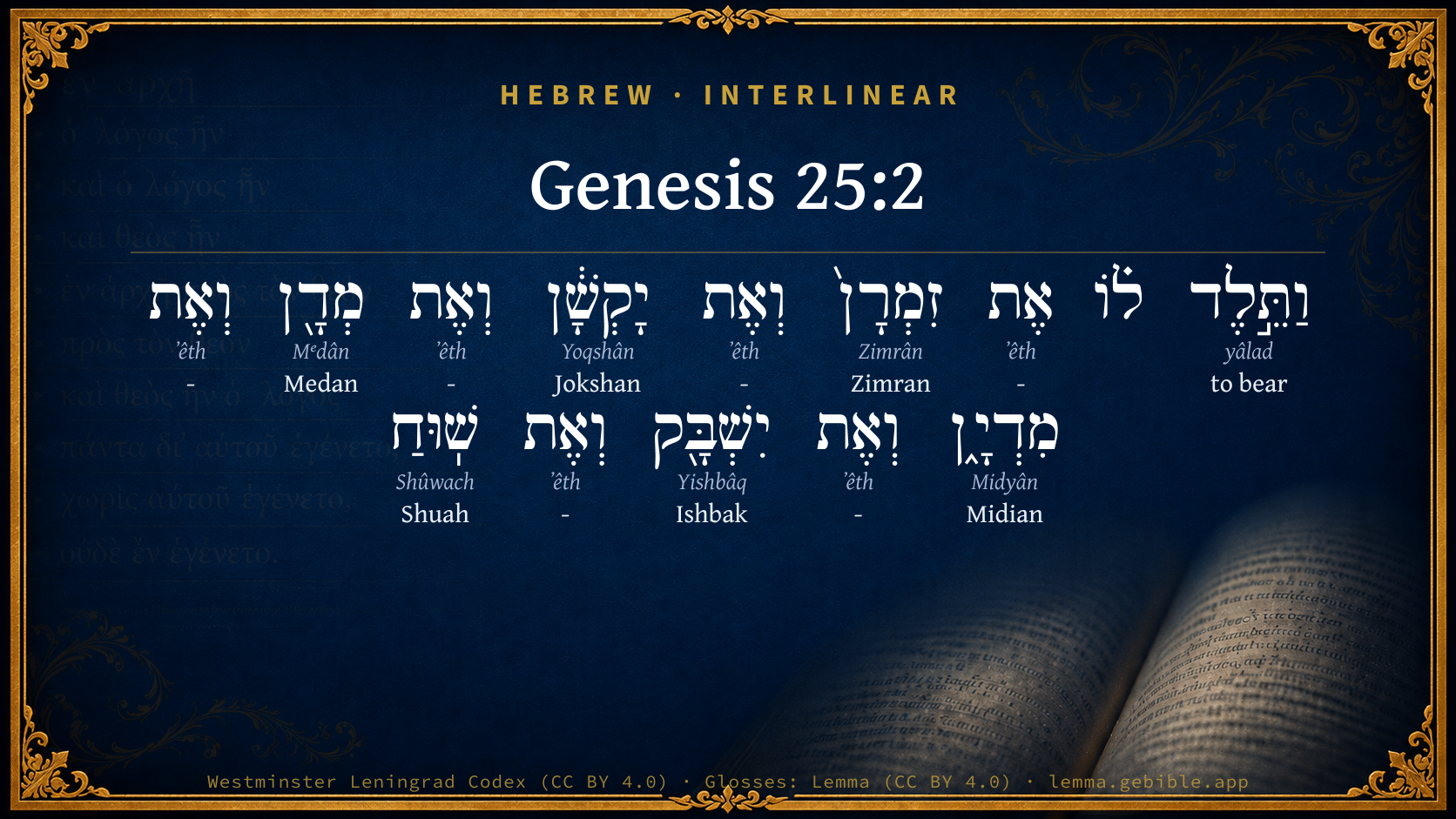
Genesis 25:2

Hebrew (Westminster Leningrad Codex) Genesis 25:2 appears in the Hebrew Old Testament. The text above is from the Westminster Leningrad Codex. Each word links to its Strong’s number, a concise gloss, and parsing drawn from the Open Scriptures Hebrew Bible morphology. Click any word for its full Brown-Driver-Briggs (BDB) entry.
Download image
Cite this verse

Genesis 25:2 (World English Bible). Public Domain. Lemma interlinear Bible study tool, https://lemma.gebible.app/v/genesis/25/2.

Show BibTeX & RIS
BibTeX
RIS
English Translation
She bore him Zimran, Jokshan, Medan, Midian, Ishbak, and Shuah.
World English Bible · Public Domain
Highlights Full analysis ↓
Download a study sheet

One document with this verse’s original text, its word-by-word gloss line, the meaning frame, cross-references with their text, attributed commentary, and full source and license credits — printable, and it pastes into notes with its structure intact.

This verse Autodidact and up

Study sheet (.html) Plain text (.txt)

A passage Seminary Student

Up to 50 verses in one chapter. A passage sheet keeps up to 6 commentary sources and 12 cross-references per verse, in the order this page ranks them, and says so on the sheet whenever that leaves anything out. Ask for a single verse and you get the Autodidact verse sheet above.

Everything on this page stays free to read, with no account — the sheet is a download of what is already on screen, not access to it.

Want to remove ads? Support Godless Engineer
Compare translations 3

The same verse in 3 English versions, stacked beneath the original-language interlinear above. Click any original word for its lexicon entry.

Each is an independent rendering of the whole verse — the interlinear is not word-aligned to these translations.

Highlighted words mark where these versions differ — a whole-verse word diff, not a word-by-word alignment.

  • World English Bible Public Domain
    She bore him Zimran, Jokshan, Medan, Midian, Ishbak, and Shuah.
  • King James Version Public Domain
    And she bare him Zimran, and Jokshan, and Medan, and Midian, and Ishbak, and Shuah.
  • unfoldingWord Literal Text CC BY-SA 4.0
    And she bore for him Zimran and Jokshan and Medan and Midian and Ishbak and Shuah.

unfoldingWord Literal Text — © unfoldingWord, licensed CC BY-SA 4.0. Word-aligned USFM3 via Door43 (git.door43.org/unfoldingWord/en_ult).

Versions to compare (up to 4)

3 of 4 selected

Show all 18 translations

Every available English version of this verse, each an independent rendering of the whole verse.

  • World English Bible Public Domain
    She bore him Zimran, Jokshan, Medan, Midian, Ishbak, and Shuah.
  • Berean Standard Bible Public Domain
    and she bore him Zimran, Jokshan, Medan, Midian, Ishbak, and Shuah.
  • Majority Standard Bible Public Domain
    and she bore him Zimran, Jokshan, Medan, Midian, Ishbak, and Shuah.
  • King James Version Public Domain
    And she bare him Zimran, and Jokshan, and Medan, and Midian, and Ishbak, and Shuah.
  • American Standard Version (1901) Public Domain
    And she bare him Zimran, and Jokshan, and Medan, and Midian, and Ishbak, and Shuah.
  • Revised Version (1885) Public Domain
    And she bare him Zimran, and Jokshan, and Medan, and Midian, and Ishbak, and Shuah.
  • Geneva Bible (1599) Public Domain
    Which bare him Zimran, and Iokshan, and Medan, and Midian, and Ishbak, and Shuah.
  • Douay-Rheims (1899) Public Domain
    Who bore to him Zamran, and Jecsan, and Madan, and Madian, and Jesboc, and Sue.
  • Young's Literal Translation Public Domain
    and she beareth to him Zimran, and Jokshan, and Medan, and Midian, and Ishbak, and Shuah.
  • Literal Standard Version CC BY-SA 4.0
    and she bears to him Zimran, and Jokshan, and Medan, and Midian, and Ishbak, and Shuah.
  • Unlocked Literal Bible CC BY-SA 4.0
    She bore him Zimran, Jokshan, Medan, Midian, Ishbak, and Shuah.
  • unfoldingWord Literal Text CC BY-SA 4.0
    And she bore for him Zimran and Jokshan and Medan and Midian and Ishbak and Shuah.
  • Darby Bible Public Domain
    And she bore him Zimran, and Jokshan, and Medan, and Midian, and Ishbak, and Shuah.
  • World Messianic Bible Public Domain
    She bore him Zimran, Jokshan, Medan, Midian, Ishbak, and Shuah.
  • Webster's Bible Public Domain
    And she bore him Zimran, and Jokshan, and Medan, and Midian, and Ishbak, and Shuah.
  • Free Bible Version CC BY-SA 4.0
    She had the following sons: Zimran, Jokshan, Medan, Midian, Ishbak, and Shuah.
  • Bible in Basic English Public Domain
    She became the mother of Zimran and Jokshan and Medan and Midian and Ishbak and Shuah.
  • JPS Tanakh (1917) Public Domain
    And she bore him Zimran, and Jokshan, and Medan, and Midian, and Ishbak, and Shuah.

Literal Standard Version (2020), Covenant Press — licensed CC BY-SA 4.0. Text via the HelloAO Bible API (eBible.org). Unlocked Literal Bible (unfoldingWord) — licensed CC BY-SA 4.0. Text via the HelloAO Bible API (eBible.org). unfoldingWord Literal Text — © unfoldingWord, licensed CC BY-SA 4.0. Word-aligned USFM3 via Door43 (git.door43.org/unfoldingWord/en_ult). Free Bible Version, Dr. Jonathan Gallagher — licensed CC BY-SA 4.0. Text via the HelloAO Bible API (eBible.org).

Word by word

More ways to search: Search by grammar → Find every occurrence → Compare this word →

Practice this passage: Drill this verse → Learn its vocabulary →

About this verse

These counts appear in no published source. They are computed here, from the morphology-tagged text and Lemma’s own curated glosses. What Lemma adds →

14
words
8
distinct lemmas
Pentateuch
section

Notable vocabulary

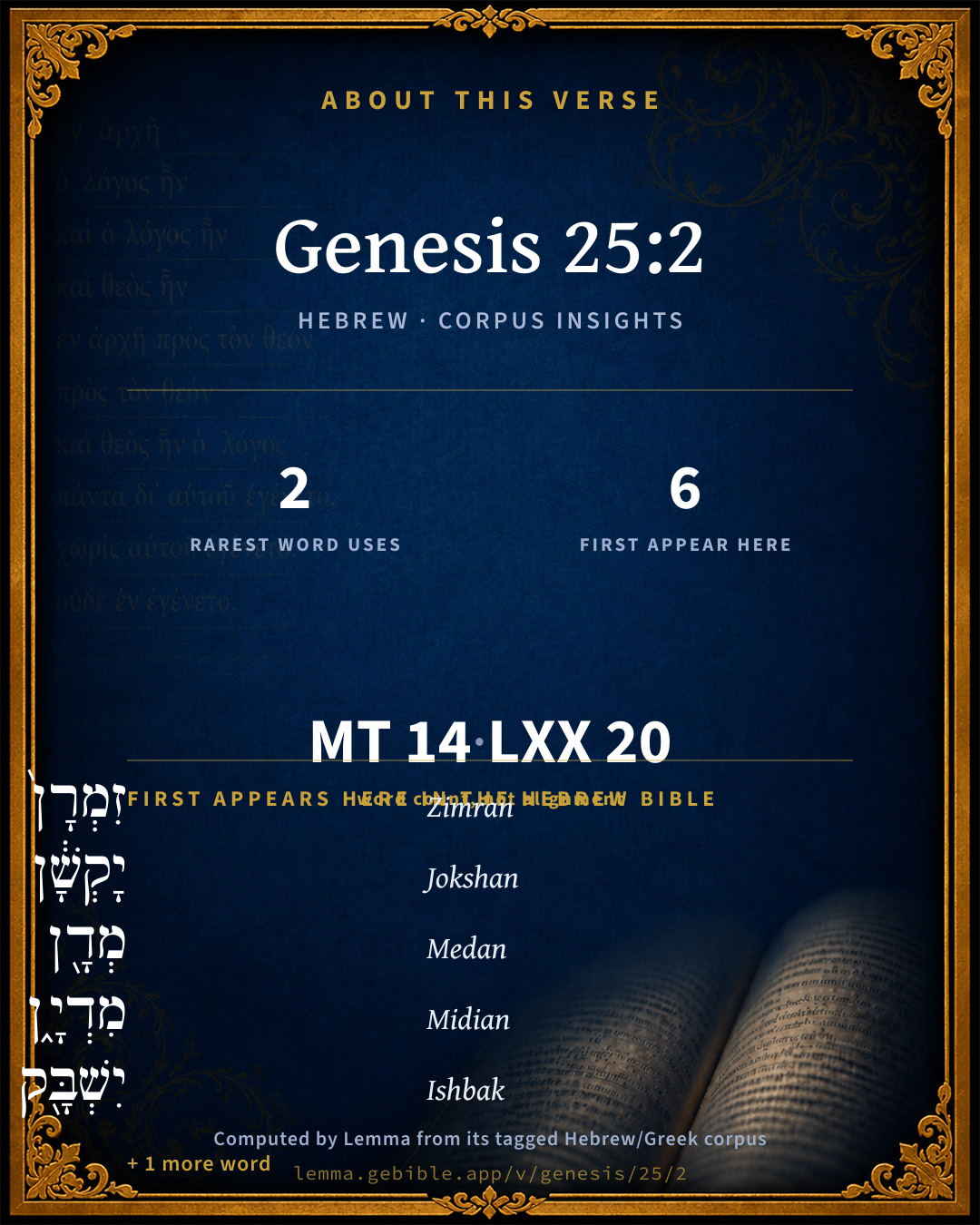
The rarest word here is זִמְרָן֙ Zimran H2175 — appearing just 2 times in the whole Hebrew Bible.

First appearance in Scripture

These words make their first canonical appearance in the Hebrew Bible here:

  • זִמְרָן֙ Zimran H2175
  • יָקְשָׁ֔ן Jokshan H3370
  • מְדָ֖ן Medan H4091
  • מִדְיָ֑ן Midian H4080
  • יִשְׁבָּ֖ק Ishbak H3435
  • שֽׁוּחַ Shuah H7744

Shared distinctive vocabulary

זִמְרָן֙ Zimran H2175 occurs in 2 verses of the Hebrew Bible. Also found in:

Grammatical profile

  • 1 verb
  • 6 nouns
  • 1 preposition
  • 6 particles

Verb forms

  • וַתֵּ֣לֶד Qal · Sequential Imperfect

Hebrew & Septuagint length

In English translation the verse runs 10 words from the Hebrew and 16 from the Septuagint (LXX English) — the Septuagint runs noticeably longer here. See the side-by-side →

A rough comparison of the two English renderings, which tokenize alike — not a word-level alignment.

Word counts can differ between the Hebrew and the Greek without any difference in meaning — e.g. the Hebrew direct-object marker אֵת has no separate Greek word, and Greek often adds the article ὁ.

In the original languages it is 14 Hebrew tokens and 20 Greek tokens — but the two are counted differently (Hebrew bundles its prefixes and suffixes into one token; the Greek is in lemma form), so that isn’t a like-for-like length.

Cross-references

13

Topical passages linked to Genesis 25:2 in the Treasury of Scripture Knowledge — connected by theme and wording, ordered by reader-vote popularity; previews shown in the World English Bible.

  • 1 Chronicles 1:32–33 The sons of Keturah, Abraham's concubine: she bore Zimran, and Jokshan, and Medan, and Midian, and Ishbak, and Shuah. The sons of Jokshan: Sheba, and Dedan.
  • Genesis 36:35 Husham died, and Hadad, the son of Bedad, who struck Midian in the field of Moab, reigned in his place. The name of his city was Avith.
  • Genesis 37:28 Midianites who were merchants passed by, and they drew and lifted up Joseph out of the pit, and sold Joseph to the Ishmaelites for twenty pieces of silver. They brought Joseph into Egypt.
  • Genesis 37:36 The Midianites sold him into Egypt to Potiphar, an officer of Pharaoh's, the captain of the guard.
  • Exodus 2:15–16 Now when Pharaoh heard this thing, he sought to kill Moses. But Moses fled from the face of Pharaoh, and lived in the land of Midian, and he sat down by a well.
  • Exodus 18:1–4 Now Jethro, the priest of Midian, Moses' father-in-law, heard of all that God had done for Moses, and for Israel his people, how that Yahweh had brought Israel out of Egypt.
  • Numbers 22:4 Moab said to the elders of Midian, Now will this multitude lick up all that is round about us, as the ox licks up the grass of the field. Balak the son of Zippor was king of Moab at that time.
  • Numbers 25:17–18 Vex the Midianites, and strike them;
  • Numbers 31:2 Avenge the children of Israel of the Midianites: afterward you shall be gathered to your people.
  • Numbers 31:8 They killed the kings of Midian with the rest of their slain: Evi, and Rekem, and Zur, and Hur, and Reba, the five kings of Midian: Balaam also the son of Beor they killed with the sword.
  • Job 2:11 Now when Job's three friends heard of all this evil that had come on him, they each came from his own place: Eliphaz the Temanite, Bildad the Shuhite, and Zophar the Naamathite, and they made an appointment together to come to sympathize with him and to comfort him.
  • Jeremiah 25:25 and all the kings of Zimri, and all the kings of Elam, and all the kings of the Medes;
  • Judges 6:1–8 The children of Israel did that which was evil in the sight of Yahweh: and Yahweh delivered them into the hand of Midian seven years.

Cross-references courtesy of OpenBible.info (CC BY 4.0).

Hebrew and Greek witnesses Masoretic Hebrew ↔ Greek Septuagint

The same verse in the two great witnesses to the Old Testament, shown verse-for-verse.

Here the Septuagint runs noticeably longer than the Hebrew — LXX2012 (modern English Septuagint) 16 words vs World English Bible 10. A rough length comparison of the two English translations, not a word-level alignment — read both below.

These are two independent witnesses, not word-aligned to each other, and the Septuagint is shown in lemma (dictionary) form.

Hebrew Genesis 25:2 Masoretic · Westminster Leningrad Codex

וַתֵּ֣לֶד ל֗וֹ אֶת זִמְרָן֙ וְאֶת יָקְשָׁ֔ן וְאֶת מְדָ֖ן וְאֶת מִדְיָ֑ן וְאֶת יִשְׁבָּ֖ק וְאֶת שֽׁוּחַ

She bore him Zimran, Jokshan, Medan, Midian, Ishbak, and Shuah.

World English Bible · Public Domain

Greek LXX Genesis 25:2 Septuagint · lemma form

τίκτω δέ αὐτός ὁ ζεμραν καί ὁ ιεξαν καί ὁ μαδαν καί ὁ μαδιαμ καί ὁ ιεσβοκ καί ὁ σωυε

And she bore to him Zombran, and Jezan, and Madal, and Madiam, and Jesboc, and Soie.

LXX2012 (modern English Septuagint) · Public Domain

Hebrew: Westminster Leningrad Codex (CC BY 4.0). Greek: Septuagint (public domain); English from LXX2012 (modern English Septuagint) (Public Domain). How the Septuagint differs from the Hebrew →

Targum (Aramaic paraphrase)

2

The Targum is the ancient Jewish Aramaic paraphrase of the Hebrew Scriptures — an interpretive translation, not the Hebrew text itself. Onkelos (literal) and Pseudo-Jonathan (expansive) render the Torah, and Jonathan the Prophets. Coverage is partial: where no permissively-licensed English translation exists for a verse, only the Aramaic is shown. This is verse-level text, not a word-by-word alignment to the Hebrew.

  1. Targum Onkelos Torah (Genesis–Deuteronomy)
    וִילֵידַת לֵהּ יָת זִמְרָן וְיָת יָקְשָׁן וְיָת מְדָן וְיָת מִדְיָן וְיָת יִשְׁבָּק וְיָת שׁוּחַ

    (no public-domain English translation for this verse)

    Targum Onkelos — Aramaic: “Onkelos Genesis” (public domain); “Onkelos Exodus” (public domain); “Onkelos Leviticus” (public domain); “Onkelos Numbers” (public domain); “Onkelos Deuteronomy” (public domain). English: “Sefaria Community Translation” (CC0 1.0 (public-domain dedication)); “J.W. Etheridge. The Targums of Onkelos and Jonathan Ben Uzziel on the Pentateuch. London: Longmans, Green, 1862” (public domain). Text via Sefaria.

  2. Targum Pseudo-Jonathan Torah (Genesis–Deuteronomy)
    וִילֵידַת לֵיהּ יַת זִמְרָן וְיַת יָקְשָׁן וְיַת מְדָן וְיַת מִדְיָן וְיַת יִשְׁבָּק וְיַת שׁוּחַ

    And she bare to him Zimran, and Jokshan, and Medan, and Midyan, and Yishbak, and Shovack.

    Targum Pseudo-Jonathan — Aramaic: “Targum Jonathan on Genesis” (public domain); “Targum Jonathan on Exodus” (public domain); “Targum Jonathan on Leviticus” (public domain); “Targum Jonathan on Numbers” (public domain); “Targum Jonathan on Deuteronomy” (public domain). English: “The Targum of Jonathan ben Uzziel, trans. J. W. Etheridge, London, 1862” (public domain). Text via Sefaria.

Commentary

Notes on Genesis 25:2 from classic Christian and Jewish commentators (each source and its license shown beneath its notes). The classic Christian expositions comment on the surrounding passage and are grouped to its opening verse, so a note may address several verses; the Jewish commentaries on the Tanakh (Rashi and others) are per-verse, so they appear only where the commentator wrote on this verse.

Lemma curates 59 commentaries, every one of them public domain or Creative Commons licensed, each selected and text-cleaned for this edition rather than reprinted as found. About our sources →

Trapp's Complete Commentary

John Trapp

Gen 25:2 And she bare him Zimran, and Jokshan, and Medan, and Midian, and Ishbak, and Shuah.

Ver. 2. No Text for this verse.

John Trapp, A Commentary or Exposition upon All the Books of the Old and New Testament (1647–1656) — public domain. Text from a community e-Sword module.

Tyndale Open Study Notes

Tyndale Open Resources

25:2-4 The birth of these nations from Abraham partially fulfilled God’s promise to him (12:2; 17:4).

Tyndale Open Study Notes — © Tyndale Open Resources, licensed CC BY-SA 4.0. Text via the HelloAO Bible API.

Adam Clarke's Commentary

Verse 2. Zimran] Stephanus Byzantinus mentions a city in Arabia Felix called Zadram, which some suppose to have been named from this son of Keturah; but it is more likely, as Calmet observes, that all these sons of Abraham resided in Arabia Deserta; and Pliny, Hist. Nat., lib. vi., c. 28, mentions a people in that country called Zamarenians, who were probably the descendants of this person.

Jokshan] Several learned men have been of opinion that this Jokshan was the same as Kachtan, the father of the Arabs. The testimonies in favour of this opinion see in Dr. Hunt's Oration, De Antiquitate, c., Linguae Arabicae, p. 4. Calmet supposes that the Cataneans, who inhabited a part of Arabia Deserta, sprang from this Jokshan.

Medan, and Midian] Probably those who peopled that part of Arabia Petraea contiguous to the land of Moab eastward of the Dead Sea. St. Jerome terms the people of this country Madinaeans and Ptolemy mentions a people called Madianites, who dwelt in the same place.

Ishbak] From this person Calmet supposes the brook Jabbok, which has its source in the mountains of Gilead, and falls into the sea of Tiberias, took its name.

Shuah.] Or Shuach. From this man the Sacceans, near to Batanla, at the extremity of Arabia Deserta, towards Syria, are supposed to have sprung. Bildad the Shuhite, one of Job's friends, is supposed to have descended from this son of Abraham.

Adam Clarke's Commentary on the Bible (1810–1826) — public domain. Text from a community e-Sword/MySword module.

Ellicott's Commentary for English Readers

(2) Zimran.—The home of Keturah’s descendants is placed by Josephus and Jerome in Arabia-Felix; but the supposed traces of their names are untrustworthy.

Midian is the one son of Keturah who had a great future before him, for his race became famous traders (Gen_37:28); and as they are called Me danites there in the Hebrew, in Gen_37:36, it is probable that Medan and Midian coalesced into one tribe. Jethro, the father-in-law of Moses, belonged to them (Exo_2:15-16), and, enriched by commerce, they became so powerful as to be dangerous neighbours to the Israelites. (Judges 6, 7, 8)

Shuah.—From him perhaps descended Bildad the Shuhite, Job’s friend (Job_2:11). The name in the Hebrew is different from that also rendered “Shuah” in Gen_38:2.

A Bible Commentary for English Readers, edited by Charles John Ellicott (1878–1897) — public domain. Text from a community e-Sword module.

The Cambridge Bible for Schools and Colleges

gen. ed. J. J. S. Perowne

2. And she bare him] The genealogy of Keturah is found again in a shortened form in 1Ch_1:32. That we have to do with a tradition relating to tribes and places rather than to individuals, is clearly shewn by such names as Midian, Shuah, Sheba, and Dedan. In this verse six names are given. In view of other groups of twelve (cf. notes on Gen_17:20, Gen_22:21), this number is hardly accidental; see Gen_25:12.

Zimran] Probably from a word meaning “wild goat”: cf. Zimri, Num_25:14.

Midian] The territory with which the Midianites are usually found associated is N.W. Arabia, the east side of the Gulf of Akaba. Groups of Midianites appear in the Sinaitic Peninsula (Exo_2:15; Exo_3:1 Extending their influence along the eastern side of the Dead Sea, Midianites appear as the enemies of Israel on the eastern side of the Jordan (Num_22:4; Num_25:6; Num_25:17; Num_31:1-12); and in Judges 6 bands of Midianites overrun Palestine. On Midianite trade with Egypt, cf. Gen_37:28; Gen_37:36.

Shuah] = 1Ch_1:32. Cf. Job_2:11, “Bildad, the Shuhite.” It has been identified somewhat precariously with the Assyrian Suhu, on the Euphrates, S. of Carchemish.

The Cambridge Bible for Schools and Colleges (gen. ed. J. J. S. Perowne; Cambridge University Press, 1878–1918) — public domain. Text from a community e-Sword module.

John Gill's Exposition

And she bare him Zimran,.... That Keturah should bear children who probably, was a young woman, is not strange; but that Abraham, whose body forty years before this was dead should now have any bore to him, may seem difficult to account for, and only can be attributed to the fresh vigour his body was endued with at the generation of Isaac; and which still continued for the fulfilment of the promise to him of the multiplication of his seed. But if the notion of a late learned bishop (e) is right, there will be no need to have recourse to any thing extraordinary; which is, that Abraham took Keturah for his concubine, about twenty years after his marriage with Sarah, she being barren, and long before he took Hagar; though not mentioned till after the death of Sarah, that the thread of the history might not be broken in upon; and there are various things which make it probable, as that she is called his concubine, Ch1 1:32, which one would think she should not be, if married to him after the death of Sarah, and when he had no other wife, and seeing before he died he had great grandchildren by her, and the children of her are reckoned down to the third generation; whereas there are only mention of two generations of Hagar, as in Gen 25:1; and therefore seems to have been taken by him before Hagar, and even when he was in Haran, and the children by her are thought to be the souls gotten there; nor does it seem very probable that he should take a wife after the death of Sarah, when he was one hundred and forty years of age, and was reckoned an old man forty years before this; and Dr. Lightfoot (f) is of opinion, that Abraham married her long before Isaac's marriage, or Sarah's death; and if this was the case, the difficulty of accounting for Abraham's fitness for generation vanishes. The first son of Keturah, born to him, was called Zimran, from whence came the Zamareni, a people in Arabia Felix mentioned by Pliny (g); and hereabout the sons of Keturah settled, being sent by Abraham into the east country, even into Arabia, which lay east of the place where he then was; and very probably Zabram; or it may be rather Zamram, a royal city in the country of the Cinaedocolpites, a part of Arabia Felix, as placed by Ptolemy (h), may have its name from this man: five more of Abraham's sons by Keturah follow:

and Jokshan, and Medan, and Midian, and Ishbak, and Shuah: some think that the first of these is the same with Cahtan, whom the Arabs call the father of their nation; but that Cahtan rather seems to be Joktan the son of Eber, see Gen 10:25. Philostorgius (i) speaks of a nation in his time, called Homerites, who were a people that sprung from Keturah, and inhabited Arabia Felix, and who used circumcision on the eighth day: and Bishop Patrick observes from Theophanes, a chronologer of the ninth century, that the Homerites, who lived in the interior parts of Arabia, descended from Jectan, which he conjectures should be read Jocshan, though perhaps he is no other than the Joktan before mentioned. From Medan and Midian sprung the Midianites, so often mentioned in Scripture; their posterity seem to be confounded together, for the same people are called Medanites and Midianites, Gen 37:28; from these men the towns in Arabia might have their names, as the Modiana and Madiana of Ptolemy (k): as for Ishbak, there is no tracing of his name anywhere, unless, as Bishop Patrick observes, some footsteps of it are to be found in Bacascami, a town of the Zamareni, who descended from his brother Zimran, and in the people Backliltae, both mentioned by Pliny (l); though Junius think that Scabiosa Laodicea, in Laodicene of Syria, has its name from him; which seems not likely. The name of Shuah or Shuach may be traced in Socacia, Soaca, and Socheher, cities placed by Ptolemy (m) in Arabia Felix: though some think the posterity of this man are those whom the geographers call Sauchites, Sauchaeans, and Saccaeans, who settled in Arabia Deserta, and from whom Bildad the Shuhite, Job 2:11, descended; which is not improbable. But others have been of opinion, that the town of Suez, which Pliny calls Suaza, had its name from this Shuah, situate at the extremity of the Red sea (n).

(e) Dr. Clayton's Chronology of the Hebrew Bible, p. 83, &c. (f) Observations on the Book of Genesis in his Works, vol. 1. p. 695. (g) Nat. Hist. l. 6. c. 28. (h) Geograph. l. 6. c. 7. (i) Eccl. Hist. l. 3. sect. 4. p. 477. (k) Ut supra. (h)) (l) Ut supra. (g)) (m) Ut supra. (h)) (n) See Egmont and Heyman's Travels, vol. 2. p. 184.

John Gill's Exposition of the Whole Bible (1746–1763) — public domain (CC PDM 1.0). Text via the HelloAO Bible API.

Matthew Poole's English Annotations

Quest. How could Abraham, being now about one hundred and forty years old, have so many children, when his body was dead in his hundredth year?

Answ. Because that renewed strength which was miraculously conferred upon him, did still in a great measure remain in him, being not a temporary action, but a durable habit or power.

These persons were the heads of several people dwelling in Arabia and Syria, where we shall find evident footsteps of their names amongst ancient geographers, only a little changed, which could not be avoided in their translation into another language.

Midian, the father of those Midianites, of whom we read Gen 36:35; Jdg 6:2; Isa 10:26. From Shuah Bildad seems to be descended, Job 2:11.

Matthew Poole's English Annotations on the Holy Bible (1683–1685) — public domain. Text from a community e-Sword/MySword module.

Whedon's Commentary on the Bible

Daniel D. Whedon

2-4. Compare 1Ch_1:32-33. Here are mentioned six sons, seven grandsons, and three great-grandsons. The subsequent history and location of the tribes that sprung from them are very uncertain, and conjectures on the subject are scarcely worth repeating. Those who wish to note them should consult the Bible Dictionaries on the several names. From Midian came the Midianites, often mentioned in the later history of Israel. We meet them in the history of Joseph (Gen_37:28) and of Moses, (Exo_2:15; Num_22:4,) and against them Gideon waged successful war. Judges chapters 6-8. The names of Sheba and Dedan occur among the sons of Cush, (Gen_10:7,) but nothing can be argued from such repetition of names. Some, however, think that these tribes subsequently became intermixed by marriage. Midian, Ephah, and Sheba are mentioned together in Isa_60:6. These tribes were nomadic, and probably for a time wandered, like Abraham, to and fro in the wide deserts south and east of Palestine. They probably, at a subsequent date, became largely intermingled with the Ishmaelites, and are represented now in the numerous Arab tribes of these same ancient deserts.

Daniel D. Whedon (gen. ed.), Commentary on the Old and New Testaments (1874–1909) — public domain. Text from a community e-Sword module.

The Pulpit Commentary

And she bare him (since the patriarch"s body at 100 years was practically dead, it is almost certain that his marriage with Keturah took place after the renewal of his powers; and it is easier to suppose that his physical vigor remained for some years after Sarah"s death than that, with his former experience of concubinage, and his parental joy in the birth of Isaac, he should add a second wife while Sarah lived) Zimran, identified with Zabram, west of Mecca, on the Red Sea (Knobel, Keil); or the Zimareni, in the interior of Arabia (Delitzsch, Kalisch)and Jokshan, the Kassamitae, on the Red Sea (Knobel); or the Himarytish tribe Jakish, in Southern Arabia (Keil)and Medan, and Midian, Modiana, on the east of the Elamitic Gulf, and Madiana, north of this (Rosenm Keil, Knobel)and Ishbak, perhaps preserved in Schobeck, in the land of the Edomites (Knobel, Keil)and Shuah for which the epithet Shuhite (Job_2:11) may point to Northern Idumaea (Keil, Knobel, Kalisch).

The Pulpit Commentary (1880–1919), ed. H.D.M. Spence-Jones & Joseph S. Exell — public domain. Text from a community e-Sword module.

Lesson kit

Teaching starters — assembled from the data on this page, not authored interpretation. Every prompt links to the verse data it draws on. Edit before teaching.

Genesis, in the Pentateuch, opens this verse with 14 words (8 distinct Hebrew lemmas). Its most distinctive word is Zimrân (“Zimran”). The Greek Septuagint runs longer here. A historical commentator’s framing appears above. Read the whole chapter for the surrounding context.

Discussion questions

  1. How does “Zimran” (Zimrân) shape what this verse is saying?
  2. 6 words make their first appearance in Scripture here. What does this debut establish?
  3. How does 1 Chronicles 1:32, which shares the word «Zimran», read alongside this verse?
  4. The Septuagint runs longer here than the Hebrew. What might account for the difference?
  5. The translations on this page render this verse differently — a whole-verse word diff, not a word-by-word alignment. What might account for the different wordings?
  6. «וַתֵּ֣לֶד» is a Qal Sequential Imperfect verb. How does that grammatical form shape the action described?
  7. Compare how Trapp's Complete Commentary and Tyndale Open Study Notes read this verse. Where do they agree or differ?

Things to notice

Reading settings

Reading text

Shown beneath each verse's original-language words.

Old Testament
Old Testament edition

Read the OT as the Masoretic Hebrew (MT) or the Greek Septuagint (LXX).

English shown for the Greek Septuagint (in the Hebrew ↔ Greek comparison).

Comparing translations? Open the Compare panel on any verse page to stack up to four side by side.