
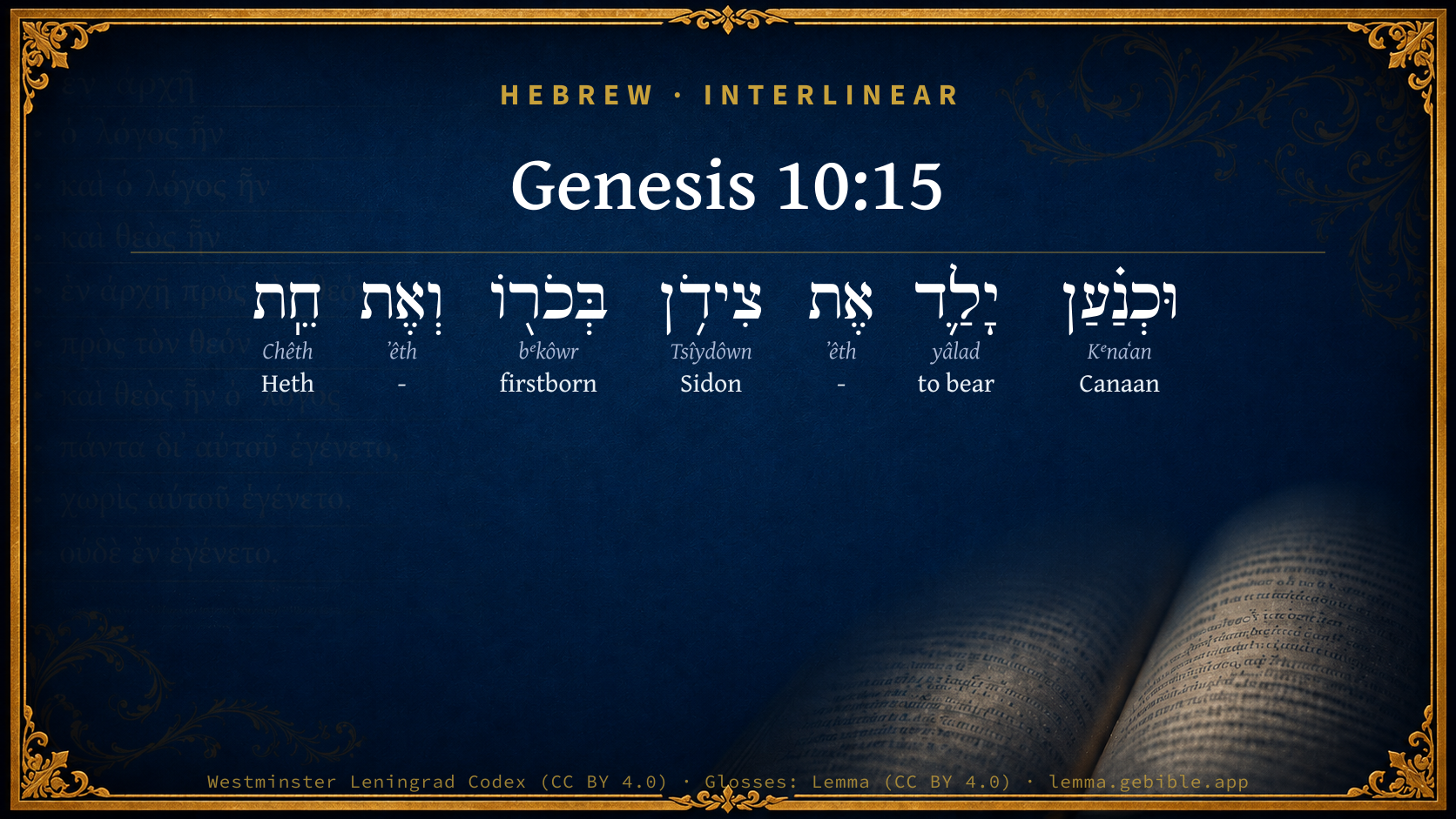
Genesis 10:15

Hebrew (Westminster Leningrad Codex) Genesis 10:15 appears in the Hebrew Old Testament. The text above is from the Westminster Leningrad Codex. Each word links to its Strong’s number, a concise gloss, and parsing drawn from the Open Scriptures Hebrew Bible morphology. Click any word for its full Brown-Driver-Briggs (BDB) entry.
Download image
Cite this verse

Genesis 10:15 (World English Bible). Public Domain. Lemma interlinear Bible study tool, https://lemma.gebible.app/v/genesis/10/15.

Show BibTeX & RIS
BibTeX
RIS
English Translation
Canaan became the father of Sidon (his firstborn), Heth,
World English Bible · Public Domain
Highlights
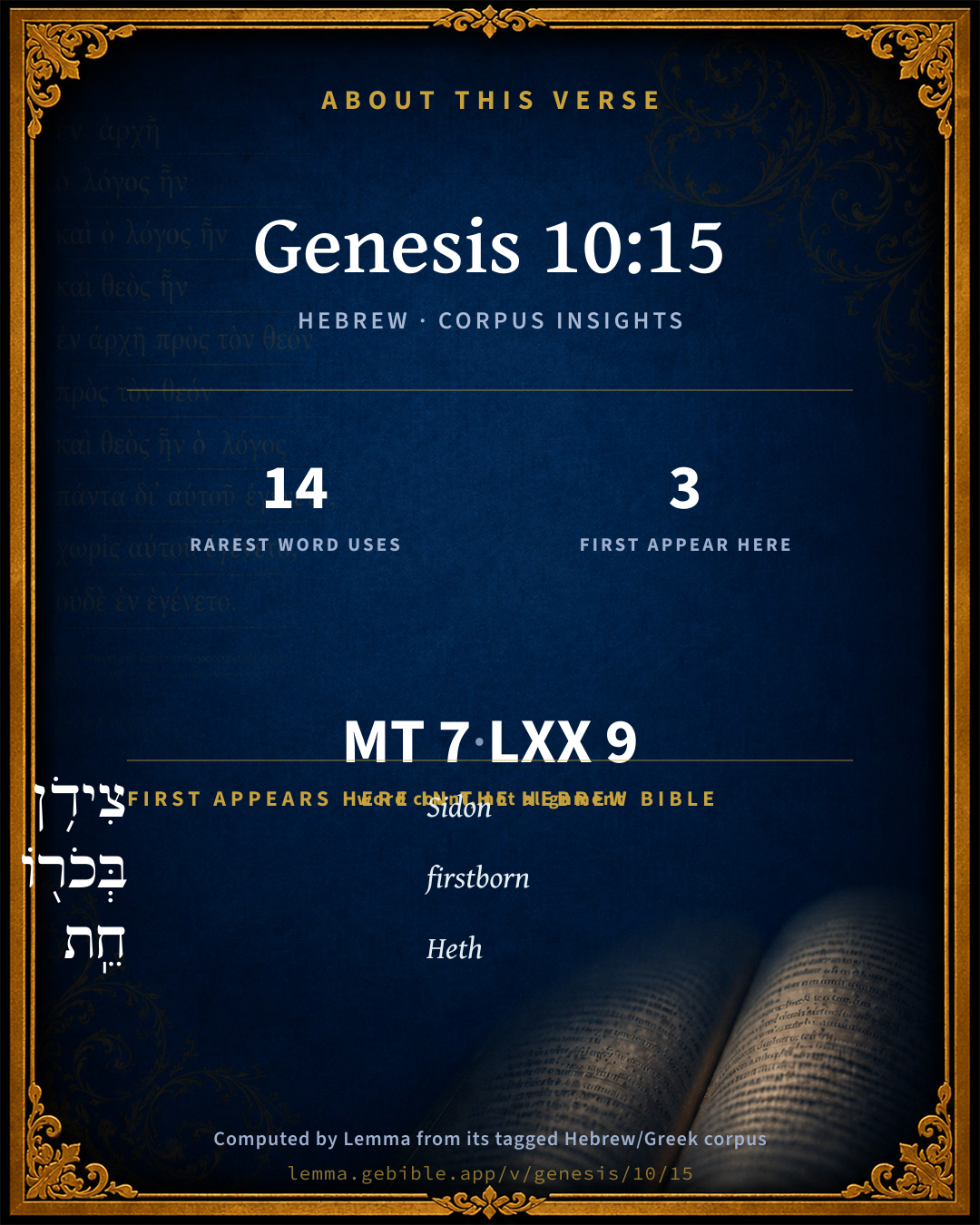
  • 3 first appearances in the Hebrew Bible
Full analysis ↓
Download a study sheet

One document with this verse’s original text, its word-by-word gloss line, the meaning frame, cross-references with their text, attributed commentary, and full source and license credits — printable, and it pastes into notes with its structure intact.

This verse Autodidact and up

Study sheet (.html) Plain text (.txt)

A passage Seminary Student

Up to 50 verses in one chapter. A passage sheet keeps up to 6 commentary sources and 12 cross-references per verse, in the order this page ranks them, and says so on the sheet whenever that leaves anything out. Ask for a single verse and you get the Autodidact verse sheet above.

Everything on this page stays free to read, with no account — the sheet is a download of what is already on screen, not access to it.

Want to remove ads? Support Godless Engineer
Compare translations 3

The same verse in 3 English versions, stacked beneath the original-language interlinear above. Click any original word for its lexicon entry.

Each is an independent rendering of the whole verse — the interlinear is not word-aligned to these translations.

Highlighted words mark where these versions differ — a whole-verse word diff, not a word-by-word alignment.

  • World English Bible Public Domain
    Canaan became the father of Sidon (his firstborn), Heth,
  • King James Version Public Domain
    And Canaan begat Sidon his first born, and Heth,
  • unfoldingWord Literal Text CC BY-SA 4.0
    And Canaan fathered Sidon his firstborn, then Heth

unfoldingWord Literal Text — © unfoldingWord, licensed CC BY-SA 4.0. Word-aligned USFM3 via Door43 (git.door43.org/unfoldingWord/en_ult).

Versions to compare (up to 4)

3 of 4 selected

Show all 18 translations

Every available English version of this verse, each an independent rendering of the whole verse.

  • World English Bible Public Domain
    Canaan became the father of Sidon (his firstborn), Heth,
  • Berean Standard Bible Public Domain
    And Canaan was the father of Sidon his firstborn, and of the Hittites,
  • Majority Standard Bible Public Domain
    And Canaan was the father of Sidon his firstborn, and of the Hittites,
  • King James Version Public Domain
    And Canaan begat Sidon his first born, and Heth,
  • American Standard Version (1901) Public Domain
    And Canaan begat Sidon his first-born, and Heth,
  • Revised Version (1885) Public Domain
    And Canaan begat Zidon his firstborn, and Heth;
  • Geneva Bible (1599) Public Domain
    Also Canaan begat Zidon his first borne, and Heth,
  • Douay-Rheims (1899) Public Domain
    And Chanaan begot Sidon, his firstborn, the Hethite,
  • Young's Literal Translation Public Domain
    And Canaan hath begotten Sidon his first-born, and Heth,
  • Literal Standard Version CC BY-SA 4.0
    And Canaan has begotten Sidon his firstborn, and Heth,
  • Unlocked Literal Bible CC BY-SA 4.0
    Canaan became the father of Sidon, his firstborn, and of Heth,
  • unfoldingWord Literal Text CC BY-SA 4.0
    And Canaan fathered Sidon his firstborn, then Heth
  • Darby Bible Public Domain
    -- And Canaan begot Sidon, his firstborn, and Heth,
  • World Messianic Bible Public Domain
    Canaan became the father of Sidon (his firstborn), Heth,
  • Webster's Bible Public Domain
    And Canaan begat Sidon his first-born, and Heth,
  • Free Bible Version CC BY-SA 4.0
    Canaan was the father of Sidon, his firstborn, and of the Hittites,
  • Bible in Basic English Public Domain
    And Canaan was the father of Zidon, who was his oldest son, and Heth,
  • JPS Tanakh (1917) Public Domain
    And Canaan begot Zidon his firstborn, and Heth;

Literal Standard Version (2020), Covenant Press — licensed CC BY-SA 4.0. Text via the HelloAO Bible API (eBible.org). Unlocked Literal Bible (unfoldingWord) — licensed CC BY-SA 4.0. Text via the HelloAO Bible API (eBible.org). unfoldingWord Literal Text — © unfoldingWord, licensed CC BY-SA 4.0. Word-aligned USFM3 via Door43 (git.door43.org/unfoldingWord/en_ult). Free Bible Version, Dr. Jonathan Gallagher — licensed CC BY-SA 4.0. Text via the HelloAO Bible API (eBible.org).

Word by word

More ways to search: Search by grammar → Find every occurrence → Compare this word →

Practice this passage: Drill this verse → Learn its vocabulary →

About this verse

These counts appear in no published source. They are computed here, from the morphology-tagged text and Lemma’s own curated glosses. What Lemma adds →

7
words
6
distinct lemmas
Pentateuch
section

Notable vocabulary

The rarest word here is חֵֽת Heth H2845 — appearing just 14 times in the whole Hebrew Bible.

First appearance in Scripture

These words make their first canonical appearance in the Hebrew Bible here:

  • צִידֹ֥ן Sidon H6721
  • בְּכֹר֖וֹ firstborn H1060
  • חֵֽת Heth H2845

Shared distinctive vocabulary

חֵֽת Heth H2845 occurs in 12 verses of the Hebrew Bible. Also found in:

Grammatical profile

  • 1 verb
  • 4 nouns
  • 2 particles

Verb forms

  • יָלַ֛ד Qal · Perfect

Hebrew & Septuagint length

In English translation the verse runs 9 words from the Hebrew and 9 from the Septuagint (LXX English) — the same length.

A rough comparison of the two English renderings, which tokenize alike — not a word-level alignment.

Word counts can differ between the Hebrew and the Greek without any difference in meaning — e.g. the Hebrew direct-object marker אֵת has no separate Greek word, and Greek often adds the article ὁ.

In the original languages it is 7 Hebrew tokens and 9 Greek tokens — but the two are counted differently (Hebrew bundles its prefixes and suffixes into one token; the Greek is in lemma form), so that isn’t a like-for-like length.

Cross-references

12

Topical passages linked to Genesis 10:15 in the Treasury of Scripture Knowledge — connected by theme and wording, ordered by reader-vote popularity; previews shown in the World English Bible.

  • Exodus 34:11 Observe that which I command you this day. Behold, I drive out before you the Amorite, the Canaanite, the Hittite, the Perizzite, the Hivite, and the Jebusite.
  • Numbers 34:2–15 Command the children of Israel, and tell them, When you come into the land of Canaan (this is the land that shall fall to you for an inheritance, even the land of Canaan according to the borders of it),
  • Genesis 15:18–21 In that day Yahweh made a covenant with Abram, saying, "To your seed have I given this land, from the river of Egypt to the great river, the river Euphrates:
  • Genesis 23:3 Abraham rose up from before his dead, and spoke to the children of Heth, saying,
  • 1 Chronicles 1:13 Canaan became the father of Sidon his firstborn, and Heth,
  • Genesis 28:3–20 May God Almighty bless you, and make you fruitful, and multiply you, that you may be a company of peoples,
  • Genesis 49:13 "Zebulun will dwell at the haven of the sea. He will be for a haven of ships. His border will be on Sidon.
  • Exodus 3:8 I have come down to deliver them out of the hand of the Egyptians, and to bring them up out of that land to a good and large land, to a land flowing with milk and honey; to the place of the Canaanite, the Hittite, the Amorite, the Perizzite, the Hivite, and the Jebusite.
  • Joshua 11:8 Yahweh delivered them into the hand of Israel, and they struck them, and chased them to great Sidon, and to Misrephoth Maim, and to the valley of Mizpeh eastward; and they struck them, until they left them none remaining.
  • Joshua 12:8–24 in the hill-country, and in the lowland, and in the Arabah, and in the slopes, and in the wilderness, and in the South; the Hittite, the Amorite, and the Canaanite, the Perizzite, the Hivite, and the Jebusite:
  • 2 Samuel 11:3 David send and inquired after the woman. One said, Is not this Bathsheba, the daughter of Eliam, the wife of Uriah the Hittite?
  • Isaiah 23:4 Be ashamed, Sidon; for the sea has spoken, the stronghold of the sea, saying, I have not travailed, nor brought forth, neither have I nourished young men, nor brought up virgins.

Cross-references courtesy of OpenBible.info (CC BY 4.0).

Hebrew and Greek witnesses Masoretic Hebrew ↔ Greek Septuagint

The same verse in the two great witnesses to the Old Testament, shown verse-for-verse.

These are two independent witnesses, not word-aligned to each other, and the Septuagint is shown in lemma (dictionary) form.

Hebrew Genesis 10:15 Masoretic · Westminster Leningrad Codex

וּכְנַ֗עַן יָלַ֛ד אֶת צִידֹ֥ן בְּכֹר֖וֹ וְאֶת חֵֽת

Canaan became the father of Sidon (his firstborn), Heth,

World English Bible · Public Domain

Greek LXX Genesis 10:15 Septuagint · lemma form

χανααν δέ γεννάω ὁ σιδῶν πρωτότοκος καί ὁ χετταῖος

And Chanaan begot Sidon his firstborn, and the Chettite,

LXX2012 (modern English Septuagint) · Public Domain

Hebrew: Westminster Leningrad Codex (CC BY 4.0). Greek: Septuagint (public domain); English from LXX2012 (modern English Septuagint) (Public Domain). How the Septuagint differs from the Hebrew →

Targum (Aramaic paraphrase)

2

The Targum is the ancient Jewish Aramaic paraphrase of the Hebrew Scriptures — an interpretive translation, not the Hebrew text itself. Onkelos (literal) and Pseudo-Jonathan (expansive) render the Torah, and Jonathan the Prophets. Coverage is partial: where no permissively-licensed English translation exists for a verse, only the Aramaic is shown. This is verse-level text, not a word-by-word alignment to the Hebrew.

  1. Targum Onkelos Torah (Genesis–Deuteronomy)
    וּכְנַעַן אוֹלִיד יָת צִידוֹן בָּכְרֵהּ וְיָת חֵת

    And Kenaan begat Zidon his firstborn, and Cheth,

    Targum Onkelos — Aramaic: “Onkelos Genesis” (public domain); “Onkelos Exodus” (public domain); “Onkelos Leviticus” (public domain); “Onkelos Numbers” (public domain); “Onkelos Deuteronomy” (public domain). English: “Sefaria Community Translation” (CC0 1.0 (public-domain dedication)); “J.W. Etheridge. The Targums of Onkelos and Jonathan Ben Uzziel on the Pentateuch. London: Longmans, Green, 1862” (public domain). Text via Sefaria.

  2. Targum Pseudo-Jonathan Torah (Genesis–Deuteronomy)
    וּכְנָעַן אוֹלִיד יַת צִידוֹן בּוּכְרֵיהּ וְיַת חֵת

    And Kenaan begat Zidon his firstborn, and Heth,

    Targum Pseudo-Jonathan — Aramaic: “Targum Jonathan on Genesis” (public domain); “Targum Jonathan on Exodus” (public domain); “Targum Jonathan on Leviticus” (public domain); “Targum Jonathan on Numbers” (public domain); “Targum Jonathan on Deuteronomy” (public domain). English: “The Targum of Jonathan ben Uzziel, trans. J. W. Etheridge, London, 1862” (public domain). Text via Sefaria.

Commentary

Notes on Genesis 10:15 from classic Christian and Jewish commentators (each source and its license shown beneath its notes). The classic Christian expositions comment on the surrounding passage and are grouped to its opening verse, so a note may address several verses; the Jewish commentaries on the Tanakh (Rashi and others) are per-verse, so they appear only where the commentator wrote on this verse.

Lemma curates 59 commentaries, every one of them public domain or Creative Commons licensed, each selected and text-cleaned for this edition rather than reprinted as found. About our sources →

Trapp's Complete Commentary

John Trapp

Gen 10:15 And Canaan begat Sidon his firstborn, and Heth,

Ver. 15. Canaan begat Sidon.] Who built the city Sidon, in Phoenicia, near to Tyre, which afterwards contended with it for principality. It fell afterwards by lot to the tribe of Asher. {Jos 19:28}

John Trapp, A Commentary or Exposition upon All the Books of the Old and New Testament (1647–1656) — public domain. Text from a community e-Sword module.

Joseph Benson's Commentary

Gen 10:15. The account of the posterity of Canaan, and of the land they possessed, is more particular than that of any other in this chapter; because these were the nations that were to be subdued before Israel, and their land was to become Immanuel’s land. And by this account it appears that the posterity of Canaan were both numerous and rich, and very pleasantly seated; and yet Canaan was under a curse. Canaan here has a better land than either Shem or Japheth; and yet they have a better lot, for they inherit the blessing.

Joseph Benson's Commentary on the Old and New Testaments (1811–1818) — public domain. Text from a community e-Sword module.

Tyndale Open Study Notes

Tyndale Open Resources

10:15-18 Sidon settled in Phoenicia, north of Canaan. • Hittites: The Hittites in Genesis were a coalition of cities within Canaan (see 26:34-35; 27:46; Ezek 16:3). They were probably not the same as the Hittites of Anatolia (Asia Minor), whose empire was one of the great empires of antiquity during the patriarchal period. • The Jebusites were ancient inhabitants of Jerusalem (Josh 15:63; Judg 19:10-11; 2 Sam 5:6-9). • The Amorites lived throughout the mountains of Palestine in Canaan (see Gen 15:16; 48:22; Num 13:29; Deut 3:8; Josh 10:5; Judg 1:35; 10:8; Ezek 16:3). • Little is known of the Girgashites, a Canaanite tribe (Gen 15:21; Deut 7:1; Josh 3:10). • The Hivites were an uncircumcised Canaanite tribe (Gen 34:2, 13-24; Josh 9:1, 7; 11:3; Judg 3:3; 2 Sam 24:7). • The Arkites resided in Tell ’Arqa in Lebanon. • The Sinites formed a city-state and inhabited Phoenicia. • The Arvadites inhabited Ruad in northern Phoenicia, near the El Kebir River. They were known for shipping (cp. Ezek 27:8). • The Zemarites inhabited Sumur (modern Sumra), north of Arka on the Phoenician coast. • The Hamathites founded what is now Hama on the Orontes River, the northern boundary of Canaan (see Num 34:8; Josh 13:5; 2 Sam 8:9-10; 1 Kgs 8:65; 2 Kgs 14:25-28).

Tyndale Open Study Notes — © Tyndale Open Resources, licensed CC BY-SA 4.0. Text via the HelloAO Bible API.

Matthew Henry's Commentary

Observe here, 1. The account of the posterity of Canaan, of the families and nations that descended from him, and of the land they possessed, is more particular than of any other in this chapter, because these were the nations that were to be subdued before Israel, and their land was in process of time to become the holy land, Immanuel's land; and this God had an eye to when, in the mean time, he cast the lot of that accursed devoted race in that spot of ground which he had selected for his own people; this Moses takes notice of, Deu 32:8, When the Most High divided to the nations their inheritance, he set the bounds of the people according to the number of the children of Israel. 2. By this account it appears that the posterity of Canaan were numerous, and rich, and very pleasantly situated; and yet Canaan was under a curse, a divine curse, and not a curse causeless. Note, Those that are under the curse of God may yet perhaps thrive and prosper greatly in this world; for we cannot know love or hatred, the blessing or the curse, by what is before us, but by what is within us, Ecc 9:1. The curse of God always works really and always terribly: but perhaps it is a secret curse, a curse to the soul, and does not work visibly, or a slow curse, and does not work immediately; but sinners are by it reserved for, and bound over to, a day of wrath. Canaan here has a better land than either Shem or Japheth, and yet they have a better lot, for they inherit the blessing.

Matthew Henry's Commentary on the Whole Bible (1708–1710) — public domain (CC PDM 1.0). Text via the HelloAO Bible API.

Adam Clarke's Commentary

Verse 15. Sidon] Who probably built the city of this name, and was the father of the Sidonians.

Heth] From whom came the Hittites, so remarkable among the Canaanitish nations.

Adam Clarke's Commentary on the Bible (1810–1826) — public domain. Text from a community e-Sword/MySword module.

Ellicott's Commentary for English Readers

(15-18) Canaan.—The meaning of this name is uncertain, as, most probably, it is a Hamitic word: if derived from a Semitic root, it may mean the lowland. Though the Canaanites spoke a Semitic tongue at the time when we find them in Palestine, yet the assertion of the Bible that they were Hamites is confirmed by the testimony of profane writers, who say that their original home was on the Indian Ocean. They had probably been driven thence by the pressure of Semitic races, with whose language they had thus already become familiar; and when, farther, they found a Semitic people thinly spread over Palestine, they may, while absorbing them, have been confirmed in the use of their tongue. So, subsequently, Abraham gave up Syriac for Hebrew; and though these are kindred dialects, yet they are often remote enough from one another (see Gen_31:47). On the other hand, the whole character of the Canaanite religion and thought was Hamitic, and while they Were active in commercial pursuits, and in culture far in advance of the Greeks, to whom they gave their alphabet, they were intensely sensuous in their worship and voluptuous in their manners. They are divided into eleven tribes, namely:—

1. Sidon.—This is remarkable as being the only town mentioned in the account either of Mizraim or of Canaan. All the rest are apparently the names of tribes still wandering about; and thus we gain a clearer idea both of the antiquity of this early record, and also of the great advance made by Nimrod in founding so many cities. Sidon, situated on the sea-shore, about thirty miles north of Tyre, became thus early a settled community and the seat of social life, because of its advantages for fishing (whence its name is derived), and also for commerce.

2. Heth.—The Kheta, or Hittites, a powerful race, whose language and monuments have recently become the object of careful study. They seem subsequently to have possessed not only Syria, but a large portion of Asia Minor. (See Note on Gen_23:3; Gen_23:5.)

3. The Jebusite.—This race held the territory afterwards occupied by Benjamin, and retained Jerusalem until the time of David (2Sa_5:6-9. See Note on Gen_14:18.)

4. The Amorite.—Or rather, Emorite, that is, mountaineer. Next to the Kheta, or Hittites, they were the most powerful race in Palestine, holding the hill country of Judea, where they had five kings (Jos_10:5), and a large district on the eastern side of the Jordan (2Sa_9:10).

5. The Girgasite.—Mentioned in Jos_24:11, but otherwise unknown.

6. The Hivite.—At Sichern (Gen_34:2), at Gibeon (Jos_9:7), and near Hermon and Lebanon (Jos_11:3; Jdg_3:3).

7. The Arkite.—Also in Lebanon.

8. The Sinite.—A small tribe in the same neighbourhood.

9. The Arvadite.—A more important people, inhabiting the island Aradus.

10. The Zemarite.—An obscure people, inhabiting Samyra, in Phœnicia.

11. The Hamathite whose city, Hamath, was the capital of Northern Syria. It was situated on the river Orontes, and though called Epiphaneia by the Macedonians, still retains its ancient name. The Kheta subsequently gained the supremacy at Hamath, and had their capital in the immediate neighbourhood.

Afterward were the families of the Canaanites spread abroad.—This may mean either that they spread inwards, or may refer to the numerous colonies of the Tyrians on the Mediterranean. While in Babylonia the Hamites are described as black, this branch was called Phœnicians, from their ruddy colour, in contrast with the olive-coloured Semitic stock. As they came by sea from the Indian Ocean, their earliest settlement was on the coast, and thus Sidon is called “the first-born” of Ham. Thence they advanced into the interior, and though few in number, absorbed by their superior culture the inhabitants of Palestine. It is probably this expansion inwards which is here referred to.

A Bible Commentary for English Readers, edited by Charles John Ellicott (1878–1897) — public domain. Text from a community e-Sword module.

The Cambridge Bible for Schools and Colleges

gen. ed. J. J. S. Perowne

15. Canaan] Observe that we pass from Cush and Mizraim to Canaan, the fourth son of Ham; omitting Put, the third son in Gen_10:6.

Zidon his firstborn] “Firstborn”; i.e. the capital, and most ancient city, of the Phoenicians. The Phoenicians called themselves Zidonians, and were so called by the Israelites. Cf. 1Ki_16:31. Zidon probably means “fish-town.”

Heth] i.e. the Hittites called by the Egyptians “Khêta,” and by the Assyrians “Khatti.” It is more than doubtful whether the Hittites had any connexion with the Phoenicians. Their language has not yet (1913) been deciphered. The Hittite empire appears to have lasted from 1800 b.c. to 700 b.c. Carchemish on the Euphrates was for a time their capital. They made their influence felt throughout Syria and Asia Minor. Their famous collision with Egypt occurred in the reign of Rameses III, about 1180 b.c. The mention of Heth as the “son of Canaan” is probably to be understood as indicating the presence of a large number of Hittite dwellers in Phoenicia and Palestine. There are traces of these elsewhere in O.T., e.g. ch. 23; Num_13:29; Jdg_1:26; 1Ki_10:29; 2Ki_7:6. The supremacy of the Hittites throughout Syria and Canaan belongs to the period shortly after the age represented by the Tel-el-Amarna tablets (1400 b.c.).

The Cambridge Bible for Schools and Colleges (gen. ed. J. J. S. Perowne; Cambridge University Press, 1878–1918) — public domain. Text from a community e-Sword module.

John Gill's Exposition

And Canaan begat Sidon his firstborn,.... Canaan is the fourth son of Ham; the posterity of Phut, his third son, are omitted: the firstborn of Canaan was Sidon, from whom the city of Sidon had its name, being either built by himself, who called it after his own name, or by some of his posterity, who called it so in memory of their ancestor: it was a very ancient city, more ancient than Tyre, for that was built by the Sidonians; Homer makes mention of it, but not of Tyre: it is now called Said, as it was in the times of Benjamin of Tudela (f). Justin (g) says it had its name from the plenty of fish on its coasts; but, since Canaan had a son of this name, it was no doubt so called from him.

And Heth; the father of the Hittites, who dwelt about Hebron, on the south of the land of Canaan; for when Sarah died, the sons of Heth were in possession of it, Gen 23:2 of this race were the Anakim, or giants, drove out from hence by Caleb, Num 13:22 and these Hittites became terrible to men in later times, as appears from Kg2 7:6 hence signifies to terrify, affright, and throw into a consternation.

(f) Itinerarium. p. 34. (g) E. Trogo, l. 18. c. 3.

John Gill's Exposition of the Whole Bible (1746–1763) — public domain (CC PDM 1.0). Text via the HelloAO Bible API.

Matthew Poole's English Annotations

Sidon his first-born, the father of the people, and builder of the city of Sidon, Jos 11:8; 19:28.

Of Heth came the Hittites, Jos 1:4; 9:1, &c.

Matthew Poole's English Annotations on the Holy Bible (1683–1685) — public domain. Text from a community e-Sword/MySword module.

Whedon's Commentary on the Bible

Daniel D. Whedon

15-18. Eleven Canaanitish nations are here enumerated. The first two names are probably personal, the last nine are certainly national. The descendants of Canaan, it is observable, are given with unusual fulness, they being the foreign tribes with whom the Hebrews came into most immediate contact, and, therefore, the sources of information were in this case unusually complete. The descendants of Canaan were, first, the Phenicians; second, the Canaanites proper.

Sidon — Sidonians, Phenicians. Recent studies of Phenician monuments establish the view, long since on other grounds entertained, that the Phenicians spoke a Shemitish language, very closely allied to the Hebrew, if not identical with it. Thus Carthage (the name of a Phenician colony) signifies New-Town; Barcas, Carthagenian for Hamilcar, is the Hebrew Barak, signifying thunderbolt, a name appropriate to a military hero. The bal of Hannibal and Hasdrubal is the Phenician and Hebrew Baal, signifying Lord. These facts accord well with the Scripture record of Canaanitish proper names, and of the free intercourse between the Hebrew patriarchs and the Canaanitish aborigines. Some have insisted that the Phenicians must have been of Shemitic origin, but they show no Shemitic peculiarities, except in language. There is much obscurity yet to be cleared up in the early Phenician history; but the facts seem best explained by supposing a very early mingling of Hamites and Shemites in what is now Palestine, whereby the Hamites acquired a Shemitic language, yet retained, in a most marked manner, the leading Hamitic peculiarities, such as sensuality and idolatry, and, as contrasted with the Shemites, commercial enterprise. The ancient myths and the Assyrian monuments show a similar mingling of the two races, in prehistoric times, in Mesopotamia.

Rawlinson, however, supposes that Sidon and Tyre were originally Canaanitic, but afterwards Shemitic, the Phenicians being a Shemitic race, who immigrated into Palestine from the shores of the Persian Gulf in about the 13th century B.C. The free and friendly intercourse maintained between the Hebrews and the Phenicians in the days of David and Solomon, certainly seems to separate them, in a marked manner, from the Canaanitish tribes who were devoted so solemnly to destruction, and with whom the Hebrews were forbidden to form any alliances. The subject can by no means be regarded as settled. (RAWL., Her., book vii, Essay ii; Knobel, p. 305.)

Sidon, or Zidon, or Tsidon, signifies hunter, or fisher. This was the chief city of the Phenicians, from which Tyre was colonized. It was situated on the Mediterranean shore, where its ruins may now be seen. The Sidonians were the first navigators, being the first to steer by the stars; they had colonies in Africa, Spain, and even in Britain. Tyre surpassed Sidon in power and commercial splendor. The great variety and richness of the Tyrian commerce is described by Ezekiel in lofty strains, chapters 26, 27. The name Sidon is used by the Greeks and on the Tyrian coins, as equivalent to Phenician. There are Phenician names along the Persian Gulf, which attest the westward movement of this people in very ancient times. (RAWL., Her., 1:1.)

Heth — Or Cheth, ancestor of the Hittites or Chittites, who are also called sons of Heth, Gen_23:3, etc. They were a Canaanitish tribe, who, in the time of Abraham. occupied the hill country about Hebron, (then called Kirjath-Arba,) and who treated the patriarch with much kindness and hospitality, chap. 23. They afterwards spread northward, and the name Hittite becomes synonymous with Canaanite. In the time of Solomon and of Elisha we read of their “kings.” 1Ki_10:29; 2Ki_7:6.

Jebusite — A mountain tribe who dwelt in Jebus, afterwards Mount Zion, and who held that strong fortress for centuries after the conquest of Canaan, being only finally subdued by David. 2Sa_5:7.

Amorite — The most powerful and widespread of the Canaanitish tribes, and hence their name is often equivalent to Canaanite, as in Gen_15:16; Gen_48:22. They founded powerful kingdoms on both banks of the Jordan, the eastern Amorites being conquered by Moses and the western by Joshua. Yet a remnant of this, as of other Canaanitish tribes, survived, even in the days of Solomon. 1Ki_9:20. It is made quite probable by Knobel that the word Amorite is used not only of an Hamitic tribe, but also in a larger sense of a widespread people who dwelt in Canaan before the Canaanitish occupation, and were descended from the Shemitic Lud. The gigantic Amorites, of whom Og and Sihon were kings, he believes to have been Shemites. (So FURST, Gesch. Bib. Lit., pp. 19, 127, etc.)

Girgasite — A tribe of whom, as Josephus says, there is left only the name.

Hivite — Or Chivite; a people who, in the time of Jacob, lived in Shechem, (Gen_34:2,) who were also found by Joshua in Gibeon, (Jos_11:19,) but whose chief seat at the time of the conquest of Canaan seems to have been in North-west Palestine, about Hermon and Lebanon. Jos_11:3.

Arkite — This people dwelt on the Mediterranean shore north of Sidon. Their name is still preserved in the modern Arka, famous as being the birthplace of the Emperor Alexander Severus. Its ruins, including great columns of granite and of syenite, are scattered about a lofty mound twelve miles north of Tripoli.

Sinite — This people seem to have left their relics in the mountain fortress of Sinna, mentioned by Strabo, and the town of Sini, or Syn, north of Arka.

Arvadite — Inhabitants of the island Arvad or Arad, and the adjacent shore. Arvad was a rocky island fortress, two miles from the shore, north of Arka and Sini. It was colonized from Sidon, and was the mother of Tarsus, ranking at one time next to Tyre. It is ranked with these renowned Phenician cities by Herodotus, (vii, 98,) by Ezekiel, (Eze_27:8; Eze_27:11,) and by the historian of the Maccabees. 1Ma_15:23. It is still inhabited by a maritime population bearing the name of Ruad, and retains some well-preserved remnants of heavy, bevelled Phenician walls.

Zemarite — This people has not, as yet, been with certainty, identified by any historical or geographical traces. Perhaps the town of Sumra or Shoumra, at the foot of Lebanon, between Arka and the sea, is one of the memorials of this tribe, (so Knobel,) but there is no other proof than its vicinity to the other identified Phenician remains.

Hamathite — Or Chamathite; inhabitants of Hamath or Chamath Rabba, that is, Chamath the Great, (Amo_6:2,) a city on the Orontes, now known by the same name, in the great valley between Lebanon and Anti-Lebanon. This valley is known in the Old Testament as “the entering in of Hamath,” and formed the northern boundary of the promised land. See Num_13:21; 1Ki_8:65.

Daniel D. Whedon (gen. ed.), Commentary on the Old and New Testaments (1874–1909) — public domain. Text from a community e-Sword module.

The Pulpit Commentary

And Canaan begat Sidon his firstborn. A famous commercial and maritime town on the coast of Syria (1Ki_5:6; 1Ch_22:4 Isa_23:2, Isa_23:4, Isa_23:12; Eze_27:8) here including Tyre. From the mention of the circumstance that Sidon was Canaan"s firstborn, we may infer that in the rest of the table the order of seniority is not followed. And Heth. The father of the Hittites, (Gen_23:3, Gen_23:5) identified by Egyptologers with the Kheta, a powerful Syrian tribe.

Vers. 15-19.

The Canaanites.

I DESCENDANTS OF A WICKED FATHER.

II INHERITORS OF AN AWFUL CURSE.

III POSSESSORS OF A FAIR DOMAIN.

IV USURPERS OF ANOTHER"S LAND. Lessons:

1. Wicked men and nations may greatly prosper.

2. Prosperity sometimes leads to greater wickedness.

3. The greatest prosperity cannot turn aside the punishment of sin.

W.

The Pulpit Commentary (1880–1919), ed. H.D.M. Spence-Jones & Joseph S. Exell — public domain. Text from a community e-Sword module.

John Wesley's Explanatory Notes

The account of the posterity of Canaan, and the land they possessed is more particular than of any other in this chapter, because these were the nations that were to be subdued before Israel, and their land was to become Immanuel's land. And by this account, it appears that the posterity of Canaan was both numerous and rich, and very pleasantly seated, and yet Canaan was under a curse. Canaan here has a better land than either Shem or Japheth and yet they have a better lot, for they inherit the blessing.

John Wesley, Explanatory Notes Upon the Whole Bible (1754–1765) — public domain. Text via the GEBible commentary corpus.

Kretzmann's Popular Commentary

Paul E. Kretzmann

The Sons of Canaan

v. 15. And Canaan begat Sidon, his first-born, and Heth,

v. 16. and the Jebusite, and the Amorite, and the Girgasite,

v. 17. and the Hivite, and the Arkite, and the Sinite,

v. 18. and the Arvadite, and the Zemarite, and the Hamathite; and afterward were the families of the Canaanites spread abroad. This explains the origin of the Phenicians on the eastern coast of the Mediterranean, of the Hittites, whose various branches were found throughout Asia Minor, Syria, and Canaan, some of them occupying the hill land of Judah in the neighborhood of Hebron, of the Jebusites, who lived in the country where Jerusalem was afterward built, of the Amorites on the mountains of Judah and far beyond the Jordan, of the Girgasites, who may have occupied the country southeast of the Sea of Galilee, of the Hivites, who lived from Gibeon to the foot of Herman, of the Arkites, north of Sidon, of the Sinites and Zemarites, who lived well into what was later Northern Syria and Cilicia, of the Arvadites, farthest north of all these tribes, of the Hamathites, on the river Orontes. All these tribes and nations came into existence as the children of Canaan left the home of their fathers and sought their own places to live.

v. 19. And the border of the Canaanites was from Sidon, as thou comest to Gerar, unto Gaza; as thou goest unto Sodom and Gomorrah, and Admah, and Zeboim, even unto Lasha. These are the general boundaries of the Canaanites, who later gave the children of Israel so much trouble: from Sidon in Phenicia to Gaza in Philistia, and including the country toward the west as far as the later location of the Dead Sea.

v. 20. These are the sons of Ham, after their families, after their tongues, in their countries, and in their nations.

Paul E. Kretzmann, Popular Commentary of the Bible (1921–1924) — public domain. Text from a community e-Sword module.

unfoldingWord translationNotes

Door43 World Missions Community

Jebusites ... Amorites ... Girgashites

These names refer to larger groups of people that descended from Canaan.

translationWords

Sidon

Jebus

Amorite

Girgashites

Canaan

unfoldingWord translationNotes — © Distant Shores Media and the Door43 World Missions Community, licensed CC BY-SA 4.0. Source: git.door43.org/Door43/en_tn.

Ramban (Nachmanides)

Rabbi Moshe ben Nachman (Ramban / Nachmanides)

AND CANAAN BEGOT ZIDON HIS FIRST-BORN. These were the ten nations, sons of Canaan, whose lands were given to our father Abraham since all seed of Canaan were sold into servitude forever. These were the ones that were given to Abraham. Their names, however, changed for the most part in the days of Abraham; here they were inscribed according to the names their father called them on the days of their birth, but after they parted according to their lands and their nations, they were called by other names. Perhaps they were called by the names of the land in which they settled, as we have explained. Likewise, Se’ir the Horite was so called because the name of the city was Se’ira. And there are many similar names. It may be that the Arkite and the Sinite did beget families but were cut off from them, and their children were, for example, the Kenite, and the Kenizzite. These became the heads of families, the entire nation being called by their name as was customary among the tribes of Israel. Now in His gift [of the land of Abraham, G-d] called the ten nations by the names by which they were known in the time of Abraham., Verses 19-21.Proof of this, [namely, that some of the names of the sons of Canaan changed in the time of Abraham], is that the Hivite mentioned here is not mentioned in the gift to Abraham, Verses 19-21. and yet he was among them, as it is said, And He shall cast out many nations before thee, the Hittite, and the Girgashite, and the Amorite, and the Canaanite, and the Perizzite, and the Hivite, and the Jebusite, seven nations. So also in every place [Scripture counts the Hivite among the nations that inhabited the land of Canaan]. Now the Canaanite is counted in the gift to Abraham among his [Canaan’s] children, …. Further, 15:21. but only ten are counted [there, Verses 19-21. — while eleven children of Canaan are mentioned here] — because one of his sons did not prevail like his other brothers, and so he was called together with his brother [the Hivite] by the name of his father, [thus bringing to a total of ten the number of nations whose lands were given to Abraham]. It is possible also that it was Zidon, Canaan’s first-born who was called the Canaanite together with his brother, [the eleventh son of Canaan], who did not become a nation, [thus making ten the total number of lands given to Abraham].Do not find it difficult that the land of the Philistines was also given to Abraham — as it is written, Sojourn in this land … for unto thee, and unto thy seed, I will give all these lands — and yet the Philistines were of the sons of Mitzraim [and not of Canaan]! Scripture said, Counted to the Canaanites were the five lords of the Philistines, because the Philistines conquered part of the land of the Canaanites and settled thereon. And here in Scripture you will see [that the Philistines captured part of the Canaanite land], for the boundary of the Canaanite was from Sidon, as thou comest to Gerar, unto Gaza yet we find that these were Philistine cities, since Abimelech, king of the Philistines, was king of Gerar, and Gaza belonged to the Gazites. Similarly, For Gaza one. Sidon also belonged to the Philistines, for it is written, All the Zidonians will I drive out from before the children of Israel; only allot thou it unto Israel for an inheritance; and again, And also what are ye to Me, O Tyre, and Zidon, and all the regions of Philistia? Perhaps the rest of the land of the Philistines, excluding that of these five of their lords, was not given to Israel.Know that the land of Canaan with its boundaries, since it became a nation, was qualified for Israel, and this was the lot of their inheritance, as it is said, When the Most High gave to the nations their inheritance, when He separated the children of men, He set the borders of the peoples according to the number of the children of Israel. But at the time of the dispersion of the nations, the Holy One, blessed be He, gave it to Canaan, on account of his being a servant, to keep it for Israel. This is just as a man who deposits for safe-keeping the belongings of the master’s son with his servant until such time as the son will grow up and acquire the belongings as well as the servant. I will explain this yet, 2:23. with the help of G-d, exalted be He.

Ramban (Nachmanides) on the Tanakh — English translation: “Commentary on the Torah by Ramban (Nachmanides). Translated and annotated by Charles B. Chavel. New York, Shilo Pub. House, 1971-1976” (CC BY 4.0). Text via Sefaria.

Radak

Rabbi David Kimhi (Radak)

וכנען ילד, I have found one commentator who writes that Canaan had 11 sons so that his nation, including the founding father Canaan, comprised 12 tribes This is supposedly what is meant in Deuteronomy 32,8 יצב גבולות עמים למספר בני ישראל, “He sets the borders of the people in a manner corresponding to the number (of tribes) of the Children of Israel.” וכנען, Put’s offspring is not mentioned as there is no need to report on this.

את צדון בכורו, I have not been able to find a good reason for the Torah describing צדון as a firstborn, seeing that no other firstborn son of these people is described as such. Normally, the first named son is presumed to be the firstborn, so that there is no need for adding that attribute, unless we are to assume that the Torah, in naming someone as the first in a list of sons, does so because he possessed superior qualities to those of his brothers. One such example would be the mention of Shem ahead of his brothers, although he was not the oldest (5,32), according to those commentators who believe that Yaphet was Noach’s oldest son. It is possible that Tzidon did possess superior qualities when compared to his brothers, so that by describing him as the firstborn the Torah wanted to draw attention to both of these distinctions. We find something parallel in Genesis 25,13 where Nevayot is described as the firstborn son of Ishmael. We have reason to believe that he possessed outstanding qualities because his sister Machalat is not described only as the daughter of her father Ishmael, and her grandfather Avraham, but also as the sister of Nevayot, her brother. (Genesis 28,9)

Radak on the Tanakh — English translations: “Sefaria Community Translation” (CC0 1.0 (public-domain dedication)); “Eliyahu Munk, HaChut Hameshulash” (CC BY 4.0); “Rabbi Mike Feuer, Jerusalem Anthology” (CC BY 4.0); and “R. David Kimhi on the first book of Psalms, Translated by R.G. Finch, London, 1919” (public domain). Text via Sefaria.

Lesson kit

Teaching starters — assembled from the data on this page, not authored interpretation. Every prompt links to the verse data it draws on. Edit before teaching.

Genesis, in the Pentateuch, opens this verse with 7 words (6 distinct Hebrew lemmas). Its most distinctive word is Chêth (“Heth”). A historical commentator’s framing appears above. Read the whole chapter for the surrounding context.

Discussion questions

  1. The word Chêth carries the sense “Heth.” How does it shape the verse?
  2. 3 words make their first appearance in Scripture here. What does this debut establish?
  3. How does Genesis 23:3, which shares the word «Heth», read alongside this verse?
  4. These translations render this verse differently. What is at stake in choosing one wording over another?
  5. «יָלַ֛ד» is a Qal Perfect verb. How does that grammatical form shape the action described?
  6. Compare how Trapp's Complete Commentary and Joseph Benson's Commentary read this verse. Where do they agree or differ?

Things to notice

Reading settings

Reading text

Shown beneath each verse's original-language words.

Old Testament
Old Testament edition

Read the OT as the Masoretic Hebrew (MT) or the Greek Septuagint (LXX).

English shown for the Greek Septuagint (in the Hebrew ↔ Greek comparison).

Comparing translations? Open the Compare panel on any verse page to stack up to four side by side.