
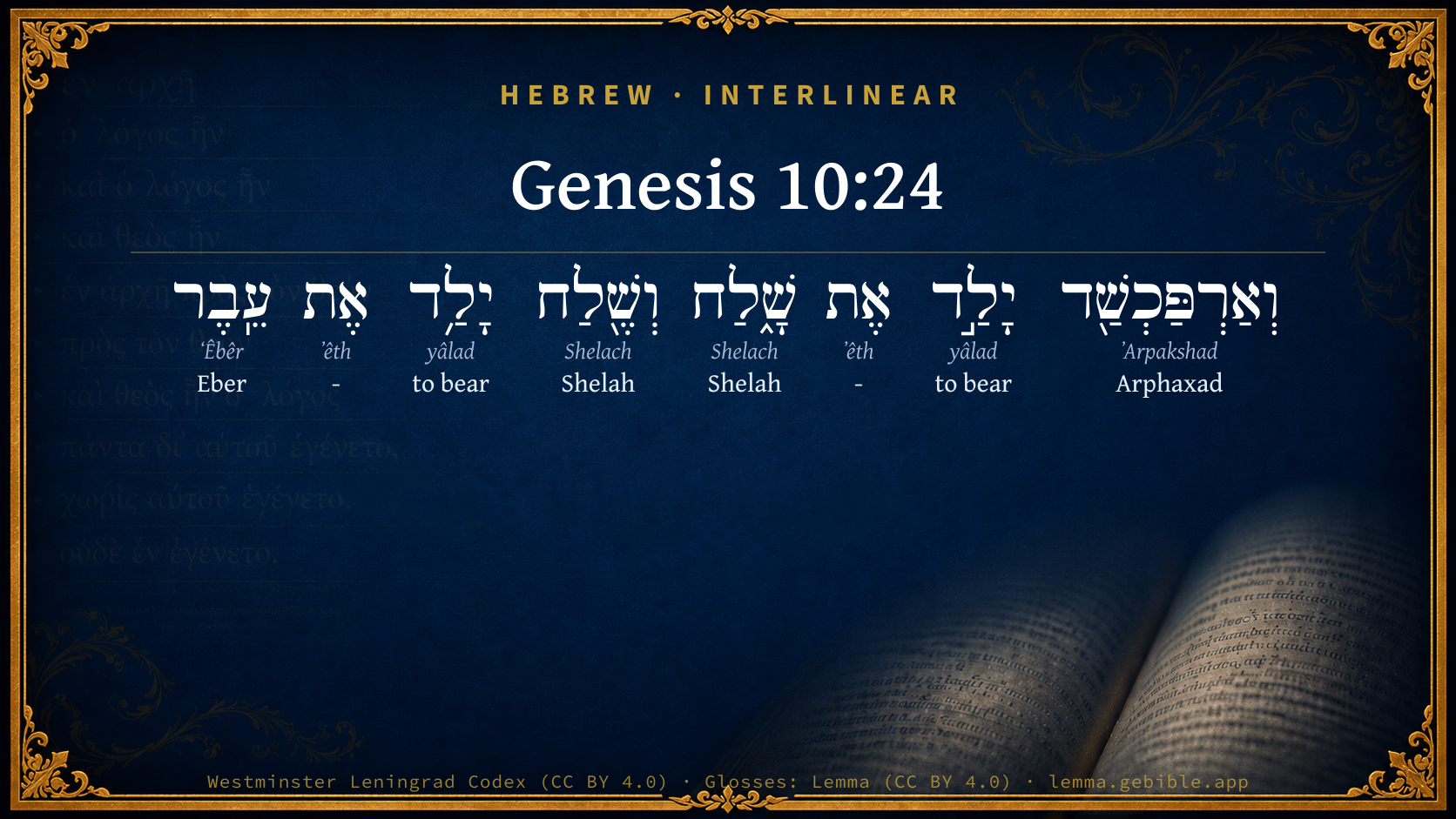
Genesis 10:24

Hebrew (Westminster Leningrad Codex) Genesis 10:24 appears in the Hebrew Old Testament. The text above is from the Westminster Leningrad Codex. Each word links to its Strong’s number, a concise gloss, and parsing drawn from the Open Scriptures Hebrew Bible morphology. Click any word for its full Brown-Driver-Briggs (BDB) entry.
Download image
Cite this verse

Genesis 10:24 (World English Bible). Public Domain. Lemma interlinear Bible study tool, https://lemma.gebible.app/v/genesis/10/24.

Show BibTeX & RIS
BibTeX
RIS
English Translation
Arpachshad became the father of Shelah. Shelah became the father of Eber.
World English Bible · Public Domain
Highlights
  • 1 first appearance in the Hebrew Bible
Full analysis ↓
Download a study sheet

One document with this verse’s original text, its word-by-word gloss line, the meaning frame, cross-references with their text, attributed commentary, and full source and license credits — printable, and it pastes into notes with its structure intact.

This verse Autodidact and up

Study sheet (.html) Plain text (.txt)

A passage Seminary Student

Up to 50 verses in one chapter. A passage sheet keeps up to 6 commentary sources and 12 cross-references per verse, in the order this page ranks them, and says so on the sheet whenever that leaves anything out. Ask for a single verse and you get the Autodidact verse sheet above.

Everything on this page stays free to read, with no account — the sheet is a download of what is already on screen, not access to it.

Want to remove ads? Support Godless Engineer
Compare translations 3

The same verse in 3 English versions, stacked beneath the original-language interlinear above. Click any original word for its lexicon entry.

Each is an independent rendering of the whole verse — the interlinear is not word-aligned to these translations.

Highlighted words mark where these versions differ — a whole-verse word diff, not a word-by-word alignment.

  • World English Bible Public Domain
    Arpachshad became the father of Shelah. Shelah became the father of Eber.
  • King James Version Public Domain
    And Arphaxad begat Salah; and Salah begat Eber.
  • unfoldingWord Literal Text CC BY-SA 4.0
    And Arpachshad fathered Shelah, then Shelah fathered Eber.

unfoldingWord Literal Text — © unfoldingWord, licensed CC BY-SA 4.0. Word-aligned USFM3 via Door43 (git.door43.org/unfoldingWord/en_ult).

Versions to compare (up to 4)

3 of 4 selected

Show all 18 translations

Every available English version of this verse, each an independent rendering of the whole verse.

  • World English Bible Public Domain
    Arpachshad became the father of Shelah. Shelah became the father of Eber.
  • Berean Standard Bible Public Domain
    Arphaxad was the father of Shelah, and Shelah was the father of Eber.
  • Majority Standard Bible Public Domain
    Arphaxad was the father of Shelah, and Shelah was the father of Eber.
  • King James Version Public Domain
    And Arphaxad begat Salah; and Salah begat Eber.
  • American Standard Version (1901) Public Domain
    And Arpachshad begat Shelah; and Shelah begat Eber.
  • Revised Version (1885) Public Domain
    And Arpachshad begat Shelah; and Shelah begat Eber.
  • Geneva Bible (1599) Public Domain
    Also Arpachshad begate Shelah, and Shelah begate Eber.
  • Douay-Rheims (1899) Public Domain
    But Arphaxad begot Sale, of whom was born Heber.
  • Young's Literal Translation Public Domain
    And Arphaxad hath begotten Salah, and Salah hath begotten Eber.
  • Literal Standard Version CC BY-SA 4.0
    And Arphaxad has begotten Salah, and Salah has begotten Eber.
  • Unlocked Literal Bible CC BY-SA 4.0
    Arphaxad became the father of Shelah, and Shelah became the father of Eber.
  • unfoldingWord Literal Text CC BY-SA 4.0
    And Arpachshad fathered Shelah, then Shelah fathered Eber.
  • Darby Bible Public Domain
    -- And Arphaxad begot Shelah; and Shelah begot Eber.
  • World Messianic Bible Public Domain
    Arpachshad became the father of Shelah. Shelah became the father of Eber.
  • Webster's Bible Public Domain
    And Arphaxad begat Salah; and Salah begat Eber.
  • Free Bible Version CC BY-SA 4.0
    Arphaxad was the father of Shelah. Shelah was the father of Eber.
  • Bible in Basic English Public Domain
    And Arpachshad became the father of Shelah; and Shelah became the father of Eber.
  • JPS Tanakh (1917) Public Domain
    And Arpachshad begot Shelah; and Shelah begot Eber.

Literal Standard Version (2020), Covenant Press — licensed CC BY-SA 4.0. Text via the HelloAO Bible API (eBible.org). Unlocked Literal Bible (unfoldingWord) — licensed CC BY-SA 4.0. Text via the HelloAO Bible API (eBible.org). unfoldingWord Literal Text — © unfoldingWord, licensed CC BY-SA 4.0. Word-aligned USFM3 via Door43 (git.door43.org/unfoldingWord/en_ult). Free Bible Version, Dr. Jonathan Gallagher — licensed CC BY-SA 4.0. Text via the HelloAO Bible API (eBible.org).

Word by word

More ways to search: Search by grammar → Find every occurrence → Compare this word →

Practice this passage: Drill this verse → Learn its vocabulary →

About this verse

These counts appear in no published source. They are computed here, from the morphology-tagged text and Lemma’s own curated glosses. What Lemma adds →

8
words
5
distinct lemmas
Pentateuch
section

Notable vocabulary

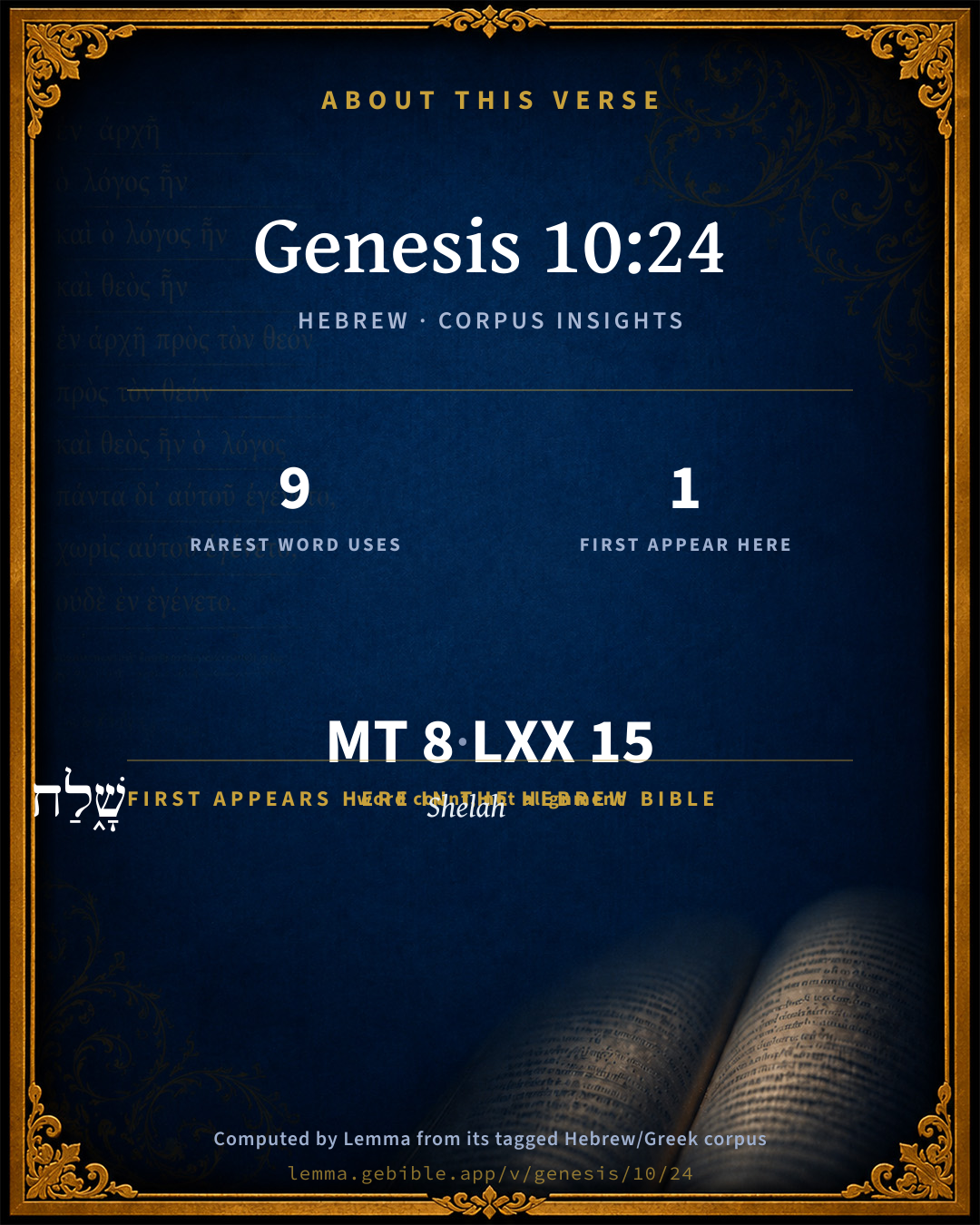
The rarest word here is וְאַרְפַּכְשַׁ֖ד Arphaxad H775 — appearing just 9 times in the whole Hebrew Bible.

First appearance in Scripture

This word makes its first canonical appearance in the Hebrew Bible here:

  • שָׁ֑לַח Shelah H7974

Shared distinctive vocabulary

וְאַרְפַּכְשַׁ֖ד Arphaxad H775 occurs in 9 verses of the Hebrew Bible. Also found in:

Grammatical profile

  • 2 verbs
  • 4 nouns
  • 2 particles

Verb forms

  • יָלַ֣ד Qal · Perfect
  • יָלַ֥ד Qal · Perfect

Repetition

Words recur within this verse — often emphatic in Hebrew:

  • יָלַ֣ד to bear H3205 ×2
  • שָׁ֑לַח Shelah H7974 ×2

Hebrew & Septuagint length

In English translation the verse runs 12 words from the Hebrew and 12 from the Septuagint (LXX English) — the same length.

A rough comparison of the two English renderings, which tokenize alike — not a word-level alignment.

Word counts can differ between the Hebrew and the Greek without any difference in meaning — e.g. the Hebrew direct-object marker אֵת has no separate Greek word, and Greek often adds the article ὁ.

In the original languages it is 8 Hebrew tokens and 15 Greek tokens — but the two are counted differently (Hebrew bundles its prefixes and suffixes into one token; the Greek is in lemma form), so that isn’t a like-for-like length.

Cross-references

2

Topical passages linked to Genesis 10:24 in the Treasury of Scripture Knowledge — connected by theme and wording, ordered by reader-vote popularity; previews shown in the World English Bible.

  • Genesis 11:12–15 Arpachshad lived thirty-five years, and became the father of Shelah.
  • Luke 3:35 the son of Serug, the son of Reu, the son of Peleg, the son of Eber, the son of Shelah

Cross-references courtesy of OpenBible.info (CC BY 4.0).

Hebrew and Greek witnesses Masoretic Hebrew ↔ Greek Septuagint

The same verse in the two great witnesses to the Old Testament, shown verse-for-verse.

These are two independent witnesses, not word-aligned to each other, and the Septuagint is shown in lemma (dictionary) form.

Hebrew Genesis 10:24 Masoretic · Westminster Leningrad Codex

וְאַרְפַּכְשַׁ֖ד יָלַ֣ד אֶת שָׁ֑לַח וְשֶׁ֖לַח יָלַ֥ד אֶת עֵֽבֶר

Arpachshad became the father of Shelah. Shelah became the father of Eber.

World English Bible · Public Domain

Greek LXX Genesis 10:24 Septuagint · lemma form

καί αρφαξαδ γεννάω ὁ καιναν καί καιναν γεννάω ὁ σαλα σαλα δέ γεννάω ὁ εβερ

And Arphaxad begot Cainan, and Cainan begot Sala. And Sala begot Heber.

LXX2012 (modern English Septuagint) · Public Domain

On this verse, Adam Clarke's Commentary discusses the Septuagint’s reading. Read the note in Commentary ↓

Hebrew: Westminster Leningrad Codex (CC BY 4.0). Greek: Septuagint (public domain); English from LXX2012 (modern English Septuagint) (Public Domain). How the Septuagint differs from the Hebrew →

Targum (Aramaic paraphrase)

2

The Targum is the ancient Jewish Aramaic paraphrase of the Hebrew Scriptures — an interpretive translation, not the Hebrew text itself. Onkelos (literal) and Pseudo-Jonathan (expansive) render the Torah, and Jonathan the Prophets. Coverage is partial: where no permissively-licensed English translation exists for a verse, only the Aramaic is shown. This is verse-level text, not a word-by-word alignment to the Hebrew.

  1. Targum Onkelos Torah (Genesis–Deuteronomy)
    וְאַרְפַּכְשַׁד אוֹלִיד יָת שָׁלַח וְשֶׁלַח אוֹלִיד יָת עֵבֶר

    And Arphaxad begat Shelach; and Shelach begat Eber.

    Targum Onkelos — Aramaic: “Onkelos Genesis” (public domain); “Onkelos Exodus” (public domain); “Onkelos Leviticus” (public domain); “Onkelos Numbers” (public domain); “Onkelos Deuteronomy” (public domain). English: “Sefaria Community Translation” (CC0 1.0 (public-domain dedication)); “J.W. Etheridge. The Targums of Onkelos and Jonathan Ben Uzziel on the Pentateuch. London: Longmans, Green, 1862” (public domain). Text via Sefaria.

  2. Targum Pseudo-Jonathan Torah (Genesis–Deuteronomy)
    וְאַרְפַּכְשַׁד אוֹלִיד יַת שֶׁלַח וְשֶׁלַח אוֹלִיד יַת עֵבֶר

    Arphakshad begat Shelach, and Shelach begat Eber.

    Targum Pseudo-Jonathan — Aramaic: “Targum Jonathan on Genesis” (public domain); “Targum Jonathan on Exodus” (public domain); “Targum Jonathan on Leviticus” (public domain); “Targum Jonathan on Numbers” (public domain); “Targum Jonathan on Deuteronomy” (public domain). English: “The Targum of Jonathan ben Uzziel, trans. J. W. Etheridge, London, 1862” (public domain). Text via Sefaria.

Commentary

Notes on Genesis 10:24 from classic Christian and Jewish commentators (each source and its license shown beneath its notes). The classic Christian expositions comment on the surrounding passage and are grouped to its opening verse, so a note may address several verses; the Jewish commentaries on the Tanakh (Rashi and others) are per-verse, so they appear only where the commentator wrote on this verse.

Lemma curates 59 commentaries, every one of them public domain or Creative Commons licensed, each selected and text-cleaned for this edition rather than reprinted as found. About our sources →

Trapp's Complete Commentary

John Trapp

Gen 10:24 And Arphaxad begat Salah; and Salah begat Eber.

Ver. 24. And Arphaxad.] Held to be the father of the Chaldees.

John Trapp, A Commentary or Exposition upon All the Books of the Old and New Testament (1647–1656) — public domain. Text from a community e-Sword module.

Tyndale Open Study Notes

Tyndale Open Resources

10:24 Shelah is unknown, but may be short for Methushelah (cp. 38:5, 11). • Eber was the ancestor of Abram the Hebrew (11:10-26); his name is at the root of the term “Hebrew” (see 14:13; 39:14; 40:15; 41:12; Exod 2:11; 3:18).

Tyndale Open Study Notes — © Tyndale Open Resources, licensed CC BY-SA 4.0. Text via the HelloAO Bible API.

Jamieson, Fausset & Brown

Robert Jamieson, A. R. Fausset & David Brown

Arphaxad--The settlement of his posterity was in the extensive valley of Shinar, on the Tigris, towards the southern extremity of Mesopotamia, including the country of Eden and the region on the east side of the river.

Jamieson, Fausset & Brown — Commentary Critical and Explanatory on the Whole Bible (1871) — public domain (CC PDM 1.0). Text via the HelloAO Bible API.

Adam Clarke's Commentary

Verse 24. Salah] The founder of the people of Susiana.

Eber.] See Ge 10:21. The Septuagint add Cainan here, with one hundred and thirty to the chronology.

Adam Clarke's Commentary on the Bible (1810–1826) — public domain. Text from a community e-Sword/MySword module.

Ellicott's Commentary for English Readers

(24) Arphaxad begat Salah.—Heb., Shelah. The rest of the chapter is devoted to giving an account of the settlements of the Joktanite Arabs, who formed only one, apparently, of the races sprung from Arphaxad, as in this table even the Hebrews are omitted, although Eber’s birth is given with the view of showing that the right of primogeniture belonged not to Joktan, but to Eber. The name Arphaxad, as we have seen (Gen_10:22), at present defies all explanation. For the rest, see the Tôldôth Shem, Gen_11:10-26.

A Bible Commentary for English Readers, edited by Charles John Ellicott (1878–1897) — public domain. Text from a community e-Sword module.

The Cambridge Bible for Schools and Colleges

gen. ed. J. J. S. Perowne

24. begat Shelah] R.V. marg. “The Sept. reads begat Cainan, and Cainan begat Shelah.” This addition is followed in Luk_3:36.

Eber] See note on Gen_10:21. Eber is evidently the most important name in this genealogy. As the grandson of Arpachshad, his name stands geographically in some kind of connexion with Elam, Asshur, Arpachshad and Aram. Êber in the Hebrew means “on the other side of.” The ancestors of Israel are described as those who “dwelt of old time beyond the River” (êber ha-nâhâr = “on the other side of the Euphrates river”). See Jos_24:2.

24–30 (J). Genealogy of Shem

A section from J, who speaks not of peoples, but of individuals of the heroic age. See Gen_11:10-19 (P) for a duplicate mention of “Arpachshad, … Peleg.”

The Cambridge Bible for Schools and Colleges (gen. ed. J. J. S. Perowne; Cambridge University Press, 1878–1918) — public domain. Text from a community e-Sword module.

John Gill's Exposition

And Arphaxad begat Salah,.... Or Shelach which signifies "a sending forth"; that is, of waters: it is part of the name of Methuselah, given him by his father, as prophetic of the flood, see Gen 5:21 and Arphaxad, who was born two years after the flood, gives this name to his first born, as commemorative of it: according to some, from him are the Susians (g); and in Susiana is found a city called Sele, by Ptolemy (h); but this seems not to be a sufficient proof:

and Salah begat Eber; from whom, Josephus (i) says, the Jews were called Hebrews from the beginning; and which, perhaps, is as good a derivation of their name as can be given, and seems to be confirmed by Num 24:24 though some derive it from Abraham's passing over the rivers in his way from Chaldea into Syria; but be it so, why might not this name be given to Eber, as prophetic of that passage, or of the passage of his posterity over the Euphrates into Canaan, as well as Eber gave to his son Peleg his name, as a prediction of the division of the earth in his time? the Septuagint version of this text inserts a Cainan between Arphaxad and Salah, but is not to be found in any Hebrew copy, nor in the Samaritan, Syriac, and Arabic versions, nor in Josephus, see Luk 3:36.

(g) Vid. Bochart. Phaleg. l. 2. c. 13. col. 92. (h) Geograph. l. 6. c. 3. (i) Ut supra. (Antiqu. l. 1. c. 6. sect. 4.)

John Gill's Exposition of the Whole Bible (1746–1763) — public domain (CC PDM 1.0). Text via the HelloAO Bible API.

Haydock's Catholic Bible Commentary

Begot Sale; either his son, or his grandson, by Cainan. See Luke iii. 36, where we shall examine this question; also chap. xi. 12. The copies of the Septuagint still extant, all assert that Cainan was the son of Arphaxad, in all the places where they are mentioned, both in Genesis and Chronicles; and though some endeavour to prove that this is an interpolation, inserted by a later hand, it is certain it was found in the Septuagint in the days of St. Luke, who confirms it by his authority, as all the copies both Greek and Latin, except a very faulty one which belonged to Beza, and is now at Cambridge, testify. Beza was so bold as to expunge the name. But before we allow of this freedom, we must be informed how St. Luke could adopt such an error, being, as he was, under the guidance of the Holy Ghost! See Salien, &c. (Haydock) --- Mariana asserts, that the Hebrew copies have been vitiated.

George Leo Haydock (1774–1849), Haydock's Catholic Family Bible and Commentary, 1859 edition — public domain. Excludes Psalms (Douay-Rheims chapter numbering differs from Protestant) and Deuterocanonical books (Catholic canon only).

Whedon's Commentary on the Bible

Daniel D. Whedon

24. The line of Arphaxad is now specially taken up, as that with which the narrative is mainly concerned. Salah, or Shelah, from שׁלח, to send forth, one sent; hence Shiloah, or Siloah, sent. Joh_9:7. Eber, or Heber, from עבר, beyond, that is, beyond the river, (Euphrates,) an emigrant. Both of these names seem to point to the migration of the Hebrew people from Aram westward. The name Hebrew, עברי, first occurs in Gen_14:13, in the phrase Abram the Hebrew, and seems to be derived from the same root, meaning “one coming from beyond,” (the river Euphrates,) that is, immigrant, pilgrim. So the Seventy understood the word, and, therefore, translated it ο περατης, one from beyond. (So Jerome, Theodotion, Chrysostom, Origen, Rosenmuller, Gesenius, Furst, Knobel.) In later years the term became narrowed to those who came from beyond the Jordan, that is, the Israelites proper, who dwelt west of the Jordan. (Furst.) The sacred historian is supposed by many to have traced the word Hebrew to the person Eber, making it a patronymic, in styling Shem the “father of all the children of Eber.” Gen_10:21. (So Gesenius.) But he calls the Hebrew people sons of Eber simply because the name Eber expresses their character; they were a pilgrim people, going forth by faith to a land that was not their own; wandering there for generations before they obtained possession, yet believing it theirs, (Heb_11:8-9,) and conquering it at last by divine help. They were owners of the land where they dwelt, not by original possession or conquest, but by faith. The word Eber expresses this distinguishing trait of the Hebrew people. Comp. Gen_12:1-2. Thus were they typical of the spiritual Israel, who are pilgrims and strangers here, but seek a heavenly country. Heb_11:13-14. This is the name by which the chosen people were designated by foreigners (see Gen_39:14; Gen_39:17, etc.) and by the Greek and Roman writers until the term Jew (from Judah) came into use. They called themselves Israelites, except when speaking of themselves to foreigners, or in contrast with foreigners. Gen_40:15; Exo_1:19; Exo_2:11; Exo_2:13. This trait made them a peculiar people.

Daniel D. Whedon (gen. ed.), Commentary on the Old and New Testaments (1874–1909) — public domain. Text from a community e-Sword module.

The Pulpit Commentary

And Arphaxad begat Salah. The nation descended from him has not been identified, though their name, Extension," may imply that they were early colonists. And Salah begat Eber. The father of the Hebrews or Emigrants (vide ver. 21).

The Pulpit Commentary (1880–1919), ed. H.D.M. Spence-Jones & Joseph S. Exell — public domain. Text from a community e-Sword module.

unfoldingWord translationNotes

Door43 World Missions Community

Arphaxad

Arphaxad was one of Shem's sons.

Peleg

Translators may add a footnote note that says: "The name Peleg means 'division.'"

the earth was divided

This can be made active. AT: "the people of the earth divided themselves" or "the people of the earth separated from one another" or "God divided the people of the earth" (See: Active or Passive)

unfoldingWord translationNotes — © Distant Shores Media and the Door43 World Missions Community, licensed CC BY-SA 4.0. Source: git.door43.org/Door43/en_tn.

Lesson kit

Teaching starters — assembled from the data on this page, not authored interpretation. Every prompt links to the verse data it draws on. Edit before teaching.

Genesis, in the Pentateuch, opens this verse with 8 words (5 distinct Hebrew lemmas). Its most distinctive word is ʼArpakshad (“Arphaxad”). A historical commentator’s framing appears above. Read the whole chapter for the surrounding context.

Discussion questions

  1. What does “Arphaxad” (ʼArpakshad) contribute to the verse as a whole?
  2. This is the first place “Shelah” appears in Scripture (first appears here). What does its debut here establish?
  3. How does Genesis 10:22, which shares the word «Arphaxad», read alongside this verse?
  4. What does the repetition of “to bear” (2× in this one verse) do in this verse?
  5. These translations render this verse differently; the difference is in the English rendering, not the original. What questions does that raise?
  6. «יָלַ֣ד» is a Qal Perfect verb. How does that grammatical form shape the action described?
  7. Compare how Trapp's Complete Commentary and Tyndale Open Study Notes read this verse. Where do they agree or differ?

Things to notice

Reading settings

Reading text

Shown beneath each verse's original-language words.

Old Testament
Old Testament edition

Read the OT as the Masoretic Hebrew (MT) or the Greek Septuagint (LXX).

English shown for the Greek Septuagint (in the Hebrew ↔ Greek comparison).

Comparing translations? Open the Compare panel on any verse page to stack up to four side by side.