Micah 4:9

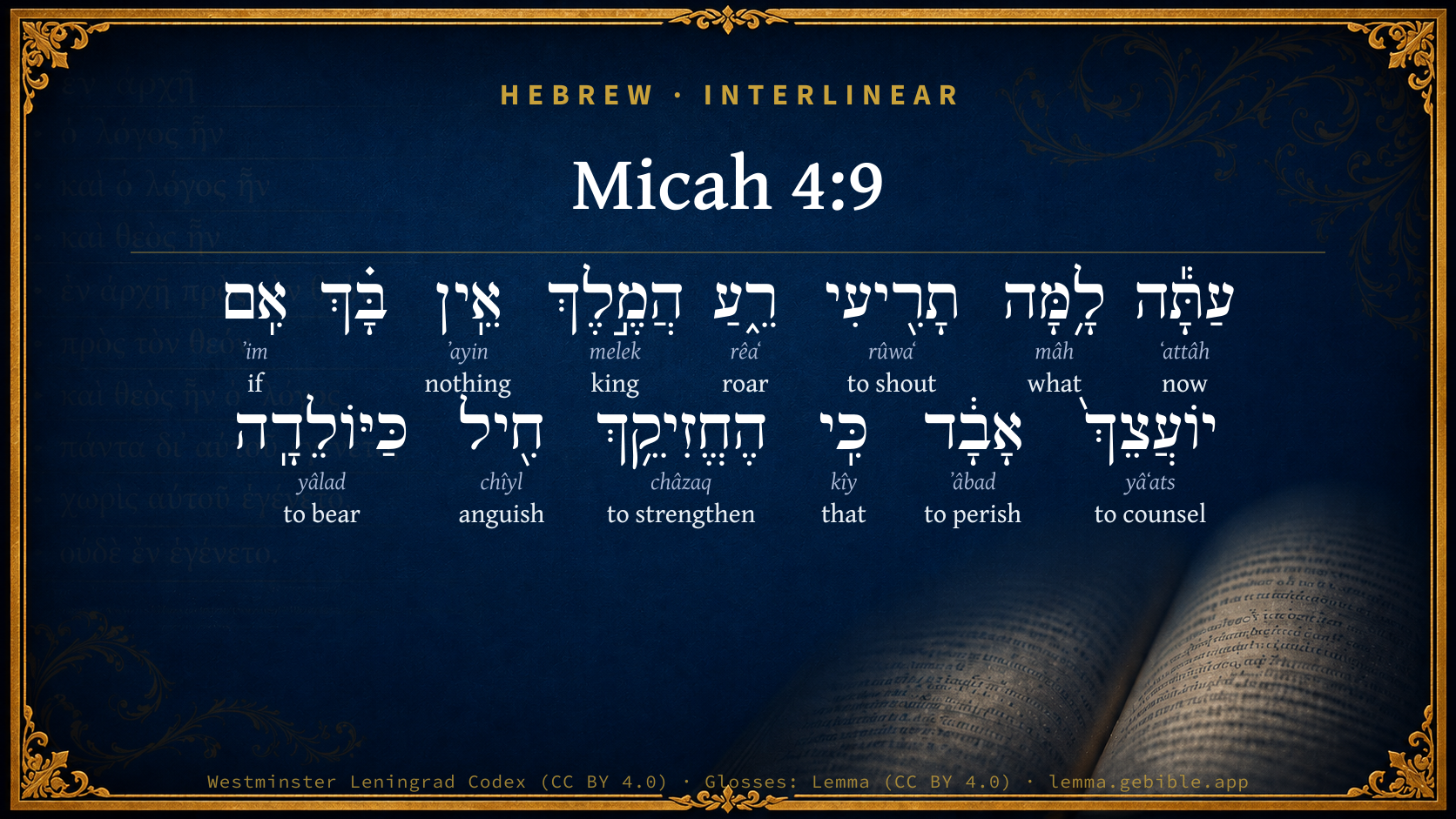
Hebrew (Westminster Leningrad Codex) Micah 4:9 appears in the Hebrew Old Testament. The text above is from the Westminster Leningrad Codex. Each word links to its Strong’s number, a concise gloss, and parsing drawn from the Open Scriptures Hebrew Bible morphology. Click any word for its full Brown-Driver-Briggs (BDB) entry.
Download image
Cite this verse

Micah 4:9 (World English Bible). Public Domain. Lemma interlinear Bible study tool, https://lemma.gebible.app/v/micah/4/9.

Show BibTeX & RIS
BibTeX
RIS
English Translation
Now why do you cry out aloud? Is there no king in you? Has your counselor perished, That pains have taken hold of you as of a woman in travail?
World English Bible · Public Domain
Download a study sheet

One document with this verse’s original text, its word-by-word gloss line, the meaning frame, cross-references with their text, attributed commentary, and full source and license credits — printable, and it pastes into notes with its structure intact.

This verse Autodidact and up

Study sheet (.html) Plain text (.txt)

A passage Seminary Student

Up to 50 verses in one chapter. A passage sheet keeps up to 6 commentary sources and 12 cross-references per verse, in the order this page ranks them, and says so on the sheet whenever that leaves anything out. Ask for a single verse and you get the Autodidact verse sheet above.

Everything on this page stays free to read, with no account — the sheet is a download of what is already on screen, not access to it.

Want to remove ads? Support Godless Engineer
Compare translations 3

The same verse in 3 English versions, stacked beneath the original-language interlinear above. Click any original word for its lexicon entry.

Each is an independent rendering of the whole verse — the interlinear is not word-aligned to these translations.

Highlighted words mark where these versions differ — a whole-verse word diff, not a word-by-word alignment.

  • World English Bible Public Domain
    Now why do you cry out aloud? Is there no king in you? Has your counselor perished, That pains have taken hold of you as of a woman in travail?
  • King James Version Public Domain
    Now why dost thou cry out aloud? is there no king in thee? is thy counsellor perished? for pangs have taken thee as a woman in travail.
  • unfoldingWord Literal Text CC BY-SA 4.0
    Now, why do you shout a shout? Is there no king among you, or has your counselor perished, that pain grips you like a woman giving birth?

unfoldingWord Literal Text — © unfoldingWord, licensed CC BY-SA 4.0. Word-aligned USFM3 via Door43 (git.door43.org/unfoldingWord/en_ult).

Versions to compare (up to 4)

3 of 4 selected

Show all 18 translations

Every available English version of this verse, each an independent rendering of the whole verse.

  • World English Bible Public Domain
    Now why do you cry out aloud? Is there no king in you? Has your counselor perished, That pains have taken hold of you as of a woman in travail?
  • Berean Standard Bible Public Domain
    Why do you now cry aloud? Is there no king among you? Has your counselor perished so that anguish grips you like a woman in labor?
  • Majority Standard Bible Public Domain
    Why do you now cry aloud? Is there no king among you? Has your counselor perished so that anguish grips you like a woman in labor?
  • King James Version Public Domain
    Now why dost thou cry out aloud? is there no king in thee? is thy counsellor perished? for pangs have taken thee as a woman in travail.
  • American Standard Version (1901) Public Domain
    Now why dost thou cry out aloud? Is there no king in thee, is thy counsellor perished, that pangs have taken hold of thee as of a woman in travail?
  • Revised Version (1885) Public Domain
    Now why dost thou cry out aloud? Is there no king in thee, is thy counsellor perished, that pangs have taken hold of thee as of a woman in travail?
  • Geneva Bible (1599) Public Domain
    Nowe why doest thou crie out with lamentation? is there no King in thee? is thy counseller perished? for sorowe hath taken thee, as a woman in trauaile.
  • Douay-Rheims (1899) Public Domain
    Now, why art thou drawn together with grief? Hast thou no king in thee, or is thy counsellor perished, because sorrow hath taken thee as a woman in labour?
  • Young's Literal Translation Public Domain
    Now, why dost thou shout aloud? A king -- is there none in thee? Hath thy counsellor perished, That taken hold of thee hath pain as a travailing woman?
  • Literal Standard Version CC BY-SA 4.0
    Now why do you shout aloud? Is there no king in you? Has your counselor perished, || That pain as of a travailing woman has taken hold of you?
  • Unlocked Literal Bible CC BY-SA 4.0
    Now, why do you shout so loudly? Is there no king among you? Has your counselor died? Is this why pain grips you like that of a woman in labor?
  • unfoldingWord Literal Text CC BY-SA 4.0
    Now, why do you shout a shout? Is there no king among you, or has your counselor perished, that pain grips you like a woman giving birth?
  • Darby Bible Public Domain
    Now why dost thou cry out aloud? Is there no king in thee? is thy counsellor perished, that pangs have seized thee as a woman in travail?
  • World Messianic Bible Public Domain
    Now why do you cry out aloud? Is there no king in you? Has your counselor perished, that pains have taken hold of you as of a woman in travail?
  • Webster's Bible Public Domain
    Now why dost thou cry aloud? is there no king in thee? hath thy counselor perished? for pangs have taken thee as a woman in travail.
  • Free Bible Version CC BY-SA 4.0
    So why are you screaming aloud? Don't you have a king? Has the king who advises you died so that pain has gripped you like a woman in childbirth?
  • Bible in Basic English Public Domain
    Now why are you crying so loudly? is there no king in you? has destruction come on your wise helper? so that pains have taken you like the pains of a woman in childbirth:
  • JPS Tanakh (1917) Public Domain
    Now why dost thou cry out aloud? Is there no King in thee, is thy Counsellor perished, that pangs have taken hold of thee as of a woman in travail?

Literal Standard Version (2020), Covenant Press — licensed CC BY-SA 4.0. Text via the HelloAO Bible API (eBible.org). Unlocked Literal Bible (unfoldingWord) — licensed CC BY-SA 4.0. Text via the HelloAO Bible API (eBible.org). unfoldingWord Literal Text — © unfoldingWord, licensed CC BY-SA 4.0. Word-aligned USFM3 via Door43 (git.door43.org/unfoldingWord/en_ult). Free Bible Version, Dr. Jonathan Gallagher — licensed CC BY-SA 4.0. Text via the HelloAO Bible API (eBible.org).

Word by word

More ways to search: Search by grammar → Find every occurrence → Compare this word →

Practice this passage: Drill this verse → Learn its vocabulary →

רֵ֑עַ
rêaʻ
H7452
“roar”
Noun, Common, Masculine, Singular, Absolute
Part of Speech
Noun
Type
Common
Gender
Masculine
Number
Singular
State
Absolute
Full BDB Definition

Origin: from H7321

TWOT: 2135a

shouting, roar - meaning dubious
  1. עַתָּ֕ה ʻattâh H6258 “now” Adverb
  2. לָ֥מָּה mâh H4100 “to/for · what” Preposition + Particle, Interrogative
  3. תָרִ֖יעִי rûwaʻ H7321 “to shout” Verb, Hiphil, Imperfect, 2nd Person, Feminine, Singular
  4. הֲמֶ֣לֶךְ melek H4428 “king” Particle, Interrogative + Noun, Common, Masculine, Singular, Absolute
  5. אֵֽין ʼayin H369 “nothing” Particle, Negative
  6. אִֽם ʼim H518 “if” Conjunction
  7. יוֹעֲצֵךְ֙ yâʻats H3289 “counseling · you” Verb, Qal, Participle Active, Masculine, Singular, Construct + Suffix, Personal, 2nd Person, Feminine, Singular
  8. אָבָ֔ד ʼâbad H6 “to perish” Verb, Qal, Perfect, 3rd Person, Masculine, Singular
  9. כִּֽי kîy H3588 “that” Conjunction
  10. הֶחֱזִיקֵ֥ךְ châzaq H2388 “to strengthen · you” Verb, Hiphil, Perfect, 3rd Person, Masculine, Singular + Suffix, Personal, 2nd Person, Feminine, Singular
  11. חִ֖יל chîyl H2427 “anguish” Noun, Common, Masculine, Singular, Absolute
  12. כַּיּוֹלֵדָֽה yâlad H3205 “like/as the · bearing” Preposition, Determined + Verb, Qal, Participle Active, Feminine, Singular, Absolute

About this verse

These counts appear in no published source. They are computed here, from the morphology-tagged text and Lemma’s own curated glosses. What Lemma adds →

14
words
13
distinct lemmas
Prophets
section

Notable vocabulary

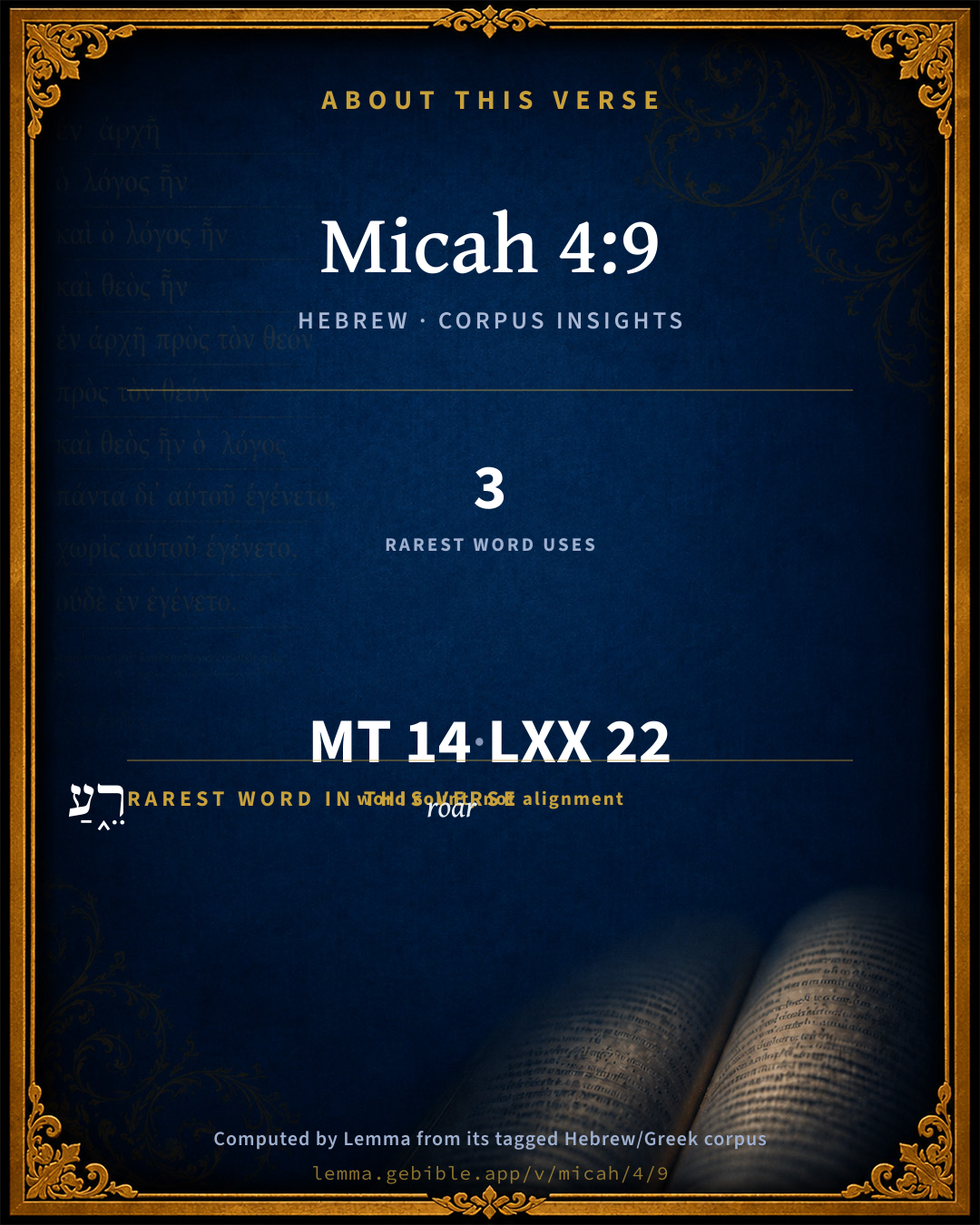
The rarest word here is רֵ֑עַ roar H7452 — appearing just 3 times in the whole Hebrew Bible.

Shared distinctive vocabulary

רֵ֑עַ roar H7452 occurs in 3 verses of the Hebrew Bible. Also found in:

Grammatical profile

  • 5 verbs
  • 3 nouns
  • 1 preposition
  • 2 conjunctions
  • 1 adverb
  • 2 particles

Verb forms

  • תָרִ֖יעִי Hiphil · Imperfect
  • יוֹעֲצֵךְ֙ Qal · Participle Active
  • אָבָ֔ד Qal · Perfect
  • הֶחֱזִיקֵ֥ךְ Hiphil · Perfect
  • כַּיּוֹלֵדָֽה Qal · Participle Active

Hebrew & Septuagint length

In English translation the verse runs 30 words from the Hebrew and 31 from the Septuagint (LXX English) — closely comparable.

A rough comparison of the two English renderings, which tokenize alike — not a word-level alignment.

Word counts can differ between the Hebrew and the Greek without any difference in meaning — e.g. the Hebrew direct-object marker אֵת has no separate Greek word, and Greek often adds the article ὁ.

In the original languages it is 14 Hebrew tokens and 22 Greek tokens — but the two are counted differently (Hebrew bundles its prefixes and suffixes into one token; the Greek is in lemma form), so that isn’t a like-for-like length.

Cross-references

13

Topical passages linked to Micah 4:9 in the Treasury of Scripture Knowledge — connected by theme and wording, ordered by reader-vote popularity; previews shown in the World English Bible.

  • Jeremiah 8:19 Behold, the voice of the cry of the daughter of my people from a land that is very far off: isn't Yahweh in Zion? Isn't her King in her? Why have they provoked me to anger with their engraved images, and with foreign vanities?
  • Isaiah 3:1–7 For, behold, the Lord, Yahweh of Hosts, takes away from Jerusalem and from Judah supply and support, The whole supply of bread, And the whole supply of water;
  • Lamentations 4:20 The breath of our nostrils, the anointed of Yahweh, was taken in their pits; Of whom we said, Under his shadow we shall live among the nations.
  • Isaiah 13:8 and they shall be dismayed; pangs and sorrows shall take hold [of them]; they shall be in pain as a woman in travail: they shall look in amazement one at another; their faces [shall be] faces of flame.
  • Isaiah 21:3 Therefore are my loins filled with anguish; pangs have taken hold on me, as the pangs of a woman in travail: I am pained so that I can't hear; I am dismayed so that I can't see.
  • Isaiah 26:17 Like as a woman with child, who draws near the time of her delivery, is in pain and cries out in her pangs; so we have been before you, Yahweh.
  • Jeremiah 4:21 How long shall I see the standard, and hear the sound of the trumpet?
  • Jeremiah 22:23 Inhabitant of Lebanon, who makes your nest in the cedars, how greatly to be pitied shall you be when pangs come on you, the pain as of a woman in travail!
  • Jeremiah 30:6–7 Ask now, and see whether a man does travail with child: why do I see every man with his hands on his loins, as a woman in travail, and all faces are turned into paleness?
  • Jeremiah 50:43 The king of Babylon has heard the news of them, and his hands wax feeble: anguish has taken hold of him, [and] pangs as of a woman in travail.
  • Hosea 3:4 For the children of Israel shall abide many days without king, and without prince, and without sacrifice, and without sacred stone, and without ephod or idols.
  • Hosea 10:3 Surely now they will say, "We have no king; for we don't fear Yahweh; And the king, what can he do for us?"
  • Hosea 13:10–11 Where is your king now, that he may save you in all your cities? And your judges, of whom you said, 'Give me a king and princes?'

Cross-references courtesy of OpenBible.info (CC BY 4.0).

Hebrew and Greek witnesses Masoretic Hebrew ↔ Greek Septuagint

The same verse in the two great witnesses to the Old Testament, shown verse-for-verse.

These are two independent witnesses, not word-aligned to each other, and the Septuagint is shown in lemma (dictionary) form.

Hebrew Micah 4:9 Masoretic · Westminster Leningrad Codex

עַתָּ֕ה לָ֥מָּה תָרִ֖יעִי רֵ֑עַ הֲמֶ֣לֶךְ אֵֽין בָּ֗ךְ אִֽם יוֹעֲצֵךְ֙ אָבָ֔ד כִּֽי הֶחֱזִיקֵ֥ךְ חִ֖יל כַּיּוֹלֵדָֽה

Now why do you cry out aloud? Is there no king in you? Has your counselor perished, That pains have taken hold of you as of a woman in travail?

World English Bible · Public Domain

Greek LXX Micah 4:9 Septuagint · lemma form

καί νῦν ἵνα τίς γιγνώσκω κακός μή βασιλεύς οὐ εἰμί σύ ἤ ὁ βουλή σύ ἀποὀλλύω ὅτι κατακρατέω σύ ὠδίν ὡς τίκτω

And now, why have you known calamities? was there not a king to you? or has your counsel perished that pangs as of a woman in travail have seized upon you?

LXX2012 (modern English Septuagint) · Public Domain

On this verse, The Pulpit Commentary discusses the Septuagint’s reading. Read the note in Commentary ↓

Hebrew: Westminster Leningrad Codex (CC BY 4.0). Greek: Septuagint (public domain); English from LXX2012 (modern English Septuagint) (Public Domain). How the Septuagint differs from the Hebrew →

Targum (Aramaic paraphrase)

1

The Targum is the ancient Jewish Aramaic paraphrase of the Hebrew Scriptures — an interpretive translation, not the Hebrew text itself. Onkelos (literal) and Pseudo-Jonathan (expansive) render the Torah, and Jonathan the Prophets. Coverage is partial: where no permissively-licensed English translation exists for a verse, only the Aramaic is shown. This is verse-level text, not a word-by-word alignment to the Hebrew.

  1. Targum Jonathan Prophets (Joshua–Malachi)
    וּכְעַן לָמָה אַתְּ מִתְחַבְּרָא לְעַמְמַיָא הֲמַלְכָּא לֵית בִּיךְ אִם מַלְכֵי מַלְכֵּךְ אֲבָדוּ אֲרֵי תִקְפוּךְ עָקָא וְזִיעַ הָא כְחֶבְלִין לְלֵידָתָא:

    (no public-domain English translation for this verse)

    Targum Jonathan — Aramaic: “Mikraot Gedolot” (public domain). English: “Sefaria Community Translation” (CC0 1.0 (public-domain dedication)); “London "Chaldee Paraphrase," 1871” (public domain). Text via Sefaria.

Commentary

Notes on Micah 4:9 from classic Christian and Jewish commentators (each source and its license shown beneath its notes). The classic Christian expositions comment on the surrounding passage and are grouped to its opening verse, so a note may address several verses; the Jewish commentaries on the Tanakh (Rashi and others) are per-verse, so they appear only where the commentator wrote on this verse.

Lemma curates 59 commentaries, every one of them public domain or Creative Commons licensed, each selected and text-cleaned for this edition rather than reprinted as found. About our sources →

Trapp's Complete Commentary

John Trapp

Mic 4:9 Now why dost thou cry out aloud? [is there] no king in thee? is thy counsellor perished? for pangs have taken thee as a woman in travail.

Ver. 9. Now why dost thou cry out aloud?] Shout and howl? q.d. hast thou any such cause to be so unreasonably and outrageously impatient, so long as Christ is thy king and counsellor? What if there now be no king in thee? what if thy counsellor perished? A woeful case, I confess, and great confusion must needs be the issue of it; as it happened in Jerusalem after Josiah was slain: confer Hos 3:4. {See Trapp on "Hos 3:4"} But yet there is hope in Israel concerning this thing; neither need the saints be so excessively dejected with outward crosses so long as Christ is with them and for them. If Seneca could say to his friend Polybius, Fas tibi non est salvo Caesare, de fortuna tua queri, Be thy case never so miserable, thou hast no cause to complain, so long as Caesar is in safety; how much less ground of mourning or murmuring have Christ’s subjects, so long as he liveth and reigneth! Gaudeo quod Christus Dominus est, alioqui totus desperassem, I rejoice because Christ est Lord, otherwise, I am in total dispair, writeth Miconius to Calvin, of the Church’s enemies: I am glad that Christ is Lord of all, for otherwise I should have had no hope of help at all. David in deep distress comforteth himself in the Lord his God, 1Sa 30:6 Psa 119:94, "I am thine, save me," saith he, q.d. my professed subjection to thee calleth for thy care and protection of me, and here he stays himself. Kings and counsellors are great stays to a state, but Christ is not tied to them. These are but particular good things, as is health against sickness, wealth against poverty, &c., but Christ is a universal good, all-sufficient and satisfactory; every way proportionable and fitting to our souls and several necessities. Why then do we cry aloud as utterly undone? why sing we not rather with David when at greatest under, "The Lord liveth, and blessed be the God of my salvation. It is God that avengeth me, and delivereth me from the violent man," Psa 18:46. He is King of all the earth. He is wonderful in counsel, and excellent in working. It was a learned man’s motto, Blessed be God, that he is God; and blessed be Christ, that he reigns for ever; that counsel is his, and sound wisdom; that he hath understanding, he hath strength, Pro 8:14.

For pangs have taken thee as a woman in travail] They have, but they needed not, hadst thou but turned into thy counting house, and considered thy manifold privileges in Christ, thy king and counsellor. We often punish ourselves by our passions, as the lion that beats himself with his own tail. Sed o bene (saith an interpreter here) quod sint hi dolores saltem similes parturientium, It is yet a happiness that the Church’s pangs, though bitter, yet are no worse than as those of a woman in travail (Tarnovius). For, 1. The pains of travail seldom bring death, but life both to mother and child; so do afflictions to the saints, 2Co 4:17 Heb 12:9. 2. Travail comes not by chance, nor for long continuance; neither doth affliction, Joh 7:30; Luk 22:53. 3. Travail is unavoidable, and must be patiently borne; so must affliction; or else we lose the fruit of it, Act 14:22 2Ti 3:12 4. Sharp though it be, yet it is short; so mourning lasteth but till morning, Psa 30:6; Psa 73:24; Psa 135:14 Joh 16:22 Jer 10:24. 5. As the travailing woman hath the help of other women; so hath the afflicted, of God, angels, and men. 6. Lastly, as she remembereth the sorrow no more for joy of a man child born into the world; so is it here, Joh 16:20 Rom 8:17-18.

John Trapp, A Commentary or Exposition upon All the Books of the Old and New Testament (1647–1656) — public domain. Text from a community e-Sword module.

The Biblical Illustrator

Joseph S. Exell

Mic_4:9-13

The Lord shall redeem thee from the hand of thine enemies

The moral regeneration of the world

I. The state of mankind requires it. Is there no king in thee? is thy counsellor perished? It was more serious for the Jewish people to be deprived of a king than for any other people, for their king was theocratic, he was supposed to be the Voice and vicegerent of God. The prophet means to say, that when the Chaldeans would come and carry them away, they would have no king and no counsellors. Now, men in an unregenerate state--

1. Have no king. A political ruler is to man, as a spiritual existent, only a king in name. He does not command the moral affections, rule the conscience, or legislate for the inner and primal springs of all activity. Such a king is the deep want of man, he wants some one to be enthroned on his heart, to whom his conscience can render homage. No man in an unregenerate state has such a king; he has gods many and lords many, of a sort, but none to rule him, and to bring all the powers of his soul into one harmonious channel of obedience.

2. Have no counsellor. Society abounds with counsellors who proffer their advice; but some of them are wicked, most of them worthless, few, if any, satisfactory, that is, to conscience. What the soul wants, is not the mere book counsellor,--though it be the Bible itself,--but the spirit of that book, the spirit of reverence, love, Christlike trust.

3. Have no ease. Pangs have taken thee as a woman in travail. The unregenerate soul is always liable to consternation, remorse, it often writhes in agony. There is no peace, saith my God, for the wicked. Now, moral regeneration brings the man a true King, a true Counsellor, a true Peace--a peace that passeth all understanding.

II. It is opposed by formidable antagonists. The nations referred to are those that composed the army of Nebuchadnezzar. What formidable opponents there are to the conversion of man!

1. The depraved elements of the soul. Unbelief, selfishness, carnality, etc.

2. The corrupt influence of society. Custom, fashion, amusements, pleasures!

III. It is guaranteed by the Word of Almighty God. The enemies of the Jews were utterly ignorant of Gods purpose to deliver His people from Babylonish Captivity.

1. Man in ignorance fights against Gods purpose.

2. Man, in fighting against Gods purpose, brings ruin on himself.

The nations thought to ruin Christianity in its infancy, but it was victorious over them! (Homilist.)

.

The Biblical Illustrator, edited by Joseph S. Exell (c. 1880s–1900s) — public domain. Text from a community e-Sword module.

Joseph Benson's Commentary

Mic 4:9-10. Now — Now I have promised such great things to you, why dost thou cry out aloud — As a woman in the anguish of her travail? Here the Jewish people are addressed, as bewailing themselves under the miseries of their captivity. Is there no king in thee? — Thou hast lost the king Zedekiah, but thy God, thy king, is with thee. Is thy counsellor perished? — Hast thou none among thy wise counsellors left? Yet the Wonderful Counsellor is with thee. Messiah, the wisdom of the Father, hath the conduct of thy sufferings, deliverance, and re-establishment. For pangs hath taken thee as a woman in travail — This may be understood of the time when Zedekiah and his counsellors were seized by the Chaldeans. Be in pain, and labour to bring forth — Be like a woman in her pangs; bow thyself down, and show all the signs of excessive pain, for there is a sufficient cause. For now shalt thou go forth out of the city, &c. — Thou shalt not only have troubles, sorrows, and dangers, in the wars against the Babylonians; but shortly thou shalt be driven out from thy city and country, and have no habitation of thy own, but be forced to dwell in a foreign land. The Jews’ captivity is expressed thus, because their city and temple being destroyed, they should live in an obscure state. The same condition is elsewhere expressed by their living in the wilderness, Eze 20:35. And thou shalt go even to Babylon; there shalt thou be delivered — Thou shalt be carried away, even as far as Babylon; but there, where, according to all human probability, and the expectations of thine enemies, thou mayest seem to be cut off from all relief, even there shalt thou be delivered: — such is the power, and lovingkindness, and faithfulness of Jehovah thy God.

Joseph Benson's Commentary on the Old and New Testaments (1811–1818) — public domain. Text from a community e-Sword module.

Whedon's Commentary on the Bible

Daniel D. Whedon

Distress and subsequent redemption, Mic_4:9-10.

The distant future, the prophet is convinced, will be all brightness and glory, but in the immediate future he can see nothing but gloom and despair. This new section opens with a vision of the agony and despair soon to be felt by the people. The prophet already beholds the destruction and hears the lamentation.

Why dost thou cry out aloud? — Addressed is the “daughter of Zion” (Mic_4:10), that is, Jerusalem and its inhabitants. The capital is filled with lamentation over the present or rapidly approaching judgment.

A woman in travail — This and similar expressions are used not infrequently in the Old Testament, as expressive of extreme pain and anguish. The questions of Mic_4:9 are meant to be more or less ironical. The prophet knows well enough the reason for the lamentation and the helplessness of king and nobles in such a crisis.

King… counselor — There is a king and there are counselors; but in the time of calamity, when they are needed the most, they can do nothing, because one greater than they has caused the distress (see on Hos_13:10).

Be in pain… — Jerusalem may well continue the lamentation, for there can be no immediate relief; and the wail is justified, because the city is desolate; homeless and without protection the inhabitants will camp in the fields, until finally they are carried away into exile. Only after these calamities have been suffered will Jehovah manifest his redemptive powers. The tertium comparationis in the picture is only the pain and anguish; there is no thought of Zion actually bringing forth a child, that is, the Messianic king.

If Mic_4:9-10 were standing by themselves their interpretation would be a very simple matter; but when they are studied with due regard for their context difficulties seem to arise. Mic_4:11-12 picture the enemy gathered around Jerusalem, determined to defile and to destroy the holy city; but the scheme will not succeed; the enemy will be “beaten to pieces,” and Jerusalem will triumph gloriously; and all this will happen without a capture of the city or an exile. Such outlook seems to be in hopeless contradiction with the statements in Mic_4:10, which imply a conquest and an exile, and promise deliverance only after the people have been deported to Babylon. To remove this difficulty the words “and shall come even unto Babylon” are commonly rejected as a later interpolation. But the omission of these words by no means removes the whole difficulty, for the fate foretold in Mic_4:10 still remains very different from that announced in Mic_4:11; in the former there is an expectation of great affliction and suffering, in the latter all is triumph and glory. A more satisfactory solution of the difficulty, and one that requires no textual changes, is to separate Mic_4:9-10 entirely from Mic_4:11 ff., and to consider the oracles as two distinct utterances coming from entirely different periods of Micah’s ministry. At one time, near the fall of Samaria, he expected that Judah, including Jerusalem, would suffer the same fate as Israel (Mic_1:8 ff.; Mic_3:12), but it is not necessary to suppose that he adhered to this view throughout his entire ministry. It is at least possible that in his later years he was influenced by the conviction of his greater contemporary Isaiah that Jerusalem was inviolable (Isa_37:33 ff.). That conviction is reflected in 11ff., verses which fit admirably in the period of Sennacherib’s invasion in 701 B.C. (compare Isaiah 36, 37); Mic_4:9-10 would reflect the earlier conviction, expressed so forcibly in chapter 1. These words, then, may have been spoken either before or, better, soon after the fall of Samaria, while that calamity was still fresh in the memory of the prophet, or, perhaps, as late as 711 B.C. (compare Isaiah 20), when Sargon sent an expedition against Philistia. The mention of Babylon does not militate against the view that Micah is the author of the words, for the reference does not imply that at the time the words were spoken, Babylon had already displaced Assyria as the great Eastern world power. Babylon is mentioned simply as a place to which the people would be deported. According to 2Ki_17:24, Sargon settled in the territory of Israel men from Babylon, and this statement is corroborated by Sargon’s own inscription (Records of the Past, 7:29). It is only natural to suppose — and this would be in perfect accord with Assyrian practice — that the depleted territory in the east was filled with exiles from the land of Israel. If this was done we can readily understand how Micah, who expected the people of the south to suffer a fate similar to that of the north, might represent the people of Jerusalem as following their brethren from Samaria to the same place of exile.

Daniel D. Whedon (gen. ed.), Commentary on the Old and New Testaments (1874–1909) — public domain. Text from a community e-Sword module.

The Preacher's Complete Homiletical Commentary

Joseph S. Exell (gen. ed.)

CRITICAL NOTES.

Mic_4:9.] Zion will lose her king, wander into captivity, but will be redeemed from her enemies. King] Loss of royal government, the cause of lamentation, more painful to Israel than other people; the king a sign of God’s presence, &c.

Mic_4:10. Pain] Fig. of a woman with child (cf. Jer_4:31). Out of the city, &c] Set forth the greatness and certainty of the calamity. There … thee] Emphatic declaration; the scene of distress, the place of deliverance.

Mic_4:11.] Distant sunlight overclouded by present cloud. Now] Nations gathered not to hear the law (Mic_4:2), but for war. Defiled] Like a virgin.

Mic_4:12. Gather them] To be punished in turn when they have answered his purpose, when fully ripe, like sheaves, lit. sheaf. However great the numbers of the foe, all are but as one sheaf ready to be threshed [Calvin].

Mic_4:13. Arise] Deu_25:4 Horn] To push the enemies (1Ki_22:11). Gain] Goods collected by robbery (Jdg_5:19). Lord] Not for Zion’s selfish ends (Isa_60:6; Isa_60:9). Whole earth] Who through subjugating the heathen has proved to be such (Psalms 93, 96).

HOMILETICS

THE SUFFERING AND TRIUMPH OF GOD’S PEOPLE.—Mic_4:9-13

Israel’s history, like human life, has its dark and its bright side. Before the glory promised is ever gained, sorrow and trial must be endured. This is—

1. A constant rule; and—

2. A necessary order in God’s discipline. But the scene of trial was to be the place of deliverance. The sufferings shall be over-ruled for the salvation of his people and the destruction of their enemies. Notice:—

I. The bitterness of the affliction. “Pangs have taken thee,” &c. Pangs with out remedy, and painful as a woman in travail.

1. The loss of kings. “Is there no king in thee?” A visible king was a protection, and a symbol of God’s presence to them. The loss was most serious and irreparable. It was a condition of helplessness and shame.

2. The loss of counsellors. “Is thy counsellor perished?” Kings and judges were their counsellors and guides; but they were bereft of wisdom to direct, left in the hands of the enemy, and governed by captive nations.

3. The loss of liberties. “Now shalt thou go forth out of the city,” which shall be captured; “dwell in the field” exposed to danger; and be carried “even to Babylon” into long captivity. This was a sad exchange of liberty and luxury for bondage and misery. But it is the picture of many a soul reduced to slavery, bereft of God and writhing in agony.

II. The comforts under the affliction. All is not lost, though they have neither king nor counsellor. God will make up for everything.

1. Affliction will end in good. “Jerusalem’s pangs are not as dying agonies, but as travailing throes, which after a while will be forgotten for joy that a child is born into the world.” Weeping may endure for a night, but joy cometh in the morning (Psa_30:6; Psa_73:24; Jer_10:24).

2. Deliverance will be granted. “There shalt thou be delivered.” There, where sorrow is greatest and hope is faintest—even in Babylon, the most unlikely place, “the Lord shall redeem thee.” The utmost degree of affliction is often the nearest to the end, and help is not in the holy city, but in the stronghold of the foe. “Man’s extremity is God’s opportunity.” The Red Sea must be the scene of triumph to Israel, and the prison the place of deliverance to Joseph and Peter. This magnifies God’s grace and power. “When the Lord turned again the captivity of Zion, we were like them that dream.”

3. Enemies will be subdued. “Thou shalt beat in pieces many people.” In their weakness, God will be their strength, and make them victorious over confederate nations. Their horns shall be iron, to push their enemies; and their hoofs brass, to tread them down. The destruction is universal and complete. All enemies shall be put under their feet, as conquered foes, or willing subjects. “Fear not, thou worm Jacob. Behold, I will make thee a new sharp threshing instrument, having teeth: thou shalt thresh the mountains and beat them small, and shalt make the hills as chaff” (Isa_41:13-15).

III. The spirit in which they should bear the affliction. If such be their prospects in the trial, how should they demean themselves?

1. They should cherish a patient spirit. “Why dost thou cry out aloud?” Calm fear and hush grief; though affliction be grievous at present, it shall afterward yield the fruits of joy and peace. Patience defeats the menace of the foe, but passion takes his part

“Patience doth conquer by out-suffering all” [Peel].

2. They should cherish a submissive spirit. “Be in pain,” &c. Grieve, but remember excessive grief, fretfulness, and rebellion, are unreasonable. Resistance is folly, submission is triumph.

“By not opposing, thou dost ills destroy,

And wear thy conquered sorrows into joy” [Young].

3. They should cherish a spirit of hope. What a bright prospect opens up before them! Why doubt or despair? God will accomplish his word. Hope will sweeten trial, and, like the sun, paint the rainbow on the clouds. “Black though our side of the canvas be,” said Sir Harry Vane, in going to be executed, “the Divine hand paints a beautiful picture on the unseen side.”

THE DESTRUCTION OF ZION’S FOES.—Mic_4:11-13

Those who exult in Israel’s fall, and seek to defile and outrage her, will be disappointed. Inscrutable wisdom will correct the children with the foe, and then destroy the foe with the children.

I. They are frustrated in their design. “Let her be defiled,” &c.

1. They sought her injury. They desired to defile her with blood, and condemn her in guilt. The wicked delight in the fall and inconsistencies of God’s people. They often become tempters, then accusers; “first desecrators, then sanctimonious justiciaries,” says one.

2. They feasted their eyes on her misery. “Let our eye look upon Zion.” The world always hates the Church and rejoices in its sorrow. Edom delighted in the chastisement of Israel (Oba_1:12); and the sufferings of the martyrs were a spectacle to the heathen. Malice is blind to all virtue, and eyes can always see what hearts can wish. “Yea, they opened their mouth wide against me, and said, Aha, aha, our eye hath seen it.”

II. They are crushed in their efforts. “Many nations are gathered against thee.” The powers of earth and hell are sometimes arrayed against the Church, but all in vain. They are against God when against his people. They may have wickedness to imagine, craft to devise, but are not able to perform (Psalms 21). God knows their thoughts, but they cannot defeat his purpose. Pharaoh’s counsel to extinguish issued in the increase of the chosen people. The wisdom, power, and counsel of man signify nothing, if they oppose the decrees of God. “He taketh the wise in their craftiness.” Learn—

1. The folly of designing against God.

2. The security of obedience to God.

III. They are ruined in their numbers. “Many nations” combined against Zion. The armies of Babylon, with their subject nations, the forces of Edom, Ammon, Moab, and others, who exulted in Judah’s fall, were types of the anti-Christian powers of the latter days. Neither numbers nor craft avail before God. They only ripen themselves for God to “gather them as the sheaves into the floor.”

HOMILETIC HINTS AND OUTLINES

Mic_4:9-10. I. The moral condition of men. Kingless and restless, in captivity and misery. Unable to cope with sin, evil habits, and the world. Without the privileges of that city, whose builder and maker is God; exposed to danger, tumult, and the distractions of life. II. The purpose of God concerning men. To redeem, to govern, to guide, and to exalt above all misery and opposition. He will shortly bruise Satan under their feet, and every power of body and mind shall be consecrated to him.

Mic_4:11-12. The enemies of Zion.

1. Their number.

2. Their purpose,—to defile and rejoice.

3. Their spirit—proud and determined.

4. Their helplessness. “They know not the thoughts of God.”

5. Their ruin. “He shall gather them,” &c. God’s people begin, and he will finish, the work.

Gather them as sheaves. Persecutors.

1. Ripened by their own conduct.

2. Gathered by the providence of God.

3. Threshed by the judgments of God. “This prophecy received a primary and partial fulfilment in the victories of the Maccabees (1Ma_5:1). But its adequate accomplishment is in Christ. It is to be applied to the work of the apostles, and apostolic men, missionaries of Christ, who are compared by St. Paul to oxen treading out the corn (1Co_9:9; 1Ti_5:18; cf. Isa_32:20). Their work is indeed one of bringing the nations into subjection (2Co_2:14; 2Co_10:5; Eph_6:12); but it is in subjection to the law of love, in order that the good grain winnowed from the sheaves on the floor may be gathered into the garner of heaven” (cf. Psa_149:8) [Wordsworth].

Mic_4:13. The very image of the threshing implies that this is no mere destruction. While the stubble is beaten or bruised to small pieces, and the chaff is far more than the wheat, and is carried out of the floor, there yet remains the seed-corn. So in the great judgments of God, while most is refuse, there yet remains over what is severed from the lost heap, and wholly consecrated to him [Pusey].

The Lord of the whole earth.

1. God the supreme ruler of the world. Not merely the God of Israel, but ruler “of the whole earth.”

2. All things governed in the interests of the Church. The nations subject to Zion, not for selfish aggrandisement, but for her good and his glory (Isa_60:6; Isa_60:9; Isa_23:18).

3. The glory of victory should be given to God. All gains of merchandise, all achievements of intellect, all success of spiritual efforts, spring from him, and should be consecrated to him. Holiness to the Lord should be written on all things we do.

Mic_4:9-13. Of the struggles of God’s congregation. They must be maintained:

1. Under heavy sorrow, in secure expectation of their final redemption (Mic_4:9-10).

2. Under the mighty assaults of the foe, in sure confidence that the Lord sits upon the throne (Mic_4:11-12).

3. In constant self-examination. For although the victory must certainly be given to God’s cause (Mic_4:13), nevertheless, until Christ is born in the congregation (and in each individual, Mic_4:1), the result of every contest is deserved disaster and disgrace (Mic_4:13) [Lange].

The whole chapter sets forth—

1. The glory;

2. The peace;

3. The dominion; and,

4. The victory of the Church.

ILLUSTRATIONS TO CHAPTER 4

Mic_4:1-2. Last days. God’s promises are dated, but with a mysterious character; and for want of skill in God’s chronology, we are prone to think God forgets us, when, indeed, we forget ourselves in being so bold to set God a time of our own, and in being angry that he comes not just then to us [Gurnall].

Mic_4:3. War. There must be peace when the art of war is laid by as useless, and shall be learned no more. That will be a blessed time, indeed, when the art military shall be out of date, and (being itself the greatest interrupter of learning) shall be learned no more. When soldiers shall turn husbandmen and vine-dressers. When a man casts away his sword we may well conclude he intends to be quiet. Thus the Lord gives quiet to nations which have been engaged in war, by causing wars to cease [Caryl].

Mic_4:4. Peace of country life.

“In all things grew his wisdom and his wealth,

And folk beholding the fair state and health

Wherein his land was, said that now at last

A fragment of the Golden Age was cast

Over the place, for there was no debate,

And men forgot the very name of hate.” [Wm. Morris.]

Mic_4:6-8. As the pleasures of the future will be spiritual and pure, the object of a good and wise man in this transitory state of existence should be to fit himself for a better, by controlling the unworthy propensities of his nature and improving all his better aspirations; to do his duty, first to God, then to his neighbour; to promote the happiness and welfare of those who are in any degree dependent upon him, or whom he has the means of assisting; never wantonly to injure the meanest thing that lives; to encourage, as far as he can, whatever is useful and tends to refine and exalt humanity; to store his mind with such knowledge as it is fitted to receive, and he is able to attain; and so to employ the talents committed to his care that, when the account is required, he may hope to have his stewardship approved [Southey].

Mic_4:9. King.

“Kings are like stars—they rise and set—they have

The worship of the world, but no repose.” [Shelley.]

Mic_4:8-10. The kingdom shall come. Observe, it is a kingdom that is to come to us; we are not to go to it. Also, it is not to be a kingdom of the dead, but of the living. Also, it is not to come all at once, but quietly; nobody knows how. “The kingdom cometh not with observation” [Ruskin].

Mic_4:10-11. It belongs, in truth, to the Church of God to suffer blows, not to strike them. But at the same time let it be remembered that the Church is an anvil which has worn out many a hammer [Beza].

Mic_4:12. Thoughts of the Lord. To those, the eyes of whose understandings are enlightened, and the avenues of their hearts opened to discern and adore the perfections of God, how manifold are the instances which occur of the providence of God interfering to direct the course of human events towards a salutary end; to make afflictions of men the by-path to enjoyment; out of evils, temporal and transitory, to produce substantial and permanent good [Bp. Mant].

Mic_4:13. Hope doth three things: it assures good things to come; it disposes us for them; it waits for them unto the end, each of which will be of singular use to fit us for pious sufferings [Polhill].

Arise. When God has conquering work for his people to do, he will furnish them with strength and ability for it; will make the horn iron and the hoofs brass: and, when he does so, they must exert the power he gives them, and execute the commission; even the daughter of Zion must arise and thresh [Matt. Henry].

The Preacher's Complete Homiletical Commentary (gen. ed. Joseph S. Exell; Funk & Wagnalls, c. 1892) — public domain (pre-1929). A full-Bible homiletical/sermon-outline anthology covering 65 of 66 books (2 John is absent from the source module). Text from a community e-Sword module.

Keil & Delitzsch

C. F. Keil & F. Delitzsch

But before this takes place, the daughter Zion will lose her king, and wander into captivity to Babylon; but there she will be redeemed by the Lord out of the power of her enemies. Mic 4:9. "Now why dost thou cry a cry? Is there no king in thee, or is thy counsellor perished, that pangs have seized thee like the woman in labour? Mic 4:10. Writhe and break forth, O daughter Zion, like a woman in labour! For how wilt thou go out of the city and dwell in the field, and come to Babel? there wilt thou be rescued; there will Jehovah redeem thee out of the hand of thine enemies." From this glorious future the prophet now turns his eye to the immediate future, to proclaim to the people what will precede this glorification, viz., first of all, the loss of the royal government, and the deportation of the people to Babylon. If Micah, after announcing the devastation of Zion in Mic 3:12, has offered to the faithful a firm ground of hope in the approaching calamities, by pointing to the highest glory as awaiting it in the future, he now guards against the abuse which might be made of this view by the careless body of the people, who might either fancy that the threat of punishment was not meant so seriously after all, or that the time of adversity would very speedily give place to a much more glorious state of prosperity, by depicting the grievous times that are still before them. Beholding in spirit the approaching time of distress as already present, he hears a loud cry, like that of a woman in labour, and inquires the cause of this lamentation, and whether it refers to the loss of her king. The words are addressed to the daughter Zion, and the meaning of the rhetorical question is simply this: Zion will lose her king, and be thrown into the deepest mourning in consequence. The loss of the king was a much more painful thing for Israel than for any other nation, because such glorious promises were attached to the throne, the king being the visible representative of the grace of God, and his removal a sign of the wrath of God and of the abolition of all the blessings of salvation which were promised to the nation in his person. Compare Lam 4:20, where Israel calls the king its vital breath (Hengstenberg). יועץ (counsellor) is also the king; and this epithet simply gives prominence to that which the Davidic king had been to Zion (cf. Isa 9:5, where the Messiah is designated as "Counsellor" par excellence). But Zion must experience this pain: writhe and break forth. Gōchı̄ is strengthened by chūlı̄, and is used intransitively, to break forth, describing the pain connected with the birth as being as it were a bursting of the whole nature (cf. Jer 4:31). It is not used transitively in the sense of "drive forth," as Hitzig and others suppose; for the determination that Jerusalem would submit, and the people be carried away, could not properly be represented as a birth or as a reorganization of things. With the words כּי עתּה וגו the prophet leaves the figure, and predicts in literal terms the catastrophe awaiting the nation. עתּה (now), repeated from Lam 4:9, is the ideal present, which the prophet sees in spirit, but which is in reality the near or more remote future. קריה, without an article, is a kind of proper name, like urbs for Rome (Caspari). In order to set forth the certainty of the threatened judgment, and at the same time the greatness of the calamity in the most impressive manner, Micah fills up the details of the drama: viz., going out of the city, dwelling in the field, without shelter, delivered up to all the chances of weather, and coming to Babel, carried thither without delay. Going out of the city presupposes the conquest of the city by the enemy; since going out to surrender themselves to the enemy (Kg2 24:12; Sa1 11:3) does not fit in with the prophetic description, which is not a historical description in detail. Nevertheless Israel shall not perish. There (shâm, i.e., even in Babel) will the Lord its God deliver it out of the hand of its foes.

The prediction that the daughter Zion, i.e., the nation of Israel which was governed from Zion, and had its centre in Zion - the covenant nation which, since the destruction of the kingdom of the ten tribes, existed in Judah only - should be carried away to Babylon, and that at a time when Assyria was in the field as the chief enemy of Israel and the representative of the imperial power, goes so far beyond the bounds of the political horizon of Micah's time, that it cannot be accounted for from any natural presentiment. It is true that it has an analogon in Isa 34:6-7, where Isaiah predicts to king Hezekiah in the most literal terms the carrying away of all his treasures, and of his sons (descendants), to Babylon. At the same time, this analogy is not sufficient to explain the prediction before us; for Isaiah's prophecy was uttered during the period immediately following the destruction of the Assyrian forces in front of Jerusalem and the arrival of Babylonian ambassadors in Jerusalem, and had a point of connection in these events, which indicated the destruction of the Assyrian empire and the rise of Babylon in its stead, at all events in the germ; whereas no such connecting link exists in the case of Micah's prophecy, which was unquestionably uttered before these events. It has therefore been thought, that in Mic 3:12 Micah predicts the destruction of Jerusalem, and here in Mic 4:10 the carrying away of Judah to Babylon by the Assyrians; and this opinion, that Micah expected the judgment upon Jerusalem and Judah to be executed by the Assyrians, and not by the Babylonians, has been supported partly by such passages as Mic 5:4-5, and Jer 26:18-19, and partly by the circumstance that Micah threatens his own corrupt contemporaries with the judgment which he predicts on account of their sins; whereas in his time the Assyrians were the only possible executors of a judgment upon Israel who were then standing on the stage of history (Caspari). But these arguments are not decisive. All that can be inferred from Mic 5:4-5, where Asshur is mentioned as the representative of all the enemies of Israel, and of the power of the world in its hostility to the people of God in the Messianic times, is that at the time of Micah the imperial power in its hostility to the kingdom of God was represented by Assyria; but it by no means follows that Assyria would always remain the imperial power, so that it could only be from her that Micah could expect the destruction of Jerusalem, and the carrying away of Judah to Babylon. Again, Jer 26:18, Jer 26:19 - where the chief men of Judah, in order to defend the prophet Jeremiah, quote Micah's prophecy, with the remark that king Hezekiah did not put him to death in consequence, but feared the Lord and besought His face, so that the Lord repented of the evil which He had spoken concerning Jerusalem - simply proves that these chief men referred Micah's words to the Assyrians, and attributed the non-fulfilment of the threatened judgment by the Assyrians to Hezekiah's penitence and prayer, and that this was favoured by the circumstance that the Lord answered the prayer of the king, by assuring him that the Assyrian army should be destroyed (Isa 37:21.). But whether the opinion of these chief men as to the meaning and fulfilment of Micah's prophecy (Mic 3:12) was the correct one or not, cannot be decided from the passage quoted. Its correctness is apparently favoured, indeed, by the circumstance that Micah threatened the people of his own time with the judgment (for your sakes shall Zion be ploughed into a field, etc.). Now, if he had been speaking of a judgment upon Judah through the medium of the Babylonians, "he would (so Caspari thinks) not only have threatened his contemporaries with a judgment which could not fall upon them, since it was not possible till after their time, inasmuch as the Assyrians were on the stage in his day; but he would also have been most incomprehensibly silent as to the approaching Assyrian judgment, of which Isaiah spoke again and again." This argument falls to the ground with the untenable assumptions upon which it is founded. Micah neither mentions the Assyrians nor the Babylonians as executing the judgment, nor does he say a word concerning the time when the predicted devastation or destruction of Jerusalem will occur. In the expression בּגללכם, for your sakes (Mic 3:12), it is by no means affirmed that it will take place in his time through the medium of the Assyrians. The persons addressed are the scandalous leaders of the house of Israel, i.e., of the covenant nation, and primarily those living in his own time, though by no means those only, but all who share their character and ungodliness, so that the words apply to succeeding generations quite as much as to his contemporaries. The only thing that would warrant our restricting the prophecy to Micah's own times, would be a precise definition by Micah himself of the period when Jerusalem would be destroyed, or his expressly distinguishing his own contemporaries from their sons and descendants. But as he has done neither the one nor the other, it cannot be said that, inasmuch as the destruction of Jerusalem and the carrying away of the people was not effected by the Assyrians, but by the Babylonians (Chaldaeans), he would have been altogether silent as to the approaching Assyrian judgment, and only threatened them with the Chaldaean catastrophe, which did not take place till a long time afterwards. His words refer to all the judgments, which took place from his own time onwards till the utter destruction of Jerusalem and the carrying away of the people to Babylon by Nebuchadnezzar. The one-sided reference of the prophecy to the Assyrians is simply based upon an incorrect idea of the nature of prophecy, and its relation to the fulfilment, and involves the prophet Micah in an irreconcilable discrepancy between himself and his contemporary the prophet Isaiah, who does indeed predict the severe oppression of Judah by the Assyrians, but at the same time foretels the failure of the plans of these foes to the people of Jehovah, and the total destruction of their army.

This contradiction, with the consequence to which it would inevitably lead, - namely, that if one of the prophets predicted the destruction of Jerusalem by the Assyrians, whereas the other prophesied that it would not be destroyed by them, the two contemporary prophets would necessarily lead the people astray, and render both the truth of their contradictory utterances and their own divine mission doubtful, - cannot be removed by the assumption that Isaiah uttered the prophecies in ch. 28-32 at a somewhat later period, after Micah had published his book, and the terribly severe words of Micah in Mic 3:12 had produced repentance. For Isaiah had predicted that the Assyrian would not conquer Jerusalem, but that his army would be destroyed under its walls, not only in Isaiah 28-32, at the time when the Assyrians are approaching with threatening aspect under Shalmaneser or Sennacherib, but much earlier than that, - namely, in the time of Ahaz, in Isaiah 10:5-12:6. Moreover, in Isaiah 28-32 there is not a single trace that Micah's terrible threatening had produced such repentance, that the Lord was able to withdraw His threat in consequence, and predict through Isaiah the rescue of Jerusalem from the Assyrian. On the contrary, Isaiah scourges the evil judges and false prophets quite as severely in Isa 28:7. and Isa 29:9-12 as Micah does in Mic 3:1-3 and Mic 3:5-8. And lastly, although the distinction between conditional prophecies and those uttered unconditionally is, generally speaking, correct enough, and is placed beyond all doubt by Jer 18:7-10; there is nothing in the addresses and threatenings of the two prophets to indicate that Micah uttered his threats conditionally, i.e., in case there should be no repentance, whereas Isaiah uttered his unconditionally. Moreover, such an explanation is proved to be untenable by the fact, that in Micah the threat of the destruction of Jerusalem and of the desolation of the temple mountain (Mic 3:12) stands in the closest connection with the promise, that at the end of the days the mountain of God's house will be exalted above all mountains, and Jehovah reign on Zion as king for ever (Mic 4:1-3 and Mic 7:1). If this threat were only conditional, the promise would also have only a conditional validity; and the final glorification of the kingdom of God would be dependent upon the penitence of the great mass of the people of Israel, - a view which is diametrically opposed to the real nature of the prophecies of both, yea, of all the prophets. The only difference between Isaiah and Micah in this respect consists in the fact that Isaiah, in his elaborate addresses, brings out more distinctly the attitude of the imperial power of Assyria towards the kingdom of God in Israel, and predicts not only that Israel will be hard pressed by the Assyrians, but also that the latter will not overcome the people of God, but will be wrecked upon the foundation-stone laid by Jehovah in Zion; whereas Micah simply threatens the sinners with judgment, and after the judgment predicts the glorification of Zion in grand general terms, without entering more minutely into the attitude of the Assyrians towards Israel.

In the main, however, Micah goes hand in hand with his contemporary Isaiah. In Isa 32:14, Isaiah also foretels the devastation, or rather the destruction, of Jerusalem, notwithstanding the fact that he has more than once announced the deliverance of the city of God from Asshur, and that without getting into contradiction with himself. For this double announcement may be very simply explained from the fact that the judgments which Israel had yet to endure, and the period of glory to follow, lay, like a long, deep diorama, before the prophet's mental eye; and that in his threatenings he plunged sometimes more, sometimes less, deeply into those judgments which lay in perspective before him (see Delitzsch on Isaiah, at Isa 32:20). The same thing applies to Micah, who goes to a great depth both in his threats and promises, not only predicting the judgment in all its extremity, - namely, the utter destruction of Jerusalem, and the carrying away of the people to Babel, - but also the salvation in its ultimate perfection, viz., the glorification of Zion. We must therefore not restrict his threats in Mic 3:12 and Mic 4:10 even to the Chaldaean catastrophe, nor the promise of Israel's deliverance in Babel out of the hands of its foes to the liberation of the Jews from Babylon, which was effected by Cyrus, and their return to Palestine under Zerubbabel and Ezra; but must also extend the threat of punishment to the destruction of Jerusalem by the Romans and the attendant dispersion of the Jews over all the world, and the redemption out of Babel promised in Mic 4:10 to that deliverance of Israel which, in the main, is in the future still. These two judgments and these two deliverances are comprehended in an undivided unity in the words of the prophet, Babel being regarded not only in its historical character, but also in its typical significance, as the beginning and the hearth of the kingdom of the world. Babel has this double significance in the Scriptures from the very commencement. Even the building of the city with a tower intended to reach to heaven was a work of human pride, and an ungodly display of power (Gen 11:4.); and after its erection Babel was made by Nimrod the beginning of the empire of the world (Gen 10:10). It was from these two facts that Babel became the type of the imperial power, and not because the division of the human race into nations with different languages, and their dispersion over the whole earth, had their origin there (see A. ch. Lmmert, Babel, das Thier und der falsche Prophet. Goth. 1862, p. 36ff.); and it is in this typical significance of Babel that we have to seek not only for the reason for the divine purpose to banish the people of God to Babel, when they were given up to the power of the kingdom of the world, but also for a point of connection for the prophetic announcement when this purpose had been communicated to the prophet's mind. Micah accordingly predicts the carrying away of the daughter Zion to Babel, and her deliverance there out of the power of her enemies, not because Babel along with Nineveh was the metropolis of the world-empire of his time, or a chief city of that empire, but because Babel, from its very origin, was a type and symbol of the imperial power. That the words of Micah, in their deepest sense, should be so interpreted, is not only warranted, but necessitated, by the announcement which follows in Mic 4:11-13 of the victorious conflict of Zion with many nations, which points far beyond the conflicts of the Jews in the times succeeding the captivity.

Keil & Delitzsch — Biblical Commentary on the Old Testament (1861–1891) — public domain (CC PDM 1.0). Text via the HelloAO Bible API. (Old Testament only.)

Tyndale Open Study Notes

Tyndale Open Resources

4:9 Israel’s king and wise people were supposed to provide leadership and embody the Lord’s instructions and covenant in their lives (Deut 17:18-20). Now, however, the people would be without godly leadership (cp. Judg 17:6; 18:1; 21:25).

Tyndale Open Study Notes — © Tyndale Open Resources, licensed CC BY-SA 4.0. Text via the HelloAO Bible API.

Geneva Bible (1599)

Geneva Bible translators

In the mean season he showeth that they should endure great troubles and temptations when thy saw themselves neither to have king nor counsel.

Geneva Bible (1599) marginal notes — public domain. Text via Bolls.life.

Jamieson, Fausset & Brown

Robert Jamieson, A. R. Fausset & David Brown

Addressed to the daughter of Zion, in her consternation at the approach of the Chaldeans.

is there no king in thee?--asked tauntingly. There is a king in her; but it is the same as if there were none, so helpless to devise means of escape are he and his counsellors [MAURER]. Or, Zion's pains are because her king is taken away from her (Jer 52:9; Lam 4:20; Eze 12:13) [CALVIN]. The former is perhaps the preferable view (compare Jer 49:7). The latter, however, describes better Zion's kingless state during her present long dispersion (Hos 3:4-5).

Jamieson, Fausset & Brown — Commentary Critical and Explanatory on the Whole Bible (1871) — public domain (CC PDM 1.0). Text via the HelloAO Bible API.

Adam Clarke's Commentary

Verse 9. Is there no King in thee?] None. And why? Because thou hast rejected Jehovah thy king.

Is thy counsellor perished?] No: but thou hast rejected the words and advices of the prophets.

Pangs have taken thee] He is speaking of the desolations that should take place when the Chaldeans should come against the city; and hence he says, "Thou shalt go to Babylon;" ye shall be cast out of your own land, and sent slaves to a foreign country, He represents the people under the notion of a woman in travail.

Adam Clarke's Commentary on the Bible (1810–1826) — public domain. Text from a community e-Sword/MySword module.

John Calvin's Commentaries

The Prophet blends here things in their nature wholly contrary, — that the Jews were for a time to be cut off, — and that afterwards they were to recover their former state. Why, he says, dost thou cry out with crying? We must notice the Prophet’s design. He did not intend to overturn what he had before stated; but as the minds of the godly might have fainted amidst so many changes, the Prophet here gives them support, that they might continue firm in their faith; and hence he says, Why dost thou cry aloud with loud crying? That is, “I see that grievous troubles will arise capable of shaking even the stoutest hearts: time will be changeable; it will often be, that the faithful will be disturbed and degraded; but though various tumults may arise, and tempests throw all things into confusion, yet God will redeem his people.” We now then see what the Prophet means by saying, Why dost thou now cry? Why dost thou make an uproar? for the verb here properly means, not only to cry out, but also to sound the trumpet; as though he said, Why do the Jews so much torment themselves? There is he says, no doubt, a good reason.

And he adds, Is there no king among thee? This was doubtless the reason why the Jews so much harassed themselves; it was, because God had deprived them of their kingdom and of counsel: and we know what Jeremiah has said, ‘Christ,’ that is, the anointed of the Lord, ‘by whose life we breathe, is slain,’ (Lamentations 4:20.) Since, then, the whole Church derived as it were its life from the safety of its king, the faithful could not be otherwise than filled with amazement when the kingdom was upset and abolished; for the hope of salvation was taken away Is there, then, not a king among thee? and have thy counselors perished? Some think that the unfaithfulness of the people is here indirectly reproved, because they thought themselves to be destitute of the help of God and of his Christ, as though he said, — “Have ye forgotten what God has promised to you, that he would be your king for ever, and would send the Messiah to rule over you? nay, has he not promised that the kingdom of David would be perpetual? Whence then, is this fear and trembling, as though God no longer reigned in the midst of you, and the throne of David were hopelessly overturned?” These interpreters, in confirmation of this opinion, say, that Christ is here distinguished by the same title as in Isaiah 9:7; where he is called יועף, ivots, a counselor. But as in this verse, it is the Prophet’s design to terrify, and to reprove rather than to alleviate the grievousness of evils by consolation; it is more probable, that their own destitution is set before the people; as though Micah said, “What cause have you for trembling? Is it because your king and all his counselors have been taken away?” But what immediately follows proves that this sorrow arose from a just cause; it was because they were stripped of all those things which had been till that time the evidences of God’s favor.

John Calvin's Commentaries (1540-1563) — public domain. Text from the Calvin Translation Society English edition (1840s-50s) via the Christian Classics Ethereal Library (ccel.org). Calvin's coverage is partial (roughly two-thirds of the Bible); uncommented books and verses are honest gaps, never fabricated. The 19th-century editor's footnotes and remarks are omitted so the notes are faithfully Calvin's own voice.

Ellicott's Commentary for English Readers

(9) Now why dost thou cry out aloud?—The prophet places again, side by side with his vision of returned glory, the circumstances of misery which will intervene. The king and the counsellors of Jerusalem will be powerless to help in the moment of emergency.

A Bible Commentary for English Readers, edited by Charles John Ellicott (1878–1897) — public domain. Text from a community e-Sword module.

The Cambridge Bible for Schools and Colleges

gen. ed. J. J. S. Perowne

9. Now why dost thou cry out aloud?] The prophet from his watch-tower beholds the capture of Jerusalem, and hears the lamentation of its inhabitants (comp. Isa_10:30). Absorbed in high visions of the future, he deprecates this unmanly despair. True, all is lost, for the present; but they may carry with them into exile a consoling promise of deliverance.

Is there no king in thee?] Is it because thy king has been carried captive? Comp. Hos_13:10, ‘Where then is thy king that he may save thee?’

thy counseller] A synonym for ‘thy king.’ The root of mélech (king) in Aramaic means ‘to counsel.’ The Messiah is called ‘Wonderful counsellor’ in Isa_9:6.

The Cambridge Bible for Schools and Colleges (gen. ed. J. J. S. Perowne; Cambridge University Press, 1878–1918) — public domain. Text from a community e-Sword module.

John Gill's Exposition

Now why dost thou cry out aloud?.... Or "cry a cry" (w); a vehement one, or set up a most lamentable cry, as if no help or hope were to be had, but as in the most desperate condition: here the prophet represents the Jews as if they were already in captivity, and in the utmost distress, and as they certainly would be; and yet had no reason to despair of deliverance and salvation, since the Messiah would certainly come to them, and his kingdom would be set up among them, The word used has sometimes the notion of friendship and association; hence the Targum renders it,

"now why art thou joined to the people?''

and so Jarchi,

"thou hast no need to seek friends and lovers, the kings of Egypt and Assyria, for help.''

And which sense of the word as approved by Gussetius (x).

Is there no king in thee? is thy counsellor perished? he it so that they were; as was the case when Zedekiah was taken and carried captive, and his princes, nobles, and counsellors killed; yet God, their King and Counsellor, was with them, to keep and preserve them, counsel, instruct, and comfort them, and at last to deliver and save them; and the King Messiah would be raised up, and sent unto them in due time, who is the Wonderful Counsellor Isaiah had prophesied of:

for pangs have taken thee as a worn an in travail; which is often expressive of great sufferings and sorrows; and yet, as the pangs of a woman in travail do not continue always, but have an end, so would theirs, and therefore there was no reason for despair; and as, when she brings forth her issue, her sorrow is turned into joy, this would be their case.

(w) "quid vociferabis vociferationem", Pagninus, Montanus. So Vatablus, Drusius. (x) Ebr. Comment. p. 789.

John Gill's Exposition of the Whole Bible (1746–1763) — public domain (CC PDM 1.0). Text via the HelloAO Bible API.

Albert Barnes' Notes on the Bible

Now - The prophet places himself in the midst of their deepest sorrows, and out of them he promises comfort. “Why dost thou cry out aloud? is there no King in thee? is thy Counsellor perished?” . Is then all lost, because thou hast no visible king, none to counsel thee or consult for thee? . Very remarkably he speaks of their “King and Counsellor” as one, as if to say, “When all beside is gone, there is One who abides. Though thou be a captive, God will not forsake thee. When thou hadst no earthly king, “the Lord thy God was thy King” 1Sa 12:12. He is the First, and He is the Last. When thou shalt have no other, He, thy King, ceaseth not to be.” Montanus: “Thou shouldest not fear, so long as He, who counselleth for thee, liveth; but He liveth forever.” Thy “Counsellor,” He, who is called “Counsellor” Isa 9:6, who counselleth for thee, who counselleth thee, will, if thou obey His counsel, make birth-pangs to end in joy.

For pangs have taken thee, as a woman in travail - Resistless, remediless, doubling the whole frame, redoubled until the end, for which God sends them, is accomplished, and then ceasing in joy. The truest comfort, amid all sorrow, is in owning that the travail-pains must be, but that the reward shall be afterward. Montanus: “It is meet to look for deliverance from God’s mercy, as certainly as for punishment from our guilt; and that the more, since He who foretold both, willingly saves, punishes unwillingly.” So the prophets adds.

Albert Barnes' Notes on the Bible (1834–1885) — public domain. Text from a community e-Sword/MySword module.

Haydock's Catholic Bible Commentary

No king, after Sedecias was taken. (Calmet) --- The two tribes shall be led into captivity and released, v. 12. (Worthington)

George Leo Haydock (1774–1849), Haydock's Catholic Family Bible and Commentary, 1859 edition — public domain. Excludes Psalms (Douay-Rheims chapter numbering differs from Protestant) and Deuterocanonical books (Catholic canon only).

Matthew Poole's English Annotations

Now; now that I have from the Lord promised such great good things to you, after the seventy years’ captivity, and in the days of the Messiah,

why dost thou cry out aloud? as if this case were desperate, or as if it would be ever night with thee, or as if thy hopes would not outweigh thy fears, or thy future joy would not counterbalance thy present griefs.

Is there no king in thee? thou hast lost thy king Zedekiah, and now art become tributary, but thy God, thy King, is with thee. and will be with thee to preserve, restore, establish, enlarge, enrich, and beautify thee with salvation, and to reign over thee in Mount Zion for ever, Mic 4:7. Thy loss at present is great, but thy future advantage may well stop these outcries.

Is thy counsellor perished? hast thou none among thy wise counsellors left in thee? Hath Nebuchadnezzar cruelly slain all he took of them, and are the rest fled? Yet the wonderful Counsellor is with thee, doth consult and resolve that thou shalt not be undone, and perish for ever. Messiah, the wisdom of his Father, hath the conduct of thy sufferings, deliverance, and re-establishment, in which thou mayst at last glory.

For pangs have taken thee as a woman in travail: this great distress of spirit appears by thy outcries, like those of a woman in travail; of which no great reason can be given, all things considered, no more than of those of a woman at her full time, and bringing forth the fruit of her womb, to the present increase and future honour of the family; whose pains end in joy, Joh 16:21.

Matthew Poole's English Annotations on the Holy Bible (1683–1685) — public domain. Text from a community e-Sword/MySword module.

The Pulpit Commentary

Before this glorious revival the prophet foresees calamity and exile in the nearer future; yet he bids the people not to despair. Why dost thou cry out aloud? The prophet hears the cry of Zion, and asks the cause. Septuagint, Inat egnwv kaka ; "Why knowest thou evils?" from a variation in reading. Is there no king in thee? Hast thou lost thy king? Is this the reason of thy sorrow? The allusion is to the captivity of Jehoiachin and Zedekiah. (2Ki 24 2Ki 25) The loss of the king, the representative of the help and favour of God, was a token of the withdrawal of the Divine protection. (comp. Lam_4:20 Hos_13:10) Thy counsellor. A synonym for "king." Cheyne notes that the root of melech ("king") in Aramaic means "to counsel." In Isa_9:6 Messiah is Called"counsellor." The Septuagint, treating the word as a collective, renders, h boulh sou , "thy counsel." Pangs, etc. The comparison of sorrow of heart to the anguish of labour pains is very common. (comp. Isa_13:8 Jer_6:24 Jer_6:3 Hos_13:13)

Vers. 9-13; ch. Mic_5:1) Whatever view may be taken as to the true application of these verses, it is very clear that they refer to deep sorrow, through which the nation must pass before the manifestation of the true spiritual King whose coming is so clearly indicated in the chapter following. Captivity must be experienced; conflict must be engaged in with "many nations;" loss of rulers and leaders must be sustained; war and siege must be felt. Yet all these should prove but preparatory to the experience of joy and victory; they should be but as the pangs preceding birth; out of and following these throes there should come the establishment of a kingdom which should never be moved, and which their material kingdom, now being so shaken, even in its most prosperous and peaceful days only faintly symbolized. And this is ever the Divine order of procedure. It is the all-wise appointment of God that his servants should pass through trial and be made perfect through suffering. He takes the seed and plants it in rough soil, and as the result he causes to arise beauteous flowers. The tear often precedes the smile. The thick cloud gathers over our heads, and lo! afterwards the triumphant arch spans the sky, telling of the Divine faithfulness and love. We must suffer would we ultimately reign; we must bear the cross would we wear the crown. God"s servants are soldiers, and the soldier must "endure hardness", (2Ti_2:3) "and engage in sharp conflict ere he reaps the warrior"s reward. His followers are trees of righteousness, and God prunes his trees that they may bring forth much fruit". (Joh_15:2)

II STIMULATING THOUGHTS AMIDST THESE DARKER EXPERIENCES OF LIFE. Several such thoughts are suggested here.

1. There"s a needs be" for these sorrows. (Ver. 10) It is here declared that there was a necessity for the sorrows here predicted. The trials are referred to as experiences that must be, and that could not be avoided. The travail must be endured, the captivity must be experienced, the discipline must be passed through. The nation had woefully transgressed, and only thus could it be purged and purified. As the crushing of the seed results in a more abundant increase, so the oppression of God"s servants should result in the upspringing of "the peaceable fruits of righteousness." "Of sorrow, sanctity is born." Here is one solution of "the mystery of suffering." It is designed to work purification; it is a healthful discipline. It is not that our Father-God is wanting in sympathy that we have to pass through adverse scenes, but because his sympathy is so large and so perfect that it extends to the whole of our being. When he says, "Be in pain," etc. (ver. 10), it is not that he does not feel with us, but rather because his sympathy is so large that he deigns to lift us up to a higher level, and to lead us to attain unto a purer and more perfect character and life; and hence, whilst "he will not break the bruised reed, nor quench the smoking flax," he will also "send forth judgment unto victory". (Isa_42:2, Isa_42:3)

2. There is an overruling Providence. (Vers. 11, 12) In these verses the heathen nations are represented as encouraging each other to make a decisive onslaught, upon the favoured people, and as speaking as though, their plans, could very easily be executed, the overthrow of Judah be effected, and they gaze with satisfaction upon the downfall and desolation (ver. 11). But there was a higher than any mere human power swaying the destinies of the peoples of the earth. The Lord God omnipotent was reigning. He had his purposes and plans of which, the nations took no account, but which nevertheless were to be developed. And in the unfolding of these all the dark designs of the evil would be overruled, and whilst the nation of his choice should. thus be tried as by fire, and so have its dross consumes, they who, prompted by their own mercenary and ambitious ends, assaulted it, should be brought to utter confusion and shame (ver. 13). The world still abounds in evil doers who am pursuing their own ends, and that they may gain these are ever planning and contriving harm; but it may well comfort and strengthen our hearts, amidst the anxiety and distress such occasion, that there is still an overruling Providence guiding human affairs, and that under God"s all-wise and loving direction good only shall eventually come to the good, whilst the counsel of the wicked shall perish, and the arm of their power be broken.

3. There is the Divine abiding presence. This is implied in ver. 9. The prophet, abounding in deepest sympathy with his people in their calamities, would, nevertheless, have them feel that they were not left utterly destitute; that, though earthly rulers had failed them, there was One who ever abides, and who, if they but trusted him, would bear them safely through all. He who had been the King and Guide of their nation before earthly monarch had ever been appointed over it (1Sa_12:12) would not forsake them now that human supports had given way, but would make their present sorrows to end in higher joy than they had formerly experienced. (Hos_13:9, Hos_13:14) Nor need we fear in the time of trouble, so long as it remaineth that "the Lord of hosts is with us," etc. (Psa_46:7)

4. There is ultimate deliverance. (Ver. 10) The Lord would assuredly "turn again the captivity of Zion". (Psa_126:1-6) Through fire and through water they should be brought out into a wealthy place. (Psa_116:12) Weeping might endure for a night, but joy should come in the morning. (Psa_30:5) And so with his servants in every age. The way he would have us take, despite all its difficulties and discouragements, shall bring us at length to the palace and to our crown.

Vers. 9, 10. Discipline and deliverance.

A glorious future has been held up to the view of the Jewish nation (vers. 6-8). It is like the ideals of peace and blessedness presented to all in the Word of God; like the visions of the heavenly glory set before even the most ungodly. Such promises are attractive; even the godless Jews in Micah"s time would exult in the thought of "the former dominion," the days of David and Solomon returning to Zion. But the vision again changes. Cries of pain and distress are heard. There passes before the prophet"s mind a view of the discipline and chastisement which must fall on the disobedient nation before the promised blessings can be enjoyed.

I THE SALUTARY DISCIPLINE. In brief, vivid words a succession of calamities is sketched.

1. Their monarchy is overthrown. "Is there no king in thee?" Jehoahaz, Jehoiakim, Jehoiachin, and Zedekiah in succession were dethroned by foreign conquerors, and carried into exile. Many national premises and blessings were bound up with the name and family of David, (2Sa 7) so that the loss of their king was no ordinary loss. He was their chief stay and "counsellor", (cf. Isa_9:6) "the breath of their nostrils". (Lam_4:20) No wonder their consternation and distress: "pangs," etc.. (cf. Psa_89:38-51) Thus one step in Divine discipline then and now may be the striking down to the ground of the chief objects of our confidence, the earthly props which we seek to substitute for God.

2. They are humiliated before their foes. They "go forth out of the city;" some in a vain attempt to escape, like Zedekiah and his troops; (2Ki_25:4-6) others as prisoners of war from a city which has capitulated and is being sacked by its conquerors. Illustrate from Lam_5:1-16. They are driven forth into "the field;" without shelter even from the elements unless in tents; (contrast their former "ease in Zion," Amo_6:1-7, etc.) without the protection of the old towers and bulwarks in which they had prided themselves; (Psa_48:12, Psa_48:13) without weapons or leaders, and thus exposed to any indignities that these conquerors choose to inflict upon them. Thus may it be with those whose way God "turneth upside down," stripping them of all their old sources of security money, position, friends; turning them out of the "nest" in which they expected peacefully to spend the remainder of their days. Illustrate from contrasts in Job 29 and Job 30.

3. They are carried captive even to Babylon. " Babel in early days had been a symbol of a godless world power. It does not rise again on the Hebrew horizon till the days of Isaiah and Micah. Making friendly overtures to Hezekiah, it is presented to his view, by his faithful seer, as a distant, mysterious, hut formidable foe of the futureignotum pro mirifico. (Isa 39) As the ten tribes had been carried captive to Halah and Habor and adjacent districts, so should Judah be taken even to Babylon. " Thus is it in God"s discipline with his prodigals now. They may find themselves in "a far country," brought down to the lowest depth of humiliation, shut out from all earthly help, shut up to God. And even now, in the midst of the pleasures of sin, prophetic voices within may warn them: "Thou shalt go forth... thou shalt go even to ." The dreadful possibilities of judgment, whether in this world or another, may at times mar their peace. For, unlike the servants of God, they dare not say, "Things to come... are ours.

4. In the house of bondage pangs of sorrow must be borne. "Seventy years! a long lifetime of captivity. "Tribulation ten days!" a time of discipline indefinite to us, though fixed by the counsel of God. Those pangs will be "resistless, remediless, doubling the whole frame, redoubled till the end for which God sends them is accomplished, and then ceasing in joy" (Pusey). For the very term "daughter of Zion" suggests hope. It is a term of friendliness, like "Father of spirits", (Heb_12:9) which reminds us of the essential relations between us and our God, and gives us a pledge that in wrath he will remember mercy. (cf. Isa_57:16)

II "THE END OF THE LORD." Then and there the end for which the trials are sent will be reached, and deliverance will come. As with their king Manasseh, so shall it be with the nation. In their affliction they will seek the Lord. (Jer_29:10-13)

1. They shall be delivered. Set free from the burden of their sins, a burden too grievous to be borne; purged from idolatry; blessed with a revival of religion, as shown by a renewed regard to God"s Law through the gracious work of his own "free Spirit". (Eze_36:16-27)

2. They shall be redeemed from the hand of their enemies. God will visit them as their Goel, their Kinsman-Redeemer, who has not forgotten or forsaken them. (Jer_30:8-11) By the manifestation of his righteous grace and irresistible power they shall be "redeemed without money", (Isa_52:3) restored to their land and to the enjoyment of ancient privileges. Such is "the end of the Lord" in the discipline of life. The revelation of the Fatherhood of God in the Person of Christ and in his sacrificial death for the redemption of sinners assures us that he chastens "for our profit, that we may be partakers of his holiness." But it is only by sitting at his feet and learning of him, and thus being "exercised" by our trials, that we can hope to win from them "the peaceable fruit of righteousness". E.S.P. (Heb_12:9-11)

Vers. 9-13. The moral regeneration of the world.

"Now why dost thou cry out aloud? is there no king in thee? is thy counsellor perished? for pangs have taken thee as a woman in travail. Be in pain, and labour to bring forth, O daughter of Zion," etc. The prophet here, without doubt, refers to the carrying away of the Jews to Babylon. He refers to the consternation in which the Jews would be placed on the approach of the Chaldean army, The questions relative to a "king" and a "counsellor" (ver. 9) are, it is thought, put forth in bitter irony, in order to provoke an answer. "Is there no king in thee? is thy counsellor perished?" The answer, perhaps, would be, "Yes, we have a king, and we have counsellors, but they are utterly worthless; they have power neither to protect us from the terrible calamities nor to invent means for our escape." The metaphor of the parturient woman seems intended to shadow forth the agony of their consternation at the idea of going forth from the city of Jerusalem, being located in the open country, and afterwards conveyed to Babylon. After this comes the promise of emancipation. "There the Lord shall redeem thee from the hand of thine enemies." Their restoration is metaphorically represented by a travailing woman. Whilst it is unfair to attach to Scripture a wrong interpretation, it is perfectly fair to use its passages as symbols of truths applicable to man in all ages and all lands. These words may serve to illustrate, therefore, some points in relation to the moral regeneration of the world.

I THE STATE OF MANKIND REQUIRES IT. "Is there no king in thee? is thy counsellor perished?" It was more serious for the Jewish people to be deprived of a king than for any other people, for their king was theocratic; he was supposed to be the voice and vicegerent of God. The prophet means to say that when the Chaldeans would come and carry them away, they would have no king and no counsellors. Now, men in an unregenerate state:

1. Have no king. A political ruler is to man, as a spiritual energy, only a king in name. He does not command the moral affections, rule the conscience, or legislate for the inner and primal springs of all activity. Such a king is the deep want of man; he wants some one to be enthroned on his heart, to whom his conscience can render homage. No man in an unregenerate state has such a king; he has gods many and lords many, of a sort, but none to rule him, and to bring all the powers of his soul into one harmonious channel of obedience.

2. Have no counsellor. Society abounds with counsellors who proffer their advice; but some of them are wicked, most of them worthless, few, if any, satisfactory, that is, to conscience. What the soul wants is not the mere book counsellor though it be the Bible itself but the spirit of that book, the spirit of reverence, love, Christ-like trust. Such a spirit, when it comes to us, will guide us into all truth; it is the "unction from the Holy One.

3. Have no ease. "Pangs have taken thee as a woman in travail." The unregenerate soul is always liable to consternation, remorse; it often writhes in agony. "There is no peace, saith my God, to the wicked." Now, moral regeneration brings the man a true King, a true Counsellor, a true Peace a peace "that passeth all understanding.

II IT IS OPPOSED BY FORMIDABLE ANTAGONISTS. "Many nations are gathered against thee." The nations here referred to are those that composed the army of Nebuchadnezzar, or those that joined it in the attack against the Jews. What formidable opponents there are to the conversion of man!

1. The depraved elements of the soul. Unbelief, selfishness, carnality, etc. These are Canaanites that battle mightily against the moral Joshua.

2. The corrupt influence of society. How much, in this country and this age especially, is there struggling against man"s regeneration custom, fashion, amusements, pleasures! And then, too, acting through all these forces within and without, there are the principalities and powers of darkness; so that it comes to pass that it is no very easy thing to effect the regeneration of men; there are nations of moral forces battling against it.

III IT IS GUARANTEED BY THE WORD OF ALMIGHTY GOD. "They know not the thoughts of the Lord," etc. The enemies of the Jews were utterly ignorant of God"s purpose to deliver his people from Babylonish captivity. "They had not the most distant idea that the object of Jehovah, in permitting his people to be so treated, was to recover them from idolatry, and thus prepare them for a triumphant restoration. The metaphor taken from the process of threshing out grain is frequently used by the prophets to denote the complete destruction of a people.

1. Man in ignorance fights against Gods purpose. The Chaldeans and all the enemies of the Jews did so now. Men are always doing this. "Had they known it, they would not have crucified the Lord of glory.

2. Man, in fighting against Gods purpose, brings ruin on himself. It is here predicted that the enemies of the Jews should be as "sheaves," and that the Jews themselves should be strengthened. "I will make thine horn iron, and I will make thy hoofs brass." "When God," says an old writer, "has conquering work for his people to do, he will furnish them with strength and ability for it will make the horn iron and the hoofs brass; and when he does so, they must exert the power he gives them, and execute the commission: even the daughter of Zion may arise and thresh." The nations thought to ruin Christianity in its infancy, but it was victorious over them. Those who persisted in their enmity were broken to pieces, (Mat_21:44) particularly the Jewish nation; but multitudes by Divine grace were joined to the Church, and they and their substance were consecrated to the Lord Jesus, the Lord of the whole earth. D.T.

The Pulpit Commentary (1880–1919), ed. H.D.M. Spence-Jones & Joseph S. Exell — public domain. Text from a community e-Sword module.

John Wesley's Explanatory Notes

Now - Now I have promised such great things to you. No king - Thou hast lost thy king Zedekiah, but thy God, thy king is with thee. Thy counsellor - Hast thou none among thy wise counsellors left? Yet the Wonderful Counsellor is with thee. Messiah, the wisdom of his father, hath the conduct of thy sufferings, deliverance and re-establishment.

John Wesley, Explanatory Notes Upon the Whole Bible (1754–1765) — public domain. Text via the GEBible commentary corpus.

unfoldingWord translationNotes

Door43 World Missions Community

Now, why do you shout so loudly?

Micah is mocking the people, trying to make them think about why God is dealing with them in this way. This question can be translated as a statement. AT: "Look at how you are shouting loudly." or "Think carefully about why you are shouting loudly." (See: Rhetorical Question)

Is there no king among you? Has your counselor died? Is this why pain grips you like that of a woman in labor?

Micah continues to mock the people. These questions can be translated as statements. AT: "You have a king, but he is useless to you. All your wise people are still alive, but they have nothing wise to say to you. This is why you are weeping loudly like a woman who is giving birth to a baby." (See: Rhetorical Question and Simile)

Be in pain ... like a woman in labor

Micah compares the suffering the people will experience when enemies force them away from their cities to the pain a woman experiences when giving birth to a baby. (See: Simile)

There you will be rescued. There Yahweh will rescue you

Yahweh says the same thing in both active and passive forms to emphasize that he will do what he has said he will do. This can be translated in active form. AT: "There Yahweh will rescue you. There he will rescue you" (See: Active or Passive)

the hand of your enemies

Possible meanings for the word "hand" are 1) it could be a metonym for the power that the hand exercises, AT: "the power of your enemies" or 2) it could be a synecdoche for the person. AT: "your enemies" (See: Metonymy and Synecdoche)

translationWords

king

advice

labor pains

Zion

Babylon

Yahweh

hand

adversary

unfoldingWord translationNotes — © Distant Shores Media and the Door43 World Missions Community, licensed CC BY-SA 4.0. Source: git.door43.org/Door43/en_tn.

Rashi

Rabbi Shlomo Yitzchaki (Rashi)

Now that you rebel against Me.

why do you seek friends? Heb. תָרִיעִי רֵעַ, lit. befriend a friend. Put to your heart: why do you need to seek friends and beloved ones, the kings of Egypt and the kings of Assyria, for aid?

Rashi on the Tanakh — English translations: “The Judaica Press complete Tanach with Rashi, translated by A. J. Rosenberg” (CC BY 4.0); “Pentateuch with Rashi's commentary by M. Rosenbaum and A.M. Silbermann, 1929-1934” (public domain); “The Metsudah Tanach series, Lakewood, N.J” (CC BY 4.0); and “The Book of Joshua, Metsudah Publications, 1997” (CC BY 4.0). Text via Sefaria.

Lesson kit

Teaching starters — assembled from the data on this page, not authored interpretation. Every prompt links to the verse data it draws on. Edit before teaching.

Micah, in the Prophets, opens this verse with 14 words (13 distinct Hebrew lemmas). Its most distinctive word is rêaʻ (“roar”). A historical commentator’s framing appears above. Read the whole chapter for the surrounding context.

Discussion questions

  1. What does “roar” (rêaʻ) contribute to the verse as a whole?
  2. How does Exodus 32:17, which shares the word «roar», read alongside this verse?
  3. The translations on this page render this verse differently — a whole-verse word diff, not a word-by-word alignment. What might account for the different wordings?
  4. «תָרִ֖יעִי» is a Hiphil Imperfect verb. How does that grammatical form shape the action described?
  5. Compare how Trapp's Complete Commentary and The Biblical Illustrator read this verse. Where do they agree or differ?

Things to notice

Reading settings

Reading text

Shown beneath each verse's original-language words.

Old Testament
Old Testament edition

Read the OT as the Masoretic Hebrew (MT) or the Greek Septuagint (LXX).

English shown for the Greek Septuagint (in the Hebrew ↔ Greek comparison).

Comparing translations? Open the Compare panel on any verse page to stack up to four side by side.